Core Principles
of Programming
with python
Week 2
Logical Operators
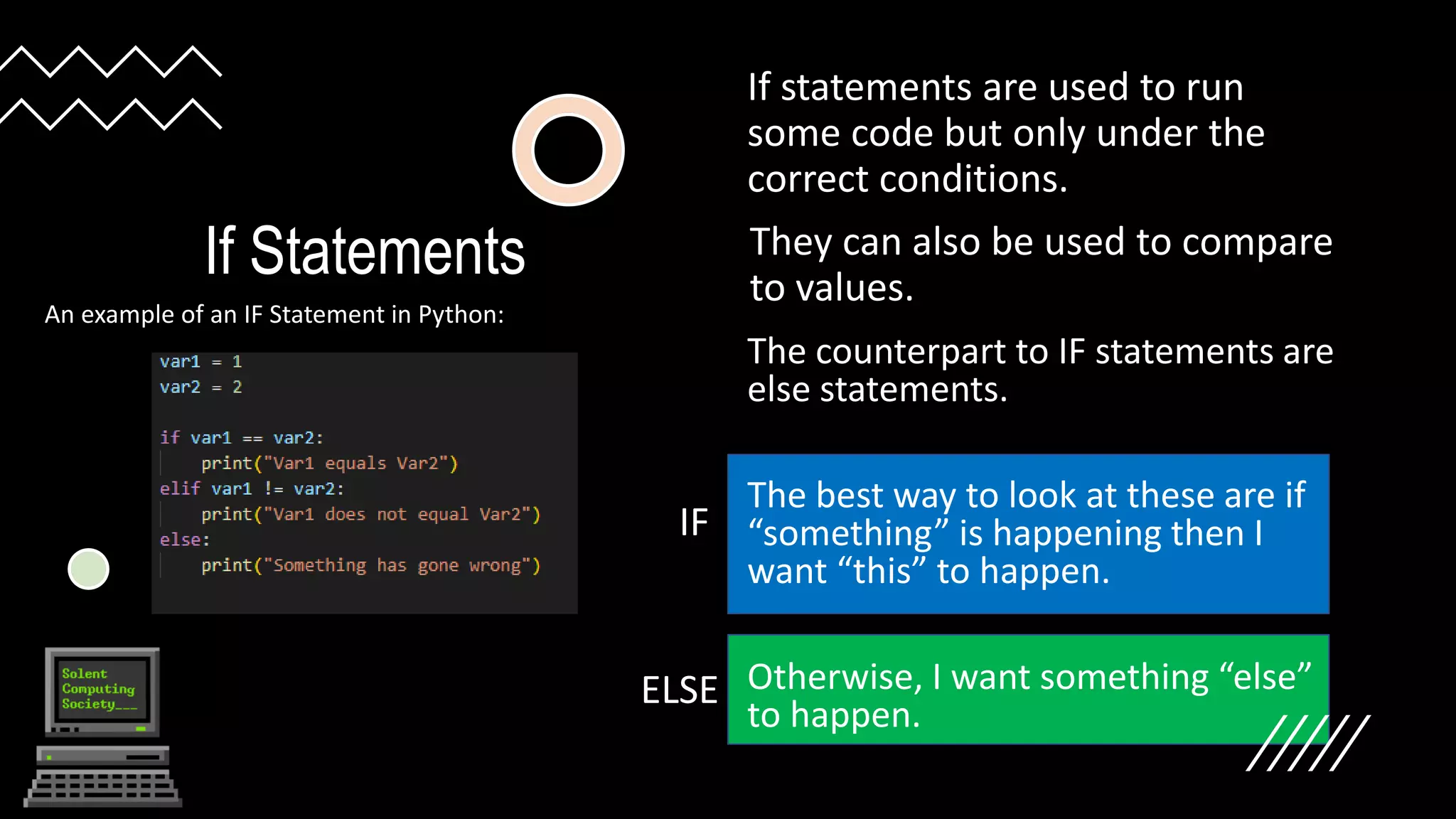
Logical operators are used to compare
two values.
These include:
An example of the logical operators in Python:
Equals: a == b
Not Equals a != b
Less than a < b
Less than or equal to a <= b
Greater than a > b
Greater than or equal to: a >= b
If Statements
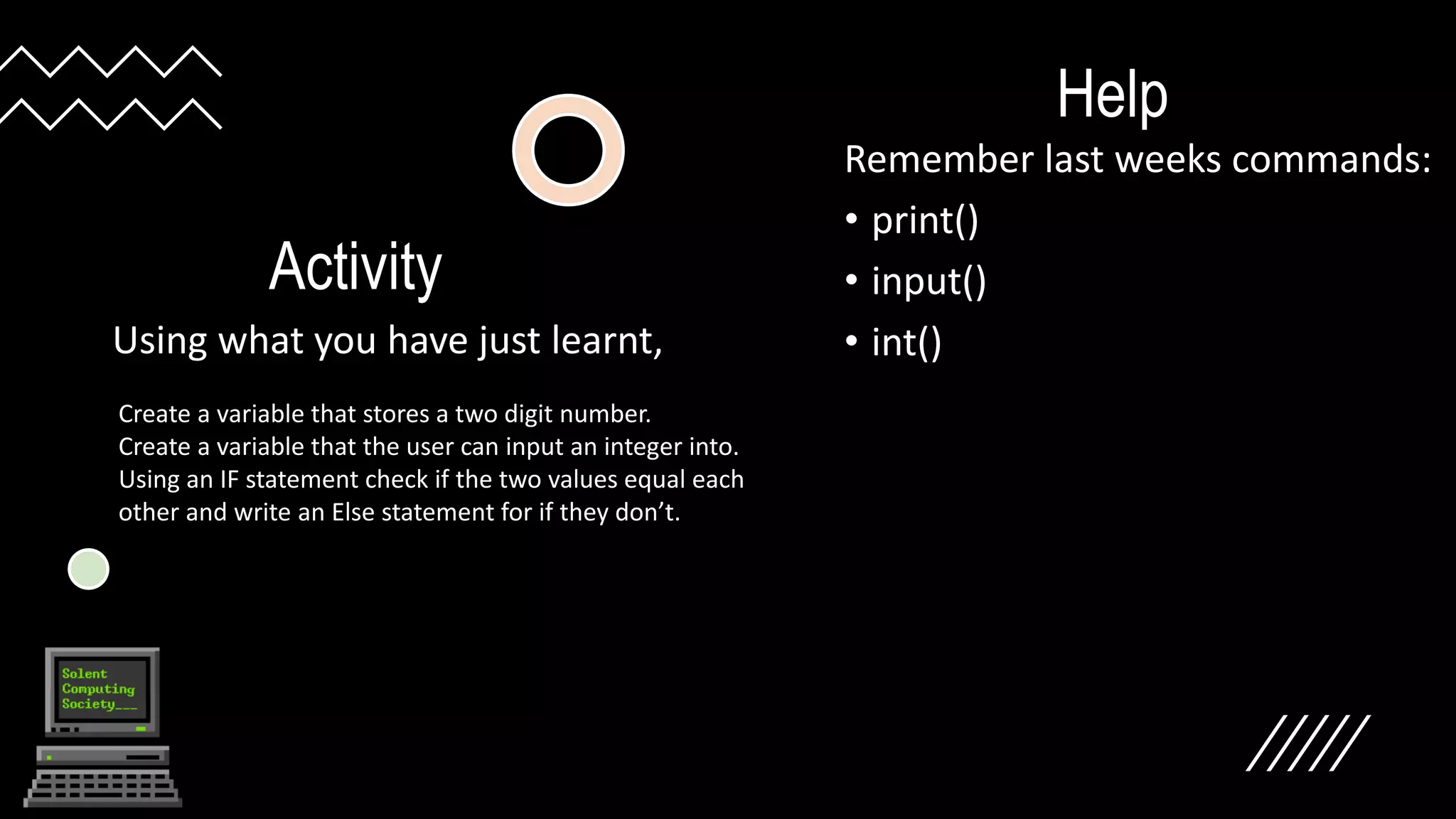
If statements are used to run
some code but only under the
correct conditions.
Var1
An example of an IF Statement in Python:
They can also be used to compare
to values.
The counterpart to IF statements are
else statements.
The best way to look at these are if
“something” is happening then I
want “this” to happen.
Otherwise, I want something “else”
to happen.
IF
ELSE
Activity
Using what you have just learnt,
Help
Remember last weeks commands:
• print()
• input()
• int()
Create a variable that stores a two digit number.
Create a variable that the user can input an integer into.
Using an IF statement check if the two values equal each
other and write an Else statement for if they don’t.
functions
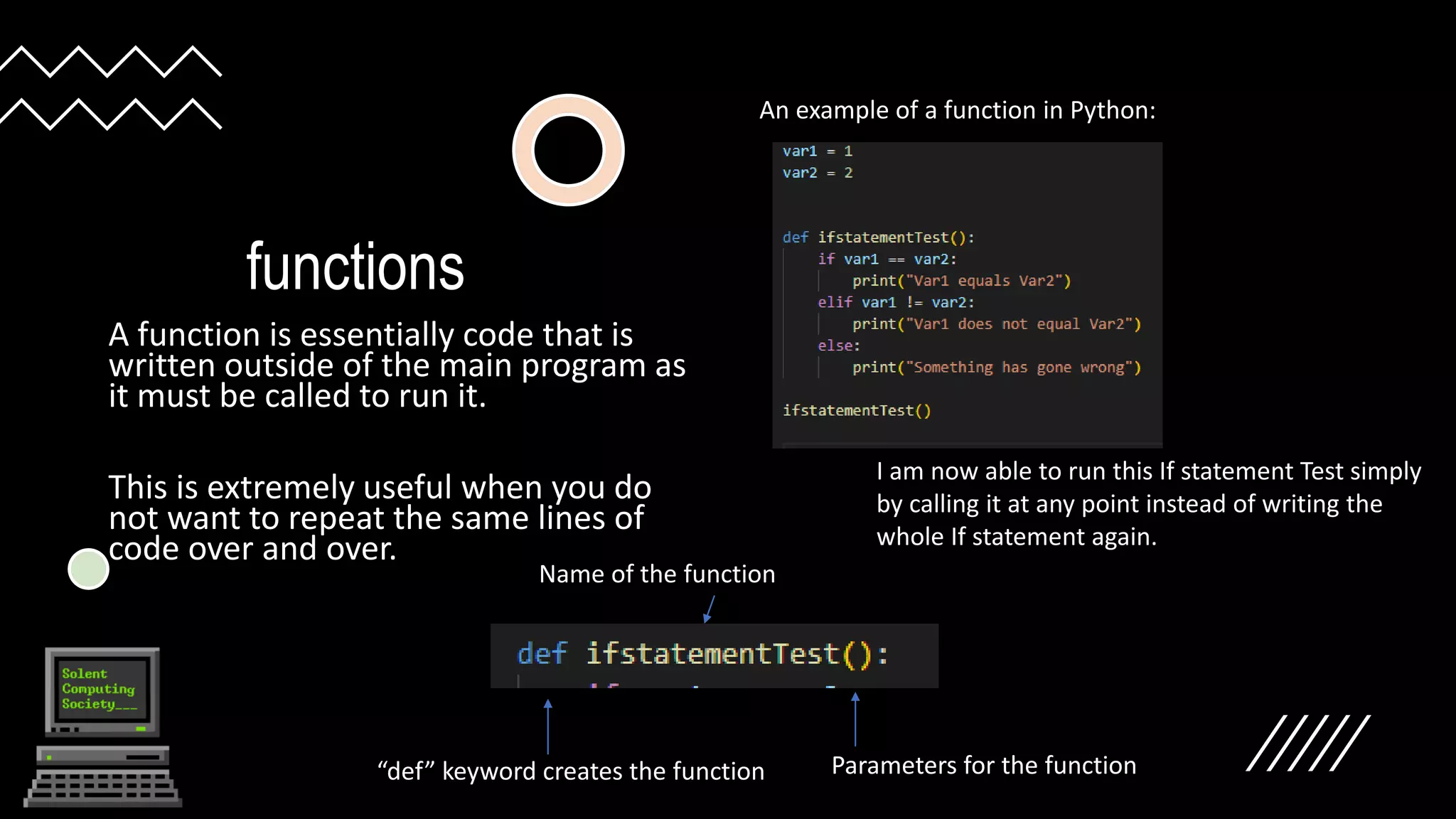
A function is essentially code that is
written outside of the main program as
it must be called to run it.
This is extremely useful when you do
not want to repeat the same lines of
code over and over.
An example of a function in Python:
I am now able to run this If statement Test simply
by calling it at any point instead of writing the
whole If statement again.
“def” keyword creates the function
Name of the function
Parameters for the function
Activity
Using what you have just learnt,
Help
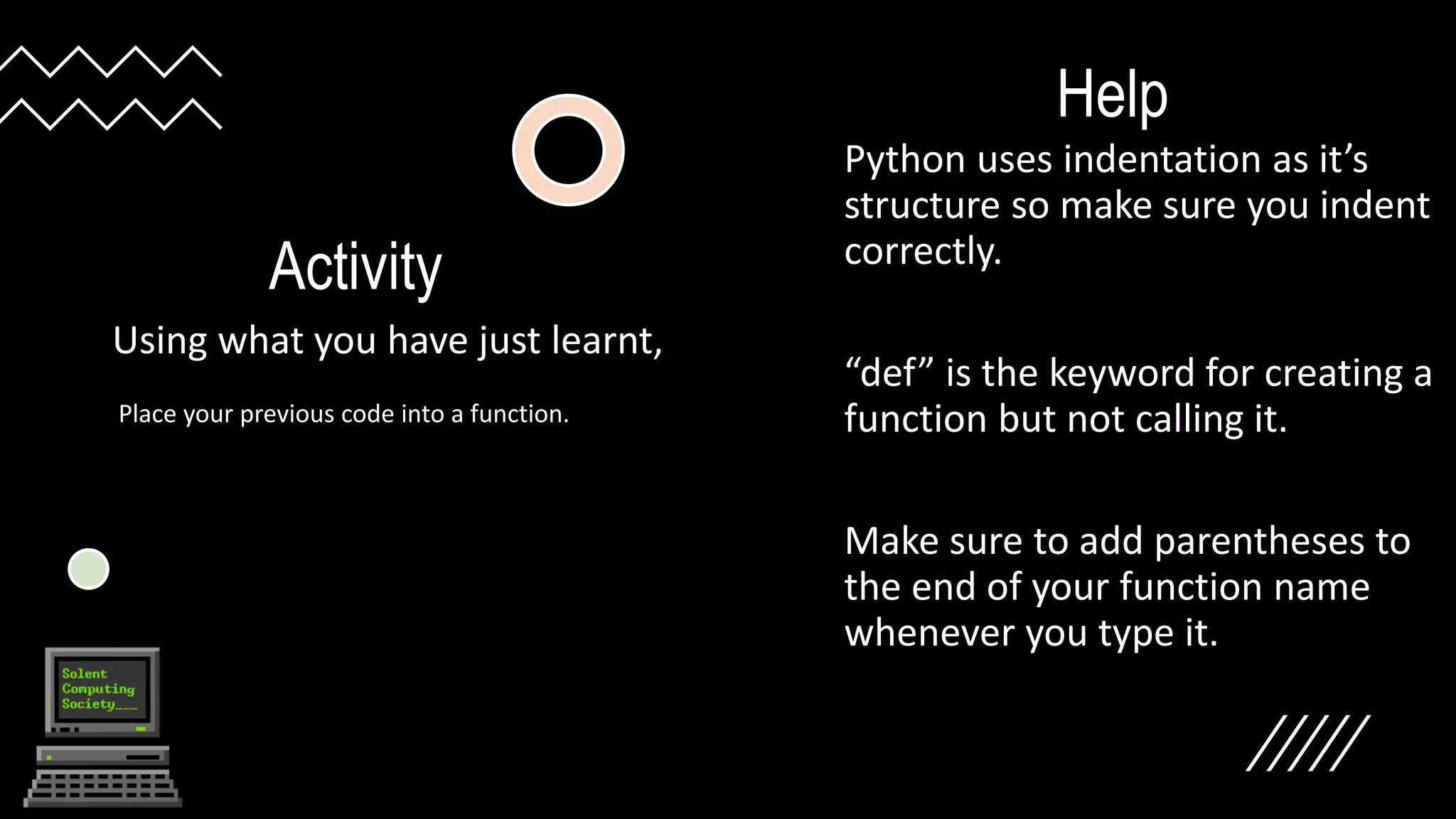
Python uses indentation as it’s
structure so make sure you indent
correctly.
“def” is the keyword for creating a
function but not calling it.
Make sure to add parentheses to
the end of your function name
whenever you type it.
Place your previous code into a function.
For loops
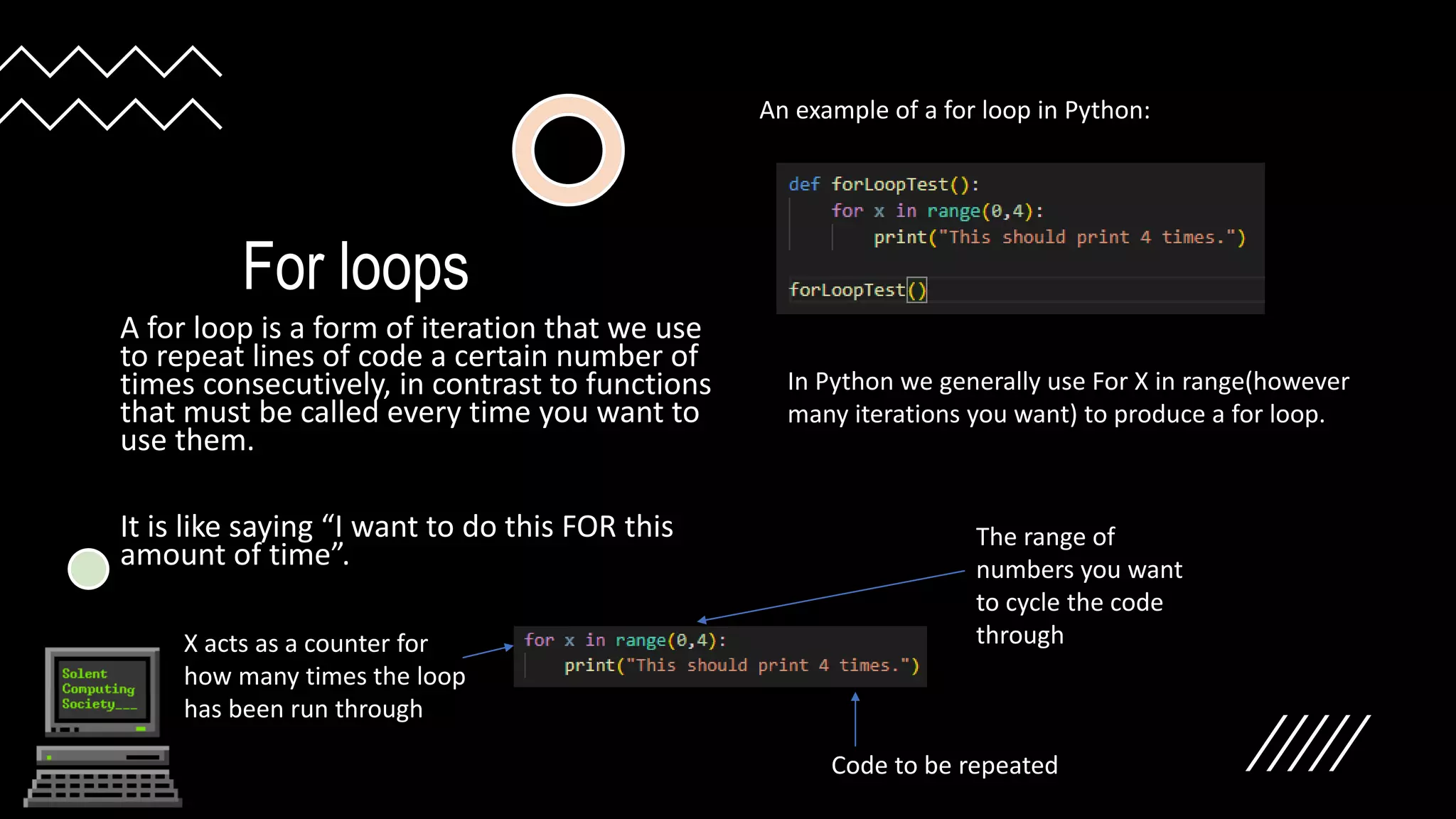
A for loop is a form of iteration that we use
to repeat lines of code a certain number of
times consecutively, in contrast to functions
that must be called every time you want to
use them.
It is like saying “I want to do this FOR this
amount of time”.
An example of a for loop in Python:
In Python we generally use For X in range(however
many iterations you want) to produce a for loop.
X acts as a counter for
how many times the loop
has been run through
The range of
numbers you want
to cycle the code
through
Code to be repeated
Activity
Using what you have just learnt,
Further Activity
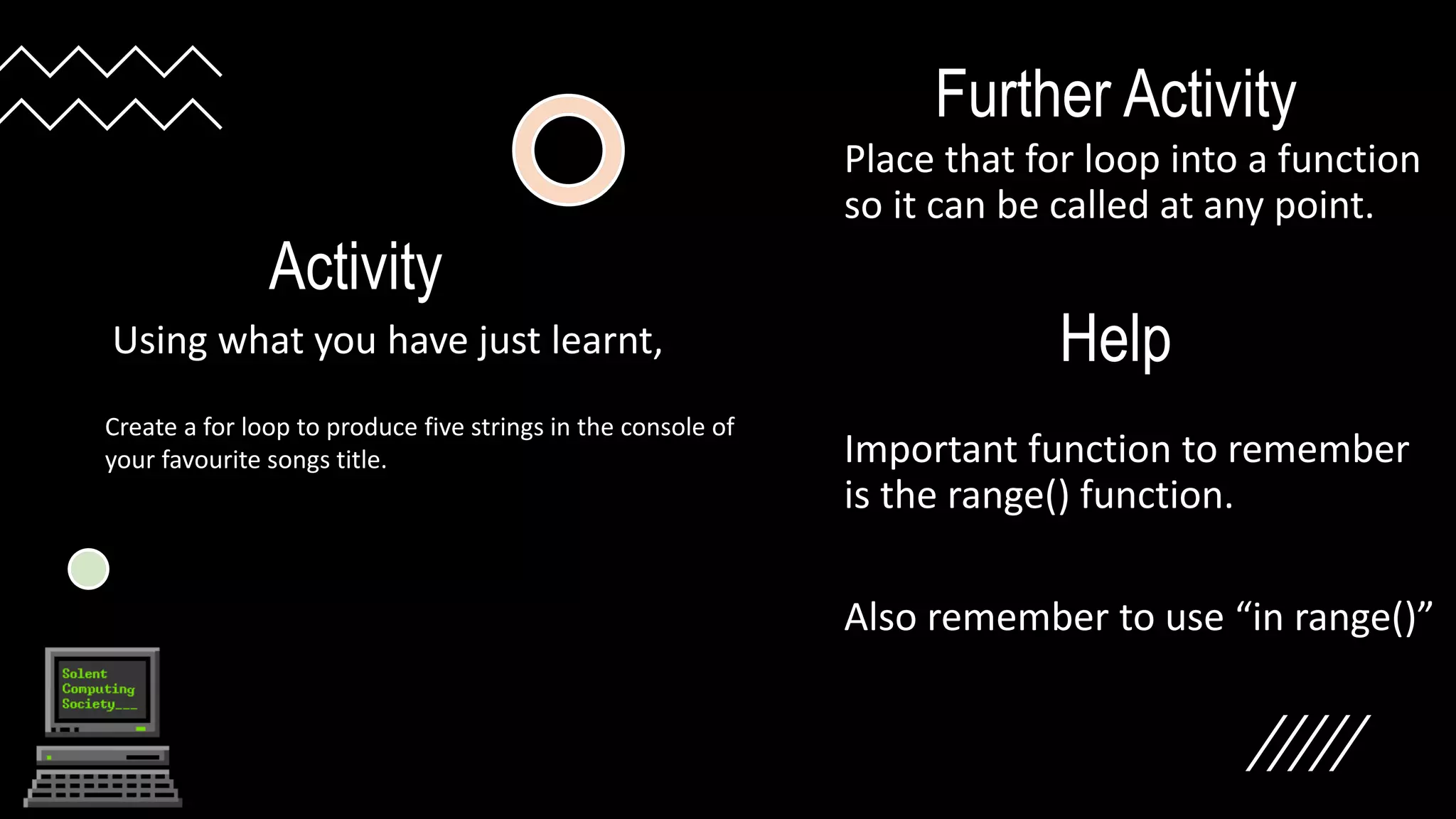
Place that for loop into a function
so it can be called at any point.
Important function to remember
is the range() function.
Also remember to use “in range()”
Create a for loop to produce five strings in the console of
your favourite songs title.
Help
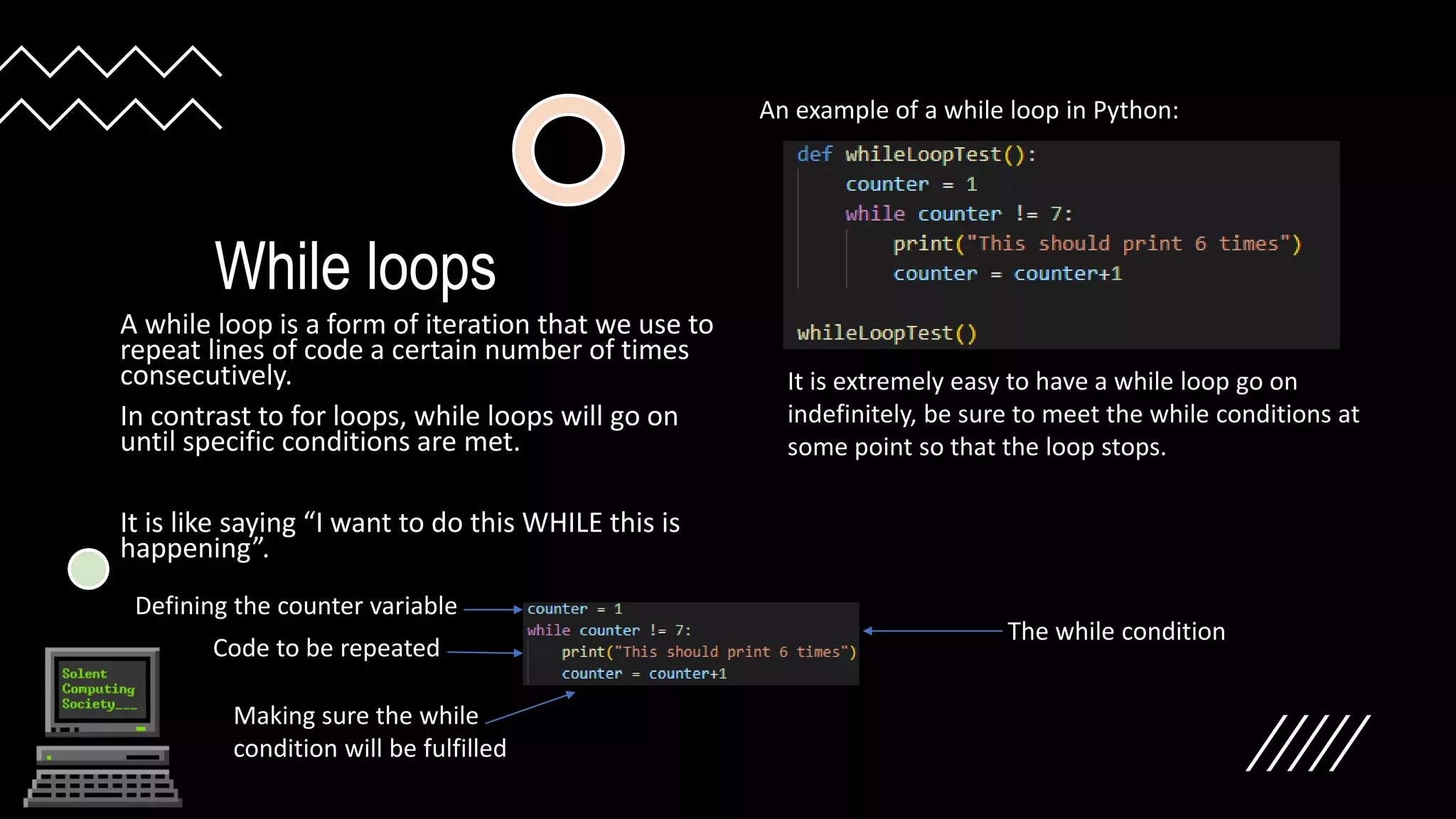
While loops
A while loop is a form of iteration that we use to
repeat lines of code a certain number of times
consecutively.
In contrast to for loops, while loops will go on
until specific conditions are met.
It is like saying “I want to do this WHILE this is
happening”.
An example of a while loop in Python:
It is extremely easy to have a while loop go on
indefinitely, be sure to meet the while conditions at
some point so that the loop stops.
Defining the counter variable
The while condition
Code to be repeated
Making sure the while
condition will be fulfilled
Activity
Using what you have just learnt,
Create a while loop to produce five strings in
the console of your favourite music artists or
bands name.
Further Activity
Place that while loop into a
function so it can be called at any
point.
Important to remember to meet
the while condition to make sure it
does not go on forever.
Also remember to indent
correctly!
Help
End of week two

Week 2.pptx

  • 1.
  • 2.
    Logical Operators Logical operatorsare used to compare two values. These include: An example of the logical operators in Python: Equals: a == b Not Equals a != b Less than a < b Less than or equal to a <= b Greater than a > b Greater than or equal to: a >= b
  • 3.
    If Statements If statementsare used to run some code but only under the correct conditions. Var1 An example of an IF Statement in Python: They can also be used to compare to values. The counterpart to IF statements are else statements. The best way to look at these are if “something” is happening then I want “this” to happen. Otherwise, I want something “else” to happen. IF ELSE
  • 4.
    Activity Using what youhave just learnt, Help Remember last weeks commands: • print() • input() • int() Create a variable that stores a two digit number. Create a variable that the user can input an integer into. Using an IF statement check if the two values equal each other and write an Else statement for if they don’t.
  • 5.
    functions A function isessentially code that is written outside of the main program as it must be called to run it. This is extremely useful when you do not want to repeat the same lines of code over and over. An example of a function in Python: I am now able to run this If statement Test simply by calling it at any point instead of writing the whole If statement again. “def” keyword creates the function Name of the function Parameters for the function
  • 6.
    Activity Using what youhave just learnt, Help Python uses indentation as it’s structure so make sure you indent correctly. “def” is the keyword for creating a function but not calling it. Make sure to add parentheses to the end of your function name whenever you type it. Place your previous code into a function.
  • 7.
    For loops A forloop is a form of iteration that we use to repeat lines of code a certain number of times consecutively, in contrast to functions that must be called every time you want to use them. It is like saying “I want to do this FOR this amount of time”. An example of a for loop in Python: In Python we generally use For X in range(however many iterations you want) to produce a for loop. X acts as a counter for how many times the loop has been run through The range of numbers you want to cycle the code through Code to be repeated
  • 8.
    Activity Using what youhave just learnt, Further Activity Place that for loop into a function so it can be called at any point. Important function to remember is the range() function. Also remember to use “in range()” Create a for loop to produce five strings in the console of your favourite songs title. Help
  • 9.
    While loops A whileloop is a form of iteration that we use to repeat lines of code a certain number of times consecutively. In contrast to for loops, while loops will go on until specific conditions are met. It is like saying “I want to do this WHILE this is happening”. An example of a while loop in Python: It is extremely easy to have a while loop go on indefinitely, be sure to meet the while conditions at some point so that the loop stops. Defining the counter variable The while condition Code to be repeated Making sure the while condition will be fulfilled
  • 10.
    Activity Using what youhave just learnt, Create a while loop to produce five strings in the console of your favourite music artists or bands name. Further Activity Place that while loop into a function so it can be called at any point. Important to remember to meet the while condition to make sure it does not go on forever. Also remember to indent correctly! Help
  • 11.