1
Introduction to Programming
Introductionto Programming
with Python
with Python
Marty Stepp (stepp@cs.washington.edu)
Lecturer, Computer Science & Engineering
University of Washington
2.
2
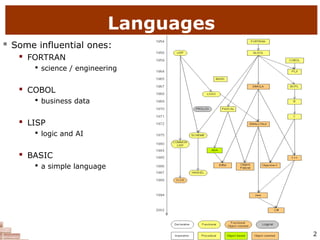
Some influentialones:
FORTRAN
science / engineering
COBOL
business data
LISP
logic and AI
BASIC
a simple language
Languages
3.
3
code orsource code: The sequence of instructions in a program.
syntax: The set of legal structures and commands that can be
used in a particular programming language.
output: The messages printed to the user by a program.
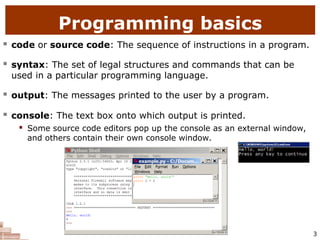
console: The text box onto which output is printed.
Some source code editors pop up the console as an external window,
and others contain their own console window.
Programming basics
4.
4
Compiling and interpreting
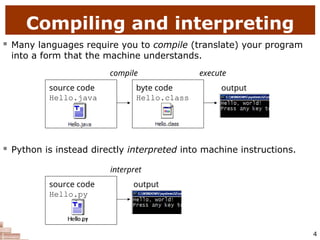
Many languages require you to compile (translate) your program
into a form that the machine understands.
Python is instead directly interpreted into machine instructions.
compile execute
output
source code
Hello.java
byte code
Hello.class
interpret
output
source code
Hello.py
5.
5
Expressions
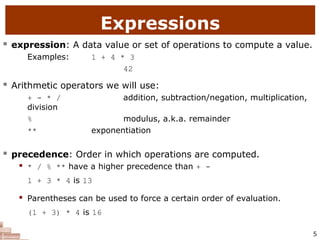
expression: Adata value or set of operations to compute a value.
Examples: 1 + 4 * 3
42
Arithmetic operators we will use:
+ - * / addition, subtraction/negation, multiplication,
division
% modulus, a.k.a. remainder
** exponentiation
precedence: Order in which operations are computed.
* / % ** have a higher precedence than + -
1 + 3 * 4 is 13
Parentheses can be used to force a certain order of evaluation.
(1 + 3) * 4 is 16
6.
6
Integer division
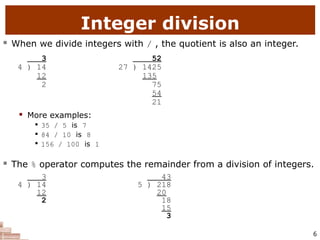
Whenwe divide integers with / , the quotient is also an integer.
3 52
4 ) 14 27 ) 1425
12 135
2 75
54
21
More examples:
35 / 5 is 7
84 / 10 is 8
156 / 100 is 1
The % operator computes the remainder from a division of integers.
3 43
4 ) 14 5 ) 218
12 20
2 18
15
3
7.
7
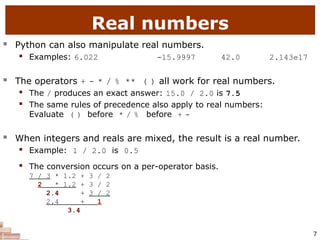
Real numbers
Pythoncan also manipulate real numbers.
Examples: 6.022 -15.9997 42.0 2.143e17
The operators + - * / % ** ( ) all work for real numbers.
The / produces an exact answer: 15.0 / 2.0 is 7.5
The same rules of precedence also apply to real numbers:
Evaluate ( ) before * / % before + -
When integers and reals are mixed, the result is a real number.
Example: 1 / 2.0 is 0.5
The conversion occurs on a per-operator basis.
7 / 3 * 1.2 + 3 / 2
2 * 1.2 + 3 / 2
2.4 + 3 / 2
2.4 + 1
3.4
8.
8
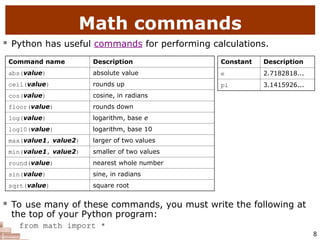
Math commands
Pythonhas useful commands for performing calculations.
To use many of these commands, you must write the following at
the top of your Python program:
from math import *
Command name Description
abs(value) absolute value
ceil(value) rounds up
cos(value) cosine, in radians
floor(value) rounds down
log(value) logarithm, base e
log10(value) logarithm, base 10
max(value1, value2) larger of two values
min(value1, value2) smaller of two values
round(value) nearest whole number
sin(value) sine, in radians
sqrt(value) square root
Constant Description
e 2.7182818...
pi 3.1415926...
9.
9
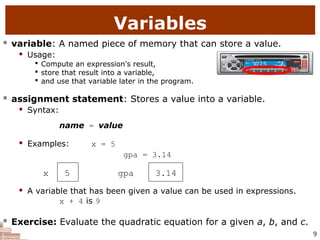
Variables
variable: Anamed piece of memory that can store a value.
Usage:
Compute an expression's result,
store that result into a variable,
and use that variable later in the program.
assignment statement: Stores a value into a variable.
Syntax:
name = value
Examples: x = 5
gpa = 3.14
x 5 gpa 3.14
A variable that has been given a value can be used in expressions.
x + 4 is 9
Exercise: Evaluate the quadratic equation for a given a, b, and c.
10.
10
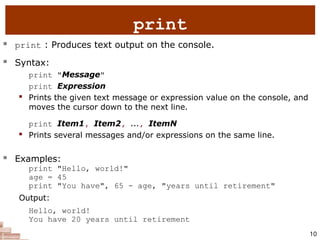
print :Produces text output on the console.
Syntax:
print "Message"
print Expression
Prints the given text message or expression value on the console, and
moves the cursor down to the next line.
print Item1, Item2, ..., ItemN
Prints several messages and/or expressions on the same line.
Examples:
print "Hello, world!"
age = 45
print "You have", 65 - age, "years until retirement"
Output:
Hello, world!
You have 20 years until retirement
print
11.
11
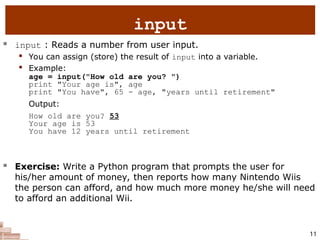
input :Reads a number from user input.
You can assign (store) the result of input into a variable.
Example:
age = input("How old are you? ")
print "Your age is", age
print "You have", 65 - age, "years until retirement"
Output:
How old are you? 53
Your age is 53
You have 12 years until retirement
Exercise: Write a Python program that prompts the user for
his/her amount of money, then reports how many Nintendo Wiis
the person can afford, and how much more money he/she will need
to afford an additional Wii.
input
13
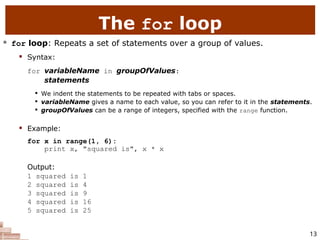
The for loop
for loop: Repeats a set of statements over a group of values.
Syntax:
for variableName in groupOfValues:
statements
We indent the statements to be repeated with tabs or spaces.
variableName gives a name to each value, so you can refer to it in the statements.
groupOfValues can be a range of integers, specified with the range function.
Example:
for x in range(1, 6):
print x, "squared is", x * x
Output:
1 squared is 1
2 squared is 4
3 squared is 9
4 squared is 16
5 squared is 25
14.
14
range
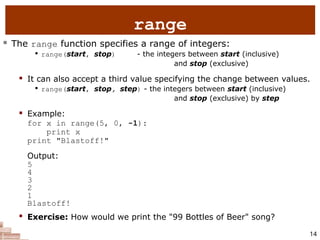
The rangefunction specifies a range of integers:
range(start, stop) - the integers between start (inclusive)
and stop (exclusive)
It can also accept a third value specifying the change between values.
range(start, stop, step) - the integers between start (inclusive)
and stop (exclusive) by step
Example:
for x in range(5, 0, -1):
print x
print "Blastoff!"
Output:
5
4
3
2
1
Blastoff!
Exercise: How would we print the "99 Bottles of Beer" song?
15.
15
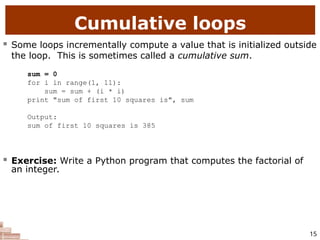
Cumulative loops
Someloops incrementally compute a value that is initialized outside
the loop. This is sometimes called a cumulative sum.
sum = 0
for i in range(1, 11):
sum = sum + (i * i)
print "sum of first 10 squares is", sum
Output:
sum of first 10 squares is 385
Exercise: Write a Python program that computes the factorial of
an integer.
16.
16
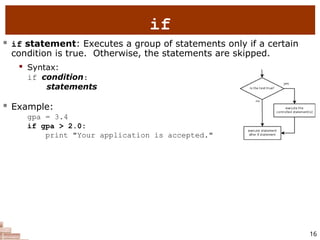
if
if statement:Executes a group of statements only if a certain
condition is true. Otherwise, the statements are skipped.
Syntax:
if condition:
statements
Example:
gpa = 3.4
if gpa > 2.0:
print "Your application is accepted."
17.
17
if/else
if/else statement:Executes one block of statements if a certain
condition is True, and a second block of statements if it is False.
Syntax:
if condition:
statements
else:
statements
Example:
gpa = 1.4
if gpa > 2.0:
print "Welcome to Mars University!"
else:
print "Your application is denied."
Multiple conditions can be chained with elif ("else if"):
if condition:
statements
elif condition:
statements
else:
statements
18.
18
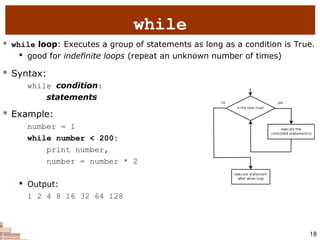
while
while loop:Executes a group of statements as long as a condition is True.
good for indefinite loops (repeat an unknown number of times)
Syntax:
while condition:
statements
Example:
number = 1
while number < 200:
print number,
number = number * 2
Output:
1 2 4 8 16 32 64 128
19.
19
Logic
Many logicalexpressions use relational operators:
Logical expressions can be combined with logical operators:
Exercise: Write code to display and count the factors of a number.
Operator Example Result
and 9 != 6 and 2 < 3 True
or 2 == 3 or -1 < 5 True
not not 7 > 0 False
Operator Meaning Example Result
== equals 1 + 1 == 2 True
!= does not equal 3.2 != 2.5 True
< less than 10 < 5 False
> greater than 10 > 5 True
<= less than or equal to 126 <= 100 False
>= greater than or equal to 5.0 >= 5.0 True
21
string: Asequence of text characters in a program.
Strings start and end with quotation mark " or apostrophe ' characters.
Examples:
"hello"
"This is a string"
"This, too, is a string. It can be very long!"
A string may not span across multiple lines or contain a " character.
"This is not
a legal String."
"This is not a "legal" String either."
A string can represent characters by preceding them with a backslash.
t tab character
n new line character
" quotation mark character
backslash character
Example: "HellottherenHow are you?"
Strings
22.
22
Indexes
Characters ina string are numbered with indexes starting at 0:
Example:
name = "P. Diddy"
Accessing an individual character of a string:
variableName [ index ]
Example:
print name, "starts with", name[0]
Output:
P. Diddy starts with P
index 0 1 2 3 4 5 6 7
character P . D i d d y
23.
23
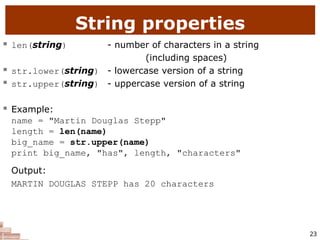
String properties
len(string)- number of characters in a string
(including spaces)
str.lower(string) - lowercase version of a string
str.upper(string) - uppercase version of a string
Example:
name = "Martin Douglas Stepp"
length = len(name)
big_name = str.upper(name)
print big_name, "has", length, "characters"
Output:
MARTIN DOUGLAS STEPP has 20 characters
24.
24
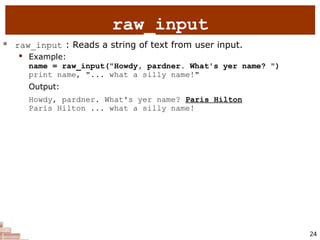
raw_input :Reads a string of text from user input.
Example:
name = raw_input("Howdy, pardner. What's yer name? ")
print name, "... what a silly name!"
Output:
Howdy, pardner. What's yer name? Paris Hilton
Paris Hilton ... what a silly name!
raw_input
25.
25
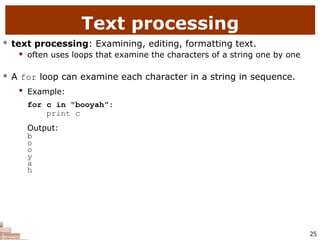
Text processing
textprocessing: Examining, editing, formatting text.
often uses loops that examine the characters of a string one by one
A for loop can examine each character in a string in sequence.
Example:
for c in "booyah":
print c
Output:
b
o
o
y
a
h
26.
26
Strings and numbers
ord(text) - converts a string into a number.
Example: ord("a") is 97, ord("b") is 98, ...
Characters map to numbers using standardized mappings such as
ASCII and Unicode.
chr(number) - converts a number into a string.
Example: chr(99) is "c"
Exercise: Write a program that performs a rotation cypher.
e.g. "Attack" when rotated by 1 becomes "buubdl"
27.
27
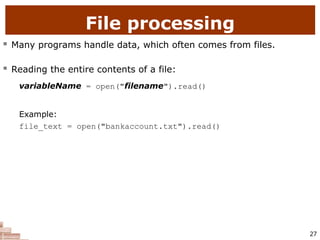
File processing
Manyprograms handle data, which often comes from files.
Reading the entire contents of a file:
variableName = open("filename").read()
Example:
file_text = open("bankaccount.txt").read()
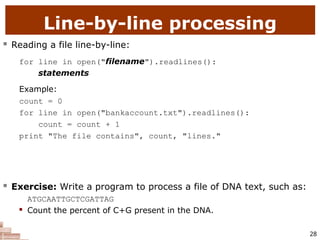
28.
28
Line-by-line processing
Readinga file line-by-line:
for line in open("filename").readlines():
statements
Example:
count = 0
for line in open("bankaccount.txt").readlines():
count = count + 1
print "The file contains", count, "lines."
Exercise: Write a program to process a file of DNA text, such as:
ATGCAATTGCTCGATTAG
Count the percent of C+G present in the DNA.
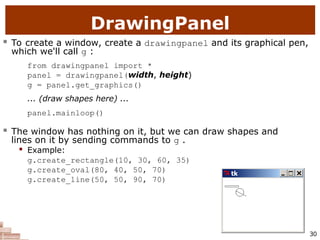
30
DrawingPanel
To createa window, create a drawingpanel and its graphical pen,
which we'll call g :
from drawingpanel import *
panel = drawingpanel(width, height)
g = panel.get_graphics()
... (draw shapes here) ...
panel.mainloop()
The window has nothing on it, but we can draw shapes and
lines on it by sending commands to g .
Example:
g.create_rectangle(10, 30, 60, 35)
g.create_oval(80, 40, 50, 70)
g.create_line(50, 50, 90, 70)
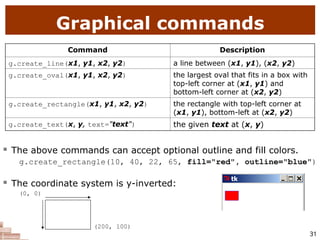
31.
31
Graphical commands
Command Description
g.create_line(x1,y1, x2, y2) a line between (x1, y1), (x2, y2)
g.create_oval(x1, y1, x2, y2) the largest oval that fits in a box with
top-left corner at (x1, y1) and
bottom-left corner at (x2, y2)
g.create_rectangle(x1, y1, x2, y2) the rectangle with top-left corner at
(x1, y1), bottom-left at (x2, y2)
g.create_text(x, y, text="text") the given text at (x, y)
The above commands can accept optional outline and fill colors.
g.create_rectangle(10, 40, 22, 65, fill="red", outline="blue")
The coordinate system is y-inverted:
(0, 0)
(200, 100)
32.
32
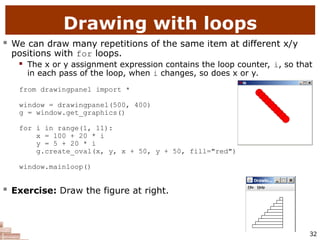
Drawing with loops
We can draw many repetitions of the same item at different x/y
positions with for loops.
The x or y assignment expression contains the loop counter, i, so that
in each pass of the loop, when i changes, so does x or y.
from drawingpanel import *
window = drawingpanel(500, 400)
g = window.get_graphics()
for i in range(1, 11):
x = 100 + 20 * i
y = 5 + 20 * i
g.create_oval(x, y, x + 50, y + 50, fill="red")
window.mainloop()
Exercise: Draw the figure at right.
34
Further programming
Labexercises
Let's go downstairs to the basement computer labs!
All resources are available at the following URL:
http://faculty.washington.edu/stepp/cs4hs/
What next?
Arrays, data structures
Algorithms: searching, sorting, recursion, etc.
Objects and object-oriented programming
Graphical user interfaces, event-driven programming




![22
Indexes
Characters in a string are numbered with indexes starting at 0:
Example:
name = "P. Diddy"
Accessing an individual character of a string:
variableName [ index ]
Example:
print name, "starts with", name[0]
Output:
P. Diddy starts with P
index 0 1 2 3 4 5 6 7
character P . D i d d y](https://image.slidesharecdn.com/python-250702025226-0f56f083/85/python-fundamental-for-beginner-course-ppt-22-320.jpg)