His most notableachievements
Artists-
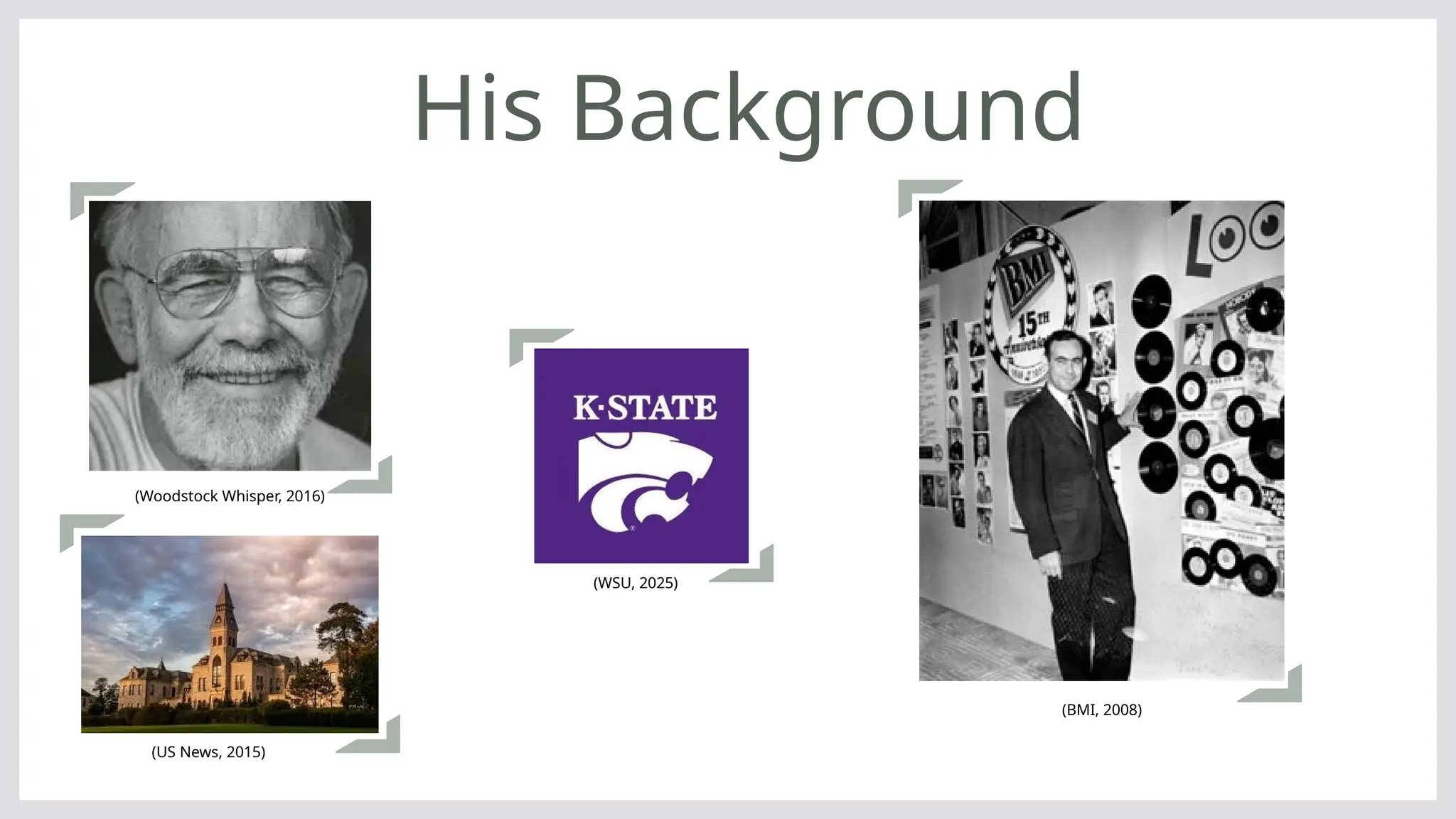
(Rolling Stone, 2008)
Recordings- Awards-
Aretha Franklin
Led Zeppelin
Ray Charles
Bob Dylan
Rock and Roll Hall of Fame
National Rhythm & Blues Hall of Fame
John Herbert Orr Pioneer Award
Grammy Awards
“Respect” Aretha Franklin
“Green Onions” Booker T. & the MG’s
“If You Need Me” Solomon Burke
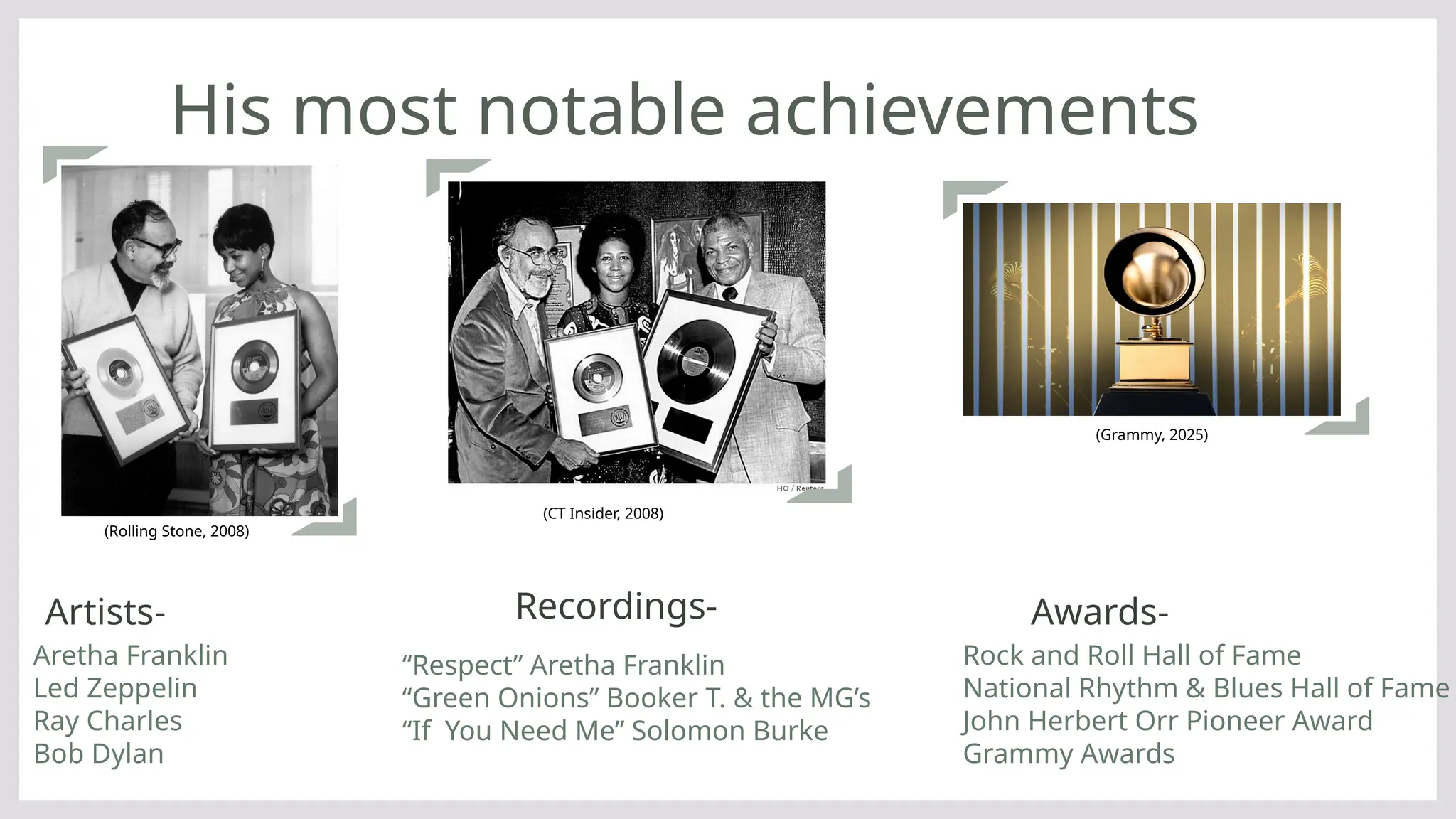
(CT Insider, 2008)
(Grammy, 2025)
4.
His path tosuccess
(History of Rock, n.d)
(Stax Records, n.d)
(Alabama Music, 2014)
Editor's Notes
#2 Wexler has always been a large fan of music, particularly jazz, blues, and soulful, so much so that he dropped out of high school to continue following his love through record collecting. After serving in the United States Army during World War II, he got his degree in Journalism at Kansas State University. After graduation he started working at Billboard Magazine as a reporter where in 1949, he coined the term “Rhythm and Blues” for the magazine’s black music chart to replace the term “Race Music”. Wexler has always had a profound love for music, while he started out as a journalist for the music company Billboard, he eventually became a music producer. While Wexler didn’t grow up in a musical background, his musical experience stems from his major love of Jazz. When Wexler dropped out of school and became a part of a group who did record collecting, he gained a great ear for different genres of music. Which in return helped him as a music producer, allowing multiple productions of his to generate a number of gold and platinum records (Rolling Stone, 2008).
#3 While Wexler didn’t found the company of Atlantic he did become a full partner after Abramson left to go to the Army in the early 1950’s. Wexler discovered artists like Led Zeppelin, Aretha Franklin, Ray Charles, and Bob Dylan. His most notable recordings include “Respect” by Aretha Franklin in 1967, “Green Onions” by Booker T. & the MG’s in 1962, and “If You Need Me” by Solomon Burke in 1963 (BMI, 2008). Wexler’s awards range from being inducted into the Rock and Roll hall of fame in 1987, receiving the John Herbert Orr Pioneer Award in 1987, the National Rhythm & Blues Hall of fame in 2017 and Grammy Awards in 1968, 1976, 1981, 1993, 1996, 1998, and 2009.
#4 Mistakes will always happen, Mr.Wexler commented that his biggest mistake was in 1968 when he persuaded the Ertegun brothers to sell Atlantic to Warner Brothers for $17.5 million, he stated to Rolling Stones “What a mistake. Worst thing we ever did. It was because of my own insecurity when I saw all these other independent record companies going out of existence. We were sort of done in by the broker who was supposed to be representing us. He undersold us” (Rolling Stone, 2008). While Wexler made mistakes he was a fighter, he made sure that radio stations gave Atlantic singles airtime, one way or another, and he battled other labels for marketing shares. He created innovative contracts with studios, labels, songwriters, and producers, which helped him have a major hand in the creative force of the genres of Rock, Jazz, Soul, and Blues (The Guardian, 2008). He launched subsidiary labels under the Atlantic Umbrella which helped Atlantic branch out in different areas of the music industry. By discovering Stax Records he discovered a new way of making records and in the music production area, he separated the rhythm section, advocated for adding more bass and pitched in when needed; he changed the way music was created (The Washington Post, 2008). The major thing that helped Wexler create his success was focusing on the artists, and letting them have creative control while helping them hone in on their potential, this major step helped Wexler make a wedge in “Race Music” and instead gave his artists the chance no matter the race to be heard by everyone; this step helped bridge a gap between white and black listeners, as well as helped get lesser-known genres out into the public's eye.