HOW TO: Record acoustic instruments

A very primer from a very newbie


                                   David Fernández Vaamonde
                                          davidfv(at)gmail(dot)com
But first, Who am I?


03/10/13                     2
Who am I?

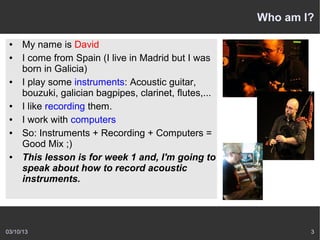
 ●   My name is David
 ●   I come from Spain (I live in Madrid but I was
     born in Galicia)
 ●   I play some instruments: Acoustic guitar,
     bouzuki, galician bagpipes, clarinet, flutes,...
 ●   I like recording them.
 ●   I work with computers
 ●   So: Instruments + Recording + Computers =
     Good Mix ;)
 ●   This lesson is for week 1 and, I'm going to
     speak about how to record acoustic
     instruments.


03/10/13                                                        3
And now, this is the
           agenda...


03/10/13                     4
Agenda

    Differences between recording electric and
    acoustic instruments
    Basic considerations
    Microphones choice
    Microphones placement
    Summing up


03/10/13                                              5
Differences between recording
electric and acoustic instruments


03/10/13                        6
Differences between recording electric and acoustic
                                                   instruments

    Main difference:
           Electric instruments: We are getting voltage
           differences and we should obtain digital information.
           Acoustic instruments: We are getting pressure
           variations in the air and we should obtain digital
           information.
    We are going to focus in how to get that
    information (air pressure) on the best way.


03/10/13                                                           7
Basic considerations


03/10/13                          8
Basic considerations

    What data should be considered for getting a good
    recording?
           Instrument behavior
               How is our instrument amplitude?
               Which is its frequency range?
               Where is the sound emission?
               How is the sound of this instrument?
               Which sound we want to get? (all sound, a very focused sound...).
           Room behavior
               How is the room where we are recording? (Reflect a lot of sound, is a big
               or a small one...).


03/10/13                                                                                   9
Basic considerations

    For example: Clarinet
               ● Not all sound its emitted from the bell (lower piece), only bass sounds
               (That could be a common mistake)
               ● We should know this fact to place a mic.


                            Clarinet in Bb works in a frequency range between
                            125Hz and 2Khz (aprox). This is its clarinet spectrum
                            analysis: Air pressure vs. frequencies. We should know
                            that to choose the mic.


03/10/13                                                                              10
Basic considerations

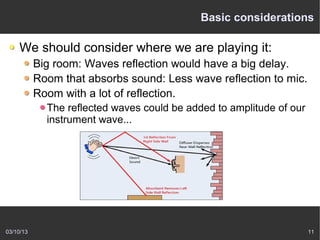
    We should consider where we are playing it:
           Big room: Waves reflection would have a big delay.
           Room that absorbs sound: Less wave reflection to mic.
           Room with a lot of reflection.
             The reflected waves could be added to amplitude of our
             instrument wave...


03/10/13                                                              11
Microphones choice


03/10/13                        12
Microphone choices

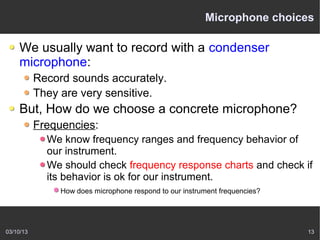
    We usually want to record with a condenser
    microphone:
           Record sounds accurately.
           They are very sensitive.
    But, How do we choose a concrete microphone?
           Frequencies:
             We know frequency ranges and frequency behavior of
             our instrument.
             We should check frequency response charts and check if
             its behavior is ok for our instrument.
                How does microphone respond to our instrument frequencies?


03/10/13                                                                     13
Microphone choices

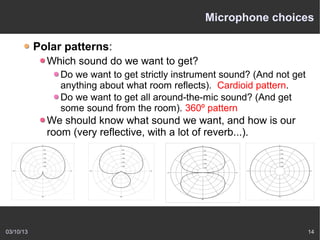
           Polar patterns:
             Which sound do we want to get?
                Do we want to get strictly instrument sound? (And not get
                anything about what room reflects). Cardioid pattern.
                Do we want to get all around-the-mic sound? (And get
                some sound from the room). 360º pattern
             We should know what sound we want, and how is our
             room (very reflective, with a lot of reverb...).


03/10/13                                                                    14
First considerations

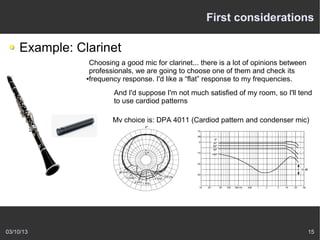
    Example: Clarinet
                Choosing a good mic for clarinet... there is a lot of opinions between
                professionals, we are going to choose one of them and check its
               ●frequency response. I'd like a “flat” response to my frequencies.


                       And I'd suppose I'm not much satisfied of my room, so I'll tend
                       to use cardiod patterns

                       My choice is: DPA 4011 (Cardiod pattern and condenser mic)


03/10/13                                                                                 15
Microphones placement


03/10/13                           16
Microphone placement

    Basic considerations:
           If we are very near from mic we only get instrument
           sound
             But we could have “proximity effect”: Distortions in low sounds when we
             are too much close to mic...
           If we are far from mic we get sound reflected in the
           room too.
           We should know how the instrument emits its sound.
             Sometimes this is not evident (instruments usually emit
             sounds all along the instrument... clarinet for example).
             The hole, it isn't always the right place :).


03/10/13                                                                           17
Microphone placement

    The best tip that I listen:
           Follow your ear: Where is the sound better?
           A good experiment:
             Begin to play
             Move the mic all around the room
             Check where the mic are getting the best sound.
             Place the mic there.


03/10/13                                                       18
Microphone placement

    Example: Clarinet

                  We should avoid putting mic in clarinet bell, we get a lot of bass


03/10/13                                                                           19
Microphone placement

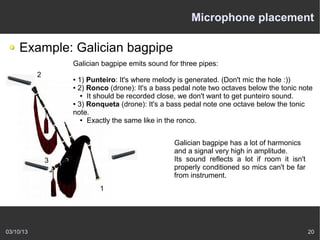
    Example: Galician bagpipe
                   Galician bagpipe emits sound for three pipes:
           2       ● 1) Punteiro: It's where melody is generated. (Don't mic the hole :))
                   ● 2) Ronco (drone): It's a bass pedal note two octaves below the tonic note

                      ● It should be recorded close, we don't want to get punteiro sound.

                   ● 3) Ronqueta (drone): It's a bass pedal note one octave below the tonic

                   note.
                      ● Exactly the same like in the ronco.


                                                  Galician bagpipe has a lot of harmonics
                                                  and a signal very high in amplitude.
               3                                  Its sound reflects a lot if room it isn't
                                                  properly conditioned so mics can't be far
                                                  from instrument.
                           1


03/10/13                                                                                      20
Summing up

    Summing up:
           Know the instrument you are going to record:
              Timbre, frequencies ranges, amplitude...
              Where the sound is emitted
           Know the room where you are going to record:
              A big or small room, with or without sound reflection.
              What sound I want to get...

                                                                       And then...
           Choose your microphone
               Based in polar pattern, frequency response, etc...
           Place your microphone:
               Test and get the best sound.
               Take care about where sound it's emitted.


03/10/13                                                                             21
References

    References used:
           Recording acoustic instruments: http://www.musictech.net/2012/08/recording-acoustic-instruments/
           Recording individual instruments:
           http://www.netplaces.com/home-recording/recording-individual-instruments/acoustic-instruments.htm
           Clarinet acoustic: http://www.phys.unsw.edu.au/jw/reprints/AAclarinet.pdf
           Clarinet acoustic: http://www.phys.unsw.edu.au/jw/clarinetacoustics.html#spectrum
           Room acoustics: http://www.recordingmag.com/resources/resourceDetail/224.html
           Room acoustics: http://www.silcom.com/~aludwig/Room_acoustics.html
           Room acoustincs: http://www.acoustics.salford.ac.uk/feschools/waves/diffract4.htm
           Polar patterns: http://blog.digitalstudent.co.uk/microphones/microphone-polar-patterns/
           Miking a clarinet: http://www.dpamicrophones.com/en/Mic-University/Application-Guide/Clarinet.aspx
           DPA microphones:
           http://www.dpamicrophones.com/en/products.aspx?c=Item&category=234&item=24387#diagrams
           Proximity effect: http://en.wikipedia.org/wiki/Proximity_effect_(audio)
           Galician bagpipe sound: http://www.arrakis.es/~jpresedo/afinacion.htm (spanish)


03/10/13                                                                                                        22
Thank you very much for you
    attention and for your reviewing!!!

             Regards, David


03/10/13                                  23

Week 1 assignment_david_fernandez_vaamonde

  • 1.
    HOW TO: Recordacoustic instruments A very primer from a very newbie David Fernández Vaamonde davidfv(at)gmail(dot)com
  • 2.
    But first, Whoam I? 03/10/13 2
  • 3.
    Who am I? ● My name is David ● I come from Spain (I live in Madrid but I was born in Galicia) ● I play some instruments: Acoustic guitar, bouzuki, galician bagpipes, clarinet, flutes,... ● I like recording them. ● I work with computers ● So: Instruments + Recording + Computers = Good Mix ;) ● This lesson is for week 1 and, I'm going to speak about how to record acoustic instruments. 03/10/13 3
  • 4.
    And now, thisis the agenda... 03/10/13 4
  • 5.
    Agenda Differences between recording electric and acoustic instruments Basic considerations Microphones choice Microphones placement Summing up 03/10/13 5
  • 6.
    Differences between recording electricand acoustic instruments 03/10/13 6
  • 7.
    Differences between recordingelectric and acoustic instruments Main difference: Electric instruments: We are getting voltage differences and we should obtain digital information. Acoustic instruments: We are getting pressure variations in the air and we should obtain digital information. We are going to focus in how to get that information (air pressure) on the best way. 03/10/13 7
  • 8.
  • 9.
    Basic considerations What data should be considered for getting a good recording? Instrument behavior How is our instrument amplitude? Which is its frequency range? Where is the sound emission? How is the sound of this instrument? Which sound we want to get? (all sound, a very focused sound...). Room behavior How is the room where we are recording? (Reflect a lot of sound, is a big or a small one...). 03/10/13 9
  • 10.
    Basic considerations For example: Clarinet ● Not all sound its emitted from the bell (lower piece), only bass sounds (That could be a common mistake) ● We should know this fact to place a mic. Clarinet in Bb works in a frequency range between 125Hz and 2Khz (aprox). This is its clarinet spectrum analysis: Air pressure vs. frequencies. We should know that to choose the mic. 03/10/13 10
  • 11.
    Basic considerations We should consider where we are playing it: Big room: Waves reflection would have a big delay. Room that absorbs sound: Less wave reflection to mic. Room with a lot of reflection. The reflected waves could be added to amplitude of our instrument wave... 03/10/13 11
  • 12.
  • 13.
    Microphone choices We usually want to record with a condenser microphone: Record sounds accurately. They are very sensitive. But, How do we choose a concrete microphone? Frequencies: We know frequency ranges and frequency behavior of our instrument. We should check frequency response charts and check if its behavior is ok for our instrument. How does microphone respond to our instrument frequencies? 03/10/13 13
  • 14.
    Microphone choices Polar patterns: Which sound do we want to get? Do we want to get strictly instrument sound? (And not get anything about what room reflects). Cardioid pattern. Do we want to get all around-the-mic sound? (And get some sound from the room). 360º pattern We should know what sound we want, and how is our room (very reflective, with a lot of reverb...). 03/10/13 14
  • 15.
    First considerations Example: Clarinet Choosing a good mic for clarinet... there is a lot of opinions between professionals, we are going to choose one of them and check its ●frequency response. I'd like a “flat” response to my frequencies. And I'd suppose I'm not much satisfied of my room, so I'll tend to use cardiod patterns My choice is: DPA 4011 (Cardiod pattern and condenser mic) 03/10/13 15
  • 16.
  • 17.
    Microphone placement Basic considerations: If we are very near from mic we only get instrument sound But we could have “proximity effect”: Distortions in low sounds when we are too much close to mic... If we are far from mic we get sound reflected in the room too. We should know how the instrument emits its sound. Sometimes this is not evident (instruments usually emit sounds all along the instrument... clarinet for example). The hole, it isn't always the right place :). 03/10/13 17
  • 18.
    Microphone placement The best tip that I listen: Follow your ear: Where is the sound better? A good experiment: Begin to play Move the mic all around the room Check where the mic are getting the best sound. Place the mic there. 03/10/13 18
  • 19.
    Microphone placement Example: Clarinet We should avoid putting mic in clarinet bell, we get a lot of bass 03/10/13 19
  • 20.
    Microphone placement Example: Galician bagpipe Galician bagpipe emits sound for three pipes: 2 ● 1) Punteiro: It's where melody is generated. (Don't mic the hole :)) ● 2) Ronco (drone): It's a bass pedal note two octaves below the tonic note ● It should be recorded close, we don't want to get punteiro sound. ● 3) Ronqueta (drone): It's a bass pedal note one octave below the tonic note. ● Exactly the same like in the ronco. Galician bagpipe has a lot of harmonics and a signal very high in amplitude. 3 Its sound reflects a lot if room it isn't properly conditioned so mics can't be far from instrument. 1 03/10/13 20
  • 21.
    Summing up Summing up: Know the instrument you are going to record: Timbre, frequencies ranges, amplitude... Where the sound is emitted Know the room where you are going to record: A big or small room, with or without sound reflection. What sound I want to get... And then... Choose your microphone Based in polar pattern, frequency response, etc... Place your microphone: Test and get the best sound. Take care about where sound it's emitted. 03/10/13 21
  • 22.
    References References used: Recording acoustic instruments: http://www.musictech.net/2012/08/recording-acoustic-instruments/ Recording individual instruments: http://www.netplaces.com/home-recording/recording-individual-instruments/acoustic-instruments.htm Clarinet acoustic: http://www.phys.unsw.edu.au/jw/reprints/AAclarinet.pdf Clarinet acoustic: http://www.phys.unsw.edu.au/jw/clarinetacoustics.html#spectrum Room acoustics: http://www.recordingmag.com/resources/resourceDetail/224.html Room acoustics: http://www.silcom.com/~aludwig/Room_acoustics.html Room acoustincs: http://www.acoustics.salford.ac.uk/feschools/waves/diffract4.htm Polar patterns: http://blog.digitalstudent.co.uk/microphones/microphone-polar-patterns/ Miking a clarinet: http://www.dpamicrophones.com/en/Mic-University/Application-Guide/Clarinet.aspx DPA microphones: http://www.dpamicrophones.com/en/products.aspx?c=Item&category=234&item=24387#diagrams Proximity effect: http://en.wikipedia.org/wiki/Proximity_effect_(audio) Galician bagpipe sound: http://www.arrakis.es/~jpresedo/afinacion.htm (spanish) 03/10/13 22
  • 23.
    Thank you verymuch for you attention and for your reviewing!!! Regards, David 03/10/13 23