By:jyothish kumar sirigidi
Department of Computer science & Engineering
ADITYA INSTITUTE OF TECHNOLOGY AND MANAGEMENT
TEKKALI,A.P
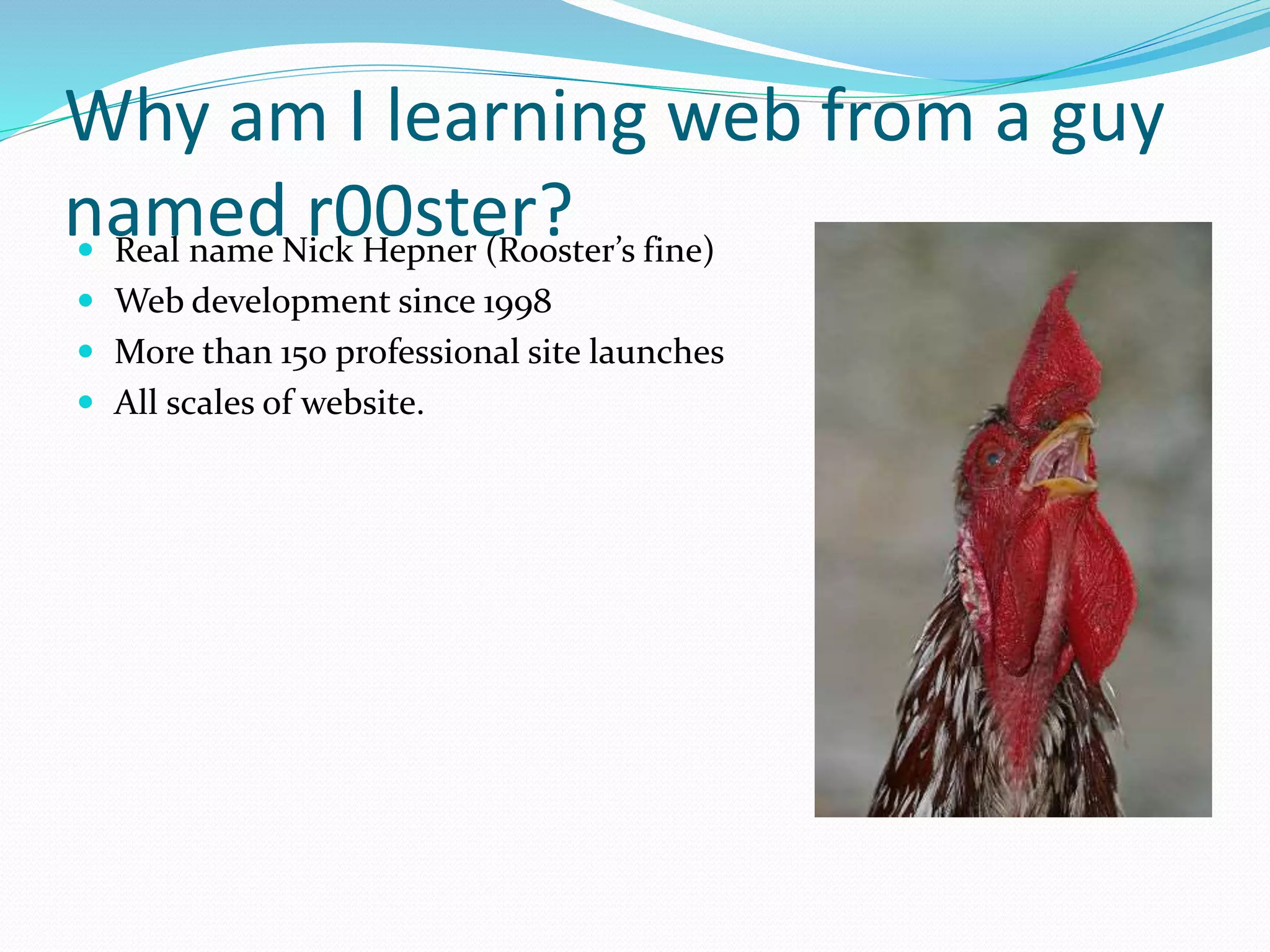
Why am I learning web from a guy
named r00ster? Real name Nick Hepner (Rooster’s fine)
 Web development since 1998
 More than 150 professional site launches
 All scales of website.
Scope of Course
 *AMP stack
 Fundamentals, HTML, PHP
 Components of Web
 Relational Databases
 Code Versioning and Environments
 Web dev workflows and best practices
 Web site builds
Open Source
 Defined by the Open Source Initiative as software that contains
these properties:
 Free Redistribution
 Include Source Code or means to obtain source code
 Allow modifications and “derived works”
 Cannot discriminate against group or persons
 Cannot discriminate against specific endeavor
 Redistributable license (no new agreements are issued)
 License cannot be product specific
 License cannot restrict other software
 License must be technology-neutral
http://opensource.org/docs/osd
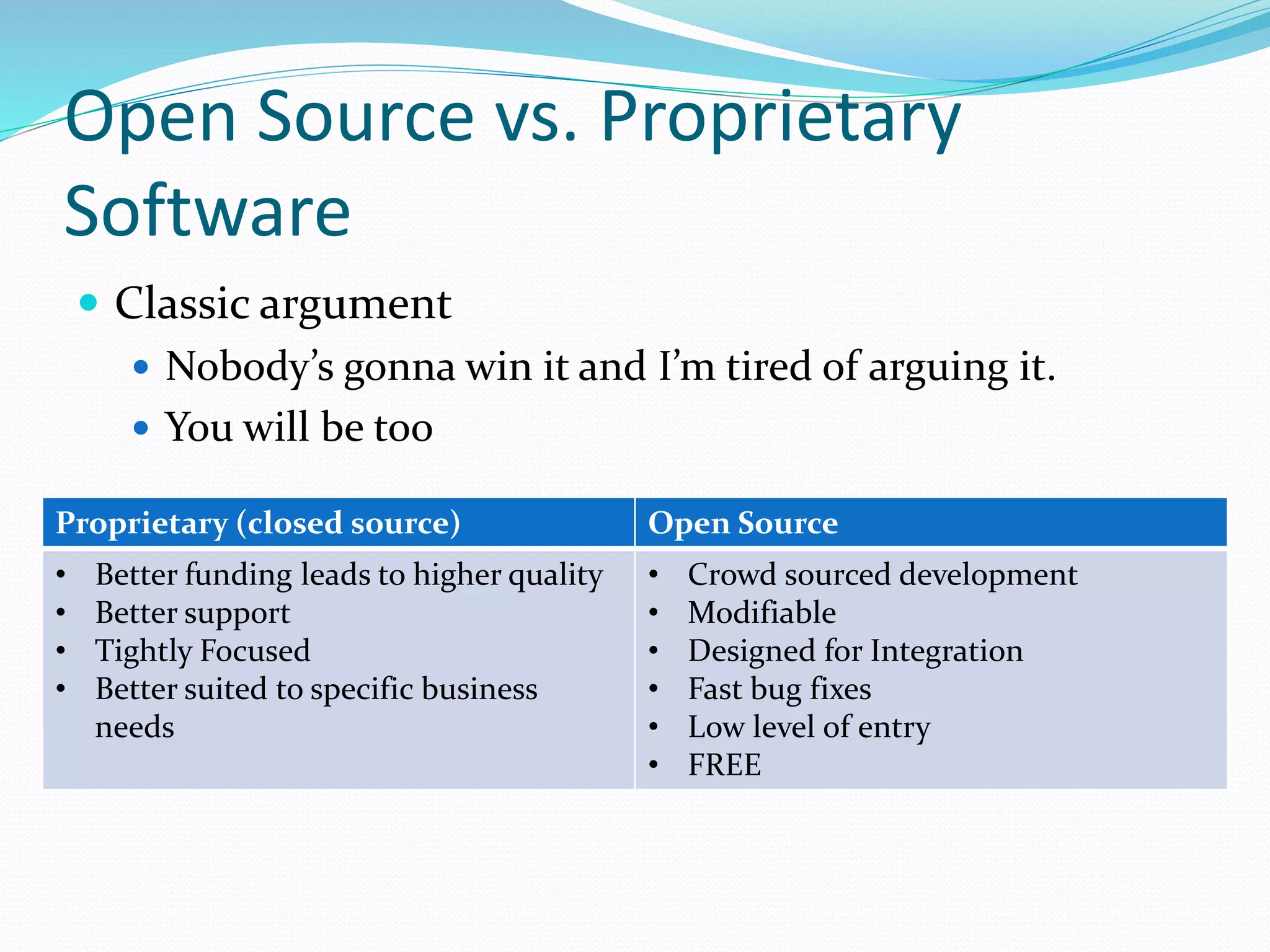
Open Source vs. Proprietary
Software
 Classic argument
 Nobody’s gonna win it and I’m tired of arguing it.
 You will be too
Proprietary (closed source) Open Source
• Better funding leads to higher quality
• Better support
• Tightly Focused
• Better suited to specific business
needs
• Crowd sourced development
• Modifiable
• Designed for Integration
• Fast bug fixes
• Low level of entry
• FREE
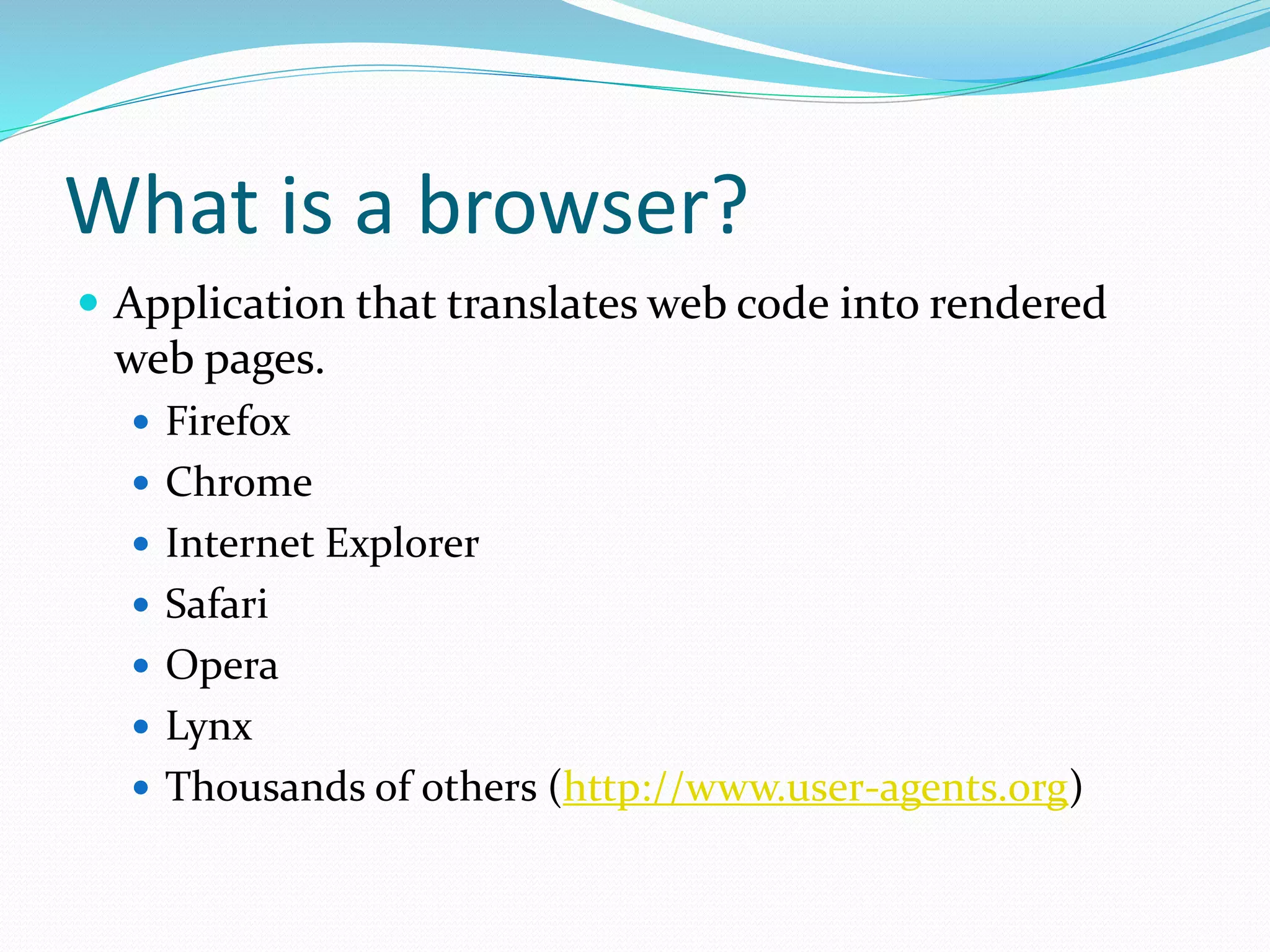
What is a browser?
 Application that translates web code into rendered
web pages.
 Firefox
 Chrome
 Internet Explorer
 Safari
 Opera
 Lynx
 Thousands of others (http://www.user-agents.org)
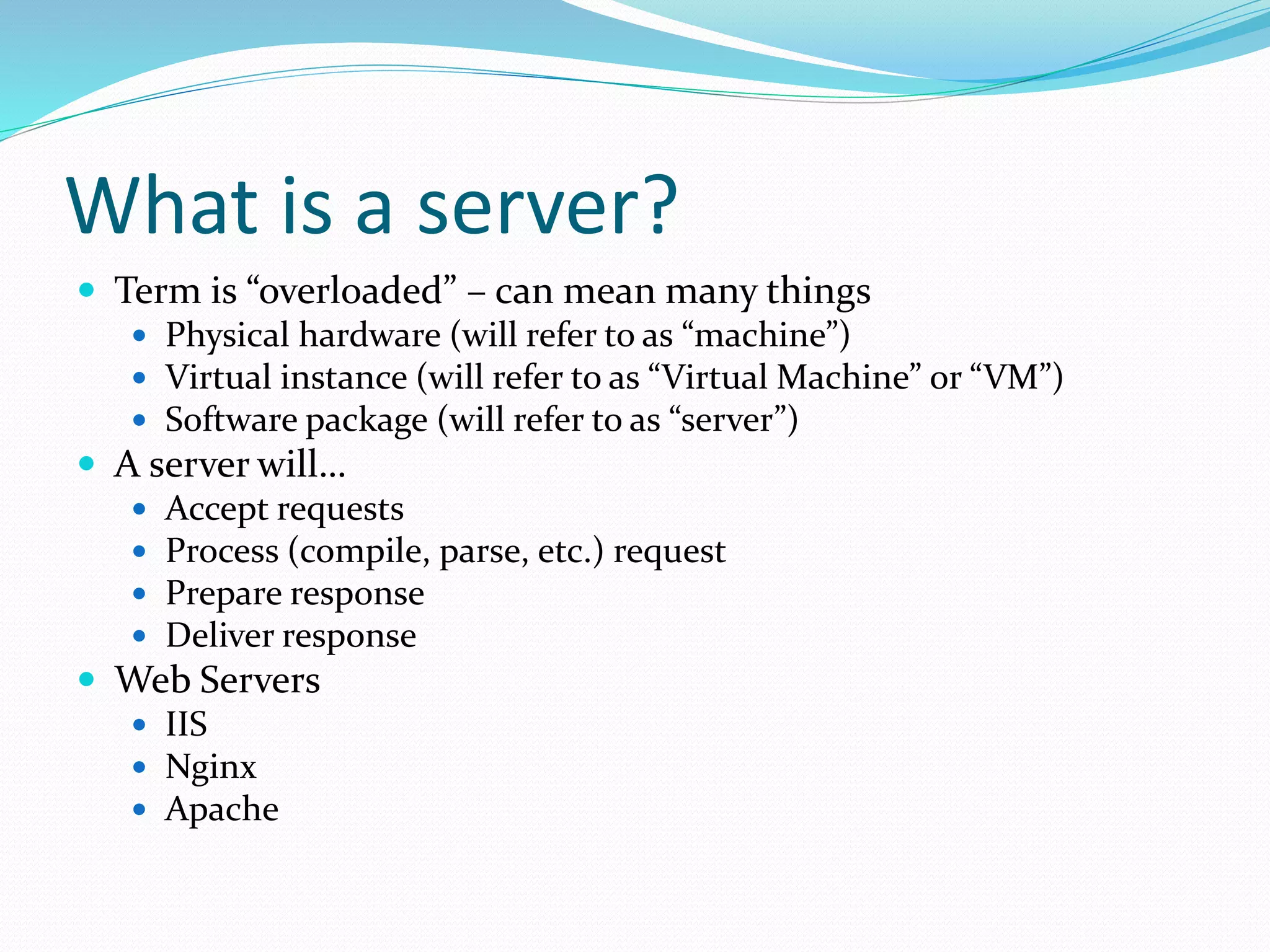
What is a server?
 Term is “overloaded” – can mean many things
 Physical hardware (will refer to as “machine”)
 Virtual instance (will refer to as “Virtual Machine” or “VM”)
 Software package (will refer to as “server”)
 A server will…
 Accept requests
 Process (compile, parse, etc.) request
 Prepare response
 Deliver response
 Web Servers
 IIS
 Nginx
 Apache
What is the Web?
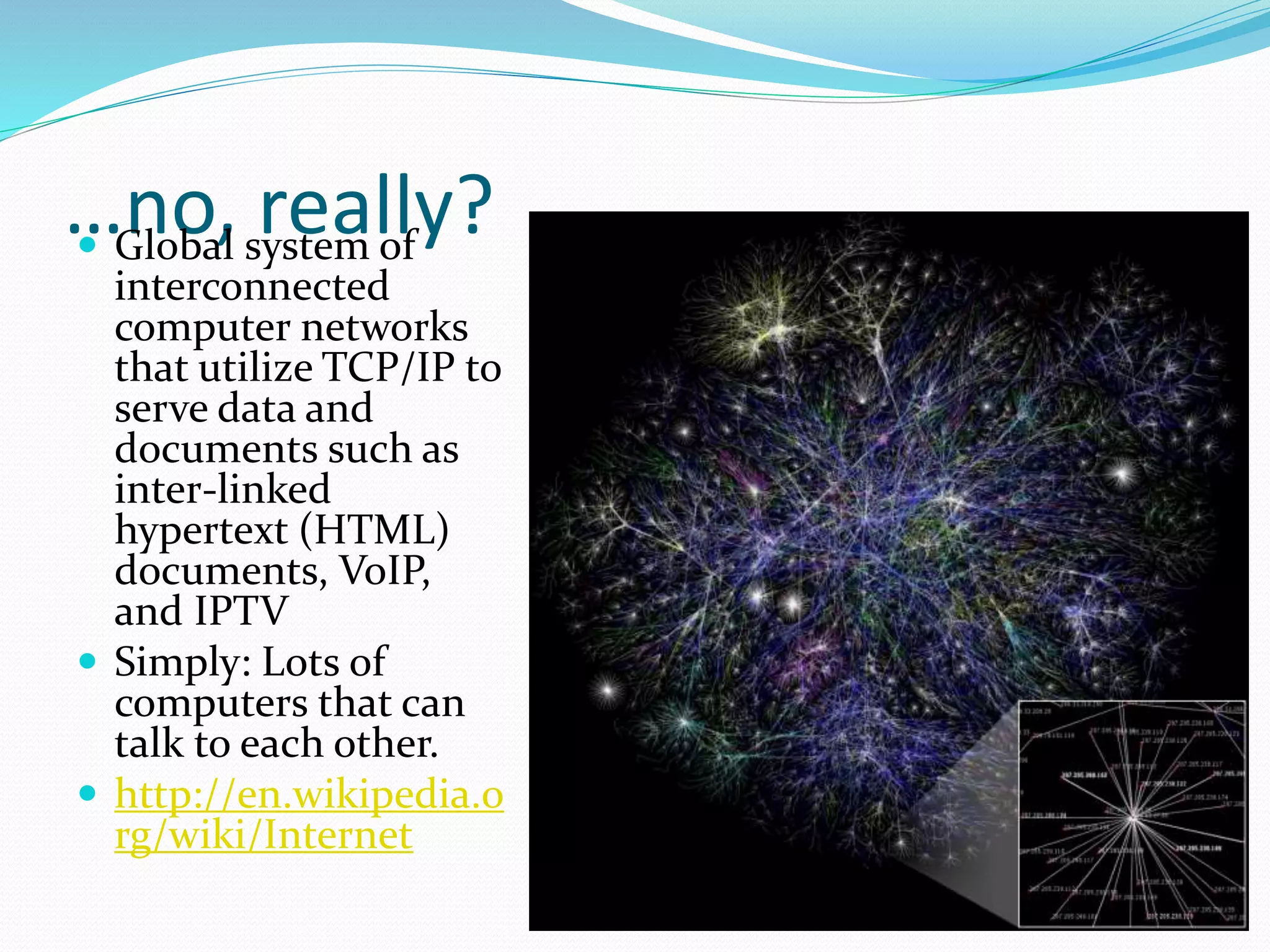
…no, really? Global system of
interconnected
computer networks
that utilize TCP/IP to
serve data and
documents such as
inter-linked
hypertext (HTML)
documents, VoIP,
and IPTV
 Simply: Lots of
computers that can
talk to each other.
 http://en.wikipedia.o
rg/wiki/Internet
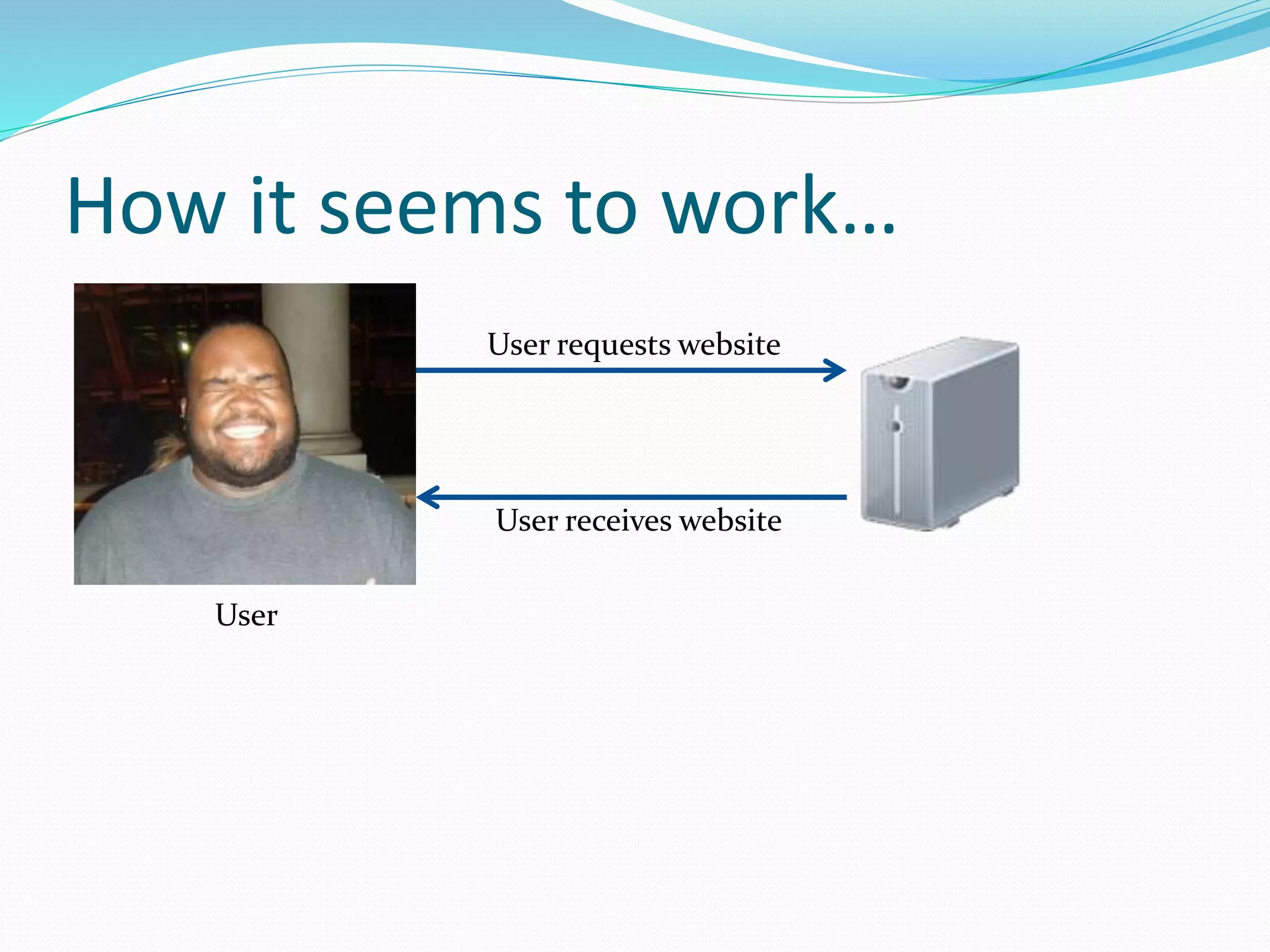
How it seems to work…
User
User requests website
User receives website
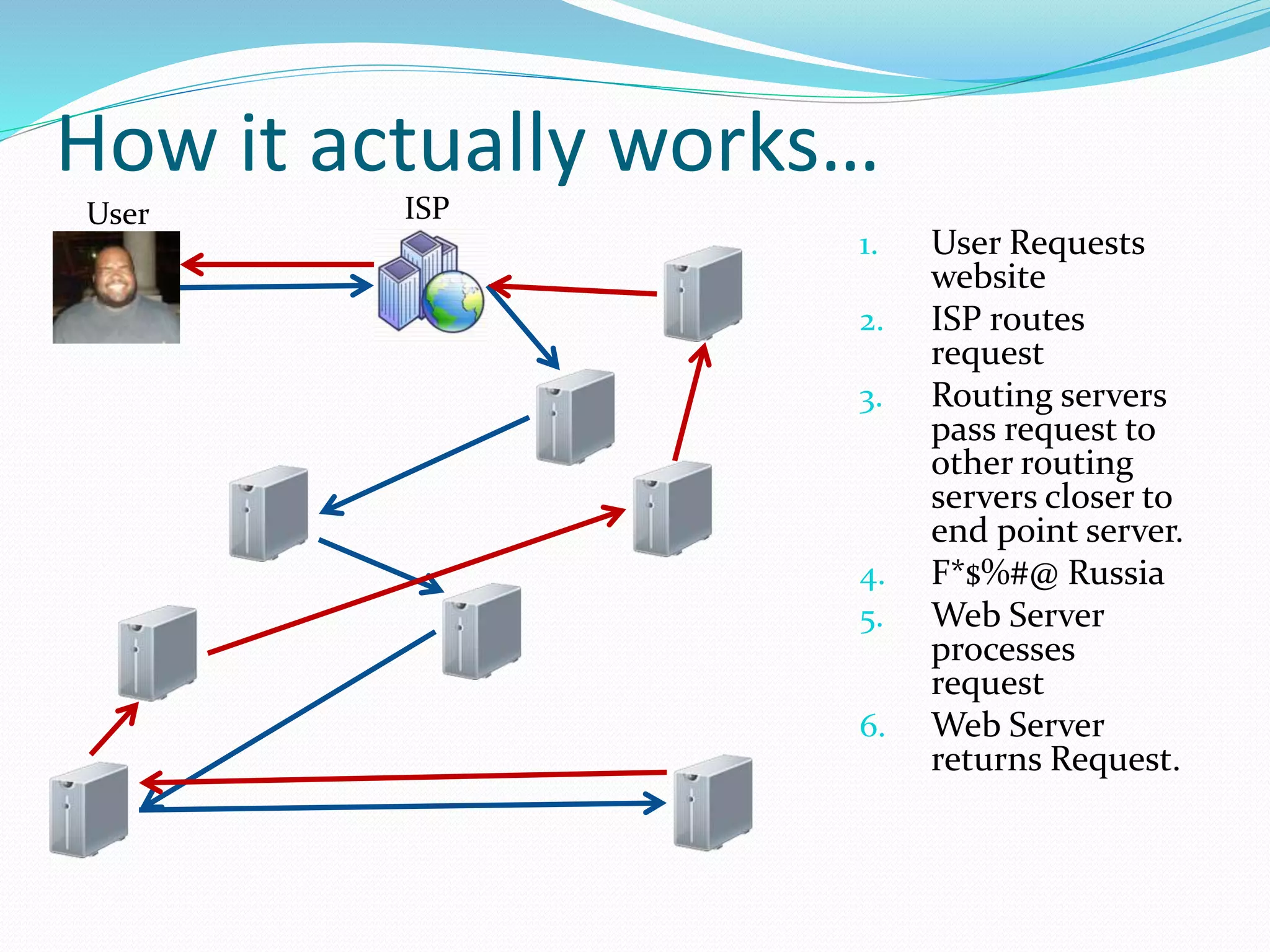
How it actually works…
1. User Requests
website
2. ISP routes
request
3. Routing servers
pass request to
other routing
servers closer to
end point server.
4. F*$%#@ Russia
5. Web Server
processes
request
6. Web Server
returns Request.
User ISP
What is a database?
 System that stores and makes available structured
digital data.
 Data, in this context, will refer to any unique digital
information must be stored for future reference.
A quick word about Operating
Systems…
 “Most” web sites are hosted on Linux.
 Larger enterprise sites tend to be hosted on windows,
but not exclusively.
 Can develop on one system and deploy to another
using cross-platform techniques. Some limitations.
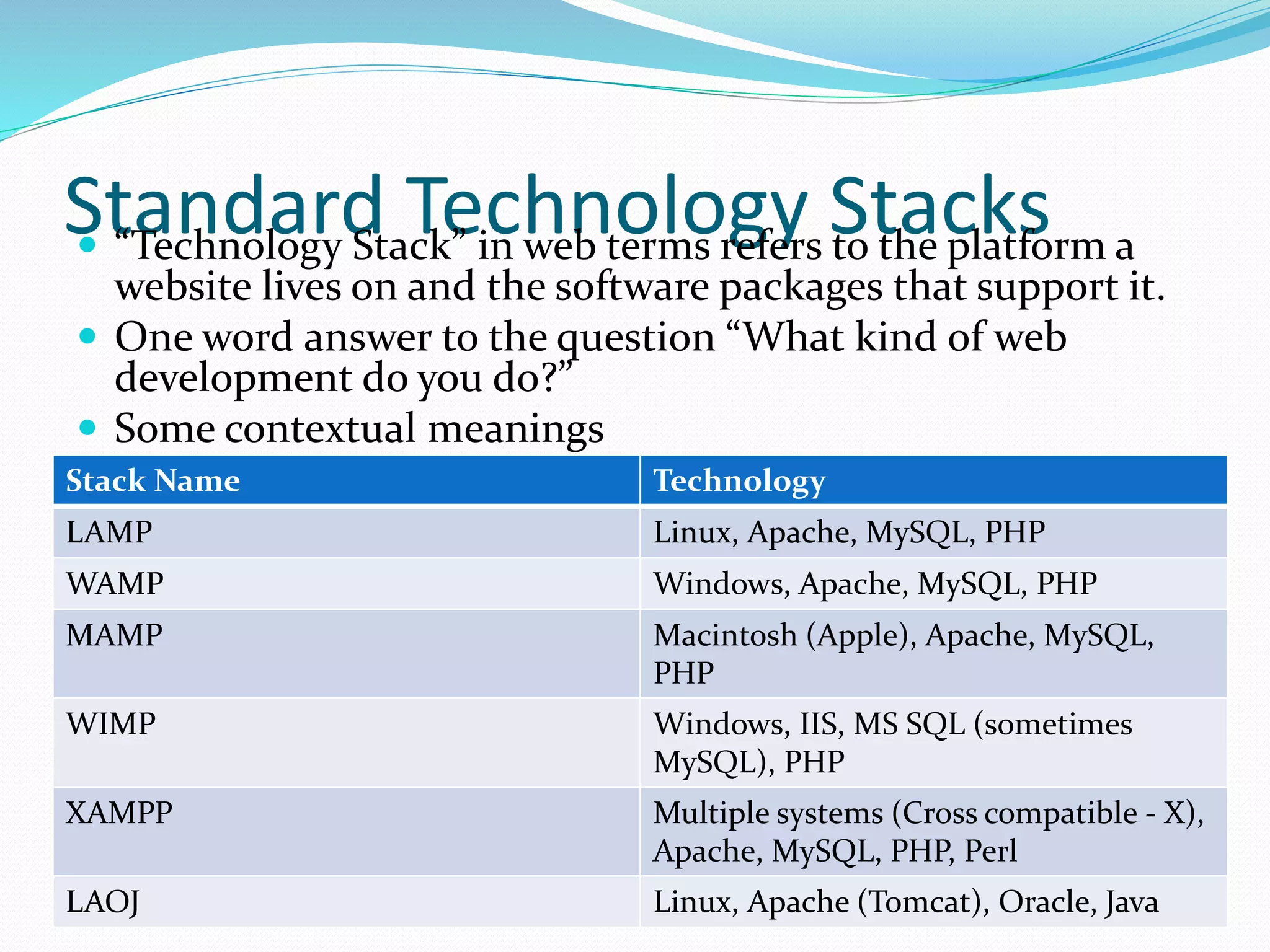
Standard Technology Stacks “Technology Stack” in web terms refers to the platform a
website lives on and the software packages that support it.
 One word answer to the question “What kind of web
development do you do?”
 Some contextual meanings
Stack Name Technology
LAMP Linux, Apache, MySQL, PHP
WAMP Windows, Apache, MySQL, PHP
MAMP Macintosh (Apple), Apache, MySQL,
PHP
WIMP Windows, IIS, MS SQL (sometimes
MySQL), PHP
XAMPP Multiple systems (Cross compatible - X),
Apache, MySQL, PHP, Perl
LAOJ Linux, Apache (Tomcat), Oracle, Java
Compiled Languages, Scripted
Languages and Markup
 Compiled Languages generate machine code from
source code. (.NET, C#, Java, Python)
 Scripted (interpreted) languages. “Step-by-step”
execution of source code. (PHP, Ruby, Coldfusion)
 Compiled languages are much faster, but more
complex. Modern caching strategies make this
irrelevant for web. I’m not getting into this argument.
 Markup (HTML, XML, YAML, Wikitext, BB Code) is a
document description that uses syntax to differentiate
text from display or meta information. Templating
language, no logic
HyperText Markup Language
 Fundamental to web development.
 It says it in the title – this is a Markup Language
 Browsers read HTML documents and render based on
the document description.
 Most web languages generate HTML. CSS and
Javascript are used to enhance HTML.
 XHTML, HTML 5, DHTML
Cascading Style Sheets
 “Presentation Layer” for HTML pages. Allows
customized instruction for browser to read and display
HTML tags.
 Makes websites pretty.
 Interpreted slightly differently by major browsers (I’m
lookin at you IE ಠ_ಠ)
 Unexpectedly difficult to master.
JavaScript
 Allows manipulation of the Document Object Model
 Client side language
 Event driven
 Not even remotely related to Java
 Foundation of Asynchronous JavaScript And XML
eXtensible Markup Language (XML)
 Used to encode documents that are both machine
readable and human readable.
 Used to transfer data between systems and publish
content (RSS, Atom, etc.)
 Used in most “modern” word processors.
Resources
 Google. Seriously.
 WorldWideWeb Consortium (http://w3.org)
 W3Schools (http://www.w3schools.com)
 PHP (www.php.net)
 XAMPP (http://apachefriends.org)

Webtechnologies

  • 1.
    By:jyothish kumar sirigidi Departmentof Computer science & Engineering ADITYA INSTITUTE OF TECHNOLOGY AND MANAGEMENT TEKKALI,A.P
  • 2.
    Why am Ilearning web from a guy named r00ster? Real name Nick Hepner (Rooster’s fine)  Web development since 1998  More than 150 professional site launches  All scales of website.
  • 3.
    Scope of Course *AMP stack  Fundamentals, HTML, PHP  Components of Web  Relational Databases  Code Versioning and Environments  Web dev workflows and best practices  Web site builds
  • 4.
    Open Source  Definedby the Open Source Initiative as software that contains these properties:  Free Redistribution  Include Source Code or means to obtain source code  Allow modifications and “derived works”  Cannot discriminate against group or persons  Cannot discriminate against specific endeavor  Redistributable license (no new agreements are issued)  License cannot be product specific  License cannot restrict other software  License must be technology-neutral http://opensource.org/docs/osd
  • 5.
    Open Source vs.Proprietary Software  Classic argument  Nobody’s gonna win it and I’m tired of arguing it.  You will be too Proprietary (closed source) Open Source • Better funding leads to higher quality • Better support • Tightly Focused • Better suited to specific business needs • Crowd sourced development • Modifiable • Designed for Integration • Fast bug fixes • Low level of entry • FREE
  • 6.
    What is abrowser?  Application that translates web code into rendered web pages.  Firefox  Chrome  Internet Explorer  Safari  Opera  Lynx  Thousands of others (http://www.user-agents.org)
  • 7.
    What is aserver?  Term is “overloaded” – can mean many things  Physical hardware (will refer to as “machine”)  Virtual instance (will refer to as “Virtual Machine” or “VM”)  Software package (will refer to as “server”)  A server will…  Accept requests  Process (compile, parse, etc.) request  Prepare response  Deliver response  Web Servers  IIS  Nginx  Apache
  • 8.
  • 9.
    …no, really? Globalsystem of interconnected computer networks that utilize TCP/IP to serve data and documents such as inter-linked hypertext (HTML) documents, VoIP, and IPTV  Simply: Lots of computers that can talk to each other.  http://en.wikipedia.o rg/wiki/Internet
  • 10.
    How it seemsto work… User User requests website User receives website
  • 11.
    How it actuallyworks… 1. User Requests website 2. ISP routes request 3. Routing servers pass request to other routing servers closer to end point server. 4. F*$%#@ Russia 5. Web Server processes request 6. Web Server returns Request. User ISP
  • 12.
    What is adatabase?  System that stores and makes available structured digital data.  Data, in this context, will refer to any unique digital information must be stored for future reference.
  • 13.
    A quick wordabout Operating Systems…  “Most” web sites are hosted on Linux.  Larger enterprise sites tend to be hosted on windows, but not exclusively.  Can develop on one system and deploy to another using cross-platform techniques. Some limitations.
  • 14.
    Standard Technology Stacks“Technology Stack” in web terms refers to the platform a website lives on and the software packages that support it.  One word answer to the question “What kind of web development do you do?”  Some contextual meanings Stack Name Technology LAMP Linux, Apache, MySQL, PHP WAMP Windows, Apache, MySQL, PHP MAMP Macintosh (Apple), Apache, MySQL, PHP WIMP Windows, IIS, MS SQL (sometimes MySQL), PHP XAMPP Multiple systems (Cross compatible - X), Apache, MySQL, PHP, Perl LAOJ Linux, Apache (Tomcat), Oracle, Java
  • 15.
    Compiled Languages, Scripted Languagesand Markup  Compiled Languages generate machine code from source code. (.NET, C#, Java, Python)  Scripted (interpreted) languages. “Step-by-step” execution of source code. (PHP, Ruby, Coldfusion)  Compiled languages are much faster, but more complex. Modern caching strategies make this irrelevant for web. I’m not getting into this argument.  Markup (HTML, XML, YAML, Wikitext, BB Code) is a document description that uses syntax to differentiate text from display or meta information. Templating language, no logic
  • 16.
    HyperText Markup Language Fundamental to web development.  It says it in the title – this is a Markup Language  Browsers read HTML documents and render based on the document description.  Most web languages generate HTML. CSS and Javascript are used to enhance HTML.  XHTML, HTML 5, DHTML
  • 17.
    Cascading Style Sheets “Presentation Layer” for HTML pages. Allows customized instruction for browser to read and display HTML tags.  Makes websites pretty.  Interpreted slightly differently by major browsers (I’m lookin at you IE ಠ_ಠ)  Unexpectedly difficult to master.
  • 18.
    JavaScript  Allows manipulationof the Document Object Model  Client side language  Event driven  Not even remotely related to Java  Foundation of Asynchronous JavaScript And XML
  • 19.
    eXtensible Markup Language(XML)  Used to encode documents that are both machine readable and human readable.  Used to transfer data between systems and publish content (RSS, Atom, etc.)  Used in most “modern” word processors.
  • 20.
    Resources  Google. Seriously. WorldWideWeb Consortium (http://w3.org)  W3Schools (http://www.w3schools.com)  PHP (www.php.net)  XAMPP (http://apachefriends.org)

Editor's Notes

  • #8 Server takes request, compiles it, prepares it, and delivers it