April 25, 2019
WHAT’S ALL
THE BUZZ
ABOUT?
Mobile engagement and best in breed
technology solutions versus HCMs in the
industry adds struggles to our employers.
Benefits and technology experts can help.
.
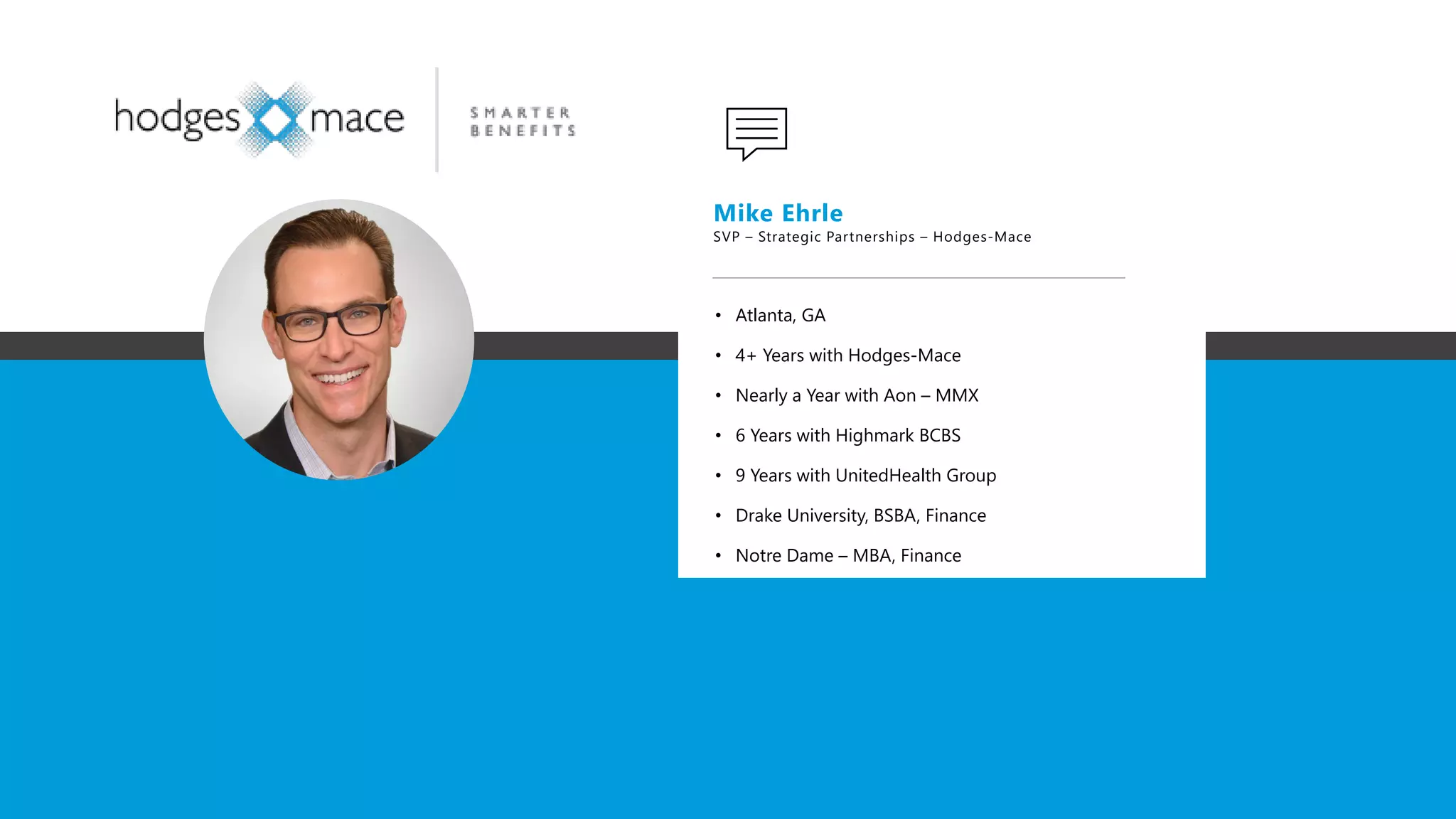
Mike Ehrle
SVP – Strategic Partnerships – Hodges-Mace
• Atlanta, GA
• 4+ Years with Hodges-Mace
• Nearly a Year with Aon – MMX
• 6 Years with Highmark BCBS
• 9 Years with UnitedHealth Group
• Drake University, BSBA, Finance
• Notre Dame – MBA, Finance
.
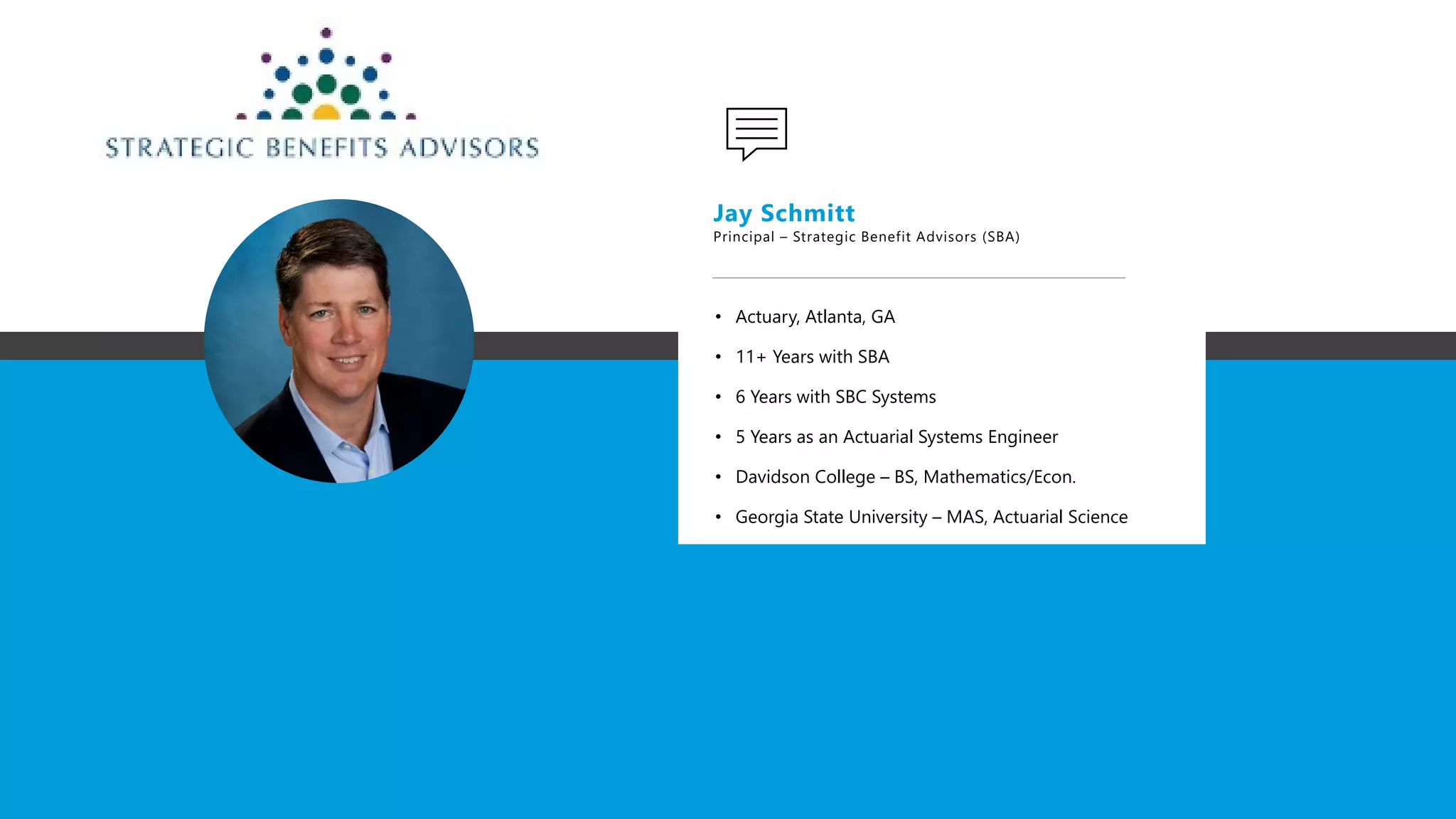
Jay Schmitt
Principal – Strategic Benefit Advisors (SBA)
• Actuary, Atlanta, GA
• 11+ Years with SBA
• 6 Years with SBC Systems
• 5 Years as an Actuarial Systems Engineer
• Davidson College – BS, Mathematics/Econ.
• Georgia State University – MAS, Actuarial Science
What’s happening in
our industry today?
• What are the current trends in the market?
• What is happening with HCM’s?
• Where does mobile and engagement fit in?
• How is the industry preparing for what’s going on?
• How are specialized consultants helping?
• Case studies?
• Open dialogue
What’s happening in our
industry today?
(continued)
• Benefits / HR Departments being asked to do more
with less
• Many internal stakeholders with competing priorities
• Forced shift from tactical thinking to strategic
• Lots of vendors vying for attention
• The emergence of IT, Purchasing and Legal
• “Implementation Fatigue” from prior projects
What are the current
trends in the market?
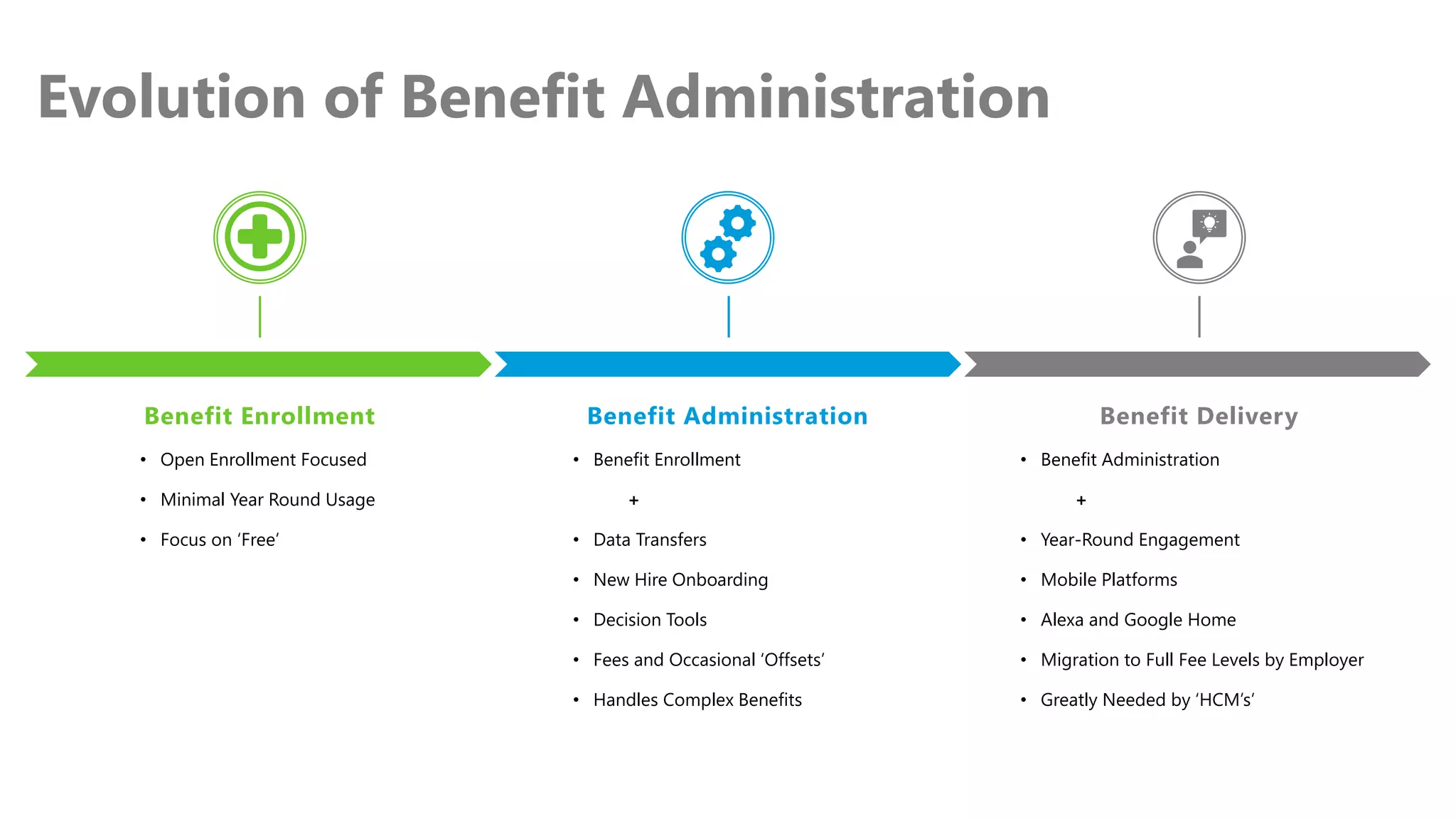
Benefit Enrollment
• Open Enrollment Focused
• Minimal Year Round Usage
• Focus on ‘Free’
Benefit Administration
• Benefit Enrollment
+
• Data Transfers
• New Hire Onboarding
• Decision Tools
• Fees and Occasional ‘Offsets’
• Handles Complex Benefits
Benefit Delivery
• Benefit Administration
+
• Year-Round Engagement
• Mobile Platforms
• Alexa and Google Home
• Migration to Full Fee Levels by Employer
• Greatly Needed by ‘HCM’s’
Evolution of Benefit Administration
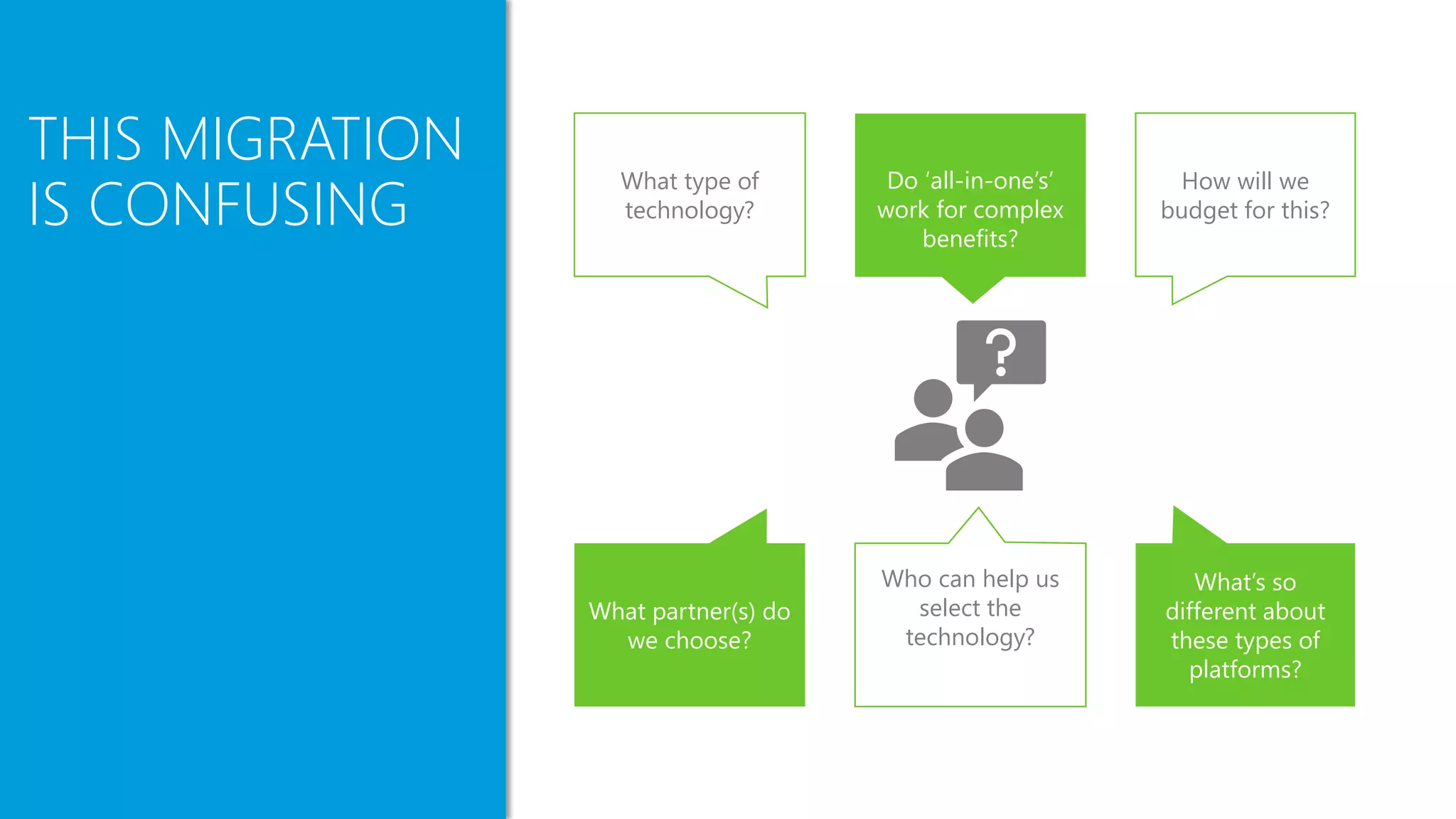
What type of
technology?
Do ‘all-in-one’s’
work for complex
benefits?
How will we
budget for this?
What partner(s) do
we choose?
Who can help us
select the
technology?
What’s so
different about
these types of
platforms?
THIS MIGRATION
IS CONFUSING
There appear to be two
constants in the industry:
Overwhelmed / confused buyers
(both employer and employee)
Medical cost increases and a
myriad of ideas/solutions to
address or mitigate
Overwhelmed / confused buyers
(both employer and employee)
Medical cost increases and a
myriad of ideas/solutions to
address or mitigate
Related trends that sprout from
the above constant challenges:
• ‘Engagement’ is now the rage – but what
does that mean?
• Mobile is more important than ever
• Personalization – Human and AI connections
with multi-generational workforce
• Addressing ‘cohorts’ or subgroups of medical
conditions
• The all-in-one, HCM, sounds great but is
vulnerable
• Partnerships are of greater interest
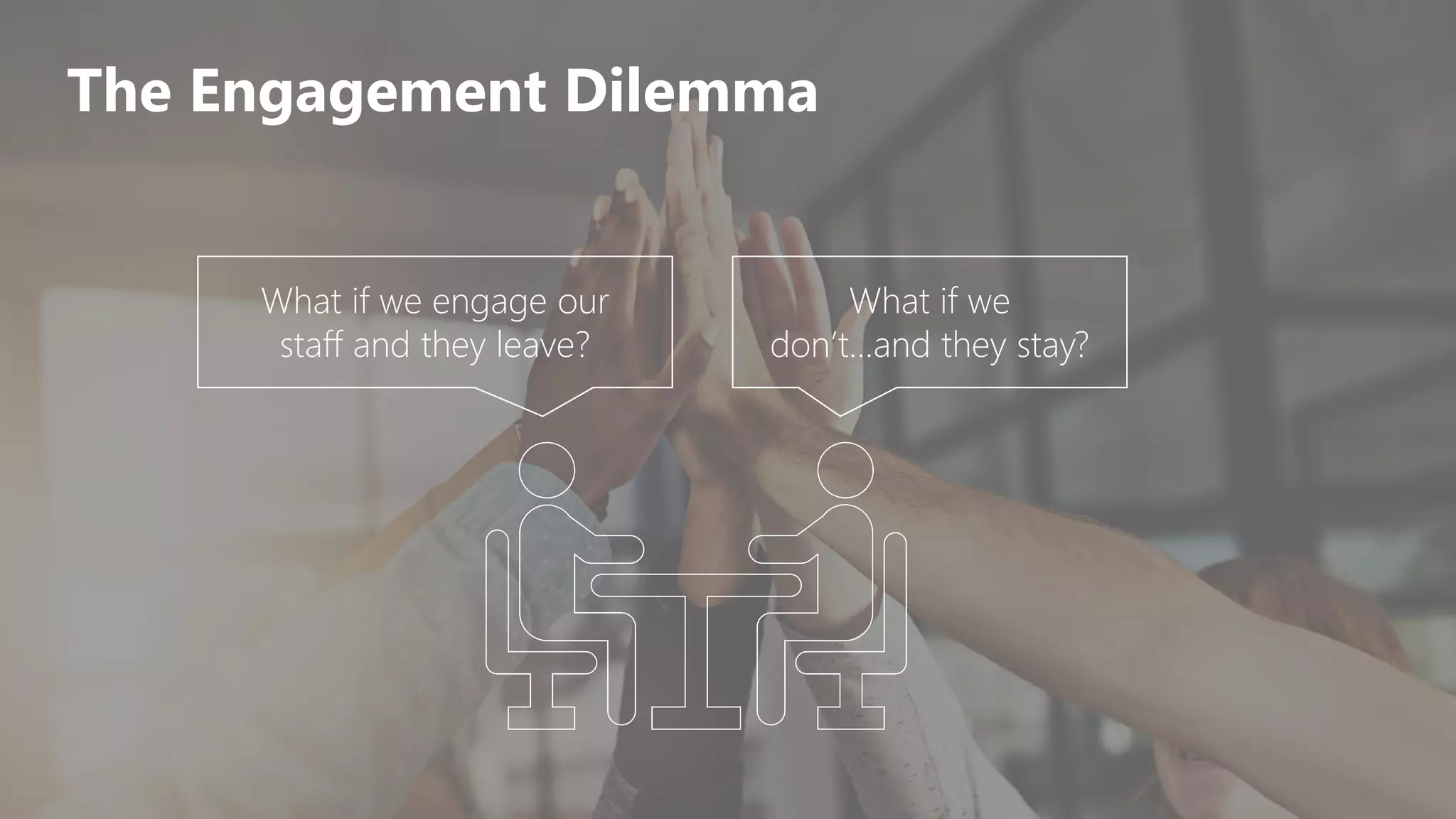
What if we engage our
staff and they leave?
What if we
don’t…and they stay?
The Engagement Dilemma
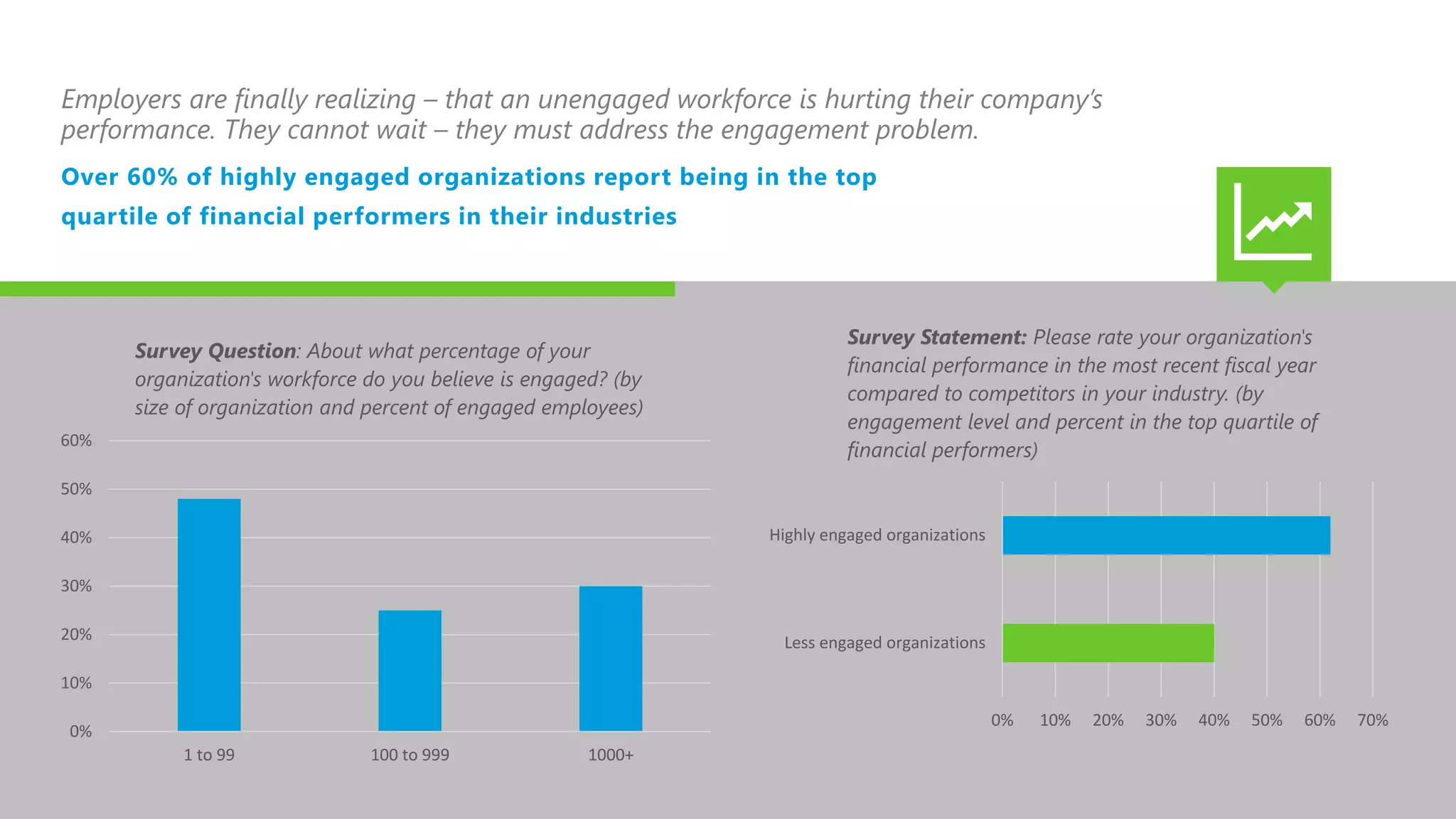
Employers are finally realizing – that an unengaged workforce is hurting their company’s
performance. They cannot wait – they must address the engagement problem.
0%
10%
20%
30%
40%
50%
60%
1 to 99 100 to 999 1000+
Survey Question: About what percentage of your
organization's workforce do you believe is engaged? (by
size of organization and percent of engaged employees)
0% 10% 20% 30% 40% 50% 60% 70%
Less engaged organizations
Highly engaged organizations
Survey Statement: Please rate your organization's
financial performance in the most recent fiscal year
compared to competitors in your industry. (by
engagement level and percent in the top quartile of
financial performers)
Over 60% of highly engaged organizations report being in the top
quartile of financial performers in their industries
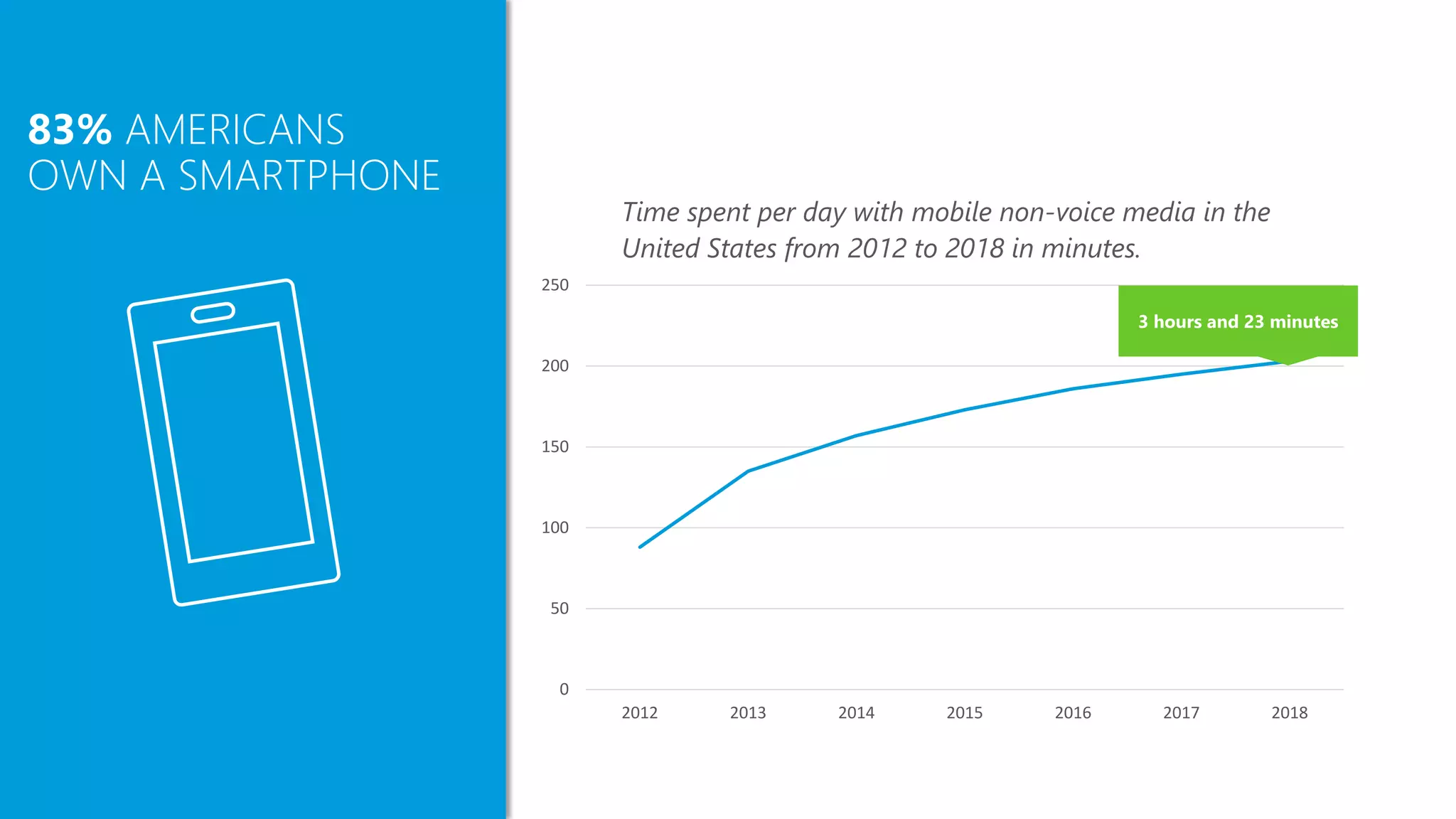
83% AMERICANS
OWN A SMARTPHONE
0
50
100
150
200
250
2012 2013 2014 2015 2016 2017 2018
Time spent per day with mobile non-voice media in the
United States from 2012 to 2018 in minutes.
3 hours and 23 minutes
Paul Greenberg writes:
“In 2018, 253 million Americans spent $1,380 and
91 waking days [each] on their phones.
Cumulatively, that adds up to 370 billion waking
American hours and $349 billion.”
79%
customers
order via
mobile
40%
of Black Friday
sales via
mobile
230
million
Americans own
a smartphone
100
million plus
own a tablet
10%
of all retail
sales are
eCommerce
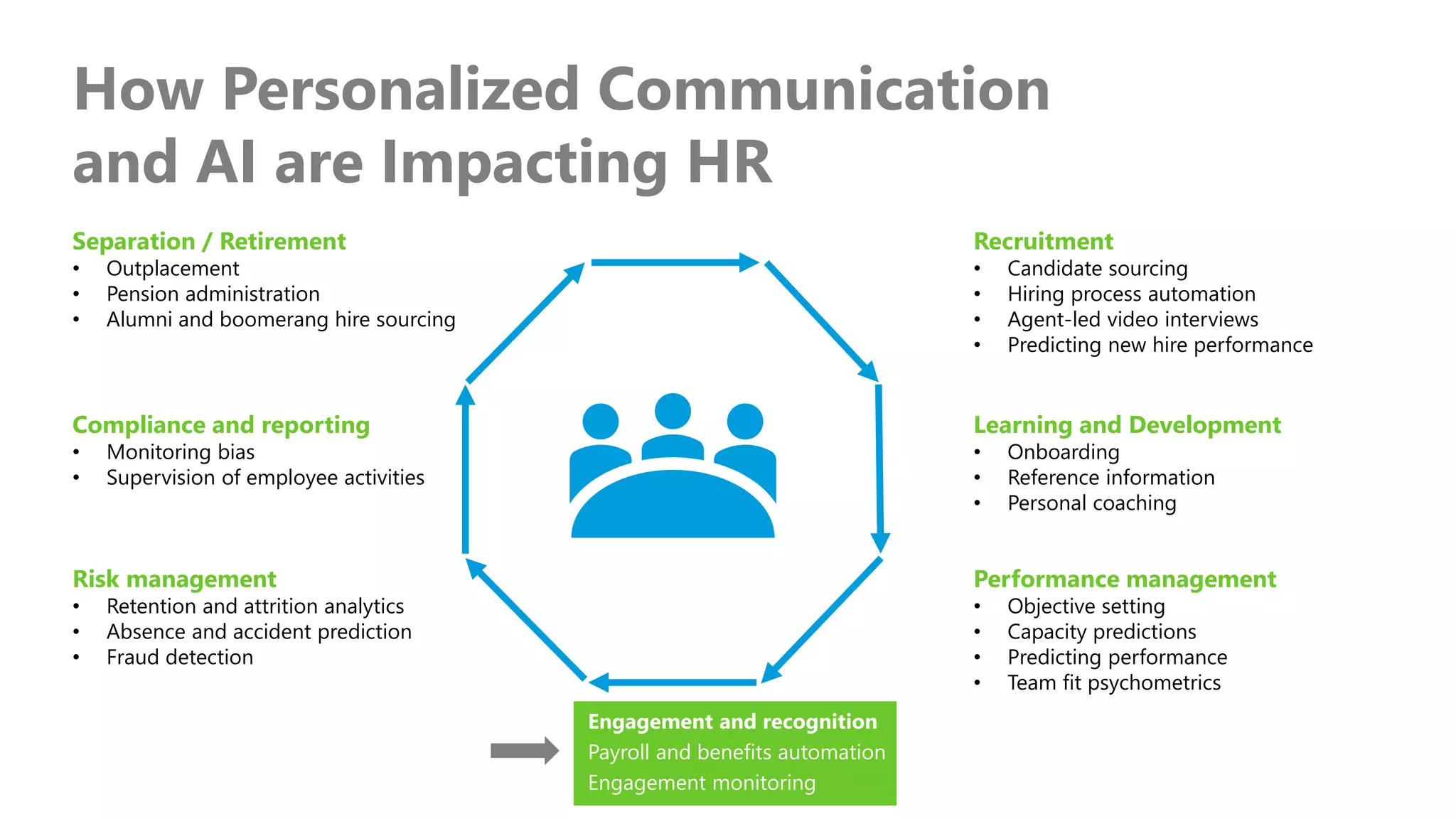
How Personalized Communication
and AI are Impacting HR
Recruitment
• Candidate sourcing
• Hiring process automation
• Agent-led video interviews
• Predicting new hire performance
Learning and Development
• Onboarding
• Reference information
• Personal coaching
Performance management
• Objective setting
• Capacity predictions
• Predicting performance
• Team fit psychometrics
Separation / Retirement
• Outplacement
• Pension administration
• Alumni and boomerang hire sourcing
Compliance and reporting
• Monitoring bias
• Supervision of employee activities
Risk management
• Retention and attrition analytics
• Absence and accident prediction
• Fraud detection
Engagement and recognition
Payroll and benefits automation
Engagement monitoring
Q
PAYROLL HR
BENEFITS
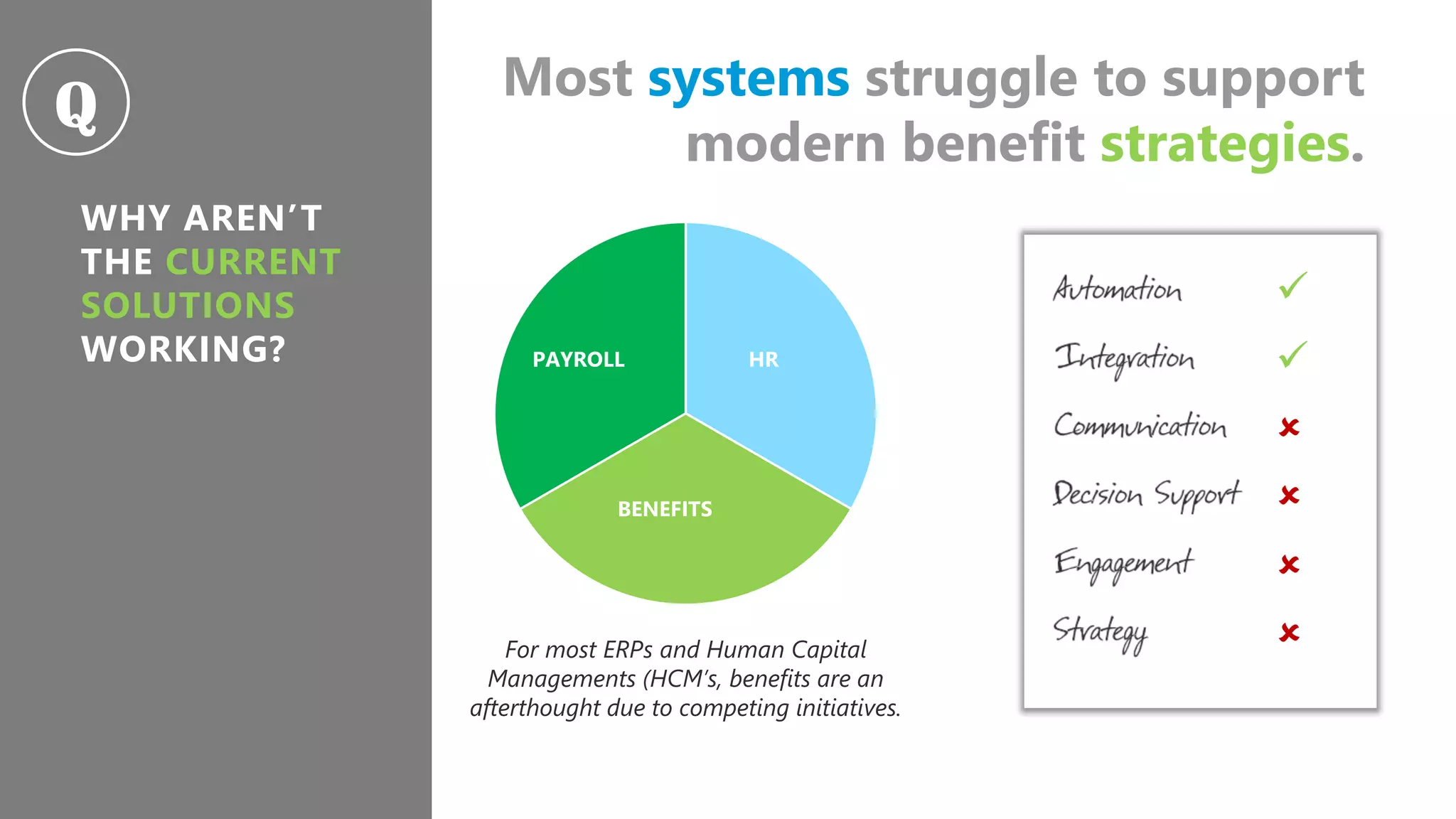
Most systems struggle to support
modern benefit strategies.
WHY AREN’T
THE CURRENT
SOLUTIONS
WORKING?





For most ERPs and Human Capital
Managements (HCM’s, benefits are an
afterthought due to competing initiatives.
WHAT SHOULD
A MODERN
SOLUTION
LOOK LIKE ?
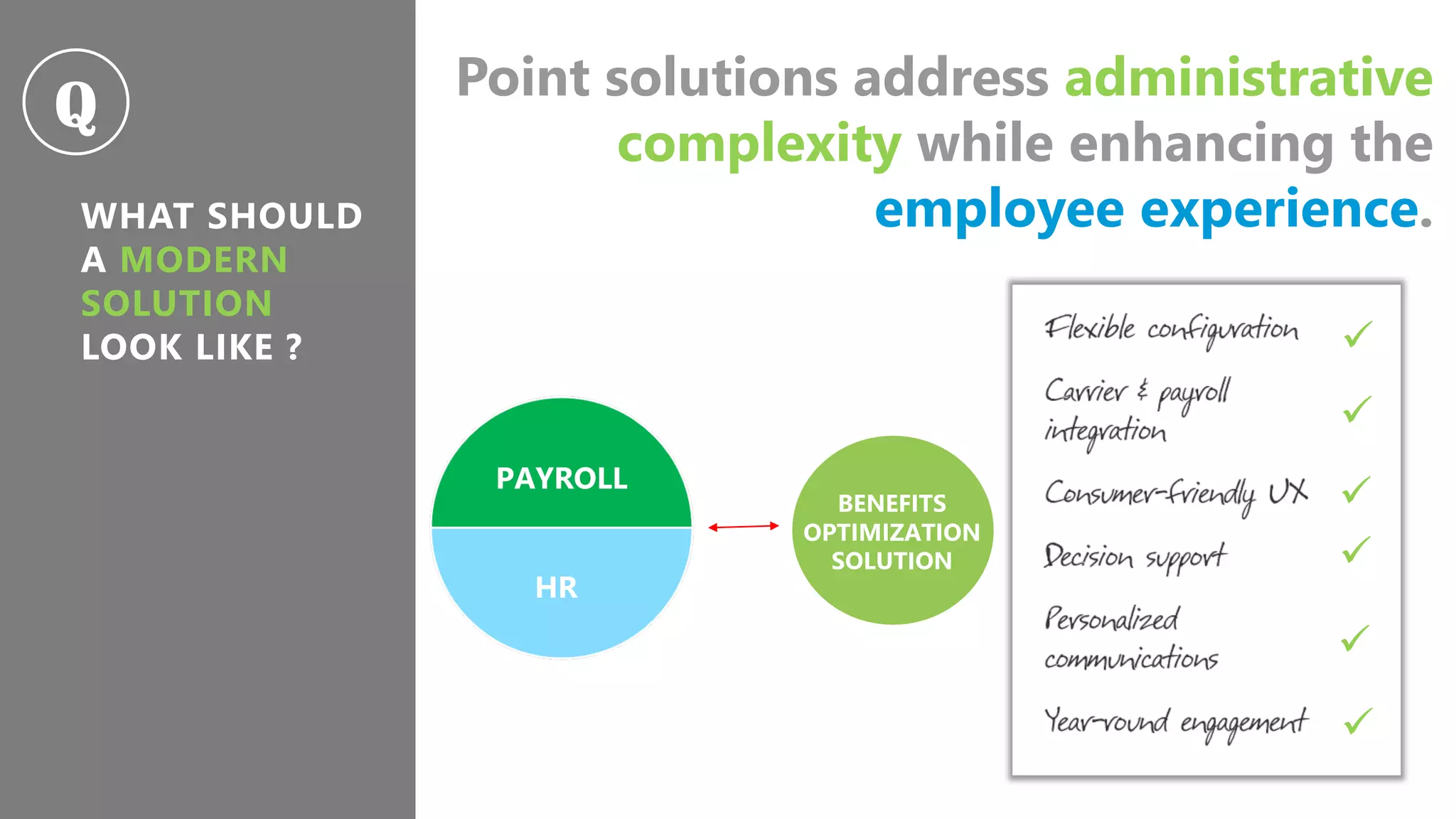
Q Point solutions address administrative
complexity while enhancing the
employee experience.
PAYROLL
HR
BENEFITS
OPTIMIZATION
SOLUTION






HOW IS THE INDUSTRY
PREPARING?
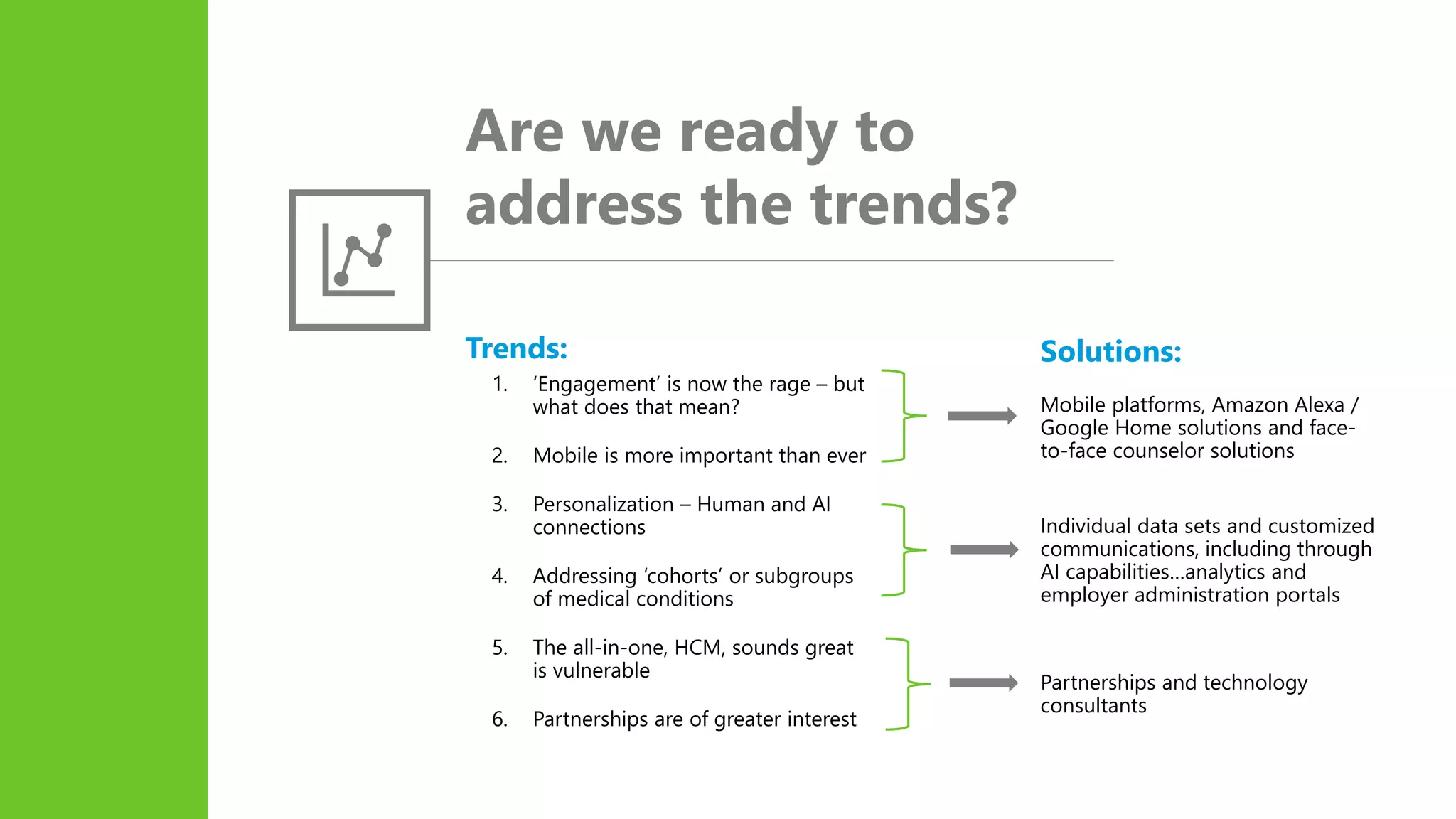
Are we ready to
address the trends?
Trends:
1. ‘Engagement’ is now the rage – but
what does that mean?
2. Mobile is more important than ever
3. Personalization – Human and AI
connections
4. Addressing ‘cohorts’ or subgroups
of medical conditions
5. The all-in-one, HCM, sounds great
is vulnerable
6. Partnerships are of greater interest
Solutions:
Mobile platforms, Amazon Alexa /
Google Home solutions and face-
to-face counselor solutions
Individual data sets and customized
communications, including through
AI capabilities…analytics and
employer administration portals
Partnerships and technology
consultants
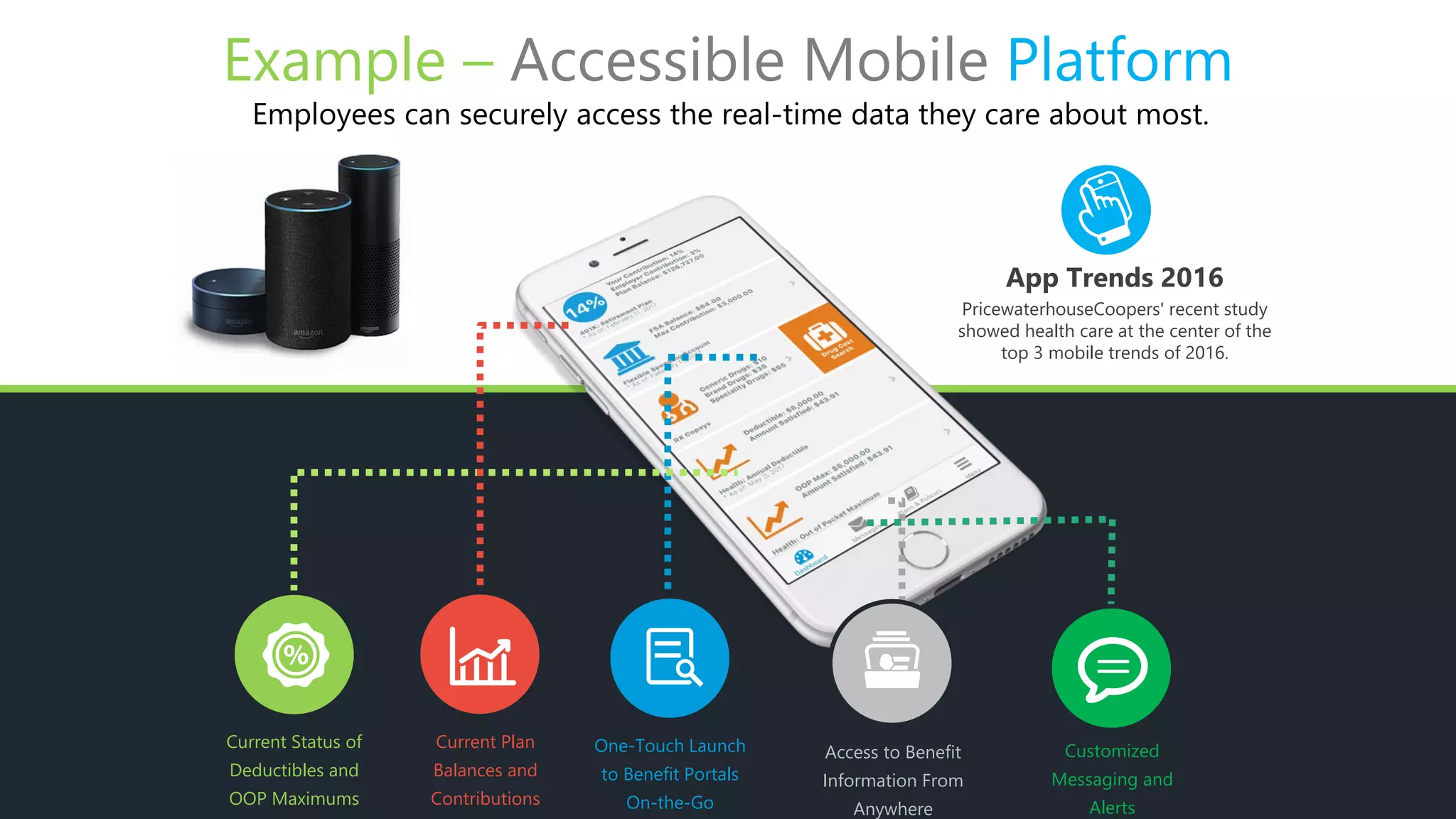
Example – Accessible Mobile Platform
Employees can securely access the real-time data they care about most.
Access to Benefit
Information From
Anywhere
One-Touch Launch
to Benefit Portals
On-the-Go
Current Status of
Deductibles and
OOP Maximums
App Trends 2016
PricewaterhouseCoopers' recent study
showed health care at the center of the
top 3 mobile trends of 2016.
Current Plan
Balances and
Contributions
Customized
Messaging and
Alerts
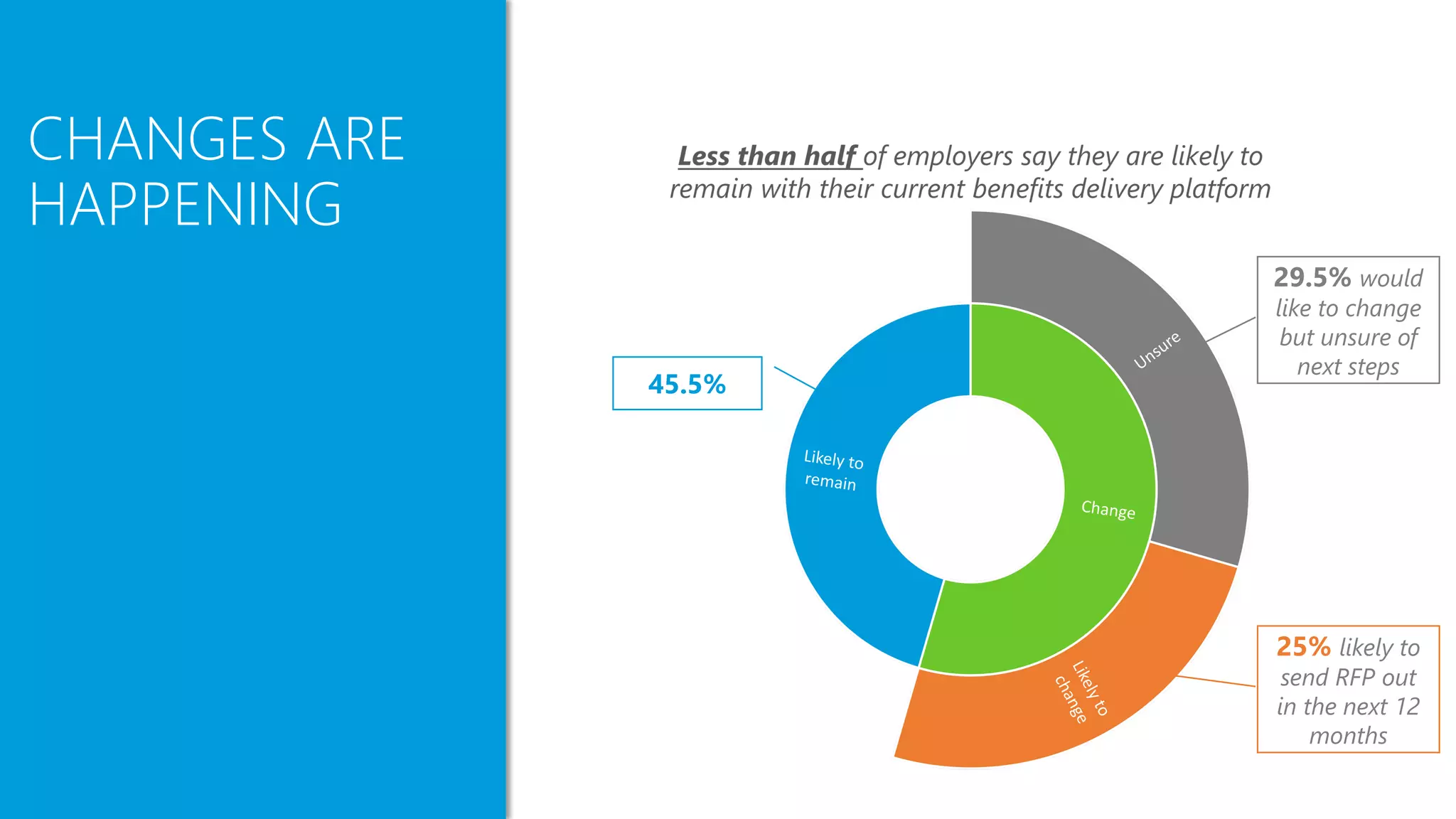
CHANGES ARE
HAPPENING
45.5%
29.5% would
like to change
but unsure of
next steps
25% likely to
send RFP out
in the next 12
months
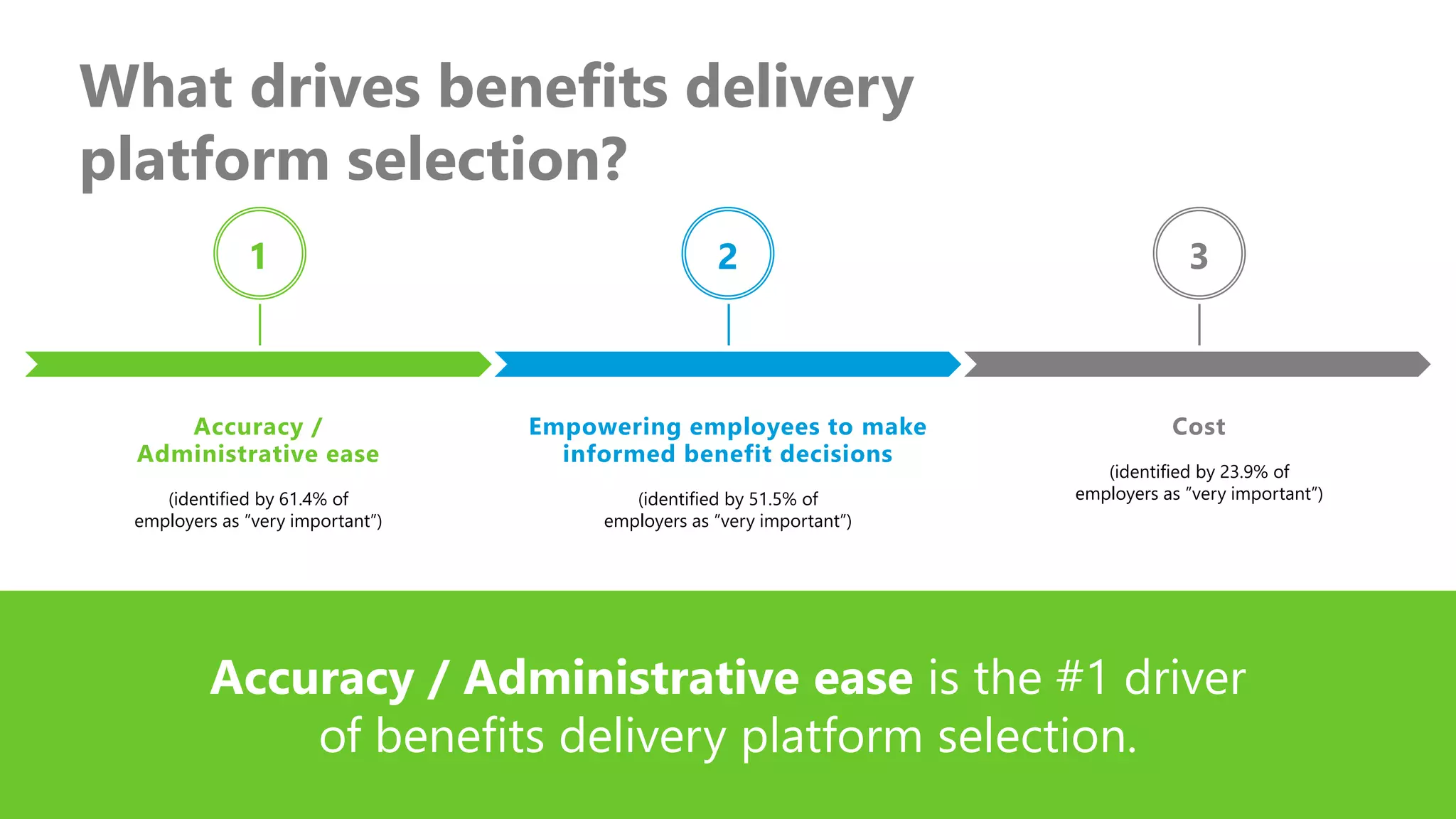
What drives benefits delivery
platform selection?
Accuracy /
Administrative ease
(identified by 61.4% of
employers as ”very important”)
Empowering employees to make
informed benefit decisions
(identified by 51.5% of
employers as ”very important”)
Cost
(identified by 23.9% of
employers as ”very important”)
1 2 3
Accuracy / Administrative ease is the #1 driver
of benefits delivery platform selection.
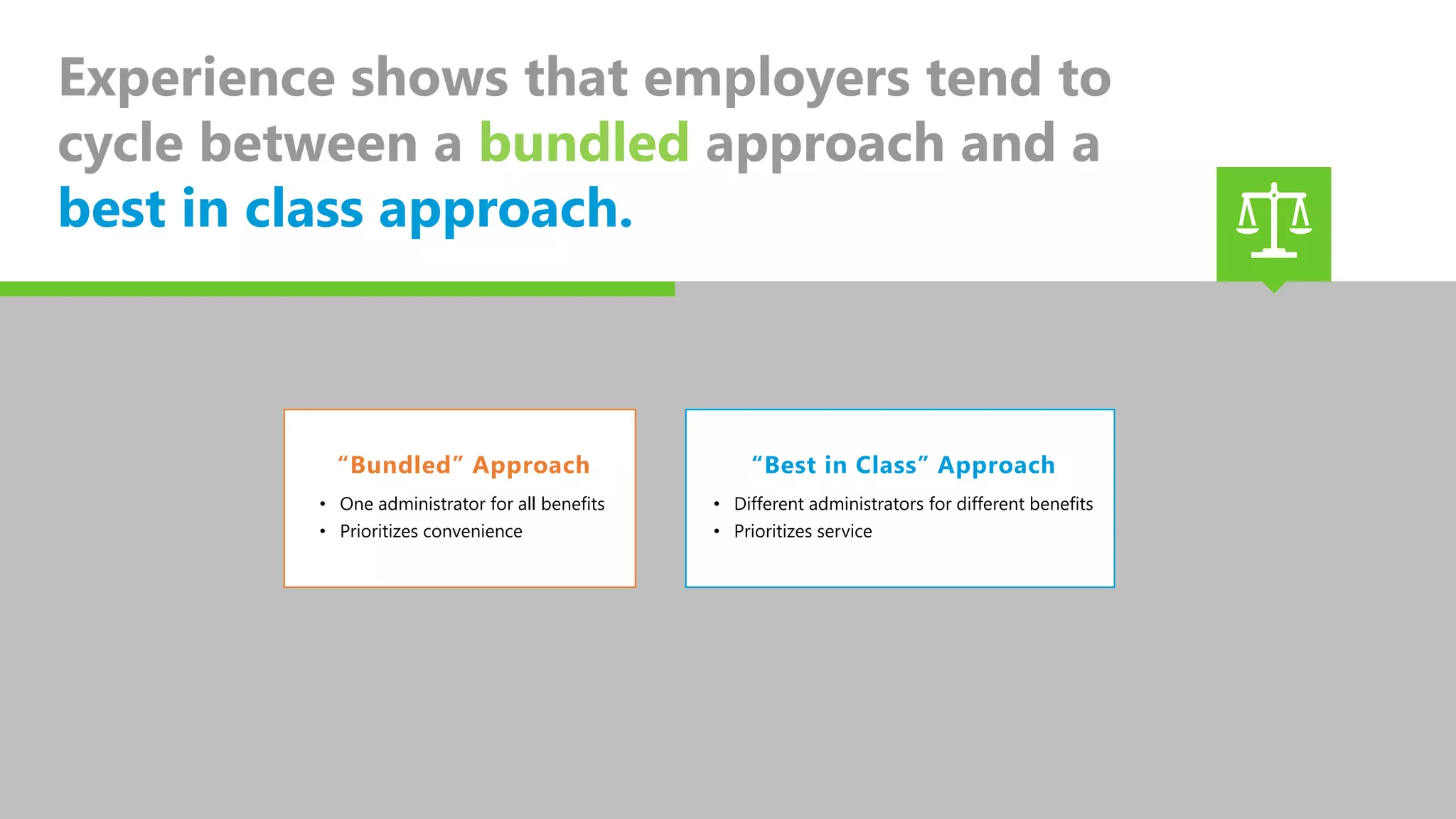
Experience shows that employers tend to
cycle between a bundled approach and a
best in class approach.
“Bundled” Approach
• One administrator for all benefits
• Prioritizes convenience
“Best in Class” Approach
• Different administrators for different benefits
• Prioritizes service
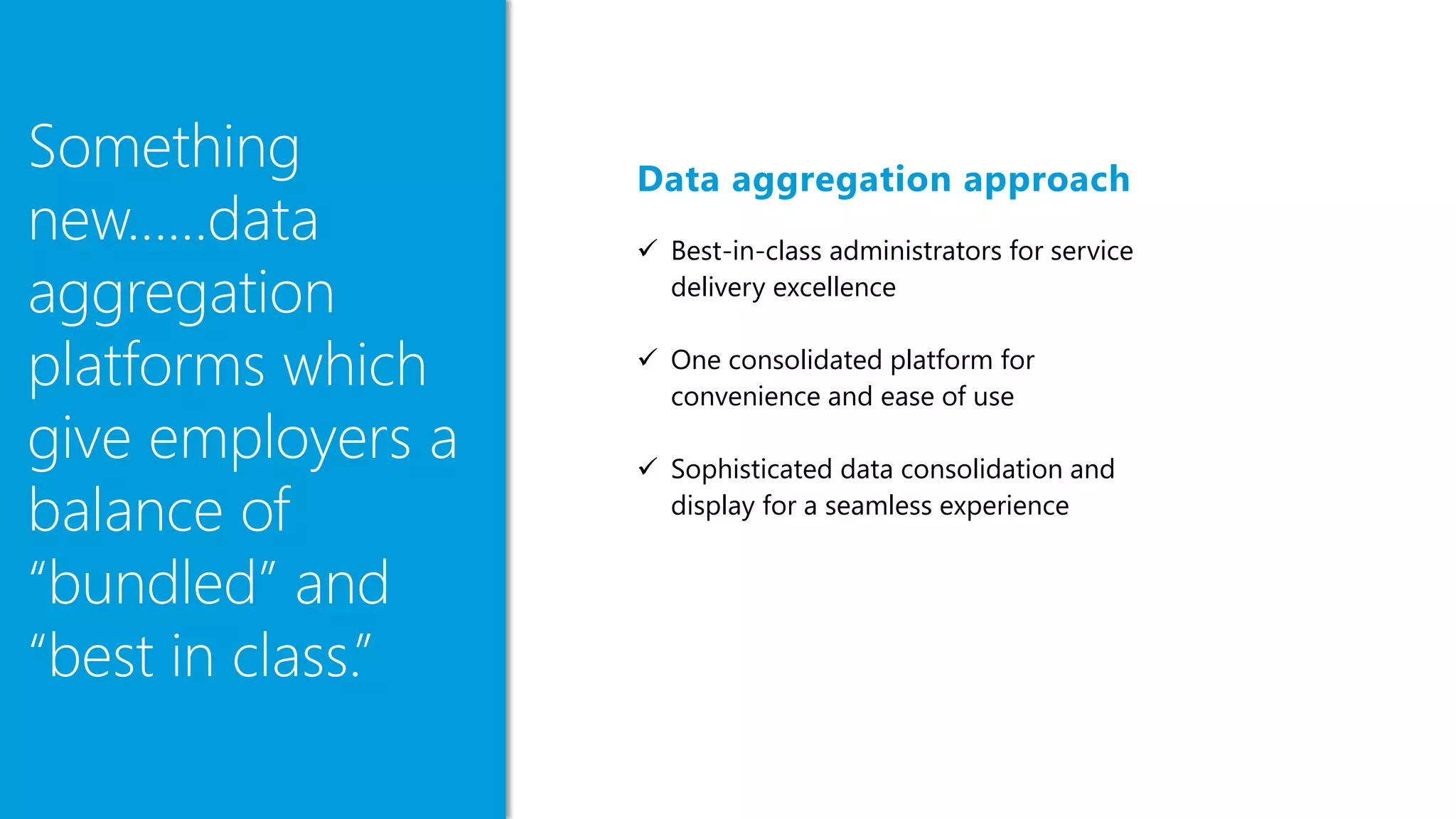
Something
new……data
aggregation
platforms which
give employers a
balance of
“bundled” and
“best in class.”
Data aggregation approach
 Best-in-class administrators for service
delivery excellence
 One consolidated platform for
convenience and ease of use
 Sophisticated data consolidation and
display for a seamless experience
SO, WHAT’S PREVENTING
EMPLOYERS FROM TAKING ADVANTAGE
OF THESE NEW PLATFORMS?
Employer benefits
departments are
already fraught…
• Thinly staffed
• Doing more with less
• Change fatigued
(software implementations,
outsourcing woes, etc.)
• Compliance fatigued
• Emotionally attachment to
costly, existing platforms
(whether they work or not)
…making new technology
implementations a
challenge.
• No time to build a proper business case
• Unsure how to choose the right vendor
• Too many stakeholders involved in the
decision-making (e.g., finance, legal, IT
and procurement)
• Understaffed for proper implementation
• Worried about missteps that will surface
down the road
WHAT’S THE SOLUTION?
Help from an
experienced team
can ensure successful
implementation
of a new benefits
delivery platform.
 Analyze current environment and develop
business case for change
 Assist in identifying ALL internal
stakeholders
 Develop and run a tailored RFP
 Assist with implementation and project
management
 Coordinate with stakeholders across the
business
Case Study -
Strategic Planning
Healthcare Industry
Situation:
A Fortune 100 Healthcare System had numerous internal and external
benefits administration systems that had been pieced together over a
decade. There were multiple client stakeholders across departments (e.g.,
HR, finance, payroll, etc.) with competing objectives.
The client needed an unbiased firm to assess how best control the increasing
cost and inefficiencies of having so many systems.
Result:
• Objectively analyzed solutions solely in the best interest of the client and
in conjunction with the business needs of their vendors.
• Client undertook an initiative to streamline administration systems and
improve internal processes.
• Internal client resources were freed up to perform more strategic work
rather than the tactical day-to-day work required by the inefficient
administration setup.
• Technology partner solidified their relationships with the client, and the
client ended up saving both soft and hard dollars in the long run.
THANK YOU!
Jay Schmitt
Jay.Schmitt@sba-inc.com
404-429-7397
Mike Ehrle
mikeehrle@hodgesmace.com
312-523-1059

WEBINAR: What's all the buzz about? Cutting through the noise to find the right solutions.

  • 1.
    April 25, 2019 WHAT’SALL THE BUZZ ABOUT? Mobile engagement and best in breed technology solutions versus HCMs in the industry adds struggles to our employers. Benefits and technology experts can help.
  • 2.
    . Mike Ehrle SVP –Strategic Partnerships – Hodges-Mace • Atlanta, GA • 4+ Years with Hodges-Mace • Nearly a Year with Aon – MMX • 6 Years with Highmark BCBS • 9 Years with UnitedHealth Group • Drake University, BSBA, Finance • Notre Dame – MBA, Finance
  • 3.
    . Jay Schmitt Principal –Strategic Benefit Advisors (SBA) • Actuary, Atlanta, GA • 11+ Years with SBA • 6 Years with SBC Systems • 5 Years as an Actuarial Systems Engineer • Davidson College – BS, Mathematics/Econ. • Georgia State University – MAS, Actuarial Science
  • 4.
    What’s happening in ourindustry today? • What are the current trends in the market? • What is happening with HCM’s? • Where does mobile and engagement fit in? • How is the industry preparing for what’s going on? • How are specialized consultants helping? • Case studies? • Open dialogue
  • 5.
    What’s happening inour industry today? (continued) • Benefits / HR Departments being asked to do more with less • Many internal stakeholders with competing priorities • Forced shift from tactical thinking to strategic • Lots of vendors vying for attention • The emergence of IT, Purchasing and Legal • “Implementation Fatigue” from prior projects
  • 6.
    What are thecurrent trends in the market?
  • 7.
    Benefit Enrollment • OpenEnrollment Focused • Minimal Year Round Usage • Focus on ‘Free’ Benefit Administration • Benefit Enrollment + • Data Transfers • New Hire Onboarding • Decision Tools • Fees and Occasional ‘Offsets’ • Handles Complex Benefits Benefit Delivery • Benefit Administration + • Year-Round Engagement • Mobile Platforms • Alexa and Google Home • Migration to Full Fee Levels by Employer • Greatly Needed by ‘HCM’s’ Evolution of Benefit Administration
  • 8.
    What type of technology? Do‘all-in-one’s’ work for complex benefits? How will we budget for this? What partner(s) do we choose? Who can help us select the technology? What’s so different about these types of platforms? THIS MIGRATION IS CONFUSING
  • 9.
    There appear tobe two constants in the industry: Overwhelmed / confused buyers (both employer and employee) Medical cost increases and a myriad of ideas/solutions to address or mitigate
  • 10.
    Overwhelmed / confusedbuyers (both employer and employee) Medical cost increases and a myriad of ideas/solutions to address or mitigate Related trends that sprout from the above constant challenges: • ‘Engagement’ is now the rage – but what does that mean? • Mobile is more important than ever • Personalization – Human and AI connections with multi-generational workforce • Addressing ‘cohorts’ or subgroups of medical conditions • The all-in-one, HCM, sounds great but is vulnerable • Partnerships are of greater interest
  • 11.
    What if weengage our staff and they leave? What if we don’t…and they stay? The Engagement Dilemma
  • 12.
    Employers are finallyrealizing – that an unengaged workforce is hurting their company’s performance. They cannot wait – they must address the engagement problem. 0% 10% 20% 30% 40% 50% 60% 1 to 99 100 to 999 1000+ Survey Question: About what percentage of your organization's workforce do you believe is engaged? (by size of organization and percent of engaged employees) 0% 10% 20% 30% 40% 50% 60% 70% Less engaged organizations Highly engaged organizations Survey Statement: Please rate your organization's financial performance in the most recent fiscal year compared to competitors in your industry. (by engagement level and percent in the top quartile of financial performers) Over 60% of highly engaged organizations report being in the top quartile of financial performers in their industries
  • 13.
    83% AMERICANS OWN ASMARTPHONE 0 50 100 150 200 250 2012 2013 2014 2015 2016 2017 2018 Time spent per day with mobile non-voice media in the United States from 2012 to 2018 in minutes. 3 hours and 23 minutes
  • 14.
    Paul Greenberg writes: “In2018, 253 million Americans spent $1,380 and 91 waking days [each] on their phones. Cumulatively, that adds up to 370 billion waking American hours and $349 billion.” 79% customers order via mobile 40% of Black Friday sales via mobile 230 million Americans own a smartphone 100 million plus own a tablet 10% of all retail sales are eCommerce
  • 15.
    How Personalized Communication andAI are Impacting HR Recruitment • Candidate sourcing • Hiring process automation • Agent-led video interviews • Predicting new hire performance Learning and Development • Onboarding • Reference information • Personal coaching Performance management • Objective setting • Capacity predictions • Predicting performance • Team fit psychometrics Separation / Retirement • Outplacement • Pension administration • Alumni and boomerang hire sourcing Compliance and reporting • Monitoring bias • Supervision of employee activities Risk management • Retention and attrition analytics • Absence and accident prediction • Fraud detection Engagement and recognition Payroll and benefits automation Engagement monitoring
  • 16.
    Q PAYROLL HR BENEFITS Most systemsstruggle to support modern benefit strategies. WHY AREN’T THE CURRENT SOLUTIONS WORKING?      For most ERPs and Human Capital Managements (HCM’s, benefits are an afterthought due to competing initiatives.
  • 17.
    WHAT SHOULD A MODERN SOLUTION LOOKLIKE ? Q Point solutions address administrative complexity while enhancing the employee experience. PAYROLL HR BENEFITS OPTIMIZATION SOLUTION      
  • 18.
    HOW IS THEINDUSTRY PREPARING?
  • 19.
    Are we readyto address the trends? Trends: 1. ‘Engagement’ is now the rage – but what does that mean? 2. Mobile is more important than ever 3. Personalization – Human and AI connections 4. Addressing ‘cohorts’ or subgroups of medical conditions 5. The all-in-one, HCM, sounds great is vulnerable 6. Partnerships are of greater interest Solutions: Mobile platforms, Amazon Alexa / Google Home solutions and face- to-face counselor solutions Individual data sets and customized communications, including through AI capabilities…analytics and employer administration portals Partnerships and technology consultants
  • 20.
    Example – AccessibleMobile Platform Employees can securely access the real-time data they care about most. Access to Benefit Information From Anywhere One-Touch Launch to Benefit Portals On-the-Go Current Status of Deductibles and OOP Maximums App Trends 2016 PricewaterhouseCoopers' recent study showed health care at the center of the top 3 mobile trends of 2016. Current Plan Balances and Contributions Customized Messaging and Alerts
  • 22.
    CHANGES ARE HAPPENING 45.5% 29.5% would liketo change but unsure of next steps 25% likely to send RFP out in the next 12 months
  • 23.
    What drives benefitsdelivery platform selection? Accuracy / Administrative ease (identified by 61.4% of employers as ”very important”) Empowering employees to make informed benefit decisions (identified by 51.5% of employers as ”very important”) Cost (identified by 23.9% of employers as ”very important”) 1 2 3 Accuracy / Administrative ease is the #1 driver of benefits delivery platform selection.
  • 24.
    Experience shows thatemployers tend to cycle between a bundled approach and a best in class approach. “Bundled” Approach • One administrator for all benefits • Prioritizes convenience “Best in Class” Approach • Different administrators for different benefits • Prioritizes service
  • 25.
    Something new……data aggregation platforms which give employersa balance of “bundled” and “best in class.” Data aggregation approach  Best-in-class administrators for service delivery excellence  One consolidated platform for convenience and ease of use  Sophisticated data consolidation and display for a seamless experience
  • 26.
    SO, WHAT’S PREVENTING EMPLOYERSFROM TAKING ADVANTAGE OF THESE NEW PLATFORMS?
  • 27.
    Employer benefits departments are alreadyfraught… • Thinly staffed • Doing more with less • Change fatigued (software implementations, outsourcing woes, etc.) • Compliance fatigued • Emotionally attachment to costly, existing platforms (whether they work or not) …making new technology implementations a challenge. • No time to build a proper business case • Unsure how to choose the right vendor • Too many stakeholders involved in the decision-making (e.g., finance, legal, IT and procurement) • Understaffed for proper implementation • Worried about missteps that will surface down the road
  • 28.
  • 29.
    Help from an experiencedteam can ensure successful implementation of a new benefits delivery platform.  Analyze current environment and develop business case for change  Assist in identifying ALL internal stakeholders  Develop and run a tailored RFP  Assist with implementation and project management  Coordinate with stakeholders across the business
  • 30.
    Case Study - StrategicPlanning Healthcare Industry Situation: A Fortune 100 Healthcare System had numerous internal and external benefits administration systems that had been pieced together over a decade. There were multiple client stakeholders across departments (e.g., HR, finance, payroll, etc.) with competing objectives. The client needed an unbiased firm to assess how best control the increasing cost and inefficiencies of having so many systems. Result: • Objectively analyzed solutions solely in the best interest of the client and in conjunction with the business needs of their vendors. • Client undertook an initiative to streamline administration systems and improve internal processes. • Internal client resources were freed up to perform more strategic work rather than the tactical day-to-day work required by the inefficient administration setup. • Technology partner solidified their relationships with the client, and the client ended up saving both soft and hard dollars in the long run.
  • 31.
    THANK YOU! Jay Schmitt Jay.Schmitt@sba-inc.com 404-429-7397 MikeEhrle mikeehrle@hodgesmace.com 312-523-1059