LAB CONFIGURATION
Increase deal size AND provide exact solution
to the customer
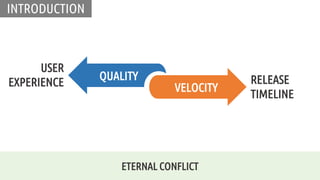
QUALITY
VELOCITY
USER
EXPERIENCE RELEASE
TIMELINE
INTRODUCTION
ETERNAL CONFLICT
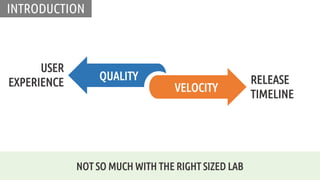
QUALITY
VELOCITY
USER
EXPERIENCE RELEASE
TIMELINE
INTRODUCTION
NOT SO MUCH WITH THE RIGHT SIZED LAB
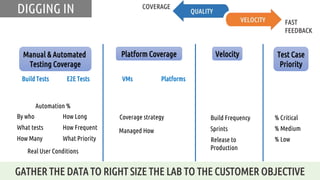
DIGGING IN
GATHER THE DATA TO RIGHT SIZE THE LAB TO THE CUSTOMER OBJECTIVE
Platform Coverage
VMs Platforms
Managed How
Coverage strategy
Velocity
Sprints
Release to
Production
Manual & Automated
Testing Coverage
Build Tests E2E Tests
How Long
How Frequent
What PriorityHow Many
What tests
By who
% Low
% Medium
% Critical
Test Case
Priority
Automation %
Real User Conditions
Build Frequency
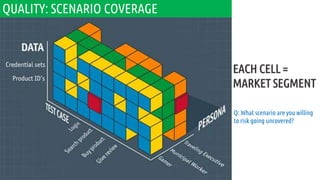
QUALITY: SCENARIO COVERAGE
EACH CELL =
MARKET SEGMENT
Q: What scenario are you willing
to risk going uncovered?
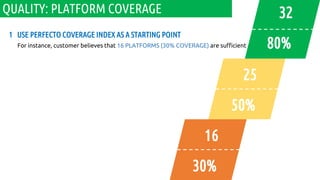
16
30%
25
50%
32
80%
1 USE PERFECTO COVERAGE INDEX AS A STARTING POINT
For instance, customer believes that 16 PLATFORMS (30% COVERAGE) are sufficient
QUALITY: PLATFORM COVERAGE
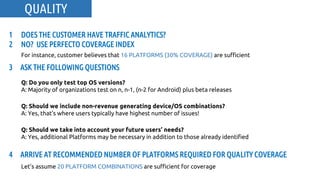
3 ASK THE FOLLOWING QUESTIONS
Q: Do you only test top OS versions?
A: Majority of organizations test on n, n-1, (n-2 for Android) plus beta releases
Q: Should we include non-revenue generating device/OS combinations?
A: Yes, that’s where users typically have highest number of issues!
Q: Should we take into account your future users’ needs?
A: Yes, additional Platforms may be necessary in addition to those already identified
1 DOES THE CUSTOMER HAVE TRAFFIC ANALYTICS?
2 NO? USE PERFECTO COVERAGE INDEX
For instance, customer believes that 16 PLATFORMS (30% COVERAGE) are sufficient
4 ARRIVE AT RECOMMENDED NUMBER OF PLATFORMS REQUIRED FOR QUALITY COVERAGE
Let’s assume 20 PLATFORM COMBINATIONS are sufficient for coverage
QUALITY
VELOCITY
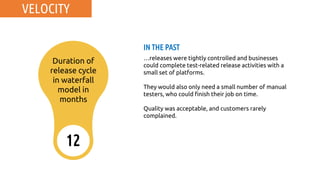
Duration of
release cycle
in waterfall
model in
months
12
IN THE PAST
…releases were tightly controlled and businesses
could complete test-related release activities with a
small set of platforms.
They would also only need a small number of manual
testers, who could finish their job on time.
Quality was acceptable, and customers rarely
complained.
VELOCITY
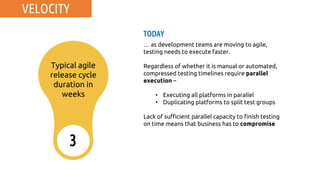
Typical agile
release cycle
duration in
weeks
3
TODAY
… as development teams are moving to agile,
testing needs to execute faster.
Regardless of whether it is manual or automated,
compressed testing timelines require parallel
execution –
• Executing all platforms in parallel
• Duplicating platforms to split test groups
Lack of sufficient parallel capacity to finish testing
on time means that business has to compromise
VELOCITY
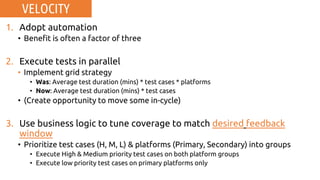
1. Adopt automation
• Benefit is often a factor of three
2. Execute tests in parallel
• Implement grid strategy
• Was: Average test duration (mins) * test cases * platforms
• Now: Average test duration (mins) * test cases
• (Create opportunity to move some in-cycle)
3. Use business logic to tune coverage to match desired feedback
window
• Prioritize test cases (H, M, L) & platforms (Primary, Secondary) into groups
• Execute High & Medium priority test cases on both platform groups
• Execute low priority test cases on primary platforms only
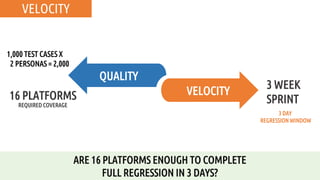
QUALITY
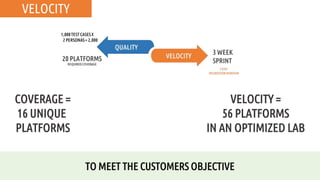
VELOCITY16 PLATFORMS
REQUIRED COVERAGE
3 WEEK
SPRINT
VELOCITY
ARE 16 PLATFORMS ENOUGH TO COMPLETE
FULL REGRESSION IN 3 DAYS?
1,000 TEST CASES X
2 PERSONAS = 2,000
3 DAY
REGRESSION WINDOW
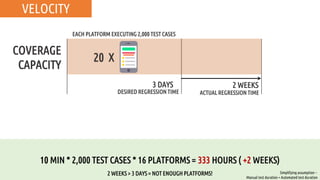
VELOCITY
COVERAGE
CAPACITY
EACH PLATFORM EXECUTING 2,000 TEST CASES
3 DAYS
DESIRED REGRESSION TIME
10 MIN * 2,000 TEST CASES * 16 PLATFORMS = 333 HOURS ( +2 WEEKS)
2 WEEKS
ACTUAL REGRESSION TIME
20 X
Simplifying assumption –
Manual test duration = Automated test duration
2 WEEKS > 3 DAYS = NOT ENOUGH PLATFORMS!
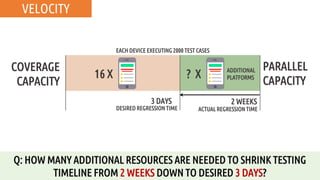
VELOCITY
COVERAGE
CAPACITY
EACH DEVICE EXECUTING 2000 TEST CASES
3 DAYS
DESIRED REGRESSION TIME
Q: HOW MANY ADDITIONAL RESOURCES ARE NEEDED TO SHRINK TESTING
TIMELINE FROM 2 WEEKS DOWN TO DESIRED 3 DAYS?
2 WEEKS
ACTUAL REGRESSION TIME
16 X
PARALLEL
CAPACITY
? X ADDITIONAL
PLATFORMS
VELOCITY
REQUIRED
COVERAGE
EACH DEVICE EXECUTING 2000 TEST CASES
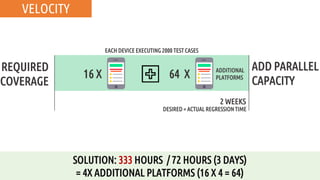
SOLUTION: 333 HOURS / 72 HOURS (3 DAYS)
= 4X ADDITIONAL PLATFORMS (16 X 4 = 64)
2 WEEKS
DESIRED = ACTUAL REGRESSION TIME
16 X
ADD PARALLEL
CAPACITY
64 X ADDITIONAL
PLATFORMS
VELOCITY
COVERAGE
CAPACITY
EACH DEVICE EXECUTING 2000 TEST CASES
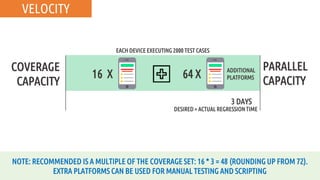
NOTE: RECOMMENDED IS A MULTIPLE OF THE COVERAGE SET: 16 * 3 = 48 (ROUNDING UP FROM 72).
EXTRA PLATFORMS CAN BE USED FOR MANUAL TESTING AND SCRIPTING
3 DAYS
DESIRED = ACTUAL REGRESSION TIME
16 X
PARALLEL
CAPACITY
64 X ADDITIONAL
PLATFORMS
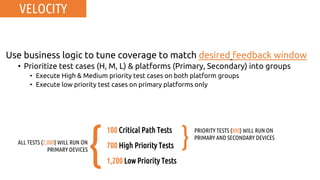
Use business logic to tune coverage to match desired feedback window
• Prioritize test cases (H, M, L) & platforms (Primary, Secondary) into groups
• Execute High & Medium priority test cases on both platform groups
• Execute low priority test cases on primary platforms only
100 Critical Path Tests
700 High Priority Tests
1,200 Low Priority Tests
ALL TESTS (2,000) WILL RUN ON
PRIMARY DEVICES
PRIORITY TESTS (800) WILL RUN ON
PRIMARY AND SECONDARY DEVICES
{ }
VELOCITY
PRIMARY
DEVICES
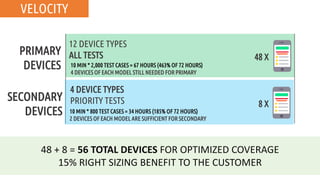
48 + 8 = 56 TOTAL DEVICES FOR OPTIMIZED COVERAGE
15% RIGHT SIZING BENEFIT TO THE CUSTOMER
SECONDARY
DEVICES
48 X
8 X
12 DEVICE TYPES
ALL TESTS
4 DEVICE TYPES
PRIORITY TESTS
10 MIN * 800 TEST CASES = 34 HOURS (185% OF 72 HOURS)
2 DEVICES OF EACH MODEL ARE SUFFICIENT FOR SECONDARY
10 MIN * 2,000 TEST CASES = 67 HOURS (463% OF 72 HOURS)
4 DEVICES OF EACH MODEL STILL NEEDED FOR PRIMARY
VELOCITY
VELOCITY
TO MEET THE CUSTOMERS OBJECTIVE
COVERAGE =
16 UNIQUE
PLATFORMS
VELOCITY =
56 PLATFORMS
IN AN OPTIMIZED LAB
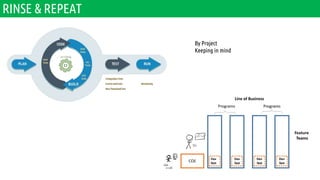
RINSE & REPEAT
By Project
Keeping in mind
THEORETICAL?
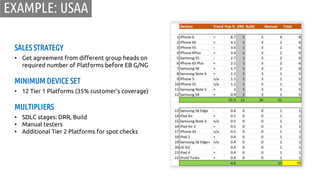
SALES STRATEGY
• Get agreement from different group heads on
required number of Platforms before EB G/NG
MINIMUM DEVICE SET
• 12 Tier 1 Platforms (35% customer’s coverage)
MULTIPLIERS
• SDLC stages: DRR, Build
• Manual testers
• Additional Tier 2 Platforms for spot checks
EXAMPLE: USAA
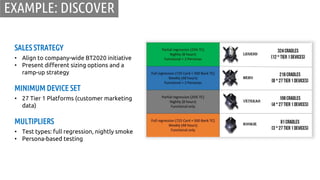
SALES STRATEGY
• Align to company-wide BT2020 initiative
• Present different sizing options and a
ramp-up strategy
MINIMUM DEVICE SET
• 27 Tier 1 Platforms (customer marketing
data)
MULTIPLIERS
• Test types: full regression, nightly smoke
• Persona-based testing
EXAMPLE: DISCOVER
VELOCITY
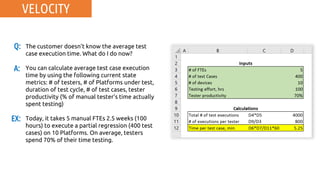
Q: The customer doesn’t know the average test
case execution time. What do I do now?
You can calculate average test case execution
time by using the following current state
metrics: # of testers, # of Platforms under test,
duration of test cycle, # of test cases, tester
productivity (% of manual tester’s time actually
spent testing)
Today, it takes 5 manual FTEs 2.5 weeks (100
hours) to execute a partial regression (400 test
cases) on 10 Platforms. On average, testers
spend 70% of their time testing.
A:
EX:
VELOCITY
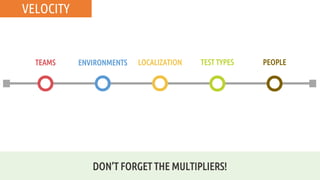
TEAMS ENVIRONMENTS LOCALIZATION TEST TYPES PEOPLE
DON’T FORGET THE MULTIPLIERS!
VELOCITY
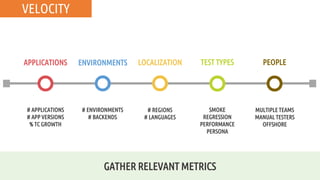
APPLICATIONS ENVIRONMENTS LOCALIZATION TEST TYPES PEOPLE
GATHER RELEVANT METRICS
# ENVIRONMENTS
# BACKENDS
# APPLICATIONS
# APP VERSIONS
% TC GROWTH
# REGIONS
# LANGUAGES
SMOKE
REGRESSION
PERFORMANCE
PERSONA
MULTIPLE TEAMS
MANUAL TESTERS
OFFSHORE

Webinar: How to Size a Lab

  • 1.
    LAB CONFIGURATION Increase dealsize AND provide exact solution to the customer
  • 2.
  • 3.
  • 4.
    DIGGING IN GATHER THEDATA TO RIGHT SIZE THE LAB TO THE CUSTOMER OBJECTIVE Platform Coverage VMs Platforms Managed How Coverage strategy Velocity Sprints Release to Production Manual & Automated Testing Coverage Build Tests E2E Tests How Long How Frequent What PriorityHow Many What tests By who % Low % Medium % Critical Test Case Priority Automation % Real User Conditions Build Frequency
  • 5.
    QUALITY: SCENARIO COVERAGE EACHCELL = MARKET SEGMENT Q: What scenario are you willing to risk going uncovered?
  • 6.
    16 30% 25 50% 32 80% 1 USE PERFECTOCOVERAGE INDEX AS A STARTING POINT For instance, customer believes that 16 PLATFORMS (30% COVERAGE) are sufficient QUALITY: PLATFORM COVERAGE
  • 7.
    3 ASK THEFOLLOWING QUESTIONS Q: Do you only test top OS versions? A: Majority of organizations test on n, n-1, (n-2 for Android) plus beta releases Q: Should we include non-revenue generating device/OS combinations? A: Yes, that’s where users typically have highest number of issues! Q: Should we take into account your future users’ needs? A: Yes, additional Platforms may be necessary in addition to those already identified 1 DOES THE CUSTOMER HAVE TRAFFIC ANALYTICS? 2 NO? USE PERFECTO COVERAGE INDEX For instance, customer believes that 16 PLATFORMS (30% COVERAGE) are sufficient 4 ARRIVE AT RECOMMENDED NUMBER OF PLATFORMS REQUIRED FOR QUALITY COVERAGE Let’s assume 20 PLATFORM COMBINATIONS are sufficient for coverage QUALITY
  • 8.
    VELOCITY Duration of release cycle inwaterfall model in months 12 IN THE PAST …releases were tightly controlled and businesses could complete test-related release activities with a small set of platforms. They would also only need a small number of manual testers, who could finish their job on time. Quality was acceptable, and customers rarely complained.
  • 9.
    VELOCITY Typical agile release cycle durationin weeks 3 TODAY … as development teams are moving to agile, testing needs to execute faster. Regardless of whether it is manual or automated, compressed testing timelines require parallel execution – • Executing all platforms in parallel • Duplicating platforms to split test groups Lack of sufficient parallel capacity to finish testing on time means that business has to compromise
  • 11.
    VELOCITY 1. Adopt automation •Benefit is often a factor of three 2. Execute tests in parallel • Implement grid strategy • Was: Average test duration (mins) * test cases * platforms • Now: Average test duration (mins) * test cases • (Create opportunity to move some in-cycle) 3. Use business logic to tune coverage to match desired feedback window • Prioritize test cases (H, M, L) & platforms (Primary, Secondary) into groups • Execute High & Medium priority test cases on both platform groups • Execute low priority test cases on primary platforms only
  • 12.
    QUALITY VELOCITY16 PLATFORMS REQUIRED COVERAGE 3WEEK SPRINT VELOCITY ARE 16 PLATFORMS ENOUGH TO COMPLETE FULL REGRESSION IN 3 DAYS? 1,000 TEST CASES X 2 PERSONAS = 2,000 3 DAY REGRESSION WINDOW
  • 13.
    VELOCITY COVERAGE CAPACITY EACH PLATFORM EXECUTING2,000 TEST CASES 3 DAYS DESIRED REGRESSION TIME 10 MIN * 2,000 TEST CASES * 16 PLATFORMS = 333 HOURS ( +2 WEEKS) 2 WEEKS ACTUAL REGRESSION TIME 20 X Simplifying assumption – Manual test duration = Automated test duration 2 WEEKS > 3 DAYS = NOT ENOUGH PLATFORMS!
  • 14.
    VELOCITY COVERAGE CAPACITY EACH DEVICE EXECUTING2000 TEST CASES 3 DAYS DESIRED REGRESSION TIME Q: HOW MANY ADDITIONAL RESOURCES ARE NEEDED TO SHRINK TESTING TIMELINE FROM 2 WEEKS DOWN TO DESIRED 3 DAYS? 2 WEEKS ACTUAL REGRESSION TIME 16 X PARALLEL CAPACITY ? X ADDITIONAL PLATFORMS
  • 15.
    VELOCITY REQUIRED COVERAGE EACH DEVICE EXECUTING2000 TEST CASES SOLUTION: 333 HOURS / 72 HOURS (3 DAYS) = 4X ADDITIONAL PLATFORMS (16 X 4 = 64) 2 WEEKS DESIRED = ACTUAL REGRESSION TIME 16 X ADD PARALLEL CAPACITY 64 X ADDITIONAL PLATFORMS
  • 16.
    VELOCITY COVERAGE CAPACITY EACH DEVICE EXECUTING2000 TEST CASES NOTE: RECOMMENDED IS A MULTIPLE OF THE COVERAGE SET: 16 * 3 = 48 (ROUNDING UP FROM 72). EXTRA PLATFORMS CAN BE USED FOR MANUAL TESTING AND SCRIPTING 3 DAYS DESIRED = ACTUAL REGRESSION TIME 16 X PARALLEL CAPACITY 64 X ADDITIONAL PLATFORMS
  • 17.
    Use business logicto tune coverage to match desired feedback window • Prioritize test cases (H, M, L) & platforms (Primary, Secondary) into groups • Execute High & Medium priority test cases on both platform groups • Execute low priority test cases on primary platforms only 100 Critical Path Tests 700 High Priority Tests 1,200 Low Priority Tests ALL TESTS (2,000) WILL RUN ON PRIMARY DEVICES PRIORITY TESTS (800) WILL RUN ON PRIMARY AND SECONDARY DEVICES { } VELOCITY
  • 18.
    PRIMARY DEVICES 48 + 8= 56 TOTAL DEVICES FOR OPTIMIZED COVERAGE 15% RIGHT SIZING BENEFIT TO THE CUSTOMER SECONDARY DEVICES 48 X 8 X 12 DEVICE TYPES ALL TESTS 4 DEVICE TYPES PRIORITY TESTS 10 MIN * 800 TEST CASES = 34 HOURS (185% OF 72 HOURS) 2 DEVICES OF EACH MODEL ARE SUFFICIENT FOR SECONDARY 10 MIN * 2,000 TEST CASES = 67 HOURS (463% OF 72 HOURS) 4 DEVICES OF EACH MODEL STILL NEEDED FOR PRIMARY VELOCITY
  • 19.
    VELOCITY TO MEET THECUSTOMERS OBJECTIVE COVERAGE = 16 UNIQUE PLATFORMS VELOCITY = 56 PLATFORMS IN AN OPTIMIZED LAB
  • 20.
    RINSE & REPEAT ByProject Keeping in mind
  • 21.
  • 22.
    SALES STRATEGY • Getagreement from different group heads on required number of Platforms before EB G/NG MINIMUM DEVICE SET • 12 Tier 1 Platforms (35% customer’s coverage) MULTIPLIERS • SDLC stages: DRR, Build • Manual testers • Additional Tier 2 Platforms for spot checks EXAMPLE: USAA
  • 23.
    SALES STRATEGY • Alignto company-wide BT2020 initiative • Present different sizing options and a ramp-up strategy MINIMUM DEVICE SET • 27 Tier 1 Platforms (customer marketing data) MULTIPLIERS • Test types: full regression, nightly smoke • Persona-based testing EXAMPLE: DISCOVER
  • 24.
    VELOCITY Q: The customerdoesn’t know the average test case execution time. What do I do now? You can calculate average test case execution time by using the following current state metrics: # of testers, # of Platforms under test, duration of test cycle, # of test cases, tester productivity (% of manual tester’s time actually spent testing) Today, it takes 5 manual FTEs 2.5 weeks (100 hours) to execute a partial regression (400 test cases) on 10 Platforms. On average, testers spend 70% of their time testing. A: EX:
  • 25.
    VELOCITY TEAMS ENVIRONMENTS LOCALIZATIONTEST TYPES PEOPLE DON’T FORGET THE MULTIPLIERS!
  • 26.
    VELOCITY APPLICATIONS ENVIRONMENTS LOCALIZATIONTEST TYPES PEOPLE GATHER RELEVANT METRICS # ENVIRONMENTS # BACKENDS # APPLICATIONS # APP VERSIONS % TC GROWTH # REGIONS # LANGUAGES SMOKE REGRESSION PERFORMANCE PERSONA MULTIPLE TEAMS MANUAL TESTERS OFFSHORE

Editor's Notes

  • #19 With priorities in place, we get the following revised calculations: Primary devices will run all test cases (67 hours). There are 9 device models, multiplied by 4 (to fit the 18-hour window), we will need 36 Primary devices Secondary devices will run priority test cases (34 hours). There are 7 device models multiplied by 2, so we will need 14 secondary devices. This reduces the lab size from 64 to 50 devices (a 21.8% reduction) by excluding some test/device combinations while minimizing overall risk.