How to Better Leverage
Data to Fuel Your
Compensation
Lifecycle
Today’s Presenters
Ruth Thomas
Chief Evangelist
SVP, Marketing
Sara Hillenmeyer, PhD
Senior Director, Data
Science
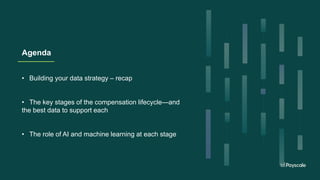
Agenda
• Building your data strategy – recap
• The key stages of the compensation lifecycle—and
the best data to support each
• The role of AI and machine learning at each stage
Building your data strategy
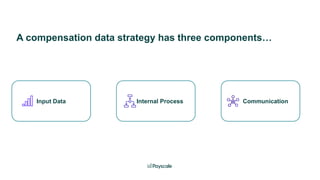
A compensation data strategy has three components…
Communication
Input Data Internal Process
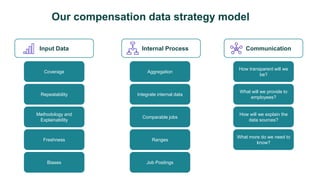
How transparent will we
be?
What will we provide to
employees?
How will we explain the
data sources?
What more do we need to
know?
Communication
Coverage
Repeatability
Methodology and
Explainability
Freshness
Biases
Input Data
Aggregation
Integrate internal data
Comparable jobs
Ranges
Job Postings
Internal Process
Our compensation data strategy model
What data should I use when?
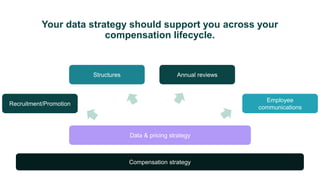
Annual reviews
Recruitment/Promotion
Employee
communications
Structures
Compensation strategy
Data & pricing strategy
Your data strategy should support you across your
compensation lifecycle.
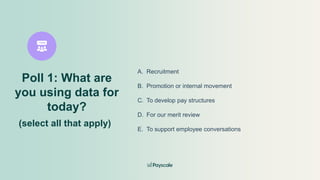
Poll 1: What are
you using data for
today?
(select all that apply)
A. Recruitment
B. Promotion or internal movement
C. To develop pay structures
D. For our merit review
E. To support employee conversations
Recruitment and promotion
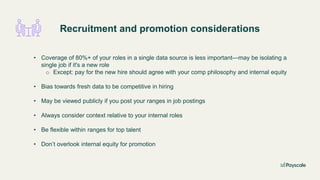
Recruitment and promotion considerations
• Coverage of 80%+ of your roles in a single data source is less important—may be isolating a
single job if it's a new role
o Except: pay for the new hire should agree with your comp philosophy and internal equity
• Bias towards fresh data to be competitive in hiring
• May be viewed publicly if you post your ranges in job postings
• Always consider context relative to your internal roles
• Be flexible within ranges for top talent
• Don’t overlook internal equity for promotion
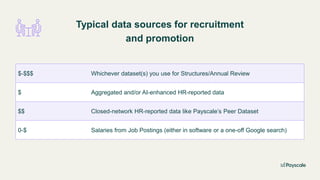
$-$$$ Whichever dataset(s) you use for Structures/Annual Review
$ Aggregated and/or AI-enhanced HR-reported data
$$ Closed-network HR-reported data like Payscale’s Peer Dataset
0-$ Salaries from Job Postings (either in software or a one-off Google search)
Typical data sources for recruitment
and promotion
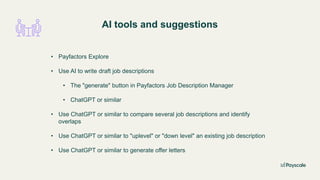
AI tools and suggestions
• Payfactors Explore
• Use AI to write draft job descriptions
• The "generate" button in Payfactors Job Description Manager
• ChatGPT or similar
• Use ChatGPT or similar to compare several job descriptions and identify
overlaps
• Use ChatGPT or similar to "uplevel" or "down level" an existing job description
• Use ChatGPT or similar to generate offer letters
Structures and annual reviews
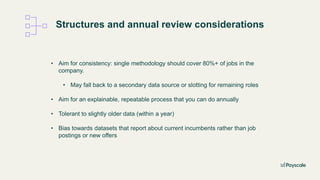
Structures and annual review considerations
• Aim for consistency: single methodology should cover 80%+ of jobs in the
company.
• May fall back to a secondary data source or slotting for remaining roles
• Aim for an explainable, repeatable process that you can do annually
• Tolerant to slightly older data (within a year)
• Bias towards datasets that report about current incumbents rather than job
postings or new offers
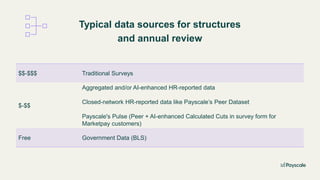
$$-$$$ Traditional Surveys
$-$$
Aggregated and/or AI-enhanced HR-reported data
Closed-network HR-reported data like Payscale’s Peer Dataset
Payscale's Pulse (Peer + AI-enhanced Calculated Cuts in survey form for
Marketpay customers)
Free Government Data (BLS)
Typical data sources for structures
and annual review
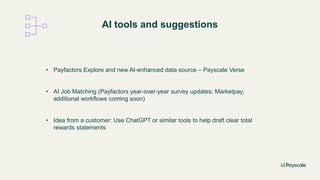
AI tools and suggestions
• Payfactors Explore and new AI-enhanced data source – Payscale Verse
• AI Job Matching (Payfactors year-over-year survey updates; Marketpay;
additional workflows coming soon)
• Idea from a customer: Use ChatGPT or similar tools to help draft clear total
rewards statements
Employee conversations
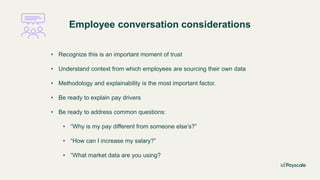
Employee conversation considerations
• Recognize this is an important moment of trust
• Understand context from which employees are sourcing their own data
• Methodology and explainability is the most important factor.
• Be ready to explain pay drivers
• Be ready to address common questions:
• “Why is my pay different from someone else’s?”
• “How can I increase my salary?”
• “What market data are you using?
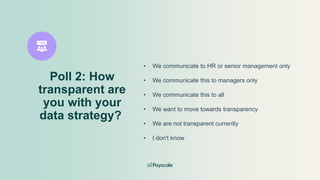
Poll 2: How
transparent are
you with your
data strategy?
• We communicate to HR or senior management only
• We communicate this to managers only
• We communicate this to all
• We want to move towards transparency
• We are not transparent currently
• I don't know
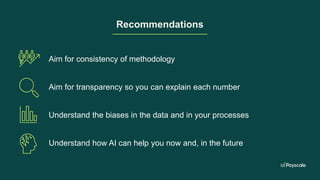
Recommendations
Aim for consistency of methodology
Aim for transparency so you can explain each number
Understand the biases in the data and in your processes
Understand how AI can help you now and, in the future
Q&A
Feel free to ask any questions in the Q&A
section of your console!
Interested in a demo of
Payscale’s data solutions?
Let us know in the poll currently
open in the polling tab and the team
will be in touch!

Webinar-How to Better Leverage Data to Fuel Your Compensation Lifecycle.pdf

  • 1.
    How to BetterLeverage Data to Fuel Your Compensation Lifecycle
  • 2.
    Today’s Presenters Ruth Thomas ChiefEvangelist SVP, Marketing Sara Hillenmeyer, PhD Senior Director, Data Science
  • 3.
    Agenda • Building yourdata strategy – recap • The key stages of the compensation lifecycle—and the best data to support each • The role of AI and machine learning at each stage
  • 4.
  • 5.
    A compensation datastrategy has three components… Communication Input Data Internal Process
  • 6.
    How transparent willwe be? What will we provide to employees? How will we explain the data sources? What more do we need to know? Communication Coverage Repeatability Methodology and Explainability Freshness Biases Input Data Aggregation Integrate internal data Comparable jobs Ranges Job Postings Internal Process Our compensation data strategy model
  • 7.
    What data shouldI use when?
  • 8.
    Annual reviews Recruitment/Promotion Employee communications Structures Compensation strategy Data& pricing strategy Your data strategy should support you across your compensation lifecycle.
  • 9.
    Poll 1: Whatare you using data for today? (select all that apply) A. Recruitment B. Promotion or internal movement C. To develop pay structures D. For our merit review E. To support employee conversations
  • 10.
  • 11.
    Recruitment and promotionconsiderations • Coverage of 80%+ of your roles in a single data source is less important—may be isolating a single job if it's a new role o Except: pay for the new hire should agree with your comp philosophy and internal equity • Bias towards fresh data to be competitive in hiring • May be viewed publicly if you post your ranges in job postings • Always consider context relative to your internal roles • Be flexible within ranges for top talent • Don’t overlook internal equity for promotion
  • 12.
    $-$$$ Whichever dataset(s)you use for Structures/Annual Review $ Aggregated and/or AI-enhanced HR-reported data $$ Closed-network HR-reported data like Payscale’s Peer Dataset 0-$ Salaries from Job Postings (either in software or a one-off Google search) Typical data sources for recruitment and promotion
  • 13.
    AI tools andsuggestions • Payfactors Explore • Use AI to write draft job descriptions • The "generate" button in Payfactors Job Description Manager • ChatGPT or similar • Use ChatGPT or similar to compare several job descriptions and identify overlaps • Use ChatGPT or similar to "uplevel" or "down level" an existing job description • Use ChatGPT or similar to generate offer letters
  • 14.
  • 15.
    Structures and annualreview considerations • Aim for consistency: single methodology should cover 80%+ of jobs in the company. • May fall back to a secondary data source or slotting for remaining roles • Aim for an explainable, repeatable process that you can do annually • Tolerant to slightly older data (within a year) • Bias towards datasets that report about current incumbents rather than job postings or new offers
  • 16.
    $$-$$$ Traditional Surveys $-$$ Aggregatedand/or AI-enhanced HR-reported data Closed-network HR-reported data like Payscale’s Peer Dataset Payscale's Pulse (Peer + AI-enhanced Calculated Cuts in survey form for Marketpay customers) Free Government Data (BLS) Typical data sources for structures and annual review
  • 17.
    AI tools andsuggestions • Payfactors Explore and new AI-enhanced data source – Payscale Verse • AI Job Matching (Payfactors year-over-year survey updates; Marketpay; additional workflows coming soon) • Idea from a customer: Use ChatGPT or similar tools to help draft clear total rewards statements
  • 18.
  • 19.
    Employee conversation considerations •Recognize this is an important moment of trust • Understand context from which employees are sourcing their own data • Methodology and explainability is the most important factor. • Be ready to explain pay drivers • Be ready to address common questions: • “Why is my pay different from someone else’s?” • “How can I increase my salary?” • “What market data are you using?
  • 20.
    Poll 2: How transparentare you with your data strategy? • We communicate to HR or senior management only • We communicate this to managers only • We communicate this to all • We want to move towards transparency • We are not transparent currently • I don't know
  • 21.
    Recommendations Aim for consistencyof methodology Aim for transparency so you can explain each number Understand the biases in the data and in your processes Understand how AI can help you now and, in the future
  • 22.
    Q&A Feel free toask any questions in the Q&A section of your console! Interested in a demo of Payscale’s data solutions? Let us know in the poll currently open in the polling tab and the team will be in touch!