Pay Transparency Legislation Series, Ep. 9:
Navigate the Changing Global
Landscape
Today's Presenters:
Ruth Thomas
Chief Product Evangelist
Payscale
Lulu Seikaly
Senior Corporate Attorney- Employment
Payscale
Today's Agenda
• US update: recently passed and emerging laws
• Global update: legislation being passed and updates in different countries
• How to stay compliant and stay ahead of this new legislation
Recently passed and emerging
laws in the US
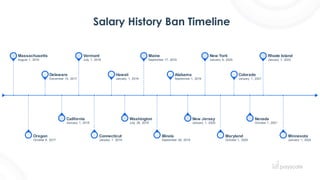
Salary History Ban Timeline
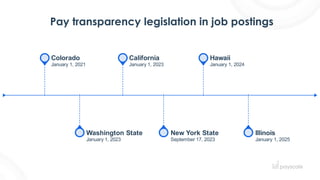
Pay transparency legislation in job postings
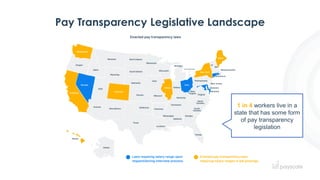
Pay Transparency Legislative Landscape
1 in 4 workers live in a
state that has some form
of pay transparency
legislation
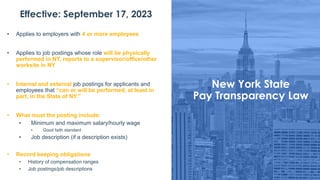
Effective: September 17, 2023
• Applies to employers with 4 or more employees
• Applies to job postings whose role will be physically
performed in NY, reports to a supervisor/office/other
worksite in NY
• Internal and external job postings for applicants and
employees that “ p ,
p , .”
• What must the posting include:
• Minimum and maximum salary/hourly wage
• Good faith standard
• Job description (if a description exists)
• Record keeping obligations
• History of compensation ranges
• Job postings/job descriptions
New York State
Pay Transparency Law
Effective Date: January 1, 2024
Hawaii
Pay Transparency Law
• Applies to Hawaii employers with 50 or more
employees
• Must post the hourly rate or salary range
that reasonably reflects the actual
expected compensation
• Does not apply to internal
promotions/transfers
• Remote work?
• Expansion of Equal Pay Requirements
Effective Date: January 1, 2025
Illinois
Pay Transparency Law
• Applies to employers with 15 or more employees in
Illinois
• Applies to job postings whose role will be physically
performed at least in part in Illinois or the role
reports to a supervisor/office/other worksite in
Illinois
• Applies to internal job postings
• What must the posting include:
• Wage/salary or salary range
• Good faith Standard
• General description of benefits and other comp
• E.g., bonuses, stocks, other incentives
Legislation being passed
globally and updates in
different countries
12
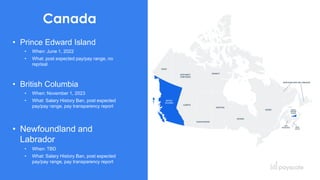
Canada
• Prince Edward Island
• When: June 1, 2022
• What: post expected pay/pay range, no
reprisal
• British Columbia
• When: November 1, 2023
• What: Salary History Ban, post expected
pay/pay range, pay transparency report
• Newfoundland and
Labrador
• When: TBD
• What: Salary History Ban, post expected
pay/pay range, pay transparency report
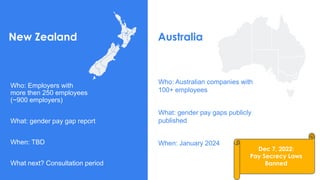
New Zealand
Who: Employers with
more then 250 employees
(~900 employers)
What: gender pay gap report
When: TBD
What next? Consultation period
Australia
Who: Australian companies with
100+ employees
What: gender pay gaps publicly
published
When: January 2024
Dec 7, 2022:
Pay Secrecy Laws
Banned
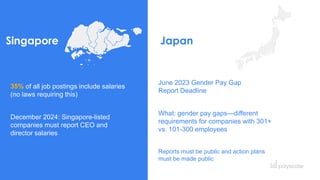
Singapore
35% of all job postings include salaries
(no laws requiring this)
December 2024: Singapore-listed
companies must report CEO and
director salaries
Japan
June 2023 Gender Pay Gap
Report Deadline
What: gender pay gaps—different
requirements for companies with 301+
vs. 101-300 employees
Reports must be public and action plans
must be made public
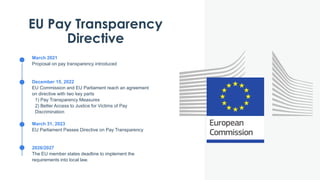
EU Pay Transparency
Directive
March 2021
Proposal on pay transparency introduced
December 15, 2022
EU Commission and EU Parliament reach an agreement
on directive with two key parts
1) Pay Transparency Measures
2) Better Access to Justice for Victims of Pay
Discrimination
March 31, 2023
EU Parliament Passes Directive on Pay Transparency
2026/2027
The EU member states deadline to implement the
requirements into local law.
How to stay compliant and stay
ahead of this new legislation
Stay informed Act local, think
global
Be proactive
to stay ahead of
legislation
Stay informed Act local, think
global
Be proactive
to stay ahead of
legislation
Recommendations
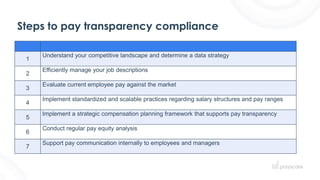
Steps to pay transparency compliance
1
Understand your competitive landscape and determine a data strategy
2
Efficiently manage your job descriptions
3
Evaluate current employee pay against the market
4
Implement standardized and scalable practices regarding salary structures and pay ranges
5
Implement a strategic compensation planning framework that supports pay transparency
6
Conduct regular pay equity analysis
7
Support pay communication internally to employees and managers
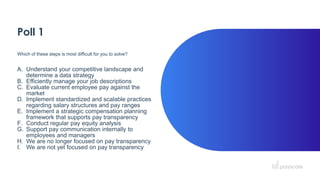
Poll 1
Which of these steps is most difficult for you to solve?
A. Understand your competitive landscape and
determine a data strategy
B. Efficiently manage your job descriptions
C. Evaluate current employee pay against the
market
D. Implement standardized and scalable practices
regarding salary structures and pay ranges
E. Implement a strategic compensation planning
framework that supports pay transparency
F. Conduct regular pay equity analysis
G. Support pay communication internally to
employees and managers
H. We are no longer focused on pay transparency
I. We are not yet focused on pay transparency
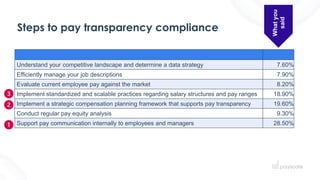
Steps to pay transparency compliance
Understand your competitive landscape and determine a data strategy
Efficiently manage your job descriptions
Evaluate current employee pay against the market
Implement standardized and scalable practices regarding salary structures and pay ranges
Implement a strategic compensation planning framework that supports pay transparency
Conduct regular pay equity analysis
Support pay communication internally to employees and managers
7.60%
7.90%
8.20%
18.90%
19.60%
9.30%
28.50%
What
you
said
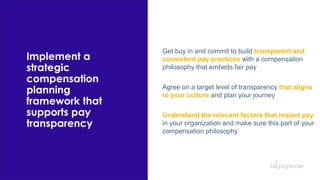
Implement a
strategic
compensation
planning
framework that
supports pay
transparency
Get buy in and commit to build transparent and
consistent pay practices with a compensation
philosophy that embeds fair pay
Agree on a target level of transparency that aligns
to your culture and plan your journey
Understand the relevant factors that impact pay
in your organization and make sure this part of your
compensation philosophy
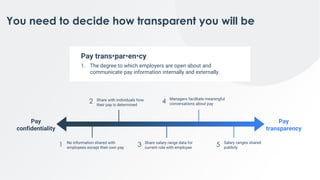
You need to decide how transparent you will be
Pay trans•par•en•cy
1. The degree to which employers are open about and
communicate pay information internally and externally.
Pay
confidentiality
Pay
transparency
No information shared with
employees except their own pay
1
Share with individuals how
their pay is determined
2
Share salary range data for
current role with employee
3
Managers facilitate meaningful
conversations about pay
4
Salary ranges shared
publicly
5
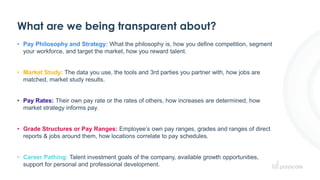
What are we being transparent about?
• Pay Philosophy and Strategy: What the philosophy is, how you define competition, segment
your workforce, and target the market, how you reward talent.
• Market Study: The data you use, the tools and 3rd parties you partner with, how jobs are
matched, market study results.
• Pay Rates: Their own pay rate or the rates of others, how increases are determined, how
market strategy informs pay.
• Grade Structures or Pay Ranges: E ’ w d d f di
reports & jobs around them, how locations correlate to pay schedules.
• Career Pathing: Talent investment goals of the company, available growth opportunities,
support for personal and professional development.
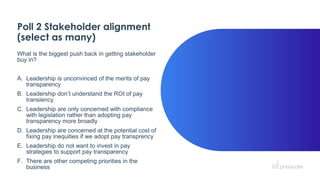
Poll 2 Stakeholder alignment
(select as many)
What is the biggest push back in getting stakeholder
buy in?
A. Leadership is unconvinced of the merits of pay
transparency
B. L d hi d ’ d d h R I f
transiency
C. Leadership are only concerned with compliance
with legislation rather than adopting pay
transparency more broadly
D. Leadership are concerned at the potential cost of
fixing pay inequities if we adopt pay transprency
E. Leadership do not want to invest in pay
strategies to support pay transparency
F. There are other competing priorities in the
business
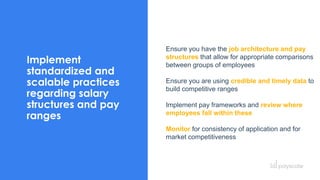
Implement
standardized and
scalable practices
regarding salary
structures and pay
ranges
Ensure you have the job architecture and pay
structures that allow for appropriate comparisons
between groups of employees
Ensure you are using credible and timely data to
build competitive ranges
Implement pay frameworks and review where
employees fall within these
Monitor for consistency of application and for
market competitiveness
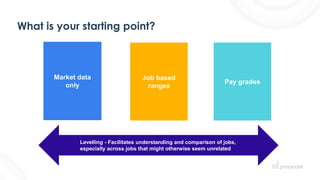
What is your starting point?
Market data
only
Job based
ranges
Pay grades
Levelling - Facilitates understanding and comparison of jobs,
especially across jobs that might otherwise seem unrelated
Attend Compference23 to learn more!
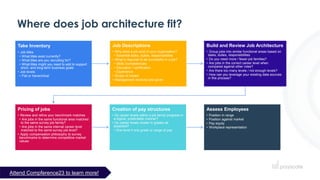
Where does job architecture fit?
Take Inventory
• Job titles
• What titles exist currently?
• What titles are you recruiting for?
• What titles might you need to add to support
short- and long-term business goals
• Job levels
• Flat or hierarchical
Job Descriptions
• Why does a job exist in your organization?
• Essential tasks, duties, responsibilities
• What is required to be successful in a job?
• Skills /competencies
• Education / certification
• Experience
• Scope of impact
• Management received and given
Build and Review Job Architecture
• Group jobs into similar functional areas based on
tasks, duties, responsibilities
• Do you need more / fewer job families?
• Are jobs in the correct career level when
compared against other roles?
• Are there too many levels / not enough levels?
• How can you leverage your existing data sources
in this process?
Pricing of jobs
• Review and refine your benchmark matches
• Are jobs in the same functional area matched
to the same survey job family?
• Are jobs in the same internal career level
matched to the same survey job level?
• Apply compensation philosophy to survey
benchmarks to determine competitive market
values
Creation of pay structures
• Do career levels within a job family progress in
a logical, predictable manner?
• Do career levels cluster in grades as
expected?
• v ≠ d f
Assess Employees
• Position in range
• Position against market
• Pay equity
• Workplace representation
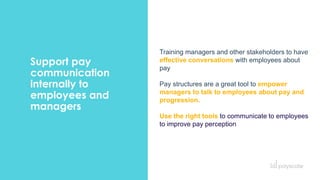
Support pay
communication
internally to
employees and
managers
Training managers and other stakeholders to have
effective conversations with employees about
pay
Pay structures are a great tool to empower
managers to talk to employees about pay and
progression.
Use the right tools to communicate to employees
to improve pay perception
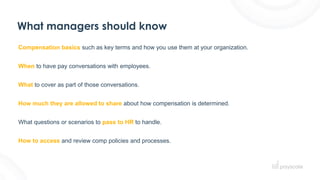
What managers should know
Compensation basics such as key terms and how you use them at your organization.
When to have pay conversations with employees.
What to cover as part of those conversations.
How much they are allowed to share about how compensation is determined.
What questions or scenarios to pass to HR to handle.
How to access and review comp policies and processes.
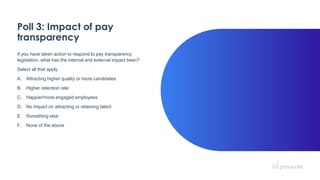
Poll 3: Impact of pay
transparency
If you have taken action to respond to pay transparency
legislation, what has the internal and external impact been?
Select all that apply
A. Attracting higher quality or more candidates
B. Higher retention rate
C. Happier/more engaged employees
D. No impact on attracting or retaining talent
E. Something else
F. None of the above
Q&A
Feel free to ask any questions in the chat!

Webinar - Pay Transparency Legislation Series Ep 9

  • 1.
    Pay Transparency LegislationSeries, Ep. 9: Navigate the Changing Global Landscape
  • 2.
    Today's Presenters: Ruth Thomas ChiefProduct Evangelist Payscale Lulu Seikaly Senior Corporate Attorney- Employment Payscale
  • 3.
    Today's Agenda • USupdate: recently passed and emerging laws • Global update: legislation being passed and updates in different countries • How to stay compliant and stay ahead of this new legislation
  • 4.
    Recently passed andemerging laws in the US
  • 5.
  • 6.
  • 7.
    Pay Transparency LegislativeLandscape 1 in 4 workers live in a state that has some form of pay transparency legislation
  • 8.
    Effective: September 17,2023 • Applies to employers with 4 or more employees • Applies to job postings whose role will be physically performed in NY, reports to a supervisor/office/other worksite in NY • Internal and external job postings for applicants and employees that “ p , p , .” • What must the posting include: • Minimum and maximum salary/hourly wage • Good faith standard • Job description (if a description exists) • Record keeping obligations • History of compensation ranges • Job postings/job descriptions New York State Pay Transparency Law
  • 9.
    Effective Date: January1, 2024 Hawaii Pay Transparency Law • Applies to Hawaii employers with 50 or more employees • Must post the hourly rate or salary range that reasonably reflects the actual expected compensation • Does not apply to internal promotions/transfers • Remote work? • Expansion of Equal Pay Requirements
  • 10.
    Effective Date: January1, 2025 Illinois Pay Transparency Law • Applies to employers with 15 or more employees in Illinois • Applies to job postings whose role will be physically performed at least in part in Illinois or the role reports to a supervisor/office/other worksite in Illinois • Applies to internal job postings • What must the posting include: • Wage/salary or salary range • Good faith Standard • General description of benefits and other comp • E.g., bonuses, stocks, other incentives
  • 11.
    Legislation being passed globallyand updates in different countries
  • 12.
    12 Canada • Prince EdwardIsland • When: June 1, 2022 • What: post expected pay/pay range, no reprisal • British Columbia • When: November 1, 2023 • What: Salary History Ban, post expected pay/pay range, pay transparency report • Newfoundland and Labrador • When: TBD • What: Salary History Ban, post expected pay/pay range, pay transparency report
  • 13.
    New Zealand Who: Employerswith more then 250 employees (~900 employers) What: gender pay gap report When: TBD What next? Consultation period Australia Who: Australian companies with 100+ employees What: gender pay gaps publicly published When: January 2024 Dec 7, 2022: Pay Secrecy Laws Banned
  • 14.
    Singapore 35% of alljob postings include salaries (no laws requiring this) December 2024: Singapore-listed companies must report CEO and director salaries Japan June 2023 Gender Pay Gap Report Deadline What: gender pay gaps—different requirements for companies with 301+ vs. 101-300 employees Reports must be public and action plans must be made public
  • 15.
    EU Pay Transparency Directive March2021 Proposal on pay transparency introduced December 15, 2022 EU Commission and EU Parliament reach an agreement on directive with two key parts 1) Pay Transparency Measures 2) Better Access to Justice for Victims of Pay Discrimination March 31, 2023 EU Parliament Passes Directive on Pay Transparency 2026/2027 The EU member states deadline to implement the requirements into local law.
  • 16.
    How to staycompliant and stay ahead of this new legislation
  • 17.
    Stay informed Actlocal, think global Be proactive to stay ahead of legislation
  • 18.
    Stay informed Actlocal, think global Be proactive to stay ahead of legislation Recommendations
  • 19.
    Steps to paytransparency compliance 1 Understand your competitive landscape and determine a data strategy 2 Efficiently manage your job descriptions 3 Evaluate current employee pay against the market 4 Implement standardized and scalable practices regarding salary structures and pay ranges 5 Implement a strategic compensation planning framework that supports pay transparency 6 Conduct regular pay equity analysis 7 Support pay communication internally to employees and managers
  • 20.
    Poll 1 Which ofthese steps is most difficult for you to solve? A. Understand your competitive landscape and determine a data strategy B. Efficiently manage your job descriptions C. Evaluate current employee pay against the market D. Implement standardized and scalable practices regarding salary structures and pay ranges E. Implement a strategic compensation planning framework that supports pay transparency F. Conduct regular pay equity analysis G. Support pay communication internally to employees and managers H. We are no longer focused on pay transparency I. We are not yet focused on pay transparency
  • 21.
    Steps to paytransparency compliance Understand your competitive landscape and determine a data strategy Efficiently manage your job descriptions Evaluate current employee pay against the market Implement standardized and scalable practices regarding salary structures and pay ranges Implement a strategic compensation planning framework that supports pay transparency Conduct regular pay equity analysis Support pay communication internally to employees and managers 7.60% 7.90% 8.20% 18.90% 19.60% 9.30% 28.50% What you said
  • 22.
    Implement a strategic compensation planning framework that supportspay transparency Get buy in and commit to build transparent and consistent pay practices with a compensation philosophy that embeds fair pay Agree on a target level of transparency that aligns to your culture and plan your journey Understand the relevant factors that impact pay in your organization and make sure this part of your compensation philosophy
  • 23.
    You need todecide how transparent you will be Pay trans•par•en•cy 1. The degree to which employers are open about and communicate pay information internally and externally. Pay confidentiality Pay transparency No information shared with employees except their own pay 1 Share with individuals how their pay is determined 2 Share salary range data for current role with employee 3 Managers facilitate meaningful conversations about pay 4 Salary ranges shared publicly 5
  • 24.
    What are webeing transparent about? • Pay Philosophy and Strategy: What the philosophy is, how you define competition, segment your workforce, and target the market, how you reward talent. • Market Study: The data you use, the tools and 3rd parties you partner with, how jobs are matched, market study results. • Pay Rates: Their own pay rate or the rates of others, how increases are determined, how market strategy informs pay. • Grade Structures or Pay Ranges: E ’ w d d f di reports & jobs around them, how locations correlate to pay schedules. • Career Pathing: Talent investment goals of the company, available growth opportunities, support for personal and professional development.
  • 25.
    Poll 2 Stakeholderalignment (select as many) What is the biggest push back in getting stakeholder buy in? A. Leadership is unconvinced of the merits of pay transparency B. L d hi d ’ d d h R I f transiency C. Leadership are only concerned with compliance with legislation rather than adopting pay transparency more broadly D. Leadership are concerned at the potential cost of fixing pay inequities if we adopt pay transprency E. Leadership do not want to invest in pay strategies to support pay transparency F. There are other competing priorities in the business
  • 26.
    Implement standardized and scalable practices regardingsalary structures and pay ranges Ensure you have the job architecture and pay structures that allow for appropriate comparisons between groups of employees Ensure you are using credible and timely data to build competitive ranges Implement pay frameworks and review where employees fall within these Monitor for consistency of application and for market competitiveness
  • 27.
    What is yourstarting point? Market data only Job based ranges Pay grades Levelling - Facilitates understanding and comparison of jobs, especially across jobs that might otherwise seem unrelated
  • 28.
    Attend Compference23 tolearn more! Where does job architecture fit? Take Inventory • Job titles • What titles exist currently? • What titles are you recruiting for? • What titles might you need to add to support short- and long-term business goals • Job levels • Flat or hierarchical Job Descriptions • Why does a job exist in your organization? • Essential tasks, duties, responsibilities • What is required to be successful in a job? • Skills /competencies • Education / certification • Experience • Scope of impact • Management received and given Build and Review Job Architecture • Group jobs into similar functional areas based on tasks, duties, responsibilities • Do you need more / fewer job families? • Are jobs in the correct career level when compared against other roles? • Are there too many levels / not enough levels? • How can you leverage your existing data sources in this process? Pricing of jobs • Review and refine your benchmark matches • Are jobs in the same functional area matched to the same survey job family? • Are jobs in the same internal career level matched to the same survey job level? • Apply compensation philosophy to survey benchmarks to determine competitive market values Creation of pay structures • Do career levels within a job family progress in a logical, predictable manner? • Do career levels cluster in grades as expected? • v ≠ d f Assess Employees • Position in range • Position against market • Pay equity • Workplace representation
  • 29.
    Support pay communication internally to employeesand managers Training managers and other stakeholders to have effective conversations with employees about pay Pay structures are a great tool to empower managers to talk to employees about pay and progression. Use the right tools to communicate to employees to improve pay perception
  • 30.
    What managers shouldknow Compensation basics such as key terms and how you use them at your organization. When to have pay conversations with employees. What to cover as part of those conversations. How much they are allowed to share about how compensation is determined. What questions or scenarios to pass to HR to handle. How to access and review comp policies and processes.
  • 31.
    Poll 3: Impactof pay transparency If you have taken action to respond to pay transparency legislation, what has the internal and external impact been? Select all that apply A. Attracting higher quality or more candidates B. Higher retention rate C. Happier/more engaged employees D. No impact on attracting or retaining talent E. Something else F. None of the above
  • 33.
    Q&A Feel free toask any questions in the chat!