Page 1
WEB BROWSERS
Page 2
INTRODUCTION
• A Web browser acts as an interface
between the user and Web server
• Software application that resides on a
computer and is used to locate and
display Web pages.
• Web user access information from
web servers, through a client program
called browser.
• A web browser is a software
application for retrieving, presenting,
and traversing information resources
on the World Wide Web
Page 3
FEATURES
• All major web browsers allow the user to
open multiple information resources at
the same time, either in different
browser windows or in different tabs of
the same window
• A refresh and stop buttons for refreshing
and stopping the loading of current
documents
• Home button that gets you to your home
page
• Major browsers also include pop-up
blockers to prevent unwanted windows
from "popping up" without the user's
consent
Page 4
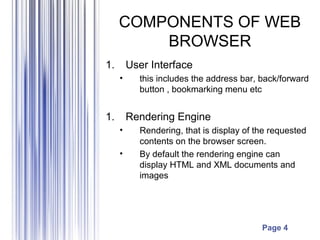
COMPONENTS OF WEB
BROWSER
1. User Interface
• this includes the address bar, back/forward
button , bookmarking menu etc
1. Rendering Engine
• Rendering, that is display of the requested
contents on the browser screen.
• By default the rendering engine can
display HTML and XML documents and
images
Page 5
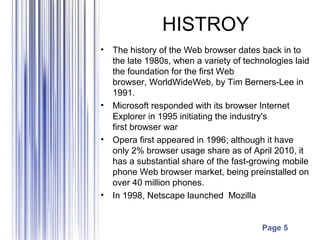
HISTROY
• The history of the Web browser dates back in to
the late 1980s, when a variety of technologies laid
the foundation for the first Web
browser, WorldWideWeb, by Tim Berners-Lee in
1991.
• Microsoft responded with its browser Internet
Explorer in 1995 initiating the industry's
first browser war
• Opera first appeared in 1996; although it have
only 2% browser usage share as of April 2010, it
has a substantial share of the fast-growing mobile
phone Web browser market, being preinstalled on
over 40 million phones.
• In 1998, Netscape launched Mozilla
Page 6
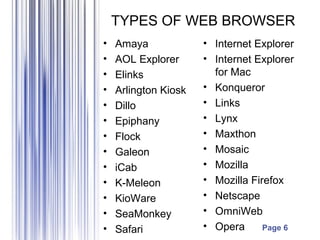
TYPES OF WEB BROWSER
• Amaya
• AOL Explorer
• Elinks
• Arlington Kiosk
• Dillo
• Epiphany
• Flock
• Galeon
• iCab
• K-Meleon
• KioWare
• SeaMonkey
• Safari
• Internet Explorer
• Internet Explorer
for Mac
• Konqueror
• Links
• Lynx
• Maxthon
• Mosaic
• Mozilla
• Mozilla Firefox
• Netscape
• OmniWeb
• Opera
Page 7
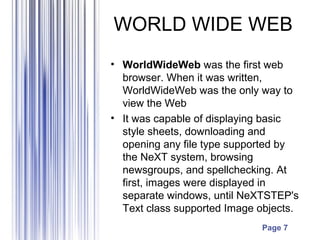
WORLD WIDE WEB
• WorldWideWeb was the first web
browser. When it was written,
WorldWideWeb was the only way to
view the Web
• It was capable of displaying basic
style sheets, downloading and
opening any file type supported by
the NeXT system, browsing
newsgroups, and spellchecking. At
first, images were displayed in
separate windows, until NeXTSTEP's
Text class supported Image objects.
Page 8
MOZILLA FIREFOX
• The Firefox Web
Browser is the faster,
more secure, and fully
customizable way to
surf the web
• Mozilla is a global
community dedicated
to building free, open
source products like
the award winning
Firefox web browser
and Thunderbird email
software. Mozilla
Firefox
Page 9
MOSIAC
• Mosaic was developed
at the National Center for
Supercomputing
Applications(NCSA) at
the University of Illinois
Urbana-Champaign
beginning in late 1992.
NCSA released the
browser in 1993, and
officially discontinued
development and support
on January 7, 1997.
• Mosaic was also the first
browser to display
images inline with text
instead of displaying
images in a separate
window
Page 10
NETSCAPE NAVIGATOR
• Netscape Navigator and
Netscape are the names
for the proprietary web
browser popular in the
1990s
• It was the flagship product
of the Netscape
Communications
Corporation and the
dominant web browser in
terms of usage share,
although by 2002 its usage
had almost disappeared
Page 11
WINDOWS INTERNET
EXPLORER
• Windows Internet
Explorer (formerly
Microsoft Internet
Explorer), is a series
of graphical web
browsers developed by
Microsoft and included
as part of the Microsoft
Windows line of
operating systems
starting in 1995
Page 12
OPERA
• Opera is a web browser and
Internet suite developed by
Opera Software.
• The browser handles common
Internet-related tasks such as
displaying web sites, sending
and receiving e-mail
messages, managing
contacts, chatting on IRC
downloading files via
BitTorrent, and reading web
feeds.
• Opera is offered free of charge
for personal computers and
mobile phones.
Page 13
SAFARI
• Safari is a graphical web
browser developed by
Apple and included as
part of the Mac OS X
operating system.
• on the company's Mac
OS X operating system, it
became Apple's default
browser
Page 14
GOOGLE CHROME
• Google Chrome is a web
browser developed by
Google that uses the
WebKit layout engine and
application framework
• It was first released as a
beta version for Microsoft
Windows on 2 September
2008, and the public
stable release was on 11
December 2008.
Page 15
MOBILE BROWSERS
• Mobile Browsers A mobile browser, also
called a micro browser, minibrowser or
wireless internet browser(WIB), is a web
browser designed for use on a mobile
device such as a mobile phone or PDA.
• Opera Mini, offered free of charge, is
designed primarily for mobile phones,
but also for smartphones and personal
digital assistants.
Page 16
PRESENTED BY
• Name: Nirmal Patel
• Roll no:37
• Class: B.B.A(I.T.M)SEM-4
Page 17
THANK YOU

webbrowser-130309124651-phpapp02.pdf

  • 1.
  • 2.
    Page 2 INTRODUCTION • AWeb browser acts as an interface between the user and Web server • Software application that resides on a computer and is used to locate and display Web pages. • Web user access information from web servers, through a client program called browser. • A web browser is a software application for retrieving, presenting, and traversing information resources on the World Wide Web
  • 3.
    Page 3 FEATURES • Allmajor web browsers allow the user to open multiple information resources at the same time, either in different browser windows or in different tabs of the same window • A refresh and stop buttons for refreshing and stopping the loading of current documents • Home button that gets you to your home page • Major browsers also include pop-up blockers to prevent unwanted windows from "popping up" without the user's consent
  • 4.
    Page 4 COMPONENTS OFWEB BROWSER 1. User Interface • this includes the address bar, back/forward button , bookmarking menu etc 1. Rendering Engine • Rendering, that is display of the requested contents on the browser screen. • By default the rendering engine can display HTML and XML documents and images
  • 5.
    Page 5 HISTROY • Thehistory of the Web browser dates back in to the late 1980s, when a variety of technologies laid the foundation for the first Web browser, WorldWideWeb, by Tim Berners-Lee in 1991. • Microsoft responded with its browser Internet Explorer in 1995 initiating the industry's first browser war • Opera first appeared in 1996; although it have only 2% browser usage share as of April 2010, it has a substantial share of the fast-growing mobile phone Web browser market, being preinstalled on over 40 million phones. • In 1998, Netscape launched Mozilla
  • 6.
    Page 6 TYPES OFWEB BROWSER • Amaya • AOL Explorer • Elinks • Arlington Kiosk • Dillo • Epiphany • Flock • Galeon • iCab • K-Meleon • KioWare • SeaMonkey • Safari • Internet Explorer • Internet Explorer for Mac • Konqueror • Links • Lynx • Maxthon • Mosaic • Mozilla • Mozilla Firefox • Netscape • OmniWeb • Opera
  • 7.
    Page 7 WORLD WIDEWEB • WorldWideWeb was the first web browser. When it was written, WorldWideWeb was the only way to view the Web • It was capable of displaying basic style sheets, downloading and opening any file type supported by the NeXT system, browsing newsgroups, and spellchecking. At first, images were displayed in separate windows, until NeXTSTEP's Text class supported Image objects.
  • 8.
    Page 8 MOZILLA FIREFOX •The Firefox Web Browser is the faster, more secure, and fully customizable way to surf the web • Mozilla is a global community dedicated to building free, open source products like the award winning Firefox web browser and Thunderbird email software. Mozilla Firefox
  • 9.
    Page 9 MOSIAC • Mosaicwas developed at the National Center for Supercomputing Applications(NCSA) at the University of Illinois Urbana-Champaign beginning in late 1992. NCSA released the browser in 1993, and officially discontinued development and support on January 7, 1997. • Mosaic was also the first browser to display images inline with text instead of displaying images in a separate window
  • 10.
    Page 10 NETSCAPE NAVIGATOR •Netscape Navigator and Netscape are the names for the proprietary web browser popular in the 1990s • It was the flagship product of the Netscape Communications Corporation and the dominant web browser in terms of usage share, although by 2002 its usage had almost disappeared
  • 11.
    Page 11 WINDOWS INTERNET EXPLORER •Windows Internet Explorer (formerly Microsoft Internet Explorer), is a series of graphical web browsers developed by Microsoft and included as part of the Microsoft Windows line of operating systems starting in 1995
  • 12.
    Page 12 OPERA • Operais a web browser and Internet suite developed by Opera Software. • The browser handles common Internet-related tasks such as displaying web sites, sending and receiving e-mail messages, managing contacts, chatting on IRC downloading files via BitTorrent, and reading web feeds. • Opera is offered free of charge for personal computers and mobile phones.
  • 13.
    Page 13 SAFARI • Safariis a graphical web browser developed by Apple and included as part of the Mac OS X operating system. • on the company's Mac OS X operating system, it became Apple's default browser
  • 14.
    Page 14 GOOGLE CHROME •Google Chrome is a web browser developed by Google that uses the WebKit layout engine and application framework • It was first released as a beta version for Microsoft Windows on 2 September 2008, and the public stable release was on 11 December 2008.
  • 15.
    Page 15 MOBILE BROWSERS •Mobile Browsers A mobile browser, also called a micro browser, minibrowser or wireless internet browser(WIB), is a web browser designed for use on a mobile device such as a mobile phone or PDA. • Opera Mini, offered free of charge, is designed primarily for mobile phones, but also for smartphones and personal digital assistants.
  • 16.
    Page 16 PRESENTED BY •Name: Nirmal Patel • Roll no:37 • Class: B.B.A(I.T.M)SEM-4
  • 17.