Web Engineering
Lecture-02
Lecture Outline
 Web Development Process
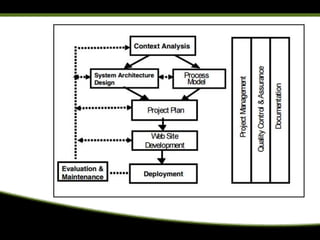
 Context Analysis
 Architecture Design
 Web Page Design
 Web Maintenance
Web Development Process
Process – a series of actions or steps taken in
order to achieve a particular end.
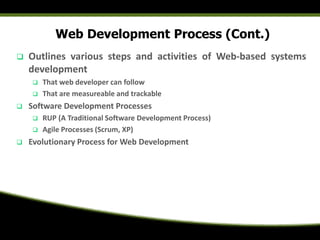
Web Development Process (Cont.)
 Outlines various steps and activities of Web-based systems
development
 That web developer can follow
 That are measureable and trackable
 Software Development Processes
 RUP (A Traditional Software Development Process)
 Agile Processes (Scrum, XP)
 Evolutionary Process for Web Development
Context Analysis
Context Analysis
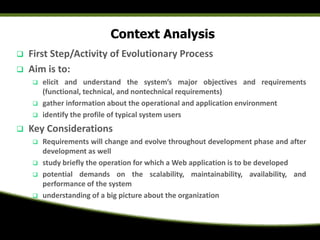
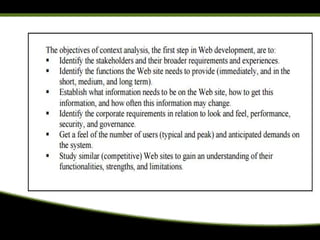
 First Step/Activity of Evolutionary Process
 Aim is to:
 elicit and understand the system’s major objectives and requirements
(functional, technical, and nontechnical requirements)
 gather information about the operational and application environment
 identify the profile of typical system users
 Key Considerations
 Requirements will change and evolve throughout development phase and after
development as well
 study briefly the operation for which a Web application is to be developed
 potential demands on the scalability, maintainability, availability, and
performance of the system
 understanding of a big picture about the organization
Context Analysis
 A thoroughly conducted Context Analysis can minimise or
eliminate the major problems plaguing large Web-based
system development
 In Practice, Still many developers and project managers
overlook this essential first step in Web system development
and face the problems later when it is hard to correct them
Architecture Design
Architecture Design
Website architecture is an approach to the design and
planning of websites that involves technical, aesthetic and
functional criteria. As in traditional architecture, the focus is
on the user and on user requirements.
Architecture Design (Cont.)
 Based on the context analysis, we then arrive at the system’s
technical and non-technical requirements, which, in turn,
influence the web system architecture design.
 In system architecture design, we decide on various
components of the system and how they are linked.
Architecture Design (Cont.)
 At this stage, we design:
 Overall system architecture describing how the network and the various
servers (Web servers, application servers and database servers) interact.
 Application architecture depicting various information modules and the
functions they support.
 Software architecture identifying various software and database modules
required to implement the application architecture.
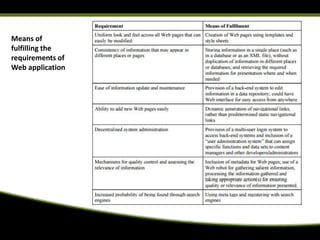
Means of
fulfilling the
requirements of
Web application
Web Page Design
Web Page Design
 Web page design is an important activity; it determines what
information is presented and how it is presented to the users.
 Prototype Approach
 Key Considerations
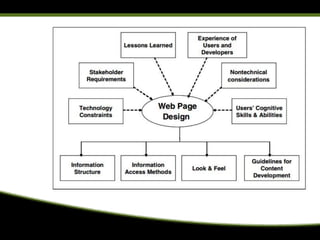
 Web page content development needs to take into consideration the
stakeholders’ requirements, users’ cognitive abilities (Cloyd, 2001), technical
issues and considerations, nontechnical issues, earlier experiences of
developers and users, and lessons learned from similar Web applications.
Web Maintenance
Web Maintenance
 After Deployment of a WebApp, it needs to be maintained
 Example: Content Maintenance
 Content Maintenance is a continual process. We need to formulate content
maintenance policies and procedures, based on the decision taken at the
system architecture design stage on how the information content would be
maintained and then we need to implement them.
 Example: System Updation
 Requirements of Web systems grow and evolve, the system needs to be
updated and also may be redesigned to cater to the new requirements.
Web Maintenance (Cont.)
 A good strategy for Web Maintenance is to periodically review
the systems regarding the currency of information content,
potential security risks, performance of the system, and usage
patterns, and take suitable measures to fix the shortcomings
and weaknesses, if any.
Assignment 1
DEFINE WEB ENGINEERING? Apply all engineering
concepts learned in this lectures to your term project.
Due Date: 8th March, 2019
Softcopy

Web engineering ppt

  • 1.
  • 2.
    Lecture Outline  WebDevelopment Process  Context Analysis  Architecture Design  Web Page Design  Web Maintenance
  • 3.
  • 4.
    Web Development Process Process– a series of actions or steps taken in order to achieve a particular end.
  • 5.
    Web Development Process(Cont.)  Outlines various steps and activities of Web-based systems development  That web developer can follow  That are measureable and trackable  Software Development Processes  RUP (A Traditional Software Development Process)  Agile Processes (Scrum, XP)  Evolutionary Process for Web Development
  • 7.
  • 8.
    Context Analysis  FirstStep/Activity of Evolutionary Process  Aim is to:  elicit and understand the system’s major objectives and requirements (functional, technical, and nontechnical requirements)  gather information about the operational and application environment  identify the profile of typical system users  Key Considerations  Requirements will change and evolve throughout development phase and after development as well  study briefly the operation for which a Web application is to be developed  potential demands on the scalability, maintainability, availability, and performance of the system  understanding of a big picture about the organization
  • 10.
    Context Analysis  Athoroughly conducted Context Analysis can minimise or eliminate the major problems plaguing large Web-based system development  In Practice, Still many developers and project managers overlook this essential first step in Web system development and face the problems later when it is hard to correct them
  • 11.
  • 12.
    Architecture Design Website architectureis an approach to the design and planning of websites that involves technical, aesthetic and functional criteria. As in traditional architecture, the focus is on the user and on user requirements.
  • 13.
    Architecture Design (Cont.) Based on the context analysis, we then arrive at the system’s technical and non-technical requirements, which, in turn, influence the web system architecture design.  In system architecture design, we decide on various components of the system and how they are linked.
  • 14.
    Architecture Design (Cont.) At this stage, we design:  Overall system architecture describing how the network and the various servers (Web servers, application servers and database servers) interact.  Application architecture depicting various information modules and the functions they support.  Software architecture identifying various software and database modules required to implement the application architecture.
  • 15.
  • 16.
  • 17.
    Web Page Design Web page design is an important activity; it determines what information is presented and how it is presented to the users.  Prototype Approach  Key Considerations  Web page content development needs to take into consideration the stakeholders’ requirements, users’ cognitive abilities (Cloyd, 2001), technical issues and considerations, nontechnical issues, earlier experiences of developers and users, and lessons learned from similar Web applications.
  • 19.
  • 20.
    Web Maintenance  AfterDeployment of a WebApp, it needs to be maintained  Example: Content Maintenance  Content Maintenance is a continual process. We need to formulate content maintenance policies and procedures, based on the decision taken at the system architecture design stage on how the information content would be maintained and then we need to implement them.  Example: System Updation  Requirements of Web systems grow and evolve, the system needs to be updated and also may be redesigned to cater to the new requirements.
  • 21.
    Web Maintenance (Cont.) A good strategy for Web Maintenance is to periodically review the systems regarding the currency of information content, potential security risks, performance of the system, and usage patterns, and take suitable measures to fix the shortcomings and weaknesses, if any.
  • 22.
    Assignment 1 DEFINE WEBENGINEERING? Apply all engineering concepts learned in this lectures to your term project. Due Date: 8th March, 2019 Softcopy

Editor's Notes

  • #2  Wasihaider734@gmail.com