Welcome! WealthWorks Network Peer Learning Event
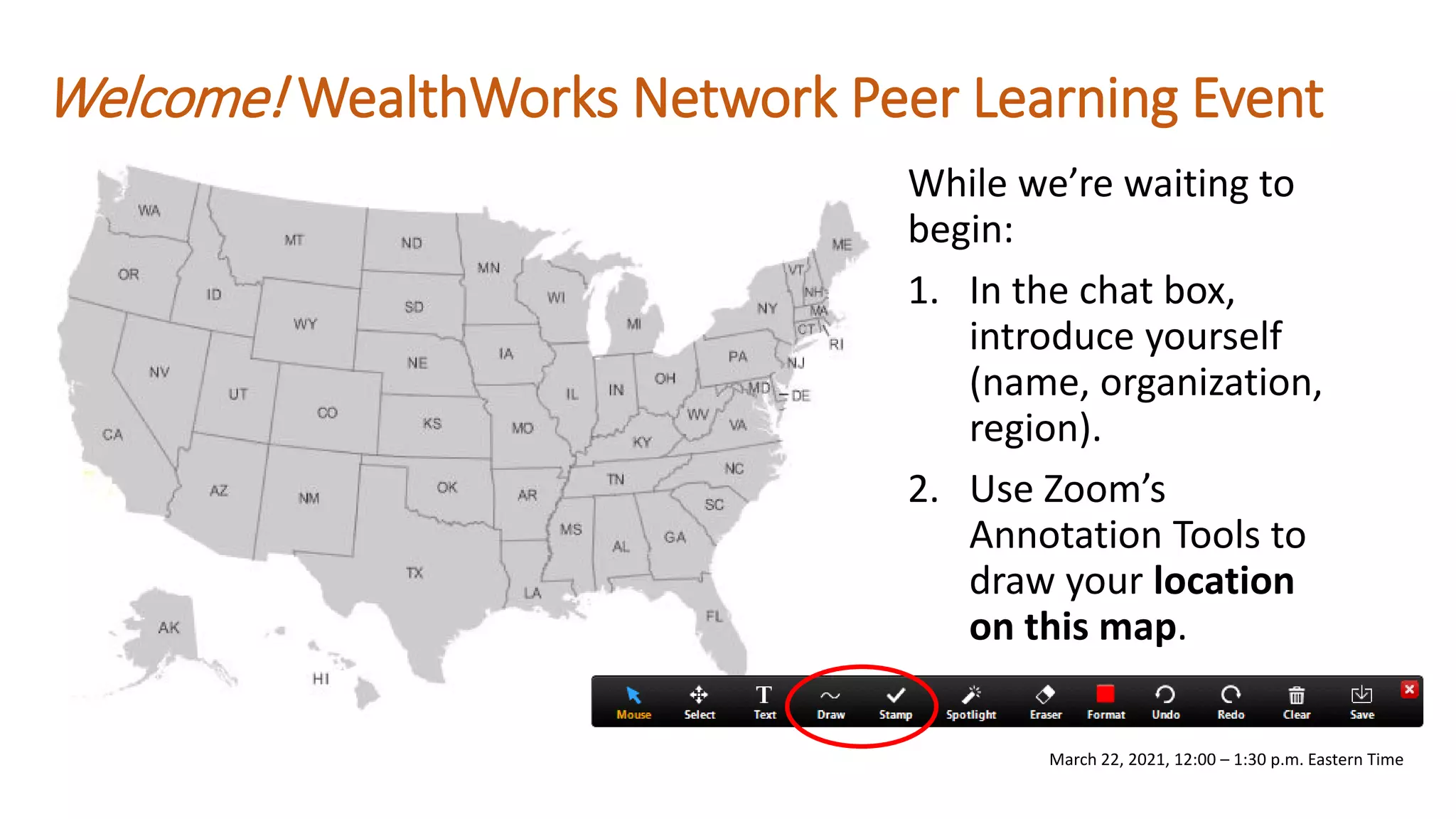
While we’re waiting to
begin:
1. In the chat box,
introduce yourself
(name, organization,
region).
2. Use Zoom’s
Annotation Tools to
draw your location
on this map.
March 22, 2021, 12:00 – 1:30 p.m. Eastern Time
Zoom Sector/Topic Events
• February 16: Local Foods, Recreation and Tourism, Entrepreneurship
• March 8: Broadband, Infrastructure & Services, Regional Planning
• March 22: Workforce Development, Energy, and Forestry
• All events Noon – 1:30 p.m. Eastern on Zoom
Goals for Today
• Introduction about rural wealth creation
• Breakout groups for discussion and networking
• Formatted as a Zoom meeting, not a webinar: Ask questions via chat
or aloud, interact with peers
• Recording the main session only, not group discussions
• Audio problems? Try dialing in by phone
• Any issues, check https://support.zoom.us/ or chat to Brittany Salazar
for tips
3/22/2021
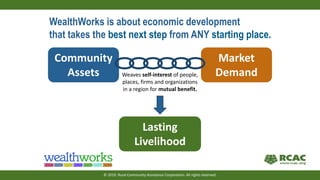
Community
Assets
Market
Demand
Lasting
Livelihood
Weaves self-interest of people,
places, firms and organizations
in a region for mutual benefit.
WealthWorks is about economic development
that takes the best next step from ANY starting place.
© 2019, Rural Community Assistance Corporation. All rights reserved.
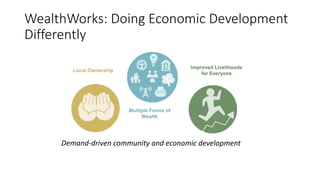
Multiple Forms of
Wealth
Improved Livelihoods
for Everyone
Local Ownership
WealthWorks: Doing Economic Development
Differently
Demand-driven community and economic development
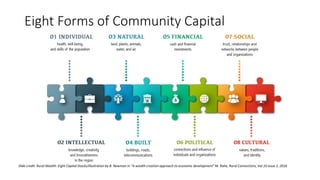
Slide credit: Rural Wealth: Eight Capital Stocks/illustration by B. Newman in “A wealth creation approach to economic development” M. Rahe, Rural Connections, Vol 10 Issue 2, 2016
Eight Forms of Community Capital
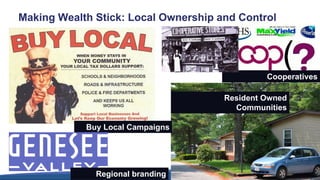
Making Wealth Stick: Local Ownership and Control
Buy Local Campaigns
Cooperatives
Resident Owned
Communities
Regional branding
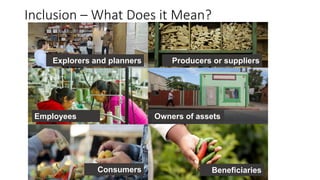
Inclusion – What Does it Mean?
9/23/2020
Explorers and planners Producers or suppliers
Employees Owners of assets
Consumers Beneficiaries
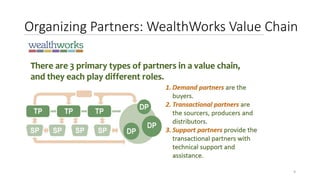
Organizing Partners: WealthWorks Value Chain
9
What does WealthWorks look like?
• Energy, forestry
• Understanding available resources
• Feasibility studies, R&D
• Addressing demand
• Connecting to consumers
• While doing intentional inclusion—intended beneficiaries should be involved
• While building multiple assets within the community
• While focusing on local ownership and control
• While meeting real market demand
What does WealthWorks look like?
• Workforce development
• Broad-based advisory group
• Sector-focused activities
• Metrics, milestones, indicators of success
• While doing intentional inclusion—intended beneficiaries should be involved
• While building multiple assets within the community
• While focusing on local ownership and control
• While meeting real market demand
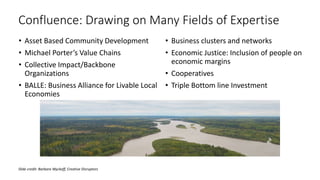
Confluence: Drawing on Many Fields of Expertise
• Asset Based Community Development
• Michael Porter’s Value Chains
• Collective Impact/Backbone
Organizations
• BALLE: Business Alliance for Livable Local
Economies
• Business clusters and networks
• Economic Justice: Inclusion of people on
economic margins
• Cooperatives
• Triple Bottom line Investment
Slide credit: Barbara Wyckoff, Creative Disruptors
Addressing Equity: Understanding Compliance
• Environmental Justice:
• Avoid, minimize, or mitigate disproportionately high and adverse human health
and environmental effects, including social and economic effects, on minority
populations and low-income populations (FTA Circular:
www.transit.dot.gov/sites/fta.dot.gov/files/docs/FTA_EJ_Circular_7.14-
12_FINAL.pdf)
• Title VI of the Civil Rights Act:
• Prohibits discrimination by recipients of Federal financial assistance on the basis of
race, color, and national origin, including the denial of meaningful access for
limited English proficient (LEP) persons (FTA Circular:
www.transit.dot.gov/sites/fta.dot.gov/files/docs/FTA_Title_VI_FINAL.pdf)
• Americans with Disabilities Act:
• Prohibits discrimination and ensures equal opportunity and access for persons with
disabilities (FTA Circular:
www.transit.dot.gov/sites/fta.dot.gov/files/docs/Final_FTA_ADA_Circular_C_4710.
1.pdf)
13
Beyond Compliance
• Equity & justice work
• Doesn’t discriminate, avoids disproportionate effects, but also…
• Has a broad lens on fair treatment, meaningful participation, and removing
barriers, beyond those identified in Title VI, EJ, ADA
• Internal organizational policies and processes
• Hiring, dress codes, leave policies, communications, workplace evaluations,
procurement, board/committee recruitment
• External programming
• Public outreach/input gathering, information sharing, participation in programs/services
or benefit from outcomes of programs
14
Concepts in equity & justice work
• Everyone benefits from support or removal of barriers at least some
of the time; who benefits from what kinds of support might change
over time
• Individual characteristics such as race, class, gender, sexuality, age,
health & disability status, educational attainment, English language
proficiency, religion, immigration status intersect and shape people’s
lives
• Intersectionality: experience differs based on individual, characteristics and
identity, and context (Crenshaw)
15
Concepts in equity & justice work
• Agency: capacity of individuals/groups to act independently
• Look for ways to engage people as:
• Producers
• Consumers
• Investors
• Entrepreneurs
• Planners
• Beneficiaries
• All of whom have a role and a stake in the programs you work with
and can contribute to its success
16
Concepts in equity & justice work
• Implicit bias, explicit bias, and stereotyping about others (and what
others need) affect our work
• Intent vs. Impact
• Sometimes we offend without meaning to
• But it still causes harm
• It’s a learning process
• We can mitigate biases
17
Doing equity & justice work
• Build relationships with people/organizations already working in
communities
• Plan for authentic engagement
• Make it easy to provide input
• Be open about what happens with that input
• Acknowledge agency: offer opportunities to shape the future
• Make sure there is a value proposition for them to work with you…
The perspectives of diverse participants will improve your work. How
are you improving theirs?
18
Breakout Groups
• In breakout groups:
• Share who you are, where you work, what you’re working on that relates to
energy, forestry, and/or workforce development
• Who or what are your major assets in this work?
• What are your challenges?
• Facilitators:
• Erica Bjelland, Region Five Development Commission
• Carol Cohen, Rural Community Assistance Corporation
• Amy Hause, Rural Development Initiatives
Resources
• www.WealthWorks.org
• “Success Stories” section of site includes several case studies on various sectors,
including energy and forestry.
• Find a WealthWorks Hub: https://www.wealthworks.org/connect/hubs
• Aspen Institute videos: All Land is Not Creating Equal: Unleashing
Community and Family Wealth through Landownership
• https://www.aspeninstitute.org/videos/all-land-is-not-creating-equal-unleashing-
family-and-community-wealth-through-land-ownership/
• Measurement resources:
• https://www.nado.org/wealthworks-evaluation-framework/
• https://www.nado.org/measuring-rural-wealth-creation-a-guide-for-regional-
development-organizations/
3/22/2021
Contact Information
• Carrie Kissel, National Association of Development Organizations
(NADO) Research Foundation
• ckissel@nado.org
3/22/2021

WealthWorks Network Peer Learning Event: Workforce Development, Energy, and Forestry

  • 1.
    Welcome! WealthWorks NetworkPeer Learning Event While we’re waiting to begin: 1. In the chat box, introduce yourself (name, organization, region). 2. Use Zoom’s Annotation Tools to draw your location on this map. March 22, 2021, 12:00 – 1:30 p.m. Eastern Time
  • 2.
    Zoom Sector/Topic Events •February 16: Local Foods, Recreation and Tourism, Entrepreneurship • March 8: Broadband, Infrastructure & Services, Regional Planning • March 22: Workforce Development, Energy, and Forestry • All events Noon – 1:30 p.m. Eastern on Zoom
  • 3.
    Goals for Today •Introduction about rural wealth creation • Breakout groups for discussion and networking • Formatted as a Zoom meeting, not a webinar: Ask questions via chat or aloud, interact with peers • Recording the main session only, not group discussions • Audio problems? Try dialing in by phone • Any issues, check https://support.zoom.us/ or chat to Brittany Salazar for tips 3/22/2021
  • 4.
    Community Assets Market Demand Lasting Livelihood Weaves self-interest ofpeople, places, firms and organizations in a region for mutual benefit. WealthWorks is about economic development that takes the best next step from ANY starting place. © 2019, Rural Community Assistance Corporation. All rights reserved.
  • 5.
    Multiple Forms of Wealth ImprovedLivelihoods for Everyone Local Ownership WealthWorks: Doing Economic Development Differently Demand-driven community and economic development
  • 6.
    Slide credit: RuralWealth: Eight Capital Stocks/illustration by B. Newman in “A wealth creation approach to economic development” M. Rahe, Rural Connections, Vol 10 Issue 2, 2016 Eight Forms of Community Capital
  • 7.
    Making Wealth Stick:Local Ownership and Control Buy Local Campaigns Cooperatives Resident Owned Communities Regional branding
  • 8.
    Inclusion – WhatDoes it Mean? 9/23/2020 Explorers and planners Producers or suppliers Employees Owners of assets Consumers Beneficiaries
  • 9.
  • 10.
    What does WealthWorkslook like? • Energy, forestry • Understanding available resources • Feasibility studies, R&D • Addressing demand • Connecting to consumers • While doing intentional inclusion—intended beneficiaries should be involved • While building multiple assets within the community • While focusing on local ownership and control • While meeting real market demand
  • 11.
    What does WealthWorkslook like? • Workforce development • Broad-based advisory group • Sector-focused activities • Metrics, milestones, indicators of success • While doing intentional inclusion—intended beneficiaries should be involved • While building multiple assets within the community • While focusing on local ownership and control • While meeting real market demand
  • 12.
    Confluence: Drawing onMany Fields of Expertise • Asset Based Community Development • Michael Porter’s Value Chains • Collective Impact/Backbone Organizations • BALLE: Business Alliance for Livable Local Economies • Business clusters and networks • Economic Justice: Inclusion of people on economic margins • Cooperatives • Triple Bottom line Investment Slide credit: Barbara Wyckoff, Creative Disruptors
  • 13.
    Addressing Equity: UnderstandingCompliance • Environmental Justice: • Avoid, minimize, or mitigate disproportionately high and adverse human health and environmental effects, including social and economic effects, on minority populations and low-income populations (FTA Circular: www.transit.dot.gov/sites/fta.dot.gov/files/docs/FTA_EJ_Circular_7.14- 12_FINAL.pdf) • Title VI of the Civil Rights Act: • Prohibits discrimination by recipients of Federal financial assistance on the basis of race, color, and national origin, including the denial of meaningful access for limited English proficient (LEP) persons (FTA Circular: www.transit.dot.gov/sites/fta.dot.gov/files/docs/FTA_Title_VI_FINAL.pdf) • Americans with Disabilities Act: • Prohibits discrimination and ensures equal opportunity and access for persons with disabilities (FTA Circular: www.transit.dot.gov/sites/fta.dot.gov/files/docs/Final_FTA_ADA_Circular_C_4710. 1.pdf) 13
  • 14.
    Beyond Compliance • Equity& justice work • Doesn’t discriminate, avoids disproportionate effects, but also… • Has a broad lens on fair treatment, meaningful participation, and removing barriers, beyond those identified in Title VI, EJ, ADA • Internal organizational policies and processes • Hiring, dress codes, leave policies, communications, workplace evaluations, procurement, board/committee recruitment • External programming • Public outreach/input gathering, information sharing, participation in programs/services or benefit from outcomes of programs 14
  • 15.
    Concepts in equity& justice work • Everyone benefits from support or removal of barriers at least some of the time; who benefits from what kinds of support might change over time • Individual characteristics such as race, class, gender, sexuality, age, health & disability status, educational attainment, English language proficiency, religion, immigration status intersect and shape people’s lives • Intersectionality: experience differs based on individual, characteristics and identity, and context (Crenshaw) 15
  • 16.
    Concepts in equity& justice work • Agency: capacity of individuals/groups to act independently • Look for ways to engage people as: • Producers • Consumers • Investors • Entrepreneurs • Planners • Beneficiaries • All of whom have a role and a stake in the programs you work with and can contribute to its success 16
  • 17.
    Concepts in equity& justice work • Implicit bias, explicit bias, and stereotyping about others (and what others need) affect our work • Intent vs. Impact • Sometimes we offend without meaning to • But it still causes harm • It’s a learning process • We can mitigate biases 17
  • 18.
    Doing equity &justice work • Build relationships with people/organizations already working in communities • Plan for authentic engagement • Make it easy to provide input • Be open about what happens with that input • Acknowledge agency: offer opportunities to shape the future • Make sure there is a value proposition for them to work with you… The perspectives of diverse participants will improve your work. How are you improving theirs? 18
  • 19.
    Breakout Groups • Inbreakout groups: • Share who you are, where you work, what you’re working on that relates to energy, forestry, and/or workforce development • Who or what are your major assets in this work? • What are your challenges? • Facilitators: • Erica Bjelland, Region Five Development Commission • Carol Cohen, Rural Community Assistance Corporation • Amy Hause, Rural Development Initiatives
  • 20.
    Resources • www.WealthWorks.org • “SuccessStories” section of site includes several case studies on various sectors, including energy and forestry. • Find a WealthWorks Hub: https://www.wealthworks.org/connect/hubs • Aspen Institute videos: All Land is Not Creating Equal: Unleashing Community and Family Wealth through Landownership • https://www.aspeninstitute.org/videos/all-land-is-not-creating-equal-unleashing- family-and-community-wealth-through-land-ownership/ • Measurement resources: • https://www.nado.org/wealthworks-evaluation-framework/ • https://www.nado.org/measuring-rural-wealth-creation-a-guide-for-regional- development-organizations/ 3/22/2021
  • 21.
    Contact Information • CarrieKissel, National Association of Development Organizations (NADO) Research Foundation • ckissel@nado.org 3/22/2021