BECOMING
A WORLD DESIGN
CAPITAL®
A comprehensive guide
to the application process
TABLE OF CONTENTS
	 4	 What is World Design Capital®?
	 7	 Message from the President
	 10	 The WDC Network of Cities
	 14	 WDC Selection Committee
	 18	 WDC 2020 Signature Events
	 22	 WDC Organizational Structure
	 28	 Who can submit a bid?
	 32	 What are the fees related to the
WDC designation?
	 34	 Frequently asked questions
	 40	 About Us
I THINK DESIGN
IS ­CONSIDER­ATION,
­COMMUNICATION,
­CULTURE, LEISURE,
PLEASURE
AND ECONOMY.
SO, IF I PUT IT INTO
ONE SENTENCE:
DESIGN IS EVERYTHING.
— Oh Se-hoon, Mayor of Seoul (2006-2011)
4
WHAT IS
WORLD DESIGN CAPITAL®?
With more than half the world’s
population now living in cities,
design has become an increasingly
fundamentaltoolformakingcities
more attractive, competitive,
efficient, livable, and sustainable.
The World Design Capital® (WDC) is designated every two years
by the International Council of Societies of Industrial Design1
to recognize a city’s innovative use of design to strengthen eco-
nomic, social, cultural and environmental development. Through
a year-long programme of design-related events, WDC provides
a platform to showcase best practices in design-led urban
­policy and innovation, increase civic engagement, as well as
attract business and tourism.
First launched in Torino (Italy) in 2008, WDC has also been
awarded to Seoul (South Korea) in 2010, Helsinki (Finland) in
2012, and Cape Town (South Africa) in 2014. Taipei is WDC 2016
and Mexico City will be WDC 2018. Will you be WDC 2020?
1	 Effective 1 January 2017, the International Council of Societies of Industrial
Design (Icsid) will be known as the World Design Organization (WDO).
Icsid becomes the
World Design ­Organization
on 1 ­January 2017.
The new name reflects the organi-
zation’s desire to be more inclusive,
echoing the evolution and interdis-
ciplinary nature of the practice of
industrial design today and the role
of design as a catalyst for change.
As the world body for industrial
design, we seek to advocate design-
led innovation that will contribute
to the achievement of the United
Nations Sustainable Development
Goals (SDGs) by 2030.
5
WHAT ARE THE OBJECTIVES
OF THE WDC PROGRAMME?
•	 Showcase a designated city’s use of
design to reinvent itself and improve
the quality of life of its citizens
•	 Promote a city and its design com­
munity on the international stage
•	 Increase public awareness of
the power of design to strengthen
economic, social, cultural
and environmental development
•	 Inspire other cities to use design as
astrategictooltogrowandprosper
•	 Create an international network
where cities share best practices in
innovative design
•	 Ensure a design legacy flourishes
in a designated city long after the
WDC year ends.
6
WHAT DOES IT MEAN FOR
A CITY TO RECEIVE THE WDC
DESIGNATION?
A city that becomes a World Design
Capital can expect to:
•	 Gain visibility as a hub of creativity
and innovation
•	 Attract investment, tourism and
civic pride
•	 Strengthen economic development
•	 Improve the quality of life of
its citizens
•	 Position itself as an international
leader in design
•	 Build its global image, and
•	 Join an international network of
design-effective cities.
7
MESSAGE FROM
THE PRESIDENT
As the global organization for industrial design, we are passionate
about positioning design as a positive agent for change. With
140 members in 40 countries across 6 regions, we share a common
vision of design’s ability to create a better world.
We are immensely proud of our World Design Capital® (WDC) pro-
gramme, which showcases design’s inextricable role in improving
urban quality of life.
More people than ever before now live within the built environment.
As the impact and complexity of rapid urbanization dawns upon
the human family, we are cognizant of the need within our ­industry
to tackle such imperatives as environmental degradation, social
inequality, and the myriad other challenges associated with
21st century living that were not traditionally within the purview
of industrial design a mere generation ago.
The WDC programme provides a platform to highlight and share
best practices in urban design-led innovation that addresses
areas such as public transportation, sustainable infrastructure,
changing demographics, mobility, safety, renewable energy,
transparent and inclusive governance, among many others. It
recognizes those cities that have effectively used design to
reinvent themselves, creating attractive places for people to live,
work and visit.
WDC is more than just a year-long programme of events. It is a
global movement of cities that shows how design can, and does,
help to reinvent a city. The success of WDC lies in the fact that
WDC cities go on to become prominent design hubs, co-creating
design led innovation and urban policies that continue to make
a difference in citizens’ lives long after the WDC year comes to
an end.
As we launch our new brand as the World Design Organization,
effective 1 January 2017, and celebrate our 60th anniversary
year, we aspire to enhance all peoples’ quality of life. We seek to
be more inclusive, echoing the evolution and interdisciplinary
nature of the practice of industrial design today, and to leverage
our strength, working together to design a better world.
As the African proverb says: If I run alone, I can fun faster; but if
we run together, we can run further. We need to run farther, faster,
together. I encourage you to join us!
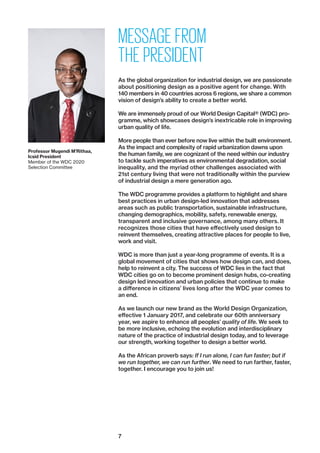
Professor Mugendi M’Rithaa,
Icsid President
Member of the WDC 2020
Selection Committee
WORLD DESIGN CAPITAL
TOLD THE STORY
OF OUR REGION’S IDENTITY,
EXAMINING ITS HISTORY,
INDUSTRIAL TRADITION
AND BUSINESS THROUGH
THE LENS OF DESIGN
AND USED DESIGN TO
PRESENT THE ­LOCAL REGION
IN A FRESH LIGHT.
— Sergio Chiamparino, Mayor of Torino (2001-2011)
10
THE WDC
NETWORK OF CITIES
Since its inception in 2008, the
World Design Capital programme
has accumulated many success
stories and achievements. A global
network of cities is emerging,
facilitating dialogue and knowledge
sharing about the power of
design totacklesomeoftheworld’s
biggest challenges.
11
12
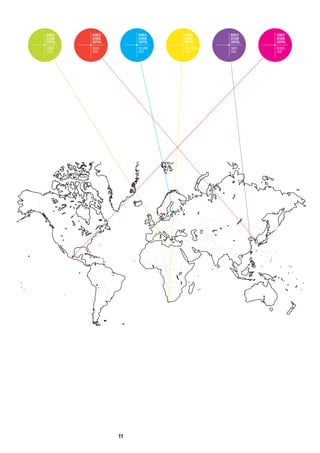
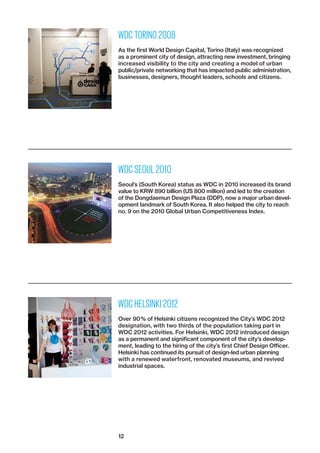
WDC TORINO 2008
As the first World Design Capital, Torino (Italy) was recognized
as a prominent city of design, attracting new investment, ­bringing
increased visibility to the city and creating a model of urban
­public/private networking that has impacted public administration,
businesses, designers, thought leaders, schools and citizens.
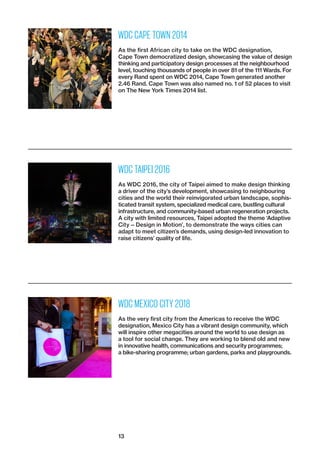
WDC SEOUL 2010
Seoul’s (South Korea) status as WDC in 2010 increased its brand
value to KRW 890 billion (US 800 million) and led to the creation
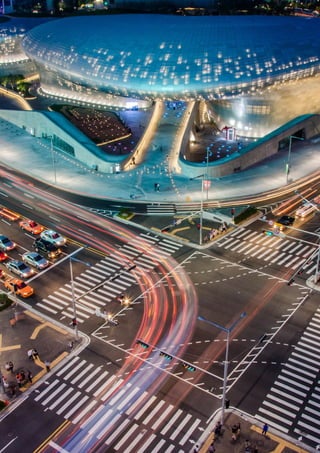
of the Dongdaemun Design Plaza (DDP), now a major urban devel-
opment landmark of South Korea. It also helped the city to reach
no. 9 on the 2010 Global Urban Competitiveness Index.
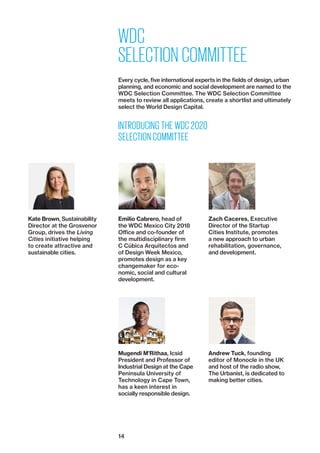
WDC HELSINKI 2012
Over 90 % of Helsinki citizens recognized the City’s WDC 2012
designation, with two thirds of the population taking part in
WDC 2012 activities. For Helsinki, WDC 2012 introduced design
as a permanent and significant component of the city’s develop-
ment, leading to the hiring of the city’s first Chief Design Officer.
Helsinki has continued its pursuit of design-led urban planning
with a renewed waterfront, renovated museums, and revived
industrial spaces.
13
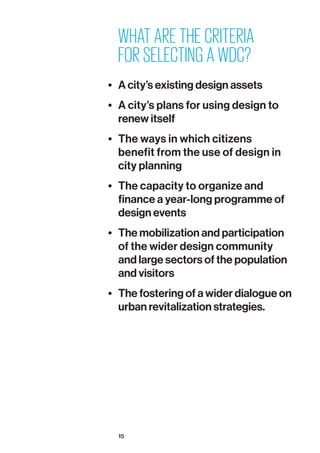
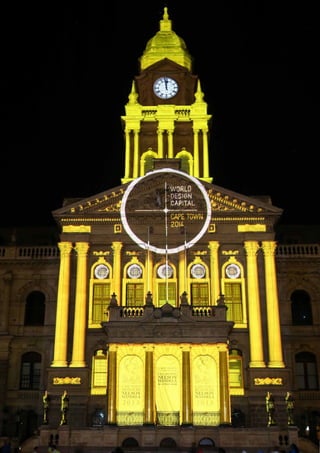
WDC CAPE TOWN 2014
As the first African city to take on the WDC designation,
Cape Town democratized design, showcasing the value of design
thinking and participatory design processes at the neighbourhood
level, touching thousands of people in over 81 of the 111 Wards. For
every Rand spent on WDC 2014, Cape Town generated another
2.46 Rand. Cape Town was also named no. 1 of 52 places to visit
on The New York Times 2014 list.
WDC TAIPEI 2016
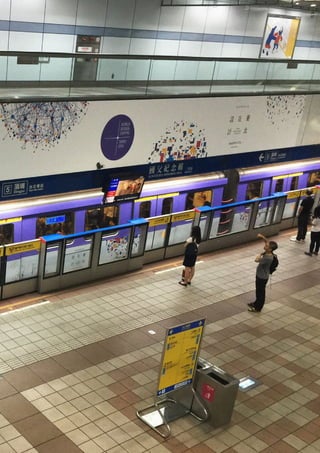
As WDC 2016, the city of Taipei aimed to make design thinking
a driver of the city’s development, showcasing to ­neighbouring
cities and the world their reinvigorated urban landscape, sophis-
ticated transit system, specialized medical care, bustling cultural
infrastructure, and community-based urban regeneration projects.
A city with limited resources, Taipei adopted the theme ‘­Adaptive
City — Design in Motion’, to demonstrate the ways cities can
adapt to meet citizen’s demands, using design-led innovation to
raise citizens’ quality of life.
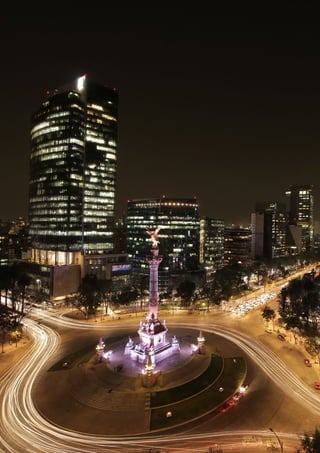
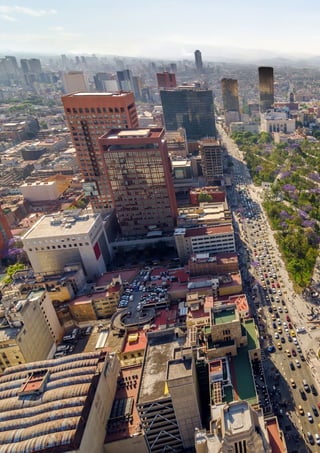
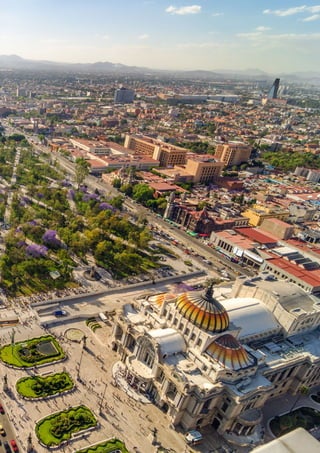
WDC MEXICO CITY 2018
As the very first city from the Americas to receive the WDC
desig­nation, Mexico City has a vibrant design community, which
will inspire other megacities around the world to use design as
a tool for social change. They are working to blend old and new
in innovative health, communications and security ­programmes;
a bike-sharing programme; urban gardens, parks and playgrounds.
14
WDC
SELECTION COMMITTEE
Every cycle, five international experts in the fields of design, urban
planning, and economic and social development are named to the
WDC Selection Committee. The WDC Selection Committee
meets to review all applications, create a shortlist and ultimately
select the World Design Capital.
INTRODUCING THE WDC 2020
SELECTION COMMITTEE
Kate Brown, Sustainability
Director at the Grosvenor
Group, drives the Living
­Cities initiative helping
to create attractive and
­sustainable cities.
Emilio Cabrero, head of
the WDC Mexico City 2018
Office and co-founder of
the ­multidisciplinary firm
C Cúbica Arquitectos and
of Design Week Mexico,
promotes design as a key
changemaker for eco-
nomic, social and cultural
development.
Mugendi M’Rithaa, Icsid
President and Professor of
Industrial Design at the Cape
Peninsula ­University of
Technology in Cape Town,
has a keen interest in
socially responsible design.
Zach Caceres, ­Executive
Director of the Startup
­Cities Institute, promotes
a new approach to urban
­rehabilitation, governance,
and development.
Andrew Tuck, founding
editor of Monocle in the UK
and host of the radio show,
The Urbanist, is dedicated to
making better cities.
15
WHAT ARE THE CRITERIA
FOR SELECTING A WDC?
•	 A city’s existing design assets
•	 A city’s plans for using design to
renew itself
•	 The ways in which citizens
benefit from the use of design in
city planning
•	 The capacity to organize and
finance a year-long programme of
design events
•	 The mobilization and participation
of the wider design community
and large sectors of the population
and visitors
•	 The fostering of a wider dialogue on
urban revitalization strategies.
WDC WILL HELP US ENSURE
DESIGN PERMEATES
ACROSS ALL ASPECTS OF
OUR MEGALOPOLIS,
SINCE IT IS ONLY THROUGH
DESIGN THAT WE CAN
ACHIEVE REAL CHANGE.
— Emilio Cabrero, Design Week Mexico
18
WDC 2020
SIGNATURE EVENTS
Every World Design Capital
identifiesanddevelopsayear-long
programme of unique design
events, relevant to their city and
their citizens, and which sets out to
achieve local objectives while
attractingbothlocalaudiencesand
international visitors and press.
19
In addition to these local events, each WDC also organizes eight
WDC Signature Events in partnership with Icsid:
WDC Signing Ceremony
The WDC Signing Ceremony is an opportunity for the designated
city to invite key stakeholders, including government officials,
the design community, local media, and business to witness and
celebrate the official signing of the WDC Host City Agreement.
It is the first official WDC event and the only WDC signature event
held outside the designated year, usually in the first quarter of the
year following the official announcement of the designated WDC
City. The WDC Signing Ceremony is an opportunity to celebrate
those who developed the bid, as well as to shine a spotlight on the
best and the brightest of the incoming WDC Host City’s design
community. The event also helps build citizen pride in the accom-
plishment of the city.
World Design Street Festival
(formerly WDC New Year’s Eve of Design)
The World Design Street Festival is the kick-off celebration to
the WDC Calendar Year. Festivities are experience-driven and
focus on building citizen excitement and engagement for the year
to come, fostering civic pride in achieving the WDC designation
and increasing public awareness of the importance of design in
improving citizens’ lives. This is an opportunity to engage as many
people as possible, including international visitors, to ­experience
design activities in person through concerts, public design work-
shops, exhibitions, or design studio open houses. Recommended
to be held in the first quarter of the designated year, the World
Design Street Festival can also be paired with another WDC
­Signature Event or event on the Local WDC calendar.
World Design Spotlight
(formerly the International Design Gala)
The World Design Spotlight is a celebratory event conceptualized
to highlight design as an impactful tool for city development and to
showcase why the WDC Host City was awarded the designation.
Speaking to the designated city’s unique identity, this event pays
tribute to the city’s design community, recognizing those local con-
tributions that led to the city’s WDC designation. It also recognizes
best practices in impact design at the international level.
World Design Experience
(formerly the International Design House Exhibition)
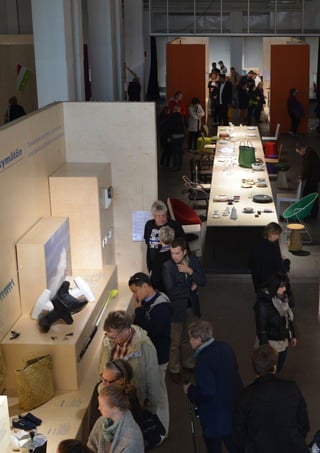
The World Design Experience is an interactive showcase of design
from around the world held over seven days. With an emphasis
on user experience, this WDC Signature Event features ­exhibitors
sharing their unique design stories as interpreted through the
theme of the WDC year. Design effective communities are invited
to present the best of their country’s design and its power
to improve quality of life, creating an opportunity for designers
to share ideas, innovation and expertise. This WDC Signature
Event can raise significant media attention and is a prime draw
for international visitors.
20
World Design Policy Conference
(formerly the WDC International Design Policy Conference)
Design-led urban policies are increasingly recognized as ­critical
to shaping the future prosperity and wellbeing of a city and its
inhabitants. The World Design Policy Conference provides a global
platform for the exchange of ideas, insights, and best practices
from different countries, regions, and cities that are ­developing,
launching, and maintaining effective design policy. The most
content rich of the WDC Signature Events, its findings have the
potential to set the foundation for a design-led legacy pro-
gramme that benefits the design community and citizens and
that resonates far beyond the designated WDC year.
World Design Week Forum
The World Design Week Forum is the ‘go-to’ event for Design
Week organizers from around the world to share best ­practices
and lessons learned. It is also an opportunity for cities that do
not already hold a Design Week to obtain the information, tools
and support needed to initiate such an event. A one-day event,
it is usually held in conjunction with the World Design Experience,
attracting key players on the international design stage as well as
public-private investors.
World Design Network of Cities Meeting
(formerly the WDC Network of Cities Meeting)
The World Design Network of Cities Meeting is a forum for
municipal representatives, including but not limited to the ­mayors
of WDC designated cities. Led by Icsid, this Signature Event
provides an opportunity for this unique cluster of cities to ­maintain
an active dialogue about design in the life of a city since the
WDC designated year. The meeting aims to highlight ­successes
in WDC legacy programmes and to identify collaborative
opportunities between the WDC designated and other design
effective cities.
World Design Capital Convocation Ceremony
The WDC Convocation Ceremony is a symbolic event to mark
the successes of the WDC year, showcase the year’s highlights,
recognize those who contributed to the year’s success, share
the preliminary findings of the impact study, reflect on the WDC
legacy, and officially hand over the WDC title to the incoming city.
The Convocation Ceremony includes city officials, local WDC
leadership, the design community, media and the incoming WDC’s
political leadership and planning team.
22
WDC ORGANIZATIONAL
STRUCTURE
The WDC Organizational Structure is split into two levels:
1.	 The WDC Programme: High-level management, promotion
and support of the overall WDC programme by Icsid
2.	 WDC Project Management: Local development and imple-
mentation of the designated calendar year of events by
an independent management entity named by the host city.
The WDC Programme
As creator and owner of World Design Capital, Icsid ­manages
each cycle of the WDC Programme from its international
­Secretariat based in Montreal (Canada). Icsid is responsible for
the vision, policy, and promotion of the WDC programme.
Daily operations relating to each of the designated WDC cities
are managed by a professional team from within the Secretariat,
including the bid process, contract management, international
sponsorships and partnerships, programming and WDC Signature
Event support, as well as brand management.
WDC Project Management
The designated city establishes an independent managing entity,
the WDC Organizing Lead, responsible for the planning and
execution of the proposed WDC calendar year of events for the
designated city. The members of the Organizing Lead execute
local and international promotion for the programming and the
city itself.
A WDC Local Organizing Committee is established by the city to
provide strategic direction to the Organizing Lead for the WDC
year-long programming. It is composed of city representatives,
other levels of government, as well as external stakeholders
(i.e. funding partners) and representatives from the local design
community. The Organizing Lead members liaise with their Local
Organizing Committee and Icsid.
In addition, Icsid and the designated city establish an International
Advisory Committee (IAC) whose chief responsibility is to help
place the WDC Host City in a global context and attract different
regions to what is happening in the designated city. Composed of
high-profile local and international design leaders and a repre­
sentative from the Secretariat, they provide creative direction
and serve as a sounding board for programme ideas.
23
To date, the composition of the Organizing Leads within each
of the WDC designated cities have been different from one
another, each built around the intricacies of their own ­municipal
requirements and the logistics of establishing a stand-alone
entity to use funding dedicated from the city and implement it.
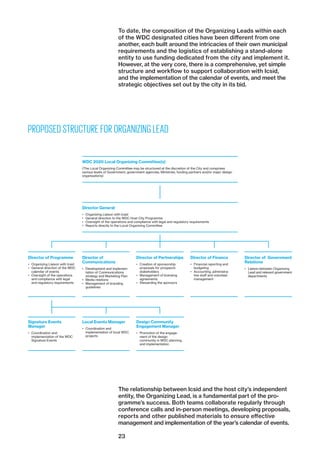
However, at the very core, there is a comprehensive, yet ­simple
structure and workflow to support collaboration with Icsid,
and the implementation of the calendar of events, and meet the
strategic objectives set out by the city in its bid.
The relationship between Icsid and the host city’s ­independent
entity, the Organizing Lead, is a fundamental part of the pro-
gramme’s success. Both teams collaborate regularly through
conference calls and in-person meetings, developing ­proposals,
reports and other published materials to ensure effective
­management and implementation of the year’s calendar of events.
WDC 2020 Local Organizing Committee(s)
(The Local Organizing Committee may be structured at the discretion of the City and comprises
­various levels of Government, government agencies, Ministries, funding partners and/or major design
organisations)
Director General
•	 Organizing Liaison with Icsid
•	 General direction to the WDC Host City Programme
•	 Oversight of the operations and compliance with legal and regulatory requirements
•	 Reports directly to the Local Organizing Committee
Director of Programme
•	 Organizing Liaison with Icsid
•	 General direction of the WDC
calendar of events
•	 Oversight of the operations
and compliance with legal
and regulatory requirements
Signature Events
Manager
•	 Coordination and
­implementation of the WDC
Signature Events
Director of
Communications
•	 Development and implemen-
tation of Communications
strategy and Marketing Plan
•	 Media relations
•	 Management of branding
guidelines
Local Events Manager
•	 Coordination and
­implementation of local WDC
projects                        
Director of Partnerships
•	 Creation of sponsorship
proposals for prospects
stakeholders
•	 Management of licensing
agreements
•	 Stewarding the sponsors
Design Community
Engagement Manager
•	 Promotion of the engage-
ment of the design
community in WDC planning
and implementation
Director of Finance
•	 Financial reporting and
budgeting
•	 Accounting, administra-
tive staff and volunteer
management
Director of Government
Relations
•	 Liaison between Organizing
Lead and relevant government
departments
PROPOSED STRUCTURE FOR ORGANIZING LEAD
THE WDC DESIGNATION
OPENED UP ­REMARKABLE
OPPORTUNITIES FOR
OUR CITY AND WE FEEL
DEEPLY HONOURED
TO (HAVE) JOINED THIS
­DISTINGUISHED GROUP OF
WORLD DESIGN CAPITALS.
— Jussi Pajunen Mayor of the city of Helsinki since 2005
26
HOW TO APPLY
•	 The title of World Design Capital is
open to any city in the world that
can demonstrate its commitment
to design as a powerful tool to
strengtheneconomic,social,cultural,
and environmental development.
It is given to those cities that have
mosteffectivelyandcreativelyused
design as a tool for progress.
•	 Cities must clearly demonstrate
how their government, industry,
educational institutions, designers,
and population are working
individually and in concert to
revitalize and reinvent their urban
environment.
27
•	 Only one application is accepted
per city and must clearly
demonstrate support from local
government.
•	 Previous applicants are welcome
to reapply.
Application questions can be downloaded from our website
www.wdo.org.
All completed applications must be sent electronically (in PDF
format) to jhanson@wdo.org, on or before midnight (GMT-5)
31 March 2017. Applications received following the 31 March
deadline will not be considered by the WDC Selection Committee.
­Additionally, applicant cities will have seven business days to
submit ten hard copies of the application (bid book), accompanied
by the required fee, to:
World Design Capital
c /o World Design Organization
455 St-Antoine Street West, Suite SS10
Montreal, Quebec, H2Z 1J1, Canada
28
WHO CAN
SUBMIT A BID?
World Design Capital is open to
any city, large or small.
However, activating the WDC project citywide does require a
­certain critical mass and resources such as substantial ­cultural
and business infrastructure, a well-developed design ­industry
or design programmes, sufficient administrative services,
a ­successful portfolio of large-scale design initiatives and the
capability to manage the international promotion, as well as a
relevant budget to support the year-long programme.
The bid must be formally submitted by an autonomous agency,
and may not be from within a level of government of the bidding
city. However, the support of the local government is essential and
the mayor of the Host City has a key role to play during the des­
ignated year. A letter of financial guarantee from the city must be
included in the bid.
The bid should be prepared by a relevant and dedicated team that
can preferably see the bid process all the way through from
­submission until the final designation. While the bid does not have
to come from a design organization or designer, the designation
is based on the fact that the city is using design and designers to
better their infrastructure, systems, and general quality of life.
Successful World Design Capital cities, and design cities generally
have strong, inclusive partnerships with national, regional and
local stakeholders in the areas of culture, design, business and
municipal development.
29
How to develop your bid
It all starts with a conversation between the city and design
stakeholders. Engaging the design community that activates local
programmes or projects, hosting a town hall meeting to gauge
interest and to see what the success might be like if your city is
designated World Design Capital, and meeting with the mayor
or city officials are all ways of starting a bid. The World Design
Capital programme really is one of full community engagement. It
is an initiative, which brings together all types of industries and
people of all ages, to communicate with each other and recognize
the role that design plays in their city and in their lives.
In putting together a creative bid package, we recommend that
bidding entities engage all relevant partners (local and national)
to showcase the right balance between the support of the
­political authorities, as well as the support of the local design and
business community.
The bid comprises many components, each of which needs care
and consideration. All questions listed on the application must
be answered comprehensively. The bid can be as long or as short
as is deemed necessary by the team preparing the submission.
Bidding teams and organizations are welcome to be as creative
as they want using a variety of mediums to get their ­message
across. Bearing in mind that the physical bid books are the
first indication of the city’s appreciation of design, it is strongly
recommended that each bid express a unique and palpable
­aesthetic — one that would reflect a relatable expression of design
in the city. The style and format of the bid package must not
compromise the quality and access to information on how a city
will embrace the WDC designation.
Determining a budget
As part of the bid, cities are required to submit a budget outlining
projected operating and programming costs, as well as an over-
view of the financial support that will be given to the project by
various levels of government.
Once designated, Icsid and the designated city will work in concert
to understand the Host City Agreement (HCA) requirements and
secure the right mix of partnership and/or sponsorship support to
fulfill the year-long programme.
THERE IS NO DOUBT THAT
WORLD DESIGN CAPITAL
PLAYED A PIVOTAL ROLE IN
RAISING THE ­PROFILE
OF CAPE TOWN ON THE
WORLD STAGE.
— David Green, CEO, Victoria & Alfred Waterfront
32
WHAT ARE THE FEES RELATED
TO THE WDC DESIGNATION?
Application Fee
A CA$10,000 (Canadian dollar) non-refundable application fee
must be remitted at the time of submission.
Administration Fee
As a condition for consideration for the final selection,
­shortlisted cities shall remit a CA$25,000 (Canadian ­dollar)
fee to cover administrative and logistical expenses during
the evaluation phase. If following the shortlist announcement
­cities no longer wish to proceed to the next phase under the
terms of the ­contract, Icsid will refund 50 % of the CA$25,000
administration fee.
Hosting Fee
Designated World Design Capital cities shall remit a CAD$600,000
(Canadian dollar) hosting fee to be paid over three (3) years
in three (3) equal installments. Specific details regarding the
­timing of the fee payments will be presented in the WDC Host
City Agreement.
Invoicing
Upon request, we will issue an invoice to facilitate fee processing,
at which time banking details will also be provided for fee transfer.
Other Expenses
Bidding cities can expect to also cover all travel expenses for the
shortlisted city visits. This hosting package should cover the cost
associated with the travel and accommodations (2 days/3 nights)
for two (2) Icsid representatives.
33
BECOMING A WDC
— TIMELINE
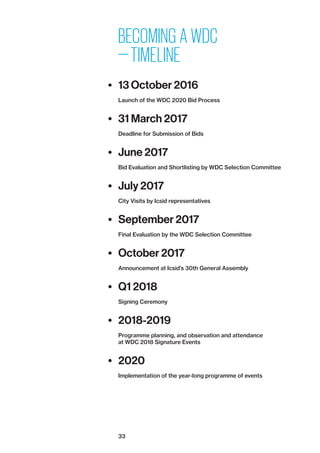
•	 13 October 2016
Launch of the WDC 2020 Bid Process
•	 31 March 2017
Deadline for Submission of Bids
•	 June 2017
Bid Evaluation and Shortlisting by WDC Selection Committee
•	 July 2017
City Visits by Icsid representatives
•	 September 2017
Final Evaluation by the WDC Selection Committee
•	 October 2017
Announcement at Icsid’s 30th General Assembly
•	 Q1 2018
Signing Ceremony
•	 2018-2019
Programme planning, and observation and attendance
at WDC 2018 Signature Events
•	 2020
Implementation of the year-long programme of events
34
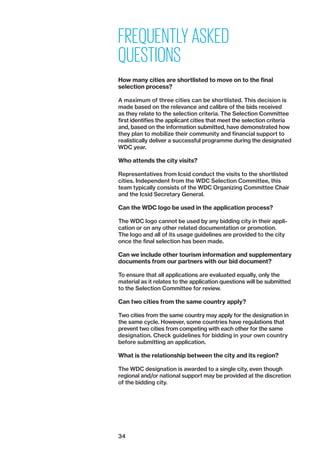
FREQUENTLY ASKED
QUESTIONS
How many cities are shortlisted to move on to the final
­selection process?
A maximum of three cities can be shortlisted. This decision is
made based on the relevance and calibre of the bids received
as they relate to the selection criteria. The Selection Committee
first identifies the applicant cities that meet the selection criteria
and, based on the information submitted, have demonstrated how
they plan to mobilize their community and financial support to
realistically deliver a successful programme during the designated
WDC year.
Who attends the city visits?
Representatives from Icsid ­conduct the visits to the shortlisted
cities. Independent from the WDC Selection Committee, this
team typically consists of the WDC Organizing Committee Chair
and the Icsid Secretary General.
Can the WDC logo be used in the application process?
The WDC logo cannot be used by any bidding city in their appli-
cation or on any other related documentation or promotion.
The logo and all of its usage guidelines are provided to the city
once the final selection has been made.
Can we include other tourism information and supplementary
documents from our partners with our bid document?
To ensure that all applications are evaluated equally, only the
material as it relates to the application questions will be submitted
to the Selection Committee for review.
Can two cities from the same country apply?
Two cities from the same country may apply for the designation in
the same cycle. However, some countries have regulations that
prevent two cities from competing with each other for the same
designation. Check guidelines for bidding in your own country
before submitting an application.
What is the relationship between the city and its region?
The WDC designation is awarded to a single city, even though
regional and/or national support may be provided at the discretion
of the bidding city.
35
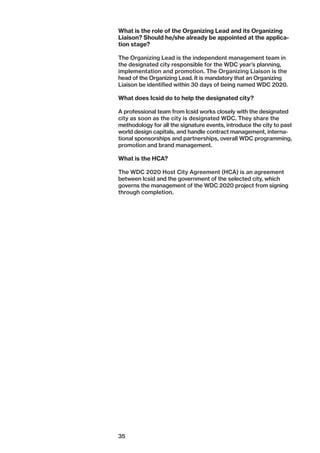
What is the role of the Organizing Lead and its Organizing
Liaison? Should he/she already be appointed at the applica-
tion stage?
The Organizing Lead is the independent management team in
the designated city responsible for the WDC year’s ­planning,
­implementation and promotion. The Organizing Liaison is the
head of the Organizing Lead. It is mandatory that an Organizing
Liaison be identified within 30 days of being named WDC 2020.
What does Icsid do to help the designated city?
A professional team from Icsid works closely with the designated
city as soon as the city is designated WDC. They share the
method­ology for all the signature events, introduce the city to past
world design capitals, and handle contract management, interna-
tional sponsorships and partnerships, overall WDC programming,
promotion and brand management.
What is the HCA?
The WDC 2020 Host City Agreement (HCA) is an agreement
between Icsid and the government of the selected city, which
governs the management of the WDC 2020 project from signing
through completion.
USING WDC 2016
AS A PLATFORM, THE CITY
GOVERNMENT IS NOW
ACTIVELY INCORPORATING
INTO CITY ADMINISTRATIVE
SYSTEM THE ABUNDANT
INNOVATIVE SKILLS OF LOCAL
DESIGN PROFESSIONALS
AND CREATIVITY FROM THE
PEOPLE OF TAIPEI.
— Beatrice Hsieh, Taipei’s Commissioner of Cultural Affairs
ABOUT US
Founded in 1957, Icsid (to be known as the World Design
­Organization, effective 1 January 2017) is an international non-­
governmental organization that promotes the profession of
industrial design. We advocate industrial design driven innovation
that creates a better world, engaging our more than 140 member
organizations in collaborative efforts and international program-
ming — World Design Capital®, World Design Talks, World Design
Impact Prize, World Industrial Design Day, and Inter­design. We have
United Nations Special Consultative Status. Visit www.wdo.org.
For more information about World Design Capital, please contact:
Jessica Hanson, WDC Programme Manager
t: +1 514 448 4949 ext. 224  e:  jhanson@wdo.org
All photos © Icsid, except:
p. 2 © iStock
p. 16 © Santiago Arau
p. 38-39 © Jess Kraft
Wdc2020 becominga wdc

Wdc2020 becominga wdc

  • 1.
    BECOMING A WORLD DESIGN CAPITAL® Acomprehensive guide to the application process
  • 3.
    TABLE OF CONTENTS 4 What is World Design Capital®? 7 Message from the President 10 The WDC Network of Cities 14 WDC Selection Committee 18 WDC 2020 Signature Events 22 WDC Organizational Structure 28 Who can submit a bid? 32 What are the fees related to the WDC designation? 34 Frequently asked questions 40 About Us
  • 5.
    I THINK DESIGN IS­CONSIDER­ATION, ­COMMUNICATION, ­CULTURE, LEISURE, PLEASURE AND ECONOMY. SO, IF I PUT IT INTO ONE SENTENCE: DESIGN IS EVERYTHING. — Oh Se-hoon, Mayor of Seoul (2006-2011)
  • 6.
    4 WHAT IS WORLD DESIGN CAPITAL®? With morethan half the world’s population now living in cities, design has become an increasingly fundamentaltoolformakingcities more attractive, competitive, efficient, livable, and sustainable. The World Design Capital® (WDC) is designated every two years by the International Council of Societies of Industrial Design1 to recognize a city’s innovative use of design to strengthen eco- nomic, social, cultural and environmental development. Through a year-long programme of design-related events, WDC provides a platform to showcase best practices in design-led urban ­policy and innovation, increase civic engagement, as well as attract business and tourism. First launched in Torino (Italy) in 2008, WDC has also been awarded to Seoul (South Korea) in 2010, Helsinki (Finland) in 2012, and Cape Town (South Africa) in 2014. Taipei is WDC 2016 and Mexico City will be WDC 2018. Will you be WDC 2020? 1 Effective 1 January 2017, the International Council of Societies of Industrial Design (Icsid) will be known as the World Design Organization (WDO). Icsid becomes the World Design ­Organization on 1 ­January 2017. The new name reflects the organi- zation’s desire to be more inclusive, echoing the evolution and interdis- ciplinary nature of the practice of industrial design today and the role of design as a catalyst for change. As the world body for industrial design, we seek to advocate design- led innovation that will contribute to the achievement of the United Nations Sustainable Development Goals (SDGs) by 2030.
  • 7.
    5 WHAT ARE THEOBJECTIVES OF THE WDC PROGRAMME? • Showcase a designated city’s use of design to reinvent itself and improve the quality of life of its citizens • Promote a city and its design com­ munity on the international stage • Increase public awareness of the power of design to strengthen economic, social, cultural and environmental development • Inspire other cities to use design as astrategictooltogrowandprosper • Create an international network where cities share best practices in innovative design • Ensure a design legacy flourishes in a designated city long after the WDC year ends.
  • 8.
    6 WHAT DOES ITMEAN FOR A CITY TO RECEIVE THE WDC DESIGNATION? A city that becomes a World Design Capital can expect to: • Gain visibility as a hub of creativity and innovation • Attract investment, tourism and civic pride • Strengthen economic development • Improve the quality of life of its citizens • Position itself as an international leader in design • Build its global image, and • Join an international network of design-effective cities.
  • 9.
    7 MESSAGE FROM THE PRESIDENT As theglobal organization for industrial design, we are passionate about positioning design as a positive agent for change. With 140 members in 40 countries across 6 regions, we share a common vision of design’s ability to create a better world. We are immensely proud of our World Design Capital® (WDC) pro- gramme, which showcases design’s inextricable role in improving urban quality of life. More people than ever before now live within the built environment. As the impact and complexity of rapid urbanization dawns upon the human family, we are cognizant of the need within our ­industry to tackle such imperatives as environmental degradation, social inequality, and the myriad other challenges associated with 21st century living that were not traditionally within the purview of industrial design a mere generation ago. The WDC programme provides a platform to highlight and share best practices in urban design-led innovation that addresses areas such as public transportation, sustainable infrastructure, changing demographics, mobility, safety, renewable energy, transparent and inclusive governance, among many others. It recognizes those cities that have effectively used design to reinvent themselves, creating attractive places for people to live, work and visit. WDC is more than just a year-long programme of events. It is a global movement of cities that shows how design can, and does, help to reinvent a city. The success of WDC lies in the fact that WDC cities go on to become prominent design hubs, co-creating design led innovation and urban policies that continue to make a difference in citizens’ lives long after the WDC year comes to an end. As we launch our new brand as the World Design Organization, effective 1 January 2017, and celebrate our 60th anniversary year, we aspire to enhance all peoples’ quality of life. We seek to be more inclusive, echoing the evolution and interdisciplinary nature of the practice of industrial design today, and to leverage our strength, working together to design a better world. As the African proverb says: If I run alone, I can fun faster; but if we run together, we can run further. We need to run farther, faster, together. I encourage you to join us! Professor Mugendi M’Rithaa, Icsid President Member of the WDC 2020 Selection Committee
  • 11.
    WORLD DESIGN CAPITAL TOLDTHE STORY OF OUR REGION’S IDENTITY, EXAMINING ITS HISTORY, INDUSTRIAL TRADITION AND BUSINESS THROUGH THE LENS OF DESIGN AND USED DESIGN TO PRESENT THE ­LOCAL REGION IN A FRESH LIGHT. — Sergio Chiamparino, Mayor of Torino (2001-2011)
  • 12.
    10 THE WDC NETWORK OFCITIES Since its inception in 2008, the World Design Capital programme has accumulated many success stories and achievements. A global network of cities is emerging, facilitating dialogue and knowledge sharing about the power of design totacklesomeoftheworld’s biggest challenges.
  • 13.
  • 14.
    12 WDC TORINO 2008 Asthe first World Design Capital, Torino (Italy) was recognized as a prominent city of design, attracting new investment, ­bringing increased visibility to the city and creating a model of urban ­public/private networking that has impacted public administration, businesses, designers, thought leaders, schools and citizens. WDC SEOUL 2010 Seoul’s (South Korea) status as WDC in 2010 increased its brand value to KRW 890 billion (US 800 million) and led to the creation of the Dongdaemun Design Plaza (DDP), now a major urban devel- opment landmark of South Korea. It also helped the city to reach no. 9 on the 2010 Global Urban Competitiveness Index. WDC HELSINKI 2012 Over 90 % of Helsinki citizens recognized the City’s WDC 2012 designation, with two thirds of the population taking part in WDC 2012 activities. For Helsinki, WDC 2012 introduced design as a permanent and significant component of the city’s develop- ment, leading to the hiring of the city’s first Chief Design Officer. Helsinki has continued its pursuit of design-led urban planning with a renewed waterfront, renovated museums, and revived industrial spaces.
  • 15.
    13 WDC CAPE TOWN2014 As the first African city to take on the WDC designation, Cape Town democratized design, showcasing the value of design thinking and participatory design processes at the neighbourhood level, touching thousands of people in over 81 of the 111 Wards. For every Rand spent on WDC 2014, Cape Town generated another 2.46 Rand. Cape Town was also named no. 1 of 52 places to visit on The New York Times 2014 list. WDC TAIPEI 2016 As WDC 2016, the city of Taipei aimed to make design thinking a driver of the city’s development, showcasing to ­neighbouring cities and the world their reinvigorated urban landscape, sophis- ticated transit system, specialized medical care, bustling cultural infrastructure, and community-based urban regeneration projects. A city with limited resources, Taipei adopted the theme ‘­Adaptive City — Design in Motion’, to demonstrate the ways cities can adapt to meet citizen’s demands, using design-led innovation to raise citizens’ quality of life. WDC MEXICO CITY 2018 As the very first city from the Americas to receive the WDC desig­nation, Mexico City has a vibrant design community, which will inspire other megacities around the world to use design as a tool for social change. They are working to blend old and new in innovative health, communications and security ­programmes; a bike-sharing programme; urban gardens, parks and playgrounds.
  • 16.
    14 WDC SELECTION COMMITTEE Every cycle,five international experts in the fields of design, urban planning, and economic and social development are named to the WDC Selection Committee. The WDC Selection Committee meets to review all applications, create a shortlist and ultimately select the World Design Capital. INTRODUCING THE WDC 2020 SELECTION COMMITTEE Kate Brown, Sustainability Director at the Grosvenor Group, drives the Living ­Cities initiative helping to create attractive and ­sustainable cities. Emilio Cabrero, head of the WDC Mexico City 2018 Office and co-founder of the ­multidisciplinary firm C Cúbica Arquitectos and of Design Week Mexico, promotes design as a key changemaker for eco- nomic, social and cultural development. Mugendi M’Rithaa, Icsid President and Professor of Industrial Design at the Cape Peninsula ­University of Technology in Cape Town, has a keen interest in socially responsible design. Zach Caceres, ­Executive Director of the Startup ­Cities Institute, promotes a new approach to urban ­rehabilitation, governance, and development. Andrew Tuck, founding editor of Monocle in the UK and host of the radio show, The Urbanist, is dedicated to making better cities.
  • 17.
    15 WHAT ARE THECRITERIA FOR SELECTING A WDC? • A city’s existing design assets • A city’s plans for using design to renew itself • The ways in which citizens benefit from the use of design in city planning • The capacity to organize and finance a year-long programme of design events • The mobilization and participation of the wider design community and large sectors of the population and visitors • The fostering of a wider dialogue on urban revitalization strategies.
  • 19.
    WDC WILL HELPUS ENSURE DESIGN PERMEATES ACROSS ALL ASPECTS OF OUR MEGALOPOLIS, SINCE IT IS ONLY THROUGH DESIGN THAT WE CAN ACHIEVE REAL CHANGE. — Emilio Cabrero, Design Week Mexico
  • 20.
    18 WDC 2020 SIGNATURE EVENTS EveryWorld Design Capital identifiesanddevelopsayear-long programme of unique design events, relevant to their city and their citizens, and which sets out to achieve local objectives while attractingbothlocalaudiencesand international visitors and press.
  • 21.
    19 In addition tothese local events, each WDC also organizes eight WDC Signature Events in partnership with Icsid: WDC Signing Ceremony The WDC Signing Ceremony is an opportunity for the designated city to invite key stakeholders, including government officials, the design community, local media, and business to witness and celebrate the official signing of the WDC Host City Agreement. It is the first official WDC event and the only WDC signature event held outside the designated year, usually in the first quarter of the year following the official announcement of the designated WDC City. The WDC Signing Ceremony is an opportunity to celebrate those who developed the bid, as well as to shine a spotlight on the best and the brightest of the incoming WDC Host City’s design community. The event also helps build citizen pride in the accom- plishment of the city. World Design Street Festival (formerly WDC New Year’s Eve of Design) The World Design Street Festival is the kick-off celebration to the WDC Calendar Year. Festivities are experience-driven and focus on building citizen excitement and engagement for the year to come, fostering civic pride in achieving the WDC designation and increasing public awareness of the importance of design in improving citizens’ lives. This is an opportunity to engage as many people as possible, including international visitors, to ­experience design activities in person through concerts, public design work- shops, exhibitions, or design studio open houses. Recommended to be held in the first quarter of the designated year, the World Design Street Festival can also be paired with another WDC ­Signature Event or event on the Local WDC calendar. World Design Spotlight (formerly the International Design Gala) The World Design Spotlight is a celebratory event conceptualized to highlight design as an impactful tool for city development and to showcase why the WDC Host City was awarded the designation. Speaking to the designated city’s unique identity, this event pays tribute to the city’s design community, recognizing those local con- tributions that led to the city’s WDC designation. It also recognizes best practices in impact design at the international level. World Design Experience (formerly the International Design House Exhibition) The World Design Experience is an interactive showcase of design from around the world held over seven days. With an emphasis on user experience, this WDC Signature Event features ­exhibitors sharing their unique design stories as interpreted through the theme of the WDC year. Design effective communities are invited to present the best of their country’s design and its power to improve quality of life, creating an opportunity for designers to share ideas, innovation and expertise. This WDC Signature Event can raise significant media attention and is a prime draw for international visitors.
  • 22.
    20 World Design PolicyConference (formerly the WDC International Design Policy Conference) Design-led urban policies are increasingly recognized as ­critical to shaping the future prosperity and wellbeing of a city and its inhabitants. The World Design Policy Conference provides a global platform for the exchange of ideas, insights, and best practices from different countries, regions, and cities that are ­developing, launching, and maintaining effective design policy. The most content rich of the WDC Signature Events, its findings have the potential to set the foundation for a design-led legacy pro- gramme that benefits the design community and citizens and that resonates far beyond the designated WDC year. World Design Week Forum The World Design Week Forum is the ‘go-to’ event for Design Week organizers from around the world to share best ­practices and lessons learned. It is also an opportunity for cities that do not already hold a Design Week to obtain the information, tools and support needed to initiate such an event. A one-day event, it is usually held in conjunction with the World Design Experience, attracting key players on the international design stage as well as public-private investors. World Design Network of Cities Meeting (formerly the WDC Network of Cities Meeting) The World Design Network of Cities Meeting is a forum for municipal representatives, including but not limited to the ­mayors of WDC designated cities. Led by Icsid, this Signature Event provides an opportunity for this unique cluster of cities to ­maintain an active dialogue about design in the life of a city since the WDC designated year. The meeting aims to highlight ­successes in WDC legacy programmes and to identify collaborative opportunities between the WDC designated and other design effective cities. World Design Capital Convocation Ceremony The WDC Convocation Ceremony is a symbolic event to mark the successes of the WDC year, showcase the year’s highlights, recognize those who contributed to the year’s success, share the preliminary findings of the impact study, reflect on the WDC legacy, and officially hand over the WDC title to the incoming city. The Convocation Ceremony includes city officials, local WDC leadership, the design community, media and the incoming WDC’s political leadership and planning team.
  • 24.
    22 WDC ORGANIZATIONAL STRUCTURE The WDCOrganizational Structure is split into two levels: 1. The WDC Programme: High-level management, promotion and support of the overall WDC programme by Icsid 2. WDC Project Management: Local development and imple- mentation of the designated calendar year of events by an independent management entity named by the host city. The WDC Programme As creator and owner of World Design Capital, Icsid ­manages each cycle of the WDC Programme from its international ­Secretariat based in Montreal (Canada). Icsid is responsible for the vision, policy, and promotion of the WDC programme. Daily operations relating to each of the designated WDC cities are managed by a professional team from within the Secretariat, including the bid process, contract management, international sponsorships and partnerships, programming and WDC Signature Event support, as well as brand management. WDC Project Management The designated city establishes an independent managing entity, the WDC Organizing Lead, responsible for the planning and execution of the proposed WDC calendar year of events for the designated city. The members of the Organizing Lead execute local and international promotion for the programming and the city itself. A WDC Local Organizing Committee is established by the city to provide strategic direction to the Organizing Lead for the WDC year-long programming. It is composed of city representatives, other levels of government, as well as external stakeholders (i.e. funding partners) and representatives from the local design community. The Organizing Lead members liaise with their Local Organizing Committee and Icsid. In addition, Icsid and the designated city establish an International Advisory Committee (IAC) whose chief responsibility is to help place the WDC Host City in a global context and attract different regions to what is happening in the designated city. Composed of high-profile local and international design leaders and a repre­ sentative from the Secretariat, they provide creative direction and serve as a sounding board for programme ideas.
  • 25.
    23 To date, thecomposition of the Organizing Leads within each of the WDC designated cities have been different from one another, each built around the intricacies of their own ­municipal requirements and the logistics of establishing a stand-alone entity to use funding dedicated from the city and implement it. However, at the very core, there is a comprehensive, yet ­simple structure and workflow to support collaboration with Icsid, and the implementation of the calendar of events, and meet the strategic objectives set out by the city in its bid. The relationship between Icsid and the host city’s ­independent entity, the Organizing Lead, is a fundamental part of the pro- gramme’s success. Both teams collaborate regularly through conference calls and in-person meetings, developing ­proposals, reports and other published materials to ensure effective ­management and implementation of the year’s calendar of events. WDC 2020 Local Organizing Committee(s) (The Local Organizing Committee may be structured at the discretion of the City and comprises ­various levels of Government, government agencies, Ministries, funding partners and/or major design organisations) Director General • Organizing Liaison with Icsid • General direction to the WDC Host City Programme • Oversight of the operations and compliance with legal and regulatory requirements • Reports directly to the Local Organizing Committee Director of Programme • Organizing Liaison with Icsid • General direction of the WDC calendar of events • Oversight of the operations and compliance with legal and regulatory requirements Signature Events Manager • Coordination and ­implementation of the WDC Signature Events Director of Communications • Development and implemen- tation of Communications strategy and Marketing Plan • Media relations • Management of branding guidelines Local Events Manager • Coordination and ­implementation of local WDC projects Director of Partnerships • Creation of sponsorship proposals for prospects stakeholders • Management of licensing agreements • Stewarding the sponsors Design Community Engagement Manager • Promotion of the engage- ment of the design community in WDC planning and implementation Director of Finance • Financial reporting and budgeting • Accounting, administra- tive staff and volunteer management Director of Government Relations • Liaison between Organizing Lead and relevant government departments PROPOSED STRUCTURE FOR ORGANIZING LEAD
  • 27.
    THE WDC DESIGNATION OPENEDUP ­REMARKABLE OPPORTUNITIES FOR OUR CITY AND WE FEEL DEEPLY HONOURED TO (HAVE) JOINED THIS ­DISTINGUISHED GROUP OF WORLD DESIGN CAPITALS. — Jussi Pajunen Mayor of the city of Helsinki since 2005
  • 28.
    26 HOW TO APPLY • The title of World Design Capital is open to any city in the world that can demonstrate its commitment to design as a powerful tool to strengtheneconomic,social,cultural, and environmental development. It is given to those cities that have mosteffectivelyandcreativelyused design as a tool for progress. • Cities must clearly demonstrate how their government, industry, educational institutions, designers, and population are working individually and in concert to revitalize and reinvent their urban environment.
  • 29.
    27 • Only oneapplication is accepted per city and must clearly demonstrate support from local government. • Previous applicants are welcome to reapply. Application questions can be downloaded from our website www.wdo.org. All completed applications must be sent electronically (in PDF format) to jhanson@wdo.org, on or before midnight (GMT-5) 31 March 2017. Applications received following the 31 March deadline will not be considered by the WDC Selection Committee. ­Additionally, applicant cities will have seven business days to submit ten hard copies of the application (bid book), accompanied by the required fee, to: World Design Capital c /o World Design Organization 455 St-Antoine Street West, Suite SS10 Montreal, Quebec, H2Z 1J1, Canada
  • 30.
    28 WHO CAN SUBMIT ABID? World Design Capital is open to any city, large or small. However, activating the WDC project citywide does require a ­certain critical mass and resources such as substantial ­cultural and business infrastructure, a well-developed design ­industry or design programmes, sufficient administrative services, a ­successful portfolio of large-scale design initiatives and the capability to manage the international promotion, as well as a relevant budget to support the year-long programme. The bid must be formally submitted by an autonomous agency, and may not be from within a level of government of the bidding city. However, the support of the local government is essential and the mayor of the Host City has a key role to play during the des­ ignated year. A letter of financial guarantee from the city must be included in the bid. The bid should be prepared by a relevant and dedicated team that can preferably see the bid process all the way through from ­submission until the final designation. While the bid does not have to come from a design organization or designer, the designation is based on the fact that the city is using design and designers to better their infrastructure, systems, and general quality of life. Successful World Design Capital cities, and design cities generally have strong, inclusive partnerships with national, regional and local stakeholders in the areas of culture, design, business and municipal development.
  • 31.
    29 How to developyour bid It all starts with a conversation between the city and design stakeholders. Engaging the design community that activates local programmes or projects, hosting a town hall meeting to gauge interest and to see what the success might be like if your city is designated World Design Capital, and meeting with the mayor or city officials are all ways of starting a bid. The World Design Capital programme really is one of full community engagement. It is an initiative, which brings together all types of industries and people of all ages, to communicate with each other and recognize the role that design plays in their city and in their lives. In putting together a creative bid package, we recommend that bidding entities engage all relevant partners (local and national) to showcase the right balance between the support of the ­political authorities, as well as the support of the local design and business community. The bid comprises many components, each of which needs care and consideration. All questions listed on the application must be answered comprehensively. The bid can be as long or as short as is deemed necessary by the team preparing the submission. Bidding teams and organizations are welcome to be as creative as they want using a variety of mediums to get their ­message across. Bearing in mind that the physical bid books are the first indication of the city’s appreciation of design, it is strongly recommended that each bid express a unique and palpable ­aesthetic — one that would reflect a relatable expression of design in the city. The style and format of the bid package must not compromise the quality and access to information on how a city will embrace the WDC designation. Determining a budget As part of the bid, cities are required to submit a budget outlining projected operating and programming costs, as well as an over- view of the financial support that will be given to the project by various levels of government. Once designated, Icsid and the designated city will work in concert to understand the Host City Agreement (HCA) requirements and secure the right mix of partnership and/or sponsorship support to fulfill the year-long programme.
  • 33.
    THERE IS NODOUBT THAT WORLD DESIGN CAPITAL PLAYED A PIVOTAL ROLE IN RAISING THE ­PROFILE OF CAPE TOWN ON THE WORLD STAGE. — David Green, CEO, Victoria & Alfred Waterfront
  • 34.
    32 WHAT ARE THEFEES RELATED TO THE WDC DESIGNATION? Application Fee A CA$10,000 (Canadian dollar) non-refundable application fee must be remitted at the time of submission. Administration Fee As a condition for consideration for the final selection, ­shortlisted cities shall remit a CA$25,000 (Canadian ­dollar) fee to cover administrative and logistical expenses during the evaluation phase. If following the shortlist announcement ­cities no longer wish to proceed to the next phase under the terms of the ­contract, Icsid will refund 50 % of the CA$25,000 administration fee. Hosting Fee Designated World Design Capital cities shall remit a CAD$600,000 (Canadian dollar) hosting fee to be paid over three (3) years in three (3) equal installments. Specific details regarding the ­timing of the fee payments will be presented in the WDC Host City Agreement. Invoicing Upon request, we will issue an invoice to facilitate fee processing, at which time banking details will also be provided for fee transfer. Other Expenses Bidding cities can expect to also cover all travel expenses for the shortlisted city visits. This hosting package should cover the cost associated with the travel and accommodations (2 days/3 nights) for two (2) Icsid representatives.
  • 35.
    33 BECOMING A WDC — TIMELINE • 13 October 2016 Launch of the WDC 2020 Bid Process • 31 March 2017 Deadline for Submission of Bids • June 2017 Bid Evaluation and Shortlisting by WDC Selection Committee • July 2017 City Visits by Icsid representatives • September 2017 Final Evaluation by the WDC Selection Committee • October 2017 Announcement at Icsid’s 30th General Assembly • Q1 2018 Signing Ceremony • 2018-2019 Programme planning, and observation and attendance at WDC 2018 Signature Events • 2020 Implementation of the year-long programme of events
  • 36.
    34 FREQUENTLY ASKED QUESTIONS How manycities are shortlisted to move on to the final ­selection process? A maximum of three cities can be shortlisted. This decision is made based on the relevance and calibre of the bids received as they relate to the selection criteria. The Selection Committee first identifies the applicant cities that meet the selection criteria and, based on the information submitted, have demonstrated how they plan to mobilize their community and financial support to realistically deliver a successful programme during the designated WDC year. Who attends the city visits? Representatives from Icsid ­conduct the visits to the shortlisted cities. Independent from the WDC Selection Committee, this team typically consists of the WDC Organizing Committee Chair and the Icsid Secretary General. Can the WDC logo be used in the application process? The WDC logo cannot be used by any bidding city in their appli- cation or on any other related documentation or promotion. The logo and all of its usage guidelines are provided to the city once the final selection has been made. Can we include other tourism information and supplementary documents from our partners with our bid document? To ensure that all applications are evaluated equally, only the material as it relates to the application questions will be submitted to the Selection Committee for review. Can two cities from the same country apply? Two cities from the same country may apply for the designation in the same cycle. However, some countries have regulations that prevent two cities from competing with each other for the same designation. Check guidelines for bidding in your own country before submitting an application. What is the relationship between the city and its region? The WDC designation is awarded to a single city, even though regional and/or national support may be provided at the discretion of the bidding city.
  • 37.
    35 What is therole of the Organizing Lead and its Organizing Liaison? Should he/she already be appointed at the applica- tion stage? The Organizing Lead is the independent management team in the designated city responsible for the WDC year’s ­planning, ­implementation and promotion. The Organizing Liaison is the head of the Organizing Lead. It is mandatory that an Organizing Liaison be identified within 30 days of being named WDC 2020. What does Icsid do to help the designated city? A professional team from Icsid works closely with the designated city as soon as the city is designated WDC. They share the method­ology for all the signature events, introduce the city to past world design capitals, and handle contract management, interna- tional sponsorships and partnerships, overall WDC programming, promotion and brand management. What is the HCA? The WDC 2020 Host City Agreement (HCA) is an agreement between Icsid and the government of the selected city, which governs the management of the WDC 2020 project from signing through completion.
  • 39.
    USING WDC 2016 ASA PLATFORM, THE CITY GOVERNMENT IS NOW ACTIVELY INCORPORATING INTO CITY ADMINISTRATIVE SYSTEM THE ABUNDANT INNOVATIVE SKILLS OF LOCAL DESIGN PROFESSIONALS AND CREATIVITY FROM THE PEOPLE OF TAIPEI. — Beatrice Hsieh, Taipei’s Commissioner of Cultural Affairs
  • 42.
    ABOUT US Founded in1957, Icsid (to be known as the World Design ­Organization, effective 1 January 2017) is an international non-­ governmental organization that promotes the profession of industrial design. We advocate industrial design driven innovation that creates a better world, engaging our more than 140 member organizations in collaborative efforts and international program- ming — World Design Capital®, World Design Talks, World Design Impact Prize, World Industrial Design Day, and Inter­design. We have United Nations Special Consultative Status. Visit www.wdo.org. For more information about World Design Capital, please contact: Jessica Hanson, WDC Programme Manager t: +1 514 448 4949 ext. 224  e:  jhanson@wdo.org All photos © Icsid, except: p. 2 © iStock p. 16 © Santiago Arau p. 38-39 © Jess Kraft