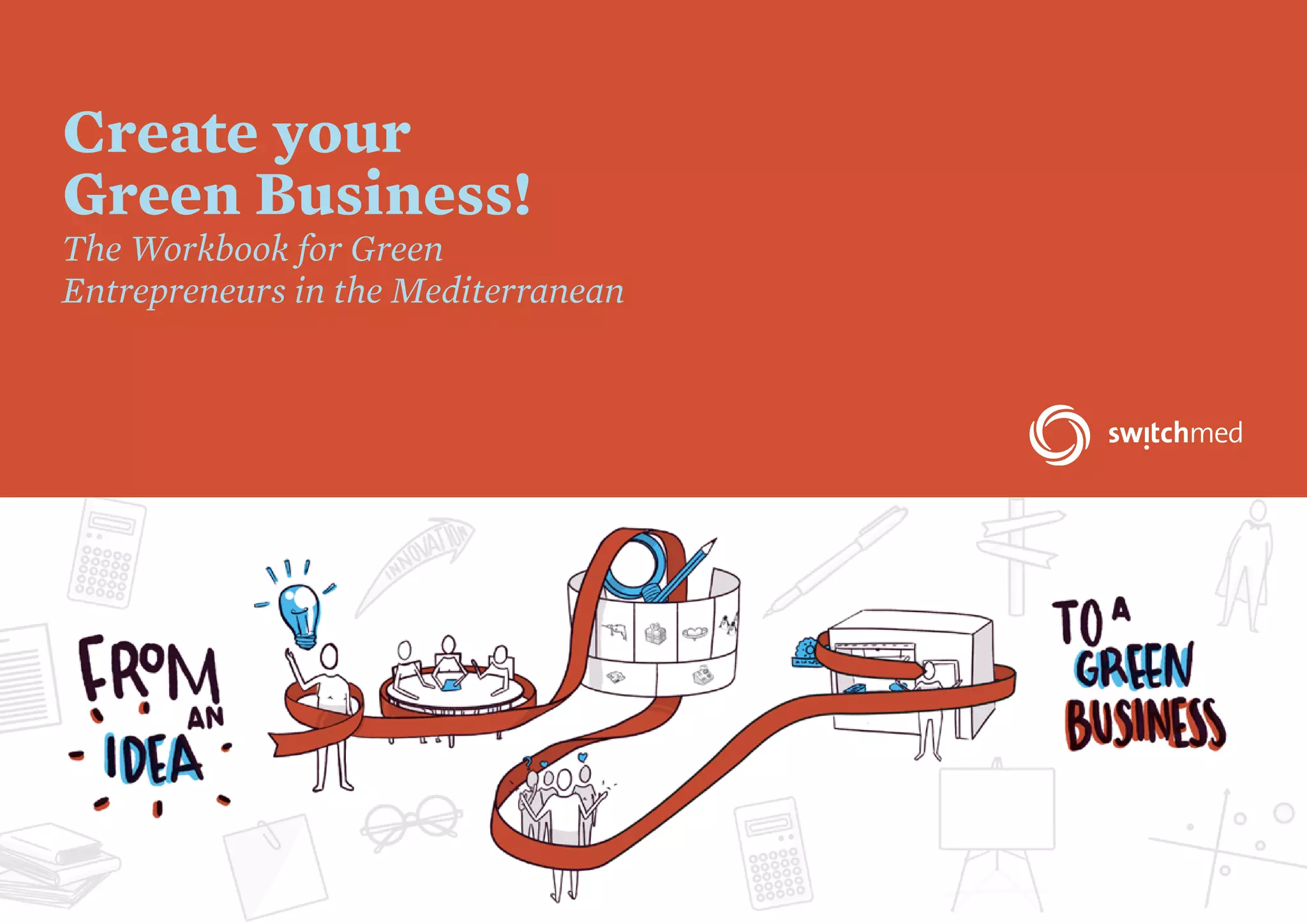
Create your
Green Business!
The Workbook for Green
Entrepreneurs in the Mediterranean
Introduction
Introduction
Implement Measure and Improve
04 05 Create your Green Business!
The Handbook for Green Entrepreneurs
in the Mediterranean
03
The Workbook
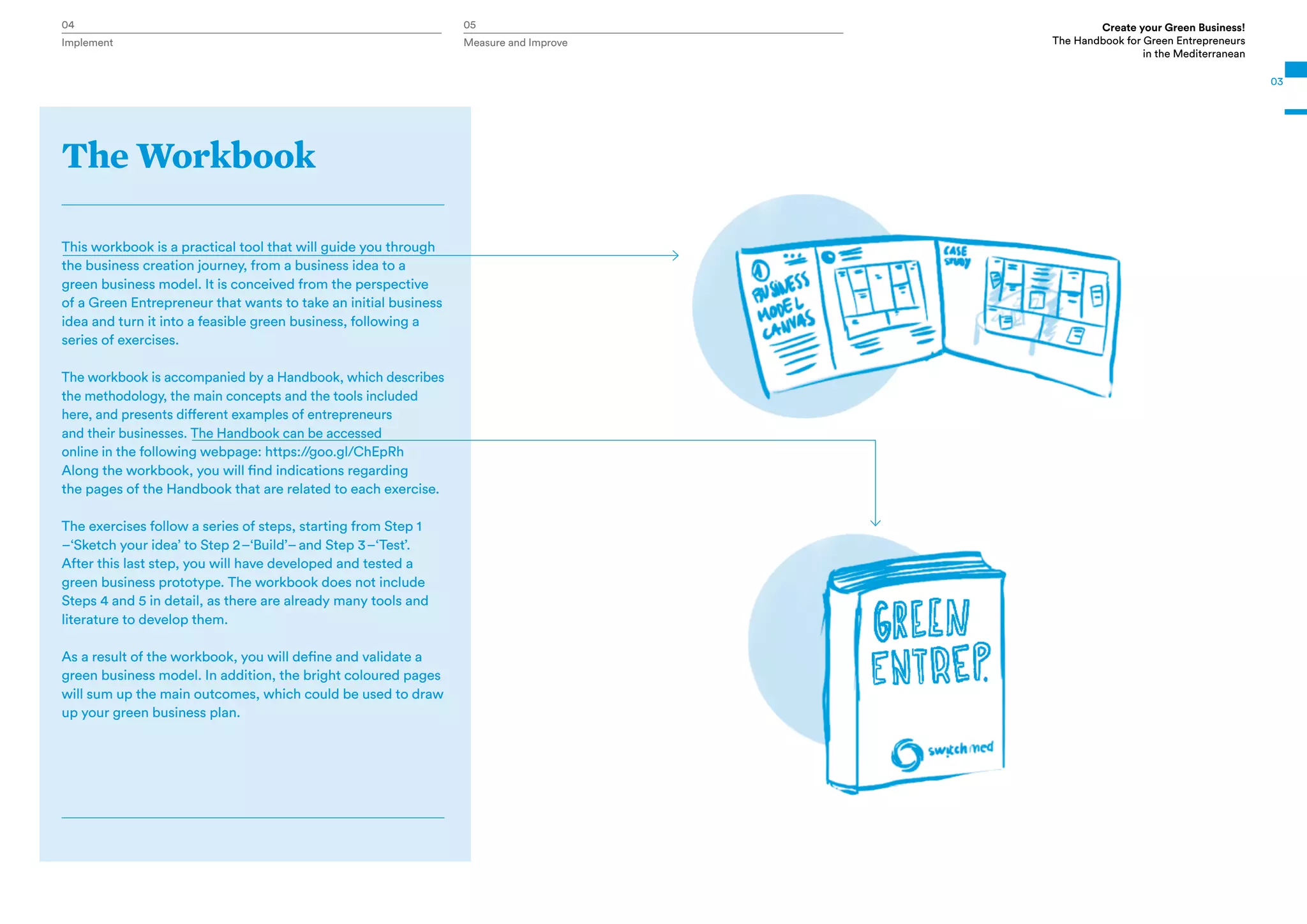
This workbook is a practical tool that will guide you through
the business creation journey, from a business idea to a
green business model. It is conceived from the perspective
of a Green Entrepreneur that wants to take an initial business
idea and turn it into a feasible green business, following a
series of exercises.
The workbook is accompanied by a Handbook, which describes
the methodology, the main concepts and the tools included
here, and presents different examples of entrepreneurs
and their businesses. The Handbook can be accessed
online in the following webpage: https://goo.gl/ChEpRh
Along the workbook, you will find indications regarding
the pages of the Handbook that are related to each exercise.
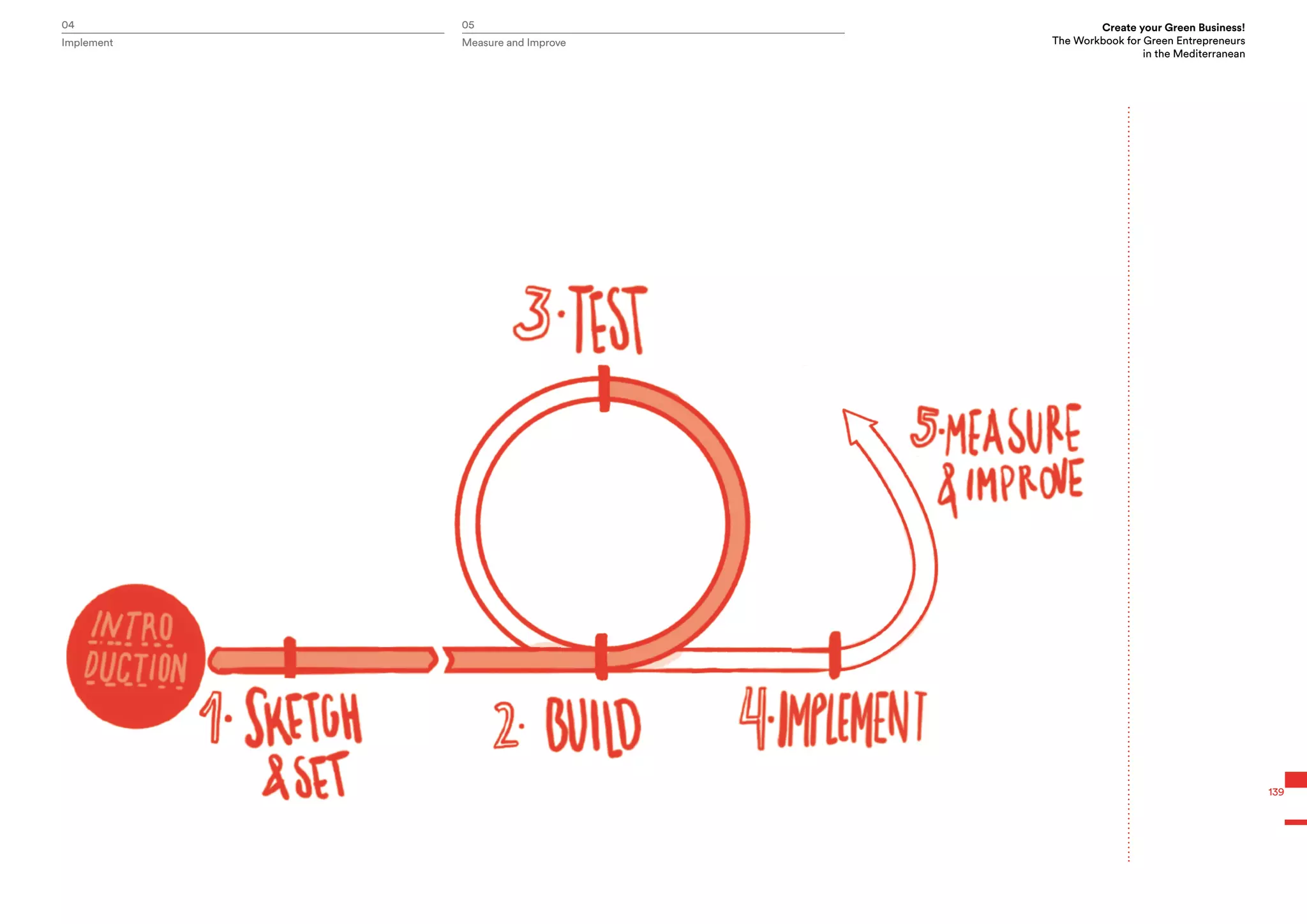
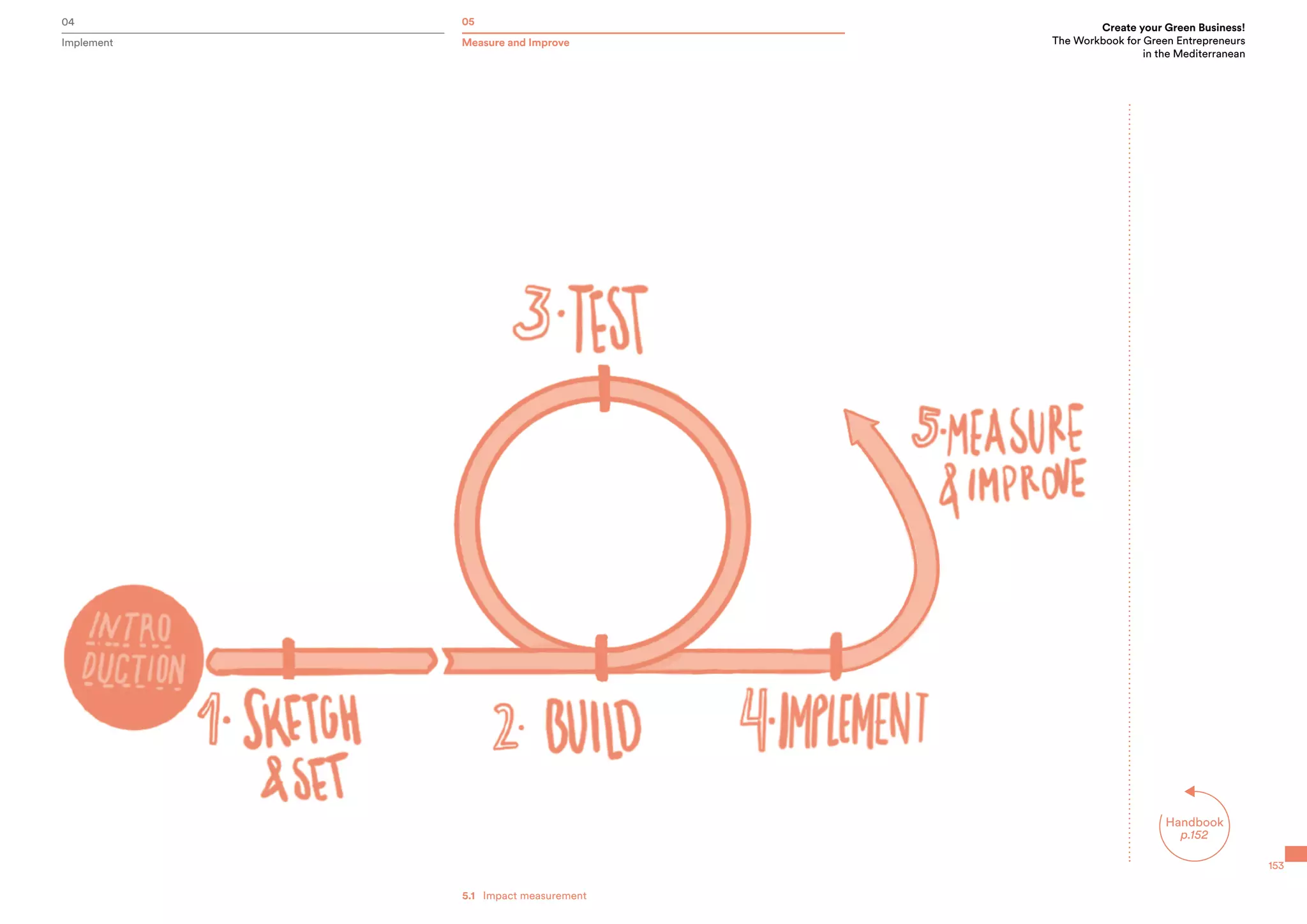
The exercises follow a series of steps, starting from Step 1
–‘Sketch your idea’ to Step 2–‘Build’–and Step 3–‘Test’.
After this last step, you will have developed and tested a
green business prototype. The workbook does not include
Steps 4 and 5 in detail, as there are already many tools and
literature to develop them.
As a result of the workbook, you will define and validate a
green business model. In addition, the bright coloured pages
will sum up the main outcomes, which could be used to draw
up your green business plan.
Sketch and Set Test
01 03
04
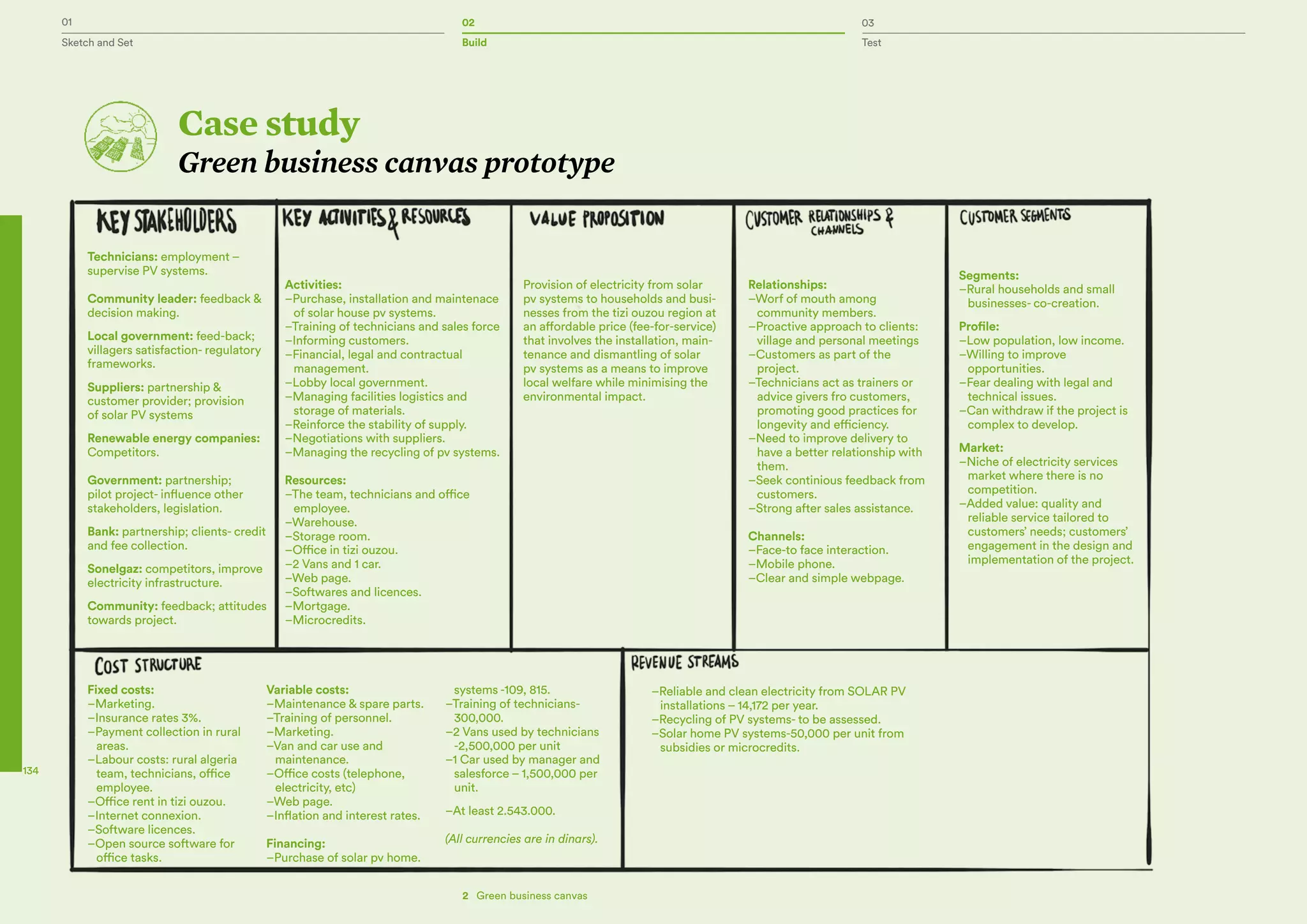
1. Energy services company in rural
Areas in algeria
In Algeria, more than 25% of the population live in rural areas.
Although the Algerian government and Sonelgaz, the main
energy supply company in the country, are showing quite some
efforts to supply rural areas with urban-quality services, their
electricity accessibility is still insufficient.
Hassan, a young Green Entrepreneurs (GE) living in Oran, was
reading a newspaper article about solar photovoltaic new
technologies.
‘Maybe solar energy is a solution to supply light to my family,
and their neighbors!! and they won’t depend on fuel generators
and kerosene anymore!’
He was so excited about the idea that he could not wait to share
it with Amina and Karim…
‘Guys! I have been reading about solar energy and it occurred
to me that I could provide solar energy in rural areas. You know
that my family lives in Ghardaïa district, and they have lots of
problems with electricity supply. I have relatives there, I would
have no problems going…! What do you think? Would you buy
the idea for a business? Do you want to be my team mates?!’
He needed a collaborating and enthusiastic team to accompany
him in this arduous journey...
The case studies
To make it helpful, each step of the journey is made out of a
set of questions and tools that are defined in the white pages.
The whole process is illustrated in detail with one or more illus-
trative business cases (full coloured pages). These case studies
have been selected taking into account the opportunities
identified in the Middle East and North Africa (MENA) region
and the diversity they offer in the coverage of different stages
of the business development.
We hope they inspire you!
The energy services company in rural areas in Algeria (ESCO)
business case is used as the main case study. It is explained
in detail throughout the whole methodology, proceeding
step by step, and trying to capture the evolution and
construction of the business idea. The Textile Products and
Waste Management case studies illustrate specific parts of
the methodology as a means to reinforce and clarify relevant
aspects of it. At the end of the document you will find a
completed green business model canvas for each of the three
business cases. These canvases summarize the information
and results of the intensive analysis process. They illustrate
the final result that you should get from this journey.
Build
02
Implement Measure and Improve
04 05 Create your Green Business!
The Handbook for Green Entrepreneurs
in the Mediterranean
05
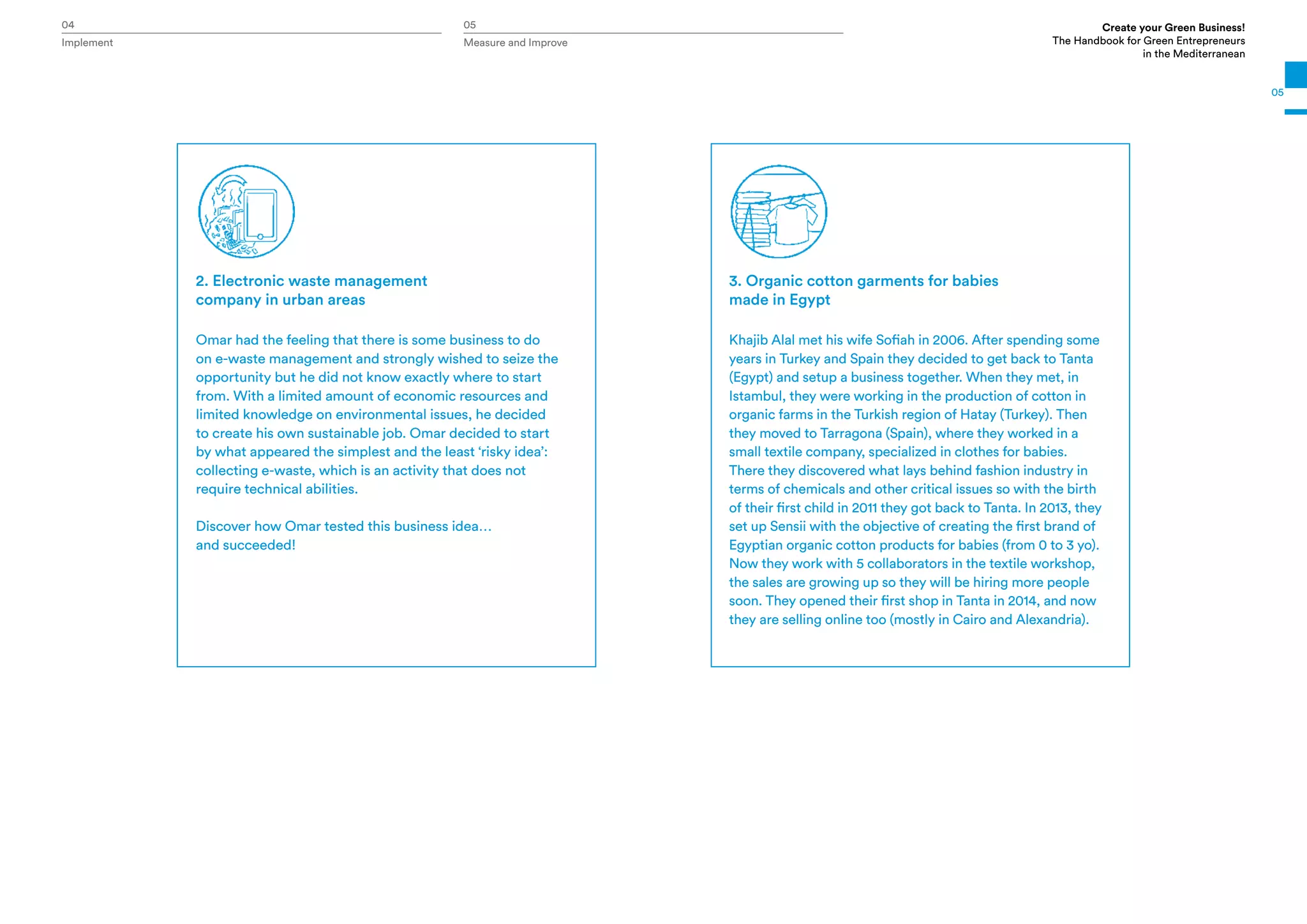
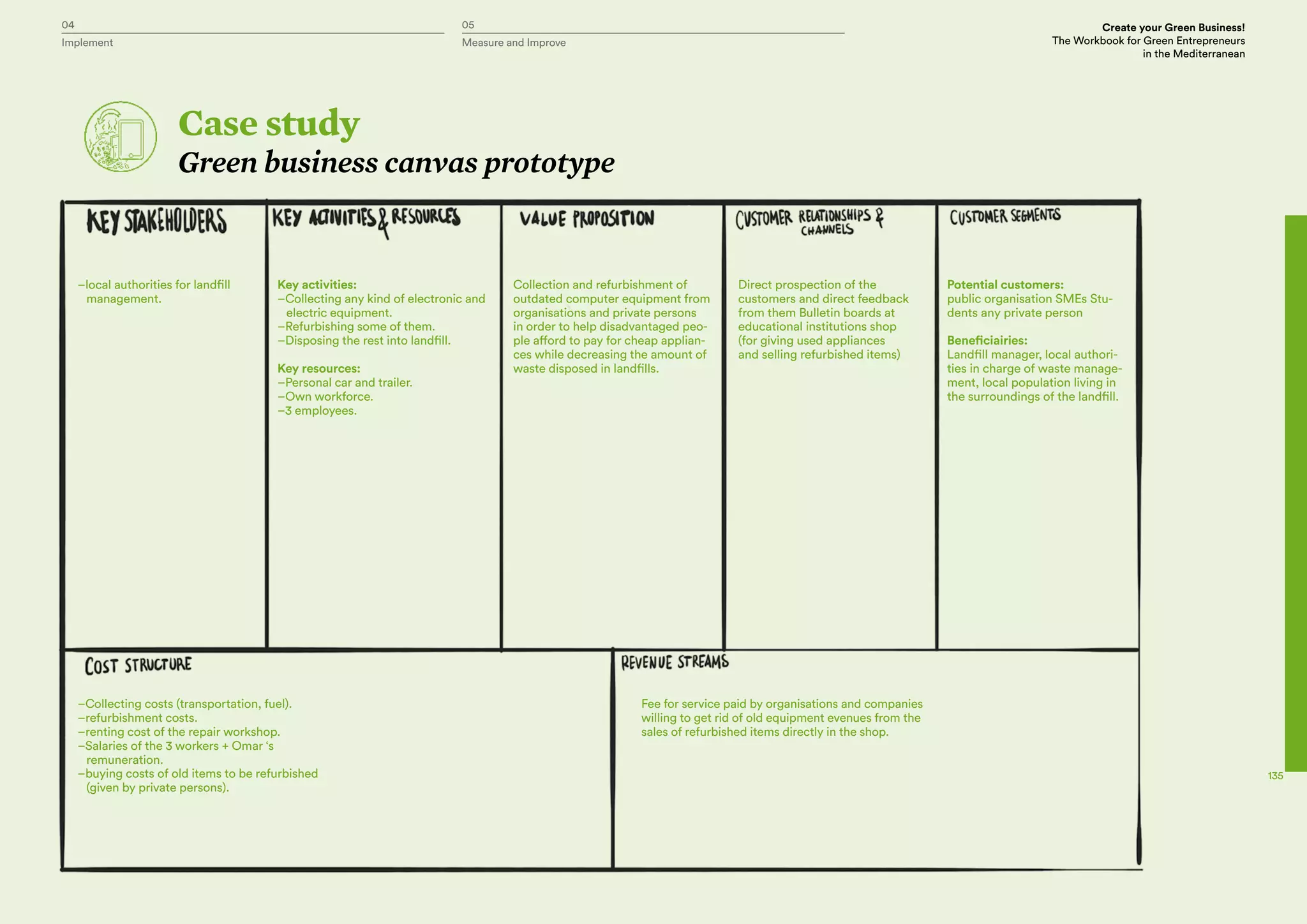
2. Electronic waste management
company in urban areas
Omar had the feeling that there is some business to do
on e-waste management and strongly wished to seize the
opportunity but he did not know exactly where to start
from. With a limited amount of economic resources and
limited knowledge on environmental issues, he decided
to create his own sustainable job. Omar decided to start
by what appeared the simplest and the least ‘risky idea’:
collecting e-waste, which is an activity that does not
require technical abilities.
Discover how Omar tested this business idea…
and succeeded!
3. Organic cotton garments for babies
made in Egypt
Khajib Alal met his wife Sofiah in 2006. After spending some
years in Turkey and Spain they decided to get back to Tanta
(Egypt) and setup a business together. When they met, in
Istambul, they were working in the production of cotton in
organic farms in the Turkish region of Hatay (Turkey). Then
they moved to Tarragona (Spain), where they worked in a
small textile company, specialized in clothes for babies.
There they discovered what lays behind fashion industry in
terms of chemicals and other critical issues so with the birth
of their first child in 2011 they got back to Tanta. In 2013, they
set up Sensii with the objective of creating the first brand of
Egyptian organic cotton products for babies (from 0 to 3 yo).
Now they work with 5 collaborators in the textile workshop,
the sales are growing up so they will be hiring more people
soon. They opened their first shop in Tanta in 2014, and now
they are selling online too (mostly in Cairo and Alexandria).
Implement Measure and Improve
04 05 Create your Green Business!
The Handbook for Green Entrepreneurs
in the Mediterranean
07
Implement Measure and Improve
04 05
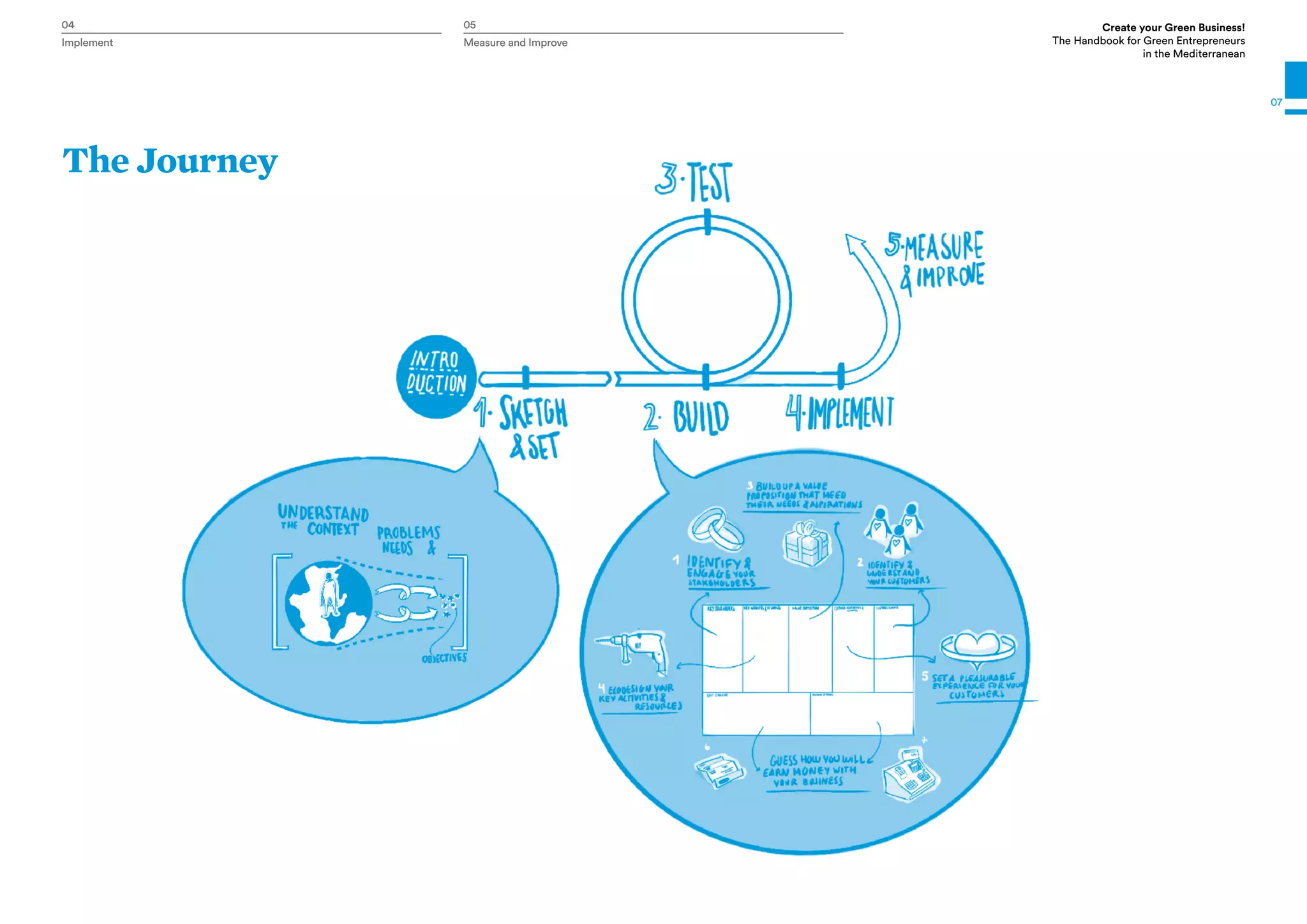
The Journey
Sketch and Set Test
01 03
08
Tips for Green
Entrepreneurs
Be ready to changing your initial idea!
Entrepreneurs normally start the entrepreneurship journey with
an idea, and try to develop it is as soon as possible. However, we
recommend you to stop for a while and ask yourself: Why do you
want to set up that business? What are the drivers behind it? Is there
a different way to achieve your goals? During this questioning process,
you may come up with other ideas different from the initial one. Be
open-minded and think of these other ideas. Don’t stick too much to
your initial idea!
Know yourself… and your limits!
Prior to embarking on the ambitious project of a business creation,
you must know yourselves well: skills possessed and needed, abilities,
desired work-life balance, the way we work, our relationships with
others, etc. Those elements are extremely important when elaborating
any business project, since they will help us anticipate the risks, failure
or difficulties. According to that diagnosis, we may find relevant to
partner with complementary people.
Can I launch and run my business alone?
Depending on your aspirations, you may prefer to run the business
on your own. Although this may be advantageous for some activities
(hand craft, consultant ...), other more complex ones will require more
resources, including human talent. In any case, it is always advisable to
be surrounded by people that can take an objective look at the project.
Also, working in teams and distributing work according to capacities,
allows members to focus on their specialties, dramatically improving
results as a consequence.
Be a Green Entrepreneur
Whatever our deepest motivations for being a green entrepreneur
are (create your own job, address a social issue, generate a new
community dynamics ...), your primary goal is to create economic
value by addressing an environmental issue.
Think big!
Setting ambitious goals for ourselves can push us to reach for greater
heights and do better. All of course, while enjoying each small step
towards success.
Set up a good team
Don’t try to manage all the business alone. Concentrate on your
speciality, in the domain you shine, and let others do what you cannot
do (or do poorly). Similarly, no matter how innovative the idea may
be, it is worthless if you do not sell it. And you need a good team
for that, one that can deal with the core business and manage the
fundamental tasks... Look around you and identify who will help you
in this task and engage them! Source the best resource you need
and built up partnerships.
Identify the stakeholders
Amongst the stakeholders, you may find easier to identify your
customers first. Customers, as well as other stakeholders, will have
a critical role for building your value proposition, and define the
structure of your business model. Do as you can to involve at early
phase the stakeholders and keep in mind that some of them may be
discovered later.
Involve customers and stakeholders
Whereas involving your customers in a co-creation process is a
prerequisite for the rapid success of your project, it may be tricky to
get your others stakeholders into the same level or engagement. On
the basis of your interviews with your stakeholders, think carefully
about whom you can expect a full implication from, and rank the level
of engagement, from the weakest (for example via regular feedback
on the project) to the highest (co-creation).
Think big!
We must carefully consider the needs and behaviours of the
stakeholders. Also, we can find innovative solutions by involving
them in the co-creation of our solution. Building up partnerships
to complement our team and outsorcing less critical tasks outside
the company (private companies, public research centres, clients,
suppliers, universities...), are smart strategies in pursuit
of effectiveness.
Look at international market opportunities!
When identifying potential customers, don’t forget to look at
international market opportunities! Although marketing products
internationally may require adaptations and be costly, it is an option
Build
02
Implement Measure and Improve
04 05 Create your Green Business!
The Handbook for Green Entrepreneurs
in the Mediterranean
09
we should consider at a very early stage of our green business project.
The potential is great in some sectors such as ecotourism!
‘Think economic sustainability!’
We have to bear in mind that a green business is a business, meaning
that, besides the green aspects we want to highlight, we must not
forget that our client may consider other criteria to justify his/her
purchasing decision, including design, cost, technical specifications,
convenience, health, etc.
Have a unique value proposition!
This is the essential point of our business project. The value proposition
should bring customers something new that will prompt them to turn
aside from competitors.
Consider the Web 2.0 revolution!
The internet revolution has emerged as the new reality affecting
social and economic life, as well as the way we do business. Most
of the communication and marketing channels have a web 2.0
component. Each internet user is potentially a customer. Social
networks, organised by topic, interest or affinity, are the sounding-
board of marketing trends in real-time. Customers go on the
internet and look for consumer reviews before purchasing. Do not
underestimate the power of web 2.0 technologies in your green
business model, especially when you target a market that goes
beyond the local level.
Partner with your supply chain
You can also try to promote sustainability through your supply chain,
pushing your suppliers to be more aware about eco-design and asking
them to incorporate eco-design strategies. You can involve them in
co-creation processes to align eco-design strategies towards a
common purpose.
Communicate wisely
If you are interested in certifying your product you can learn more
about available eco-labels, their technical and legal requirements
and their costs. However, we recommend you to start easily with a
self-declaration environmental claim. It is a faster and cheaper way to
communicate the environmental benefits of your product or service!
Alleviating startup capital
You do not necessarily need high investments to launch a product/
service. Development cost can be alleviated in different ways, as you
will see later. Moreover, don’t think you need to develop every part of
your project: finding the right partner to outsource your activities can
help you save a lot of time and money.
Be aware of new business models!
Over the last decades, a trend for a more well-reasoned consumption
pattern has been regularly growing: buying local, choosing a better
quality at the expense of a higher price, fostering short-circuit
consumption... We are observing new patterns of consumption, that
are led by environmental and health concerns. More particularly, the
circular and collaborative economy tend to bring communities and
actors together, around common objectives that aim at limiting the
impact of and re-use resources in a more efficient way. New business
models can emerge from the new paradigm of the sharing economy.
This consists of moving from an economy of ownership to one of
service functionality. You may be paid in proportion to the real water
savings you are able to achieve thanks to your services (instead of
selling water-saving devices).
Don’t be frightened of failure!
Failure is a necessary step to success, so learning and improving from
it is an integral part of the entrepreneurial process.
Must I be rich to set up a green business?
We do not necessarily need high investments to launch a product/
service. Development cost can be alleviated in different ways.
Moreover, we do not have to develop every part of the project by
ourselves: finding the right partner to outsource activities can save
a lot of time and money.
Try hard to convince financing institutions!
Because green markets and green business models are not stabilized
yet, the finance sector may be reluctant to finance emerging green
ventures. It’s up to you to convince them about the economic relevancy
of our project.
Whoever the financier or investor you approach may be, the meeting
has to be thoroughly prepared. In 5 minutes, you should be able to
explain clearly what the value proposition offered is, the clients, how
the business will be profitable, and why you are the right team to do
the job. If you meet potential investors, know that most often they
will base their decision on personality and motivation first, on the
credibility of the management team, and lastly the performance of
the product/service.
Ideally, you may start mobilizing ‘love money’ first (from family or
friends) for building up startup capital. That would ease the way
towards financial institutions.
Stay connected!
The uncertain environment of our green business activity demands
for constant access to up-to-date information about legal and political
frameworks, competitive solutions, customers needs, costs, etc.
Web-based solutions, but also direct contact with experts or clients,
will help alleviate risks and formulate effective strategies. You can
always do better towards continuous improvement.
Step 1.
Sketch and Set
Step1.
01 02 03
Sketch and Set Build Test
1.1   Business Idea
Exercise 1
Sketch your business idea
Do you have a business idea in your mind? Let’s describe it!
Sketch it by briefly answering the following questions.
1. What is your initial business idea?
2. What are you going to offer (product, service)?
3. Who may be your customers? And your partners?
Handbook
pp.17–20
13
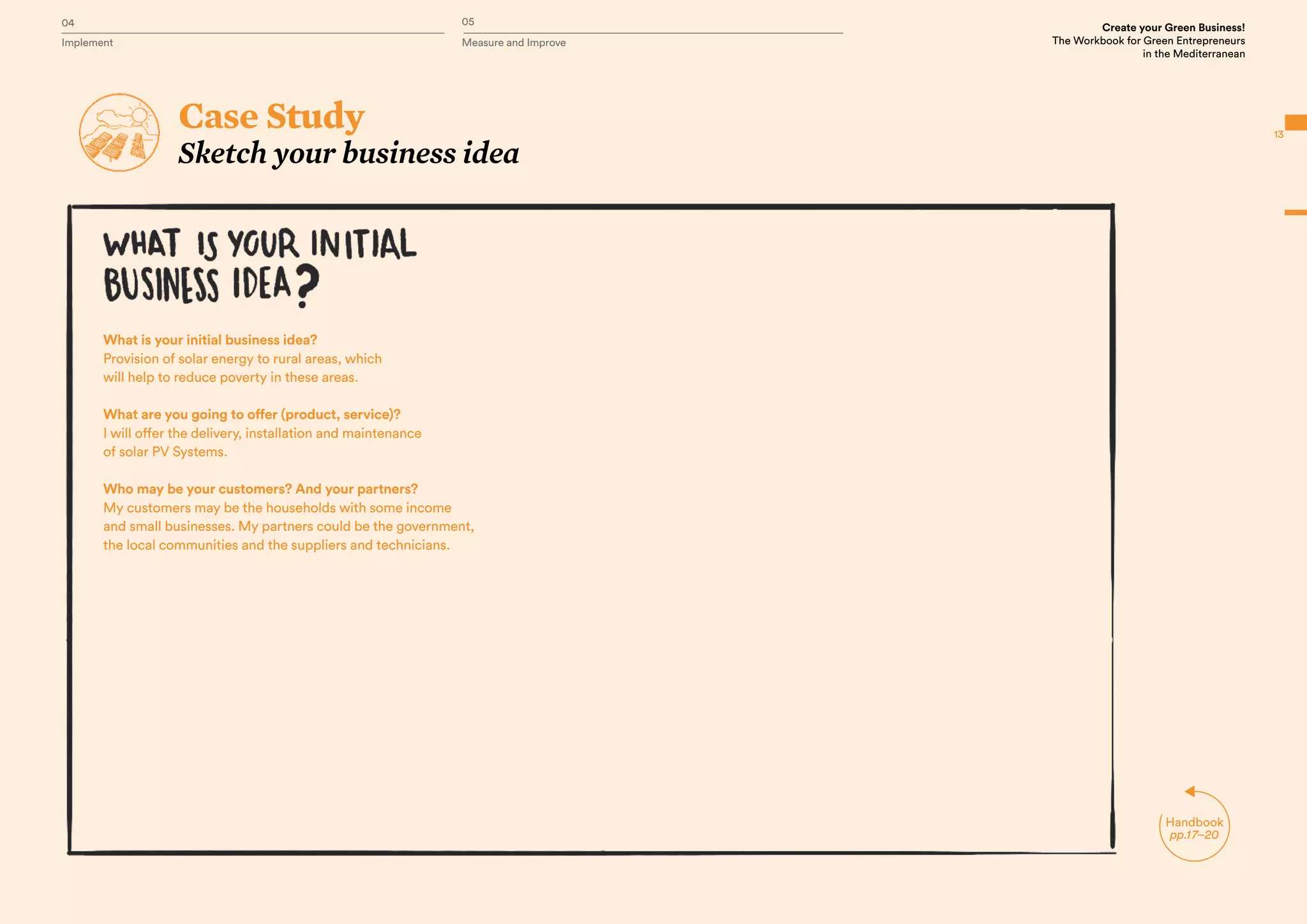
Case Study
Sketch your business idea
What is your initial business idea?
Provision of solar energy to rural areas, which
will help to reduce poverty in these areas.
What are you going to offer (product, service)?
I will offer the delivery, installation and maintenance
of solar PV Systems.
Who may be your customers? And your partners?
My customers may be the households with some income
and small businesses. My partners could be the government,
the local communities and the suppliers and technicians.
04 05
Implement Measure and Improve
Create your Green Business!
The Workbook for Green Entrepreneurs
in the Mediterranean
01 02 03
Sketch and Set Build Test
14
Exercise 2.
Identify problems and needs
After describing your initial business idea, it is the time to
ask yourself: Why would I like to develop it? What are the
problems or challenges that I want to address? What are the
needs from potential customers that I would like to satisfy?
Next you will find four boxes that ask you to reflect on the
environmental and social factors, the customers needs and
the team motivations that push your idea to exist. Answer
these questions to understand the WHY behind your initial
business idea.
Does your idea tackle real environmental challenges?
Which of them?
What are the biggest needs faced by your
potential customers?
1.2   Context
04 05
Implement Measure and Improve
Create your Green Business!
The Workbook for Green Entrepreneurs
in the Mediterranean
Handbook
pp.21–25
15
Does your idea tackle real social challenges?
Which of them?
What are the personal or professional drivers behind
the business idea?
Note
It is extremely important that you check that
these problems are real. We should avoid
wasting time to develop a solution nobody
needs or paying attention to an unexistent
problem. We recommend you to ask and
inquire about these problems and needs, in
order to get a deeper understanding of them.
01 02 03
Sketch and Set Build Test
16
1.2   Context
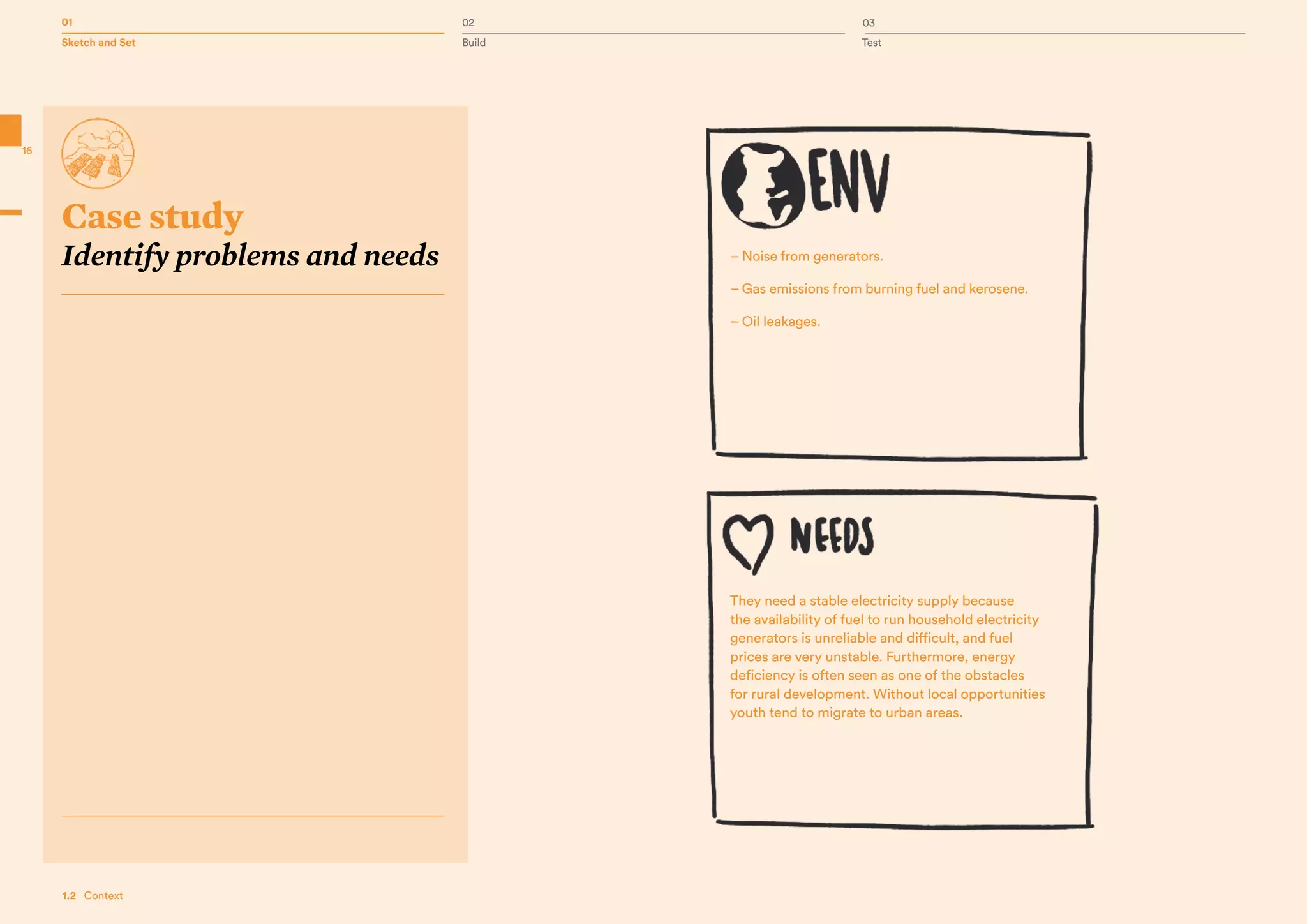
– Noise from generators.
– Gas emissions from burning fuel and kerosene.
– Oil leakages.
They need a stable electricity supply because
the availability of fuel to run household electricity
generators is unreliable and difficult, and fuel
prices are very unstable. Furthermore, energy
deficiency is often seen as one of the obstacles
for rural development. Without local opportunities
youth tend to migrate to urban areas.
Case study
Identify problems and needs
04 05
Implement Measure and Improve
Create your Green Business!
The Workbook for Green Entrepreneurs
in the Mediterranean
17
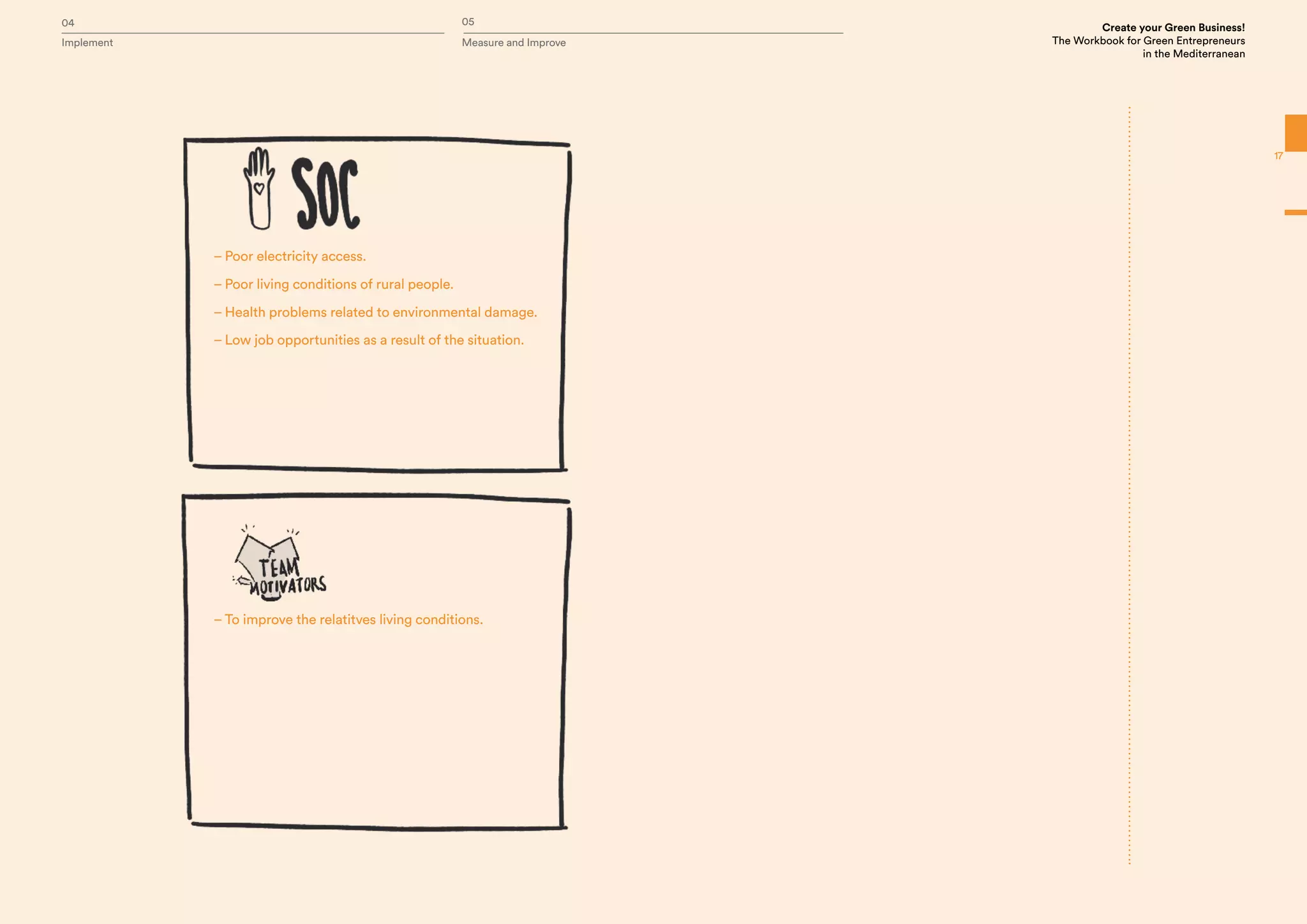
– Poor electricity access.
– Poor living conditions of rural people.
– Health problems related to environmental damage.
– Low job opportunities as a result of the situation.
– To improve the relatitves living conditions.
01 02 03
Sketch and Set Build Test
18
1.2   Context
Case study
Identify problems and needs
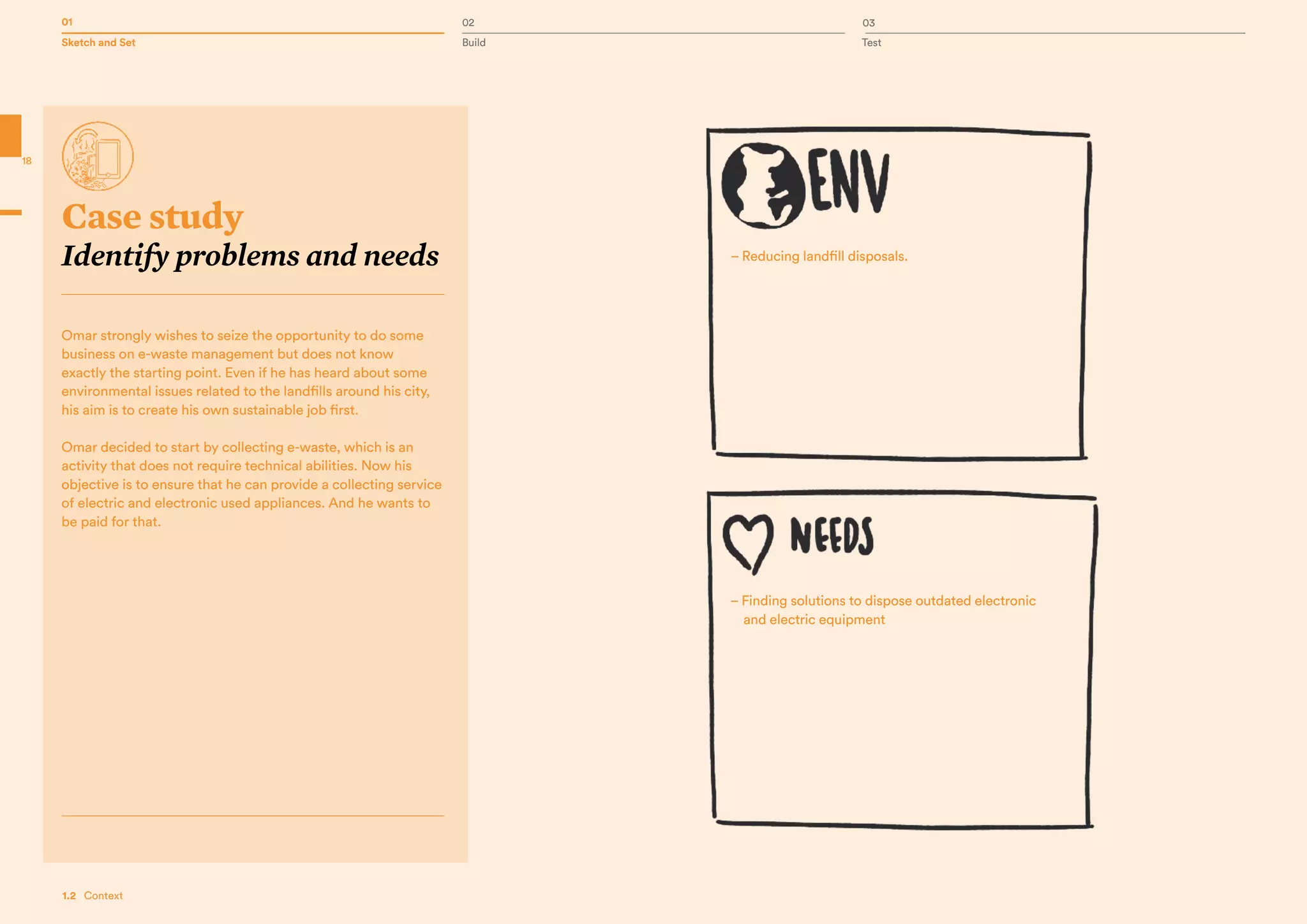
Omar strongly wishes to seize the opportunity to do some
business on e-waste management but does not know
exactly the starting point. Even if he has heard about some
environmental issues related to the landfills around his city,
his aim is to create his own sustainable job first.
Omar decided to start by collecting e-waste, which is an
activity that does not require technical abilities. Now his
objective is to ensure that he can provide a collecting service
of electric and electronic used appliances. And he wants to
be paid for that.
– Reducing landfill disposals.
– Finding solutions to dispose outdated electronic
and electric equipment
04 05
Implement Measure and Improve
Create your Green Business!
The Workbook for Green Entrepreneurs
in the Mediterranean
19
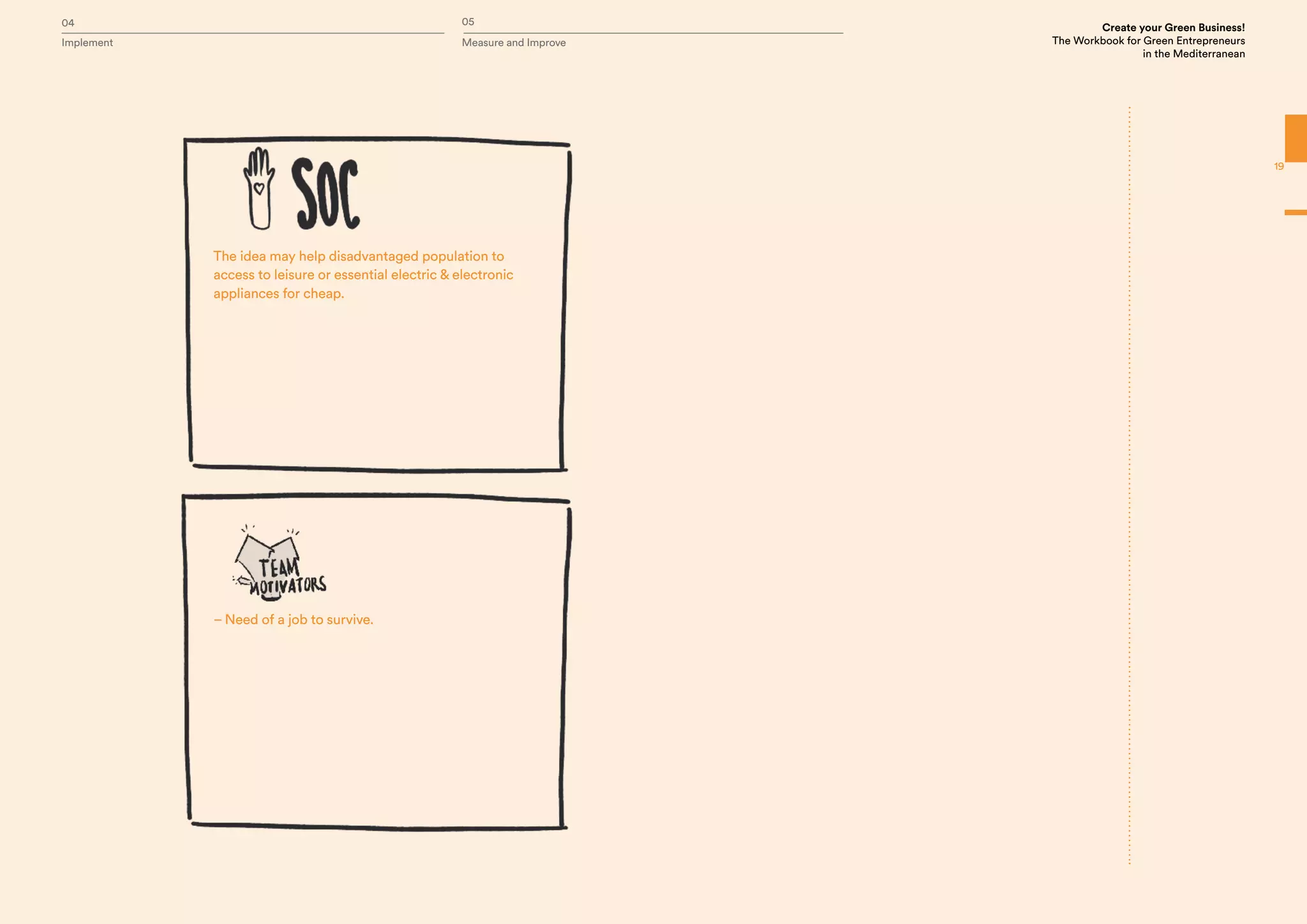
The idea may help disadvantaged population to
access to leisure or essential electric & electronic
appliances for cheap.
– Need of a job to survive.
01 02 03
Sketch and Set Build Test
20
After having identified the problems and needs, it is the time
to zoom out and look at the local, regional and global context
around your business idea. Pay special attention to those
aspects that may either boost or constrain the development
of your idea.
Brainstorm: think about the conditions, changes
and trends in the local, regional and global
context that can affect your business in the
future. These aspects can be grouped into
the following categories: Political (P), Economic
(E), Social (S), Technological (T), Environmental
(E) and Legal (L).
Prioritise: select the most relevant aspects for
your business (maximum five) and write them
down in the following box.
Confront: it would be great if you could bring
some insights on how would you confront these
aspects!
Exercise 3
Understand the context
1.2  Context
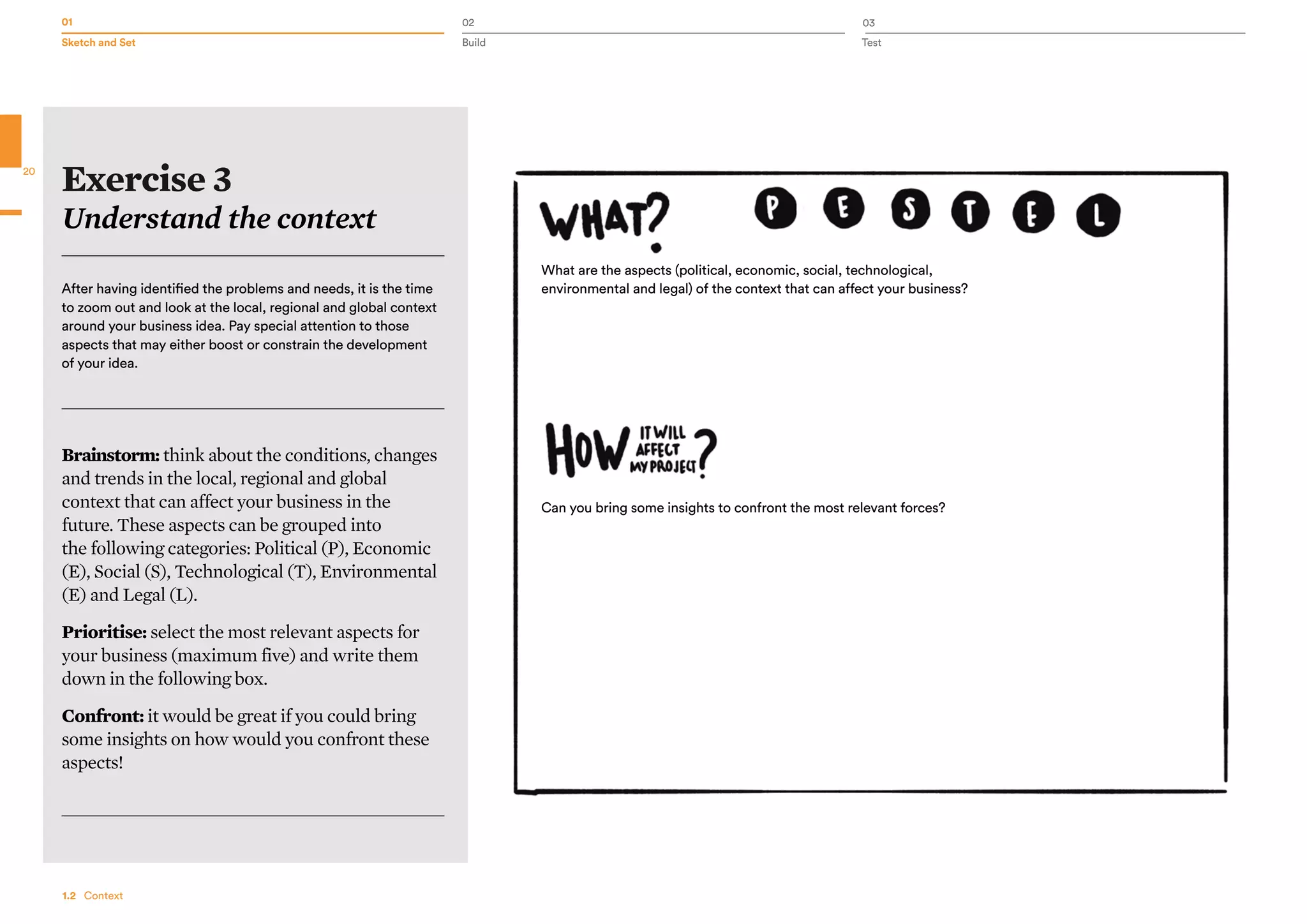
What are the aspects (political, economic, social, technological,
environmental and legal) of the context that can affect your business?
Can you bring some insights to confront the most relevant forces?
Handbook
P.g 25
04 05
Implement Measure and Improve
Create your Green Business!
The Handbook for Green Entrepreneurs
in the Mediterranean
Case study
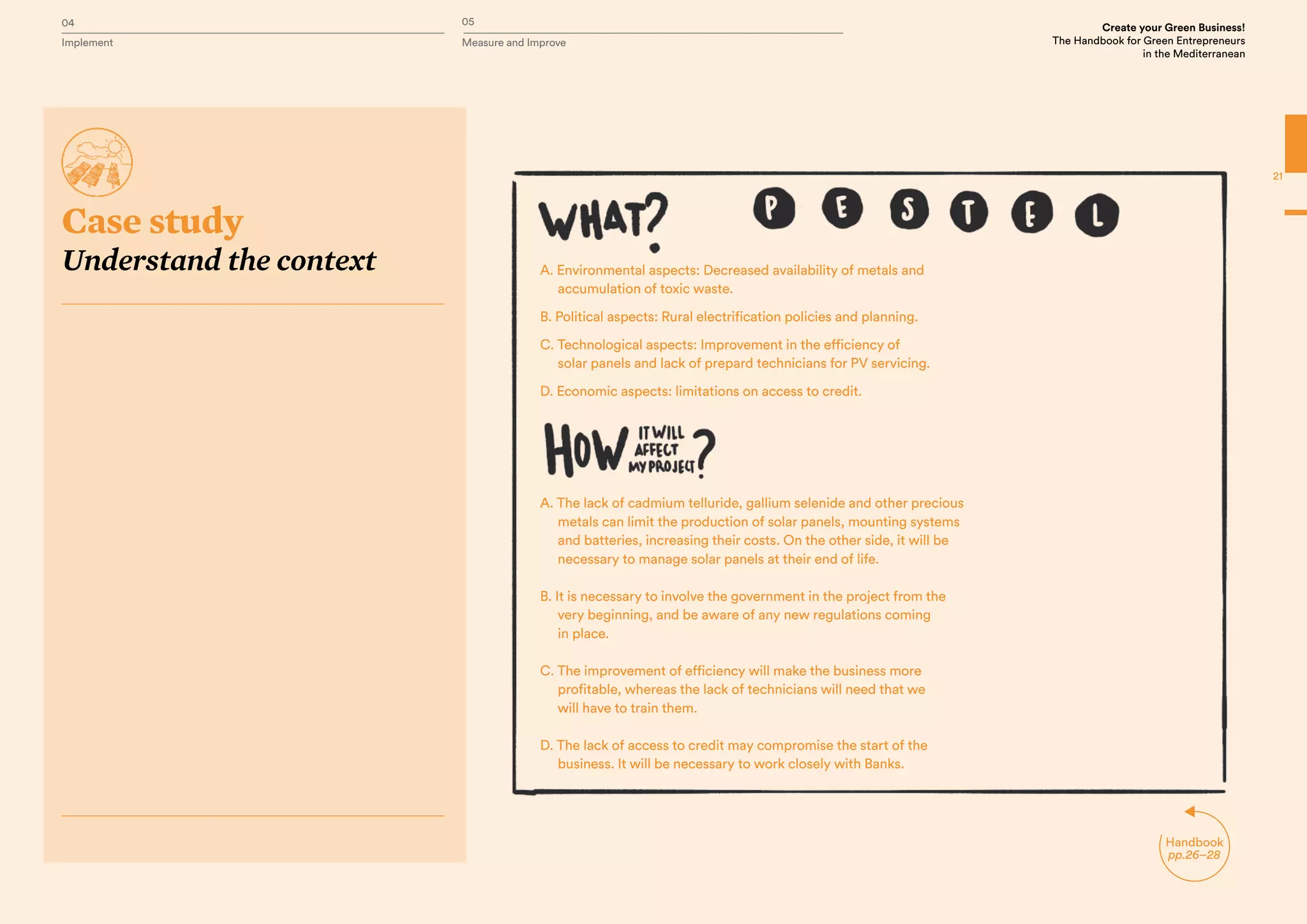
Understand the context A. Environmental aspects: Decreased availability of metals and
accumulation of toxic waste.
B. Political aspects: Rural electrification policies and planning.
C. Technological aspects: Improvement in the efficiency of
solar panels and lack of prepard technicians for PV servicing.
D. Economic aspects: limitations on access to credit.
A. The lack of cadmium telluride, gallium selenide and other precious
metals can limit the production of solar panels, mounting systems
and batteries, increasing their costs. On the other side, it will be
necessary to manage solar panels at their end of life.
B. It is necessary to involve the government in the project from the
very beginning, and be aware of any new regulations coming
in place.
C. The improvement of efficiency will make the business more
profitable, whereas the lack of technicians will need that we
will have to train them.
D. The lack of access to credit may compromise the start of the
business. It will be necessary to work closely with Banks.
21
Handbook
pp.26–28
01 02 03
Sketch and Set Build Test
22
1.3   Objectives
Exercise 4
Set your goals
Recap: Revise exercises 2 and 3. Capture in the
column ‘Problems and needs’ the most relevant
problems and needs that your project is seeking
to tackle. Be aware that you can also add personal
or team objectives.
Set objectives: Reframe the problems and needs
into specific objectives to solve or confront them
(remember when defining the objectives the
context in which you operate in).
Measure progress: Optionally, you can set
indicators that will help you measure the
progress towards the set objectives. However,
this is something complementary at this stage.
Notes
04 05
Implement Measure and Improve
Create your Green Business!
The Workbook for Green Entrepreneurs
in the Mediterranean
Handbook
pp.29–32
23
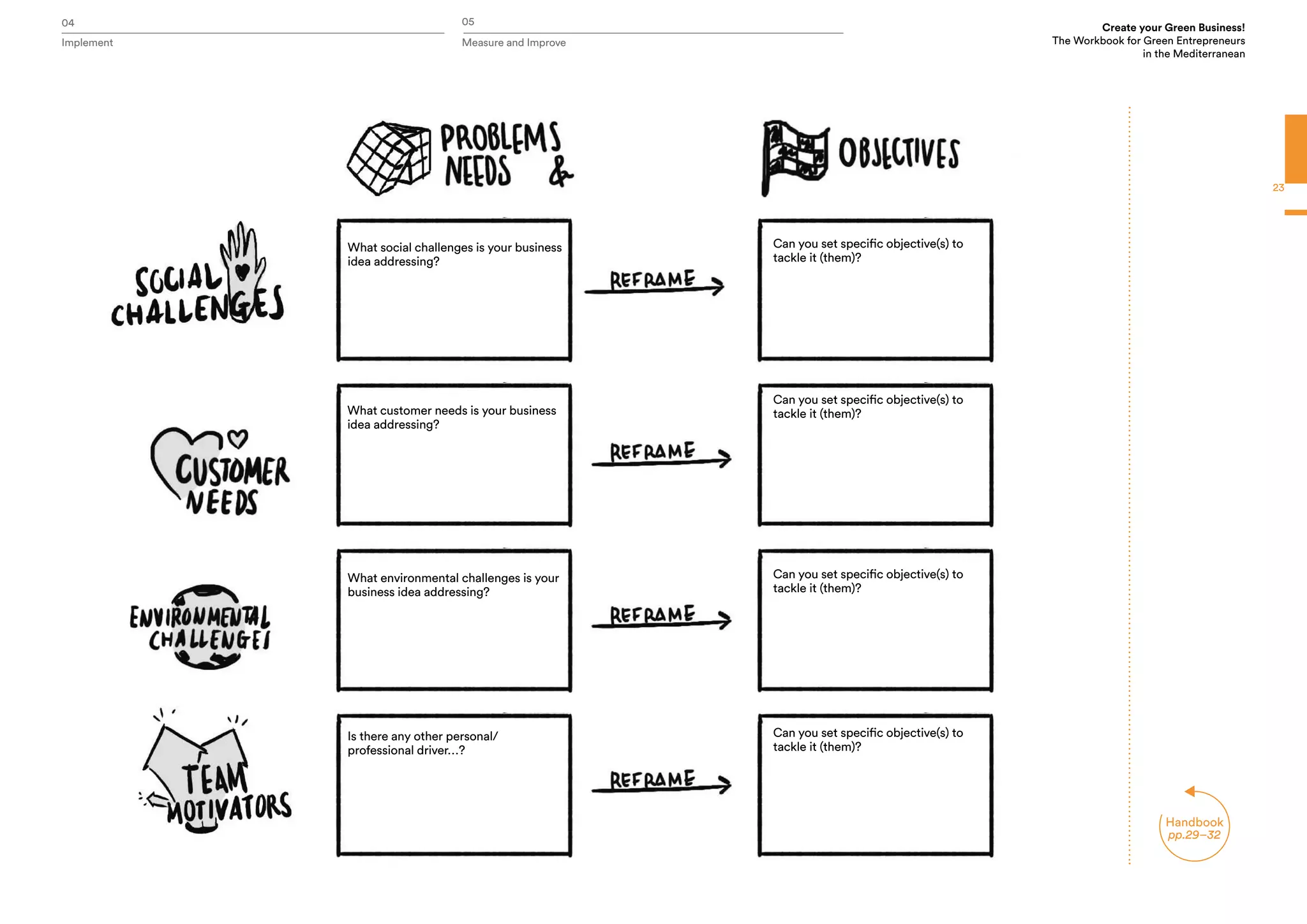
What social challenges is your business
idea addressing?
What customer needs is your business
idea addressing?
What environmental challenges is your
business idea addressing?
Is there any other personal/
professional driver…?
Can you set specific objective(s) to
tackle it (them)?
Can you set specific objective(s) to
tackle it (them)?
Can you set specific objective(s) to
tackle it (them)?
Can you set specific objective(s) to
tackle it (them)?
01 02 03
Sketch and Set Build Test
24
1.3   Objectives
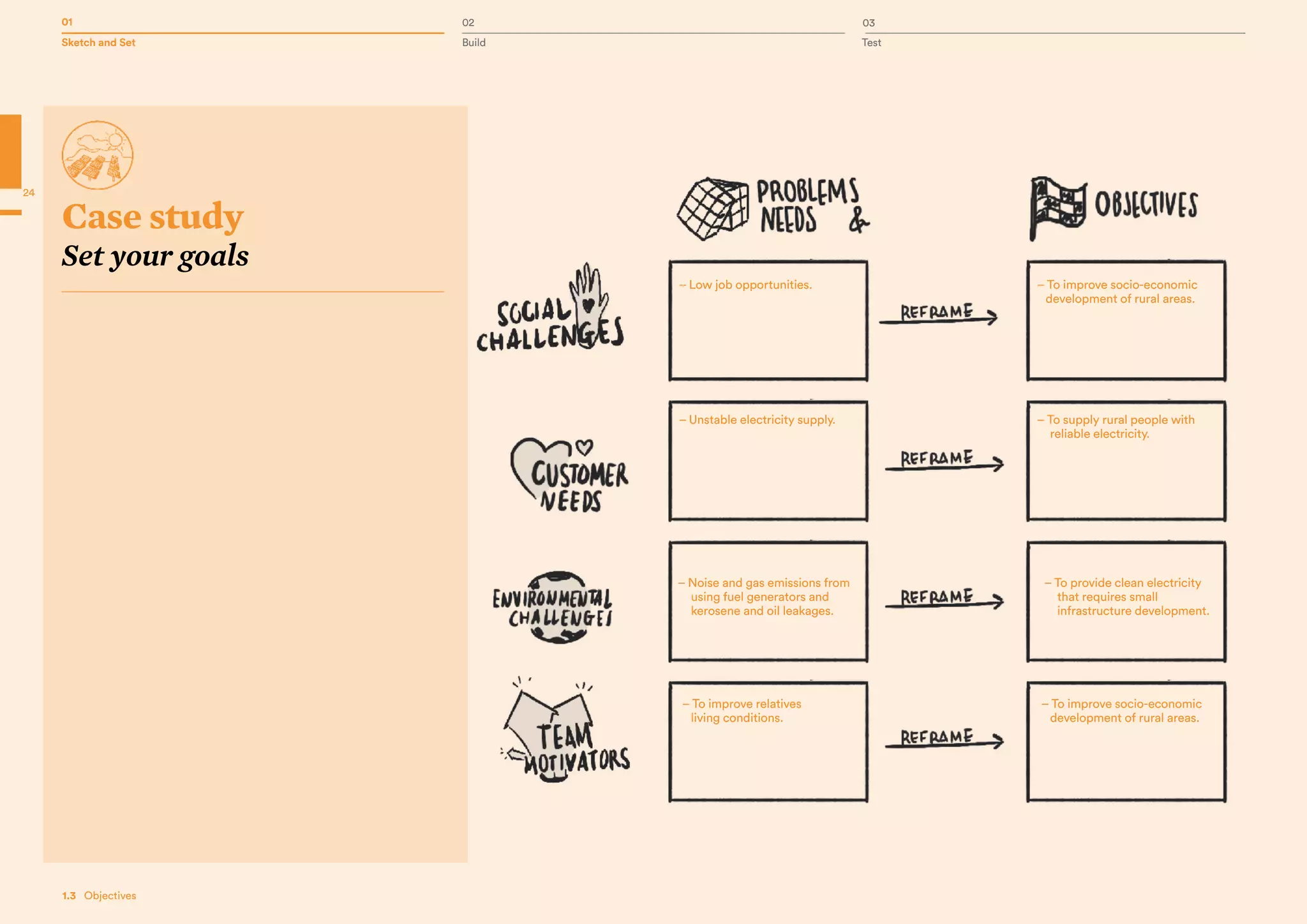
Case study
Set your goals
– Low job opportunities.
– Unstable electricity supply.
– Noise and gas emissions from
using fuel generators and
kerosene and oil leakages.
– To improve relatives
living conditions.
– To improve socio-economic
development of rural areas.
– To supply rural people with
reliable electricity.
– To provide clean electricity
that requires small
infrastructure development.
– To improve socio-economic
development of rural areas.
04 05
Implement Measure and Improve
Create your Green Business!
The Workbook for Green Entrepreneurs
in the Mediterranean
25
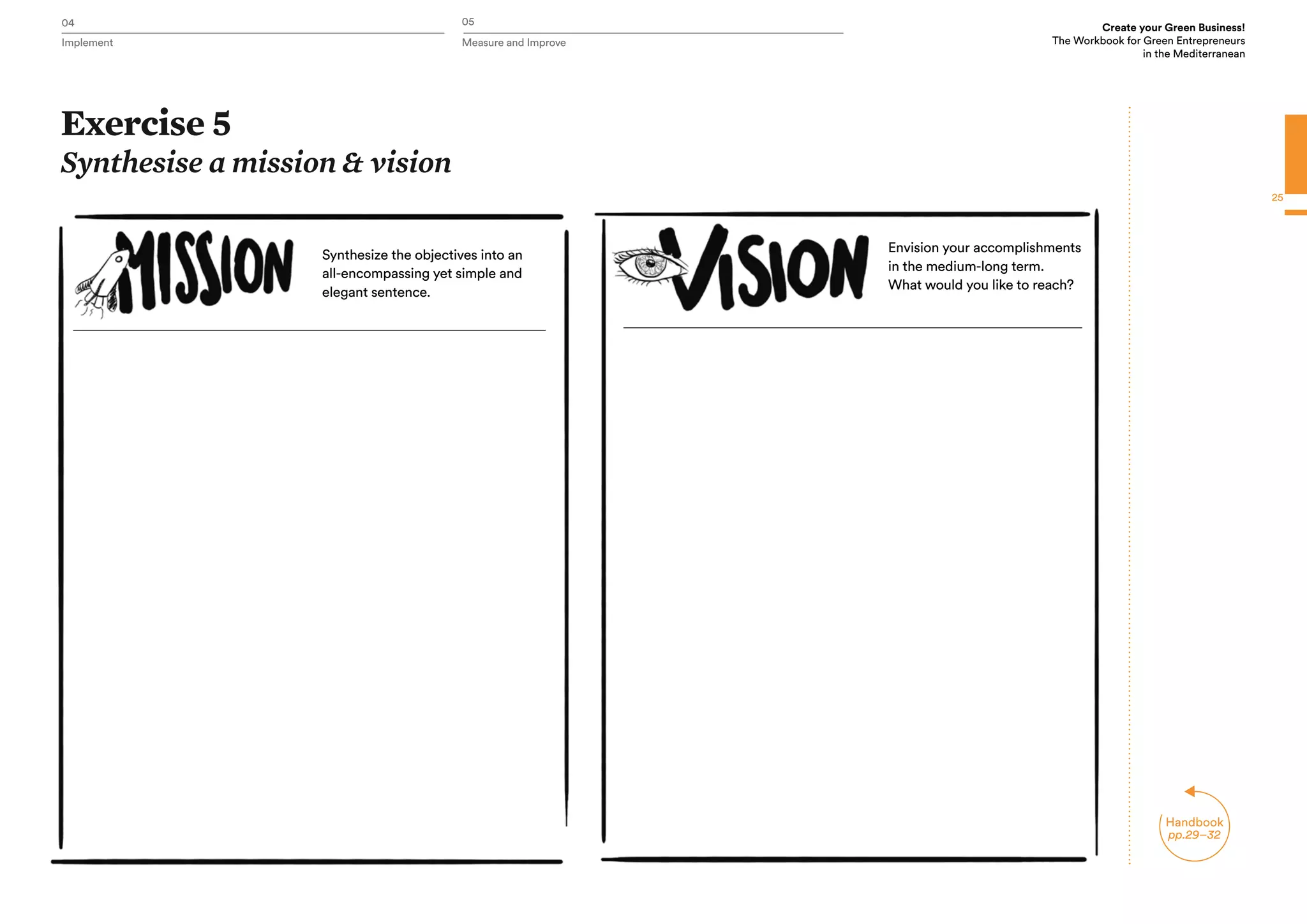
Exercise 5
Synthesise a mission & vision
Synthesize the objectives into an
all-encompassing yet simple and
elegant sentence.
Envision your accomplishments
in the medium-long term.
What would you like to reach?
Handbook
pp.29–32
01 02 03
2.4 Key Activities & Key Resources
Sketch and Set Build Test
26
1.3   Objectives
01 02 03
Exercise 6
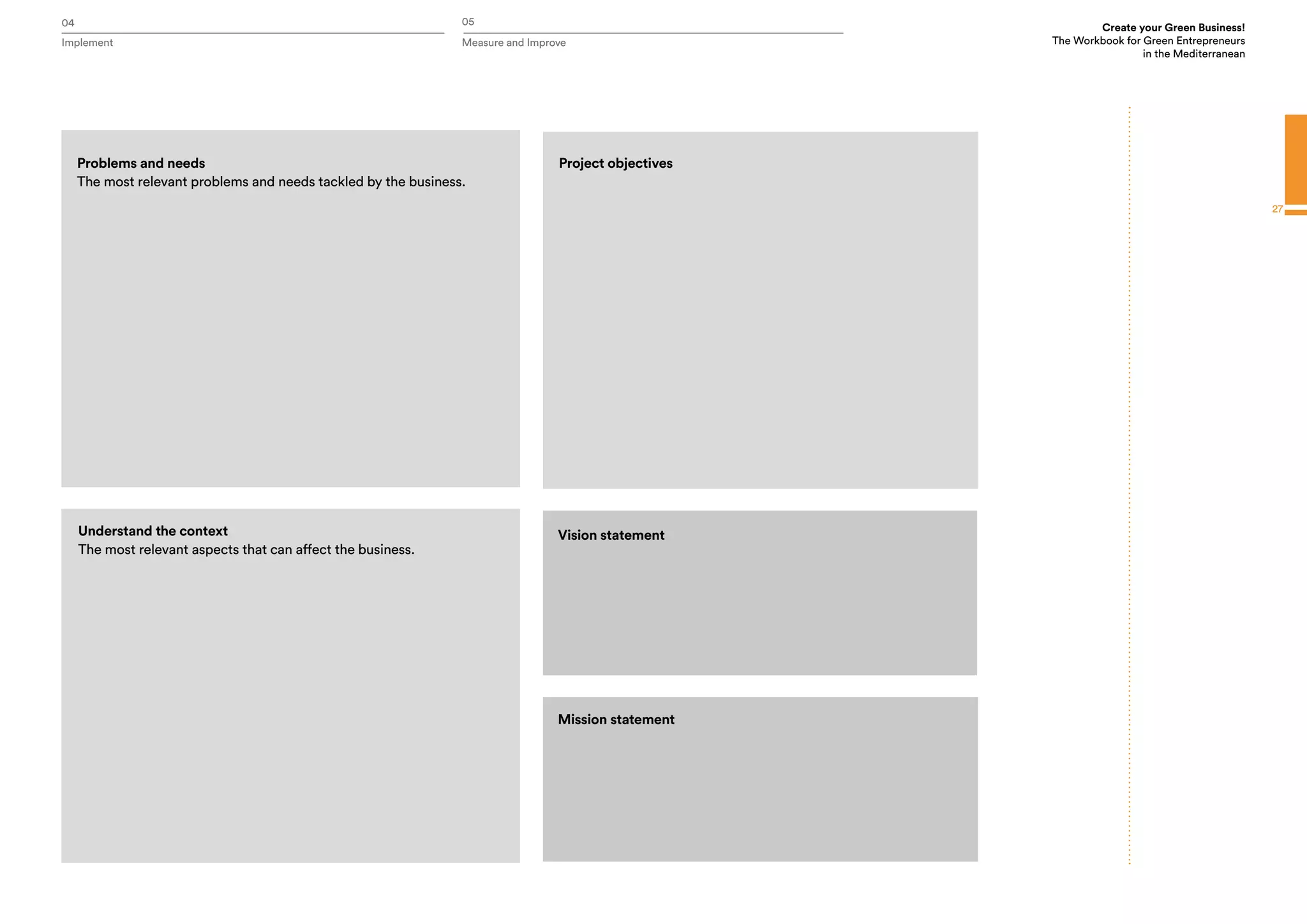
Summary of context
and objectives
Build TestSketch and Set
04 05
Implement Measure and Improve
Create your Green Business!
The Workbook for Green Entrepreneurs
in the Mediterranean
27
Vision statement
Mission statement
Problems and needs
The most relevant problems and needs tackled by the business.
Project objectives
Understand the context
The most relevant aspects that can affect the business.
01 02 03
Sketch and Set Build Test
28
1.3   Objectives
Case study
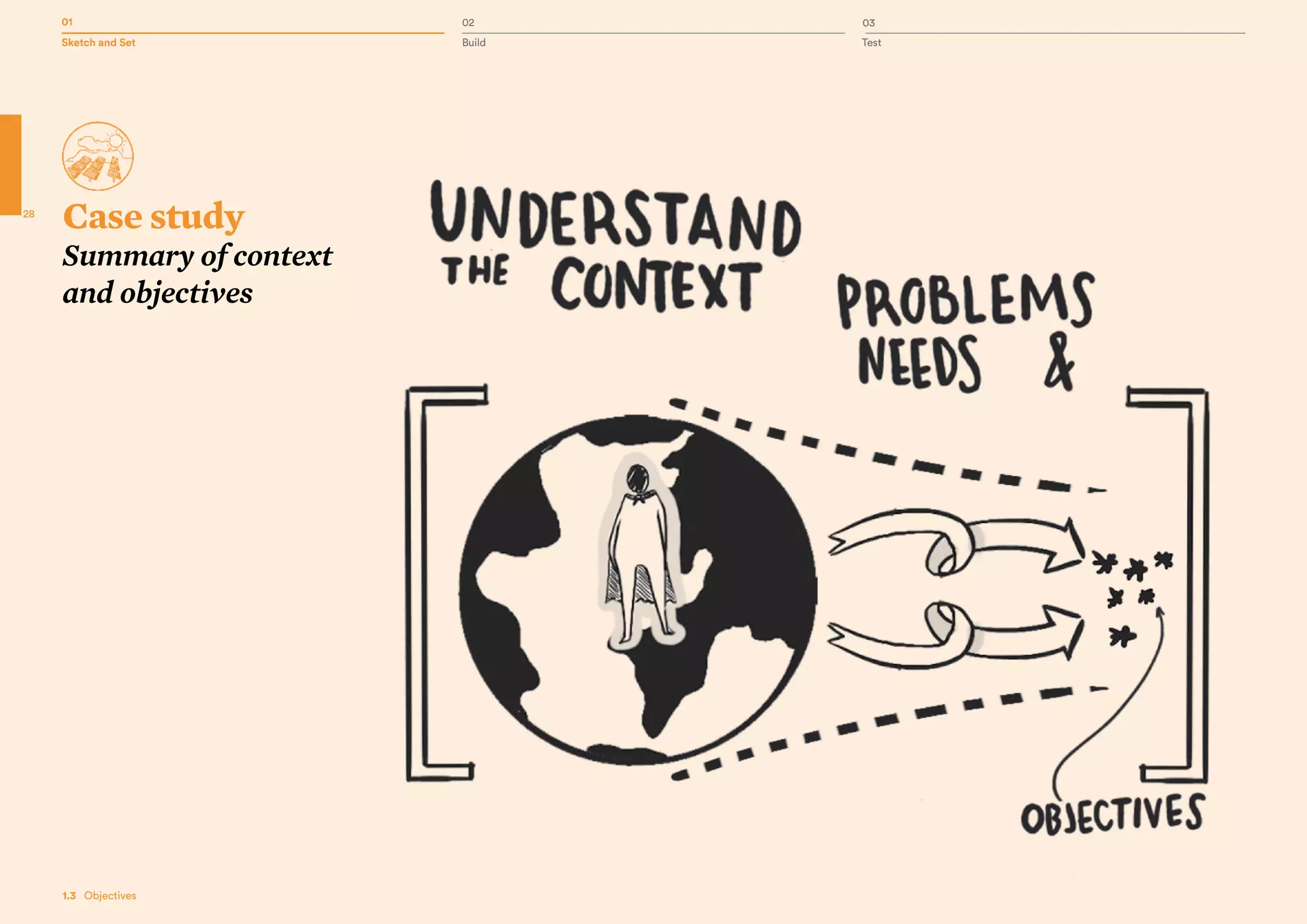
Summary of context
and objectives
04 05
Implement Measure and Improve
Create your Green Business!
The Workbook for Green Entrepreneurs
in the Mediterranean
29
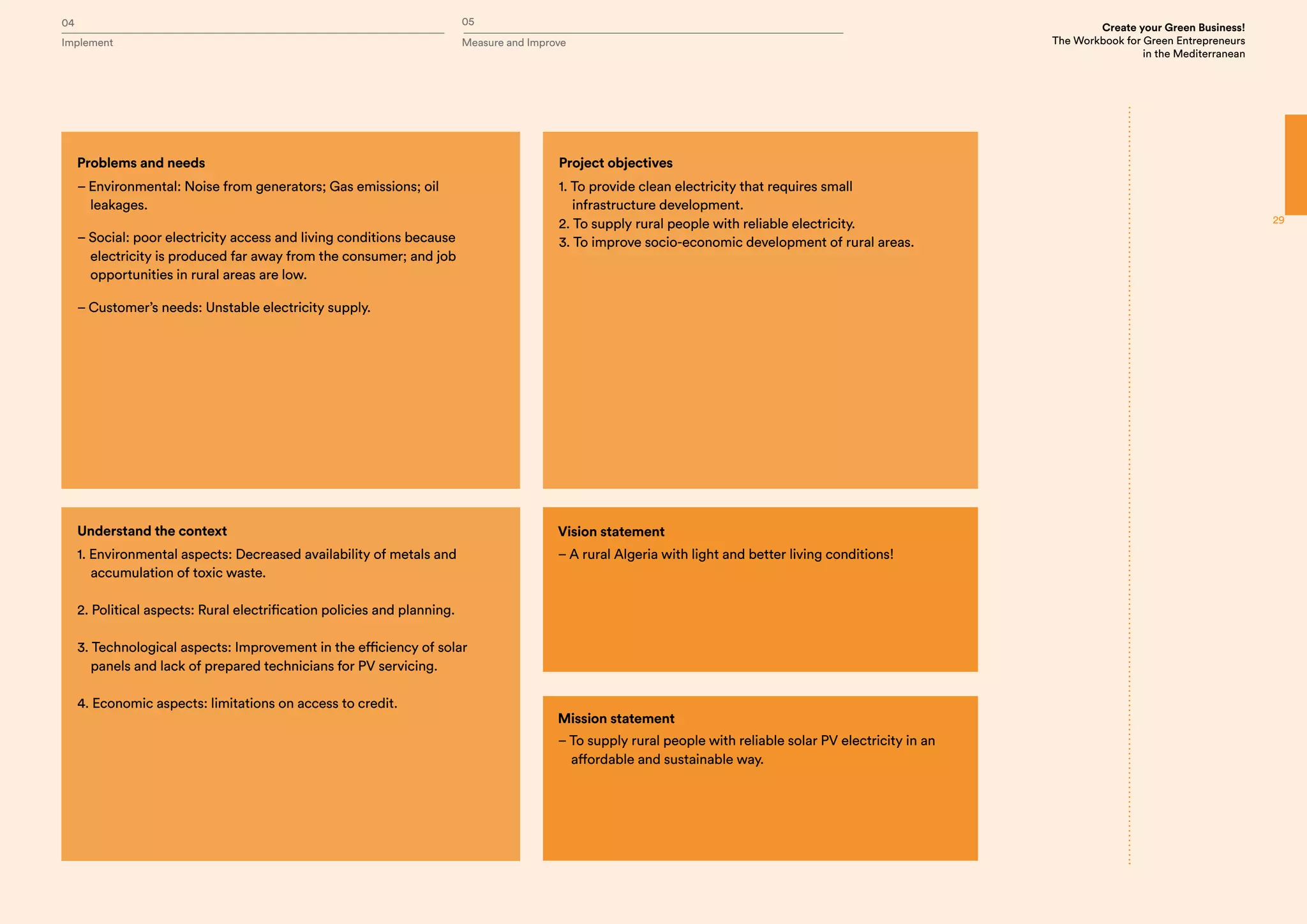
Vision statement
– A rural Algeria with light and better living conditions!
Mission statement
– To supply rural people with reliable solar PV electricity in an
affordable and sustainable way.
Problems and needs
– Environmental: Noise from generators; Gas emissions; oil
leakages.
– Social: poor electricity access and living conditions because
electricity is produced far away from the consumer; and job
opportunities in rural areas are low.
– Customer’s needs: Unstable electricity supply.
Project objectives
1. To provide clean electricity that requires small
infrastructure development.
2. To supply rural people with reliable electricity.
3. To improve socio-economic development of rural areas.
Understand the context
1. Environmental aspects: Decreased availability of metals and
accumulation of toxic waste.
2. Political aspects: Rural electrification policies and planning.
3. Technological aspects: Improvement in the efficiency of solar
panels and lack of prepared technicians for PV servicing.
4. Economic aspects: limitations on access to credit.
Step 2.
Build
Step2.
01 02 03
Sketch and Set Build Test
Build your
business model
It is time to design step-by-step your business
by using the Green Business Canvas:
1. Identify the customers and key stakeholders
related to your business objectives (exercises
7 and 8)
2. Create the value proposition with them
(exercises 9 to 11).
3. Identify the channels and relationships
with your customer segments and eco-design
the activities and resources to develop your
business (exercises 12 to 15),
4. Estimate the expected costs and revenues
(exercises 16 to 18).
Notes
2.1   The green business canvas
04 05 Create your Green Business!
The Workbook for Green Entrepreneurs
in the Mediterranean
Implement Measure and Improve
33
Note
There is an individual Green Business Canvas
sheet apart from this Workbook. You can print
it in A3 size and use it to write down your
outcomes as you go through the exercises!
Who are the main actors that
are going to affect the project
or can be affected by it?
For example, team (founders
and employees), partners,
providers, media, local com-
munity, etc.
What are the costs the project will incur
into by implementing the activities using the
resources needed?
List, and if possible estimate roughly
How much are your customers willing to pay?
By comparing with similar products/services
in the market, try to set approximate prices or
rates for each product-customer segment pair.
What value does the project
offer to customers and stake-
holders?
How does it contribute to the
protection and/or improvement
of the natural environment?
How does your project contri-
bute to the society?
What is the innovation in your
value propostion? Is it unique?
How will you attract and
engage your potential
customers, seeking to achieve
sales, but also to get feedback,
spread the word, etc.?
Which channels will be most
suitable for so doing?
Who are your potential custo-
mers (pay a certain price for
the value they receive)?
Segment them in separate
categories if they differ
substantially.
Can you innovate in the way
you approach and engage
customers?
What activities will you put
in place to materialize the
value proposition (products or
services)?
What resources (physical,
human, financial ...) will those
require?
Are there new ways to perform
these activities that are less
impacting to the environment?
01 02 03
Sketch and Set Build Test
34
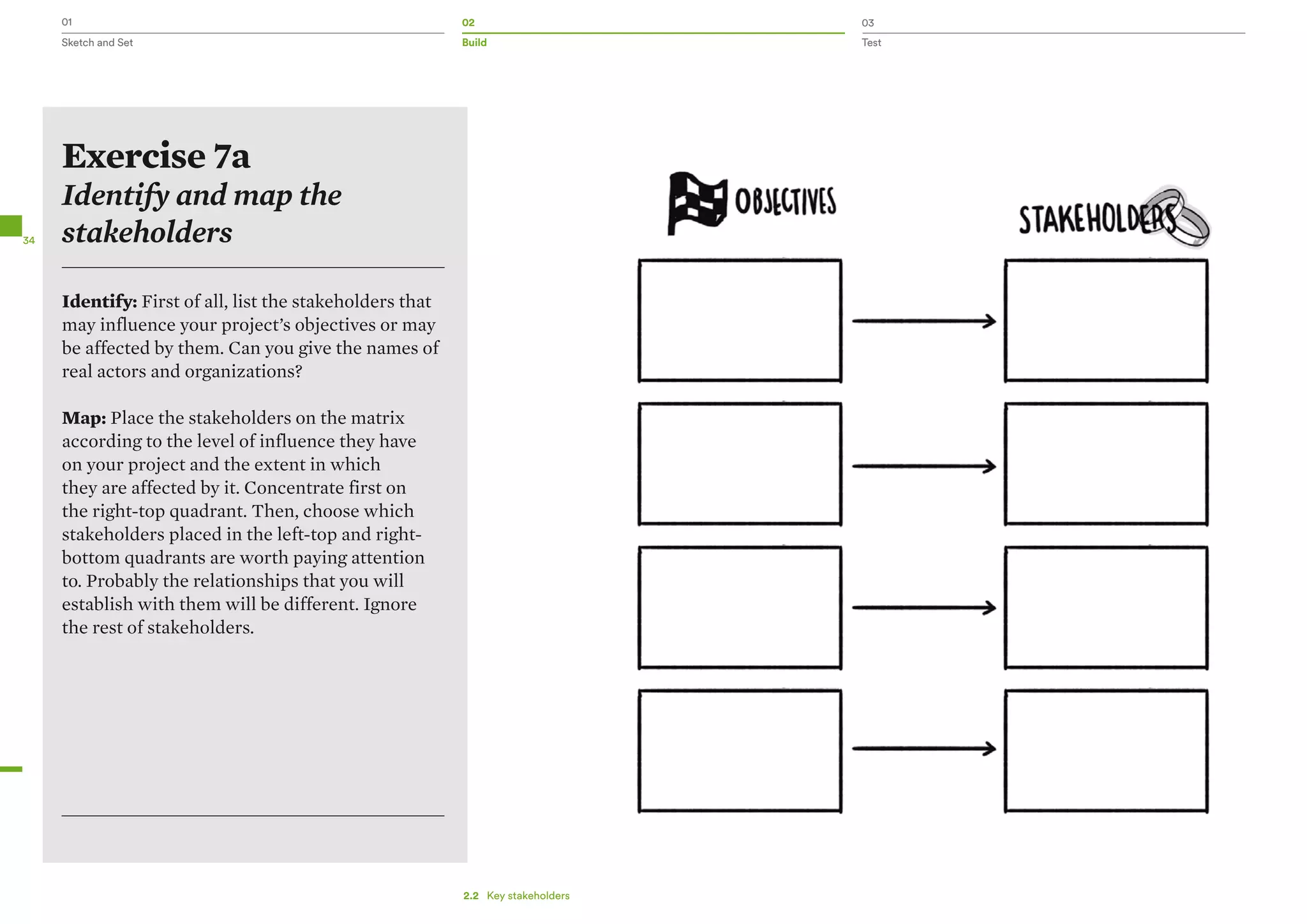
Exercise 7a
Identify and map the
stakeholders
Identify: First of all, list the stakeholders that
may influence your project’s objectives or may
be affected by them. Can you give the names of
real actors and organizations?
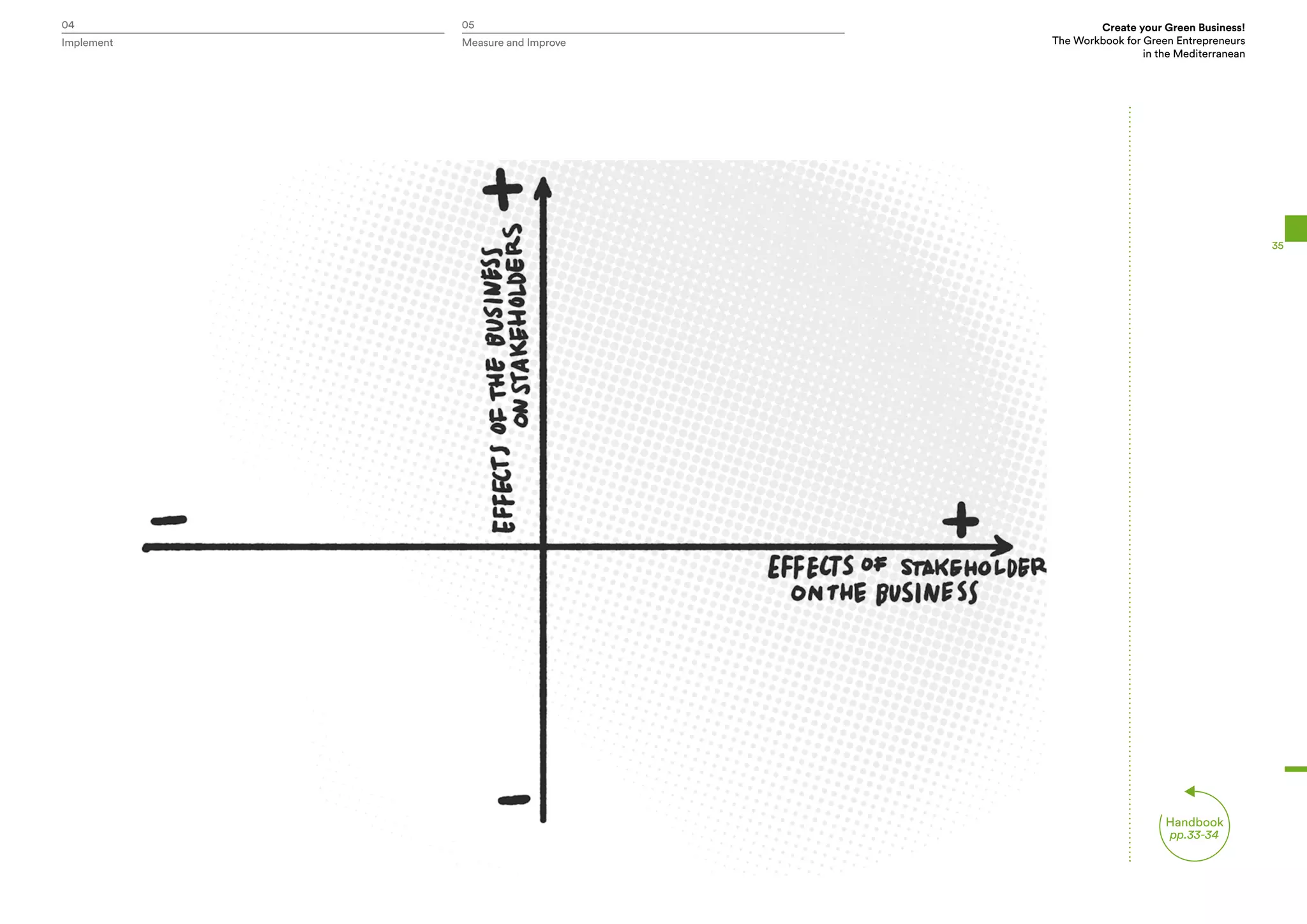
Map: Place the stakeholders on the matrix
according to the level of influence they have
on your project and the extent in which
they are affected by it. Concentrate first on
the right-top quadrant. Then, choose which
stakeholders placed in the left-top and right-
bottom quadrants are worth paying attention
to. Probably the relationships that you will
establish with them will be different. Ignore
the rest of stakeholders.
2.2   Key stakeholders
04 05 Create your Green Business!
The Workbook for Green Entrepreneurs
in the Mediterranean
Implement Measure and Improve
Handbook
pp.33-34
35
01 02 03
Sketch and Set Build Test
36
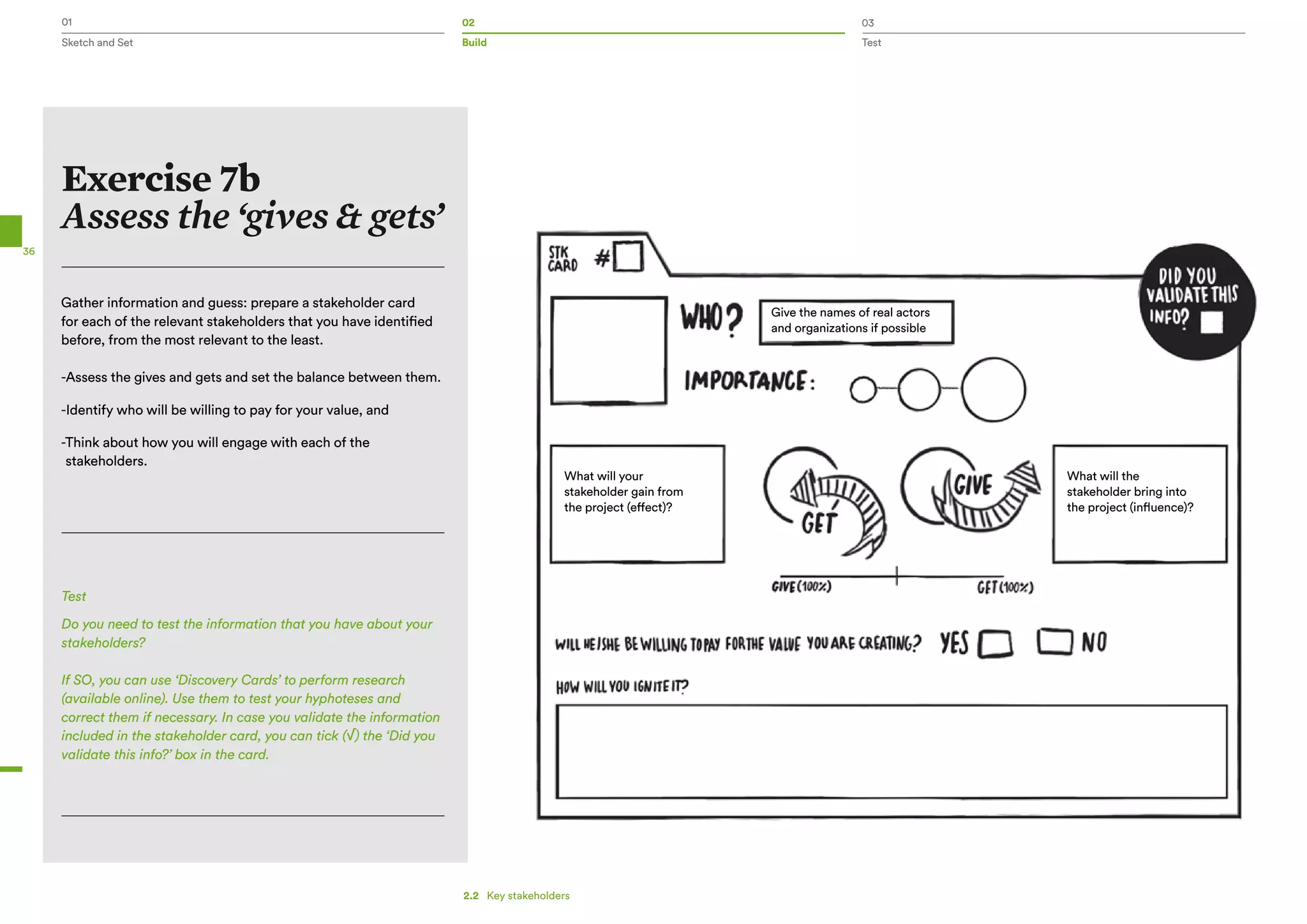
Give the names of real actors
and organizations if possible
What will the
stakeholder bring into
the project (influence)?
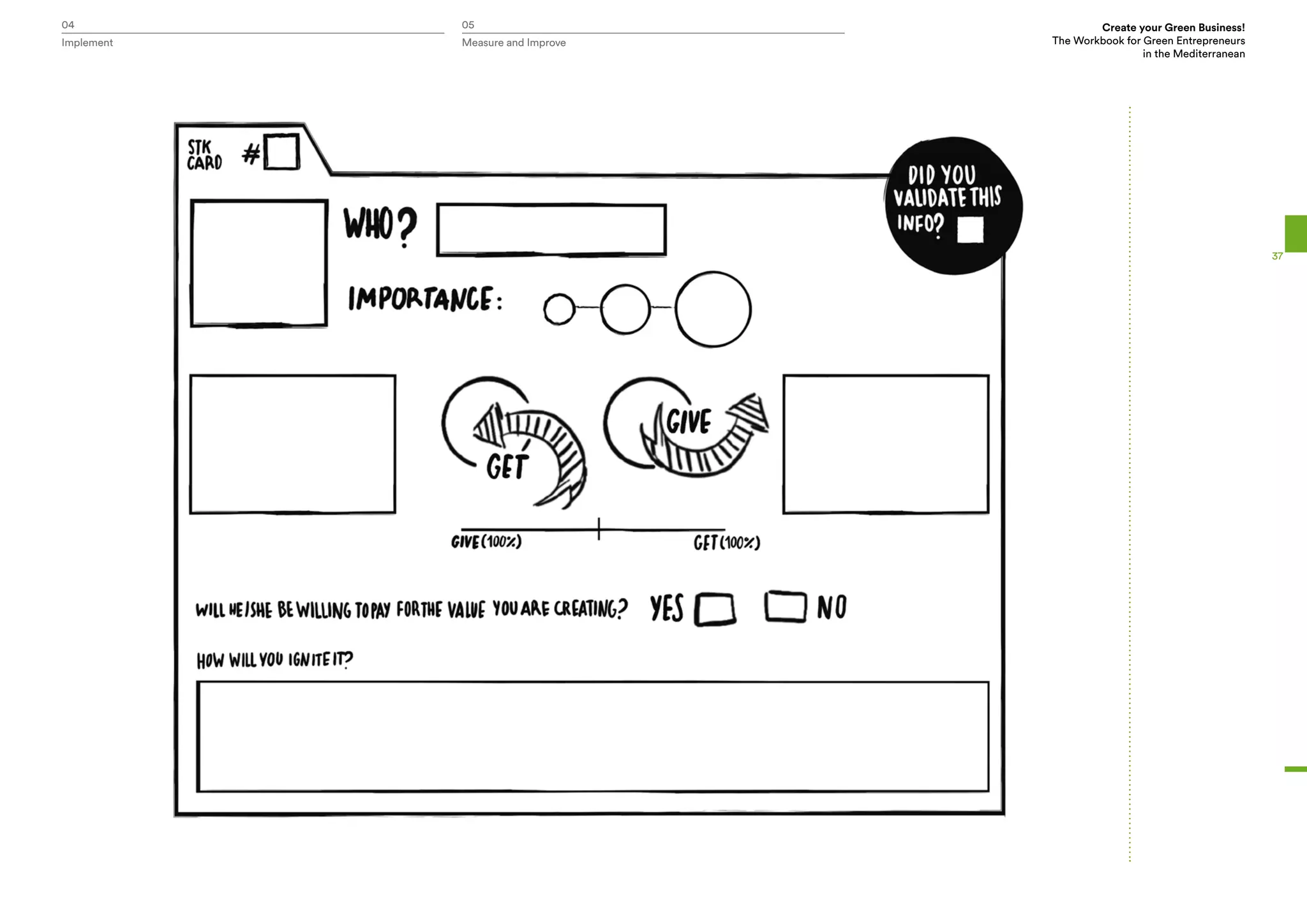
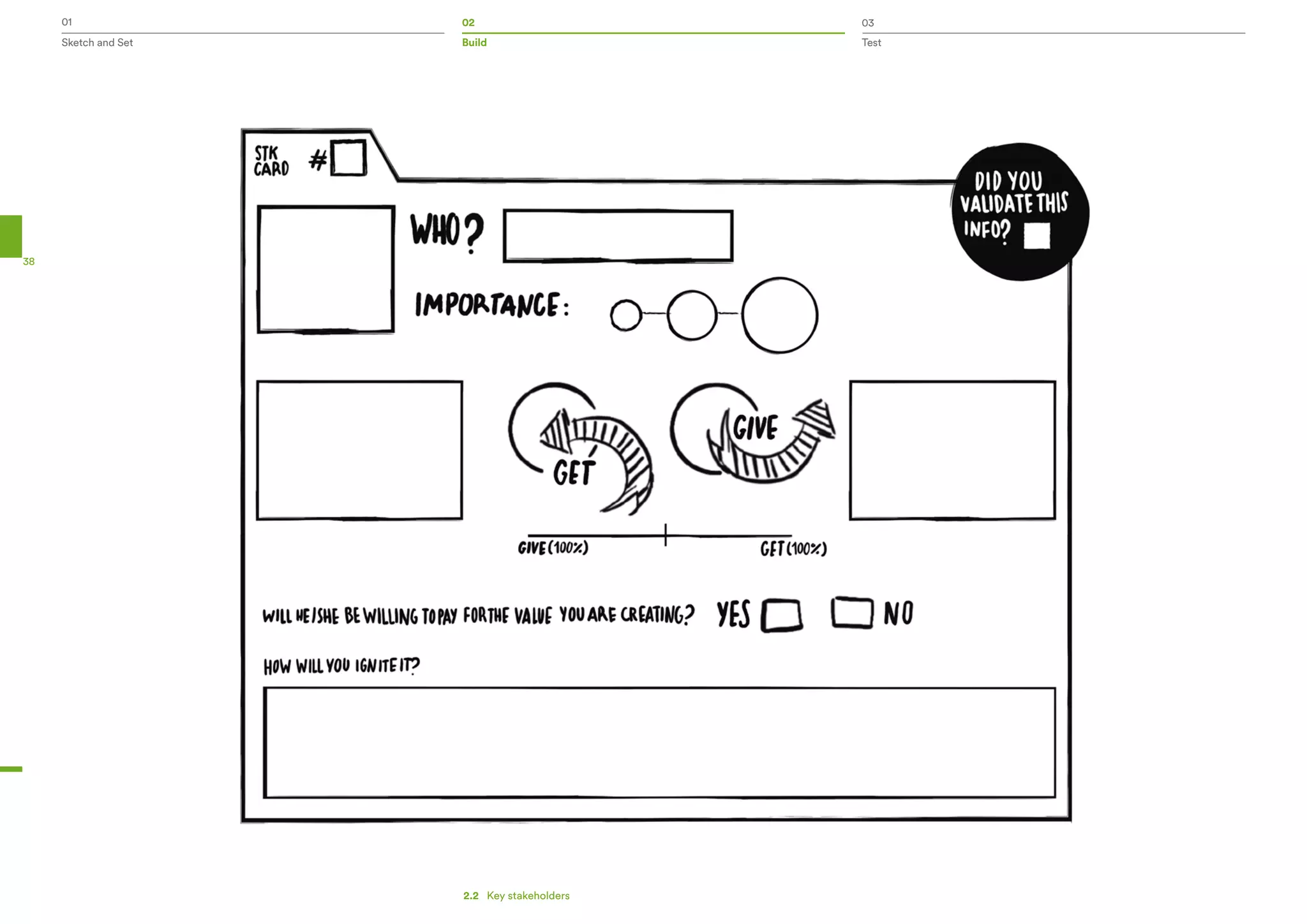
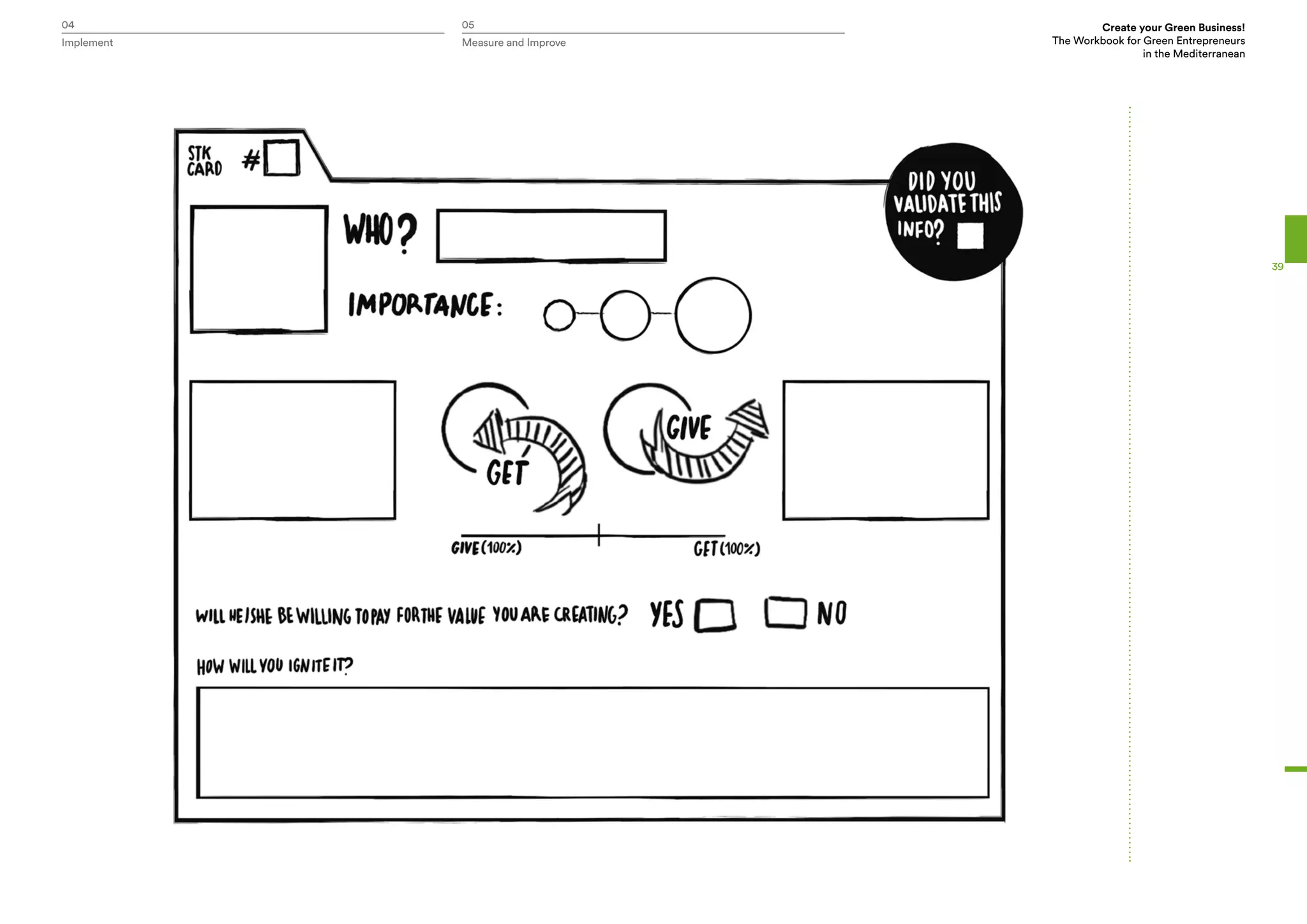
Exercise 7b
Assess the ‘gives & gets’
Gather information and guess: prepare a stakeholder card
for each of the relevant stakeholders that you have identified
before, from the most relevant to the least.
-Assess the gives and gets and set the balance between them.
-Identify who will be willing to pay for your value, and
-Think about how you will engage with each of the
stakeholders.
Test
Do you need to test the information that you have about your
stakeholders?
If SO, you can use ‘Discovery Cards’ to perform research
(available online). Use them to test your hyphoteses and
correct them if necessary. In case you validate the information
included in the stakeholder card, you can tick (√) the ‘Did you
validate this info?’ box in the card.
What will your
stakeholder gain from
the project (effect)?
2.2   Key stakeholders
04 05 Create your Green Business!
The Workbook for Green Entrepreneurs
in the Mediterranean
Implement Measure and Improve
37
01 02 03
Sketch and Set Build Test
38
2.2   Key stakeholders
04 05 Create your Green Business!
The Workbook for Green Entrepreneurs
in the Mediterranean
Implement Measure and Improve
39
01 02 03
Sketch and Set Build Test
40
LG
T
S
REC
G
EL
B
CL
CLIENT
NGOs
Case study
Stakeholders
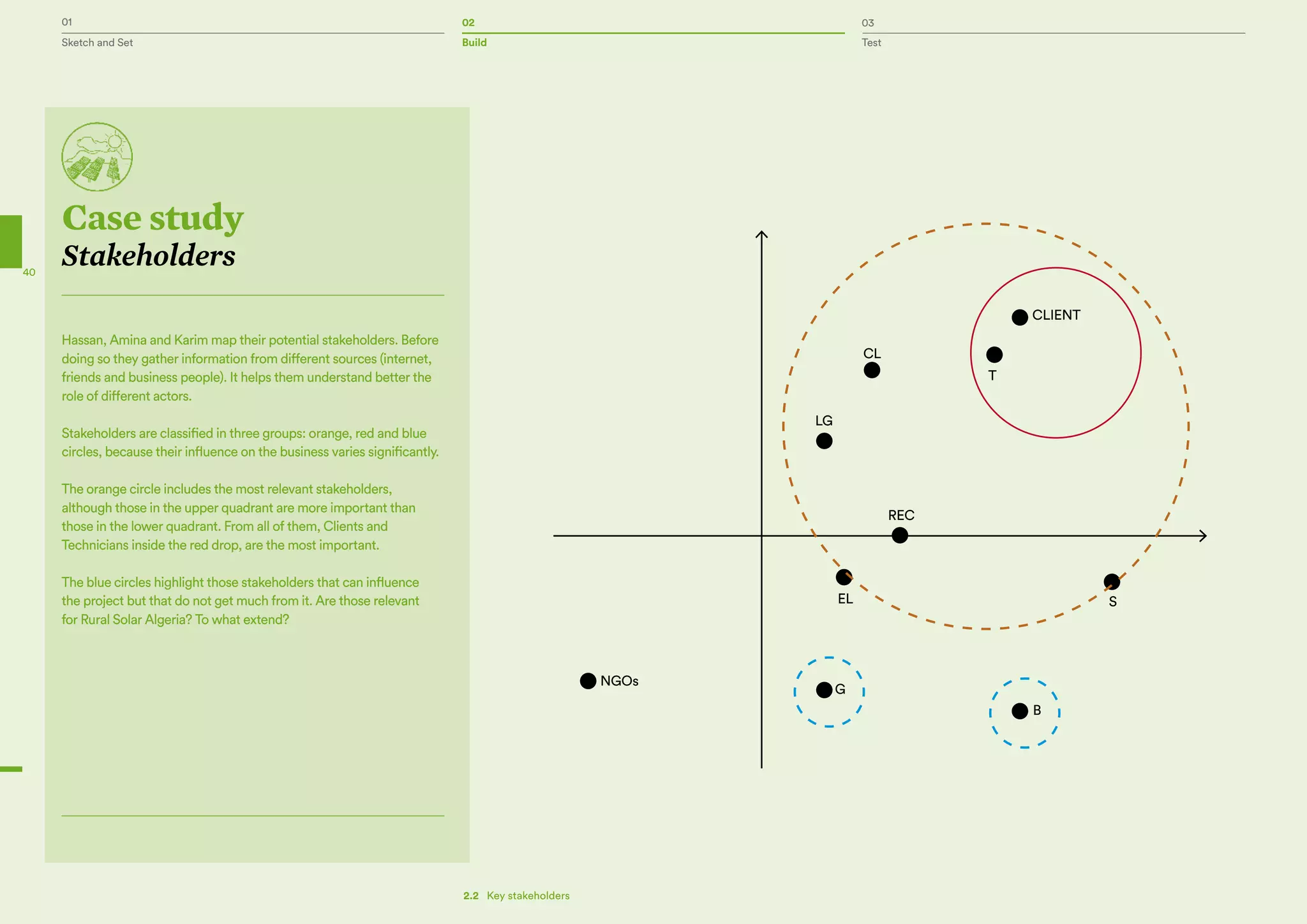
Hassan, Amina and Karim map their potential stakeholders. Before
doing so they gather information from different sources (internet,
friends and business people). It helps them understand better the
role of different actors.
Stakeholders are classified in three groups: orange, red and blue
circles, because their influence on the business varies significantly.
The orange circle includes the most relevant stakeholders,
although those in the upper quadrant are more important than
those in the lower quadrant. From all of them, Clients and
Technicians inside the red drop, are the most important.
The blue circles highlight those stakeholders that can influence
the project but that do not get much from it. Are those relevant
for Rural Solar Algeria? To what extend?
2.2   Key stakeholders
04 05 Create your Green Business!
The Workbook for Green Entrepreneurs
in the Mediterranean
Implement Measure and Improve
41
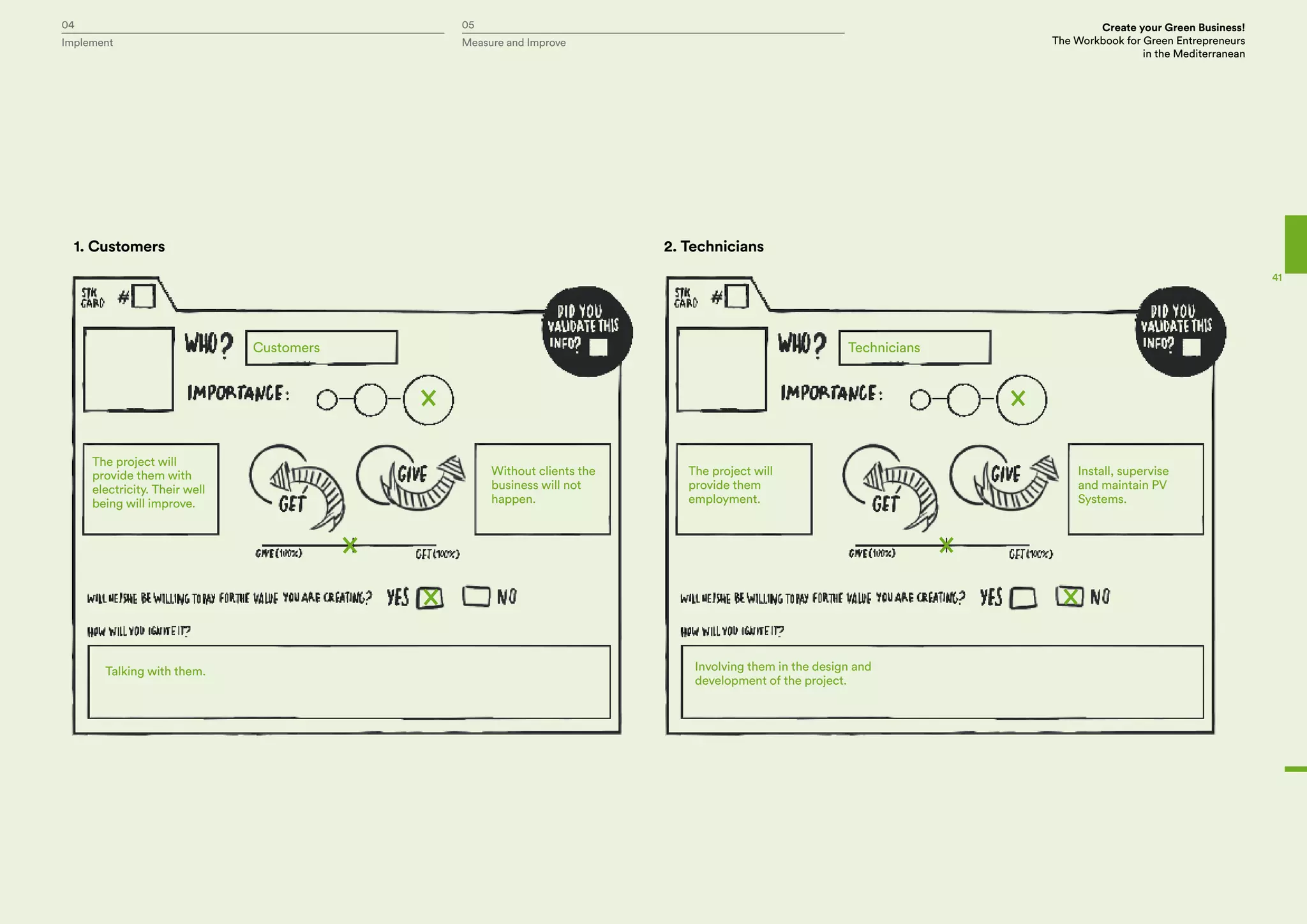
Customers
The project will
provide them with
electricity. Their well
being will improve.
Talking with them. Involving them in the design and
development of the project.
Technicians
The project will
provide them
employment.
Install, supervise
and maintain PV
Systems.
1. Customers 2. Technicians
Without clients the
business will not
happen.
01 02 03
Sketch and Set Build Test
42
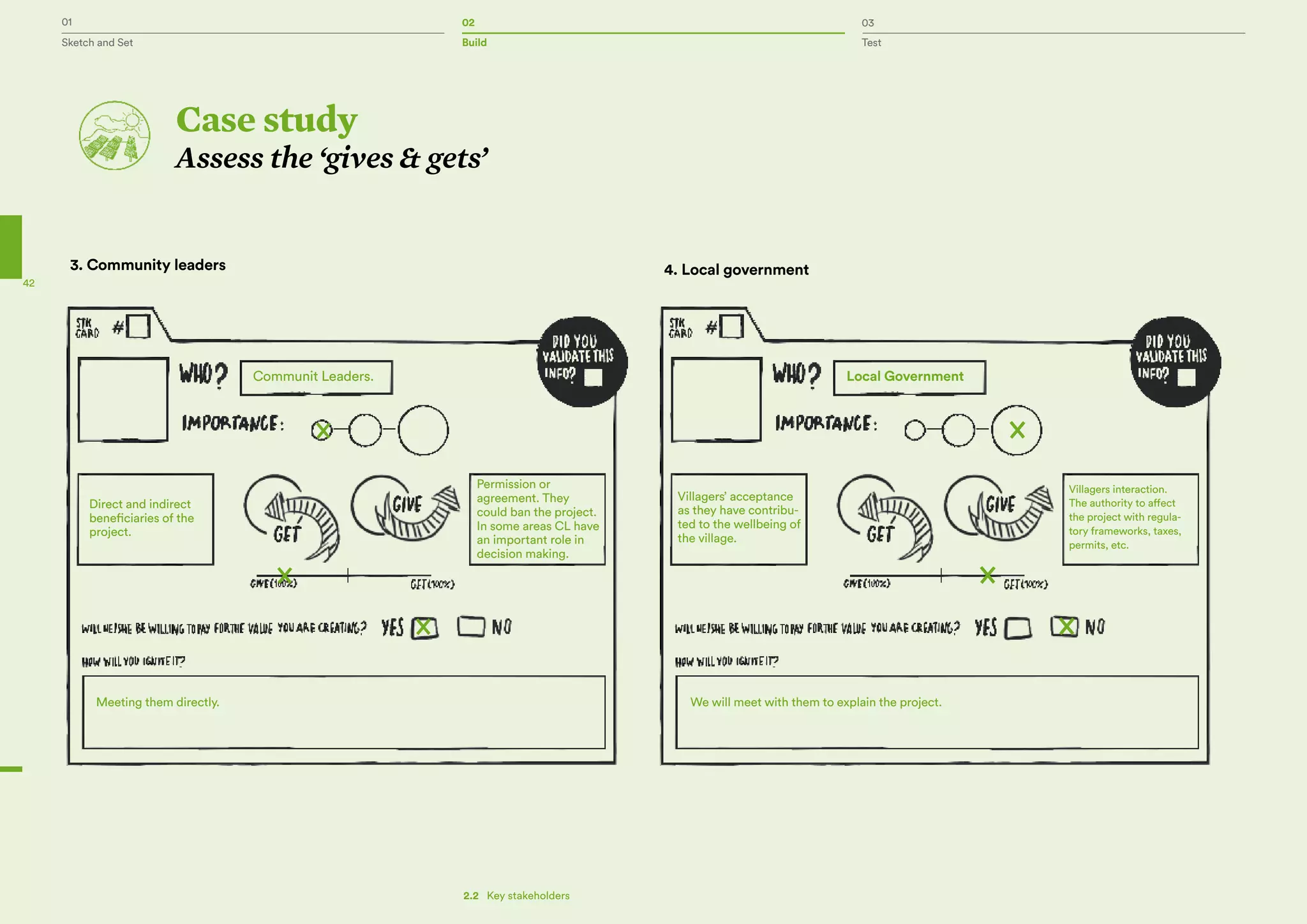
Case study
Assess the ‘gives & gets’
Local Government
Villagers’ acceptance
as they have contribu-
ted to the wellbeing of
the village.
We will meet with them to explain the project.
Villagers interaction.
The authority to affect
the project with regula-
tory frameworks, taxes,
permits, etc.
4. Local government
Communit Leaders.
Direct and indirect
beneficiaries of the
project.
Permission or
agreement. They
could ban the project.
In some areas CL have
an important role in
decision making.
Meeting them directly.
3. Community leaders
2.2   Key stakeholders
04 05 Create your Green Business!
The Workbook for Green Entrepreneurs
in the Mediterranean
Implement Measure and Improve
43
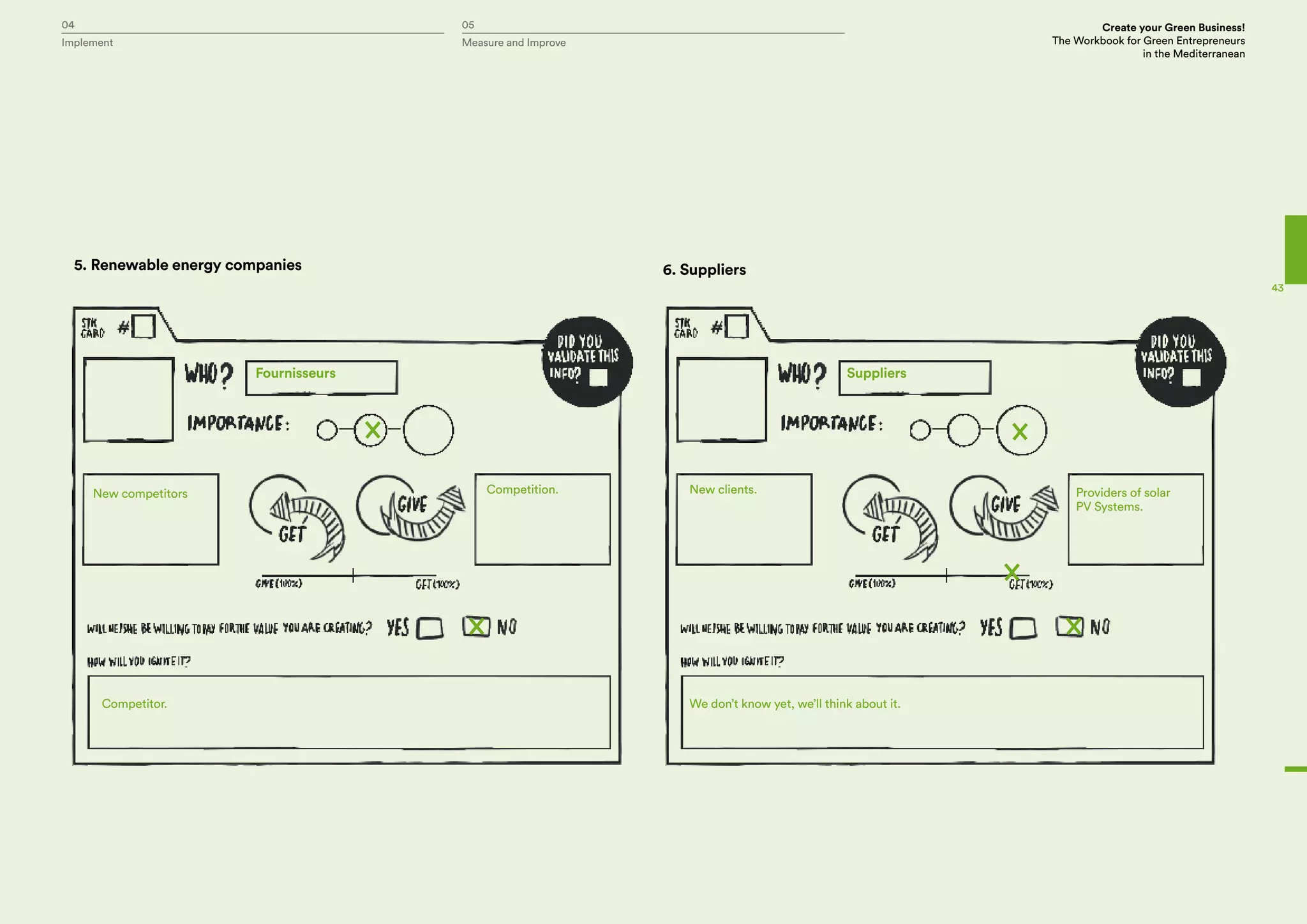
5. Renewable energy companies 6. Suppliers
SuppliersFournisseurs
New competitors
Competitor.
New clients.
We don’t know yet, we’ll think about it.
Providers of solar
PV Systems.
Competition.
01 02 03
Sketch and Set Build Test
44
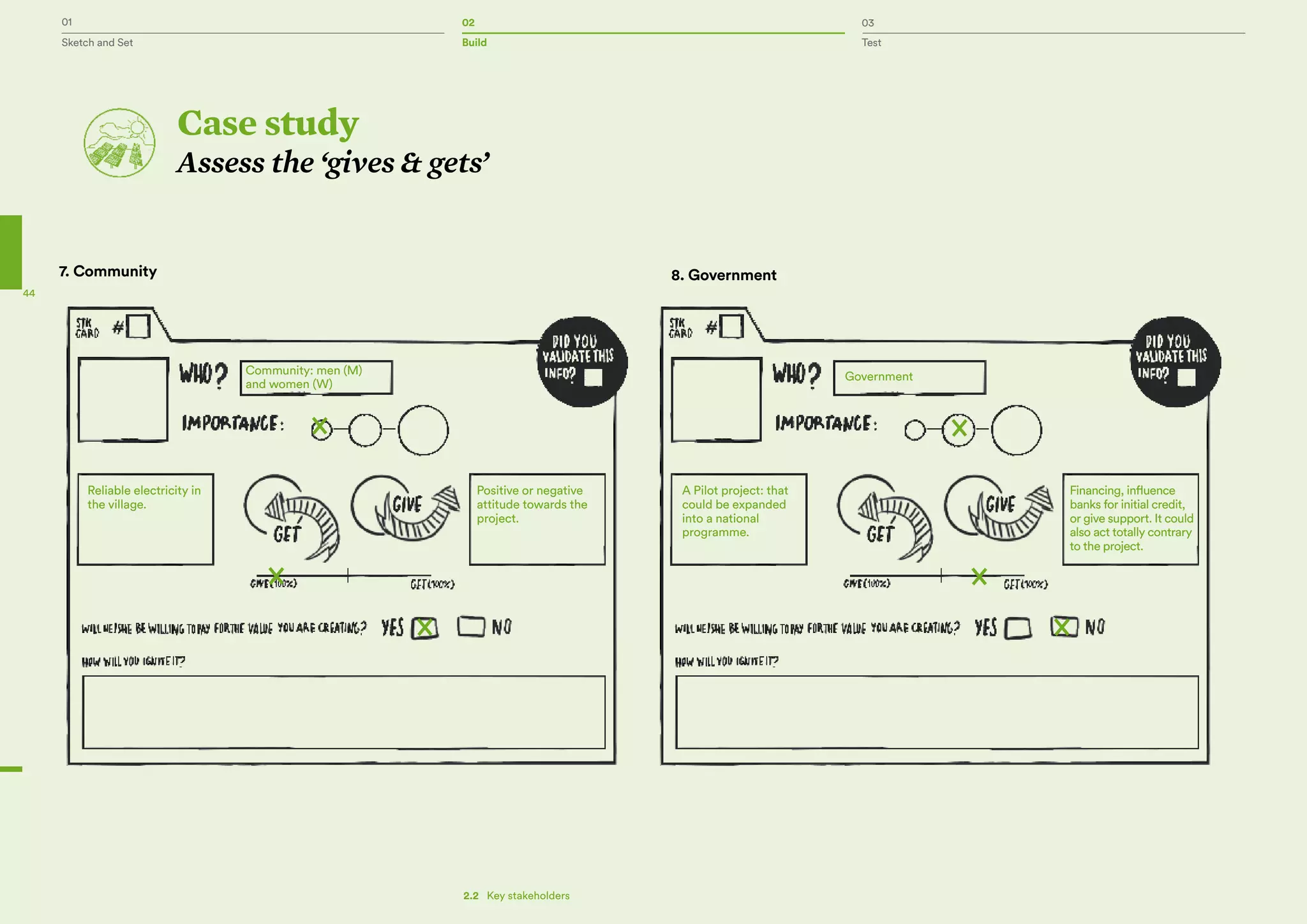
Government
A Pilot project: that
could be expanded
into a national
programme.
Financing, influence
banks for initial credit,
or give support. It could
also act totally contrary
to the project.
8. Government
Community: men (M)
and women (W)
Positive or negative
attitude towards the
project.
Reliable electricity in
the village.
7. Community
Case study
Assess the ‘gives & gets’
2.2   Key stakeholders
04 05 Create your Green Business!
The Workbook for Green Entrepreneurs
in the Mediterranean
Implement Measure and Improve
45
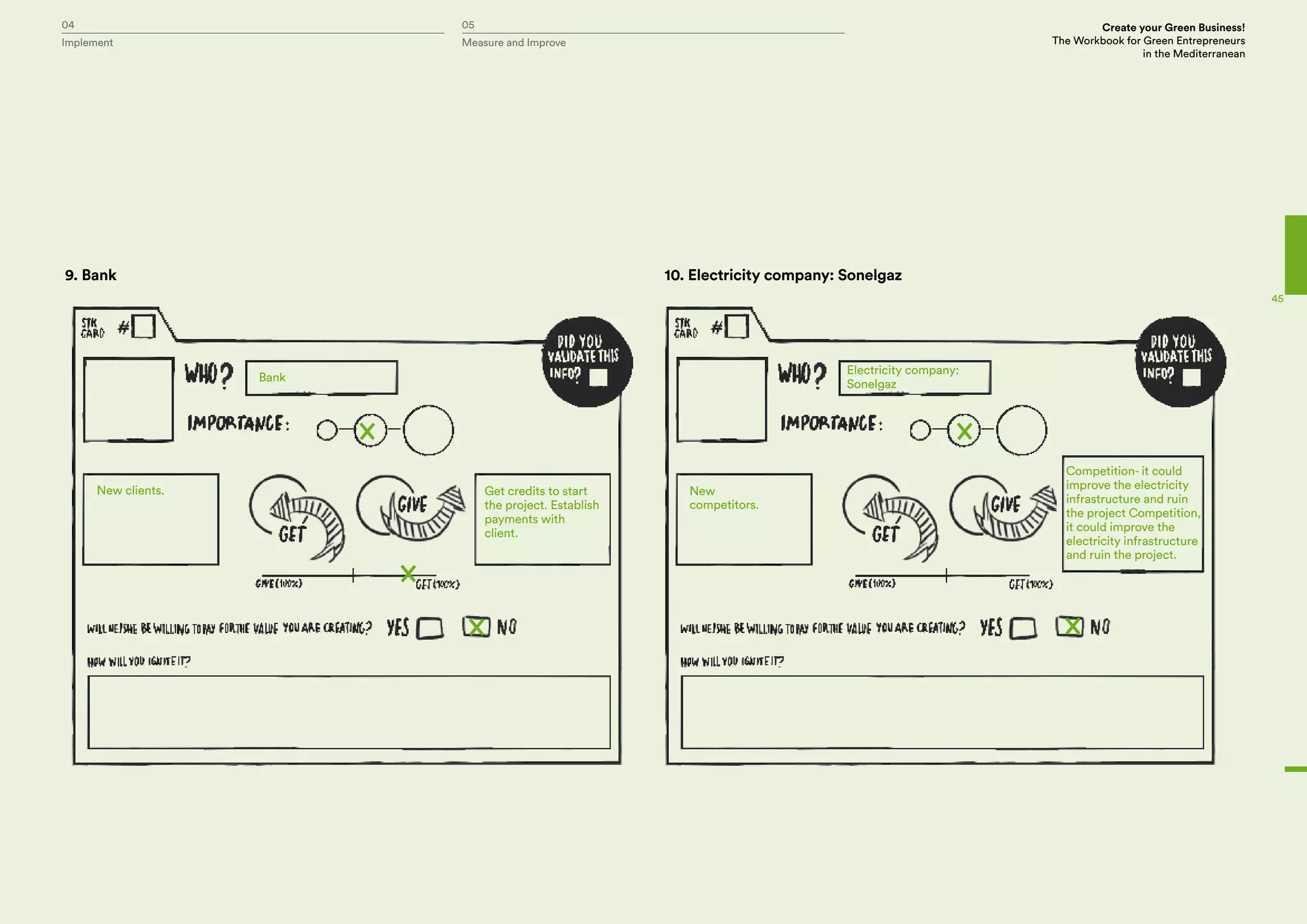
Bank
New clients. Get credits to start
the project. Establish
payments with
client.
Electricity company:
Sonelgaz
New
competitors.
Competition- it could
improve the electricity
infrastructure and ruin
the project Competition,
it could improve the
electricity infrastructure
and ruin the project.
9. Bank 10. Electricity company: Sonelgaz
01 02 03
Sketch and Set Build Test
46
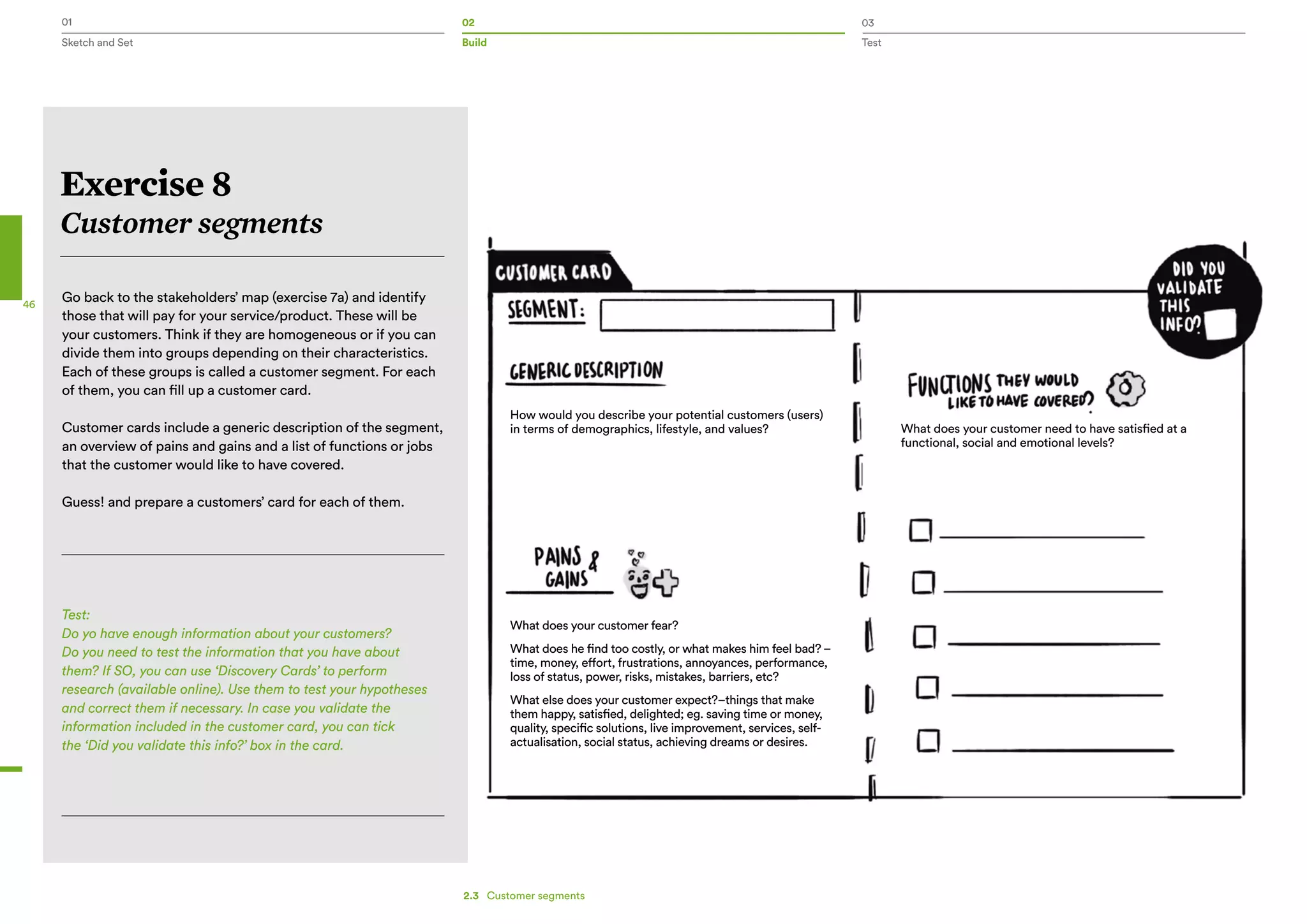
How would you describe your potential customers (users)
in terms of demographics, lifestyle, and values? What does your customer need to have satisfied at a
functional, social and emotional levels?
What does your customer fear?
What does he find too costly, or what makes him feel bad? –
time, money, effort, frustrations, annoyances, performance,
loss of status, power, risks, mistakes, barriers, etc?
What else does your customer expect?–things that make
them happy, satisfied, delighted; eg. saving time or money,
quality, specific solutions, live improvement, services, self-
actualisation, social status, achieving dreams or desires.
Exercise 8
Customer segments
Go back to the stakeholders’ map (exercise 7a) and identify
those that will pay for your service/product. These will be
your customers. Think if they are homogeneous or if you can
divide them into groups depending on their characteristics.
Each of these groups is called a customer segment. For each
of them, you can fill up a customer card.
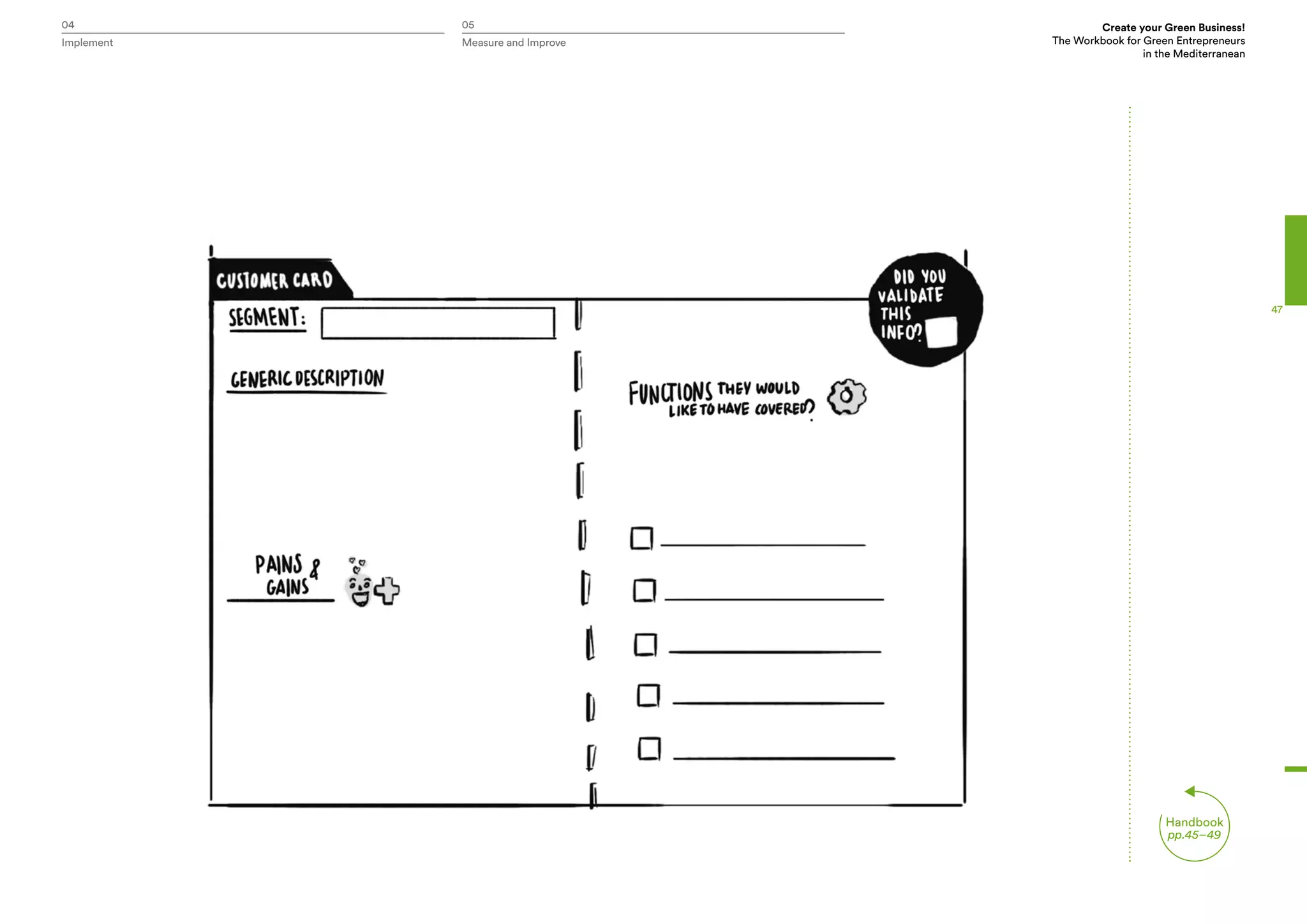
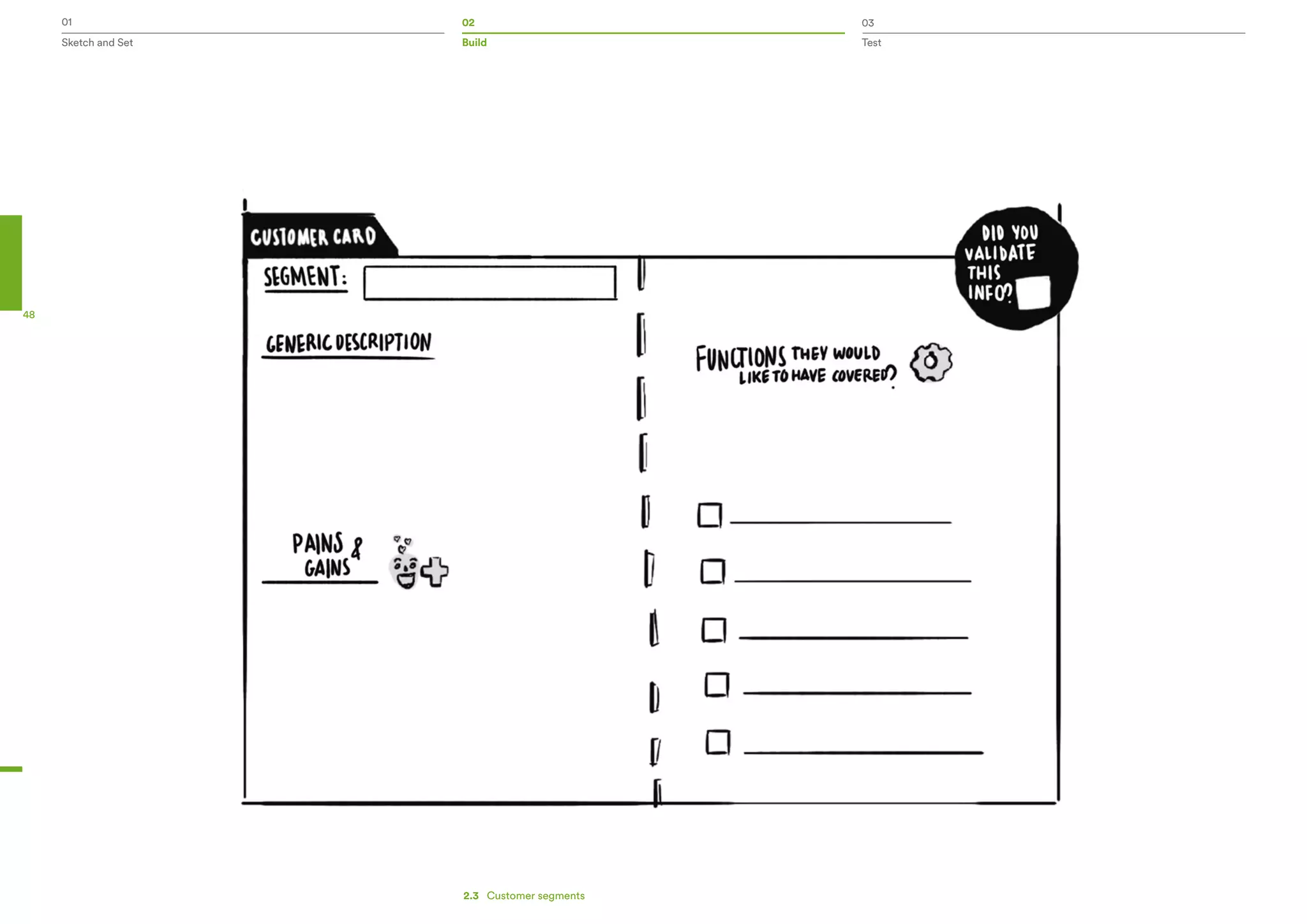
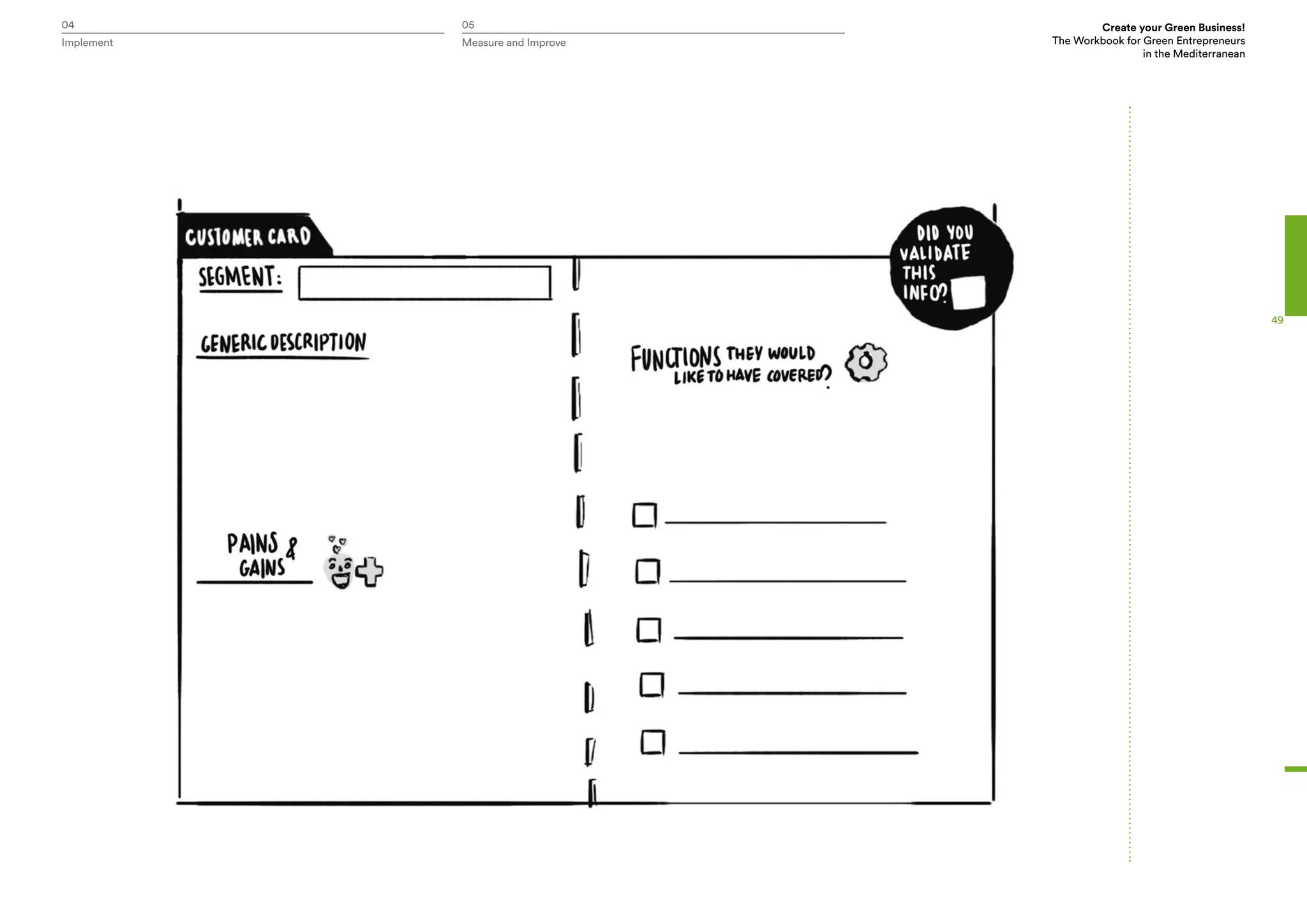
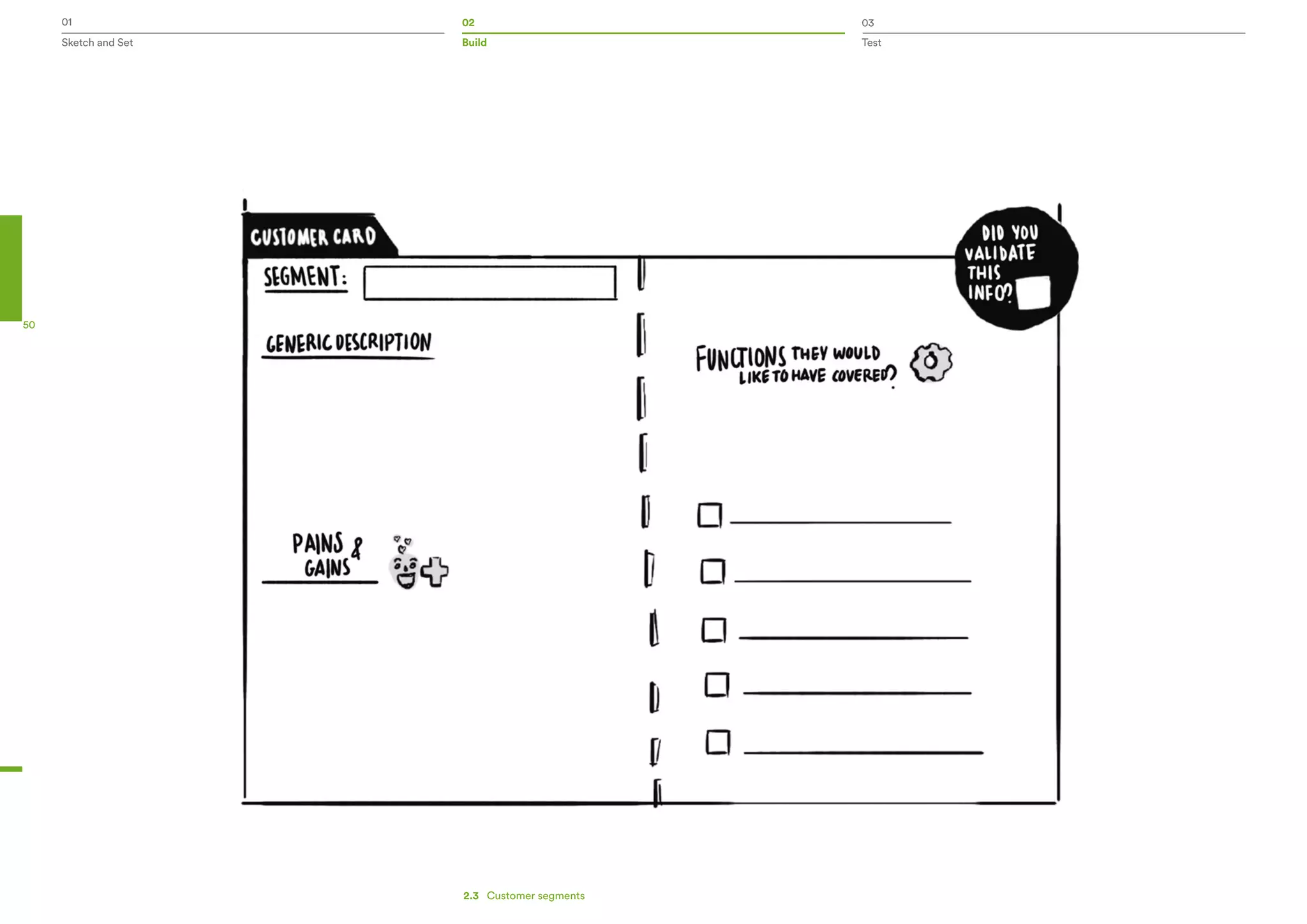
Customer cards include a generic description of the segment,
an overview of pains and gains and a list of functions or jobs
that the customer would like to have covered.
Guess! and prepare a customers’ card for each of them.
Test:
Do yo have enough information about your customers?
Do you need to test the information that you have about
them? If SO, you can use ‘Discovery Cards’ to perform
research (available online). Use them to test your hypotheses
and correct them if necessary. In case you validate the
information included in the customer card, you can tick
the ‘Did you validate this info?’ box in the card.
2.3   Customer segments
04 05 Create your Green Business!
The Workbook for Green Entrepreneurs
in the Mediterranean
Implement Measure and Improve
Handbook
pp.45–49
47
01 02 03
Sketch and Set Build Test
48
2.3   Customer segments
04 05 Create your Green Business!
The Workbook for Green Entrepreneurs
in the Mediterranean
Implement Measure and Improve
49
01 02 03
Sketch and Set Build Test
50
2.3   Customer segments
04 05 Create your Green Business!
The Workbook for Green Entrepreneurs
in the Mediterranean
Implement Measure and Improve
51
Case study
Customer segments
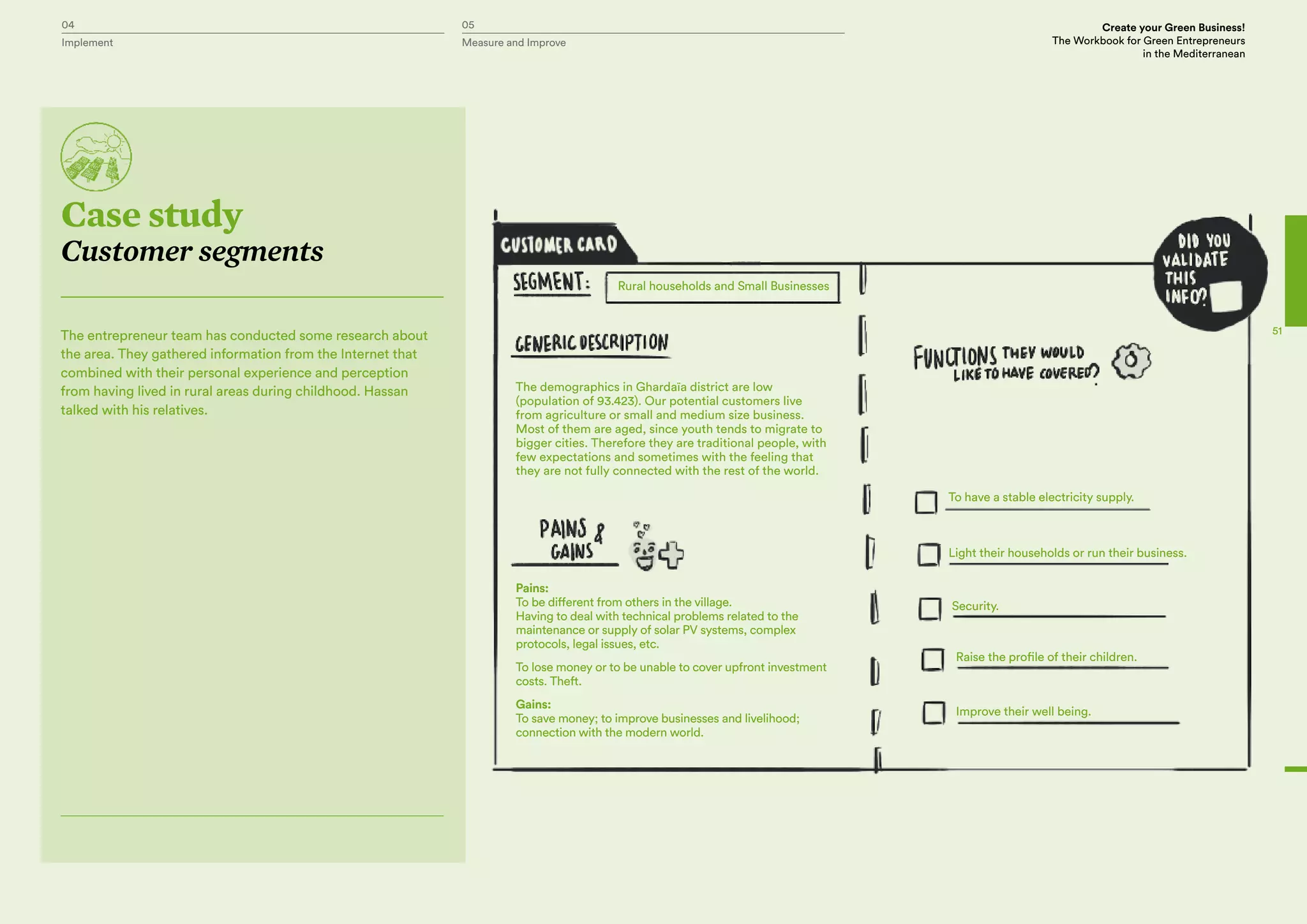
The entrepreneur team has conducted some research about
the area. They gathered information from the Internet that
combined with their personal experience and perception
from having lived in rural areas during childhood. Hassan
talked with his relatives.
The demographics in Ghardaïa district are low
(population of 93.423). Our potential customers live
from agriculture or small and medium size business.
Most of them are aged, since youth tends to migrate to
bigger cities. Therefore they are traditional people, with
few expectations and sometimes with the feeling that
they are not fully connected with the rest of the world.
Rural households and Small Businesses
To have a stable electricity supply.
Security.
Raise the profile of their children.
Improve their well being.
Light their households or run their business.
Pains:
To be different from others in the village.
Having to deal with technical problems related to the
maintenance or supply of solar PV systems, complex
protocols, legal issues, etc.
To lose money or to be unable to cover upfront investment
costs. Theft.
Gains:
To save money; to improve businesses and livelihood;
connection with the modern world.
01 02 03
Sketch and Set Build Test
52
Case study
Customer segments & test
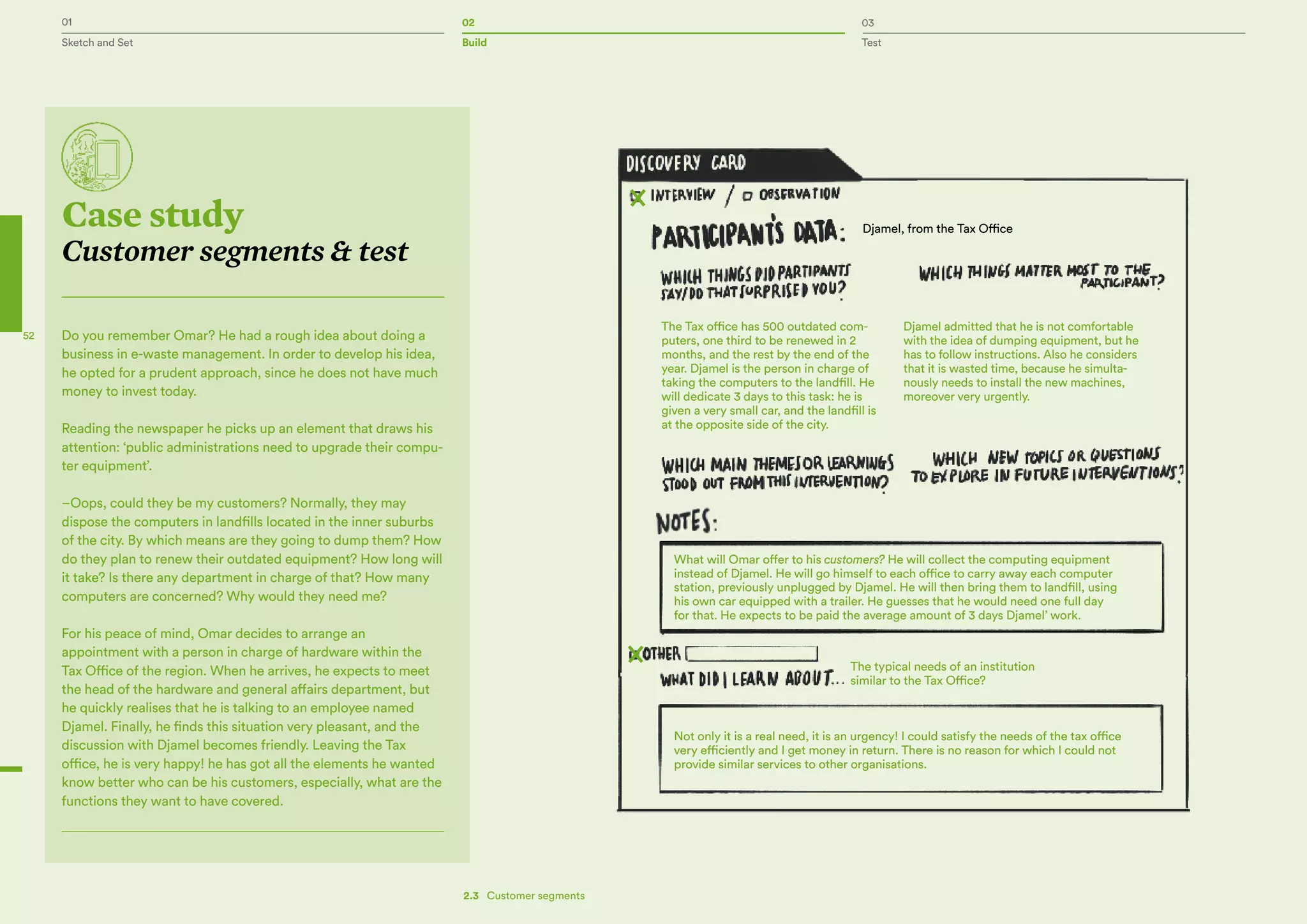
Do you remember Omar? He had a rough idea about doing a
business in e-waste management. In order to develop his idea,
he opted for a prudent approach, since he does not have much
money to invest today.
Reading the newspaper he picks up an element that draws his
attention: ‘public administrations need to upgrade their compu-
ter equipment’.
–Oops, could they be my customers? Normally, they may
dispose the computers in landfills located in the inner suburbs
of the city. By which means are they going to dump them? How
do they plan to renew their outdated equipment? How long will
it take? Is there any department in charge of that? How many
computers are concerned? Why would they need me?
For his peace of mind, Omar decides to arrange an
appointment with a person in charge of hardware within the
Tax Office of the region. When he arrives, he expects to meet
the head of the hardware and general affairs department, but
he quickly realises that he is talking to an employee named
Djamel. Finally, he finds this situation very pleasant, and the
discussion with Djamel becomes friendly. Leaving the Tax
office, he is very happy! he has got all the elements he wanted
know better who can be his customers, especially, what are the
functions they want to have covered.
Djamel, from the Tax Office
The typical needs of an institution
similar to the Tax Office?
The Tax office has 500 outdated com-
puters, one third to be renewed in 2
months, and the rest by the end of the
year. Djamel is the person in charge of
taking the computers to the landfill. He
will dedicate 3 days to this task: he is
given a very small car, and the landfill is
at the opposite side of the city.
What will Omar offer to his customers? He will collect the computing equipment
instead of Djamel. He will go himself to each office to carry away each computer
station, previously unplugged by Djamel. He will then bring them to landfill, using
his own car equipped with a trailer. He guesses that he would need one full day
for that. He expects to be paid the average amount of 3 days Djamel’ work.
Not only it is a real need, it is an urgency! I could satisfy the needs of the tax office
very efficiently and I get money in return. There is no reason for which I could not
provide similar services to other organisations.
Djamel admitted that he is not comfortable
with the idea of dumping equipment, but he
has to follow instructions. Also he considers
that it is wasted time, because he simulta-
nously needs to install the new machines,
moreover very urgently.
2.3   Customer segments
04 05 Create your Green Business!
The Workbook for Green Entrepreneurs
in the Mediterranean
Implement Measure and Improve
53
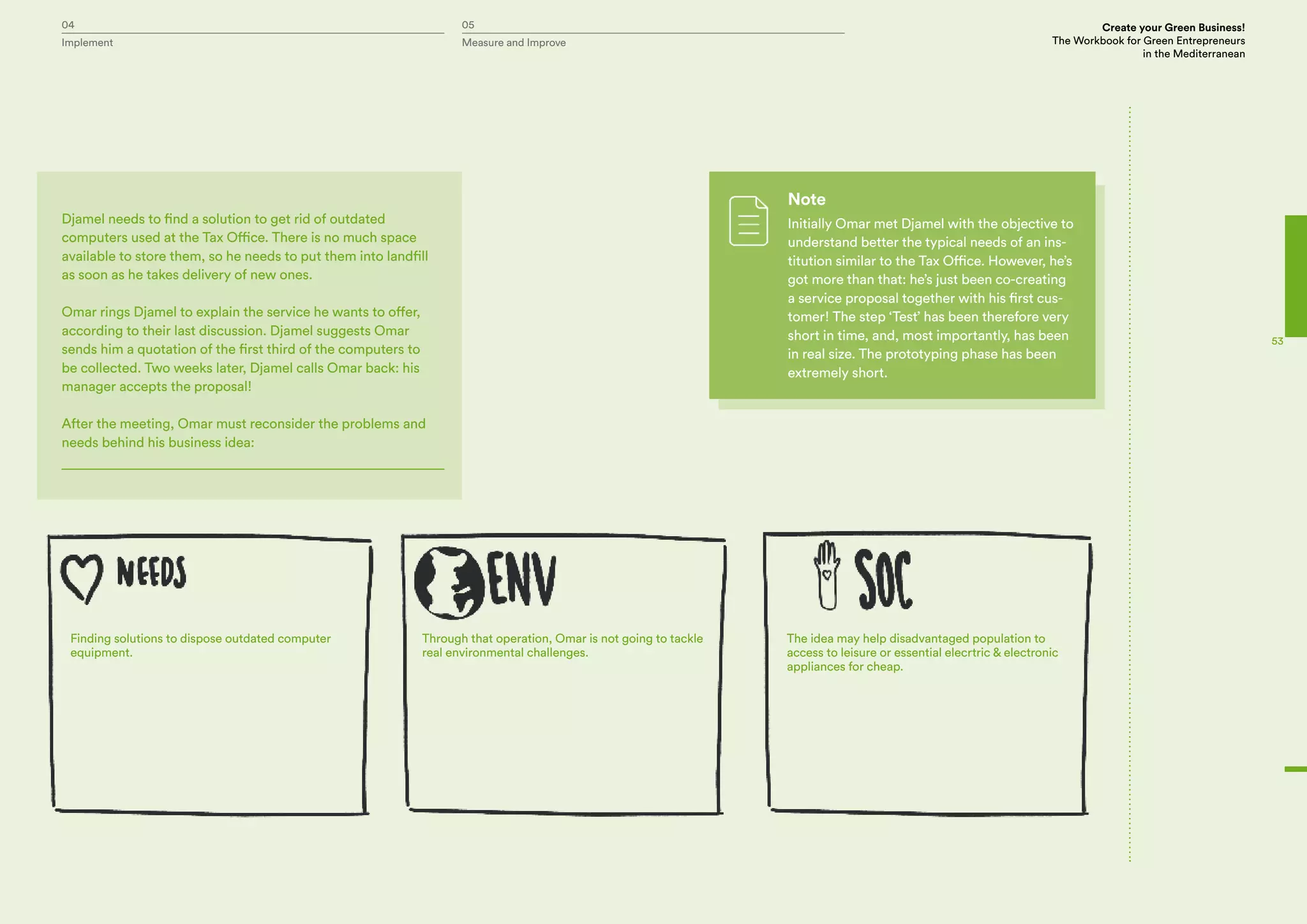
Djamel needs to find a solution to get rid of outdated
computers used at the Tax Office. There is no much space
available to store them, so he needs to put them into landfill
as soon as he takes delivery of new ones.
Omar rings Djamel to explain the service he wants to offer,
according to their last discussion. Djamel suggests Omar
sends him a quotation of the first third of the computers to
be collected. Two weeks later, Djamel calls Omar back: his
manager accepts the proposal!
After the meeting, Omar must reconsider the problems and
needs behind his business idea:
Finding solutions to dispose outdated computer
equipment.
Through that operation, Omar is not going to tackle
real environmental challenges.
The idea may help disadvantaged population to
access to leisure or essential elecrtric & electronic
appliances for cheap.
Note
Initially Omar met Djamel with the objective to
understand better the typical needs of an ins-
titution similar to the Tax Office. However, he’s
got more than that: he’s just been co-creating
a service proposal together with his first cus-
tomer! The step ‘Test’ has been therefore very
short in time, and, most importantly, has been
in real size. The prototyping phase has been
extremely short.
54
02 03
Build Test
01
Sketch and Set
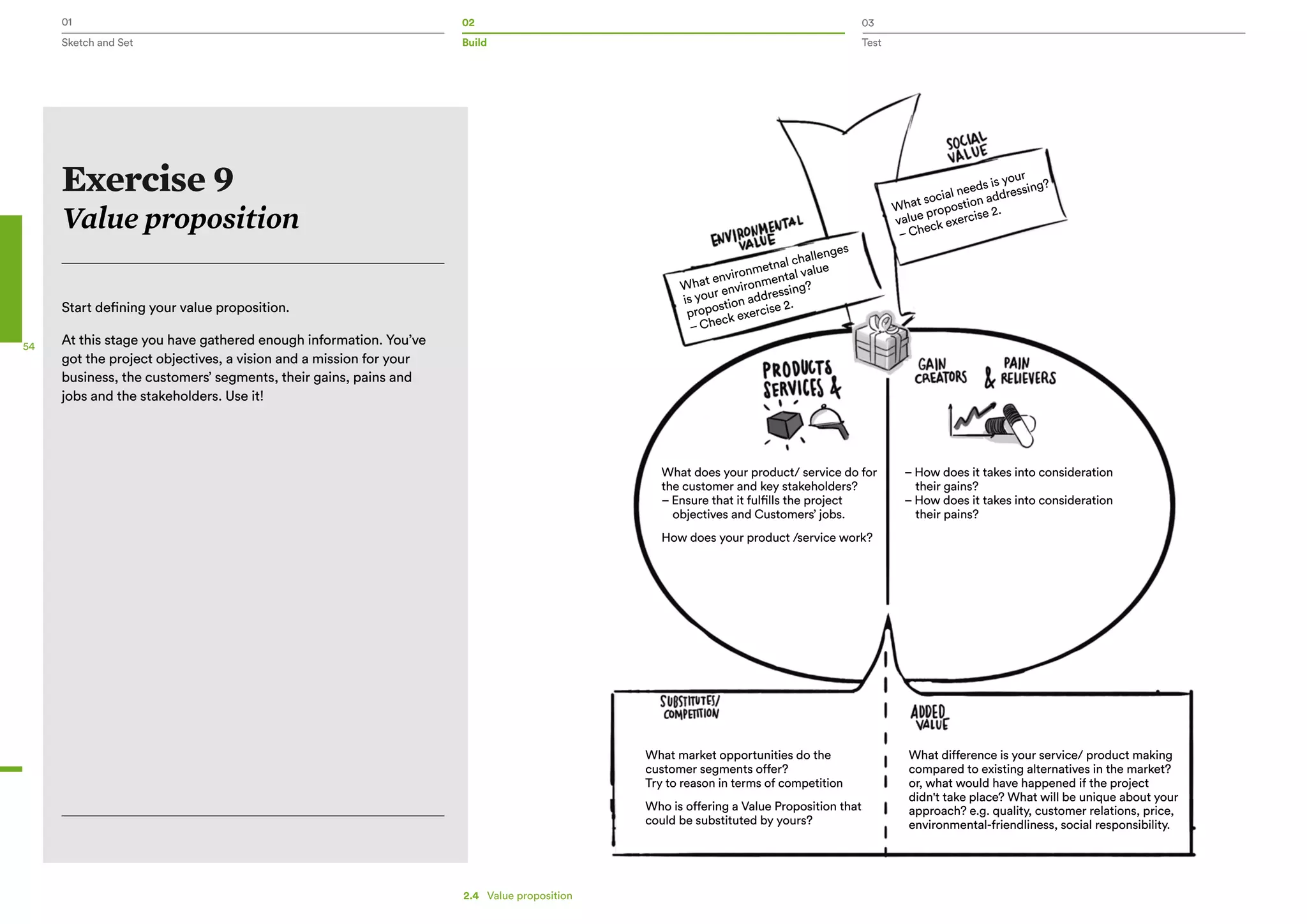
What environmetnal challenges
is your environmental value
propostion addressing?
– Check exercise 2.
What does your product/ service do for
the customer and key stakeholders?
– Ensure that it fulfills the project
objectives and Customers’ jobs.
How does your product /service work?
– How does it takes into consideration
their gains?
– How does it takes into consideration
their pains?
What market opportunities do the
customer segments offer?
Try to reason in terms of competition
Who is offering a Value Proposition that
could be substituted by yours?
What difference is your service/ product making
compared to existing alternatives in the market?
or, what would have happened if the project
didn't take place? What will be unique about your
approach? e.g. quality, customer relations, price,
environmental-friendliness, social responsibility.
What social needs is your
value propostion addressing?
– Check exercise 2.
Exercise 9
Value proposition
Start defining your value proposition.
At this stage you have gathered enough information. You’ve
got the project objectives, a vision and a mission for your
business, the customers’ segments, their gains, pains and
jobs and the stakeholders. Use it!
2.4   Value proposition
04 05 Create your Green Business!
The Workbook for Green Entrepreneurs
in the Mediterranean
Implement Measure and Improve
Handbook
pp.50–55
55
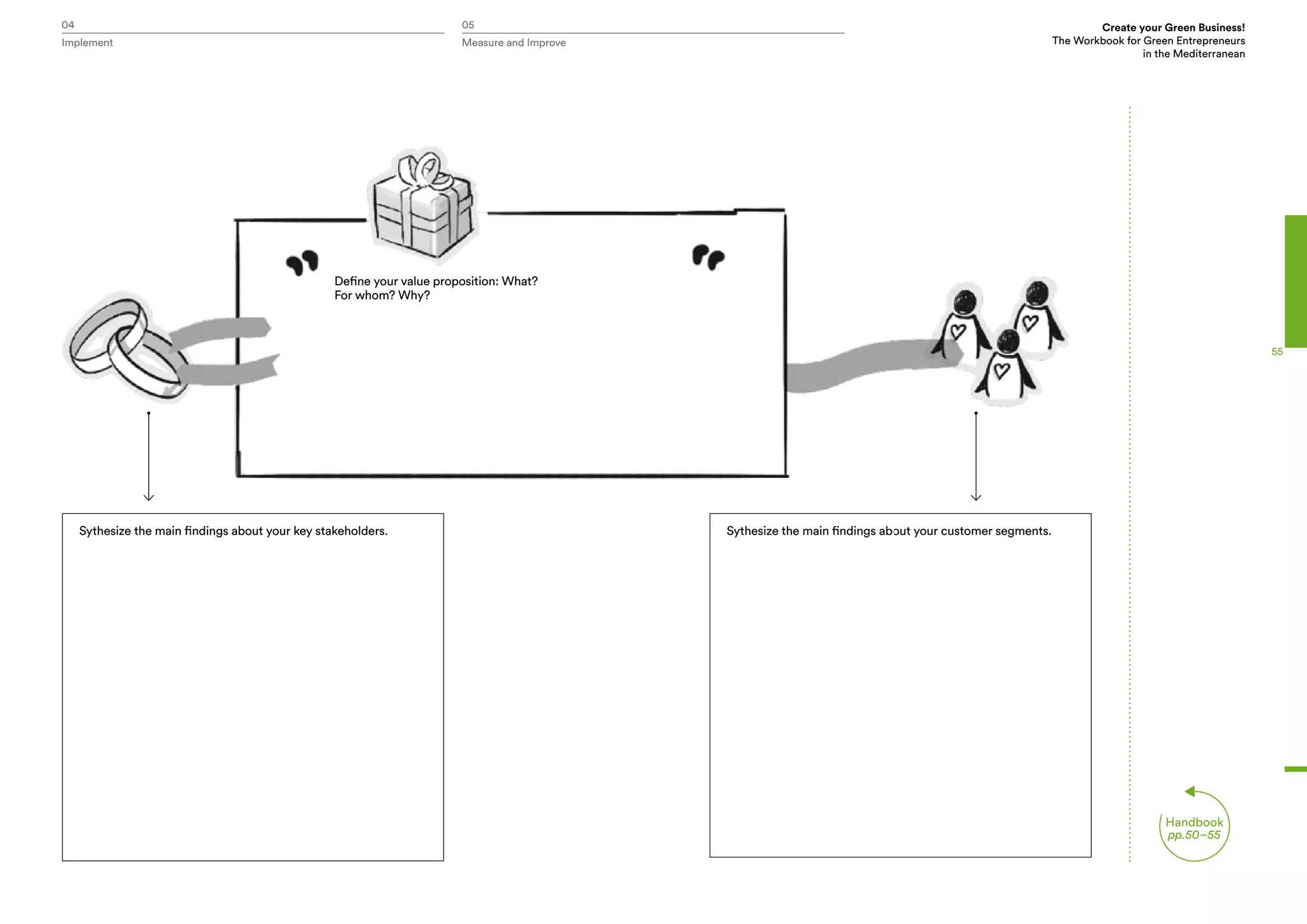
Define your value proposition: What?
For whom? Why?
Sythesize the main findings about your key stakeholders. Sythesize the main findings about your customer segments.
01 02 03
Sketch and Set Build Test
56
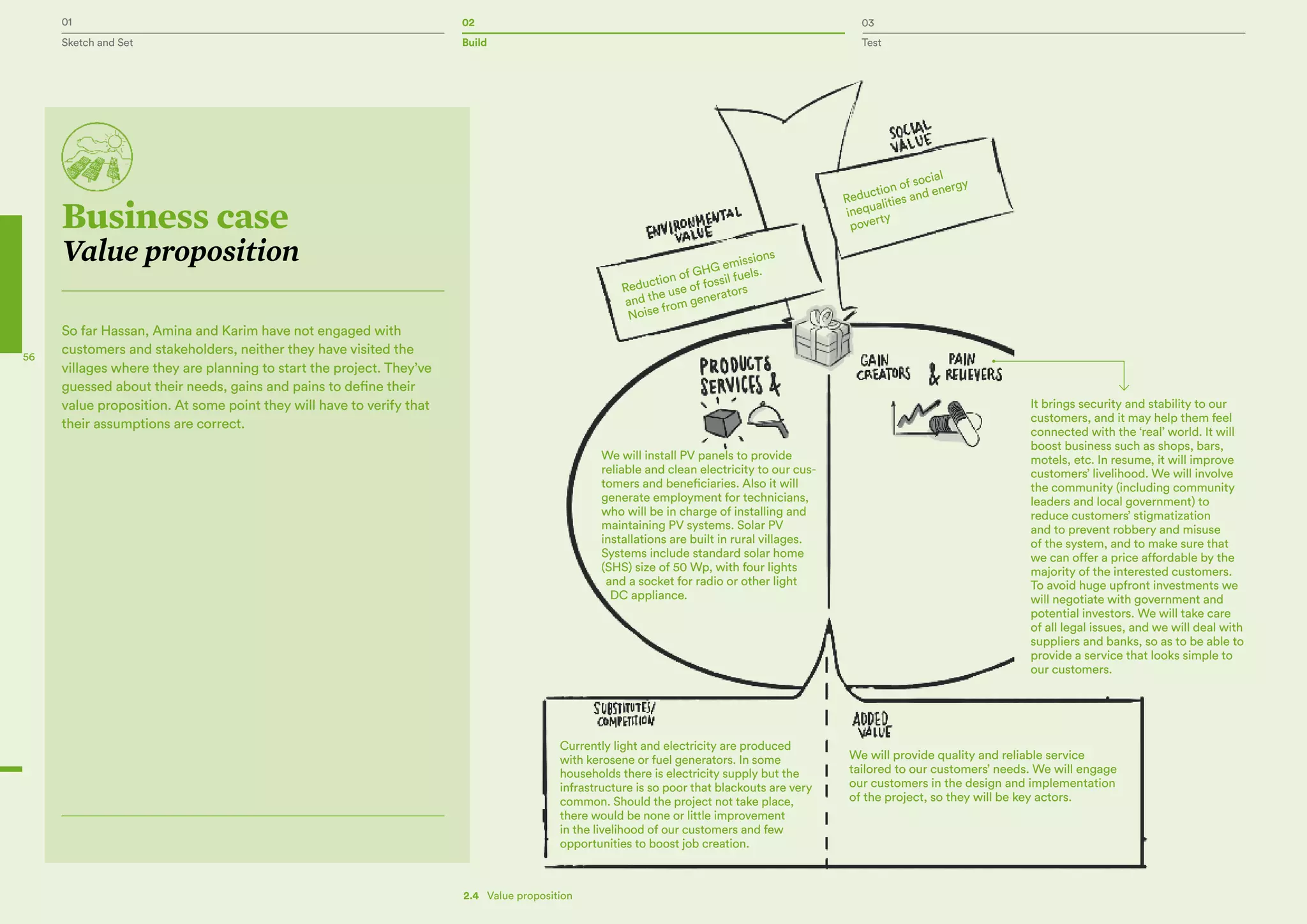
So far Hassan, Amina and Karim have not engaged with
customers and stakeholders, neither they have visited the
villages where they are planning to start the project. They’ve
guessed about their needs, gains and pains to define their
value proposition. At some point they will have to verify that
their assumptions are correct.
Business case
Value proposition
Reduction of GHG emissions
and the use of fossil fuels.
Noise from generators
We will install PV panels to provide
reliable and clean electricity to our cus-
tomers and beneficiaries. Also it will
generate employment for technicians,
who will be in charge of installing and
maintaining PV systems. Solar PV
installations are built in rural villages.
Systems include standard solar home
(SHS) size of 50 Wp, with four lights
and a socket for radio or other light
DC appliance.
It brings security and stability to our
customers, and it may help them feel
connected with the ‘real’ world. It will
boost business such as shops, bars,
motels, etc. In resume, it will improve
customers’ livelihood. We will involve
the community (including community
leaders and local government) to
reduce customers’ stigmatization
and to prevent robbery and misuse
of the system, and to make sure that
we can offer a price affordable by the
majority of the interested customers.
To avoid huge upfront investments we
will negotiate with government and
potential investors. We will take care
of all legal issues, and we will deal with
suppliers and banks, so as to be able to
provide a service that looks simple to
our customers.
Currently light and electricity are produced
with kerosene or fuel generators. In some
households there is electricity supply but the
infrastructure is so poor that blackouts are very
common. Should the project not take place,
there would be none or little improvement
in the livelihood of our customers and few
opportunities to boost job creation.
We will provide quality and reliable service
tailored to our customers’ needs. We will engage
our customers in the design and implementation
of the project, so they will be key actors.
Reduction of social
inequalities and energy
poverty
2.4   Value proposition
04 05 Create your Green Business!
The Workbook for Green Entrepreneurs
in the Mediterranean
Implement Measure and Improve
57
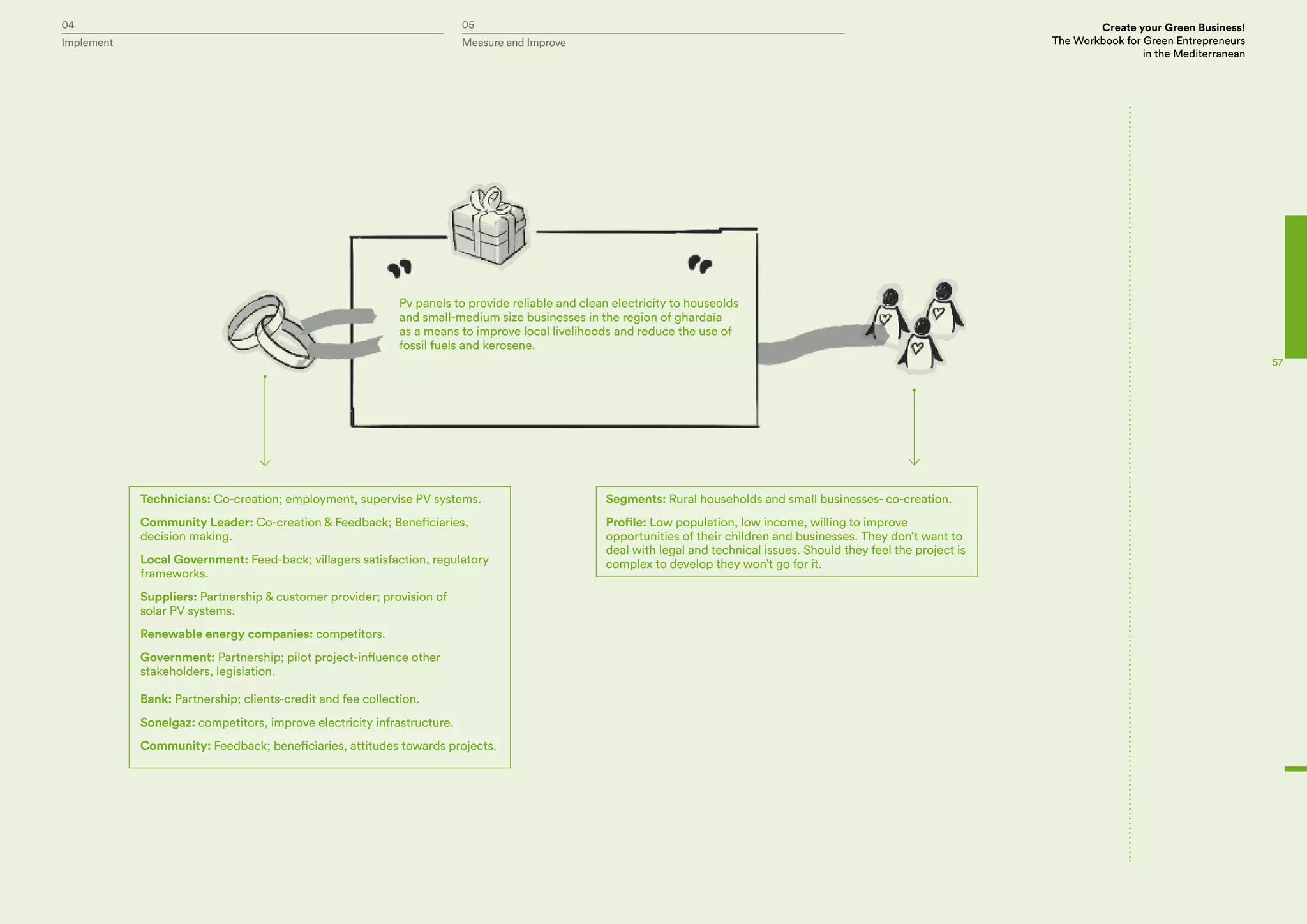
Pv panels to provide reliable and clean electricity to houseolds
and small-medium size businesses in the region of ghardaïa
as a means to improve local livelihoods and reduce the use of
fossil fuels and kerosene.
Technicians: Co-creation; employment, supervise PV systems.
Community Leader: Co-creation & Feedback; Beneficiaries,
decision making.
Local Government: Feed-back; villagers satisfaction, regulatory
frameworks.
Suppliers: Partnership & customer provider; provision of
solar PV systems.
Renewable energy companies: competitors.
Government: Partnership; pilot project-influence other
stakeholders, legislation.
Bank: Partnership; clients-credit and fee collection.
Sonelgaz: competitors, improve electricity infrastructure.
Community: Feedback; beneficiaries, attitudes towards projects.
Segments: Rural households and small businesses- co-creation.
Profile: Low population, low income, willing to improve
opportunities of their children and businesses. They don’t want to
deal with legal and technical issues. Should they feel the project is
complex to develop they won’t go for it.
Sketch and Set Build Test
01 02 03
058
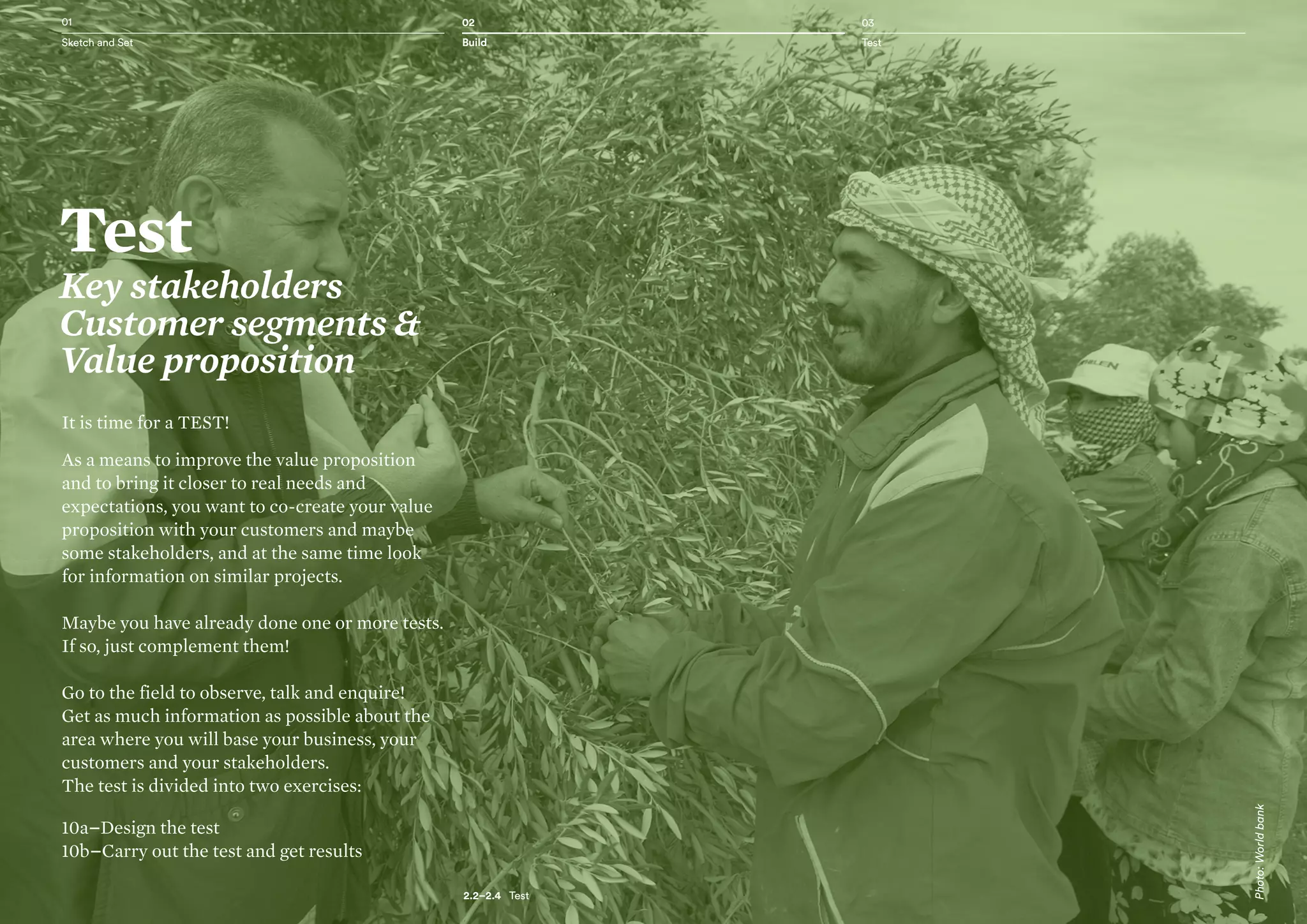
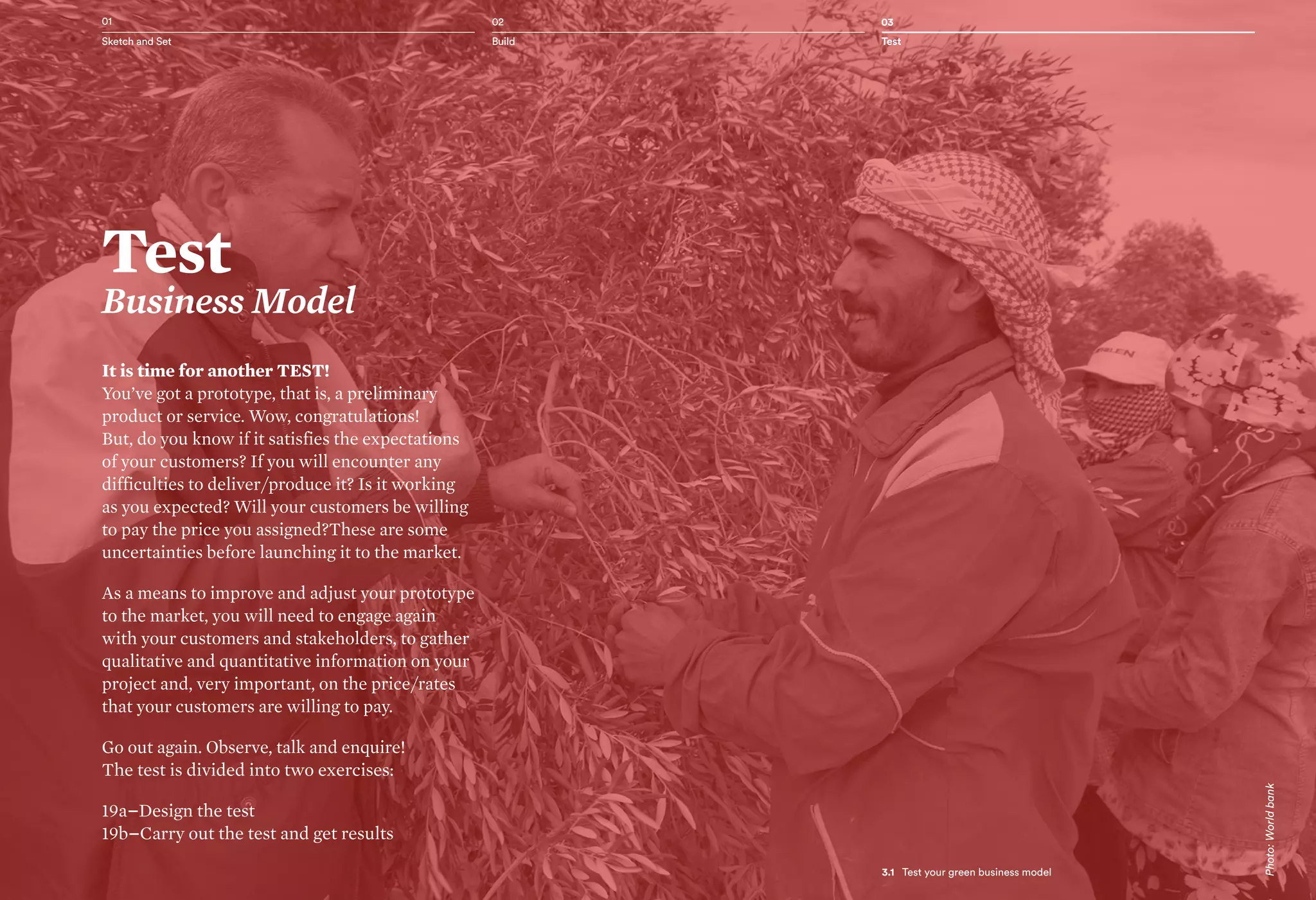
It is time for a TEST!
As a means to improve the value proposition
and to bring it closer to real needs and
expectations, you want to co-create your value
proposition with your customers and maybe
some stakeholders, and at the same time look
for information on similar projects.
Maybe you have already done one or more tests.
If so, just complement them!
Go to the field to observe, talk and enquire!
Get as much information as possible about the
area where you will base your business, your
customers and your stakeholders.
The test is divided into two exercises:
10a–Design the test
10b–Carry out the test and get results
02 03
Build Test
01
Sketch and Set
2.2–2.4   Test
Test
Key stakeholders
Customer segments &
Value proposition
Photo:Worldbank
04 05 Create your Green Business!
The Workbook for Green Entrepreneurs
in the Mediterranean
Implement Measure and Improve
59
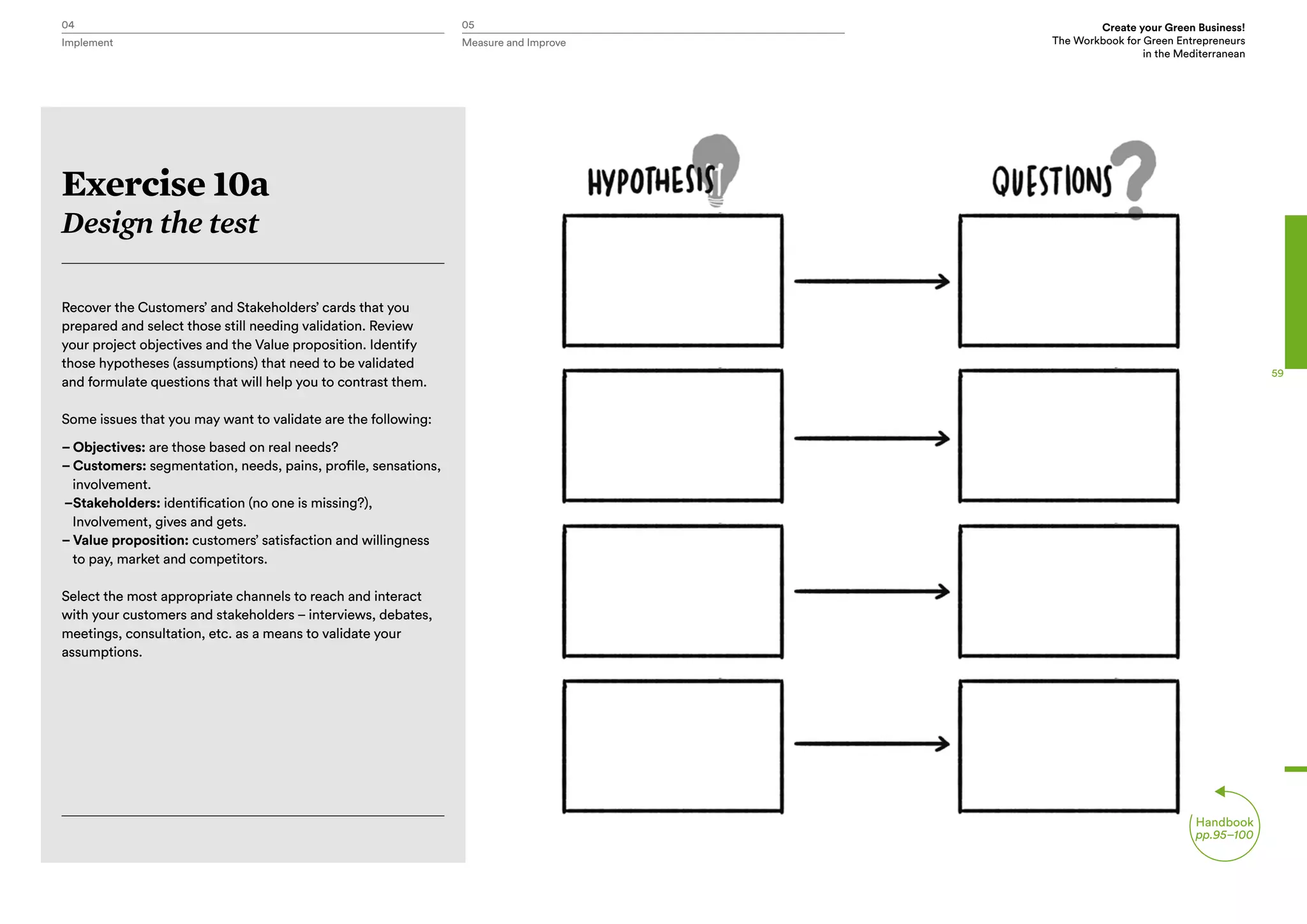
Exercise 10a
Design the test
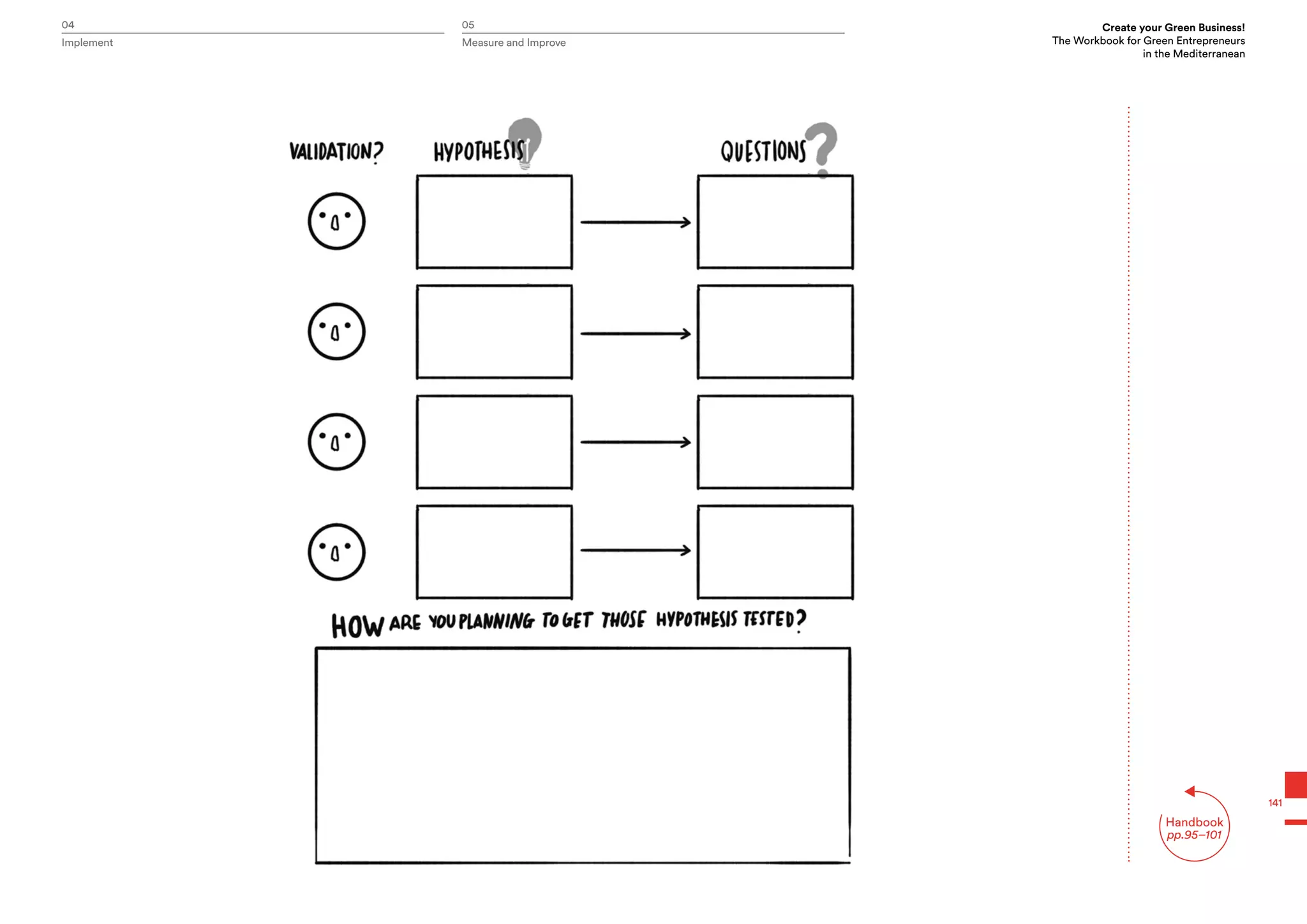
Recover the Customers’ and Stakeholders’ cards that you
prepared and select those still needing validation. Review
your project objectives and the Value proposition. Identify
those hypotheses (assumptions) that need to be validated
and formulate questions that will help you to contrast them.
Some issues that you may want to validate are the following:
– Objectives: are those based on real needs?
– Customers: segmentation, needs, pains, profile, sensations,
involvement.
–Stakeholders: identification (no one is missing?),
Involvement, gives and gets.
– Value proposition: customers’ satisfaction and willingness
to pay, market and competitors.
Select the most appropriate channels to reach and interact
with your customers and stakeholders – interviews, debates,
meetings, consultation, etc. as a means to validate your
assumptions.
Handbook
pp.95–100
01 02 03
Sketch and Set Build Test
60
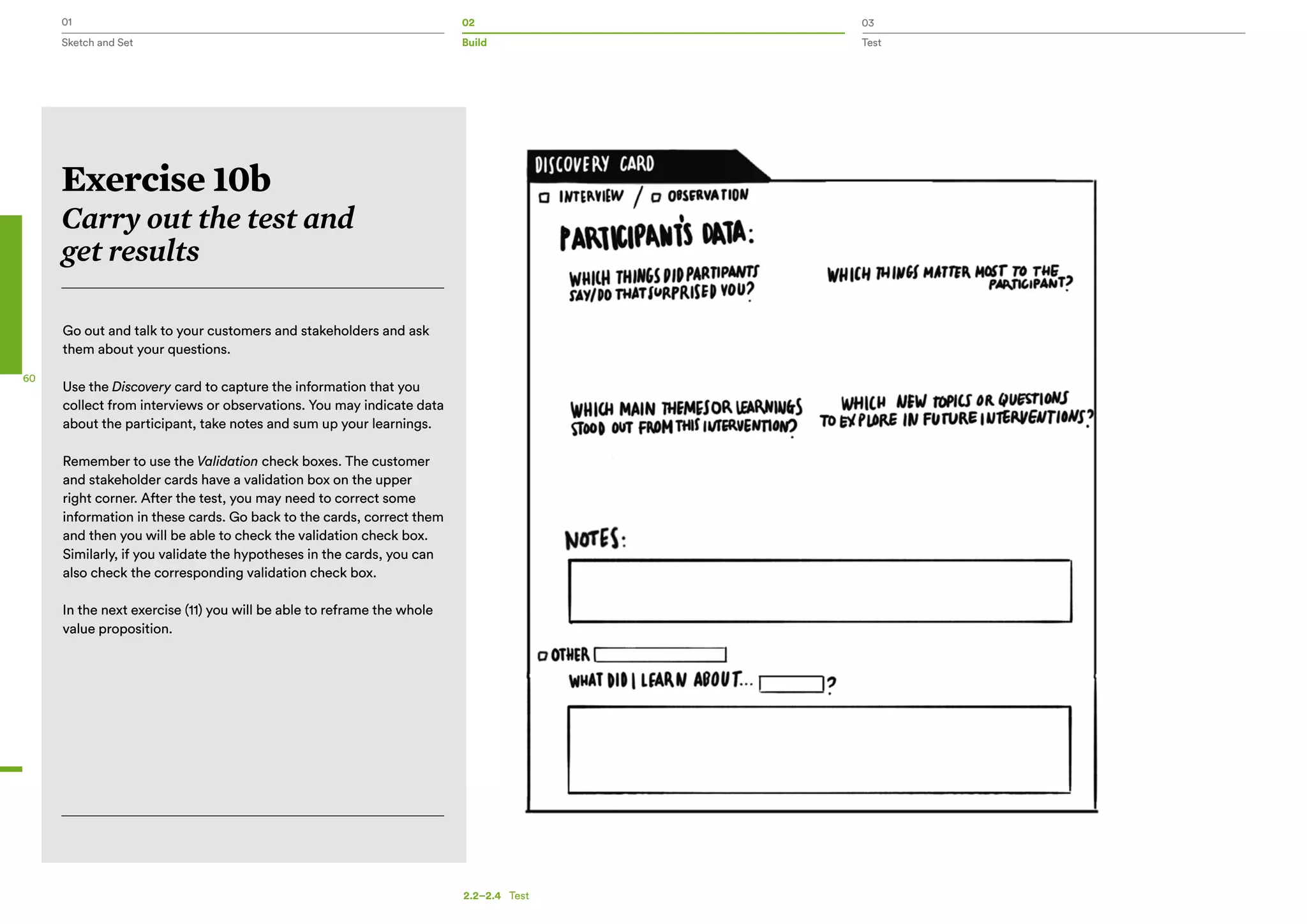
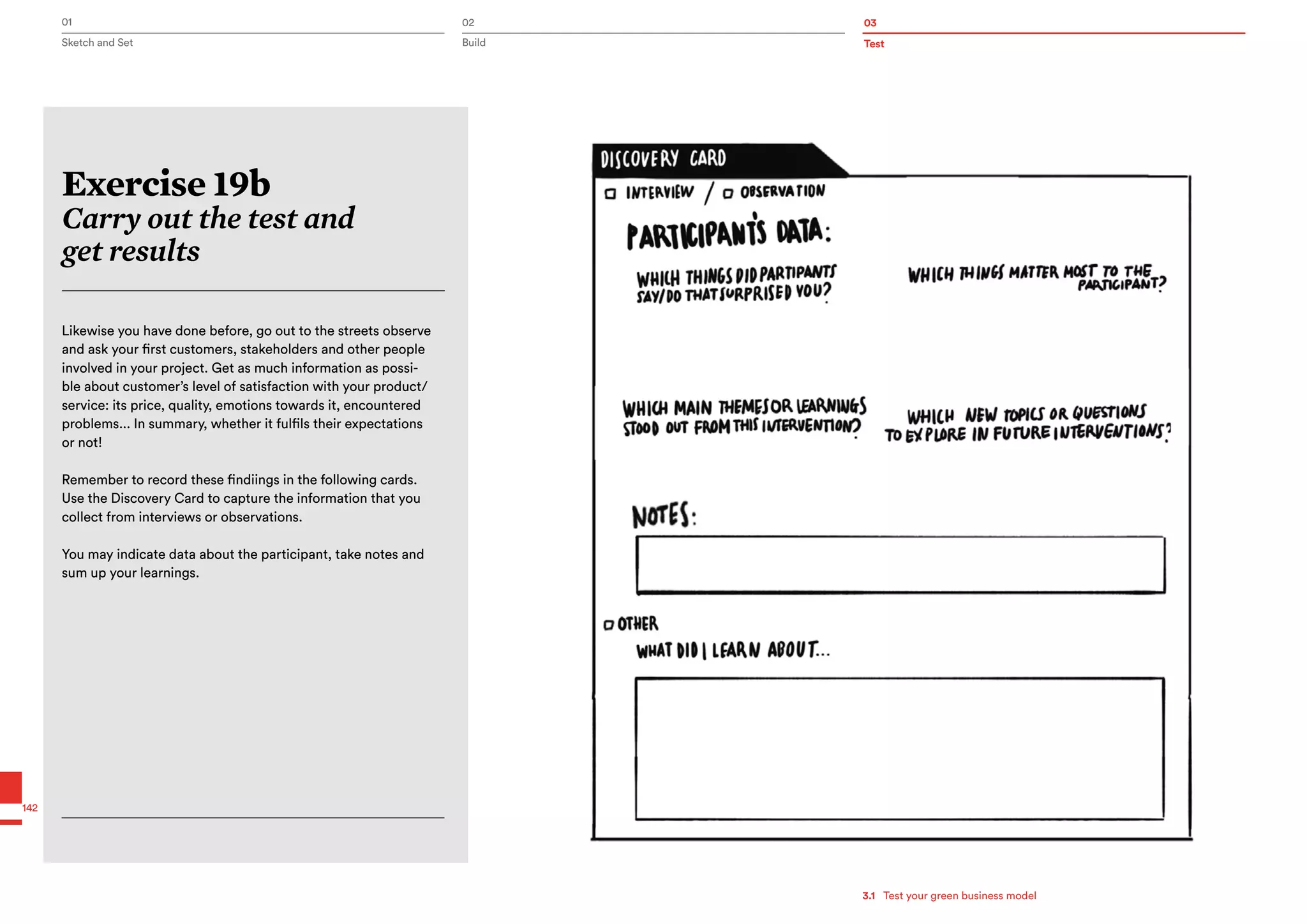
Go out and talk to your customers and stakeholders and ask
them about your questions.
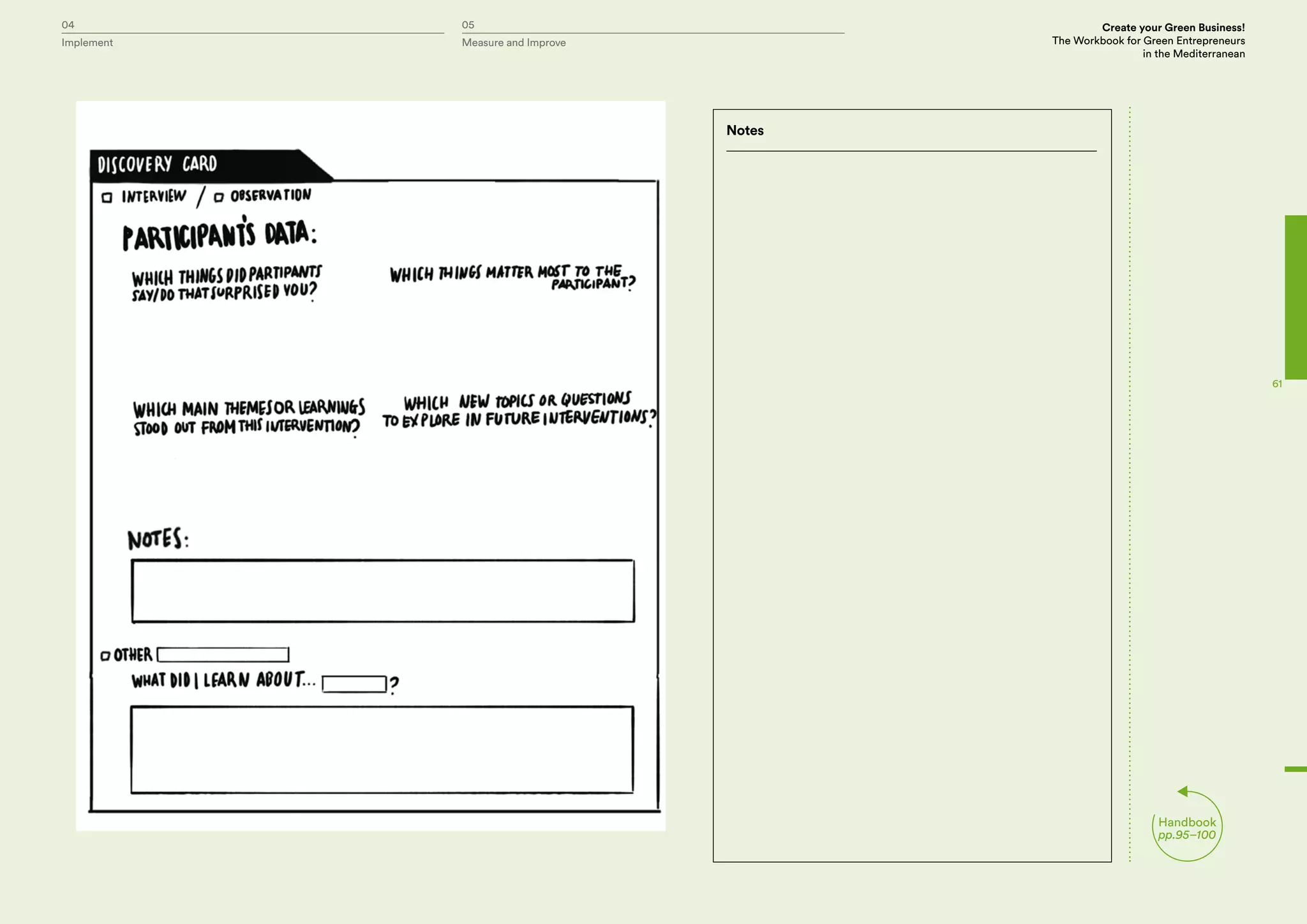
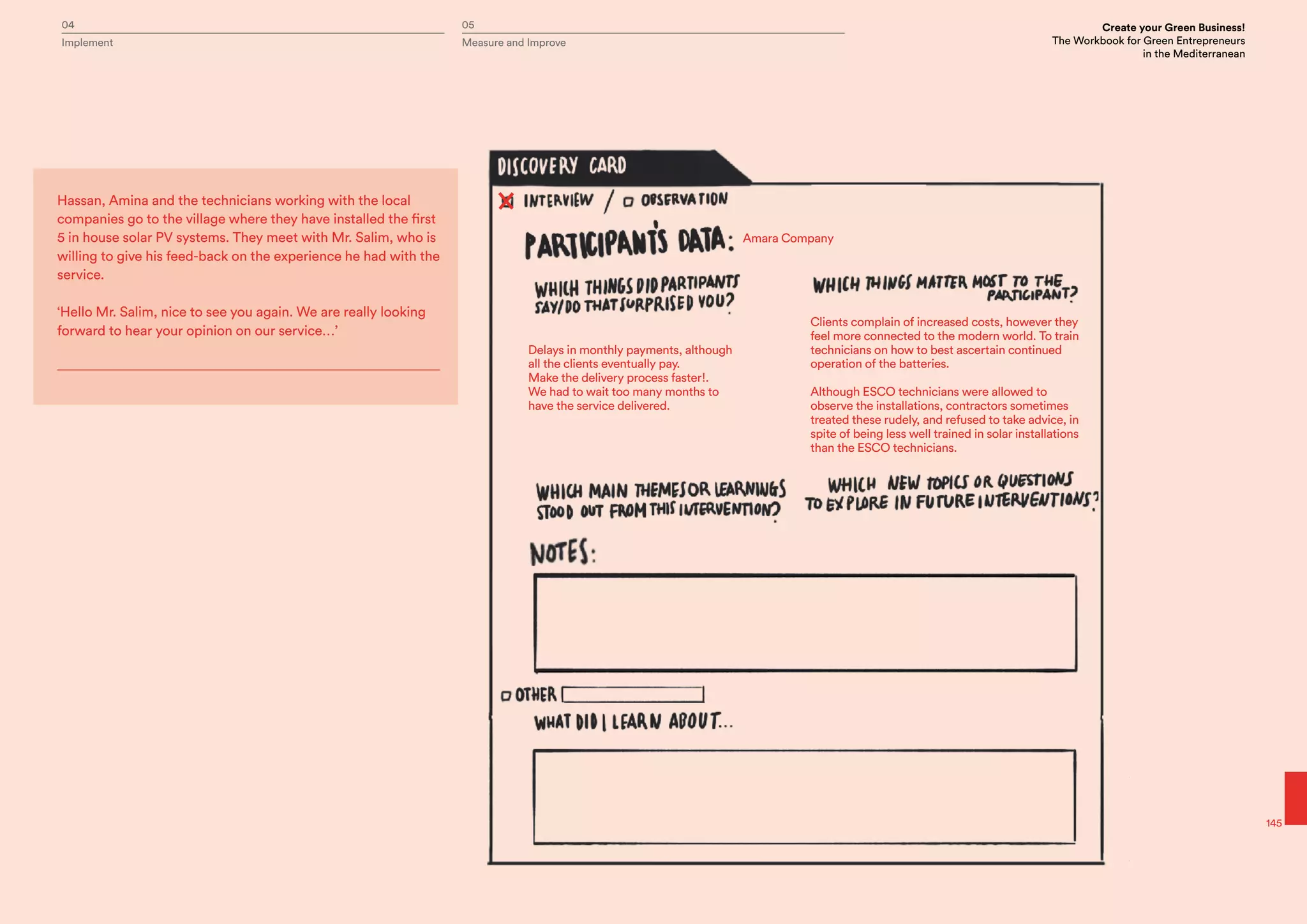
Use the Discovery card to capture the information that you
collect from interviews or observations. You may indicate data
about the participant, take notes and sum up your learnings.
Remember to use the Validation check boxes. The customer
and stakeholder cards have a validation box on the upper
right corner. After the test, you may need to correct some
information in these cards. Go back to the cards, correct them
and then you will be able to check the validation check box.
Similarly, if you validate the hypotheses in the cards, you can
also check the corresponding validation check box.
In the next exercise (11) you will be able to reframe the whole
value proposition.
Exercise 10b
Carry out the test and
get results
2.2–2.4   Test
04 05 Create your Green Business!
The Workbook for Green Entrepreneurs
in the Mediterranean
Implement Measure and Improve
61
Notes
Handbook
pp.95–100
01 02 03
Sketch and Set Build Test
62
Case study
Test
Hassan, Amina and Karim are aware that the information they
have about customers, stakeholders and value proposition is
founded on mere assumptions based mainly on some internet
research and Hassan’s personal and family background.
But, are these assumptions correct? Hassan asks Amina
and Karim.
Solar Rural Algeria team decides to go out to the villages
where the project was to be implemented to perform a first
survey. Before leaving they prepare the visit thoroughly.
We must capture everything!! And we must be efficient as it
costs us money…
The team sits down to decided what to assess.
First and most important:
Is it real that the electricity access in these areas is poor
and people rely upon kerosene and oil generators?
(it is the assumption underpinning the whole project).
Should this assumption be confirmed, they would go a step
forward in discovering the pains and gains behind customers’
decision and the real demand for better electricity supply.
They also consider important to approach some of the
key stakeholders. Specifically local government, bank and
government. They will meet with each of them to explain their
idea and to gather information on possible infrastructure plans
in the area, and their willingness to participate and/or support
the project.
At arrival in the first village Solar Rural Algeria team looks
for the community leader. They want to introduce him the
project, as he is one of the most respectful persons in the
village. This first contact is key to get an impression on the
acceptance of the project.
Mr. Salim seems very excited about the idea. He owns a small
bar in the village and once and again he lackes sufficient
electricity to cool the beverages. And most days he has to
close at sunset… because there is no electricity supply and
he can’t find any petrol for the generator… He can see in the
project a solution to his daily struggles!!!
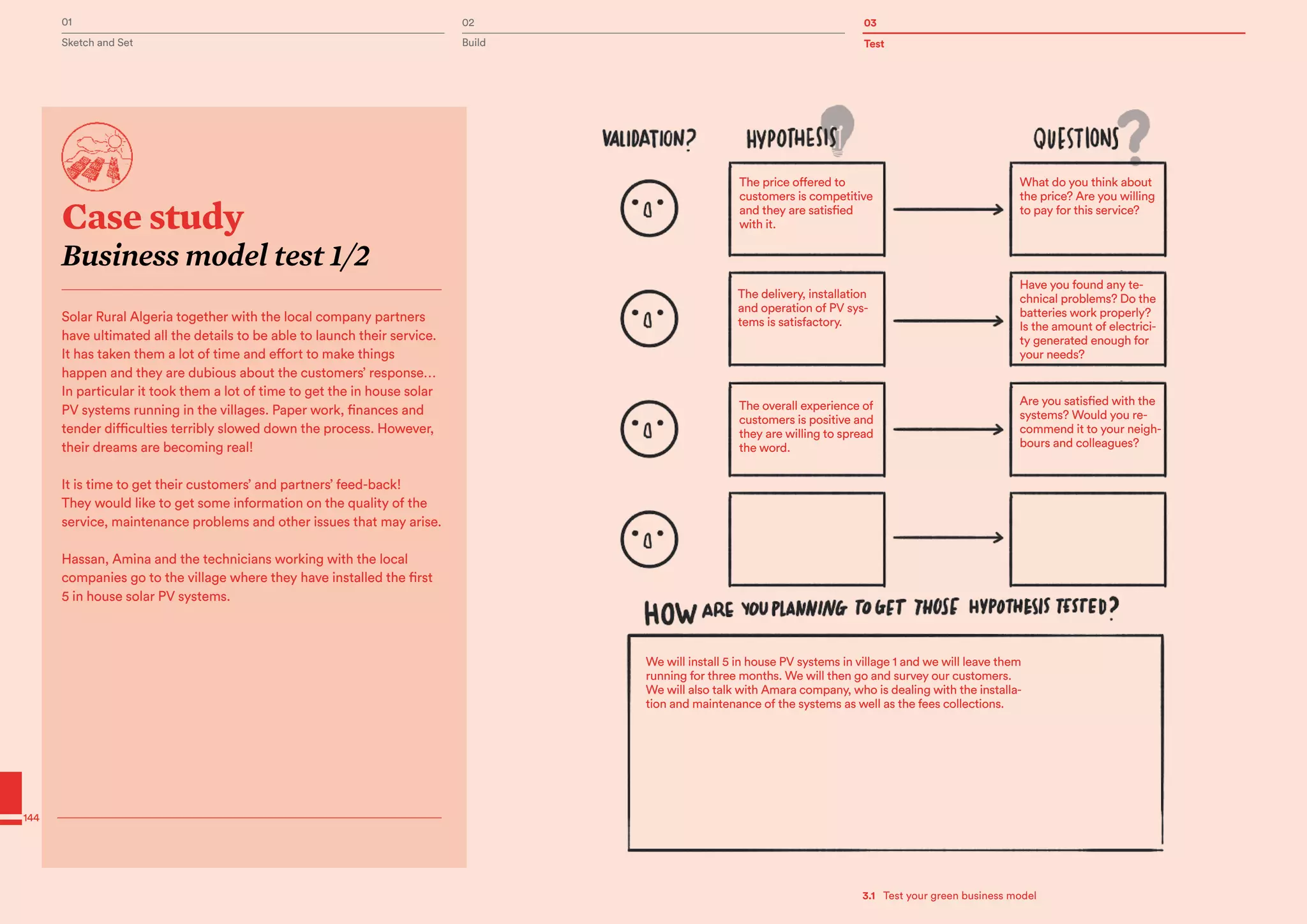
Mr Salim encourages the team to explain their project to the
village and he organizes a public meeting for the next day.
He invites all men to listen about the project. – Would they
become as excited as he is?
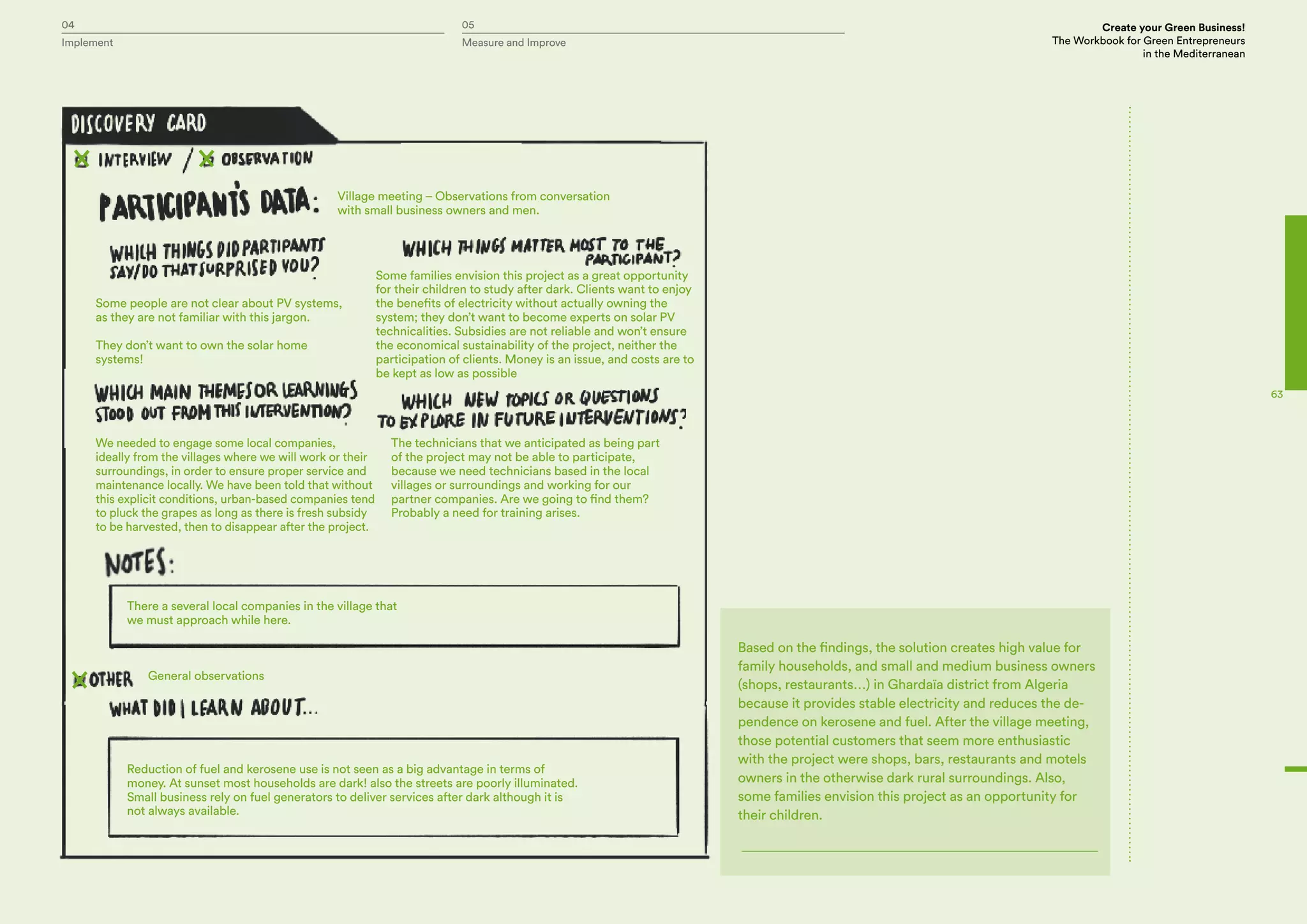
At the meeting Rural Solar Algeria uses the discovery cards
to gather information. They prepare some questions to launch
and guide the debate. They aim to learn about villagers’
interest on PV systems, but they are also interested in people’s
body language, particular experiences, and new learnings.
2.2–2.4   Test
04 05 Create your Green Business!
The Workbook for Green Entrepreneurs
in the Mediterranean
Implement Measure and Improve
63
Village meeting – Observations from conversation
with small business owners and men.
There a several local companies in the village that
we must approach while here.
General observations
Reduction of fuel and kerosene use is not seen as a big advantage in terms of
money. At sunset most households are dark! also the streets are poorly illuminated.
Small business rely on fuel generators to deliver services after dark although it is
not always available.
Some people are not clear about PV systems,
as they are not familiar with this jargon.
They don’t want to own the solar home
systems!
We needed to engage some local companies,
ideally from the villages where we will work or their
surroundings, in order to ensure proper service and
maintenance locally. We have been told that without
this explicit conditions, urban-based companies tend
to pluck the grapes as long as there is fresh subsidy
to be harvested, then to disappear after the project.
The technicians that we anticipated as being part
of the project may not be able to participate,
because we need technicians based in the local
villages or surroundings and working for our
partner companies. Are we going to find them?
Probably a need for training arises.
Some families envision this project as a great opportunity
for their children to study after dark. Clients want to enjoy
the benefits of electricity without actually owning the
system; they don’t want to become experts on solar PV
technicalities. Subsidies are not reliable and won’t ensure
the economical sustainability of the project, neither the
participation of clients. Money is an issue, and costs are to
be kept as low as possible
Based on the findings, the solution creates high value for
family households, and small and medium business owners
(shops, restaurants…) in Ghardaïa district from Algeria
because it provides stable electricity and reduces the de-
pendence on kerosene and fuel. After the village meeting,
those potential customers that seem more enthusiastic
with the project were shops, bars, restaurants and motels
owners in the otherwise dark rural surroundings. Also,
some families envision this project as an opportunity for
their children.
01 02 03
Sketch and Set Build Test
64
Exercise 11
Pivoting the value
proposition
At this stage you have contrasted your assumptions and you
have gathered information from your customers and key
stakeholders. Probably you have discovered something or you
have learned some lessons. You must integrated all these into
your value proposition.
What will you modify from your value proposition in order
to incorporate the input gathered?
Notes
2.4   Value proposition
04 05 Create your Green Business!
The Workbook for Green Entrepreneurs
in the Mediterranean
Implement Measure and Improve
Handbook
pp.101–104
65
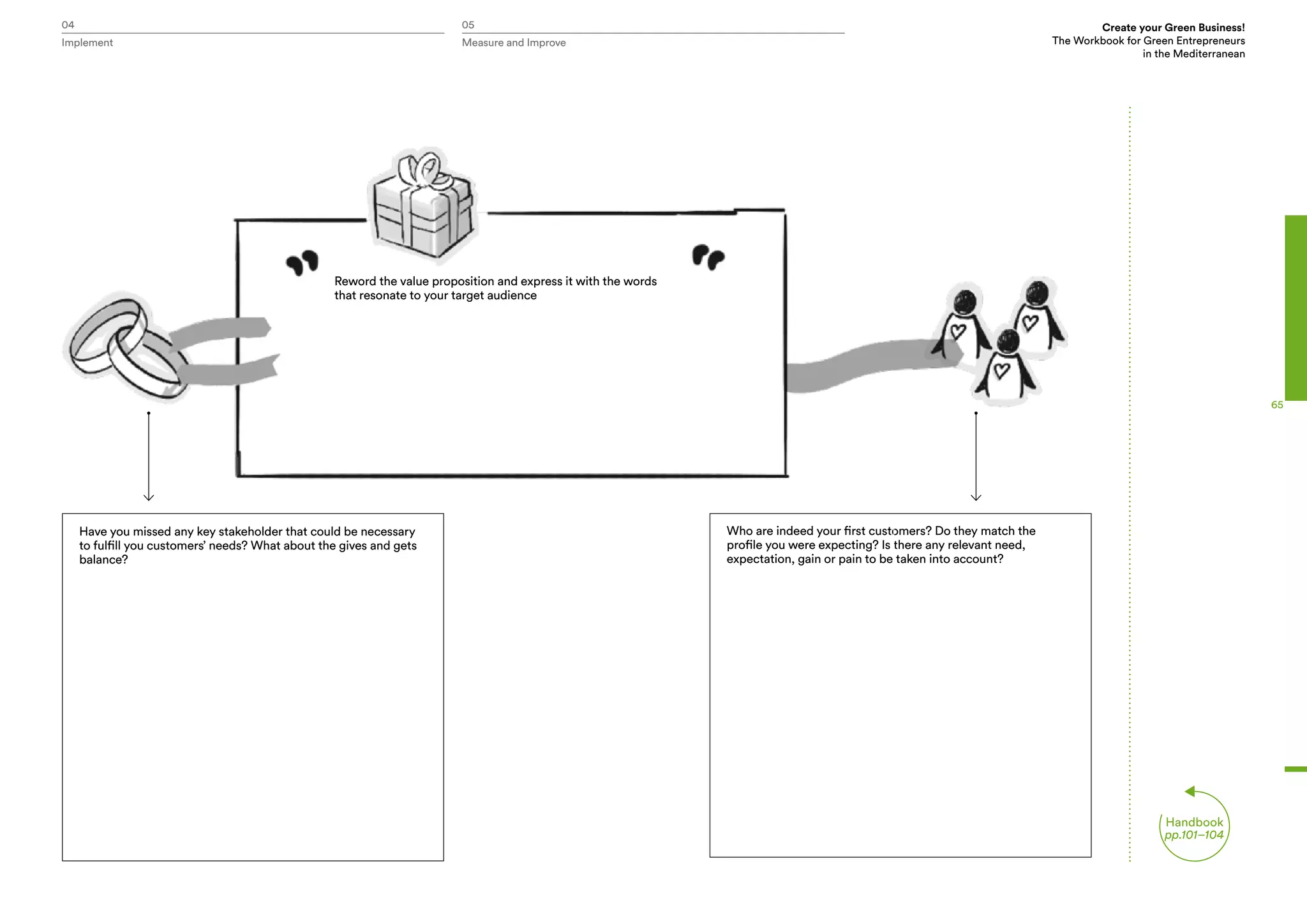
Reword the value proposition and express it with the words
that resonate to your target audience
Have you missed any key stakeholder that could be necessary
to fulfill you customers’ needs? What about the gives and gets
balance?
Who are indeed your first customers? Do they match the
profile you were expecting? Is there any relevant need,
expectation, gain or pain to be taken into account?
01 02 03
Sketch and Set Build Test
66
Case study
Pivoting the value
proposition
Rural Solar Algeria discovered, as one of the most relevant
pains to take into account, that customers did not want to
buy PV solar systems. Also, the price their clients were able
to pay for the service was low. Subsidies were not reliable
to ensure the economical sustainability of the project nor
the participation of clients in it.
To overcome these downsides they had to find a way to
provide electricity without the need to buy PV systems and
to increase the revenues in order to reduce prices. Hassan,
Amina and Karim were looking for a solution… what could
they do?!
‘Maybe if we recycle PV systems we open another revenue
stream that contributes to reduce the price of our service
and our dependence on external subsidies’... said Amina. But,
what are we going to do to provide energy if they don’t want
to buy PV panels?
Simultaneously, PV recycling will help bypass one of the
systemic boundaries of the project that on the long term
could bounce with a negative effect, the accumulation of
toxic and non-toxic waste in the villages after the life-span
of the PV systems.
2.4   Value proposition
Note
Up to know the value proposition was a
product (selling of PV solar panels). After
this first test, the fact that customers state
that they won’t purchase solar PV systems,
obliges Solar Rural Algeria to look for an
alternative solution. They resolve it offering
a service instead: they will provide electricity
on a Fee-for-service basis.
04 05 Create your Green Business!
The Workbook for Green Entrepreneurs
in the Mediterranean
Implement Measure and Improve
67
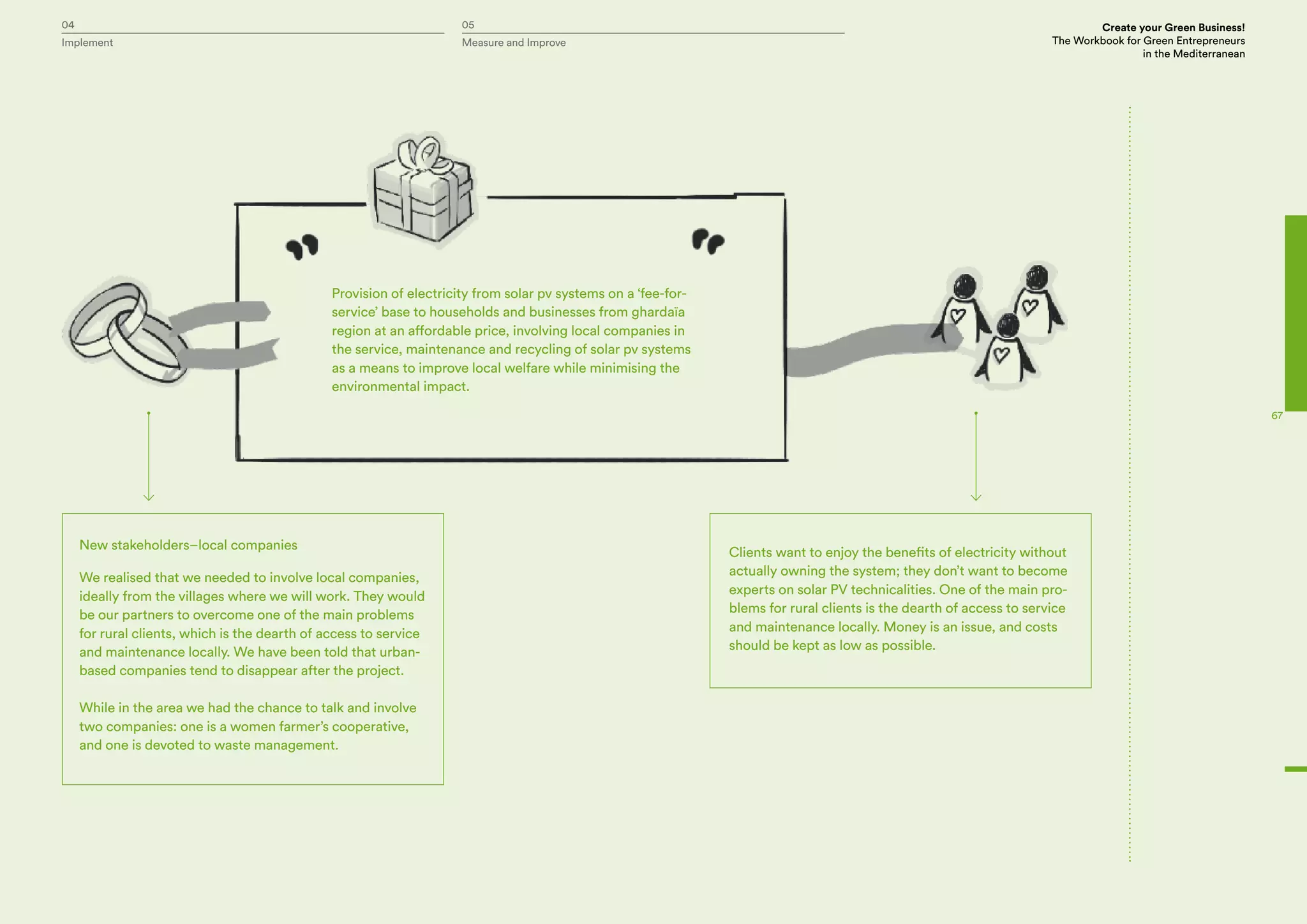
Provision of electricity from solar pv systems on a ‘fee-for-
service’ base to households and businesses from ghardaïa
region at an affordable price, involving local companies in
the service, maintenance and recycling of solar pv systems
as a means to improve local welfare while minimising the
environmental impact.
New stakeholders–local companies
We realised that we needed to involve local companies,
ideally from the villages where we will work. They would
be our partners to overcome one of the main problems
for rural clients, which is the dearth of access to service
and maintenance locally. We have been told that urban-
based companies tend to disappear after the project.
While in the area we had the chance to talk and involve
two companies: one is a women farmer’s cooperative,
and one is devoted to waste management.
Clients want to enjoy the benefits of electricity without
actually owning the system; they don’t want to become
experts on solar PV technicalities. One of the main pro-
blems for rural clients is the dearth of access to service
and maintenance locally. Money is an issue, and costs
should be kept as low as possible.
01 02 03
Sketch and Set Build Test
68
Les autorités locales pour la gestion
des décharges
Case study
Pivoting the value
proposition 1/2
Let’s go back to Omar!
He performed his obligations very efficiently and got money in
return from the Tax office. To him, there was no reason for which
he could not provide similar services to other organisations.
Omar remembers that the Tax office has still more than three
hundred computers to be collected by the end of the year.
And some thoughts disturb Omar:
The problem of e-waste disposal has been transferred to his
hands… He his making money but nothing has changed from
the environmental side. I want to do something else with that
waste, instead of throwing it away! Omar calls Djamel in order
to have a feedback of his services delivery. Djamel informs him
that his manager, Walid, would like to meet him to plan the
coming collecting operations. –Uau, this is great!
Omar informs the Tax office that he intends to refurbish old
computers, in addition to the collecting services. Djamel will
give him some indications on each computer health and status.
The Tax Office is willing to pay an extra for the service of collec-
ting, since it gives an added environmental value to that activity:
all in all, it is the price to build a better image of the administra-
tion with the citizens. Omar quite easily finds in his relationship
two persons passionate about computing and IT technologies.
Another friend of him has made available a large room that is
currently unused, so that Omar can store and repair computers.
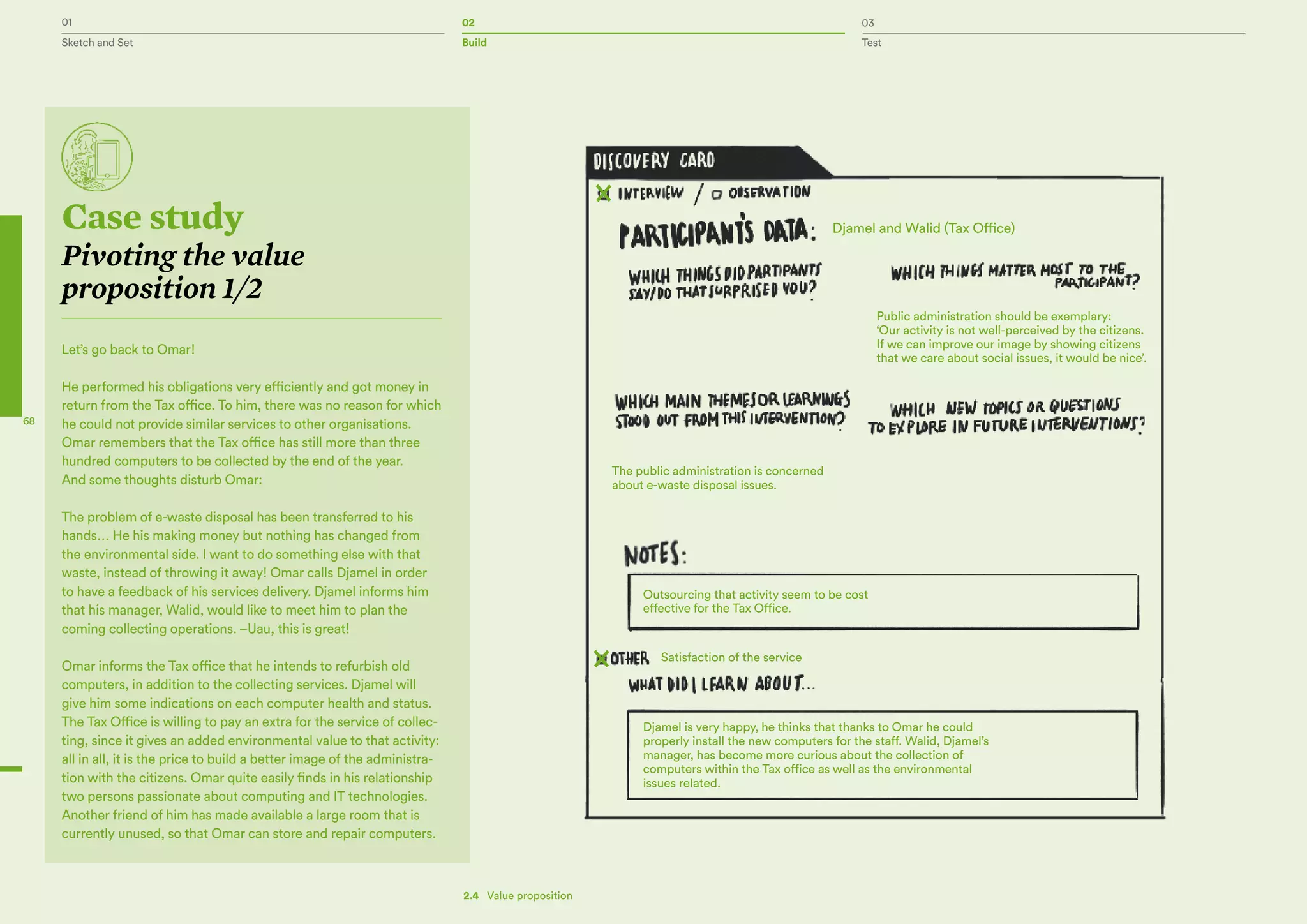
Djamel and Walid (Tax Office)
Public administration should be exemplary:
‘Our activity is not well-perceived by the citizens.
If we can improve our image by showing citizens
that we care about social issues, it would be nice’.
The public administration is concerned
about e-waste disposal issues.
Outsourcing that activity seem to be cost
effective for the Tax Office.
Djamel is very happy, he thinks that thanks to Omar he could
properly install the new computers for the staff. Walid, Djamel’s
manager, has become more curious about the collection of
computers within the Tax office as well as the environmental
issues related.
Satisfaction of the service
2.4   Value proposition
04 05 Create your Green Business!
The Workbook for Green Entrepreneurs
in the Mediterranean
Implement Measure and Improve
69
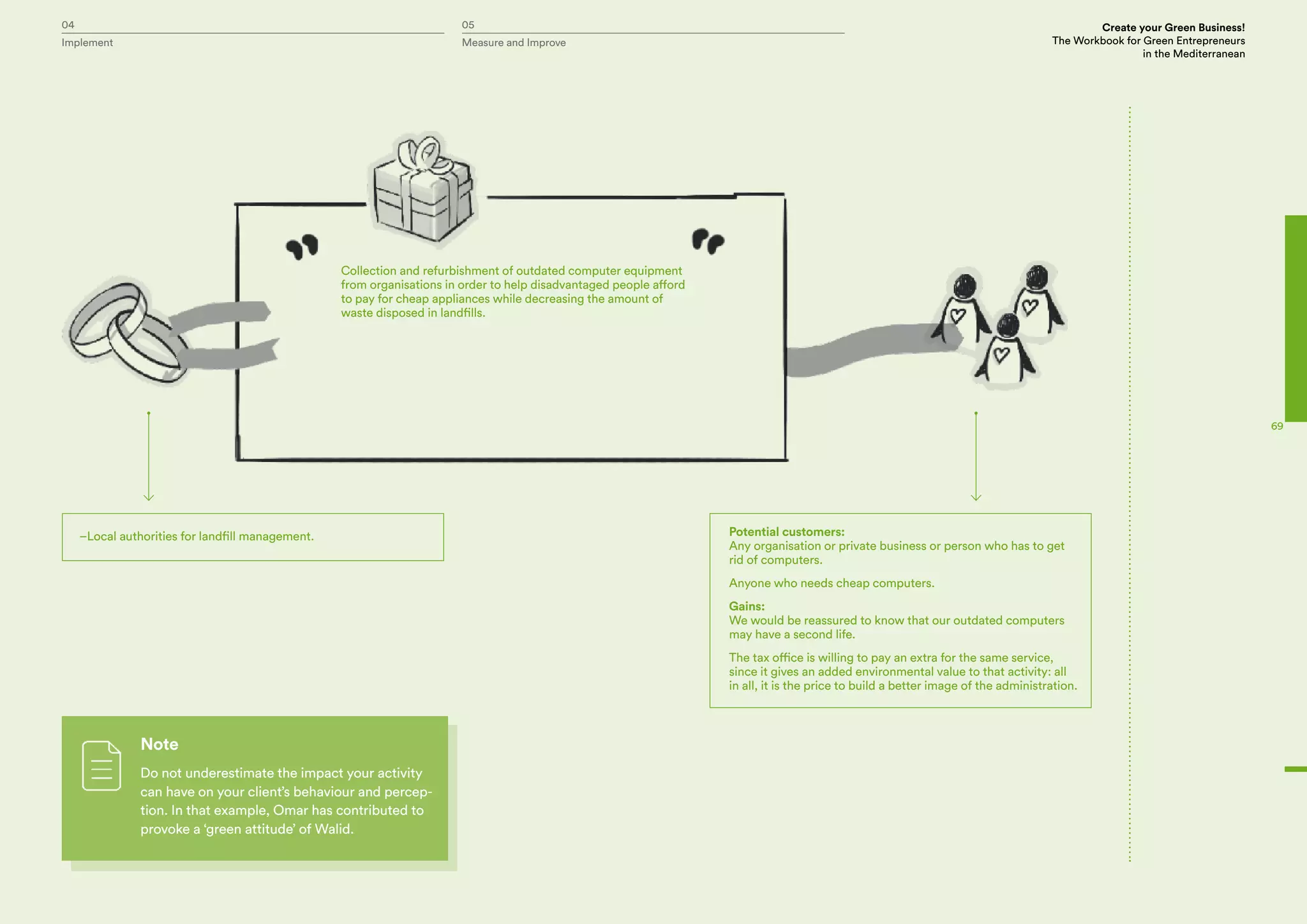
–Local authorities for landfill management. Potential customers:
Any organisation or private business or person who has to get
rid of computers.
Anyone who needs cheap computers.
Gains:
We would be reassured to know that our outdated computers
may have a second life.
The tax office is willing to pay an extra for the same service,
since it gives an added environmental value to that activity: all
in all, it is the price to build a better image of the administration.
Collection and refurbishment of outdated computer equipment
from organisations in order to help disadvantaged people afford
to pay for cheap appliances while decreasing the amount of
waste disposed in landfills.
Note
Do not underestimate the impact your activity
can have on your client’s behaviour and percep-
tion. In that example, Omar has contributed to
provoke a ‘green attitude’ of Walid.
01 02 03
Sketch and Set Build Test
70
Les autorités locales pour la gestion
des décharges
Case study
Pivoting the value
proposition 2/2
On the basis of the contract signed with the Tax Office, Omar’s
bank grants him a short term loan, so that he can pay his em-
ployees over a 3 months period, the time estimated to refurbish
some of the computers.
Omar’s idea at the moment is to sell second-hand refurbished
computer, therefore he needs to communicate his service.
–Who could be interested on second-hand computers or spare
parts? Probably not companies… Private persons may be inter-
ested, maybe students?!
Omar communicates his offer through bulletin boards in colle-
ges and universities to reach the students. ‘New-Life Electronic:
your computer for cheap! Refurbished computers tested and
guaranteed 5 months!’
In the meanwhile, an article in the local newspaper titled ‘Tax
Office becomes green’, makes Omar’s activities known, and
some SMEs call him to enquire about his services. As a wise
manager, he decides to answer positively to that emerging
demand: from now on, any people can go to his ‘shop’ to sell at
a low price their old electric and electronic appliances, while
they can also buy second-hand devices. The SMEs are happy
to outsource collecting hardware, while building a new ‘green
image’ to theirs clients. Besides the two employees specialized
in computing hardware, Omar needs to hire a technician who
knows how to repair domestic appliances.
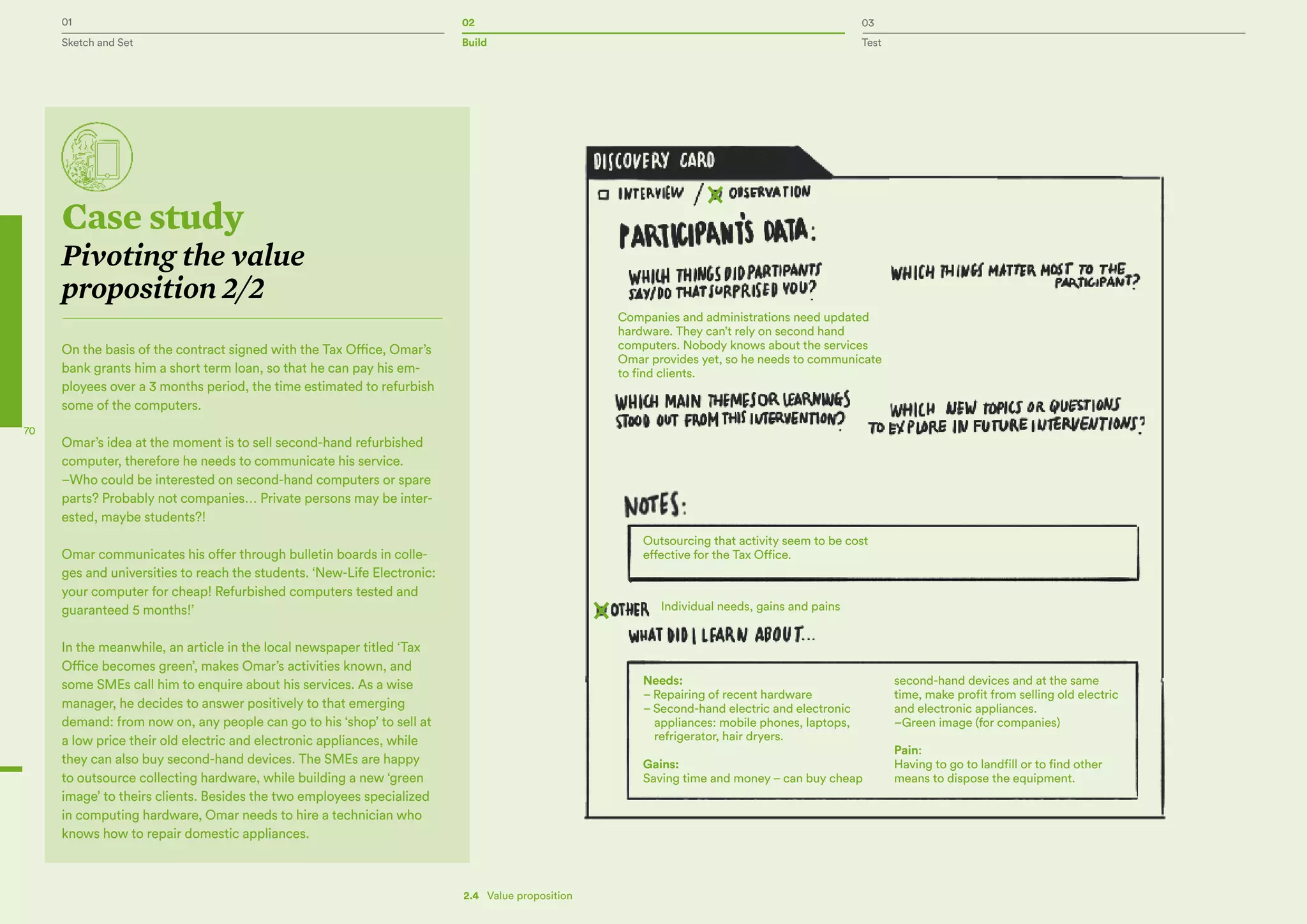
Companies and administrations need updated
hardware. They can’t rely on second hand
computers. Nobody knows about the services
Omar provides yet, so he needs to communicate
to find clients.
Outsourcing that activity seem to be cost
effective for the Tax Office.
Needs:
– Repairing of recent hardware
– Second-hand electric and electronic
appliances: mobile phones, laptops,
refrigerator, hair dryers.
Gains:
Saving time and money – can buy cheap
second-hand devices and at the same
time, make profit from selling old electric
and electronic appliances.
–Green image (for companies)
Pain:
Having to go to landfill or to find other
means to dispose the equipment.
Individual needs, gains and pains
2.4   Value proposition
04 05 Create your Green Business!
The Workbook for Green Entrepreneurs
in the Mediterranean
Implement Measure and Improve
71
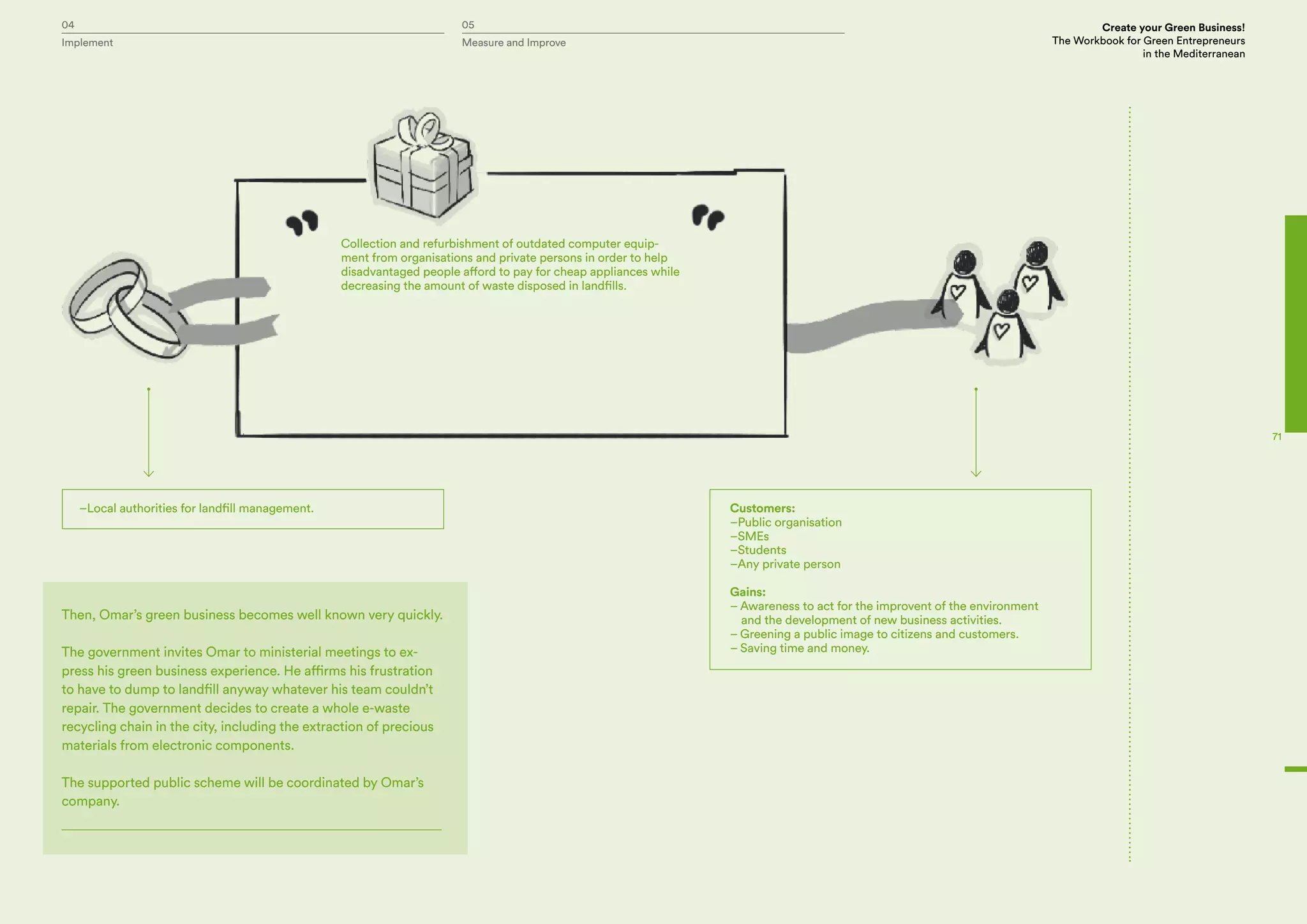
–Local authorities for landfill management. Customers:
–Public organisation
–SMEs
–Students
–Any private person
Gains:
– Awareness to act for the improvent of the environment
and the development of new business activities.
– Greening a public image to citizens and customers.
– Saving time and money.
Then, Omar’s green business becomes well known very quickly.
The government invites Omar to ministerial meetings to ex-
press his green business experience. He affirms his frustration
to have to dump to landfill anyway whatever his team couldn’t
repair. The government decides to create a whole e-waste
recycling chain in the city, including the extraction of precious
materials from electronic components.
The supported public scheme will be coordinated by Omar’s
company.
Collection and refurbishment of outdated computer equip-
ment from organisations and private persons in order to help
disadvantaged people afford to pay for cheap appliances while
decreasing the amount of waste disposed in landfills.
01 02 03
Sketch and Set Build Test
72
Who?
Segment?
Photo
Exercise 12
Customer channels
& relationships
Explore how you will reach your customers and what
kind of relationship you will establish with them. Use the
customer journey map, which describes the interaction
journey of a customer with your service/product, from
discovery to purchase, use and post-use.
Emotions: emotional stages of the customer during
the journey.
Touchpoints & channels: points and means of contact
between the service/product and the customers.
Feelings & thoughts: sensations and rational ideas of your
customer in relation to each stage of the journey.
Stages: each of the steps in the customers’ journey, from
becoming aware of your service/product to use –discovery,
assessment, purchase.
Once you have described the journey it is important to
analyze the stages that need action in order to improve pain
points and to maximize pleasure points. It's about providing
calming element to alleviate the pain as well as adding value
to reinforce pleasure points. Find out about the resources
that you will need for it.
2.6   Customer channels and relationships
04 05 Create your Green Business!
The Workbook for Green Entrepreneurs
in the Mediterranean
Implement Measure and Improve
Handbook
pp.56–62
73
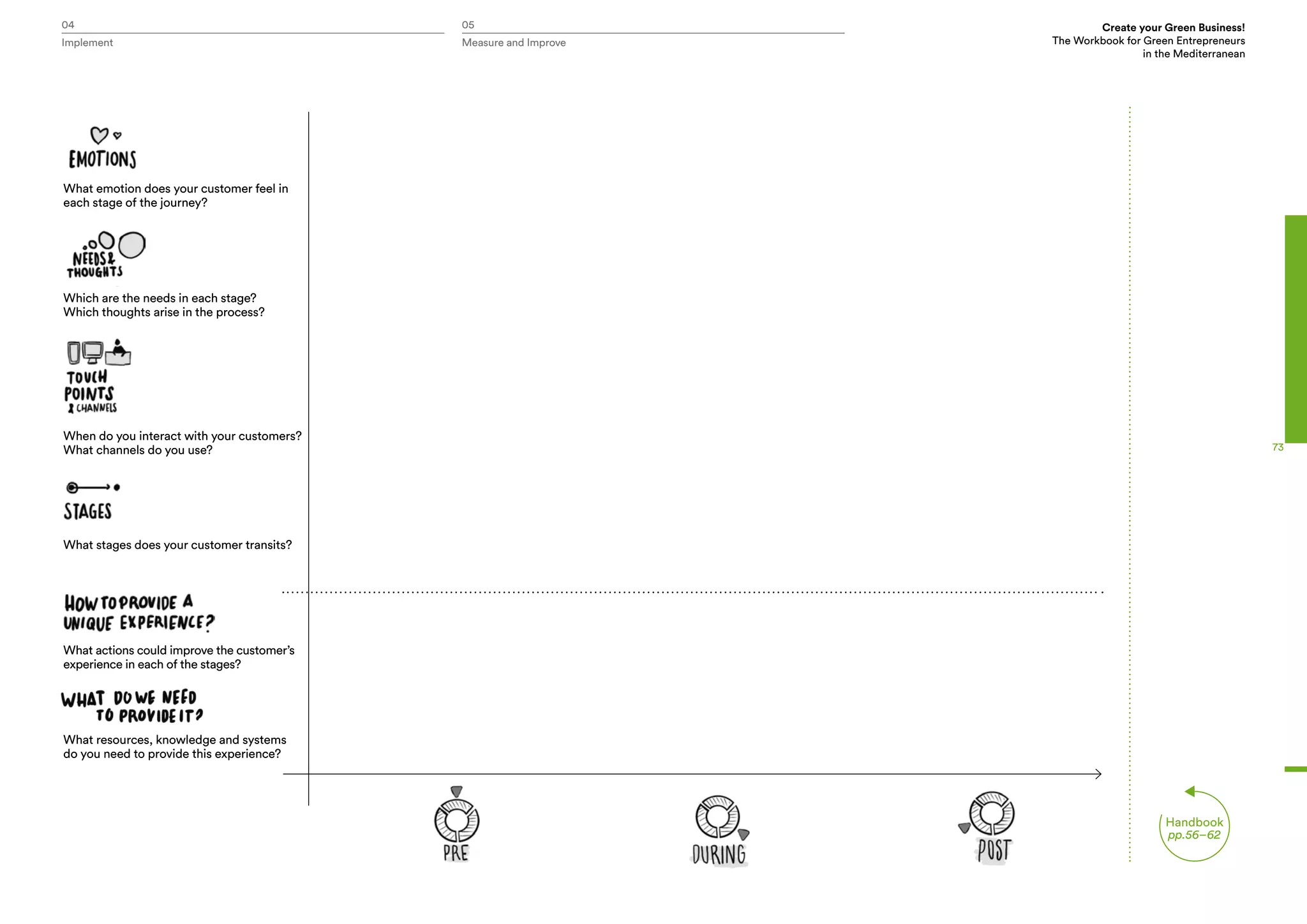
What emotion does your customer feel in
each stage of the journey?
Which are the needs in each stage?
Which thoughts arise in the process?
When do you interact with your customers?
What channels do you use?
What stages does your customer transits?
What actions could improve the customer’s
experience in each of the stages?
What resources, knowledge and systems
do you need to provide this experience?
01 02 03
Sketch and Set Build Test
74
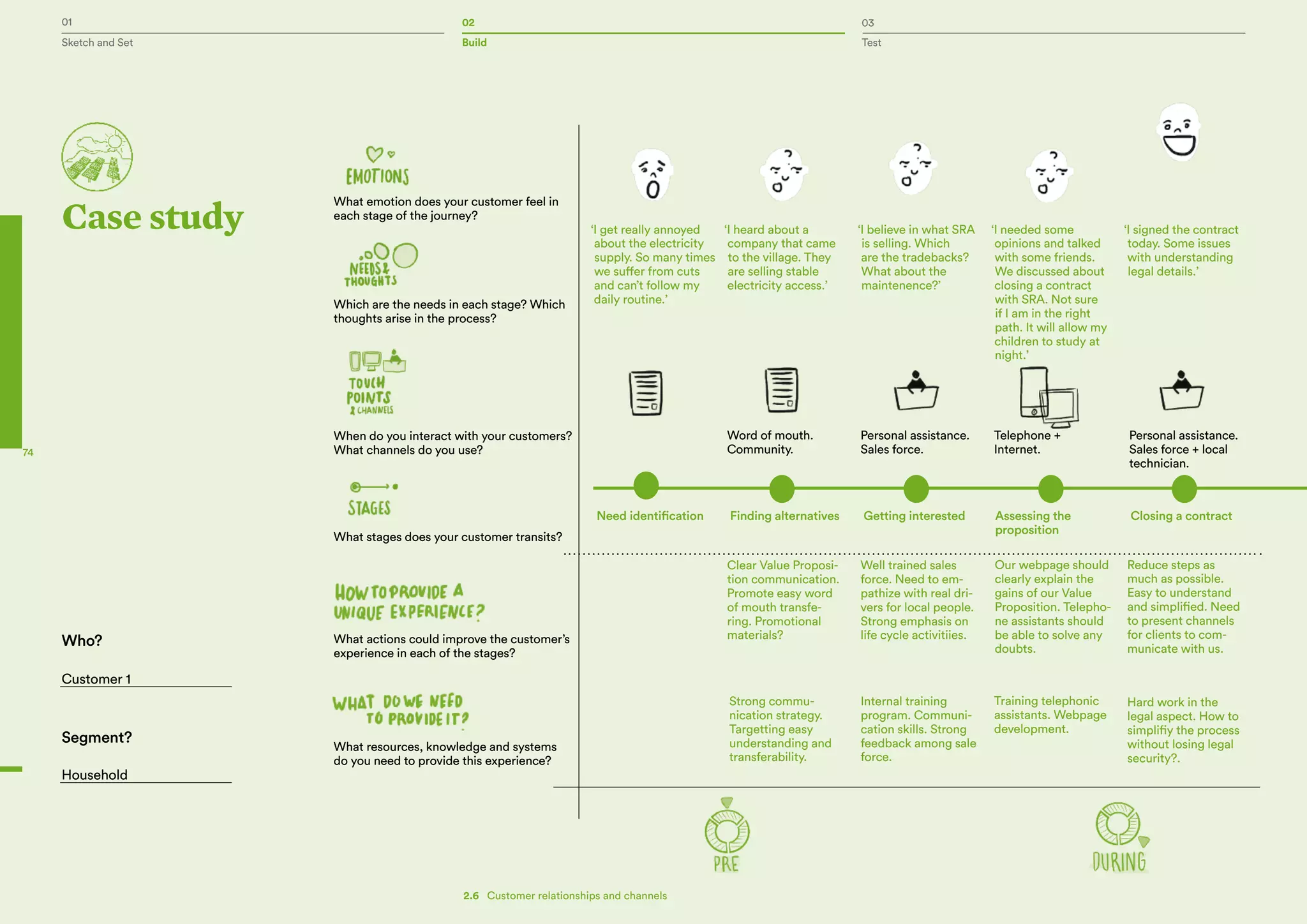
What emotion does your customer feel in
each stage of the journey?
Which are the needs in each stage? Which
thoughts arise in the process?
When do you interact with your customers?
What channels do you use?
What stages does your customer transits?
What actions could improve the customer’s
experience in each of the stages?
What resources, knowledge and systems
do you need to provide this experience?
Clear Value Proposi-
tion communication.
Promote easy word
of mouth transfe-
ring. Promotional
materials?
Word of mouth.
Community.
Personal assistance.
Sales force.
Telephone +
Internet.
Personal assistance.
Sales force + local
technician.
Well trained sales
force. Need to em-
pathize with real dri-
vers for local people.
Strong emphasis on
life cycle activitiies.
Reduce steps as
much as possible.
Easy to understand
and simplified. Need
to present channels
for clients to com-
municate with us.
Our webpage should
clearly explain the
gains of our Value
Proposition. Telepho-
ne assistants should
be able to solve any
doubts.
Strong commu-
nication strategy.
Targetting easy
understanding and
transferability.
Need identification Finding alternatives Getting interested Assessing the
proposition
Closing a contract
Internal training
program. Communi-
cation skills. Strong
feedback among sale
force.
Training telephonic
assistants. Webpage
development.
Hard work in the
legal aspect. How to
simplifiy the process
without losing legal
security?.
‘I get really annoyed
about the electricity
supply. So many times
we suffer from cuts
and can’t follow my
daily routine.’
‘I heard about a
company that came
to the village. They
are selling stable
electricity access.’
‘I believe in what SRA
is selling. Which
are the tradebacks?
What about the
maintenence?’
‘I signed the contract
today. Some issues
with understanding
legal details.’
‘I needed some
opinions and talked
with some friends.
We discussed about
closing a contract
with SRA. Not sure
if I am in the right
path. It will allow my
children to study at
night.’
2.6   Customer relationships and channels
Case study
Who?
Customer 1
Household
Segment?
04 05 Create your Green Business!
The Workbook for Green Entrepreneurs
in the Mediterranean
Implement Measure and Improve
75
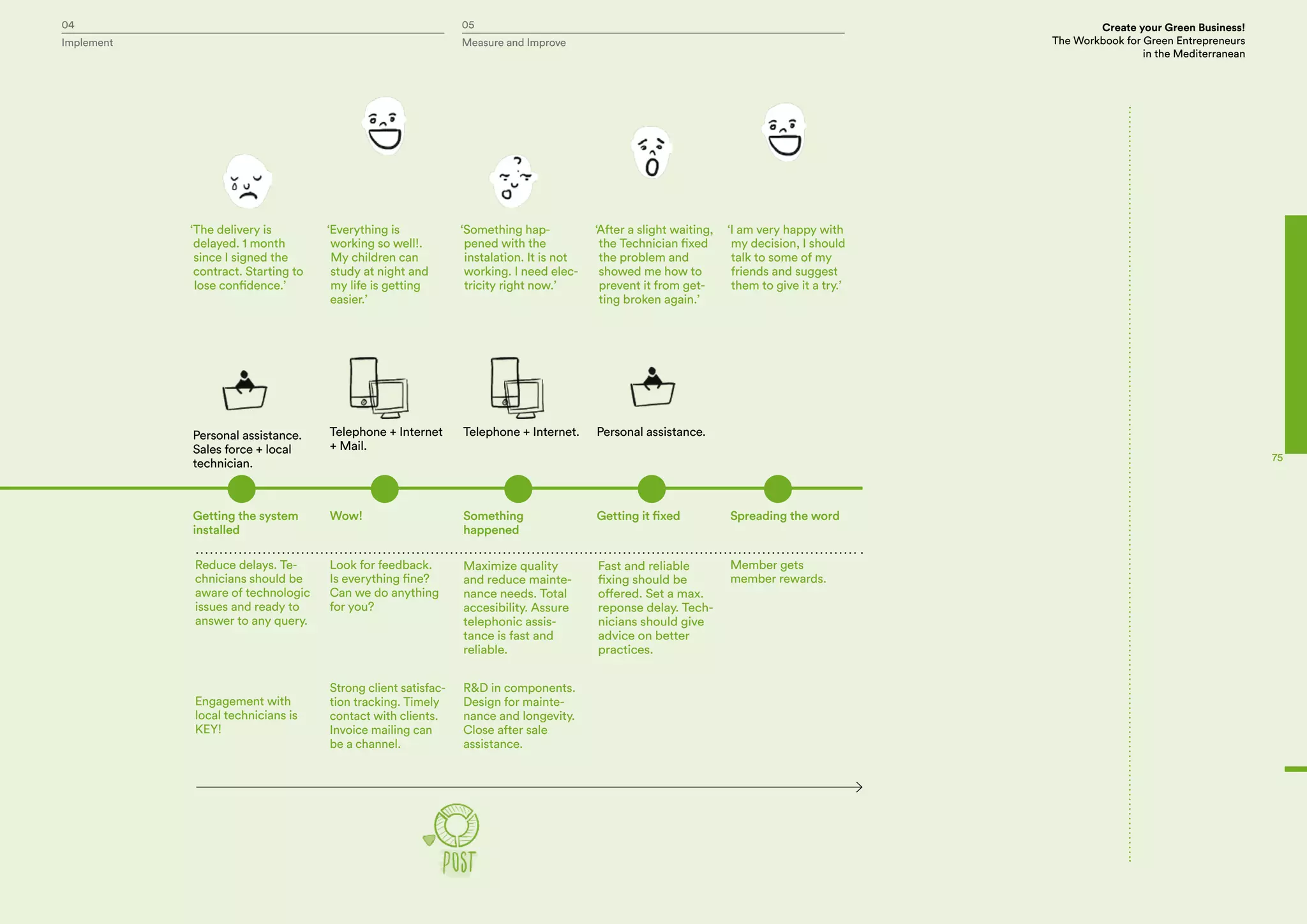
Personal assistance.
Sales force + local
technician.
Telephone + Internet
+ Mail.
Telephone + Internet. Personal assistance.
Reduce delays. Te-
chnicians should be
aware of technologic
issues and ready to
answer to any query.
Look for feedback.
Is everything fine?
Can we do anything
for you?
Maximize quality
and reduce mainte-
nance needs. Total
accesibility. Assure
telephonic assis-
tance is fast and
reliable.
Fast and reliable
fixing should be
offered. Set a max.
reponse delay. Tech-
nicians should give
advice on better
practices.
Member gets
member rewards.
Getting the system
installed
Wow! Something
happened
Getting it fixed Spreading the word
Engagement with
local technicians is
KEY!
Strong client satisfac-
tion tracking. Timely
contact with clients.
Invoice mailing can
be a channel.
R&D in components.
Design for mainte-
nance and longevity.
Close after sale
assistance.
‘The delivery is
delayed. 1 month
since I signed the
contract. Starting to
lose confidence.’
‘Everything is
working so well!.
My children can
study at night and
my life is getting
easier.’
‘Something hap-
pened with the
instalation. It is not
working. I need elec-
tricity right now.’
‘After a slight waiting,
the Technician fixed
the problem and
showed me how to
prevent it from get-
ting broken again.’
‘I am very happy with
my decision, I should
talk to some of my
friends and suggest
them to give it a try.’
01 02 03
Sketch and Set Build Test
76
2.5   Key activities and resources
Exercise 13
Key activities and resources
Think how you will develop your value proposition.
Now, it is time to define the key activities and key resources
that will be involved in the generation, management and
delivery of your value proposition. Read the following
questions and make the list your key activities and resources.
Notes
Handbook
pp.63–67
77
Problem solving
What activities and tasks do you need to accomplish to create
your VP, solve a specific challenge or maintain a high level of
innovation in your business?
Human capital
What human resources does your value proposition require?
what about the people working for/ with you?
Production
What activities and tasks do you need to accomplish to
produce your products or supply your services?
Physical capital
What physical resources are important for you business?
(Think about facilities, machinery, vehicles...)
Platform/ network/ sales
What activities and tasks do you need to accomplish to
create a efficient and valuable network or platform in
order to promote sales, distribution, communication with
stakeholders?
Intellectual & digital capital
Which intellectual and digital resources do you need?
Do you need licences, patents, software?
Supply chain management
What activities and tasks do you need to accomplish to create
a efficient and valuable supply chain management system?
What do you need to deal with supplier?
Financial capital
Which type of financial capital do you need? Have you
investments, loans or other financial issues (e.g. machinery
leasing...) related with your business?
Write a list of Key activities. Remember that some of them may be related with specific
activities of your business niche market, other may be related to general management.
Both are very important, don’t forget it!
Write a list of Key resources considering everything you need to create, deliver and manage
your products, services and perform business operations.
1 Key Resources 2Key Activities
04 05 Create your Green Business!
The Workbook for Green Entrepreneurs
in the Mediterranean
Implement Measure and Improve
Sketch and Set Build Test
78
01 02 03
Exercise 14
Ecodesign your business
After defining the key activities and resources, you are invited
to ecodesign the best solution to deliver your value. This
voluntary exercise will help you to rethink the activities and
resources identified in Exercise 13, in order to qualitatively
assess and improve the way your products or services
perform in environmental terms.
This exercise consists of a set of ecodesign cards, from 1 to 9.
Before starting with the cards, you will need to identify if your
business offers a product and its related services (e.g. textiles,
food products), or if you are offering only a service without
any related product (e.g. education).
In case you are offering a product-service, you will be working
on cards 1 to 9. In case you are offering only a service, you will
be working on cards 6 to 9.
Cards 1 to 8 are divided into 3 parts. Along each card, you
need to go through the indications and questions in order to
score and improve your propositions. Then, in Card 9 you will
be able to sum up the score of each previous card and get
your performance.
?
2.5   Key activities and resources
Handbook
pp.68–85
04 05 Create your Green Business!
The Workbook for Green Entrepreneurs
in the Mediterranean
Implement Measure and Improve
79
1
Type and NR Materials Location of Sources
Type and number of different materials and resources used?
Amount (weight) of all the elements and components?
Amount (Weight) Tech materials:
Recycled content and recyclability
Bio materials:
Renewability and compostability
For Technical materials (such as plastics, metals...):
What about recycled content and recyclability of these
materials?
For Organic materials (such as cotton, wood, food):
Renewability of the source and compostability of the materials?
Where and how do you source the materials from (distances
from your facilities)?
How to proceed?
Try to answer these questions. You can start from wherever
you feel more comfortable.
Think about them, gather information around them. They are
going to be scored in the next part of this CARD. If you don’t
have an answer now, well, we recommend you to try to find it
out, in order to keep going to the next part.
Let go and good luck!
Go to
Card 1 Part 22
1
Materials and
resources
2 3 4 5 6 7 8 9
Follow the steps in
the circles
Ecodesign card 1
Card 1/3
04 05 Create your Green Business!
The Workbook for Green Entrepreneurs
in the Mediterranean
Implement Measure and Improve
01 02 03
Sketch and Set Build Test
80
1
2
How to proceed?
Answer these questions. For each: yes (y) you get 1 point,
For each no (n) you get 0 points. If you don’t know a question
You choose other (o) and you get 0 points unless you provide
an good explaination or other options.
How to proceed?
Calculate for each box how many points you got and write
the score above where indicated. Write the score
And an emoticon that represent it.
Type and NR Materials Location of Sources
1. Has my product only one or a few types of material but
they are very easy to separate from each other?
2. ‘I cannot reduce in any way the number of different
materials’. Is this statement true?
3. Do I have enough information about environmental
performances of the materials and components are used
in my product lifecycle?
Tech materials: Recycled
content and recyclability
Bio materials: Renewability
and compostability
If you don’t have technical materials skip the 3 questions
and get 3 points
1. Is my product completely made of recycled content?
2. Is my product made of fully recyclable materials?
3. Have I avoided composites, banned substances and
combinated (mixed together) materials?
If you don’t have organic materials skip the 3 questions and
get 3 points
1. Does my product use compostable or biodegradable
organic materials?
2. Did I choose a renewable* organic material? (*the
extraction speed of the material is much slower than nature
needs for regenerating it)
3. Farming, harvesting and treatment is performed with no
toxics, banned or unknown chemicals. Is this statement true?
1. Are all the materials I need common & easy to find in
my region?
2. Are all the materials I need sourced in an
environmental sustainable way?
3. Are all the suppliers within a distance of 150 km?
1. Do I choose the lightest materials to build my product?
2. Is my product much lighter than other alternatives in
the market?
3. ‘I cannot concentrate* my product more than how it is
now (*an example? removing water from liquid soap)’
Is this statement true?
Amount (Weight) Score Score
Score Score
ScoreYes, No, Or? Yes, No, Or?
Yes, No, Or? Yes, No, Or?
Yes, No, Or?
31
Materials and
resources
2 3 4 5 6 7 8 9
Ecodesign card 1
Card 2/3
Go to
Card 1 Part 3
Follow the steps in
the circles
2.5   Key activities and resources
04 05 Create your Green Business!
The Workbook for Green Entrepreneurs
in the Mediterranean
Implement Measure and Improve
81
1
How to proceed?
For each block you didn’t get the smiley face (3/3 yes) you
should be thinking about what you are going to do to improve
these aspects.
In the green box you can find some good tips to improve your
actual solution. Write down your strategies and ideas! Green
tips! In the green box you can find helpful ecodesign strategies
and ideas. Let’s ecodesign! ;)
Type and NR Materials Location of Sources
Ideas and strategies for improving the actual score?
Tech materials: Recycled
content and recyclability
Bio materials: Renewabi-
lity and compostability
Ideas and strategies for improving the actual score? Ideas and strategies for improving the actual score?
Ideas and strategies for improving the actual score?
Green box strategies
-	Creating a more tighten and collaborative supply chain
-	Local harvested or sourced materials complying labor
conditions
-	Choosing highly renewable sourced materials (e.g.
harvested in less than 3-5 years...)
-	Choosing lower energy & water embedded materials (avoid
virgin metals and minerals...)
Amount (Weight)
Initial
Score
Initial
Score
Initial
Score
Initial
Score
Initial
Score
New
Score
New
Score
New
Score
New
Score
New
Score
2
1
Materials and
resources
2 3 4 5 6 7 8 9
-	Choosing recycled & highly recyclable materials (especially
those with a well-known recycling circuit.)
-	Choosing materials without hazardous substances-
additives, toxic materials, Persistent Organic Pollutants.
Avoid dangerous elements like: Lead (Pb), Mercury
(Hg) Cadmium (Cd) Hexavalent chromium (Cr6+)
Polybrominated biphenyls (PBB and PBDE).
-	Monomateriality: reduce the diversity of materials used
for a given product (monomaterial products are easier to
recycle).
-	Using ecolabelled resources
-	Designing smaller and lighter product (least weight as
possible)
-	Choosing reused components
-	Adopting Green procurement guidelines
Ecodesign card 1
Card 3/3
Go to
Card 2
Follow the steps in
the circles
01 02 03
Sketch and Set Build Test
82
Energy management Water management
How is the energy you need in the production sourced
(renewable energy or not?) and managed?
How much waste is generated? What do you do with it?
How is the rate of discarded and lost material per unit?
Waste management Chemicals In-out Processes & technology
Which types of chemicals do you need in the production
processes?
How many step and processes do you need? are those
technologies efficient (high performance new machinery?)
How is the water you need, in the production, managed?
Ecodesign card 2
Card 1/3
1
How to proceed?
Try to answer these questions. You can start from wherever
you feel more comfortable.
Think about them, gather information around them. They are
going to be scored in the next part of this CARD. If you don’t
have an answer now, well, we recommend you to try to find it
out, in order to keepgoing to the next part.
Let go and good luck!
23 4 5 6 7 8 9
Go to
Card 2 Part 2
Follow the steps in
the circlesProduction
21
2.5   Key activities and resources
04 05 Create your Green Business!
The Workbook for Green Entrepreneurs
in the Mediterranean
Implement Measure and Improve
83
Energy management Water management
1. ‘Most of energy (at least a 75%) needed come from
renewable source’ is this statement true?
2. Do I estimate the energy consumption per
manufactured unit?
3. ‘I cannot improve further the efficiency of my
production system, i’m already using the latest
technology’. Is this statement true?
Chemicals In-out Processes & technology
If you don’t use chemicals skip the 3 questions and get
3 points
1. ‘I use only water-based chemistry or ecolabelled
elements’, is this statement true?
2. ‘I cannot further minimise chemicals use and their
waste is properly managed’ is this statement true?
3. Do I guarantee that chemical storage is fully controlled
and legally responsive?
1. ‘I cannot further minimise the number of steps in the
production’ is this statement true?
2. Have I chosen to use an easy to repair, maintain and use
safe process technology?
3. ‘I adapt the production to the market demand, avoiding
large stocks of products’ is this statement true?
1. Do I estimate the water consumption per
manufactured unit?
2. ‘I am sure that there are not uncontrolled flows or
leaks along the processes’. Is this statement true?
3. ‘My water supply and discharge is not damaging or
changing the local environment’.
Is this statement true?
1. ‘My production is not generating waste and most
of by product is reused and refurbished inside the
workshop’. Is this statement true?
2. I cannot reduce further the waste generation, and
waste is managed by an authorized organisation
within regulations, is that true?
3. ‘I promoted a quality management policy that has
reduced at the minimum discarded products and
unconformities’. Is this statement true?
Waste management Score Score
Score Score
ScoreYes, No, Or? Yes, No, Or?
Yes, No, Or? Yes, No, Or?
Yes, No, Or?
3
Ecodesign card 2
Card 2/3
1
2
How to proceed?
Answer these questions. For each: yes (y) you get 1 point,
For each no (n) you get 0 points. If you don’t know a question
You choose other (o) and you get 0 points unless you provide
an good explaination or other options.
How to proceed?
Calculate for each box how many points you got and write
the score above where indicated. Write the score
And an emoticon that represent it.
Go to
Card 2 Part 3Production
2 3 4 5 6 7 8 9
Follow the steps in
the circles
1
01 02 03
Sketch and Set Build Test
84
Energy management Water management
Ideas and strategies for improving the actual score?
Chemicals In-out Processes & technology
Ideas and strategies for improving the actual score? Ideas and strategies for improving the actual score?
Ideas and strategies for improving the actual score?
Green box strategies
-	Choosing newer & more efficient process technologies
or Outsource activities when higher specialization and
technological efficiency of products/infrastructures are
available.
- Promoting artisan production, possibly, only on demand.
- Fewer processing steps, less movements of mass/volume.
- Choosing less energy/ water consumptive processes.
Waste management
Initial
Score
Initial
Score
Initial
Score
Initial
Score
Initial
Score
New
Score
New
Score
New
Score
New
Score
New
Score
- Choosing processes that generate minimum amount or no
amount of waste.
- Using less consumibles, less hazard, washable or easily
repairable ones.
- Promoting local and safe work.
Ecodesign card 2
Card 3/3
1
How to proceed?
For each block you didn’t get the smiley face (3/3 yes) you
should be thinking about what you are going to do to improve
these aspects.
In the green box you can find some good tips to improve your
actual solution. Write down your strategies and ideas! Green
tips! In the green box you can find helpful ecodesign strategies
and ideas. Let’s ecodesign! ;)
23 4 5 6 7 8 9
Go to
Card 3
Follow the steps in
the circlesProduction
21
2.5   Key activities and resources
04 05 Create your Green Business!
The Workbook for Green Entrepreneurs
in the Mediterranean
Implement Measure and Improve
85
Package materials Flat design
Which type of material is used, list all of them (including labels,
bags)? How much does it weight compared with the product
you are delivering?
Is it your designed product easy to stack, occupying the
least volume?
Stackability Means of transport Routes & distances
Can you describe the main means of transportation?
which vehicles are used, in which conditions are they?
How much is the distance between production facilities and
final shops (customer location)?
Is the product completely disassemble and be reduced in flat or
cubic shape?
Ecodesign card 3
Card 1/3
1
How to proceed?
Try to answer these questions. You can start from wherever
you feel more comfortable.
Think about them, gather information around them. They are
going to be scored in the next part of this CARD. If you don’t
have an answer now, well, we recommend you to try to find it
out, in order to keepgoing to the next part.
Let go and good luck!
Go to
Card 3 Part 2
3 4 5 6 7 8 9
Follow the steps in
the circles 2Packaging &
distribution
1 2
01 02 03
Sketch and Set Build Test
86
Package materials Flat design
If you don’t have any packaging, the product is the packaging
or there is no need for it, skip the 3 questions and get 3
points.
1. ‘I choose a renewable material for one-use packaging
applications’ is this statement true or I choose a
resistant, highly recyclable materials for multiple
uses and returnable systems’. Is this statement true?
2. ‘In any case, I cannot make the packaging simpler, with
fewer elements, fewer materials types’ is this statement
true?
3. ‘In any case, I cannot make the packaging lighter’
is this statement true?
Means of transport Routes & distances
If you use only non-motorized means of transportation
(foot, bikes, etc.) You skip the 3 questions and you get 3
points.
1. ‘To receive the raw materials and distribute the product,
i use mostly human power (foot & bikes), transoceanic
ships or electric vehicles’ is this statement true?
2. Do I choose mostly very new efficient vehicles, big
trucks (40ton) or scooters to delivery my product?
3. Do I take advantage of the return-journeys to transport
other things?
1. Is there a very short distance all along the chain, less than
150km between production and customer?
2. Am I using the most optimised routes?
3. ‘When we send by post for online purchase, we choose
the greenest option available they offer us!’. Is this
statement true?
1. ‘My product and its packaging shape is a flat
or cubic, with almost no air (fully optimised)’ is this
Statement true?
2. Is my product sold and delivered completely
Disassembled?
3. There is no room for further reduction of the volume?
1. Is the product designed to be stackable as it is?
2. Is my product designed to be transported (in multiples
units) without compromise its quality and functionality?
3. Are the dimensions of the pallet footprint considered
when determining the dimensions of primary (from
supplier) and secondary (to clients) packaging?
Stackability Score Score
Score Score
ScoreYes, No, Or? Yes, No, Or?
Yes, No, Or? Yes, No, Or?
Yes, No, Or?
Ecodesign card 3
Card 2/3
1
2
How to proceed?
Answer these questions. For each: yes (y) you get 1 point,
For each no (n) you get 0 points. If you don’t know a question
You choose other (o) and you get 0 points unless you provide
an good explaination or other options.
How to proceed?
Calculate for each box how many points you got and write
the score above where indicated. Write the score
And an emoticon that represent it.
32 4 5 6 7 8 9
Go to
Card 3 Part 3
Follow the steps in
the circles
3
Packaging &
distribution
1
2.5   Key activities and resources
04 05 Create your Green Business!
The Workbook for Green Entrepreneurs
in the Mediterranean
Implement Measure and Improve
87
Ideas and strategies for improving the actual score?
Ideas and strategies for improving the actual score? Ideas and strategies for improving the actual score?
Ideas and strategies for improving the actual score?
Green box strategies
-	Avoid unnecessary packaging or reduce it at the minimum
- Pick up only ISO sizes and optimise mass and volume
transported (air is the most expensive and unsustainable
‘thing’ to transport!)
- Reduce the amount of different materials and make
them very easy to separate from each other to maximise
recycling.
Initial
Score
Initial
Score
Initial
Score
Initial
Score
Initial
Score
New
Score
New
Score
New
Score
New
Score
New
Score
- Choosing biobased disposable packaging for long (one
way) delivery (e.g. cardboard...)
- Choosing a returnable packaging for closer and frequent
delivery (e.g. metal, plastic crates...)
- For retornable packaging, make them the lightest, resistant
and easy to recycle and dismantle.
- Design a reusable (by the client), smaller, flat or cubic
packaging.
- Choose more efficient means of transportation optimising
routes and inverse logistics.
- Reduce distances between production and consumption,
as much as possible.
Ecodesign card 3
Card 3/3
1
How to proceed?
For each block you didn’t get the smiley face (3/3 yes) you
should be thinking about what you are going to do to improve
these aspects.
In the green box you can find some good tips to improve your
actual solution. Write down your strategies and ideas! Green
tips! In the green box you can find helpful ecodesign strategies
and ideas. Let’s ecodesign! ;)
Go to
Card 4
2 4 5 6 7 8 9
Follow the steps in
the circles 2
Package materials Flat design
Stackability Means of transport Routes & distances
3
Packaging &
distribution
1
01 02 03
Sketch and Set Build Test
88
Energy consumption Consumibles
What is the energy consumption when using the product?
Is your product easily repairable? can user or technician access
to its main parts quickly?
Repairability Durability
Multi-Functionality
& Modularity
How long do you expect it is going to work your product? How many functions could you integrate in your product?
Can you build different configurations with the same pieces?
Do your product need consumibles for working properly?
How are they, one-use only, renewable?
Ecodesign card 4
Card 1/3
1
How to proceed?
Try to answer these questions. You can start from wherever
you feel more comfortable.
Think about them, gather information around them. They are
going to be scored in the next part of this CARD. If you don’t
have an answer now, well, we recommend you to try to find it
out, in order to keepgoing to the next part.
Let go and good luck!
2
Go to
Card 4 Part 2
Follow the steps in
the circles2 3 5 6 7 8 94
Use &
maintenance
1
2.5   Key activities and resources
04 05 Create your Green Business!
The Workbook for Green Entrepreneurs
in the Mediterranean
Implement Measure and Improve
89
If there is no energy use you skip the 3 questions and get
3 points.
1. ‘I cannot be more efficient that now’. Is this statement
true?
2. Is it powered by renewable sources?
3. Is there any system to prevent energy waste when not
in use?
1. ‘I have designed my product to avoid expiration date
with no limit in lifespan duration’. Is this statement true?
2. ‘I have designed my product to last and avoid
aesthetical limitation (classic design)’. Is this statement
true?
3. Am I sure that durability is not limited and
compromised by some aspect (component, material)?
If you product cannot be multifunctional can skip the 1st
question and you get 1 point.
1. Does my product integrate more than one function?
If you product cannot be modular can skip the 2nd and 3rd
questions and you get 2 points.
2. Does my product allow to be replicated with a basic
elemental component (is it modular, like lego)?
3. Can I guarantee that all the functions are usable by all the
people (older, younger, etc)?
IF you product doesn’t need maintenance or consumibles,
you skip the 3 questions and you get 3 points.
1. ‘Consumibles, composition and accessibility, makes
easy the maintenance and the product durable’. Is this
statement true?
2. ‘Any resources needed (or consumible) are no toxic
and easy to find’. Is this statement true?
3. Any resources needed can be easily recycled or
managed in their end of life stage’. Is this statement true?
1. ‘My product can be fully, easily and economically
repaired by users/ technicians’. Is this statement true?
2. ‘Any important part can be accessed quickly by repair
operator’. Is this statement true?
3. Are repair components easy to obtain with the
information about how to do it accessible?
Score Score
Score Score
ScoreYes, No, Or? Yes, No, Or?
Yes, No, Or? Yes, No, Or?
Yes, No, Or?
Ecodesign card 4
Card 2/3
1
2
How to proceed?
Answer these questions. For each: yes (y) you get 1 point,
For each no (n) you get 0 points. If you don’t know a question
You choose other (o) and you get 0 points unless you provide
an good explaination or other options.
How to proceed?
Calculate for each box how many points you got and write
the score above where indicated. Write the score
And an emoticon that represent it.
Go to
Card 4 Part 3
2 3 4 5 6 7 8 9
Follow the steps in
the circles 3
Energy consumption Consumibles
Repairability Durability Multi-Functionality
& Modularity
Use &
maintenance
1
01 02 03
Sketch and Set Build Test
90
Ideas and strategies for improving the actual score?
Ideas and strategies for improving the actual score? Ideas and strategies for improving the actual score?
Ideas and strategies for improving the actual score?
Green box strategies
-	Offer the access/availability to products/infrastructures
through payment based on the unit of utility/satisfaction
-	Modularity and design for maintenance.
-	Using standard components to promote repairing (most
vulnerable components should be easily removed and
replaced).
Initial
Score
Initial
Score
Initial
Score
Initial
Score
Initial
Score
New
Score
New
Score
New
Score
New
Score
New
Score
-	Reduce consumption of energy and materials per service
unit offered by the product.
-	Use of few (and clean) consumables (reduce support
products for service functioning).
-	Easy installation and/or assembly, with a rational use of
resources.
-	Product reliability and durability.
-	Strong link between the product and its user (it favours
user care for long lasting of physical supports products
and infrastructures).
Ecodesign card 4
Card 3/3
1
How to proceed?
For each block you didn’t get the smiley face (3/3 yes) you
should be thinking about what you are going to do to improve
these aspects.
In the green box you can find some good tips to improve your
actual solution. Write down your strategies and ideas! Green
tips! In the green box you can find helpful ecodesign strategies
and ideas. Let’s ecodesign! ;)
22 3 5 6 7 8 9
Go to
Card 5
Follow the steps in
the circles
Energy consumption Consumibles
Repairability Durability
Multi-Functionality
& Modularity
4
Use &
maintenance
1
2.5   Key activities and resources
04 05 Create your Green Business!
The Workbook for Green Entrepreneurs
in the Mediterranean
Implement Measure and Improve
91
Once your product is useless for a user, can it be reused directly
by other people or renewed?
Once your product become useless, can it be disassembled
easily (by no expert personnel) and economically?
Different materials are clearly identified by labels or information
signs to classify them properly, once dismantled?
What problems arise in the recovery and disposal of products?
What about chemicals and hazardous substances?
Once your product is discarded by the user, can it be refurbished
easily and economically?
Ecodesign card 5
Card 1/3
1
How to proceed?
Try to answer these questions. You can start from wherever
you feel more comfortable.
Think about them, gather information around them. They are
going to be scored in the next part of this CARD. If you don’t
have an answer now, well, we recommend you to try to find it
out, in order to keepgoing to the next part.
Let go and good luck!
Go to
Card 5 Part 2
2 3 5 6 7 8 9
Follow the steps in
the circles 2
Easy to be reused Easy to be refurbished
Easy to be disassembled Labelling & Identification Chemicals In-out
End of life
management
1 4
01 02 03
Sketch and Set Build Test
92
If your answer to one of the following questions is yes,
you can skip the other questions and get 3 points.
1. ‘When a user gets rid of it, my product can be
potentially reused directly by other as it is’. Is this
statement true?
2. ‘When a user gets rid of it my product can be re-sold
in the market with an easy cleaning/ refurbishment
process’. Is this statement true?
3. ‘When a user gets rid of it, my product can be part
of another set of components or upcycled for different
applications. Is this statement true?
1. Is each different material, clearly, identified with labels
or other signs?
2. Is there further information about composition and
so on in the product itself or in some other location
(like website?)
3. Are there some color code or other technique to
speed up the process of recognizing different types of
materials?
1. ‘No need for chemical or hazardous substances processing
in my product eol’ is this statement true?
2. Is my product toxic free once it is broken or useless?
3. ‘During waste treatment and disposal, there are not toxic
emissions (e.g. Incineration)’. Is this statement true?
1. In the end of its life (eol),can my product be
refurbished (technically) easily by local entities?
2. In the end of its life (eol), can my product be easily
collected for its refurbishment by local entities?
3. In the end of its life (eol), can my product be
refurbished economically by local entities?
1. Could the different materials & components of my
product be easily separated?
2. Could my product different materials & components
be recycled or composted?
3. Could my product be fully disassembled?
Score Score
Score Score
ScoreYes, No, Or? Yes, No, Or?
Yes, No, Or? Yes, No, Or?
Yes, No, Or?
Ecodesign card 5
Card 2/3
1
2
How to proceed?
Answer these questions. For each: yes (y) you get 1 point,
For each no (n) you get 0 points. If you don’t know a question
You choose other (o) and you get 0 points unless you provide
an good explaination or other options.
How to proceed?
Calculate for each box how many points you got and write
the score above where indicated. Write the score
And an emoticon that represent it.
32 3 4 6 7 8 9
Go to
Card 5 Part 3
Follow the steps in
the circles
Easy to be reused Easy to be refurbished
Easy to be disassembled Labelling & Identification Chemicals In-out
5
End of life
management
1
2.5   Key activities and resources
04 05 Create your Green Business!
The Workbook for Green Entrepreneurs
in the Mediterranean
Implement Measure and Improve
93
Ideas and strategies for improving the actual score?
Ideas and strategies for improving the actual score? Ideas and strategies for improving the actual score?
Ideas and strategies for improving the actual score?
Green box strategies
-	Simplification of product disassembly, to reduce the time
and costs of separating its components for recycling or
reuse.
-	Identification of the type of materials used, in order to
foster waste sorting.
-	Reusability (e.g. reuse of product components).
-	Biodegradability (making it easier to reincorporate parts of
Initial
Score
Initial
Score
Initial
Score
Initial
Score
Initial
Score
New
Score
New
Score
New
Score
New
Score
New
Score
the product to their natural cycles/ecosystem), choosing
when possible compostable organic materials that feed the
ground when biodegrading.
-	Recyclability.
-	Energy recovery.
-	Reduce the volume of waste by means of easy compaction
of the product.
-	Reducing toxicity of waste management, in order to avoid
unintentional emissions of compounds such as POPs
(e.g. incorporating adequate flue gas, solid residue and
effluent treatments).
Ecodesign card 5
Card 3/3
1
How to proceed?
For each block you didn’t get the smiley face (3/3 yes) you
should be thinking about what you are going to do to improve
these aspects.
In the green box you can find some good tips to improve your
actual solution. Write down your strategies and ideas! Green
tips! In the green box you can find helpful ecodesign strategies
and ideas. Let’s ecodesign! ;)
Go to
Card 6
2 3 4 6 7 8 9
Follow the steps in
the circles 2
5
End of life
management
1
Easy to be disassembled Labelling & Identification Chemicals In-out
Easy to be reused Easy to be refurbished
01 02 03
Sketch and Set Build Test
94
Accessories & Gadgets Responsible usability
How many and which type of devices, accessories and objects
are involved when your customer is using the service?
Is your product/ service promoting a more collaborative use
of some resource? Is it fostering cooperation and a sharing
efficiency?
Design for sharing & exchanging Design for education Compensation policies
How does your product/ service promote environmental
protection and education within users and society?
Have you established some compensation policy (like CO2
offset, NGO support) to offset your impacts or support
green initiatives?
Have you included any strategy to improve environmental
behaviour of your service user?
Ecodesign card 6
Card 1/3
1
How to proceed?
Try to answer these questions. You can start from wherever
you feel more comfortable.
Think about them, gather information around them. They are
going to be scored in the next part of this CARD. If you don’t
have an answer now, well, we recommend you to try to find it
out, in order to keepgoing to the next part.
Let go and good luck!
22 3 4 5 7 8 9
Go to
Card 6 Part 2
Follow the steps in
the circles
6
Service
1
2.5  Key activities and resources
04 05 Create your Green Business!
The Workbook for Green Entrepreneurs
in the Mediterranean
Implement Measure and Improve
95
If you answer yes to the 1st question, skip the the 2nd and
3rd and get 3 points
1. ‘No physical devices or equipment involved in the
service supply’. Is this statement true?
2. ‘All devices, equipment are rented or accessible for
the users, they don’t buy them. Your company owns
and maintains them’. Is this statement true?
3. Are most of the involved equipment or products quite
new, very efficient and even ecodesigned?
1. Does my service embody sustainability & education,
Gender equality, social integration of minorities?
All of Them?
2. Does my service help others to make their activities
More sustainable? Or spreading the word about
Sustainability?
3. Does my project, inspire others to follow good practices
And learn more about ecodesign and sustainability?
1. Am I participating in some Offset programs in order to
compensate my service emissions?
2. Am I collaborating with initiatives to help them or support
them?
3. Does my service help local community, neighbour or other
stakeholders?
1. The user interaction within the service has been
Designed to achieve the most efficient use of
Resources and equipment, avoid energy loss and
Promote sustainable behaviours?
2. Any user can access and use, comfortably, the
Service, even elder people, handicapped, kids, ill and
Other special groups?
If you don’t have any interface (screen, web
application...) Skip the 3rd and get 1 points.
3. Are all the interfaces (physical, web, mobile app...)
Designed to minimise energy consumption and
Usability affordance?
1. Is my service encouraging exchange of resources,
unused products or second hand items, within
collaborative consumption?
2. Is my business supporting responsible consumption?
3. Does my service foster collaboration, innovation and
cocreation for good?
Score Score
Score Score
ScoreYes, No, Or? Yes, No, Or?
Yes, No, Or? Yes, No, Or?
Yes, No, Or?
Ecodesign card 6
Card 2/3
1
2
How to proceed?
Answer these questions. For each: yes (y) you get 1 point,
For each no (n) you get 0 points. If you don’t know a question
You choose other (o) and you get 0 points unless you provide
an good explaination or other options.
How to proceed?
Calculate for each box how many points you got and write
the score above where indicated. Write the score
And an emoticon that represent it.
Go to
Card 6 Part 3
2 3 4 5 6
7 8 9
Follow the steps in
the circles 3
Accessories & Gadgets Responsible usability
Design for sharing &
exchanging
Design for education Compensation policies
Service
1
01 02 03
Sketch and Set Build Test
96
Ideas and strategies for improving the actual score?
Ideas and strategies for improving the actual score? Ideas and strategies for improving the actual score?
Ideas and strategies for improving the actual score?
Green box strategies
-	Offer a collective/shared use of infrastructures.
-	Reducing number and types of different devices optimising
their lifespan and performances.
-	Design better interfaces to improve engagement and
promote sustainable behaviours and habits.
-	Choosing new ways of monetisation and servitizations for
conventional products.
Initial
Score
Initial
Score
Initial
Score
Initial
Score
Initial
Score
New
Score
New
Score
New
Score
New
Score
New
Score
-	Promote design for all.
-	Be transparent and honest.
-	Cocreate with users next version of your service.
-	Connect people and green initiatives.
-	Promote resource exchange and unexploited green
opportunities.
-	Offset service emissions through specific programs and
No profit initiative.
Ecodesign card 6
Card 3/3
1
How to proceed?
For each block you didn’t get the smiley face (3/3 yes) you
should be thinking about what you are going to do to improve
these aspects.
In the green box you can find some good tips to improve your
actual solution. Write down your strategies and ideas! Green
tips! In the green box you can find helpful ecodesign strategies
and ideas. Let’s ecodesign! ;)
22 3 4 5 7 8 9
Go to
Card 7
Follow the steps in
the circles
Accessories & Gadgets Responsible usability
Design for sharing &
exchanging
Design for education Compensation policies
6
Service
1
2.5   Key activities and resources
04 05
Handbook
P.g 25
Create your Green Business!
The Workbook for Green Entrepreneurs
in the Mediterranean
Implement Measure and Improve
97
Transparency & information
Support to ecoproducts
& Ecoservices
Is relevant information about environmental policy, materials,
suppliers, product characteristics… easily accessible? How?
Are you managing papers, brochures and sales materials only in
a digital way? How much do you print (how many copies)? How
are these publications (materials, quality, labels...)?
Office material Conference calls Travels & Fairs
How do you organize work and meetings with mates, clients and
other STKs in a different region or country?
How do you perform sales travels? Which means do you use?
are you organising events or fairs? how are they?
Are you selling or promoting other’s green entrepreneurs,
products or services? Is your Shop or Showroom energy, water
and waste efficient?
Ecodesign card 7
Card 1/3
1
How to proceed?
Try to answer these questions. You can start from wherever
you feel more comfortable.
Think about them, gather information around them. They are
going to be scored in the next part of this CARD. If you don’t
have an answer now, well, we recommend you to try to find it
out, in order to keepgoing to the next part.
Let go and good luck!
Go to
Card 7 Part 2
2 3 4 5 7
8 9
Follow the steps in
the circles 2Sales &
communication
1 6
01 02 03
Sketch and Set Build Test
98
1. Have you got any green label or certification?
2. Is my environmental information free and easily
accessible on the internet or my sale point (hotel...etc)?
3. Do I measure and report all the relevant aspects of my
business for stakeholders review (environmental, social,
labor conditions...)?
1. ‘I foster the use of videoconference systems’. Is this
statement true?
2. ‘If there is need to travel, I use efficient means of
transport when available (train, bus, bike...)’. Is this
statement true?
3. ‘I minimize paper and mail use, using e-mailing systems
whenever it is possible.’ Is this statement true?
1. ‘For commercial purposes the workforce does not travel
using the following means of transport: plane, car, van (or
similar)’. Is this statement true?
2. ‘We take the planes only for longer flights or when other
more efficient options are not available’. Is this statement
true?
If you don’t organize events or fairs skip the 3rd question and
get 1 point
3. Do I take care to reduce events and fairs environmental
impact?
1. Am I selling ecoproducts or ecoservices?
2. Am I being a necessary intermediary between
producers and consumers?
If you don’t have a shop or showroom skip the 3rd
question and get 1 point
3. Are my shops (or showroom) very efficient in energy,
water and waste management?
1. I don’t print, almost, any document, just few for legal
requirements, is that true?
2. When I use paper, or other office materials I choose
certified one, with optimised resolution avoiding
plastic coverings, is that true?
3. Do I apply green procurement criteria in the office
material supply?
Score Score
Score Score
ScoreYes, No, Or? Yes, No, Or?
Yes, No, Or? Yes, No, Or?
Yes, No, Or?
Ecodesign card 7
Card 2/3
1
2
How to proceed?
Answer these questions. For each: yes (y) you get 1 point,
For each no (n) you get 0 points. If you don’t know a question
You choose other (o) and you get 0 points unless you provide
an good explaination or other options.
How to proceed?
Calculate for each box how many points you got and write
the score above where indicated. Write the score
And an emoticon that represent it.
32 3 4 5 6 8 9
Go to
Card 7 Part 3
Follow the steps in
the circles
Transparency & information
Support to ecoproducts
& Ecoservices
Office material Conference calls Travels & Fairs
7
Sales &
communication
1
2.5   Key activities and resources
04 05 Create your Green Business!
The Workbook for Green Entrepreneurs
in the Mediterranean
Implement Measure and Improve
99
Ideas and strategies for improving the actual score?
Ideas and strategies for improving the actual score? Ideas and strategies for improving the actual score?
Ideas and strategies for improving the actual score?
Green box strategies
-	Efficient use of resources (avoid resources wasting).
-	Avoid as much as you can short travels promoting online
meetings.
-	Take care about fairs and marketing events, they use
to be very inefficient and costly (environamentally and
economically). Explore new possibilities like online
marketplaces and sustainable events.
Initial
Score
Initial
Score
Initial
Score
Initial
Score
Initial
Score
New
Score
New
Score
New
Score
New
Score
New
Score
-	Decentralisation of workteam and collaborators could be
managed effectively with online applications to avoid them
to move.
-	Avoid sending salesforces around with cars without a
optimised plan, check for alternatives more safer, comfortable
and ecofriendly.
-	Choose ecolabelled suppliers or at least quality certified ones.
-	Cocreate with your stakeholders the product/service offer.
-	Inform all the stakeholders about your environmental policy
and the improvement they able to achieve adopting them.
Ecodesign card 7
Card 3/3
1
How to proceed?
For each block you didn’t get the smiley face (3/3 yes) you
should be thinking about what you are going to do to improve
these aspects.
In the green box you can find some good tips to improve your
actual solution. Write down your strategies and ideas! Green
tips! In the green box you can find helpful ecodesign strategies
and ideas. Let’s ecodesign! ;)
Go to
Card 8
2 3 4 5 6 8 9
Follow the steps in
the circles 2
Transparency & information
Support to ecoproducts
& Ecoservices
Office material Conference calls Travels & Fairs
7
Sales &
communication
1
01 02 03
Sketch and Set Build Test
100
Energy management Water management
Has your production facility, office, hotel... been designed and
built to reduce energy consumption to the minimum?
Are you managing your activities and priorities within policies
that promote efficient management of resources?
Business management Green procurement
Labor Conditions
& Policies
Are you buying certified products/ services? Which certification
do they have?
How are labor conditions of people working directly in your
product/ service?
Has your production facility, office, hotel... been designed and
built to reduce water consumption at the minimum?
Ecodesign card 8
Card 1/3
1
How to proceed?
Try to answer these questions. You can start from wherever
you feel more comfortable.
Think about them, gather information around them. They are
going to be scored in the next part of this CARD. If you don’t
have an answer now, well, we recommend you to try to find it
out, in order to keepgoing to the next part.
Let go and good luck!
2
Go to
Card 8 Part 2
Follow the steps in
the circles2 3 4 5 6 8 9
Infrastructure
1 7
2.5   Key activities and resources
04 05 Create your Green Business!
The Workbook for Green Entrepreneurs
in the Mediterranean
Implement Measure and Improve
101
1. ‘I know how much water I need monthly in my
infrastructure, and i’ve made everything possible to
reduce it’ is this statement true?
2. ‘My facilities are thermically completely isolated or
powered by renewable sources’. Is this statement true?
3. Did I choose a green certified energy provider or apply
for some efficiency program?
1. Am I buying most of products and service I need from
green labelled suppliers?
2. Am I a ecolabelled or certified supplier?
3. Is the environmental information about my supply chain
and labels accessible for my stakeholders?
1. Have I adopted a gender equality policy?
2. Are all my workers and suppliers fairly paid, safe and
protected within the legal framework?
3. Have I adopted a social responsibility policy towards all
the stakeholders connected with my project?
1. I know how much water I need monthly in my
infrastructure, and I’ve made everything possible to
reduce it, is that true?
2. Do I use efficient water consuming devices?
3. Am I informing and preparing correctly all the
personnel and customers to avoid water waste?
1. Do I have an environmental policy?
2. Do I have the objective of continuous improvement
of the environmental performance of my products and
service?
3. Are you managing your activities and priorities to
promote sustainable innovation, co-creation?
Score Score
Score Score
ScoreYes, No, Or? Yes, No, Or?
Yes, No, Or? Yes, No, Or?
Yes, No, Or?
Ecodesign card 8
Card 2/3
1
2
How to proceed?
Answer these questions. For each: yes (y) you get 1 point,
For each no (n) you get 0 points. If you don’t know a question
You choose other (o) and you get 0 points unless you provide
an good explaination or other options.
How to proceed?
Calculate for each box how many points you got and write
the score above where indicated. Write the score
And an emoticon that represent it.
Go to
Card 8 Part 3
2 3 4 5 6 7 9 Follow the steps in
the circles 3
Energy management Water management
Business management Green procurement
Labor Conditions
& Policies
8
Infrastructure
1
01 02 03
Sketch and Set Build Test
102
Ideas and strategies for improving the actual score?
Ideas and strategies for improving the actual score? Ideas and strategies for improving the actual score?
Ideas and strategies for improving the actual score?
Green box strategies
-	Use of low-impact energy sources.
-	Efficient use of resources (avoid resources wasting).
-	Choosing cleaner processes (more efficient in water and
energy consumption, using renewable energies without
modifying the properties of materials that make them more
difficult to recycle).
-	Adequate process conditions during operations or service
Initial
Score
Initial
Score
Initial
Score
Initial
Score
Initial
Score
New
Score
New
Score
New
Score
New
Score
New
Score
to minimize environmental impacts (e.g. temperature
control, presorting and cleaning of input materials, etc.)
-	Choose ecolabelled suppliers or at least quality certified
ones.
-	Cocreate with your stakeholders the product/service offer.
-	Inform all the stakeholders about your environmental policy
and the improvement they able to achieve adopting them.
-	Promote fairness, gender equality and minorities
integration within your workforce and workspace.
Ecodesign card 8
Card 3/3
1
How to proceed?
For each block you didn’t get the smiley face (3/3 yes) you
should be thinking about what you are going to do to improve
these aspects.
In the green box you can find some good tips to improve your
actual solution. Write down your strategies and ideas! Green
tips! In the green box you can find helpful ecodesign strategies
and ideas. Let’s ecodesign! ;)
2
Go to
Card 9
Follow the steps in
the circles
Energy management Water management
Business management Green procurement
Labor Conditions
& Policies
2 3 4 5 6 8 9
Infrastructure
1 7
2.5  Key activities and resources
04 05
Handbook
P.g 25
Create your Green Business!
The Workbook for Green Entrepreneurs
in the Mediterranean
Implement Measure and Improve
103
Notes
01 02 03
Sketch and Set Build Test
104
Ecodesign card 9 How to proceed?
Start from here! Gather all the score you had in the previous
cards, and draw an emoticon with its number in each cell.
2.5   Key activities and resources
1
04 05
Handbook
P.g 25
Create your Green Business!
The Workbook for Green Entrepreneurs
in the Mediterranean
Implement Measure and Improve
105
Keep going in
the workbook4Global Score
Matrix
9
Your total Score:
How to proceed?
Well done! now sum up any point you got and let’s see what
is your global score! To have an idea of the final result you
can look at the table to see you result!
How to proceed? (Optional)
Before we let you go to the next step you can write here
how do you think to improve this score, your feeling and
everything you want to communicate about the process.
Follow the steps in
the circles2 3 4 5 6 71 8
2
3
01 02 03
Sketch and Set Build Test
106
Case study
Key activities and
resources, and ecodesign
Problem solving
What activities and tasks do you need to accomplish to create
your VP, solve a specific challenge or maintain a high level of
innovation in your business?
Human capital
What human resources does your value proposition require?
what about the people working for/ with you?
Solar Rural Algeria team has not yet allocated time to think
about what they will need to deliver their service. They start
now, together with their company partners.
Production
What activities and tasks do you need to accomplish to
produce your products or supply your services?
Physical capital
What physical resources are important for you business?
(Think about facilities, machinery, vehicles)
Platform/ network/ sales
What activities and tasks do you need to accomplish to
create a efficient and valuable network or platform in
order to promote sales, distribution, communication with
stakeholders?
Intellectual & digital capital
Which intellectual and digital resources do you need?
Do you need licences, patents, software?
Supply chainmanagement
What activities and tasks do you need to accomplish to create
a efficient and valuable supply chain management system?
What do you need to deal with supplier?
Financial capital
Which type of financial capital do you need? Have you
investments, loans or other financial issues (e.g. machinery
leasing) related with your business?
–Training of technicians and sales force.
–Informing final users about advantages
of domestic solar PV systems.
–Managing the servicing and maintenance
of solar PV systems once installed.
–Installation of domestic solar PV systems.
–Legal and contractual management.
–Quality control and power testing.
–Financial management.
–Creating and coordinating sales network.
–Supporting technicians.
–Planning strategies to expand the
network of customers.
–Lobby local government to incentivize
the implementation of solar PV systems.
–Managing facilities, logistics and storage
of materials.
–Strategy to reinforce the stability of
supply.
–Negotiations with supplier to obtain
interesting supply contracts.
–Managing the recycling of PV systems.
– Founder team: Abdullah Rachin and
–Mohamad Aziz (Technical Dpt. &
Sales Dpt.)
–4 Technicians.
–Office employee.
 
–Warehouse
–Storage room for hazardous elements and
empty/broken batteries.
–Office in the region.
–2 vans used by technicians.
–1 car used by manager and sales force.
–Web page with information.
–Software to control PV system.
–Software licenses.
–Open source software for office tasks.
 
–15-year mortgage for expenses of facilities
and vehicles.
–Microcredits to provide financial support
to purchase PV systems.
1 Key Resources 2Key Activities
2.5   Key activities and resources
04 05 Create your Green Business!
The Workbook for Green Entrepreneurs
in the Mediterranean
Implement Measure and Improve
107
Accessories & Gadgets Responsible usability
How many and which type of devices, accessories and objects
are involved when your customer is using the service?
–Solar PV systems.
–Batteries.
–Switches.
–Cables and tools.
–Supporting structural material for PV installation.
Is your product/ service promoting a more collaborative use
of some resource? Is it fostering cooperation and a sharing
efficiency?
We want to provide as many people as we can with electricity.
We know that many families cannot afford it, but we still try
to promote collaboration with other families that bought our
systems. Ultimately we are creating a positive mechanism that
could help us increase sales in the future by solving urgent
needs now.
Design for sharing & exchanging Design for education Compensation policies
How does your product/ service promote environmental
protection and education within users and society?
Not yet. We are considering this possibility. Next year we will
ask for help on carbon accounting in order to send a coherent
message to our customers.
Have you established some compensation policy (like CO2
offset, NGO support...) to offset your impacts or support
green initiatives?
It decreases noise and gas emissions in households. It also brings
children the opportunity to study at night, thus helping them to
finish school on time!
Have you included any strategy to improve environmental
behaviour of your service user?
Yes, our technicians will give brief training to customers on how
to use PV systems. That is very important since efficient use of the
device is critical to provide a stable and secure supply to users.
Cleaning the panel is something we also recommend to them.
Ecodesign card 6
Card 1/3
1
How to proceed?
Try to answer these questions. You can start from wherever
you feel more comfortable.
Think about them, gather information around them. They are
going to be scored in the next part of this CARD. If you don’t
have an answer now, well, we recommend you to try to find it
out, in order to keepgoing to the next part.
Let go and good luck!
2
Go to
Card 6 Part 2
Follow the steps in
the circles2 3 4 5 6 7 8 9
Service
1
01 02 03
Sketch and Set Build Test
108
Score Score
Score Score
ScoreYes, No, Or? Yes, No, Or?
Yes, No, Or? Yes, No, Or?
Yes, No, Or?
2 2
2 1 2
N
Y
Y
Y
Y
Y
O
Y
Y
O
Y
Y
N
N
N
6b1. We didn’t design them but we have chosen the easiest
interfaces to use, since our costumer needs a simple control
panel to see that everything is working fine. +1 point.
6e3. We are considering organizing some talks in local
communities and schools to encourage parents to learn more
about our PV systems. 0 points.
If you answer yes to the 1st question, skip the the 2nd and
3rd and get 3 points
1. ‘No physical devices or equipment involved in the
service supply’. Is this statement true?
2. ‘All devices, equipment are rented or accessible for
the users, they don’t buy them. Your company owns
and maintains them’. Is this statement true?
3. Are most of the involved equipment or products quite
new, very efficient and even ecodesigned?
1. Does my service embody sustainability & education,
Gender equality, social integration of minorities?
All of Them?
2. Does my service help others to make their activities
More sustainable? Or spreading the word about
Sustainability?
3. Does my project, inspire others to follow good practices
And learn more about ecodesign and sustainability?
1. Am I participating in some Offset programs in order to
compensate my service emissions?
2. Am I collaborating with initiatives to help them or support
them?
3. Does my service help local community, neighbour or other
stakeholders?
1. The user interaction within the service has been
Designed to achieve the most efficient use of
Resources and equipment, avoid energy loss and
Promote sustainable behaviours?
2. Any user can access and use, comfortably, the
Service, even elder people, handicapped, kids, ill and
Other special groups?
If you don’t have any interface (screen, web
application...) Skip the 3rd and get 1 points.
3. Are all the interfaces (physical, web, mobile app...)
Designed to minimise energy consumption and
Usability affordance?
1. Is my service encouraging exchange of resources,
unused products or second hand items, within
collaborative consumption?
2. Is my business supporting responsible consumption?
3. Does my service foster collaboration, innovation and
cocreation for good?
Ecodesign card 6
Card 2/3
1
2
How to proceed?
Answer these questions. For each: yes (y) you get 1 point,
For each no (n) you get 0 points. If you don’t know a question
You choose other (o) and you get 0 points unless you provide
an good explaination or other options.
How to proceed?
Calculate for each box how many points you got and write
the score above where indicated. Write the score
And an emoticon that represent it.
Go to
Card 6 Part 3
Follow the steps in
the circles 3
Accessories & Gadgets Responsible usability
Design for sharing &
exchanging
Design for education Compensation policies
2 3 4 5 7 8 96
Service
1
2.5   Key activities and resources
04 05 Create your Green Business!
The Workbook for Green Entrepreneurs
in the Mediterranean
Implement Measure and Improve
109
6e3 >> We have planned 5 talks in rural communities until
December to spread the word about the importance of energy
efficiency +1 point.
Initial
Score
Initial
Score
Initial
Score
Initial
Score
Initial
Score
New
Score
New
Score
New
Score
New
Score
New
Score2 2
2
2
2 1 1 2 3
3
Ecodesign card 6
Card 3/3
1
How to proceed?
For each block you didn’t get the smiley face (3/3 yes) you
should be thinking about what you are going to do to improve
these aspects.
In the green box you can find some good tips to improve your
actual solution. Write down your strategies and ideas! Green
tips! In the green box you can find helpful ecodesign strategies
and ideas. Let’s ecodesign! ;)
2
Go to
Card 7
Follow the steps in
the circles
Accessories & Gadgets Responsible usability
Design for sharing &
exchanging
Design for education Compensation policies
2 3 4 5 6 7 8 9
Service
1
01 02 03
Sketch and Set Build Test
110
Transparency & information Support to ecoproducts & Ecoservices
Is relevant information about environmental policy, materials,
suppliers, product characteristics… easily accessible? How?
–Information on environmental policy is accessible, for it is
published in governmental documents and is also available
online.
–Product characteristics are difficult to compare, for very
often specifications do not match or are insufficient in terms
of environmental performance.
Are you managing papers, brochures and sales materials only
in a digital way? How much do you print (how many copies)?
How are these publications (materials, quality, labels...)?
–Up to now we didn’t print so much beyond some brochures...
but we are starting to use a tablet to show a video to potential
distributors and clients. It is fun and more attractive ;)
Office Material Conference calls Travels & Fairs
How do you organize work and meetings with mates, clients and
other STKs in a different region or country?
–We use the telephone, email and Skype most of the time.
–We travel by air to Europe to deal with our PV system providers
sometimes and we visit our clients in the villages by car.
How do you perform sales travels? Which means do you use?
are you organising events or fairs? how are they?
–Well, we don’t travel so much... our workforce does. They try
to spread the word and gain new customers in the region.
They mostly travel by van (our vans are not new or efficient).
–Sometimes they may use the train.
–We don’t participate in fairs, maybe in the future we will.
Are you selling or promoting other’s green entrepreneurs,
products or services? Is your Shop or Showroom energy,
water and waste efficient?
–We chose conventional PV systems but we believe that they
have not been ecodesigned. We will check if we can find
certified PV panels or systems.
–We are offering an ecoservice to our customers.
–We don’t have shops or a showroom.
Ecodesign card 7
Card 1/3
1
How to proceed?
Try to answer these questions. You can start from wherever
you feel more comfortable.
Think about them, gather information around them. They are
going to be scored in the next part of this CARD. If you don’t
have an answer now, well, we recommend you to try to find it
out, in order to keepgoing to the next part.
Let go and good luck!
Go to
Card 7 Part 2
Follow the steps in
the circles 22 3 4 5 6 8 97
Sales &
communication
1
2.5   Key activities and resources
04 05 Create your Green Business!
The Workbook for Green Entrepreneurs
in the Mediterranean
Implement Measure and Improve
04 05 Create your Green Business!
The Workbook for Green Entrepreneurs
in the Mediterranean
Implement Measure and Improve
Score Score
Score Score
ScoreYes, No, Or? Yes, No, Or?
Yes, No, Or? Yes, No, Or?
Yes, No, Or?
1 2
1 2 2
Y
N
O
Y
Y
O
Y
N
Y
Y
Y
O
O
1. Have you got any green label or certification?
2. Is my environmental information free and easily
accessible on the internet or my sale point(hotel...etc)?
3. Do I measure and report all the relevant aspects of my
business for stakeholders review (environmental, social,
labor conditions...)?
1. ‘I foster the use of videoconference systems’. Is this
statement true?
2. ‘If there is need to travel, I use efficient means of
transport when available (train, bus, bike...)’. Is this
statement true?
3. ‘I minimize paper and mail use, using e-mailing systems
whenever it is possible.’ Is this statement true?
1. ‘For commercial purposes the workforce does not travel
using the following means of transport: plane, car, van (or
similar)’. Is this statement true?
2. ‘We take the planes only for longer flights or when other
more efficient options are not available’. Is this statement
true?
If you don’t organize events or fairs skip the 3rd question and
get 1 point
3. Do I take care to reduce events and fairs environmental
impact?
1. Am I selling ecoproducts or ecoservices?
2. Am I being a necessary intermediary between
producers and consumers?
If you don’t have a shop or showroom skip the 3rd
question and get 1 point
3. Are my shops (or showroom) very efficient in energy,
water and waste management?
1. I don’t print, almost, any document, just few for legal
requirements, is that true?
2. When I use paper, or other office materials I choose
certified one, with optimised resolution avoiding
plastic coverings, is that true?
3. Do I apply green procurement criteria in the office
material supply?
Ecodesign card 7
Card 2/3
1
2
How to proceed?
Answer these questions. For each: yes (y) you get 1 point,
For each no (n) you get 0 points. If you don’t know a question
You choose other (o) and you get 0 points unless you provide
an good explaination or other options.
How to proceed?
Calculate for each box how many points you got and write
the score above where indicated. Write the score
And an emoticon that represent it.
3
Go to
Card 7 Part 3
Follow the steps in
the circles
Transparency & information
Support to ecoproducts
& Ecoservices
Office material Conference calls Travels & Fairs
7a1. No, we don’t have it yet... we thought about achieving
an ISO 14001 certification but we cannot afford it at the
moment (0 points)
7C2- Most of the time we find it difficult to purchase
certified or ecological paper in Ghardaïa (+0 point)
7C3- We will try to apply green procurement criteria to office
assets, but till now we have not been able. (0 point)
7d2- Unfortunately our office is not easy to reach by public
transport so when we have meetings everyone comes by car
(often old and inefficient). (0 points)
2 3 4 5 6 8 97
Sales &
communication
1
111
01 02 03
Sketch and Set Build Test
112
Initial
Score
Initial
Score
Initial
Score
Initial
Score
Initial
Score
New
Score
New
Score
New
Score
New
Score
New
Score1 1
11 2 3 2 2
22
Ideas and strategies for improving the actual score?
7d2>> We have planned to reduce onsite meetings with
distributor as much as possible and do them only by video
conference. In this way we reduced costs and time! >> +1 points.
Ideas and strategies for improving the actual score?
7C2>> We decided to move towards a 0 paper policy, but at
the moment we still can’t introduce a ‘digital’ billing system.
>> 0 points.
7C3>> We are going to looking for ecolabeled office material
>> 0 points.
Ecodesign card 7
Card 3/3
1
How to proceed?
For each block you didn’t get the smiley face (3/3 yes) you
should be thinking about what you are going to do to improve
these aspects.
In the green box you can find some good tips to improve your
actual solution. Write down your strategies and ideas! Green
tips! In the green box you can find helpful ecodesign strategies
and ideas. Let’s ecodesign! ;)
Go to
Card 8
Follow the steps in
the circles 2
Transparency & information
Support to ecoproducts
& Ecoservices
Office material Conference calls Travels & Fairs
2 3 4 5 6 8 97
Sales &
communication
1
2.5   Key activities and resources
04 05 Create your Green Business!
The Workbook for Green Entrepreneurs
in the Mediterranean
Implement Measure and Improve
04 05 Create your Green Business!
The Workbook for Green Entrepreneurs
in the Mediterranean
Implement Measure and Improve
Energy management Water management
Has your production facility, office, hotel... been designed and
built to reduce energy consumption to the minimum?
No, we rented an old facility to start operating. We are now
looking for a better and more efficient building close to the
center of the city, since we want to bring investors and public
representatives to learn about our work and give our company
more visibility. In the coming years we would like to expand our
operation in suburban areas much closer to the cities.
Are you managing your activities and priorities within policies
that promote efficient management of resources?
Well, for economic and environmental reasons we started 3
months ago a plan to optimize our resources in general. At the
beginning it was hard but we have calculated a minimum of 5%
savings if we control resources and purchases.
Business management Green procurement
Labor Conditions
& Policies
Are you buying certified products/ services? Which certification
do they have?
No, our PV systems are not certified (beyond quality and legal
requirements) but we are looking for new suppliers.
How are labor conditions of people working directly in your
product/ service?
Yes, we always take care of our people, and in particular our
technicians, as they represent a huge opportunity to keep expan-
ding our network. If they are engaged and happy they work
better and promote our brand within the communities. Women
are another issue. We believe they are key to reach community
leadership, so we started a program to empower them.
Has your production facility, office, hotel... been designed and
built to reduce water consumption at the minimum?
As mentioned in the energy question, our facility is an old
building. Water consumption is measured by the water company
but we know that some improvements can be made. From time
to time we find leaks and unnecessary water waste (mostly in the
bathroom). We need to take care of this as soon as possible.
Ecodesign card 8
Card 1/3
1
How to proceed?
Try to answer these questions. You can start from wherever
you feel more comfortable.
Think about them, gather information around them. They are
going to be scored in the next part of this CARD. If you don’t
have an answer now, well, we recommend you to try to find it
out, in order to keepgoing to the next part.
Let go and good luck!
2
Go to
Card 8 Part 2
Follow the steps in
the circles2 3 4 5 6 7 98
Infrastructure
1
113
01 02 03
Sketch and Set Build Test
114
Score Score
Score Score
ScoreYes, No, Or? Yes, No, Or?
Yes, No, Or? Yes, No, Or?
Yes, No, Or?
2 0
3 1 2
Y
Y
O
Y
Y
Y
Y
N
N
O
O
N
O
O
Y
8a3. Our building is old. We are now looking for a new building
where we can better demonstrate the importance of energy
efficiency, and if necessary, install PV systems. And save money
too! (1 points)
8b1. We are asking the water company to provide us with real
consumption data in order to design an efficiency strategy
(0 points)
8a3. We are on it but there is still work to do (0 points)
8E1- At the moment it is difficult to have such policy since we
are a small business and there are few women with technical
skills on solar panel maintenance. We will keep it in mind for the
future (0 points).
3E2- At the moment all the hired workers are paid as legally
required but we would like to improve that. (0 points)
8c1. Just a comment... as mentioned before we are studying how
to achieve an ISO14001 certification to make our environmental
policy stronger and recognized by our stakeholders.
1. ‘I know how much water I need monthly in my
infrastructure, and i’ve made everything possible to
reduce it’ is this statement true?
2. ‘My facilities are thermically completely isolated or
powered by renewable sources’. Is this statement true?
3. Did I choose a green certified energy provider or apply
for some efficiency program?
1. Am I buying most of products and service I need from
green labelled suppliers?
2. Am I a ecolabelled or certified supplier?
3. Is the environmental information about my supply chain
and labels accessible for my stakeholders?
1. Have I adopted a gender equality policy?
2. Are all my workers and suppliers fairly paid, safe and
protected within the legal framework?
3. Have I adopted a social responsibility policy towards all
the stakeholders connected with my project?
1. I know how much water I need monthly in my
infrastructure, and I’ve made everything possible to
reduce it, is that true?
2. Do I use efficient water consuming devices?
3. Am I informing and preparing correctly all the
personnel and customers to avoid water waste?
1. Do I have an environmental policy?
2. Do I have the objective of continuous improvement
of the environmental performance of my products and
service?
3. Are you managing your activities and priorities to
promote sustainable innovation, co-creation?
Ecodesign card 8
Card 2/3
1
2
How to proceed?
Answer these questions. For each: yes (y) you get 1 point,
For each no (n) you get 0 points. If you don’t know a question
You choose other (o) and you get 0 points unless you provide
an good explaination or other options.
How to proceed?
Calculate for each box how many points you got and write
the score above where indicated. Write the score
And an emoticon that represent it.
Go to
Card 8 Part 3
Follow the steps in
the circles 3
Energy management Water management
Green procurement
Labor Conditions
& Policies
2 3 4 5 6 8 9
Infrastructure
1 7
2.5   Key activities and resources
Business management
04 05 Create your Green Business!
The Workbook for Green Entrepreneurs
in the Mediterranean
Implement Measure and Improve
115
Initial
Score
Initial
Score
Initial
Score
Initial
Score
Initial
Score
New
Score
New
Score
New
Score
New
Score
New
Score2 3
33 2 3
20
Ideas and strategies for improving the actual score?
Ideas and strategies for improving the actual score? Ideas and strategies for improving the actual score?
8E1- We are still learning how to do it. At the moment we are
promoting programs in rural communities to train women in
the installation and maintenance of PV systems. To do so we
drew inspiration from the Indian project ‘Barefoot college’ that
helped women become strategic in connecting technology and
sustainability. We are quite impressed by it, we think it is the
right way forward! (1 point)
Ideas and strategies for improving the actual score?
8b1.>> This month we will get the data and we will start a
plan for water efficiency to avoid leaks and reduce up to 10%
consumption (it is our objective) (1 points)
8b3.>> We plan to provide our workforce with a training
program on water use twice a year (+1 points)
Ideas and strategies for improving the actual score?
Ecodesign card 8
Card 3/3
1
How to proceed?
For each block you didn’t get the smiley face (3/3 yes) you
should be thinking about what you are going to do to improve
these aspects.
In the green box you can find some good tips to improve your
actual solution. Write down your strategies and ideas! Green
tips! In the green box you can find helpful ecodesign strategies
and ideas. Let’s ecodesign! ;)
2
Go to
Card 9
Follow the steps in
the circles
Energy management Water management
Green procurement
Labor Conditions
& Policies
2 3 4 5 6 7 98
Infrastructure
1
Business management 1 1
01 02 03
Sketch and Set Build Test
116
Case study
Ecodesign card 9
Solar Rural Algeria team has not yet allocated time to think
about what they will need to deliver their service. They start
now, together with their company partners.
2.5  Key activities and resources
04 05 Create your Green Business!
The Workbook for Green Entrepreneurs
in the Mediterranean
Implement Measure and Improve
117
However the team is aware that they scored relatively low:
- We are sure there is road for further improvements.
In particular issues like water and energy management
got low points and need further attention.
- It is strategic for us to send a coherent message to our
communities and stakeholders, if we can be sustainable
with economic feasibility we can attract investors and
people that trust us!
Recap: How to proceed?
At the moment we will focus on the following:
-Deliver 5 talks in rural communities to spread the word
about the importance of energy efficiency.
-This month we will get our water consumption data and
we will start a plan for water efficiency to avoid leaks and
reduce up to 10% consumption.
-Provide our workforce with a training program on water use
can be sustainable with economic feasibility we can attract
investors and people that trust us.
01 02 03
Sketch and Set Build Test
118
Handbook
P.g 25
Problem solving
What activities and tasks do you need to accomplish to create
your VP, solve a specific challenge or maintain a high level of
innovation in your business?
Human capital
What human resources does your value proposition require?
what about the people working for / with you?
Production
What activities and tasks do you need to accomplish to
produce your products or supply your services?
Physical capital
What physical resources are important for you business?
(Think about facilities, machinery, vehicles..)
Platform / network / sales
What activities and tasks do you need to accomplish to
create a efficient and valuable network or platform in
order to promote sales, distribution, communication with
stakeholders?
Intellectual & digital capital
Which intellectual and digital resources do you need?
Do you need licences, patents, software?
Supply chainmanagement
What activities and tasks do you need to accomplish to create
a efficient and valuable supply chain management system?
What do you need to deal with supplier?
Financial capital
Which type of financial capital do you need? Have you
investments, loans or other financial issues (e.g. machinery
leasing..) related with your business?
Write a list of Key activities. Remember that some of them may be related with specific
activities of your business niche market, other may be related to general management.
Both are very important, don’t forget it!
Write a list of Key resources considering everything you need to create, deliver and manage
your products, services and perform business operations.
1
Card 0
Key resources 2Key activities
04 05 Create your Green Business!
The Workbook for Green Entrepreneurs
in the Mediterranean
Implement Measure and Improve
– Research to reduce handmade cutting time/costs
– Marketing campaign to reach sensitive mothers
– Managing our own organic certification
– Managing workshop activities and storage of materials
– Garments manufacturing processes (dying, cutting
sewing, ironing)
– Workforce management
– Online shop management
– Social networks management
– Control of supplier certifications
– Looking for local natural dyers
Founder team: Khajib Alal and Sofiah Kamal
– 5 workers
– Workshop and warehouse outside Tanta (15km).
– Machinery and equipment for dying, cutting sewing, ironing.
– Shop/ office in Tanta (center).
– 1 van used for carrying threads and other necessary materials
– Dyers.
– Water and energy.
– Web page with information and ecommerce.
– Open source software for office tasks.
– 5 years mortgage for expenses of machinery
– We got the Shop/ Office as heritage from Sofiah parents
(NO renting!)
Case study
Key activities and
resources, and ecodesign
Do you remember Khajib Alal?! He wants to start Sensii,
the first brand of Egyptian organic cotton products for babies
(from 0 to 3 yo). Sensii’s value proposition is to provide
healthy (toxic free) garments for babies’
Khajib Alal is now doing the Key Activities and Key Resources
analysis with his wife Sofiah (also his Sensii’s team mate).
It turns to be complicate, as they are simultaneously offering
a product (garments) and a service (selling). Therefore, in
Card 0 they indicate that they will need to fill out all the
cards. They go on.
2.5   Key activities and resources
04 05 Create your Green Business!
The Workbook for Green Entrepreneurs
in the Mediterranean
Implement Measure and Improve
119
Khajib Alal and Sophie have listed all the activities and
resources they need to deliver their value proposition.
Can they find an efficient and environmental and social
friendly way to do it? They answer all the questions in cards
1 to 8 and start thinking of better approaches and possible
solutions to improve their final score!.
Note
You will find the full KA & KR analysis online. It
is long but rather interesting to have a look for
those of you developing a product or a product
& service green business. Go to
https://goo.gl/ChEpRh
Handbook
P.g 25
1
Type and NR Materials Location of Sources
Type and number of different materials and resources used?
Amount (weight) of all the elements and components?
Amount (Weight) Tech materials :
Recycled content and recyclability
Bio materials :
Renewability and compostability
For Technical materials (such as plastics, metals..):
What about recycled content and recyclability of these
materials?
For Organic materials (such as cotton, wood, food..):
Renewability of the source and compostability of the materials?
Where and how do you source the materials from (distances
from your facilities)?
How to proceed?
Try to answer these questions. You can start from wherever
you feel more comfortable.
Think about them, gather information around them. They are
going to be scored in the next part of this CARD. If you don’t
have an answer now, well, we recommend you to try to find it
out, in order to keepgoing to the next part.
Let’go and good luck!
Go to
Card 1 Part 22
1
Materials and
resources
2 3 4 5 6 7 8 9
Follow the steps in
the circles
Ecodesign card 1
Card 1/3
04 05 Create your Green Business!
The Workbook for Green Entrepreneurs
in the Mediterranean
Implement Measure and Improve
Handbook
P.g 25
1
Type and NR Materials Location of Sources
Type and number of different materials and resources used?
Amount (weight) of all the elements and components?
Amount (Weight) Tech materials :
Recycled content and recyclability
Bio materials :
Renewability and compostability
For Technical materials (such as plastics, metals..):
What about recycled content and recyclability of these
materials?
For Organic materials (such as cotton, wood, food..):
Renewability of the source and compostability of the materials?
Where and how do you source the materials from (distances
from your facilities)?
How to proceed?
Try to answer these questions. You can start from wherever
you feel more comfortable.
Think about them, gather information around them. They are
going to be scored in the next part of this CARD. If you don’t
have an answer now, well, we recommend you to try to find it
out, in order to keepgoing to the next part.
Let’go and good luck!
Go to
Card 1 Part 22
1
Materials and
resources
2 3 4 5 6 7 8 9
Follow the steps in
the circles
Ecodesign card 1
Card 1/3
04 05 Create your Green Business!
The Workbook for Green Entrepreneurs
in the Mediterranean
Implement Measure and Improve
Handbook
P.g 25
1
Type and NR Materials Location of Sources
Type and number of different materials and resources used?
Amount (weight) of all the elements and components?
Amount (Weight) Tech materials :
Recycled content and recyclability
Bio materials :
Renewability and compostability
For Technical materials (such as plastics, metals..):
What about recycled content and recyclability of these
materials?
For Organic materials (such as cotton, wood, food..):
Renewability of the source and compostability of the materials?
Where and how do you source the materials from (distances
from your facilities)?
How to proceed?
Try to answer these questions. You can start from wherever
you feel more comfortable.
Think about them, gather information around them. They are
going to be scored in the next part of this CARD. If you don’t
have an answer now, well, we recommend you to try to find it
out, in order to keepgoing to the next part.
Let’go and good luck!
Go to
Card 1 Part 22
1
Materials and
resources
2 3 4 5 6 7 8 9
Follow the steps in
the circles
Ecodesign card 1
Card 1/3
04 05 Create your Green Business!
The Workbook for Green Entrepreneurs
in the Mediterranean
Implement Measure and Improve
01 02 03
Sketch and Set Build Test
120
Case study
Ecodesign card 9
2.5   Key activities and resources
04 05 Create your Green Business!
The Workbook for Green Entrepreneurs
in the Mediterranean
Implement Measure and Improve
121
During the Ecodesign process from card 1 to 9 Khajib Alal
defined many strategies. Their favourites, thus those with
which they will start dealing are:
– Asking for recycled PS or local organic alternative
like wood.
– Informing our customers in the label how to choose a
‘ecological soap’ and maintain properly the product.
– Launching a campaign for collecting used garments and
give them to charity organisations in slums of Manshiet
Naser (Cairo).
– Exchanging polystyrene (PS) components for wood.
(buttons) and cotton (label and thread).
– starting a cocreation sessions with mothers and
grandmothers to teach them how to design new baby
items that we will manufactures later.
They are proud of it, since applying ecodesign they have
increased their score. They are proud of it!
01 02 03
Sketch and Set Build Test
Exercise 15
Summary of Key activities
and resources and customer
relationships and channels.
01 02 03
2.5  Key activities and resources
Build TestSketch and Set
04 05 Create your Green Business!
The Workbook for Green Entrepreneurs
in the Mediterranean
Implement Measure and Improve
123
Case study
Summary of Key activities
and resources and customer
relationships and channels.
Activities
–Purchase, install and maintenance of solar
house pv systems.
–Training of technicians and sales force
–Informing customers.
–Financial, legal and contractual management.
–Lobby local government.
–Managing facilities logistics and storage of
materials.
–Reinforce the stability of supply.
–Negotiations with suppliers.
–Managing the recycling of pv systems.
Resources
–The team, technicians and office employee.
–Warehouse.
–Storage room.
–Office in tizi ouzou.
–2 Vans and 1 car.
–Web page.
–Softwares and licences.
–Mortgage.
–Microcredits.
Relationships
–Clear value propositon that enables worf
of mouth among community members.
–Proactive approach to clients: village and
personal meetings.
–Customers as part of the project.
–Technicians act as trainers or advice givers
fro customers, promoting good practices
for longevity and efficiency.
–Need to improve delivery to have a better
relationship with them.
–Seek continious feedback from customers
–Strong after sales assistance.
Channels
–Face-to face inteaction.
–Mobile phone.
–Clear and simple webpage.
01 02 03
Sketch and Set Build Test
124
Exercise 16
Cost structure
What are the investment costs to start your
business?
Which are your most
important fixed costs?
Can you give and
estimate cost to them?
Which are your most
important variable
costs? Can your give and
estimate cost to tem?
Brainstorm: go to exercise 13 to review the activities and
resources. Then, list the investment costs that you need
to start your business (eg. purchase of products, offices
or factories, training and education, etc.) and list the most
important costs inherent to your business model (differentiate
between fixed and variable costs).
Price: try to give an estimate cost for each of the items.
Transform: it is important to reduce the fixed costs as
much as possible. Think about a possible strategy to do it.
Sum up: give the total fixed and variable costs.
Recap: spot if something needs special or further attention.
2.7   Cost structure
Create your Green Business!
The Workbook for Green Entrepreneurs
in the Mediterranean
Implement Measure and Improve
125
04 05
Handbook
pp.86–89
Notes
Note
This exercise provides you with a rough
estimation of costs that you will have to polish
in the detailed financial plan (Step 4 of the HB).
However it helps you capture those aspects to
focus on.
01 02 03
Sketch and Set Build Test
126
Training of technicians
2 vans used by technicians
1 car used by manager and salesforce
Currency Algerian
dinar
300.000 for four
technicians.
2.500.000 per van.
1.900.000 per car.
975.000 + cost
PV Systems
1.568.000
Case study
Cost structure
Hassan, Amina and Karim are working on numbers... Heads
are fuming! It seems as the upfront investments are very high.
-We wont be able to afford them!
Amina suggests:
‘Maybe we can start by renting or leasing our vehicles so as to
decrease the upfront investments. What do you think?’
‘Yes, it is a good idea but we must find out whether it is feasible.
Let’s leave the investment numbers as they are, for the
moment’… answers Karim as he is the financing brain of
the group.
We will talk with our partners to see whether they have
other ideas to reduce costs.
2.7   Cost structure
04 05 Create your Green Business!
The Workbook for Green Entrepreneurs
in the Mediterranean
Implement Measure and Improve
127
Fixed costs
The purchase of solar PV home systems: 50
Wp SHS, including battery, four lamps, trans-
port and installation.
Marketing
Insurance rates 3%
Payment collection in rural areas.
Labour costs.
–Rural Algeria Team–2 persons.
–Techniciens –4 personnes.
–Office employee.
Office in Tizi Ouzou, including rent, telepho-
ne, electricity.
Internet connexion.
Software licences.
Open source software for office tasks.
91.592 per unit (don’t know the total
units yet).
—
2.747 per PV system (don’t know
the total units yet).
At the moment we don’t know.
450.000 per person/year.
250.000–per person/year.
190.000–per person/year.
We need to look for it.
34.488 per year.
50.000 per annum.
No cost.
Variable costs
Maintenance.
Spare parts.
Training of personnel.
Marketing.
Van use and maintenance.
Car use and maintenance.
Office costs (telephone, electricity, etc)
Web page.
Inflation and interest rates.
No cost, included in technicians labour costs.
No idea, very variable. We will know it after
the first pilot test.
150.000 per annum.
700.000 first year and expectedly
lower over time.
150.000 per year and unit.
100.000 per year and unit.
At least 3.900 per month.
At the moment is not a priority.
Depend on bank conditions.
01 02 03
Sketch and Set Build Test
128
Exercise 17
Revenue streams
Brainstorm: go back to exercises 9 and 11 (Value Proposition)
and make a list here of the Products and/ or Services that
you will deliver.
Select a revenue model and assign a price. Mark the
revenue streams that you would generate related to the list
of products and services, and assign them a price. Then,
try to think about other possible ways to increase your
revenues and make any necessary changes.
Description: describe, for each revenue stream, the most
important characteristics. Try to rank the importance of
each revenue stream and link it with a particular customer
segment and channel.
2.7   Revenue streams
Note
This exercise provides you with a rough estimation of
revenues that you will have to polish in the detailed
financial plan (Step 4 of the HB). However it gives
ideas for further research and helps you capture
those aspects to focus on.
04 05 Create your Green Business!
The Workbook for Green Entrepreneurs
in the Mediterranean
Implement Measure and Improve
Handbook
pp.90–94
129
Case study
Revenue streams
Solar Rural Algeria is providing electricity to its customers
on a fee-for-service delivery mode. So the main revenue are
the monthly fees that each consumer will pay.
Karim says:
‘But we still need to purchase the solar house PV systems.
How are we going to pay them?’
‘What about looking for governmental or international
subsidies and funding?-suggests Hassan, or maybe
exploring microcredits.’
Probably subsidies and financial credit will be a means to
afford upfront capital costs.
Usage Fees: customers will pay a feed for the use of the
system (fee-for-service delivery mode). A survey was
carried out determine the cost for present energy sources.
Based on this assessment, and on the estimated operation
costs, the service fee is determined at 71.181 dinars per
month.
Subsidies should cover around 50% of the initial costs of
the solar house PV systems and the rest should be included
in the usage fee. The company in partnership with govern-
ment or other institutions will buy and own the PV systems.
(1) 14.172/year (3) 50.000 per unit
(2) To be studied
Reliable and clean electricity from SOLAR PV installations.
Recycling of PV Systems.
Solar home PV Systems.
At the moment it is not clear where to get these subsidies
from. It could be a governmental incentive, or an international
green initiative. The repayment period (in case of a loan) and
amount of return from buying PV systems will be based on the
initial purchase price, with rate of interest added and a small
premium for administration of this mechanism
Asset sale: coming from the recycling of PV systems on the
long run. So it is a revenue that will have effect once batteries
and PV systems become old (5 to 10 years).
Sketch and Set Build Test
Exercise 18
Summary of the cost structure
and revenue streams
01 02 03
2.7  Revenue streams
Build TestSketch and Set
04 05 Create your Green Business!
The Workbook for Green Entrepreneurs
in the Mediterranean
Implement Measure and Improve
131
Note
At this point, you should have already
sketched a complete Green Business Model
covering all the aspects needed to launch
your business idea!
Remember that you can use the individual
Green Business Model canvas sheet to
rewrite all the conclusions gathered from
previous exercises in the given blocks. If
necessary, print an additional copy to put it
clean and everything in order
Notes
01 02 03
Sketch and Set Build Test
132
Case study
Summary of costs
and revenues.
Solar Rural Algeria team has roughly estimated the costs and
revenues of their activity, so they can have an idea on the
number of clients they need to start the business. They still
need to research on the costs of some items, therefore, the
cost structure they have at the moment will probably increase.
As they realized that the financing needs are too high, they will
look for real options to lease their vehicles in order to decrease
them. However, at this stage and since they are not clear
whether it is an option in the area of work, they decided to
include the vehicle costs (purchase) as an upfront investment.
2.7  Revenue streams
04 05 Create your Green Business!
The Workbook for Green Entrepreneurs
in the Mediterranean
Implement Measure and Improve
133
Fixed costs:
– 50% Purchase of solar pv home systems.
– Marketing.
– Insurance rates 3%.
– Payment collection in rural areas.
– Labour costs: rural algeria team,
technicians, office employee.
– Office rent in tizi ouzou.
– Internet connexion.
– 2 Vans and 1 car.
– Software licences.
– Open source software for office tasks.
Variable costs:
– Maintenance.
– Dismantling.
– Spare parts.
Revenue streams:
– Reliable and clean electricity from
SOLAR PV installations – 14,172 per year.
– Recycling of PV systems- to be assessed
– 50% Solar home PV systems
costs-50,000 per unit from subsidies
Conclusion
With these values we raughly estimate that we heed around
700 systems installed if we buy the vehicles and around 300 if
we lease them to cover the operating costs of the company.
With information starting to emerge on the actual operating
costs of other ESCO projects, it appears that the minimum
size needed for profitable operation, including paying for the
initial capital is when the company has 150-200 clients on a
fee-for-service programme.
– Training of personnel.
– Marketing.
– Van and car use and maintenance.
– Office costs (telephone, electricity, etc)
– Web page.
– Inflation and Interest rates.
Financing:
– Training of technicians- 300,000.
– 2 vans used by technicians -2,500,000
per unit.
– 1 car used by manager and salesforce
1,500,000 per unit.
A minimum of 2,543,000 + 50% cost
PV systems.
01 02 03
Sketch and Set Build Test
134
Technicians: employment –
supervise PV systems.
Community leader: feedback &
decision making.
Local government: feed-back;
villagers satisfaction- regulatory
frameworks.
Suppliers: partnership &
customer provider; provision
of solar PV systems
Renewable energy companies:
Competitors.
Government: partnership;
pilot project- influence other
stakeholders, legislation.
Bank: partnership; clients- credit
and fee collection.
Sonelgaz: competitors, improve
electricity infrastructure.
Community: feedback; attitudes
towards project.
Fixed costs:
–Marketing.
–Insurance rates 3%.
–Payment collection in rural
areas.
–Labour costs: rural algeria
team, technicians, office
employee.
–Office rent in tizi ouzou.
–Internet connexion.
–Software licences.
–Open source software for
office tasks.
Variable costs:
–Maintenance & spare parts.
–Training of personnel.
–Marketing.
–Van and car use and
maintenance.
–Office costs (telephone,
electricity, etc)
–Web page.
–Inflation and interest rates.
Financing:
–Purchase of solar pv home.
systems -109, 815.
–Training of technicians-
300,000.
–2 Vans used by technicians
-2,500,000 per unit
–1 Car used by manager and
salesforce – 1,500,000 per
unit.
–At least 2.543.000.
(All currencies are in dinars).
–Reliable and clean electricity from SOLAR PV
installations – 14,172 per year.
–Recycling of PV systems- to be assessed.
–Solar home PV systems-50,000 per unit from
subsidies or microcredits.
Provision of electricity from solar
pv systems to households and busi-
nesses from the tizi ouzou region at
an affordable price (fee-for-service)
that involves the installation, main-
tenance and dismantling of solar
pv systems as a means to improve
local welfare while minimising the
environmental impact.
Relationships:
–Worf of mouth among
community members.
–Proactive approach to clients:
village and personal meetings
–Customers as part of the
project.
–Technicians act as trainers or
advice givers fro customers,
promoting good practices for
longevity and efficiency.
–Need to improve delivery to
have a better relationship with
them.
–Seek continious feedback from
customers.
–Strong after sales assistance.
Channels:
–Face-to face interaction.
–Mobile phone.
–Clear and simple webpage.
Segments:
–Rural households and small
businesses- co-creation.
Profile:
–Low population, low income.
–Willing to improve
opportunities.
–Fear dealing with legal and
technical issues.
–Can withdraw if the project is
complex to develop.
Market:
–Niche of electricity services
market where there is no
competition.
–Added value: quality and
reliable service tailored to
customers’ needs; customers’
engagement in the design and
implementation of the project.
Activities:
–Purchase, installation and maintenace
of solar house pv systems.
–Training of technicians and sales force
–Informing customers.
–Financial, legal and contractual
management.
–Lobby local government.
–Managing facilities logistics and
storage of materials.
–Reinforce the stability of supply.
–Negotiations with suppliers.
–Managing the recycling of pv systems.
Resources:
–The team, technicians and office
employee.
–Warehouse.
–Storage room.
–Office in tizi ouzou.
–2 Vans and 1 car.
–Web page.
–Softwares and licences.
–Mortgage.
–Microcredits.
2  Green business canvas
Case study
Green business canvas prototype
04 05 Create your Green Business!
The Workbook for Green Entrepreneurs
in the Mediterranean
Implement Measure and Improve
135
–local authorities for landfill
management.
–Collecting costs (transportation, fuel).
–refurbishment costs.
–renting cost of the repair workshop.
–Salaries of the 3 workers + Omar ‘s
remuneration.
–buying costs of old items to be refurbished
(given by private persons).
Fee for service paid by organisations and companies
willing to get rid of old equipment evenues from the
sales of refurbished items directly in the shop.
Collection and refurbishment of
outdated computer equipment from
organisations and private persons
in order to help disadvantaged peo-
ple afford to pay for cheap applian-
ces while decreasing the amount of
waste disposed in landfills.
Direct prospection of the
customers and direct feedback
from them Bulletin boards at
educational institutions shop
(for giving used appliances
and selling refurbished items)
Potential customers:
public organisation SMEs Stu-
dents any private person
Beneficiairies:
Landfill manager, local authori-
ties in charge of waste manage-
ment, local population living in
the surroundings of the landfill.
Key activities:
–Collecting any kind of electronic and
electric equipment.
–Refurbishing some of them.
–Disposing the rest into landfill.
Key resources:
–Personal car and trailer.
–Own workforce.
–3 employees.
Case study
Green business canvas prototype
01 02 03
Sketch and Set Build Test
–Organic cotton suppliers.
–2 External collaborators.
–Association SOY from Manshiet
Nasser, Cairo.
Variable costs (mostly
depending on production
volume)
–Raw materials supply from
Turkey (material expenses
per m2 and transportation)
and energy, water and
chemicals for garment
processing.
–Packaging and delivery
costs.
–Some event and DIY
workshop expenses but
they are is fully covered by
suppliers sponsorship
2 collaborators wages for
their contributions from
time to time.
Fixed costs (mostly upon
business operations and
seasons)
–Energy water and
chemicals for office and
shop heat, sanitation and
lightening.
–Personnel wages (7 people,
founders and 5 workers).
–Monthly renting the
workshop facility outside
Tanta).
–Asset sale to customers onsite (Tanta)
(approximately 60% of our profit).
–Asset online sale to Cairo and Alexandria
customers (30%).
–Some extra order from international children
schools and kindergarden in Cairo (from time
to time, about 10% of our profit).
–Sponsorship to organice free promotional event
or DIY workshop (it just cover the expenses).
Healthy (toxic free) garments for
babies
Social value:
–Fostering organic and fair traded
cotton industry.
–Promoting sustainable and healthy
textile industry.
Environmental value:
–Reduce conventional cotton use
avoiding toxic pesticides and
synthetic fertilizers.
–Supporting regional organic
agriculture.
Customer Relationship:
–Very close and honest
relationship with local (onsite)
consumer.
–Personalized but ‘virtual’
customer service for online
buyers.
–The main value of our customer
relationship is the way we care
so much about mothers and
their babies health.
Channels:
–Shop in the center of Tanta we
sell our garments to local
poeple.
–Online throught the
e-commerce website we
reach more people in Cairo and
Alexandria.
–Social network like facebook.
Online buyer:
Middle-upper class parents
(both) looking for safer garments
for their children in cairo and
alexandria up to 40 years old
with higher education and
international work experience.
Onsite buyer:
Middle class parents from tanta
and close villages, mostly 20
to 30 years old mothers with
an elementary education, very
sensitive to health issues.
Key activities & resources:
–Research to reduce handmade cutting
time/costs.
–Marketing campaign.
–Managing our own organic
certification.
–Managing workshop activities and
storage of materials.
–Garments manufacturing processes
(dying, cutting sewing, ironing)
–Workforce management.
–Online shop management.
–Social networks management.
–Control of supplier certifications.
–Looking for local natural dyers.
–Founder team and 5 workers.
–Workshop and shop (+ small office for
accounting).
–Energy, water and water based
chemicals for garments processing.
–Raw materials (mostly cotton, PS, PE
and cardboard).
–Vehicle to get cotton from Alexandria.
–Website for e-commerce.
–Open office for management tasks.
Case study
Green business canvas prototype
2  Green business canvas
Step 3.
Test
Step3.
3.1 Test your green business model
It is time for another TEST!
You’ve got a prototype, that is, a preliminary
product or service. Wow, congratulations!
But, do you know if it satisfies the expectations
of your customers? If you will encounter any
difficulties to deliver/produce it? Is it working
as you expected? Will your customers be willing
to pay the price you assigned?These are some
uncertainties before launching it to the market.
As a means to improve and adjust your prototype
to the market, you will need to engage again
with your customers and stakeholders, to gather
qualitative and quantitative information on your
project and, very important, on the price/rates
that your customers are willing to pay.
Go out again. Observe, talk and enquire!
The test is divided into two exercises:
19a–Design the test
19b–Carry out the test and get results
02 03
Build Test
01
Sketch and Set
Test
Business Model
3.1   Test your green business model
Photo:Worldbank
Create your Green Business!
The Workbook for Green Entrepreneurs
in the Mediterranean
Implement Measure and Improve
139
04 05
Test
01 02 03
Sketch and Set Build
140
Exercise 19a
Design the test
As you did before in Exercise 10, first you will need
to identify those hypotheses (assumptions) that need
validation (p.e. availability to pay, interest raised by your
products, delivery service, acceptation of your products,
etc). Then, think of the questions that you need to raise in
order to check if the hypotheses are right, or the different
ways to validate them.
Then, describe how are you going to test the hyphoteses.
How are you planning to get your idea tested is an open
question for you to think and plan where, how and with
whom will you test your prototype. Is it going to be on a
congress, on site, with a small or big group of customers
(early adopters)?
-Where are you going to test your prototype?
-Who are going to be your early adapters? - name, number
-How will you collect their feedback?
Notes
3.1   Test your green business model
04 05 Create your Green Business!
The Workbook for Green Entrepreneurs
in the Mediterranean
Implement Measure and Improve
Handbook
pp.95–101
141
Test
01 02 03
Sketch and Set Build
142
Exercise 19b
Carry out the test and
get results
Likewise you have done before, go out to the streets observe
and ask your first customers, stakeholders and other people
involved in your project. Get as much information as possi-
ble about customer’s level of satisfaction with your product/
service: its price, quality, emotions towards it, encountered
problems... In summary, whether it fulfils their expectations
or not!
Remember to record these findiings in the following cards.
Use the Discovery Card to capture the information that you
collect from interviews or observations.
You may indicate data about the participant, take notes and
sum up your learnings.
3.1   Test your green business model
04 05 Create your Green Business!
The Workbook for Green Entrepreneurs
in the Mediterranean
Implement Measure and Improve
143
Use the Satisfaction Card to collect specific information
about the satisfaction of your customers. Use it to quantify
their level of satisfaction (from 1 -lowest to 5 – highest), with
your product/ service in relation to a set of aspects that may
influence their perception. Write their comments on the
right side.
Finally, once you have gained enough understanding, get
back to your canvas and fine tune it! For doing so, you can
correct your previous canvas or write a new one.
Satisfaction Card
Notes
Test
01 02 03
Sketch and Set Build
144
Case study
Business model test 1/2
Solar Rural Algeria together with the local company partners
have ultimated all the details to be able to launch their service.
It has taken them a lot of time and effort to make things
happen and they are dubious about the customers’ response…
In particular it took them a lot of time to get the in house solar
PV systems running in the villages. Paper work, finances and
tender difficulties terribly slowed down the process. However,
their dreams are becoming real!
It is time to get their customers’ and partners’ feed-back!
They would like to get some information on the quality of the
service, maintenance problems and other issues that may arise.
Hassan, Amina and the technicians working with the local
companies go to the village where they have installed the first
5 in house solar PV systems.
The price offered to
customers is competitive
and they are satisfied
with it.
What do you think about
the price? Are you willing
to pay for this service?
Are you satisfied with the
systems? Would you re-
commend it to your neigh-
bours and colleagues?
Have you found any te-
chnical problems? Do the
batteries work properly?
Is the amount of electrici-
ty generated enough for
your needs?
The delivery, installation
and operation of PV sys-
tems is satisfactory.
The overall experience of
customers is positive and
they are willing to spread
the word.
We will install 5 in house PV systems in village 1 and we will leave them
running for three months. We will then go and survey our customers.
We will also talk with Amara company, who is dealing with the installa-
tion and maintenance of the systems as well as the fees collections.
3.1   Test your green business model
04 05 Create your Green Business!
The Workbook for Green Entrepreneurs
in the Mediterranean
Implement Measure and Improve
145
Amara Company
Delays in monthly payments, although
all the clients eventually pay.
Make the delivery process faster!.
We had to wait too many months to
have the service delivered.
Clients complain of increased costs, however they
feel more connected to the modern world. To train
technicians on how to best ascertain continued
operation of the batteries.
Although ESCO technicians were allowed to
observe the installations, contractors sometimes
treated these rudely, and refused to take advice, in
spite of being less well trained in solar installations
than the ESCO technicians.
Hassan, Amina and the technicians working with the local
companies go to the village where they have installed the first
5 in house solar PV systems. They meet with Mr. Salim, who is
willing to give his feed-back on the experience he had with the
service.
‘Hello Mr. Salim, nice to see you again. We are really looking
forward to hear your opinion on our service…’
146
Quality: The light is of a higher quality. half of the
batteries have decayed in less than one year!! the
installations were of good quality from the beginning,
but panels are shadowing and sloppy!!
Delivery service: Delivery was very, very delayed.
Some of my neighbours lost faith in the process, and
some even withdrew their applications.
Overall experience: Provided children with the op-
portunity to study after dark.Our opportunity to play
music and watch video.
The system was overused, and although I learnt that
I could not press the batteries beyond certain limits,
some of the batteries were not fully recharged ever,
and went out of commission!
Price: Paying a higher price than what was previously
spent on candles and kerosene for lighting. However,
they are willing to pay for it because this new system
provides added value.
2
3
3
3
4
1
After the test, Hassan and Amina realize that one of the main
challenges is related to the second hyphotesis: they will
need to pay attention to it in order to improve. If they make
changes in the delivery and maintenance service, the overall
experience will improve. For this, they will need to work with
the technicians and with suppliers. As regards the price (first
hyphotesis), the general feeling is that customers will be
willing to pay for it considering the added value of the service.
Note
The information gathered in this test will help you
tailor your prototype to the customers’ expectations
but also to adjust specific problems or difficulties
that may have arisen with your stakeholders and
partners.
Remember that the discovery card can be useful to
take notes from the interviews or observations. On
the other side, the satisfaction card is thought to be
used to collect feedback from customers regarding
their satisfaction with your products/service.
Case study
Business model test 2/2
3.1   Test your green business model
Test
01 02 03
Sketch and Set Build
146
Step 4.
Implement
Step4.
01 02 03
Sketch and Set Build Test
Implement
Well done!
You have designed and validated your business model. So,
you have a pretty well defined idea of what do you want to do,
with whom and for whom, and what do you need to make it
happen. To enter the market it is time to polish this idea and to
make it doable.
To be able to do so, you must carefully plan the development,
management and operations of your business. It is, another
phase of your business creation, which includes developing
a financial plan, a legal management plan, a roadmap, and a
management and operational plan. You can find these phases
extensively explained in Step 4 of the Handbook.
In order to get your business succesfully
implemented into the market you should
follow some final steps that are described
in the Handbook. Remember to check it
and thoroughly develop the following:
–Legal management plan
–Operational & management plan
–Roadmap
04 05
Create your Green Business!
The Workbook for Green Entrepreneurs
in the Mediterranean
Implement Measure and Improve
149
4  Implement
Step 5.
Measure and improve
Step5.
01 02 03
Sketch and Set Build Test
The project indicators are related to the objectives defined in exer-
cise 4 (Set your goals). Go back to those objectives and define an
indicator or a set of indicators for each objective. Remember that
these indicators should be measurable and useful to keep track of
your progress.
During exercise 14 (ecodesign), you have calculated an overall
performance indicator based on the different ecodesign strate-
gies that you apply in your business. Go back to this exercise and
check what score did you obtain (see Card 9). This indicator will
be useful to track progress on the environmental performance of
your business.
Exercise 20
Indicators
You are running your business! But, do you know whether you
are achieving your project objectives? Are you being as efficient
as possible? Is there something that could be improved?
You won’t be able to answer these questions without a
measurement system in place that allows you to track progress.
During the creation of your business you have set project
indicators-to assess the accomplishment of project objectives,
and environmental performance indicators-to evaluate the
environmental and social impact of key activities and key
resources. You have also identified the systemic boundaries and
forces of change that may affect the business, the customers
and stakeholders.
Use all this information to set measurement parameters and
to initiate a cycle of continual improvement. You can find
information about it in Step 5 of the Handbook.
04 05
Create your Green Business!
The Workbook for Green Entrepreneurs
in the Mediterranean
Implement Measure and Improve
Handbook
p.152
153
5.1   Impact measurement
Implement Measure and Improve
04 05 Create your Green Business!
The Handbook for Green Entrepreneurs
in the Mediterranean
This manual has been produced by the
Regional Activity Centre for Sustainable
Consumption and Production (SCP/RAC)
within the framework of the SwitchMed
programme, financed by the European
Union. SwitchMed is collaboratively
coordinated by the European Union,
United Nations Industrial Development
Organisation (UNIDO), United Nations
Environment Programme Mediterranean
Action Plan (UNEP/MAP), Regional
Activity Centre for Sustainable
Consumption and Production (SCP/RAC)
and the Division of Technology, Industry
and Economics of the United Nations
Environment programme (UNEP/DTIE).
Coordination and Supervision:
Giorgio Mosangini, Regional Activity
Centre for Sustainable Consumption
and Production (SCP/RAC)
Authors: Ramon Farreny (Coordinator),
Ariadna Benet, Luis Morales,
Nicola Cerantola, Markel Cormenzana,
Jesús Iglesias and Guy-Franck Merlo
Design and layout: Folch
Graphics and illustrations:
Markel Cormenzana
Printing: PCG, in 100% recycled paper
Copyright
This publication may be reproduced
in whole or in part for educational or
non-profit purposes without special
permission from the Regional Activity
Centre for Sustainable Consumption
and Production (SCP/RAC) provided
acknowledgment of the source is made.
SCP/RAC would appreciate receiving
a copy of any publication that uses this
publication as a source. This publication
cannot be used for resale or for any
other commercial purpose whatsoever
without permission in writing for
SCP/RAC.
Disclaimer
This publication has been produced
with the assistance of the European
Union. The contents of this publication
are the sole responsibility of the
Regional Activity Centre for Sustainable
Consumption and Production (SCP/RAC)
and can in no way be taken to reflect
the views of the European Union.
For more information contact:
www.switchmed.eu
gmosangini@scprac.org
English version, 2015, also available
in Arabic, French and Hebrew.
Sketch and Set Build Test
01 02 03
SwitchMed Programme
is funded by the European Union

WB_ENG_digital_Single

  • 1.
    Create your Green Business! TheWorkbook for Green Entrepreneurs in the Mediterranean
  • 3.
  • 5.
    Implement Measure andImprove 04 05 Create your Green Business! The Handbook for Green Entrepreneurs in the Mediterranean 03 The Workbook This workbook is a practical tool that will guide you through the business creation journey, from a business idea to a green business model. It is conceived from the perspective of a Green Entrepreneur that wants to take an initial business idea and turn it into a feasible green business, following a series of exercises. The workbook is accompanied by a Handbook, which describes the methodology, the main concepts and the tools included here, and presents different examples of entrepreneurs and their businesses. The Handbook can be accessed online in the following webpage: https://goo.gl/ChEpRh Along the workbook, you will find indications regarding the pages of the Handbook that are related to each exercise. The exercises follow a series of steps, starting from Step 1 –‘Sketch your idea’ to Step 2–‘Build’–and Step 3–‘Test’. After this last step, you will have developed and tested a green business prototype. The workbook does not include Steps 4 and 5 in detail, as there are already many tools and literature to develop them. As a result of the workbook, you will define and validate a green business model. In addition, the bright coloured pages will sum up the main outcomes, which could be used to draw up your green business plan.
  • 6.
    Sketch and SetTest 01 03 04 1. Energy services company in rural Areas in algeria In Algeria, more than 25% of the population live in rural areas. Although the Algerian government and Sonelgaz, the main energy supply company in the country, are showing quite some efforts to supply rural areas with urban-quality services, their electricity accessibility is still insufficient. Hassan, a young Green Entrepreneurs (GE) living in Oran, was reading a newspaper article about solar photovoltaic new technologies. ‘Maybe solar energy is a solution to supply light to my family, and their neighbors!! and they won’t depend on fuel generators and kerosene anymore!’ He was so excited about the idea that he could not wait to share it with Amina and Karim… ‘Guys! I have been reading about solar energy and it occurred to me that I could provide solar energy in rural areas. You know that my family lives in Ghardaïa district, and they have lots of problems with electricity supply. I have relatives there, I would have no problems going…! What do you think? Would you buy the idea for a business? Do you want to be my team mates?!’ He needed a collaborating and enthusiastic team to accompany him in this arduous journey... The case studies To make it helpful, each step of the journey is made out of a set of questions and tools that are defined in the white pages. The whole process is illustrated in detail with one or more illus- trative business cases (full coloured pages). These case studies have been selected taking into account the opportunities identified in the Middle East and North Africa (MENA) region and the diversity they offer in the coverage of different stages of the business development. We hope they inspire you! The energy services company in rural areas in Algeria (ESCO) business case is used as the main case study. It is explained in detail throughout the whole methodology, proceeding step by step, and trying to capture the evolution and construction of the business idea. The Textile Products and Waste Management case studies illustrate specific parts of the methodology as a means to reinforce and clarify relevant aspects of it. At the end of the document you will find a completed green business model canvas for each of the three business cases. These canvases summarize the information and results of the intensive analysis process. They illustrate the final result that you should get from this journey. Build 02
  • 7.
    Implement Measure andImprove 04 05 Create your Green Business! The Handbook for Green Entrepreneurs in the Mediterranean 05 2. Electronic waste management company in urban areas Omar had the feeling that there is some business to do on e-waste management and strongly wished to seize the opportunity but he did not know exactly where to start from. With a limited amount of economic resources and limited knowledge on environmental issues, he decided to create his own sustainable job. Omar decided to start by what appeared the simplest and the least ‘risky idea’: collecting e-waste, which is an activity that does not require technical abilities. Discover how Omar tested this business idea… and succeeded! 3. Organic cotton garments for babies made in Egypt Khajib Alal met his wife Sofiah in 2006. After spending some years in Turkey and Spain they decided to get back to Tanta (Egypt) and setup a business together. When they met, in Istambul, they were working in the production of cotton in organic farms in the Turkish region of Hatay (Turkey). Then they moved to Tarragona (Spain), where they worked in a small textile company, specialized in clothes for babies. There they discovered what lays behind fashion industry in terms of chemicals and other critical issues so with the birth of their first child in 2011 they got back to Tanta. In 2013, they set up Sensii with the objective of creating the first brand of Egyptian organic cotton products for babies (from 0 to 3 yo). Now they work with 5 collaborators in the textile workshop, the sales are growing up so they will be hiring more people soon. They opened their first shop in Tanta in 2014, and now they are selling online too (mostly in Cairo and Alexandria).
  • 9.
    Implement Measure andImprove 04 05 Create your Green Business! The Handbook for Green Entrepreneurs in the Mediterranean 07 Implement Measure and Improve 04 05 The Journey
  • 10.
    Sketch and SetTest 01 03 08 Tips for Green Entrepreneurs Be ready to changing your initial idea! Entrepreneurs normally start the entrepreneurship journey with an idea, and try to develop it is as soon as possible. However, we recommend you to stop for a while and ask yourself: Why do you want to set up that business? What are the drivers behind it? Is there a different way to achieve your goals? During this questioning process, you may come up with other ideas different from the initial one. Be open-minded and think of these other ideas. Don’t stick too much to your initial idea! Know yourself… and your limits! Prior to embarking on the ambitious project of a business creation, you must know yourselves well: skills possessed and needed, abilities, desired work-life balance, the way we work, our relationships with others, etc. Those elements are extremely important when elaborating any business project, since they will help us anticipate the risks, failure or difficulties. According to that diagnosis, we may find relevant to partner with complementary people. Can I launch and run my business alone? Depending on your aspirations, you may prefer to run the business on your own. Although this may be advantageous for some activities (hand craft, consultant ...), other more complex ones will require more resources, including human talent. In any case, it is always advisable to be surrounded by people that can take an objective look at the project. Also, working in teams and distributing work according to capacities, allows members to focus on their specialties, dramatically improving results as a consequence. Be a Green Entrepreneur Whatever our deepest motivations for being a green entrepreneur are (create your own job, address a social issue, generate a new community dynamics ...), your primary goal is to create economic value by addressing an environmental issue. Think big! Setting ambitious goals for ourselves can push us to reach for greater heights and do better. All of course, while enjoying each small step towards success. Set up a good team Don’t try to manage all the business alone. Concentrate on your speciality, in the domain you shine, and let others do what you cannot do (or do poorly). Similarly, no matter how innovative the idea may be, it is worthless if you do not sell it. And you need a good team for that, one that can deal with the core business and manage the fundamental tasks... Look around you and identify who will help you in this task and engage them! Source the best resource you need and built up partnerships. Identify the stakeholders Amongst the stakeholders, you may find easier to identify your customers first. Customers, as well as other stakeholders, will have a critical role for building your value proposition, and define the structure of your business model. Do as you can to involve at early phase the stakeholders and keep in mind that some of them may be discovered later. Involve customers and stakeholders Whereas involving your customers in a co-creation process is a prerequisite for the rapid success of your project, it may be tricky to get your others stakeholders into the same level or engagement. On the basis of your interviews with your stakeholders, think carefully about whom you can expect a full implication from, and rank the level of engagement, from the weakest (for example via regular feedback on the project) to the highest (co-creation). Think big! We must carefully consider the needs and behaviours of the stakeholders. Also, we can find innovative solutions by involving them in the co-creation of our solution. Building up partnerships to complement our team and outsorcing less critical tasks outside the company (private companies, public research centres, clients, suppliers, universities...), are smart strategies in pursuit of effectiveness. Look at international market opportunities! When identifying potential customers, don’t forget to look at international market opportunities! Although marketing products internationally may require adaptations and be costly, it is an option Build 02
  • 11.
    Implement Measure andImprove 04 05 Create your Green Business! The Handbook for Green Entrepreneurs in the Mediterranean 09 we should consider at a very early stage of our green business project. The potential is great in some sectors such as ecotourism! ‘Think economic sustainability!’ We have to bear in mind that a green business is a business, meaning that, besides the green aspects we want to highlight, we must not forget that our client may consider other criteria to justify his/her purchasing decision, including design, cost, technical specifications, convenience, health, etc. Have a unique value proposition! This is the essential point of our business project. The value proposition should bring customers something new that will prompt them to turn aside from competitors. Consider the Web 2.0 revolution! The internet revolution has emerged as the new reality affecting social and economic life, as well as the way we do business. Most of the communication and marketing channels have a web 2.0 component. Each internet user is potentially a customer. Social networks, organised by topic, interest or affinity, are the sounding- board of marketing trends in real-time. Customers go on the internet and look for consumer reviews before purchasing. Do not underestimate the power of web 2.0 technologies in your green business model, especially when you target a market that goes beyond the local level. Partner with your supply chain You can also try to promote sustainability through your supply chain, pushing your suppliers to be more aware about eco-design and asking them to incorporate eco-design strategies. You can involve them in co-creation processes to align eco-design strategies towards a common purpose. Communicate wisely If you are interested in certifying your product you can learn more about available eco-labels, their technical and legal requirements and their costs. However, we recommend you to start easily with a self-declaration environmental claim. It is a faster and cheaper way to communicate the environmental benefits of your product or service! Alleviating startup capital You do not necessarily need high investments to launch a product/ service. Development cost can be alleviated in different ways, as you will see later. Moreover, don’t think you need to develop every part of your project: finding the right partner to outsource your activities can help you save a lot of time and money. Be aware of new business models! Over the last decades, a trend for a more well-reasoned consumption pattern has been regularly growing: buying local, choosing a better quality at the expense of a higher price, fostering short-circuit consumption... We are observing new patterns of consumption, that are led by environmental and health concerns. More particularly, the circular and collaborative economy tend to bring communities and actors together, around common objectives that aim at limiting the impact of and re-use resources in a more efficient way. New business models can emerge from the new paradigm of the sharing economy. This consists of moving from an economy of ownership to one of service functionality. You may be paid in proportion to the real water savings you are able to achieve thanks to your services (instead of selling water-saving devices). Don’t be frightened of failure! Failure is a necessary step to success, so learning and improving from it is an integral part of the entrepreneurial process. Must I be rich to set up a green business? We do not necessarily need high investments to launch a product/ service. Development cost can be alleviated in different ways. Moreover, we do not have to develop every part of the project by ourselves: finding the right partner to outsource activities can save a lot of time and money. Try hard to convince financing institutions! Because green markets and green business models are not stabilized yet, the finance sector may be reluctant to finance emerging green ventures. It’s up to you to convince them about the economic relevancy of our project. Whoever the financier or investor you approach may be, the meeting has to be thoroughly prepared. In 5 minutes, you should be able to explain clearly what the value proposition offered is, the clients, how the business will be profitable, and why you are the right team to do the job. If you meet potential investors, know that most often they will base their decision on personality and motivation first, on the credibility of the management team, and lastly the performance of the product/service. Ideally, you may start mobilizing ‘love money’ first (from family or friends) for building up startup capital. That would ease the way towards financial institutions. Stay connected! The uncertain environment of our green business activity demands for constant access to up-to-date information about legal and political frameworks, competitive solutions, customers needs, costs, etc. Web-based solutions, but also direct contact with experts or clients, will help alleviate risks and formulate effective strategies. You can always do better towards continuous improvement.
  • 13.
  • 14.
    01 02 03 Sketchand Set Build Test 1.1   Business Idea Exercise 1 Sketch your business idea Do you have a business idea in your mind? Let’s describe it! Sketch it by briefly answering the following questions. 1. What is your initial business idea? 2. What are you going to offer (product, service)? 3. Who may be your customers? And your partners?
  • 15.
    Handbook pp.17–20 13 Case Study Sketch yourbusiness idea What is your initial business idea? Provision of solar energy to rural areas, which will help to reduce poverty in these areas. What are you going to offer (product, service)? I will offer the delivery, installation and maintenance of solar PV Systems. Who may be your customers? And your partners? My customers may be the households with some income and small businesses. My partners could be the government, the local communities and the suppliers and technicians. 04 05 Implement Measure and Improve Create your Green Business! The Workbook for Green Entrepreneurs in the Mediterranean
  • 16.
    01 02 03 Sketchand Set Build Test 14 Exercise 2. Identify problems and needs After describing your initial business idea, it is the time to ask yourself: Why would I like to develop it? What are the problems or challenges that I want to address? What are the needs from potential customers that I would like to satisfy? Next you will find four boxes that ask you to reflect on the environmental and social factors, the customers needs and the team motivations that push your idea to exist. Answer these questions to understand the WHY behind your initial business idea. Does your idea tackle real environmental challenges? Which of them? What are the biggest needs faced by your potential customers? 1.2   Context
  • 17.
    04 05 Implement Measureand Improve Create your Green Business! The Workbook for Green Entrepreneurs in the Mediterranean Handbook pp.21–25 15 Does your idea tackle real social challenges? Which of them? What are the personal or professional drivers behind the business idea? Note It is extremely important that you check that these problems are real. We should avoid wasting time to develop a solution nobody needs or paying attention to an unexistent problem. We recommend you to ask and inquire about these problems and needs, in order to get a deeper understanding of them.
  • 18.
    01 02 03 Sketchand Set Build Test 16 1.2   Context – Noise from generators. – Gas emissions from burning fuel and kerosene. – Oil leakages. They need a stable electricity supply because the availability of fuel to run household electricity generators is unreliable and difficult, and fuel prices are very unstable. Furthermore, energy deficiency is often seen as one of the obstacles for rural development. Without local opportunities youth tend to migrate to urban areas. Case study Identify problems and needs
  • 19.
    04 05 Implement Measureand Improve Create your Green Business! The Workbook for Green Entrepreneurs in the Mediterranean 17 – Poor electricity access. – Poor living conditions of rural people. – Health problems related to environmental damage. – Low job opportunities as a result of the situation. – To improve the relatitves living conditions.
  • 20.
    01 02 03 Sketchand Set Build Test 18 1.2   Context Case study Identify problems and needs Omar strongly wishes to seize the opportunity to do some business on e-waste management but does not know exactly the starting point. Even if he has heard about some environmental issues related to the landfills around his city, his aim is to create his own sustainable job first. Omar decided to start by collecting e-waste, which is an activity that does not require technical abilities. Now his objective is to ensure that he can provide a collecting service of electric and electronic used appliances. And he wants to be paid for that. – Reducing landfill disposals. – Finding solutions to dispose outdated electronic and electric equipment
  • 21.
    04 05 Implement Measureand Improve Create your Green Business! The Workbook for Green Entrepreneurs in the Mediterranean 19 The idea may help disadvantaged population to access to leisure or essential electric & electronic appliances for cheap. – Need of a job to survive.
  • 22.
    01 02 03 Sketchand Set Build Test 20 After having identified the problems and needs, it is the time to zoom out and look at the local, regional and global context around your business idea. Pay special attention to those aspects that may either boost or constrain the development of your idea. Brainstorm: think about the conditions, changes and trends in the local, regional and global context that can affect your business in the future. These aspects can be grouped into the following categories: Political (P), Economic (E), Social (S), Technological (T), Environmental (E) and Legal (L). Prioritise: select the most relevant aspects for your business (maximum five) and write them down in the following box. Confront: it would be great if you could bring some insights on how would you confront these aspects! Exercise 3 Understand the context 1.2  Context What are the aspects (political, economic, social, technological, environmental and legal) of the context that can affect your business? Can you bring some insights to confront the most relevant forces?
  • 23.
    Handbook P.g 25 04 05 ImplementMeasure and Improve Create your Green Business! The Handbook for Green Entrepreneurs in the Mediterranean Case study Understand the context A. Environmental aspects: Decreased availability of metals and accumulation of toxic waste. B. Political aspects: Rural electrification policies and planning. C. Technological aspects: Improvement in the efficiency of solar panels and lack of prepard technicians for PV servicing. D. Economic aspects: limitations on access to credit. A. The lack of cadmium telluride, gallium selenide and other precious metals can limit the production of solar panels, mounting systems and batteries, increasing their costs. On the other side, it will be necessary to manage solar panels at their end of life. B. It is necessary to involve the government in the project from the very beginning, and be aware of any new regulations coming in place. C. The improvement of efficiency will make the business more profitable, whereas the lack of technicians will need that we will have to train them. D. The lack of access to credit may compromise the start of the business. It will be necessary to work closely with Banks. 21 Handbook pp.26–28
  • 24.
    01 02 03 Sketchand Set Build Test 22 1.3   Objectives Exercise 4 Set your goals Recap: Revise exercises 2 and 3. Capture in the column ‘Problems and needs’ the most relevant problems and needs that your project is seeking to tackle. Be aware that you can also add personal or team objectives. Set objectives: Reframe the problems and needs into specific objectives to solve or confront them (remember when defining the objectives the context in which you operate in). Measure progress: Optionally, you can set indicators that will help you measure the progress towards the set objectives. However, this is something complementary at this stage. Notes
  • 25.
    04 05 Implement Measureand Improve Create your Green Business! The Workbook for Green Entrepreneurs in the Mediterranean Handbook pp.29–32 23 What social challenges is your business idea addressing? What customer needs is your business idea addressing? What environmental challenges is your business idea addressing? Is there any other personal/ professional driver…? Can you set specific objective(s) to tackle it (them)? Can you set specific objective(s) to tackle it (them)? Can you set specific objective(s) to tackle it (them)? Can you set specific objective(s) to tackle it (them)?
  • 26.
    01 02 03 Sketchand Set Build Test 24 1.3   Objectives Case study Set your goals – Low job opportunities. – Unstable electricity supply. – Noise and gas emissions from using fuel generators and kerosene and oil leakages. – To improve relatives living conditions. – To improve socio-economic development of rural areas. – To supply rural people with reliable electricity. – To provide clean electricity that requires small infrastructure development. – To improve socio-economic development of rural areas.
  • 27.
    04 05 Implement Measureand Improve Create your Green Business! The Workbook for Green Entrepreneurs in the Mediterranean 25 Exercise 5 Synthesise a mission & vision Synthesize the objectives into an all-encompassing yet simple and elegant sentence. Envision your accomplishments in the medium-long term. What would you like to reach? Handbook pp.29–32
  • 28.
    01 02 03 2.4Key Activities & Key Resources Sketch and Set Build Test 26 1.3   Objectives 01 02 03 Exercise 6 Summary of context and objectives Build TestSketch and Set
  • 29.
    04 05 Implement Measureand Improve Create your Green Business! The Workbook for Green Entrepreneurs in the Mediterranean 27 Vision statement Mission statement Problems and needs The most relevant problems and needs tackled by the business. Project objectives Understand the context The most relevant aspects that can affect the business.
  • 30.
    01 02 03 Sketchand Set Build Test 28 1.3   Objectives Case study Summary of context and objectives
  • 31.
    04 05 Implement Measureand Improve Create your Green Business! The Workbook for Green Entrepreneurs in the Mediterranean 29 Vision statement – A rural Algeria with light and better living conditions! Mission statement – To supply rural people with reliable solar PV electricity in an affordable and sustainable way. Problems and needs – Environmental: Noise from generators; Gas emissions; oil leakages. – Social: poor electricity access and living conditions because electricity is produced far away from the consumer; and job opportunities in rural areas are low. – Customer’s needs: Unstable electricity supply. Project objectives 1. To provide clean electricity that requires small infrastructure development. 2. To supply rural people with reliable electricity. 3. To improve socio-economic development of rural areas. Understand the context 1. Environmental aspects: Decreased availability of metals and accumulation of toxic waste. 2. Political aspects: Rural electrification policies and planning. 3. Technological aspects: Improvement in the efficiency of solar panels and lack of prepared technicians for PV servicing. 4. Economic aspects: limitations on access to credit.
  • 33.
  • 34.
    01 02 03 Sketchand Set Build Test Build your business model It is time to design step-by-step your business by using the Green Business Canvas: 1. Identify the customers and key stakeholders related to your business objectives (exercises 7 and 8) 2. Create the value proposition with them (exercises 9 to 11). 3. Identify the channels and relationships with your customer segments and eco-design the activities and resources to develop your business (exercises 12 to 15), 4. Estimate the expected costs and revenues (exercises 16 to 18). Notes 2.1   The green business canvas
  • 35.
    04 05 Createyour Green Business! The Workbook for Green Entrepreneurs in the Mediterranean Implement Measure and Improve 33 Note There is an individual Green Business Canvas sheet apart from this Workbook. You can print it in A3 size and use it to write down your outcomes as you go through the exercises! Who are the main actors that are going to affect the project or can be affected by it? For example, team (founders and employees), partners, providers, media, local com- munity, etc. What are the costs the project will incur into by implementing the activities using the resources needed? List, and if possible estimate roughly How much are your customers willing to pay? By comparing with similar products/services in the market, try to set approximate prices or rates for each product-customer segment pair. What value does the project offer to customers and stake- holders? How does it contribute to the protection and/or improvement of the natural environment? How does your project contri- bute to the society? What is the innovation in your value propostion? Is it unique? How will you attract and engage your potential customers, seeking to achieve sales, but also to get feedback, spread the word, etc.? Which channels will be most suitable for so doing? Who are your potential custo- mers (pay a certain price for the value they receive)? Segment them in separate categories if they differ substantially. Can you innovate in the way you approach and engage customers? What activities will you put in place to materialize the value proposition (products or services)? What resources (physical, human, financial ...) will those require? Are there new ways to perform these activities that are less impacting to the environment?
  • 36.
    01 02 03 Sketchand Set Build Test 34 Exercise 7a Identify and map the stakeholders Identify: First of all, list the stakeholders that may influence your project’s objectives or may be affected by them. Can you give the names of real actors and organizations? Map: Place the stakeholders on the matrix according to the level of influence they have on your project and the extent in which they are affected by it. Concentrate first on the right-top quadrant. Then, choose which stakeholders placed in the left-top and right- bottom quadrants are worth paying attention to. Probably the relationships that you will establish with them will be different. Ignore the rest of stakeholders. 2.2   Key stakeholders
  • 37.
    04 05 Createyour Green Business! The Workbook for Green Entrepreneurs in the Mediterranean Implement Measure and Improve Handbook pp.33-34 35
  • 38.
    01 02 03 Sketchand Set Build Test 36 Give the names of real actors and organizations if possible What will the stakeholder bring into the project (influence)? Exercise 7b Assess the ‘gives & gets’ Gather information and guess: prepare a stakeholder card for each of the relevant stakeholders that you have identified before, from the most relevant to the least. -Assess the gives and gets and set the balance between them. -Identify who will be willing to pay for your value, and -Think about how you will engage with each of the stakeholders. Test Do you need to test the information that you have about your stakeholders? If SO, you can use ‘Discovery Cards’ to perform research (available online). Use them to test your hyphoteses and correct them if necessary. In case you validate the information included in the stakeholder card, you can tick (√) the ‘Did you validate this info?’ box in the card. What will your stakeholder gain from the project (effect)? 2.2   Key stakeholders
  • 39.
    04 05 Createyour Green Business! The Workbook for Green Entrepreneurs in the Mediterranean Implement Measure and Improve 37
  • 40.
    01 02 03 Sketchand Set Build Test 38 2.2   Key stakeholders
  • 41.
    04 05 Createyour Green Business! The Workbook for Green Entrepreneurs in the Mediterranean Implement Measure and Improve 39
  • 42.
    01 02 03 Sketchand Set Build Test 40 LG T S REC G EL B CL CLIENT NGOs Case study Stakeholders Hassan, Amina and Karim map their potential stakeholders. Before doing so they gather information from different sources (internet, friends and business people). It helps them understand better the role of different actors. Stakeholders are classified in three groups: orange, red and blue circles, because their influence on the business varies significantly. The orange circle includes the most relevant stakeholders, although those in the upper quadrant are more important than those in the lower quadrant. From all of them, Clients and Technicians inside the red drop, are the most important. The blue circles highlight those stakeholders that can influence the project but that do not get much from it. Are those relevant for Rural Solar Algeria? To what extend? 2.2   Key stakeholders
  • 43.
    04 05 Createyour Green Business! The Workbook for Green Entrepreneurs in the Mediterranean Implement Measure and Improve 41 Customers The project will provide them with electricity. Their well being will improve. Talking with them. Involving them in the design and development of the project. Technicians The project will provide them employment. Install, supervise and maintain PV Systems. 1. Customers 2. Technicians Without clients the business will not happen.
  • 44.
    01 02 03 Sketchand Set Build Test 42 Case study Assess the ‘gives & gets’ Local Government Villagers’ acceptance as they have contribu- ted to the wellbeing of the village. We will meet with them to explain the project. Villagers interaction. The authority to affect the project with regula- tory frameworks, taxes, permits, etc. 4. Local government Communit Leaders. Direct and indirect beneficiaries of the project. Permission or agreement. They could ban the project. In some areas CL have an important role in decision making. Meeting them directly. 3. Community leaders 2.2   Key stakeholders
  • 45.
    04 05 Createyour Green Business! The Workbook for Green Entrepreneurs in the Mediterranean Implement Measure and Improve 43 5. Renewable energy companies 6. Suppliers SuppliersFournisseurs New competitors Competitor. New clients. We don’t know yet, we’ll think about it. Providers of solar PV Systems. Competition.
  • 46.
    01 02 03 Sketchand Set Build Test 44 Government A Pilot project: that could be expanded into a national programme. Financing, influence banks for initial credit, or give support. It could also act totally contrary to the project. 8. Government Community: men (M) and women (W) Positive or negative attitude towards the project. Reliable electricity in the village. 7. Community Case study Assess the ‘gives & gets’ 2.2   Key stakeholders
  • 47.
    04 05 Createyour Green Business! The Workbook for Green Entrepreneurs in the Mediterranean Implement Measure and Improve 45 Bank New clients. Get credits to start the project. Establish payments with client. Electricity company: Sonelgaz New competitors. Competition- it could improve the electricity infrastructure and ruin the project Competition, it could improve the electricity infrastructure and ruin the project. 9. Bank 10. Electricity company: Sonelgaz
  • 48.
    01 02 03 Sketchand Set Build Test 46 How would you describe your potential customers (users) in terms of demographics, lifestyle, and values? What does your customer need to have satisfied at a functional, social and emotional levels? What does your customer fear? What does he find too costly, or what makes him feel bad? – time, money, effort, frustrations, annoyances, performance, loss of status, power, risks, mistakes, barriers, etc? What else does your customer expect?–things that make them happy, satisfied, delighted; eg. saving time or money, quality, specific solutions, live improvement, services, self- actualisation, social status, achieving dreams or desires. Exercise 8 Customer segments Go back to the stakeholders’ map (exercise 7a) and identify those that will pay for your service/product. These will be your customers. Think if they are homogeneous or if you can divide them into groups depending on their characteristics. Each of these groups is called a customer segment. For each of them, you can fill up a customer card. Customer cards include a generic description of the segment, an overview of pains and gains and a list of functions or jobs that the customer would like to have covered. Guess! and prepare a customers’ card for each of them. Test: Do yo have enough information about your customers? Do you need to test the information that you have about them? If SO, you can use ‘Discovery Cards’ to perform research (available online). Use them to test your hypotheses and correct them if necessary. In case you validate the information included in the customer card, you can tick the ‘Did you validate this info?’ box in the card. 2.3   Customer segments
  • 49.
    04 05 Createyour Green Business! The Workbook for Green Entrepreneurs in the Mediterranean Implement Measure and Improve Handbook pp.45–49 47
  • 50.
    01 02 03 Sketchand Set Build Test 48 2.3   Customer segments
  • 51.
    04 05 Createyour Green Business! The Workbook for Green Entrepreneurs in the Mediterranean Implement Measure and Improve 49
  • 52.
    01 02 03 Sketchand Set Build Test 50 2.3   Customer segments
  • 53.
    04 05 Createyour Green Business! The Workbook for Green Entrepreneurs in the Mediterranean Implement Measure and Improve 51 Case study Customer segments The entrepreneur team has conducted some research about the area. They gathered information from the Internet that combined with their personal experience and perception from having lived in rural areas during childhood. Hassan talked with his relatives. The demographics in Ghardaïa district are low (population of 93.423). Our potential customers live from agriculture or small and medium size business. Most of them are aged, since youth tends to migrate to bigger cities. Therefore they are traditional people, with few expectations and sometimes with the feeling that they are not fully connected with the rest of the world. Rural households and Small Businesses To have a stable electricity supply. Security. Raise the profile of their children. Improve their well being. Light their households or run their business. Pains: To be different from others in the village. Having to deal with technical problems related to the maintenance or supply of solar PV systems, complex protocols, legal issues, etc. To lose money or to be unable to cover upfront investment costs. Theft. Gains: To save money; to improve businesses and livelihood; connection with the modern world.
  • 54.
    01 02 03 Sketchand Set Build Test 52 Case study Customer segments & test Do you remember Omar? He had a rough idea about doing a business in e-waste management. In order to develop his idea, he opted for a prudent approach, since he does not have much money to invest today. Reading the newspaper he picks up an element that draws his attention: ‘public administrations need to upgrade their compu- ter equipment’. –Oops, could they be my customers? Normally, they may dispose the computers in landfills located in the inner suburbs of the city. By which means are they going to dump them? How do they plan to renew their outdated equipment? How long will it take? Is there any department in charge of that? How many computers are concerned? Why would they need me? For his peace of mind, Omar decides to arrange an appointment with a person in charge of hardware within the Tax Office of the region. When he arrives, he expects to meet the head of the hardware and general affairs department, but he quickly realises that he is talking to an employee named Djamel. Finally, he finds this situation very pleasant, and the discussion with Djamel becomes friendly. Leaving the Tax office, he is very happy! he has got all the elements he wanted know better who can be his customers, especially, what are the functions they want to have covered. Djamel, from the Tax Office The typical needs of an institution similar to the Tax Office? The Tax office has 500 outdated com- puters, one third to be renewed in 2 months, and the rest by the end of the year. Djamel is the person in charge of taking the computers to the landfill. He will dedicate 3 days to this task: he is given a very small car, and the landfill is at the opposite side of the city. What will Omar offer to his customers? He will collect the computing equipment instead of Djamel. He will go himself to each office to carry away each computer station, previously unplugged by Djamel. He will then bring them to landfill, using his own car equipped with a trailer. He guesses that he would need one full day for that. He expects to be paid the average amount of 3 days Djamel’ work. Not only it is a real need, it is an urgency! I could satisfy the needs of the tax office very efficiently and I get money in return. There is no reason for which I could not provide similar services to other organisations. Djamel admitted that he is not comfortable with the idea of dumping equipment, but he has to follow instructions. Also he considers that it is wasted time, because he simulta- nously needs to install the new machines, moreover very urgently. 2.3   Customer segments
  • 55.
    04 05 Createyour Green Business! The Workbook for Green Entrepreneurs in the Mediterranean Implement Measure and Improve 53 Djamel needs to find a solution to get rid of outdated computers used at the Tax Office. There is no much space available to store them, so he needs to put them into landfill as soon as he takes delivery of new ones. Omar rings Djamel to explain the service he wants to offer, according to their last discussion. Djamel suggests Omar sends him a quotation of the first third of the computers to be collected. Two weeks later, Djamel calls Omar back: his manager accepts the proposal! After the meeting, Omar must reconsider the problems and needs behind his business idea: Finding solutions to dispose outdated computer equipment. Through that operation, Omar is not going to tackle real environmental challenges. The idea may help disadvantaged population to access to leisure or essential elecrtric & electronic appliances for cheap. Note Initially Omar met Djamel with the objective to understand better the typical needs of an ins- titution similar to the Tax Office. However, he’s got more than that: he’s just been co-creating a service proposal together with his first cus- tomer! The step ‘Test’ has been therefore very short in time, and, most importantly, has been in real size. The prototyping phase has been extremely short.
  • 56.
    54 02 03 Build Test 01 Sketchand Set What environmetnal challenges is your environmental value propostion addressing? – Check exercise 2. What does your product/ service do for the customer and key stakeholders? – Ensure that it fulfills the project objectives and Customers’ jobs. How does your product /service work? – How does it takes into consideration their gains? – How does it takes into consideration their pains? What market opportunities do the customer segments offer? Try to reason in terms of competition Who is offering a Value Proposition that could be substituted by yours? What difference is your service/ product making compared to existing alternatives in the market? or, what would have happened if the project didn't take place? What will be unique about your approach? e.g. quality, customer relations, price, environmental-friendliness, social responsibility. What social needs is your value propostion addressing? – Check exercise 2. Exercise 9 Value proposition Start defining your value proposition. At this stage you have gathered enough information. You’ve got the project objectives, a vision and a mission for your business, the customers’ segments, their gains, pains and jobs and the stakeholders. Use it! 2.4   Value proposition
  • 57.
    04 05 Createyour Green Business! The Workbook for Green Entrepreneurs in the Mediterranean Implement Measure and Improve Handbook pp.50–55 55 Define your value proposition: What? For whom? Why? Sythesize the main findings about your key stakeholders. Sythesize the main findings about your customer segments.
  • 58.
    01 02 03 Sketchand Set Build Test 56 So far Hassan, Amina and Karim have not engaged with customers and stakeholders, neither they have visited the villages where they are planning to start the project. They’ve guessed about their needs, gains and pains to define their value proposition. At some point they will have to verify that their assumptions are correct. Business case Value proposition Reduction of GHG emissions and the use of fossil fuels. Noise from generators We will install PV panels to provide reliable and clean electricity to our cus- tomers and beneficiaries. Also it will generate employment for technicians, who will be in charge of installing and maintaining PV systems. Solar PV installations are built in rural villages. Systems include standard solar home (SHS) size of 50 Wp, with four lights and a socket for radio or other light DC appliance. It brings security and stability to our customers, and it may help them feel connected with the ‘real’ world. It will boost business such as shops, bars, motels, etc. In resume, it will improve customers’ livelihood. We will involve the community (including community leaders and local government) to reduce customers’ stigmatization and to prevent robbery and misuse of the system, and to make sure that we can offer a price affordable by the majority of the interested customers. To avoid huge upfront investments we will negotiate with government and potential investors. We will take care of all legal issues, and we will deal with suppliers and banks, so as to be able to provide a service that looks simple to our customers. Currently light and electricity are produced with kerosene or fuel generators. In some households there is electricity supply but the infrastructure is so poor that blackouts are very common. Should the project not take place, there would be none or little improvement in the livelihood of our customers and few opportunities to boost job creation. We will provide quality and reliable service tailored to our customers’ needs. We will engage our customers in the design and implementation of the project, so they will be key actors. Reduction of social inequalities and energy poverty 2.4   Value proposition
  • 59.
    04 05 Createyour Green Business! The Workbook for Green Entrepreneurs in the Mediterranean Implement Measure and Improve 57 Pv panels to provide reliable and clean electricity to houseolds and small-medium size businesses in the region of ghardaïa as a means to improve local livelihoods and reduce the use of fossil fuels and kerosene. Technicians: Co-creation; employment, supervise PV systems. Community Leader: Co-creation & Feedback; Beneficiaries, decision making. Local Government: Feed-back; villagers satisfaction, regulatory frameworks. Suppliers: Partnership & customer provider; provision of solar PV systems. Renewable energy companies: competitors. Government: Partnership; pilot project-influence other stakeholders, legislation. Bank: Partnership; clients-credit and fee collection. Sonelgaz: competitors, improve electricity infrastructure. Community: Feedback; beneficiaries, attitudes towards projects. Segments: Rural households and small businesses- co-creation. Profile: Low population, low income, willing to improve opportunities of their children and businesses. They don’t want to deal with legal and technical issues. Should they feel the project is complex to develop they won’t go for it.
  • 60.
    Sketch and SetBuild Test 01 02 03 058 It is time for a TEST! As a means to improve the value proposition and to bring it closer to real needs and expectations, you want to co-create your value proposition with your customers and maybe some stakeholders, and at the same time look for information on similar projects. Maybe you have already done one or more tests. If so, just complement them! Go to the field to observe, talk and enquire! Get as much information as possible about the area where you will base your business, your customers and your stakeholders. The test is divided into two exercises: 10a–Design the test 10b–Carry out the test and get results 02 03 Build Test 01 Sketch and Set 2.2–2.4   Test Test Key stakeholders Customer segments & Value proposition Photo:Worldbank
  • 61.
    04 05 Createyour Green Business! The Workbook for Green Entrepreneurs in the Mediterranean Implement Measure and Improve 59 Exercise 10a Design the test Recover the Customers’ and Stakeholders’ cards that you prepared and select those still needing validation. Review your project objectives and the Value proposition. Identify those hypotheses (assumptions) that need to be validated and formulate questions that will help you to contrast them. Some issues that you may want to validate are the following: – Objectives: are those based on real needs? – Customers: segmentation, needs, pains, profile, sensations, involvement. –Stakeholders: identification (no one is missing?), Involvement, gives and gets. – Value proposition: customers’ satisfaction and willingness to pay, market and competitors. Select the most appropriate channels to reach and interact with your customers and stakeholders – interviews, debates, meetings, consultation, etc. as a means to validate your assumptions. Handbook pp.95–100
  • 62.
    01 02 03 Sketchand Set Build Test 60 Go out and talk to your customers and stakeholders and ask them about your questions. Use the Discovery card to capture the information that you collect from interviews or observations. You may indicate data about the participant, take notes and sum up your learnings. Remember to use the Validation check boxes. The customer and stakeholder cards have a validation box on the upper right corner. After the test, you may need to correct some information in these cards. Go back to the cards, correct them and then you will be able to check the validation check box. Similarly, if you validate the hypotheses in the cards, you can also check the corresponding validation check box. In the next exercise (11) you will be able to reframe the whole value proposition. Exercise 10b Carry out the test and get results 2.2–2.4   Test
  • 63.
    04 05 Createyour Green Business! The Workbook for Green Entrepreneurs in the Mediterranean Implement Measure and Improve 61 Notes Handbook pp.95–100
  • 64.
    01 02 03 Sketchand Set Build Test 62 Case study Test Hassan, Amina and Karim are aware that the information they have about customers, stakeholders and value proposition is founded on mere assumptions based mainly on some internet research and Hassan’s personal and family background. But, are these assumptions correct? Hassan asks Amina and Karim. Solar Rural Algeria team decides to go out to the villages where the project was to be implemented to perform a first survey. Before leaving they prepare the visit thoroughly. We must capture everything!! And we must be efficient as it costs us money… The team sits down to decided what to assess. First and most important: Is it real that the electricity access in these areas is poor and people rely upon kerosene and oil generators? (it is the assumption underpinning the whole project). Should this assumption be confirmed, they would go a step forward in discovering the pains and gains behind customers’ decision and the real demand for better electricity supply. They also consider important to approach some of the key stakeholders. Specifically local government, bank and government. They will meet with each of them to explain their idea and to gather information on possible infrastructure plans in the area, and their willingness to participate and/or support the project. At arrival in the first village Solar Rural Algeria team looks for the community leader. They want to introduce him the project, as he is one of the most respectful persons in the village. This first contact is key to get an impression on the acceptance of the project. Mr. Salim seems very excited about the idea. He owns a small bar in the village and once and again he lackes sufficient electricity to cool the beverages. And most days he has to close at sunset… because there is no electricity supply and he can’t find any petrol for the generator… He can see in the project a solution to his daily struggles!!! Mr Salim encourages the team to explain their project to the village and he organizes a public meeting for the next day. He invites all men to listen about the project. – Would they become as excited as he is? At the meeting Rural Solar Algeria uses the discovery cards to gather information. They prepare some questions to launch and guide the debate. They aim to learn about villagers’ interest on PV systems, but they are also interested in people’s body language, particular experiences, and new learnings. 2.2–2.4   Test
  • 65.
    04 05 Createyour Green Business! The Workbook for Green Entrepreneurs in the Mediterranean Implement Measure and Improve 63 Village meeting – Observations from conversation with small business owners and men. There a several local companies in the village that we must approach while here. General observations Reduction of fuel and kerosene use is not seen as a big advantage in terms of money. At sunset most households are dark! also the streets are poorly illuminated. Small business rely on fuel generators to deliver services after dark although it is not always available. Some people are not clear about PV systems, as they are not familiar with this jargon. They don’t want to own the solar home systems! We needed to engage some local companies, ideally from the villages where we will work or their surroundings, in order to ensure proper service and maintenance locally. We have been told that without this explicit conditions, urban-based companies tend to pluck the grapes as long as there is fresh subsidy to be harvested, then to disappear after the project. The technicians that we anticipated as being part of the project may not be able to participate, because we need technicians based in the local villages or surroundings and working for our partner companies. Are we going to find them? Probably a need for training arises. Some families envision this project as a great opportunity for their children to study after dark. Clients want to enjoy the benefits of electricity without actually owning the system; they don’t want to become experts on solar PV technicalities. Subsidies are not reliable and won’t ensure the economical sustainability of the project, neither the participation of clients. Money is an issue, and costs are to be kept as low as possible Based on the findings, the solution creates high value for family households, and small and medium business owners (shops, restaurants…) in Ghardaïa district from Algeria because it provides stable electricity and reduces the de- pendence on kerosene and fuel. After the village meeting, those potential customers that seem more enthusiastic with the project were shops, bars, restaurants and motels owners in the otherwise dark rural surroundings. Also, some families envision this project as an opportunity for their children.
  • 66.
    01 02 03 Sketchand Set Build Test 64 Exercise 11 Pivoting the value proposition At this stage you have contrasted your assumptions and you have gathered information from your customers and key stakeholders. Probably you have discovered something or you have learned some lessons. You must integrated all these into your value proposition. What will you modify from your value proposition in order to incorporate the input gathered? Notes 2.4   Value proposition
  • 67.
    04 05 Createyour Green Business! The Workbook for Green Entrepreneurs in the Mediterranean Implement Measure and Improve Handbook pp.101–104 65 Reword the value proposition and express it with the words that resonate to your target audience Have you missed any key stakeholder that could be necessary to fulfill you customers’ needs? What about the gives and gets balance? Who are indeed your first customers? Do they match the profile you were expecting? Is there any relevant need, expectation, gain or pain to be taken into account?
  • 68.
    01 02 03 Sketchand Set Build Test 66 Case study Pivoting the value proposition Rural Solar Algeria discovered, as one of the most relevant pains to take into account, that customers did not want to buy PV solar systems. Also, the price their clients were able to pay for the service was low. Subsidies were not reliable to ensure the economical sustainability of the project nor the participation of clients in it. To overcome these downsides they had to find a way to provide electricity without the need to buy PV systems and to increase the revenues in order to reduce prices. Hassan, Amina and Karim were looking for a solution… what could they do?! ‘Maybe if we recycle PV systems we open another revenue stream that contributes to reduce the price of our service and our dependence on external subsidies’... said Amina. But, what are we going to do to provide energy if they don’t want to buy PV panels? Simultaneously, PV recycling will help bypass one of the systemic boundaries of the project that on the long term could bounce with a negative effect, the accumulation of toxic and non-toxic waste in the villages after the life-span of the PV systems. 2.4   Value proposition Note Up to know the value proposition was a product (selling of PV solar panels). After this first test, the fact that customers state that they won’t purchase solar PV systems, obliges Solar Rural Algeria to look for an alternative solution. They resolve it offering a service instead: they will provide electricity on a Fee-for-service basis.
  • 69.
    04 05 Createyour Green Business! The Workbook for Green Entrepreneurs in the Mediterranean Implement Measure and Improve 67 Provision of electricity from solar pv systems on a ‘fee-for- service’ base to households and businesses from ghardaïa region at an affordable price, involving local companies in the service, maintenance and recycling of solar pv systems as a means to improve local welfare while minimising the environmental impact. New stakeholders–local companies We realised that we needed to involve local companies, ideally from the villages where we will work. They would be our partners to overcome one of the main problems for rural clients, which is the dearth of access to service and maintenance locally. We have been told that urban- based companies tend to disappear after the project. While in the area we had the chance to talk and involve two companies: one is a women farmer’s cooperative, and one is devoted to waste management. Clients want to enjoy the benefits of electricity without actually owning the system; they don’t want to become experts on solar PV technicalities. One of the main pro- blems for rural clients is the dearth of access to service and maintenance locally. Money is an issue, and costs should be kept as low as possible.
  • 70.
    01 02 03 Sketchand Set Build Test 68 Les autorités locales pour la gestion des décharges Case study Pivoting the value proposition 1/2 Let’s go back to Omar! He performed his obligations very efficiently and got money in return from the Tax office. To him, there was no reason for which he could not provide similar services to other organisations. Omar remembers that the Tax office has still more than three hundred computers to be collected by the end of the year. And some thoughts disturb Omar: The problem of e-waste disposal has been transferred to his hands… He his making money but nothing has changed from the environmental side. I want to do something else with that waste, instead of throwing it away! Omar calls Djamel in order to have a feedback of his services delivery. Djamel informs him that his manager, Walid, would like to meet him to plan the coming collecting operations. –Uau, this is great! Omar informs the Tax office that he intends to refurbish old computers, in addition to the collecting services. Djamel will give him some indications on each computer health and status. The Tax Office is willing to pay an extra for the service of collec- ting, since it gives an added environmental value to that activity: all in all, it is the price to build a better image of the administra- tion with the citizens. Omar quite easily finds in his relationship two persons passionate about computing and IT technologies. Another friend of him has made available a large room that is currently unused, so that Omar can store and repair computers. Djamel and Walid (Tax Office) Public administration should be exemplary: ‘Our activity is not well-perceived by the citizens. If we can improve our image by showing citizens that we care about social issues, it would be nice’. The public administration is concerned about e-waste disposal issues. Outsourcing that activity seem to be cost effective for the Tax Office. Djamel is very happy, he thinks that thanks to Omar he could properly install the new computers for the staff. Walid, Djamel’s manager, has become more curious about the collection of computers within the Tax office as well as the environmental issues related. Satisfaction of the service 2.4   Value proposition
  • 71.
    04 05 Createyour Green Business! The Workbook for Green Entrepreneurs in the Mediterranean Implement Measure and Improve 69 –Local authorities for landfill management. Potential customers: Any organisation or private business or person who has to get rid of computers. Anyone who needs cheap computers. Gains: We would be reassured to know that our outdated computers may have a second life. The tax office is willing to pay an extra for the same service, since it gives an added environmental value to that activity: all in all, it is the price to build a better image of the administration. Collection and refurbishment of outdated computer equipment from organisations in order to help disadvantaged people afford to pay for cheap appliances while decreasing the amount of waste disposed in landfills. Note Do not underestimate the impact your activity can have on your client’s behaviour and percep- tion. In that example, Omar has contributed to provoke a ‘green attitude’ of Walid.
  • 72.
    01 02 03 Sketchand Set Build Test 70 Les autorités locales pour la gestion des décharges Case study Pivoting the value proposition 2/2 On the basis of the contract signed with the Tax Office, Omar’s bank grants him a short term loan, so that he can pay his em- ployees over a 3 months period, the time estimated to refurbish some of the computers. Omar’s idea at the moment is to sell second-hand refurbished computer, therefore he needs to communicate his service. –Who could be interested on second-hand computers or spare parts? Probably not companies… Private persons may be inter- ested, maybe students?! Omar communicates his offer through bulletin boards in colle- ges and universities to reach the students. ‘New-Life Electronic: your computer for cheap! Refurbished computers tested and guaranteed 5 months!’ In the meanwhile, an article in the local newspaper titled ‘Tax Office becomes green’, makes Omar’s activities known, and some SMEs call him to enquire about his services. As a wise manager, he decides to answer positively to that emerging demand: from now on, any people can go to his ‘shop’ to sell at a low price their old electric and electronic appliances, while they can also buy second-hand devices. The SMEs are happy to outsource collecting hardware, while building a new ‘green image’ to theirs clients. Besides the two employees specialized in computing hardware, Omar needs to hire a technician who knows how to repair domestic appliances. Companies and administrations need updated hardware. They can’t rely on second hand computers. Nobody knows about the services Omar provides yet, so he needs to communicate to find clients. Outsourcing that activity seem to be cost effective for the Tax Office. Needs: – Repairing of recent hardware – Second-hand electric and electronic appliances: mobile phones, laptops, refrigerator, hair dryers. Gains: Saving time and money – can buy cheap second-hand devices and at the same time, make profit from selling old electric and electronic appliances. –Green image (for companies) Pain: Having to go to landfill or to find other means to dispose the equipment. Individual needs, gains and pains 2.4   Value proposition
  • 73.
    04 05 Createyour Green Business! The Workbook for Green Entrepreneurs in the Mediterranean Implement Measure and Improve 71 –Local authorities for landfill management. Customers: –Public organisation –SMEs –Students –Any private person Gains: – Awareness to act for the improvent of the environment and the development of new business activities. – Greening a public image to citizens and customers. – Saving time and money. Then, Omar’s green business becomes well known very quickly. The government invites Omar to ministerial meetings to ex- press his green business experience. He affirms his frustration to have to dump to landfill anyway whatever his team couldn’t repair. The government decides to create a whole e-waste recycling chain in the city, including the extraction of precious materials from electronic components. The supported public scheme will be coordinated by Omar’s company. Collection and refurbishment of outdated computer equip- ment from organisations and private persons in order to help disadvantaged people afford to pay for cheap appliances while decreasing the amount of waste disposed in landfills.
  • 74.
    01 02 03 Sketchand Set Build Test 72 Who? Segment? Photo Exercise 12 Customer channels & relationships Explore how you will reach your customers and what kind of relationship you will establish with them. Use the customer journey map, which describes the interaction journey of a customer with your service/product, from discovery to purchase, use and post-use. Emotions: emotional stages of the customer during the journey. Touchpoints & channels: points and means of contact between the service/product and the customers. Feelings & thoughts: sensations and rational ideas of your customer in relation to each stage of the journey. Stages: each of the steps in the customers’ journey, from becoming aware of your service/product to use –discovery, assessment, purchase. Once you have described the journey it is important to analyze the stages that need action in order to improve pain points and to maximize pleasure points. It's about providing calming element to alleviate the pain as well as adding value to reinforce pleasure points. Find out about the resources that you will need for it. 2.6   Customer channels and relationships
  • 75.
    04 05 Createyour Green Business! The Workbook for Green Entrepreneurs in the Mediterranean Implement Measure and Improve Handbook pp.56–62 73 What emotion does your customer feel in each stage of the journey? Which are the needs in each stage? Which thoughts arise in the process? When do you interact with your customers? What channels do you use? What stages does your customer transits? What actions could improve the customer’s experience in each of the stages? What resources, knowledge and systems do you need to provide this experience?
  • 76.
    01 02 03 Sketchand Set Build Test 74 What emotion does your customer feel in each stage of the journey? Which are the needs in each stage? Which thoughts arise in the process? When do you interact with your customers? What channels do you use? What stages does your customer transits? What actions could improve the customer’s experience in each of the stages? What resources, knowledge and systems do you need to provide this experience? Clear Value Proposi- tion communication. Promote easy word of mouth transfe- ring. Promotional materials? Word of mouth. Community. Personal assistance. Sales force. Telephone + Internet. Personal assistance. Sales force + local technician. Well trained sales force. Need to em- pathize with real dri- vers for local people. Strong emphasis on life cycle activitiies. Reduce steps as much as possible. Easy to understand and simplified. Need to present channels for clients to com- municate with us. Our webpage should clearly explain the gains of our Value Proposition. Telepho- ne assistants should be able to solve any doubts. Strong commu- nication strategy. Targetting easy understanding and transferability. Need identification Finding alternatives Getting interested Assessing the proposition Closing a contract Internal training program. Communi- cation skills. Strong feedback among sale force. Training telephonic assistants. Webpage development. Hard work in the legal aspect. How to simplifiy the process without losing legal security?. ‘I get really annoyed about the electricity supply. So many times we suffer from cuts and can’t follow my daily routine.’ ‘I heard about a company that came to the village. They are selling stable electricity access.’ ‘I believe in what SRA is selling. Which are the tradebacks? What about the maintenence?’ ‘I signed the contract today. Some issues with understanding legal details.’ ‘I needed some opinions and talked with some friends. We discussed about closing a contract with SRA. Not sure if I am in the right path. It will allow my children to study at night.’ 2.6   Customer relationships and channels Case study Who? Customer 1 Household Segment?
  • 77.
    04 05 Createyour Green Business! The Workbook for Green Entrepreneurs in the Mediterranean Implement Measure and Improve 75 Personal assistance. Sales force + local technician. Telephone + Internet + Mail. Telephone + Internet. Personal assistance. Reduce delays. Te- chnicians should be aware of technologic issues and ready to answer to any query. Look for feedback. Is everything fine? Can we do anything for you? Maximize quality and reduce mainte- nance needs. Total accesibility. Assure telephonic assis- tance is fast and reliable. Fast and reliable fixing should be offered. Set a max. reponse delay. Tech- nicians should give advice on better practices. Member gets member rewards. Getting the system installed Wow! Something happened Getting it fixed Spreading the word Engagement with local technicians is KEY! Strong client satisfac- tion tracking. Timely contact with clients. Invoice mailing can be a channel. R&D in components. Design for mainte- nance and longevity. Close after sale assistance. ‘The delivery is delayed. 1 month since I signed the contract. Starting to lose confidence.’ ‘Everything is working so well!. My children can study at night and my life is getting easier.’ ‘Something hap- pened with the instalation. It is not working. I need elec- tricity right now.’ ‘After a slight waiting, the Technician fixed the problem and showed me how to prevent it from get- ting broken again.’ ‘I am very happy with my decision, I should talk to some of my friends and suggest them to give it a try.’
  • 78.
    01 02 03 Sketchand Set Build Test 76 2.5   Key activities and resources Exercise 13 Key activities and resources Think how you will develop your value proposition. Now, it is time to define the key activities and key resources that will be involved in the generation, management and delivery of your value proposition. Read the following questions and make the list your key activities and resources. Notes
  • 79.
    Handbook pp.63–67 77 Problem solving What activitiesand tasks do you need to accomplish to create your VP, solve a specific challenge or maintain a high level of innovation in your business? Human capital What human resources does your value proposition require? what about the people working for/ with you? Production What activities and tasks do you need to accomplish to produce your products or supply your services? Physical capital What physical resources are important for you business? (Think about facilities, machinery, vehicles...) Platform/ network/ sales What activities and tasks do you need to accomplish to create a efficient and valuable network or platform in order to promote sales, distribution, communication with stakeholders? Intellectual & digital capital Which intellectual and digital resources do you need? Do you need licences, patents, software? Supply chain management What activities and tasks do you need to accomplish to create a efficient and valuable supply chain management system? What do you need to deal with supplier? Financial capital Which type of financial capital do you need? Have you investments, loans or other financial issues (e.g. machinery leasing...) related with your business? Write a list of Key activities. Remember that some of them may be related with specific activities of your business niche market, other may be related to general management. Both are very important, don’t forget it! Write a list of Key resources considering everything you need to create, deliver and manage your products, services and perform business operations. 1 Key Resources 2Key Activities 04 05 Create your Green Business! The Workbook for Green Entrepreneurs in the Mediterranean Implement Measure and Improve
  • 80.
    Sketch and SetBuild Test 78 01 02 03 Exercise 14 Ecodesign your business After defining the key activities and resources, you are invited to ecodesign the best solution to deliver your value. This voluntary exercise will help you to rethink the activities and resources identified in Exercise 13, in order to qualitatively assess and improve the way your products or services perform in environmental terms. This exercise consists of a set of ecodesign cards, from 1 to 9. Before starting with the cards, you will need to identify if your business offers a product and its related services (e.g. textiles, food products), or if you are offering only a service without any related product (e.g. education). In case you are offering a product-service, you will be working on cards 1 to 9. In case you are offering only a service, you will be working on cards 6 to 9. Cards 1 to 8 are divided into 3 parts. Along each card, you need to go through the indications and questions in order to score and improve your propositions. Then, in Card 9 you will be able to sum up the score of each previous card and get your performance. ? 2.5   Key activities and resources Handbook pp.68–85
  • 81.
    04 05 Createyour Green Business! The Workbook for Green Entrepreneurs in the Mediterranean Implement Measure and Improve 79 1 Type and NR Materials Location of Sources Type and number of different materials and resources used? Amount (weight) of all the elements and components? Amount (Weight) Tech materials: Recycled content and recyclability Bio materials: Renewability and compostability For Technical materials (such as plastics, metals...): What about recycled content and recyclability of these materials? For Organic materials (such as cotton, wood, food): Renewability of the source and compostability of the materials? Where and how do you source the materials from (distances from your facilities)? How to proceed? Try to answer these questions. You can start from wherever you feel more comfortable. Think about them, gather information around them. They are going to be scored in the next part of this CARD. If you don’t have an answer now, well, we recommend you to try to find it out, in order to keep going to the next part. Let go and good luck! Go to Card 1 Part 22 1 Materials and resources 2 3 4 5 6 7 8 9 Follow the steps in the circles Ecodesign card 1 Card 1/3 04 05 Create your Green Business! The Workbook for Green Entrepreneurs in the Mediterranean Implement Measure and Improve
  • 82.
    01 02 03 Sketchand Set Build Test 80 1 2 How to proceed? Answer these questions. For each: yes (y) you get 1 point, For each no (n) you get 0 points. If you don’t know a question You choose other (o) and you get 0 points unless you provide an good explaination or other options. How to proceed? Calculate for each box how many points you got and write the score above where indicated. Write the score And an emoticon that represent it. Type and NR Materials Location of Sources 1. Has my product only one or a few types of material but they are very easy to separate from each other? 2. ‘I cannot reduce in any way the number of different materials’. Is this statement true? 3. Do I have enough information about environmental performances of the materials and components are used in my product lifecycle? Tech materials: Recycled content and recyclability Bio materials: Renewability and compostability If you don’t have technical materials skip the 3 questions and get 3 points 1. Is my product completely made of recycled content? 2. Is my product made of fully recyclable materials? 3. Have I avoided composites, banned substances and combinated (mixed together) materials? If you don’t have organic materials skip the 3 questions and get 3 points 1. Does my product use compostable or biodegradable organic materials? 2. Did I choose a renewable* organic material? (*the extraction speed of the material is much slower than nature needs for regenerating it) 3. Farming, harvesting and treatment is performed with no toxics, banned or unknown chemicals. Is this statement true? 1. Are all the materials I need common & easy to find in my region? 2. Are all the materials I need sourced in an environmental sustainable way? 3. Are all the suppliers within a distance of 150 km? 1. Do I choose the lightest materials to build my product? 2. Is my product much lighter than other alternatives in the market? 3. ‘I cannot concentrate* my product more than how it is now (*an example? removing water from liquid soap)’ Is this statement true? Amount (Weight) Score Score Score Score ScoreYes, No, Or? Yes, No, Or? Yes, No, Or? Yes, No, Or? Yes, No, Or? 31 Materials and resources 2 3 4 5 6 7 8 9 Ecodesign card 1 Card 2/3 Go to Card 1 Part 3 Follow the steps in the circles 2.5   Key activities and resources
  • 83.
    04 05 Createyour Green Business! The Workbook for Green Entrepreneurs in the Mediterranean Implement Measure and Improve 81 1 How to proceed? For each block you didn’t get the smiley face (3/3 yes) you should be thinking about what you are going to do to improve these aspects. In the green box you can find some good tips to improve your actual solution. Write down your strategies and ideas! Green tips! In the green box you can find helpful ecodesign strategies and ideas. Let’s ecodesign! ;) Type and NR Materials Location of Sources Ideas and strategies for improving the actual score? Tech materials: Recycled content and recyclability Bio materials: Renewabi- lity and compostability Ideas and strategies for improving the actual score? Ideas and strategies for improving the actual score? Ideas and strategies for improving the actual score? Ideas and strategies for improving the actual score? Green box strategies - Creating a more tighten and collaborative supply chain - Local harvested or sourced materials complying labor conditions - Choosing highly renewable sourced materials (e.g. harvested in less than 3-5 years...) - Choosing lower energy & water embedded materials (avoid virgin metals and minerals...) Amount (Weight) Initial Score Initial Score Initial Score Initial Score Initial Score New Score New Score New Score New Score New Score 2 1 Materials and resources 2 3 4 5 6 7 8 9 - Choosing recycled & highly recyclable materials (especially those with a well-known recycling circuit.) - Choosing materials without hazardous substances- additives, toxic materials, Persistent Organic Pollutants. Avoid dangerous elements like: Lead (Pb), Mercury (Hg) Cadmium (Cd) Hexavalent chromium (Cr6+) Polybrominated biphenyls (PBB and PBDE). - Monomateriality: reduce the diversity of materials used for a given product (monomaterial products are easier to recycle). - Using ecolabelled resources - Designing smaller and lighter product (least weight as possible) - Choosing reused components - Adopting Green procurement guidelines Ecodesign card 1 Card 3/3 Go to Card 2 Follow the steps in the circles
  • 84.
    01 02 03 Sketchand Set Build Test 82 Energy management Water management How is the energy you need in the production sourced (renewable energy or not?) and managed? How much waste is generated? What do you do with it? How is the rate of discarded and lost material per unit? Waste management Chemicals In-out Processes & technology Which types of chemicals do you need in the production processes? How many step and processes do you need? are those technologies efficient (high performance new machinery?) How is the water you need, in the production, managed? Ecodesign card 2 Card 1/3 1 How to proceed? Try to answer these questions. You can start from wherever you feel more comfortable. Think about them, gather information around them. They are going to be scored in the next part of this CARD. If you don’t have an answer now, well, we recommend you to try to find it out, in order to keepgoing to the next part. Let go and good luck! 23 4 5 6 7 8 9 Go to Card 2 Part 2 Follow the steps in the circlesProduction 21 2.5   Key activities and resources
  • 85.
    04 05 Createyour Green Business! The Workbook for Green Entrepreneurs in the Mediterranean Implement Measure and Improve 83 Energy management Water management 1. ‘Most of energy (at least a 75%) needed come from renewable source’ is this statement true? 2. Do I estimate the energy consumption per manufactured unit? 3. ‘I cannot improve further the efficiency of my production system, i’m already using the latest technology’. Is this statement true? Chemicals In-out Processes & technology If you don’t use chemicals skip the 3 questions and get 3 points 1. ‘I use only water-based chemistry or ecolabelled elements’, is this statement true? 2. ‘I cannot further minimise chemicals use and their waste is properly managed’ is this statement true? 3. Do I guarantee that chemical storage is fully controlled and legally responsive? 1. ‘I cannot further minimise the number of steps in the production’ is this statement true? 2. Have I chosen to use an easy to repair, maintain and use safe process technology? 3. ‘I adapt the production to the market demand, avoiding large stocks of products’ is this statement true? 1. Do I estimate the water consumption per manufactured unit? 2. ‘I am sure that there are not uncontrolled flows or leaks along the processes’. Is this statement true? 3. ‘My water supply and discharge is not damaging or changing the local environment’. Is this statement true? 1. ‘My production is not generating waste and most of by product is reused and refurbished inside the workshop’. Is this statement true? 2. I cannot reduce further the waste generation, and waste is managed by an authorized organisation within regulations, is that true? 3. ‘I promoted a quality management policy that has reduced at the minimum discarded products and unconformities’. Is this statement true? Waste management Score Score Score Score ScoreYes, No, Or? Yes, No, Or? Yes, No, Or? Yes, No, Or? Yes, No, Or? 3 Ecodesign card 2 Card 2/3 1 2 How to proceed? Answer these questions. For each: yes (y) you get 1 point, For each no (n) you get 0 points. If you don’t know a question You choose other (o) and you get 0 points unless you provide an good explaination or other options. How to proceed? Calculate for each box how many points you got and write the score above where indicated. Write the score And an emoticon that represent it. Go to Card 2 Part 3Production 2 3 4 5 6 7 8 9 Follow the steps in the circles 1
  • 86.
    01 02 03 Sketchand Set Build Test 84 Energy management Water management Ideas and strategies for improving the actual score? Chemicals In-out Processes & technology Ideas and strategies for improving the actual score? Ideas and strategies for improving the actual score? Ideas and strategies for improving the actual score? Ideas and strategies for improving the actual score? Green box strategies - Choosing newer & more efficient process technologies or Outsource activities when higher specialization and technological efficiency of products/infrastructures are available. - Promoting artisan production, possibly, only on demand. - Fewer processing steps, less movements of mass/volume. - Choosing less energy/ water consumptive processes. Waste management Initial Score Initial Score Initial Score Initial Score Initial Score New Score New Score New Score New Score New Score - Choosing processes that generate minimum amount or no amount of waste. - Using less consumibles, less hazard, washable or easily repairable ones. - Promoting local and safe work. Ecodesign card 2 Card 3/3 1 How to proceed? For each block you didn’t get the smiley face (3/3 yes) you should be thinking about what you are going to do to improve these aspects. In the green box you can find some good tips to improve your actual solution. Write down your strategies and ideas! Green tips! In the green box you can find helpful ecodesign strategies and ideas. Let’s ecodesign! ;) 23 4 5 6 7 8 9 Go to Card 3 Follow the steps in the circlesProduction 21 2.5   Key activities and resources
  • 87.
    04 05 Createyour Green Business! The Workbook for Green Entrepreneurs in the Mediterranean Implement Measure and Improve 85 Package materials Flat design Which type of material is used, list all of them (including labels, bags)? How much does it weight compared with the product you are delivering? Is it your designed product easy to stack, occupying the least volume? Stackability Means of transport Routes & distances Can you describe the main means of transportation? which vehicles are used, in which conditions are they? How much is the distance between production facilities and final shops (customer location)? Is the product completely disassemble and be reduced in flat or cubic shape? Ecodesign card 3 Card 1/3 1 How to proceed? Try to answer these questions. You can start from wherever you feel more comfortable. Think about them, gather information around them. They are going to be scored in the next part of this CARD. If you don’t have an answer now, well, we recommend you to try to find it out, in order to keepgoing to the next part. Let go and good luck! Go to Card 3 Part 2 3 4 5 6 7 8 9 Follow the steps in the circles 2Packaging & distribution 1 2
  • 88.
    01 02 03 Sketchand Set Build Test 86 Package materials Flat design If you don’t have any packaging, the product is the packaging or there is no need for it, skip the 3 questions and get 3 points. 1. ‘I choose a renewable material for one-use packaging applications’ is this statement true or I choose a resistant, highly recyclable materials for multiple uses and returnable systems’. Is this statement true? 2. ‘In any case, I cannot make the packaging simpler, with fewer elements, fewer materials types’ is this statement true? 3. ‘In any case, I cannot make the packaging lighter’ is this statement true? Means of transport Routes & distances If you use only non-motorized means of transportation (foot, bikes, etc.) You skip the 3 questions and you get 3 points. 1. ‘To receive the raw materials and distribute the product, i use mostly human power (foot & bikes), transoceanic ships or electric vehicles’ is this statement true? 2. Do I choose mostly very new efficient vehicles, big trucks (40ton) or scooters to delivery my product? 3. Do I take advantage of the return-journeys to transport other things? 1. Is there a very short distance all along the chain, less than 150km between production and customer? 2. Am I using the most optimised routes? 3. ‘When we send by post for online purchase, we choose the greenest option available they offer us!’. Is this statement true? 1. ‘My product and its packaging shape is a flat or cubic, with almost no air (fully optimised)’ is this Statement true? 2. Is my product sold and delivered completely Disassembled? 3. There is no room for further reduction of the volume? 1. Is the product designed to be stackable as it is? 2. Is my product designed to be transported (in multiples units) without compromise its quality and functionality? 3. Are the dimensions of the pallet footprint considered when determining the dimensions of primary (from supplier) and secondary (to clients) packaging? Stackability Score Score Score Score ScoreYes, No, Or? Yes, No, Or? Yes, No, Or? Yes, No, Or? Yes, No, Or? Ecodesign card 3 Card 2/3 1 2 How to proceed? Answer these questions. For each: yes (y) you get 1 point, For each no (n) you get 0 points. If you don’t know a question You choose other (o) and you get 0 points unless you provide an good explaination or other options. How to proceed? Calculate for each box how many points you got and write the score above where indicated. Write the score And an emoticon that represent it. 32 4 5 6 7 8 9 Go to Card 3 Part 3 Follow the steps in the circles 3 Packaging & distribution 1 2.5   Key activities and resources
  • 89.
    04 05 Createyour Green Business! The Workbook for Green Entrepreneurs in the Mediterranean Implement Measure and Improve 87 Ideas and strategies for improving the actual score? Ideas and strategies for improving the actual score? Ideas and strategies for improving the actual score? Ideas and strategies for improving the actual score? Ideas and strategies for improving the actual score? Green box strategies - Avoid unnecessary packaging or reduce it at the minimum - Pick up only ISO sizes and optimise mass and volume transported (air is the most expensive and unsustainable ‘thing’ to transport!) - Reduce the amount of different materials and make them very easy to separate from each other to maximise recycling. Initial Score Initial Score Initial Score Initial Score Initial Score New Score New Score New Score New Score New Score - Choosing biobased disposable packaging for long (one way) delivery (e.g. cardboard...) - Choosing a returnable packaging for closer and frequent delivery (e.g. metal, plastic crates...) - For retornable packaging, make them the lightest, resistant and easy to recycle and dismantle. - Design a reusable (by the client), smaller, flat or cubic packaging. - Choose more efficient means of transportation optimising routes and inverse logistics. - Reduce distances between production and consumption, as much as possible. Ecodesign card 3 Card 3/3 1 How to proceed? For each block you didn’t get the smiley face (3/3 yes) you should be thinking about what you are going to do to improve these aspects. In the green box you can find some good tips to improve your actual solution. Write down your strategies and ideas! Green tips! In the green box you can find helpful ecodesign strategies and ideas. Let’s ecodesign! ;) Go to Card 4 2 4 5 6 7 8 9 Follow the steps in the circles 2 Package materials Flat design Stackability Means of transport Routes & distances 3 Packaging & distribution 1
  • 90.
    01 02 03 Sketchand Set Build Test 88 Energy consumption Consumibles What is the energy consumption when using the product? Is your product easily repairable? can user or technician access to its main parts quickly? Repairability Durability Multi-Functionality & Modularity How long do you expect it is going to work your product? How many functions could you integrate in your product? Can you build different configurations with the same pieces? Do your product need consumibles for working properly? How are they, one-use only, renewable? Ecodesign card 4 Card 1/3 1 How to proceed? Try to answer these questions. You can start from wherever you feel more comfortable. Think about them, gather information around them. They are going to be scored in the next part of this CARD. If you don’t have an answer now, well, we recommend you to try to find it out, in order to keepgoing to the next part. Let go and good luck! 2 Go to Card 4 Part 2 Follow the steps in the circles2 3 5 6 7 8 94 Use & maintenance 1 2.5   Key activities and resources
  • 91.
    04 05 Createyour Green Business! The Workbook for Green Entrepreneurs in the Mediterranean Implement Measure and Improve 89 If there is no energy use you skip the 3 questions and get 3 points. 1. ‘I cannot be more efficient that now’. Is this statement true? 2. Is it powered by renewable sources? 3. Is there any system to prevent energy waste when not in use? 1. ‘I have designed my product to avoid expiration date with no limit in lifespan duration’. Is this statement true? 2. ‘I have designed my product to last and avoid aesthetical limitation (classic design)’. Is this statement true? 3. Am I sure that durability is not limited and compromised by some aspect (component, material)? If you product cannot be multifunctional can skip the 1st question and you get 1 point. 1. Does my product integrate more than one function? If you product cannot be modular can skip the 2nd and 3rd questions and you get 2 points. 2. Does my product allow to be replicated with a basic elemental component (is it modular, like lego)? 3. Can I guarantee that all the functions are usable by all the people (older, younger, etc)? IF you product doesn’t need maintenance or consumibles, you skip the 3 questions and you get 3 points. 1. ‘Consumibles, composition and accessibility, makes easy the maintenance and the product durable’. Is this statement true? 2. ‘Any resources needed (or consumible) are no toxic and easy to find’. Is this statement true? 3. Any resources needed can be easily recycled or managed in their end of life stage’. Is this statement true? 1. ‘My product can be fully, easily and economically repaired by users/ technicians’. Is this statement true? 2. ‘Any important part can be accessed quickly by repair operator’. Is this statement true? 3. Are repair components easy to obtain with the information about how to do it accessible? Score Score Score Score ScoreYes, No, Or? Yes, No, Or? Yes, No, Or? Yes, No, Or? Yes, No, Or? Ecodesign card 4 Card 2/3 1 2 How to proceed? Answer these questions. For each: yes (y) you get 1 point, For each no (n) you get 0 points. If you don’t know a question You choose other (o) and you get 0 points unless you provide an good explaination or other options. How to proceed? Calculate for each box how many points you got and write the score above where indicated. Write the score And an emoticon that represent it. Go to Card 4 Part 3 2 3 4 5 6 7 8 9 Follow the steps in the circles 3 Energy consumption Consumibles Repairability Durability Multi-Functionality & Modularity Use & maintenance 1
  • 92.
    01 02 03 Sketchand Set Build Test 90 Ideas and strategies for improving the actual score? Ideas and strategies for improving the actual score? Ideas and strategies for improving the actual score? Ideas and strategies for improving the actual score? Ideas and strategies for improving the actual score? Green box strategies - Offer the access/availability to products/infrastructures through payment based on the unit of utility/satisfaction - Modularity and design for maintenance. - Using standard components to promote repairing (most vulnerable components should be easily removed and replaced). Initial Score Initial Score Initial Score Initial Score Initial Score New Score New Score New Score New Score New Score - Reduce consumption of energy and materials per service unit offered by the product. - Use of few (and clean) consumables (reduce support products for service functioning). - Easy installation and/or assembly, with a rational use of resources. - Product reliability and durability. - Strong link between the product and its user (it favours user care for long lasting of physical supports products and infrastructures). Ecodesign card 4 Card 3/3 1 How to proceed? For each block you didn’t get the smiley face (3/3 yes) you should be thinking about what you are going to do to improve these aspects. In the green box you can find some good tips to improve your actual solution. Write down your strategies and ideas! Green tips! In the green box you can find helpful ecodesign strategies and ideas. Let’s ecodesign! ;) 22 3 5 6 7 8 9 Go to Card 5 Follow the steps in the circles Energy consumption Consumibles Repairability Durability Multi-Functionality & Modularity 4 Use & maintenance 1 2.5   Key activities and resources
  • 93.
    04 05 Createyour Green Business! The Workbook for Green Entrepreneurs in the Mediterranean Implement Measure and Improve 91 Once your product is useless for a user, can it be reused directly by other people or renewed? Once your product become useless, can it be disassembled easily (by no expert personnel) and economically? Different materials are clearly identified by labels or information signs to classify them properly, once dismantled? What problems arise in the recovery and disposal of products? What about chemicals and hazardous substances? Once your product is discarded by the user, can it be refurbished easily and economically? Ecodesign card 5 Card 1/3 1 How to proceed? Try to answer these questions. You can start from wherever you feel more comfortable. Think about them, gather information around them. They are going to be scored in the next part of this CARD. If you don’t have an answer now, well, we recommend you to try to find it out, in order to keepgoing to the next part. Let go and good luck! Go to Card 5 Part 2 2 3 5 6 7 8 9 Follow the steps in the circles 2 Easy to be reused Easy to be refurbished Easy to be disassembled Labelling & Identification Chemicals In-out End of life management 1 4
  • 94.
    01 02 03 Sketchand Set Build Test 92 If your answer to one of the following questions is yes, you can skip the other questions and get 3 points. 1. ‘When a user gets rid of it, my product can be potentially reused directly by other as it is’. Is this statement true? 2. ‘When a user gets rid of it my product can be re-sold in the market with an easy cleaning/ refurbishment process’. Is this statement true? 3. ‘When a user gets rid of it, my product can be part of another set of components or upcycled for different applications. Is this statement true? 1. Is each different material, clearly, identified with labels or other signs? 2. Is there further information about composition and so on in the product itself or in some other location (like website?) 3. Are there some color code or other technique to speed up the process of recognizing different types of materials? 1. ‘No need for chemical or hazardous substances processing in my product eol’ is this statement true? 2. Is my product toxic free once it is broken or useless? 3. ‘During waste treatment and disposal, there are not toxic emissions (e.g. Incineration)’. Is this statement true? 1. In the end of its life (eol),can my product be refurbished (technically) easily by local entities? 2. In the end of its life (eol), can my product be easily collected for its refurbishment by local entities? 3. In the end of its life (eol), can my product be refurbished economically by local entities? 1. Could the different materials & components of my product be easily separated? 2. Could my product different materials & components be recycled or composted? 3. Could my product be fully disassembled? Score Score Score Score ScoreYes, No, Or? Yes, No, Or? Yes, No, Or? Yes, No, Or? Yes, No, Or? Ecodesign card 5 Card 2/3 1 2 How to proceed? Answer these questions. For each: yes (y) you get 1 point, For each no (n) you get 0 points. If you don’t know a question You choose other (o) and you get 0 points unless you provide an good explaination or other options. How to proceed? Calculate for each box how many points you got and write the score above where indicated. Write the score And an emoticon that represent it. 32 3 4 6 7 8 9 Go to Card 5 Part 3 Follow the steps in the circles Easy to be reused Easy to be refurbished Easy to be disassembled Labelling & Identification Chemicals In-out 5 End of life management 1 2.5   Key activities and resources
  • 95.
    04 05 Createyour Green Business! The Workbook for Green Entrepreneurs in the Mediterranean Implement Measure and Improve 93 Ideas and strategies for improving the actual score? Ideas and strategies for improving the actual score? Ideas and strategies for improving the actual score? Ideas and strategies for improving the actual score? Ideas and strategies for improving the actual score? Green box strategies - Simplification of product disassembly, to reduce the time and costs of separating its components for recycling or reuse. - Identification of the type of materials used, in order to foster waste sorting. - Reusability (e.g. reuse of product components). - Biodegradability (making it easier to reincorporate parts of Initial Score Initial Score Initial Score Initial Score Initial Score New Score New Score New Score New Score New Score the product to their natural cycles/ecosystem), choosing when possible compostable organic materials that feed the ground when biodegrading. - Recyclability. - Energy recovery. - Reduce the volume of waste by means of easy compaction of the product. - Reducing toxicity of waste management, in order to avoid unintentional emissions of compounds such as POPs (e.g. incorporating adequate flue gas, solid residue and effluent treatments). Ecodesign card 5 Card 3/3 1 How to proceed? For each block you didn’t get the smiley face (3/3 yes) you should be thinking about what you are going to do to improve these aspects. In the green box you can find some good tips to improve your actual solution. Write down your strategies and ideas! Green tips! In the green box you can find helpful ecodesign strategies and ideas. Let’s ecodesign! ;) Go to Card 6 2 3 4 6 7 8 9 Follow the steps in the circles 2 5 End of life management 1 Easy to be disassembled Labelling & Identification Chemicals In-out Easy to be reused Easy to be refurbished
  • 96.
    01 02 03 Sketchand Set Build Test 94 Accessories & Gadgets Responsible usability How many and which type of devices, accessories and objects are involved when your customer is using the service? Is your product/ service promoting a more collaborative use of some resource? Is it fostering cooperation and a sharing efficiency? Design for sharing & exchanging Design for education Compensation policies How does your product/ service promote environmental protection and education within users and society? Have you established some compensation policy (like CO2 offset, NGO support) to offset your impacts or support green initiatives? Have you included any strategy to improve environmental behaviour of your service user? Ecodesign card 6 Card 1/3 1 How to proceed? Try to answer these questions. You can start from wherever you feel more comfortable. Think about them, gather information around them. They are going to be scored in the next part of this CARD. If you don’t have an answer now, well, we recommend you to try to find it out, in order to keepgoing to the next part. Let go and good luck! 22 3 4 5 7 8 9 Go to Card 6 Part 2 Follow the steps in the circles 6 Service 1 2.5  Key activities and resources
  • 97.
    04 05 Createyour Green Business! The Workbook for Green Entrepreneurs in the Mediterranean Implement Measure and Improve 95 If you answer yes to the 1st question, skip the the 2nd and 3rd and get 3 points 1. ‘No physical devices or equipment involved in the service supply’. Is this statement true? 2. ‘All devices, equipment are rented or accessible for the users, they don’t buy them. Your company owns and maintains them’. Is this statement true? 3. Are most of the involved equipment or products quite new, very efficient and even ecodesigned? 1. Does my service embody sustainability & education, Gender equality, social integration of minorities? All of Them? 2. Does my service help others to make their activities More sustainable? Or spreading the word about Sustainability? 3. Does my project, inspire others to follow good practices And learn more about ecodesign and sustainability? 1. Am I participating in some Offset programs in order to compensate my service emissions? 2. Am I collaborating with initiatives to help them or support them? 3. Does my service help local community, neighbour or other stakeholders? 1. The user interaction within the service has been Designed to achieve the most efficient use of Resources and equipment, avoid energy loss and Promote sustainable behaviours? 2. Any user can access and use, comfortably, the Service, even elder people, handicapped, kids, ill and Other special groups? If you don’t have any interface (screen, web application...) Skip the 3rd and get 1 points. 3. Are all the interfaces (physical, web, mobile app...) Designed to minimise energy consumption and Usability affordance? 1. Is my service encouraging exchange of resources, unused products or second hand items, within collaborative consumption? 2. Is my business supporting responsible consumption? 3. Does my service foster collaboration, innovation and cocreation for good? Score Score Score Score ScoreYes, No, Or? Yes, No, Or? Yes, No, Or? Yes, No, Or? Yes, No, Or? Ecodesign card 6 Card 2/3 1 2 How to proceed? Answer these questions. For each: yes (y) you get 1 point, For each no (n) you get 0 points. If you don’t know a question You choose other (o) and you get 0 points unless you provide an good explaination or other options. How to proceed? Calculate for each box how many points you got and write the score above where indicated. Write the score And an emoticon that represent it. Go to Card 6 Part 3 2 3 4 5 6 7 8 9 Follow the steps in the circles 3 Accessories & Gadgets Responsible usability Design for sharing & exchanging Design for education Compensation policies Service 1
  • 98.
    01 02 03 Sketchand Set Build Test 96 Ideas and strategies for improving the actual score? Ideas and strategies for improving the actual score? Ideas and strategies for improving the actual score? Ideas and strategies for improving the actual score? Ideas and strategies for improving the actual score? Green box strategies - Offer a collective/shared use of infrastructures. - Reducing number and types of different devices optimising their lifespan and performances. - Design better interfaces to improve engagement and promote sustainable behaviours and habits. - Choosing new ways of monetisation and servitizations for conventional products. Initial Score Initial Score Initial Score Initial Score Initial Score New Score New Score New Score New Score New Score - Promote design for all. - Be transparent and honest. - Cocreate with users next version of your service. - Connect people and green initiatives. - Promote resource exchange and unexploited green opportunities. - Offset service emissions through specific programs and No profit initiative. Ecodesign card 6 Card 3/3 1 How to proceed? For each block you didn’t get the smiley face (3/3 yes) you should be thinking about what you are going to do to improve these aspects. In the green box you can find some good tips to improve your actual solution. Write down your strategies and ideas! Green tips! In the green box you can find helpful ecodesign strategies and ideas. Let’s ecodesign! ;) 22 3 4 5 7 8 9 Go to Card 7 Follow the steps in the circles Accessories & Gadgets Responsible usability Design for sharing & exchanging Design for education Compensation policies 6 Service 1 2.5   Key activities and resources
  • 99.
    04 05 Handbook P.g 25 Createyour Green Business! The Workbook for Green Entrepreneurs in the Mediterranean Implement Measure and Improve 97 Transparency & information Support to ecoproducts & Ecoservices Is relevant information about environmental policy, materials, suppliers, product characteristics… easily accessible? How? Are you managing papers, brochures and sales materials only in a digital way? How much do you print (how many copies)? How are these publications (materials, quality, labels...)? Office material Conference calls Travels & Fairs How do you organize work and meetings with mates, clients and other STKs in a different region or country? How do you perform sales travels? Which means do you use? are you organising events or fairs? how are they? Are you selling or promoting other’s green entrepreneurs, products or services? Is your Shop or Showroom energy, water and waste efficient? Ecodesign card 7 Card 1/3 1 How to proceed? Try to answer these questions. You can start from wherever you feel more comfortable. Think about them, gather information around them. They are going to be scored in the next part of this CARD. If you don’t have an answer now, well, we recommend you to try to find it out, in order to keepgoing to the next part. Let go and good luck! Go to Card 7 Part 2 2 3 4 5 7 8 9 Follow the steps in the circles 2Sales & communication 1 6
  • 100.
    01 02 03 Sketchand Set Build Test 98 1. Have you got any green label or certification? 2. Is my environmental information free and easily accessible on the internet or my sale point (hotel...etc)? 3. Do I measure and report all the relevant aspects of my business for stakeholders review (environmental, social, labor conditions...)? 1. ‘I foster the use of videoconference systems’. Is this statement true? 2. ‘If there is need to travel, I use efficient means of transport when available (train, bus, bike...)’. Is this statement true? 3. ‘I minimize paper and mail use, using e-mailing systems whenever it is possible.’ Is this statement true? 1. ‘For commercial purposes the workforce does not travel using the following means of transport: plane, car, van (or similar)’. Is this statement true? 2. ‘We take the planes only for longer flights or when other more efficient options are not available’. Is this statement true? If you don’t organize events or fairs skip the 3rd question and get 1 point 3. Do I take care to reduce events and fairs environmental impact? 1. Am I selling ecoproducts or ecoservices? 2. Am I being a necessary intermediary between producers and consumers? If you don’t have a shop or showroom skip the 3rd question and get 1 point 3. Are my shops (or showroom) very efficient in energy, water and waste management? 1. I don’t print, almost, any document, just few for legal requirements, is that true? 2. When I use paper, or other office materials I choose certified one, with optimised resolution avoiding plastic coverings, is that true? 3. Do I apply green procurement criteria in the office material supply? Score Score Score Score ScoreYes, No, Or? Yes, No, Or? Yes, No, Or? Yes, No, Or? Yes, No, Or? Ecodesign card 7 Card 2/3 1 2 How to proceed? Answer these questions. For each: yes (y) you get 1 point, For each no (n) you get 0 points. If you don’t know a question You choose other (o) and you get 0 points unless you provide an good explaination or other options. How to proceed? Calculate for each box how many points you got and write the score above where indicated. Write the score And an emoticon that represent it. 32 3 4 5 6 8 9 Go to Card 7 Part 3 Follow the steps in the circles Transparency & information Support to ecoproducts & Ecoservices Office material Conference calls Travels & Fairs 7 Sales & communication 1 2.5   Key activities and resources
  • 101.
    04 05 Createyour Green Business! The Workbook for Green Entrepreneurs in the Mediterranean Implement Measure and Improve 99 Ideas and strategies for improving the actual score? Ideas and strategies for improving the actual score? Ideas and strategies for improving the actual score? Ideas and strategies for improving the actual score? Ideas and strategies for improving the actual score? Green box strategies - Efficient use of resources (avoid resources wasting). - Avoid as much as you can short travels promoting online meetings. - Take care about fairs and marketing events, they use to be very inefficient and costly (environamentally and economically). Explore new possibilities like online marketplaces and sustainable events. Initial Score Initial Score Initial Score Initial Score Initial Score New Score New Score New Score New Score New Score - Decentralisation of workteam and collaborators could be managed effectively with online applications to avoid them to move. - Avoid sending salesforces around with cars without a optimised plan, check for alternatives more safer, comfortable and ecofriendly. - Choose ecolabelled suppliers or at least quality certified ones. - Cocreate with your stakeholders the product/service offer. - Inform all the stakeholders about your environmental policy and the improvement they able to achieve adopting them. Ecodesign card 7 Card 3/3 1 How to proceed? For each block you didn’t get the smiley face (3/3 yes) you should be thinking about what you are going to do to improve these aspects. In the green box you can find some good tips to improve your actual solution. Write down your strategies and ideas! Green tips! In the green box you can find helpful ecodesign strategies and ideas. Let’s ecodesign! ;) Go to Card 8 2 3 4 5 6 8 9 Follow the steps in the circles 2 Transparency & information Support to ecoproducts & Ecoservices Office material Conference calls Travels & Fairs 7 Sales & communication 1
  • 102.
    01 02 03 Sketchand Set Build Test 100 Energy management Water management Has your production facility, office, hotel... been designed and built to reduce energy consumption to the minimum? Are you managing your activities and priorities within policies that promote efficient management of resources? Business management Green procurement Labor Conditions & Policies Are you buying certified products/ services? Which certification do they have? How are labor conditions of people working directly in your product/ service? Has your production facility, office, hotel... been designed and built to reduce water consumption at the minimum? Ecodesign card 8 Card 1/3 1 How to proceed? Try to answer these questions. You can start from wherever you feel more comfortable. Think about them, gather information around them. They are going to be scored in the next part of this CARD. If you don’t have an answer now, well, we recommend you to try to find it out, in order to keepgoing to the next part. Let go and good luck! 2 Go to Card 8 Part 2 Follow the steps in the circles2 3 4 5 6 8 9 Infrastructure 1 7 2.5   Key activities and resources
  • 103.
    04 05 Createyour Green Business! The Workbook for Green Entrepreneurs in the Mediterranean Implement Measure and Improve 101 1. ‘I know how much water I need monthly in my infrastructure, and i’ve made everything possible to reduce it’ is this statement true? 2. ‘My facilities are thermically completely isolated or powered by renewable sources’. Is this statement true? 3. Did I choose a green certified energy provider or apply for some efficiency program? 1. Am I buying most of products and service I need from green labelled suppliers? 2. Am I a ecolabelled or certified supplier? 3. Is the environmental information about my supply chain and labels accessible for my stakeholders? 1. Have I adopted a gender equality policy? 2. Are all my workers and suppliers fairly paid, safe and protected within the legal framework? 3. Have I adopted a social responsibility policy towards all the stakeholders connected with my project? 1. I know how much water I need monthly in my infrastructure, and I’ve made everything possible to reduce it, is that true? 2. Do I use efficient water consuming devices? 3. Am I informing and preparing correctly all the personnel and customers to avoid water waste? 1. Do I have an environmental policy? 2. Do I have the objective of continuous improvement of the environmental performance of my products and service? 3. Are you managing your activities and priorities to promote sustainable innovation, co-creation? Score Score Score Score ScoreYes, No, Or? Yes, No, Or? Yes, No, Or? Yes, No, Or? Yes, No, Or? Ecodesign card 8 Card 2/3 1 2 How to proceed? Answer these questions. For each: yes (y) you get 1 point, For each no (n) you get 0 points. If you don’t know a question You choose other (o) and you get 0 points unless you provide an good explaination or other options. How to proceed? Calculate for each box how many points you got and write the score above where indicated. Write the score And an emoticon that represent it. Go to Card 8 Part 3 2 3 4 5 6 7 9 Follow the steps in the circles 3 Energy management Water management Business management Green procurement Labor Conditions & Policies 8 Infrastructure 1
  • 104.
    01 02 03 Sketchand Set Build Test 102 Ideas and strategies for improving the actual score? Ideas and strategies for improving the actual score? Ideas and strategies for improving the actual score? Ideas and strategies for improving the actual score? Ideas and strategies for improving the actual score? Green box strategies - Use of low-impact energy sources. - Efficient use of resources (avoid resources wasting). - Choosing cleaner processes (more efficient in water and energy consumption, using renewable energies without modifying the properties of materials that make them more difficult to recycle). - Adequate process conditions during operations or service Initial Score Initial Score Initial Score Initial Score Initial Score New Score New Score New Score New Score New Score to minimize environmental impacts (e.g. temperature control, presorting and cleaning of input materials, etc.) - Choose ecolabelled suppliers or at least quality certified ones. - Cocreate with your stakeholders the product/service offer. - Inform all the stakeholders about your environmental policy and the improvement they able to achieve adopting them. - Promote fairness, gender equality and minorities integration within your workforce and workspace. Ecodesign card 8 Card 3/3 1 How to proceed? For each block you didn’t get the smiley face (3/3 yes) you should be thinking about what you are going to do to improve these aspects. In the green box you can find some good tips to improve your actual solution. Write down your strategies and ideas! Green tips! In the green box you can find helpful ecodesign strategies and ideas. Let’s ecodesign! ;) 2 Go to Card 9 Follow the steps in the circles Energy management Water management Business management Green procurement Labor Conditions & Policies 2 3 4 5 6 8 9 Infrastructure 1 7 2.5  Key activities and resources
  • 105.
    04 05 Handbook P.g 25 Createyour Green Business! The Workbook for Green Entrepreneurs in the Mediterranean Implement Measure and Improve 103 Notes
  • 106.
    01 02 03 Sketchand Set Build Test 104 Ecodesign card 9 How to proceed? Start from here! Gather all the score you had in the previous cards, and draw an emoticon with its number in each cell. 2.5   Key activities and resources 1
  • 107.
    04 05 Handbook P.g 25 Createyour Green Business! The Workbook for Green Entrepreneurs in the Mediterranean Implement Measure and Improve 105 Keep going in the workbook4Global Score Matrix 9 Your total Score: How to proceed? Well done! now sum up any point you got and let’s see what is your global score! To have an idea of the final result you can look at the table to see you result! How to proceed? (Optional) Before we let you go to the next step you can write here how do you think to improve this score, your feeling and everything you want to communicate about the process. Follow the steps in the circles2 3 4 5 6 71 8 2 3
  • 108.
    01 02 03 Sketchand Set Build Test 106 Case study Key activities and resources, and ecodesign Problem solving What activities and tasks do you need to accomplish to create your VP, solve a specific challenge or maintain a high level of innovation in your business? Human capital What human resources does your value proposition require? what about the people working for/ with you? Solar Rural Algeria team has not yet allocated time to think about what they will need to deliver their service. They start now, together with their company partners. Production What activities and tasks do you need to accomplish to produce your products or supply your services? Physical capital What physical resources are important for you business? (Think about facilities, machinery, vehicles) Platform/ network/ sales What activities and tasks do you need to accomplish to create a efficient and valuable network or platform in order to promote sales, distribution, communication with stakeholders? Intellectual & digital capital Which intellectual and digital resources do you need? Do you need licences, patents, software? Supply chainmanagement What activities and tasks do you need to accomplish to create a efficient and valuable supply chain management system? What do you need to deal with supplier? Financial capital Which type of financial capital do you need? Have you investments, loans or other financial issues (e.g. machinery leasing) related with your business? –Training of technicians and sales force. –Informing final users about advantages of domestic solar PV systems. –Managing the servicing and maintenance of solar PV systems once installed. –Installation of domestic solar PV systems. –Legal and contractual management. –Quality control and power testing. –Financial management. –Creating and coordinating sales network. –Supporting technicians. –Planning strategies to expand the network of customers. –Lobby local government to incentivize the implementation of solar PV systems. –Managing facilities, logistics and storage of materials. –Strategy to reinforce the stability of supply. –Negotiations with supplier to obtain interesting supply contracts. –Managing the recycling of PV systems. – Founder team: Abdullah Rachin and –Mohamad Aziz (Technical Dpt. & Sales Dpt.) –4 Technicians. –Office employee.   –Warehouse –Storage room for hazardous elements and empty/broken batteries. –Office in the region. –2 vans used by technicians. –1 car used by manager and sales force. –Web page with information. –Software to control PV system. –Software licenses. –Open source software for office tasks.   –15-year mortgage for expenses of facilities and vehicles. –Microcredits to provide financial support to purchase PV systems. 1 Key Resources 2Key Activities 2.5   Key activities and resources
  • 109.
    04 05 Createyour Green Business! The Workbook for Green Entrepreneurs in the Mediterranean Implement Measure and Improve 107 Accessories & Gadgets Responsible usability How many and which type of devices, accessories and objects are involved when your customer is using the service? –Solar PV systems. –Batteries. –Switches. –Cables and tools. –Supporting structural material for PV installation. Is your product/ service promoting a more collaborative use of some resource? Is it fostering cooperation and a sharing efficiency? We want to provide as many people as we can with electricity. We know that many families cannot afford it, but we still try to promote collaboration with other families that bought our systems. Ultimately we are creating a positive mechanism that could help us increase sales in the future by solving urgent needs now. Design for sharing & exchanging Design for education Compensation policies How does your product/ service promote environmental protection and education within users and society? Not yet. We are considering this possibility. Next year we will ask for help on carbon accounting in order to send a coherent message to our customers. Have you established some compensation policy (like CO2 offset, NGO support...) to offset your impacts or support green initiatives? It decreases noise and gas emissions in households. It also brings children the opportunity to study at night, thus helping them to finish school on time! Have you included any strategy to improve environmental behaviour of your service user? Yes, our technicians will give brief training to customers on how to use PV systems. That is very important since efficient use of the device is critical to provide a stable and secure supply to users. Cleaning the panel is something we also recommend to them. Ecodesign card 6 Card 1/3 1 How to proceed? Try to answer these questions. You can start from wherever you feel more comfortable. Think about them, gather information around them. They are going to be scored in the next part of this CARD. If you don’t have an answer now, well, we recommend you to try to find it out, in order to keepgoing to the next part. Let go and good luck! 2 Go to Card 6 Part 2 Follow the steps in the circles2 3 4 5 6 7 8 9 Service 1
  • 110.
    01 02 03 Sketchand Set Build Test 108 Score Score Score Score ScoreYes, No, Or? Yes, No, Or? Yes, No, Or? Yes, No, Or? Yes, No, Or? 2 2 2 1 2 N Y Y Y Y Y O Y Y O Y Y N N N 6b1. We didn’t design them but we have chosen the easiest interfaces to use, since our costumer needs a simple control panel to see that everything is working fine. +1 point. 6e3. We are considering organizing some talks in local communities and schools to encourage parents to learn more about our PV systems. 0 points. If you answer yes to the 1st question, skip the the 2nd and 3rd and get 3 points 1. ‘No physical devices or equipment involved in the service supply’. Is this statement true? 2. ‘All devices, equipment are rented or accessible for the users, they don’t buy them. Your company owns and maintains them’. Is this statement true? 3. Are most of the involved equipment or products quite new, very efficient and even ecodesigned? 1. Does my service embody sustainability & education, Gender equality, social integration of minorities? All of Them? 2. Does my service help others to make their activities More sustainable? Or spreading the word about Sustainability? 3. Does my project, inspire others to follow good practices And learn more about ecodesign and sustainability? 1. Am I participating in some Offset programs in order to compensate my service emissions? 2. Am I collaborating with initiatives to help them or support them? 3. Does my service help local community, neighbour or other stakeholders? 1. The user interaction within the service has been Designed to achieve the most efficient use of Resources and equipment, avoid energy loss and Promote sustainable behaviours? 2. Any user can access and use, comfortably, the Service, even elder people, handicapped, kids, ill and Other special groups? If you don’t have any interface (screen, web application...) Skip the 3rd and get 1 points. 3. Are all the interfaces (physical, web, mobile app...) Designed to minimise energy consumption and Usability affordance? 1. Is my service encouraging exchange of resources, unused products or second hand items, within collaborative consumption? 2. Is my business supporting responsible consumption? 3. Does my service foster collaboration, innovation and cocreation for good? Ecodesign card 6 Card 2/3 1 2 How to proceed? Answer these questions. For each: yes (y) you get 1 point, For each no (n) you get 0 points. If you don’t know a question You choose other (o) and you get 0 points unless you provide an good explaination or other options. How to proceed? Calculate for each box how many points you got and write the score above where indicated. Write the score And an emoticon that represent it. Go to Card 6 Part 3 Follow the steps in the circles 3 Accessories & Gadgets Responsible usability Design for sharing & exchanging Design for education Compensation policies 2 3 4 5 7 8 96 Service 1 2.5   Key activities and resources
  • 111.
    04 05 Createyour Green Business! The Workbook for Green Entrepreneurs in the Mediterranean Implement Measure and Improve 109 6e3 >> We have planned 5 talks in rural communities until December to spread the word about the importance of energy efficiency +1 point. Initial Score Initial Score Initial Score Initial Score Initial Score New Score New Score New Score New Score New Score2 2 2 2 2 1 1 2 3 3 Ecodesign card 6 Card 3/3 1 How to proceed? For each block you didn’t get the smiley face (3/3 yes) you should be thinking about what you are going to do to improve these aspects. In the green box you can find some good tips to improve your actual solution. Write down your strategies and ideas! Green tips! In the green box you can find helpful ecodesign strategies and ideas. Let’s ecodesign! ;) 2 Go to Card 7 Follow the steps in the circles Accessories & Gadgets Responsible usability Design for sharing & exchanging Design for education Compensation policies 2 3 4 5 6 7 8 9 Service 1
  • 112.
    01 02 03 Sketchand Set Build Test 110 Transparency & information Support to ecoproducts & Ecoservices Is relevant information about environmental policy, materials, suppliers, product characteristics… easily accessible? How? –Information on environmental policy is accessible, for it is published in governmental documents and is also available online. –Product characteristics are difficult to compare, for very often specifications do not match or are insufficient in terms of environmental performance. Are you managing papers, brochures and sales materials only in a digital way? How much do you print (how many copies)? How are these publications (materials, quality, labels...)? –Up to now we didn’t print so much beyond some brochures... but we are starting to use a tablet to show a video to potential distributors and clients. It is fun and more attractive ;) Office Material Conference calls Travels & Fairs How do you organize work and meetings with mates, clients and other STKs in a different region or country? –We use the telephone, email and Skype most of the time. –We travel by air to Europe to deal with our PV system providers sometimes and we visit our clients in the villages by car. How do you perform sales travels? Which means do you use? are you organising events or fairs? how are they? –Well, we don’t travel so much... our workforce does. They try to spread the word and gain new customers in the region. They mostly travel by van (our vans are not new or efficient). –Sometimes they may use the train. –We don’t participate in fairs, maybe in the future we will. Are you selling or promoting other’s green entrepreneurs, products or services? Is your Shop or Showroom energy, water and waste efficient? –We chose conventional PV systems but we believe that they have not been ecodesigned. We will check if we can find certified PV panels or systems. –We are offering an ecoservice to our customers. –We don’t have shops or a showroom. Ecodesign card 7 Card 1/3 1 How to proceed? Try to answer these questions. You can start from wherever you feel more comfortable. Think about them, gather information around them. They are going to be scored in the next part of this CARD. If you don’t have an answer now, well, we recommend you to try to find it out, in order to keepgoing to the next part. Let go and good luck! Go to Card 7 Part 2 Follow the steps in the circles 22 3 4 5 6 8 97 Sales & communication 1 2.5   Key activities and resources
  • 113.
    04 05 Createyour Green Business! The Workbook for Green Entrepreneurs in the Mediterranean Implement Measure and Improve 04 05 Create your Green Business! The Workbook for Green Entrepreneurs in the Mediterranean Implement Measure and Improve Score Score Score Score ScoreYes, No, Or? Yes, No, Or? Yes, No, Or? Yes, No, Or? Yes, No, Or? 1 2 1 2 2 Y N O Y Y O Y N Y Y Y O O 1. Have you got any green label or certification? 2. Is my environmental information free and easily accessible on the internet or my sale point(hotel...etc)? 3. Do I measure and report all the relevant aspects of my business for stakeholders review (environmental, social, labor conditions...)? 1. ‘I foster the use of videoconference systems’. Is this statement true? 2. ‘If there is need to travel, I use efficient means of transport when available (train, bus, bike...)’. Is this statement true? 3. ‘I minimize paper and mail use, using e-mailing systems whenever it is possible.’ Is this statement true? 1. ‘For commercial purposes the workforce does not travel using the following means of transport: plane, car, van (or similar)’. Is this statement true? 2. ‘We take the planes only for longer flights or when other more efficient options are not available’. Is this statement true? If you don’t organize events or fairs skip the 3rd question and get 1 point 3. Do I take care to reduce events and fairs environmental impact? 1. Am I selling ecoproducts or ecoservices? 2. Am I being a necessary intermediary between producers and consumers? If you don’t have a shop or showroom skip the 3rd question and get 1 point 3. Are my shops (or showroom) very efficient in energy, water and waste management? 1. I don’t print, almost, any document, just few for legal requirements, is that true? 2. When I use paper, or other office materials I choose certified one, with optimised resolution avoiding plastic coverings, is that true? 3. Do I apply green procurement criteria in the office material supply? Ecodesign card 7 Card 2/3 1 2 How to proceed? Answer these questions. For each: yes (y) you get 1 point, For each no (n) you get 0 points. If you don’t know a question You choose other (o) and you get 0 points unless you provide an good explaination or other options. How to proceed? Calculate for each box how many points you got and write the score above where indicated. Write the score And an emoticon that represent it. 3 Go to Card 7 Part 3 Follow the steps in the circles Transparency & information Support to ecoproducts & Ecoservices Office material Conference calls Travels & Fairs 7a1. No, we don’t have it yet... we thought about achieving an ISO 14001 certification but we cannot afford it at the moment (0 points) 7C2- Most of the time we find it difficult to purchase certified or ecological paper in Ghardaïa (+0 point) 7C3- We will try to apply green procurement criteria to office assets, but till now we have not been able. (0 point) 7d2- Unfortunately our office is not easy to reach by public transport so when we have meetings everyone comes by car (often old and inefficient). (0 points) 2 3 4 5 6 8 97 Sales & communication 1 111
  • 114.
    01 02 03 Sketchand Set Build Test 112 Initial Score Initial Score Initial Score Initial Score Initial Score New Score New Score New Score New Score New Score1 1 11 2 3 2 2 22 Ideas and strategies for improving the actual score? Ideas and strategies for improving the actual score? 7d2>> We have planned to reduce onsite meetings with distributor as much as possible and do them only by video conference. In this way we reduced costs and time! >> +1 points. Ideas and strategies for improving the actual score? Ideas and strategies for improving the actual score? Ideas and strategies for improving the actual score? 7C2>> We decided to move towards a 0 paper policy, but at the moment we still can’t introduce a ‘digital’ billing system. >> 0 points. 7C3>> We are going to looking for ecolabeled office material >> 0 points. Ecodesign card 7 Card 3/3 1 How to proceed? For each block you didn’t get the smiley face (3/3 yes) you should be thinking about what you are going to do to improve these aspects. In the green box you can find some good tips to improve your actual solution. Write down your strategies and ideas! Green tips! In the green box you can find helpful ecodesign strategies and ideas. Let’s ecodesign! ;) Go to Card 8 Follow the steps in the circles 2 Transparency & information Support to ecoproducts & Ecoservices Office material Conference calls Travels & Fairs 2 3 4 5 6 8 97 Sales & communication 1 2.5   Key activities and resources
  • 115.
    04 05 Createyour Green Business! The Workbook for Green Entrepreneurs in the Mediterranean Implement Measure and Improve 04 05 Create your Green Business! The Workbook for Green Entrepreneurs in the Mediterranean Implement Measure and Improve Energy management Water management Has your production facility, office, hotel... been designed and built to reduce energy consumption to the minimum? No, we rented an old facility to start operating. We are now looking for a better and more efficient building close to the center of the city, since we want to bring investors and public representatives to learn about our work and give our company more visibility. In the coming years we would like to expand our operation in suburban areas much closer to the cities. Are you managing your activities and priorities within policies that promote efficient management of resources? Well, for economic and environmental reasons we started 3 months ago a plan to optimize our resources in general. At the beginning it was hard but we have calculated a minimum of 5% savings if we control resources and purchases. Business management Green procurement Labor Conditions & Policies Are you buying certified products/ services? Which certification do they have? No, our PV systems are not certified (beyond quality and legal requirements) but we are looking for new suppliers. How are labor conditions of people working directly in your product/ service? Yes, we always take care of our people, and in particular our technicians, as they represent a huge opportunity to keep expan- ding our network. If they are engaged and happy they work better and promote our brand within the communities. Women are another issue. We believe they are key to reach community leadership, so we started a program to empower them. Has your production facility, office, hotel... been designed and built to reduce water consumption at the minimum? As mentioned in the energy question, our facility is an old building. Water consumption is measured by the water company but we know that some improvements can be made. From time to time we find leaks and unnecessary water waste (mostly in the bathroom). We need to take care of this as soon as possible. Ecodesign card 8 Card 1/3 1 How to proceed? Try to answer these questions. You can start from wherever you feel more comfortable. Think about them, gather information around them. They are going to be scored in the next part of this CARD. If you don’t have an answer now, well, we recommend you to try to find it out, in order to keepgoing to the next part. Let go and good luck! 2 Go to Card 8 Part 2 Follow the steps in the circles2 3 4 5 6 7 98 Infrastructure 1 113
  • 116.
    01 02 03 Sketchand Set Build Test 114 Score Score Score Score ScoreYes, No, Or? Yes, No, Or? Yes, No, Or? Yes, No, Or? Yes, No, Or? 2 0 3 1 2 Y Y O Y Y Y Y N N O O N O O Y 8a3. Our building is old. We are now looking for a new building where we can better demonstrate the importance of energy efficiency, and if necessary, install PV systems. And save money too! (1 points) 8b1. We are asking the water company to provide us with real consumption data in order to design an efficiency strategy (0 points) 8a3. We are on it but there is still work to do (0 points) 8E1- At the moment it is difficult to have such policy since we are a small business and there are few women with technical skills on solar panel maintenance. We will keep it in mind for the future (0 points). 3E2- At the moment all the hired workers are paid as legally required but we would like to improve that. (0 points) 8c1. Just a comment... as mentioned before we are studying how to achieve an ISO14001 certification to make our environmental policy stronger and recognized by our stakeholders. 1. ‘I know how much water I need monthly in my infrastructure, and i’ve made everything possible to reduce it’ is this statement true? 2. ‘My facilities are thermically completely isolated or powered by renewable sources’. Is this statement true? 3. Did I choose a green certified energy provider or apply for some efficiency program? 1. Am I buying most of products and service I need from green labelled suppliers? 2. Am I a ecolabelled or certified supplier? 3. Is the environmental information about my supply chain and labels accessible for my stakeholders? 1. Have I adopted a gender equality policy? 2. Are all my workers and suppliers fairly paid, safe and protected within the legal framework? 3. Have I adopted a social responsibility policy towards all the stakeholders connected with my project? 1. I know how much water I need monthly in my infrastructure, and I’ve made everything possible to reduce it, is that true? 2. Do I use efficient water consuming devices? 3. Am I informing and preparing correctly all the personnel and customers to avoid water waste? 1. Do I have an environmental policy? 2. Do I have the objective of continuous improvement of the environmental performance of my products and service? 3. Are you managing your activities and priorities to promote sustainable innovation, co-creation? Ecodesign card 8 Card 2/3 1 2 How to proceed? Answer these questions. For each: yes (y) you get 1 point, For each no (n) you get 0 points. If you don’t know a question You choose other (o) and you get 0 points unless you provide an good explaination or other options. How to proceed? Calculate for each box how many points you got and write the score above where indicated. Write the score And an emoticon that represent it. Go to Card 8 Part 3 Follow the steps in the circles 3 Energy management Water management Green procurement Labor Conditions & Policies 2 3 4 5 6 8 9 Infrastructure 1 7 2.5   Key activities and resources Business management
  • 117.
    04 05 Createyour Green Business! The Workbook for Green Entrepreneurs in the Mediterranean Implement Measure and Improve 115 Initial Score Initial Score Initial Score Initial Score Initial Score New Score New Score New Score New Score New Score2 3 33 2 3 20 Ideas and strategies for improving the actual score? Ideas and strategies for improving the actual score? Ideas and strategies for improving the actual score? 8E1- We are still learning how to do it. At the moment we are promoting programs in rural communities to train women in the installation and maintenance of PV systems. To do so we drew inspiration from the Indian project ‘Barefoot college’ that helped women become strategic in connecting technology and sustainability. We are quite impressed by it, we think it is the right way forward! (1 point) Ideas and strategies for improving the actual score? 8b1.>> This month we will get the data and we will start a plan for water efficiency to avoid leaks and reduce up to 10% consumption (it is our objective) (1 points) 8b3.>> We plan to provide our workforce with a training program on water use twice a year (+1 points) Ideas and strategies for improving the actual score? Ecodesign card 8 Card 3/3 1 How to proceed? For each block you didn’t get the smiley face (3/3 yes) you should be thinking about what you are going to do to improve these aspects. In the green box you can find some good tips to improve your actual solution. Write down your strategies and ideas! Green tips! In the green box you can find helpful ecodesign strategies and ideas. Let’s ecodesign! ;) 2 Go to Card 9 Follow the steps in the circles Energy management Water management Green procurement Labor Conditions & Policies 2 3 4 5 6 7 98 Infrastructure 1 Business management 1 1
  • 118.
    01 02 03 Sketchand Set Build Test 116 Case study Ecodesign card 9 Solar Rural Algeria team has not yet allocated time to think about what they will need to deliver their service. They start now, together with their company partners. 2.5  Key activities and resources
  • 119.
    04 05 Createyour Green Business! The Workbook for Green Entrepreneurs in the Mediterranean Implement Measure and Improve 117 However the team is aware that they scored relatively low: - We are sure there is road for further improvements. In particular issues like water and energy management got low points and need further attention. - It is strategic for us to send a coherent message to our communities and stakeholders, if we can be sustainable with economic feasibility we can attract investors and people that trust us! Recap: How to proceed? At the moment we will focus on the following: -Deliver 5 talks in rural communities to spread the word about the importance of energy efficiency. -This month we will get our water consumption data and we will start a plan for water efficiency to avoid leaks and reduce up to 10% consumption. -Provide our workforce with a training program on water use can be sustainable with economic feasibility we can attract investors and people that trust us.
  • 120.
    01 02 03 Sketchand Set Build Test 118 Handbook P.g 25 Problem solving What activities and tasks do you need to accomplish to create your VP, solve a specific challenge or maintain a high level of innovation in your business? Human capital What human resources does your value proposition require? what about the people working for / with you? Production What activities and tasks do you need to accomplish to produce your products or supply your services? Physical capital What physical resources are important for you business? (Think about facilities, machinery, vehicles..) Platform / network / sales What activities and tasks do you need to accomplish to create a efficient and valuable network or platform in order to promote sales, distribution, communication with stakeholders? Intellectual & digital capital Which intellectual and digital resources do you need? Do you need licences, patents, software? Supply chainmanagement What activities and tasks do you need to accomplish to create a efficient and valuable supply chain management system? What do you need to deal with supplier? Financial capital Which type of financial capital do you need? Have you investments, loans or other financial issues (e.g. machinery leasing..) related with your business? Write a list of Key activities. Remember that some of them may be related with specific activities of your business niche market, other may be related to general management. Both are very important, don’t forget it! Write a list of Key resources considering everything you need to create, deliver and manage your products, services and perform business operations. 1 Card 0 Key resources 2Key activities 04 05 Create your Green Business! The Workbook for Green Entrepreneurs in the Mediterranean Implement Measure and Improve – Research to reduce handmade cutting time/costs – Marketing campaign to reach sensitive mothers – Managing our own organic certification – Managing workshop activities and storage of materials – Garments manufacturing processes (dying, cutting sewing, ironing) – Workforce management – Online shop management – Social networks management – Control of supplier certifications – Looking for local natural dyers Founder team: Khajib Alal and Sofiah Kamal – 5 workers – Workshop and warehouse outside Tanta (15km). – Machinery and equipment for dying, cutting sewing, ironing. – Shop/ office in Tanta (center). – 1 van used for carrying threads and other necessary materials – Dyers. – Water and energy. – Web page with information and ecommerce. – Open source software for office tasks. – 5 years mortgage for expenses of machinery – We got the Shop/ Office as heritage from Sofiah parents (NO renting!) Case study Key activities and resources, and ecodesign Do you remember Khajib Alal?! He wants to start Sensii, the first brand of Egyptian organic cotton products for babies (from 0 to 3 yo). Sensii’s value proposition is to provide healthy (toxic free) garments for babies’ Khajib Alal is now doing the Key Activities and Key Resources analysis with his wife Sofiah (also his Sensii’s team mate). It turns to be complicate, as they are simultaneously offering a product (garments) and a service (selling). Therefore, in Card 0 they indicate that they will need to fill out all the cards. They go on. 2.5   Key activities and resources
  • 121.
    04 05 Createyour Green Business! The Workbook for Green Entrepreneurs in the Mediterranean Implement Measure and Improve 119 Khajib Alal and Sophie have listed all the activities and resources they need to deliver their value proposition. Can they find an efficient and environmental and social friendly way to do it? They answer all the questions in cards 1 to 8 and start thinking of better approaches and possible solutions to improve their final score!. Note You will find the full KA & KR analysis online. It is long but rather interesting to have a look for those of you developing a product or a product & service green business. Go to https://goo.gl/ChEpRh Handbook P.g 25 1 Type and NR Materials Location of Sources Type and number of different materials and resources used? Amount (weight) of all the elements and components? Amount (Weight) Tech materials : Recycled content and recyclability Bio materials : Renewability and compostability For Technical materials (such as plastics, metals..): What about recycled content and recyclability of these materials? For Organic materials (such as cotton, wood, food..): Renewability of the source and compostability of the materials? Where and how do you source the materials from (distances from your facilities)? How to proceed? Try to answer these questions. You can start from wherever you feel more comfortable. Think about them, gather information around them. They are going to be scored in the next part of this CARD. If you don’t have an answer now, well, we recommend you to try to find it out, in order to keepgoing to the next part. Let’go and good luck! Go to Card 1 Part 22 1 Materials and resources 2 3 4 5 6 7 8 9 Follow the steps in the circles Ecodesign card 1 Card 1/3 04 05 Create your Green Business! The Workbook for Green Entrepreneurs in the Mediterranean Implement Measure and Improve Handbook P.g 25 1 Type and NR Materials Location of Sources Type and number of different materials and resources used? Amount (weight) of all the elements and components? Amount (Weight) Tech materials : Recycled content and recyclability Bio materials : Renewability and compostability For Technical materials (such as plastics, metals..): What about recycled content and recyclability of these materials? For Organic materials (such as cotton, wood, food..): Renewability of the source and compostability of the materials? Where and how do you source the materials from (distances from your facilities)? How to proceed? Try to answer these questions. You can start from wherever you feel more comfortable. Think about them, gather information around them. They are going to be scored in the next part of this CARD. If you don’t have an answer now, well, we recommend you to try to find it out, in order to keepgoing to the next part. Let’go and good luck! Go to Card 1 Part 22 1 Materials and resources 2 3 4 5 6 7 8 9 Follow the steps in the circles Ecodesign card 1 Card 1/3 04 05 Create your Green Business! The Workbook for Green Entrepreneurs in the Mediterranean Implement Measure and Improve Handbook P.g 25 1 Type and NR Materials Location of Sources Type and number of different materials and resources used? Amount (weight) of all the elements and components? Amount (Weight) Tech materials : Recycled content and recyclability Bio materials : Renewability and compostability For Technical materials (such as plastics, metals..): What about recycled content and recyclability of these materials? For Organic materials (such as cotton, wood, food..): Renewability of the source and compostability of the materials? Where and how do you source the materials from (distances from your facilities)? How to proceed? Try to answer these questions. You can start from wherever you feel more comfortable. Think about them, gather information around them. They are going to be scored in the next part of this CARD. If you don’t have an answer now, well, we recommend you to try to find it out, in order to keepgoing to the next part. Let’go and good luck! Go to Card 1 Part 22 1 Materials and resources 2 3 4 5 6 7 8 9 Follow the steps in the circles Ecodesign card 1 Card 1/3 04 05 Create your Green Business! The Workbook for Green Entrepreneurs in the Mediterranean Implement Measure and Improve
  • 122.
    01 02 03 Sketchand Set Build Test 120 Case study Ecodesign card 9 2.5   Key activities and resources
  • 123.
    04 05 Createyour Green Business! The Workbook for Green Entrepreneurs in the Mediterranean Implement Measure and Improve 121 During the Ecodesign process from card 1 to 9 Khajib Alal defined many strategies. Their favourites, thus those with which they will start dealing are: – Asking for recycled PS or local organic alternative like wood. – Informing our customers in the label how to choose a ‘ecological soap’ and maintain properly the product. – Launching a campaign for collecting used garments and give them to charity organisations in slums of Manshiet Naser (Cairo). – Exchanging polystyrene (PS) components for wood. (buttons) and cotton (label and thread). – starting a cocreation sessions with mothers and grandmothers to teach them how to design new baby items that we will manufactures later. They are proud of it, since applying ecodesign they have increased their score. They are proud of it!
  • 124.
    01 02 03 Sketchand Set Build Test Exercise 15 Summary of Key activities and resources and customer relationships and channels. 01 02 03 2.5  Key activities and resources Build TestSketch and Set
  • 125.
    04 05 Createyour Green Business! The Workbook for Green Entrepreneurs in the Mediterranean Implement Measure and Improve 123 Case study Summary of Key activities and resources and customer relationships and channels. Activities –Purchase, install and maintenance of solar house pv systems. –Training of technicians and sales force –Informing customers. –Financial, legal and contractual management. –Lobby local government. –Managing facilities logistics and storage of materials. –Reinforce the stability of supply. –Negotiations with suppliers. –Managing the recycling of pv systems. Resources –The team, technicians and office employee. –Warehouse. –Storage room. –Office in tizi ouzou. –2 Vans and 1 car. –Web page. –Softwares and licences. –Mortgage. –Microcredits. Relationships –Clear value propositon that enables worf of mouth among community members. –Proactive approach to clients: village and personal meetings. –Customers as part of the project. –Technicians act as trainers or advice givers fro customers, promoting good practices for longevity and efficiency. –Need to improve delivery to have a better relationship with them. –Seek continious feedback from customers –Strong after sales assistance. Channels –Face-to face inteaction. –Mobile phone. –Clear and simple webpage.
  • 126.
    01 02 03 Sketchand Set Build Test 124 Exercise 16 Cost structure What are the investment costs to start your business? Which are your most important fixed costs? Can you give and estimate cost to them? Which are your most important variable costs? Can your give and estimate cost to tem? Brainstorm: go to exercise 13 to review the activities and resources. Then, list the investment costs that you need to start your business (eg. purchase of products, offices or factories, training and education, etc.) and list the most important costs inherent to your business model (differentiate between fixed and variable costs). Price: try to give an estimate cost for each of the items. Transform: it is important to reduce the fixed costs as much as possible. Think about a possible strategy to do it. Sum up: give the total fixed and variable costs. Recap: spot if something needs special or further attention. 2.7   Cost structure
  • 127.
    Create your GreenBusiness! The Workbook for Green Entrepreneurs in the Mediterranean Implement Measure and Improve 125 04 05 Handbook pp.86–89 Notes Note This exercise provides you with a rough estimation of costs that you will have to polish in the detailed financial plan (Step 4 of the HB). However it helps you capture those aspects to focus on.
  • 128.
    01 02 03 Sketchand Set Build Test 126 Training of technicians 2 vans used by technicians 1 car used by manager and salesforce Currency Algerian dinar 300.000 for four technicians. 2.500.000 per van. 1.900.000 per car. 975.000 + cost PV Systems 1.568.000 Case study Cost structure Hassan, Amina and Karim are working on numbers... Heads are fuming! It seems as the upfront investments are very high. -We wont be able to afford them! Amina suggests: ‘Maybe we can start by renting or leasing our vehicles so as to decrease the upfront investments. What do you think?’ ‘Yes, it is a good idea but we must find out whether it is feasible. Let’s leave the investment numbers as they are, for the moment’… answers Karim as he is the financing brain of the group. We will talk with our partners to see whether they have other ideas to reduce costs. 2.7   Cost structure
  • 129.
    04 05 Createyour Green Business! The Workbook for Green Entrepreneurs in the Mediterranean Implement Measure and Improve 127 Fixed costs The purchase of solar PV home systems: 50 Wp SHS, including battery, four lamps, trans- port and installation. Marketing Insurance rates 3% Payment collection in rural areas. Labour costs. –Rural Algeria Team–2 persons. –Techniciens –4 personnes. –Office employee. Office in Tizi Ouzou, including rent, telepho- ne, electricity. Internet connexion. Software licences. Open source software for office tasks. 91.592 per unit (don’t know the total units yet). — 2.747 per PV system (don’t know the total units yet). At the moment we don’t know. 450.000 per person/year. 250.000–per person/year. 190.000–per person/year. We need to look for it. 34.488 per year. 50.000 per annum. No cost. Variable costs Maintenance. Spare parts. Training of personnel. Marketing. Van use and maintenance. Car use and maintenance. Office costs (telephone, electricity, etc) Web page. Inflation and interest rates. No cost, included in technicians labour costs. No idea, very variable. We will know it after the first pilot test. 150.000 per annum. 700.000 first year and expectedly lower over time. 150.000 per year and unit. 100.000 per year and unit. At least 3.900 per month. At the moment is not a priority. Depend on bank conditions.
  • 130.
    01 02 03 Sketchand Set Build Test 128 Exercise 17 Revenue streams Brainstorm: go back to exercises 9 and 11 (Value Proposition) and make a list here of the Products and/ or Services that you will deliver. Select a revenue model and assign a price. Mark the revenue streams that you would generate related to the list of products and services, and assign them a price. Then, try to think about other possible ways to increase your revenues and make any necessary changes. Description: describe, for each revenue stream, the most important characteristics. Try to rank the importance of each revenue stream and link it with a particular customer segment and channel. 2.7   Revenue streams Note This exercise provides you with a rough estimation of revenues that you will have to polish in the detailed financial plan (Step 4 of the HB). However it gives ideas for further research and helps you capture those aspects to focus on.
  • 131.
    04 05 Createyour Green Business! The Workbook for Green Entrepreneurs in the Mediterranean Implement Measure and Improve Handbook pp.90–94 129 Case study Revenue streams Solar Rural Algeria is providing electricity to its customers on a fee-for-service delivery mode. So the main revenue are the monthly fees that each consumer will pay. Karim says: ‘But we still need to purchase the solar house PV systems. How are we going to pay them?’ ‘What about looking for governmental or international subsidies and funding?-suggests Hassan, or maybe exploring microcredits.’ Probably subsidies and financial credit will be a means to afford upfront capital costs. Usage Fees: customers will pay a feed for the use of the system (fee-for-service delivery mode). A survey was carried out determine the cost for present energy sources. Based on this assessment, and on the estimated operation costs, the service fee is determined at 71.181 dinars per month. Subsidies should cover around 50% of the initial costs of the solar house PV systems and the rest should be included in the usage fee. The company in partnership with govern- ment or other institutions will buy and own the PV systems. (1) 14.172/year (3) 50.000 per unit (2) To be studied Reliable and clean electricity from SOLAR PV installations. Recycling of PV Systems. Solar home PV Systems. At the moment it is not clear where to get these subsidies from. It could be a governmental incentive, or an international green initiative. The repayment period (in case of a loan) and amount of return from buying PV systems will be based on the initial purchase price, with rate of interest added and a small premium for administration of this mechanism Asset sale: coming from the recycling of PV systems on the long run. So it is a revenue that will have effect once batteries and PV systems become old (5 to 10 years).
  • 132.
    Sketch and SetBuild Test Exercise 18 Summary of the cost structure and revenue streams 01 02 03 2.7  Revenue streams Build TestSketch and Set
  • 133.
    04 05 Createyour Green Business! The Workbook for Green Entrepreneurs in the Mediterranean Implement Measure and Improve 131 Note At this point, you should have already sketched a complete Green Business Model covering all the aspects needed to launch your business idea! Remember that you can use the individual Green Business Model canvas sheet to rewrite all the conclusions gathered from previous exercises in the given blocks. If necessary, print an additional copy to put it clean and everything in order Notes
  • 134.
    01 02 03 Sketchand Set Build Test 132 Case study Summary of costs and revenues. Solar Rural Algeria team has roughly estimated the costs and revenues of their activity, so they can have an idea on the number of clients they need to start the business. They still need to research on the costs of some items, therefore, the cost structure they have at the moment will probably increase. As they realized that the financing needs are too high, they will look for real options to lease their vehicles in order to decrease them. However, at this stage and since they are not clear whether it is an option in the area of work, they decided to include the vehicle costs (purchase) as an upfront investment. 2.7  Revenue streams
  • 135.
    04 05 Createyour Green Business! The Workbook for Green Entrepreneurs in the Mediterranean Implement Measure and Improve 133 Fixed costs: – 50% Purchase of solar pv home systems. – Marketing. – Insurance rates 3%. – Payment collection in rural areas. – Labour costs: rural algeria team, technicians, office employee. – Office rent in tizi ouzou. – Internet connexion. – 2 Vans and 1 car. – Software licences. – Open source software for office tasks. Variable costs: – Maintenance. – Dismantling. – Spare parts. Revenue streams: – Reliable and clean electricity from SOLAR PV installations – 14,172 per year. – Recycling of PV systems- to be assessed – 50% Solar home PV systems costs-50,000 per unit from subsidies Conclusion With these values we raughly estimate that we heed around 700 systems installed if we buy the vehicles and around 300 if we lease them to cover the operating costs of the company. With information starting to emerge on the actual operating costs of other ESCO projects, it appears that the minimum size needed for profitable operation, including paying for the initial capital is when the company has 150-200 clients on a fee-for-service programme. – Training of personnel. – Marketing. – Van and car use and maintenance. – Office costs (telephone, electricity, etc) – Web page. – Inflation and Interest rates. Financing: – Training of technicians- 300,000. – 2 vans used by technicians -2,500,000 per unit. – 1 car used by manager and salesforce 1,500,000 per unit. A minimum of 2,543,000 + 50% cost PV systems.
  • 136.
    01 02 03 Sketchand Set Build Test 134 Technicians: employment – supervise PV systems. Community leader: feedback & decision making. Local government: feed-back; villagers satisfaction- regulatory frameworks. Suppliers: partnership & customer provider; provision of solar PV systems Renewable energy companies: Competitors. Government: partnership; pilot project- influence other stakeholders, legislation. Bank: partnership; clients- credit and fee collection. Sonelgaz: competitors, improve electricity infrastructure. Community: feedback; attitudes towards project. Fixed costs: –Marketing. –Insurance rates 3%. –Payment collection in rural areas. –Labour costs: rural algeria team, technicians, office employee. –Office rent in tizi ouzou. –Internet connexion. –Software licences. –Open source software for office tasks. Variable costs: –Maintenance & spare parts. –Training of personnel. –Marketing. –Van and car use and maintenance. –Office costs (telephone, electricity, etc) –Web page. –Inflation and interest rates. Financing: –Purchase of solar pv home. systems -109, 815. –Training of technicians- 300,000. –2 Vans used by technicians -2,500,000 per unit –1 Car used by manager and salesforce – 1,500,000 per unit. –At least 2.543.000. (All currencies are in dinars). –Reliable and clean electricity from SOLAR PV installations – 14,172 per year. –Recycling of PV systems- to be assessed. –Solar home PV systems-50,000 per unit from subsidies or microcredits. Provision of electricity from solar pv systems to households and busi- nesses from the tizi ouzou region at an affordable price (fee-for-service) that involves the installation, main- tenance and dismantling of solar pv systems as a means to improve local welfare while minimising the environmental impact. Relationships: –Worf of mouth among community members. –Proactive approach to clients: village and personal meetings –Customers as part of the project. –Technicians act as trainers or advice givers fro customers, promoting good practices for longevity and efficiency. –Need to improve delivery to have a better relationship with them. –Seek continious feedback from customers. –Strong after sales assistance. Channels: –Face-to face interaction. –Mobile phone. –Clear and simple webpage. Segments: –Rural households and small businesses- co-creation. Profile: –Low population, low income. –Willing to improve opportunities. –Fear dealing with legal and technical issues. –Can withdraw if the project is complex to develop. Market: –Niche of electricity services market where there is no competition. –Added value: quality and reliable service tailored to customers’ needs; customers’ engagement in the design and implementation of the project. Activities: –Purchase, installation and maintenace of solar house pv systems. –Training of technicians and sales force –Informing customers. –Financial, legal and contractual management. –Lobby local government. –Managing facilities logistics and storage of materials. –Reinforce the stability of supply. –Negotiations with suppliers. –Managing the recycling of pv systems. Resources: –The team, technicians and office employee. –Warehouse. –Storage room. –Office in tizi ouzou. –2 Vans and 1 car. –Web page. –Softwares and licences. –Mortgage. –Microcredits. 2  Green business canvas Case study Green business canvas prototype
  • 137.
    04 05 Createyour Green Business! The Workbook for Green Entrepreneurs in the Mediterranean Implement Measure and Improve 135 –local authorities for landfill management. –Collecting costs (transportation, fuel). –refurbishment costs. –renting cost of the repair workshop. –Salaries of the 3 workers + Omar ‘s remuneration. –buying costs of old items to be refurbished (given by private persons). Fee for service paid by organisations and companies willing to get rid of old equipment evenues from the sales of refurbished items directly in the shop. Collection and refurbishment of outdated computer equipment from organisations and private persons in order to help disadvantaged peo- ple afford to pay for cheap applian- ces while decreasing the amount of waste disposed in landfills. Direct prospection of the customers and direct feedback from them Bulletin boards at educational institutions shop (for giving used appliances and selling refurbished items) Potential customers: public organisation SMEs Stu- dents any private person Beneficiairies: Landfill manager, local authori- ties in charge of waste manage- ment, local population living in the surroundings of the landfill. Key activities: –Collecting any kind of electronic and electric equipment. –Refurbishing some of them. –Disposing the rest into landfill. Key resources: –Personal car and trailer. –Own workforce. –3 employees. Case study Green business canvas prototype
  • 138.
    01 02 03 Sketchand Set Build Test –Organic cotton suppliers. –2 External collaborators. –Association SOY from Manshiet Nasser, Cairo. Variable costs (mostly depending on production volume) –Raw materials supply from Turkey (material expenses per m2 and transportation) and energy, water and chemicals for garment processing. –Packaging and delivery costs. –Some event and DIY workshop expenses but they are is fully covered by suppliers sponsorship 2 collaborators wages for their contributions from time to time. Fixed costs (mostly upon business operations and seasons) –Energy water and chemicals for office and shop heat, sanitation and lightening. –Personnel wages (7 people, founders and 5 workers). –Monthly renting the workshop facility outside Tanta). –Asset sale to customers onsite (Tanta) (approximately 60% of our profit). –Asset online sale to Cairo and Alexandria customers (30%). –Some extra order from international children schools and kindergarden in Cairo (from time to time, about 10% of our profit). –Sponsorship to organice free promotional event or DIY workshop (it just cover the expenses). Healthy (toxic free) garments for babies Social value: –Fostering organic and fair traded cotton industry. –Promoting sustainable and healthy textile industry. Environmental value: –Reduce conventional cotton use avoiding toxic pesticides and synthetic fertilizers. –Supporting regional organic agriculture. Customer Relationship: –Very close and honest relationship with local (onsite) consumer. –Personalized but ‘virtual’ customer service for online buyers. –The main value of our customer relationship is the way we care so much about mothers and their babies health. Channels: –Shop in the center of Tanta we sell our garments to local poeple. –Online throught the e-commerce website we reach more people in Cairo and Alexandria. –Social network like facebook. Online buyer: Middle-upper class parents (both) looking for safer garments for their children in cairo and alexandria up to 40 years old with higher education and international work experience. Onsite buyer: Middle class parents from tanta and close villages, mostly 20 to 30 years old mothers with an elementary education, very sensitive to health issues. Key activities & resources: –Research to reduce handmade cutting time/costs. –Marketing campaign. –Managing our own organic certification. –Managing workshop activities and storage of materials. –Garments manufacturing processes (dying, cutting sewing, ironing) –Workforce management. –Online shop management. –Social networks management. –Control of supplier certifications. –Looking for local natural dyers. –Founder team and 5 workers. –Workshop and shop (+ small office for accounting). –Energy, water and water based chemicals for garments processing. –Raw materials (mostly cotton, PS, PE and cardboard). –Vehicle to get cotton from Alexandria. –Website for e-commerce. –Open office for management tasks. Case study Green business canvas prototype 2  Green business canvas
  • 139.
  • 140.
    3.1 Test yourgreen business model It is time for another TEST! You’ve got a prototype, that is, a preliminary product or service. Wow, congratulations! But, do you know if it satisfies the expectations of your customers? If you will encounter any difficulties to deliver/produce it? Is it working as you expected? Will your customers be willing to pay the price you assigned?These are some uncertainties before launching it to the market. As a means to improve and adjust your prototype to the market, you will need to engage again with your customers and stakeholders, to gather qualitative and quantitative information on your project and, very important, on the price/rates that your customers are willing to pay. Go out again. Observe, talk and enquire! The test is divided into two exercises: 19a–Design the test 19b–Carry out the test and get results 02 03 Build Test 01 Sketch and Set Test Business Model 3.1   Test your green business model Photo:Worldbank
  • 141.
    Create your GreenBusiness! The Workbook for Green Entrepreneurs in the Mediterranean Implement Measure and Improve 139 04 05
  • 142.
    Test 01 02 03 Sketchand Set Build 140 Exercise 19a Design the test As you did before in Exercise 10, first you will need to identify those hypotheses (assumptions) that need validation (p.e. availability to pay, interest raised by your products, delivery service, acceptation of your products, etc). Then, think of the questions that you need to raise in order to check if the hypotheses are right, or the different ways to validate them. Then, describe how are you going to test the hyphoteses. How are you planning to get your idea tested is an open question for you to think and plan where, how and with whom will you test your prototype. Is it going to be on a congress, on site, with a small or big group of customers (early adopters)? -Where are you going to test your prototype? -Who are going to be your early adapters? - name, number -How will you collect their feedback? Notes 3.1   Test your green business model
  • 143.
    04 05 Createyour Green Business! The Workbook for Green Entrepreneurs in the Mediterranean Implement Measure and Improve Handbook pp.95–101 141
  • 144.
    Test 01 02 03 Sketchand Set Build 142 Exercise 19b Carry out the test and get results Likewise you have done before, go out to the streets observe and ask your first customers, stakeholders and other people involved in your project. Get as much information as possi- ble about customer’s level of satisfaction with your product/ service: its price, quality, emotions towards it, encountered problems... In summary, whether it fulfils their expectations or not! Remember to record these findiings in the following cards. Use the Discovery Card to capture the information that you collect from interviews or observations. You may indicate data about the participant, take notes and sum up your learnings. 3.1   Test your green business model
  • 145.
    04 05 Createyour Green Business! The Workbook for Green Entrepreneurs in the Mediterranean Implement Measure and Improve 143 Use the Satisfaction Card to collect specific information about the satisfaction of your customers. Use it to quantify their level of satisfaction (from 1 -lowest to 5 – highest), with your product/ service in relation to a set of aspects that may influence their perception. Write their comments on the right side. Finally, once you have gained enough understanding, get back to your canvas and fine tune it! For doing so, you can correct your previous canvas or write a new one. Satisfaction Card Notes
  • 146.
    Test 01 02 03 Sketchand Set Build 144 Case study Business model test 1/2 Solar Rural Algeria together with the local company partners have ultimated all the details to be able to launch their service. It has taken them a lot of time and effort to make things happen and they are dubious about the customers’ response… In particular it took them a lot of time to get the in house solar PV systems running in the villages. Paper work, finances and tender difficulties terribly slowed down the process. However, their dreams are becoming real! It is time to get their customers’ and partners’ feed-back! They would like to get some information on the quality of the service, maintenance problems and other issues that may arise. Hassan, Amina and the technicians working with the local companies go to the village where they have installed the first 5 in house solar PV systems. The price offered to customers is competitive and they are satisfied with it. What do you think about the price? Are you willing to pay for this service? Are you satisfied with the systems? Would you re- commend it to your neigh- bours and colleagues? Have you found any te- chnical problems? Do the batteries work properly? Is the amount of electrici- ty generated enough for your needs? The delivery, installation and operation of PV sys- tems is satisfactory. The overall experience of customers is positive and they are willing to spread the word. We will install 5 in house PV systems in village 1 and we will leave them running for three months. We will then go and survey our customers. We will also talk with Amara company, who is dealing with the installa- tion and maintenance of the systems as well as the fees collections. 3.1   Test your green business model
  • 147.
    04 05 Createyour Green Business! The Workbook for Green Entrepreneurs in the Mediterranean Implement Measure and Improve 145 Amara Company Delays in monthly payments, although all the clients eventually pay. Make the delivery process faster!. We had to wait too many months to have the service delivered. Clients complain of increased costs, however they feel more connected to the modern world. To train technicians on how to best ascertain continued operation of the batteries. Although ESCO technicians were allowed to observe the installations, contractors sometimes treated these rudely, and refused to take advice, in spite of being less well trained in solar installations than the ESCO technicians. Hassan, Amina and the technicians working with the local companies go to the village where they have installed the first 5 in house solar PV systems. They meet with Mr. Salim, who is willing to give his feed-back on the experience he had with the service. ‘Hello Mr. Salim, nice to see you again. We are really looking forward to hear your opinion on our service…’
  • 148.
    146 Quality: The lightis of a higher quality. half of the batteries have decayed in less than one year!! the installations were of good quality from the beginning, but panels are shadowing and sloppy!! Delivery service: Delivery was very, very delayed. Some of my neighbours lost faith in the process, and some even withdrew their applications. Overall experience: Provided children with the op- portunity to study after dark.Our opportunity to play music and watch video. The system was overused, and although I learnt that I could not press the batteries beyond certain limits, some of the batteries were not fully recharged ever, and went out of commission! Price: Paying a higher price than what was previously spent on candles and kerosene for lighting. However, they are willing to pay for it because this new system provides added value. 2 3 3 3 4 1 After the test, Hassan and Amina realize that one of the main challenges is related to the second hyphotesis: they will need to pay attention to it in order to improve. If they make changes in the delivery and maintenance service, the overall experience will improve. For this, they will need to work with the technicians and with suppliers. As regards the price (first hyphotesis), the general feeling is that customers will be willing to pay for it considering the added value of the service. Note The information gathered in this test will help you tailor your prototype to the customers’ expectations but also to adjust specific problems or difficulties that may have arisen with your stakeholders and partners. Remember that the discovery card can be useful to take notes from the interviews or observations. On the other side, the satisfaction card is thought to be used to collect feedback from customers regarding their satisfaction with your products/service. Case study Business model test 2/2 3.1   Test your green business model Test 01 02 03 Sketch and Set Build 146
  • 149.
  • 150.
    01 02 03 Sketchand Set Build Test Implement Well done! You have designed and validated your business model. So, you have a pretty well defined idea of what do you want to do, with whom and for whom, and what do you need to make it happen. To enter the market it is time to polish this idea and to make it doable. To be able to do so, you must carefully plan the development, management and operations of your business. It is, another phase of your business creation, which includes developing a financial plan, a legal management plan, a roadmap, and a management and operational plan. You can find these phases extensively explained in Step 4 of the Handbook. In order to get your business succesfully implemented into the market you should follow some final steps that are described in the Handbook. Remember to check it and thoroughly develop the following: –Legal management plan –Operational & management plan –Roadmap
  • 151.
    04 05 Create yourGreen Business! The Workbook for Green Entrepreneurs in the Mediterranean Implement Measure and Improve 149 4  Implement
  • 153.
    Step 5. Measure andimprove Step5.
  • 154.
    01 02 03 Sketchand Set Build Test The project indicators are related to the objectives defined in exer- cise 4 (Set your goals). Go back to those objectives and define an indicator or a set of indicators for each objective. Remember that these indicators should be measurable and useful to keep track of your progress. During exercise 14 (ecodesign), you have calculated an overall performance indicator based on the different ecodesign strate- gies that you apply in your business. Go back to this exercise and check what score did you obtain (see Card 9). This indicator will be useful to track progress on the environmental performance of your business. Exercise 20 Indicators You are running your business! But, do you know whether you are achieving your project objectives? Are you being as efficient as possible? Is there something that could be improved? You won’t be able to answer these questions without a measurement system in place that allows you to track progress. During the creation of your business you have set project indicators-to assess the accomplishment of project objectives, and environmental performance indicators-to evaluate the environmental and social impact of key activities and key resources. You have also identified the systemic boundaries and forces of change that may affect the business, the customers and stakeholders. Use all this information to set measurement parameters and to initiate a cycle of continual improvement. You can find information about it in Step 5 of the Handbook.
  • 155.
    04 05 Create yourGreen Business! The Workbook for Green Entrepreneurs in the Mediterranean Implement Measure and Improve Handbook p.152 153 5.1   Impact measurement
  • 157.
    Implement Measure andImprove 04 05 Create your Green Business! The Handbook for Green Entrepreneurs in the Mediterranean This manual has been produced by the Regional Activity Centre for Sustainable Consumption and Production (SCP/RAC) within the framework of the SwitchMed programme, financed by the European Union. SwitchMed is collaboratively coordinated by the European Union, United Nations Industrial Development Organisation (UNIDO), United Nations Environment Programme Mediterranean Action Plan (UNEP/MAP), Regional Activity Centre for Sustainable Consumption and Production (SCP/RAC) and the Division of Technology, Industry and Economics of the United Nations Environment programme (UNEP/DTIE). Coordination and Supervision: Giorgio Mosangini, Regional Activity Centre for Sustainable Consumption and Production (SCP/RAC) Authors: Ramon Farreny (Coordinator), Ariadna Benet, Luis Morales, Nicola Cerantola, Markel Cormenzana, Jesús Iglesias and Guy-Franck Merlo Design and layout: Folch Graphics and illustrations: Markel Cormenzana Printing: PCG, in 100% recycled paper Copyright This publication may be reproduced in whole or in part for educational or non-profit purposes without special permission from the Regional Activity Centre for Sustainable Consumption and Production (SCP/RAC) provided acknowledgment of the source is made. SCP/RAC would appreciate receiving a copy of any publication that uses this publication as a source. This publication cannot be used for resale or for any other commercial purpose whatsoever without permission in writing for SCP/RAC. Disclaimer This publication has been produced with the assistance of the European Union. The contents of this publication are the sole responsibility of the Regional Activity Centre for Sustainable Consumption and Production (SCP/RAC) and can in no way be taken to reflect the views of the European Union. For more information contact: www.switchmed.eu gmosangini@scprac.org English version, 2015, also available in Arabic, French and Hebrew.
  • 158.
    Sketch and SetBuild Test 01 02 03 SwitchMed Programme is funded by the European Union