“Watching the
Garden Bird Watch!”
A look at how winter bird populations in gardens are changing
By Peter Orchard
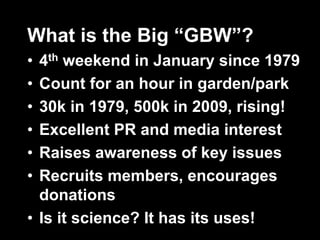
What is the Big “GBW”?
• 4th weekend in January since 1979
• Count for an hour in garden/park
• 30k in 1979, 500k in 2009, rising!
• Excellent PR and media interest
• Raises awareness of key issues
• Recruits members, encourages
donations
• Is it science? It has its uses!
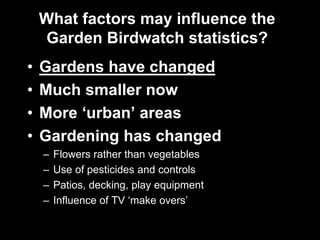
What factors may influence the
Garden Birdwatch statistics?
• Gardens have changed
• Much smaller now
• More ‘urban’ areas
• Gardening has changed
– Flowers rather than vegetables
– Use of pesticides and controls
– Patios, decking, play equipment
– Influence of TV ‘make overs’
What factors may influence the
Garden Birdwatch statistics?
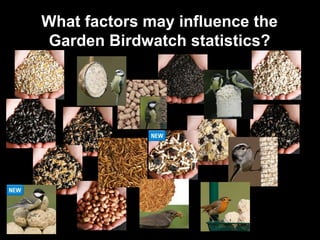
• Bird Feeding has changed
• 1979 Peanuts and scraps
• Advice has changed
• TV has had a huge influence
• Feeding stations especially in
small gardens
• Feeding the birds is now big
business!
What factors may influence the
Garden Birdwatch statistics?
What factors may influence the
Garden Birdwatch statistics?
• Bird populations have changed
• Changes in farming & land
management
• Continuing erosion of nest sites
• Increased air, noise and light
pollution
• Climate is changing
What factors influence the numbers
of birds using gardens?
• Amount of natural food available in the
countryside (time of year)
• Access to natural food available in the
countryside (weather)
• Amount/variety of food provided in a garden
(artificial and natural)
• The size and location of the garden in respect
the larger local habitat (macro-habitat)
• The general population level of the species
(influenced by seasonal migration and weather)
What are the results of the
“Big Garden Birdwatch”?
• Shows overall populations change
year on year due to weather
• Shows changes in how birds use
gardens in winter
• Shows population trends of species
over a long period
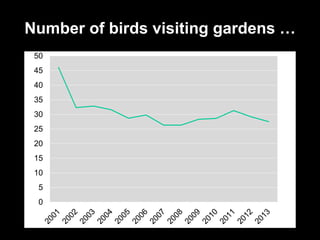
• Shows bird numbers visiting
gardens declining
Number of birds visiting gardens …
0
5
10
15
20
25
30
35
40
45
50
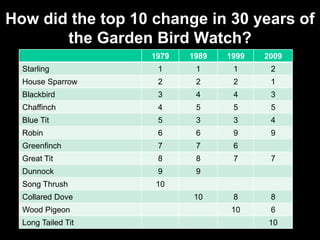
How did the top 10 change in 30 years of
the Garden Bird Watch?
1979 1989 1999 2009
Starling 1 1 1 2
House Sparrow 2 2 2 1
Blackbird 3 4 4 3
Chaffinch 4 5 5 5
Blue Tit 5 3 3 4
Robin 6 6 9 9
Greenfinch 7 7 6
Great Tit 8 8 7 7
Dunnock 9 9
Song Thrush 10
Collared Dove 10 8 8
Wood Pigeon 10 6
Long Tailed Tit 10
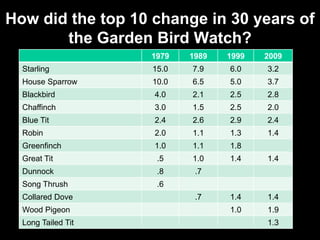
How did the top 10 change in 30 years of
the Garden Bird Watch?
1979 1989 1999 2009
Starling 15.0 7.9 6.0 3.2
House Sparrow 10.0 6.5 5.0 3.7
Blackbird 4.0 2.1 2.5 2.8
Chaffinch 3.0 1.5 2.5 2.0
Blue Tit 2.4 2.6 2.9 2.4
Robin 2.0 1.1 1.3 1.4
Greenfinch 1.0 1.1 1.8
Great Tit .5 1.0 1.4 1.4
Dunnock .8 .7
Song Thrush .6
Collared Dove .7 1.4 1.4
Wood Pigeon 1.0 1.9
Long Tailed Tit 1.3
0.00
2.00
4.00
6.00
8.00
10.00
12.00
14.00
16.00
18.00
Average
Percentage
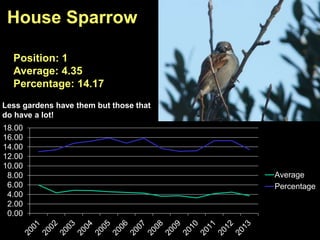
House Sparrow
Position: 1
Average: 4.35
Percentage: 14.17
Less gardens have them but those that
do have a lot!
0.00
5.00
10.00
15.00
20.00
Average
Percentage
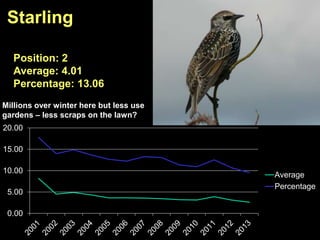
Starling
Position: 2
Average: 4.01
Percentage: 13.06
Millions over winter here but less use
gardens – less scraps on the lawn?
0.00
2.00
4.00
6.00
8.00
10.00
12.00
Average
Percentage
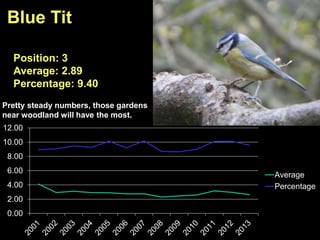
Blue Tit
Position: 3
Average: 2.89
Percentage: 9.40
Pretty steady numbers, those gardens
near woodland will have the most.
0.00
2.00
4.00
6.00
8.00
10.00
12.00
14.00
Average
Percentage
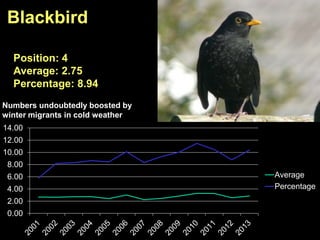
Blackbird
Position: 4
Average: 2.75
Percentage: 8.94
Numbers undoubtedly boosted by
winter migrants in cold weather
0.00
1.00
2.00
3.00
4.00
5.00
6.00
7.00
8.00
9.00
2001200220032004200520062007200820092010201120122013
Average
Percentage
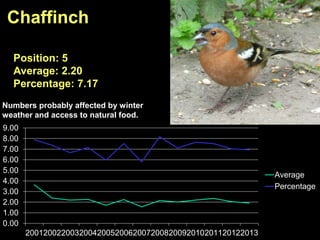
Chaffinch
Position: 5
Average: 2.20
Percentage: 7.17
Numbers probably affected by winter
weather and access to natural food.
0.00
1.00
2.00
3.00
4.00
5.00
6.00
7.00
8.00
2001200220032004200520062007200820092010201120122013
Average
Percentage
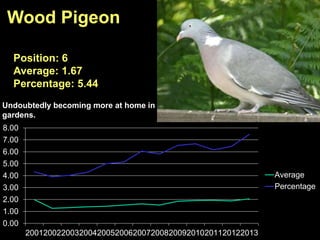
Wood Pigeon
Position: 6
Average: 1.67
Percentage: 5.44
Undoubtedly becoming more at home in
gardens.
0.00
1.00
2.00
3.00
4.00
5.00
6.00
7.00
2001200220032004200520062007200820092010201120122013
Average
Percentage
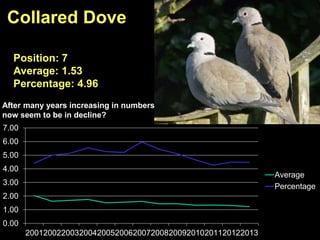
Collared Dove
Position: 7
Average: 1.53
Percentage: 4.96
After many years increasing in numbers
now seem to be in decline?
0.00
1.00
2.00
3.00
4.00
5.00
6.00
2001200220032004200520062007200820092010201120122013
Average
Percentage
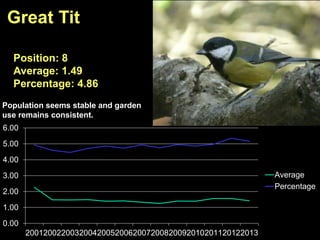
Great Tit
Position: 8
Average: 1.49
Percentage: 4.86
Population seems stable and garden
use remains consistent.
0.00
1.00
2.00
3.00
4.00
5.00
6.00
7.00
8.00
2001200220032004200520062007200820092010201120122013
Average
Percentage
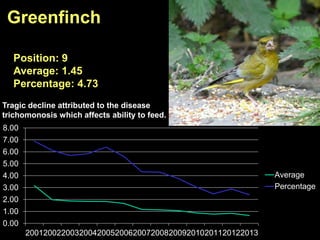
Greenfinch
Position: 9
Average: 1.45
Percentage: 4.73
Tragic decline attributed to the disease
trichomonosis which affects ability to feed.
0.00
1.00
2.00
3.00
4.00
5.00
6.00
2001200220032004200520062007200820092010201120122013
Average
Percentage
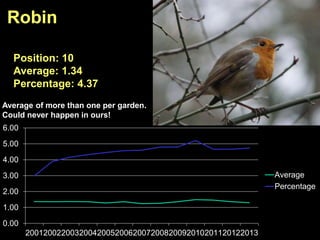
Robin
Position: 10
Average: 1.34
Percentage: 4.37
Average of more than one per garden.
Could never happen in ours!
0.00
1.00
2.00
3.00
4.00
5.00
6.00
2001200220032004200520062007200820092010201120122013
Average
Percentage
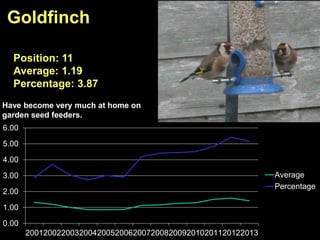
Goldfinch
Position: 11
Average: 1.19
Percentage: 3.87
Have become very much at home on
garden seed feeders.
0.00
0.50
1.00
1.50
2.00
2.50
3.00
3.50
4.00
4.50
2001200220032004200520062007200820092010201120122013
Average
Percentage
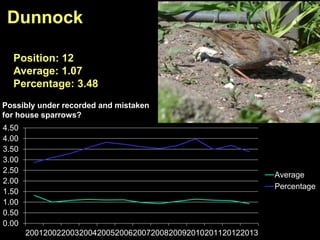
Dunnock
Position: 12
Average: 1.07
Percentage: 3.48
Possibly under recorded and mistaken
for house sparrows?
0.00
1.00
2.00
3.00
4.00
5.00
2001200220032004200520062007200820092010201120122013
Average
Percentage
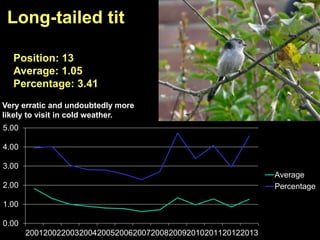
Long-tailed tit
Position: 13
Average: 1.05
Percentage: 3.41
Very erratic and undoubtedly more
likely to visit in cold weather.
0.00
0.50
1.00
1.50
2.00
2.50
3.00
3.50
4.00
2001200220032004200520062007200820092010201120122013
Average
Percentage
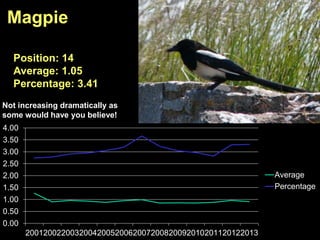
Magpie
Position: 14
Average: 1.05
Percentage: 3.41
Not increasing dramatically as
some would have you believe!
0.00
0.50
1.00
1.50
2.00
2.50
3.00
2001200220032004200520062007200820092010201120122013
Average
Percentage
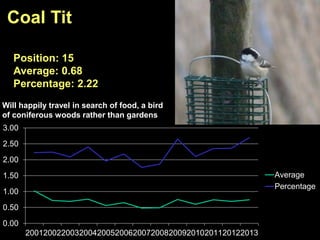
Coal Tit
Position: 15
Average: 0.68
Percentage: 2.22
Will happily travel in search of food, a bird
of coniferous woods rather than gardens
0.00
0.50
1.00
1.50
2.00
2.50
3.00
3.50
2001200220032004200520062007200820092010201120122013
Average
Percentage
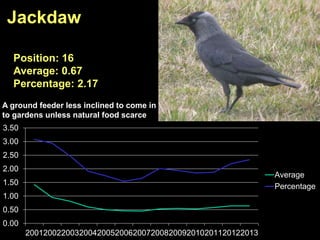
Jackdaw
Position: 16
Average: 0.67
Percentage: 2.17
A ground feeder less inclined to come in
to gardens unless natural food scarce
0.00
0.50
1.00
1.50
2.00
2.50
3.00
2001200220032004200520062007200820092010201120122013
Average
Percentage
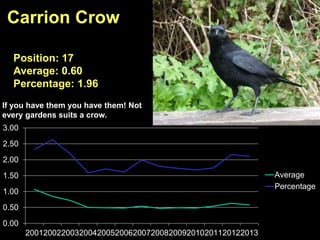
Carrion Crow
Position: 17
Average: 0.60
Percentage: 1.96
If you have them you have them! Not
every gardens suits a crow.
0.00
0.20
0.40
0.60
0.80
1.00
1.20
1.40
1.60
2001200220032004200520062007200820092010201120122013
Average
Percentage
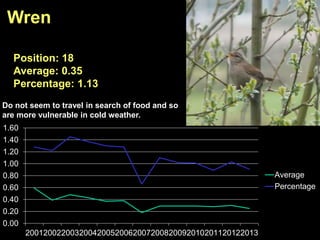
Wren
Position: 18
Average: 0.35
Percentage: 1.13
Do not seem to travel in search of food and so
are more vulnerable in cold weather.
0.00
0.20
0.40
0.60
0.80
1.00
1.20
1.40
2001200220032004200520062007200820092010201120122013
Average
Percentage
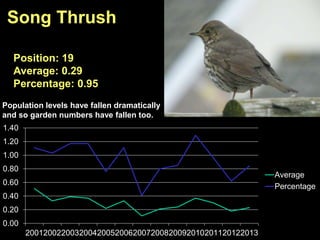
Song Thrush
Position: 19
Average: 0.29
Percentage: 0.95
Population levels have fallen dramatically
and so garden numbers have fallen too.
0.00
0.20
0.40
0.60
0.80
1.00
2001200220032004200520062007200820092010201120122013
Average
Percentage
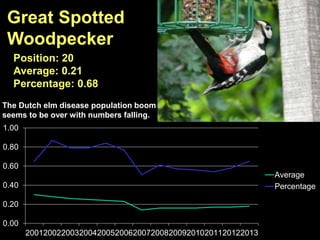
Great Spotted
Woodpecker
Position: 20
Average: 0.21
Percentage: 0.68
The Dutch elm disease population boom
seems to be over with numbers falling.
Summing up …
• No two winters are the same and no two
winters are the same in your garden
• No two gardens are the same, the area
surrounding you will have a big effect
• The numbers of birds using gardens in
winter is falling but so are population levels
• Gardens are vitally important to some
species, less so to others
• Despite some dramatic losses there are also
some winners (that seem to be less popular)

Watching the garden birdwatch update 2013