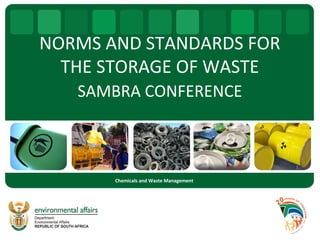
NORMS AND STANDARDS FOR
THE STORAGE OF WASTE
SAMBRA CONFERENCE
Chemicals and Waste Management
Presentation Outline
• Background
• Purpose
• Application of the Standards
• Design and Construction
• General Requirements of storage containers
• Minimum Requirements for above ground
storage facilities
• Minimum Requirements for underground
storage containers
• Monitoring & Inspection
• Auditing& Reporting
• Decommissioning
• Transitional Provisions
Background
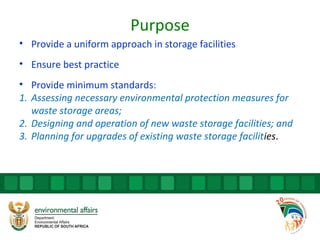
NEM:WA,2008 : Part 4 List of activities that require a
WML:S19(1)
S 7 (1) (c) : Norms & standards for the storage, treatment &
disposal of waste
S19(3)(a) : Standards that must be adhered to
S19(2)(b) : Removal of waste management activities
from the list
Purpose
• Provide a uniform approach in storage facilities
• Ensure best practice
• Provide minimum standards:
1. Assessing necessary environmental protection measures for
waste storage areas;
2. Designing and operation of new waste storage facilities; and
3. Planning for upgrades of existing waste storage facilities.
Application of the N&S
• Any person who stores general or hazardous waste in a
storage facility.
• Activities commenced or upgraded after the coming into
effect of these standards.
• The norms and standards do not apply to the storage of
general or hazardous waste in surface impoundments or
lagoons.
Registration
• Registration with the competent authority 90 days prior to construction
• Information to be provided when you register:
1. Demarcation & location
2. Name of the facility
3. Owner
4. Type of waste
5. Size
6. Geographical co-ordinates
• Registration form available on http://sawic.environment.gov.za
Construction and Design
• To be carried out under the supervision of a
registered professional engineer.
• Firm and impermeable chemical resistant floor.
• Liquid storage facility must have an interception
trench.
• Drainage and containment system
General Requirements
• All solid waste must be stored in skips or sealed containers
• Liquid wastes must be covered with roof and stored in leak
resistant waste storage containers.
• A leak monitoring device must be installed on the liquid waste
storage containers.
• Containers in contact with soil must be protected from
external corrosion.
Minimum Req for above ground waste storage facility
• A hazardous waste container resting on the ground must be underlain by
barriers, which will not deteriorate with permeability rate of the waste
stored.
• Bottoms of the container in contact with soil and are subject to corrosion
must be protected from external corrosion by either ensuring that the
container is made of corrosion resistant materials or the container have a
cathodic protection system.
• A waste storage tank must not have mechanical joints, except if it can be
accessed for inspection.
• The screw fitting or other fixed coupling fitted to the tank must be
maintained in good condition and must only be used when filling the tank.
Minimum Req for underground waste storage
containers
• Underground waste storage container must have double walled and synthetic
liners and underground vaults must be installed.
• A steel underground tank and piping in contact with soil must be protected
from corrosion using corrosion resistant materials or cathodic protection.
• Container components that are placed underground and backfilled must be
provided with a backfill material that is a non-corrosive, porous,
homogeneous substance and that is installed so that the backfill is placed
completely around the tank and compacted to ensure that the tank and
piping are fully and uniformly supported.
• If external coating is used to protect the tank from external corrosion, the
coating must be fiberglass, reinforced, plastic, epoxy, or any other suitable
dielectric material.
Monitoring & Inspection
• Containers must be inspected for leaks, structural integrity &
any sign of deterioration on a weekly basis.
• Registered engineer must inspect tanks containing hazardous
waste every year.
• Secondary containment system must be examined at least
weekly
• Ventilation systems, sump pumps, emergency alarms & other
mechanical system must be inspected on a weekly basis.
Auditing & Reporting
• Internal audits must be conducted bi-annually & findings of the audit
must be made available to the external auditor.
• External audit must conducted bi-ennially by an external auditor &
findings must be submitted to the relevant authority within 30 days after
the completion of the audit.
• Emergency incidents will be reported in terms of S30 of NEMA.
• Complaints & incident register must be made available to the external
auditor & the relevant authority.
• The relevant authority responsible for waste management reserves the
right to inspect the waste storage facility without prior notification at any
time.
Decommissioning
• Compile & Submit a rehabilitation plan for approval at least 1
year prior to the intended closure.
• The site must be rehabilitated to the satisfaction of the
relevant authority
Transitional Provisions
• Person who lawfully operated a waste storage facility prior to
and on the date of coming into operation of the standards
may continue with the activity for the duration as stipulated
in the authorization & after the expiry of the authorization
must comply with the standards.
Waste Management: Norms & Standards

Waste Management: Norms & Standards

  • 1.
    NORMS AND STANDARDSFOR THE STORAGE OF WASTE SAMBRA CONFERENCE Chemicals and Waste Management
  • 2.
    Presentation Outline • Background •Purpose • Application of the Standards • Design and Construction • General Requirements of storage containers • Minimum Requirements for above ground storage facilities • Minimum Requirements for underground storage containers • Monitoring & Inspection • Auditing& Reporting • Decommissioning • Transitional Provisions
  • 3.
    Background NEM:WA,2008 : Part4 List of activities that require a WML:S19(1) S 7 (1) (c) : Norms & standards for the storage, treatment & disposal of waste S19(3)(a) : Standards that must be adhered to S19(2)(b) : Removal of waste management activities from the list
  • 4.
    Purpose • Provide auniform approach in storage facilities • Ensure best practice • Provide minimum standards: 1. Assessing necessary environmental protection measures for waste storage areas; 2. Designing and operation of new waste storage facilities; and 3. Planning for upgrades of existing waste storage facilities.
  • 5.
    Application of theN&S • Any person who stores general or hazardous waste in a storage facility. • Activities commenced or upgraded after the coming into effect of these standards. • The norms and standards do not apply to the storage of general or hazardous waste in surface impoundments or lagoons.
  • 6.
    Registration • Registration withthe competent authority 90 days prior to construction • Information to be provided when you register: 1. Demarcation & location 2. Name of the facility 3. Owner 4. Type of waste 5. Size 6. Geographical co-ordinates • Registration form available on http://sawic.environment.gov.za
  • 7.
    Construction and Design •To be carried out under the supervision of a registered professional engineer. • Firm and impermeable chemical resistant floor. • Liquid storage facility must have an interception trench. • Drainage and containment system
  • 8.
    General Requirements • Allsolid waste must be stored in skips or sealed containers • Liquid wastes must be covered with roof and stored in leak resistant waste storage containers. • A leak monitoring device must be installed on the liquid waste storage containers. • Containers in contact with soil must be protected from external corrosion.
  • 9.
    Minimum Req forabove ground waste storage facility • A hazardous waste container resting on the ground must be underlain by barriers, which will not deteriorate with permeability rate of the waste stored. • Bottoms of the container in contact with soil and are subject to corrosion must be protected from external corrosion by either ensuring that the container is made of corrosion resistant materials or the container have a cathodic protection system. • A waste storage tank must not have mechanical joints, except if it can be accessed for inspection. • The screw fitting or other fixed coupling fitted to the tank must be maintained in good condition and must only be used when filling the tank.
  • 10.
    Minimum Req forunderground waste storage containers • Underground waste storage container must have double walled and synthetic liners and underground vaults must be installed. • A steel underground tank and piping in contact with soil must be protected from corrosion using corrosion resistant materials or cathodic protection. • Container components that are placed underground and backfilled must be provided with a backfill material that is a non-corrosive, porous, homogeneous substance and that is installed so that the backfill is placed completely around the tank and compacted to ensure that the tank and piping are fully and uniformly supported. • If external coating is used to protect the tank from external corrosion, the coating must be fiberglass, reinforced, plastic, epoxy, or any other suitable dielectric material.
  • 11.
    Monitoring & Inspection •Containers must be inspected for leaks, structural integrity & any sign of deterioration on a weekly basis. • Registered engineer must inspect tanks containing hazardous waste every year. • Secondary containment system must be examined at least weekly • Ventilation systems, sump pumps, emergency alarms & other mechanical system must be inspected on a weekly basis.
  • 12.
    Auditing & Reporting •Internal audits must be conducted bi-annually & findings of the audit must be made available to the external auditor. • External audit must conducted bi-ennially by an external auditor & findings must be submitted to the relevant authority within 30 days after the completion of the audit. • Emergency incidents will be reported in terms of S30 of NEMA. • Complaints & incident register must be made available to the external auditor & the relevant authority. • The relevant authority responsible for waste management reserves the right to inspect the waste storage facility without prior notification at any time.
  • 13.
    Decommissioning • Compile &Submit a rehabilitation plan for approval at least 1 year prior to the intended closure. • The site must be rehabilitated to the satisfaction of the relevant authority
  • 14.
    Transitional Provisions • Personwho lawfully operated a waste storage facility prior to and on the date of coming into operation of the standards may continue with the activity for the duration as stipulated in the authorization & after the expiry of the authorization must comply with the standards.