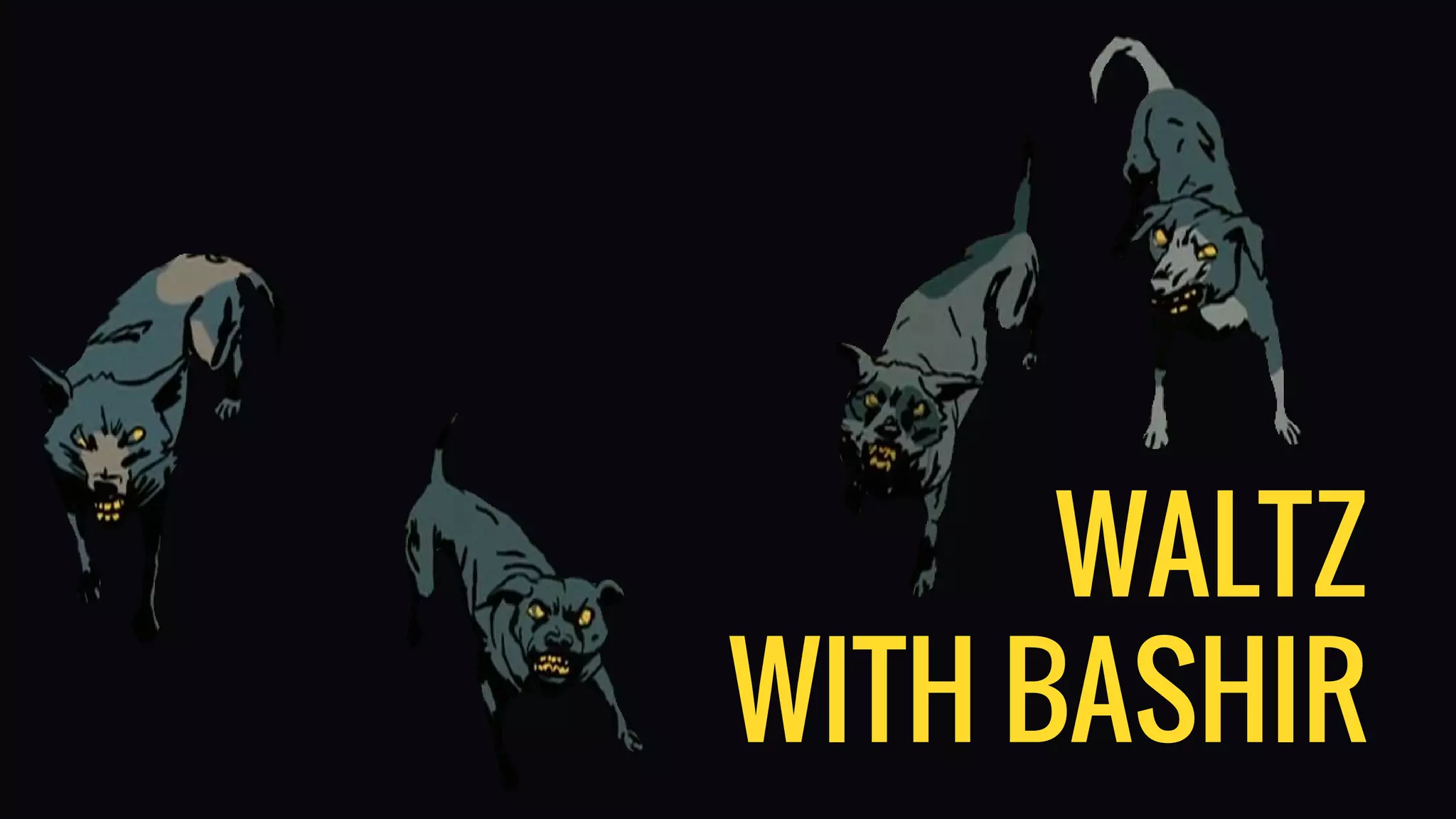
WALTZ
WITH BASHIR
TECHNOLOGY,
POWER & PROTEST
GROUP MANAGER
Kendra Lynn
GROUP EDITOR
Alex Henry
GROUP DESIGNER
Kyle Bacon
FILM INTRODUCTION
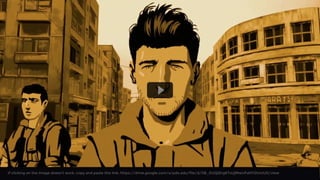
Israeli filmmaker Ari Folman wrote, directed, and stars in this autobiographical animated
film. As a young infantry soldier in the 1982 war with Lebanon, Folman witnessed the
Sabra and Shatila massacre, but realizes that he has no memory of the event whatsoever.
In 2006, Ari seeks out others who were in Beirut during the war, interviewing them to
learn more about what really happened and how he can cope with his unknown role in
the massacre. Through the use of flashback, strange animated dream-sequences, and
music-video-like scenes, Folman narrates his piecing together of the events in Beirut with
the help of a psychologist specializing in post-traumatic stress disorders and one of the
first journalists who covered the massacre.
On the way, he finds people who have no memories of the massacre, just like him, people
who have vivid and clear memories that are so fantastic and improbable that they couldn’
t have ever happened in reality, and people who are very selective about their memories
of the war.
If clicking on the image doesn’t work, copy and paste this link: https://drive.google.com/open?id=0B_DUQtErgKTsZnJfQ09ycFExVHM
CULTURAL
CONTEXT
CULTURAL CONTEXT
The Israeli army invaded Lebanon
in June of 1982. The purpose was
to defeat the Palestine Liberation
Organization.
Israel had hoped that the newly
elected President Gemayel would
encourage an Israeli-Christian
alliance because he was a
Maronite Christian.
The Sabra and Shatila massacre occurred on September 16-18, 1982. It was
in response to the assassination of Lebanese President Gemayel. It was
wrongly assumed that Palestinians were responsible for the assassination.
The Israeli army allowed the Lebanese Christian Phalangist militia to enter
the Sabra and Shatila camps in Beirut, where they murdered up to 2,000
Palestinian civilian men, women, and children.
(BBC News, 2002)
CULTURAL CONTEXT
“Despite the differences between my experience of
the massacres and that of Folman, it was my war on
the screen in Waltz with Bashir. But it was also his,
and that of the people he portrayed. Not my war,
but our war. And suddenly, almost miraculously, I
am not alone.”
CULTURAL CONTEXT
—TOD NORMAN, HOW A CARTOON HELPED HEAL A LEBANON VETERAN
ANIMATION
TECHNICAL
ASPECTS
ANIMATION TECHNICAL ASPECTS
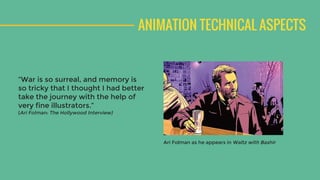
“War is so surreal, and memory is
so tricky that I thought I had better
take the journey with the help of
very fine illustrators.”
(Ari Folman: The Hollywood Interview)
Ari Folman as he appears in Waltz with Bashir
ANIMATION TECHNICAL ASPECTS
HOW THEY DID IT
Even before production began, Ari
Folman believed that animation was
the correct method to tell his story.
The production of Waltz with Bashir
took four years from the moment
research began until the final cut.
The whole film was filmed first in-
studio, then animated later.
FOR EXAMPLE,
as Ari interviewed Carmi in the film
inside of a car traveling to Holland, the
in-studio interview had Carmi and Ari
sitting on two studio chairs while
Carmine held a toy steering wheel in
his hands.
ANIMATION TECHNICAL ASPECTS
WHY IT’S AMAZING
The highly advanced Sisyphean
animation technique developed for
this movie took incredible amounts
of time to make and to use. Only
four minutes of movie were made a
month.
This is the second-ever Israeli
animated film.
The unique style blended together
reality and fantasy, to further the
themes of finding what is real and
what isn’t.
The final scene of the movie is not
animated but is actual footage from
the aftermath of the tragic massacre.
VISUAL
METAPHOR
VISUAL METAPHOR
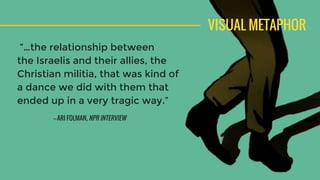
“…the relationship between
the Israelis and their allies, the
Christian militia, that was kind of
a dance we did with them that
ended up in a very tragic way.”
—ARI FOLMAN, NPR INTERVIEW
VISUAL METAPHOR
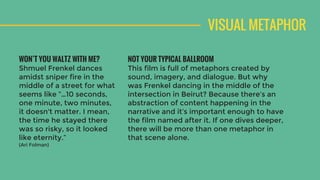
NOT YOUR TYPICAL BALLROOM
This film is full of metaphors created by
sound, imagery, and dialogue. But why
was Frenkel dancing in the middle of the
intersection in Beirut? Because there’s an
abstraction of content happening in the
narrative and it’s important enough to have
the film named after it. If one dives deeper,
there will be more than one metaphor in
that scene alone.
WON’T YOU WALTZ WITH ME?
Shmuel Frenkel dances
amidst sniper fire in the
middle of a street for what
seems like ”…10 seconds,
one minute, two minutes,
it doesn't matter. I mean,
the time he stayed there
was so risky, so it looked
like eternity.”
(Ari Folman)
VISUAL METAPHOR
A battle of politics, weaved with
religious interests, resulting in war and
massacre making soldiers mad with
thoughts of Chopin and dance. Or, is Ari
Folman simply waltzing, a dance for
two, with his memories?
MEMORY
MEMORY
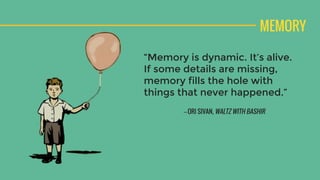
“Memory is dynamic. It’s alive.
If some details are missing,
memory fills the hole with
things that never happened.”
—ORI SIVAN, WALTZ WITH BASHIR
MEMORY
A FAMOUS PSYCHOLOGICAL EXPERIMENT…
A group of subjects were shown ten pictures
from their childhood. Nine of the ten pictures
were authentic, but one was fabricated. An
image of the subject as a child was pasted into
a scene from a fairground they never attended.
Eighty percent of the people recognized the
fake picture as real. The other twenty percent
“remembered” the event at a later date.
MEMORY
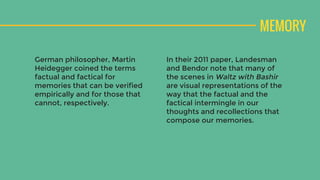
German philosopher, Martin
Heidegger coined the terms
factual and factical for
memories that can be verified
empirically and for those that
cannot, respectively.
In their 2011 paper, Landesman
and Bendor note that many of
the scenes in Waltz with Bashir
are visual representations of the
way that the factual and the
factical intermingle in our
thoughts and recollections that
compose our memories.
MEMORY
“The real is a closely woven fabric. It
does not await our judgment before
incorporating the most surprising
phenomena, or before rejecting the
most plausible figments of our
imagination.”
(Merleau-Ponty, 1962)
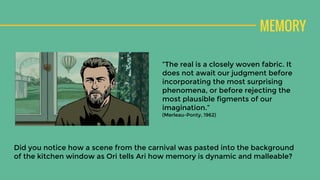
Did you notice how a scene from the carnival was pasted into the background
of the kitchen window as Ori tells Ari how memory is dynamic and malleable?
WORKS CITED
Anziska, Seth. “A Preventable Massacre.” The New York Times 16 Sept. 2012, The Opinion Pages sec. Web. 14 Nov.
2015.
“Flashback: Sabra and Shatila Massacres.” BBC News. BBC, 24 Jan. 2002. Web. 14 Nov. 2015.
Feinstein, Hermine. “Meaning and Visual Metaphor.” Studies in Art Education 23.2 (1982): 45-55. JSTOR. Web. 13
Nov. 2015.
Folman, Ari. “Dancing With Memory, Massacre In ‘Bashir’” NPR. Ed. Terry Gross. NPR, 03 Dec. 2008. Web. 09 Nov.
2015.
Folman, Ari. Ari Folman: The Hollywood Interview Terry Keefe. 13 November 2012. 2012.
“Waltz with Bashir.” Waltz with Bashir. The Match Factory, 2008. Web. 12 Nov. 2015.
Landesman, Ohad, and Roy Bendor. “Animated Recollection and Spectatorial Experience in Waltz with Bashir.”
Animation (2011): 353-70. Sage Publications. Web.
Merleau-Ponty, Maurice. Phenomenology of Perception. Routledge & Kegan Paul, 1962. Print.
Norman, Tod. “How a Cartoon Helped Heal a Lebanon Veteran.”Thejc.com. 13 Nov. 2008. Web. 15 Nov. 2015.
Waltz with Bashir. By Ari Folman. Dir. Ari Folman. Sony Picture Classics, 2008. Animated War Documentary.

Waltz with Bashir Group Presentation

  • 1.
  • 2.
  • 3.
    GROUP MANAGER Kendra Lynn GROUPEDITOR Alex Henry GROUP DESIGNER Kyle Bacon
  • 4.
    FILM INTRODUCTION Israeli filmmakerAri Folman wrote, directed, and stars in this autobiographical animated film. As a young infantry soldier in the 1982 war with Lebanon, Folman witnessed the Sabra and Shatila massacre, but realizes that he has no memory of the event whatsoever. In 2006, Ari seeks out others who were in Beirut during the war, interviewing them to learn more about what really happened and how he can cope with his unknown role in the massacre. Through the use of flashback, strange animated dream-sequences, and music-video-like scenes, Folman narrates his piecing together of the events in Beirut with the help of a psychologist specializing in post-traumatic stress disorders and one of the first journalists who covered the massacre. On the way, he finds people who have no memories of the massacre, just like him, people who have vivid and clear memories that are so fantastic and improbable that they couldn’ t have ever happened in reality, and people who are very selective about their memories of the war.
  • 5.
    If clicking onthe image doesn’t work, copy and paste this link: https://drive.google.com/open?id=0B_DUQtErgKTsZnJfQ09ycFExVHM
  • 6.
  • 7.
    CULTURAL CONTEXT The Israeliarmy invaded Lebanon in June of 1982. The purpose was to defeat the Palestine Liberation Organization. Israel had hoped that the newly elected President Gemayel would encourage an Israeli-Christian alliance because he was a Maronite Christian.
  • 8.
    The Sabra andShatila massacre occurred on September 16-18, 1982. It was in response to the assassination of Lebanese President Gemayel. It was wrongly assumed that Palestinians were responsible for the assassination. The Israeli army allowed the Lebanese Christian Phalangist militia to enter the Sabra and Shatila camps in Beirut, where they murdered up to 2,000 Palestinian civilian men, women, and children. (BBC News, 2002) CULTURAL CONTEXT
  • 9.
    “Despite the differencesbetween my experience of the massacres and that of Folman, it was my war on the screen in Waltz with Bashir. But it was also his, and that of the people he portrayed. Not my war, but our war. And suddenly, almost miraculously, I am not alone.” CULTURAL CONTEXT —TOD NORMAN, HOW A CARTOON HELPED HEAL A LEBANON VETERAN
  • 10.
  • 11.
    ANIMATION TECHNICAL ASPECTS “Waris so surreal, and memory is so tricky that I thought I had better take the journey with the help of very fine illustrators.” (Ari Folman: The Hollywood Interview) Ari Folman as he appears in Waltz with Bashir
  • 12.
    ANIMATION TECHNICAL ASPECTS HOWTHEY DID IT Even before production began, Ari Folman believed that animation was the correct method to tell his story. The production of Waltz with Bashir took four years from the moment research began until the final cut. The whole film was filmed first in- studio, then animated later. FOR EXAMPLE, as Ari interviewed Carmi in the film inside of a car traveling to Holland, the in-studio interview had Carmi and Ari sitting on two studio chairs while Carmine held a toy steering wheel in his hands.
  • 13.
    ANIMATION TECHNICAL ASPECTS WHYIT’S AMAZING The highly advanced Sisyphean animation technique developed for this movie took incredible amounts of time to make and to use. Only four minutes of movie were made a month. This is the second-ever Israeli animated film. The unique style blended together reality and fantasy, to further the themes of finding what is real and what isn’t. The final scene of the movie is not animated but is actual footage from the aftermath of the tragic massacre.
  • 14.
  • 15.
    VISUAL METAPHOR “…the relationshipbetween the Israelis and their allies, the Christian militia, that was kind of a dance we did with them that ended up in a very tragic way.” —ARI FOLMAN, NPR INTERVIEW
  • 16.
    VISUAL METAPHOR NOT YOURTYPICAL BALLROOM This film is full of metaphors created by sound, imagery, and dialogue. But why was Frenkel dancing in the middle of the intersection in Beirut? Because there’s an abstraction of content happening in the narrative and it’s important enough to have the film named after it. If one dives deeper, there will be more than one metaphor in that scene alone. WON’T YOU WALTZ WITH ME? Shmuel Frenkel dances amidst sniper fire in the middle of a street for what seems like ”…10 seconds, one minute, two minutes, it doesn't matter. I mean, the time he stayed there was so risky, so it looked like eternity.” (Ari Folman)
  • 17.
    VISUAL METAPHOR A battleof politics, weaved with religious interests, resulting in war and massacre making soldiers mad with thoughts of Chopin and dance. Or, is Ari Folman simply waltzing, a dance for two, with his memories?
  • 18.
  • 19.
    MEMORY “Memory is dynamic.It’s alive. If some details are missing, memory fills the hole with things that never happened.” —ORI SIVAN, WALTZ WITH BASHIR
  • 20.
    MEMORY A FAMOUS PSYCHOLOGICALEXPERIMENT… A group of subjects were shown ten pictures from their childhood. Nine of the ten pictures were authentic, but one was fabricated. An image of the subject as a child was pasted into a scene from a fairground they never attended. Eighty percent of the people recognized the fake picture as real. The other twenty percent “remembered” the event at a later date.
  • 21.
    MEMORY German philosopher, Martin Heideggercoined the terms factual and factical for memories that can be verified empirically and for those that cannot, respectively. In their 2011 paper, Landesman and Bendor note that many of the scenes in Waltz with Bashir are visual representations of the way that the factual and the factical intermingle in our thoughts and recollections that compose our memories.
  • 22.
    MEMORY “The real isa closely woven fabric. It does not await our judgment before incorporating the most surprising phenomena, or before rejecting the most plausible figments of our imagination.” (Merleau-Ponty, 1962) Did you notice how a scene from the carnival was pasted into the background of the kitchen window as Ori tells Ari how memory is dynamic and malleable?
  • 23.
    WORKS CITED Anziska, Seth.“A Preventable Massacre.” The New York Times 16 Sept. 2012, The Opinion Pages sec. Web. 14 Nov. 2015. “Flashback: Sabra and Shatila Massacres.” BBC News. BBC, 24 Jan. 2002. Web. 14 Nov. 2015. Feinstein, Hermine. “Meaning and Visual Metaphor.” Studies in Art Education 23.2 (1982): 45-55. JSTOR. Web. 13 Nov. 2015. Folman, Ari. “Dancing With Memory, Massacre In ‘Bashir’” NPR. Ed. Terry Gross. NPR, 03 Dec. 2008. Web. 09 Nov. 2015. Folman, Ari. Ari Folman: The Hollywood Interview Terry Keefe. 13 November 2012. 2012. “Waltz with Bashir.” Waltz with Bashir. The Match Factory, 2008. Web. 12 Nov. 2015. Landesman, Ohad, and Roy Bendor. “Animated Recollection and Spectatorial Experience in Waltz with Bashir.” Animation (2011): 353-70. Sage Publications. Web. Merleau-Ponty, Maurice. Phenomenology of Perception. Routledge & Kegan Paul, 1962. Print. Norman, Tod. “How a Cartoon Helped Heal a Lebanon Veteran.”Thejc.com. 13 Nov. 2008. Web. 15 Nov. 2015. Waltz with Bashir. By Ari Folman. Dir. Ari Folman. Sony Picture Classics, 2008. Animated War Documentary.