W E A L T H                            A C C E L E R A T I O N        C E R T I F I C A T I O N   L E V E L   1


Name


Contact Details


Wealth Acceleration Certification Level 1 Manual v 10 © 2004 - 2010                                               1
T H E   A C A D E M Y   O F   W E A L T H       &   A C H I E V E M E N T


                                 My Buddy


    	    My Buddy


    	    Home Town


    	    Phone Number


    	    Tell Your Buddy


    		          1. 	   What’s your name?
    		          2.	    What are your contact details?
    		          3.	    Why are you absolutely committed to being here?


2                                                                    Wealth Acceleration Certification Level 1 Manual v 10 © 2004 - 2010
W E A L T H                            A C C E L E R A T I O N            C E R T I F I C A T I O N    L E V E L        1


                                                                      Welcome to Your
  Wealth Acceleration Certification
W    e all have dreams and desires for our lives. Why is it that sometimes we get what we want and sometimes we don’t? Why do
     we start out in the direction of our goals only to find ourselves off course or falling short of what we know we are capable of?
And more importantly, how can we consistently accomplish the goals we set for ourselves so that we can live the life of our dreams?

Those were some of the questions I began asking myself at a time in my life when I was $70,000 in debt, living in someone else’s
garage apartment and feeling I had few prospects for my future. I had already taken countless seminars and read all the best-sellers
on personal development so I knew what to do, just not how to do it. It was when I started to write down my goals and take personal
responsibility to shift my focus toward what I truly desired that everything in my thinking and my life started to shift. Instead of
dwelling on the feeling that I was not where I wanted to be, I asked myself, what is the difference between those people who have
wealth and riches beyond their wildest dreams and those who live from paycheck to paycheck? Because the mind always seeks
resolution, that one unanswered question sent me on a quest studying the lives of great leaders in every field and caused me to develop
my system of Subconscious Reprogramming that eventually resulted in the growth of The Academy of Wealth & Achievement.

The answer to that question—what sets successful leaders apart—is their mind sets, focus, strategies, behaviors, beliefs, values and
many other internal factors that determine our experiences in life. The Academy of Wealth & Achievement was established to give
individuals and organizations those particular skills, attitudes and mind sets to turn their boldest visions and intentions into realities and
results and most importantly to help them create the rich and fulfilling life and lifestyle that they truly desire and absolutely deserve.
Most people go through life believing they have to cope with themselves as they are and deal with life as it comes because, “that’s
just the way it is.” The scientific fact is, reality is subjective, therefore, you can actually create your life however you want it. You
can forever transform aspects of your personality that no longer serve you and manifest your deepest heart’s desires. I developed the
techniques of Subconscious Reprogramming as a specific set of tools that literally reprograms thinking on a subconscious, neurological
level to replicate the thinking and behavioral patterns of success.

I am not interested in pumping people up into a hyper state of motivation only to have them go home and have their lives gradually
return to “normal,” as is so many people’s experience with seminars. Our trainings and programs are unique in that participants not
only undergo a profound change on both a conscious and subconscious level, they also take with them specific techniques to apply in
their daily lives to remain focused and motivated through the accomplishment of their intended goals. If you are ready to finally take
charge of your reality and live the life you know you are meant to live, our fast track to success that will absolutely assist you in closing
the gap between where you are and where you want to be.


           To your success,


           Christopher Howard
           CEO & Founder
           The Academy of Wealth & Achievement


Wealth Acceleration Certification Level 1 Manual v 10 © 2004 - 2010                                                                         3
T H E      A C A D E M Y         O F     W E A L T H        &    A C H I E V E M E N T


    The

Academy of Wealth & Achievement
                                                                                                                            by Amy Sorkin


    If you were introduced to a quick effective technique to
     create change in your life instantly, in your finances,
health, relationships, and career, would you try it?
                                                                your self-concept and expanding the results that you
                                                                are able to produce in any context.
                                                                “Through the technique of Cognitive Profiling, we can
Christopher Howard, an internationally acclaimed expert         look at any result that anybody has ever produced and
in accelerated change technologies and leadership, has          replicate that result in a fraction of the time,” explains
made a career out of guiding people to immediately              Howard. “In the various courses we teach in our Academy
transform ineffective thoughts and behaviors into               of Wealth & Achievement, Cognitive Profiling and
adaptable, successful ones that allow them to create the        Cognitive Re-imprinting, along with other tools, are
results they want in their lives.                               taught as a means of accelerating one’s own success We
                                                                teach how to replicate or expand excellence.”
Howard’s unique Subconscious Reprogramming
technologies are the next generation of tools for               So how does it work? Let’s say somebody wants to
achievement. They are a hybrid science grown out of and         become a multi-billionaire or super success, and they
improving on several models dating back to earlier last         choose Oprah Winfrey as their role model. “Her success
century. What started with Korzybski’s general semantics        is the result of a superior mindset,” says Howard. “The
in the 1930’s, was further developed by Bandler and Grinder     question then becomes; “How can we emulate and install
in the early 70’s into Neuro-Linguistic Programming or          her psychology into somebody else?” All of Oprah’s
NLP. Since then the field was popularized in the 80s by         qualities, her values, attitudes, beliefs, the decisions she’s
the likes of Tony Robbins, and now Howard brings these          made, how she sees people, and the strategies she uses to
cutting edge tools into their fourth generation, adding his     produce the results she wants, are analyzed and broken
unique understanding of hypnosis and quantum physics            down. “One of Oprah’s main driving forces is to be loved,”
to create change in a fraction of the time it has taken in      explains Howard. “We can take that and then analyze the
the past.                                                       strategies she used to run that driving force. Part of what
                                                                this technology does is allows us to break things down
“Think of the human brain as being the most fantastic
                                                                into small enough parts to make them transferable.”
biocomputer ever created,” explains Howard, who has
personally led, managed, launched or turned around              The manner in which Cognitive Re-imprinting transfers
numerous organizations and businesses in the past decade.       such parts to an individual includes adjusting their values
“But it’s not user friendly. The technologies we teach are      and beliefs in a way that serves their highest potential. “We
kind of like a User’s Guide. Installing a new system, such      all have certain ways we code and store information in our
as the mindset of someone like Gandhi, for example, is          minds and bodies. A ‘value’ is simply what is important to
like upgrading your software system.”                           you, and values will largely shape your world,” elaborates
                                                                Howard. “A ‘belief’ is simply a feeling of certainty about
In his courses, Howard uses Subconscious Reprogramming
                                                                something, but it’s not necessarily true. Using Results
to instigate instant change on a subconscious level.
                                                                Technologies, we can shift the way you store values and
“Instead of looking only at therapists as a source to model,    beliefs in your body, so you can change what’s important
I began looking to the greatest spiritual, world and business   to you at the subconscious level, therefore releasing
leaders of all time, such as Nelson Mandela, Gandhi, and        subconscious blocks to your success.”
Richard Branson (the mastermind behind Virgin Records
                                                                And going back to the computer analogy, “If all you have
and Virgin Airlines), to name a few.”
                                                                is poverty or lousy relationships punched into your search
 From this research Howard created his Subconscious             engine, that’s all that will come up. We teach people how
Reprogramming Technologies. They are tools that allow           to gain control of those things, so that they can punch
you to create your life the way that you want by expanding      wealth and harmony in instead, and then that will appear


4                                                                                            Wealth Acceleration Certification Level 1 Manual v 10 © 2004 - 2010
W E A L T H                            A C C E L E R A T I O N        C E R T I F I C A T I O N       L E V E L       1


      in their lives.”                                                       Although       the     Subconscious    Reprogramming
                                                                             technologies are largely psychologically oriented,
 In the Wealth Propulsion Intensive weekend, people
                                                                             Howard feels there is a strong spiritual aspect to what he
 focus on the Financial Pain or Wealth Goals. Howard, his
                                                                             does. “Who we really are is love and light and goodness,
 Trainers and Support Team help them to apply accelerated
                                                                             and what prevents us from tapping into that are, negative
 technologies to break through any blocks and apply his
                                                                             emotions and limiting decisions. So when we release those
 next generation tools. “It’s a wonderful weekend to figure
                                                                             things in our programs, we then become more of who we
 out what subconscious factors are controlling one’s life,
                                                                             really are. I see the use of Subconscious Reprogramming
 and how they can break through these obstacles once and
                                                                             in my courses as a means of getting closer to our spiritual
 for all,” says Howard.
                                                                             nature.
 A great example of the success of the techniques taught
                                                                             “When people come into the weekend program,” concludes
 by Howard is exemplified by an artist who came to a
                                                                             Howard, “They have major changes as a result of being
 weekend seminar. “She decided to focus on finances
                                                                             there only two-and a half days. They are blown away by
 first,” says Howard. “She was making $70,000.00 a year
                                                                             the personal transformation they get afterwards and call
 at the time. What she learned was that one of her beliefs
                                                                             us for weeks, months and even years later telling us how
 was that money and happiness didn’t go hand in hand.
                                                                             much their lives have changed. From an instructor’s
 During the training she released this and other limiting
                                                                             viewpoint, what could be more fulfilling than that?”
 decisions through a regression type of technique. Within
 a year and a half after attending our program, she is now
 making $180,000.00 a year and working less. She’s also
 attended an additional week long program, lost over 50
 pounds, and has gotten her ideal relationship as well.
 Howard maintains that there are two things that determine
 our success in life, our internal communication, which
 is how and what we communicate inside our minds and
 bodies (our thoughts), and our external communication,
 which is the manner in which we communicate with
 others. “No one who produces major results in the world
 has done so unless it has been with and through other
 people,” emphasizes Howard
 “Subconscious Reprogramming techniques enable us to
 change internal and external communication, focus on
 leadership and groups, and show people how to develop
 the ability to be influential in their own lives.”
 An important aspect of Howard’s training is that he has
 developed a system where people not only learn the tools
 for change, but are forced to apply them. In addition to the
 various exercises done in class, challenging activities such
 as rope training, rock climbing, and even hang gliding are
 used to stretch people beyond their limits to make them
 believe they can do anything.


Wealth Acceleration Certification Level 1 Manual v 10 © 2004 - 2010                                                                   5
T H E           A C A D E M Y                    O F         W E A L T H                 &       A C H I E V E M E N T


Trademarks of The Academy of Wealth & Achievement (AWA) and The Christopher Howard Companies are not designated in the text of this manual.

The following are trademarks of AWA and may not be used without permission: (this is not an exhaustive list).
Christopher Howard ®				                                      The Christopher Howard Companies ™			                              Ultimate Investment Seminar ™
Precision Repatterning ™				                                  Cognitive Repatterning ™				                                       Behavior Replacement Model ™
Breakthrough to Success ™			                                  RESULTS Certification ™			                                         Strategy Scrambler ™
Master RESULTS Certification ™			                             Presentation and Platform Skills ™			                              Christopher Howard’s Foundation Skills ™
Performance Revolution ®			                                   Billionaire Bootcamp ™				                                         Christopher Howard Profit Coaching ™
Design Your Destiny ™				                                     Leadership Explosion ™				                                         Wealth and Power Evening ™
Your Personal Breakthrough ™			                               Christopher Howard Business Training ™		                           7 Keys to Wealth ™	
Stepping Into Wealth ™				                                    Skyrocket Your Sales ™				                                         Leadership Skills for Influence ™		
Decide, Commit, Take Action ™			                              Ultimate Business Seminar ™			                                     Creation Technologies ™
Neural Bridge ™				                                           Neurological Bridge ™				                                          S. O. A. R. to R. I. C. H. E. S. ™
Billionaire Adventure Club ™			                               Fast Track to Success ®				                                        The Clarity Model ™
University of Excellence ™			                                 Creation Technologies™				                                         C. R. E. A. T. E. ™
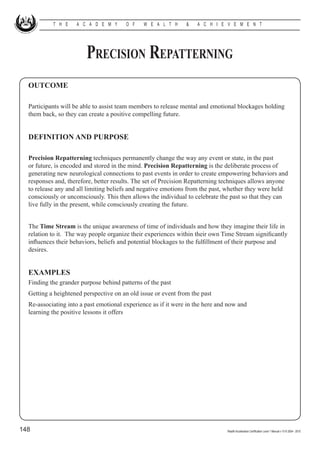
Precision Repatterning ™				                                  Cognitive Re-Imprinting ™			                                       Cognitive Profiling ™
Christopher Howard’s Decision Destroyer ™		                   Christopher Howard’s Emotion Obliterator ™		                       Turning Passions Into Profits ™
Time Stream ™				                                             Response Repatterning ™				                                        Solution Model ™
Identity Expansion Model ™			                                 Momentum Pattern ™				                                             Questions to Customize Results ™
The Mentors Circle ™				                                      Christopher Howard Trainer ™			                                    Neurological Repatterning ™
Results Technologies ™				                                    Christopher Howard Business Training ™		                           Strategic Visioning ™
Christopher Howard Coaching and Mentoring Program ™	          Rich Heart | Wealthy Mind ™			                                     The Warrior Spirit ™
Wealth Acceleration Certification ™			                        Advanced Presenter Immersion ™			                                  Ultimate Trainer Acceleration ™
Awakened Wealth Warrior ™			                                  Awakened Wealth Master ™			                                        Ultimate Marketing Seminar ™
The Christopher Howard Training Academy of Wealth ™	          Christopher Howard’s Leadership & Coaching Academy ™ 	             The Next Generation of Achievement ®
The Path to Awakened Wealth ™			                              Christopher Howard Trainers Training ™		                           The Wealth Propulsion Intensive ™
The Wealth Propulsion System ™			                             Instant Wealth: Wake Up Rich ™			                                  Wealth Acceleration Coaching ™
Platform Skills Intensive ™			                                Academy of Wealth & Achievement™			                                Ultimate Internet Marketing Seminar ™
Christopher Howard’s Master Trainer Development Program ™	 Ultimate Wealth Seminar ™			                                          Forgiveness Process™
Christopher Howard Training™			                               Funeral Process™				                                               The Wealth Creed™
The Wealth Incantation™				                                   Wealth Acceleration Intensive™			                                  Ultimate Compelling Close™
The 5 Dichotomies of Thought™			                              Questions for Self Discovery™			                                   The New Entrepreneurial Mind™
Strategic Visioning™				                                      10 Step Introduction™				                                          4 Phase Instruction™
3 Step Debrief™				                                           Simultaneous Thinking™				                                         W.I.C.S. Model™
T.O.F. Model™				                                             E.A.B. Model™				                                                  10 Step Effective Criticism Pattern™
Bulletproof Bookstore™				                                    My M.E.O.™				                                                     Finding Life in the Desert Process™
Elements of Living a Rich Life™			                            Cognitive Profiling™				                                           Wealth & Success Pack™
The Writing Process™				                                      Genius Reading™				                                                Assumptions of Wealth™
4MATd Feedback Model™			                                      Protein Style Feedback Model™			                                   Results Focused Change Model™
Mastery Model™				                                            Emotional Pyramid™				                                             3 Spheres of Leadership™
Charting Across Contexts of Life™			                          Crystal Merchant Game™				                                         Stick & Stones Process Game™
Win As Much As U Can™			                                      Visual Stack™				                                                  Dream Programming™
12 Tenets of Accelerated Learning™			                         Assumptions of Empowered Teaching™		                               Assumptions of Empowered Leadership™
4x4 Strategy Process™				                                     Work Back to Now Process™			                                       WB2N™
The Quantum Question™				                                     The Advanced Writing Process™			                                   Archetypal Writing Process™
Neurological Repatterning™			                                 Creation Technologies™				                                         Master of Wealth & Achievement™
Platform Power™				                                           The Purple Belt Story™				                                         The 5 Trainer Styles™
7 Master Steps™				                                           Game of Pure Potentiality™			                                      E-S-A Loops™
Living Goals™				                                             Gifts I Give to Me List™				                                       Macro Mind Virus™
Performance Results Descriptions™			                          PRD™					                                                          Results Programming™
Subconscious Reprogramming™			                                Pyramid Qualifier Close™			                                        Extreme Limiter Close™
“The globe and swoosh” logo ®			                              Universal Expansion Induction™			                                  Intention Groups™
The Attitude Challenge™				                                   The Boardroom Challenge™			                                        The Trading Game™
Collage of Dreams™				                                        Vision Journal™				                                                Two Worlds of Existence™
This Is Me; This Is Who I Am Process™		                       Being With Process™				                                            Firing It Up™
Billionaire Club Reality TV Show Game™		                      Empowerment Pack™				

All seminar materials are copyrighted pursuant to federal copyright law. No part of this manual may be reproduced or transmitted in any way without written permission from AWA.


6                                                                                                                                          Wealth Acceleration Certification Level 1 Manual v 10 © 2004 - 2010
W E A L T H                            A C C E L E R A T I O N        C E R T I F I C A T I O N   L E V E L   1


                                                   Resources


Wealth Acceleration Certification Level 1 Manual v 10 © 2004 - 2010                                               7
T H E     A C A D E M Y        O F    W E A L T H        &    A C H I E V E M E N T


          Discover the most cutting edge, advanced techniques for creating massive, rapid
                     and lasting behavioral change in yourself and other people.


                          WEALTH ACCELERATION CERTIFICATION LEVEL I


    T    his 5-DayAccelerated Certification Training takes the skills modeled from masters of accelerated human
         transformation and puts them in your hands. The skills, tools and techniques are focused on eliminating any
    self-doubt, impediment or belief in your own ability to create a rich and fulfilling lifestyle. Not only that, you will
    learn exactly what to do in order to Coach and Lead others to produce wealth and abundance in their finances,
    relationships and life.


    Y    ou will learn to harness the power of your subconscious mind and the communication skills to give you the
         ability to maximize your potential and multiply your effectiveness. With the set of tools taken away from this
    Level you will be able to and have the potential to be certified to empower your clients, colleagues, family and self
    to break through the behavioral patterns that stand in the way of the true richness of life and lifestyle you desire and
    deserve.

    You will learn…

    •	     The ability to create rapport instantly with anyone
    •	     Skills to transform individuals and/or organizations for extraordinary results
    •	     Mastery of language
    •	     Intervention techniques for eliminating deeply rooted subconscious and behavioral issues that
           block you and others from achieving success or keep you stuck in place in 10 minutes or less
    •	     Powerful strategies for creating what you want in any situation

    Become Certified in…

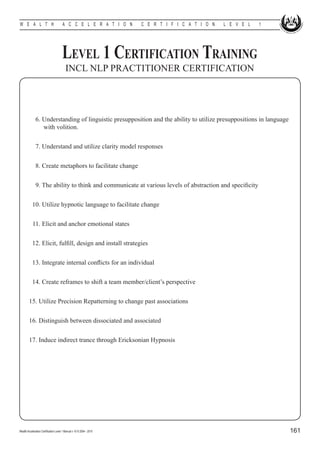
    	          Christopher Howard Acceleration Coach		          Practitioner Level Neuro-Linguistic Programming
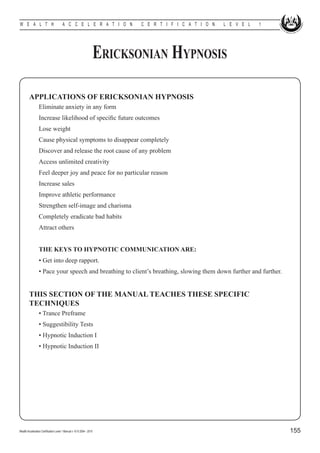
    	          Subconscious Reprogramming			                    Ericksonian Hypnosis


         The Wealth Acceleration Certification Trainings teach the skills and skillsets behind the
         breakthrough Christopher Howard Subconscious Reprogramming Techniques and trainings.
         Learn the science and master the technology to create massive and lasting change.


8                                                                                          Wealth Acceleration Certification Level 1 Manual v 10 © 2004 - 2010
W E A L T H                            A C C E L E R A T I O N        C E R T I F I C A T I O N   L E V E L    1


                 Learn the techniques, science and skills behind Christopher Howard’s breakthrough
                                      Neurological Repatterning™ technology


                                             WEALTH ACCELERATION CERTIFICATION LEVEL II


T    his next level of Acceleration Training designed to help you create Wealth in all aspects of your life is a must-do for
     anyone wanting to perform at the highest level and create the most rich and fulfilling life and life-style. It is also an
absolute must-do for anyone wanting to do high-level coaching or business performance consulting. It takes you deeper
into uncovering, working with, and changing personal values, attitudes, and other deep Subconscious Re-programming
and thought viruses that determine the level of results you achieve and exactly what you achieve in life.


I t is about changing the very basis of personality to make powerful, positive and permanent change. You will receive
  internationally recognized qualifications in Subconscious Reprogramming and neuro-linguistic programming that
will allow you to make and build your own life and weave the rich tapestry of existence you desire. You will also be
qualified to consult, coaching and motivate others to do exactly the same.


You will learn…

•	      Advanced tools for high-level business consulting
•	      Values processes to align personal and professional relationships
•	      Personality profiling skills that will make you a master hiring consultant
•	      Advanced language patterns for creating change conversationally
•	      The best diagnostic tool to get to the core of major issues for individuals
•	      The second half of the full body of Results Technologies tools to enable long and lasting change

Become Certified in…

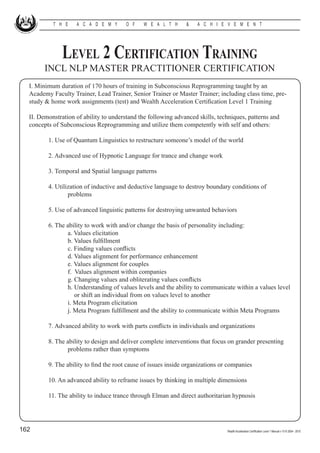
	                Christopher Howard Acceleration Master Coach		                  Advanced Subconscious Reprogramming
	                Master Practitioner Neuro-Linguistic Programming	               Master Hypnosis
	                Performance Consultant

                 The Wealth Acceleration Certification Trainings teach the skills and skillsets behind the
                 breakthrough Christopher Howard Subconscious Reprogramming Techniques and trainings.
                 Learn the science and master the technology to create massive and lasting change.


Wealth Acceleration Certification Level 1 Manual v 10 © 2004 - 2010                                                         9
T H E        A C A D E M Y               O F       W E A L T H            &     A C H I E V E M E N T


                           Are you inspired to accomplish great things in your life?
                             Do you want extraordinary communication skills to
                                inspire, influence and motivate other people?
Y    ou will walk away from this one-week immersion training with extraordinary communication skills to inspire,
     influence and motivate other people. This is truly the highest level of training designed to accelerate your wealth
in not only business but in every aspect of your finances and life.


T   hese teachings will help you become a truly charismatic and compelling communicator; you will learn how to
    create a truly confident and commanding presence both on and off the stage. You will then be able to leverage
your influence and business results by delivering your message to large audiences and groups.


Y    ou will learn the 36 behaviors of the most outstanding speakers, influencers and motivators on the planet
     and have those behaviors integrated at the subconscious level so that you will automatically use them in any
presentation without conscious effort or thought.


Y   our enhanced powers of persuasion, mastery of language and ability to create instant rapport will enable you to
    expand your personal and professional influence and help you grow your career or business beyond your wildest
expectations.

During the training you will gain...

       - 	 The power and confidence of a brilliant communicator and public speaker
       -	   Mastery of performance skills and the ability to wipe out performance anxiety
       -	   The ability to create instant and unconscious rapport with groups anywhere from 20 to 20,000 people
       -	   The secrets to entrancing your audience with spellbinding presentations
       -	   Skills for masterfully handling questions, objections and hecklers
       -	   A complete arsenal of the most cutting-edge psychological platform techniques in existence
       -	   Tailored communication skills and how to make your presentation most compelling to all learning styles
       -	   The ability to design impactful seminars and trainings
       -	   The business & marketing plan used by Chris Howard to create his international speaking business
       -	   The secrets to creating dynamic and compelling sales presentations used by the biggest names in the industry
       -	   Internationally recognized certification as a professional speaker
       -	   High quality feedback from Christopher Howard’s Trainers and certified presenters
       -    The step by step process for selling any product or service from a platform to small groups or large scale     	
       	    audiences
       -    The exact duplicatable business and marketing plan used to create a speaking business or in fact enhance any 	
       	    business through the power of leverage created on a platform

And much, much more!

The Platform Skills Intensive Training is only held once a year in each country and is in hot demand by masters of the
industry and new speakers alike.
10                                                                                       Wealth Acceleration Certification Level 1 Manual v 10 © 2004 - 2010
W E A L T H                            A C C E L E R A T I O N        C E R T I F I C A T I O N    L E V E L     1


Imagine if you could sit down with some of the world’s most powerful business legends like
              Warren Buffett, Bill Gates, Donald Trump or Oprah Winfrey...


W       hat could you do if you learnt the secrets behind what made their achievements inevitable, and then
        installed their mindsets in yourself to fulfill your own dreams. Billionaire Bootcamp transforms your
life instantly and forever by systematically helping you to remove unconscious sources of limitation while
simultaneously layering in the mindsets of these magicians of the material world. You walk away from this
one-week intensive possessing a new level of leadership and financial ability. The breakthroughs you will
have will leave you unstoppable as you move powerfully in the direction of your dreams.


D    uring the week long Billionaire Bootcamp you will embody the leadership techniques of the world’s
     rich and famous to achieve spectacular results. With the cutting edge techniques of Subconscious
Reprogramming™ and Cognitive Re-Imprinting™ we are as close as we’ve ever come to actually being
able to “download the mind software” of the super successful.


During the training you will learn...


                                       •	 How to eliminate thoughts and patterns (even ones you didn’t know you had)
                                       •	 Discover what has prevented you from fulfilling your boldest dreams
                                       •	 How to transform any and every aspect of your life instantly - and permanently
                                       •	 How to upgrade the software of your own mind and install the mindsets and strategies of
                                          the super successful for spectacular results
                                       •	 Subconscious Reprogramming™ processes that will allow you to embody the chosen
                                          beliefs, values, habits and attitudes of billionaires and great world leaders
                                       •	 How to enrich your interpersonal relationships and live a life of wealth and luxury


And much, much more!


                        Our Billionaire Bootcamp Trainings fill up quickly every year as more and more people, just like
                                     you act now on their desire to achieve the ultimate in financial success.
Wealth Acceleration Certification Level 1 Manual v 10 © 2004 - 2010                                                           11
T H E      A C A D E M Y        O F     W E A L T H        &    A C H I E V E M E N T


Do you ever find yourself wondering...


                                  What is my purpose in life?
                                What path can I take to get there?
Imagine if you could feel the richness of love and passion in your heart of knowing exactly what your purpose or
mission was in life while at the same time knowing you have the knowledge and skill and personal mastery needed to
make it happen. That is exactly what you will get during the extraordinary multi-day experience that is Rich Heart |
Wealthy Mind.

You will cast off the ache of wondering, “Why am I here?”, “What is my purpose?”, “What is the right path to get me
there?” Instead you will finally discover and truly know what you were destined to do and be able to map a path that
will let you live your life with passion, richness of experience, joy, wealth and abundance.

You will experience a phenomenal series of subconscious reprogramming techniques and tools to install those beliefs
and habits within yourself to turn your boldest dreams into the reality of your rich life and lifestyle that you desire and
have always truly deserved.

You will learn:

  •	   Exactly what your life’s purpose and mission is and be able to enjoy the richness of experience that it brings
       your heart
  •	   To identify, share and create your ultimate Vision for creating the life of your dreams for yourself, those you
       love the most and the world
  •	   To step forward on a path of power, wealth and abundance that will lead you to the creation of your wildest
       dreams and desires
  •	   Subconscious Re-programming techniques that will enable you to master your mind and behaviors
  •	   How to eliminate fear and doubt so you can move toward your desired future
  •	   How to create and live a step-by-step plan to manifest your destiny and how to stay on track to bring you there
       faster than ever imagined


And much, much more!

What is the value of knowing you are living your life on purpose every single day... and what is the cost of not living
your purpose?


12                                                                                         Wealth Acceleration Certification Level 1 Manual v 10 © 2004 - 2010
W E A L T H                            A C C E L E R A T I O N        C E R T I F I C A T I O N   L E V E L   1


T   he Warrior Spirit is a powerful metaphor for qualities of courage, responsibility, conviction, commitment and
    passion that you will develop over this intense multi-day experience. You will learn and develop the power to face
any challenge and stand up in the face of any adversity to triumph on a level never thought possible. Whether you
want to achieve in only on a personal level or in your business goals or in all aspects of life: business, personal, health,
financial wealth, family, connection etc… The Warrior Spirit is your path to ultimate victory and a richness of life that
only a few truly live.


T  his intense multi-day experience will bring you face to face with the true powerful leader you can become.
   Through powerful Subconscious Reprogramming techniques, Cognitive Profiling and experiential training and
games you will learn to embody the leadership qualities and skills of the world’s greatest leaders and influencers.


Y    ou will experience a revolution in your business or career communication, negotiation, ability to sell with heart
     and passion, influence and persuasion. The true richness of your personal and professional relationships will be
enhanced as you discover old patterns of limitation and replace them with new ways of embracing the true strength
and power you possess.


I n a turbo-charged series of experiential learning games, simulations and processes interspersed with powerful
  content and teachings you will be challenged time and time again to truly blast through any limitation and overcome
any obstacle to create a richness of experience, to create the wealth and abundance for yourself and those you love the
most in every aspect and area of your life.

You will be ready to face any challenge, stand up in the face of any adversity and

You will learn:

     •	      How to become a charismatic, magnetic and influential leader
     •	      How to get into the heads of the world’s most powerful, successful or richest people in order to accelerate your
             own success
     •	      A powerful process for negotiating any outcome in business or your personal life so that all parties get what
             they want
     •	      How to identify limiting patterns of behavior in yourself and others and to replace them with new behaviors to
             drive you forward
     •	      How to create or enhance the effectiveness, morale and loyalty of any Team and have them all achieving any
             goal or dream through complete alignment of purpose
     •	      An incredibly powerful model for sales that can be applied to personal dreams, beliefs and desires as easily as it
             is to your business and career wealth and profit


And much, much more!

The Warrior Spirit is held in limited locations around the world. This training experience is a must for every person in
business and in life. Due to the limited number of times this training is held it sells out quickly.

Wealth Acceleration Certification Level 1 Manual v 10 © 2004 - 2010                                                         13
T H E       A C A D E M Y          O F      W E A L T H          &    A C H I E V E M E N T


               Are you ready to step up to the level of Mastery hidden from most?
         Do you want to accelerate your success beyond what you ever thought possible?
        Are you prepared for the ultimate Presentation Training experience on the planet?


A     s a graduate of Christopher Howard’s Platform Skills Intensive™ (Presentation & Platform Skills I) you understand the
      powerful transformation achieved at that event and know that the secret to truly creating massive results is to play at the highest
level possible. To do this you must learn and model from the best. Advanced Presenter Immersion™ is your opportunity to do this
at a level usually reserved for only the elite few.


O    riginally designed as part of an eighteen month apprenticeship for members of the Christopher Howard Training™ Team this
     intensive seminar has compressed the lessons, skills, knowledge and experience into what will be FIVE of the most important
days of your life. Two years of detailed study of video, audio recordings and live performances of Christopher Howard, the
Christopher Howard Training™ Team, many more master communicators and other leaders of the speaking industry has brought
about a depth of training never before seen by the public.


E    ach day is designed to immerse you in multiple lessons through education, experience and evaluation.


You will learn...

                    •	   How to access any emotional state or resource instantly at any time by utilizing deep unconscious modeling
                         techniques
                    •	   Persuasion, Influence & sales techniques used by the biggest and best in the business
                    •	   Advanced Accelerated Learning Techniques to supercharge your Presentations and your Audiences
                    •	   How to design and deliver knock-out “Hypnotic Induction Processes”
                    •	   Multiple presentation styles that can be adapted to any situation
                    •	   Media Presenting Skills
                    •	   How to match your image, branding and presentation to create an impactful and impressive package
                    •	   Voice production, control & protection
                    •	   Behind the Scenes Logistical requirements for Presentations
                    •	   How to write your own Bookstores & practice them with interactive Coaching

			                              ... and so much more!


 Due to the nature of this intensive experiential training, room numbers are extremely limited
                                                and
                               this event is held ONLY once a year


14                                                                                                   Wealth Acceleration Certification Level 1 Manual v 10 © 2004 - 2010
W E A L T H                            A C C E L E R A T I O N                         C E R T I F I C A T I O N             L E V E L        1


                        Only for the most committed Trainers on the planet
                   Who want the most advanced skills available anywhere today
      And are prepared for the most challenging and focused training experience in the world


Y         ou completed the Platform Skills Intensive™ (Presentation & Platform Skills I) and mastered the basic patterns of the best
          speakers, motivators and facilitators on the planet.


Y     ou are a Trainer, Teacher, Educator, and Coach that deals with multiple people and want to drive yourself to reach your full
      potential. Or you want to create that career and life-style and the wealth that it can give you and those you love most. Graduates
of this program will be FASTRACKED to the final application phase of THE TRAINER CANDIDATE PROGRAM and may be
eligible to enter this path to become a Christopher Howard Trainer on one of our stages around the world.


O    riginally designed as part of an eighteen month apprenticeship for members of the Christopher Howard Training™ Team
     this intensive seminar has compressed the lessons, skills, knowledge and experience into what will be FOUR of the most
important days of your life. Two years of detailed study of video, audio recordings and live performances of Christopher Howard,
the Christopher Howard Training™ Team, many more master communicators and other leaders of the speaking industry has brought
about a depth of training never before seen by the public.


D    uring the program you will be presenting many segments from Christopher Howard FAST TRACK to Success™ Programs
     including Breakthrough to Success™. Due to the proprietary nature of the content and exercises, you will be asked to sign
confidentiality agreements prior to completing the Training.


   You will learn...

                                                     •	       Secrets to Large Audience success
                                                     •	       Keys to Participant Interventions from the Stage
                                                     •	       How to deliver world class demonstrations of Results Technologies processes
                                                     •	       What Archetypes are required for Trainers and how to access them on stage
                                                     •	       Question Answering and Coaching techniques from the platform
                                                     •	       Utilization Mastery - turn anything that happens to your advantage
                                                     •	       How to deal with any problem, feedback or high pressure situation & still create sales
                                                     •	       How to give and receive feedback that makes an instant impact


			                                                          ... and so much more!

  Due to the nature of this intensive experiential training, room numbers are extremely limited
                                                 and
                                this event is held ONLY once a year


Wealth Acceleration Certification Level 1 Manual v 10 © 2004 - 2010                                                                                    15
T H E   A C A D E M Y   O F   W E A L T H   &   A C H I E V E M E N T


               “Education’s
                 purpose is to
                  replace an
                 empty mind
                 with an open
                    one.”
             				                    -Malcolm Forbes-


16                                                            Wealth Acceleration Certification Level 1 Manual v 10 © 2004 - 2010
W E A L T H                            A C C E L E R A T I O N        C E R T I F I C A T I O N   L E V E L   1


                                              My Goals For This Training


   I am 100% ENROLLED in doing everything and anything I can to achieve my
   GOALS from this Program.

   I am 100% committed to my Goals and taking the actions NOW I know I can here.

       						                                                         								
Wealth Acceleration Certification Level 1 Manual v 10 © 2004 - 2010                                               17
T H E   A C A D E M Y   O F   W E A L T H   &   A C H I E V E M E N T


18                                                            Wealth Acceleration Certification Level 1 Manual v 10 © 2004 - 2010
W E A L T H                            A C C E L E R A T I O N          C E R T I F I C A T I O N   L E V E L   1


                                                                      SECTION
                                                                         1

                SUBCONSCIOUS
               REPROGRAMMING


        “All activity is at bottom imaginal. An awakened imagination works with a purpose. 	
        	 It creates and conserves the desirable and transforms or destroys the undesirable.”
        								                                                                      - Neville


Wealth Acceleration Certification Level 1 Manual v 10 © 2004 - 2010                                                 19
T H E       A C A D E M Y     O F       W E A L T H       &      A C H I E V E M E N T


      A Brief History of Accelerated Change
                                             Instant Wealth:
                                              Wake Up Rich                          SUBCONSCIOUS                               2009
                                                Chris Howard
                                                                                   REPROGRAMMING

                                            Turning Passions
                                              into Profits
                                                                 COGNITIVE
                                                                REIMPRINTING
                                                                                      COGNITIVE
                                                                                      PROFILING
                                                                                                                               2003
                                                Chris Howard


                                                                                       RESULTS
                                             PRECISION
                                           REPATTERNING
                                                                 NEUROLOGICAL
                                                                 REPATTERNING
                                                                                    TECHNOLOGIES
                                                                                      Christopher
                                                                                                                               2002
                                                                                        Howard

                        SUBMODALITIES      Using Your Brain       LANGUAGE
                                                                   PATTERNS
                                                                                     SLEIGHT OF                                1985
                                             for a Change                              MOUTH
                                                                                    Polya, J.S. Mill
                                                                Magic in Action


                            REFRAMING           Reframing           TRANCE
                                                                  INDUCTION          META PROGRAMS
                                                                                                                               1982
                                                                                      Richard & Leslie
                                                                Tranceformations          Bandler
                                                                 Applications of
                                                                      NLP
                                                                  Roots of NLP      NEURO ASSOCIATIVE
                                                                                      CONDITIONING
                                                                                                                               1980
                                                                                    Anthony Robbins

       TOTE MODEL           STRATEGIES       NLP Volume I            Dilts          METAPHORS                                  1980
         Galanter                                                                       Gordon
         7 + or - 2
          Miller

     BEHAVIORAL                            Frogs Into Princes      CHANGE
                           EYE PATTERNS                           PERSONAL
     PSYCHOLOGY                                                    HISTORY
        Pavlov


        HYPNOSIS            HYPNOTIC         Patterns I & II     EMBEDDED
      Milton Erickson       LANGUAGE                             COMMANDS
                             PATTERNS
                                                                REP SYSTEMS
                                                                                    FAMILY THERAPY                             1979
                                                                                      Virginia Satir

       LINGUISTICS                           The Structure       SYNETHESIA         GESTALT THERAPY
                           META MODEL        of Magic I & II      PATTERNS             Fritz Perls
        Watzlawick
         1950’s                                                                       ECOLOGY                                  1975
                                                                                                                                Debate about
                                                                                       Bateson &
        GENERAL                                                                         Haley
                                                                                                                             personal power
                                                                                                                     and its place in therapy
                                 Bandler Computers,
       SEMANTICS                      Gestalt
         Korzybski               Grinder Linguistics


20                                                                                        Wealth Acceleration Certification Level 1 Manual v 10 © 2004 - 2010
W E A L T H                            A C C E L E R A T I O N        C E R T I F I C A T I O N   L E V E L   1


                                           Subconscious Reprogramming
                                THE ART and SCIENCE of ACHIEVING RESULTS


      I  f traditional psychology is the study of “What’s wrong? And why?” then the technologies of
         Subconscious Reprogramming are the study and practice of “What’s right? And how can we replicate
      it?” It is the application of the psychology of excellence; a system of rapid evolution for ourselves,
      others and our lives utilizing the most up-to-date life-transforming sciences.
      Whether your vision is to improve your personal life and finances, to start or expand a business, to attain
      professional success, or to assist others in making major life-changes, you absolutely can achieve your
      goals. If anyone has ever produced the kinds of results you want in life and has achieved the kinds of
      successes you desire, there is a system to duplicate those results in your life and design the present and
      future as you want them. By knowing how to accelerate change within yourself, you can then manifest
      your vision in the world, inspire change in others and create the necessary synergistic relationships to
      carry that vision forward. Subconscious Reprogramming provides some of the most powerful and
      effective tools on the planet to move you to the next level of achievement and expand your spheres of
      influence. The possibilities for your life are as endless as your imagination.
      What are the steps you need to take to transform your boldest visions and dreams into real results? How
      do you take all that you envision in your financial future, career, personal and professional relationships,
      and your own personal development, and then accelerate the process to accomplish more than you ever
      thought possible? These are the promises of Subconscious Reprogramming. Recent major advances
      in the areas of science and technology are impacting the field of human potential. The Subconscious
      Reprogramming Technologies are the entire body of cutting-edge tools and techniques, which includes
      Neurological Repatterning and Cognitive Reimprinting, that utilize the mind’s and body’s capabilities to
      produce real results quickly. Now, as people understand more about how the brain operates, they can also
      learn how to utilize its power to create the lives they have always wanted. Subconscious Reprogramming
      is about removing all perceived “limitations” in order to gain behavioral options, mental flexibility and
      internal power to unleash your potential in any field of life.
      It is the nature of humans to do things better, quicker, and faster. Prior to Roger Banister’s achievement,
      running a mile in four minutes or less was considered physically “impossible.” When Banister broke
      the record, he also shattered the commonly held limitations of people’s thinking. Now high school and
      college students match or better Banister’s time every day. The same phenomenon happened when
      Chuck Yeager broke the “sound barrier” flying the X-1. Where society (and science) once held the
      thought pattern or belief “that could never be done,” people now accept that we are capable of flying
      further and faster with the continuing development of technology.
      Today, individuals can break through any of their own “barriers” to success and excel far beyond what
      they previously imagined possible for themselves. Subconscious Reprogramming produces accelerated
      human change by combining the most effective tools of Neurological Repatterning and Neuro Linguistic
      Programming with current scientific knowledge of how the mind and neurology define individual realities.
      If Neuro Linguistic Programming is like an owner’s manual for the mind, Subconscious Reprogramming
      is the owner’s manual for life. Where NLP was founded on modeling behavioral changes, Subconscious
      Reprogramming accelerates that transformation and expands upon the processes to model and replicate
      success and fulfillment in every area.


Wealth Acceleration Certification Level 1 Manual v 10 © 2004 - 2010                                                  21
T H E     A C A D E M Y      O F    W E A L T H       &   A C H I E V E M E N T


                                        What is NLP?
                         NEURO LINGUISTIC PROGRAMMING


     N    euro Linguistic Programming is a set of specific techniques that deliberately restructure toward
          positive functioning the brain’s thinking and the body’s behaviors by aligning the conscious with
     the unconscious mind and body. NLP offers highly refined tools to take charge of every area of life in the
     most effective way possible to produce results. It enables individuals to proactively design their physical
     and emotional responses.
     The Three Components of NLP are:


     NEURO –
		 •	 The nervous system’s taking in of “reality” through the five senses
			 - Visual (sight)
			 - Auditory (sound)
			 - Kinesthetic (touch)
			 - Olfactory (smell)
			 - Gustatory (taste)
		 •	 Understanding how the body’s and mind’s neurology works to better direct it toward more 		
   effective thoughts and behaviors
		 •	 Creating new neurological pathways that break through mental boundary conditions


     LINGUISTIC –
		 •	 Becoming aware of how communication occurs within self and with others
			 - pictures
			 - sounds			
		 - feelings
			 - tastes
			 - smells
			 - internal dialogue
		 •	 Using language to guide the mind toward change
		 •	 Speaking to others within their particular representational system or their model of the world


     PROGRAMMING –
		 •	 Understanding the mind is like a computer with thought patterns as the “software,” discovering 		
   what programs are determining current experience
		 •	 Using specific tools and techniques to reprogram, upgrade and install new “software” for 			
   optimal high performance


22                                                                                   Wealth Acceleration Certification Level 1 Manual v 10 © 2004 - 2010
W E A L T H                            A C C E L E R A T I O N        C E R T I F I C A T I O N   L E V E L   1


                                                            A Brief History of NLP
                                               A STUDY OF SUBJECTIVE EXPERIENCE


      N    euro Linguistic Programming is a hybrid science that was developed in the late 1960’s and early
           1970’s by computer scientist, Richard Bandler, and linguist, John Grinder. From the combined
      perspectives of their respective sciences, they began a study of three therapists with excellent results
      transforming their clients’ ways of thinking, feeling and behaving. They modeled Family therapist,
      Virginia Satir; Gestalt therapist, Fritz Perls; and Hypnotherapist, Milton Erickson, who legitimized
      hypnotherapy as a healing treatment modality accepted by the A.M.A. (American Medical Association).
      Bandler and Grinder were looking to discover exactly what transpired in the minds and bodies of patients
      at the moment change occurred. They asked what specifically caused the change and how they could
      replicate it more quickly and efficiently, without years of therapy.
      In addition, Bandler and Grinder examined what was occurring in the minds and behaviors of the therapists
      who achieved such great successes with their patients. Bandler and Grinder wanted to describe the steps
      of the therapeutic process itself to teach others step-by-step how to achieve the exact same results in
      less time. The techniques Bandler and Grinder developed by modeling Satir, Perls and Erickson are so
      concise and effective that the behavioral changes that used to take years now can occur within a matter
      of hours or minutes. In the decades since its inception, NLP has proved a reliable and fast way for people
      to gain control of their minds and, therefore, their results.


Wealth Acceleration Certification Level 1 Manual v 10 © 2004 - 2010                                                23
T H E   A C A D E M Y   O F   W E A L T H   &   A C H I E V E M E N T


24                                                            Wealth Acceleration Certification Level 1 Manual v 10 © 2004 - 2010
W E A L T H                            A C C E L E R A T I O N            C E R T I F I C A T I O N   L E V E L   1


                                                                      Quantum Reality
                                               INTERAL WORLD = EXTERNAL WORLD


      A     ll that exists in the external world is raw data, information with no intrinsic meaning. It is the human
            mind that ascribes meaning to experience. The unique meaning an individual chooses then affects
      their internal state, subsequent behaviors and outcomes. That is why to produce preferred results one
      must first understand and master the mind’s Information Filtration System—how external information is
      received internally to create experience.
      The senses are assaulted with 2 million bits of information per second throughout the course of a day.
      Located at the base of the brain, the Reticular Activating System (R.A.S.) is responsible for a number
      of functions, including filtering. Filtering is the process of sorting through those 2 million bits of
      information per second coming through the sensory input channels. To protect the brain from mental
      overwhelm, the R.A.S. must choose quickly what information to let into the conscious mind, and what
      simply to store in the recesses of the unconscious. Prior to understanding experiences, individuals have
      to internalize external events. To do this, people first take everything in through the five senses. They
      then create an Internal Representation of that event (I/R). That I/R is made up of internal pictures, sounds
      and sensations, including self-talk and feelings. The senses serve both external and internal functions:


      		          VISUAL – external sights in the world and internal in the mind’s eye
      		          AUDITORY – sounds heard externally and internally, including self-dialogue and voice tonality
      		          KINESTHETIC – sensations felt on the skin (the largest organ) as well as inside the body, 		
      		          including feelings produced by emotions
      		          OLFACTORY – the odors or fragrances smelled mostly externally; and those smells simulated 		
      	           by the imagination (i.e.. When someone is so hungry he or she can “smell dinner.”)
      		          GUSTATORY – tastes (also sometimes imagined, as in: “I can just taste it.”)

      The external information is then reconfigured as an internal experience. This interpretation of the world
      is then intimately linked to an internal “state.” A State is the term for any emotional/physical/mental
      state produced within the mind and body, such as a sad state, an excited state, a happy state, a nervous
      state, or a totally motivated state. A state could refer to a “state of mind.” Science has demonstrated
      that any state of mind also triggers an emotion in the physiology, a specific combination of chemicals
      released in the entire nervous system, and throughout every cell in the body. Hence, state refers to a
      specific and replicable emotional condition occurring within both mind and body simultaneously.


Wealth Acceleration Certification Level 1 Manual v 10 © 2004 - 2010                                                    25
T H E   A C A D E M Y   O F   W E A L T H   &   A C H I E V E M E N T


        Perception is Projection


26                                                            Wealth Acceleration Certification Level 1 Manual v 10 © 2004 - 2010
W E A L T H                            A C C E L E R A T I O N               C E R T I F I C A T I O N   L E V E L   1


                             Information Filtration Processing
                                                                      YOUR HIDDEN RULE BOOK


      A     fter receiving an external experience through the senses, the mind and body then interpret, or ascribe
            meaning to, the external event by running it through the internal processing system. This combines
      the biological filters of the Reticular Activating System with other more psychologically based Internal
      Filters that create a unique subjective reality for each individual. Interrupting and taking charge of these
      internal filters is the key to mental, emotional and behavioral mastery.


      RETICULAR ACTIVATING SYSTEM (R.A.S.)
      In order to reduce the overwhelming amount of information coming in through the five senses, the
      nervous system deletes, distorts, and generalizes information. It is those Internal Filters, formed and
      maintained by the unconscious mind, that “tell” the Reticular Activating System what information to
      sort for—usually those things that confirm an individual’s long-held beliefs and expectations. I call it
      the Hidden Rule Book.
      Sometimes individuals use this process in a way that robs them of options and, therefore, power. They can
      also consciously utilize this function to empower themselves by choosing the way they want to see and
      act in the world. This course teaches participants how to create an internal process that is empowering.
      By taking more control of a filtering process that would otherwise remain unconscious, people empower
      themselves to produce the results they most desire.
      The mind uses the following techniques to manage the amount of information registering in the conscious
      mind and assimilate it into a cohesive version of “reality”:


      	 1. Deletion
      Deleting incoming information is simply the process of leaving out large amounts of data to avoid
      sensory overload. Humans selectively pay attention to certain aspects of experience based on their
      Internal Filters (discussed in detail below). Because people get what they focus on and can’t experience
      what they delete, the experience of life is largely dependent upon what individuals are deleting at any
      given moment.
      An example of deletion is a person looking at something right in front of his face, as he’s saying, “I can’t
      find it!” Or, a woman may not “recognize” a colleague from work at first because he is out of context
      at the mall on a Saturday. Because the R.A.S. is not “sorting for” that face in that place or that time, it
      deletes the information. Even though the eyes pick up the information, it never becomes conscious.

      	 2. Distortion
      As with deletion, the ability to distort is a very important function of the human nervous system.


Wealth Acceleration Certification Level 1 Manual v 10 © 2004 - 2010                                                      27
T H E     A C A D E M Y       O F    W E A L T H      &    A C H I E V E M E N T


              Information Filtration Processing
                                  YOUR HIDDEN RULE BOOK

     It consists of creating and imagining as well as interpreting or ascribing meaning to a set of data.
     Although people may experience or view the “same” event, they will distort or interpret it differently.
     Twenty people could witness a performance and each end up with a separate Internal Representation
     (I/R) of that event in the form of pictures, sounds and/or feelings.
     One example of a distortion is a woman thinking she sees someone she knows who actually turns out to
     be a stranger. Or conversely, seeing the “ex” around every corner because he is on her mind.
     	 3. Generalization
     The third way to filter information is generalization. By generalizing, humans organize information to see
     a theme or overall picture. Generalization is a valuable process because it allows people to remember and
     categorize what they have learned. However, it can also lead to sweeping assumptions. Generalizations,
     like the other filtration processes, can either benefit or limit individuals because generalizations make
     up belief systems. Generalizations may be based on individual experiences as well as on socially and
     culturally-related issues such as gender, age, ethnicity, religion, or occupation.
     Unfortunately, many people generalize in ways that eliminate choices for them—“I could NEVER
     be successful,” or “You CAN’T make money without cheating people.” This is when people use the
     generalizing function in a disempowering way.


     INTERNAL FILTERS
     What people delete, distort and generalize depends on their Internal Filters. Internal Filters determine
     what humans focus on, look for, or “sort for,” as well as what is “left out” of their experience of reality.
     Internal Filters are created by:
     	 - upbringing
     	 - environment
     	 - significant emotional experiences (SEE)
     Internal Filters absolutely determine experience because they are the criteria used to sort the 2 million
     bits of information received each second. Together Internal Filters comprise a “mind set.” Yet, most of
     these filters—the very things that determine the experience of life—were established so long ago they
     are now obscured or completely hidden from awareness. People assume their “reality” reflects an
     absolute “truth.” Having minds “set” already a certain way doesn’t allow room for changes or for the
     expansion of spheres of influence. How can people expect to get more out of life if they think and act in
     the same way they (and possibly their ancestors) always have? One definition of insanity is doing the
     same thing over and over again while expecting different results. Those who find they are not achieving
     at the level at which they know they are capable, can change their mind set and Internal Filters, and
     thereby change their outcomes. Internal Filters include values, beliefs, attitudes, memories, decisions,
     language, and Meta Programs.


28                                                                                    Wealth Acceleration Certification Level 1 Manual v 10 © 2004 - 2010
W E A L T H                            A C C E L E R A T I O N               C E R T I F I C A T I O N   L E V E L   1


                             Information Filtration Processing
                                                                      YOUR HIDDEN RULE BOOK

      Values
      Values are broad concepts that guide decisions in life; they determine what is important, and they are the
      foundation of character. Significantly, what the conscious mind deems important is not always the same
      as what the unconscious mind values. Values can be detected by what people are attracted to or repulsed
      by and by people’s actions. Values determine how humans spend their time. Because individuals have
      different hierarchies of values, they experience life differently. For instance, individuals whose top value
      is wealth will invest time and effort in that area. Their experience of life will reflect that focus. If some
      of those same individuals do not also value honesty, then their route to wealth would be very different
      from others who highly value both wealth and honesty.
      Recognizing, reprioritizing, or aligning conscious and unconscious values, are major steps toward
      getting what one truly wants.


      Beliefs
      Beliefs are the second set of internal filters. Beliefs are convictions, what is held to be “true” in life. For
      instance, if someone believes that she can learn anything that she puts her mind to regardless of age, then
      her experience of life is going to be very different from someone else who if he believes he is not that
      smart and can’t possibly learn something new.
      Beliefs often form the boundary conditions of thinking. Depending on how much individuals are willing
      to believe is possible, beliefs can either keep them boxed in or allow them to live a bigger life. Small
      possibility thinking has little chance of giving anything other than small results, whereas big possibility
      thinking leads to big results. When transformed, beliefs allow people to fulfill their highest potential.


      Attitudes
      Attitudes are abstract ideas derived from “clusters” of beliefs and values around a given subject. They
      comprise “frames of mind,” the glasses through which people see the world, rose-colored or otherwise.
      They are often quite hard to pinpoint; therefore, their effects can be insidious. They can distort perspective
      positively or negatively, subsequently determining what individuals are able to get out of life. For
      example, the person who has a positive attitude toward work and sees it as a place to self-actualize while
      creating value for others will have a very different experience than someone with a negative attitude
      toward work who sees it only as a necessity to pay bills. Sometimes attitudes are the only things standing
      between people and the outcomes they want.


      Memories
      Memories also filter the current experience of reality. Memories are often the rationale for keeping a
      belief, whether it serves a person’s best interests anymore or not. Because the brain tends to categorize
      events in relation to previous experiences, both present and future are evaluated and/ or anticipated
      based on the meaning ascribed to past events. Yet, memories are only stored, selected snapshots of a
      multi-dimensional event that took place. Like an old photograph, the memory itself may be faded or

Wealth Acceleration Certification Level 1 Manual v 10 © 2004 - 2010                                                      29
T H E     A C A D E M Y       O F    W E A L T H      &    A C H I E V E M E N T


              Information Filtration Processing
                                 YOUR HIDDEN RULE BOOK

     may even be “forgotten” and stored in the unconscious; however, the interpretation of the event is stored
     neurologically in such a way that a similar event stimulates the old associations and ascribes the same or
     similar meaning to the “new” event. Thus faded memories oftentimes direct what actions people choose
     to take, making their behavior primarily directed by the unconscious.


     Decisions
     If memories perpetuate beliefs, then decisions are the cornerstones of beliefs. First, something “objective”
     happens, then individuals make subjective decisions about what to believe about life based on that
     “objective” event. For example, two people can have the same experience and make very different
     choices based on that experience. Two students in the same class could be told by their teacher they
     will never amount to anything in life. One may decide that, because teachers are knowledgeable, the
     statement is true. Subsequently, the student never amounts to anything. Meanwhile, the other student
     decides to prove the teacher wrong and goes on to become President of the United States of America.
     Life in the present reflects all the decisions made in the past. Although most decisions are filed away
     in the unconscious mind, they continue to determine current behaviors. Results Technologies™ uses
     specific tools to obliterate limiting decisions and anchor new more empowering ones.


     Language
     Language is also a powerful filter. Analytical philosophers and linguists from Schopenhauer to Muller
     have asserted that it is language that allows humans to take their minds to previously unexplored places
     and viewpoints. Because language determines what people can think about and how, it also determines
     what they can see in the world.
     The words people speak, hear and see are translated in their minds as pictures. Since what they focus on
     they create, it is worth being conscientious about word usage. For instance, individuals who are looking
     to be wealthy need to increase their financial vocabulary. An enlarged financial vocabulary will expand
     their view of what is monetarily possible for them in their lives.


     Meta Programs
     Meta Programs are context-dependent thought and behavioral patterns. They include our awareness
     of time, response to challenges and direction of energy. Understanding Meta Programs gives people
     more choice over how they choose to function. Recognizing certain Meta Programs in others helps in
     predicting people’s actions, providing services, understanding and communicating better with others.
     For example, a working knowledge of Meta Programs is invaluable when hiring. Recruiters can derive
     an individual’s Meta Programs with a set of questions that will enable them to predict with amazing
     accuracy how that individual would behave under stress, how long the candidate would probably stay in
     a job, whether the person is good at managing others, etc. In addition, installing Meta Programs is very
     important when modeling someone to replicate their results.


30                                                                                    Wealth Acceleration Certification Level 1 Manual v 10 © 2004 - 2010
W E A L T H                            A C C E L E R A T I O N        C E R T I F I C A T I O N   L E V E L   1


                                                                                                                  Notes


Wealth Acceleration Certification Level 1 Manual v 10 © 2004 - 2010                                                  31
T H E   A C A D E M Y   O F   W E A L T H   &   A C H I E V E M E N T


32                                                            Wealth Acceleration Certification Level 1 Manual v 10 © 2004 - 2010
W E A L T H                            A C C E L E R A T I O N        C E R T I F I C A T I O N   L E V E L   1


                                                                                                                  Notes


Wealth Acceleration Certification Level 1 Manual v 10 © 2004 - 2010                                                  33
T H E   A C A D E M Y   O F   W E A L T H   &   A C H I E V E M E N T


                             Time Stream
                       IN RELATION TO SELF


                                                           IN TIME CODING


                                            Description: Classic In Time person has past
                                            behind them, future in front of them and the
                                            Stream of Time runs through their body.


                                            Characteristics:
                                            - Lives in the moment
                                            -
                                            	 Likes to keep options open
                                            -
                                            	 Can be chronically late


                                            THROUGH TIME CODING


                                            Description: Classic Through Time person
                                            has Time Stream stretched out in front of them
                                            like a yard stick with the past off to the left
                                            and the future to the right.


                                            C
                                            	 haracteristics:
                                            	 Evaluates life linearly through time
                                            -
                                            -
                                            	 Likes day planners and schedules
                                            -
                                            	 Very cognizant of time; Chronically on time


34                                                               Wealth Acceleration Certification Level 1 Manual v 10 © 2004 - 2010
W E A L T H                            A C C E L E R A T I O N           C E R T I F I C A T I O N   L E V E L    1


                                                                      Time Stream
                                                                       ELICITATION
       This Elicitation Script will help you determine the Time
       Stream Coding for any individual.


       The first step to eliciting someone’s Time Stream is to pre-
       frame the concept of the Time Stream by explaining that
       people generally do have a spatial awareness of time, and
       everyone conceives it differently.


       Now if I were to ask you which direction the past seems
       like it is for you, I have the sense that you would point in
       some direction in relation to your body…


       Why don’t you just go ahead and point, so that you
       know you know where your past is. It may seem like                                   Person Points
       you’re guessing, but just go ahead and point.


       Good.
                                                                                            Acknowledging their action

       Now you have a past, and I know you have a future,
       so why don’t you just go ahead and point, so that you                                Person Points
       know, where the future is?


       Good.
                                                                                            Acknowledging their action

       Now notice that having the past in one direction and the
       future in another
       s
       	 ort of implies a stream, or COULD imply a stream...
       flowing from one direction to another


Wealth Acceleration Certification Level 1 Manual v 10 © 2004 - 2010                                                      35
T H E     A C A D E M Y      O F    W E A L T H     &   A C H I E V E M E N T


      Assumptions for Empowered Leadership

                     C.R.E.A.T.E.S. Y.O.U.R. C.H.O.I.C.E.S.


	 C	 Calibrate on behavior–actions speak louder than words
	 R	 Respect the other person’s model of the world
	 E	 Ecology of outcomes must be considered and evaluated
	 A	 Accept people; change behaviors
	 T	 Territory is represented by the map; just as reality is represented by the mind			
		 E 	 Everyone is doing the best they can with the resources they have available	
	 S	 Signs of resistance are due to a lack of rapport
						
	
	 Y	 You are in charge of your mind, and therefore your results					                    	
	 O	 Only feedback–no failure; therefore, utilize everything
	 U	 Unresourceful people do not exist, only unresourceful states
	 R	 Responses are the best way to evaluate the effectiveness of your communication
	

	    C	   Change occurring on the unconscious level is pervasive and creates long-lasting results
	    H	   Having a mission, vision and goals determines your focus, therefore your results
	    O	   Outcomes are determined by expectations
	    I	   If you help enough people get what they want most, you will get what you want most
	    C	 Choice is the desired condition, so design processes to gain more choices, not fewer
	    E	 Ecological framework always increases wholeness
	    S	 Situational behavioral flexibility increases effectiveness


36                                                                               Wealth Acceleration Certification Level 1 Manual v 10 © 2004 - 2010
W E A L T H                            A C C E L E R A T I O N        C E R T I F I C A T I O N   L E V E L   1


                                             Success Formula of Masters
								 “The secret of success is to fall down four times and get up five.”
														                                        - Chris Howard


	 1.	 Know your outcome (Strategic Visioning).


	 2.	 Take action.


	 3.	 Have situational awareness and sensory acuity


	 4.	 Exercise behavioral flexibility.


	 5.	 Operate from a physiology and psychology of excellence.


     6 . Utilize anything and everything to your advantage.	


Wealth Acceleration Certification Level 1 Manual v 10 © 2004 - 2010                                               37
T H E   A C A D E M Y   O F   W E A L T H    &   A C H I E V E M E N T


                         State vs. Outcome

          PRESENT STATE                              FUTURE OUTCOME

     	    Have it now		                          Takes time

     	    No steps involved		                    Steps needed to get there

     	    Internal State		                       External Result		

     	    Infinite		                             Measurable

     	    Quality		                              Quantity

     	    Stated for self only		                 Stated for self and/or others

     	    Associated Affirmations		              Dissociated End Step

     	    Cause		                                Effect			


38                                                                   Wealth Acceleration Certification Level 1 Manual v 10 © 2004 - 2010
W E A L T H                            A C C E L E R A T I O N        C E R T I F I C A T I O N   L E V E L   1


                                  Criteria for Creating Outcomes

       W
       	 HEN SETTING GOALS/OUTCOMES:
       	
       	 1.	 State in the positive


       	 2.	 Individual must initiate and be able to maintain and cause/manage progress
       	

       	 3.	 Associate into End Step/Evidence Procedure using heightened senses


       	 4.	 Dissociate from End Step picture to create drive to reach it


       	 5.	 Confirm ecology


       	 6.	 Realize there is more than one way to get the outcome


       	 7.	 Make End Step realistic, within your realm of possibility, to build confidence for further 		
       	      	 successes


       	 8.	 Make sure outcome increases choice


Wealth Acceleration Certification Level 1 Manual v 10 © 2004 - 2010                                               39
T H E    A C A D E M Y        O F    W E A L T H      &    A C H I E V E M E N T


               Questions to Customize Results
 To get the person with whom you are working as clear as possible about what they desire for their future
 and customize those results up front, have them:
 	 1.	 State in the positive.
 			                                                                       “What specifically do you want?”
 	 2.	 Specify present situation and get them associated.
 			                                                                                    “Where are you now?”
 	 3.	 Clarify outcome using all senses.
 			                                                           “What will you see, hear, feel, (taste or smell)
                                                                                         when you have it?”
 	 4.	 Specify evidence procedure.
 			                                                                “How will you know when you have it?”
 	 5.	 Design it to be congruently desirable;
 		 and increase choice.
 			                                                                    “What will this outcome get for you
                                                                                       or allow you to do?”
 	 6.	 Ensure that it is self-initiated and self-maintained,
 		 in other words, not for someone else.
 			                                                                                            “Is it only for you?”
 	 7.	 Put it in context to get clearer overall picture.
 			                                                                    “Where, when, how, and with whom
                                                                                         do you want it?”
 	 8.	 Access all needed inner and outer resources.
 			                                                                    “What do you have now, and what
                                                                        do you need to get your outcome?”
 				                                                             “Have you ever had or done this before?”
 				                                                                    “Do you know anyone who has?”
 				                                                                      “Can you act as if you have it?”
 	 9.	 Check that desired result is ecological and
 		 thoroughly congruent.
 			                                                               “For what purpose do you want this?”
 			                                                            “What will you gain or lose if you have it?”
 			                                                                    “What will happen if you get it?”
 			                                                                  “What won’t happen if you get it?”
 			                                                              “What will happen if you don’t get it?”
 			                                                             “What won’t happen if you don’t get it?”

40                                                                                 Wealth Acceleration Certification Level 1 Manual v 10 © 2004 - 2010
W E A L T H                            A C C E L E R A T I O N        C E R T I F I C A T I O N   L E V E L   1


                                                                                                                  Notes


Wealth Acceleration Certification Level 1 Manual v 10 © 2004 - 2010                                                  41
T H E    A C A D E M Y   O F   W E A L T H    &   A C H I E V E M E N T


                          CREATE Your Outcomes


                 C.
                 R.
                 E.
                 A.
                 T.
                 E.

     It is now           ______________________________________________________          (Future date)

     and I am/I have ______________________________________________________

                         ______________________________________________________        (End Step).


42                                                                           Wealth Acceleration Certification Level 1 Manual v 10 © 2004 - 2010
W E A L T H                            A C C E L E R A T I O N          C E R T I F I C A T I O N   L E V E L      1


                                                     Goals to Strategic Vision
           It is now                              ______________________________________________________   (Future date)

           and I am/I have ______________________________________________________

                                                 ______________________________________________________    (End Step).


           It is now                              ______________________________________________________   (Future date)

           and I am/I have ______________________________________________________

                                                 ______________________________________________________    (End Step).


           It is now                              ______________________________________________________   (Future date)

           and I am/I have ______________________________________________________

                                                 ______________________________________________________    (End Step).


           It is now                              ______________________________________________________   (Future date)

           and I am/I have ______________________________________________________

                                                 ______________________________________________________    (End Step).


           It is now                              ______________________________________________________   (Future date)

           and I am/I have ______________________________________________________

                                                 ______________________________________________________    (End Step).


           It is now                              ______________________________________________________   (Future date)

           and I am/I have ______________________________________________________

                                                 ______________________________________________________    (End Step).


Wealth Acceleration Certification Level 1 Manual v 10 © 2004 - 2010                                                        43
T H E      A C A D E M Y          O F     W E A L T H         &   A C H I E V E M E N T


                                     Strategic Visioning
                                                     INDUCTION
     Before doing the process of Strategic Visioning it’s important to            Have the individual CREATE their goal...
     write your goal down, and ensure that it meets the CREATE your               Coach them to ensure it fulfills the criteria
     outcome criteria


     Go ahead and step right into the goal, so that you are looking               Have them associate into the evidence pro-
     through your own eyes, hearing the sounds around you and feeling             cedure
     the feelings of being right there inside of it


     Now if it’s black and white, change it to color; if you need to adjust
                                                                                  Adjust the submodalities
     the brightness, just turn the brightness right up; make it most com-
     pelling for you


     Now step out of the picture, but leave your body in it so that you see       Have them dissociate
     yourself in the picture


     Take that picture in your hands and rise up above the stream of              Ask them to rise above the time stream
     time

                                                                                  Have them energize with 3 HA breaths
     Now, energize that picture with 3 Ha breaths


     Float out into the future, until you’re right up above the date where
                                                                                  Have them float out into future
     you said this would occur


     Drop the picture down into the time stream now
                                                                                  Ask them to insert goal into time stream

     Turn and look back off toward the past, and notice that everything
     that had to happen for that event to occur is rapidly shifting in the        Ask them to look back toward now
     stream of time to support it, at the unconscious level


     And now, turn and look off toward the future and notice that the             Then have them look off to the future to gen-
     future is changing as well... it’s brighter, more brilliant and more         eralize the change to their own future
     alive


     And now, knowing that all that is out there waiting for you, come all        Ask them to float back to now and into room
     the way back toward now and right back down into now and into                to reassociate with the present time
     the room


44                                                                                              Wealth Acceleration Certification Level 1 Manual v 10 © 2004 - 2010
W E A L T H                            A C C E L E R A T I O N        C E R T I F I C A T I O N   L E V E L   1


Wealth Acceleration Certification Level 1 Manual v 10 © 2004 - 2010                                               45
T H E     A C A D E M Y    O F   W E A L T H     &    A C H I E V E M E N T


                   Model of Accelerated Change
                  THE ACADEMY OF WEALTH & ACHIEVEMENT


          PRESENT STATE                                        DESIRED STATE

     1. GAIN LEVERAGE                                    4. CHANGE WORK
         Behavioral Tasking                              	    Anchoring
                                                         	    Precision Repatterning
     2. GATHER INFORMATION
                                                         	    Values
     	   Establish Rapport
                                                         	    Submodalities
     	   CREATE Outcomes
                                                         	    Quantum Linguistics
     	   Strategic Visioning
                                                         	    Trance / Hypnotic Language Patterns
     	   The Clarity Model
                                                         	    Strategies
     	   Detailed Personal History OR
                                                         	    Parts Integration
     	   Corporate Needs Assessment
                                                         	    Metaphors
     	   Questions to Customize Results
                                                         	    SPIN PATTERNS
     	   Elicit Meta Programs
                                                         	    Reframing
     	   Elicit Values
                                                         	    Meta Programs
     	   Listen for Presuppositions
     	   Elicit Strategies                               5. CLEAN-UP
     	   Representational Systems                        	    Ecology
                                                         	    Set boundaries
     3. EXPAND POSSIBILITIES                             	    Check Parts
     	   Quantum Linguistics
                                                         	    Alignment
     	   Hypnotic Language Patterns
                                                         	    Re-elicit values
     	   The Clarity Model
                                                         6. LINK TO FUTURE
     	   Reframing
                                                         	    New Behaviors
     	   Spin Patterns
                                                         	    Fill up Convincer
     	   Strategy Scrambler
                                                         7. CREATE A SUPPORTIVE 		
     	   Trance
                                                         ENVIRONMENT


           OLD MODEL                                                 NEW MODEL
          OF THE WORLD                                              OF THE WORLD

46                                                                                Wealth Acceleration Certification Level 1 Manual v 10 © 2004 - 2010
W E A L T H                            A C C E L E R A T I O N           C E R T I F I C A T I O N   L E V E L   1


                                                                      SECTION
                                                                         2

                                                         READING
                                                       AND LEADING
                                                          PEOPLE

                                                    “Leadership is the capacity to translate vision into reality.”
                                                    							                        	     - Warren G. Bennis


Wealth Acceleration Certification Level 1 Manual v 10 © 2004 - 2010                                                  47
T H E    A C A D E M Y        O F   W E A L T H      &   A C H I E V E M E N T


                    Reading and Leading People
 OUTCOME
 Participants will learn three basic skills: first how to observe people using sensory acuity; next how to
 create rapport, an instant connection with any person at any time; and finally how to lead that individual
 toward a positive outcome.


 DEFINITION AND PURPOSE
 Sensory Acuity is the ability to observe minute changes in a person’s physiology that are a direct result
 of fluctuating internal states. By recognizing these external indicators, one can know when change is
 occurring on a mental and emotional level.
 Rapport is a deep and unconscious state of trust and responsiveness with another person or people. It
 is based on the observation that people who are like each other tend to like each other. Rapport creates a
 sense of connection in which all things become possible.


 EXAMPLES
 Observing eye movement patterns during conversations
 Matching someone’s gestures and tone of voice
 Experiencing a sense of familiarity with a stranger
 Noticing someone’s face go red or pale at the mention of a keyword


 APPLICATIONS OF SENSORY ACUITY AND RAPPORT
 	   Detect when someone has completed necessary internal change work
 	   Anchor a positive peak state in anyone
 	   Know someone’s preferred Representational System
 	   Recognize when a prospect is ready to buy
 	   Develop group rapport for dynamic public speaking and training
 	   Maintain connection with all sides while negotiating
 	   Understand responses of others to communications
 	   Get any message across within multiple communication styles


 THIS SECTION OF THE MANUAL TEACHES SPECIFIC TECHNIQUES TO:
 	   • Recognize Physiological Changes as they occur
 	   • Match and Mirror to gain Rapport
 	   • Determine Representational Systems based on Language 	
 	   • Determine Preferred Representational Systems based on Eye Patterns


48                                                                               Wealth Acceleration Certification Level 1 Manual v 10 © 2004 - 2010
W E A L T H                            A C C E L E R A T I O N            C E R T I F I C A T I O N   L E V E L   1


                                                                      Sensory Acuity
 						
 					                                        “You need to read them in order to lead them.”
 										                                                                    - Chris Howard


 Having Sensory Acuity allows you to detect internal changes based on external indicators. People use sensory
 acuity and rapport skills each and every day, unconsciously. However, our intention here is to make reading
 people a conscious process.


 It is important as we learn these tools that we don’t add meaning to anything we observe in the initial stages.
 Sensory Acuity is often used unconsciously to infer significance from physical cues, body language, tone
 of voice and words, then overlay a meaning onto those clues. Sometimes people may correctly infer the
 psychological changes occurring simultaneously with the physiological, other times not. Unfortunately, the
 meaning people give to other people’s internal changes are often more reflective of the observer’s hidden
 rule book of internal filters than the person undergoing the changes. Sometimes two people in conversation
 are inferring all kinds of unintended meanings that they are unconsciously picking up, and then not being
 aware of how they are allowing their inferences to effect their own state, and therefore their judgment of and
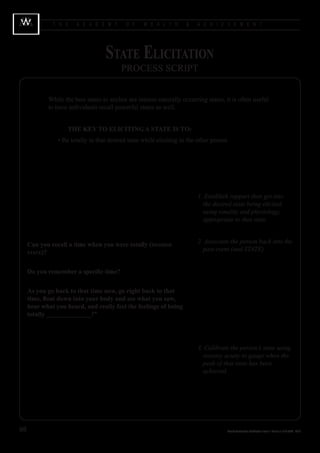
 relationship with the other person.


 Developing Sensory Acuity is a preliminary skill, a jumping place from which to develop and refine rapport,
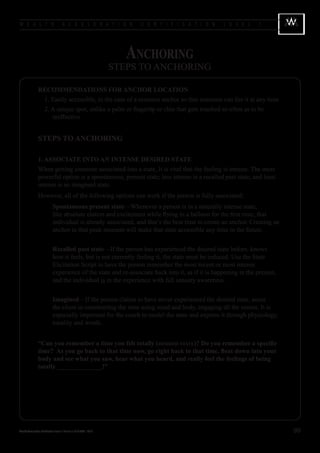
 communication skills and appropriate responses to other people.


              The key to Sensory Acuity is not to assign any specific or personal meaning to observed changes
              initially. Instead, simply use those external cues as indicators that the person is having some
              internal response.
              When necessary, use rapport and communication skills to delve deeper to determine what that
              response indicates specifically, and whether it is empowering or based on an internal thought
              pattern that is not congruent with that person’s goals.


Wealth Acceleration Certification Level 1 Manual v 10 © 2004 - 2010                                                   49
T H E      A C A D E M Y           O F      W E A L T H              &     A C H I E V E M E N T


                   Physiology of Internal Change
     Five unconscious, external indicators that can demonstrate internal state change:


     	 1. 	SKIN COLOR		                           Light . . . . . . . . . . . . . . . . . . . . . . . . . . . . . . . . . . . . . . Dark


     	 2. 	SKIN TONUS (muscle tone) 	Shiny. . . . . . . . . . . . . . . . . . . . . . . . . . . . . . . . . . . . . . Not Shiny	


     	 3.	 BREATHING	               RATE	         Fast . . . . . . . . . . . . . . . . . . . . . . . . . . . . . . . . . . . . . . Slow


     			                    LOCATION	             High. . . . . . . . . . . . . . . . . . . . . . . . . . . . . . . . . . . . . . Low


     	 4.	 LOWER LIP SIZE		                       Lines . . . . . . . . . . . . . . . . . . . . . . . . . . . . . . . . . . . . . . No Lines


     		 5.	 EYES	          FOCUS	                 Focused . . . . . . . . . . . . . . . . . . . . . . . . . . . . . . . . . . . Unfocused
     				         PUPIL DILATION	                 Dilated. . . . . . . . . . . . . . . . . . . . . . . . . . . . . . . . . . . . . Constricted


50                                                                                                           Wealth Acceleration Certification Level 1 Manual v 10 © 2004 - 2010
W E A L T H                            A C C E L E R A T I O N                     C E R T I F I C A T I O N   L E V E L   1


                                                                                 Rapport
           “Anything is possible in the presence of rapport.”
        								                            - Milton Erickson

        Language was created so humans could communicate more effectively with each other, to get their
        point across, right? Then why, with all the words available in any language, do people still have so
        many problems communicating? People are always surprised and often frustrated when the meaning
        of their message is not understood, even when they have chosen all the right words.


        This communication “break-down” is best explained by the study, which indicates:


        Communication is
        	                                                     7%	     Word
        	                                                  38%	       Tonality
        	                                                  55%	       Physiology


        By developing the skill of rapport, individuals no longer need to rely on merely words to clearly
        communicate a message. Rapport is created by using ALL levels of communication to create a bond
        of familiarity with a person or group of people. Indeed, the “gift of rapport” far exceeds the “gift of
        gab.”


                         The key to creating rapport is matching and mirroring (discussed in the next section) in
                         such a subtle and undetectable way that the other person can only recognize the similarity
                         unconsciously. Deep rapport makes the communicator massively persuasive on both a
                         conscious and unconscious level.


Wealth Acceleration Certification Level 1 Manual v 10 © 2004 - 2010                                                            51
T H E    A C A D E M Y      O F     W E A L T H    &   A C H I E V E M E N T


                         Matching and Mirroring
     Rapport is established by matching and mirroring.
     Matching is doing something the other person is doing, but in reverse image.
     Mirroring is being the mirror image of someone. If one person raises the right hand, the person
     mirroring raises the left hand.
     Matching has a more subtle effect than mirroring, yet mirroring can create deeper unconscious levels
     of rapport.
     Cross-over Mirroring is mirroring one area of physiology with another, such as breathing rate with
     a tapping finger rate.


     The following features of physiology, tonality, and words can be matched and/or mirrored to help
     establish rapport.
     				          PHYSIOLOGY (55%)
     				          Posture
     				          Facial expression and blinking
     				          Gesture
     				          Breathing


     							                              TONALITY (38%)
     							                              Voice
     							                              Tone (pitch)
     							                              Tempo (speed)
     							                              Timbre (quality)
     							                              Volume (loudness)


     										                                                 WORDS (7%)
     										                                                 Predicates
     										                                                 Key words and phrases
     										                                                 Common experiences & associations	
     										                                                 Content chunks


52                                                                               Wealth Acceleration Certification Level 1 Manual v 10 © 2004 - 2010
W E A L T H                            A C C E L E R A T I O N         C E R T I F I C A T I O N   L E V E L   1


                                                                Indicators of Rapport
        There are four key things we can notice that indicate rapport:

        1. A color shift
        	
        	      Using sensory acuity you can calibrate and notice a shift in skin color from light to dark.


        2. An internal feeling
        	
        	      A feeling of butterflies, or excitement.


        3. A question of familiarity
        	
        	      The person may ask you a question such as
        		             “Have I met you before?”
        		             “Are you a Taurean?”
        		             “You remind me so much of my favorite cousin!”


        4. Leading
        	
        	     The key indicator of rapport is being able to lead the person
              Indeed this is the whole purpose of creating rapport. It is to establish a level of trust and
              responsiveness to the point where you can lead the person’s internal representations and
              thereby lead their minds and imagination.


Wealth Acceleration Certification Level 1 Manual v 10 © 2004 - 2010                                                53
T H E    A C A D E M Y      O F    W E A L T H      &   A C H I E V E M E N T


                                Tonality Patterns
Tonality has a significant influence on the meaning of your communication. It strongly effects how others
respond to your words. It is also one of the most effective areas you can match to build rapport.
The arrows indicate the tone of voice used and its corresponding effect.


	 W	                          W	                    W.	 = Question

	 W	                          W	                    W.	 = Statement

	 W	                          W	                    W.	 = Command


54                                                                              Wealth Acceleration Certification Level 1 Manual v 10 © 2004 - 2010
W E A L T H                            A C C E L E R A T I O N        C E R T I F I C A T I O N   L E V E L   1


                                                     Representational Systems
       All humans process information using Representational Systems. After receiving data through the
       five senses (seeing, hearing, touching, tasting and smelling) plus self-talk (internal dialogue), people
       translate the external world into an internal blueprint, or Internal Representation (I/R), of “reality.”
       The four Primary Representational Systems used to make these Internal Representations are
       primarily: pictures, sounds, feelings and self-talk.
       A Preferred Representational System is the one a particular individual tends to use more than the
       others to create their Internal Representations (I/Rs) of the outside world. While one representational
       system is preferred over the others, humans “take in the world” using any or all of these.


       Representational Systems:


       VISUAL (V) creates and sees pictures
       	 • Represents the largest amount of data simultaneously and instantaneously compared with other 	
       		 systems
       	        • “A picture is worth a thousand words.”


       AUDITORY (A) hears sounds
       	        • More sequential in nature
       	        • Takes more time to process
       	        • Can lend emphasis or contrast to visual images, much like a sound track does to a film


       KINESTHETIC (K) experiences feelings internally (proprioceptive) and externally (tactile)
       	        • Purely sensory experiences without evaluations
       	        • Can last even after the visual and auditory experience
       	        • Meta Kinesthetic is an overall “sense” of things, how humans evaluate events with a general 	
       	            negative or positive value


       AUDITORY DIGITAL (AD) listens to self-talk internally
       	 • Secondary interpretation of information; what individuals say to themselves about events 		
       		 and their meaning
       	        • Summarizes and categorizes experience; uses words to delineate and make sense of things


Wealth Acceleration Certification Level 1 Manual v 10 © 2004 - 2010                                               55
T H E     A C A D E M Y       O F    W E A L T H      &    A C H I E V E M E N T


           Preferred Representational Systems
     Some experiences lend themselves better to certain Representational Systems. For example,
     experiencing a piece of music would mostly be Auditory (A). However, some people simultaneously
     may also see vivid images (V), while others literally “feel” (K) the mood of the piece. Enjoying a
     massage may be considered purely Kinesthetic (K), yet some people may be more focused on an
     internal, running commentary (Ad) about the experience.
     While people operate in all of the representational systems, they will tend to process and rely
     predominantly on one system over the others-this is their Preferred Representational System.
     Within that Preferred Representational System their behavior is fairly typical. The following
     behaviors are clues for detecting which is someone’s Preferred Representational System:


     VISUAL
     People who are primarily visual operate more from the top half their body—they tend to breathe
     from the top of their lungs and speak faster; they stand or sit with their bodies erect and their eyes
     up; they sit at the front of their chairs; appearances are important to them, so they tend to be neat and
     organized, and are often thin or wiry; they learn and memorize by associating images with ideas; if
     instructions are only given verbally, they are more challenged to recall the information; they aren’t
     easily distracted by noise; they usually have to see something to capture their attention or interest.


     AUDITORY
     People who are primarily auditory breathe from the middle of their chests, move their eyes from
     side to side, often talk to themselves and are easily distracted by noises; they learn and memorize by
     hearing information sequentially; they like to be told how they’re doing on a job and feel loved by
     hearing a certain tone of voice or words; they respond to sounds; consequently, they like music and
     talking on the phone.


     KINESTHETIC
     People who are primarily kinesthetic typically breathe from the bottom of their lungs, so their
     stomach visibly moves up and down; they move and speak slowly and respond to touch and physical
     rewards; they learn and memorize by doing; something has to “feel right” for them to be interested.


     AUDITORY DIGITAL
     People who are primarily Auditory digital are often listening to inner dialogue in their heads; they
     make decisions using a list of criteria; they can use any or all of the other representational systems
     but are interested in something when it, “makes sense.”


56                                                                                   Wealth Acceleration Certification Level 1 Manual v 10 © 2004 - 2010
W E A L T H                            A C C E L E R A T I O N        C E R T I F I C A T I O N   L E V E L   1


                                                 Preferred Rep System Test
       People tend to use one representational system over another. This becomes their Preferred or Primary
       Representational System.
       For each of the following statements, please place a number next to every phrase.
       			                        4 = Almost always
       			                        3 = Often
       			                        2 = Sometimes
       			                        1 = Almost never
       	 1. 	 I make a choice when:
       		 _____ it feels right to me.
       		 _____ I hear it, and it sounds right to me.
       		 _____ I see it, and it looks great.
       		 _____ I review it, and it fits my criteria.
       	 2.	 When discussing an issue, I am persuaded by:
       		 _____ how convincing the other person sounds.
       		 _____ really seeing the other’s point of view.
       		 _____ how reasonable the individual makes the point.
       		 _____ my own gut feeling.
       	 3.	 When I meet someone for the first time, I am impressed by:
       		 _____ the appearance of the person.
       		 _____ how he or she makes me feel.
       		 _____ how articulate or intelligent the individual is.
       		 _____ if what the person says rings true to me.
       	 4.	 I generally respond to:
       		 _____ sounds, and I am easily distracted by noises.
       		 _____ interesting facts, and I am easily distracted by my own thoughts.
       		 _____ sensations, and I am easily distracted by the way my body feels.
       		 _____ colors, and I am easily distracted by sights around me.
       	 5.	 When I like a proposal, I tend to say things like:
       		 _____ “Sounds good.”
       		 _____ “Makes sense.”
       		 _____ “Got it.”
       		 _____ “Looks good.”


Wealth Acceleration Certification Level 1 Manual v 10 © 2004 - 2010                                               57
T H E    A C A D E M Y      O F    W E A L T H     &   A C H I E V E M E N T


          Preferred Representational Systems

     STEP ONE
     	   Copy the number values from the previous page in the same sequence you wrote them.


     	 1.	 _____ K	 2.	 _____ A	 3.	 _____ V	 4.	 _____ A	 5.	 _____ A
     		 _____ A		 _____ V		 _____ K		 _____ Ad		 _____ Ad	
     		 _____ V		 _____ Ad		 _____ Ad		 _____ K		 _____ K
     		 _____ Ad		 _____ K		 _____ A		 _____ V		 _____ V


     STEP TWO
     	

     	   Record each number in the corresponding box then add each column.


                         	 V	                   A	               K	               Ad
                  1

                  2

                  3

                  4

                  5
         TOTALS

     STEP THREE
     	 The scores in each column will give the relative preference for each of the four
     major Representational Systems. The highest total will be your Preferred/Primary
     Representational System.


58                                                                               Wealth Acceleration Certification Level 1 Manual v 10 © 2004 - 2010
W E A L T H                            A C C E L E R A T I O N                      C E R T I F I C A T I O N      L E V E L   1


                                                                                  Predicates
        		 VISUAL	                                           AUDITORY	              KINESTHETIC	          AUDITORY DIGITAL

        	                 appear	                                all ears 	           catch on 	          change
        	                 clear 	                                deaf 	               concrete 	          chart progress
        	                 crystal 	                              dissonance	          feel 	              conceive
        	                 dawn	                                  harmonize	           feel out 	          consider
        	                 envision 	                             hear 	               grasp 	             criteria
        	                 focused	                               listen	              get a handle	       decide
        	                 foggy 	                                make music	          get hold of 	       distinct
        	                 hazy	                                  question 	           hard 	              experience
        	                 illuminate	                            resonate	            harsh 	             know
        	                 imagine	                               rings a bell 	       make contact 	      learn
        	                 look	                                  silence	             sense 	             makes sense
        	                 picture	                               sound(s)	            sensitive 	         motivate
        	                 reveal	                                tune in/out	         solid	              perceive
        	                 see	                                   unhearing 	          tap into 	          plan
        	                 show		                                                      throw out	          process
        	                 view		                                                      touch	              sensible
        	                 watch		                                                     turn around	        steps
        				                                                                                              think
        				                                                                                              understand


Wealth Acceleration Certification Level 1 Manual v 10 © 2004 - 2010                                                                59
T H E     A C A D E M Y     O F    W E A L T H    &    A C H I E V E M E N T


                               Predicate Phrases
 VISUAL		                      AUDITORY               KINESTHETIC                 AUDITORY DIGITAL
 An eyeful
                               Blabbermouth            All washed up                   According to
 Appears to me
                               Clear as a bell         Boils down to                   Afterthought
 Bird’s eye view
                               Call on                 Chip off the old block          Clearly expressed
 Catch a glimpse of
                               Earful                  Come to grips with              Compared to
 Caught my eye
                               Falls on deaf ears      Control yourself                Describe in detail
 Clear cut
                               Grant an audience       Cool, calm, collected           Give an account of
 Easy on the eyes
                               Hear me out             Feel where I’m                  Figure of Speech
 Eye candy
                               Hearsay                 coming from?                    Fits the criteria
 Eyes on the prize
                               Hear what I’m saying    Firm foundations                Good point
 Flashed on
                               Heard it all            Get a handle on                 Inner-voice
 From another perspective
                               Heard it through the    Get a load of this              Inquire into
 Get the big picture
                               grapevine               Get a sense of things           Know-how
 Hazy notion		
                               Hidden message          Get over it                     Listen to myself
 Horse of a different color	
                               Hold your tongue        Get the drift                   Mental note
 In light of		
                               I hear you              Gut feeling                     On second thought
 In person		
                               Idle chatter            Hang in there                   Pay attention to
 In view of
                               Keynote speaker         Have a feeling                  Pros and cons
 Just looking
                               Listen to this          Heated argument                 Relatively speaking
 Laid eyes on		
                               Listen up               Hold it!                        So to speak
 Look at it this way
                               Loud and clear          Hold on!                        State your purpose
 Look into it
                               Love the sound of       Hot-head                        To tell the truth
 Look it over
                               that                    Jump on it                      Utterly
 Looks like		
                               Manner of speaking      Keep in touch                   Verbatim
 Make a scene	 	
                               Pitch perfect           Keep your shirt on              Well informed
 Mental image		
                               Power of speech         Lay cards on table              Word for word
 Mind’s eye
                               Rings true              On the other hand
 More than meets the eye	
                               Sound bytes             Pain in the neck
 Naked eye		
                               Sounds good             Pull some strings
 Paint a picture
                               Tattle-tale             Sharp as a tack
 Picture worth 1000 words	
                               Tongue-tied             Sink your teeth into
 Saw it coming
                               Tuned in/tuned out      Slipped my mind
 See for yourself
                               Unheard of              Smooth operator
 See what you’re saying
                               Voiced an opinion       So-so
 See to it		
                               Within earshot          Start from scratch
 Short sighted		
                               Within hearing          Stiff upper lip
 Sight for sore eyes	      	
                               distance                Stuffed shirt 	
 Take a peek		
                                                       Topsy-turvy
 Tunnel vision		
                                                       Underhanded
 Under your nose		
                                                       Warm and fuzzy
 Vantage point	
                                                       You feel me?

60                                                                              Wealth Acceleration Certification Level 1 Manual v 10 © 2004 - 2010
W E A L T H                            A C C E L E R A T I O N          C E R T I F I C A T I O N   L E V E L   1


                                                                      SECTION
                                                                         3

      BEGINNING
    SUBCONSICOUS
  REPROGRAMMING
					
					
      “You cannot be in one image and not suffer the
       consequences of not being in another.”
							        			                - Neville


Wealth Acceleration Certification Level 1 Manual v 10 © 2004 - 2010                                                 61
T H E     A C A D E M Y      O F    W E A L T H      &    A C H I E V E M E N T


                                         Submodalities
                                      TOOLS FOR CHANGE


     OUTCOME
     Participants will learn how to install new choices, beliefs and habits in self and others by breaking
     down Internal Representations into their submodalities then replacing them with new submodalities.


     DEFINITION AND PURPOSE
     Submodalities are the building blocks of experience. They constitute subcategories within each
     primary Representational System modality. For example, the Visual Representational System is made
     up of the subcomponents of black or white, bright or dim, moving or still, etc. The ability to describe
     an image in more detail gives one the power to break down a thought system and behavioral pattern
     into its smaller components. This process creates more choices and control when forming those
     Internal Representations and beliefs that determine experience.


     EXAMPLES OF SUBMODALITIES
     Remembering the sound of someone’s voice as having positive or negative associations with it
     Visualizing a future presentation and feeling a tightness in the stomach
     Having an internal image of pizza that is so close and colorful, and practically smells real


     APPLICATIONS OF SUBMODALITIES
     	   Stop unwanted cravings for certain foods and drinks
     	   Break old habits
     	   Exchange a limiting belief for a more productive one
     	   Create new responses to old problems
     	   Change old unproductive thought pattern into a positive action
     	   Replace an unhealthy behavior or desire with a healthy one


     THIS SECTION OF THE MANUAL TEACHES THESE SPECIFIC
     TECHNIQUES
     	   • 	 Submodalities Elicitation
     	   • 	 Momentum Pattern
     	   • 	 Response Repattern
     	   • 	 Belief Change


62                                                                                  Wealth Acceleration Certification Level 1 Manual v 10 © 2004 - 2010
W E A L T H                            A C C E L E R A T I O N          C E R T I F I C A T I O N   L E V E L   1


                                           Subconscious Reprogramming
        Any Subconscious Reprogramming Process using submodalities, including the Response Repattern
        and the Belief Change, could be considered a pattern interrupt. The techniques involve: 	
        	        • interrupting an existing neurological link between a trigger and its response
        	        • simultaneously creating a positive association with a new, desired behavior, state or belief.


        Shifting the submodalities someone uses to store and code anything—whether a strong, long-held
        belief, habitual behavior, memory or state—establishes new neurological pathways that install a
        range of new options for responses.
        With these simple yet profound Subconscious Reprogramming techniques, extreme emotional
        tension or trauma associated with a past event can be released so that the event no longer has an
        emotional charge on it at all. Or, certain behaviors can be eliminated immediately and forever, if
        desired. For example, people who have been coffee drinkers for decades can not only stop overnight
        but also lose all desire for the coffee. Or someone can take a behavior like cold-calling from
        something that they loathe doing, to something that they are compelled to do.


        SUBCONSCIOUS REPORGRAMMING BY SHIFTING SUBMODALITIES
        	 1.	 Determine the unwanted state or behavior to be changed.
        	 2.	 Choose the preferred state or behavior to replace the one being changed.
        	 3.	 Elicit the Internal Representation (I/R) and their submodalities for both the unwanted and the
              preferred.
        	 4.	 Determine the “drivers,” those critical submodalities that differ between both I/Rs.
        	 5.	 Change the submodalities of the unwanted state or behavior with those of the preferred.
        	 6.	 Test and link new response to future.

        		 THE KEYS TO A SUCCESSFUL SUBMODALITIES SHIFT:
                          	        •        Speed
                                   •	 Utilize universally generalized experiences.
                                 	 • Find the “drivers”—the critical submodalities that create the most change when they
                                 are replaced. Drivers are considered the “difference that makes the difference.”


                          Drivers are always:
        				                                Location
        				                                OR
        				                                Associated or Dissociated


Wealth Acceleration Certification Level 1 Manual v 10 © 2004 - 2010                                                        63
T H E    A C A D E M Y      O F    W E A L T H      &   A C H I E V E M E N T


                       Intervention Script Notes
     WHEN GETTING A PRESENTING PROBLEM
     	
     To make sure that you are dealing with the real issue and not just its symptoms or a surface 		
     	level problem, ask:


            “How is that a problem for you now?”


     Make sure to get an affirmative response or a “yes” to the following questions at appropriate stages
     of certain interventions before proceeding. This will:
     		     a) align interventions for change
     		     b) create a contrast frame for ratifying change
     BEFORE INTERVENTION
     To set up the change work about to take place, ask:


     			 “Is it all right with your unconscious mind to make this change today 				
     				 and for you to have conscious awareness of it?”


     	 et a congruent “yes” response before proceeding. Then ask:
     G


     			 “Can you do it now?”
     			 “So you would know if it disappeared, right?”


     AFTER INTERVENTION
     To ratify change ask:
            “So how do you feel now about your ability to
              (new behavior stated positively/opposite of the original problem) now?”


     To generalize learnings to future situations and pave new neurological pathways, you can future
     pace say:
            “Now think of some indefinite time in the future where, in the past, that old
            problem might have hindered you or held you back and notice what happens
            for you now...”


64                                                                                Wealth Acceleration Certification Level 1 Manual v 10 © 2004 - 2010
W E A L T H                            A C C E L E R A T I O N                    C E R T I F I C A T I O N        L E V E L      1


                                                              Response Repatterning
       This technique can be used to change someone’s salivary response to certain things. We can change
       a like to a dislike and vice versa. We may repattern responses to:
              •	 Food 		
               		                                            e.g. Develop an intense distaste for coffee, red wine or ice-cream
              •	 People		
               		                                            e.g. Change a response to a colleague and their idiosyncrasies
              •	 Projects	
               		                                            e.g. Get moving on delayed projects
              •	 Behaviors	
               		                                            e.g. Develop a compelling desire to exercise
       Effectively what we are doing is unlocking how someone codes and stores their response to
       something at the unconscious level. Once we decipher that, we are able to change it and open up
       new behavioral choices for that individual.

                                                The Big Picture of Response Repatterning

       If #1 is the item or activity to be changed, and #2 is the item or activity to be changed to:

                                                                        1.	 Elicit the SMDs of #1 and #2
                                                                        2.	 Change the submodalities of #1 into #2
                                                                        3.	 Break state, test and future pace


                                                                             #1                    #2


       In class we will be learning the process of response repatterning by changing a team member’s
       response to a food that they like, into an intense revulsion or distaste. There are a few keys to be
       aware of as we do this:
       		
       		                THE KEY TO RESPONSE REPATTERNING LIKE TO DISLIKE FOR 	
       		                FOOD
       	        Find one comparable item that:
       		 a)	 is the same logical type, or has most of the same qualities, as the food that they like, 		
       				 eg) exchange coffee for castor oil; ice cream for spoiled lumpy milk		
       		                and
       		                b)	 produces the biggest negative response in the client, something extremely disliked

Wealth Acceleration Certification Level 1 Manual v 10 © 2004 - 2010                                                                   65
T H E      A C A D E M Y         O F     W E A L T H       &   A C H I E V E M E N T


                                 Response Repatterning
                                               LIKE TO DISLIKE
     What is a food that you like but you wish you did not?                     	 ind out what food the person likes but wants
                                                                                F
                                                                                to dislike.
     What is a food that’s of a similar logical type, that you absolutely       Decide on a food that is a similar logical
                  hate?                                                         type, but which is repulsive to the person.
                                                                                	
     Is it OK with your unconscious mind to make this change today and          Confirm unconscious alignment
                  to have conscious awareness of it?
                                                                                	
     Good. As you think about that food that you like and how you know          Have the person bring to mind the picture
                you like it, do you have a picture?”                            that represents the food they like.
                                                                                	
     Is it black and white or color?...” etc                                    Elicit the submodalities. Speed is the key.
                                                                                	
     Clear the screen                                                           Break state.
                                                                                		
     Now, go ahead and think of the thing that you absolutely hate, and         Have the person bring to mind a picture of
                 how you know you hate it. Have you got a picture?              the repulsive item.
                                                                                	
     Is it black and white or color?...” etc                                    Elicit the submodalities.
                                                                                	
                                                                                M
                                                                                	 ap across submodalities--change the
                    Script is determined by the SMDs elicited                   drivers of the liked item into the disliked
                                                                                item.
                                                                                	

     You know the sound that Tupperware® makes? Thwack! Lock it
                into place                                                      Anchor it in place using an auditory anchor.
                                                                                		
     Do you smell popcorn?                                                      Break state.
                                                                                		
     Now how do you feel about (the item they used to like)?                    Test:
                                                                                		
     The next time you have a chance to have ____, what do you do?              Future pace:
                                                                                		 “


                                                                                    Client will either show strong revulsion
                                                                                    or the affect will be flat. Both new
                                                                                    responses indicate the old pattern has
                                                                                    been interrupted and repatterned.


66                                                                                             Wealth Acceleration Certification Level 1 Manual v 10 © 2004 - 2010
W E A L T H                            A C C E L E R A T I O N             C E R T I F I C A T I O N      L E V E L        1


                                                              Response Repatterning
                                                                      MOMENTUM PATTERN

      		          KEYS TO A MOMENTUM PATTERN
			 • Always replace a behavior with a behavior
			 • Find the right trigger
    •	 Use for behaviors, not non behaviors (eg I don’t get up in the mornings is a non-behavior)

                                                                                             1.	 licit unwanted behavior. Have the person
                                                                                               E
                                                                                             describe the current behavior or state to be
                                                                                             changed


                                                                                             2.	 ind the trigger for this behavior or state
                                                                                               F
       How do you know it’s time to ______________?                                          or belief

       Now, close your eyes. When you think of that (trigger) now, do you                    3.	 licit the Internal Representation (I/R) they
                                                                                               E
       have a picture?                                                                       are currently accessing


                                                                                             4.	 fter the person gets the picture, do a break
                                                                                               A
       OK, good. Now open your eyes                                                          state and have them open their eyes


                                                                                             5.	 ext, elicit the desired behavior
                                                                                               N
       How would you like to act instead?
                                                                                             6.	 et the I/R for this preferred behavior. With
                                                                                               G
       When you think of (that behavior), do you a have a picture?                           their eyes open or closed


       We’re just going to adjust some of the qualities of the picture now.                  7.	 ave the person associate into the picture
                                                                                               H
       So go ahead and step into it, see it through your own eyes. If it’s                   temporarily and intensify some of this
       black and white, make it color. And turn the brightness up, so it’s                   picture’s submodalities to create a more
       most compelling and most realistic for you. Turn the volume up on                     compelling desired behavior
       the sounds. Notice the feelings that you are feeling, and double the
       intensity of those feelings now.


       Okay, now go ahead and step out of the picture so you see yourself,                   8.	 ave them dissociate from this picture
                                                                                               H
       the ideal you, in the picture.

                                                                                             9.	 reak state
                                                                                               B
       Clear the screen

                                                                                             10.	Have them associate back into the old
       Close your eyes. Good, now take the picture of (the old trigger)                      trigger for the undesired behavior. And
       and put it back up on the screen. Make sure you’re looking through                    create the new picture in the lower left hand
       your own eyes. Now, as you look at that picture have the new                          corner
       picture of the ideal you, appear small and dark on the lower left
       hand corner of the screen of your mind.


Wealth Acceleration Certification Level 1 Manual v 10 © 2004 - 2010                                                                           67
T H E     A C A D E M Y         O F    W E A L T H        &      A C H I E V E M E N T


                              Response Repatterning
                                       MOMENTUM PATTERN
     Okay, now in a moment I am going to have you replace the old               11. (Optional) While saying this, rapidly
     picture with the picture of your new behavior, not yet, but in a           move your hand up from their lower left
     moment, and when you do, you’ll have the new picture explode               corner to the center in front of the person’s
     big and bright on the screen of your mind in place of the other,           face and make the sound, “WHHHISSHHT!”
     while the old picture will fade and shrink down into your lower
     left-hand corner. So, not yet, but when I say “WHSSHT!” you will
     have the new picture explode big and bright! Do that now quickly!
     WHHIIIISSHT!


     “Now clear the screen.” or “Open your eyes”                                12.Once the person has experienced this new
                                                                                picture directly in front, break state


                                                                                13. Repeat steps 10-13 faster and faster
                                                                                while dropping off language each time and
                                                                                continuing to break state between each until
                                                                                they are no longer able to experience the old
                                                                                behavior. It should become difficult for the
                                                                                person to even visualize it anymore on the
                                                                                screen

     So, now when you think about the next time you (experience the
                                                                                14. Break state, test and future pace
     old trigger), what happens? What do you do?


                                                                             Old Picture
                            New                                                 (PS)
                            picture
                            (DS)


68                                                                                            Wealth Acceleration Certification Level 1 Manual v 10 © 2004 - 2010
W E A L T H                            A C C E L E R A T I O N                           C E R T I F I C A T I O N   L E V E L    1


                                                                           Belief Change
                                                                          WITH SUBMODALITIES


                    A                                                 B                        C                     D


           Unwanted                                                         Belief no
                                                                                                        Universal                New belief
             belief                                                        longer true


                 PART I: Change the SMD of A into B

                  PART II: Put the picture of D into the
                              SMDs of C


Wealth Acceleration Certification Level 1 Manual v 10 © 2004 - 2010                                                                           69
T H E      A C A D E M Y          O F     W E A L T H           &   A C H I E V E M E N T


                                             Belief Change
                                          WITH SUBMODALITIES
     Can you think of a limiting belief that you wish you didn’t have?               1. Elicit submodalities of belief that the
     Good, what is it?                                                               individual wants to change. (Belief A)
     As you think about that belief now, do you have a picture? Elicit
     submodalities


     Clear the screen                                                                2. Break state


     Can you think of a belief that is no longer true? For example, you
     once had the belief, ‘I am a seven year old child,’ did you not? And            3. Elicit submodalities of a belief that is no
     do you believe that now?                                                        longer true. (Belief B)
     So when you think of that belief, the belief that you are a seven year
     old child, where is that belief now? Do you have a picture? Good,
     what is it? Elicit submodalities


     Take that picture of that old belief, and move it on the screen of
     your mind... put it right on top of that belief that is no longer true...       4. Change the submodalities of unwanted
     and notice that it becomes (repeat SMDs of Belief B) .
                                                                                     belief (A) into the submodalities of the belief
     You know the sound that Tupperware ™ makes? Just go ahead and                   no longer true (B), and lock it into place
     lock it into place... thwack.


     Clear the screen                                                                5. Break state.

                                                                                     6. Test
     Now what do you think of that old belief?


     Can you think of a belief which for you is absolutely true? Like the            7. Elicit submodalities of belief that they
     belief that the sun is going to come up tomorrow. Do you believe                believe is absolutely true. (Belief C)
     that? Or that it’s good to breathe? Good, what is it?” 	 (Get
     response.) “And as you think of that belief and how you know it’s
     true, do you have a picture? Elicit submodalities


     Clear the screen                                                                8. Break state. (Optional)


     Can you think of a belief you want to have, which is the opposite of
     the belief in #1?       	                                                       9. Have client decide on the new belief that
     Good, what is it? (Get response.) And as you think about that                   they want to have instead. (Belief D)
     belief now, do you have a 	       picture?”


     Take that picture of that new belief, and move it on the screen of              10. Put this picture of desired belief (D) into
     your mind... put it right on top 	 of that belief that is absolutely            submodalities of belief absolutely true (C)
     true... and notice that it becomes (repeat SMDs of Belief C) .
     You know the sound that Tupperware™ makes? Just go ahead and
     lock it into place... thwack.”                                                  11. Break state.

                                                                                     12. Test:
     Clear the Screen. Now what do you believe? How do you know?”


70                                                                                                    Wealth Acceleration Certification Level 1 Manual v 10 © 2004 - 2010
W E A L T H                            A C C E L E R A T I O N             C E R T I F I C A T I O N      L E V E L        1


                                                                      Parts Integration
                                                                        PROCESS SCRIPT
       How is that a problem for you now?                                                     1. Identify the conflict and the problem part.
       What’s it preventing you from doing that you really want to do?                        You do not need to find out both parts. You
                                                                                              just need to elicit the problem part and have
                                                                                              them associate to the real problem by asking:

                                                                                              2. Have the part which represents the
       I wonder if I could talk to that part of you that’s__________                          unwanted state or behavior come out on the
       (exhibiting negative behavior) and I wonder if that part would like to                 hand first: Have client extend chosen hand
       come out and stand on one of your hands… would it prefer to stand                      with palm facing up.
       on the left hand or the right hand?

       Now if that part were to stand on the hand there, where exactly on                     3. Get a V-A-K image of the problem part
       the hand would it prefer to stand?
       And as you look at that part that’s ____________, who does that part
       look like that you know?
       And if that part were to say something to you now, what would it
       say?
       Does that part have a weight as it sits there in your hand?


       Now, I wonder if that part realizes that there’s another part that it’s                4. Invite the “opposite number” or “flip side
       most in conflict with – the opposite number, the flip side of the coin as              of the coin” to come out on the other hand.
       it were? … I wonder if that other part would like to come and stand
       on the other hand?


       Now if that part were to stand on the hand there, where exactly on                     5. Get a V-A-K image of the “flip side” part
       the hand would it prefer to stand?
       And as you look at that other part, who does that part look like that
       you know?
       And if that part were to say something to you now, what would it
       say?
       Does that part have a weight as it sits there in your hand?


       Alright – I’d like to come back and talk to the part of you that                       6. Elicit the highest positive intention of the
       looks like (mention the image associated with the problem part), and I                 unwanted part, separating intention from
       wonder if that part could consider for you what its highest intention                  behavior.
       is. What’s its highest positive intention?
       Good, _______ (stated intention) for what purpose?                                     Chunk up

       IF they start looping... say “all of that for what purpose?”                           Continue to chunk up until you have gone
       To help them through the boundary conditions if they are really stuck                  through the boundaries and gone at least 2-3
       say “You’re right where you need to be… you’re at the boundary                         levels beyond
       conditions, that means you are about to have a breakthrough.” You                      i. Ensure they are associated to the upper
       could then change your language a little and ask “so if you had _______                level word
       (most recent words) what’s that get for you? What does that do for                     ii. Ensure they are not smoke-screening
       you? For what purpose – all of that?”                                                  iii. They may start to loop a little at the
                                                                                              boundary conditions


Wealth Acceleration Certification Level 1 Manual v 10 © 2004 - 2010                                                                          71
T H E      A C A D E M Y          O F      W E A L T H           &   A C H I E V E M E N T


                                        Parts Integration
                                                 PROCESS SCRIPT
     Now this other part that looks like (mention the image of the “flip              7. Elicit the highest positive intention of the
     side” part), and I wonder if that part could consider for you what it’s          second part. Chunk up until you arrive at the
     highest intention is. What’s its highest positive intention for you?”            same word as the problem part.
     Are you doing that on purpose?                                                   *As soon as the hands start to come together
                                                                                      point it out to the team member/client, by
                                                                                      asking:

     Did those two parts realize that they had the same highest positive              8. Point out that both parts have the same
     intention for you, which is ________________ (state the common                   highest intention
     word)?
     And did they know that by being in conflict they were preventing
     you from achieving your highest intention which is _____________?
     And would those two parts be willing to work together now in order
     to achieve your highest positive intention which is _______________


     I wonder could this part (point to problem part), look over at that part         9. Point out resources to assist each in
     (point to flipside part), and see some resources it could use in helping         achieving highest positive intention
     you to achieve your highest positive intention which is____________?
     And I wonder if that part (point to flipside part) could look at this part
     (point to problem part) and see some resources that it could use in
     helping you to achieve your highest positive intention which is_____?
     	

     And allow those parts to realize now that they were once part of a               10. Now have the parts notice that they were
     larger whole.                                                                    both once part of a larger whole.


     If there are any other parts that would like to join the integration,            11. Ask for other parts that were also once
     just have them join in the integration now.                                      part of a larger whole. Have them join in the
                                                                                      integration.


     That’s right. As your hands come together, take that integration                 12. Allow the hands to come together. Take
     inside.                                                                          the integrated part inside.


72                                                                                                  Wealth Acceleration Certification Level 1 Manual v 10 © 2004 - 2010
W E A L T H                            A C C E L E R A T I O N           C E R T I F I C A T I O N      L E V E L       1


                                          Behavior Replacement Model
                                                                      PROCESS SCRIPT
       Perhaps you would be more comfortable with your feet flat on the                     Suggest body position that would facilitate
       ground and your finger tips lightly on your lap, and go ahead and                    trance. Break tension between finers and
       close your eyes.                                                                     knees to facilitate idiosyncratic movement of
                                                                                            fingers later on


       I’d like to set up a communication signal with your unconscious                      Set up a signal for “yes” and a signal for
       mind and that could be something as simple as a finger movement,                     “no”
       so I want you right now to go ahead and give me a signal for yes,
       and it could just be a simple twitching of the finger…. (wait for yes
       signal and affirm prior to asking for a signal for no), and a signal for
       no, and that could just be the movement of another finger.


       ___________, I’d like to ask the part of you that is creating the un-                1. Set up unconscious communication with
       wanted behavior if it’s willing to communicate with me now. (wait                    problem and dissociate person from problem
       for signal)                                                                          part


       Let’s refer to you as part X and I want to thank you for signaling                   2. Acknowledge the part causing the problem
       me now.


       Part X, I want to acknowledge you for always having acted in
       ___________ best interest and for having provided benefits for him/                  3. Recognize Part X intent and chunk up on
       her in the past. We’re here to assist __________ in creating addi-                   it
       tional choices for his/her life now. Part X, I’d like you to consider,
       your highest positive intention….what’s your highest positive inten-
       tion? And just give me a signal for yes when you have that.


       Now__________, can you take part X to the creative part of you and
       have the creative part come up with at least 3 additional choices                    4. Create new possibilities/choices using
       that will provide you with equal or greater benefit. When you have                   Part X and Creative Part
       all 3 of those additional choices, and only when you have all 3, sig-
       nal me with a yes signal.


       I’d like to ask part X, if it’s willing to take responsibility for imple-            5. Have Part X take responsibility for new
       menting these alternative                                                            choices and behaviors
       choices instead of the old behavior (yes/no signal)
             Yes…. Thank you part X
             No …. Part X, would you be willing to use these alternative
             choices for a trial period of say 2 weeks and then, if they are
             appropriate, continue to implement them beyond that?
             Yes …. Thank you part X
             No ….. ___________ can you take part X back to the creative
             part and generate 3 alternative choices that will provide you
             with equal or greater benefit.


Wealth Acceleration Certification Level 1 Manual v 10 © 2004 - 2010                                                                      73
T H E     A C A D E M Y         O F     W E A L T H         &   A C H I E V E M E N T


                     Behavior Replacement Model
                                              PROCESS SCRIPT

     Now ___________, go inside and make sure that all of the parts of
     you are in alignment with the change you’ve just made. If so, will         6. Establish & ensure congruency with all
     those parts signal with a yes signal now? (Wait for signal) Thank          parts
     you.
          Yes…. Thank all parts
          No …. Go back to step 4

                                                                                7. Future Pace and generalize change
     Now ____________, can you step out to some indefinite time in the
     future where in the past that old problem may have hindered you or
     held you back, and notice what happens for you now.

                                                                                8. Count them back up out of trance state to
     As I count to three, you will open your eyes, knowing you have fully       waking state
     integrated all these


74                                                                                           Wealth Acceleration Certification Level 1 Manual v 10 © 2004 - 2010
W E A L T H                            A C C E L E R A T I O N          C E R T I F I C A T I O N   L E V E L   1


                                                                      SECTION
                                                                         4

                    COMMUNICATION
                       MASTERY

                              “You can have brilliant ideas, but if you can’t get them across
                              your ideas won’t get you anywhere.”
                              								                                               - Lee Iacocca


Wealth Acceleration Certification Level 1 Manual v 10 © 2004 - 2010                                                 75
T H E     A C A D E M Y       O F    W E A L T H       &   A C H I E V E M E N T


                                 Language Patterns
                                    THE POWER OF WORDS

     OUTCOME
     Participants will be able to utilize successfully the full power of words, in speaking and listening, to
     bring about clarity and change. They will begin to learn to master communication skills to meet any
     objective.


     DEFINITION AND PURPOSE
     Language transports the mind. One can listen for language or use language to define, gain awareness
     of and move around within an individual’s model of the world. One can also use language in such
     a way as to guide someone’s internal representations, and effect change at both the conscious and
     unconscious level.
     It is always important to be aware of the power of words in all situations and use them with volition
     toward a specific intention.
     Language Patterns, the words and sentence structures people use, are indicators of underlying
     thought patterns and belief systems. Language Patterns are one of the most powerful tools to create
     change work both internally and externally. Words can be used to chunk up from specific to abstract
     concepts, or chunk down from abstract to specific language.
     Linguistic Presuppositions are the specific language constructs that reveal the speakers mental
     assumptions or unique beliefs. Recognizing them and knowing exactly how to assist in restructuring
     them is one way to catalyze transformation on conscious and unconscious levels.


     EXAMPLES OF LANGUAGE PATTERNS
     Cause and effect or complex equivalence statements
     Implied blame, as in, someone “makes me” feel bad.
     Generalizations that reveal a belief system
     Using passive tense to avoid reference to a particular person
     Words such as “should” and “must” that indicate a sense of necessity
     A sentence that makes one idea synonymous with another
     Language that portrays a lot of negative I/Rs


76                                                                                   Wealth Acceleration Certification Level 1 Manual v 10 © 2004 - 2010
W E A L T H                            A C C E L E R A T I O N             C E R T I F I C A T I O N   L E V E L   1


                                                                      Language Patterns
                                                                      THE POWER OF WORDS

         APPLICATIONS OF LANGUAGE PATTERNS
         	        Induce a trance state in which a person is receptive to positive suggestions
         	        Create positive new ideas or Internal Representations (I/Rs) in someone’s imagination
         	        Guide the imagination of a business team toward organizational success
         	        Break through boundary conditions to larger realms of possibility thinking
         	        Make specific goals more tangible and compelling, therefore, more likely to occur
         	        Break down presenting problems until they are no longer “real”
         	        Clarify someone’s intentions and beliefs
         	        Dissolve limited perceptions of “reality”
         	        Help a team member to fulfil on their targets through inspiring communication	
         	        Establish deeper rapport and, therefore, more profound results and stronger partnerships
         	        Tell a story that changes someone’s life forever


         THIS SECTION OF THE MANUAL TEACHES SPECIFIC TECHNIQUES TO:
         	        • Detect Linguistic Presuppositions
         	        • Design Communication to Induce Trance and Communicate Persuasively
         	        • Design Communication for Specificity
         	        • Create Metaphors and Stories for Change
         	        • Use The Clarity Model for Precision Communication
         	        • Directionalize Communication with Frames and Closes


Wealth Acceleration Certification Level 1 Manual v 10 © 2004 - 2010                                                    77
T H E     A C A D E M Y        O F    W E A L T H        &   A C H I E V E M E N T


                         Linguistic Presuppositions
     Here are ten types of Presuppositions that may be present in communication; and what tips you off
     to each one. These help you recognize another’s beliefs and model of the world. These markers will
     give you clues as to what someone thinks about the world simply by listening to the assumptions
     inherent in their language. You can also use them to direct change in another’s perspective or create
     new I/Rs in an individual.


     	 1. Existence - Nouns in a sentence


     	 2. Possibility/Necessity - Modal operators, adverbs, verbs


     	 3. Cause - Effect - The words “Because,” “causes” or “makes;” “If...then...” statements


     	 4. Complex Equivalence - The word “means” or implied meanings associated with people places or
     things; 										                                      The verb “to be”: “is”, “are” etc


     	 5. Awareness - Anything that indicates awareness, such as “hear,” “see,” “think,” “feel,” etc.


     	 6. Time - References to specific times or temporal language


     	 7. Adverb/Adjective - Adjectives or adverbs in a sentence


     	 8. Exclusive OR - The word “or” in the sentence or implied


     	 9. Inclusive OR - The word “or” in the sentence or implied


     	 10. Sequential/Ordinal - List of a temporal sequence of events


78                                                                                       Wealth Acceleration Certification Level 1 Manual v 10 © 2004 - 2010
W E A L T H                            A C C E L E R A T I O N        C E R T I F I C A T I O N   L E V E L   1


                                       Presuppositions vs. Mind Reads
       A Presupposition is an assumption of the speaker inherent within the particular words chosen by
       them. A Mind Read is when the listener infers or “hallucinates” a meaning based on someone’s
       words that is not actually stated.
       It is important to distinguish between the two. When you are able to use this tool you will be able
       to tell what your co-workers, employees and clients are really saying. “Mind Reading” is a very
       common cause of misunderstandings. Since Mind Reads are inferred meanings that are possibly
       unfounded, it is essential for effective and powerful communication to be able to detect them. It is
       vital for people in leadership roles to be aware when they are mind reading.


       Please mark “P” or “MR” next to each sentence depending on whether the statement is a
       Presupposition (P) or Mind Read (MR):


       	 1.	 “I don’t know why I keep eating chips when I know they’re unhealthy for me.”
       		 _____ He eats chips.
       		 _____ He loves the sound of crunching chips.
       		 _____ He knows chips are unhealthy.
       		 _____ He’s obese.
       	 2.	 “I want to be better at budgeting my money.”
       		 _____ She has money.
       		 _____ She’s never taken an accounting class.
       		 _____ She took accounting and failed.
       		 _____ She feels she could improve her budgeting skills.
       	 3.	 “I’ll never be a millionaire because I don’t have any special skills.”
       		 _____ He is not now a millionaire.
       		 _____ He believes he has to have special skills to be a millionaire.
       		 _____ He doesn’t have any special skills.
       		 _____ He believes he doesn’t have the special skills required.
       	 4.	 “My manager treats me differently than the other sales people at the office.”
       		 _____ Her manager treats her worse than everyone else.
       		 _____ She does sales.
       		 _____ She ranks lower in commissions than the other sales people.
       		 _____ She thinks she’s being treated unfairly.
       	 5.	 “You never tell me how you’re feeling!”
       		 _____ He wants to know how she’s feeling.
       		 _____ He is frustrated.
       		 _____ He wants to leave the relationship but doesn’t know how to tell her.
       		 _____ He believes she has feelings.

Wealth Acceleration Certification Level 1 Manual v 10 © 2004 - 2010                                               79
T H E    A C A D E M Y        O F   W E A L T H       &    A C H I E V E M E N T


               What Are Others Really Saying?
     Please state which types of Linguistic Presuppositions are being used in the following statements:


     	 1.	 “I can’t afford to invest money in my new business because I don’t have enough clients.”


     	 2.	 “I am hurt because you didn’t call me back.”


     	 3.	 “They never tell me when I’m doing a good job, so I can’t improve.”


     	 4.	 “You should stop doing that.”


     	 5.	 “I can tell she likes me by the way she laughs at my jokes.”


     	 6.	 “Either she leaves, or I will.”


     	 7.	 “First you have to make the calls, then we will talk about your raise.”


     	 8.	 “Do you want to sign these papers before the bank closes or do it first thing tomorrow?”


     	 9.	 “Stop talking about trying to lose weight and just do it now.”


     	 10.	 “I really want to change careers but I won’t have any security if I paint full-time.”


80                                                                                    Wealth Acceleration Certification Level 1 Manual v 10 © 2004 - 2010
W E A L T H                            A C C E L E R A T I O N                   C E R T I F I C A T I O N   L E V E L   1


                                                                        Ask Yourself...


                                                                      “What’s the question I can ask
                                                           that will cause the most positive change
                                                 within someone’s thinking, by their having to
                                                              accept the underlying presuppositions
                                                                      inherent in the question itself?”


       Words are powerful because they arouse the imagination. Just as important as recognizing language
       patterns in others is purposefully using your own words with volition, intention and ecology. To use
       language effectively to lead others in the direction of transforming old thought patterns and limiting
       beliefs, consider the question above. Then choose your words and presuppositions carefully with the
       highest results in mind. Remain aware of the effect words have on creating internal representations;
       then intend a specific result.


Wealth Acceleration Certification Level 1 Manual v 10 © 2004 - 2010                                                          81
T H E     A C A D E M Y        O F     W E A L T H      &    A C H I E V E M E N T


                                     Hierarchy of Ideas
                   FROM ABSTRACT TO SPECIFIC THINKING

 PURPOSE
                                                           CHUNKING UP
 •	 Move out of boundary conditions
                                                           Move from a specific term to the general category.
 •	 Find the intention behind a demand                     		 For Agreement, Alignment
 •	 Use to motivate others                                 CHUNKING DOWN
 •	 Gain awareness of structure of a “problem”             Move from the specific to the more specific or to the
                                                           component parts.
 •	 Discover new options
                                                           		 For Specificity, the “How To”
 •	 Express concept and give concrete 		
     example, or vice versa
 •	 Lead others toward a larger vision              BIG PICTURE
 •	 Negotiate                              Abstraction / Intuitor / Trance
                                       The Structure of Overwhelm–Too Big Chunks
 •	 Create metaphors

                                                    Existence
     To chunk up, say:                                                             To chunk down, say:

     “What is this an example of?”
                                                    Expression                     “What are examples of this?”
     “
     	 For what purpose...?”                                                       “
                                                                                   	 What specifically...?”
     “
     	 What is your intention...?”                      Art


                 	 Carvings	          Sculptures	 Paintings	         Stained Glass	 Films


                                     CATEGORIES                       CLASSES

                                	          Monet             	            Oil

                                	         Picasso            	        Watercolor

                                	          Renoir

                                      CHUNKING DOWN TO DETAILS


82                                                                                      Wealth Acceleration Certification Level 1 Manual v 10 © 2004 - 2010
W E A L T H                            A C C E L E R A T I O N             C E R T I F I C A T I O N   L E V E L   1


                                                                      Hypnotic Language
                                                                           PATTERNS
        	 1.	 MIND READ - Claiming to know the thoughts or feelings of another without specifying the 	
        		 process by which you came to know the info
        			 “I know you are thinking certain things…”
         
        	 2.	 LOST PERFORMATIVE - Value judgments where the performer of the value judgment is 	
        		 left 	 out
        			 “And it’s a good to think those things you’re thinking...”
         
        	 3.	 CAUSE AND EFFECT - Where it is implied that one thing causes another. Implied 		
        		 Causatives include:
        			 C “makes” E “…makes me feel…”; “If... then...”; “As... then...”; “…because”
               “Because it’s those thoughts that you are thinking that are leading you to new insights...”


        	 4.	 COMPLEX EQUIVALENCE - Equating two things so that their meanings seem synonymous
        			 “And the fact that you’ll be coming to new understandings means that you can take your life 	
        			 in a new and powerful direction.”


        	 5.	 PRESUPPOSITION - The linguistic equivalent of assumptions
        			 “...and you can feel even more confident of the shifts you’re making...”
         
        	 6.	 UNIVERSAL QUANTIFIER - A set of words with a universal generalization and no 		
        		 referential index
        		 “And every shift that you make at the unconscious level now...”


         	 7.	 MODAL OPERATOR (MOPs) - Words which imply possibility or necessity, which form our 	
        		 rules	 in life
        			 “...can allow you to choose to do what you know at some level you really must...”


         	 8.	 NOMINALIZATION - Process or action words (verbs) made static by forming them into 		
        		 nouns
        			 “...deepen your relationship with your unconscious…”


        	 9.	 UNSPECIFIED VERB - Lack of specific action indicated.
        			 “And you can...”; “And you are...”


Wealth Acceleration Certification Level 1 Manual v 10 © 2004 - 2010                                                    83
T H E    A C A D E M Y       O F    W E A L T H      &   A C H I E V E M E N T


                                Hypnotic Language
                                                 PATTERNS

     10.	 AG QUESTION - A question added after a statement, designed to tie down responsiveness
        T
     			
     11.	 ACK OF REFERENTIAL INDEX - A phrase which does not pick out a specific portion of 	
        L
     		 the 	 istener’ experience; Does not indicate to whom or what it refers
             l
     			 “…and one can attain the deepest depths of trance by simply taking a deep breath...”

     12.	 OMPARATIVE DELETION - Where the comparison is made and it is not specified as to 		
        C
     		 what or whom it was made
     			 “That’s the best way to do it.”; “And it’s more or less the right thing to continue drifting as 	
     			 you are now...”
     	
     13.	 ACE CURRENT EXPERIENCE - Where individual’s experience (verifiable, external) is 		
        P
     		 described in a way so that the statement is undeniable
     			 “Because, think about it...you’re sitting where you’re sitting, listening to the sound of my 		
     			 voice and thinking those thoughts that you’re thinking.”


     14.	 OUBLE BIND - When only two options are presented assuming one or the other will occur
        D
     			 “And I don’t know if that will cause you to make new connections immediately or if the 		
     				 connections will be made as you...just continue to relax...”


     15.	 ONVERSATIONAL POSTULATE - A question that would normally get a ‘yes’ or ‘no’ 		
        C
     		 response, that avoids being a direct commands, yet prompts the listener to take action 		
     	
     			 “Does that feel like something...you can enjoy doing?”; “Can you take another deep 		
     			 breath?..and as you do...”
     	
     16.	 XTENDED QUOTE - Draws the listener so far away from the original speaker’s point-of-		
        E
     		 view they can no longer track perspective; disengages linear logical thought process
     		 “I am reminded of a time I had a conversation with a dear friend who told me that he had 		
     		 spoken with a child whose father had given him the message that, ‘you can do, be, have and 	
     		 create anything you desire in life.”	


     17.	 ELECTIONAL RESTRICTION VIOLATION - Statements ascribing technically or literally 	
        S
     		 incorrect attributes to something:
     			 “And as your chair beckons you to sink even deeper into it...”


84                                                                                 Wealth Acceleration Certification Level 1 Manual v 10 © 2004 - 2010
W E A L T H                            A C C E L E R A T I O N             C E R T I F I C A T I O N   L E V E L   1


                                                                      Hypnotic Language
                                                                           PATTERNS
        18.	 AMBIGUITY
       		 a) Phonological – Using two words that sound similar
       			 “Consider that you are here and can hear what I’m saying…”
       		 b) Syntactic – Where the function (syntax) of a word has more than one meaning
       			 “And speaking to you as one who knows...”
       		 c) Scope – Where it’s dubious which word is being described
       			 “How easy it can be to relax and speak when you are in a deep trance…”
       		 d) Punctuation – The meaning of the sentence changes based on punctuation or lack thereof
       		 “I want you to tell me, only the things you want to tell me everything you can speak as freely 	
       			 as you like...”


       	 19.	 UTILISATION Utilize all that happens or is said
       				 Individual says: “I don’t feel like I can change.”
       				 Response: “That’s right, you don’t feel like you can...change consciously...but it’s your 		
       				 unconscious where you really change now...isn’t it?”


       WEAVING TRANCE THROUGH LANGUAGE


       “I know you are thinking certain things...and it’s a good thing to think those things you’re thinking....
       because it’s those thoughts that you’re thinking that are the first steps to leading you to new insights
       and understandings...and the fact that you’ll be coming to new understandings means that you can
       take your life in a new and powerful direction...and you can feel even more confident of the shifts
       you’re making...and every shift that you make...at the unconscious level now...can allow you to
       choose to do what you know at some level you really must...deepen the relationship with your
       unconscious now...and you can...and you are...are you not? Going even deeper, haven’t you been?
       And one can attain the deepest depths of trance by simply taking a deep breath...that’s right...and
       that’s the best way to do it, and it’s more or less the right thing to continue drifting as you are now...
       because, think about it, you’re sitting where you’re sitting, listening to the sound of my voice, and
       thinking those thoughts that you’re thinking...and I don’t know if that will cause you to make new
       connections immediately or if the connections will be made as you just continue to relax...does that
       feel like something you can enjoy doing? Can you take another deep breath? And as you do...I’m
       reminded of a time I had a conversation with a dear friend who told me that he had spoken with a
       child whose father had given him the message that, ‘you can be, do, have and create anything you
       desire in life,’ and as your chair beckons you to sink even deeper into it...consider that you’re here
       and can hear what I’m saying and speaking to you as one who knows how easy it can be to relax
       and speak when you’re in a deep trance...I want you to tell me only the things you want to tell me
       everything you can speak as freely as you like...”


Wealth Acceleration Certification Level 1 Manual v 10 © 2004 - 2010                                                    85
T H E   A C A D E M Y     O F   W E A L T H    &   A C H I E V E M E N T


                             Hypnotic Language
                 WEAVING TRANCE THROUGH LANGUAGE


        Read the following passage in your best “hypnotic voice” to weave your trance


     “I
                       know you are thinking certain things...and it’s a good thing to think
                       those things you’re thinking....because it’s those thoughts that
                       you’re thinking that are the first steps to leading you to new insights
                       and understandings...and the fact that you’ll be coming to new
     understandings means that you can take your life in a new and powerful direction...and
     you can feel even more confident of the shifts you’re making...and every shift that you
     make...at the unconscious level now...can allow you to choose to do what you know at
     some level you really must...deepen the relationship with your unconscious now...and
     you can...and you are...are you not? Going even deeper, haven’t you been? And one
     can attain the deepest depths of trance by simply taking a deep breath...that’s right...
     and that’s the best way to do it, and it’s more or less the right thing to continue drifting
     as you are now...because, think about it, you’re sitting where you’re sitting, listening
     to the sound of my voice, and thinking those thoughts that you’re thinking...and I don’t
     know if that will cause you to make new connections immediately or if the connections
     will be made as you just continue to relax...does that feel like something you can enjoy
     doing? Can you take another deep breath? And as you do...I’m reminded of a time I had
     a conversation with a dear friend who told me that he had spoken with a child whose
     father had given him the message that, ‘you can be, do, have and create anything you
     desire in life,’ and as your chair beckons you to sink even deeper into it...consider that
     you’re here and can hear what I’m saying and speaking to you as one who knows how
     easy it can be to relax and speak when you’re in a deep trance...I want you to tell me
     only the things you want to tell me everything you can speak as freely as you like...”

86                                                                        Wealth Acceleration Certification Level 1 Manual v 10 © 2004 - 2010
W E A L T H                            A C C E L E R A T I O N             C E R T I F I C A T I O N             L E V E L       1


                                                                      The Clarity Model
                                                        FOR PRECISION COMMUNICATION
	                                                 PATTERN	                                   RESPONSE	
    DISTORTIONS
	 1.	Mind Reading                                                                  How do you know he’s upset with you?
		 Claiming to know someone’s internal state.
			 “He’s upset with me.”
	 2.	Lost Performative                                                              Who says it’s bad?
      Value judgments where the person doing the judging is left out.               According to whom?
			 “Not speaking up is bad.”                                                       How do you know it’s bad?
	 3.	Cause-Effect                                                                   How does what he’s doing cause you 		
		 Where cause is wrongly put outside the self.                                     t
                                                                                    	 o choose to feel mad?
			 “He makes me mad.”                                                              How Specifically?
	 4.	Complex Equivalence                                                             How does coming home late mean 			
      Where two experiences are interpreted as being synonymous.                     t
                                                                                     	 hat he’s irresponsible?
			 “He comes home late. He’s irresponsible.”                                        Has anyone ever been late, yet still responsible?
	 5.	Presuppositions
		 “If my husband knew how lonely I get, 				
		 he wouldn’t do that.”
	 There are 3 Presuppositions in this sentence:
  a) I am lonely                                                                   a) How do you choose to feel lonely?
  b) My husband acts in some way.                                                  b) How is he reacting?
  c) My husband doesn’t know I get lonely.	                                        c) How do you know he doesn’t know?”

    GENERALIZATIONS
  6.	 Universal Quantifiers                                                        Find Counter Examples
      Universal Generalizations such as all, every, never, no one,                   Always?
      everyone, etc.                                                                 What would happen if you didn’t get it 	
			 “I always get it wrong.”                                                       	 wrong?
	 7.	Modal Operators
		 a) of Necessity                                                                 a) What would happen if you did?
      	 As in should, shouldn’t, must, must not, have to, need to,		                  What would happen if you didn’t?
      	 it is necessary.                                                             Also
			 “You have to listen.”                                                             Or?
		 b) of Possibility or Impossibility                                              b) What prevents you?
			 As in can/can’t, will/won’t, may/may not, possible/impossible                     What would happen if you did?
			 “I can’t move yet.”

    DELETIONS
	 8.	Nominalizations                                                               What specifically isn’t working about
      Process words which have been frozen in time, making them                    the way you are relating?
      nouns.                                                                       How would you like to relate?
			 “Our relationship does not work.”
	 9.	Unspecified Verbs                                                             How, specifically? On what specifically?
			 “She just gave up.”
	 10. a) Simple Deletions                                                          a) With what/whom?
				 “I am bored.”
		 b) Lack of Referential Index                                                    b) Who, specifically, doesn’t 			
			 Fails to specify a person or thing.                                            	 understand you?
				 “They don’t understand me.”
		 c) Comparative Deletions                                                        c) Better than whom?
			 As in good, better, best, worst, more, less, most, least                          Better at what?
				 “I want a better husband.”                                                       Compared to whom, what?


Wealth Acceleration Certification Level 1 Manual v 10 © 2004 - 2010                                                                      87
T H E    A C A D E M Y       O F    W E A L T H      &   A C H I E V E M E N T


                            Masterful Metaphors
     Powerful stories and masterful metaphors are unparalleled in their ability to help lead the hearts and
     minds of those around us. Whether it be to inspire and motivate a team inside of an organization, or
     to help an individual make profound changes in their thinking, metaphors can function as catalysts
     for profound shifts and learnings. They work to displace conscious resistance by dissociating the
     listener from the experience and delivering learning through a main character in a story. This will
     then pace and lead the listener to their own transformation.


     An effective story causes people to dissociate from a behavior or situation, while simultaneously
     associating themselves with a character overcoming their problem and achieving the result they may
     desire for themselves. The narrative expands their frame of reference, automatically connecting
     them to an entire range of possible solutions and inner resources that they were unaware were
     available to them prior to hearing the story.


     The main purpose of using stories and metaphors for behavioral change is to:
     	   - bypass conscious resistance to change and attachment to a fixed perspective
     	   - offer a broader perspective on a given situation
     	   - lead others to a possible lesson or solution to a problem
     	   - cause learning to be inductive


            THE KEYS TO A MASTERFUL METAPHOR
     		 • Make sure to get to the deeper level problem by asking, “How is that a problem for you now?”
        Otherwise, the metaphor or story only addresses surface issues and symptoms, rather than the
        underlying problem.
     		
     		 • The more unconscious the message, the more profound the effect can be. Deeply embedded 	
        suggestions and solutions cause the person to “own” any revelation and transformation that
        occurs. If the storyteller simply states how to solve the issues, conscious resistance is a real
        possibility, or the listener may “get” the lesson intellectually, without having it transform
        thoughts, feelings or behaviors.


88                                                                                 Wealth Acceleration Certification Level 1 Manual v 10 © 2004 - 2010
W E A L T H                            A C C E L E R A T I O N                       C E R T I F I C A T I O N          L E V E L   1


                                                                Masterful Metaphors
                                                                       CREATING A METAPHOR


	 1.	 Elicit information about the individual’s interests, preferences, activities and family or friends who are
      important to them who could serve as other characters in the story.
			
		                                                                    “What do you like or are you passionate about?”
	
	 2.	 Get presenting problem or current situation. If it seems like a surface issue, get closer to the core issue by asking
      them,


			                                                                         “How is that a problem for you now?”
		
		 Write it down in the client/ team member’s exact words.
	 3.	 Send the team member/client away. 	
	 4.	 Determine the best possible solution, lesson or alternative perspective for the person. This may be a mind
      read or you may ask the client/team member.
				 As yourself: “What’s the AHA that they need to get which if they got it would cause the problem to 	
   					                disappear?”
	 5.	 Chunk up on the problem by figuring out in your own mind, what is this issue an example of?
		 Or what is a broader, more encompassing issue?
	 6.	 Take the answer to #5 and chunk laterally on that example by asking yourself, what are other examples of
      this same type of issue that pertain to what the client likes or feels is important to them?
	 7.	 Select one of these examples as the metaphor, then design a story that can pace the client to an “aha!” as
      they relate to the character’s solution.
	 8.	 Make sure to build the best positive solution into the ending of the story. Suggestions to accomplish this include:
	                  a.	 using a character the client can relate to through common interests, values, circumstances, etc. who
                       discovers previously hidden personal resources
	                  b.	 using a character in a similar situation who resolves the problem in a way that is positive for everyone
	                  c. possibly using a cautionary tale with the negative consequences of not taking action
      9. Call the team member/ client back.
     10. Associate the person to the problem


		                                                                               “ A moment ago you told me...


     11. Deliver your metaphor
     12. After telling story, calibrate the response.


Wealth Acceleration Certification Level 1 Manual v 10 © 2004 - 2010                                                                     89
T H E    A C A D E M Y        O F    W E A L T H       &   A C H I E V E M E N T


                                                   Frames
                                                    FRAMES

     Agreement Frame
     Establish tone of agreement and respect before stating your point. They are incredibly useful in
     negotiation and debate as they displace resistance.
     	 Don’t USE:
     		 “I understand.... but.......”
     	 INSTEAD USE
     			 “I appreciate________, and…”
     			 “I respect that_______, and…”
     			 “I agree__________, and…”

     	
     Purpose Frame
     Chunk up to reach clarity about the true desire behind the stated need or request.
     		 “For what purpose?”


     What If Frame
     Expand the listener’s possibilities; gain clarity.
     	   	 “What would happen if…?”


     Positively Stated Frame
     Turn any negative statement around to create positive I/Rs; 				
     		 “Say it how you want it.”
     To the Negative Statement, “I don’t want to be broke anymore,” ask:
     	   	 “So if you aren’t (negative), what will you be instead?”
     		      Positive Reply: “I will be rich!”


90                                                                                        Wealth Acceleration Certification Level 1 Manual v 10 © 2004 - 2010
W E A L T H                            A C C E L E R A T I O N        C E R T I F I C A T I O N   L E V E L   1


                                                                      Closes
                                                                       CLOSES
        	
        Conditional Close
        Lead listener toward desired outcome by asking a series of questions that achieve commitment each
        step of the way. 	
        		 “Just suppose…”
        		 “So if (these conditions were met), then would that (desired outcome) be okay?”
        		 OR “If I do (X) will you do (Y)?”


        Judger Close
        Judger’s have a high need for closure. Spell out the process in a dissociated fashion, then associate
        them to the process, and leave out the last step, so that they will take action and complete the
        expected last step.
        	 “Usually what happens is we will sit down with someone, and look at what is going on for
        the company. We will then draft a proposal, the client will look over it and we’ll complete the
        paperwork. Now let’s take a look at where we are. We’ve sat down with you and had a look at
        what’s going on in your company, and you’ve had a look over the proposal...”


        Perceiver Close
        Perceiver’s have a high need to keep their options open. Give values that person will have fulfilled if
        they take action.
        “I know you like to keep your options open, so in order to keep your options open, it’s
        important that you take action now...”


        Tag Questions
        At the end of a sentence, invite affirmative response, which results in tying down responsiveness.
        “
        	 This is really exciting, isn’t it?”


Wealth Acceleration Certification Level 1 Manual v 10 © 2004 - 2010                                               91
T H E   A C A D E M Y   O F   W E A L T H   &   A C H I E V E M E N T


92                                                            Wealth Acceleration Certification Level 1 Manual v 10 © 2004 - 2010
W E A L T H                            A C C E L E R A T I O N          C E R T I F I C A T I O N   L E V E L   1


                                                                      SECTION
                                                                         5

                                    MIND AND BODY
                                      MASTERY


       “Learn to control your emotions or they will control you”
   								                               - Christopher Howard


Wealth Acceleration Certification Level 1 Manual v 10 © 2004 - 2010                                                 93
T H E     A C A D E M Y       O F    W E A L T H       &   A C H I E V E M E N T


                                            Anchoring
                   MASTERING STATES OF MIND AND BODY

     OUTCOME
     Participants will be able to anchor a specific state in a person at any time.


     DEFINITION AND PURPOSE
     An anchor is a neurological association or link between a specific stimulus and a response or state.
     Anchoring is the process of creating neurological associations by applying a specific stimulus to one
     or more of the five senses while the person is in an associated, heightened state. This neurologically
     links the specific stimulus and the emotional state. Anchoring provides immediate access to any past
     emotional state so that someone can experience that state at anytime that they choose. Anchoring
     also occurs unconsciously at those points in life during which a particular stimulus is either intense,
     or repetitive or both.
     Anchors are created in most people due to:


     		 - Intensity of a state i.e. When an individual is in a heightened emotional state while a specific
        stimulus is experienced, the two become inextricably linked.
     		 - Repetition of a stimulus over many hours or days. i.e. A particular experience occurs with
        such regularity that the individual links the stimulus automatically to the simultaneously
        occurring state.


     When a one-time event has sufficient emotional intensity or a stimulus is repeated often enough,
     that stimulus becomes inextricably connected to a response within the individual’s mind and body.
     Because the stimulus and response are experienced almost simultaneously, an anchor is created.


94                                                                                   Wealth Acceleration Certification Level 1 Manual v 10 © 2004 - 2010
W E A L T H                            A C C E L E R A T I O N          C E R T I F I C A T I O N   L E V E L   1


                                                                      Anchoring
                                                                       EXAMPLES

        The most famous example of anchoring is described in the experiments of Ivan Pavlov. Every time
        he fed his dogs meat, the dogs would go into a state of excitement and salivate. Each time he fed
        the dogs he would simultaneously sound a tuning fork. Pretty soon, just hearing the tuning fork
        alone without seeing, smelling, or tasting a meat product stimulated the same response, an artificially
        induced state of excitement. The tuning fork became an auditory anchor.
        States are triggered by various subtle and overt anchors every day. When drivers see a green light,
        they go; in relationships one individual may be skilled at “pushing the buttons” of the other person;
        at home hearing a partner’s or parent’s keys in the door may stimulate a sense of dread or delight,
        depending on previous encounters. Indeed, anchors can be positive or negative. The purpose
        here is to learn how to design and install anchors as tools to a more congruent present and a more
        compelling future.


        EXAMPLES OF OTHER TYPES OF ANCHORS
        KINESTHETIC
        	 •	 holding a specific fist in a unique way that instantly creates a state of supreme confidence
        	 •	 one person’s touch always making another person feel romantic (positive anchor) or afraid
             (negative anchor)
        AUDITORY
        	 •	 feeling sad every time a particular song plays on the radio, even long after forgetting the
             original incident that created the association
        	 •	 the sound of coins rattling stimulating a vivid recall from childhood of one’s father
        VISUAL
        	 •	 seeing a certain colleague and immediately feeling happy (positive anchor) or angry (negative
             anchor)
        	 •	 looking at a traffic light change from red to green and pressing on the gas pedal
        OLFACTORY
        	 •	 smelling apple pie and suddenly being transported back to childhood and Mom’s kitchen
        	 •	 passing a fast food restaurant, smelling their product, and immediately feeling the anger from a
             heated conversation that occurred during a previous visit
        GUSTATORY
        	 •	 becoming ill from eating a certain food that caused food poisoning several years previously
        	 •	 associating a certain food with comfort (that first taste of chocolate that causes a sigh of relief)


Wealth Acceleration Certification Level 1 Manual v 10 © 2004 - 2010                                                 95
T H E     A C A D E M Y       O F    W E A L T H       &   A C H I E V E M E N T


                                            Anchoring
                                            APPLICATIONS
     APPLICATIONS OF ANCHORING

     	   Access resourceful states in ANY situation
     	   Condition responses in a different way than previously
     	   Choose from a range of emotional responses, rather than reacting automatically
     	   Change any negative association to a positive one, or vice versa
     	   Move from procrastination to motivation
     	   Eliminate existing negative anchors within a relationship
     	   Be in control of one’s emotional state at all times
     	   Design unique, specific triggers to tap into personal power at any time
     	   Create positive associations in others with a particular product or service while selling it


     IN THIS SECTION OF THE MANUAL YOU WILL LEARN THESE SPECIFIC
     TECHNIQUES:

            • State Elicitation
            • Anchoring Process
            • Resource Anchor
            • Collapse Anchor
            • Neural Bridge


96                                                                                   Wealth Acceleration Certification Level 1 Manual v 10 © 2004 - 2010
W E A L T H                            A C C E L E R A T I O N                       C E R T I F I C A T I O N     L E V E L   1


                                                                           Anchoring
                                    5 KEYS TO CREATING POWERFUL ANCHORS
                                                                                                   	
                                                                                                   	    I	     INTENSITY
                                                                                                   	    T	     TIMING
                                                                                                   	    U	     UNIQUENESS
                                                                                                   	    R	     REPLICABLE
                                                                                                   	    N	     NUMBER OF TIMES


                                                                        Anchor

                                                                                                       State
                                        INTENSITY


                                                                      5-15 seconds
                                                    TIME


       Intensity refers to being in a heightened and associated state at the moment of setting the anchor. The
       more intense the state is during the anchoring process, the more optimal the result and the longer the
       anchor will last. Powerful communicators use their own state to intensify the clients’ state, making
       sure the clients are fully associated (in their own body looking out through their own eyes), and not
       dissociated (watching themselves experience the state).
       Timing the anchor is important. Use sensory acuity to know when to apply the anchor as a client
       goes into a peak state and when to release the anchor before it decreases. Anchoring a state when it is
       less than intense, or when it is mixed with another state, produces diminished or confused reactions
       the next time the anchor is fired.
       Uniqueness of the type of the stimulus is important in order to establish an anchor that endures.
       Choosing a common area for a kinesthetic anchor (touch), like the palm of the hand, causes a dilution
       of the anchor every time someone shakes the client’s hand. Effective, unique locations include behind
       the ear, on the side of the arm, on a knuckle, or on the top of the shoulder.
       Replicable refers to the ability to fire the anchor in the exact same way as it was set. A kinesthetic
       anchor needs to be accessible; don’t apply a stimulus where the person can’t reach, like the center of
       the back! An auditory or visual anchor—like a phrase said with a specific tonality or a look made a
       certain way—may be used if the stimulus is replicable, or it may not trigger the desired response.
       Number of times the anchor is set determines how deeply the neurological link is established. The
       more an anchor is repeated, the stronger it is later when fired, and the longer it lasts.


Wealth Acceleration Certification Level 1 Manual v 10 © 2004 - 2010                                                                97
T H E   A C A D E M Y        O F    W E A L T H       &   A C H I E V E M E N T


                                    State Elicitation
                                           PROCESS SCRIPT


            While the best states to anchor are intense naturally occurring states, it is often useful
            to have individuals recall powerful states as well.


            		       THE KEY TO ELICITING A STATE IS TO:
            	    • Be totally in that desired state while eliciting in the other person


                                                                          1. Establish rapport then get into
                                                                            the desired state being elicited
                                                                            using tonality and physiology,
                                                                            appropriate to that state


     Can you recall a time when you were totally (desired                 2. Associate the person back into the
     state)?
                                                                            past event (and STATE)


     D
     	 o you remember a specific time?


     A
     	 s you go back to that time now, go right back to that
     time, float down into your body and see what you saw,
     hear what you heard, and really feel the feelings of being
     totally ______________!”


                                                                          3. Calibrate the person’s state using
                                                                            sensory acuity to gauge when the
                                                                            peak of that state has been 		
                                                                            achieved.


98                                                                                        Wealth Acceleration Certification Level 1 Manual v 10 © 2004 - 2010
W E A L T H                            A C C E L E R A T I O N             C E R T I F I C A T I O N   L E V E L   1


                                                                         Anchoring
                                                                      STEPS TO ANCHORING

                 RECOMMENDATIONS FOR ANCHOR LOCATION
                 	 1. Easily accessible, in the case of a resource anchor so that someone can fire it at any time
                 	 2. A unique spot, unlike a palm or fingertip or chin that gets touched so often as to be
                      ineffective


                 STEPS TO ANCHORING

                 1. ASSOCIATE INTO AN INTENSE DESIRED STATE
                 When getting someone associated into a state, It is vital that the feeling is intense. The most
                 powerful option is a spontaneous, present state; less intense is a recalled past state, and least
                 intense is an imagined state.
                 However, all of the following options can work if the person is fully associated:
                 		 Spontaneous present state—Whenever a person is in a naturally intense state,
                    like absolute elation and excitement while flying in a balloon for the first time, that
                    individual is already associated, and that’s the best time to create an anchor. Creating an
                    anchor in that peak moment will make that state accessible any time in the future.


                 		 Recalled past state—If the person has experienced the desired state before, knows
                    how it feels, but is not currently feeling it, the state must be induced. Use the State
                    Elicitation Script to have the person remember the most recent or most intense
                    experience of the state and re-associate back into it, as if it is happening in the present,
                    and the individual is in the experience with full sensory awareness.


                 		 Imagined—If the person claims to have never experienced the desired state, assist
                    the client in constructing the state using mind and body, engaging all the senses. It is
                    especially important for the coach to model the state and express it through physiology,
                    tonality and words.


                 “Can you remember a time you felt totally (desired state)? Do you remember a specific
                 time? As you go back to that time now, go right back to that time, float down into your
                 body and see what you saw, hear what you heard, and really feel the feelings of being
                 totally ______________!”


Wealth Acceleration Certification Level 1 Manual v 10 © 2004 - 2010                                                    99
T H E    A C A D E M Y        O F    W E A L T H      &    A C H I E V E M E N T


                                          Anchoring
                                  STEPS TO ANCHORING

      2. APPLY A SPECIFIC STIMULUS AT THE PEAK OF THAT STATE
      To create the strongest possible anchor, elicit the state and apply the stimulus several times
      by repeatedly evoking intense states. After the initial state has peaked and the client has
      returned to the present, wait a moment, then associate the person into another time he or she
      experienced that desired state—preferably a recent time. Or, ask the individual to recall “the
      last time” the state occurred. Use the script:


      “Now can you remember another time you felt totally (desired state)? Do you
      remember a specific time? As you go back to that time now, go right back to that time,
      float down into your body and see what you saw, hear what you heard, and really feel
      the feelings of being totally ______________!”


      As the person begins to reach the height of intensity, and before the intensity starts to
      decrease, anchor that state for 5-15 seconds by applying a firm kinesthetic stimulus to an
      accessible area such as a knuckle, shoulder or behind the ear.


      3. BREAK STATE
      After repeating this step enough times to create a solid anchor, break state. Change the
      subject, ask the person to “clear the screen,” or instruct the individual to take a deep breath.


      4. CALIBRATE AND LINK NEW RESPONSE TO FUTURE
      Now the person gets to experience the power of the new anchor! After the break state, the
      client is distracted and no longer in the peak state. Test the anchor by firing it off and calibrate
      the response. You should be able to see the client slip right back into that heightened state,
      either by observing a physiology of excellence, a big smile, or a flushing of the skin.
      Next, have the person imagine a time in the future where in the past he or she would have
      wanted to access this state—for example, a future job interview in which the person in the
      past would have normally felt anxious. As the client associates into a scenario where anxiety
      would have been the previous, expected response, fire the anchor and observe what happens.
      Then ask, “How do you feel about the situation now?” If the anchor has been set enough
      times in an intense enough state, the individual will experience a totally new empowering
      response.


100                                                                                Wealth Acceleration Certification Level 1 Manual v 10 © 2004 - 2010
W E A L T H                            A C C E L E R A T I O N              C E R T I F I C A T I O N   L E V E L   1


                                                                      Resource Anchoring
                                                                        STACKING ANCHORS

        Creating a Resource Anchor is a process of anchoring a series of resourceful states onto the same
        spot; this creates one Resource Anchor, available to trigger an absolutely empowered state in any
        situation. Through anchoring you can feel anyway you choose right now!


        POSSIBLE RESOURCEFUL STATES TO STACK 					
        	

        		           “Can you recall a time when you felt…
        		           …totally powerful!
        		           …totally playful!
        		           … totally loved!
        		           …you could fall down laughing!
        		           …massively confident!”


        S
        	 TEPS TO SETTING A KINESTHETIC RESOURCE ANCHOR
        	 1.	 Choose a series of states that are particularly positive triggers for the individual.
        	 2.	 Choose a unique spot to be the Resource Anchor location, accessible in any situation naturally.
        	 3.	 Anchor the first state a number of times using each step of the Anchoring Process.
        	 4.	 Stack the next state on this same spot with the same process.
        	 5.	 Continue eliciting each of the other 3-4 empowered states repeatedly, anchoring them in the
              exact same place.
        	 6.	 Link the new resource anchor to the future


Wealth Acceleration Certification Level 1 Manual v 10 © 2004 - 2010                                                     101
T H E    A C A D E M Y       O F    W E A L T H      &    A C H I E V E M E N T


                               Collapse Anchors
  The Collapse Anchor involves taking an existing negative state and engulfing it in a positive
  state until the negativity dissolves completely. The process causes an old negative trigger to be
  neurologically linked to a more resourceful state, thereby neutralizing its old negative association.
  An individual can collapse a negative anchor for oneself or another person.
  This process is extremely useful for when an external stimulus such as a place, person or situation
  causes an individual to go into an unresourceful state. For example, people who always get angry in
  traffic can neutralize that trigger within a positive state of amusement and falling down laughing; the
  next time they encounter traffic where they used to feel angry, the “negative charge” will disappear,
  or feel “flat.” They may even be amazed to find themselves smiling and enjoying the journey for
  no apparent reason! Other examples may include the salesperson who becomes nervous every time
  they visit a particular client, or the manager who flies off the handle every time they encounter a
  particular employee.


  		 KEYS TO A COLLAPSE ANCHOR
  		 •	 Make sure the positive state(s) anchored are stronger than the negative
  		 •	 Only have the person access a negative state as long as it takes to set the negative anchor
     once.
  		 •	 NEVER STACK A NEGATIVE ANCHOR


  STEPS TO A COLLAPSE ANCHOR
  	 1.	 Choose a negative state to eliminate.
  	 2.	 Choose the powerfully positive state(s) needed to replace the negative.
  	 3.	 Elicit and anchor the positive state(s) on one knuckle (preferably at least 5 times. This could be
         one state 5 times, or 5 states once each, or a mix!)
  	 4. Break state.
  	 5.	 Elicit and anchor the negative state on the next knuckle (once only)
  	 7. Break state.
  	 8.	 Fire both simultaneously until integration is complete.
  	 9.	 Release the negative anchor, while continuing to hold the positive anchor.
  	 10.	 Release the positive anchor 5 seconds later.
  	 11.	 Test


  	                 “So the next time you (encounter the trigger) what happens?”


102                                                                              Wealth Acceleration Certification Level 1 Manual v 10 © 2004 - 2010
W E A L T H                            A C C E L E R A T I O N              C E R T I F I C A T I O N   L E V E L   1


                                                                       Neural Bridge
                                                                      ADVANCED ANCHORING
        A Neural Bridge, or Chain of Anchors, takes someone from one state to another when there is a
        wide distance between the beginning (undesired) state and the end (desired) state. It consists of a
        series of closely linked kinesthetic anchors that can move anyone from:
        	        •	 Procrastination to motivation
        	        •	 Fear to confidence
        	        •	 Anger to playfulness
        	        •	 Frustration to calm
        	        •	 Feeling stuck with no options to being excited about all possibilities


        This technique creates a bridge from one negative, habitual way of reacting in a given situation
        to a more resourceful set of choices. The process actually installs a conditioned association in the
        neurology from the original negative state directly to the empowered one, the last state on the chain.


        The chain of anchors could be placed on a set of knuckles or up the arm, somewhere closely
        neurologically linked. Eventually neither the original anchor nor the chain will have to be fired
        again. The undesired state will automatically serve as a trigger to link up to the newly installed
        emotional strategy and desired behavior.


        KEYS TO CREATING A NEURAL BRIDGE:

        	 •	 Design the chain to suit the steps that are most effective for the individual.
        	 •	 Use the specific “key words” provided by the client. If someone, for example, says she would
             definitely move off of procrastination if she got extremely “disgusted” or “frustrated,” then use
             “disgust” or “frustration” as the second link in the chain.
        	 •	 The first intermediate step (the second link in the chain) is often “away-from” motivated;
             away-from motivation may be used initially to propel a previously stuck person toward a
             positive outcome.
        	 •	 Continue to design the chain, using “toward” motivation, once more elicited from the client,
             for the third state in the sequence.


Wealth Acceleration Certification Level 1 Manual v 10 © 2004 - 2010                                                     103
T H E    A C A D E M Y       O F    W E A L T H      &    A C H I E V E M E N T


                                    Neural Bridge
          BRIDGE DESIGN & STEPS TO NEURAL BRIDGING

  BRIDGE DESIGN
  	 1. Decide the first and last state
  	 2. Criteria for intermediate states
             •	 First intermediate state can be away from motivated
             •	 All intermediate states must have movement.
             •	 What will be a sufficiently intense state to move the chain onto the next state?
                  •	 Good to use modifiers
             •	 Second to last state must be toward motivated
             •	 The state should be self-initiated
             •	 Should NOT be how they already do it
             •	 Should be a natural progression
             •	 Avoid major negative emotions


  STEPS TO A NEURAL BRIDGE
  	 1.	 Choose the undesirable state the person wants to change.
  	 2.	 Choose the desired end state.
  	 3.	 Identify 2-3 states in between that can be utilized to successfully create movement from one
         state to the next.
  	 4.	 Elicit each state and stack each anchor separately on the individual knuckles (at least three
         times each, even away from states).
     5. Break state between each separate anchor.
  	 6.	 Test each stacked anchor separately.
  	 7.	 Chain states to each other by firing the 1st state. When the first state peaks, fire the 2nd anchor
         simultaneously, then release the 1st.
  	 8.	 Hold 2nd anchor. When 2nd state peaks, fire the 3rd anchor simultaneously; then release the 2nd.
  	 9.	 Hold 3rd anchor. When 3rd state peaks, fire the 4th anchor simultaneously, then release the 3rd and
         hold onto the 4th, until the 4th peaks then release the 4th.
  	 10..	Break state.
  	 11	 Test by touching the 1st knuckle and firing the 1st link in the bridge. The subject should chain
         through all the states and wind up in the desired state.
  	 12.	 Break state.
  	 13. Future pace by asking,


  		 “Can you think of a an indefinite time in the future where in the past you may have
     experienced that old state, and notice what happens for you now.”


104                                                                               Wealth Acceleration Certification Level 1 Manual v 10 © 2004 - 2010
W E A L T H                            A C C E L E R A T I O N          C E R T I F I C A T I O N   L E V E L   1


                                                                      SECTION
                                                                         6

                                                      STRATEGIES


                                                  “Our habits determine our destinies.”
                                                  								                           - Chris Howard


Wealth Acceleration Certification Level 1 Manual v 10 © 2004 - 2010                                                 105
T H E     A C A D E M Y       O F    W E A L T H      &   A C H I E V E M E N T


                                         Strategies
                                 RECIPES FOR SUCCESS
  OUTCOME
  Participants will be able to understand how people use strategies for everything they do. They will
  learn to discover, fulfill, change, and install strategies for themselves and others.


  DEFINITION AND PURPOSE
  A Strategy is a sequence of internal and external processes that occurs in the mind and body that
  consistently produces a particular result. It can also be described as a specific pattern of thoughts and
  behaviors that leads to a predictable and replicable outcome. When a person is getting undesirable
  results and is willing to change a behavior, the first step to changing the result is becoming aware of
  the strategy that produces it.
  To use an analogy, a strategy is like following a recipe to bake a cake. Specific steps must be
  followed in a certain order to produce the desired cake. First might be gathering the necessary
  ingredients, bowls, and utensils. The order in which the carefully measured ingredients are combined
  is important as well. For instance, putting the mixing bowl in the oven instead of putting the mix in a
  pan, or adding ingredients after baking the mix will produce substantially different results. Similarly,
  in life some strategies are recipes for success while others are recipes for failure.
  Strategies can be external or internal. An external strategy could be a gymnast who learns and
  perfects a certain sequence of steps and muscle movements that leads to a perfect performance.
  An internal strategy could be a sequence of negative thoughts that leads inevitably to a state of
  depression.
  Behaviors, states and outcomes arise from three types of strategies:
       Micro-strategies usually take a matter of seconds. They are the exact order and sequence
       of steps a person uses unconsciously to produce a certain result, like making a choice to buy
       something or feeling attracted to someone. Eliciting a micro-strategy can provide extremely
       precise information about how to replicate a chosen result. For example, we could elicit and
       model the creativity strategy of someone whose creative results we admire.
       Macro-strategies are the actions people take in a general area of their lives. For example,
       Richard Branson has strategies for leading the Virgin Companies that includes creating a fun
       work atmosphere, hard-edged negotiating, and fostering the entrepreneurial mind set in his
       employees. Milton Erickson had strategies for achieving personal transformation with his
       patients that included conversational hypnosis, rapport, and metaphors.
       Meta-strategies are the overall philosophies that cause people to choose all of their other
       strategies. For instance the meta-strategy of Richard Branson may be something like a pursuit
       of fun and adventure.


106                                                                               Wealth Acceleration Certification Level 1 Manual v 10 © 2004 - 2010
W E A L T H                            A C C E L E R A T I O N             C E R T I F I C A T I O N     L E V E L     1


                                                                      Strategies

        EXAMPLES
            We have strategies for every action or behavior.
                                                                                                  Managing
                           Being disciplined                          Getting a job
                                                                                                  people
                           Being late	                                Getting sick
                                                                                                  Parenting	
                           Being punctual                             Getting up in the morning
                                                                                                  Playing sports
                           Being wealthy                              Laughing	
                                                                                                  Sleeping well
                           Eating                                     Learning
                                                                                                  Speaking in public
                           Falling in love                            Listening	
                                             Staying motivated
         Feeling angry     Making a decision
                                             Staying health
        													
         Feeling confident Making a sandwich
                                             Thinking about money
        																
         Feeling depressed Making love
        											                          Working	


        APPLICATIONS OF STRATEGIES
        	        Understanding strategies provides a basis to:
        	        Change personal strategies and, therefore, results
        	        Assist others to change strategies that no longer serve their best interests
        	        Elicit the strategies of role models and install them (in self or others) to produce similar outcomes
        	        Utilize another’s strategy to communicate and lead that person more effectively
        	        Model those who are producing desirous results


Wealth Acceleration Certification Level 1 Manual v 10 © 2004 - 2010                                                        107
T H E     A C A D E M Y     O F     W E A L T H     &   A C H I E V E M E N T


                                        Strategies
  THIS SECTION OF THE MANUAL TEACHES SPECIFIC TECHNIQUES TO:

  	   • Discover Strategies with Eye Patterns
  	   • Elicit Strategies
  	   • Design new Strategies
  	   • Install Strategies
  	   • Fulfill a Strategy


  First of all, it is important to understand that all strategies are “effective.” When people follow the
  same pattern, they achieve predictable results. The neurology in mind and body communicating
  effectively so that certain behaviors and attitudes produce specific results. The question becomes, are
  they the desired results? Is the strategy running the person? Or, is the person running the strategy?
  Therefore, rather than being concerned with the effectiveness of strategies, the focus here is on
  whether strategies “empower” or “disempower” the individual.


  While some strategies are recipes for success, others are sure-fire recipes for failure. Sometimes
  people follow the same directions inside their minds and bodies that create exactly what they don’t
  want. Becoming conscious of strategies provides new opportunities to design alternative strategies
  that produce positive results. In addition, individuals can learn to embrace the empowered strategies
  of the people who are producing the results they want for themselves. Then full integration of those
  strategies occurs during the processes of Neurological Repatterning and Cognitive Re-imprinting.


  It is important to note that just because people employ most strategies unconsciously this does not
  mean that they cannot be changed. The first step is becoming consciously aware of how a strategy
  runs. It is then that each person can choose whether he or she wants to keep or change a strategy
  based on whether it is producing a desired outcome. A strategy can always be changed, and then
  changed again to achieve a different result. In other words, when current behavior is not producing
  the intended results, people design and install a new, empowered strategy to produce a different
  outcome.


108                                                                             Wealth Acceleration Certification Level 1 Manual v 10 © 2004 - 2010
W E A L T H                            A C C E L E R A T I O N            C E R T I F I C A T I O N         L E V E L   1


                                                                      Strategies


                 Sociologist Dr. Morris Massey asserts that the modeling period occurs from ages seven to
                 fourteen.


                 	                                                      0 - 7 years old	   Imprint Period
                 	                                                     7 - 14 years old	   Modeling Period
                 	                                                    14 - 21 years old	   Socialization Period


                 Modeling and learning never has to stop! Because strategies are learned behaviors, people
                 can reinforce a preferred strategy, or learn a new strategy, for any aspect of life at any time in
                 the life cycle.
                 For example, role models of excellence for business, coaching, wealth, relationships,
                 physical health, selling, decision-making, leadership and communicating abound. Individuals
                 need only elicit and install whichever strategies will serve their goals, and they can achieve
                 the same results in a fraction of the time that it took the original expert to do!


Wealth Acceleration Certification Level 1 Manual v 10 © 2004 - 2010                                                         109
T H E     A C A D E M Y       O F    W E A L T H      &   A C H I E V E M E N T


                                         Strategies
                             ANATOMY OF A STRATEGY
  An internal structure exists behind every experience. In other words, for every action, a systematic
  activity occurs in the brain’s and body’s nervous system. Through the five senses the nervous system
  deletes, distorts and generalizes a tremendous amount of information every single moment just
  so that humans can organize thoughts and perceptions. That filtration mechanism generates and
  maintains habitual neural patterns, or strategies, for responding to any situation without having to
  think too much about it each time it occurs.
  All overt behaviors are manifestations of the order of thinking that preceded the specific action,
  whether conscious or subconscious. On a day-to-day basis, in fact, most strategies are, of necessity,
  largely a function of the subconscious mind!
  By adulthood, most behaviors and thought patterns were learned so long ago and have been repeated
  so often that people no longer are aware consciously of how they do what they do. Consider morning
  rituals, for example. Most individuals, upon awakening, have a certain way of preparing that gets
  them out the door at approximately the same time each morning. Others have a series of habitual
  behaviors that almost always “make” them late; in other words, they have a strategy for being late,
  which they could choose to change to one for being on time.
  Within this strategy for always being on time, individuals also operate other micro-strategies that are
  uniquely their own for each separate activity—showering, brushing teeth, getting dressed, preparing
  food, driving to work, and so on. This saves time and energy. If the act of driving a car was not
  already incorporated into the subconscious, commuters would have to spend tremendous time and
  energy each day figuring out how to navigate their cars to work. They would never have enough of
  their conscious minds left to imagine the future, for example, because they would be too busy re-
  learning which muscles to use to push the gas and brake pedals and steer the car, for example.
  So, for the most part, it is helpful that people utilize most strategies unconsciously! However, it is
  not helpful when the strategy’s results are undesirable; then people are like machines on automatic
  pilot or out of control. Learning about strategies is all about increasing behavioral choices so
  individuals can create the lives they want.
  Learning a new language is an example of a conscious strategy. To learn French, for example,
  students need to model consciously the way others speak the language. The first step involves
  learning some vocabulary, what words mean and how to pronounce them. Other steps include
  modeling the syntax of French, its strategy for word order within a sentence.
  Besides using strategies for external activities, humans also have strategies for internal states, such
  as depression, confidence, anger, motivation and creativity. One goes through some predictable
  steps to arrive at any one of these emotional states. When the neurons in the brain repeatedly travel
  the same pathway, they repeatedly produce the same results. For strategies formed when people are
  young, the corresponding neural pathways can become so deeply entrenched that the behavior seems
  automatic, as if individuals have no conscious choice over their own behaviors. This simply is not
  true.


110                                                                              Wealth Acceleration Certification Level 1 Manual v 10 © 2004 - 2010
W E A L T H                            A C C E L E R A T I O N          C E R T I F I C A T I O N   L E V E L    1


                                                                      Strategies

           		 MODALITIES + SEQUENCE = STRATEGY
           The following are all the possible combinations of modalities that can occur in sequence
          to produce a strategy.


          INGREDIENTS                                                   External	    Constructed
          	 Visual                                                                   Remembered
                                                                        I
                                                                        	 nternal


                                                                        External	    Constructed
          	 Auditory                                                                 Remembered
                                                                        I
                                                                        	 nternal

                                                                       External	
                                                                                    Constructed
          	 Auditory Digital                                           I
                                                                       	 nternal
                                                                                    Remembered


                                                                                     Tactile
                                                                        External	
                                                                                                     M
                                                                                                     	 eta
          	 Kinesthetic
                                                                        I
                                                                        	 nternal    Constructed
          	                                                                          Remembered
                                                                                                     Proprioceptive

          	                                                             External	    Constructed
          	 Olfactory                                                                Remembered
                                                                        I
                                                                        	 nternal

          	
                                                                        External	    Constructed
          	 Gustatory                                                                Remembered
                                                                        I
                                                                        	 nternal


Wealth Acceleration Certification Level 1 Manual v 10 © 2004 - 2010                                                   111
T H E     A C A D E M Y       O F      W E A L T H      &   A C H I E V E M E N T


                                         Strategies

  Learning about how strategies operate creates options. People now can model and install new,
  improved strategies at any point in their development for anything they choose! In addition,
  individuals can elicit other people’s strategies to assist them to install more effective ones that
  transform their lives. They can also utilize strategies to model others’ successes.
  To create a particular experience, behavior or state, the mind has limited options because each
  thought is made up of pictures, sounds, feelings, and self-talk. Thoughts are produced by various
  combinations of visual, auditory, kinesthetic, auditory-digital, olfactory and gustatory stimuli.


  	         V	 [visual] 	                create and see pictures
  	         A	 [auditory]	               hear sounds
  	         K 	 [kinesthetic]	           experience feelings
  	         Ad 	 [auditory-digital]	     hear self-talk
  	         O	 [olfactory]	              smells 	
  	         G 	 [gustatory]	             tastes


  The parts of each strategy consist of a sequence of these representational systems that form a
  correlating result. For example, many romantics assert that attraction is instantaneous. However, if
  they were to describe the steps they took to develop an attraction for someone, they might discover
  a pattern such as: first, seeing the person (V), next, getting a good feeling about the individual
  (known as a Positive-K), then talking to themselves about that person (Ad). Once admitting to their
  attractions, these romantics would in all likelihood begin a separate strategy for attracting that
  person.
  A Synesthesia is when two representational systems are so closely linked or associated within
  the neural network that they are experienced simultaneously. A synesthesia can be empowering or
  disempowering within a strategy. In a fighter pilot a V—K synesthesia might be beneficial; the pilot
  can see (V) and act (K) almost simultaneously. Or, a woman might see (V) a man and sense (K)
  danger immediately. On the other hand, a disempowering synesthesia occurs when someone looks
  at food (V) and immediately feels compelled to eat it (K); such a strategy can leads to ill-health and
  obesity. People with gambling problems oftentimes have a K—Ad synesthesia: feeling restless or
  bored (K), the gambler automatically decides to gamble while thinking, “Just one more time, and
  I’ll stop.” (Ad). Financial problems may arise when buying strategies are out of control. A V—K
  synesthesia buying strategy is seeing it (V) equals having to have it (K). One solution to such a
  synesthesia is an auditory-digital (Ad) check between the visual and kinesthetic steps. People with
  the previously problematical buying strategy would learn to ask themselves before buying anything,
  “Is this a good investment?”
  Language patterns can often reveal synesthesias. When someone says, “I have to see if it feels right,”
  that individual may not be able to separate V—K.

112                                                                                Wealth Acceleration Certification Level 1 Manual v 10 © 2004 - 2010
W E A L T H                            A C C E L E R A T I O N                C E R T I F I C A T I O N       L E V E L    1


                                                                       Strategies
                                                                       T.O.T.E. MODEL

         First formulated in Plans and the Structure of Behavior published in 1960 by George Miller, Eugene
         Galanter and Karl H. Pribram. T.O.T.E. stands for Test, Operate, Test, Exit which is a sequence based on
         computer modeling.

         		 TEST	                                                     OPERATE	              TEST	                         EXIT

         Input


         Set or access                                                  Access or           Compare or evaluate
         the criteria for                                               gather              the data in respect to
         the desired state                                              the data            the criteria


         	 1.	 The first Test is a cue or trigger that begins the strategy. 							
         			 It establishes the criteria “fed forward” and is used as a standard for the second test.
         	 2.	 The Operation accesses data by remembering, creating, or gathering the information 			
         			 required by the strategy from the internal or external world.
         	 3.	 The second Test is a comparison of some aspect of the accessed data with the criteria 			
         			 established by the first test. 										
         			 The two things compared must be represented in the same representation system.
         	 4.	 The Exit, or Decision Point, or Choice Point is a representation of the results of the test. 			
         			 If there is a match, the strategy exits. 									
         			 If there is a mismatch, the strategy recycles.
         	 5.	 The strategy may recycle by
         			 a) Changing the outcome or redirecting the strategy.
         			 b) Adjusting the criteria, chunking laterally or reorienting.
         			 c) Refining or further specifying the outcome.
         			 d) Accessing more data.


Wealth Acceleration Certification Level 1 Manual v 10 © 2004 - 2010                                                              113
T H E    A C A D E M Y    O F   W E A L T H    &    A C H I E V E M E N T


                 Questions to Elicit Strategies
                             USING THE T.O.T.E. MODEL


      		 TEST	
      			 “What let you know it was time to decide?
      			 When did you begin deciding?
      			 How did you know it was time to decide?

      		 OPERATE	
      			 How did you know there were alternatives?
      			 How do you generate alternatives?

      		 TEST	
      			 How do you evaluate alternatives?
      			 What has to be satisfied in order for you to decide?

      		 EXIT	
      			 How do you select which alternative to take?
      			 How do you know (or what lets you know) that you have decided?”


114                                                                       Wealth Acceleration Certification Level 1 Manual v 10 © 2004 - 2010
W E A L T H                            A C C E L E R A T I O N        C E R T I F I C A T I O N   L E V E L   1


                                                               Empowered Strategies
        Knowing the criteria for an empowered strategy allows you to ask very specific and directed
        questions about a client’s current strategy to detect how you might be able to assist them in creating
        positive behavioral change.
        Remember: If there is no problem, there is no reason to change a strategy. Only in the case of there
        being a problematic result should one explore the following. The lack of any one of these criteria for
        an empowered strategy could point to the potential source of the problem.


        EMPOWERED STRATEGY CRITERIA
        	 1.	 Preserves positive and eliminates negative consequences
        	 2.	 Has a well-defined representation of outcome
        	 3.	 Uses all three (3) of the Major representational systems
        	 4.	 At least three points in every loop; so not a synesthesia
        	 5.	 Every loop includes an exit point
        	 6.	 Externalizes as behavior
        	 7.	 Uses least number of steps to get the outcome
        	 8.	 Logical sequence with no steps missing
        	 9.	 Has the internal and external sensory modalities to get desired outcome
        	 10.	 Minimizes negative feelings, or modal operators of necessity


        HOW AN EMPOWERED STRATEGY FUNCTIONS
        	 1.	 Strategy has a trigger which starts the process and carries with it the final criteria
        	 2.	 Operates within present state to bring it closer to the desired state
        	 3.	 Has a decision point which determines the next step based on congruence or lack of 			
        		 congruence
        	 4. Exits at desired state or outcome


Wealth Acceleration Certification Level 1 Manual v 10 © 2004 - 2010                                               115
T H E    A C A D E M Y       O F    W E A L T H      &    A C H I E V E M E N T


                         Motivation Strategies
                TOWARDS AND AWAY FROM MOTIVATION
  There are two types of motivation: toward and away-from. Both can be highly effective in getting
  someone motivated for different reasons at different times. Here are the differences:


  Toward motivation

       •	 Being moved forward toward a goal or reward, a positive feeling, a picture in mind;
       •	 Tends to get more consistent results over time than away-from
       •	 Potential problem with being too toward-motivated is not being willing to do the necessary
          yet unpleasant tasks required to reach the positive goal


  Away-from motivation

       •	 Being moved forward because they want to move away from something else they don’t
          want, something associated with a negative feeling

       •	 Can provide a very strong initial impetus to take action
       •	 Potential problems with being too away-from motivated:
                 * waits to take action until things get bad enough
                 * more stress associated with the goal and taking action
                 * overall results are inconsistent because once the goal is achieved the impetus for
                 continuing to stay motivated is gone


116                                                                             Wealth Acceleration Certification Level 1 Manual v 10 © 2004 - 2010
W E A L T H                            A C C E L E R A T I O N               C E R T I F I C A T I O N       L E V E L   1


                                                               Motivation Strategies
                          CREATING EFFECTIVE MOTIVATION STRATEGIES


                 The Keys to an effective Motivation Strategy are:
                 	 • Replace away-from with toward motivation.
                 	 • Voice (A or Ad ) is a positive tonality using modal operators of possibility, instead of
                    necessity since “shoulds” and “have tos” are more associated with away-from motivation.
                 	 • Stay focused on the positive outcome and its consequences (how’s it going to feel, look,
                    sound…), rather than the I/R of the process of getting there
                 	 • Chunk goal down into manageable steps. The journey of a thousand miles begins with a
                    single step.
                 	 • Create a Neural Bridge to move through unresourceful states if necessary.


        STEPS TO AN EFFECTIVE MOTIVATION STRATEGY

                 1. Put outcome in future with Strategic Visioning. (Strongly associate into future outcome; then
                    dissociate to create propulsion toward reaching it.)

                 2. Maintain pleasant, positive voice tonality (Positive Ad yours and your team mate’s) enforcing,


                                                                      “It will be so good when it’s done.”


                 3.	 Set realistic goal posts along the way with dates, appropriately chunked down into action
                     steps. Build on the successes with the positive K of completing each one; acknowledge
                     completion at each phase toward end step.

                 4. If too often slipping back into unresourceful states (away-from, overwhelm, modal operators 	
        	           of necessity, etc.) set a Resource Anchor including the state of being “totally motivated” or 	
        	           create a Neural Bridge from the unresourceful state to the state of motivation.


Wealth Acceleration Certification Level 1 Manual v 10 © 2004 - 2010                                                          117
T H E     A C A D E M Y       O F    W E A L T H       &   A C H I E V E M E N T


         Working with Motivation Strategies
                     TYPICAL PROBLEMS AND SOLUTIONS


                TYPICAL PROBLEMS                                             SOLUTIONS
      1. Overwhelm due to abstract thinking                   • Chunk down to take action on smaller
                                                              steps. 		
      The structure of overwhelm is chunking too
      big. This will often be represented by universal        Ask: “What could you do next?”
      quantifiers. For example, “I feel everything
      piling on me.”

                                                              • Use toward motivation. Imagine what
      2. Using only away-from motivation                      positive result client will gain by moving
       Insufficient motivation; or, what person is moving     forward.
      away from produces anxiety and stress which can
      cause paralysis.

                                                              • Use possibility thinking—“What could
      3. Using Modal Operators of Necessity                   happen if you did this?” and self-acceptance
         Person’s self-talk is based on obligation (should,   with approving, compassionate tone.
      must, etc.), often coupled with judgment, harsh or
      disapproving tone which results in Negative K
      association with desired result


      4. Being overly cautious                                • Make honest assessment of areas of
                                                              appropriate caution. 	 Don’t remove the
       Dwells in worst-case scenarios, considering what       person’s strategy entirely if it serves positive
      could possibly go wrong causing the person to feel      function.
      stuck.


      5. Fear of failure or success
                                                              • Stay In -Time. Focus on the satisfaction of
         Imagining negative consequences of action can        doing what’s right in front of the person.
      result in a refusal to take action.


118                                                                                  Wealth Acceleration Certification Level 1 Manual v 10 © 2004 - 2010
W E A L T H                            A C C E L E R A T I O N                   C E R T I F I C A T I O N         L E V E L     1


                                                Decision Making Strategies
                                                 TYPICAL PROBLEMS AND SOLUTIONS

                                TYPICAL PROBLEMS                                                             SOLUTIONS
                                                                           WHILE GENERATING OPTIONS
    1. No visual component.                                                                • Assist with visual construct. Use vivid, colorful
        Can’t picture or imagine any choices                                               language when presenting options.
    2. Not enough options
      Locked into “either/or” duality thinking; Or only 	
    sees one undesirable choice.                                                           • Generate options; choose one; discuss next step.

    3. Too many options
      Stays in phase of generating more options; never                                     • Eliminate options down to a few best options;
    acts on any.
                                                                                           commit to taking action.

                                                                      PROBLEMS WHILE EVALUATING OPTIONS

    1. Options not represented in all modalities                                           • Assist with missing modalities until full scope of
        Cannot fully assess viability; afraid to act.                                      choice is apparent; Compare and choose best option.
    2. Seeking unavailable external confirmation                                           • Seek internal indication of best decision. (Success
        Outside data on options does not exist                                             Indicator Meta Program).
    3. Options do not apply to given situation                                             • Focus on parameters of given situation only.
        Doesn’t have needed criteria to make decision.


                                                                      PROBLEMS WHILE CHOOSING OPTIONS
   1. Criteria for choosing is inappropriate                                                • Honest assessment of desired outcome and
      Some aspects carry too much importance, others                                        applicable criteria.
   not enough; imbalanced decisions.
   2. Criteria is not prioritized
      Unorganized thinking; not knowing priorities;                                         • List options, then advantages and disadvantages.
   confused by others’ conflicting priorities; swings                                       Decide which criteria are most important; See which
   back and forth between opposite options.                                                 have most advantages.
   3. Separating out criteria rather than options
                                                                                            • Chunk back up to level of options, and clarify
    Doesn’t see advantages and disadvantages included
   in one option. Breaks it down into too many                                              whether it’s advantageous or disadvantageous
   components; confusion                                                                    overall, without getting mired in details.


Wealth Acceleration Certification Level 1 Manual v 10 © 2004 - 2010                                                                          119
T H E      A C A D E M Y             O F      W E A L T H        &    A C H I E V E M E N T


                            Working with Strategies
                                           STANDARD NOTATIONS

REPRESENTATIONAL SYSTEMS	SUPERSCRIPTS			                                                  SUBSCRIPTS
	     V	 =	 Visual (Pictures)	                      r	 =	 remembered	                     t	 =	 tonal
	     A	 =	 Auditory (Sounds)	                      c	 =	 constructed	                    d	 =	 digital
	     K	 =	 Kinesthetic (Feelings)
	     O	 =	 Olfactory (Smells)	                     i	 =	 internal
	     G	 =	 Gustatory (Tastes)	                     e	 =	 external


EXAMPLES	
	     Ae	=	 Auditory External	                      Ai	 =	 Auditory Internal	             Ac	 =	 Auditory Constructed
	     Aid	=	 Auditory Internal Dialogue	            Art	=	 Auditory Remembered Tonal	     Ar	 =	 Auditory Remembered
	     Vc	=	 Visual Constructed	                     Vi	 =	 Visual Internal	               Vr	 =	 Visual Remembered
	     Kr	=	 Remembered Feelings	                    Ke	=	 Tactile Feelings/Sensations		


SYNTACTIC SYMBOLS	
	                                                   = Leads to
	                                                   = Comparison
	                                                   = Synesthesia
	                                                   = Meta Response
                                        m
	                                                   = Polarity Response
                                        p
	                                                   = Simultaneous but not interfering


EXAMPLES
	                                    Sequence	      Ar	                  Vc	        Ki
	
	                                           Test	   Ve	                  Vr

	    Simultaneous Picture + Feeling	 Vc	                                 K
			
	 Saying one thing & feeling another	 Ai	                                Ki
                                                                     p
	                     Talking about a picture	      Vi	                  Aid
                                                                  m
	 Inputting Auditory & Visual Simultaneously	              Ae
		                                                         Ve


120                                                                                              Wealth Acceleration Certification Level 1 Manual v 10 © 2004 - 2010
W E A L T H                            A C C E L E R A T I O N              C E R T I F I C A T I O N   L E V E L   1


                                                                      Eye Pattern Charts
                                                           NORMALLY ORGANIZED PERSON


                                                     Vc                                                  Vr
                               Visual Constructed                                              Visual Remembered


                                                     A        c                                           Ar
                           Auditory Constructed                                               Auditory Remembered


                                                       K                                                  Ad
                          Kinesthetic (Feelings)                                            Auditory Digital (Self-talk)


Wealth Acceleration Certification Level 1 Manual v 10 © 2004 - 2010                                                        121
T H E    A C A D E M Y       O F    W E A L T H      &   A C H I E V E M E N T


                              Eliciting Strategies
                                      EYE PATTERN TEST

Ask these questions to determine whether someone is normally organized or reverse organized. People who are
left-handed tend to be reverse organized, which just means they access the information in the opposite quadrant.
This information will assist you in recognizing how an individual is processing information at any given moment,
according to which quadrant their eyes move.
While asking each question, observe which direction the team member/client’s eyes go and compare the
movement to the Eye Pattern Chart.


Visual Constructed (Vc) fabricating images and pictures never seen before
		 “What would you look like with purple hair?”                                                                              Vc


Visual Remembered (Vr) recalling images seen in the past
		 *some people may also defocus their eyes                                                                                   Vr
		 “What did your first grade teacher look like?”


Auditory Constructed (Ac) imagining sounds never heard before
		 “What would I sound like if I had Mickey Mouse’s high voice?”                                                        Ac


Auditory Remembered (Ar) recalling sounds or voices heard in the past
		 “What was the first noise you heard when you woke up this morning?”

                                                                                                                          Ar
Kinesthetic (K) accessing feelings and/or how something feels to the touch
		 “How does rabbit fur feel?”
                                                                                                                                K

Auditory Digital (Ad) hearing inner dialogue; talking to oneself
		 “Can you count from 1 to 10 in your head”                                                                                 Ad


122                                                                               Wealth Acceleration Certification Level 1 Manual v 10 © 2004 - 2010
W E A L T H                            A C C E L E R A T I O N               C E R T I F I C A T I O N   L E V E L   1


                                                                      Eliciting Strategies
                                                          FORMAL STRATEGY ELICITATION
        Travelers, whether they have maps or not, arrive at a destination. No matter what their intention,
        they end up where they end up. Strategy Elicitation is like getting the directions to the exact route
        a previous traveler took to arrive at a certain result. Eye patterns reveal those directions as do a
        formalized line of questioning during which an individual recalls each step in a strategy. Having a
        person systematically recall steps is known as Formal Strategy Elicitation.
        With conversational strategy elicitation, people remain unconscious about their own strategies.
        A Formal Strategy Elicitation is valuable when the goal is to make a strategy conscious in order
        to change it or replicate it. These same steps apply whether eliciting a strategy for an undesirable
        behavior or state OR a desirable behavior or state.


        STEPS TO A FORMAL STRATEGY ELICITATION
        	        1.	 Recall and associate into a time when the client used the strategy
        	        2.	 Determine the trigger that begins the strategy
        	        3.	 Ask questions to recall each step following the trigger
        	        4.	 Repeat until strategy elicitation is complete


        As with anchoring, the ideal context to elicit a strategy is at the actual time it is occurring. NLP
        strategists were able to reduce the U.S. Army’s training time with marksmanship using a formal
        strategy elicitation. They stood by top marksmen as they were shooting and asked them at every
        step, “What’s going through your mind right now?” Once the observers had recorded the success
        strategy, they redesigned the training so that others could model the same strategy. Training time
        was reduced by a third, and recruits who participated in the modeling project improved their
        marksmanship results to make it to the top 80% of their class.


        The second best option is to put the client back at the last time the strategy was used, at the moment
        the strategy began. Document responses or note mentally which representational systems or
        modalities operate at each stage.


Wealth Acceleration Certification Level 1 Manual v 10 © 2004 - 2010                                                      123
T H E     A C A D E M Y        O F     W E A L T H       &   A C H I E V E M E N T


                     Formal Strategy Elicitation
                                          PROCESS SCRIPT

      1.		 Always begin by establishing rapport. It is essential to any process. Rapport is especially
            important with people associating into unpleasant experiences. However, even when
            eliciting positive strategies for replication, generating trust and responsiveness through
            rapport produces more detailed and accurate information.
      2.		 Determine what strategy the client wants to change (or the observer wants to model as
            the case may be).
      3. 		 Have subject go back to a vivid occurrence of that strategy and associate into it so that it
            is a more detailed step-by-step process, as if it is being done now.
      4.		 Use the Formal Strategy Elicitation Script that follows.


  Can you remember a specific time you (ran the strategy)? A              1. Have them recall a specific incident
  specific time?


  As you go back to that moment now, I want you to step into your         2. Associate to the strategy
  body, see what you saw around you, hear the sounds you heard at
  the time, feel the feelings of being right there.

  What’s the very first thing that has to happen such that you know
  it’s time to (run the strategy)? Was it something you saw? Was it       3. Determine the trigger
  something you heard? Was it the touch of something or someone?

  So after you (trigger) then what? What was the next thing that
                                                                          4. Determine the rest of the strategy
  had to occur? Did you make a picture in your mind, did you say
  something to yourself, did you get a feeling in your body?

  So after you (previous step) then what? What was the next thing         5. After each question, allow the person
  that occurred? Did you make a picture in your mind, did you say         to respond, then go back to repeat the last
  something to yourself, did you get a feeling in your body?              question as many times as necessary to elicit
                                                                          the entire strategy


                                                                          When the individual arrives at their strategy’s
                                                                          end result (desirable or undesirable, external
                                                                          or internal), the elicitation is complete


                                                                          NOTE: When doing an intensive modeling
                                                                          project with Cognitive Profiling, break down
                                                                          each individual component of a strategy,
                                                                          such as visual external, into its finer
                                                                          components or submodalities


124                                                                                     Wealth Acceleration Certification Level 1 Manual v 10 © 2004 - 2010
W E A L T H                            A C C E L E R A T I O N        C E R T I F I C A T I O N   L E V E L   1


                     Conversational Strategy Elicitation
                                                                      PROCESS
        People do in their mind and body what they are talking about. Ask anyone, “How did you do
        that?,” and that person immediately recalls a memorable time doing the behavior. As the individual
        accesses this past experience, their strategy for doing that exact behavior/action is demonstrated non-
        verbally with their eye patterns before it is expressed verbally! Eye patterns reveal the sequence of
        representational systems the person went through to do that behavior from start to finish. This is also
        called Conversational (or Informal) Strategy Elicitation.


        			 THE KEYS TO CONVERSATIONAL STRATEGY ELICITATION:
        		 • Watch eye patterns and external physiology while listening to predicates
        		               • Be able to detect and differentiate the lead representational system from when the actual 	
        		                    strategy begins
        		               • Appropriate chunking


        STEPS TO A CONVERSATIONAL STRATEGY ELICITATION
        	 1.	 Ask informally, “How do/did you do that?”
        	        2.	 Observe eye patterns
        	        3.	 Repeat the same or another scenario to test the same sequence/strategy


Wealth Acceleration Certification Level 1 Manual v 10 © 2004 - 2010                                                      125
T H E     A C A D E M Y      O F    W E A L T H      &   A C H I E V E M E N T


       Conversational Strategy Elicitation
                     OF A DECISION MAKING STRATEGY

  Eliciting a decision-making strategy is a common usage of this technique. In sales the information
  can be utilized to understand better what criteria a person requires to make a purchase. To determine
  how someone decides to buy anything, find a recent item which the individual bought without the
  help of another person. Say,


  	                 “Wow, that’s a great_________! How did you decide to buy that?”


  Pick something the subject is likely to have chosen personally. For example, notice items such as a
  pair of glasses or shoes, a watch or shirt. Ask,


  	              “Hey, cool glasses (or _______)…what made you decide to buy them/it?”


  Usually people are happy to share. The question alone will elicit their strategy within the person’s
  own mind. As the individual remembers the decision-making moment, WATCH THE EYE
  MOVEMENTS. The purchaser will run through their strategy very quickly while retrieving the
  information. Notice into which quadrants the eyes move, and take notes. The location and sequence
  of the eye movements correspond to the steps the person normally takes to buy most anything.
  The movements can be subtle and very fast. They can also be obvious to the point where some
  people will actually tilt their heads and look straight up to visual remembered. Here the observer has
  to make the distinction between the lead representational system and the strategy itself.


126                                                                             Wealth Acceleration Certification Level 1 Manual v 10 © 2004 - 2010
W E A L T H                            A C C E L E R A T I O N        C E R T I F I C A T I O N   L E V E L     1


                     Conversational Strategy Elicitation
                                                     LEAD REPRESENTATIONAL SYSTEM

        The lead representational system is the quadrant a person’s eyes go first prior to recalling and
        running through any particular strategy. When the observer asks, “What made you decide to buy
        those glasses?” The person may need to repeat the question mentally, “How did I decide to…” in
        which case their eyes would first go down and right to Auditory-digital (Ad). This movement is
        not part of their actual decision-making strategy. Or their eyes move up and right (as observed) to
        Visual-remembered (Vr) as the person recalls walking into the store.
        Then the person runs through the actual strategy in their mind, usually at least a strategy triad in
        three major representational systems (sometimes four). Before uttering any words, before it is
        conscious to the speaker, the eyes move rapidly: for example, from Visual-remembered, down to
        Auditory-digital, up to Visual-remembered and down to Kinesthetic. But the person says something
        like,
        		 “Yeah, thanks. I saw them and I liked them a lot.”
        Continue to be curious, and ask a few times until a consistent pattern emerges. Continue asking
        questions such as,
        		 “So you just walked into the store and they just jumped on you? How did you decide to buy them?”
        Observe once more as the eyes move first to Visual-remembered, then to Auditory-digital, next to
        Visual-remembered, and finally down to Kinesthetic.
        	 “Actually a friend of mine told me this place had great deals and service warranties,” the person 	
        	 might comment. Realize that this statement is part of the motivation strategy rather than the
        decision-making strategy. The decision-making portion of the buying strategy occurs only once the
        person is on the showroom floor choosing between options. Continue the conversation to elicit the
        next step.
        	        “Oh, so that was the reason you went to that place?”
        At some point as the conversation continues, the person’s words will match up with the observed eye
        patterns; this confirms the hypothesized buying strategy.
         		 “So, how did you decide to buy those again? You walked into the store and then what?”
        The person perhaps accesses Visual-remembered for a second, probably trying to recall the process;
        the observer sees the same eye pattern for the third time: Vr—Ad—Vr—K.
                     “Then I saw them and checked the price, which was right in the range I was looking for. They’re made
                     of that hard plastic stuff, so I knew I didn’t have to worry about them breaking. They looked good and
                     felt right, so I got them.”
        The purchaser in this case has revealed the strategy: Vr—Ad—Vr—K. This person begins to decide
        by seeing the item, checking to make sure it meets their criteria (in this case, the type of material
        and the price), then they check the look of the item and finally the “feel.” They run through all these
        steps prior to making the purchase. Note that language patterns do match up with the same decision-
        making strategy revealed by the eye patterns.


Wealth Acceleration Certification Level 1 Manual v 10 © 2004 - 2010                                                           127
T H E    A C A D E M Y        O F    W E A L T H      &   A C H I E V E M E N T


                           Strategy Fulfillment
                                                PROCESS
  Strategy fulfillment involves first determining how individuals do what they do, then utilizing that
  information to fulfill their particular strategy criteria. It is the most expedient and result-producing
  way possible to tailor communication to individuals within their unique model of the world. Just as it
  is possible to design communication to deliver messages more effectively within people’s preferred
  representational systems, the same is possible within their strategies. Fulfilling strategies creates
  win-win outcomes where both parties usually achieve or receive what they want.
  However, most people are more familiar with the non-fulfillment of strategies.
  Examples of non-fulfillment of strategies are numerous:
  	 •	 Sales people who try to sell what they like rather than what the customer wants
  	 •	 Leaders who use their own motivation strategy rather than their team member’s strategy
  	 •	 Service representatives whose customers feel “unheard” because the customer’s strategy is
       ignored
  	 •	 Health care providers who are considered “cold” or “unfeeling” by patients because the
       providers have poor listening and communication skills
  	 •	 One partner feeling frustrated or unsatisfied in a relationship because of unmet needs and
       desires, or being accused of not caring about the needs and desires of the other person
  	 •	 Wanting a promotion but being uncertain about the best course of action


  Strategy fulfillment improves communication significantly. Strategy fulfillment can be used in any
  situation to satisfy the needs or wants of others. Examples include: sales and services, management,
  work relationships, and love relationships. The applications of strategy fulfillment are endless; they
  can be useful in any interactions involving two or more people.
  	   •	 Make proposals irresistible by speaking directly within the listener’s strategy
  	   •	 Assist others in making decisions
  	   •	 Assist others in becoming motivated
  	   •	 Fulfill a significant other’s love strategy


  		 STEPS FOR STRATEGY FULFILLMENT
  	 1.	 Conversationally elicit another’s strategy for something
  	 2.	 Deliver propositions or proposals within the person’s strategy in a way that literally fulfills or
        linguistically satisfies that exact strategy.


128                                                                                Wealth Acceleration Certification Level 1 Manual v 10 © 2004 - 2010
W E A L T H                            A C C E L E R A T I O N        C E R T I F I C A T I O N   L E V E L   1


                                        Strategy Fulfillment in Sales
        The failure of most sales people is trying to sell products or services using the sales person’s strategy
        rather than the customer’s. Sales people who customize their sales approach to each person’s unique
        buying strategy become irresistible and compelling influences. To discover a customer’s decision-
        making strategy, just ask!


        For example, say, “That’s a nice car. How did you decide to buy it?” Once the person’s particular
        decision-making strategy is clear from eye patterns and language, feed it back to the customer in
        a linguistically to match their strategy and feed it back to them. Every comment the sales person
        makes will then be comfortable and familiar to them. It is fulfilling the customer’s expectations and
        desires within their model of the world.


        		 Example #1: Roberta comes to a car lot with a V—K strategy for making a decision.
           Spending an hour describing the specs on the car (Ad) will probably drive her away. Roberta
           wants to look around, find the car she likes on sight, then feel what it’s like to be inside.


        		 Example #2: Robert enters a sporting goods store. A sales person familiar with strategy
           fulfillment, could approach him and, very informally, remark, “Wow, nice watch. How did you
           decide to buy that?” If Robert replies using V—Ad—K language and eye patterns, the sales
           person knows this customer will more likely respond if he first shows him the product or a
           brochure, lists its benefits, then lets Robert literally hold the item to “get a feel for it.” He could
           suggest, “Look it over to see (V) how it compares with other offers. (Ad) Try it. Get a sense
           of how it feels in your hand.” (K) In doing so, the sales person responds exactly inside the
           customer’s decision-making strategy. In Robert’s case, this customized approach of V—Ad—K
           feels natural and right to him.


Wealth Acceleration Certification Level 1 Manual v 10 © 2004 - 2010                                                  129
T H E     A C A D E M Y       O F    W E A L T H      &   A C H I E V E M E N T


         Strategy Fulfillment in Leadership

  Becoming motivated involves a specific strategy for each individual. As a manager you can utilize a
  worker’s specific motivation strategy to inspire that person to do a project, for instance. Ask,


           “When was the last time you felt totally motivated? How did you get motivated?”


  After figuring out the employee’s motivation strategy, you can fulfill the strategy and inspire
  the worker. Unfulfilled motivation strategies can result in employees balking at new projects or
  procrastinating. A worker with an A-Ad-V strategy would be motivated if the manager described
  what to do first (A), then “planned out the detailed steps” (Ad) to present “the big picture” (V). The
  project will be most compelling to this worker if the manager says something like, “Listen, this
  project sounds great. Here’s the plan. We’re going to do (x, y, z). Picture this: we’ll be standing at
  the convention receiving the award for the best and most innovative product launch.” Their needs
  satisfied, the employee will feel motivated to begin the project.


130                                                                              Wealth Acceleration Certification Level 1 Manual v 10 © 2004 - 2010
W E A L T H                            A C C E L E R A T I O N        C E R T I F I C A T I O N   L E V E L   1


                                                      Designing New Strategies
        The ONLY time one needs to design a new strategy is when someone is experiencing a strategy-
        related problem, such as habitually creating undesirable results in one area of life.


        There are several keys to designing a new empowered strategy for a preferred result.
        	               Empowered strategies should:
        		               •	 Use all three major representational systems-V, A and K- in the most effective order.
        		 •	 Have a well-defined outcome. (Use the Criteria for Outcomes and the Questions to 		
        				 Customize Results to determine what the team member wants instead.)
        		               •	 Not loop twice through any set of representational systems. i.e. V-K, V-K, V-K
        		 •	 Be as short a strategy as possible, deleting unnecessary steps while still maintaining 		
        			 choice points before the exit (end point) of the strategy.
        		               •	 Always intervene at a point prior to the place where the old strategy goes haywire.
        		               •	 Make the last amount of change to get different results.


        STEPS TO DESIGNING A NEW STRATEGY
        1. Determine the current strategy.
        2. Decide what does not work about the current strategy.
        3. Discuss and choose what outcome is desired instead.
        4. Check ecology of outcome and congruency within your team member.
        5. If incongruent, use reframes, Neurological Repatterning or Precision Repatterning techniques to 	
           create congruency with preferred outcomes.
        6. Model someone’s strategy who is getting the results your team member desires.
        7. Choose that strategy, configuring the sequence of representational systems that
              arrive as simply as possible at desired outcome.	


Wealth Acceleration Certification Level 1 Manual v 10 © 2004 - 2010                                                 131
T H E    A C A D E M Y       O F    W E A L T H      &    A C H I E V E M E N T


                           Strategy Installation
  Altering and installing strategies can be done in a number of ways. Use any or all of the following
  combination of techniques to establish new, long-lasting, empowered strategies.


  METHODS FOR INSTALLING A STRATEGY

      • Associated state rehearsal while having your team member “trace in” new eye patterns for the
        new strategy. This can be done by having the person imagine themselves “walk through” the
        situation mentally while their eyes follow your finger tracing in the preferred strategy.

      • Associated state rehearsal multiple times.

      •   Dissociated state rehearsal multiple times.

      • A combination of associated and dissociated state rehearsal (especially useful in performance
        enhancement issues).

      • Techniques such as anchoring, reframing, metaphors and the Strategy Scrambler can
        automatically install new strategies.

      •   Create a Neurological Bridge, which is simply a kinesthetic strategy.
      	   i.e. A habitual strategy of procrastination leads automatically to a state of motivation, which
          leads to taking action.

      •	 All of the above can be done inside or outside of a formal trance induction


132                                                                               Wealth Acceleration Certification Level 1 Manual v 10 © 2004 - 2010
W E A L T H                            A C C E L E R A T I O N        C E R T I F I C A T I O N   L E V E L   1


                                                             Strategies: Case Study
                                              ELICITATION, DESIGN & INSTALLATION
        Within the context of a consultation, the individual and coach hit upon the result, behavior or state
        that requires change. For example, the individual finds he is going into debt.

        He realizes that a lot of his debt is just from buying things from catalogues he doesn’t need. It’s time
        to intervene in his current strategy, to design and install a new one to get a more positive outcome.
        This is when it is appropriate to first elicit the strategy in order to discover how the team member has
        repeatedly gotten that particular result.

        The first stage of installing a new strategy is to elicit the old strategy—associate the team member
        into the most recent or intense time the person ran the strategy. You ask, “How do you do that?”

        In this case, the person may say that the last time the Ethan Allen catalogue came in the mail the
        picture on the front caught his eye. He enjoyed looking at all the pictures (V) of all the home
        decorations. This made him feel so warm and fuzzy (K), then he saw the word “Sale” (V), and got
        excited about getting a deal (K). Before even thinking about it, he wrote a check and sent off his
        order. He couldn’t wait to see what he would get (V). Ironically enough, anticipating the package
        delivery made him feel rich (K).

        His decision-making strategy begins as a V—K. His exit point is a positive K—looking at the
        catalogue gives him a good feeling that makes him want to buy something.

        It can also be helpful here to chunk up and learn the intention behind the behavior. Discover the
        outcome he expects and desires to get from making the purchase by asking, “And you want that for
        what purpose? To have or experience what?”

        The answer to this question will either reveal the desire driving the behavior. It’s also possible
        that a behavior is done in an attempt to eliminate a negative feeling. In this case, the person could
        believe his action of buying will somehow replace his sense of feeling poor. You may chunk up far
        enough from “couch” by asking the question, “And you want that for what purpose? To have or
        experience what?” to discover that piece of furniture actually represents “wealth” and further up to
        “peace of mind” for him. Then you have gleaned the real outcome he is seeking—wealth and peace
        of mind. His strategy is ineffective and disempowered in that it provides exactly the opposite—more
        debt and more stress. All of this information will assist you next to design an effective strategy that
        serves the real intention with a different end result.

        You can even use a conditional close to reinforce in his mind that this new strategy will not deprive
        him of anything but rather, provide him with exactly what he is seeking in the first place from his
        catalogue purchases. “And so if you got peace of mind then any way you got that would be
        okay?”

        Utilizing the Strategy Scrambler here can also serve to elicit, interrupt and install a new strategy. It’s
        time to design an alternative strategy that will get him different results. What doesn’t work about


Wealth Acceleration Certification Level 1 Manual v 10 © 2004 - 2010                                                  133
T H E     A C A D E M Y       O F    W E A L T H      &   A C H I E V E M E N T


                         Strategies: Case Study
                   ELICITATION, DESIGN & INSTALLATION
  his current strategy seems pretty obvious—it gets him into further debt. But by asking the question,
  “How is going into debt a problem for you?” you may uncover deeper issues and beliefs behind
  the behavior to be cleaned up with other techniques later, like self-acceptance issues. Right now
  though, you want to focus on exactly what he came to you for—stopping his compulsive spending.
  Ask anyway, “What doesn’t work about your current strategy? What outcome do you want
  instead?”

  Don’t assume he must stop buying things from catalogues altogether. Check the ecology here to
  design a strategy that still serves practical functions. He may actually need furniture at some point
  and a sale price could be a legitimate and needed purchase, as long as it was one he can make
  without going into further debt. If you design a strategy that just has him throw out every catalogue
  every time he sees one, you are eliminating choices, rather than creating them. Instead, you want to
  provide a new step that interrupts the old strategy. Here, it may be a good second step if he checks in
  and has a conversation with himself (Ad) about whether he needs to make the purchase.

  The question, “What outcome do you want instead?” may get the response, “I don’t want to go
  into more debt.” Have him state it in the positive. It might be he wants to be “financially solvent.”
  This question will also get the person fully associated back into the problem behind the behavior.
  In thinking through his current end result and how he needs it to be different, he may realize that
  invariably when he runs a reassurance strategy, it leaves him in a negative state. The moment he
  receives his package and lays eyes on the actual product (V), he’s usually disappointed (Negative K)
  then ends up telling himself he’s an “idiot” and shouldn’t have bought something he doesn’t even
  need. (Negative Ad) Realize that this reassurance strategy, while also a problem, is separate from the
  decision-making strategy problem, and can always be dealt with as a separate issue later.

  A V—K synesthesia has been detected in his current decision-making strategy. We’ve also
  discovered in the process of eliciting the strategy that the trigger is visual, seeing the cover of the
  catalogue. All valuable information. The first line of defense might simply be to cancel all his
  subscriptions to catalogues. That gets rid of the trigger altogether. However, in the meantime, it’s
  still empowering for him to take charge of his response to the visually appealing colorful catalogues
  of home furnishings. You would still want to design a strategy to deal with all those unsolicited
  catalogues that come in the mail unexpectedly.

  This visual trigger is the place to intervene before the strategy goes haywire. You could begin the
  new strategy as he’s reaching into the mailbox, and gets an eye-full of the catalogues. (V) Remember
  that we want to change as little as necessary to get the desired result. In other words, keep it close
  enough to what’s familiar that it runs a close pattern, however with a strong enough divergent step
  that it leads the person toward an alternative end result. In this case, you could replace the next step
  with a strong, approving tonality (Positive Ad) telling him, “I’m fortunate I already have so much. Is
  there anything I really need right now?” If he finds that there is something that he needs right then,
  the next question he can ask himself (Ad) is, “Is it a wise financial choice?”


134                                                                              Wealth Acceleration Certification Level 1 Manual v 10 © 2004 - 2010
W E A L T H                            A C C E L E R A T I O N        C E R T I F I C A T I O N   L E V E L   1


                                                             Strategies: Case Study
                                              ELICITATION, DESIGN & INSTALLATION
        If it is, he can make a purchase and feel good about it. (Positive K) If not, he can maintain the
        positive K by tossing the catalogue in the recycling bin. The next step then is not the excitement
        of anticipating a package, but rather, the excitement of knowing he’s got more money to put in his
        savings. (This is also called reconditioning your financial pleasure centers. This is when you alter
        your associations so that you get more pleasure out of saving than spending.) He ends up with a
        V—Ad—K decision-making strategy that disrupts his debting cycle and negative self-talk, but also
        bolsters his confidence, control and wealth mind set.

        After designing a new strategy, the installation can be done using any number of the Neurological
        Repatterning techniques mentioned or a combination of them. Oftentimes, the Strategy Scrambler up
        front can be all that is needed to permanently alter the old behavior and create a new response to the
        same trigger.

        Additional methods could include walking the person through an associated state rehearsal of the
        same event with his preferred outcome. “…as you’re reaching inside the mailbox and see the pages
        of a catalogue you tell yourself, ‘I’m fortunate I already have so much.’ Then as you ask yourself,
        ‘Is there anything I really need right now?’ you realize there is not. And you stride across the room
        and toss the catalogue in the garbage, noticing the feelings of confidence you feel as you consider the
        new power you have in your life.” Have the person imagine this scenario several times to pave a new
        neural pathway. Notice how the hypnotic language pattern repeatedly runs through the V—Ad—K
        steps. You are installing the new strategy on the unconscious level.

        You can further anchor in the new strategy by ascribing a new meaning to acting intelligently in
        regards to financial decisions. He can feel as if he just earned that $1000 he didn’t spend. Rather than
        believing he is losing out on something by not buying it, reframe the situation so that “not spending”
        is equivalent to “earning.”


Wealth Acceleration Certification Level 1 Manual v 10 © 2004 - 2010                                                135
T H E    A C A D E M Y         O F   W E A L T H   &    A C H I E V E M E N T


                            Learning Strategies
      All learning is state-dependent. In other words…

      	   The key to an effective learning strategy is:
      	   • Have fun!


  STEPS TO AN EFFECTIVE LEARNING STRATEGY:

      1.	 Begin in a positive state. Think of a time when you learned something easily. Anchor that
          state as many times as necessary to create a resourceful state.
          “Think of a time when you succeeded at learning something easily and rapidly.”
      2.	 Chunk down to a manageable task to avoid overwhelm.
      3.	 Know your desired outcome.
          “How will you know when you have learned this?”
      4.	 Make appropriate comparisons that give you a sense of accomplishment. i.e. don’t compare
          your rate of integrating of material to that of Albert Einstein or don’t compare your
          knowledge to your teacher’s
      5.	 Manage expectations. Expect to still have other things you don’t understand. Stay excited
          about learning them later.
      6.	 Exit before state moves from positive to negative so that you will want to return where you
          left off. Do not reinforce negative association with learning.
      7.	 Acknowledge outcome. Anchor it with positive self-talk. Eliminate modal operators of
          necessity in regards to learning i.e.) “I must get this or else…” or “I should know the
          answer.”
      8. Future pace and link to future.


136                                                                            Wealth Acceleration Certification Level 1 Manual v 10 © 2004 - 2010
W E A L T H                            A C C E L E R A T I O N            C E R T I F I C A T I O N   L E V E L   1


                                                                      Love Strategies
                 Last time I tried to make love to my wife nothing was happening, so
                 		       I said to her ‘What’s the matter, you can’t think of anybody either?”
                 							                                 	     - Rodney Dangerfield


                 Unfulfilled love strategies are one of the main reasons relationships fail. People tend to associate
                 “being loved” with one preferred representational system—V, A or K. Often one partner wants
                 and expects to be shown love in a certain way, yet they remain unconscious of their own criteria
                 or do not communicate this strategy to their partner, who is expected to know how to fulfill it
                 nonetheless.

                 Others may not be conscious of their own love strategy. However, they will always communicate
                 it somehow. So listen, watch and observe their actions up front—how they show love is most
                 often the same way they want it themselves.

                 Typical Problems:
                    •	 Neither partner is conscious of how they themselves want to be loved
                    •	 A partner is aware of how they want to be shown love but does not believe they should
                        have to communicate it or assumes the other partner and everybody else has the same
                        strategy
                    •	 Both partners are aware and have communicated how they want to be shown love, but
                        keep falling back on their own preferred strategy for expressing it
                    •	 One partner’s preferred way of receiving love is not the way the other prefers to give it
                    •	 One’s attraction strategy is not congruent with their love strategy, yet they remain in an
                        unfulfilling relationship just because their attraction strategy is being fulfilled

                 Example:

                 He is showing his love by buying her pretty clothes and items for their home (V). She feels
                 loved more when he holds her close (K). He interprets her bland response to the clothes as lack
                 of appreciation, not accepting his love. She’s frustrated wanting more affection; and interprets
                 his visual strategy as he thinks she doesn’t look good enough already. She continues to use her
                 own love strategy (K) to fulfill him by lavishing him with affection. He interprets her kinesthetic
                 strategy as clingy neediness. He continues to apply his own strategy criteria to her, and therefore
                 doesn’t understand why she doesn’t get dressed up and want to look beautiful for him. He
                 interprets her disinterest in this visual component of their relationship as her not caring. He loves
                 going out and seeing her shine. She likes to stay in to cuddle.

                 A cycle of misunderstandings can be created even from the best intentions. The failure is not for
                 lack of love or trying! It comes simply as a result of not being aware of each other’s strategies for
                 giving and receiving love.


Wealth Acceleration Certification Level 1 Manual v 10 © 2004 - 2010                                                      137
T H E    A C A D E M Y       O F    W E A L T H    &   A C H I E V E M E N T


                                  Love Strategies

      	    The Keys to Fulfilling Love Strategies:
          	 •	 Be aware that everybody has a love strategy and it is not necessarily the same as your 	
             	 own
          	 •	 Know how you feel loved, then state it how you want it


  STEPS TO FULFILLING LOVE STRATEGIES

  1. Elicit each other’s love strategy by asking,


  	       “Can you remember a time when you knew you were totally loved? A specific time?…

             As you think of that time, in order to know that you are totally loved is it absolutely
             necessary for you to be:
             Taken places & bought things or shown in other ways,
             OR that you hear it in that special way with that special tone of voice,
             OR that you be touched in that special way?


  2. Decide and communicate how you prefer to be loved.

  3. Develop the habit of consistently utilizing your partner’s love strategy by:
  		             a)	    remain conscious of not falling back into fulfilling your own strategy
                 b)	    continue to communicate; state it how you want it, reinforcing new strategies 	
                 	      with acknowledgment of and positive response to its fulfillment


138                                                                            Wealth Acceleration Certification Level 1 Manual v 10 © 2004 - 2010
W E A L T H                            A C C E L E R A T I O N              C E R T I F I C A T I O N   L E V E L   1


                                                                      Spelling Strategies
                 “The man who doesn’t read good books has no advantage over
                 		     the man who can’t read them.”
                 								                                  - Mark Twain


        Installing a new Spelling Strategy is not only a great thing to do for those who have the belief that
        they are “a bad speller” or “learning disabled,” it’s also a convincing demonstration of how quick
        and easy it can be to replace any ineffective strategies. Most people are not even aware that they
        have a strategy for spelling, let alone that they can exchange it for one that works!

        The fact is, if someone has inconsistent or ineffective results with spelling words correctly, it is only
        because they learned an inconsistent or ineffective spelling process. It is not a learning disability,
        but a teaching disability! Coaches and teachers use this Spelling Strategy with amazing results—
        students’ test scores go up much faster than they would with other methods. Route memorization of
        words takes longer and does not get long-lasting results anyway.

        Compare the ineffective strategy with the effective Spelling Strategy we teach and see for yourself
        how simply, yet profoundly, a shift in strategies can affect every area of life.


        Ineffective Spelling Strategy (-K—A—V) results only accurate 50% of the time
        1. Negative K—Begin with bad feeling i.e.) embarrassment, defeat or frustration/sense that you
        won’t 		      be able to spell it right
        2. Auditory—Try to sound it out in your head or aloud (based on assumption a word is spelled how it 	
        	      sounds)
        3. Vc—While sounding it out, attempt to construct a picture of the word piece by piece


        Effective Spelling Strategy (Vr—A—K)
        1. Vr—See the word focused in the Visual Remembered quadrant (either on paper or in the mind)
        and 		         break it down into manageable “bite-size” chunks
        2. A—Say it (internally or aloud)
        3. K—Get a feeling of familiarity and association between the sight (spelling) and sound of word;
        and 		         feel good about your ability to improve and be a great speller!


Wealth Acceleration Certification Level 1 Manual v 10 © 2004 - 2010                                                     139
T H E     A C A D E M Y       O F    W E A L T H       &   A C H I E V E M E N T


                                Spelling Strategies
                       STEPS TO AN EFFECTIVE STRATEGY


      STEPS TO INSTALLING AN EFFECTIVE SPELLING STRATEGY

      1. Elicit the person’s current spelling strategy (optional) before installing the effective Spelling
      Strategy.

      2. If you haven’t already, check if the client is normally or reverse organized so that you know
      where the Visual Remembered quadrant is for them. You can do this with one questions such as,

      	      “Can you get a picture of what you had for breakfast today?”

      3. Give them a word that you know they will have to think about such as,

      	      “Can you spell ‘restaurant?’”or ask them, “What’s a word you can’t spell?”

      4.When you have hit on a word that’s challenging, write it down in large letters on a piece of
      paper—and this is a key piece...write each syllable in a different color and separate them with a
      dot or a space between.

      5. Visual rehearse—hold the piece of paper up in the Visual Remembered quadrant where they
      can see it and have them move their eyes up to look at it. When they’ve taken a “snapshot” of it,
      have them close their eyes BUT KEEP THEIR EYES UP SEEING THE WORD IN Vr, saying,

          “Okay, look up at the word and take a snapshot. Take a snapshot and now close your
          eyes, keeping your eyes up in that same corner. See the word up in that corner…open
          your eyes again. Take 	 snapshot. Close your eyes, see the word…”

      Repeat this as many times as it takes for them to see the word clearly even after they’ve closed
      their eyes.

      6. Remove the piece of paper and have them spell the same word. If they still have challenges,
      repeat step 4 until they can easily frontwards and backwards.
      “Now go ahead and spell the word…”

      7. Once they’ve spelled it, have them spell it backwards. This is a significant positive experience
      for them that serves as a collapse anchor for their original negative anchor since it leave them
      with a positive K around spelling.


140                                                                                  Wealth Acceleration Certification Level 1 Manual v 10 © 2004 - 2010
W E A L T H                            A C C E L E R A T I O N              C E R T I F I C A T I O N      L E V E L        1


                                                                      Strategy Scrambler
                                                                         PROCESS SCRIPT
       What’s the Problem?                                                                     1. Get Presenting Problem
       How’s that a problem for you?


       “So you’re going through life, everything’s fine,                                       2. Elicit the Strategy. Make sure you get the 	
       and then what...?”                                                                         Trigger as well as each step

       (use the Strategy Elicitation Script)


       I’m a temporary agency, teach me how to do it.”                                         3. Dissociate the person from the Strategy 		
       Give suggestions about “forget about it”                                                   & have them teach you - denominalize
                                                                                                  the process (give them suggestions to
                                                                                                  “forget”	


                                                                                               4. Deliberately misunderstand the strategy
                                                                                                  and blow out the submodalities so as to
                                                                                                  interrupt the pattern/s


       “Well could I, and if I did would it still work?”                                       5. Have them try it on
       “Well could it, and if it could would it still work?”
       ”Well don’t do that then...” (nod)
                                                                                               6. Test	

       “What happens the next time
       you __(experience the trigger)__?”


Wealth Acceleration Certification Level 1 Manual v 10 © 2004 - 2010                                                                       141
T H E   A C A D E M Y   O F   W E A L T H   &   A C H I E V E M E N T


142                                                            Wealth Acceleration Certification Level 1 Manual v 10 © 2004 - 2010
W E A L T H                            A C C E L E R A T I O N          C E R T I F I C A T I O N   L E V E L   1


                                                                      SECTION
                                                                         7

                                                             REFRAMES


					 “If I were two-faced, would I be wearing this one?”
										                           - Abraham Lincoln


Wealth Acceleration Certification Level 1 Manual v 10 © 2004 - 2010                                                 143
T H E     A C A D E M Y      O F    W E A L T H       &   A C H I E V E M E N T


                                        Reframing
                          THE POWER TO SHIFT REALITY
  OUTCOME
  Participants will be able to use reframes to alter perspective, and thereby instantly transform the
  Internal Representations that their team member considers “reality.”
  DEFINITION AND PURPOSE
  Reframes are linguistic tools used to instantly transform a person’s perspective from the currently-
  held belief to a different possible interpretation. All life events are given ascribed meaning or
  significance. Oftentimes people then store and then recall these ascribed meanings to support, or
  corroborate, what they already imagine is true about themselves and the world. Reframes serve as
  thought pattern interrupts, by causing individuals to experience new, positive I/Rs in place of the
  ones they previously maintained.
  EXAMPLES
      Remark: “She’s too much of a perfectionist around the house.”	
      Context Reframe
      “Isn’t it wonderful that she cares so much about keeping things running smoothly?”
      Remark: “My father doesn’t care about me. Whenever I go out, he doesn’t even ask me where
      I’m going.”
      Meaning Reframe
      	 “Is it possible that he cares so much he doesn’t want to impinge on your freedom?”


  APPLICATIONS OF A REFRAME
  	   Enables people to see the difference between intention and behavior (in themselves and others)
  	   Shifts chronic negative attitudes and tendencies toward depression
  	   Fosters better decision-making based on wider perspectives and more information
  	   Accelerates movement forward toward goals by improving outlook
  	   Improves self-esteem issues
  	   Breaks patterns of assumed negative meanings
  	   Empowers behaviors by expanding awareness of new possibilities


  THIS SECTION OF THE MANUAL TEACHES THESE SPECIFIC
  TECHNIQUES:
  	   • Context Reframe
  	   • Meaning Reframe


144                                                                              Wealth Acceleration Certification Level 1 Manual v 10 © 2004 - 2010
W E A L T H                            A C C E L E R A T I O N        C E R T I F I C A T I O N   L E V E L   1


                                         Context & Meaning Reframes
        “You are no bigger than the things that annoy you.”
        										                                                                  - Jerry Bundsen


        CONTEXT REFRAME
        Context Reframe is appropriate to use when individuals make judgmental statements beginning
        with “I’m too…” or “S/he’s too…”
        A Context Reframe is a separate context in which this same behavior might look totally different.
        Viewing the same issue from their new perspective, the client should respond more positively.


        To compose a Context Reframe, ask yourself,
        	        “What is another context where this same thing would take on a different meaning?”


        MEANING REFRAME
        People ascribe meaning when they observe any event or behavior, using uniquely interpretive,
        Internal Filters. They then consider their interpretation to be “true.” This is called a Complex
        Equivalence.
        A Meaning Reframe poses an alternative meaning to the same event or behavior.


        To compose a Meaning Reframe ask yourself the question,
        		 “What else could this behavior mean?”


        	        Or consider,
        		 “What is it this person hasn’t noticed within this particular context that could expose a new 		
                       possible meaning, and, therefore, change his (or her) response to the person or situation?”


        	 Or, challenge the speaker to think of an opposite meaning even if it is only remotely possible.
        Ask,
        		 “Is it then possible that what you believe it means may not actually be true, 				
        		 and it could mean something else entirely?”


Wealth Acceleration Certification Level 1 Manual v 10 © 2004 - 2010                                                  145
T H E   A C A D E M Y   O F   W E A L T H   &   A C H I E V E M E N T


146                                                            Wealth Acceleration Certification Level 1 Manual v 10 © 2004 - 2010
W E A L T H                            A C C E L E R A T I O N          C E R T I F I C A T I O N   L E V E L   1


                                                                      SECTION
                                                                         8

                                     PRECISION
                                   REPATTERNING


						 “The future isn’t what it used to be.”
									                - Anonymous


Wealth Acceleration Certification Level 1 Manual v 10 © 2004 - 2010                                                 147
T H E    A C A D E M Y       O F   W E A L T H      &   A C H I E V E M E N T


                        Precision Repatterning
  OUTCOME

  Participants will be able to assist team members to release mental and emotional blockages holding
  them back, so they can create a positive compelling future.


  DEFINITION AND PURPOSE

  Precision Repatterning techniques permanently change the way any event or state, in the past
  or future, is encoded and stored in the mind. Precision Repatterning is the deliberate process of
  generating new neurological connections to past events in order to create empowering behaviors and
  responses and, therefore, better results. The set of Precision Repatterning techniques allows anyone
  to release any and all limiting beliefs and negative emotions from the past, whether they were held
  consciously or unconsciously. This then allows the individual to celebrate the past so that they can
  live fully in the present, while consciously creating the future.


  The Time Stream is the unique awareness of time of individuals and how they imagine their life in
  relation to it. The way people organize their experiences within their own Time Stream significantly
  influences their behaviors, beliefs and potential blockages to the fulfillment of their purpose and
  desires.


  EXAMPLES
  Finding the grander purpose behind patterns of the past
  Getting a heightened perspective on an old issue or event from the past
  Re-associating into a past emotional experience as if it were in the here and now and                  			
  learning the positive lessons it offers


148                                                                            Wealth Acceleration Certification Level 1 Manual v 10 © 2004 - 2010
W E A L T H                            A C C E L E R A T I O N        C E R T I F I C A T I O N   L E V E L   1


                     Conversational Strategy Elicitation
                                                                      PROCESS

        APPLICATIONS OF PRECISION REPATTERNING
        	        Eliminate mental and emotional blockages that prevent fulfillment of desires
        	        Behave differently in dealing with time
        	        “Re-wire” memories of the past for empowerment now
        	        Scramble phobic responses
        	        Dissolve the emotional intensity of any trauma
        	        Learn needed lessons from any experience to move on from it
        	        Understand others’ actions from their perspective
        	        Change thoughts about anything
        	        Motivate self and others to take action on goals


        THE KEYS TO ANY PRECISION REPATTERNING PROCESS:

        		               • Be associated or dissociated at the appropriate times
        		               • Retain positive learnings, for self and future
        		               • Shift meaning associated to past events


        THIS SECTION OF THE MANUAL TEACHES THESE SPECIFIC
        TECHNIQUES
        	        • Transderivatoinal search
        	        • The Emotion Obliterator
        	        • The Decision Destroyer
        	        • Fast Phobia Scramble


Wealth Acceleration Certification Level 1 Manual v 10 © 2004 - 2010                                               149
T H E   A C A D E M Y   O F   W E A L T H   &   A C H I E V E M E N T


150                                                            Wealth Acceleration Certification Level 1 Manual v 10 © 2004 - 2010
W E A L T H                            A C C E L E R A T I O N        C E R T I F I C A T I O N   L E V E L   1


                                               PRECISION REPATTERNING
                                                  PROCESS SCRIPTS

                                     WILL BE PROVIDED AT
                                 LIVE CERTIFICATION TRAINING


Wealth Acceleration Certification Level 1 Manual v 10 © 2004 - 2010                                               151
T H E   A C A D E M Y   O F   W E A L T H   &   A C H I E V E M E N T


152                                                            Wealth Acceleration Certification Level 1 Manual v 10 © 2004 - 2010
W E A L T H                            A C C E L E R A T I O N          C E R T I F I C A T I O N   L E V E L   1


                                                                      SECTION
                                                                         9

                                     HYPNOTIC
                                   CHANGE WORK

                                           “The future will not be fundamentally different from the
                                           imaginal activities of man; therefore the individual who can
                                           summon at will whatever imaginal activity he pleases, and to
                                           whom the visions of his imagination are as real as the forms of
                                           nature, is master of his fate.”
                                           										                                       - Neville


Wealth Acceleration Certification Level 1 Manual v 10 © 2004 - 2010                                                 153
T H E     A C A D E M Y       O F    W E A L T H       &   A C H I E V E M E N T


                                            Hypnosis
  OUTCOME

  Participants will gain confidence in their ability to lead others into trance states for assisting in
  accelerated transformation.


  DEFINITION AND PURPOSE

  In spite of its associations with hypnosis stage shows, hypnosis is simply leading people with
  suggestive language into a receptive state where they themselves can access and utilize the power of
  their unconscious mind to direct behaviors and outcomes. To help move someone into a hypnotic, or
  trance, state, use Ericksonian Hypnotic Communication:
  	   Hypnotic Language
  	   Tone of voice
  	   Repetitive sequences
  	   Suggestions


  EXAMPLES

  Gradually lowering the voice while speaking to the subject
  Slowing speech to slow the person’s breathing
  Embedding positive suggestions into a long story
  Having someone imagine looking inside his or her own body


154                                                                                 Wealth Acceleration Certification Level 1 Manual v 10 © 2004 - 2010
W E A L T H                            A C C E L E R A T I O N           C E R T I F I C A T I O N   L E V E L   1


                                                                  Ericksonian Hypnosis

        APPLICATIONS OF ERICKSONIAN HYPNOSIS
        	        Eliminate anxiety in any form
        	        Increase likelihood of specific future outcomes
        	        Lose weight
        	        Cause physical symptoms to disappear completely
        	        Discover and release the root cause of any problem
        	        Access unlimited creativity
        	        Feel deeper joy and peace for no particular reason
        	        Increase sales
        	        Improve athletic performance
        	        Strengthen self-image and charisma
        	        Completely eradicate bad habits
        	        Attract others


        	        THE KEYS TO HYPNOTIC COMMUNICATION ARE:
        	        • Get into deep rapport.
        	        • Pace your speech and breathing to client’s breathing, slowing them down further and further.


        THIS SECTION OF THE MANUAL TEACHES THESE SPECIFIC
        TECHNIQUES
        	        • Trance Preframe
        	        • Suggestibility Tests
        	        • Hypnotic Induction I
        	        • Hypnotic Induction II


Wealth Acceleration Certification Level 1 Manual v 10 © 2004 - 2010                                                  155
T H E   A C A D E M Y   O F   W E A L T H   &   A C H I E V E M E N T


156                                                            Wealth Acceleration Certification Level 1 Manual v 10 © 2004 - 2010
W E A L T H                            A C C E L E R A T I O N        C E R T I F I C A T I O N   L E V E L   1


                                                 ERICKSONIAN HYPNOSIS
                                                 SCRIPTS AND PROCESSES

                                WILL BE PROVIDED AT
                            LIVE CERTIFICATION TRAINING


Wealth Acceleration Certification Level 1 Manual v 10 © 2004 - 2010                                               157
T H E   A C A D E M Y   O F   W E A L T H   &   A C H I E V E M E N T


158                                                            Wealth Acceleration Certification Level 1 Manual v 10 © 2004 - 2010
W E A L T H                            A C C E L E R A T I O N          C E R T I F I C A T I O N   L E V E L   1


                                                                      SECTION
                                                                         10

                                 CERTIFICATION
                                  STANDARDS


Wealth Acceleration Certification Level 1 Manual v 10 © 2004 - 2010                                                 159
T H E     A C A D E M Y      O F    W E A L T H      &    A C H I E V E M E N T


               Level 1 Certification Training
                INCL NLP PRACTITIONER CERTIFICATION

  I. Minimum duration of 100 hours of training in the basics of Subconscious Reprogramming taught
  by an Academy Faculty Trainer, Lead Trainer, Senior Trainer or Master Trainer. Including class time,
  pre-study & home work assignments (test)


  II. Demonstration of ability to understand the following basic skills, techniques, patterns and
  concepts of Subconscious Reprogramming and utilize them competently with self and others:
  	
  	 1. Behavioral integration of the following principles of Empowered Leadership:
  		 a. Calibration on behavior
  		 b. Respecting others’ model of the world
  		 c. Ecological consideration of outcomes
  		 d. Accepting people while changing behaviors
  		 e. Ability to differentiate between the map and the territory
  		 f. The ability to maintain rapport
  		 g. Being in charge of states of mind and emotion
  		 h. Recognition of there being no such thing as failure, only feedback
  		 i. State management
  		 j. Evaluating effectiveness of communication through responses received
  		 k. Working to create change both consciously as well as unconsciously
  		 l. Recognition of the drivers of focus and results
  		 m. Looking to create win-win outcomes
  		 n. Use of behavioral flexibility
  		 o. Creating a frame work for increasing choice
  		 p. Recognition of relevance of expectation in the determination of outcomes


  	 2. Pacing and leading physiologically and verbally
  	
  	 3. Ability to calibrate responses using sensory acuity


  	 4. Elicitation and utilization of representational systems (predicates and eye patterns)


  	 5. Ability to repattern responses with submodalities


160                                                                              Wealth Acceleration Certification Level 1 Manual v 10 © 2004 - 2010
W E A L T H                            A C C E L E R A T I O N        C E R T I F I C A T I O N   L E V E L   1


                                       Level 1 Certification Training
                                          INCL NLP PRACTITIONER CERTIFICATION


        	 6. Understanding of linguistic presupposition and the ability to utilize presuppositions in language 	
        		 with volition.


        	 7. Understand and utilize clarity model responses


        	 8. Create metaphors to facilitate change
        	
        	 9. The ability to think and communicate at various levels of abstraction and specificity


        	 10. Utilize hypnotic language to facilitate change


        	 11. Elicit and anchor emotional states


        	 12. Elicit, fulfill, design and install strategies


        	 13. Integrate internal conflicts for an individual


        	 14. Create reframes to shift a team member/client’s perspective


        15. Utilize Precision Repatterning to change past associations


        16. Distinguish between dissociated and associated


        17. Induce indirect trance through Ericksonian Hypnosis


Wealth Acceleration Certification Level 1 Manual v 10 © 2004 - 2010                                               161
T H E    A C A D E M Y       O F   W E A L T H      &    A C H I E V E M E N T


              Level 2 Certification Training
        INCL NLP MASTER PRACTITIONER CERTIFICATION
  I. Minimum duration of 170 hours of training in Subconscious Reprogramming taught by an
  Academy Faculty Trainer, Lead Trainer, Senior Trainer or Master Trainer; including class time, pre-
  study & home work assignments (test) and Wealth Acceleration Certification Level 1 Training

  II. Demonstration of ability to understand the following advanced skills, techniques, patterns and
  concepts of Subconscious Reprogramming and utilize them competently with self and others:

  	      1. Use of Quantum Linguistics to restructure someone’s model of the world

  	      2. Advanced use of Hypnotic Language for trance and change work

  	      3. Temporal and Spatial language patterns

  	 4. Utilization of inductive and deductive language to destroy boundary conditions of 		
  		        problems

  	      5. Use of advanced linguistic patterns for destroying unwanted behaviors

  	 6. The ability to work with and/or change the basis of personality including:
  		       a. Values elicitation
  		       b. Values fulfillment
  		       c. Finding values conflicts
  		       d. Values alignment for performance enhancement
  		       e. Values alignment for couples
  		       f. Values alignment within companies
  		       g. Changing values and obliterating values conflicts
  		       h. Understanding of values levels and the ability to communicate within a values level
  		          or shift an individual from on values level to another
  		       i. Meta Program elicitation
  		       j. Meta Program fulfillment and the ability to communicate within Meta Programs

  	 7. Advanced ability to work with parts conflicts in individuals and organizations
  	
  	 8. The ability to design and deliver complete interventions that focus on grander presenting 	
  		       problems rather than symptoms

  	      9. The ability to find the root cause of issues inside organizations or companies

  	      10. An advanced ability to reframe issues by thinking in multiple dimensions

  	      11. The ability to induce trance through Elman and direct authoritarian hypnosis


162                                                                             Wealth Acceleration Certification Level 1 Manual v 10 © 2004 - 2010
W E A L T H                            A C C E L E R A T I O N        C E R T I F I C A T I O N   L E V E L   1


                                       Level 3 Certification Training
                                                       INCL NLP TRAINER CERTIFICATION
        I. Minimum duration of 220 hours of training in Subconscious Reprogramming taught by an
        Academy Faculty Trainer, Lead Trainer, Senior Trainer or Master Trainer; including class time, pre-
        study & home work assignments (test) and Wealth Acceleration Certification Level 1 & 2 Trainings

        II. Demonstration of understanding and ability to ultilize the following skills from a platform:

        	                 1. 4MAT System of Presenting

        	                 2. Use of Presenter State and Physiology

        	                 3. Group Rapport, Group Dynamics and effective handling of challenging students

        	                 4. Hypnotic Language Patterns and naturalistic weaving of trance through presentation

        	                 5. Advanced Metaphor construction & delivery incl threaded. shallow, nested etc

        	 6. Advanced use of Anchoring
        		       a. Tonal
        		       b. Phrase
        		       c. Temporal
        		       d. Spatial
        		       e. Self
        		       f. Physical - incl Archetypal Postures (Satir Categories)
        		       g. Neural Bridges
        		
        	 7. Energy Management and advanced techniques for engaging the audience
        	
        	 8. Accelerated Learning & Empowered Teaching Models and Techniques

        	                 9. Giving, receiving and integration of feedback

        	                 10. Conversational Training Style vs. Stage Presentations

        	                 11. Effective use of Flip Charts & visual aids

        	                 12. Understanding of basic logistical requirements to run a Training Seminar

        	                 13. Visual Stack Technique for layering Presentation into memory
        	
        	                 14. Advanced Training Design (assignment required to be handed in during class)

        	                 15. Completion of two content segments of “Business of Speaking” during class


Wealth Acceleration Certification Level 1 Manual v 10 © 2004 - 2010                                               163
T H E   A C A D E M Y   O F   W E A L T H   &   A C H I E V E M E N T


164                                                            Wealth Acceleration Certification Level 1 Manual v 10 © 2004 - 2010
W E A L T H                            A C C E L E R A T I O N         C E R T I F I C A T I O N   L E V E L   1


                                                                      Extra
                                                   Resources


Wealth Acceleration Certification Level 1 Manual v 10 © 2004 - 2010                                                165
T H E    A C A D E M Y   O F   W E A L T H     &   A C H I E V E M E N T


                 SUBMODALITIES ELICITATION
VISUAL
B&W or color?
Near or far?
Bright or dim?
Location?
Size of picture?
Associated/dissociated?
Focused or defocused?
Focus steady or changing?
Framed or panoramic?
Movie or still?
Movie speed: fast/normal/slow?
Amount of contrast?
3D or flat?
Angle viewed from?
# of pictures
AUDITORY                                       Are there any sounds that are important?
Location?
Direction?
Internal or External?
Loud or soft?
Fast or slow?
High or low?
Tonality?
Timbre?
Pauses?
Cadence?
Duration?
Uniqueness of sound?
AUDITORY DIGITAL                               What do you say to yourself when you think of____?

KINESTHETIC                                    Are there any feelings that are important?
Location
Size
Shape
Vibration
Pressure/ Heat
Intensity
Steady
Movement/ duration
Weight

166                                                                        Wealth Acceleration Certification Level 1 Manual v 10 © 2004 - 2010
W E A L T H                            A C C E L E R A T I O N        C E R T I F I C A T I O N       L E V E L       1


                                           SUBMODALITIES ELICITATION
  VISUAL
  B&W or color?
  Near or far?
  Bright or dim?
  Location?
  Size of picture?
  Associated/dissociated?
  Focused or defocused?
  Focus steady or changing?
  Framed or panoramic?
  Movie or still?
  Movie speed: fast/normal/slow?
  Amount of contrast?
  3D or flat?
  Angle viewed from?
  # of pictures
  AUDITORY                                                                 Are there any sounds that are important?
  Location?
  Direction?
  Internal or External?
  Loud or soft?
  Fast or slow?
  High or low?
  Tonality?
  Timbre?
  Pauses?
  Cadence?
  Duration?
  Uniqueness of sound?
  AUDITORY DIGITAL                                                         What do you say to yourself when you think of____?

  KINESTHETIC                                                              Are there any feelings that are important?
  Location
  Size
  Shape
  Vibration
  Pressure/ Heat
  Intensity
  Steady
  Movement/ duration
  Weight

Wealth Acceleration Certification Level 1 Manual v 10 © 2004 - 2010                                                             167
T H E    A C A D E M Y   O F   W E A L T H     &   A C H I E V E M E N T


                 SUBMODALITIES ELICITATION
VISUAL
B&W or color?
Near or far?
Bright or dim?
Location?
Size of picture?
Associated/dissociated?
Focused or defocused?
Focus steady or changing?
Framed or panoramic?
Movie or still?
Movie speed: fast/normal/slow?
Amount of contrast?
3D or flat?
Angle viewed from?
# of pictures
AUDITORY                                       Are there any sounds that are important?
Location?
Direction?
Internal or External?
Loud or soft?
Fast or slow?
High or low?
Tonality?
Timbre?
Pauses?
Cadence?
Duration?
Uniqueness of sound?
AUDITORY DIGITAL                               What do you say to yourself when you think of____?

KINESTHETIC                                    Are there any feelings that are important?
Location
Size
Shape
Vibration
Pressure/ Heat
Intensity
Steady
Movement/ duration
Weight

168                                                                        Wealth Acceleration Certification Level 1 Manual v 10 © 2004 - 2010
W E A L T H                            A C C E L E R A T I O N        C E R T I F I C A T I O N       L E V E L       1


                                           SUBMODALITIES ELICITATION
  VISUAL
  B&W or color?
  Near or far?
  Bright or dim?
  Location?
  Size of picture?
  Associated/dissociated?
  Focused or defocused?
  Focus steady or changing?
  Framed or panoramic?
  Movie or still?
  Movie speed: fast/normal/slow?
  Amount of contrast?
  3D or flat?
  Angle viewed from?
  # of pictures
  AUDITORY                                                                 Are there any sounds that are important?
  Location?
  Direction?
  Internal or External?
  Loud or soft?
  Fast or slow?
  High or low?
  Tonality?
  Timbre?
  Pauses?
  Cadence?
  Duration?
  Uniqueness of sound?
  AUDITORY DIGITAL                                                         What do you say to yourself when you think of____?

  KINESTHETIC                                                              Are there any feelings that are important?
  Location
  Size
  Shape
  Vibration
  Pressure/ Heat
  Intensity
  Steady
  Movement/ duration
  Weight

Wealth Acceleration Certification Level 1 Manual v 10 © 2004 - 2010                                                             169
T H E    A C A D E M Y   O F   W E A L T H     &   A C H I E V E M E N T


                 SUBMODALITIES ELICITATION
VISUAL
B&W or color?
Near or far?
Bright or dim?
Location?
Size of picture?
Associated/dissociated?
Focused or defocused?
Focus steady or changing?
Framed or panoramic?
Movie or still?
Movie speed: fast/normal/slow?
Amount of contrast?
3D or flat?
Angle viewed from?
# of pictures
AUDITORY                                       Are there any sounds that are important?
Location?
Direction?
Internal or External?
Loud or soft?
Fast or slow?
High or low?
Tonality?
Timbre?
Pauses?
Cadence?
Duration?
Uniqueness of sound?
AUDITORY DIGITAL                               What do you say to yourself when you think of____?

KINESTHETIC                                    Are there any feelings that are important?
Location
Size
Shape
Vibration
Pressure/ Heat
Intensity
Steady
Movement/ duration
Weight

170                                                                        Wealth Acceleration Certification Level 1 Manual v 10 © 2004 - 2010
W E A L T H                            A C C E L E R A T I O N        C E R T I F I C A T I O N       L E V E L       1


                                           SUBMODALITIES ELICITATION
  VISUAL
  B&W or color?
  Near or far?
  Bright or dim?
  Location?
  Size of picture?
  Associated/dissociated?
  Focused or defocused?
  Focus steady or changing?
  Framed or panoramic?
  Movie or still?
  Movie speed: fast/normal/slow?
  Amount of contrast?
  3D or flat?
  Angle viewed from?
  # of pictures
  AUDITORY                                                                 Are there any sounds that are important?
  Location?
  Direction?
  Internal or External?
  Loud or soft?
  Fast or slow?
  High or low?
  Tonality?
  Timbre?
  Pauses?
  Cadence?
  Duration?
  Uniqueness of sound?
  AUDITORY DIGITAL                                                         What do you say to yourself when you think of____?

  KINESTHETIC                                                              Are there any feelings that are important?
  Location
  Size
  Shape
  Vibration
  Pressure/ Heat
  Intensity
  Steady
  Movement/ duration
  Weight

Wealth Acceleration Certification Level 1 Manual v 10 © 2004 - 2010                                                             171
T H E    A C A D E M Y   O F   W E A L T H     &   A C H I E V E M E N T


                 SUBMODALITIES ELICITATION
VISUAL
B&W or color?
Near or far?
Bright or dim?
Location?
Size of picture?
Associated/dissociated?
Focused or defocused?
Focus steady or changing?
Framed or panoramic?
Movie or still?
Movie speed: fast/normal/slow?
Amount of contrast?
3D or flat?
Angle viewed from?
# of pictures
AUDITORY                                       Are there any sounds that are important?
Location?
Direction?
Internal or External?
Loud or soft?
Fast or slow?
High or low?
Tonality?
Timbre?
Pauses?
Cadence?
Duration?
Uniqueness of sound?
AUDITORY DIGITAL                               What do you say to yourself when you think of____?

KINESTHETIC                                    Are there any feelings that are important?
Location
Size
Shape
Vibration
Pressure/ Heat
Intensity
Steady
Movement/ duration
Weight


172                                                                        Wealth Acceleration Certification Level 1 Manual v 10 © 2004 - 2010
W E A L T H                            A C C E L E R A T I O N        C E R T I F I C A T I O N       L E V E L       1


                                           SUBMODALITIES ELICITATION
  VISUAL
  B&W or color?
  Near or far?
  Bright or dim?
  Location?
  Size of picture?
  Associated/dissociated?
  Focused or defocused?
  Focus steady or changing?
  Framed or panoramic?
  Movie or still?
  Movie speed: fast/normal/slow?
  Amount of contrast?
  3D or flat?
  Angle viewed from?
  # of pictures
  AUDITORY                                                                 Are there any sounds that are important?
  Location?
  Direction?
  Internal or External?
  Loud or soft?
  Fast or slow?
  High or low?
  Tonality?
  Timbre?
  Pauses?
  Cadence?
  Duration?
  Uniqueness of sound?
  AUDITORY DIGITAL                                                         What do you say to yourself when you think of____?

  KINESTHETIC                                                              Are there any feelings that are important?
  Location
  Size
  Shape
  Vibration
  Pressure/ Heat
  Intensity
  Steady
  Movement/ duration
  Weight

Wealth Acceleration Certification Level 1 Manual v 10 © 2004 - 2010                                                             173
T H E   A C A D E M Y   O F   W E A L T H    &   A C H I E V E M E N T


               “No man can
                know where
                 he is going
              unless he knows
               exactly how he
                arrived at his
               present place”
          				                                    -Maya Angelou-


174                                                             Wealth Acceleration Certification Level 1 Manual v 10 © 2004 - 2010
W E A L T H                            A C C E L E R A T I O N        C E R T I F I C A T I O N   L E V E L   1


                     Journal Pages


Wealth Acceleration Certification Level 1 Manual v 10 © 2004 - 2010                                               175
T H E   A C A D E M Y   O F   W E A L T H   &   A C H I E V E M E N T


Journal


176                                                            Wealth Acceleration Certification Level 1 Manual v 10 © 2004 - 2010
W E A L T H                            A C C E L E R A T I O N        C E R T I F I C A T I O N   L E V E L    1


                                                                                                              Journal


Wealth Acceleration Certification Level 1 Manual v 10 © 2004 - 2010                                                177
T H E   A C A D E M Y   O F   W E A L T H   &   A C H I E V E M E N T


Journal


178                                                            Wealth Acceleration Certification Level 1 Manual v 10 © 2004 - 2010
W E A L T H                            A C C E L E R A T I O N        C E R T I F I C A T I O N   L E V E L   1


                                                                                                          Journal


Wealth Acceleration Certification Level 1 Manual v 10 © 2004 - 2010                                               179
T H E   A C A D E M Y   O F   W E A L T H   &   A C H I E V E M E N T


Journal


180                                                            Wealth Acceleration Certification Level 1 Manual v 10 © 2004 - 2010
W E A L T H                            A C C E L E R A T I O N        C E R T I F I C A T I O N   L E V E L   1


                          5 Ways Pages


Wealth Acceleration Certification Level 1 Manual v 10 © 2004 - 2010                                               181
T H E   A C A D E M Y   O F   W E A L T H   &   A C H I E V E M E N T


5 Ways Page


182                                                            Wealth Acceleration Certification Level 1 Manual v 10 © 2004 - 2010
W E A L T H                            A C C E L E R A T I O N        C E R T I F I C A T I O N   L E V E L   1


                                                                                                  5 Ways Page


Wealth Acceleration Certification Level 1 Manual v 10 © 2004 - 2010                                               183
T H E   A C A D E M Y   O F   W E A L T H   &   A C H I E V E M E N T


5 Ways Page


184                                                            Wealth Acceleration Certification Level 1 Manual v 10 © 2004 - 2010
W E A L T H                            A C C E L E R A T I O N        C E R T I F I C A T I O N   L E V E L   1


                                                                                                  5 Ways Page


Wealth Acceleration Certification Level 1 Manual v 10 © 2004 - 2010                                               185
T H E   A C A D E M Y   O F   W E A L T H   &   A C H I E V E M E N T


                      “There is
                nothing on
              this earth more
                to be prized
                 than true
               friendship.”
              				                   -Saint Thomas Aquinas-


186                                                            Wealth Acceleration Certification Level 1 Manual v 10 © 2004 - 2010
W E A L T H                            A C C E L E R A T I O N        C E R T I F I C A T I O N   L E V E L   1


                                      Networking
                                          &
                                       Contacts


Wealth Acceleration Certification Level 1 Manual v 10 © 2004 - 2010                                               187
T H E   A C A D E M Y   O F   W E A L T H   &   A C H I E V E M E N T


              New Networking Contacts


188                                                            Wealth Acceleration Certification Level 1 Manual v 10 © 2004 - 2010
W E A L T H                            A C C E L E R A T I O N        C E R T I F I C A T I O N   L E V E L   1


                                                  New Networking Contacts


Wealth Acceleration Certification Level 1 Manual v 10 © 2004 - 2010                                               189
T H E       A C A D E M Y             O F      W E A L T H           &     A C H I E V E M E N T


                                                 Get Involved
                                       CREW & ASSISTING TEAM
                Join the best volunteer Crew in the business and contribute towards the support and growth of our Participants.


                                               crew@chrishoward.com
                                                                 (Worldwide)


                        INTERNATIONAL TRAINING FACULTY
    Fulfill your dream of being a member of the most dynamic Training Faculty on the planet. Research cutting edge tools for accelerated
                                     transformation and share them with audiences all over the world.


                                       trainers@chrishoward.com
                                                                (Worldwide)


                                WORLDWIDE COACHING TEAM
 Work with one of the fastest growing and largest global Coaching companies. Be one of the most effective and best trained Coaches on the
                                                                  planet.


                                     coaching@chrishoward.com
                                                                (Worldwide)


                INTERNATIONAL EXPANSION - PROMOTERS
Are you the person ready and able to help us bring The Academy of Wealth & Achievement to new countries and territories and help us further
                         our mission of putting these technologies and tools in the hands of everyone on the Planet?


                                    promoters@chrishoward.com
                                                                (Worldwide)
190                                                                                                      Wealth Acceleration Certification Level 1 Manual v 10 © 2004 - 2010

Wa1 manual

  • 1.
    W E AL T H A C C E L E R A T I O N C E R T I F I C A T I O N L E V E L 1 Name Contact Details Wealth Acceleration Certification Level 1 Manual v 10 © 2004 - 2010 1
  • 2.
    T H E A C A D E M Y O F W E A L T H & A C H I E V E M E N T My Buddy My Buddy Home Town Phone Number Tell Your Buddy 1. What’s your name? 2. What are your contact details? 3. Why are you absolutely committed to being here? 2 Wealth Acceleration Certification Level 1 Manual v 10 © 2004 - 2010
  • 3.
    W E AL T H A C C E L E R A T I O N C E R T I F I C A T I O N L E V E L 1 Welcome to Your Wealth Acceleration Certification W e all have dreams and desires for our lives. Why is it that sometimes we get what we want and sometimes we don’t? Why do we start out in the direction of our goals only to find ourselves off course or falling short of what we know we are capable of? And more importantly, how can we consistently accomplish the goals we set for ourselves so that we can live the life of our dreams? Those were some of the questions I began asking myself at a time in my life when I was $70,000 in debt, living in someone else’s garage apartment and feeling I had few prospects for my future. I had already taken countless seminars and read all the best-sellers on personal development so I knew what to do, just not how to do it. It was when I started to write down my goals and take personal responsibility to shift my focus toward what I truly desired that everything in my thinking and my life started to shift. Instead of dwelling on the feeling that I was not where I wanted to be, I asked myself, what is the difference between those people who have wealth and riches beyond their wildest dreams and those who live from paycheck to paycheck? Because the mind always seeks resolution, that one unanswered question sent me on a quest studying the lives of great leaders in every field and caused me to develop my system of Subconscious Reprogramming that eventually resulted in the growth of The Academy of Wealth & Achievement. The answer to that question—what sets successful leaders apart—is their mind sets, focus, strategies, behaviors, beliefs, values and many other internal factors that determine our experiences in life. The Academy of Wealth & Achievement was established to give individuals and organizations those particular skills, attitudes and mind sets to turn their boldest visions and intentions into realities and results and most importantly to help them create the rich and fulfilling life and lifestyle that they truly desire and absolutely deserve. Most people go through life believing they have to cope with themselves as they are and deal with life as it comes because, “that’s just the way it is.” The scientific fact is, reality is subjective, therefore, you can actually create your life however you want it. You can forever transform aspects of your personality that no longer serve you and manifest your deepest heart’s desires. I developed the techniques of Subconscious Reprogramming as a specific set of tools that literally reprograms thinking on a subconscious, neurological level to replicate the thinking and behavioral patterns of success. I am not interested in pumping people up into a hyper state of motivation only to have them go home and have their lives gradually return to “normal,” as is so many people’s experience with seminars. Our trainings and programs are unique in that participants not only undergo a profound change on both a conscious and subconscious level, they also take with them specific techniques to apply in their daily lives to remain focused and motivated through the accomplishment of their intended goals. If you are ready to finally take charge of your reality and live the life you know you are meant to live, our fast track to success that will absolutely assist you in closing the gap between where you are and where you want to be. To your success, Christopher Howard CEO & Founder The Academy of Wealth & Achievement Wealth Acceleration Certification Level 1 Manual v 10 © 2004 - 2010 3
  • 4.
    T H E A C A D E M Y O F W E A L T H & A C H I E V E M E N T The Academy of Wealth & Achievement by Amy Sorkin If you were introduced to a quick effective technique to create change in your life instantly, in your finances, health, relationships, and career, would you try it? your self-concept and expanding the results that you are able to produce in any context. “Through the technique of Cognitive Profiling, we can Christopher Howard, an internationally acclaimed expert look at any result that anybody has ever produced and in accelerated change technologies and leadership, has replicate that result in a fraction of the time,” explains made a career out of guiding people to immediately Howard. “In the various courses we teach in our Academy transform ineffective thoughts and behaviors into of Wealth & Achievement, Cognitive Profiling and adaptable, successful ones that allow them to create the Cognitive Re-imprinting, along with other tools, are results they want in their lives. taught as a means of accelerating one’s own success We teach how to replicate or expand excellence.” Howard’s unique Subconscious Reprogramming technologies are the next generation of tools for So how does it work? Let’s say somebody wants to achievement. They are a hybrid science grown out of and become a multi-billionaire or super success, and they improving on several models dating back to earlier last choose Oprah Winfrey as their role model. “Her success century. What started with Korzybski’s general semantics is the result of a superior mindset,” says Howard. “The in the 1930’s, was further developed by Bandler and Grinder question then becomes; “How can we emulate and install in the early 70’s into Neuro-Linguistic Programming or her psychology into somebody else?” All of Oprah’s NLP. Since then the field was popularized in the 80s by qualities, her values, attitudes, beliefs, the decisions she’s the likes of Tony Robbins, and now Howard brings these made, how she sees people, and the strategies she uses to cutting edge tools into their fourth generation, adding his produce the results she wants, are analyzed and broken unique understanding of hypnosis and quantum physics down. “One of Oprah’s main driving forces is to be loved,” to create change in a fraction of the time it has taken in explains Howard. “We can take that and then analyze the the past. strategies she used to run that driving force. Part of what this technology does is allows us to break things down “Think of the human brain as being the most fantastic into small enough parts to make them transferable.” biocomputer ever created,” explains Howard, who has personally led, managed, launched or turned around The manner in which Cognitive Re-imprinting transfers numerous organizations and businesses in the past decade. such parts to an individual includes adjusting their values “But it’s not user friendly. The technologies we teach are and beliefs in a way that serves their highest potential. “We kind of like a User’s Guide. Installing a new system, such all have certain ways we code and store information in our as the mindset of someone like Gandhi, for example, is minds and bodies. A ‘value’ is simply what is important to like upgrading your software system.” you, and values will largely shape your world,” elaborates Howard. “A ‘belief’ is simply a feeling of certainty about In his courses, Howard uses Subconscious Reprogramming something, but it’s not necessarily true. Using Results to instigate instant change on a subconscious level. Technologies, we can shift the way you store values and “Instead of looking only at therapists as a source to model, beliefs in your body, so you can change what’s important I began looking to the greatest spiritual, world and business to you at the subconscious level, therefore releasing leaders of all time, such as Nelson Mandela, Gandhi, and subconscious blocks to your success.” Richard Branson (the mastermind behind Virgin Records And going back to the computer analogy, “If all you have and Virgin Airlines), to name a few.” is poverty or lousy relationships punched into your search From this research Howard created his Subconscious engine, that’s all that will come up. We teach people how Reprogramming Technologies. They are tools that allow to gain control of those things, so that they can punch you to create your life the way that you want by expanding wealth and harmony in instead, and then that will appear 4 Wealth Acceleration Certification Level 1 Manual v 10 © 2004 - 2010
  • 5.
    W E AL T H A C C E L E R A T I O N C E R T I F I C A T I O N L E V E L 1 in their lives.” Although the Subconscious Reprogramming technologies are largely psychologically oriented, In the Wealth Propulsion Intensive weekend, people Howard feels there is a strong spiritual aspect to what he focus on the Financial Pain or Wealth Goals. Howard, his does. “Who we really are is love and light and goodness, Trainers and Support Team help them to apply accelerated and what prevents us from tapping into that are, negative technologies to break through any blocks and apply his emotions and limiting decisions. So when we release those next generation tools. “It’s a wonderful weekend to figure things in our programs, we then become more of who we out what subconscious factors are controlling one’s life, really are. I see the use of Subconscious Reprogramming and how they can break through these obstacles once and in my courses as a means of getting closer to our spiritual for all,” says Howard. nature. A great example of the success of the techniques taught “When people come into the weekend program,” concludes by Howard is exemplified by an artist who came to a Howard, “They have major changes as a result of being weekend seminar. “She decided to focus on finances there only two-and a half days. They are blown away by first,” says Howard. “She was making $70,000.00 a year the personal transformation they get afterwards and call at the time. What she learned was that one of her beliefs us for weeks, months and even years later telling us how was that money and happiness didn’t go hand in hand. much their lives have changed. From an instructor’s During the training she released this and other limiting viewpoint, what could be more fulfilling than that?” decisions through a regression type of technique. Within a year and a half after attending our program, she is now making $180,000.00 a year and working less. She’s also attended an additional week long program, lost over 50 pounds, and has gotten her ideal relationship as well. Howard maintains that there are two things that determine our success in life, our internal communication, which is how and what we communicate inside our minds and bodies (our thoughts), and our external communication, which is the manner in which we communicate with others. “No one who produces major results in the world has done so unless it has been with and through other people,” emphasizes Howard “Subconscious Reprogramming techniques enable us to change internal and external communication, focus on leadership and groups, and show people how to develop the ability to be influential in their own lives.” An important aspect of Howard’s training is that he has developed a system where people not only learn the tools for change, but are forced to apply them. In addition to the various exercises done in class, challenging activities such as rope training, rock climbing, and even hang gliding are used to stretch people beyond their limits to make them believe they can do anything. Wealth Acceleration Certification Level 1 Manual v 10 © 2004 - 2010 5
  • 6.
    T H E A C A D E M Y O F W E A L T H & A C H I E V E M E N T Trademarks of The Academy of Wealth & Achievement (AWA) and The Christopher Howard Companies are not designated in the text of this manual. The following are trademarks of AWA and may not be used without permission: (this is not an exhaustive list). Christopher Howard ® The Christopher Howard Companies ™ Ultimate Investment Seminar ™ Precision Repatterning ™ Cognitive Repatterning ™ Behavior Replacement Model ™ Breakthrough to Success ™ RESULTS Certification ™ Strategy Scrambler ™ Master RESULTS Certification ™ Presentation and Platform Skills ™ Christopher Howard’s Foundation Skills ™ Performance Revolution ® Billionaire Bootcamp ™ Christopher Howard Profit Coaching ™ Design Your Destiny ™ Leadership Explosion ™ Wealth and Power Evening ™ Your Personal Breakthrough ™ Christopher Howard Business Training ™ 7 Keys to Wealth ™ Stepping Into Wealth ™ Skyrocket Your Sales ™ Leadership Skills for Influence ™ Decide, Commit, Take Action ™ Ultimate Business Seminar ™ Creation Technologies ™ Neural Bridge ™ Neurological Bridge ™ S. O. A. R. to R. I. C. H. E. S. ™ Billionaire Adventure Club ™ Fast Track to Success ® The Clarity Model ™ University of Excellence ™ Creation Technologies™ C. R. E. A. T. E. ™ Precision Repatterning ™ Cognitive Re-Imprinting ™ Cognitive Profiling ™ Christopher Howard’s Decision Destroyer ™ Christopher Howard’s Emotion Obliterator ™ Turning Passions Into Profits ™ Time Stream ™ Response Repatterning ™ Solution Model ™ Identity Expansion Model ™ Momentum Pattern ™ Questions to Customize Results ™ The Mentors Circle ™ Christopher Howard Trainer ™ Neurological Repatterning ™ Results Technologies ™ Christopher Howard Business Training ™ Strategic Visioning ™ Christopher Howard Coaching and Mentoring Program ™ Rich Heart | Wealthy Mind ™ The Warrior Spirit ™ Wealth Acceleration Certification ™ Advanced Presenter Immersion ™ Ultimate Trainer Acceleration ™ Awakened Wealth Warrior ™ Awakened Wealth Master ™ Ultimate Marketing Seminar ™ The Christopher Howard Training Academy of Wealth ™ Christopher Howard’s Leadership & Coaching Academy ™ The Next Generation of Achievement ® The Path to Awakened Wealth ™ Christopher Howard Trainers Training ™ The Wealth Propulsion Intensive ™ The Wealth Propulsion System ™ Instant Wealth: Wake Up Rich ™ Wealth Acceleration Coaching ™ Platform Skills Intensive ™ Academy of Wealth & Achievement™ Ultimate Internet Marketing Seminar ™ Christopher Howard’s Master Trainer Development Program ™ Ultimate Wealth Seminar ™ Forgiveness Process™ Christopher Howard Training™ Funeral Process™ The Wealth Creed™ The Wealth Incantation™ Wealth Acceleration Intensive™ Ultimate Compelling Close™ The 5 Dichotomies of Thought™ Questions for Self Discovery™ The New Entrepreneurial Mind™ Strategic Visioning™ 10 Step Introduction™ 4 Phase Instruction™ 3 Step Debrief™ Simultaneous Thinking™ W.I.C.S. Model™ T.O.F. Model™ E.A.B. Model™ 10 Step Effective Criticism Pattern™ Bulletproof Bookstore™ My M.E.O.™ Finding Life in the Desert Process™ Elements of Living a Rich Life™ Cognitive Profiling™ Wealth & Success Pack™ The Writing Process™ Genius Reading™ Assumptions of Wealth™ 4MATd Feedback Model™ Protein Style Feedback Model™ Results Focused Change Model™ Mastery Model™ Emotional Pyramid™ 3 Spheres of Leadership™ Charting Across Contexts of Life™ Crystal Merchant Game™ Stick & Stones Process Game™ Win As Much As U Can™ Visual Stack™ Dream Programming™ 12 Tenets of Accelerated Learning™ Assumptions of Empowered Teaching™ Assumptions of Empowered Leadership™ 4x4 Strategy Process™ Work Back to Now Process™ WB2N™ The Quantum Question™ The Advanced Writing Process™ Archetypal Writing Process™ Neurological Repatterning™ Creation Technologies™ Master of Wealth & Achievement™ Platform Power™ The Purple Belt Story™ The 5 Trainer Styles™ 7 Master Steps™ Game of Pure Potentiality™ E-S-A Loops™ Living Goals™ Gifts I Give to Me List™ Macro Mind Virus™ Performance Results Descriptions™ PRD™ Results Programming™ Subconscious Reprogramming™ Pyramid Qualifier Close™ Extreme Limiter Close™ “The globe and swoosh” logo ® Universal Expansion Induction™ Intention Groups™ The Attitude Challenge™ The Boardroom Challenge™ The Trading Game™ Collage of Dreams™ Vision Journal™ Two Worlds of Existence™ This Is Me; This Is Who I Am Process™ Being With Process™ Firing It Up™ Billionaire Club Reality TV Show Game™ Empowerment Pack™ All seminar materials are copyrighted pursuant to federal copyright law. No part of this manual may be reproduced or transmitted in any way without written permission from AWA. 6 Wealth Acceleration Certification Level 1 Manual v 10 © 2004 - 2010
  • 7.
    W E AL T H A C C E L E R A T I O N C E R T I F I C A T I O N L E V E L 1 Resources Wealth Acceleration Certification Level 1 Manual v 10 © 2004 - 2010 7
  • 8.
    T H E A C A D E M Y O F W E A L T H & A C H I E V E M E N T Discover the most cutting edge, advanced techniques for creating massive, rapid and lasting behavioral change in yourself and other people. WEALTH ACCELERATION CERTIFICATION LEVEL I T his 5-DayAccelerated Certification Training takes the skills modeled from masters of accelerated human transformation and puts them in your hands. The skills, tools and techniques are focused on eliminating any self-doubt, impediment or belief in your own ability to create a rich and fulfilling lifestyle. Not only that, you will learn exactly what to do in order to Coach and Lead others to produce wealth and abundance in their finances, relationships and life. Y ou will learn to harness the power of your subconscious mind and the communication skills to give you the ability to maximize your potential and multiply your effectiveness. With the set of tools taken away from this Level you will be able to and have the potential to be certified to empower your clients, colleagues, family and self to break through the behavioral patterns that stand in the way of the true richness of life and lifestyle you desire and deserve. You will learn… • The ability to create rapport instantly with anyone • Skills to transform individuals and/or organizations for extraordinary results • Mastery of language • Intervention techniques for eliminating deeply rooted subconscious and behavioral issues that block you and others from achieving success or keep you stuck in place in 10 minutes or less • Powerful strategies for creating what you want in any situation Become Certified in… Christopher Howard Acceleration Coach Practitioner Level Neuro-Linguistic Programming Subconscious Reprogramming Ericksonian Hypnosis The Wealth Acceleration Certification Trainings teach the skills and skillsets behind the breakthrough Christopher Howard Subconscious Reprogramming Techniques and trainings. Learn the science and master the technology to create massive and lasting change. 8 Wealth Acceleration Certification Level 1 Manual v 10 © 2004 - 2010
  • 9.
    W E AL T H A C C E L E R A T I O N C E R T I F I C A T I O N L E V E L 1 Learn the techniques, science and skills behind Christopher Howard’s breakthrough Neurological Repatterning™ technology WEALTH ACCELERATION CERTIFICATION LEVEL II T his next level of Acceleration Training designed to help you create Wealth in all aspects of your life is a must-do for anyone wanting to perform at the highest level and create the most rich and fulfilling life and life-style. It is also an absolute must-do for anyone wanting to do high-level coaching or business performance consulting. It takes you deeper into uncovering, working with, and changing personal values, attitudes, and other deep Subconscious Re-programming and thought viruses that determine the level of results you achieve and exactly what you achieve in life. I t is about changing the very basis of personality to make powerful, positive and permanent change. You will receive internationally recognized qualifications in Subconscious Reprogramming and neuro-linguistic programming that will allow you to make and build your own life and weave the rich tapestry of existence you desire. You will also be qualified to consult, coaching and motivate others to do exactly the same. You will learn… • Advanced tools for high-level business consulting • Values processes to align personal and professional relationships • Personality profiling skills that will make you a master hiring consultant • Advanced language patterns for creating change conversationally • The best diagnostic tool to get to the core of major issues for individuals • The second half of the full body of Results Technologies tools to enable long and lasting change Become Certified in… Christopher Howard Acceleration Master Coach Advanced Subconscious Reprogramming Master Practitioner Neuro-Linguistic Programming Master Hypnosis Performance Consultant The Wealth Acceleration Certification Trainings teach the skills and skillsets behind the breakthrough Christopher Howard Subconscious Reprogramming Techniques and trainings. Learn the science and master the technology to create massive and lasting change. Wealth Acceleration Certification Level 1 Manual v 10 © 2004 - 2010 9
  • 10.
    T H E A C A D E M Y O F W E A L T H & A C H I E V E M E N T Are you inspired to accomplish great things in your life? Do you want extraordinary communication skills to inspire, influence and motivate other people? Y ou will walk away from this one-week immersion training with extraordinary communication skills to inspire, influence and motivate other people. This is truly the highest level of training designed to accelerate your wealth in not only business but in every aspect of your finances and life. T hese teachings will help you become a truly charismatic and compelling communicator; you will learn how to create a truly confident and commanding presence both on and off the stage. You will then be able to leverage your influence and business results by delivering your message to large audiences and groups. Y ou will learn the 36 behaviors of the most outstanding speakers, influencers and motivators on the planet and have those behaviors integrated at the subconscious level so that you will automatically use them in any presentation without conscious effort or thought. Y our enhanced powers of persuasion, mastery of language and ability to create instant rapport will enable you to expand your personal and professional influence and help you grow your career or business beyond your wildest expectations. During the training you will gain... - The power and confidence of a brilliant communicator and public speaker - Mastery of performance skills and the ability to wipe out performance anxiety - The ability to create instant and unconscious rapport with groups anywhere from 20 to 20,000 people - The secrets to entrancing your audience with spellbinding presentations - Skills for masterfully handling questions, objections and hecklers - A complete arsenal of the most cutting-edge psychological platform techniques in existence - Tailored communication skills and how to make your presentation most compelling to all learning styles - The ability to design impactful seminars and trainings - The business & marketing plan used by Chris Howard to create his international speaking business - The secrets to creating dynamic and compelling sales presentations used by the biggest names in the industry - Internationally recognized certification as a professional speaker - High quality feedback from Christopher Howard’s Trainers and certified presenters - The step by step process for selling any product or service from a platform to small groups or large scale audiences - The exact duplicatable business and marketing plan used to create a speaking business or in fact enhance any business through the power of leverage created on a platform And much, much more! The Platform Skills Intensive Training is only held once a year in each country and is in hot demand by masters of the industry and new speakers alike. 10 Wealth Acceleration Certification Level 1 Manual v 10 © 2004 - 2010
  • 11.
    W E AL T H A C C E L E R A T I O N C E R T I F I C A T I O N L E V E L 1 Imagine if you could sit down with some of the world’s most powerful business legends like Warren Buffett, Bill Gates, Donald Trump or Oprah Winfrey... W hat could you do if you learnt the secrets behind what made their achievements inevitable, and then installed their mindsets in yourself to fulfill your own dreams. Billionaire Bootcamp transforms your life instantly and forever by systematically helping you to remove unconscious sources of limitation while simultaneously layering in the mindsets of these magicians of the material world. You walk away from this one-week intensive possessing a new level of leadership and financial ability. The breakthroughs you will have will leave you unstoppable as you move powerfully in the direction of your dreams. D uring the week long Billionaire Bootcamp you will embody the leadership techniques of the world’s rich and famous to achieve spectacular results. With the cutting edge techniques of Subconscious Reprogramming™ and Cognitive Re-Imprinting™ we are as close as we’ve ever come to actually being able to “download the mind software” of the super successful. During the training you will learn... • How to eliminate thoughts and patterns (even ones you didn’t know you had) • Discover what has prevented you from fulfilling your boldest dreams • How to transform any and every aspect of your life instantly - and permanently • How to upgrade the software of your own mind and install the mindsets and strategies of the super successful for spectacular results • Subconscious Reprogramming™ processes that will allow you to embody the chosen beliefs, values, habits and attitudes of billionaires and great world leaders • How to enrich your interpersonal relationships and live a life of wealth and luxury And much, much more! Our Billionaire Bootcamp Trainings fill up quickly every year as more and more people, just like you act now on their desire to achieve the ultimate in financial success. Wealth Acceleration Certification Level 1 Manual v 10 © 2004 - 2010 11
  • 12.
    T H E A C A D E M Y O F W E A L T H & A C H I E V E M E N T Do you ever find yourself wondering... What is my purpose in life? What path can I take to get there? Imagine if you could feel the richness of love and passion in your heart of knowing exactly what your purpose or mission was in life while at the same time knowing you have the knowledge and skill and personal mastery needed to make it happen. That is exactly what you will get during the extraordinary multi-day experience that is Rich Heart | Wealthy Mind. You will cast off the ache of wondering, “Why am I here?”, “What is my purpose?”, “What is the right path to get me there?” Instead you will finally discover and truly know what you were destined to do and be able to map a path that will let you live your life with passion, richness of experience, joy, wealth and abundance. You will experience a phenomenal series of subconscious reprogramming techniques and tools to install those beliefs and habits within yourself to turn your boldest dreams into the reality of your rich life and lifestyle that you desire and have always truly deserved. You will learn: • Exactly what your life’s purpose and mission is and be able to enjoy the richness of experience that it brings your heart • To identify, share and create your ultimate Vision for creating the life of your dreams for yourself, those you love the most and the world • To step forward on a path of power, wealth and abundance that will lead you to the creation of your wildest dreams and desires • Subconscious Re-programming techniques that will enable you to master your mind and behaviors • How to eliminate fear and doubt so you can move toward your desired future • How to create and live a step-by-step plan to manifest your destiny and how to stay on track to bring you there faster than ever imagined And much, much more! What is the value of knowing you are living your life on purpose every single day... and what is the cost of not living your purpose? 12 Wealth Acceleration Certification Level 1 Manual v 10 © 2004 - 2010
  • 13.
    W E AL T H A C C E L E R A T I O N C E R T I F I C A T I O N L E V E L 1 T he Warrior Spirit is a powerful metaphor for qualities of courage, responsibility, conviction, commitment and passion that you will develop over this intense multi-day experience. You will learn and develop the power to face any challenge and stand up in the face of any adversity to triumph on a level never thought possible. Whether you want to achieve in only on a personal level or in your business goals or in all aspects of life: business, personal, health, financial wealth, family, connection etc… The Warrior Spirit is your path to ultimate victory and a richness of life that only a few truly live. T his intense multi-day experience will bring you face to face with the true powerful leader you can become. Through powerful Subconscious Reprogramming techniques, Cognitive Profiling and experiential training and games you will learn to embody the leadership qualities and skills of the world’s greatest leaders and influencers. Y ou will experience a revolution in your business or career communication, negotiation, ability to sell with heart and passion, influence and persuasion. The true richness of your personal and professional relationships will be enhanced as you discover old patterns of limitation and replace them with new ways of embracing the true strength and power you possess. I n a turbo-charged series of experiential learning games, simulations and processes interspersed with powerful content and teachings you will be challenged time and time again to truly blast through any limitation and overcome any obstacle to create a richness of experience, to create the wealth and abundance for yourself and those you love the most in every aspect and area of your life. You will be ready to face any challenge, stand up in the face of any adversity and You will learn: • How to become a charismatic, magnetic and influential leader • How to get into the heads of the world’s most powerful, successful or richest people in order to accelerate your own success • A powerful process for negotiating any outcome in business or your personal life so that all parties get what they want • How to identify limiting patterns of behavior in yourself and others and to replace them with new behaviors to drive you forward • How to create or enhance the effectiveness, morale and loyalty of any Team and have them all achieving any goal or dream through complete alignment of purpose • An incredibly powerful model for sales that can be applied to personal dreams, beliefs and desires as easily as it is to your business and career wealth and profit And much, much more! The Warrior Spirit is held in limited locations around the world. This training experience is a must for every person in business and in life. Due to the limited number of times this training is held it sells out quickly. Wealth Acceleration Certification Level 1 Manual v 10 © 2004 - 2010 13
  • 14.
    T H E A C A D E M Y O F W E A L T H & A C H I E V E M E N T Are you ready to step up to the level of Mastery hidden from most? Do you want to accelerate your success beyond what you ever thought possible? Are you prepared for the ultimate Presentation Training experience on the planet? A s a graduate of Christopher Howard’s Platform Skills Intensive™ (Presentation & Platform Skills I) you understand the powerful transformation achieved at that event and know that the secret to truly creating massive results is to play at the highest level possible. To do this you must learn and model from the best. Advanced Presenter Immersion™ is your opportunity to do this at a level usually reserved for only the elite few. O riginally designed as part of an eighteen month apprenticeship for members of the Christopher Howard Training™ Team this intensive seminar has compressed the lessons, skills, knowledge and experience into what will be FIVE of the most important days of your life. Two years of detailed study of video, audio recordings and live performances of Christopher Howard, the Christopher Howard Training™ Team, many more master communicators and other leaders of the speaking industry has brought about a depth of training never before seen by the public. E ach day is designed to immerse you in multiple lessons through education, experience and evaluation. You will learn... • How to access any emotional state or resource instantly at any time by utilizing deep unconscious modeling techniques • Persuasion, Influence & sales techniques used by the biggest and best in the business • Advanced Accelerated Learning Techniques to supercharge your Presentations and your Audiences • How to design and deliver knock-out “Hypnotic Induction Processes” • Multiple presentation styles that can be adapted to any situation • Media Presenting Skills • How to match your image, branding and presentation to create an impactful and impressive package • Voice production, control & protection • Behind the Scenes Logistical requirements for Presentations • How to write your own Bookstores & practice them with interactive Coaching ... and so much more! Due to the nature of this intensive experiential training, room numbers are extremely limited and this event is held ONLY once a year 14 Wealth Acceleration Certification Level 1 Manual v 10 © 2004 - 2010
  • 15.
    W E AL T H A C C E L E R A T I O N C E R T I F I C A T I O N L E V E L 1 Only for the most committed Trainers on the planet Who want the most advanced skills available anywhere today And are prepared for the most challenging and focused training experience in the world Y ou completed the Platform Skills Intensive™ (Presentation & Platform Skills I) and mastered the basic patterns of the best speakers, motivators and facilitators on the planet. Y ou are a Trainer, Teacher, Educator, and Coach that deals with multiple people and want to drive yourself to reach your full potential. Or you want to create that career and life-style and the wealth that it can give you and those you love most. Graduates of this program will be FASTRACKED to the final application phase of THE TRAINER CANDIDATE PROGRAM and may be eligible to enter this path to become a Christopher Howard Trainer on one of our stages around the world. O riginally designed as part of an eighteen month apprenticeship for members of the Christopher Howard Training™ Team this intensive seminar has compressed the lessons, skills, knowledge and experience into what will be FOUR of the most important days of your life. Two years of detailed study of video, audio recordings and live performances of Christopher Howard, the Christopher Howard Training™ Team, many more master communicators and other leaders of the speaking industry has brought about a depth of training never before seen by the public. D uring the program you will be presenting many segments from Christopher Howard FAST TRACK to Success™ Programs including Breakthrough to Success™. Due to the proprietary nature of the content and exercises, you will be asked to sign confidentiality agreements prior to completing the Training. You will learn... • Secrets to Large Audience success • Keys to Participant Interventions from the Stage • How to deliver world class demonstrations of Results Technologies processes • What Archetypes are required for Trainers and how to access them on stage • Question Answering and Coaching techniques from the platform • Utilization Mastery - turn anything that happens to your advantage • How to deal with any problem, feedback or high pressure situation & still create sales • How to give and receive feedback that makes an instant impact ... and so much more! Due to the nature of this intensive experiential training, room numbers are extremely limited and this event is held ONLY once a year Wealth Acceleration Certification Level 1 Manual v 10 © 2004 - 2010 15
  • 16.
    T H E A C A D E M Y O F W E A L T H & A C H I E V E M E N T “Education’s purpose is to replace an empty mind with an open one.” -Malcolm Forbes- 16 Wealth Acceleration Certification Level 1 Manual v 10 © 2004 - 2010
  • 17.
    W E AL T H A C C E L E R A T I O N C E R T I F I C A T I O N L E V E L 1 My Goals For This Training I am 100% ENROLLED in doing everything and anything I can to achieve my GOALS from this Program. I am 100% committed to my Goals and taking the actions NOW I know I can here. Wealth Acceleration Certification Level 1 Manual v 10 © 2004 - 2010 17
  • 18.
    T H E A C A D E M Y O F W E A L T H & A C H I E V E M E N T 18 Wealth Acceleration Certification Level 1 Manual v 10 © 2004 - 2010
  • 19.
    W E AL T H A C C E L E R A T I O N C E R T I F I C A T I O N L E V E L 1 SECTION 1 SUBCONSCIOUS REPROGRAMMING “All activity is at bottom imaginal. An awakened imagination works with a purpose. It creates and conserves the desirable and transforms or destroys the undesirable.” - Neville Wealth Acceleration Certification Level 1 Manual v 10 © 2004 - 2010 19
  • 20.
    T H E A C A D E M Y O F W E A L T H & A C H I E V E M E N T A Brief History of Accelerated Change Instant Wealth: Wake Up Rich SUBCONSCIOUS 2009 Chris Howard REPROGRAMMING Turning Passions into Profits COGNITIVE REIMPRINTING COGNITIVE PROFILING 2003 Chris Howard RESULTS PRECISION REPATTERNING NEUROLOGICAL REPATTERNING TECHNOLOGIES Christopher 2002 Howard SUBMODALITIES Using Your Brain LANGUAGE PATTERNS SLEIGHT OF 1985 for a Change MOUTH Polya, J.S. Mill Magic in Action REFRAMING Reframing TRANCE INDUCTION META PROGRAMS 1982 Richard & Leslie Tranceformations Bandler Applications of NLP Roots of NLP NEURO ASSOCIATIVE CONDITIONING 1980 Anthony Robbins TOTE MODEL STRATEGIES NLP Volume I Dilts METAPHORS 1980 Galanter Gordon 7 + or - 2 Miller BEHAVIORAL Frogs Into Princes CHANGE EYE PATTERNS PERSONAL PSYCHOLOGY HISTORY Pavlov HYPNOSIS HYPNOTIC Patterns I & II EMBEDDED Milton Erickson LANGUAGE COMMANDS PATTERNS REP SYSTEMS FAMILY THERAPY 1979 Virginia Satir LINGUISTICS The Structure SYNETHESIA GESTALT THERAPY META MODEL of Magic I & II PATTERNS Fritz Perls Watzlawick 1950’s ECOLOGY 1975 Debate about Bateson & GENERAL Haley personal power and its place in therapy Bandler Computers, SEMANTICS Gestalt Korzybski Grinder Linguistics 20 Wealth Acceleration Certification Level 1 Manual v 10 © 2004 - 2010
  • 21.
    W E AL T H A C C E L E R A T I O N C E R T I F I C A T I O N L E V E L 1 Subconscious Reprogramming THE ART and SCIENCE of ACHIEVING RESULTS I f traditional psychology is the study of “What’s wrong? And why?” then the technologies of Subconscious Reprogramming are the study and practice of “What’s right? And how can we replicate it?” It is the application of the psychology of excellence; a system of rapid evolution for ourselves, others and our lives utilizing the most up-to-date life-transforming sciences. Whether your vision is to improve your personal life and finances, to start or expand a business, to attain professional success, or to assist others in making major life-changes, you absolutely can achieve your goals. If anyone has ever produced the kinds of results you want in life and has achieved the kinds of successes you desire, there is a system to duplicate those results in your life and design the present and future as you want them. By knowing how to accelerate change within yourself, you can then manifest your vision in the world, inspire change in others and create the necessary synergistic relationships to carry that vision forward. Subconscious Reprogramming provides some of the most powerful and effective tools on the planet to move you to the next level of achievement and expand your spheres of influence. The possibilities for your life are as endless as your imagination. What are the steps you need to take to transform your boldest visions and dreams into real results? How do you take all that you envision in your financial future, career, personal and professional relationships, and your own personal development, and then accelerate the process to accomplish more than you ever thought possible? These are the promises of Subconscious Reprogramming. Recent major advances in the areas of science and technology are impacting the field of human potential. The Subconscious Reprogramming Technologies are the entire body of cutting-edge tools and techniques, which includes Neurological Repatterning and Cognitive Reimprinting, that utilize the mind’s and body’s capabilities to produce real results quickly. Now, as people understand more about how the brain operates, they can also learn how to utilize its power to create the lives they have always wanted. Subconscious Reprogramming is about removing all perceived “limitations” in order to gain behavioral options, mental flexibility and internal power to unleash your potential in any field of life. It is the nature of humans to do things better, quicker, and faster. Prior to Roger Banister’s achievement, running a mile in four minutes or less was considered physically “impossible.” When Banister broke the record, he also shattered the commonly held limitations of people’s thinking. Now high school and college students match or better Banister’s time every day. The same phenomenon happened when Chuck Yeager broke the “sound barrier” flying the X-1. Where society (and science) once held the thought pattern or belief “that could never be done,” people now accept that we are capable of flying further and faster with the continuing development of technology. Today, individuals can break through any of their own “barriers” to success and excel far beyond what they previously imagined possible for themselves. Subconscious Reprogramming produces accelerated human change by combining the most effective tools of Neurological Repatterning and Neuro Linguistic Programming with current scientific knowledge of how the mind and neurology define individual realities. If Neuro Linguistic Programming is like an owner’s manual for the mind, Subconscious Reprogramming is the owner’s manual for life. Where NLP was founded on modeling behavioral changes, Subconscious Reprogramming accelerates that transformation and expands upon the processes to model and replicate success and fulfillment in every area. Wealth Acceleration Certification Level 1 Manual v 10 © 2004 - 2010 21
  • 22.
    T H E A C A D E M Y O F W E A L T H & A C H I E V E M E N T What is NLP? NEURO LINGUISTIC PROGRAMMING N euro Linguistic Programming is a set of specific techniques that deliberately restructure toward positive functioning the brain’s thinking and the body’s behaviors by aligning the conscious with the unconscious mind and body. NLP offers highly refined tools to take charge of every area of life in the most effective way possible to produce results. It enables individuals to proactively design their physical and emotional responses. The Three Components of NLP are: NEURO – • The nervous system’s taking in of “reality” through the five senses - Visual (sight) - Auditory (sound) - Kinesthetic (touch) - Olfactory (smell) - Gustatory (taste) • Understanding how the body’s and mind’s neurology works to better direct it toward more effective thoughts and behaviors • Creating new neurological pathways that break through mental boundary conditions LINGUISTIC – • Becoming aware of how communication occurs within self and with others - pictures - sounds - feelings - tastes - smells - internal dialogue • Using language to guide the mind toward change • Speaking to others within their particular representational system or their model of the world PROGRAMMING – • Understanding the mind is like a computer with thought patterns as the “software,” discovering what programs are determining current experience • Using specific tools and techniques to reprogram, upgrade and install new “software” for optimal high performance 22 Wealth Acceleration Certification Level 1 Manual v 10 © 2004 - 2010
  • 23.
    W E AL T H A C C E L E R A T I O N C E R T I F I C A T I O N L E V E L 1 A Brief History of NLP A STUDY OF SUBJECTIVE EXPERIENCE N euro Linguistic Programming is a hybrid science that was developed in the late 1960’s and early 1970’s by computer scientist, Richard Bandler, and linguist, John Grinder. From the combined perspectives of their respective sciences, they began a study of three therapists with excellent results transforming their clients’ ways of thinking, feeling and behaving. They modeled Family therapist, Virginia Satir; Gestalt therapist, Fritz Perls; and Hypnotherapist, Milton Erickson, who legitimized hypnotherapy as a healing treatment modality accepted by the A.M.A. (American Medical Association). Bandler and Grinder were looking to discover exactly what transpired in the minds and bodies of patients at the moment change occurred. They asked what specifically caused the change and how they could replicate it more quickly and efficiently, without years of therapy. In addition, Bandler and Grinder examined what was occurring in the minds and behaviors of the therapists who achieved such great successes with their patients. Bandler and Grinder wanted to describe the steps of the therapeutic process itself to teach others step-by-step how to achieve the exact same results in less time. The techniques Bandler and Grinder developed by modeling Satir, Perls and Erickson are so concise and effective that the behavioral changes that used to take years now can occur within a matter of hours or minutes. In the decades since its inception, NLP has proved a reliable and fast way for people to gain control of their minds and, therefore, their results. Wealth Acceleration Certification Level 1 Manual v 10 © 2004 - 2010 23
  • 24.
    T H E A C A D E M Y O F W E A L T H & A C H I E V E M E N T 24 Wealth Acceleration Certification Level 1 Manual v 10 © 2004 - 2010
  • 25.
    W E AL T H A C C E L E R A T I O N C E R T I F I C A T I O N L E V E L 1 Quantum Reality INTERAL WORLD = EXTERNAL WORLD A ll that exists in the external world is raw data, information with no intrinsic meaning. It is the human mind that ascribes meaning to experience. The unique meaning an individual chooses then affects their internal state, subsequent behaviors and outcomes. That is why to produce preferred results one must first understand and master the mind’s Information Filtration System—how external information is received internally to create experience. The senses are assaulted with 2 million bits of information per second throughout the course of a day. Located at the base of the brain, the Reticular Activating System (R.A.S.) is responsible for a number of functions, including filtering. Filtering is the process of sorting through those 2 million bits of information per second coming through the sensory input channels. To protect the brain from mental overwhelm, the R.A.S. must choose quickly what information to let into the conscious mind, and what simply to store in the recesses of the unconscious. Prior to understanding experiences, individuals have to internalize external events. To do this, people first take everything in through the five senses. They then create an Internal Representation of that event (I/R). That I/R is made up of internal pictures, sounds and sensations, including self-talk and feelings. The senses serve both external and internal functions: VISUAL – external sights in the world and internal in the mind’s eye AUDITORY – sounds heard externally and internally, including self-dialogue and voice tonality KINESTHETIC – sensations felt on the skin (the largest organ) as well as inside the body, including feelings produced by emotions OLFACTORY – the odors or fragrances smelled mostly externally; and those smells simulated by the imagination (i.e.. When someone is so hungry he or she can “smell dinner.”) GUSTATORY – tastes (also sometimes imagined, as in: “I can just taste it.”) The external information is then reconfigured as an internal experience. This interpretation of the world is then intimately linked to an internal “state.” A State is the term for any emotional/physical/mental state produced within the mind and body, such as a sad state, an excited state, a happy state, a nervous state, or a totally motivated state. A state could refer to a “state of mind.” Science has demonstrated that any state of mind also triggers an emotion in the physiology, a specific combination of chemicals released in the entire nervous system, and throughout every cell in the body. Hence, state refers to a specific and replicable emotional condition occurring within both mind and body simultaneously. Wealth Acceleration Certification Level 1 Manual v 10 © 2004 - 2010 25
  • 26.
    T H E A C A D E M Y O F W E A L T H & A C H I E V E M E N T Perception is Projection 26 Wealth Acceleration Certification Level 1 Manual v 10 © 2004 - 2010
  • 27.
    W E AL T H A C C E L E R A T I O N C E R T I F I C A T I O N L E V E L 1 Information Filtration Processing YOUR HIDDEN RULE BOOK A fter receiving an external experience through the senses, the mind and body then interpret, or ascribe meaning to, the external event by running it through the internal processing system. This combines the biological filters of the Reticular Activating System with other more psychologically based Internal Filters that create a unique subjective reality for each individual. Interrupting and taking charge of these internal filters is the key to mental, emotional and behavioral mastery. RETICULAR ACTIVATING SYSTEM (R.A.S.) In order to reduce the overwhelming amount of information coming in through the five senses, the nervous system deletes, distorts, and generalizes information. It is those Internal Filters, formed and maintained by the unconscious mind, that “tell” the Reticular Activating System what information to sort for—usually those things that confirm an individual’s long-held beliefs and expectations. I call it the Hidden Rule Book. Sometimes individuals use this process in a way that robs them of options and, therefore, power. They can also consciously utilize this function to empower themselves by choosing the way they want to see and act in the world. This course teaches participants how to create an internal process that is empowering. By taking more control of a filtering process that would otherwise remain unconscious, people empower themselves to produce the results they most desire. The mind uses the following techniques to manage the amount of information registering in the conscious mind and assimilate it into a cohesive version of “reality”: 1. Deletion Deleting incoming information is simply the process of leaving out large amounts of data to avoid sensory overload. Humans selectively pay attention to certain aspects of experience based on their Internal Filters (discussed in detail below). Because people get what they focus on and can’t experience what they delete, the experience of life is largely dependent upon what individuals are deleting at any given moment. An example of deletion is a person looking at something right in front of his face, as he’s saying, “I can’t find it!” Or, a woman may not “recognize” a colleague from work at first because he is out of context at the mall on a Saturday. Because the R.A.S. is not “sorting for” that face in that place or that time, it deletes the information. Even though the eyes pick up the information, it never becomes conscious. 2. Distortion As with deletion, the ability to distort is a very important function of the human nervous system. Wealth Acceleration Certification Level 1 Manual v 10 © 2004 - 2010 27
  • 28.
    T H E A C A D E M Y O F W E A L T H & A C H I E V E M E N T Information Filtration Processing YOUR HIDDEN RULE BOOK It consists of creating and imagining as well as interpreting or ascribing meaning to a set of data. Although people may experience or view the “same” event, they will distort or interpret it differently. Twenty people could witness a performance and each end up with a separate Internal Representation (I/R) of that event in the form of pictures, sounds and/or feelings. One example of a distortion is a woman thinking she sees someone she knows who actually turns out to be a stranger. Or conversely, seeing the “ex” around every corner because he is on her mind. 3. Generalization The third way to filter information is generalization. By generalizing, humans organize information to see a theme or overall picture. Generalization is a valuable process because it allows people to remember and categorize what they have learned. However, it can also lead to sweeping assumptions. Generalizations, like the other filtration processes, can either benefit or limit individuals because generalizations make up belief systems. Generalizations may be based on individual experiences as well as on socially and culturally-related issues such as gender, age, ethnicity, religion, or occupation. Unfortunately, many people generalize in ways that eliminate choices for them—“I could NEVER be successful,” or “You CAN’T make money without cheating people.” This is when people use the generalizing function in a disempowering way. INTERNAL FILTERS What people delete, distort and generalize depends on their Internal Filters. Internal Filters determine what humans focus on, look for, or “sort for,” as well as what is “left out” of their experience of reality. Internal Filters are created by: - upbringing - environment - significant emotional experiences (SEE) Internal Filters absolutely determine experience because they are the criteria used to sort the 2 million bits of information received each second. Together Internal Filters comprise a “mind set.” Yet, most of these filters—the very things that determine the experience of life—were established so long ago they are now obscured or completely hidden from awareness. People assume their “reality” reflects an absolute “truth.” Having minds “set” already a certain way doesn’t allow room for changes or for the expansion of spheres of influence. How can people expect to get more out of life if they think and act in the same way they (and possibly their ancestors) always have? One definition of insanity is doing the same thing over and over again while expecting different results. Those who find they are not achieving at the level at which they know they are capable, can change their mind set and Internal Filters, and thereby change their outcomes. Internal Filters include values, beliefs, attitudes, memories, decisions, language, and Meta Programs. 28 Wealth Acceleration Certification Level 1 Manual v 10 © 2004 - 2010
  • 29.
    W E AL T H A C C E L E R A T I O N C E R T I F I C A T I O N L E V E L 1 Information Filtration Processing YOUR HIDDEN RULE BOOK Values Values are broad concepts that guide decisions in life; they determine what is important, and they are the foundation of character. Significantly, what the conscious mind deems important is not always the same as what the unconscious mind values. Values can be detected by what people are attracted to or repulsed by and by people’s actions. Values determine how humans spend their time. Because individuals have different hierarchies of values, they experience life differently. For instance, individuals whose top value is wealth will invest time and effort in that area. Their experience of life will reflect that focus. If some of those same individuals do not also value honesty, then their route to wealth would be very different from others who highly value both wealth and honesty. Recognizing, reprioritizing, or aligning conscious and unconscious values, are major steps toward getting what one truly wants. Beliefs Beliefs are the second set of internal filters. Beliefs are convictions, what is held to be “true” in life. For instance, if someone believes that she can learn anything that she puts her mind to regardless of age, then her experience of life is going to be very different from someone else who if he believes he is not that smart and can’t possibly learn something new. Beliefs often form the boundary conditions of thinking. Depending on how much individuals are willing to believe is possible, beliefs can either keep them boxed in or allow them to live a bigger life. Small possibility thinking has little chance of giving anything other than small results, whereas big possibility thinking leads to big results. When transformed, beliefs allow people to fulfill their highest potential. Attitudes Attitudes are abstract ideas derived from “clusters” of beliefs and values around a given subject. They comprise “frames of mind,” the glasses through which people see the world, rose-colored or otherwise. They are often quite hard to pinpoint; therefore, their effects can be insidious. They can distort perspective positively or negatively, subsequently determining what individuals are able to get out of life. For example, the person who has a positive attitude toward work and sees it as a place to self-actualize while creating value for others will have a very different experience than someone with a negative attitude toward work who sees it only as a necessity to pay bills. Sometimes attitudes are the only things standing between people and the outcomes they want. Memories Memories also filter the current experience of reality. Memories are often the rationale for keeping a belief, whether it serves a person’s best interests anymore or not. Because the brain tends to categorize events in relation to previous experiences, both present and future are evaluated and/ or anticipated based on the meaning ascribed to past events. Yet, memories are only stored, selected snapshots of a multi-dimensional event that took place. Like an old photograph, the memory itself may be faded or Wealth Acceleration Certification Level 1 Manual v 10 © 2004 - 2010 29
  • 30.
    T H E A C A D E M Y O F W E A L T H & A C H I E V E M E N T Information Filtration Processing YOUR HIDDEN RULE BOOK may even be “forgotten” and stored in the unconscious; however, the interpretation of the event is stored neurologically in such a way that a similar event stimulates the old associations and ascribes the same or similar meaning to the “new” event. Thus faded memories oftentimes direct what actions people choose to take, making their behavior primarily directed by the unconscious. Decisions If memories perpetuate beliefs, then decisions are the cornerstones of beliefs. First, something “objective” happens, then individuals make subjective decisions about what to believe about life based on that “objective” event. For example, two people can have the same experience and make very different choices based on that experience. Two students in the same class could be told by their teacher they will never amount to anything in life. One may decide that, because teachers are knowledgeable, the statement is true. Subsequently, the student never amounts to anything. Meanwhile, the other student decides to prove the teacher wrong and goes on to become President of the United States of America. Life in the present reflects all the decisions made in the past. Although most decisions are filed away in the unconscious mind, they continue to determine current behaviors. Results Technologies™ uses specific tools to obliterate limiting decisions and anchor new more empowering ones. Language Language is also a powerful filter. Analytical philosophers and linguists from Schopenhauer to Muller have asserted that it is language that allows humans to take their minds to previously unexplored places and viewpoints. Because language determines what people can think about and how, it also determines what they can see in the world. The words people speak, hear and see are translated in their minds as pictures. Since what they focus on they create, it is worth being conscientious about word usage. For instance, individuals who are looking to be wealthy need to increase their financial vocabulary. An enlarged financial vocabulary will expand their view of what is monetarily possible for them in their lives. Meta Programs Meta Programs are context-dependent thought and behavioral patterns. They include our awareness of time, response to challenges and direction of energy. Understanding Meta Programs gives people more choice over how they choose to function. Recognizing certain Meta Programs in others helps in predicting people’s actions, providing services, understanding and communicating better with others. For example, a working knowledge of Meta Programs is invaluable when hiring. Recruiters can derive an individual’s Meta Programs with a set of questions that will enable them to predict with amazing accuracy how that individual would behave under stress, how long the candidate would probably stay in a job, whether the person is good at managing others, etc. In addition, installing Meta Programs is very important when modeling someone to replicate their results. 30 Wealth Acceleration Certification Level 1 Manual v 10 © 2004 - 2010
  • 31.
    W E AL T H A C C E L E R A T I O N C E R T I F I C A T I O N L E V E L 1 Notes Wealth Acceleration Certification Level 1 Manual v 10 © 2004 - 2010 31
  • 32.
    T H E A C A D E M Y O F W E A L T H & A C H I E V E M E N T 32 Wealth Acceleration Certification Level 1 Manual v 10 © 2004 - 2010
  • 33.
    W E AL T H A C C E L E R A T I O N C E R T I F I C A T I O N L E V E L 1 Notes Wealth Acceleration Certification Level 1 Manual v 10 © 2004 - 2010 33
  • 34.
    T H E A C A D E M Y O F W E A L T H & A C H I E V E M E N T Time Stream IN RELATION TO SELF IN TIME CODING Description: Classic In Time person has past behind them, future in front of them and the Stream of Time runs through their body. Characteristics: - Lives in the moment - Likes to keep options open - Can be chronically late THROUGH TIME CODING Description: Classic Through Time person has Time Stream stretched out in front of them like a yard stick with the past off to the left and the future to the right. C haracteristics: Evaluates life linearly through time - - Likes day planners and schedules - Very cognizant of time; Chronically on time 34 Wealth Acceleration Certification Level 1 Manual v 10 © 2004 - 2010
  • 35.
    W E AL T H A C C E L E R A T I O N C E R T I F I C A T I O N L E V E L 1 Time Stream ELICITATION This Elicitation Script will help you determine the Time Stream Coding for any individual. The first step to eliciting someone’s Time Stream is to pre- frame the concept of the Time Stream by explaining that people generally do have a spatial awareness of time, and everyone conceives it differently. Now if I were to ask you which direction the past seems like it is for you, I have the sense that you would point in some direction in relation to your body… Why don’t you just go ahead and point, so that you know you know where your past is. It may seem like Person Points you’re guessing, but just go ahead and point. Good. Acknowledging their action Now you have a past, and I know you have a future, so why don’t you just go ahead and point, so that you Person Points know, where the future is? Good. Acknowledging their action Now notice that having the past in one direction and the future in another s ort of implies a stream, or COULD imply a stream... flowing from one direction to another Wealth Acceleration Certification Level 1 Manual v 10 © 2004 - 2010 35
  • 36.
    T H E A C A D E M Y O F W E A L T H & A C H I E V E M E N T Assumptions for Empowered Leadership C.R.E.A.T.E.S. Y.O.U.R. C.H.O.I.C.E.S. C Calibrate on behavior–actions speak louder than words R Respect the other person’s model of the world E Ecology of outcomes must be considered and evaluated A Accept people; change behaviors T Territory is represented by the map; just as reality is represented by the mind E Everyone is doing the best they can with the resources they have available S Signs of resistance are due to a lack of rapport Y You are in charge of your mind, and therefore your results O Only feedback–no failure; therefore, utilize everything U Unresourceful people do not exist, only unresourceful states R Responses are the best way to evaluate the effectiveness of your communication C Change occurring on the unconscious level is pervasive and creates long-lasting results H Having a mission, vision and goals determines your focus, therefore your results O Outcomes are determined by expectations I If you help enough people get what they want most, you will get what you want most C Choice is the desired condition, so design processes to gain more choices, not fewer E Ecological framework always increases wholeness S Situational behavioral flexibility increases effectiveness 36 Wealth Acceleration Certification Level 1 Manual v 10 © 2004 - 2010
  • 37.
    W E AL T H A C C E L E R A T I O N C E R T I F I C A T I O N L E V E L 1 Success Formula of Masters “The secret of success is to fall down four times and get up five.” - Chris Howard 1. Know your outcome (Strategic Visioning). 2. Take action. 3. Have situational awareness and sensory acuity 4. Exercise behavioral flexibility. 5. Operate from a physiology and psychology of excellence. 6 . Utilize anything and everything to your advantage. Wealth Acceleration Certification Level 1 Manual v 10 © 2004 - 2010 37
  • 38.
    T H E A C A D E M Y O F W E A L T H & A C H I E V E M E N T State vs. Outcome PRESENT STATE FUTURE OUTCOME Have it now Takes time No steps involved Steps needed to get there Internal State External Result Infinite Measurable Quality Quantity Stated for self only Stated for self and/or others Associated Affirmations Dissociated End Step Cause Effect 38 Wealth Acceleration Certification Level 1 Manual v 10 © 2004 - 2010
  • 39.
    W E AL T H A C C E L E R A T I O N C E R T I F I C A T I O N L E V E L 1 Criteria for Creating Outcomes W HEN SETTING GOALS/OUTCOMES: 1. State in the positive 2. Individual must initiate and be able to maintain and cause/manage progress 3. Associate into End Step/Evidence Procedure using heightened senses 4. Dissociate from End Step picture to create drive to reach it 5. Confirm ecology 6. Realize there is more than one way to get the outcome 7. Make End Step realistic, within your realm of possibility, to build confidence for further successes 8. Make sure outcome increases choice Wealth Acceleration Certification Level 1 Manual v 10 © 2004 - 2010 39
  • 40.
    T H E A C A D E M Y O F W E A L T H & A C H I E V E M E N T Questions to Customize Results To get the person with whom you are working as clear as possible about what they desire for their future and customize those results up front, have them: 1. State in the positive. “What specifically do you want?” 2. Specify present situation and get them associated. “Where are you now?” 3. Clarify outcome using all senses. “What will you see, hear, feel, (taste or smell) when you have it?” 4. Specify evidence procedure. “How will you know when you have it?” 5. Design it to be congruently desirable; and increase choice. “What will this outcome get for you or allow you to do?” 6. Ensure that it is self-initiated and self-maintained, in other words, not for someone else. “Is it only for you?” 7. Put it in context to get clearer overall picture. “Where, when, how, and with whom do you want it?” 8. Access all needed inner and outer resources. “What do you have now, and what do you need to get your outcome?” “Have you ever had or done this before?” “Do you know anyone who has?” “Can you act as if you have it?” 9. Check that desired result is ecological and thoroughly congruent. “For what purpose do you want this?” “What will you gain or lose if you have it?” “What will happen if you get it?” “What won’t happen if you get it?” “What will happen if you don’t get it?” “What won’t happen if you don’t get it?” 40 Wealth Acceleration Certification Level 1 Manual v 10 © 2004 - 2010
  • 41.
    W E AL T H A C C E L E R A T I O N C E R T I F I C A T I O N L E V E L 1 Notes Wealth Acceleration Certification Level 1 Manual v 10 © 2004 - 2010 41
  • 42.
    T H E A C A D E M Y O F W E A L T H & A C H I E V E M E N T CREATE Your Outcomes C. R. E. A. T. E. It is now ______________________________________________________ (Future date) and I am/I have ______________________________________________________ ______________________________________________________ (End Step). 42 Wealth Acceleration Certification Level 1 Manual v 10 © 2004 - 2010
  • 43.
    W E AL T H A C C E L E R A T I O N C E R T I F I C A T I O N L E V E L 1 Goals to Strategic Vision It is now ______________________________________________________ (Future date) and I am/I have ______________________________________________________ ______________________________________________________ (End Step). It is now ______________________________________________________ (Future date) and I am/I have ______________________________________________________ ______________________________________________________ (End Step). It is now ______________________________________________________ (Future date) and I am/I have ______________________________________________________ ______________________________________________________ (End Step). It is now ______________________________________________________ (Future date) and I am/I have ______________________________________________________ ______________________________________________________ (End Step). It is now ______________________________________________________ (Future date) and I am/I have ______________________________________________________ ______________________________________________________ (End Step). It is now ______________________________________________________ (Future date) and I am/I have ______________________________________________________ ______________________________________________________ (End Step). Wealth Acceleration Certification Level 1 Manual v 10 © 2004 - 2010 43
  • 44.
    T H E A C A D E M Y O F W E A L T H & A C H I E V E M E N T Strategic Visioning INDUCTION Before doing the process of Strategic Visioning it’s important to Have the individual CREATE their goal... write your goal down, and ensure that it meets the CREATE your Coach them to ensure it fulfills the criteria outcome criteria Go ahead and step right into the goal, so that you are looking Have them associate into the evidence pro- through your own eyes, hearing the sounds around you and feeling cedure the feelings of being right there inside of it Now if it’s black and white, change it to color; if you need to adjust Adjust the submodalities the brightness, just turn the brightness right up; make it most com- pelling for you Now step out of the picture, but leave your body in it so that you see Have them dissociate yourself in the picture Take that picture in your hands and rise up above the stream of Ask them to rise above the time stream time Have them energize with 3 HA breaths Now, energize that picture with 3 Ha breaths Float out into the future, until you’re right up above the date where Have them float out into future you said this would occur Drop the picture down into the time stream now Ask them to insert goal into time stream Turn and look back off toward the past, and notice that everything that had to happen for that event to occur is rapidly shifting in the Ask them to look back toward now stream of time to support it, at the unconscious level And now, turn and look off toward the future and notice that the Then have them look off to the future to gen- future is changing as well... it’s brighter, more brilliant and more eralize the change to their own future alive And now, knowing that all that is out there waiting for you, come all Ask them to float back to now and into room the way back toward now and right back down into now and into to reassociate with the present time the room 44 Wealth Acceleration Certification Level 1 Manual v 10 © 2004 - 2010
  • 45.
    W E AL T H A C C E L E R A T I O N C E R T I F I C A T I O N L E V E L 1 Wealth Acceleration Certification Level 1 Manual v 10 © 2004 - 2010 45
  • 46.
    T H E A C A D E M Y O F W E A L T H & A C H I E V E M E N T Model of Accelerated Change THE ACADEMY OF WEALTH & ACHIEVEMENT PRESENT STATE DESIRED STATE 1. GAIN LEVERAGE 4. CHANGE WORK Behavioral Tasking Anchoring Precision Repatterning 2. GATHER INFORMATION Values Establish Rapport Submodalities CREATE Outcomes Quantum Linguistics Strategic Visioning Trance / Hypnotic Language Patterns The Clarity Model Strategies Detailed Personal History OR Parts Integration Corporate Needs Assessment Metaphors Questions to Customize Results SPIN PATTERNS Elicit Meta Programs Reframing Elicit Values Meta Programs Listen for Presuppositions Elicit Strategies 5. CLEAN-UP Representational Systems Ecology Set boundaries 3. EXPAND POSSIBILITIES Check Parts Quantum Linguistics Alignment Hypnotic Language Patterns Re-elicit values The Clarity Model 6. LINK TO FUTURE Reframing New Behaviors Spin Patterns Fill up Convincer Strategy Scrambler 7. CREATE A SUPPORTIVE Trance ENVIRONMENT OLD MODEL NEW MODEL OF THE WORLD OF THE WORLD 46 Wealth Acceleration Certification Level 1 Manual v 10 © 2004 - 2010
  • 47.
    W E AL T H A C C E L E R A T I O N C E R T I F I C A T I O N L E V E L 1 SECTION 2 READING AND LEADING PEOPLE “Leadership is the capacity to translate vision into reality.” - Warren G. Bennis Wealth Acceleration Certification Level 1 Manual v 10 © 2004 - 2010 47
  • 48.
    T H E A C A D E M Y O F W E A L T H & A C H I E V E M E N T Reading and Leading People OUTCOME Participants will learn three basic skills: first how to observe people using sensory acuity; next how to create rapport, an instant connection with any person at any time; and finally how to lead that individual toward a positive outcome. DEFINITION AND PURPOSE Sensory Acuity is the ability to observe minute changes in a person’s physiology that are a direct result of fluctuating internal states. By recognizing these external indicators, one can know when change is occurring on a mental and emotional level. Rapport is a deep and unconscious state of trust and responsiveness with another person or people. It is based on the observation that people who are like each other tend to like each other. Rapport creates a sense of connection in which all things become possible. EXAMPLES Observing eye movement patterns during conversations Matching someone’s gestures and tone of voice Experiencing a sense of familiarity with a stranger Noticing someone’s face go red or pale at the mention of a keyword APPLICATIONS OF SENSORY ACUITY AND RAPPORT Detect when someone has completed necessary internal change work Anchor a positive peak state in anyone Know someone’s preferred Representational System Recognize when a prospect is ready to buy Develop group rapport for dynamic public speaking and training Maintain connection with all sides while negotiating Understand responses of others to communications Get any message across within multiple communication styles THIS SECTION OF THE MANUAL TEACHES SPECIFIC TECHNIQUES TO: • Recognize Physiological Changes as they occur • Match and Mirror to gain Rapport • Determine Representational Systems based on Language • Determine Preferred Representational Systems based on Eye Patterns 48 Wealth Acceleration Certification Level 1 Manual v 10 © 2004 - 2010
  • 49.
    W E AL T H A C C E L E R A T I O N C E R T I F I C A T I O N L E V E L 1 Sensory Acuity “You need to read them in order to lead them.” - Chris Howard Having Sensory Acuity allows you to detect internal changes based on external indicators. People use sensory acuity and rapport skills each and every day, unconsciously. However, our intention here is to make reading people a conscious process. It is important as we learn these tools that we don’t add meaning to anything we observe in the initial stages. Sensory Acuity is often used unconsciously to infer significance from physical cues, body language, tone of voice and words, then overlay a meaning onto those clues. Sometimes people may correctly infer the psychological changes occurring simultaneously with the physiological, other times not. Unfortunately, the meaning people give to other people’s internal changes are often more reflective of the observer’s hidden rule book of internal filters than the person undergoing the changes. Sometimes two people in conversation are inferring all kinds of unintended meanings that they are unconsciously picking up, and then not being aware of how they are allowing their inferences to effect their own state, and therefore their judgment of and relationship with the other person. Developing Sensory Acuity is a preliminary skill, a jumping place from which to develop and refine rapport, communication skills and appropriate responses to other people. The key to Sensory Acuity is not to assign any specific or personal meaning to observed changes initially. Instead, simply use those external cues as indicators that the person is having some internal response. When necessary, use rapport and communication skills to delve deeper to determine what that response indicates specifically, and whether it is empowering or based on an internal thought pattern that is not congruent with that person’s goals. Wealth Acceleration Certification Level 1 Manual v 10 © 2004 - 2010 49
  • 50.
    T H E A C A D E M Y O F W E A L T H & A C H I E V E M E N T Physiology of Internal Change Five unconscious, external indicators that can demonstrate internal state change: 1. SKIN COLOR Light . . . . . . . . . . . . . . . . . . . . . . . . . . . . . . . . . . . . . . Dark 2. SKIN TONUS (muscle tone) Shiny. . . . . . . . . . . . . . . . . . . . . . . . . . . . . . . . . . . . . . Not Shiny 3. BREATHING RATE Fast . . . . . . . . . . . . . . . . . . . . . . . . . . . . . . . . . . . . . . Slow LOCATION High. . . . . . . . . . . . . . . . . . . . . . . . . . . . . . . . . . . . . . Low 4. LOWER LIP SIZE Lines . . . . . . . . . . . . . . . . . . . . . . . . . . . . . . . . . . . . . . No Lines 5. EYES FOCUS Focused . . . . . . . . . . . . . . . . . . . . . . . . . . . . . . . . . . . Unfocused PUPIL DILATION Dilated. . . . . . . . . . . . . . . . . . . . . . . . . . . . . . . . . . . . . Constricted 50 Wealth Acceleration Certification Level 1 Manual v 10 © 2004 - 2010
  • 51.
    W E AL T H A C C E L E R A T I O N C E R T I F I C A T I O N L E V E L 1 Rapport “Anything is possible in the presence of rapport.” - Milton Erickson Language was created so humans could communicate more effectively with each other, to get their point across, right? Then why, with all the words available in any language, do people still have so many problems communicating? People are always surprised and often frustrated when the meaning of their message is not understood, even when they have chosen all the right words. This communication “break-down” is best explained by the study, which indicates: Communication is 7% Word 38% Tonality 55% Physiology By developing the skill of rapport, individuals no longer need to rely on merely words to clearly communicate a message. Rapport is created by using ALL levels of communication to create a bond of familiarity with a person or group of people. Indeed, the “gift of rapport” far exceeds the “gift of gab.” The key to creating rapport is matching and mirroring (discussed in the next section) in such a subtle and undetectable way that the other person can only recognize the similarity unconsciously. Deep rapport makes the communicator massively persuasive on both a conscious and unconscious level. Wealth Acceleration Certification Level 1 Manual v 10 © 2004 - 2010 51
  • 52.
    T H E A C A D E M Y O F W E A L T H & A C H I E V E M E N T Matching and Mirroring Rapport is established by matching and mirroring. Matching is doing something the other person is doing, but in reverse image. Mirroring is being the mirror image of someone. If one person raises the right hand, the person mirroring raises the left hand. Matching has a more subtle effect than mirroring, yet mirroring can create deeper unconscious levels of rapport. Cross-over Mirroring is mirroring one area of physiology with another, such as breathing rate with a tapping finger rate. The following features of physiology, tonality, and words can be matched and/or mirrored to help establish rapport. PHYSIOLOGY (55%) Posture Facial expression and blinking Gesture Breathing TONALITY (38%) Voice Tone (pitch) Tempo (speed) Timbre (quality) Volume (loudness) WORDS (7%) Predicates Key words and phrases Common experiences & associations Content chunks 52 Wealth Acceleration Certification Level 1 Manual v 10 © 2004 - 2010
  • 53.
    W E AL T H A C C E L E R A T I O N C E R T I F I C A T I O N L E V E L 1 Indicators of Rapport There are four key things we can notice that indicate rapport: 1. A color shift Using sensory acuity you can calibrate and notice a shift in skin color from light to dark. 2. An internal feeling A feeling of butterflies, or excitement. 3. A question of familiarity The person may ask you a question such as “Have I met you before?” “Are you a Taurean?” “You remind me so much of my favorite cousin!” 4. Leading The key indicator of rapport is being able to lead the person Indeed this is the whole purpose of creating rapport. It is to establish a level of trust and responsiveness to the point where you can lead the person’s internal representations and thereby lead their minds and imagination. Wealth Acceleration Certification Level 1 Manual v 10 © 2004 - 2010 53
  • 54.
    T H E A C A D E M Y O F W E A L T H & A C H I E V E M E N T Tonality Patterns Tonality has a significant influence on the meaning of your communication. It strongly effects how others respond to your words. It is also one of the most effective areas you can match to build rapport. The arrows indicate the tone of voice used and its corresponding effect. W W W. = Question W W W. = Statement W W W. = Command 54 Wealth Acceleration Certification Level 1 Manual v 10 © 2004 - 2010
  • 55.
    W E AL T H A C C E L E R A T I O N C E R T I F I C A T I O N L E V E L 1 Representational Systems All humans process information using Representational Systems. After receiving data through the five senses (seeing, hearing, touching, tasting and smelling) plus self-talk (internal dialogue), people translate the external world into an internal blueprint, or Internal Representation (I/R), of “reality.” The four Primary Representational Systems used to make these Internal Representations are primarily: pictures, sounds, feelings and self-talk. A Preferred Representational System is the one a particular individual tends to use more than the others to create their Internal Representations (I/Rs) of the outside world. While one representational system is preferred over the others, humans “take in the world” using any or all of these. Representational Systems: VISUAL (V) creates and sees pictures • Represents the largest amount of data simultaneously and instantaneously compared with other systems • “A picture is worth a thousand words.” AUDITORY (A) hears sounds • More sequential in nature • Takes more time to process • Can lend emphasis or contrast to visual images, much like a sound track does to a film KINESTHETIC (K) experiences feelings internally (proprioceptive) and externally (tactile) • Purely sensory experiences without evaluations • Can last even after the visual and auditory experience • Meta Kinesthetic is an overall “sense” of things, how humans evaluate events with a general negative or positive value AUDITORY DIGITAL (AD) listens to self-talk internally • Secondary interpretation of information; what individuals say to themselves about events and their meaning • Summarizes and categorizes experience; uses words to delineate and make sense of things Wealth Acceleration Certification Level 1 Manual v 10 © 2004 - 2010 55
  • 56.
    T H E A C A D E M Y O F W E A L T H & A C H I E V E M E N T Preferred Representational Systems Some experiences lend themselves better to certain Representational Systems. For example, experiencing a piece of music would mostly be Auditory (A). However, some people simultaneously may also see vivid images (V), while others literally “feel” (K) the mood of the piece. Enjoying a massage may be considered purely Kinesthetic (K), yet some people may be more focused on an internal, running commentary (Ad) about the experience. While people operate in all of the representational systems, they will tend to process and rely predominantly on one system over the others-this is their Preferred Representational System. Within that Preferred Representational System their behavior is fairly typical. The following behaviors are clues for detecting which is someone’s Preferred Representational System: VISUAL People who are primarily visual operate more from the top half their body—they tend to breathe from the top of their lungs and speak faster; they stand or sit with their bodies erect and their eyes up; they sit at the front of their chairs; appearances are important to them, so they tend to be neat and organized, and are often thin or wiry; they learn and memorize by associating images with ideas; if instructions are only given verbally, they are more challenged to recall the information; they aren’t easily distracted by noise; they usually have to see something to capture their attention or interest. AUDITORY People who are primarily auditory breathe from the middle of their chests, move their eyes from side to side, often talk to themselves and are easily distracted by noises; they learn and memorize by hearing information sequentially; they like to be told how they’re doing on a job and feel loved by hearing a certain tone of voice or words; they respond to sounds; consequently, they like music and talking on the phone. KINESTHETIC People who are primarily kinesthetic typically breathe from the bottom of their lungs, so their stomach visibly moves up and down; they move and speak slowly and respond to touch and physical rewards; they learn and memorize by doing; something has to “feel right” for them to be interested. AUDITORY DIGITAL People who are primarily Auditory digital are often listening to inner dialogue in their heads; they make decisions using a list of criteria; they can use any or all of the other representational systems but are interested in something when it, “makes sense.” 56 Wealth Acceleration Certification Level 1 Manual v 10 © 2004 - 2010
  • 57.
    W E AL T H A C C E L E R A T I O N C E R T I F I C A T I O N L E V E L 1 Preferred Rep System Test People tend to use one representational system over another. This becomes their Preferred or Primary Representational System. For each of the following statements, please place a number next to every phrase. 4 = Almost always 3 = Often 2 = Sometimes 1 = Almost never 1. I make a choice when: _____ it feels right to me. _____ I hear it, and it sounds right to me. _____ I see it, and it looks great. _____ I review it, and it fits my criteria. 2. When discussing an issue, I am persuaded by: _____ how convincing the other person sounds. _____ really seeing the other’s point of view. _____ how reasonable the individual makes the point. _____ my own gut feeling. 3. When I meet someone for the first time, I am impressed by: _____ the appearance of the person. _____ how he or she makes me feel. _____ how articulate or intelligent the individual is. _____ if what the person says rings true to me. 4. I generally respond to: _____ sounds, and I am easily distracted by noises. _____ interesting facts, and I am easily distracted by my own thoughts. _____ sensations, and I am easily distracted by the way my body feels. _____ colors, and I am easily distracted by sights around me. 5. When I like a proposal, I tend to say things like: _____ “Sounds good.” _____ “Makes sense.” _____ “Got it.” _____ “Looks good.” Wealth Acceleration Certification Level 1 Manual v 10 © 2004 - 2010 57
  • 58.
    T H E A C A D E M Y O F W E A L T H & A C H I E V E M E N T Preferred Representational Systems STEP ONE Copy the number values from the previous page in the same sequence you wrote them. 1. _____ K 2. _____ A 3. _____ V 4. _____ A 5. _____ A _____ A _____ V _____ K _____ Ad _____ Ad _____ V _____ Ad _____ Ad _____ K _____ K _____ Ad _____ K _____ A _____ V _____ V STEP TWO Record each number in the corresponding box then add each column. V A K Ad 1 2 3 4 5 TOTALS STEP THREE The scores in each column will give the relative preference for each of the four major Representational Systems. The highest total will be your Preferred/Primary Representational System. 58 Wealth Acceleration Certification Level 1 Manual v 10 © 2004 - 2010
  • 59.
    W E AL T H A C C E L E R A T I O N C E R T I F I C A T I O N L E V E L 1 Predicates VISUAL AUDITORY KINESTHETIC AUDITORY DIGITAL appear all ears catch on change clear deaf concrete chart progress crystal dissonance feel conceive dawn harmonize feel out consider envision hear grasp criteria focused listen get a handle decide foggy make music get hold of distinct hazy question hard experience illuminate resonate harsh know imagine rings a bell make contact learn look silence sense makes sense picture sound(s) sensitive motivate reveal tune in/out solid perceive see unhearing tap into plan show throw out process view touch sensible watch turn around steps think understand Wealth Acceleration Certification Level 1 Manual v 10 © 2004 - 2010 59
  • 60.
    T H E A C A D E M Y O F W E A L T H & A C H I E V E M E N T Predicate Phrases VISUAL AUDITORY KINESTHETIC AUDITORY DIGITAL An eyeful Blabbermouth All washed up According to Appears to me Clear as a bell Boils down to Afterthought Bird’s eye view Call on Chip off the old block Clearly expressed Catch a glimpse of Earful Come to grips with Compared to Caught my eye Falls on deaf ears Control yourself Describe in detail Clear cut Grant an audience Cool, calm, collected Give an account of Easy on the eyes Hear me out Feel where I’m Figure of Speech Eye candy Hearsay coming from? Fits the criteria Eyes on the prize Hear what I’m saying Firm foundations Good point Flashed on Heard it all Get a handle on Inner-voice From another perspective Heard it through the Get a load of this Inquire into Get the big picture grapevine Get a sense of things Know-how Hazy notion Hidden message Get over it Listen to myself Horse of a different color Hold your tongue Get the drift Mental note In light of I hear you Gut feeling On second thought In person Idle chatter Hang in there Pay attention to In view of Keynote speaker Have a feeling Pros and cons Just looking Listen to this Heated argument Relatively speaking Laid eyes on Listen up Hold it! So to speak Look at it this way Loud and clear Hold on! State your purpose Look into it Love the sound of Hot-head To tell the truth Look it over that Jump on it Utterly Looks like Manner of speaking Keep in touch Verbatim Make a scene Pitch perfect Keep your shirt on Well informed Mental image Power of speech Lay cards on table Word for word Mind’s eye Rings true On the other hand More than meets the eye Sound bytes Pain in the neck Naked eye Sounds good Pull some strings Paint a picture Tattle-tale Sharp as a tack Picture worth 1000 words Tongue-tied Sink your teeth into Saw it coming Tuned in/tuned out Slipped my mind See for yourself Unheard of Smooth operator See what you’re saying Voiced an opinion So-so See to it Within earshot Start from scratch Short sighted Within hearing Stiff upper lip Sight for sore eyes distance Stuffed shirt Take a peek Topsy-turvy Tunnel vision Underhanded Under your nose Warm and fuzzy Vantage point You feel me? 60 Wealth Acceleration Certification Level 1 Manual v 10 © 2004 - 2010
  • 61.
    W E AL T H A C C E L E R A T I O N C E R T I F I C A T I O N L E V E L 1 SECTION 3 BEGINNING SUBCONSICOUS REPROGRAMMING “You cannot be in one image and not suffer the consequences of not being in another.” - Neville Wealth Acceleration Certification Level 1 Manual v 10 © 2004 - 2010 61
  • 62.
    T H E A C A D E M Y O F W E A L T H & A C H I E V E M E N T Submodalities TOOLS FOR CHANGE OUTCOME Participants will learn how to install new choices, beliefs and habits in self and others by breaking down Internal Representations into their submodalities then replacing them with new submodalities. DEFINITION AND PURPOSE Submodalities are the building blocks of experience. They constitute subcategories within each primary Representational System modality. For example, the Visual Representational System is made up of the subcomponents of black or white, bright or dim, moving or still, etc. The ability to describe an image in more detail gives one the power to break down a thought system and behavioral pattern into its smaller components. This process creates more choices and control when forming those Internal Representations and beliefs that determine experience. EXAMPLES OF SUBMODALITIES Remembering the sound of someone’s voice as having positive or negative associations with it Visualizing a future presentation and feeling a tightness in the stomach Having an internal image of pizza that is so close and colorful, and practically smells real APPLICATIONS OF SUBMODALITIES Stop unwanted cravings for certain foods and drinks Break old habits Exchange a limiting belief for a more productive one Create new responses to old problems Change old unproductive thought pattern into a positive action Replace an unhealthy behavior or desire with a healthy one THIS SECTION OF THE MANUAL TEACHES THESE SPECIFIC TECHNIQUES • Submodalities Elicitation • Momentum Pattern • Response Repattern • Belief Change 62 Wealth Acceleration Certification Level 1 Manual v 10 © 2004 - 2010
  • 63.
    W E AL T H A C C E L E R A T I O N C E R T I F I C A T I O N L E V E L 1 Subconscious Reprogramming Any Subconscious Reprogramming Process using submodalities, including the Response Repattern and the Belief Change, could be considered a pattern interrupt. The techniques involve: • interrupting an existing neurological link between a trigger and its response • simultaneously creating a positive association with a new, desired behavior, state or belief. Shifting the submodalities someone uses to store and code anything—whether a strong, long-held belief, habitual behavior, memory or state—establishes new neurological pathways that install a range of new options for responses. With these simple yet profound Subconscious Reprogramming techniques, extreme emotional tension or trauma associated with a past event can be released so that the event no longer has an emotional charge on it at all. Or, certain behaviors can be eliminated immediately and forever, if desired. For example, people who have been coffee drinkers for decades can not only stop overnight but also lose all desire for the coffee. Or someone can take a behavior like cold-calling from something that they loathe doing, to something that they are compelled to do. SUBCONSCIOUS REPORGRAMMING BY SHIFTING SUBMODALITIES 1. Determine the unwanted state or behavior to be changed. 2. Choose the preferred state or behavior to replace the one being changed. 3. Elicit the Internal Representation (I/R) and their submodalities for both the unwanted and the preferred. 4. Determine the “drivers,” those critical submodalities that differ between both I/Rs. 5. Change the submodalities of the unwanted state or behavior with those of the preferred. 6. Test and link new response to future. THE KEYS TO A SUCCESSFUL SUBMODALITIES SHIFT: • Speed • Utilize universally generalized experiences. • Find the “drivers”—the critical submodalities that create the most change when they are replaced. Drivers are considered the “difference that makes the difference.” Drivers are always: Location OR Associated or Dissociated Wealth Acceleration Certification Level 1 Manual v 10 © 2004 - 2010 63
  • 64.
    T H E A C A D E M Y O F W E A L T H & A C H I E V E M E N T Intervention Script Notes WHEN GETTING A PRESENTING PROBLEM To make sure that you are dealing with the real issue and not just its symptoms or a surface level problem, ask: “How is that a problem for you now?” Make sure to get an affirmative response or a “yes” to the following questions at appropriate stages of certain interventions before proceeding. This will: a) align interventions for change b) create a contrast frame for ratifying change BEFORE INTERVENTION To set up the change work about to take place, ask: “Is it all right with your unconscious mind to make this change today and for you to have conscious awareness of it?” et a congruent “yes” response before proceeding. Then ask: G “Can you do it now?” “So you would know if it disappeared, right?” AFTER INTERVENTION To ratify change ask: “So how do you feel now about your ability to (new behavior stated positively/opposite of the original problem) now?” To generalize learnings to future situations and pave new neurological pathways, you can future pace say: “Now think of some indefinite time in the future where, in the past, that old problem might have hindered you or held you back and notice what happens for you now...” 64 Wealth Acceleration Certification Level 1 Manual v 10 © 2004 - 2010
  • 65.
    W E AL T H A C C E L E R A T I O N C E R T I F I C A T I O N L E V E L 1 Response Repatterning This technique can be used to change someone’s salivary response to certain things. We can change a like to a dislike and vice versa. We may repattern responses to: • Food e.g. Develop an intense distaste for coffee, red wine or ice-cream • People e.g. Change a response to a colleague and their idiosyncrasies • Projects e.g. Get moving on delayed projects • Behaviors e.g. Develop a compelling desire to exercise Effectively what we are doing is unlocking how someone codes and stores their response to something at the unconscious level. Once we decipher that, we are able to change it and open up new behavioral choices for that individual. The Big Picture of Response Repatterning If #1 is the item or activity to be changed, and #2 is the item or activity to be changed to: 1. Elicit the SMDs of #1 and #2 2. Change the submodalities of #1 into #2 3. Break state, test and future pace #1 #2 In class we will be learning the process of response repatterning by changing a team member’s response to a food that they like, into an intense revulsion or distaste. There are a few keys to be aware of as we do this: THE KEY TO RESPONSE REPATTERNING LIKE TO DISLIKE FOR FOOD Find one comparable item that: a) is the same logical type, or has most of the same qualities, as the food that they like, eg) exchange coffee for castor oil; ice cream for spoiled lumpy milk and b) produces the biggest negative response in the client, something extremely disliked Wealth Acceleration Certification Level 1 Manual v 10 © 2004 - 2010 65
  • 66.
    T H E A C A D E M Y O F W E A L T H & A C H I E V E M E N T Response Repatterning LIKE TO DISLIKE What is a food that you like but you wish you did not? ind out what food the person likes but wants F to dislike. What is a food that’s of a similar logical type, that you absolutely Decide on a food that is a similar logical hate? type, but which is repulsive to the person. Is it OK with your unconscious mind to make this change today and Confirm unconscious alignment to have conscious awareness of it? Good. As you think about that food that you like and how you know Have the person bring to mind the picture you like it, do you have a picture?” that represents the food they like. Is it black and white or color?...” etc Elicit the submodalities. Speed is the key. Clear the screen Break state. Now, go ahead and think of the thing that you absolutely hate, and Have the person bring to mind a picture of how you know you hate it. Have you got a picture? the repulsive item. Is it black and white or color?...” etc Elicit the submodalities. M ap across submodalities--change the Script is determined by the SMDs elicited drivers of the liked item into the disliked item. You know the sound that Tupperware® makes? Thwack! Lock it into place Anchor it in place using an auditory anchor. Do you smell popcorn? Break state. Now how do you feel about (the item they used to like)? Test: The next time you have a chance to have ____, what do you do? Future pace: “ Client will either show strong revulsion or the affect will be flat. Both new responses indicate the old pattern has been interrupted and repatterned. 66 Wealth Acceleration Certification Level 1 Manual v 10 © 2004 - 2010
  • 67.
    W E AL T H A C C E L E R A T I O N C E R T I F I C A T I O N L E V E L 1 Response Repatterning MOMENTUM PATTERN KEYS TO A MOMENTUM PATTERN • Always replace a behavior with a behavior • Find the right trigger • Use for behaviors, not non behaviors (eg I don’t get up in the mornings is a non-behavior) 1. licit unwanted behavior. Have the person E describe the current behavior or state to be changed 2. ind the trigger for this behavior or state F How do you know it’s time to ______________? or belief Now, close your eyes. When you think of that (trigger) now, do you 3. licit the Internal Representation (I/R) they E have a picture? are currently accessing 4. fter the person gets the picture, do a break A OK, good. Now open your eyes state and have them open their eyes 5. ext, elicit the desired behavior N How would you like to act instead? 6. et the I/R for this preferred behavior. With G When you think of (that behavior), do you a have a picture? their eyes open or closed We’re just going to adjust some of the qualities of the picture now. 7. ave the person associate into the picture H So go ahead and step into it, see it through your own eyes. If it’s temporarily and intensify some of this black and white, make it color. And turn the brightness up, so it’s picture’s submodalities to create a more most compelling and most realistic for you. Turn the volume up on compelling desired behavior the sounds. Notice the feelings that you are feeling, and double the intensity of those feelings now. Okay, now go ahead and step out of the picture so you see yourself, 8. ave them dissociate from this picture H the ideal you, in the picture. 9. reak state B Clear the screen 10. Have them associate back into the old Close your eyes. Good, now take the picture of (the old trigger) trigger for the undesired behavior. And and put it back up on the screen. Make sure you’re looking through create the new picture in the lower left hand your own eyes. Now, as you look at that picture have the new corner picture of the ideal you, appear small and dark on the lower left hand corner of the screen of your mind. Wealth Acceleration Certification Level 1 Manual v 10 © 2004 - 2010 67
  • 68.
    T H E A C A D E M Y O F W E A L T H & A C H I E V E M E N T Response Repatterning MOMENTUM PATTERN Okay, now in a moment I am going to have you replace the old 11. (Optional) While saying this, rapidly picture with the picture of your new behavior, not yet, but in a move your hand up from their lower left moment, and when you do, you’ll have the new picture explode corner to the center in front of the person’s big and bright on the screen of your mind in place of the other, face and make the sound, “WHHHISSHHT!” while the old picture will fade and shrink down into your lower left-hand corner. So, not yet, but when I say “WHSSHT!” you will have the new picture explode big and bright! Do that now quickly! WHHIIIISSHT! “Now clear the screen.” or “Open your eyes” 12.Once the person has experienced this new picture directly in front, break state 13. Repeat steps 10-13 faster and faster while dropping off language each time and continuing to break state between each until they are no longer able to experience the old behavior. It should become difficult for the person to even visualize it anymore on the screen So, now when you think about the next time you (experience the 14. Break state, test and future pace old trigger), what happens? What do you do? Old Picture New (PS) picture (DS) 68 Wealth Acceleration Certification Level 1 Manual v 10 © 2004 - 2010
  • 69.
    W E AL T H A C C E L E R A T I O N C E R T I F I C A T I O N L E V E L 1 Belief Change WITH SUBMODALITIES A B C D Unwanted Belief no Universal New belief belief longer true PART I: Change the SMD of A into B PART II: Put the picture of D into the SMDs of C Wealth Acceleration Certification Level 1 Manual v 10 © 2004 - 2010 69
  • 70.
    T H E A C A D E M Y O F W E A L T H & A C H I E V E M E N T Belief Change WITH SUBMODALITIES Can you think of a limiting belief that you wish you didn’t have? 1. Elicit submodalities of belief that the Good, what is it? individual wants to change. (Belief A) As you think about that belief now, do you have a picture? Elicit submodalities Clear the screen 2. Break state Can you think of a belief that is no longer true? For example, you once had the belief, ‘I am a seven year old child,’ did you not? And 3. Elicit submodalities of a belief that is no do you believe that now? longer true. (Belief B) So when you think of that belief, the belief that you are a seven year old child, where is that belief now? Do you have a picture? Good, what is it? Elicit submodalities Take that picture of that old belief, and move it on the screen of your mind... put it right on top of that belief that is no longer true... 4. Change the submodalities of unwanted and notice that it becomes (repeat SMDs of Belief B) . belief (A) into the submodalities of the belief You know the sound that Tupperware ™ makes? Just go ahead and no longer true (B), and lock it into place lock it into place... thwack. Clear the screen 5. Break state. 6. Test Now what do you think of that old belief? Can you think of a belief which for you is absolutely true? Like the 7. Elicit submodalities of belief that they belief that the sun is going to come up tomorrow. Do you believe believe is absolutely true. (Belief C) that? Or that it’s good to breathe? Good, what is it?” (Get response.) “And as you think of that belief and how you know it’s true, do you have a picture? Elicit submodalities Clear the screen 8. Break state. (Optional) Can you think of a belief you want to have, which is the opposite of the belief in #1? 9. Have client decide on the new belief that Good, what is it? (Get response.) And as you think about that they want to have instead. (Belief D) belief now, do you have a picture?” Take that picture of that new belief, and move it on the screen of 10. Put this picture of desired belief (D) into your mind... put it right on top of that belief that is absolutely submodalities of belief absolutely true (C) true... and notice that it becomes (repeat SMDs of Belief C) . You know the sound that Tupperware™ makes? Just go ahead and lock it into place... thwack.” 11. Break state. 12. Test: Clear the Screen. Now what do you believe? How do you know?” 70 Wealth Acceleration Certification Level 1 Manual v 10 © 2004 - 2010
  • 71.
    W E AL T H A C C E L E R A T I O N C E R T I F I C A T I O N L E V E L 1 Parts Integration PROCESS SCRIPT How is that a problem for you now? 1. Identify the conflict and the problem part. What’s it preventing you from doing that you really want to do? You do not need to find out both parts. You just need to elicit the problem part and have them associate to the real problem by asking: 2. Have the part which represents the I wonder if I could talk to that part of you that’s__________ unwanted state or behavior come out on the (exhibiting negative behavior) and I wonder if that part would like to hand first: Have client extend chosen hand come out and stand on one of your hands… would it prefer to stand with palm facing up. on the left hand or the right hand? Now if that part were to stand on the hand there, where exactly on 3. Get a V-A-K image of the problem part the hand would it prefer to stand? And as you look at that part that’s ____________, who does that part look like that you know? And if that part were to say something to you now, what would it say? Does that part have a weight as it sits there in your hand? Now, I wonder if that part realizes that there’s another part that it’s 4. Invite the “opposite number” or “flip side most in conflict with – the opposite number, the flip side of the coin as of the coin” to come out on the other hand. it were? … I wonder if that other part would like to come and stand on the other hand? Now if that part were to stand on the hand there, where exactly on 5. Get a V-A-K image of the “flip side” part the hand would it prefer to stand? And as you look at that other part, who does that part look like that you know? And if that part were to say something to you now, what would it say? Does that part have a weight as it sits there in your hand? Alright – I’d like to come back and talk to the part of you that 6. Elicit the highest positive intention of the looks like (mention the image associated with the problem part), and I unwanted part, separating intention from wonder if that part could consider for you what its highest intention behavior. is. What’s its highest positive intention? Good, _______ (stated intention) for what purpose? Chunk up IF they start looping... say “all of that for what purpose?” Continue to chunk up until you have gone To help them through the boundary conditions if they are really stuck through the boundaries and gone at least 2-3 say “You’re right where you need to be… you’re at the boundary levels beyond conditions, that means you are about to have a breakthrough.” You i. Ensure they are associated to the upper could then change your language a little and ask “so if you had _______ level word (most recent words) what’s that get for you? What does that do for ii. Ensure they are not smoke-screening you? For what purpose – all of that?” iii. They may start to loop a little at the boundary conditions Wealth Acceleration Certification Level 1 Manual v 10 © 2004 - 2010 71
  • 72.
    T H E A C A D E M Y O F W E A L T H & A C H I E V E M E N T Parts Integration PROCESS SCRIPT Now this other part that looks like (mention the image of the “flip 7. Elicit the highest positive intention of the side” part), and I wonder if that part could consider for you what it’s second part. Chunk up until you arrive at the highest intention is. What’s its highest positive intention for you?” same word as the problem part. Are you doing that on purpose? *As soon as the hands start to come together point it out to the team member/client, by asking: Did those two parts realize that they had the same highest positive 8. Point out that both parts have the same intention for you, which is ________________ (state the common highest intention word)? And did they know that by being in conflict they were preventing you from achieving your highest intention which is _____________? And would those two parts be willing to work together now in order to achieve your highest positive intention which is _______________ I wonder could this part (point to problem part), look over at that part 9. Point out resources to assist each in (point to flipside part), and see some resources it could use in helping achieving highest positive intention you to achieve your highest positive intention which is____________? And I wonder if that part (point to flipside part) could look at this part (point to problem part) and see some resources that it could use in helping you to achieve your highest positive intention which is_____? And allow those parts to realize now that they were once part of a 10. Now have the parts notice that they were larger whole. both once part of a larger whole. If there are any other parts that would like to join the integration, 11. Ask for other parts that were also once just have them join in the integration now. part of a larger whole. Have them join in the integration. That’s right. As your hands come together, take that integration 12. Allow the hands to come together. Take inside. the integrated part inside. 72 Wealth Acceleration Certification Level 1 Manual v 10 © 2004 - 2010
  • 73.
    W E AL T H A C C E L E R A T I O N C E R T I F I C A T I O N L E V E L 1 Behavior Replacement Model PROCESS SCRIPT Perhaps you would be more comfortable with your feet flat on the Suggest body position that would facilitate ground and your finger tips lightly on your lap, and go ahead and trance. Break tension between finers and close your eyes. knees to facilitate idiosyncratic movement of fingers later on I’d like to set up a communication signal with your unconscious Set up a signal for “yes” and a signal for mind and that could be something as simple as a finger movement, “no” so I want you right now to go ahead and give me a signal for yes, and it could just be a simple twitching of the finger…. (wait for yes signal and affirm prior to asking for a signal for no), and a signal for no, and that could just be the movement of another finger. ___________, I’d like to ask the part of you that is creating the un- 1. Set up unconscious communication with wanted behavior if it’s willing to communicate with me now. (wait problem and dissociate person from problem for signal) part Let’s refer to you as part X and I want to thank you for signaling 2. Acknowledge the part causing the problem me now. Part X, I want to acknowledge you for always having acted in ___________ best interest and for having provided benefits for him/ 3. Recognize Part X intent and chunk up on her in the past. We’re here to assist __________ in creating addi- it tional choices for his/her life now. Part X, I’d like you to consider, your highest positive intention….what’s your highest positive inten- tion? And just give me a signal for yes when you have that. Now__________, can you take part X to the creative part of you and have the creative part come up with at least 3 additional choices 4. Create new possibilities/choices using that will provide you with equal or greater benefit. When you have Part X and Creative Part all 3 of those additional choices, and only when you have all 3, sig- nal me with a yes signal. I’d like to ask part X, if it’s willing to take responsibility for imple- 5. Have Part X take responsibility for new menting these alternative choices and behaviors choices instead of the old behavior (yes/no signal) Yes…. Thank you part X No …. Part X, would you be willing to use these alternative choices for a trial period of say 2 weeks and then, if they are appropriate, continue to implement them beyond that? Yes …. Thank you part X No ….. ___________ can you take part X back to the creative part and generate 3 alternative choices that will provide you with equal or greater benefit. Wealth Acceleration Certification Level 1 Manual v 10 © 2004 - 2010 73
  • 74.
    T H E A C A D E M Y O F W E A L T H & A C H I E V E M E N T Behavior Replacement Model PROCESS SCRIPT Now ___________, go inside and make sure that all of the parts of you are in alignment with the change you’ve just made. If so, will 6. Establish & ensure congruency with all those parts signal with a yes signal now? (Wait for signal) Thank parts you. Yes…. Thank all parts No …. Go back to step 4 7. Future Pace and generalize change Now ____________, can you step out to some indefinite time in the future where in the past that old problem may have hindered you or held you back, and notice what happens for you now. 8. Count them back up out of trance state to As I count to three, you will open your eyes, knowing you have fully waking state integrated all these 74 Wealth Acceleration Certification Level 1 Manual v 10 © 2004 - 2010
  • 75.
    W E AL T H A C C E L E R A T I O N C E R T I F I C A T I O N L E V E L 1 SECTION 4 COMMUNICATION MASTERY “You can have brilliant ideas, but if you can’t get them across your ideas won’t get you anywhere.” - Lee Iacocca Wealth Acceleration Certification Level 1 Manual v 10 © 2004 - 2010 75
  • 76.
    T H E A C A D E M Y O F W E A L T H & A C H I E V E M E N T Language Patterns THE POWER OF WORDS OUTCOME Participants will be able to utilize successfully the full power of words, in speaking and listening, to bring about clarity and change. They will begin to learn to master communication skills to meet any objective. DEFINITION AND PURPOSE Language transports the mind. One can listen for language or use language to define, gain awareness of and move around within an individual’s model of the world. One can also use language in such a way as to guide someone’s internal representations, and effect change at both the conscious and unconscious level. It is always important to be aware of the power of words in all situations and use them with volition toward a specific intention. Language Patterns, the words and sentence structures people use, are indicators of underlying thought patterns and belief systems. Language Patterns are one of the most powerful tools to create change work both internally and externally. Words can be used to chunk up from specific to abstract concepts, or chunk down from abstract to specific language. Linguistic Presuppositions are the specific language constructs that reveal the speakers mental assumptions or unique beliefs. Recognizing them and knowing exactly how to assist in restructuring them is one way to catalyze transformation on conscious and unconscious levels. EXAMPLES OF LANGUAGE PATTERNS Cause and effect or complex equivalence statements Implied blame, as in, someone “makes me” feel bad. Generalizations that reveal a belief system Using passive tense to avoid reference to a particular person Words such as “should” and “must” that indicate a sense of necessity A sentence that makes one idea synonymous with another Language that portrays a lot of negative I/Rs 76 Wealth Acceleration Certification Level 1 Manual v 10 © 2004 - 2010
  • 77.
    W E AL T H A C C E L E R A T I O N C E R T I F I C A T I O N L E V E L 1 Language Patterns THE POWER OF WORDS APPLICATIONS OF LANGUAGE PATTERNS Induce a trance state in which a person is receptive to positive suggestions Create positive new ideas or Internal Representations (I/Rs) in someone’s imagination Guide the imagination of a business team toward organizational success Break through boundary conditions to larger realms of possibility thinking Make specific goals more tangible and compelling, therefore, more likely to occur Break down presenting problems until they are no longer “real” Clarify someone’s intentions and beliefs Dissolve limited perceptions of “reality” Help a team member to fulfil on their targets through inspiring communication Establish deeper rapport and, therefore, more profound results and stronger partnerships Tell a story that changes someone’s life forever THIS SECTION OF THE MANUAL TEACHES SPECIFIC TECHNIQUES TO: • Detect Linguistic Presuppositions • Design Communication to Induce Trance and Communicate Persuasively • Design Communication for Specificity • Create Metaphors and Stories for Change • Use The Clarity Model for Precision Communication • Directionalize Communication with Frames and Closes Wealth Acceleration Certification Level 1 Manual v 10 © 2004 - 2010 77
  • 78.
    T H E A C A D E M Y O F W E A L T H & A C H I E V E M E N T Linguistic Presuppositions Here are ten types of Presuppositions that may be present in communication; and what tips you off to each one. These help you recognize another’s beliefs and model of the world. These markers will give you clues as to what someone thinks about the world simply by listening to the assumptions inherent in their language. You can also use them to direct change in another’s perspective or create new I/Rs in an individual. 1. Existence - Nouns in a sentence 2. Possibility/Necessity - Modal operators, adverbs, verbs 3. Cause - Effect - The words “Because,” “causes” or “makes;” “If...then...” statements 4. Complex Equivalence - The word “means” or implied meanings associated with people places or things; The verb “to be”: “is”, “are” etc 5. Awareness - Anything that indicates awareness, such as “hear,” “see,” “think,” “feel,” etc. 6. Time - References to specific times or temporal language 7. Adverb/Adjective - Adjectives or adverbs in a sentence 8. Exclusive OR - The word “or” in the sentence or implied 9. Inclusive OR - The word “or” in the sentence or implied 10. Sequential/Ordinal - List of a temporal sequence of events 78 Wealth Acceleration Certification Level 1 Manual v 10 © 2004 - 2010
  • 79.
    W E AL T H A C C E L E R A T I O N C E R T I F I C A T I O N L E V E L 1 Presuppositions vs. Mind Reads A Presupposition is an assumption of the speaker inherent within the particular words chosen by them. A Mind Read is when the listener infers or “hallucinates” a meaning based on someone’s words that is not actually stated. It is important to distinguish between the two. When you are able to use this tool you will be able to tell what your co-workers, employees and clients are really saying. “Mind Reading” is a very common cause of misunderstandings. Since Mind Reads are inferred meanings that are possibly unfounded, it is essential for effective and powerful communication to be able to detect them. It is vital for people in leadership roles to be aware when they are mind reading. Please mark “P” or “MR” next to each sentence depending on whether the statement is a Presupposition (P) or Mind Read (MR): 1. “I don’t know why I keep eating chips when I know they’re unhealthy for me.” _____ He eats chips. _____ He loves the sound of crunching chips. _____ He knows chips are unhealthy. _____ He’s obese. 2. “I want to be better at budgeting my money.” _____ She has money. _____ She’s never taken an accounting class. _____ She took accounting and failed. _____ She feels she could improve her budgeting skills. 3. “I’ll never be a millionaire because I don’t have any special skills.” _____ He is not now a millionaire. _____ He believes he has to have special skills to be a millionaire. _____ He doesn’t have any special skills. _____ He believes he doesn’t have the special skills required. 4. “My manager treats me differently than the other sales people at the office.” _____ Her manager treats her worse than everyone else. _____ She does sales. _____ She ranks lower in commissions than the other sales people. _____ She thinks she’s being treated unfairly. 5. “You never tell me how you’re feeling!” _____ He wants to know how she’s feeling. _____ He is frustrated. _____ He wants to leave the relationship but doesn’t know how to tell her. _____ He believes she has feelings. Wealth Acceleration Certification Level 1 Manual v 10 © 2004 - 2010 79
  • 80.
    T H E A C A D E M Y O F W E A L T H & A C H I E V E M E N T What Are Others Really Saying? Please state which types of Linguistic Presuppositions are being used in the following statements: 1. “I can’t afford to invest money in my new business because I don’t have enough clients.” 2. “I am hurt because you didn’t call me back.” 3. “They never tell me when I’m doing a good job, so I can’t improve.” 4. “You should stop doing that.” 5. “I can tell she likes me by the way she laughs at my jokes.” 6. “Either she leaves, or I will.” 7. “First you have to make the calls, then we will talk about your raise.” 8. “Do you want to sign these papers before the bank closes or do it first thing tomorrow?” 9. “Stop talking about trying to lose weight and just do it now.” 10. “I really want to change careers but I won’t have any security if I paint full-time.” 80 Wealth Acceleration Certification Level 1 Manual v 10 © 2004 - 2010
  • 81.
    W E AL T H A C C E L E R A T I O N C E R T I F I C A T I O N L E V E L 1 Ask Yourself... “What’s the question I can ask that will cause the most positive change within someone’s thinking, by their having to accept the underlying presuppositions inherent in the question itself?” Words are powerful because they arouse the imagination. Just as important as recognizing language patterns in others is purposefully using your own words with volition, intention and ecology. To use language effectively to lead others in the direction of transforming old thought patterns and limiting beliefs, consider the question above. Then choose your words and presuppositions carefully with the highest results in mind. Remain aware of the effect words have on creating internal representations; then intend a specific result. Wealth Acceleration Certification Level 1 Manual v 10 © 2004 - 2010 81
  • 82.
    T H E A C A D E M Y O F W E A L T H & A C H I E V E M E N T Hierarchy of Ideas FROM ABSTRACT TO SPECIFIC THINKING PURPOSE CHUNKING UP • Move out of boundary conditions Move from a specific term to the general category. • Find the intention behind a demand For Agreement, Alignment • Use to motivate others CHUNKING DOWN • Gain awareness of structure of a “problem” Move from the specific to the more specific or to the component parts. • Discover new options For Specificity, the “How To” • Express concept and give concrete example, or vice versa • Lead others toward a larger vision BIG PICTURE • Negotiate Abstraction / Intuitor / Trance The Structure of Overwhelm–Too Big Chunks • Create metaphors Existence To chunk up, say: To chunk down, say: “What is this an example of?” Expression “What are examples of this?” “ For what purpose...?” “ What specifically...?” “ What is your intention...?” Art Carvings Sculptures Paintings Stained Glass Films CATEGORIES CLASSES Monet Oil Picasso Watercolor Renoir CHUNKING DOWN TO DETAILS 82 Wealth Acceleration Certification Level 1 Manual v 10 © 2004 - 2010
  • 83.
    W E AL T H A C C E L E R A T I O N C E R T I F I C A T I O N L E V E L 1 Hypnotic Language PATTERNS 1. MIND READ - Claiming to know the thoughts or feelings of another without specifying the process by which you came to know the info “I know you are thinking certain things…”   2. LOST PERFORMATIVE - Value judgments where the performer of the value judgment is left out “And it’s a good to think those things you’re thinking...”   3. CAUSE AND EFFECT - Where it is implied that one thing causes another. Implied Causatives include: C “makes” E “…makes me feel…”; “If... then...”; “As... then...”; “…because” “Because it’s those thoughts that you are thinking that are leading you to new insights...” 4. COMPLEX EQUIVALENCE - Equating two things so that their meanings seem synonymous “And the fact that you’ll be coming to new understandings means that you can take your life in a new and powerful direction.”  5. PRESUPPOSITION - The linguistic equivalent of assumptions “...and you can feel even more confident of the shifts you’re making...”   6. UNIVERSAL QUANTIFIER - A set of words with a universal generalization and no referential index “And every shift that you make at the unconscious level now...”   7. MODAL OPERATOR (MOPs) - Words which imply possibility or necessity, which form our rules in life “...can allow you to choose to do what you know at some level you really must...”   8. NOMINALIZATION - Process or action words (verbs) made static by forming them into nouns “...deepen your relationship with your unconscious…” 9. UNSPECIFIED VERB - Lack of specific action indicated. “And you can...”; “And you are...” Wealth Acceleration Certification Level 1 Manual v 10 © 2004 - 2010 83
  • 84.
    T H E A C A D E M Y O F W E A L T H & A C H I E V E M E N T Hypnotic Language PATTERNS 10. AG QUESTION - A question added after a statement, designed to tie down responsiveness T 11. ACK OF REFERENTIAL INDEX - A phrase which does not pick out a specific portion of L the istener’ experience; Does not indicate to whom or what it refers l “…and one can attain the deepest depths of trance by simply taking a deep breath...” 12. OMPARATIVE DELETION - Where the comparison is made and it is not specified as to C what or whom it was made “That’s the best way to do it.”; “And it’s more or less the right thing to continue drifting as you are now...” 13. ACE CURRENT EXPERIENCE - Where individual’s experience (verifiable, external) is P described in a way so that the statement is undeniable “Because, think about it...you’re sitting where you’re sitting, listening to the sound of my voice and thinking those thoughts that you’re thinking.” 14. OUBLE BIND - When only two options are presented assuming one or the other will occur D “And I don’t know if that will cause you to make new connections immediately or if the connections will be made as you...just continue to relax...” 15. ONVERSATIONAL POSTULATE - A question that would normally get a ‘yes’ or ‘no’ C response, that avoids being a direct commands, yet prompts the listener to take action “Does that feel like something...you can enjoy doing?”; “Can you take another deep breath?..and as you do...” 16. XTENDED QUOTE - Draws the listener so far away from the original speaker’s point-of- E view they can no longer track perspective; disengages linear logical thought process “I am reminded of a time I had a conversation with a dear friend who told me that he had spoken with a child whose father had given him the message that, ‘you can do, be, have and create anything you desire in life.” 17. ELECTIONAL RESTRICTION VIOLATION - Statements ascribing technically or literally S incorrect attributes to something: “And as your chair beckons you to sink even deeper into it...” 84 Wealth Acceleration Certification Level 1 Manual v 10 © 2004 - 2010
  • 85.
    W E AL T H A C C E L E R A T I O N C E R T I F I C A T I O N L E V E L 1 Hypnotic Language PATTERNS 18. AMBIGUITY a) Phonological – Using two words that sound similar “Consider that you are here and can hear what I’m saying…” b) Syntactic – Where the function (syntax) of a word has more than one meaning “And speaking to you as one who knows...” c) Scope – Where it’s dubious which word is being described “How easy it can be to relax and speak when you are in a deep trance…” d) Punctuation – The meaning of the sentence changes based on punctuation or lack thereof “I want you to tell me, only the things you want to tell me everything you can speak as freely as you like...” 19. UTILISATION Utilize all that happens or is said Individual says: “I don’t feel like I can change.” Response: “That’s right, you don’t feel like you can...change consciously...but it’s your unconscious where you really change now...isn’t it?” WEAVING TRANCE THROUGH LANGUAGE “I know you are thinking certain things...and it’s a good thing to think those things you’re thinking.... because it’s those thoughts that you’re thinking that are the first steps to leading you to new insights and understandings...and the fact that you’ll be coming to new understandings means that you can take your life in a new and powerful direction...and you can feel even more confident of the shifts you’re making...and every shift that you make...at the unconscious level now...can allow you to choose to do what you know at some level you really must...deepen the relationship with your unconscious now...and you can...and you are...are you not? Going even deeper, haven’t you been? And one can attain the deepest depths of trance by simply taking a deep breath...that’s right...and that’s the best way to do it, and it’s more or less the right thing to continue drifting as you are now... because, think about it, you’re sitting where you’re sitting, listening to the sound of my voice, and thinking those thoughts that you’re thinking...and I don’t know if that will cause you to make new connections immediately or if the connections will be made as you just continue to relax...does that feel like something you can enjoy doing? Can you take another deep breath? And as you do...I’m reminded of a time I had a conversation with a dear friend who told me that he had spoken with a child whose father had given him the message that, ‘you can be, do, have and create anything you desire in life,’ and as your chair beckons you to sink even deeper into it...consider that you’re here and can hear what I’m saying and speaking to you as one who knows how easy it can be to relax and speak when you’re in a deep trance...I want you to tell me only the things you want to tell me everything you can speak as freely as you like...” Wealth Acceleration Certification Level 1 Manual v 10 © 2004 - 2010 85
  • 86.
    T H E A C A D E M Y O F W E A L T H & A C H I E V E M E N T Hypnotic Language WEAVING TRANCE THROUGH LANGUAGE Read the following passage in your best “hypnotic voice” to weave your trance “I know you are thinking certain things...and it’s a good thing to think those things you’re thinking....because it’s those thoughts that you’re thinking that are the first steps to leading you to new insights and understandings...and the fact that you’ll be coming to new understandings means that you can take your life in a new and powerful direction...and you can feel even more confident of the shifts you’re making...and every shift that you make...at the unconscious level now...can allow you to choose to do what you know at some level you really must...deepen the relationship with your unconscious now...and you can...and you are...are you not? Going even deeper, haven’t you been? And one can attain the deepest depths of trance by simply taking a deep breath...that’s right... and that’s the best way to do it, and it’s more or less the right thing to continue drifting as you are now...because, think about it, you’re sitting where you’re sitting, listening to the sound of my voice, and thinking those thoughts that you’re thinking...and I don’t know if that will cause you to make new connections immediately or if the connections will be made as you just continue to relax...does that feel like something you can enjoy doing? Can you take another deep breath? And as you do...I’m reminded of a time I had a conversation with a dear friend who told me that he had spoken with a child whose father had given him the message that, ‘you can be, do, have and create anything you desire in life,’ and as your chair beckons you to sink even deeper into it...consider that you’re here and can hear what I’m saying and speaking to you as one who knows how easy it can be to relax and speak when you’re in a deep trance...I want you to tell me only the things you want to tell me everything you can speak as freely as you like...” 86 Wealth Acceleration Certification Level 1 Manual v 10 © 2004 - 2010
  • 87.
    W E AL T H A C C E L E R A T I O N C E R T I F I C A T I O N L E V E L 1 The Clarity Model FOR PRECISION COMMUNICATION PATTERN RESPONSE DISTORTIONS 1. Mind Reading How do you know he’s upset with you? Claiming to know someone’s internal state. “He’s upset with me.” 2. Lost Performative Who says it’s bad? Value judgments where the person doing the judging is left out. According to whom? “Not speaking up is bad.” How do you know it’s bad? 3. Cause-Effect How does what he’s doing cause you Where cause is wrongly put outside the self. t o choose to feel mad? “He makes me mad.” How Specifically? 4. Complex Equivalence How does coming home late mean Where two experiences are interpreted as being synonymous. t hat he’s irresponsible? “He comes home late. He’s irresponsible.” Has anyone ever been late, yet still responsible? 5. Presuppositions “If my husband knew how lonely I get, he wouldn’t do that.” There are 3 Presuppositions in this sentence: a) I am lonely a) How do you choose to feel lonely? b) My husband acts in some way. b) How is he reacting? c) My husband doesn’t know I get lonely. c) How do you know he doesn’t know?” GENERALIZATIONS 6. Universal Quantifiers Find Counter Examples Universal Generalizations such as all, every, never, no one, Always? everyone, etc. What would happen if you didn’t get it “I always get it wrong.” wrong? 7. Modal Operators a) of Necessity a) What would happen if you did? As in should, shouldn’t, must, must not, have to, need to, What would happen if you didn’t? it is necessary. Also “You have to listen.” Or? b) of Possibility or Impossibility b) What prevents you? As in can/can’t, will/won’t, may/may not, possible/impossible What would happen if you did? “I can’t move yet.” DELETIONS 8. Nominalizations What specifically isn’t working about Process words which have been frozen in time, making them the way you are relating? nouns. How would you like to relate? “Our relationship does not work.” 9. Unspecified Verbs How, specifically? On what specifically? “She just gave up.” 10. a) Simple Deletions a) With what/whom? “I am bored.” b) Lack of Referential Index b) Who, specifically, doesn’t Fails to specify a person or thing. understand you? “They don’t understand me.” c) Comparative Deletions c) Better than whom? As in good, better, best, worst, more, less, most, least Better at what? “I want a better husband.” Compared to whom, what? Wealth Acceleration Certification Level 1 Manual v 10 © 2004 - 2010 87
  • 88.
    T H E A C A D E M Y O F W E A L T H & A C H I E V E M E N T Masterful Metaphors Powerful stories and masterful metaphors are unparalleled in their ability to help lead the hearts and minds of those around us. Whether it be to inspire and motivate a team inside of an organization, or to help an individual make profound changes in their thinking, metaphors can function as catalysts for profound shifts and learnings. They work to displace conscious resistance by dissociating the listener from the experience and delivering learning through a main character in a story. This will then pace and lead the listener to their own transformation. An effective story causes people to dissociate from a behavior or situation, while simultaneously associating themselves with a character overcoming their problem and achieving the result they may desire for themselves. The narrative expands their frame of reference, automatically connecting them to an entire range of possible solutions and inner resources that they were unaware were available to them prior to hearing the story. The main purpose of using stories and metaphors for behavioral change is to: - bypass conscious resistance to change and attachment to a fixed perspective - offer a broader perspective on a given situation - lead others to a possible lesson or solution to a problem - cause learning to be inductive THE KEYS TO A MASTERFUL METAPHOR • Make sure to get to the deeper level problem by asking, “How is that a problem for you now?” Otherwise, the metaphor or story only addresses surface issues and symptoms, rather than the underlying problem. • The more unconscious the message, the more profound the effect can be. Deeply embedded suggestions and solutions cause the person to “own” any revelation and transformation that occurs. If the storyteller simply states how to solve the issues, conscious resistance is a real possibility, or the listener may “get” the lesson intellectually, without having it transform thoughts, feelings or behaviors. 88 Wealth Acceleration Certification Level 1 Manual v 10 © 2004 - 2010
  • 89.
    W E AL T H A C C E L E R A T I O N C E R T I F I C A T I O N L E V E L 1 Masterful Metaphors CREATING A METAPHOR 1. Elicit information about the individual’s interests, preferences, activities and family or friends who are important to them who could serve as other characters in the story. “What do you like or are you passionate about?” 2. Get presenting problem or current situation. If it seems like a surface issue, get closer to the core issue by asking them, “How is that a problem for you now?” Write it down in the client/ team member’s exact words. 3. Send the team member/client away. 4. Determine the best possible solution, lesson or alternative perspective for the person. This may be a mind read or you may ask the client/team member. As yourself: “What’s the AHA that they need to get which if they got it would cause the problem to disappear?” 5. Chunk up on the problem by figuring out in your own mind, what is this issue an example of? Or what is a broader, more encompassing issue? 6. Take the answer to #5 and chunk laterally on that example by asking yourself, what are other examples of this same type of issue that pertain to what the client likes or feels is important to them? 7. Select one of these examples as the metaphor, then design a story that can pace the client to an “aha!” as they relate to the character’s solution. 8. Make sure to build the best positive solution into the ending of the story. Suggestions to accomplish this include: a. using a character the client can relate to through common interests, values, circumstances, etc. who discovers previously hidden personal resources b. using a character in a similar situation who resolves the problem in a way that is positive for everyone c. possibly using a cautionary tale with the negative consequences of not taking action 9. Call the team member/ client back. 10. Associate the person to the problem “ A moment ago you told me... 11. Deliver your metaphor 12. After telling story, calibrate the response. Wealth Acceleration Certification Level 1 Manual v 10 © 2004 - 2010 89
  • 90.
    T H E A C A D E M Y O F W E A L T H & A C H I E V E M E N T Frames FRAMES Agreement Frame Establish tone of agreement and respect before stating your point. They are incredibly useful in negotiation and debate as they displace resistance. Don’t USE: “I understand.... but.......” INSTEAD USE “I appreciate________, and…” “I respect that_______, and…” “I agree__________, and…” Purpose Frame Chunk up to reach clarity about the true desire behind the stated need or request. “For what purpose?” What If Frame Expand the listener’s possibilities; gain clarity. “What would happen if…?” Positively Stated Frame Turn any negative statement around to create positive I/Rs; “Say it how you want it.” To the Negative Statement, “I don’t want to be broke anymore,” ask: “So if you aren’t (negative), what will you be instead?” Positive Reply: “I will be rich!” 90 Wealth Acceleration Certification Level 1 Manual v 10 © 2004 - 2010
  • 91.
    W E AL T H A C C E L E R A T I O N C E R T I F I C A T I O N L E V E L 1 Closes CLOSES Conditional Close Lead listener toward desired outcome by asking a series of questions that achieve commitment each step of the way. “Just suppose…” “So if (these conditions were met), then would that (desired outcome) be okay?” OR “If I do (X) will you do (Y)?” Judger Close Judger’s have a high need for closure. Spell out the process in a dissociated fashion, then associate them to the process, and leave out the last step, so that they will take action and complete the expected last step. “Usually what happens is we will sit down with someone, and look at what is going on for the company. We will then draft a proposal, the client will look over it and we’ll complete the paperwork. Now let’s take a look at where we are. We’ve sat down with you and had a look at what’s going on in your company, and you’ve had a look over the proposal...” Perceiver Close Perceiver’s have a high need to keep their options open. Give values that person will have fulfilled if they take action. “I know you like to keep your options open, so in order to keep your options open, it’s important that you take action now...” Tag Questions At the end of a sentence, invite affirmative response, which results in tying down responsiveness. “ This is really exciting, isn’t it?” Wealth Acceleration Certification Level 1 Manual v 10 © 2004 - 2010 91
  • 92.
    T H E A C A D E M Y O F W E A L T H & A C H I E V E M E N T 92 Wealth Acceleration Certification Level 1 Manual v 10 © 2004 - 2010
  • 93.
    W E AL T H A C C E L E R A T I O N C E R T I F I C A T I O N L E V E L 1 SECTION 5 MIND AND BODY MASTERY “Learn to control your emotions or they will control you” - Christopher Howard Wealth Acceleration Certification Level 1 Manual v 10 © 2004 - 2010 93
  • 94.
    T H E A C A D E M Y O F W E A L T H & A C H I E V E M E N T Anchoring MASTERING STATES OF MIND AND BODY OUTCOME Participants will be able to anchor a specific state in a person at any time. DEFINITION AND PURPOSE An anchor is a neurological association or link between a specific stimulus and a response or state. Anchoring is the process of creating neurological associations by applying a specific stimulus to one or more of the five senses while the person is in an associated, heightened state. This neurologically links the specific stimulus and the emotional state. Anchoring provides immediate access to any past emotional state so that someone can experience that state at anytime that they choose. Anchoring also occurs unconsciously at those points in life during which a particular stimulus is either intense, or repetitive or both. Anchors are created in most people due to: - Intensity of a state i.e. When an individual is in a heightened emotional state while a specific stimulus is experienced, the two become inextricably linked. - Repetition of a stimulus over many hours or days. i.e. A particular experience occurs with such regularity that the individual links the stimulus automatically to the simultaneously occurring state. When a one-time event has sufficient emotional intensity or a stimulus is repeated often enough, that stimulus becomes inextricably connected to a response within the individual’s mind and body. Because the stimulus and response are experienced almost simultaneously, an anchor is created. 94 Wealth Acceleration Certification Level 1 Manual v 10 © 2004 - 2010
  • 95.
    W E AL T H A C C E L E R A T I O N C E R T I F I C A T I O N L E V E L 1 Anchoring EXAMPLES The most famous example of anchoring is described in the experiments of Ivan Pavlov. Every time he fed his dogs meat, the dogs would go into a state of excitement and salivate. Each time he fed the dogs he would simultaneously sound a tuning fork. Pretty soon, just hearing the tuning fork alone without seeing, smelling, or tasting a meat product stimulated the same response, an artificially induced state of excitement. The tuning fork became an auditory anchor. States are triggered by various subtle and overt anchors every day. When drivers see a green light, they go; in relationships one individual may be skilled at “pushing the buttons” of the other person; at home hearing a partner’s or parent’s keys in the door may stimulate a sense of dread or delight, depending on previous encounters. Indeed, anchors can be positive or negative. The purpose here is to learn how to design and install anchors as tools to a more congruent present and a more compelling future. EXAMPLES OF OTHER TYPES OF ANCHORS KINESTHETIC • holding a specific fist in a unique way that instantly creates a state of supreme confidence • one person’s touch always making another person feel romantic (positive anchor) or afraid (negative anchor) AUDITORY • feeling sad every time a particular song plays on the radio, even long after forgetting the original incident that created the association • the sound of coins rattling stimulating a vivid recall from childhood of one’s father VISUAL • seeing a certain colleague and immediately feeling happy (positive anchor) or angry (negative anchor) • looking at a traffic light change from red to green and pressing on the gas pedal OLFACTORY • smelling apple pie and suddenly being transported back to childhood and Mom’s kitchen • passing a fast food restaurant, smelling their product, and immediately feeling the anger from a heated conversation that occurred during a previous visit GUSTATORY • becoming ill from eating a certain food that caused food poisoning several years previously • associating a certain food with comfort (that first taste of chocolate that causes a sigh of relief) Wealth Acceleration Certification Level 1 Manual v 10 © 2004 - 2010 95
  • 96.
    T H E A C A D E M Y O F W E A L T H & A C H I E V E M E N T Anchoring APPLICATIONS APPLICATIONS OF ANCHORING Access resourceful states in ANY situation Condition responses in a different way than previously Choose from a range of emotional responses, rather than reacting automatically Change any negative association to a positive one, or vice versa Move from procrastination to motivation Eliminate existing negative anchors within a relationship Be in control of one’s emotional state at all times Design unique, specific triggers to tap into personal power at any time Create positive associations in others with a particular product or service while selling it IN THIS SECTION OF THE MANUAL YOU WILL LEARN THESE SPECIFIC TECHNIQUES: • State Elicitation • Anchoring Process • Resource Anchor • Collapse Anchor • Neural Bridge 96 Wealth Acceleration Certification Level 1 Manual v 10 © 2004 - 2010
  • 97.
    W E AL T H A C C E L E R A T I O N C E R T I F I C A T I O N L E V E L 1 Anchoring 5 KEYS TO CREATING POWERFUL ANCHORS I INTENSITY T TIMING U UNIQUENESS R REPLICABLE N NUMBER OF TIMES Anchor State INTENSITY 5-15 seconds TIME Intensity refers to being in a heightened and associated state at the moment of setting the anchor. The more intense the state is during the anchoring process, the more optimal the result and the longer the anchor will last. Powerful communicators use their own state to intensify the clients’ state, making sure the clients are fully associated (in their own body looking out through their own eyes), and not dissociated (watching themselves experience the state). Timing the anchor is important. Use sensory acuity to know when to apply the anchor as a client goes into a peak state and when to release the anchor before it decreases. Anchoring a state when it is less than intense, or when it is mixed with another state, produces diminished or confused reactions the next time the anchor is fired. Uniqueness of the type of the stimulus is important in order to establish an anchor that endures. Choosing a common area for a kinesthetic anchor (touch), like the palm of the hand, causes a dilution of the anchor every time someone shakes the client’s hand. Effective, unique locations include behind the ear, on the side of the arm, on a knuckle, or on the top of the shoulder. Replicable refers to the ability to fire the anchor in the exact same way as it was set. A kinesthetic anchor needs to be accessible; don’t apply a stimulus where the person can’t reach, like the center of the back! An auditory or visual anchor—like a phrase said with a specific tonality or a look made a certain way—may be used if the stimulus is replicable, or it may not trigger the desired response. Number of times the anchor is set determines how deeply the neurological link is established. The more an anchor is repeated, the stronger it is later when fired, and the longer it lasts. Wealth Acceleration Certification Level 1 Manual v 10 © 2004 - 2010 97
  • 98.
    T H E A C A D E M Y O F W E A L T H & A C H I E V E M E N T State Elicitation PROCESS SCRIPT While the best states to anchor are intense naturally occurring states, it is often useful to have individuals recall powerful states as well. THE KEY TO ELICITING A STATE IS TO: • Be totally in that desired state while eliciting in the other person 1. Establish rapport then get into the desired state being elicited using tonality and physiology, appropriate to that state Can you recall a time when you were totally (desired 2. Associate the person back into the state)? past event (and STATE) D o you remember a specific time? A s you go back to that time now, go right back to that time, float down into your body and see what you saw, hear what you heard, and really feel the feelings of being totally ______________!” 3. Calibrate the person’s state using sensory acuity to gauge when the peak of that state has been achieved. 98 Wealth Acceleration Certification Level 1 Manual v 10 © 2004 - 2010
  • 99.
    W E AL T H A C C E L E R A T I O N C E R T I F I C A T I O N L E V E L 1 Anchoring STEPS TO ANCHORING RECOMMENDATIONS FOR ANCHOR LOCATION 1. Easily accessible, in the case of a resource anchor so that someone can fire it at any time 2. A unique spot, unlike a palm or fingertip or chin that gets touched so often as to be ineffective STEPS TO ANCHORING 1. ASSOCIATE INTO AN INTENSE DESIRED STATE When getting someone associated into a state, It is vital that the feeling is intense. The most powerful option is a spontaneous, present state; less intense is a recalled past state, and least intense is an imagined state. However, all of the following options can work if the person is fully associated: Spontaneous present state—Whenever a person is in a naturally intense state, like absolute elation and excitement while flying in a balloon for the first time, that individual is already associated, and that’s the best time to create an anchor. Creating an anchor in that peak moment will make that state accessible any time in the future. Recalled past state—If the person has experienced the desired state before, knows how it feels, but is not currently feeling it, the state must be induced. Use the State Elicitation Script to have the person remember the most recent or most intense experience of the state and re-associate back into it, as if it is happening in the present, and the individual is in the experience with full sensory awareness. Imagined—If the person claims to have never experienced the desired state, assist the client in constructing the state using mind and body, engaging all the senses. It is especially important for the coach to model the state and express it through physiology, tonality and words. “Can you remember a time you felt totally (desired state)? Do you remember a specific time? As you go back to that time now, go right back to that time, float down into your body and see what you saw, hear what you heard, and really feel the feelings of being totally ______________!” Wealth Acceleration Certification Level 1 Manual v 10 © 2004 - 2010 99
  • 100.
    T H E A C A D E M Y O F W E A L T H & A C H I E V E M E N T Anchoring STEPS TO ANCHORING 2. APPLY A SPECIFIC STIMULUS AT THE PEAK OF THAT STATE To create the strongest possible anchor, elicit the state and apply the stimulus several times by repeatedly evoking intense states. After the initial state has peaked and the client has returned to the present, wait a moment, then associate the person into another time he or she experienced that desired state—preferably a recent time. Or, ask the individual to recall “the last time” the state occurred. Use the script: “Now can you remember another time you felt totally (desired state)? Do you remember a specific time? As you go back to that time now, go right back to that time, float down into your body and see what you saw, hear what you heard, and really feel the feelings of being totally ______________!” As the person begins to reach the height of intensity, and before the intensity starts to decrease, anchor that state for 5-15 seconds by applying a firm kinesthetic stimulus to an accessible area such as a knuckle, shoulder or behind the ear. 3. BREAK STATE After repeating this step enough times to create a solid anchor, break state. Change the subject, ask the person to “clear the screen,” or instruct the individual to take a deep breath. 4. CALIBRATE AND LINK NEW RESPONSE TO FUTURE Now the person gets to experience the power of the new anchor! After the break state, the client is distracted and no longer in the peak state. Test the anchor by firing it off and calibrate the response. You should be able to see the client slip right back into that heightened state, either by observing a physiology of excellence, a big smile, or a flushing of the skin. Next, have the person imagine a time in the future where in the past he or she would have wanted to access this state—for example, a future job interview in which the person in the past would have normally felt anxious. As the client associates into a scenario where anxiety would have been the previous, expected response, fire the anchor and observe what happens. Then ask, “How do you feel about the situation now?” If the anchor has been set enough times in an intense enough state, the individual will experience a totally new empowering response. 100 Wealth Acceleration Certification Level 1 Manual v 10 © 2004 - 2010
  • 101.
    W E AL T H A C C E L E R A T I O N C E R T I F I C A T I O N L E V E L 1 Resource Anchoring STACKING ANCHORS Creating a Resource Anchor is a process of anchoring a series of resourceful states onto the same spot; this creates one Resource Anchor, available to trigger an absolutely empowered state in any situation. Through anchoring you can feel anyway you choose right now! POSSIBLE RESOURCEFUL STATES TO STACK “Can you recall a time when you felt… …totally powerful! …totally playful! … totally loved! …you could fall down laughing! …massively confident!” S TEPS TO SETTING A KINESTHETIC RESOURCE ANCHOR 1. Choose a series of states that are particularly positive triggers for the individual. 2. Choose a unique spot to be the Resource Anchor location, accessible in any situation naturally. 3. Anchor the first state a number of times using each step of the Anchoring Process. 4. Stack the next state on this same spot with the same process. 5. Continue eliciting each of the other 3-4 empowered states repeatedly, anchoring them in the exact same place. 6. Link the new resource anchor to the future Wealth Acceleration Certification Level 1 Manual v 10 © 2004 - 2010 101
  • 102.
    T H E A C A D E M Y O F W E A L T H & A C H I E V E M E N T Collapse Anchors The Collapse Anchor involves taking an existing negative state and engulfing it in a positive state until the negativity dissolves completely. The process causes an old negative trigger to be neurologically linked to a more resourceful state, thereby neutralizing its old negative association. An individual can collapse a negative anchor for oneself or another person. This process is extremely useful for when an external stimulus such as a place, person or situation causes an individual to go into an unresourceful state. For example, people who always get angry in traffic can neutralize that trigger within a positive state of amusement and falling down laughing; the next time they encounter traffic where they used to feel angry, the “negative charge” will disappear, or feel “flat.” They may even be amazed to find themselves smiling and enjoying the journey for no apparent reason! Other examples may include the salesperson who becomes nervous every time they visit a particular client, or the manager who flies off the handle every time they encounter a particular employee. KEYS TO A COLLAPSE ANCHOR • Make sure the positive state(s) anchored are stronger than the negative • Only have the person access a negative state as long as it takes to set the negative anchor once. • NEVER STACK A NEGATIVE ANCHOR STEPS TO A COLLAPSE ANCHOR 1. Choose a negative state to eliminate. 2. Choose the powerfully positive state(s) needed to replace the negative. 3. Elicit and anchor the positive state(s) on one knuckle (preferably at least 5 times. This could be one state 5 times, or 5 states once each, or a mix!) 4. Break state. 5. Elicit and anchor the negative state on the next knuckle (once only) 7. Break state. 8. Fire both simultaneously until integration is complete. 9. Release the negative anchor, while continuing to hold the positive anchor. 10. Release the positive anchor 5 seconds later. 11. Test “So the next time you (encounter the trigger) what happens?” 102 Wealth Acceleration Certification Level 1 Manual v 10 © 2004 - 2010
  • 103.
    W E AL T H A C C E L E R A T I O N C E R T I F I C A T I O N L E V E L 1 Neural Bridge ADVANCED ANCHORING A Neural Bridge, or Chain of Anchors, takes someone from one state to another when there is a wide distance between the beginning (undesired) state and the end (desired) state. It consists of a series of closely linked kinesthetic anchors that can move anyone from: • Procrastination to motivation • Fear to confidence • Anger to playfulness • Frustration to calm • Feeling stuck with no options to being excited about all possibilities This technique creates a bridge from one negative, habitual way of reacting in a given situation to a more resourceful set of choices. The process actually installs a conditioned association in the neurology from the original negative state directly to the empowered one, the last state on the chain. The chain of anchors could be placed on a set of knuckles or up the arm, somewhere closely neurologically linked. Eventually neither the original anchor nor the chain will have to be fired again. The undesired state will automatically serve as a trigger to link up to the newly installed emotional strategy and desired behavior. KEYS TO CREATING A NEURAL BRIDGE: • Design the chain to suit the steps that are most effective for the individual. • Use the specific “key words” provided by the client. If someone, for example, says she would definitely move off of procrastination if she got extremely “disgusted” or “frustrated,” then use “disgust” or “frustration” as the second link in the chain. • The first intermediate step (the second link in the chain) is often “away-from” motivated; away-from motivation may be used initially to propel a previously stuck person toward a positive outcome. • Continue to design the chain, using “toward” motivation, once more elicited from the client, for the third state in the sequence. Wealth Acceleration Certification Level 1 Manual v 10 © 2004 - 2010 103
  • 104.
    T H E A C A D E M Y O F W E A L T H & A C H I E V E M E N T Neural Bridge BRIDGE DESIGN & STEPS TO NEURAL BRIDGING BRIDGE DESIGN 1. Decide the first and last state 2. Criteria for intermediate states • First intermediate state can be away from motivated • All intermediate states must have movement. • What will be a sufficiently intense state to move the chain onto the next state? • Good to use modifiers • Second to last state must be toward motivated • The state should be self-initiated • Should NOT be how they already do it • Should be a natural progression • Avoid major negative emotions STEPS TO A NEURAL BRIDGE 1. Choose the undesirable state the person wants to change. 2. Choose the desired end state. 3. Identify 2-3 states in between that can be utilized to successfully create movement from one state to the next. 4. Elicit each state and stack each anchor separately on the individual knuckles (at least three times each, even away from states). 5. Break state between each separate anchor. 6. Test each stacked anchor separately. 7. Chain states to each other by firing the 1st state. When the first state peaks, fire the 2nd anchor simultaneously, then release the 1st. 8. Hold 2nd anchor. When 2nd state peaks, fire the 3rd anchor simultaneously; then release the 2nd. 9. Hold 3rd anchor. When 3rd state peaks, fire the 4th anchor simultaneously, then release the 3rd and hold onto the 4th, until the 4th peaks then release the 4th. 10.. Break state. 11 Test by touching the 1st knuckle and firing the 1st link in the bridge. The subject should chain through all the states and wind up in the desired state. 12. Break state. 13. Future pace by asking, “Can you think of a an indefinite time in the future where in the past you may have experienced that old state, and notice what happens for you now.” 104 Wealth Acceleration Certification Level 1 Manual v 10 © 2004 - 2010
  • 105.
    W E AL T H A C C E L E R A T I O N C E R T I F I C A T I O N L E V E L 1 SECTION 6 STRATEGIES “Our habits determine our destinies.” - Chris Howard Wealth Acceleration Certification Level 1 Manual v 10 © 2004 - 2010 105
  • 106.
    T H E A C A D E M Y O F W E A L T H & A C H I E V E M E N T Strategies RECIPES FOR SUCCESS OUTCOME Participants will be able to understand how people use strategies for everything they do. They will learn to discover, fulfill, change, and install strategies for themselves and others. DEFINITION AND PURPOSE A Strategy is a sequence of internal and external processes that occurs in the mind and body that consistently produces a particular result. It can also be described as a specific pattern of thoughts and behaviors that leads to a predictable and replicable outcome. When a person is getting undesirable results and is willing to change a behavior, the first step to changing the result is becoming aware of the strategy that produces it. To use an analogy, a strategy is like following a recipe to bake a cake. Specific steps must be followed in a certain order to produce the desired cake. First might be gathering the necessary ingredients, bowls, and utensils. The order in which the carefully measured ingredients are combined is important as well. For instance, putting the mixing bowl in the oven instead of putting the mix in a pan, or adding ingredients after baking the mix will produce substantially different results. Similarly, in life some strategies are recipes for success while others are recipes for failure. Strategies can be external or internal. An external strategy could be a gymnast who learns and perfects a certain sequence of steps and muscle movements that leads to a perfect performance. An internal strategy could be a sequence of negative thoughts that leads inevitably to a state of depression. Behaviors, states and outcomes arise from three types of strategies: Micro-strategies usually take a matter of seconds. They are the exact order and sequence of steps a person uses unconsciously to produce a certain result, like making a choice to buy something or feeling attracted to someone. Eliciting a micro-strategy can provide extremely precise information about how to replicate a chosen result. For example, we could elicit and model the creativity strategy of someone whose creative results we admire. Macro-strategies are the actions people take in a general area of their lives. For example, Richard Branson has strategies for leading the Virgin Companies that includes creating a fun work atmosphere, hard-edged negotiating, and fostering the entrepreneurial mind set in his employees. Milton Erickson had strategies for achieving personal transformation with his patients that included conversational hypnosis, rapport, and metaphors. Meta-strategies are the overall philosophies that cause people to choose all of their other strategies. For instance the meta-strategy of Richard Branson may be something like a pursuit of fun and adventure. 106 Wealth Acceleration Certification Level 1 Manual v 10 © 2004 - 2010
  • 107.
    W E AL T H A C C E L E R A T I O N C E R T I F I C A T I O N L E V E L 1 Strategies EXAMPLES We have strategies for every action or behavior. Managing Being disciplined Getting a job people Being late Getting sick Parenting Being punctual Getting up in the morning Playing sports Being wealthy Laughing Sleeping well Eating Learning Speaking in public Falling in love Listening Staying motivated Feeling angry Making a decision Staying health Feeling confident Making a sandwich Thinking about money Feeling depressed Making love Working APPLICATIONS OF STRATEGIES Understanding strategies provides a basis to: Change personal strategies and, therefore, results Assist others to change strategies that no longer serve their best interests Elicit the strategies of role models and install them (in self or others) to produce similar outcomes Utilize another’s strategy to communicate and lead that person more effectively Model those who are producing desirous results Wealth Acceleration Certification Level 1 Manual v 10 © 2004 - 2010 107
  • 108.
    T H E A C A D E M Y O F W E A L T H & A C H I E V E M E N T Strategies THIS SECTION OF THE MANUAL TEACHES SPECIFIC TECHNIQUES TO: • Discover Strategies with Eye Patterns • Elicit Strategies • Design new Strategies • Install Strategies • Fulfill a Strategy First of all, it is important to understand that all strategies are “effective.” When people follow the same pattern, they achieve predictable results. The neurology in mind and body communicating effectively so that certain behaviors and attitudes produce specific results. The question becomes, are they the desired results? Is the strategy running the person? Or, is the person running the strategy? Therefore, rather than being concerned with the effectiveness of strategies, the focus here is on whether strategies “empower” or “disempower” the individual. While some strategies are recipes for success, others are sure-fire recipes for failure. Sometimes people follow the same directions inside their minds and bodies that create exactly what they don’t want. Becoming conscious of strategies provides new opportunities to design alternative strategies that produce positive results. In addition, individuals can learn to embrace the empowered strategies of the people who are producing the results they want for themselves. Then full integration of those strategies occurs during the processes of Neurological Repatterning and Cognitive Re-imprinting. It is important to note that just because people employ most strategies unconsciously this does not mean that they cannot be changed. The first step is becoming consciously aware of how a strategy runs. It is then that each person can choose whether he or she wants to keep or change a strategy based on whether it is producing a desired outcome. A strategy can always be changed, and then changed again to achieve a different result. In other words, when current behavior is not producing the intended results, people design and install a new, empowered strategy to produce a different outcome. 108 Wealth Acceleration Certification Level 1 Manual v 10 © 2004 - 2010
  • 109.
    W E AL T H A C C E L E R A T I O N C E R T I F I C A T I O N L E V E L 1 Strategies Sociologist Dr. Morris Massey asserts that the modeling period occurs from ages seven to fourteen. 0 - 7 years old Imprint Period 7 - 14 years old Modeling Period 14 - 21 years old Socialization Period Modeling and learning never has to stop! Because strategies are learned behaviors, people can reinforce a preferred strategy, or learn a new strategy, for any aspect of life at any time in the life cycle. For example, role models of excellence for business, coaching, wealth, relationships, physical health, selling, decision-making, leadership and communicating abound. Individuals need only elicit and install whichever strategies will serve their goals, and they can achieve the same results in a fraction of the time that it took the original expert to do! Wealth Acceleration Certification Level 1 Manual v 10 © 2004 - 2010 109
  • 110.
    T H E A C A D E M Y O F W E A L T H & A C H I E V E M E N T Strategies ANATOMY OF A STRATEGY An internal structure exists behind every experience. In other words, for every action, a systematic activity occurs in the brain’s and body’s nervous system. Through the five senses the nervous system deletes, distorts and generalizes a tremendous amount of information every single moment just so that humans can organize thoughts and perceptions. That filtration mechanism generates and maintains habitual neural patterns, or strategies, for responding to any situation without having to think too much about it each time it occurs. All overt behaviors are manifestations of the order of thinking that preceded the specific action, whether conscious or subconscious. On a day-to-day basis, in fact, most strategies are, of necessity, largely a function of the subconscious mind! By adulthood, most behaviors and thought patterns were learned so long ago and have been repeated so often that people no longer are aware consciously of how they do what they do. Consider morning rituals, for example. Most individuals, upon awakening, have a certain way of preparing that gets them out the door at approximately the same time each morning. Others have a series of habitual behaviors that almost always “make” them late; in other words, they have a strategy for being late, which they could choose to change to one for being on time. Within this strategy for always being on time, individuals also operate other micro-strategies that are uniquely their own for each separate activity—showering, brushing teeth, getting dressed, preparing food, driving to work, and so on. This saves time and energy. If the act of driving a car was not already incorporated into the subconscious, commuters would have to spend tremendous time and energy each day figuring out how to navigate their cars to work. They would never have enough of their conscious minds left to imagine the future, for example, because they would be too busy re- learning which muscles to use to push the gas and brake pedals and steer the car, for example. So, for the most part, it is helpful that people utilize most strategies unconsciously! However, it is not helpful when the strategy’s results are undesirable; then people are like machines on automatic pilot or out of control. Learning about strategies is all about increasing behavioral choices so individuals can create the lives they want. Learning a new language is an example of a conscious strategy. To learn French, for example, students need to model consciously the way others speak the language. The first step involves learning some vocabulary, what words mean and how to pronounce them. Other steps include modeling the syntax of French, its strategy for word order within a sentence. Besides using strategies for external activities, humans also have strategies for internal states, such as depression, confidence, anger, motivation and creativity. One goes through some predictable steps to arrive at any one of these emotional states. When the neurons in the brain repeatedly travel the same pathway, they repeatedly produce the same results. For strategies formed when people are young, the corresponding neural pathways can become so deeply entrenched that the behavior seems automatic, as if individuals have no conscious choice over their own behaviors. This simply is not true. 110 Wealth Acceleration Certification Level 1 Manual v 10 © 2004 - 2010
  • 111.
    W E AL T H A C C E L E R A T I O N C E R T I F I C A T I O N L E V E L 1 Strategies MODALITIES + SEQUENCE = STRATEGY The following are all the possible combinations of modalities that can occur in sequence to produce a strategy. INGREDIENTS External Constructed Visual Remembered I nternal External Constructed Auditory Remembered I nternal External Constructed Auditory Digital I nternal Remembered Tactile External M eta Kinesthetic I nternal Constructed Remembered Proprioceptive External Constructed Olfactory Remembered I nternal External Constructed Gustatory Remembered I nternal Wealth Acceleration Certification Level 1 Manual v 10 © 2004 - 2010 111
  • 112.
    T H E A C A D E M Y O F W E A L T H & A C H I E V E M E N T Strategies Learning about how strategies operate creates options. People now can model and install new, improved strategies at any point in their development for anything they choose! In addition, individuals can elicit other people’s strategies to assist them to install more effective ones that transform their lives. They can also utilize strategies to model others’ successes. To create a particular experience, behavior or state, the mind has limited options because each thought is made up of pictures, sounds, feelings, and self-talk. Thoughts are produced by various combinations of visual, auditory, kinesthetic, auditory-digital, olfactory and gustatory stimuli. V [visual] create and see pictures A [auditory] hear sounds K [kinesthetic] experience feelings Ad [auditory-digital] hear self-talk O [olfactory] smells G [gustatory] tastes The parts of each strategy consist of a sequence of these representational systems that form a correlating result. For example, many romantics assert that attraction is instantaneous. However, if they were to describe the steps they took to develop an attraction for someone, they might discover a pattern such as: first, seeing the person (V), next, getting a good feeling about the individual (known as a Positive-K), then talking to themselves about that person (Ad). Once admitting to their attractions, these romantics would in all likelihood begin a separate strategy for attracting that person. A Synesthesia is when two representational systems are so closely linked or associated within the neural network that they are experienced simultaneously. A synesthesia can be empowering or disempowering within a strategy. In a fighter pilot a V—K synesthesia might be beneficial; the pilot can see (V) and act (K) almost simultaneously. Or, a woman might see (V) a man and sense (K) danger immediately. On the other hand, a disempowering synesthesia occurs when someone looks at food (V) and immediately feels compelled to eat it (K); such a strategy can leads to ill-health and obesity. People with gambling problems oftentimes have a K—Ad synesthesia: feeling restless or bored (K), the gambler automatically decides to gamble while thinking, “Just one more time, and I’ll stop.” (Ad). Financial problems may arise when buying strategies are out of control. A V—K synesthesia buying strategy is seeing it (V) equals having to have it (K). One solution to such a synesthesia is an auditory-digital (Ad) check between the visual and kinesthetic steps. People with the previously problematical buying strategy would learn to ask themselves before buying anything, “Is this a good investment?” Language patterns can often reveal synesthesias. When someone says, “I have to see if it feels right,” that individual may not be able to separate V—K. 112 Wealth Acceleration Certification Level 1 Manual v 10 © 2004 - 2010
  • 113.
    W E AL T H A C C E L E R A T I O N C E R T I F I C A T I O N L E V E L 1 Strategies T.O.T.E. MODEL First formulated in Plans and the Structure of Behavior published in 1960 by George Miller, Eugene Galanter and Karl H. Pribram. T.O.T.E. stands for Test, Operate, Test, Exit which is a sequence based on computer modeling. TEST OPERATE TEST EXIT Input Set or access Access or Compare or evaluate the criteria for gather the data in respect to the desired state the data the criteria 1. The first Test is a cue or trigger that begins the strategy. It establishes the criteria “fed forward” and is used as a standard for the second test. 2. The Operation accesses data by remembering, creating, or gathering the information required by the strategy from the internal or external world. 3. The second Test is a comparison of some aspect of the accessed data with the criteria established by the first test. The two things compared must be represented in the same representation system. 4. The Exit, or Decision Point, or Choice Point is a representation of the results of the test. If there is a match, the strategy exits. If there is a mismatch, the strategy recycles. 5. The strategy may recycle by a) Changing the outcome or redirecting the strategy. b) Adjusting the criteria, chunking laterally or reorienting. c) Refining or further specifying the outcome. d) Accessing more data. Wealth Acceleration Certification Level 1 Manual v 10 © 2004 - 2010 113
  • 114.
    T H E A C A D E M Y O F W E A L T H & A C H I E V E M E N T Questions to Elicit Strategies USING THE T.O.T.E. MODEL TEST “What let you know it was time to decide? When did you begin deciding? How did you know it was time to decide? OPERATE How did you know there were alternatives? How do you generate alternatives? TEST How do you evaluate alternatives? What has to be satisfied in order for you to decide? EXIT How do you select which alternative to take? How do you know (or what lets you know) that you have decided?” 114 Wealth Acceleration Certification Level 1 Manual v 10 © 2004 - 2010
  • 115.
    W E AL T H A C C E L E R A T I O N C E R T I F I C A T I O N L E V E L 1 Empowered Strategies Knowing the criteria for an empowered strategy allows you to ask very specific and directed questions about a client’s current strategy to detect how you might be able to assist them in creating positive behavioral change. Remember: If there is no problem, there is no reason to change a strategy. Only in the case of there being a problematic result should one explore the following. The lack of any one of these criteria for an empowered strategy could point to the potential source of the problem. EMPOWERED STRATEGY CRITERIA 1. Preserves positive and eliminates negative consequences 2. Has a well-defined representation of outcome 3. Uses all three (3) of the Major representational systems 4. At least three points in every loop; so not a synesthesia 5. Every loop includes an exit point 6. Externalizes as behavior 7. Uses least number of steps to get the outcome 8. Logical sequence with no steps missing 9. Has the internal and external sensory modalities to get desired outcome 10. Minimizes negative feelings, or modal operators of necessity HOW AN EMPOWERED STRATEGY FUNCTIONS 1. Strategy has a trigger which starts the process and carries with it the final criteria 2. Operates within present state to bring it closer to the desired state 3. Has a decision point which determines the next step based on congruence or lack of congruence 4. Exits at desired state or outcome Wealth Acceleration Certification Level 1 Manual v 10 © 2004 - 2010 115
  • 116.
    T H E A C A D E M Y O F W E A L T H & A C H I E V E M E N T Motivation Strategies TOWARDS AND AWAY FROM MOTIVATION There are two types of motivation: toward and away-from. Both can be highly effective in getting someone motivated for different reasons at different times. Here are the differences: Toward motivation • Being moved forward toward a goal or reward, a positive feeling, a picture in mind; • Tends to get more consistent results over time than away-from • Potential problem with being too toward-motivated is not being willing to do the necessary yet unpleasant tasks required to reach the positive goal Away-from motivation • Being moved forward because they want to move away from something else they don’t want, something associated with a negative feeling • Can provide a very strong initial impetus to take action • Potential problems with being too away-from motivated: * waits to take action until things get bad enough * more stress associated with the goal and taking action * overall results are inconsistent because once the goal is achieved the impetus for continuing to stay motivated is gone 116 Wealth Acceleration Certification Level 1 Manual v 10 © 2004 - 2010
  • 117.
    W E AL T H A C C E L E R A T I O N C E R T I F I C A T I O N L E V E L 1 Motivation Strategies CREATING EFFECTIVE MOTIVATION STRATEGIES The Keys to an effective Motivation Strategy are: • Replace away-from with toward motivation. • Voice (A or Ad ) is a positive tonality using modal operators of possibility, instead of necessity since “shoulds” and “have tos” are more associated with away-from motivation. • Stay focused on the positive outcome and its consequences (how’s it going to feel, look, sound…), rather than the I/R of the process of getting there • Chunk goal down into manageable steps. The journey of a thousand miles begins with a single step. • Create a Neural Bridge to move through unresourceful states if necessary. STEPS TO AN EFFECTIVE MOTIVATION STRATEGY 1. Put outcome in future with Strategic Visioning. (Strongly associate into future outcome; then dissociate to create propulsion toward reaching it.) 2. Maintain pleasant, positive voice tonality (Positive Ad yours and your team mate’s) enforcing, “It will be so good when it’s done.” 3. Set realistic goal posts along the way with dates, appropriately chunked down into action steps. Build on the successes with the positive K of completing each one; acknowledge completion at each phase toward end step. 4. If too often slipping back into unresourceful states (away-from, overwhelm, modal operators of necessity, etc.) set a Resource Anchor including the state of being “totally motivated” or create a Neural Bridge from the unresourceful state to the state of motivation. Wealth Acceleration Certification Level 1 Manual v 10 © 2004 - 2010 117
  • 118.
    T H E A C A D E M Y O F W E A L T H & A C H I E V E M E N T Working with Motivation Strategies TYPICAL PROBLEMS AND SOLUTIONS TYPICAL PROBLEMS SOLUTIONS 1. Overwhelm due to abstract thinking • Chunk down to take action on smaller steps. The structure of overwhelm is chunking too big. This will often be represented by universal Ask: “What could you do next?” quantifiers. For example, “I feel everything piling on me.” • Use toward motivation. Imagine what 2. Using only away-from motivation positive result client will gain by moving Insufficient motivation; or, what person is moving forward. away from produces anxiety and stress which can cause paralysis. • Use possibility thinking—“What could 3. Using Modal Operators of Necessity happen if you did this?” and self-acceptance Person’s self-talk is based on obligation (should, with approving, compassionate tone. must, etc.), often coupled with judgment, harsh or disapproving tone which results in Negative K association with desired result 4. Being overly cautious • Make honest assessment of areas of appropriate caution. Don’t remove the Dwells in worst-case scenarios, considering what person’s strategy entirely if it serves positive could possibly go wrong causing the person to feel function. stuck. 5. Fear of failure or success • Stay In -Time. Focus on the satisfaction of Imagining negative consequences of action can doing what’s right in front of the person. result in a refusal to take action. 118 Wealth Acceleration Certification Level 1 Manual v 10 © 2004 - 2010
  • 119.
    W E AL T H A C C E L E R A T I O N C E R T I F I C A T I O N L E V E L 1 Decision Making Strategies TYPICAL PROBLEMS AND SOLUTIONS TYPICAL PROBLEMS SOLUTIONS WHILE GENERATING OPTIONS 1. No visual component. • Assist with visual construct. Use vivid, colorful Can’t picture or imagine any choices language when presenting options. 2. Not enough options Locked into “either/or” duality thinking; Or only sees one undesirable choice. • Generate options; choose one; discuss next step. 3. Too many options Stays in phase of generating more options; never • Eliminate options down to a few best options; acts on any. commit to taking action. PROBLEMS WHILE EVALUATING OPTIONS 1. Options not represented in all modalities • Assist with missing modalities until full scope of Cannot fully assess viability; afraid to act. choice is apparent; Compare and choose best option. 2. Seeking unavailable external confirmation • Seek internal indication of best decision. (Success Outside data on options does not exist Indicator Meta Program). 3. Options do not apply to given situation • Focus on parameters of given situation only. Doesn’t have needed criteria to make decision. PROBLEMS WHILE CHOOSING OPTIONS 1. Criteria for choosing is inappropriate • Honest assessment of desired outcome and Some aspects carry too much importance, others applicable criteria. not enough; imbalanced decisions. 2. Criteria is not prioritized Unorganized thinking; not knowing priorities; • List options, then advantages and disadvantages. confused by others’ conflicting priorities; swings Decide which criteria are most important; See which back and forth between opposite options. have most advantages. 3. Separating out criteria rather than options • Chunk back up to level of options, and clarify Doesn’t see advantages and disadvantages included in one option. Breaks it down into too many whether it’s advantageous or disadvantageous components; confusion overall, without getting mired in details. Wealth Acceleration Certification Level 1 Manual v 10 © 2004 - 2010 119
  • 120.
    T H E A C A D E M Y O F W E A L T H & A C H I E V E M E N T Working with Strategies STANDARD NOTATIONS REPRESENTATIONAL SYSTEMS SUPERSCRIPTS SUBSCRIPTS V = Visual (Pictures) r = remembered t = tonal A = Auditory (Sounds) c = constructed d = digital K = Kinesthetic (Feelings) O = Olfactory (Smells) i = internal G = Gustatory (Tastes) e = external EXAMPLES Ae = Auditory External Ai = Auditory Internal Ac = Auditory Constructed Aid = Auditory Internal Dialogue Art = Auditory Remembered Tonal Ar = Auditory Remembered Vc = Visual Constructed Vi = Visual Internal Vr = Visual Remembered Kr = Remembered Feelings Ke = Tactile Feelings/Sensations SYNTACTIC SYMBOLS = Leads to = Comparison = Synesthesia = Meta Response m = Polarity Response p = Simultaneous but not interfering EXAMPLES Sequence Ar Vc Ki Test Ve Vr Simultaneous Picture + Feeling Vc K Saying one thing & feeling another Ai Ki p Talking about a picture Vi Aid m Inputting Auditory & Visual Simultaneously Ae Ve 120 Wealth Acceleration Certification Level 1 Manual v 10 © 2004 - 2010
  • 121.
    W E AL T H A C C E L E R A T I O N C E R T I F I C A T I O N L E V E L 1 Eye Pattern Charts NORMALLY ORGANIZED PERSON Vc Vr Visual Constructed Visual Remembered A c Ar Auditory Constructed Auditory Remembered K Ad Kinesthetic (Feelings) Auditory Digital (Self-talk) Wealth Acceleration Certification Level 1 Manual v 10 © 2004 - 2010 121
  • 122.
    T H E A C A D E M Y O F W E A L T H & A C H I E V E M E N T Eliciting Strategies EYE PATTERN TEST Ask these questions to determine whether someone is normally organized or reverse organized. People who are left-handed tend to be reverse organized, which just means they access the information in the opposite quadrant. This information will assist you in recognizing how an individual is processing information at any given moment, according to which quadrant their eyes move. While asking each question, observe which direction the team member/client’s eyes go and compare the movement to the Eye Pattern Chart. Visual Constructed (Vc) fabricating images and pictures never seen before “What would you look like with purple hair?” Vc Visual Remembered (Vr) recalling images seen in the past *some people may also defocus their eyes Vr “What did your first grade teacher look like?” Auditory Constructed (Ac) imagining sounds never heard before “What would I sound like if I had Mickey Mouse’s high voice?” Ac Auditory Remembered (Ar) recalling sounds or voices heard in the past “What was the first noise you heard when you woke up this morning?” Ar Kinesthetic (K) accessing feelings and/or how something feels to the touch “How does rabbit fur feel?” K Auditory Digital (Ad) hearing inner dialogue; talking to oneself “Can you count from 1 to 10 in your head” Ad 122 Wealth Acceleration Certification Level 1 Manual v 10 © 2004 - 2010
  • 123.
    W E AL T H A C C E L E R A T I O N C E R T I F I C A T I O N L E V E L 1 Eliciting Strategies FORMAL STRATEGY ELICITATION Travelers, whether they have maps or not, arrive at a destination. No matter what their intention, they end up where they end up. Strategy Elicitation is like getting the directions to the exact route a previous traveler took to arrive at a certain result. Eye patterns reveal those directions as do a formalized line of questioning during which an individual recalls each step in a strategy. Having a person systematically recall steps is known as Formal Strategy Elicitation. With conversational strategy elicitation, people remain unconscious about their own strategies. A Formal Strategy Elicitation is valuable when the goal is to make a strategy conscious in order to change it or replicate it. These same steps apply whether eliciting a strategy for an undesirable behavior or state OR a desirable behavior or state. STEPS TO A FORMAL STRATEGY ELICITATION 1. Recall and associate into a time when the client used the strategy 2. Determine the trigger that begins the strategy 3. Ask questions to recall each step following the trigger 4. Repeat until strategy elicitation is complete As with anchoring, the ideal context to elicit a strategy is at the actual time it is occurring. NLP strategists were able to reduce the U.S. Army’s training time with marksmanship using a formal strategy elicitation. They stood by top marksmen as they were shooting and asked them at every step, “What’s going through your mind right now?” Once the observers had recorded the success strategy, they redesigned the training so that others could model the same strategy. Training time was reduced by a third, and recruits who participated in the modeling project improved their marksmanship results to make it to the top 80% of their class. The second best option is to put the client back at the last time the strategy was used, at the moment the strategy began. Document responses or note mentally which representational systems or modalities operate at each stage. Wealth Acceleration Certification Level 1 Manual v 10 © 2004 - 2010 123
  • 124.
    T H E A C A D E M Y O F W E A L T H & A C H I E V E M E N T Formal Strategy Elicitation PROCESS SCRIPT 1. Always begin by establishing rapport. It is essential to any process. Rapport is especially important with people associating into unpleasant experiences. However, even when eliciting positive strategies for replication, generating trust and responsiveness through rapport produces more detailed and accurate information. 2. Determine what strategy the client wants to change (or the observer wants to model as the case may be). 3. Have subject go back to a vivid occurrence of that strategy and associate into it so that it is a more detailed step-by-step process, as if it is being done now. 4. Use the Formal Strategy Elicitation Script that follows. Can you remember a specific time you (ran the strategy)? A 1. Have them recall a specific incident specific time? As you go back to that moment now, I want you to step into your 2. Associate to the strategy body, see what you saw around you, hear the sounds you heard at the time, feel the feelings of being right there. What’s the very first thing that has to happen such that you know it’s time to (run the strategy)? Was it something you saw? Was it 3. Determine the trigger something you heard? Was it the touch of something or someone? So after you (trigger) then what? What was the next thing that 4. Determine the rest of the strategy had to occur? Did you make a picture in your mind, did you say something to yourself, did you get a feeling in your body? So after you (previous step) then what? What was the next thing 5. After each question, allow the person that occurred? Did you make a picture in your mind, did you say to respond, then go back to repeat the last something to yourself, did you get a feeling in your body? question as many times as necessary to elicit the entire strategy When the individual arrives at their strategy’s end result (desirable or undesirable, external or internal), the elicitation is complete NOTE: When doing an intensive modeling project with Cognitive Profiling, break down each individual component of a strategy, such as visual external, into its finer components or submodalities 124 Wealth Acceleration Certification Level 1 Manual v 10 © 2004 - 2010
  • 125.
    W E AL T H A C C E L E R A T I O N C E R T I F I C A T I O N L E V E L 1 Conversational Strategy Elicitation PROCESS People do in their mind and body what they are talking about. Ask anyone, “How did you do that?,” and that person immediately recalls a memorable time doing the behavior. As the individual accesses this past experience, their strategy for doing that exact behavior/action is demonstrated non- verbally with their eye patterns before it is expressed verbally! Eye patterns reveal the sequence of representational systems the person went through to do that behavior from start to finish. This is also called Conversational (or Informal) Strategy Elicitation. THE KEYS TO CONVERSATIONAL STRATEGY ELICITATION: • Watch eye patterns and external physiology while listening to predicates • Be able to detect and differentiate the lead representational system from when the actual strategy begins • Appropriate chunking STEPS TO A CONVERSATIONAL STRATEGY ELICITATION 1. Ask informally, “How do/did you do that?” 2. Observe eye patterns 3. Repeat the same or another scenario to test the same sequence/strategy Wealth Acceleration Certification Level 1 Manual v 10 © 2004 - 2010 125
  • 126.
    T H E A C A D E M Y O F W E A L T H & A C H I E V E M E N T Conversational Strategy Elicitation OF A DECISION MAKING STRATEGY Eliciting a decision-making strategy is a common usage of this technique. In sales the information can be utilized to understand better what criteria a person requires to make a purchase. To determine how someone decides to buy anything, find a recent item which the individual bought without the help of another person. Say, “Wow, that’s a great_________! How did you decide to buy that?” Pick something the subject is likely to have chosen personally. For example, notice items such as a pair of glasses or shoes, a watch or shirt. Ask, “Hey, cool glasses (or _______)…what made you decide to buy them/it?” Usually people are happy to share. The question alone will elicit their strategy within the person’s own mind. As the individual remembers the decision-making moment, WATCH THE EYE MOVEMENTS. The purchaser will run through their strategy very quickly while retrieving the information. Notice into which quadrants the eyes move, and take notes. The location and sequence of the eye movements correspond to the steps the person normally takes to buy most anything. The movements can be subtle and very fast. They can also be obvious to the point where some people will actually tilt their heads and look straight up to visual remembered. Here the observer has to make the distinction between the lead representational system and the strategy itself. 126 Wealth Acceleration Certification Level 1 Manual v 10 © 2004 - 2010
  • 127.
    W E AL T H A C C E L E R A T I O N C E R T I F I C A T I O N L E V E L 1 Conversational Strategy Elicitation LEAD REPRESENTATIONAL SYSTEM The lead representational system is the quadrant a person’s eyes go first prior to recalling and running through any particular strategy. When the observer asks, “What made you decide to buy those glasses?” The person may need to repeat the question mentally, “How did I decide to…” in which case their eyes would first go down and right to Auditory-digital (Ad). This movement is not part of their actual decision-making strategy. Or their eyes move up and right (as observed) to Visual-remembered (Vr) as the person recalls walking into the store. Then the person runs through the actual strategy in their mind, usually at least a strategy triad in three major representational systems (sometimes four). Before uttering any words, before it is conscious to the speaker, the eyes move rapidly: for example, from Visual-remembered, down to Auditory-digital, up to Visual-remembered and down to Kinesthetic. But the person says something like, “Yeah, thanks. I saw them and I liked them a lot.” Continue to be curious, and ask a few times until a consistent pattern emerges. Continue asking questions such as, “So you just walked into the store and they just jumped on you? How did you decide to buy them?” Observe once more as the eyes move first to Visual-remembered, then to Auditory-digital, next to Visual-remembered, and finally down to Kinesthetic. “Actually a friend of mine told me this place had great deals and service warranties,” the person might comment. Realize that this statement is part of the motivation strategy rather than the decision-making strategy. The decision-making portion of the buying strategy occurs only once the person is on the showroom floor choosing between options. Continue the conversation to elicit the next step. “Oh, so that was the reason you went to that place?” At some point as the conversation continues, the person’s words will match up with the observed eye patterns; this confirms the hypothesized buying strategy. “So, how did you decide to buy those again? You walked into the store and then what?” The person perhaps accesses Visual-remembered for a second, probably trying to recall the process; the observer sees the same eye pattern for the third time: Vr—Ad—Vr—K. “Then I saw them and checked the price, which was right in the range I was looking for. They’re made of that hard plastic stuff, so I knew I didn’t have to worry about them breaking. They looked good and felt right, so I got them.” The purchaser in this case has revealed the strategy: Vr—Ad—Vr—K. This person begins to decide by seeing the item, checking to make sure it meets their criteria (in this case, the type of material and the price), then they check the look of the item and finally the “feel.” They run through all these steps prior to making the purchase. Note that language patterns do match up with the same decision- making strategy revealed by the eye patterns. Wealth Acceleration Certification Level 1 Manual v 10 © 2004 - 2010 127
  • 128.
    T H E A C A D E M Y O F W E A L T H & A C H I E V E M E N T Strategy Fulfillment PROCESS Strategy fulfillment involves first determining how individuals do what they do, then utilizing that information to fulfill their particular strategy criteria. It is the most expedient and result-producing way possible to tailor communication to individuals within their unique model of the world. Just as it is possible to design communication to deliver messages more effectively within people’s preferred representational systems, the same is possible within their strategies. Fulfilling strategies creates win-win outcomes where both parties usually achieve or receive what they want. However, most people are more familiar with the non-fulfillment of strategies. Examples of non-fulfillment of strategies are numerous: • Sales people who try to sell what they like rather than what the customer wants • Leaders who use their own motivation strategy rather than their team member’s strategy • Service representatives whose customers feel “unheard” because the customer’s strategy is ignored • Health care providers who are considered “cold” or “unfeeling” by patients because the providers have poor listening and communication skills • One partner feeling frustrated or unsatisfied in a relationship because of unmet needs and desires, or being accused of not caring about the needs and desires of the other person • Wanting a promotion but being uncertain about the best course of action Strategy fulfillment improves communication significantly. Strategy fulfillment can be used in any situation to satisfy the needs or wants of others. Examples include: sales and services, management, work relationships, and love relationships. The applications of strategy fulfillment are endless; they can be useful in any interactions involving two or more people. • Make proposals irresistible by speaking directly within the listener’s strategy • Assist others in making decisions • Assist others in becoming motivated • Fulfill a significant other’s love strategy STEPS FOR STRATEGY FULFILLMENT 1. Conversationally elicit another’s strategy for something 2. Deliver propositions or proposals within the person’s strategy in a way that literally fulfills or linguistically satisfies that exact strategy. 128 Wealth Acceleration Certification Level 1 Manual v 10 © 2004 - 2010
  • 129.
    W E AL T H A C C E L E R A T I O N C E R T I F I C A T I O N L E V E L 1 Strategy Fulfillment in Sales The failure of most sales people is trying to sell products or services using the sales person’s strategy rather than the customer’s. Sales people who customize their sales approach to each person’s unique buying strategy become irresistible and compelling influences. To discover a customer’s decision- making strategy, just ask! For example, say, “That’s a nice car. How did you decide to buy it?” Once the person’s particular decision-making strategy is clear from eye patterns and language, feed it back to the customer in a linguistically to match their strategy and feed it back to them. Every comment the sales person makes will then be comfortable and familiar to them. It is fulfilling the customer’s expectations and desires within their model of the world. Example #1: Roberta comes to a car lot with a V—K strategy for making a decision. Spending an hour describing the specs on the car (Ad) will probably drive her away. Roberta wants to look around, find the car she likes on sight, then feel what it’s like to be inside. Example #2: Robert enters a sporting goods store. A sales person familiar with strategy fulfillment, could approach him and, very informally, remark, “Wow, nice watch. How did you decide to buy that?” If Robert replies using V—Ad—K language and eye patterns, the sales person knows this customer will more likely respond if he first shows him the product or a brochure, lists its benefits, then lets Robert literally hold the item to “get a feel for it.” He could suggest, “Look it over to see (V) how it compares with other offers. (Ad) Try it. Get a sense of how it feels in your hand.” (K) In doing so, the sales person responds exactly inside the customer’s decision-making strategy. In Robert’s case, this customized approach of V—Ad—K feels natural and right to him. Wealth Acceleration Certification Level 1 Manual v 10 © 2004 - 2010 129
  • 130.
    T H E A C A D E M Y O F W E A L T H & A C H I E V E M E N T Strategy Fulfillment in Leadership Becoming motivated involves a specific strategy for each individual. As a manager you can utilize a worker’s specific motivation strategy to inspire that person to do a project, for instance. Ask, “When was the last time you felt totally motivated? How did you get motivated?” After figuring out the employee’s motivation strategy, you can fulfill the strategy and inspire the worker. Unfulfilled motivation strategies can result in employees balking at new projects or procrastinating. A worker with an A-Ad-V strategy would be motivated if the manager described what to do first (A), then “planned out the detailed steps” (Ad) to present “the big picture” (V). The project will be most compelling to this worker if the manager says something like, “Listen, this project sounds great. Here’s the plan. We’re going to do (x, y, z). Picture this: we’ll be standing at the convention receiving the award for the best and most innovative product launch.” Their needs satisfied, the employee will feel motivated to begin the project. 130 Wealth Acceleration Certification Level 1 Manual v 10 © 2004 - 2010
  • 131.
    W E AL T H A C C E L E R A T I O N C E R T I F I C A T I O N L E V E L 1 Designing New Strategies The ONLY time one needs to design a new strategy is when someone is experiencing a strategy- related problem, such as habitually creating undesirable results in one area of life. There are several keys to designing a new empowered strategy for a preferred result. Empowered strategies should: • Use all three major representational systems-V, A and K- in the most effective order. • Have a well-defined outcome. (Use the Criteria for Outcomes and the Questions to Customize Results to determine what the team member wants instead.) • Not loop twice through any set of representational systems. i.e. V-K, V-K, V-K • Be as short a strategy as possible, deleting unnecessary steps while still maintaining choice points before the exit (end point) of the strategy. • Always intervene at a point prior to the place where the old strategy goes haywire. • Make the last amount of change to get different results. STEPS TO DESIGNING A NEW STRATEGY 1. Determine the current strategy. 2. Decide what does not work about the current strategy. 3. Discuss and choose what outcome is desired instead. 4. Check ecology of outcome and congruency within your team member. 5. If incongruent, use reframes, Neurological Repatterning or Precision Repatterning techniques to create congruency with preferred outcomes. 6. Model someone’s strategy who is getting the results your team member desires. 7. Choose that strategy, configuring the sequence of representational systems that arrive as simply as possible at desired outcome. Wealth Acceleration Certification Level 1 Manual v 10 © 2004 - 2010 131
  • 132.
    T H E A C A D E M Y O F W E A L T H & A C H I E V E M E N T Strategy Installation Altering and installing strategies can be done in a number of ways. Use any or all of the following combination of techniques to establish new, long-lasting, empowered strategies. METHODS FOR INSTALLING A STRATEGY • Associated state rehearsal while having your team member “trace in” new eye patterns for the new strategy. This can be done by having the person imagine themselves “walk through” the situation mentally while their eyes follow your finger tracing in the preferred strategy. • Associated state rehearsal multiple times. • Dissociated state rehearsal multiple times. • A combination of associated and dissociated state rehearsal (especially useful in performance enhancement issues). • Techniques such as anchoring, reframing, metaphors and the Strategy Scrambler can automatically install new strategies. • Create a Neurological Bridge, which is simply a kinesthetic strategy. i.e. A habitual strategy of procrastination leads automatically to a state of motivation, which leads to taking action. • All of the above can be done inside or outside of a formal trance induction 132 Wealth Acceleration Certification Level 1 Manual v 10 © 2004 - 2010
  • 133.
    W E AL T H A C C E L E R A T I O N C E R T I F I C A T I O N L E V E L 1 Strategies: Case Study ELICITATION, DESIGN & INSTALLATION Within the context of a consultation, the individual and coach hit upon the result, behavior or state that requires change. For example, the individual finds he is going into debt. He realizes that a lot of his debt is just from buying things from catalogues he doesn’t need. It’s time to intervene in his current strategy, to design and install a new one to get a more positive outcome. This is when it is appropriate to first elicit the strategy in order to discover how the team member has repeatedly gotten that particular result. The first stage of installing a new strategy is to elicit the old strategy—associate the team member into the most recent or intense time the person ran the strategy. You ask, “How do you do that?” In this case, the person may say that the last time the Ethan Allen catalogue came in the mail the picture on the front caught his eye. He enjoyed looking at all the pictures (V) of all the home decorations. This made him feel so warm and fuzzy (K), then he saw the word “Sale” (V), and got excited about getting a deal (K). Before even thinking about it, he wrote a check and sent off his order. He couldn’t wait to see what he would get (V). Ironically enough, anticipating the package delivery made him feel rich (K). His decision-making strategy begins as a V—K. His exit point is a positive K—looking at the catalogue gives him a good feeling that makes him want to buy something. It can also be helpful here to chunk up and learn the intention behind the behavior. Discover the outcome he expects and desires to get from making the purchase by asking, “And you want that for what purpose? To have or experience what?” The answer to this question will either reveal the desire driving the behavior. It’s also possible that a behavior is done in an attempt to eliminate a negative feeling. In this case, the person could believe his action of buying will somehow replace his sense of feeling poor. You may chunk up far enough from “couch” by asking the question, “And you want that for what purpose? To have or experience what?” to discover that piece of furniture actually represents “wealth” and further up to “peace of mind” for him. Then you have gleaned the real outcome he is seeking—wealth and peace of mind. His strategy is ineffective and disempowered in that it provides exactly the opposite—more debt and more stress. All of this information will assist you next to design an effective strategy that serves the real intention with a different end result. You can even use a conditional close to reinforce in his mind that this new strategy will not deprive him of anything but rather, provide him with exactly what he is seeking in the first place from his catalogue purchases. “And so if you got peace of mind then any way you got that would be okay?” Utilizing the Strategy Scrambler here can also serve to elicit, interrupt and install a new strategy. It’s time to design an alternative strategy that will get him different results. What doesn’t work about Wealth Acceleration Certification Level 1 Manual v 10 © 2004 - 2010 133
  • 134.
    T H E A C A D E M Y O F W E A L T H & A C H I E V E M E N T Strategies: Case Study ELICITATION, DESIGN & INSTALLATION his current strategy seems pretty obvious—it gets him into further debt. But by asking the question, “How is going into debt a problem for you?” you may uncover deeper issues and beliefs behind the behavior to be cleaned up with other techniques later, like self-acceptance issues. Right now though, you want to focus on exactly what he came to you for—stopping his compulsive spending. Ask anyway, “What doesn’t work about your current strategy? What outcome do you want instead?” Don’t assume he must stop buying things from catalogues altogether. Check the ecology here to design a strategy that still serves practical functions. He may actually need furniture at some point and a sale price could be a legitimate and needed purchase, as long as it was one he can make without going into further debt. If you design a strategy that just has him throw out every catalogue every time he sees one, you are eliminating choices, rather than creating them. Instead, you want to provide a new step that interrupts the old strategy. Here, it may be a good second step if he checks in and has a conversation with himself (Ad) about whether he needs to make the purchase. The question, “What outcome do you want instead?” may get the response, “I don’t want to go into more debt.” Have him state it in the positive. It might be he wants to be “financially solvent.” This question will also get the person fully associated back into the problem behind the behavior. In thinking through his current end result and how he needs it to be different, he may realize that invariably when he runs a reassurance strategy, it leaves him in a negative state. The moment he receives his package and lays eyes on the actual product (V), he’s usually disappointed (Negative K) then ends up telling himself he’s an “idiot” and shouldn’t have bought something he doesn’t even need. (Negative Ad) Realize that this reassurance strategy, while also a problem, is separate from the decision-making strategy problem, and can always be dealt with as a separate issue later. A V—K synesthesia has been detected in his current decision-making strategy. We’ve also discovered in the process of eliciting the strategy that the trigger is visual, seeing the cover of the catalogue. All valuable information. The first line of defense might simply be to cancel all his subscriptions to catalogues. That gets rid of the trigger altogether. However, in the meantime, it’s still empowering for him to take charge of his response to the visually appealing colorful catalogues of home furnishings. You would still want to design a strategy to deal with all those unsolicited catalogues that come in the mail unexpectedly. This visual trigger is the place to intervene before the strategy goes haywire. You could begin the new strategy as he’s reaching into the mailbox, and gets an eye-full of the catalogues. (V) Remember that we want to change as little as necessary to get the desired result. In other words, keep it close enough to what’s familiar that it runs a close pattern, however with a strong enough divergent step that it leads the person toward an alternative end result. In this case, you could replace the next step with a strong, approving tonality (Positive Ad) telling him, “I’m fortunate I already have so much. Is there anything I really need right now?” If he finds that there is something that he needs right then, the next question he can ask himself (Ad) is, “Is it a wise financial choice?” 134 Wealth Acceleration Certification Level 1 Manual v 10 © 2004 - 2010
  • 135.
    W E AL T H A C C E L E R A T I O N C E R T I F I C A T I O N L E V E L 1 Strategies: Case Study ELICITATION, DESIGN & INSTALLATION If it is, he can make a purchase and feel good about it. (Positive K) If not, he can maintain the positive K by tossing the catalogue in the recycling bin. The next step then is not the excitement of anticipating a package, but rather, the excitement of knowing he’s got more money to put in his savings. (This is also called reconditioning your financial pleasure centers. This is when you alter your associations so that you get more pleasure out of saving than spending.) He ends up with a V—Ad—K decision-making strategy that disrupts his debting cycle and negative self-talk, but also bolsters his confidence, control and wealth mind set. After designing a new strategy, the installation can be done using any number of the Neurological Repatterning techniques mentioned or a combination of them. Oftentimes, the Strategy Scrambler up front can be all that is needed to permanently alter the old behavior and create a new response to the same trigger. Additional methods could include walking the person through an associated state rehearsal of the same event with his preferred outcome. “…as you’re reaching inside the mailbox and see the pages of a catalogue you tell yourself, ‘I’m fortunate I already have so much.’ Then as you ask yourself, ‘Is there anything I really need right now?’ you realize there is not. And you stride across the room and toss the catalogue in the garbage, noticing the feelings of confidence you feel as you consider the new power you have in your life.” Have the person imagine this scenario several times to pave a new neural pathway. Notice how the hypnotic language pattern repeatedly runs through the V—Ad—K steps. You are installing the new strategy on the unconscious level. You can further anchor in the new strategy by ascribing a new meaning to acting intelligently in regards to financial decisions. He can feel as if he just earned that $1000 he didn’t spend. Rather than believing he is losing out on something by not buying it, reframe the situation so that “not spending” is equivalent to “earning.” Wealth Acceleration Certification Level 1 Manual v 10 © 2004 - 2010 135
  • 136.
    T H E A C A D E M Y O F W E A L T H & A C H I E V E M E N T Learning Strategies All learning is state-dependent. In other words… The key to an effective learning strategy is: • Have fun! STEPS TO AN EFFECTIVE LEARNING STRATEGY: 1. Begin in a positive state. Think of a time when you learned something easily. Anchor that state as many times as necessary to create a resourceful state. “Think of a time when you succeeded at learning something easily and rapidly.” 2. Chunk down to a manageable task to avoid overwhelm. 3. Know your desired outcome. “How will you know when you have learned this?” 4. Make appropriate comparisons that give you a sense of accomplishment. i.e. don’t compare your rate of integrating of material to that of Albert Einstein or don’t compare your knowledge to your teacher’s 5. Manage expectations. Expect to still have other things you don’t understand. Stay excited about learning them later. 6. Exit before state moves from positive to negative so that you will want to return where you left off. Do not reinforce negative association with learning. 7. Acknowledge outcome. Anchor it with positive self-talk. Eliminate modal operators of necessity in regards to learning i.e.) “I must get this or else…” or “I should know the answer.” 8. Future pace and link to future. 136 Wealth Acceleration Certification Level 1 Manual v 10 © 2004 - 2010
  • 137.
    W E AL T H A C C E L E R A T I O N C E R T I F I C A T I O N L E V E L 1 Love Strategies Last time I tried to make love to my wife nothing was happening, so I said to her ‘What’s the matter, you can’t think of anybody either?” - Rodney Dangerfield Unfulfilled love strategies are one of the main reasons relationships fail. People tend to associate “being loved” with one preferred representational system—V, A or K. Often one partner wants and expects to be shown love in a certain way, yet they remain unconscious of their own criteria or do not communicate this strategy to their partner, who is expected to know how to fulfill it nonetheless. Others may not be conscious of their own love strategy. However, they will always communicate it somehow. So listen, watch and observe their actions up front—how they show love is most often the same way they want it themselves. Typical Problems: • Neither partner is conscious of how they themselves want to be loved • A partner is aware of how they want to be shown love but does not believe they should have to communicate it or assumes the other partner and everybody else has the same strategy • Both partners are aware and have communicated how they want to be shown love, but keep falling back on their own preferred strategy for expressing it • One partner’s preferred way of receiving love is not the way the other prefers to give it • One’s attraction strategy is not congruent with their love strategy, yet they remain in an unfulfilling relationship just because their attraction strategy is being fulfilled Example: He is showing his love by buying her pretty clothes and items for their home (V). She feels loved more when he holds her close (K). He interprets her bland response to the clothes as lack of appreciation, not accepting his love. She’s frustrated wanting more affection; and interprets his visual strategy as he thinks she doesn’t look good enough already. She continues to use her own love strategy (K) to fulfill him by lavishing him with affection. He interprets her kinesthetic strategy as clingy neediness. He continues to apply his own strategy criteria to her, and therefore doesn’t understand why she doesn’t get dressed up and want to look beautiful for him. He interprets her disinterest in this visual component of their relationship as her not caring. He loves going out and seeing her shine. She likes to stay in to cuddle. A cycle of misunderstandings can be created even from the best intentions. The failure is not for lack of love or trying! It comes simply as a result of not being aware of each other’s strategies for giving and receiving love. Wealth Acceleration Certification Level 1 Manual v 10 © 2004 - 2010 137
  • 138.
    T H E A C A D E M Y O F W E A L T H & A C H I E V E M E N T Love Strategies The Keys to Fulfilling Love Strategies: • Be aware that everybody has a love strategy and it is not necessarily the same as your own • Know how you feel loved, then state it how you want it STEPS TO FULFILLING LOVE STRATEGIES 1. Elicit each other’s love strategy by asking, “Can you remember a time when you knew you were totally loved? A specific time?… As you think of that time, in order to know that you are totally loved is it absolutely necessary for you to be: Taken places & bought things or shown in other ways, OR that you hear it in that special way with that special tone of voice, OR that you be touched in that special way? 2. Decide and communicate how you prefer to be loved. 3. Develop the habit of consistently utilizing your partner’s love strategy by: a) remain conscious of not falling back into fulfilling your own strategy b) continue to communicate; state it how you want it, reinforcing new strategies with acknowledgment of and positive response to its fulfillment 138 Wealth Acceleration Certification Level 1 Manual v 10 © 2004 - 2010
  • 139.
    W E AL T H A C C E L E R A T I O N C E R T I F I C A T I O N L E V E L 1 Spelling Strategies “The man who doesn’t read good books has no advantage over the man who can’t read them.” - Mark Twain Installing a new Spelling Strategy is not only a great thing to do for those who have the belief that they are “a bad speller” or “learning disabled,” it’s also a convincing demonstration of how quick and easy it can be to replace any ineffective strategies. Most people are not even aware that they have a strategy for spelling, let alone that they can exchange it for one that works! The fact is, if someone has inconsistent or ineffective results with spelling words correctly, it is only because they learned an inconsistent or ineffective spelling process. It is not a learning disability, but a teaching disability! Coaches and teachers use this Spelling Strategy with amazing results— students’ test scores go up much faster than they would with other methods. Route memorization of words takes longer and does not get long-lasting results anyway. Compare the ineffective strategy with the effective Spelling Strategy we teach and see for yourself how simply, yet profoundly, a shift in strategies can affect every area of life. Ineffective Spelling Strategy (-K—A—V) results only accurate 50% of the time 1. Negative K—Begin with bad feeling i.e.) embarrassment, defeat or frustration/sense that you won’t be able to spell it right 2. Auditory—Try to sound it out in your head or aloud (based on assumption a word is spelled how it sounds) 3. Vc—While sounding it out, attempt to construct a picture of the word piece by piece Effective Spelling Strategy (Vr—A—K) 1. Vr—See the word focused in the Visual Remembered quadrant (either on paper or in the mind) and break it down into manageable “bite-size” chunks 2. A—Say it (internally or aloud) 3. K—Get a feeling of familiarity and association between the sight (spelling) and sound of word; and feel good about your ability to improve and be a great speller! Wealth Acceleration Certification Level 1 Manual v 10 © 2004 - 2010 139
  • 140.
    T H E A C A D E M Y O F W E A L T H & A C H I E V E M E N T Spelling Strategies STEPS TO AN EFFECTIVE STRATEGY STEPS TO INSTALLING AN EFFECTIVE SPELLING STRATEGY 1. Elicit the person’s current spelling strategy (optional) before installing the effective Spelling Strategy. 2. If you haven’t already, check if the client is normally or reverse organized so that you know where the Visual Remembered quadrant is for them. You can do this with one questions such as, “Can you get a picture of what you had for breakfast today?” 3. Give them a word that you know they will have to think about such as, “Can you spell ‘restaurant?’”or ask them, “What’s a word you can’t spell?” 4.When you have hit on a word that’s challenging, write it down in large letters on a piece of paper—and this is a key piece...write each syllable in a different color and separate them with a dot or a space between. 5. Visual rehearse—hold the piece of paper up in the Visual Remembered quadrant where they can see it and have them move their eyes up to look at it. When they’ve taken a “snapshot” of it, have them close their eyes BUT KEEP THEIR EYES UP SEEING THE WORD IN Vr, saying, “Okay, look up at the word and take a snapshot. Take a snapshot and now close your eyes, keeping your eyes up in that same corner. See the word up in that corner…open your eyes again. Take snapshot. Close your eyes, see the word…” Repeat this as many times as it takes for them to see the word clearly even after they’ve closed their eyes. 6. Remove the piece of paper and have them spell the same word. If they still have challenges, repeat step 4 until they can easily frontwards and backwards. “Now go ahead and spell the word…” 7. Once they’ve spelled it, have them spell it backwards. This is a significant positive experience for them that serves as a collapse anchor for their original negative anchor since it leave them with a positive K around spelling. 140 Wealth Acceleration Certification Level 1 Manual v 10 © 2004 - 2010
  • 141.
    W E AL T H A C C E L E R A T I O N C E R T I F I C A T I O N L E V E L 1 Strategy Scrambler PROCESS SCRIPT What’s the Problem? 1. Get Presenting Problem How’s that a problem for you? “So you’re going through life, everything’s fine, 2. Elicit the Strategy. Make sure you get the and then what...?” Trigger as well as each step (use the Strategy Elicitation Script) I’m a temporary agency, teach me how to do it.” 3. Dissociate the person from the Strategy Give suggestions about “forget about it” & have them teach you - denominalize the process (give them suggestions to “forget” 4. Deliberately misunderstand the strategy and blow out the submodalities so as to interrupt the pattern/s “Well could I, and if I did would it still work?” 5. Have them try it on “Well could it, and if it could would it still work?” ”Well don’t do that then...” (nod) 6. Test “What happens the next time you __(experience the trigger)__?” Wealth Acceleration Certification Level 1 Manual v 10 © 2004 - 2010 141
  • 142.
    T H E A C A D E M Y O F W E A L T H & A C H I E V E M E N T 142 Wealth Acceleration Certification Level 1 Manual v 10 © 2004 - 2010
  • 143.
    W E AL T H A C C E L E R A T I O N C E R T I F I C A T I O N L E V E L 1 SECTION 7 REFRAMES “If I were two-faced, would I be wearing this one?” - Abraham Lincoln Wealth Acceleration Certification Level 1 Manual v 10 © 2004 - 2010 143
  • 144.
    T H E A C A D E M Y O F W E A L T H & A C H I E V E M E N T Reframing THE POWER TO SHIFT REALITY OUTCOME Participants will be able to use reframes to alter perspective, and thereby instantly transform the Internal Representations that their team member considers “reality.” DEFINITION AND PURPOSE Reframes are linguistic tools used to instantly transform a person’s perspective from the currently- held belief to a different possible interpretation. All life events are given ascribed meaning or significance. Oftentimes people then store and then recall these ascribed meanings to support, or corroborate, what they already imagine is true about themselves and the world. Reframes serve as thought pattern interrupts, by causing individuals to experience new, positive I/Rs in place of the ones they previously maintained. EXAMPLES Remark: “She’s too much of a perfectionist around the house.” Context Reframe “Isn’t it wonderful that she cares so much about keeping things running smoothly?” Remark: “My father doesn’t care about me. Whenever I go out, he doesn’t even ask me where I’m going.” Meaning Reframe “Is it possible that he cares so much he doesn’t want to impinge on your freedom?” APPLICATIONS OF A REFRAME Enables people to see the difference between intention and behavior (in themselves and others) Shifts chronic negative attitudes and tendencies toward depression Fosters better decision-making based on wider perspectives and more information Accelerates movement forward toward goals by improving outlook Improves self-esteem issues Breaks patterns of assumed negative meanings Empowers behaviors by expanding awareness of new possibilities THIS SECTION OF THE MANUAL TEACHES THESE SPECIFIC TECHNIQUES: • Context Reframe • Meaning Reframe 144 Wealth Acceleration Certification Level 1 Manual v 10 © 2004 - 2010
  • 145.
    W E AL T H A C C E L E R A T I O N C E R T I F I C A T I O N L E V E L 1 Context & Meaning Reframes “You are no bigger than the things that annoy you.” - Jerry Bundsen CONTEXT REFRAME Context Reframe is appropriate to use when individuals make judgmental statements beginning with “I’m too…” or “S/he’s too…” A Context Reframe is a separate context in which this same behavior might look totally different. Viewing the same issue from their new perspective, the client should respond more positively. To compose a Context Reframe, ask yourself, “What is another context where this same thing would take on a different meaning?” MEANING REFRAME People ascribe meaning when they observe any event or behavior, using uniquely interpretive, Internal Filters. They then consider their interpretation to be “true.” This is called a Complex Equivalence. A Meaning Reframe poses an alternative meaning to the same event or behavior. To compose a Meaning Reframe ask yourself the question, “What else could this behavior mean?” Or consider, “What is it this person hasn’t noticed within this particular context that could expose a new possible meaning, and, therefore, change his (or her) response to the person or situation?” Or, challenge the speaker to think of an opposite meaning even if it is only remotely possible. Ask, “Is it then possible that what you believe it means may not actually be true, and it could mean something else entirely?” Wealth Acceleration Certification Level 1 Manual v 10 © 2004 - 2010 145
  • 146.
    T H E A C A D E M Y O F W E A L T H & A C H I E V E M E N T 146 Wealth Acceleration Certification Level 1 Manual v 10 © 2004 - 2010
  • 147.
    W E AL T H A C C E L E R A T I O N C E R T I F I C A T I O N L E V E L 1 SECTION 8 PRECISION REPATTERNING “The future isn’t what it used to be.” - Anonymous Wealth Acceleration Certification Level 1 Manual v 10 © 2004 - 2010 147
  • 148.
    T H E A C A D E M Y O F W E A L T H & A C H I E V E M E N T Precision Repatterning OUTCOME Participants will be able to assist team members to release mental and emotional blockages holding them back, so they can create a positive compelling future. DEFINITION AND PURPOSE Precision Repatterning techniques permanently change the way any event or state, in the past or future, is encoded and stored in the mind. Precision Repatterning is the deliberate process of generating new neurological connections to past events in order to create empowering behaviors and responses and, therefore, better results. The set of Precision Repatterning techniques allows anyone to release any and all limiting beliefs and negative emotions from the past, whether they were held consciously or unconsciously. This then allows the individual to celebrate the past so that they can live fully in the present, while consciously creating the future. The Time Stream is the unique awareness of time of individuals and how they imagine their life in relation to it. The way people organize their experiences within their own Time Stream significantly influences their behaviors, beliefs and potential blockages to the fulfillment of their purpose and desires. EXAMPLES Finding the grander purpose behind patterns of the past Getting a heightened perspective on an old issue or event from the past Re-associating into a past emotional experience as if it were in the here and now and learning the positive lessons it offers 148 Wealth Acceleration Certification Level 1 Manual v 10 © 2004 - 2010
  • 149.
    W E AL T H A C C E L E R A T I O N C E R T I F I C A T I O N L E V E L 1 Conversational Strategy Elicitation PROCESS APPLICATIONS OF PRECISION REPATTERNING Eliminate mental and emotional blockages that prevent fulfillment of desires Behave differently in dealing with time “Re-wire” memories of the past for empowerment now Scramble phobic responses Dissolve the emotional intensity of any trauma Learn needed lessons from any experience to move on from it Understand others’ actions from their perspective Change thoughts about anything Motivate self and others to take action on goals THE KEYS TO ANY PRECISION REPATTERNING PROCESS: • Be associated or dissociated at the appropriate times • Retain positive learnings, for self and future • Shift meaning associated to past events THIS SECTION OF THE MANUAL TEACHES THESE SPECIFIC TECHNIQUES • Transderivatoinal search • The Emotion Obliterator • The Decision Destroyer • Fast Phobia Scramble Wealth Acceleration Certification Level 1 Manual v 10 © 2004 - 2010 149
  • 150.
    T H E A C A D E M Y O F W E A L T H & A C H I E V E M E N T 150 Wealth Acceleration Certification Level 1 Manual v 10 © 2004 - 2010
  • 151.
    W E AL T H A C C E L E R A T I O N C E R T I F I C A T I O N L E V E L 1 PRECISION REPATTERNING PROCESS SCRIPTS WILL BE PROVIDED AT LIVE CERTIFICATION TRAINING Wealth Acceleration Certification Level 1 Manual v 10 © 2004 - 2010 151
  • 152.
    T H E A C A D E M Y O F W E A L T H & A C H I E V E M E N T 152 Wealth Acceleration Certification Level 1 Manual v 10 © 2004 - 2010
  • 153.
    W E AL T H A C C E L E R A T I O N C E R T I F I C A T I O N L E V E L 1 SECTION 9 HYPNOTIC CHANGE WORK “The future will not be fundamentally different from the imaginal activities of man; therefore the individual who can summon at will whatever imaginal activity he pleases, and to whom the visions of his imagination are as real as the forms of nature, is master of his fate.” - Neville Wealth Acceleration Certification Level 1 Manual v 10 © 2004 - 2010 153
  • 154.
    T H E A C A D E M Y O F W E A L T H & A C H I E V E M E N T Hypnosis OUTCOME Participants will gain confidence in their ability to lead others into trance states for assisting in accelerated transformation. DEFINITION AND PURPOSE In spite of its associations with hypnosis stage shows, hypnosis is simply leading people with suggestive language into a receptive state where they themselves can access and utilize the power of their unconscious mind to direct behaviors and outcomes. To help move someone into a hypnotic, or trance, state, use Ericksonian Hypnotic Communication: Hypnotic Language Tone of voice Repetitive sequences Suggestions EXAMPLES Gradually lowering the voice while speaking to the subject Slowing speech to slow the person’s breathing Embedding positive suggestions into a long story Having someone imagine looking inside his or her own body 154 Wealth Acceleration Certification Level 1 Manual v 10 © 2004 - 2010
  • 155.
    W E AL T H A C C E L E R A T I O N C E R T I F I C A T I O N L E V E L 1 Ericksonian Hypnosis APPLICATIONS OF ERICKSONIAN HYPNOSIS Eliminate anxiety in any form Increase likelihood of specific future outcomes Lose weight Cause physical symptoms to disappear completely Discover and release the root cause of any problem Access unlimited creativity Feel deeper joy and peace for no particular reason Increase sales Improve athletic performance Strengthen self-image and charisma Completely eradicate bad habits Attract others THE KEYS TO HYPNOTIC COMMUNICATION ARE: • Get into deep rapport. • Pace your speech and breathing to client’s breathing, slowing them down further and further. THIS SECTION OF THE MANUAL TEACHES THESE SPECIFIC TECHNIQUES • Trance Preframe • Suggestibility Tests • Hypnotic Induction I • Hypnotic Induction II Wealth Acceleration Certification Level 1 Manual v 10 © 2004 - 2010 155
  • 156.
    T H E A C A D E M Y O F W E A L T H & A C H I E V E M E N T 156 Wealth Acceleration Certification Level 1 Manual v 10 © 2004 - 2010
  • 157.
    W E AL T H A C C E L E R A T I O N C E R T I F I C A T I O N L E V E L 1 ERICKSONIAN HYPNOSIS SCRIPTS AND PROCESSES WILL BE PROVIDED AT LIVE CERTIFICATION TRAINING Wealth Acceleration Certification Level 1 Manual v 10 © 2004 - 2010 157
  • 158.
    T H E A C A D E M Y O F W E A L T H & A C H I E V E M E N T 158 Wealth Acceleration Certification Level 1 Manual v 10 © 2004 - 2010
  • 159.
    W E AL T H A C C E L E R A T I O N C E R T I F I C A T I O N L E V E L 1 SECTION 10 CERTIFICATION STANDARDS Wealth Acceleration Certification Level 1 Manual v 10 © 2004 - 2010 159
  • 160.
    T H E A C A D E M Y O F W E A L T H & A C H I E V E M E N T Level 1 Certification Training INCL NLP PRACTITIONER CERTIFICATION I. Minimum duration of 100 hours of training in the basics of Subconscious Reprogramming taught by an Academy Faculty Trainer, Lead Trainer, Senior Trainer or Master Trainer. Including class time, pre-study & home work assignments (test) II. Demonstration of ability to understand the following basic skills, techniques, patterns and concepts of Subconscious Reprogramming and utilize them competently with self and others: 1. Behavioral integration of the following principles of Empowered Leadership: a. Calibration on behavior b. Respecting others’ model of the world c. Ecological consideration of outcomes d. Accepting people while changing behaviors e. Ability to differentiate between the map and the territory f. The ability to maintain rapport g. Being in charge of states of mind and emotion h. Recognition of there being no such thing as failure, only feedback i. State management j. Evaluating effectiveness of communication through responses received k. Working to create change both consciously as well as unconsciously l. Recognition of the drivers of focus and results m. Looking to create win-win outcomes n. Use of behavioral flexibility o. Creating a frame work for increasing choice p. Recognition of relevance of expectation in the determination of outcomes 2. Pacing and leading physiologically and verbally 3. Ability to calibrate responses using sensory acuity 4. Elicitation and utilization of representational systems (predicates and eye patterns) 5. Ability to repattern responses with submodalities 160 Wealth Acceleration Certification Level 1 Manual v 10 © 2004 - 2010
  • 161.
    W E AL T H A C C E L E R A T I O N C E R T I F I C A T I O N L E V E L 1 Level 1 Certification Training INCL NLP PRACTITIONER CERTIFICATION 6. Understanding of linguistic presupposition and the ability to utilize presuppositions in language with volition. 7. Understand and utilize clarity model responses 8. Create metaphors to facilitate change 9. The ability to think and communicate at various levels of abstraction and specificity 10. Utilize hypnotic language to facilitate change 11. Elicit and anchor emotional states 12. Elicit, fulfill, design and install strategies 13. Integrate internal conflicts for an individual 14. Create reframes to shift a team member/client’s perspective 15. Utilize Precision Repatterning to change past associations 16. Distinguish between dissociated and associated 17. Induce indirect trance through Ericksonian Hypnosis Wealth Acceleration Certification Level 1 Manual v 10 © 2004 - 2010 161
  • 162.
    T H E A C A D E M Y O F W E A L T H & A C H I E V E M E N T Level 2 Certification Training INCL NLP MASTER PRACTITIONER CERTIFICATION I. Minimum duration of 170 hours of training in Subconscious Reprogramming taught by an Academy Faculty Trainer, Lead Trainer, Senior Trainer or Master Trainer; including class time, pre- study & home work assignments (test) and Wealth Acceleration Certification Level 1 Training II. Demonstration of ability to understand the following advanced skills, techniques, patterns and concepts of Subconscious Reprogramming and utilize them competently with self and others: 1. Use of Quantum Linguistics to restructure someone’s model of the world 2. Advanced use of Hypnotic Language for trance and change work 3. Temporal and Spatial language patterns 4. Utilization of inductive and deductive language to destroy boundary conditions of problems 5. Use of advanced linguistic patterns for destroying unwanted behaviors 6. The ability to work with and/or change the basis of personality including: a. Values elicitation b. Values fulfillment c. Finding values conflicts d. Values alignment for performance enhancement e. Values alignment for couples f. Values alignment within companies g. Changing values and obliterating values conflicts h. Understanding of values levels and the ability to communicate within a values level or shift an individual from on values level to another i. Meta Program elicitation j. Meta Program fulfillment and the ability to communicate within Meta Programs 7. Advanced ability to work with parts conflicts in individuals and organizations 8. The ability to design and deliver complete interventions that focus on grander presenting problems rather than symptoms 9. The ability to find the root cause of issues inside organizations or companies 10. An advanced ability to reframe issues by thinking in multiple dimensions 11. The ability to induce trance through Elman and direct authoritarian hypnosis 162 Wealth Acceleration Certification Level 1 Manual v 10 © 2004 - 2010
  • 163.
    W E AL T H A C C E L E R A T I O N C E R T I F I C A T I O N L E V E L 1 Level 3 Certification Training INCL NLP TRAINER CERTIFICATION I. Minimum duration of 220 hours of training in Subconscious Reprogramming taught by an Academy Faculty Trainer, Lead Trainer, Senior Trainer or Master Trainer; including class time, pre- study & home work assignments (test) and Wealth Acceleration Certification Level 1 & 2 Trainings II. Demonstration of understanding and ability to ultilize the following skills from a platform: 1. 4MAT System of Presenting 2. Use of Presenter State and Physiology 3. Group Rapport, Group Dynamics and effective handling of challenging students 4. Hypnotic Language Patterns and naturalistic weaving of trance through presentation 5. Advanced Metaphor construction & delivery incl threaded. shallow, nested etc 6. Advanced use of Anchoring a. Tonal b. Phrase c. Temporal d. Spatial e. Self f. Physical - incl Archetypal Postures (Satir Categories) g. Neural Bridges 7. Energy Management and advanced techniques for engaging the audience 8. Accelerated Learning & Empowered Teaching Models and Techniques 9. Giving, receiving and integration of feedback 10. Conversational Training Style vs. Stage Presentations 11. Effective use of Flip Charts & visual aids 12. Understanding of basic logistical requirements to run a Training Seminar 13. Visual Stack Technique for layering Presentation into memory 14. Advanced Training Design (assignment required to be handed in during class) 15. Completion of two content segments of “Business of Speaking” during class Wealth Acceleration Certification Level 1 Manual v 10 © 2004 - 2010 163
  • 164.
    T H E A C A D E M Y O F W E A L T H & A C H I E V E M E N T 164 Wealth Acceleration Certification Level 1 Manual v 10 © 2004 - 2010
  • 165.
    W E AL T H A C C E L E R A T I O N C E R T I F I C A T I O N L E V E L 1 Extra Resources Wealth Acceleration Certification Level 1 Manual v 10 © 2004 - 2010 165
  • 166.
    T H E A C A D E M Y O F W E A L T H & A C H I E V E M E N T SUBMODALITIES ELICITATION VISUAL B&W or color? Near or far? Bright or dim? Location? Size of picture? Associated/dissociated? Focused or defocused? Focus steady or changing? Framed or panoramic? Movie or still? Movie speed: fast/normal/slow? Amount of contrast? 3D or flat? Angle viewed from? # of pictures AUDITORY Are there any sounds that are important? Location? Direction? Internal or External? Loud or soft? Fast or slow? High or low? Tonality? Timbre? Pauses? Cadence? Duration? Uniqueness of sound? AUDITORY DIGITAL What do you say to yourself when you think of____? KINESTHETIC Are there any feelings that are important? Location Size Shape Vibration Pressure/ Heat Intensity Steady Movement/ duration Weight 166 Wealth Acceleration Certification Level 1 Manual v 10 © 2004 - 2010
  • 167.
    W E AL T H A C C E L E R A T I O N C E R T I F I C A T I O N L E V E L 1 SUBMODALITIES ELICITATION VISUAL B&W or color? Near or far? Bright or dim? Location? Size of picture? Associated/dissociated? Focused or defocused? Focus steady or changing? Framed or panoramic? Movie or still? Movie speed: fast/normal/slow? Amount of contrast? 3D or flat? Angle viewed from? # of pictures AUDITORY Are there any sounds that are important? Location? Direction? Internal or External? Loud or soft? Fast or slow? High or low? Tonality? Timbre? Pauses? Cadence? Duration? Uniqueness of sound? AUDITORY DIGITAL What do you say to yourself when you think of____? KINESTHETIC Are there any feelings that are important? Location Size Shape Vibration Pressure/ Heat Intensity Steady Movement/ duration Weight Wealth Acceleration Certification Level 1 Manual v 10 © 2004 - 2010 167
  • 168.
    T H E A C A D E M Y O F W E A L T H & A C H I E V E M E N T SUBMODALITIES ELICITATION VISUAL B&W or color? Near or far? Bright or dim? Location? Size of picture? Associated/dissociated? Focused or defocused? Focus steady or changing? Framed or panoramic? Movie or still? Movie speed: fast/normal/slow? Amount of contrast? 3D or flat? Angle viewed from? # of pictures AUDITORY Are there any sounds that are important? Location? Direction? Internal or External? Loud or soft? Fast or slow? High or low? Tonality? Timbre? Pauses? Cadence? Duration? Uniqueness of sound? AUDITORY DIGITAL What do you say to yourself when you think of____? KINESTHETIC Are there any feelings that are important? Location Size Shape Vibration Pressure/ Heat Intensity Steady Movement/ duration Weight 168 Wealth Acceleration Certification Level 1 Manual v 10 © 2004 - 2010
  • 169.
    W E AL T H A C C E L E R A T I O N C E R T I F I C A T I O N L E V E L 1 SUBMODALITIES ELICITATION VISUAL B&W or color? Near or far? Bright or dim? Location? Size of picture? Associated/dissociated? Focused or defocused? Focus steady or changing? Framed or panoramic? Movie or still? Movie speed: fast/normal/slow? Amount of contrast? 3D or flat? Angle viewed from? # of pictures AUDITORY Are there any sounds that are important? Location? Direction? Internal or External? Loud or soft? Fast or slow? High or low? Tonality? Timbre? Pauses? Cadence? Duration? Uniqueness of sound? AUDITORY DIGITAL What do you say to yourself when you think of____? KINESTHETIC Are there any feelings that are important? Location Size Shape Vibration Pressure/ Heat Intensity Steady Movement/ duration Weight Wealth Acceleration Certification Level 1 Manual v 10 © 2004 - 2010 169
  • 170.
    T H E A C A D E M Y O F W E A L T H & A C H I E V E M E N T SUBMODALITIES ELICITATION VISUAL B&W or color? Near or far? Bright or dim? Location? Size of picture? Associated/dissociated? Focused or defocused? Focus steady or changing? Framed or panoramic? Movie or still? Movie speed: fast/normal/slow? Amount of contrast? 3D or flat? Angle viewed from? # of pictures AUDITORY Are there any sounds that are important? Location? Direction? Internal or External? Loud or soft? Fast or slow? High or low? Tonality? Timbre? Pauses? Cadence? Duration? Uniqueness of sound? AUDITORY DIGITAL What do you say to yourself when you think of____? KINESTHETIC Are there any feelings that are important? Location Size Shape Vibration Pressure/ Heat Intensity Steady Movement/ duration Weight 170 Wealth Acceleration Certification Level 1 Manual v 10 © 2004 - 2010
  • 171.
    W E AL T H A C C E L E R A T I O N C E R T I F I C A T I O N L E V E L 1 SUBMODALITIES ELICITATION VISUAL B&W or color? Near or far? Bright or dim? Location? Size of picture? Associated/dissociated? Focused or defocused? Focus steady or changing? Framed or panoramic? Movie or still? Movie speed: fast/normal/slow? Amount of contrast? 3D or flat? Angle viewed from? # of pictures AUDITORY Are there any sounds that are important? Location? Direction? Internal or External? Loud or soft? Fast or slow? High or low? Tonality? Timbre? Pauses? Cadence? Duration? Uniqueness of sound? AUDITORY DIGITAL What do you say to yourself when you think of____? KINESTHETIC Are there any feelings that are important? Location Size Shape Vibration Pressure/ Heat Intensity Steady Movement/ duration Weight Wealth Acceleration Certification Level 1 Manual v 10 © 2004 - 2010 171
  • 172.
    T H E A C A D E M Y O F W E A L T H & A C H I E V E M E N T SUBMODALITIES ELICITATION VISUAL B&W or color? Near or far? Bright or dim? Location? Size of picture? Associated/dissociated? Focused or defocused? Focus steady or changing? Framed or panoramic? Movie or still? Movie speed: fast/normal/slow? Amount of contrast? 3D or flat? Angle viewed from? # of pictures AUDITORY Are there any sounds that are important? Location? Direction? Internal or External? Loud or soft? Fast or slow? High or low? Tonality? Timbre? Pauses? Cadence? Duration? Uniqueness of sound? AUDITORY DIGITAL What do you say to yourself when you think of____? KINESTHETIC Are there any feelings that are important? Location Size Shape Vibration Pressure/ Heat Intensity Steady Movement/ duration Weight 172 Wealth Acceleration Certification Level 1 Manual v 10 © 2004 - 2010
  • 173.
    W E AL T H A C C E L E R A T I O N C E R T I F I C A T I O N L E V E L 1 SUBMODALITIES ELICITATION VISUAL B&W or color? Near or far? Bright or dim? Location? Size of picture? Associated/dissociated? Focused or defocused? Focus steady or changing? Framed or panoramic? Movie or still? Movie speed: fast/normal/slow? Amount of contrast? 3D or flat? Angle viewed from? # of pictures AUDITORY Are there any sounds that are important? Location? Direction? Internal or External? Loud or soft? Fast or slow? High or low? Tonality? Timbre? Pauses? Cadence? Duration? Uniqueness of sound? AUDITORY DIGITAL What do you say to yourself when you think of____? KINESTHETIC Are there any feelings that are important? Location Size Shape Vibration Pressure/ Heat Intensity Steady Movement/ duration Weight Wealth Acceleration Certification Level 1 Manual v 10 © 2004 - 2010 173
  • 174.
    T H E A C A D E M Y O F W E A L T H & A C H I E V E M E N T “No man can know where he is going unless he knows exactly how he arrived at his present place” -Maya Angelou- 174 Wealth Acceleration Certification Level 1 Manual v 10 © 2004 - 2010
  • 175.
    W E AL T H A C C E L E R A T I O N C E R T I F I C A T I O N L E V E L 1 Journal Pages Wealth Acceleration Certification Level 1 Manual v 10 © 2004 - 2010 175
  • 176.
    T H E A C A D E M Y O F W E A L T H & A C H I E V E M E N T Journal 176 Wealth Acceleration Certification Level 1 Manual v 10 © 2004 - 2010
  • 177.
    W E AL T H A C C E L E R A T I O N C E R T I F I C A T I O N L E V E L 1 Journal Wealth Acceleration Certification Level 1 Manual v 10 © 2004 - 2010 177
  • 178.
    T H E A C A D E M Y O F W E A L T H & A C H I E V E M E N T Journal 178 Wealth Acceleration Certification Level 1 Manual v 10 © 2004 - 2010
  • 179.
    W E AL T H A C C E L E R A T I O N C E R T I F I C A T I O N L E V E L 1 Journal Wealth Acceleration Certification Level 1 Manual v 10 © 2004 - 2010 179
  • 180.
    T H E A C A D E M Y O F W E A L T H & A C H I E V E M E N T Journal 180 Wealth Acceleration Certification Level 1 Manual v 10 © 2004 - 2010
  • 181.
    W E AL T H A C C E L E R A T I O N C E R T I F I C A T I O N L E V E L 1 5 Ways Pages Wealth Acceleration Certification Level 1 Manual v 10 © 2004 - 2010 181
  • 182.
    T H E A C A D E M Y O F W E A L T H & A C H I E V E M E N T 5 Ways Page 182 Wealth Acceleration Certification Level 1 Manual v 10 © 2004 - 2010
  • 183.
    W E AL T H A C C E L E R A T I O N C E R T I F I C A T I O N L E V E L 1 5 Ways Page Wealth Acceleration Certification Level 1 Manual v 10 © 2004 - 2010 183
  • 184.
    T H E A C A D E M Y O F W E A L T H & A C H I E V E M E N T 5 Ways Page 184 Wealth Acceleration Certification Level 1 Manual v 10 © 2004 - 2010
  • 185.
    W E AL T H A C C E L E R A T I O N C E R T I F I C A T I O N L E V E L 1 5 Ways Page Wealth Acceleration Certification Level 1 Manual v 10 © 2004 - 2010 185
  • 186.
    T H E A C A D E M Y O F W E A L T H & A C H I E V E M E N T “There is nothing on this earth more to be prized than true friendship.” -Saint Thomas Aquinas- 186 Wealth Acceleration Certification Level 1 Manual v 10 © 2004 - 2010
  • 187.
    W E AL T H A C C E L E R A T I O N C E R T I F I C A T I O N L E V E L 1 Networking & Contacts Wealth Acceleration Certification Level 1 Manual v 10 © 2004 - 2010 187
  • 188.
    T H E A C A D E M Y O F W E A L T H & A C H I E V E M E N T New Networking Contacts 188 Wealth Acceleration Certification Level 1 Manual v 10 © 2004 - 2010
  • 189.
    W E AL T H A C C E L E R A T I O N C E R T I F I C A T I O N L E V E L 1 New Networking Contacts Wealth Acceleration Certification Level 1 Manual v 10 © 2004 - 2010 189
  • 190.
    T H E A C A D E M Y O F W E A L T H & A C H I E V E M E N T Get Involved CREW & ASSISTING TEAM Join the best volunteer Crew in the business and contribute towards the support and growth of our Participants. crew@chrishoward.com (Worldwide) INTERNATIONAL TRAINING FACULTY Fulfill your dream of being a member of the most dynamic Training Faculty on the planet. Research cutting edge tools for accelerated transformation and share them with audiences all over the world. trainers@chrishoward.com (Worldwide) WORLDWIDE COACHING TEAM Work with one of the fastest growing and largest global Coaching companies. Be one of the most effective and best trained Coaches on the planet. coaching@chrishoward.com (Worldwide) INTERNATIONAL EXPANSION - PROMOTERS Are you the person ready and able to help us bring The Academy of Wealth & Achievement to new countries and territories and help us further our mission of putting these technologies and tools in the hands of everyone on the Planet? promoters@chrishoward.com (Worldwide) 190 Wealth Acceleration Certification Level 1 Manual v 10 © 2004 - 2010