W3C
(World Wide Web Consortium)
S.Revathi AP/CSE 1
W3C
• The W3C (World Wide Web Consortium) is an international organization that
creates standards for the World Wide Web.
• The W3C is committed to improving the web by setting and promoting web-
based standards.
• The W3C's goal is to create technical standards and guidelines for web
technologies worldwide.
• These standards are intended to keep a consistent level of technical quality and
compatibility concerning the World Wide Web.
S.Revathi AP/CSE 2
History
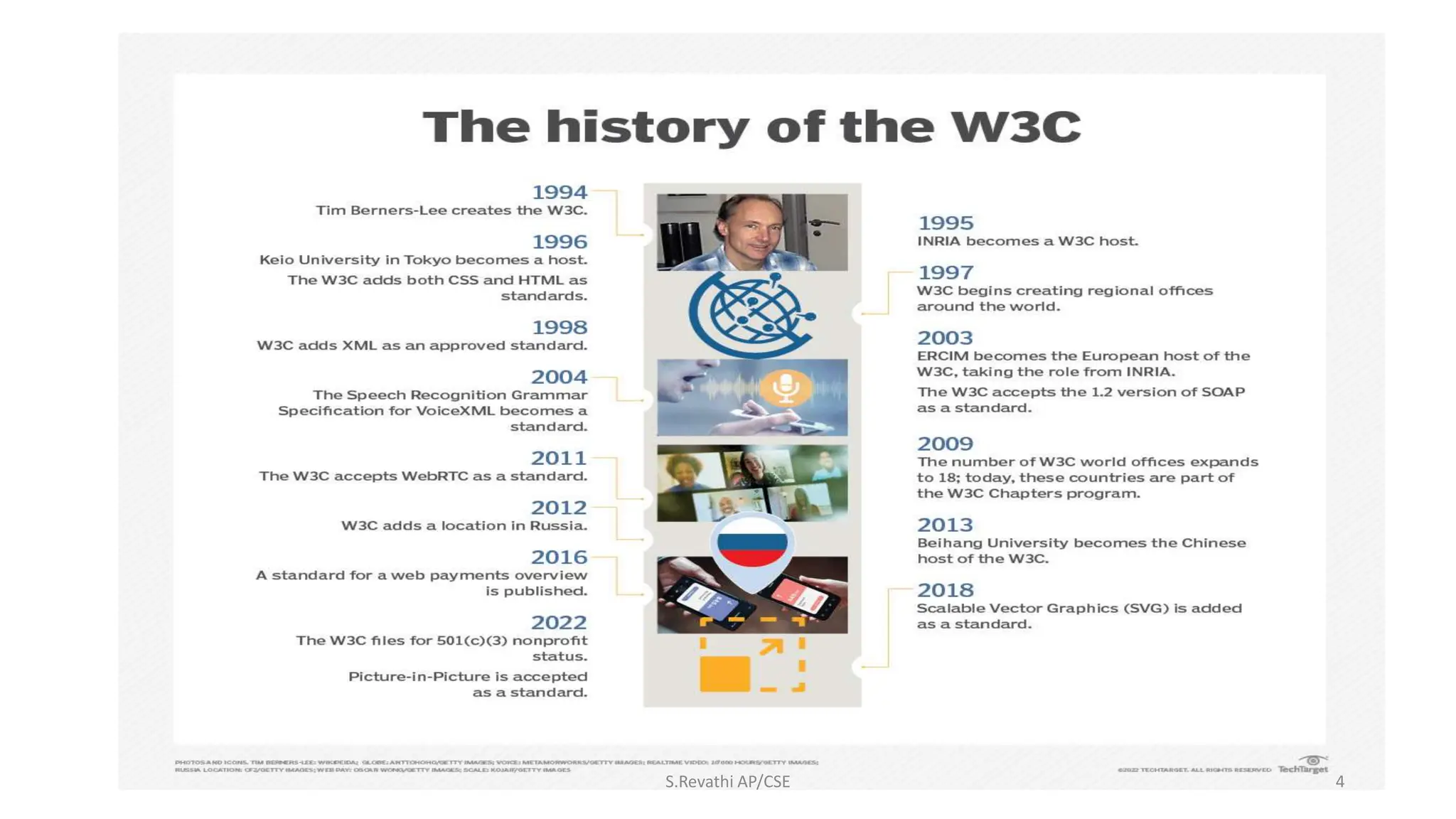
• World Wide Web Consortium was founded by Tim Berners-Lee in October 1994
at the Massachusetts Institute of Technology, with the support of
DARPA(Défense Advanced Research Projects Agency) and CERN.
• The main vision of W3C was to standardize the technologies as well as the
protocols that are used to build the web.
• It also tried to encourage the organizations to adopt the new standards defined by
the World Wide Web Consortium.
• In the next few years, the W3C thus published various recommendations such as
the format of PNG images, CSS(versions 1 and 2), etc.
S.Revathi AP/CSE 3
S.Revathi AP/CSE 4
Purpose of the W3C
• W3C is designed to bring interested parties together from different areas of IT to
work on developing web standards.
• The W3C also focuses on developing protocols and guidelines that help ensure
the growth and longevity of the web.
• Developing new standards is a consensus-based process by different teams in the
W3C, as these standards are intended to help ensure quality for web-based
developers and end users.
S.Revathi AP/CSE 5
W3C standards
• W3C standards describe a range of recommended programming languages to
generally accepted principles in web services and open architectures.
• Web design and application standards are following:
Common Gateway Interface (CGI)
CSS
Document Object Model (DOM)
Extensible HTML (XHTML)
Extensible Markup Language (XML)
Gleaning Resource Descriptions from Dialects of Languages (GRDDL)
HTML
JavaScript Object Notation for Linked Data (JSON-LD)
S.Revathi AP/CSE 6
Resource Description Framework (RDF)
Simple Object Access Protocol (SOAP)
SPARQL Protocol and RDF Query Language (SPARQL)
Speech Recognition Grammar Specification (SRGS)
Speech Synthesis Markup Language (SSML)
Scalable Vector Graphics (SVG)
VoiceXML (VXML)
Web Real-Time Communications (WebRTC)
Web Services Description Language (WSDL)
S.Revathi AP/CSE 7
Advantages
• W3C enables the easier maintenance of the W3C validated websites.
• It provides a consistent and defined look for all the W3C validated websites.
• It standardizes the validated websites so that they are accessible to different
devices.
• It enables faster browser interaction.
S.Revathi AP/CSE 8
Disadvantages
• W3C validation is a timely process and thus the time for full validation
depends on the website code.
• W3C validation exercises have costs associated with them.
• Sometimes translation issues arise in W3C validation of websites.
S.Revathi AP/CSE 9

W3C (World Wide Web Consortium)Standard.pptx

  • 1.
    W3C (World Wide WebConsortium) S.Revathi AP/CSE 1
  • 2.
    W3C • The W3C(World Wide Web Consortium) is an international organization that creates standards for the World Wide Web. • The W3C is committed to improving the web by setting and promoting web- based standards. • The W3C's goal is to create technical standards and guidelines for web technologies worldwide. • These standards are intended to keep a consistent level of technical quality and compatibility concerning the World Wide Web. S.Revathi AP/CSE 2
  • 3.
    History • World WideWeb Consortium was founded by Tim Berners-Lee in October 1994 at the Massachusetts Institute of Technology, with the support of DARPA(Défense Advanced Research Projects Agency) and CERN. • The main vision of W3C was to standardize the technologies as well as the protocols that are used to build the web. • It also tried to encourage the organizations to adopt the new standards defined by the World Wide Web Consortium. • In the next few years, the W3C thus published various recommendations such as the format of PNG images, CSS(versions 1 and 2), etc. S.Revathi AP/CSE 3
  • 4.
  • 5.
    Purpose of theW3C • W3C is designed to bring interested parties together from different areas of IT to work on developing web standards. • The W3C also focuses on developing protocols and guidelines that help ensure the growth and longevity of the web. • Developing new standards is a consensus-based process by different teams in the W3C, as these standards are intended to help ensure quality for web-based developers and end users. S.Revathi AP/CSE 5
  • 6.
    W3C standards • W3Cstandards describe a range of recommended programming languages to generally accepted principles in web services and open architectures. • Web design and application standards are following: Common Gateway Interface (CGI) CSS Document Object Model (DOM) Extensible HTML (XHTML) Extensible Markup Language (XML) Gleaning Resource Descriptions from Dialects of Languages (GRDDL) HTML JavaScript Object Notation for Linked Data (JSON-LD) S.Revathi AP/CSE 6
  • 7.
    Resource Description Framework(RDF) Simple Object Access Protocol (SOAP) SPARQL Protocol and RDF Query Language (SPARQL) Speech Recognition Grammar Specification (SRGS) Speech Synthesis Markup Language (SSML) Scalable Vector Graphics (SVG) VoiceXML (VXML) Web Real-Time Communications (WebRTC) Web Services Description Language (WSDL) S.Revathi AP/CSE 7
  • 8.
    Advantages • W3C enablesthe easier maintenance of the W3C validated websites. • It provides a consistent and defined look for all the W3C validated websites. • It standardizes the validated websites so that they are accessible to different devices. • It enables faster browser interaction. S.Revathi AP/CSE 8
  • 9.
    Disadvantages • W3C validationis a timely process and thus the time for full validation depends on the website code. • W3C validation exercises have costs associated with them. • Sometimes translation issues arise in W3C validation of websites. S.Revathi AP/CSE 9