FINAL INVESTIGATION REPORT OF
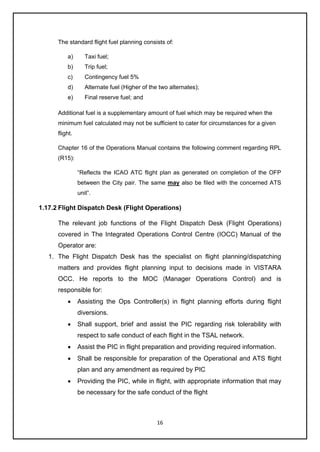
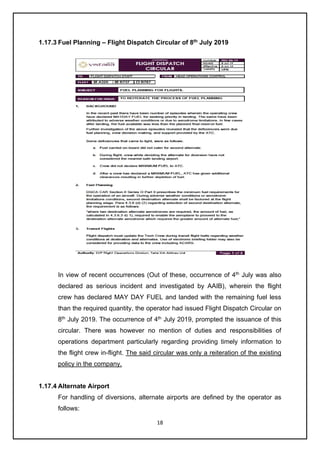
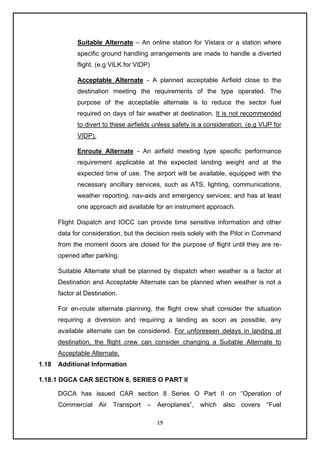
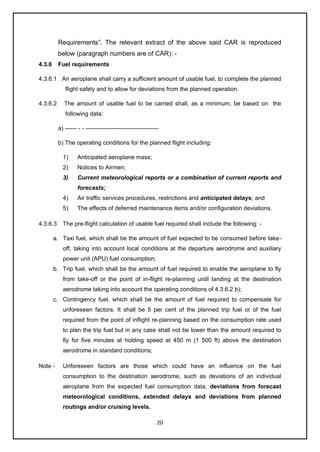
SERIOUS INCIDENT TO M/S VISTARA
AIRBUS A320 AIRCRAFT VT-TNH
ON 15TH
JULY 2019
GOVERNMENT OF INDIA
MINISTRY OF CIVIL AVIATION
AIRCRAFT ACCIDENT INVESTIGATION BUREAU
FOREWORD
This document has been prepared based upon the evidences collected
during the investigation and opinion obtained from the experts. The
investigation has been carried out in accordance with Annex 13 to the
convention on International Civil Aviation and under Rule 11 of Aircraft
(Investigation of Accidents and Incidents), Rules 2017 of India. The
investigation is conducted not to apportion blame or to assess
individual or collective responsibility. The sole objective is to draw
lessons from this serious incident which may help in preventing such
incidents in future.
INDEX
S. NO. SUBJECT PAGE
1.0 FACTUAL INFORMATION 01
1.1 HISTORY OF FLIGHT 01
1.2 INJURIES TO PERSONS 03
1.3 DAMAGE TO AIRCRAFT 04
1.4 OTHER DAMAGE 04
1.5 PERSONAL INFORMATION 04
1.5.1 PILOT IN COMMAND 04
1.5.2 PILOT MONITORING 04
1.6 AIRCRAFT INFORMATION 05
1.7 METEOROLOGY INFORMATION 06
1.8 AIDS TO NAVIGATION 09
1.9 COMMUNICATION 09
1.10 AERODROME INFORMATION 09
1.11 FLIGHT RECORDERS 10
1.12 WRECKAGE AND IMPACT INFORMATION 13
1.13 MEDICAL AND PATHOLOGICAL INFORMATION 13
1.14 FIRE 13
1.15 SURVIVAL ASPECTS 13
1.16 TEST AND RESEARCH 13
1.17 ORGANIZATIONAL AND MANAGEMENT INFORMATION 13
1.17.1 AIRLINES FUEL POLICY & OPERATIONAL REQUIREMENT 13
1.17.2 FLIGHT DISPATCH DESK (FLIGHT OPERATIONS) 16
1.17.3 FUEL PLANNING – FLIGHT DISPATCH CIRCULAR OF 8TH
JULY 2019 18
1.17.4 ALTERNATE AIRPORT 18
1.18 ADDITIONAL INFORMATION 19
1.19 USEFUL OR EFFECTIVE INVESTIGATION TECHNIQUES 27
2.0 ANALYSIS 28
2.1 GENERAL 28
2.2 FUEL POLICY & PROCEDURES 28
2.3 CIRCUMSTANCES LEADING TO THE INCIDENT 30
2.4 ROLE OF FLIGHT DISPATCH/OPERATIONS CONTROL CENTRE 36
3.0 CONCLUSION 37
3.1 FINDINGS 37
3.2 PROBABLE CAUSE 40
4.0 RECOMMENDATIONS 41
GLOSSARY
AAIB Aircraft Accident Investigation Bureau, India
ALI Aligarh VOR
ARC Airworthiness Review Certificate
ATC Air Traffic Control
ATPL Airline Transport Pilot License
AUW All Up Weight
C of A Certificate of Airworthiness
C of R Certificate of Registration
CAR Civil Aviation Requirements
CMM Component Maintenance Manual
CPL Commercial Pilot License
DGCA Directorate General of Civil Aviation
DME Distance Measuring Equipment
DPN Delhi VOR-DME
EDTO Extended Diversion Time Operations
EFOB Estimated Fuel on Board
FAF Final Approach Fix
F/O First Officer
FCU Flight Control Unit
FMGC Flight Management Guidance Computer
FOB Fuel on Board
FRTOL Flight Radio Telephone Operators License
hrs Hours
IAP Instrument Approach Procedure
IATA International Air Transport Association
ICAO International Civil Aviation Organization
ILS Instrument Landing System
IOCC Integrated Operations Control Centre
LKN Lucknow VOR
LLZ Localizer
LRC Long Range Cruise
MAP Missed Approach Procedure
MDF Minimum Diversion Fuel
METARs METeorological Aerodrome Reports
MLG Main Landing Gear
MTOW Maximum Take Off Weight
NDB Non-Directional Beacon
NLG Nose Landing Gear
OCC Operational Control Centre
PF Pilot Flying
PM Pilot Monitoring
PIC Pilot in Command
SID Standard Instrument Departure
TSAL Tata Sia Airlines Limited
TSRA Terminal Radar Service Area
VEAB Prayagraj (Allahabad) Airport
VOR VHF Omnidirectional Range
UTC Coordinated Universal Time
1
1 FACTUAL INFORMATION
1.1 History of Flight
On 15.7.2019, Vistara Airbus A-320 aircraft VT-TNH was involved in a serious
incident of landing below “fuel minima” at Lucknow (alternate) after declaring
“May Day Fuel”, while operating scheduled flight from Mumbai to Delhi. The
aircraft was under command of an ATPL holder (PF) with a CPL holder as
First Officer (PM). There were 155 passengers on board in addition to the 7
crew members.
The Operational Flight Plan (OFP) for the flight was generated at 0617 UTC.
The Airlines has a system of remote briefing and as per the Transit Briefing
Sheet provided to the crew, Ahmedabad (VAAH) was the 1st
Alternate and
Lucknow (VILK) was the 2nd
Alternate (suitable company alternate). However
on OFP provided to flight crew 1st
Alternate was given as VILK (Suitable
Alternate) and Second Alternate was Jaipur (Acceptable Alternate). Same
was accepted by the PIC and as per the OFP “Additional Fuel” of 1001 kgs
was taken for the flight with VILK as the alternate.
In the Transit Briefing Sheet, METAR of Delhi (0800 UTC), Lucknow (0800
UTC) and Ahmedabad (0600 UTC) was provided to the flight crew. In the
same sheet, METAR for Amritsar (VIAR, 0800 UTC) was also provided. TAF
of these stations was also available. METAR of Jaipur (VIJP) however was
not available (Acceptable Alternate).
As per the ACARS report of the flight, engine start up was at 0927 UTC with
8500 kgs of fuel on board. The aircraft took off from Mumbai at 0948 UTC,
with fuel on board as 8274 Kgs. The TAF for Delhi indicated Tempo TSRA at
the time of expected arrival time of the flight into Delhi. Copy of OFP used for
noting down the progress of flight indicated that the crew did not update
themselves with the weather of en-route airports like VAAH, VAUD & VIJP.
The flight was uneventful till top of descent into Delhi. On commencement of
descent into VIDP, the flight crew observed weather over VIDP (TSRA with
winds of 20 knots gusting to 30 knots) and was informed by ATC to expect
delay at Delhi.
Descent was carried out by PM. The OFP indicated that the flight crew had
updated themselves with weather of VILK of 1030 UTC & VIJP of 1100 UTC
2
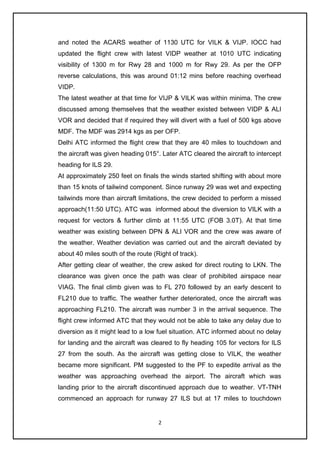
and noted the ACARS weather of 1130 UTC for VILK & VIJP. IOCC had
updated the flight crew with latest VIDP weather at 1010 UTC indicating
visibility of 1300 m for Rwy 28 and 1000 m for Rwy 29. As per the OFP
reverse calculations, this was around 01:12 mins before reaching overhead
VIDP.
The latest weather at that time for VIJP & VILK was within minima. The crew
discussed among themselves that the weather existed between VIDP & ALI
VOR and decided that if required they will divert with a fuel of 500 kgs above
MDF. The MDF was 2914 kgs as per OFP.
Delhi ATC informed the flight crew that they are 40 miles to touchdown and
the aircraft was given heading 015°. Later ATC cleared the aircraft to intercept
heading for ILS 29.
At approximately 250 feet on finals the winds started shifting with about more
than 15 knots of tailwind component. Since runway 29 was wet and expecting
tailwinds more than aircraft limitations, the crew decided to perform a missed
approach(11:50 UTC). ATC was informed about the diversion to VILK with a
request for vectors & further climb at 11:55 UTC (FOB 3.0T). At that time
weather was existing between DPN & ALI VOR and the crew was aware of
the weather. Weather deviation was carried out and the aircraft deviated by
about 40 miles south of the route (Right of track).
After getting clear of weather, the crew asked for direct routing to LKN. The
clearance was given once the path was clear of prohibited airspace near
VIAG. The final climb given was to FL 270 followed by an early descent to
FL210 due to traffic. The weather further deteriorated, once the aircraft was
approaching FL210. The aircraft was number 3 in the arrival sequence. The
flight crew informed ATC that they would not be able to take any delay due to
diversion as it might lead to a low fuel situation. ATC informed about no delay
for landing and the aircraft was cleared to fly heading 105 for vectors for ILS
27 from the south. As the aircraft was getting close to VILK, the weather
became more significant. PM suggested to the PF to expedite arrival as the
weather was approaching overhead the airport. The aircraft which was
landing prior to the aircraft discontinued approach due to weather. VT-TNH
commenced an approach for runway 27 ILS but at 17 miles to touchdown
3
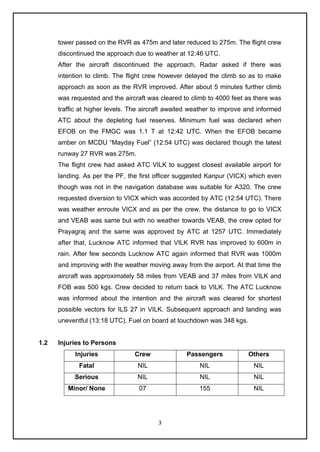
tower passed on the RVR as 475m and later reduced to 275m. The flight crew
discontinued the approach due to weather at 12:46 UTC.
After the aircraft discontinued the approach, Radar asked if there was
intention to climb. The flight crew however delayed the climb so as to make
approach as soon as the RVR improved. After about 5 minutes further climb
was requested and the aircraft was cleared to climb to 4000 feet as there was
traffic at higher levels. The aircraft awaited weather to improve and informed
ATC about the depleting fuel reserves. Minimum fuel was declared when
EFOB on the FMGC was 1.1 T at 12:42 UTC. When the EFOB became
amber on MCDU “Mayday Fuel” (12:54 UTC) was declared though the latest
runway 27 RVR was 275m.
The flight crew had asked ATC VILK to suggest closest available airport for
landing. As per the PF, the first officer suggested Kanpur (VICX) which even
though was not in the navigation database was suitable for A320. The crew
requested diversion to VICX which was accorded by ATC (12:54 UTC). There
was weather enroute VICX and as per the crew, the distance to go to VICX
and VEAB was same but with no weather towards VEAB, the crew opted for
Prayagraj and the same was approved by ATC at 1257 UTC. Immediately
after that, Lucknow ATC informed that VILK RVR has improved to 600m in
rain. After few seconds Lucknow ATC again informed that RVR was 1000m
and improving with the weather moving away from the airport. At that time the
aircraft was approximately 58 miles from VEAB and 37 miles from VILK and
FOB was 500 kgs. Crew decided to return back to VILK. The ATC Lucknow
was informed about the intention and the aircraft was cleared for shortest
possible vectors for ILS 27 in VILK. Subsequent approach and landing was
uneventful (13:18 UTC). Fuel on board at touchdown was 348 kgs.
1.2 Injuries to Persons
Injuries Crew Passengers Others
Fatal NIL NIL NIL
Serious NIL NIL NIL
Minor/ None 07 155 NIL
4
1.3 Damage to Aircraft
Nil
1.4 Other Damage
Nil
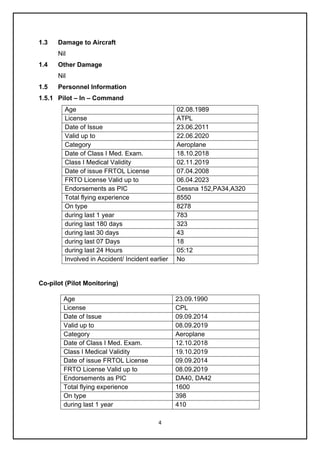
1.5 Personnel Information
1.5.1 Pilot – In – Command
Co-pilot (Pilot Monitoring)
Age 23.09.1990
License CPL
Date of Issue 09.09.2014
Valid up to 08.09.2019
Category Aeroplane
Date of Class I Med. Exam. 12.10.2018
Class I Medical Validity 19.10.2019
Date of issue FRTOL License 09.09.2014
FRTO License Valid up to 08.09.2019
Endorsements as PIC DA40, DA42
Total flying experience 1600
On type 398
during last 1 year 410
Age 02.08.1989
License ATPL
Date of Issue 23.06.2011
Valid up to 22.06.2020
Category Aeroplane
Date of Class I Med. Exam. 18.10.2018
Class I Medical Validity 02.11.2019
Date of issue FRTOL License 07.04.2008
FRTO License Valid up to 06.04.2023
Endorsements as PIC Cessna 152,PA34,A320
Total flying experience 8550
On type 8278
during last 1 year 783
during last 180 days 323
during last 30 days 43
during last 07 Days 18
during last 24 Hours 05:12
Involved in Accident/ Incident earlier No
5
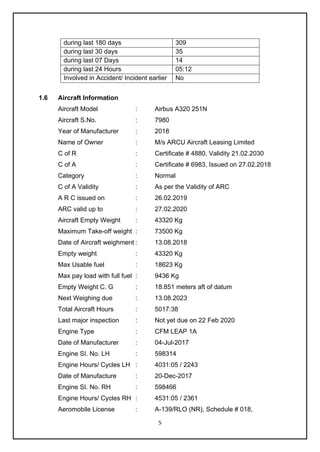
during last 180 days 309
during last 30 days 35
during last 07 Days 14
during last 24 Hours 05:12
Involved in Accident/ Incident earlier No
1.6 Aircraft Information
Aircraft Model : Airbus A320 251N
Aircraft S.No. : 7980
Year of Manufacturer : 2018
Name of Owner : M/s ARCU Aircraft Leasing Limited
C of R : Certificate # 4880, Validity 21.02.2030
C of A : Certificate # 6983, Issued on 27.02.2018
Category : Normal
C of A Validity : As per the Validity of ARC
A R C issued on : 26.02.2019
ARC valid up to : 27.02.2020
Aircraft Empty Weight : 43320 Kg
Maximum Take-off weight : 73500 Kg
Date of Aircraft weighment : 13.08.2018
Empty weight : 43320 Kg
Max Usable fuel : 18623 Kg
Max pay load with full fuel : 9436 Kg
Empty Weight C. G : 18.851 meters aft of datum
Next Weighing due : 13.08.2023
Total Aircraft Hours : 5017:38
Last major inspection : Not yet due on 22 Feb 2020
Engine Type : CFM LEAP 1A
Date of Manufacturer : 04-Jul-2017
Engine SI. No. LH : 598314
Engine Hours/ Cycles LH : 4031:05 / 2243
Date of Manufacture : 20-Dec-2017
Engine SI. No. RH : 598466
Engine Hours/ Cycles RH : 4531:05 / 2361
Aeromobile License : A-139/RLO (NR), Schedule # 018,
6
Validity : 30.04.2023
AD, SB, Modification : All complied
1.7 Meterological Information
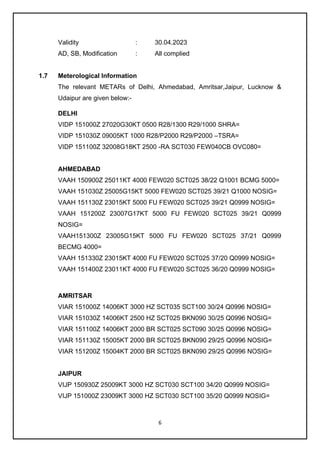
The relevant METARs of Delhi, Ahmedabad, Amritsar,Jaipur, Lucknow &
Udaipur are given below:-
DELHI
VIDP 151000Z 27020G30KT 0500 R28/1300 R29/1000 SHRA=
VIDP 151030Z 09005KT 1000 R28/P2000 R29/P2000 –TSRA=
VIDP 151100Z 32008G18KT 2500 -RA SCT030 FEW040CB OVC080=
AHMEDABAD
VAAH 150900Z 25011KT 4000 FEW020 SCT025 38/22 Q1001 BCMG 5000=
VAAH 151030Z 25005G15KT 5000 FEW020 SCT025 39/21 Q1000 NOSIG=
VAAH 151130Z 23015KT 5000 FU FEW020 SCT025 39/21 Q0999 NOSIG=
VAAH 151200Z 23007G17KT 5000 FU FEW020 SCT025 39/21 Q0999
NOSIG=
VAAH151300Z 23005G15KT 5000 FU FEW020 SCT025 37/21 Q0999
BECMG 4000=
VAAH 151330Z 23015KT 4000 FU FEW020 SCT025 37/20 Q0999 NOSIG=
VAAH 151400Z 23011KT 4000 FU FEW020 SCT025 36/20 Q0999 NOSIG=
AMRITSAR
VIAR 151000Z 14006KT 3000 HZ SCT035 SCT100 30/24 Q0996 NOSIG=
VIAR 151030Z 14006KT 2500 HZ SCT025 BKN090 30/25 Q0996 NOSIG=
VIAR 151100Z 14006KT 2000 BR SCT025 SCT090 30/25 Q0996 NOSIG=
VIAR 151130Z 15005KT 2000 BR SCT025 BKN090 29/25 Q0996 NOSIG=
VIAR 151200Z 15004KT 2000 BR SCT025 BKN090 29/25 Q0996 NOSIG=
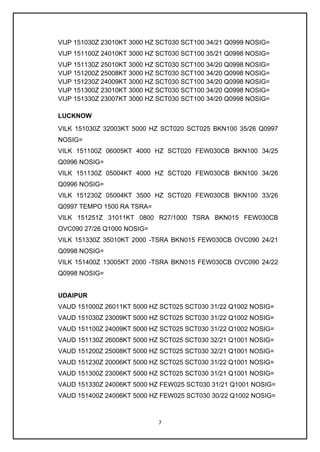
JAIPUR
VIJP 150930Z 25009KT 3000 HZ SCT030 SCT100 34/20 Q0999 NOSIG=
VIJP 151000Z 23009KT 3000 HZ SCT030 SCT100 35/20 Q0999 NOSIG=
7
VIJP 151030Z 23010KT 3000 HZ SCT030 SCT100 34/21 Q0999 NOSIG=
VIJP 151100Z 24010KT 3000 HZ SCT030 SCT100 35/21 Q0998 NOSIG=
VIJP 151130Z 25010KT 3000 HZ SCT030 SCT100 34/20 Q0998 NOSIG=
VIJP 151200Z 25008KT 3000 HZ SCT030 SCT100 34/20 Q0998 NOSIG=
VIJP 151230Z 24009KT 3000 HZ SCT030 SCT100 34/20 Q0998 NOSIG=
VIJP 151300Z 23010KT 3000 HZ SCT030 SCT100 34/20 Q0998 NOSIG=
VIJP 151330Z 23007KT 3000 HZ SCT030 SCT100 34/20 Q0998 NOSIG=
LUCKNOW
VILK 151030Z 32003KT 5000 HZ SCT020 SCT025 BKN100 35/26 Q0997
NOSIG=
VILK 151100Z 06005KT 4000 HZ SCT020 FEW030CB BKN100 34/25
Q0996 NOSIG=
VILK 151130Z 05004KT 4000 HZ SCT020 FEW030CB BKN100 34/26
Q0996 NOSIG=
VILK 151230Z 05004KT 3500 HZ SCT020 FEW030CB BKN100 33/26
Q0997 TEMPO 1500 RA TSRA=
VILK 151251Z 31011KT 0800 R27/1000 TSRA BKN015 FEW030CB
OVC090 27/26 Q1000 NOSIG=
VILK 151330Z 35010KT 2000 -TSRA BKN015 FEW030CB OVC090 24/21
Q0998 NOSIG=
VILK 151400Z 13005KT 2000 -TSRA BKN015 FEW030CB OVC090 24/22
Q0998 NOSIG=
UDAIPUR
VAUD 151000Z 26011KT 5000 HZ SCT025 SCT030 31/22 Q1002 NOSIG=
VAUD 151030Z 23009KT 5000 HZ SCT025 SCT030 31/22 Q1002 NOSIG=
VAUD 151100Z 24009KT 5000 HZ SCT025 SCT030 31/22 Q1002 NOSIG=
VAUD 151130Z 26008KT 5000 HZ SCT025 SCT030 32/21 Q1001 NOSIG=
VAUD 151200Z 25008KT 5000 HZ SCT025 SCT030 32/21 Q1001 NOSIG=
VAUD 151230Z 20006KT 5000 HZ SCT025 SCT030 31/22 Q1001 NOSIG=
VAUD 151300Z 23006KT 5000 HZ SCT025 SCT030 31/21 Q1001 NOSIG=
VAUD 151330Z 24006KT 5000 HZ FEW025 SCT030 31/21 Q1001 NOSIG=
VAUD 151400Z 24006KT 5000 HZ FEW025 SCT030 30/22 Q1002 NOSIG=
8
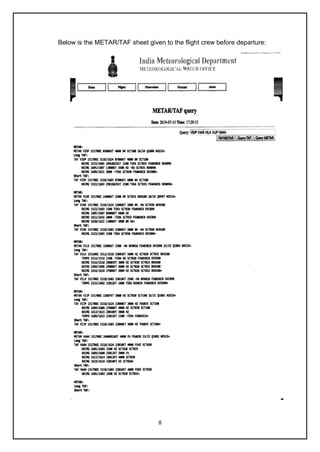
Below is the METAR/TAF sheet given to the flight crew before departure:
9
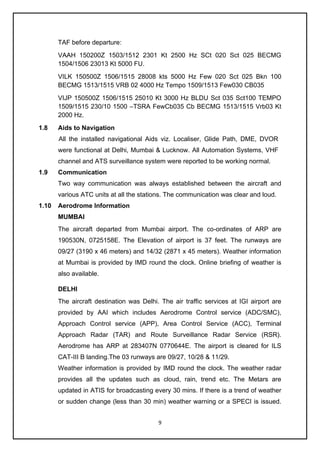
TAF before departure:
VAAH 150200Z 1503/1512 2301 Kt 2500 Hz SCt 020 Sct 025 BECMG
1504/1506 23013 Kt 5000 FU.
VILK 150500Z 1506/1515 28008 kts 5000 Hz Few 020 Sct 025 Bkn 100
BECMG 1513/1515 VRB 02 4000 Hz Tempo 1509/1513 Few030 CB035
VIJP 150500Z 1506/1515 25010 Kt 3000 Hz BLDU Sct 035 Sct100 TEMPO
1509/1515 230/10 1500 –TSRA FewCb035 Cb BECMG 1513/1515 Vrb03 Kt
2000 Hz.
1.8 Aids to Navigation
All the installed navigational Aids viz. Localiser, Glide Path, DME, DVOR
were functional at Delhi, Mumbai & Lucknow. All Automation Systems, VHF
channel and ATS surveillance system were reported to be working normal.
1.9 Communication
Two way communication was always established between the aircraft and
various ATC units at all the stations. The communication was clear and loud.
1.10 Aerodrome Information
MUMBAI
The aircraft departed from Mumbai airport. The co-ordinates of ARP are
190530N, 0725158E. The Elevation of airport is 37 feet. The runways are
09/27 (3190 x 46 meters) and 14/32 (2871 x 45 meters). Weather information
at Mumbai is provided by IMD round the clock. Online briefing of weather is
also available.
DELHI
The aircraft destination was Delhi. The air traffic services at IGI airport are
provided by AAI which includes Aerodrome Control service (ADC/SMC),
Approach Control service (APP), Area Control Service (ACC), Terminal
Approach Radar (TAR) and Route Surveillance Radar Service (RSR).
Aerodrome has ARP at 283407N 0770644E. The airport is cleared for ILS
CAT-III B landing.The 03 runways are 09/27, 10/28 & 11/29.
Weather information is provided by IMD round the clock. The weather radar
provides all the updates such as cloud, rain, trend etc. The Metars are
updated in ATIS for broadcasting every 30 mins. If there is a trend of weather
or sudden change (less than 30 min) weather warning or a SPECI is issued.
10
Any sudden change in weather is also broadcasted by ATC, after which the
flight crew (PIC) reassesses its minima and decides whether to hold, land or
divert to alternate airport.
LUCKNOW
Lucknow airport (IATA: LKO, ICAO: VILK) is an International Airport (ILS
CAT-III-B compliant). ARP coordinates are 264543N 0805300E. It has Cat 7
firefighting facilities. Weather information is provided by IMD round the clock
(ATS complex from 2330 to 1630 UTC). Weather information is broadcasted
on ATIS all the time. There is only one runway 09/27 (2742 x 45 meters)
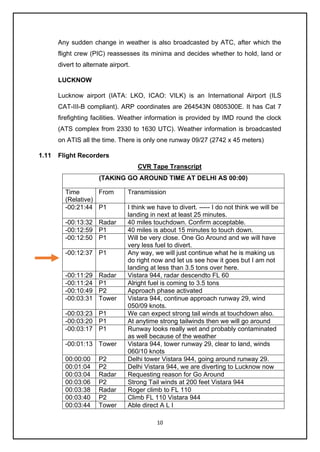
1.11 Flight Recorders
CVR Tape Transcript
(TAKING GO AROUND TIME AT DELHI AS 00:00)
Time
(Relative)
From Transmission
-00:21:44 P1 I think we have to divert. ----- I do not think we will be
landing in next at least 25 minutes.
-00:13:32 Radar 40 miles touchdown. Confirm acceptable.
-00:12:59 P1 40 miles is about 15 minutes to touch down.
-00:12:50 P1 Will be very close. One Go Around and we will have
very less fuel to divert.
-00:12:37 P1 Any way, we will just continue what he is making us
do right now and let us see how it goes but I am not
landing at less than 3.5 tons over here.
-00:11:29 Radar Vistara 944, radar descendto FL 60
-00:11:24 P1 Alright fuel is coming to 3.5 tons
-00:10:49 P2 Approach phase activated
-00:03:31 Tower Vistara 944, continue approach runway 29, wind
050/09 knots.
-00:03:23 P1 We can expect strong tail winds at touchdown also.
-00:03:20 P1 At anytime strong tailwinds then we will go around
-00:03:17 P1 Runway looks really wet and probably contaminated
as well because of the weather
-00:01:13 Tower Vistara 944, tower runway 29, clear to land, winds
060/10 knots
00:00:00 P2 Delhi tower Vistara 944, going around runway 29.
00:01:04 P2 Delhi Vistara 944, we are diverting to Lucknow now
00:03:04 Radar Requesting reason for Go Around
00:03:06 P2 Strong Tail winds at 200 feet Vistara 944
00:03:38 Radar Roger climb to FL 110
00:03:40 P2 Climb FL 110 Vistara 944
00:03:44 Tower Able direct A L I
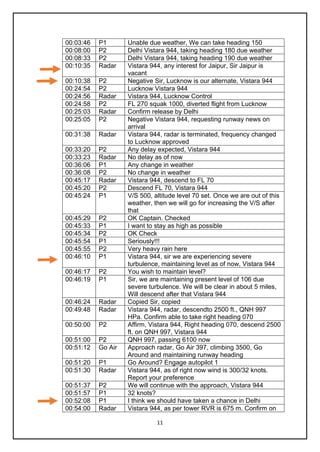
11
00:03:46 P1 Unable due weather, We can take heading 150
00:08:00 P2 Delhi Vistara 944, taking heading 180 due weather
00:08:33 P2 Delhi Vistara 944, taking heading 190 due weather
00:10:35 Radar Vistara 944, any interest for Jaipur, Sir Jaipur is
vacant
00:10:38 P2 Negative Sir, Lucknow is our alternate, Vistara 944
00:24:54 P2 Lucknow Vistara 944
00:24:56 Radar Vistara 944, Lucknow Control
00:24:58 P2 FL 270 squak 1000, diverted flight from Lucknow
00:25:03 Radar Confirm release by Delhi
00:25:05 P2 Negative Vistara 944, requesting runway news on
arrival
00:31:38 Radar Vistara 944, radar is terminated, frequency changed
to Lucknow approved
00:33:20 P2 Any delay expected, Vistara 944
00:33:23 Radar No delay as of now
00:36:06 P1 Any change in weather
00:36:08 P2 No change in weather
00:45:17 Radar Vistara 944, descend to FL 70
00:45:20 P2 Descend FL 70, Vistara 944
00:45:24 P1 V/S 500, altitude level 70 set. Once we are out of this
weather, then we will go for increasing the V/S after
that
00:45:29 P2 OK Captain. Checked
00:45:33 P1 I want to stay as high as possible
00:45:34 P2 OK Check
00:45:54 P1 Seriously!!!
00:45:55 P2 Very heavy rain here
00:46:10 P1 Vistara 944, sir we are experiencing severe
turbulence, maintaining level as of now, Vistara 944
00:46:17 P2 You wish to maintain level?
00:46:19 P1 Sir, we are maintaining present level of 106 due
severe turbulence. We will be clear in about 5 miles,
Will descend after that Vistara 944
00:46:24 Radar Copied Sir, copied
00:49:48 Radar Vistara 944, radar, descendto 2500 ft., QNH 997
HPa. Confirm able to take right heading 070
00:50:00 P2 Affirm, Vistara 944, Right heading 070, descend 2500
ft. on QNH 997, Vistara 944
00:51:00 P2 QNH 997, passing 6100 now
00:51:12 Go Air Approach radar, Go Air 397, climbing 3500, Go
Around and maintaining runway heading
00:51:20 P1 Go Around? Engage autopilot 1
00:51:30 Radar Vistara 944, as of right now wind is 300/32 knots.
Report your preference
00:51:37 P2 We will continue with the approach, Vistara 944
00:51:57 P1 32 knots?
00:52:08 P1 I think we should have taken a chance in Delhi
00:54:00 Radar Vistara 944, as per tower RVR is 675 m. Confirm on
12
localizer?
00:54:08 P2 Affirm on localizer, Vistara 944. Standby for mimima
00:54:53 Tower Vistara 944, visibility as per MET office is 800 m and
RVR touchdown 475 m.
00:55:00 P1 Don’t respond, don’t respond. Cabin crew landing
stations
00:55:06 Tower Vistara 944, latest RVR touchdown 450 m
00:55:14 P2 Roger, Discontinuing approach Sir, Vistara 944
00:56:07 P1 Vistara 944, we are --- minimum fuel now. We need
priority for landing. Otherwise we will be touhing our
minimum reserve fuel and heading turning as of now
020 due weather, Vistara 944. Please advise as soon
as the RVR is above 600 m.
00:59:19 P1 Vistara 944, any weather improvement sir?
00:59:20 Radar As per tower, current RVR is 275 m and 650 - 650 sir.
01:01:05 P2 Can we know the runway length at Kanpur airport
and also do we have option of diverting to Kanpur in
case the weather is bad at Lucknow
01:01:15 Radar Sir, we will check with Kanpur. At present Lucknow
touchdown RVR is 250 m, mid RVR is 1200 m, end
RVR is 1800 m.
01:03:15 P1 Sir, latest RVR available?
01:03:17 Radar Latest RVR 225 m, 2000 m and 2000 m
01:03:21 P1 Sir, Vistara 944. May Day May Day May Day Fuel.
We need an airport to land sir immediately, Vistara
944
01:03:33 Radar Vistara 944, radar, confirm May Day?
01:03:37 P1 Sir, we need to land somewhere immediately.
Lucknow is well below minima. Please give us an
airport
01:03:44 Radar As per them, Kanpur is available. Proceed direct to
correction, turn left heading 240 and proceed direct to
Kanpur
01:04:29 P2 May Day, Vistara, we are diverting to Allahabad sir,
Kanpur is unable due weather sir. It will take us right
through weather
01:04:39 Radar Confirm, wish to proceed direct to Prayagraj,
Allahabad?
01:04:42 P2 Affirm, Affirm, Vistara 944
01:05:07 P2 May Day, Vistara 944, requesting further climb.
01:05:17 Radar Vistara 944, radar, but Chakeri is 53 miles from
present position. Confirm still wish to proceed
towards Prayagraj
01:05:24 P1 Sir, there is lot of weather enroute to Kanpur. We will
have to circumnavigate a lot. That will increase the
track miles much more than the Prayagraj.
01:05:34 Radar Climb to FL 60 initially
01:10:57 Radar Vistara 944, radar, now visibility has improved at
Luknow, visibility is 600 m
13
1.12 Wreckage and Impact Information
Not Applicable
1.13 Medical & Pathological Information
The crew had undergone pre-flight medical prior to the flight and was
satisfactory. Breath analysis test was negative for both the cockpit crew.
1.14 Fire
There was no fire.
1.15 Survival Aspects
Incident was survivable
1.16 Test & Research
Nil
1.17 Organisation & Management Information
The aircraft was operated by a Scheduled Airlines.
1.17.1 Airlines Fuel Policy& Operational Requirement
Fuel Policy
As per the Fuel Policy of the operator contained in Operations Manual Part ‘A’,
Reserve Fuel is the sum of Alternate fuel, Final Reserve Fuel / alternate holding Fuel
and the Contingency Fuel (If not consumed). These three are defined as follows:
Alternate Fuel is the fuel required to fly from Destination to an Alternate Airport and is
based on forecast winds, temperatures and the appropriate gross weight, for the
following phases of flight:
i. A missed approach from the applicable minima at the destination aerodrome to
missed approach altitude, taking into account the complete missed approach
procedure.
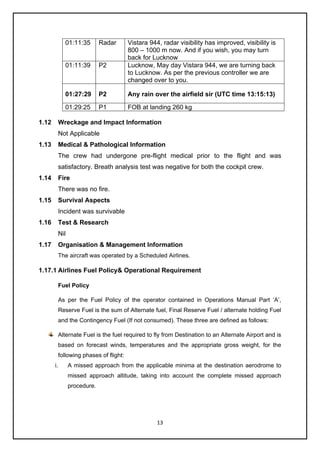
01:11:35 Radar Vistara 944, radar visibility has improved, visibility is
800 – 1000 m now. And if you wish, you may turn
back for Lucknow
01:11:39 P2 Lucknow, May day Vistara 944, we are turning back
to Lucknow. As per the previous controller we are
changed over to you.
01:27:29 P2 Any rain over the airfield sir (UTC time 13:15:13)
01:29:25 P1 FOB at landing 260 kg
14
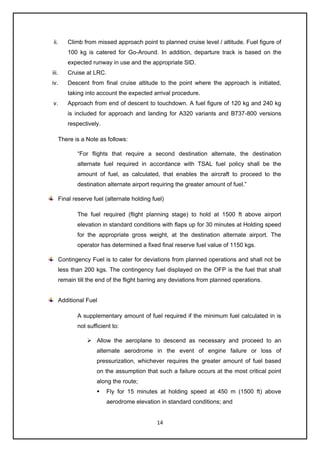
ii. Climb from missed approach point to planned cruise level / altitude. Fuel figure of
100 kg is catered for Go-Around. In addition, departure track is based on the
expected runway in use and the appropriate SID.
iii. Cruise at LRC.
iv. Descent from final cruise altitude to the point where the approach is initiated,
taking into account the expected arrival procedure.
v. Approach from end of descent to touchdown. A fuel figure of 120 kg and 240 kg
is included for approach and landing for A320 variants and B737-800 versions
respectively.
There is a Note as follows:
“For flights that require a second destination alternate, the destination
alternate fuel required in accordance with TSAL fuel policy shall be the
amount of fuel, as calculated, that enables the aircraft to proceed to the
destination alternate airport requiring the greater amount of fuel.”
Final reserve fuel (alternate holding fuel)
The fuel required (flight planning stage) to hold at 1500 ft above airport
elevation in standard conditions with flaps up for 30 minutes at Holding speed
for the appropriate gross weight, at the destination alternate airport. The
operator has determined a fixed final reserve fuel value of 1150 kgs.
Contingency Fuel is to cater for deviations from planned operations and shall not be
less than 200 kgs. The contingency fuel displayed on the OFP is the fuel that shall
remain till the end of the flight barring any deviations from planned operations.
Additional Fuel
A supplementary amount of fuel required if the minimum fuel calculated in is
not sufficient to:
➢ Allow the aeroplane to descend as necessary and proceed to an
alternate aerodrome in the event of engine failure or loss of
pressurization, whichever requires the greater amount of fuel based
on the assumption that such a failure occurs at the most critical point
along the route;
▪ Fly for 15 minutes at holding speed at 450 m (1500 ft) above
aerodrome elevation in standard conditions; and
15
▪ Make an approach and landing;
➢ Meet additional requirements not covered above;
Discretionary fuel is extra amount of fuel to be carried at the discretion of the Pilot in
Command.
Operational Requirement
In the same chapter of Operations Manual, there is a heading Operational
Requirement which mentions that a flight shall not be commenced unless, taking into
account both the meteorological conditions and any delays that are expected in flight,
the airplane carries sufficient fuel and oil to ensure that it can safely complete the
flight and shall take into account:
❖ Anticipated meteorological conditions
❖ An IAP at the destination followed by a MAP
❖ Weights
❖ Routings
❖ Delays
❖ ATS procedures
❖ The procedures prescribed in the operations manual for loss of
pressurization, where applicable, or failure of one engine while en-route;
and
❖ Any other conditions that may delay the landing of the airplane or increase
fuel and/ or oil consumption.
It is mentioned that the final authority and responsibility for fuel loads and the fuel
management in flight is with the Pilot in command and he shall ensure that the
amount of usable fuel remaining in flight is not less than the fuel required to proceed
to an aerodrome where a safe landing can be made, with final reserve fuel
remaining. The fuel for a flight is calculated on the Operational flight Plan (OFP), and
it assumes the following:
A. ATC flight plan routing and flight levels can be expected to be
achieved.
B. Delays due to traffic or special activity are not expected, unless
published. The final decision regarding the total amount of fuel to be
carried rests with the pilot in command.
It is also mentioned that the alternate aerodrome considered is usually the nearest,
and may not always be the most appropriate.
16
The standard flight fuel planning consists of:
a) Taxi fuel;
b) Trip fuel;
c) Contingency fuel 5%
d) Alternate fuel (Higher of the two alternates);
e) Final reserve fuel; and
Additional fuel is a supplementary amount of fuel which may be required when the
minimum fuel calculated may not be sufficient to cater for circumstances for a given
flight.
Chapter 16 of the Operations Manual contains the following comment regarding RPL
(R15):
“Reflects the ICAO ATC flight plan as generated on completion of the OFP
between the City pair. The same may also be filed with the concerned ATS
unit”.
1.17.2 Flight Dispatch Desk (Flight Operations)
The relevant job functions of the Flight Dispatch Desk (Flight Operations)
covered in The Integrated Operations Control Centre (IOCC) Manual of the
Operator are:
1. The Flight Dispatch Desk has the specialist on flight planning/dispatching
matters and provides flight planning input to decisions made in VISTARA
OCC. He reports to the MOC (Manager Operations Control) and is
responsible for:
• Assisting the Ops Controller(s) in flight planning efforts during flight
diversions.
• Shall support, brief and assist the PIC regarding risk tolerability with
respect to safe conduct of each flight in the TSAL network.
• Assist the PIC in flight preparation and providing required information.
• Shall be responsible for preparation of the Operational and ATS flight
plan and any amendment as required by PIC
• Providing the PIC, while in flight, with appropriate information that may
be necessary for the safe conduct of the flight
17
• Shall analyse the Weather, NOTAM’s and Performance restrictions for
the flights assigned to him
• Shall maintain a weather watch on the flights assigned to him till the
completion of the flight
• Shall monitor the conditions on the route and keep the PIC informed of
any adverse developments which may necessitate the aircraft to return
to origin or land safely at the closest airfield
• In the event of an emergency shall:
i. Initiate such procedures as outlined in the TSAL operations
manual while avoiding taking any action that would conflict with
ATC procedures;
ii. Notify IOCC and TSAL Flight Operations Management at the
earliest, of the nature of the situation.
iii. Request assistance if required.
iv. Convey safety-related information to the pilot-in-command that
may be necessary for the safe conduct of the flight, including
information related to any amendments to the fight plan that
become necessary in the course of the flight;
v. Initiate action as per TSAL Operations Manual / Flight Safety
Manual and Emergency Response Procedures Manual. This will
include information about dangerous good from NOTOC which
may be required during Aircraft accident and incident to facilitate
emergency response
• Shall keep the Shift in charge abreast of all developments in the shift
• Shall alert all internal stakeholders of any local aerodrome weather
warnings
• Furnish the pilot-in-command with all latest available information on the
route to be flown
18
1.17.3 Fuel Planning – Flight Dispatch Circular of 8th
July 2019
In view of recent occurrences (Out of these, occurrence of 4th
July was also
declared as serious incident and investigated by AAIB), wherein the flight
crew has declared MAY DAY FUEL and landed with the remaining fuel less
than the required quantity, the operator had issued Flight Dispatch Circular on
8th
July 2019. The occurrence of 4th
July 2019, prompted the issuance of this
circular. There was however no mention of duties and responsibilities of
operations department particularly regarding providing timely information to
the flight crew in-flight. The said circular was only a reiteration of the existing
policy in the company.
1.17.4 Alternate Airport
For handling of diversions, alternate airports are defined by the operator as
follows:
19
Suitable Alternate – An online station for Vistara or a station where
specific ground handling arrangements are made to handle a diverted
flight. (e.g VILK for VIDP)
Acceptable Alternate - A planned acceptable Airfield close to the
destination meeting the requirements of the type operated. The
purpose of the acceptable alternate is to reduce the sector fuel
required on days of fair weather at destination. It is not recommended
to divert to these airfields unless safety is a consideration. (e.g VIJP for
VIDP).
Enroute Alternate - An airfield meeting type specific performance
requirement applicable at the expected landing weight and at the
expected time of use. The airport will be available, equipped with the
necessary ancillary services, such as ATS, lighting, communications,
weather reporting, nav-aids and emergency services; and has at least
one approach aid available for an instrument approach.
Flight Dispatch and IOCC can provide time sensitive information and other
data for consideration, but the decision rests solely with the Pilot in Command
from the moment doors are closed for the purpose of flight until they are re-
opened after parking.
Suitable Alternate shall be planned by dispatch when weather is a factor at
Destination and Acceptable Alternate can be planned when weather is not a
factor at Destination.
For en-route alternate planning, the flight crew shall consider the situation
requiring a diversion and requiring a landing as soon as possible, any
available alternate can be considered. For unforeseen delays in landing at
destination, the flight crew can consider changing a Suitable Alternate to
Acceptable Alternate.
1.18 Additional Information
1.18.1 DGCA CAR SECTION 8, SERIES O PART II
DGCA has issued CAR section 8 Series O Part II on “Operation of
Commercial Air Transport – Aeroplanes”, which also covers “Fuel
20
Requirements”. The relevant extract of the above said CAR is reproduced
below (paragraph numbers are of CAR): -
4.3.6 Fuel requirements
4.3.6.1 An aeroplane shall carry a sufficient amount of usable fuel, to complete the planned
flight safely and to allow for deviations from the planned operation.
4.3.6.2 The amount of usable fuel to be carried shall, as a minimum, be based on the
following data:
a) ------ - - -------------------------------------
b) The operating conditions for the planned flight including:
1) Anticipated aeroplane mass;
2) Notices to Airmen;
3) Current meteorological reports or a combination of current reports and
forecasts;
4) Air traffic services procedures, restrictions and anticipated delays; and
5) The effects of deferred maintenance items and/or configuration deviations.
4.3.6.3 The pre-flight calculation of usable fuel required shall include the following: -
a. Taxi fuel, which shall be the amount of fuel expected to be consumed before take-
off; taking into account local conditions at the departure aerodrome and auxiliary
power unit (APU) fuel consumption;
b. Trip fuel, which shall be the amount of fuel required to enable the aeroplane to fly
from take-off or the point of in-flight re-planning until landing at the destination
aerodrome taking into account the operating conditions of 4.3.6.2 b);
c. Contingency fuel, which shall be the amount of fuel required to compensate for
unforeseen factors. It shall be 5 per cent of the planned trip fuel or of the fuel
required from the point of inflight re-planning based on the consumption rate used
to plan the trip fuel but in any case shall not be lower than the amount required to
fly for five minutes at holding speed at 450 m (1 500 ft) above the destination
aerodrome in standard conditions;
Note - Unforeseen factors are those which could have an influence on the fuel
consumption to the destination aerodrome, such as deviations of an individual
aeroplane from the expected fuel consumption data, deviations from forecast
meteorological conditions, extended delays and deviations from planned
routings and/or cruising levels.
21
d. Destination alternate fuel, which shall be:
1) Where a destination alternate aerodrome is required, the amount of fuel required
to enable the aeroplane to
a. Perform a missed approach at the destination aerodrome;
b. Climb to the expected cruising altitude;
c. Fly the expected routing;
d. Descend to the point where the expected approach is initiated; and
e. Conduct the approach and landing at the destination alternate aerodrome;
or
2) where two destination alternate aerodromes are required, the amount of fuel, as
calculated in 4.3.6.3 d) 1), required to enable the aeroplane to proceed to the
destination alternate aerodrome which requires the greater amount of alternate
fuel; or
e. Final reserve fuel, which shall be the amount of fuel calculated using the estimated
mass on arrival at the destination alternate aerodrome or the destination
aerodrome, when no destination alternate aerodrome is required:
1) - - - - - - - - - - - - - -------------------------------------
2) for a turbine engine aeroplane, the amount of fuel required to fly for 30
minutes at holding speed at 450 m (1 500 ft) above aerodrome elevation in
standard conditions;
f. Additional fuel, which shall be the supplementary amount of fuel required if the
minimum fuel calculated in accordance with 4.3.6.3 b), c), d) and e) is not sufficient
to:
1) allow the aeroplane to descend as necessary and proceed to an alternate
aerodrome in the event of engine failure or loss of pressurization, whichever
requires the greater amount of fuel based on the assumption that such a
failure occurs at the most critical point along the route;
i) Fly for 15 minutes at holding speed at 450 m (1 500 ft) above
aerodrome elevation in standard conditions; and
ii) Make an approach and landing;
2) allow an aeroplane engaged in EDTO to comply with the EDTO critical fuel
scenario as established by DGCA;
3) Meet additional requirements not covered above;
22
g. Discretionary fuel, which shall be the extra amount of fuel to be carried at the
discretion of the pilot-in-command.
4.3.6.4 ---------------------------------------------------
4.3.6.5 A flight shall not commence unless the usable fuel on board meets the
requirements in 4.3.6.3 a), b), c), d), e) and f) if required and shall not continue from
the point of in-flight re planning unless the usable fuel on board meets the
requirements in 4.3.6.3 b), c), d) e) and f) if required.
4.3.6.6 Notwithstanding the provisions in 4.3.6.3 a), b), c), d), and f); DGCA may,
based on the results of a specific safety risk assessment conducted by the operator
which demonstrates how an equivalent level of safety will be maintained, approve
variations to the pre-flight fuel calculation of taxi fuel, trip fuel, contingency fuel,
destination alternate fuel, and additional fuel. The specific safety risk assessment
shall include at least the:
a) Flight fuel calculations;
b) Capabilities of the operator to include:
i) A data-driven method that includes a fuel consumption monitoring
programme; and/or
ii) The advanced use of alternate aerodromes; and
c) Specific mitigation measures.
4.3.7 In-flight fuel management
4.3.7.1 -------------------------------------------------------
4.3.7.2 The pilot-in-command shall continually ensure that the amount of usable fuel
remaining on board is not less than the fuel required to proceed to an aerodrome
where a safe landing can be made with the planned final reserve fuel remaining
upon landing.
4.3.7.2.1 The pilot-in-command shall request delay information from ATC when
unanticipated circumstances may result in landing at the destination aerodrome
with less than the final reserve fuel plus any fuel required to proceed to an
alternate aerodrome or the fuel required to operate to an isolated aerodrome.
4.3.7.2.2 The pilot-in-command shall advise ATC of a minimum fuel state by declaring
MINIMUM FUEL when, having committed to land at a specific aerodrome, the
23
pilot calculates that any change to the existing clearance to that aerodrome may
result in landing with less than planned final reserve fuel.
4.3.7.2.3 The pilot-in-command shall declare a situation of fuel emergency by
broadcasting MAYDAY MAYDAY MAYDAY FUEL, when the calculated usable
fuel predicted to be available upon landing at the nearest aerodrome where a
safe landing can be made is less than the planned final reserve fuel.
1.18.2 Fuel Planning for the flights – DGCA Air Safety Circular (ASC) 03 of 2019
DGCA, has issued an Air Safety Circular considering increasing number of incidents
wherein the operating crew have declared MAYDAY FUEL for seeking priority in
landing due to adverse weather conditions or due to aerodrome limitations. The
deficiencies in fuel planning, crew decision making and support provided by the ATC
mentioned in the ASC are
Fuel carried on-board did not cater for second alternate
During flight, crew while deciding the alternate for diversion have not
considered the nearest safe landing airport.
Crew did not declare MINIMUM FUEL to ATC.
After a crew has declared a MINIMUM FUEL, ATC has given
additional clearances resulting in further depletion of fuel.
The ASC refers to the CAR Section 8 Series O Part II which prescribes minimum fuel
requirements for the operation of aircraft and mentions the following:
During adverse weather conditions or aerodrome limitations conditions, second
destination alternate should also be factored during the flight planning stage. Para
4.3.6 (d) (2) regarding selection of second destination alternate inter alia requires as
follows: “where two destination alternate aerodromes are required, the amount of
fuel, as calculated in 4.3.6.3 d) 1), required to enable the aeroplane to proceed to the
destination alternate aerodrome which requires the greater amount of alternate fuel;”
It further reiterates that Flight dispatch should update the crew during transit halts
regarding weather conditions at destination and alternates. Use of electronic briefing
folder may also be considered for providing data to the crew.
For Air Traffic Control Units, the action suggested is “whenever a crew declares
MINIMUM FUEL to the ATC, it means that all planned aerodrome options have been
reduced to a specific aerodrome of intended landing and any change to the existing
clearance may result in landing with less than planned final reserve fuel. This is not
24
an emergency situation but an indication that an emergency situation is possible,
should any additional delay occur. The ATC should facilitate the early landing for the
aircraft. The above instructions are for strict compliance by all the aircraft operators
and ATC.”
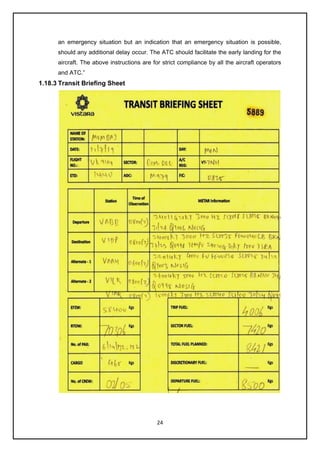
1.18.3 Transit Briefing Sheet
25
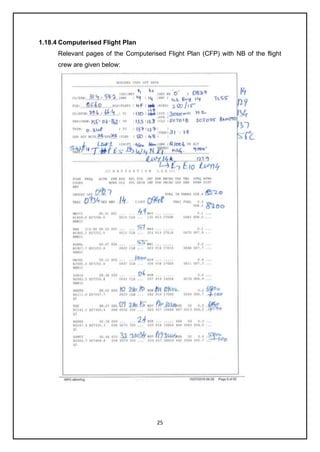
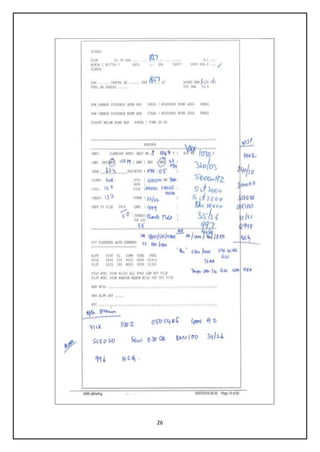
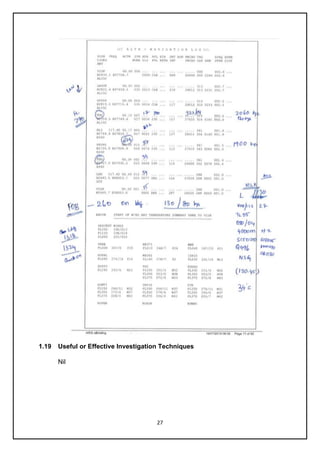
1.18.4 Computerised Flight Plan
Relevant pages of the Computerised Flight Plan (CFP) with NB of the flight
crew are given below:
26
27
1.19 Useful or Effective Investigation Techniques
Nil
28
1 ANALYSIS
2.1 General
➢ Both operating crew were appropriately licensed and qualified to
operate the flight.
➢ The aircraft had a valid Certificate of Airworthiness at the time of
incident.
➢ The Aircraft held valid Certificate of Release to Service which was
issued at the airport of departure.
➢ Airworthiness Directives, Service Bulletins, DGCA Mandatory
Modifications had been complied with. Transit inspections were carried
out as per the approved transit inspection schedules and all higher
inspection schedules including checks/inspection as per the
manufacturer’s guidelines as specified in Maintenance Programme and
approved by the Quality Manager.
For purpose of discussion in the following paragraphs, an alternate is
required when it becomes either impossible or inadvisable to proceed to
or land at the aerodrome of intended landing as per the definition(s)
given by the operator of these aerodromes. This was the case of subject
flight. While the investigation reviewed the scenario in which the said
occurrence took place, the investigation also analysed the current
regulations and instructions given to implement these regulations.
Further it has also been analysed that how tacit following of these
instructions/ procedures might have precipitated into an unsafe
situation of fuel emergency or be a contributory factor to the
occurrence.
2.2 Fuel Policy & Procedures
In today’s aviation scenario, maximum cost in operations is of fuel. Flight
operations procedures of the operators are therefore based on reducing the
overall fuel consumption and thereby the fuel cost. Across the Airlines, these
fuel saving measures are covered in the training and through the issuance of
SOPs. It is expected that flight crew would follow procedures which reduce
fuel uplifted and fuel used. The scenario does not rule out action against flight
29
crew if it is observed that he has carried extra fuel without justification. More
or less the flight crew feels the pressure when it comes to carrying extra fuel.
Careful perusal of the company Fuel Policy, CFP, OFP and the Transit
Briefing Sheet was carried out. Although, fuel policy mentioned in the
Operations Manual is in line with the DGCA CAR, however, practically the
procedure followed during day to day operations of the operator becomes
different.
Vistara policy: For handling of diversions, alternate airports are defined by
the operator.
(1) Suitable Alternate is where specific ground handling arrangements are
made to handle a diverted flight.
(2) Acceptable Alternate is a planned & acceptable airport close to the
destination and is proposed to reduce the sector fuel required on days of fair
weather at destination. It is not recommended to divert to these airports
unless safety is a consideration. Such a sentence in an important
document creates subjectivity in the mind of the flight crew and increases the
probability of erring on an unsafe side.
Further the policy mentions that in case of emergency, the “Flight Dispatch
and IOCC can provide” but it is not mandatory on the part of Flight Dispatch/
IOCC to provide time sensitive information and other data for consideration by
the flight crew. Though there is no doubt and it is well established that the
final decision rests solely with the Pilot in Command
Further the policy intends that Suitable Alternate shall be planned by dispatch
when weather is a factor at Destination and Acceptable Alternate can be
planned when weather is not a factor at Destination.
The definitions of alternates, therefore create confusion in the mind of flight
crew, while taking a decision on where to divert, particularly when the clause
of saving fuel is deeply imbibed in the mind of the flight crew these days. The
decision making during a high stress situation (weather, destination/ alternate
airport not available) may result in unsafe situations. Further with no mandate
for providing time sensitive information by the IOCC, the flight crew is
30
overloaded in case of real emergency or a high stress situation as was the
present case.
2.3 Circumstances leading to the incident
Flight crew was briefed at Mumbai before departure for VIDP with VAAH as
the 1st
Alternate and VILK (Suitable Company Alternate) as the Second
Alternate. However on OFP provided to flight crew 1st
Alternate was VILK
(Suitable Alternate) and Second Alternate was VIJP (Acceptable Alternate).
Same was accepted by the PIC. As the Company OFP carried an “Additional
Fuel” of 1001 kgs, Flight crew was aware that this additional fuel will cater for
VAAH as the alternate for legal purpose. However if VAAH was to be the
alternate, then there was no “Holding Fuel” over VIDP.
The flight crew and company knew that in case of an actual diversion, the
flight crew will choose to divert to the company preferred alternate (Suitable
alternate as VILK) as this would suit commercial purpose ( where specific
ground handling arrangements are made to handle a diverted flight).
Therefore the “Transit Briefing Sheet” showed 1st
alternate as Lucknow (VILK)
and second alternate as Jaipur (VIJP).
It is pertinent to note that on the date/ time of the occurrence, Vistara had no
operations to VIJP and hence the company knew that in case of diversion to
VIJP there will be delay wrt to ground handling and passenger inconvenience
as they had no ground handling agreement in place. This information is also
in the mind of flight crew while taking a decision to divert.
VIJP is considered as an “Acceptable Alternate” wherein purpose is to reduce
the sector fuel required on the day of fair weather at destination. It is not
recommended to divert to these airfields unless safety is a consideration (e.g.
VIJP for VIDP).
31
Satellite picture of 15th
July 0900 UTC (Airborne time 0948 UTC)
The PIC had accepted the “Transit Briefing Sheet” at 0805 UTC for the flight
from VABB to VIDP, wherein the 1st
Alternate was Ahmedabad (VAAH) and
the 2nd
Alternate was Lucknow (VILK). Fuel required for the flight was 7420
kgs and the Fuel on Board was 8560 Kgs. Additional Fuel on board as per the
Computerized Flight Plan was 1001 Kgs. Flight was planned to cruise at FL
350.
The FOB was just adequate for VAAH alternate (1st
alternate) without any
holding over destination for any delay but for VILK the aircraft had 1001 kgs
extra fuel. However on closer scrutiny, the CFP indicated that the CFP had
VILK as the 1st
alternate and 2nd
alternate was Jaipur (VIJP) which was
different from the company “Transit Briefing Sheet”. The Transit Briefing sheet
mentioned Ahmedabad (VAAH) as the 1st
alternate and Lucknow (VILK) as
the 2nd
alternate. The Transit Briefing Sheet also mentioned Amritsar (VIAR)
just below the 2nd alternate row, however the CFP did not give the fuel
required for diversion to VIAR.
The aircraft got airborne from Mumbai at 0948 UTC with 8215 Kgs of FOB.
The flight from Mumbai, en-route and till the commencement of descend into
Delhi was normal. On route to Delhi the flight had flown past 1st
alternate i.e.
32
Ahmedabad, Udaipur and north of Jaipur. Flight crew did not update
themselves with the weather of en-route alternate or of Jaipur (VIJP), which
was the 2nd
alternate (Acceptable alternate).
Both flight crew knew that at the time of arrival in to VIDP, they can expect
“TSRA”. At 1015 UTC, IOCC had updated the flight crew with latest VIDP
weather of 1000 UTC. The weather was winds 270/ 20 kts. gusting to 30 Kts;
Visibility, R28/ 1300, R29/1000; SHRA SCT 030, Few 040 CB, OVC 080;
Temp/ DP of 27/25; Q1000, TEMPO 280 20 gusting to 30 TSRA). This was
around 01:12 mins before reaching overhead VIDP as per the OFP
calculations.
When the aircraft commenced descent into VIDP, the flight crew observed
weather overhead VIDP. Delhi ATC had advised the crew regarding delay and
was advised to join hold. The flight crew continued holding and with 1001 kgs
of additional fuel, they were aware that they can hold only for 30 mins approx.
to mitigate the delay due weather activity overhead VIDP. While remaining in
the hold, the flight crew burnt the extra fuel which was sufficient for diversion
to VAAH. By doing so the flight crew took a risk and closed one of the safer
options for themselves. The holding continued till they had adequate fuel
(2914 kgs) for VILK as diversion.
While in the hold the PF briefed the PM that we will not consider Jaipur as an
alternate. At this stage there was no discussion about the existing weather at
Lucknow & Jaipur.
When flight crew advised ATC of “10 minutes for our diversion and our
diversion is Lucknow”, flight crew noted they had 3800 kgs. Thereafter Delhi
ATC at 11:27 UTC advised that flight was 40 nms to touchdown and started
radar vectors for ILS 29. PF in spite of knowing that the weather at VIDP was
bad, elected to get vectored for the ILS approach knowing well that in all
probability the approach was going to be unsuccessful, as he briefed that in
case of a missed approach, will be left with 3200 kgs of “Fuel on Board”.
After carrying out a “Missed Approach” due to changing winds, flight crew
elected to divert to VILK and thereafter updated themselves with VILK & VIJP
weather via ACARS:
33
VILK 1130 UTC 050/04 kts, 4000 meters visibility, Haze, Sct 020,
Few 030 CB, BKN 100, 34/26, 996 NSG
VIJP weather at 1130Z 25010KT 3000 HZ SCT030 SCT100 34/20
Q0998 NOSIG=
PIC was fixated to divert to VILK as the “preferred company alternate” was
VILK and not VIJP. The PIC also in his statement mentioned that due to
expected en-route weather to VILK, he had decided to divert at 3200 kgs
instead of 3000 kgs (2914 Kgs). However after Go Around FOB was 3400
Kgs (3396 as per DFDR) at the time of diversion 3100 Kgs (3077Kgs as per
DFDR). No suggestion was given by Company IOCC regarding diversion to
Jaipur.
At this point it is pertinent to note that, had the flight crew updated themselves
with Udaipur & Jaipur while en-route to Delhi, they would have known that
Jaipur (2nd
alternate as per CFP) weather was good. The flight crew also
would have been aware of the en-route weather to Jaipur as their track to
Delhi from Mumbai would made them fly north of the routing to Jaipur (Delhi-
Jaipur), close enough to get a global picture of the en-route weather.
After commencement of diversion at 1155 UTC, the aircraft could not maintain
its track toward ALI VOR due weather en-route and initially maintained
heading of 170 degrees, then 180 degrees. The aircraft climbed to FL130 due
to traffic. Delhi ATC advised the flight crew, “Any interest for Jaipur, Sir
Jaipur is vacant”. The flight crew did not take this hint given by ATC but
continued diverting to VILK, en-route the aircraft had to deviate up to 40 nms
South of track and post clearance from the Prohibited Area near Agra, it set
course to VILK. At that point, after sequencing the FMS flight plan with the ILS
approach at VILK, FOB on FMS prediction showed as 1600 Kgs.
Had the flight crew been aware of the situation and judged the en-route
weather to Lucknow, they would have decided to divert to Jaipur which was
still closer in terms of distance. In that case, they would have landed at Jaipur
without an emergency situation related to fuel.
34
The PF has not mentioned in his statement that ATC had suggested them for
diversion to Jaipur. In spite of the aircraft flying north of Jaipur while en-route
to Delhi & having Jaipur METAR which was supplied by the company Flight
Dispatch indicated Jaipur visibility of 3 Kms with no significant weather.
As per the entries in CFP by the flight crew, following were the estimates &
FOB at way points:
Wayoint Estimate in UTC FOB in KGs
TOC FL 270 1217 2060 Kgs (+60 kgs)
ALI 1224 1900
PAVRU 1237 1500
TOD 1239 1400
LKN 1254 1000
As per the company CFP, had the aircraft maintained track & climbed to
planned diversion level, flight crew should have declared “Minimum Fuel” after
commencing diversion to Delhi ATC as per the requirements. However the
flight crew declared “Minimum Fuel” only after discontinuing the approach at
Lucknow indicating inappropriate understanding about when to declare
minimum fuel.
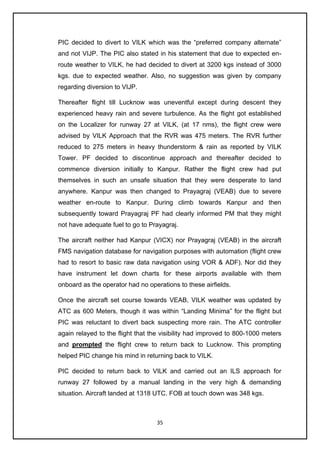
Satellite picture of 1200 UTC
35
PIC decided to divert to VILK which was the “preferred company alternate”
and not VIJP. The PIC also stated in his statement that due to expected en-
route weather to VILK, he had decided to divert at 3200 kgs instead of 3000
kgs. due to expected weather. Also, no suggestion was given by company
regarding diversion to VIJP.
Thereafter flight till Lucknow was uneventful except during descent they
experienced heavy rain and severe turbulence. As the flight got established
on the Localizer for runway 27 at VILK, (at 17 nms), the flight crew were
advised by VILK Approach that the RVR was 475 meters. The RVR further
reduced to 275 meters in heavy thunderstorm & rain as reported by VILK
Tower. PF decided to discontinue approach and thereafter decided to
commence diversion initially to Kanpur. Rather the flight crew had put
themselves in such an unsafe situation that they were desperate to land
anywhere. Kanpur was then changed to Prayagraj (VEAB) due to severe
weather en-route to Kanpur. During climb towards Kanpur and then
subsequently toward Prayagraj PF had clearly informed PM that they might
not have adequate fuel to go to Prayagraj.
The aircraft neither had Kanpur (VICX) nor Prayagraj (VEAB) in the aircraft
FMS navigation database for navigation purposes with automation (flight crew
had to resort to basic raw data navigation using VOR & ADF). Nor did they
have instrument let down charts for these airports available with them
onboard as the operator had no operations to these airfields.
Once the aircraft set course towards VEAB, VILK weather was updated by
ATC as 600 Meters, though it was within “Landing Minima” for the flight but
PIC was reluctant to divert back suspecting more rain. The ATC controller
again relayed to the flight that the visibility had improved to 800-1000 meters
and prompted the flight crew to return back to Lucknow. This prompting
helped PIC change his mind in returning back to VILK.
PIC decided to return back to VILK and carried out an ILS approach for
runway 27 followed by a manual landing in the very high & demanding
situation. Aircraft landed at 1318 UTC. FOB at touch down was 348 kgs.
36
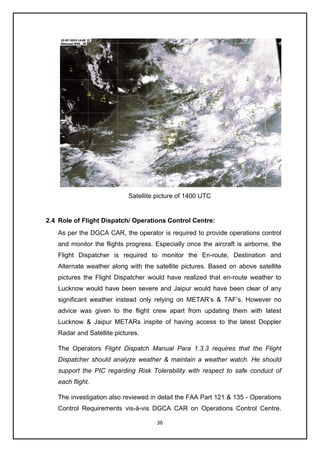
Satellite picture of 1400 UTC
2.4 Role of Flight Dispatch/ Operations Control Centre:
As per the DGCA CAR, the operator is required to provide operations control
and monitor the flights progress. Especially once the aircraft is airborne, the
Flight Dispatcher is required to monitor the En-route, Destination and
Alternate weather along with the satellite pictures. Based on above satellite
pictures the Flight Dispatcher would have realized that en-route weather to
Lucknow would have been severe and Jaipur would have been clear of any
significant weather instead only relying on METAR’s & TAF’s. However no
advice was given to the flight crew apart from updating them with latest
Lucknow & Jaipur METARs inspite of having access to the latest Doppler
Radar and Satellite pictures.
The Operators Flight Dispatch Manual Para 1.3.3 requires that the Flight
Dispatcher should analyze weather & maintain a weather watch. He should
support the PIC regarding Risk Tolerability with respect to safe conduct of
each flight.
The investigation also reviewed in detail the FAA Part 121 & 135 - Operations
Control Requirements vis-à-vis DGCA CAR on Operations Control Centre.
37
The requirements as laid down in CAR do not suffice the purpose particularly
in view of Total Flight Deck experience reducing day by day.
3 CONCLUSION
3.1 Findings
• The policy of giving in “Transit Briefing Sheet” 1st
Alternate as Ahmedabad
and Second as Lucknow and then expecting the flight to “Hold” over
destination with the additional fuel which was meant for diversion to 1st
Alternate (VAAH in this case) and thereby restricting the aircraft to fly to 2nd
Alternate (VILK in this case) was unsafe and circumvented the laid down
requirements.
• The Policy of leaving the choice of Alternate between Suitable & Acceptable
Alternate puts subtle pressure on the PF to choose the company preferred
alternate (Suitable in this case; VILK) in spite of having an Acceptable
alternate (VIJP) close to VIDP which the flight crew should have had a better
picture of, rather than choosing an alternate farther away in spite of knowing
the en-route weather. The Operator in general & PF in particular has tilted the
balance towards “Commercial Requirements” rather than keeping “Safety” of
its aircraft and occupants in mind.
• There was no practical “Safe” Operations Control of monitoring flight progress
and to suggest to flight crew in timely manner to divert to an airport where
better en-route & airport weather conditions prevailed. The PF could have
thereby discontinued to proceed to “Company Preferred/ Suitable Alternate”
and avoid situation of actual fuel emergency.
• The investigation is of a strong opinion that had the aircraft continued to
Kanpur or Prayagraj, there would have been a possibility of the aircraft
running out of fuel en-route which would have led to a forced landing in the
night time.
• The recommendations made in the investigation report into the causes of
accident to Air India A320 aircraft (VT-ESH) released on 12th
Aug 2016 are
still not fully implemented by the DGCA.
• Fuel Below Minimums should have been taken as one of the Safety
Performance Indicators (SPIs) by DGCA which could have avoided serious
incidents of landing with fuel below minimums as the present.
38
While reviewing the information which was made available to the
investigation, extensive use of ICAO Human Factor Checklist was made. The
factors observed were Faulty Planning, Error in Judgment, Stress, Company
Policies & Procedures, Company Operating Pressure, Situational Awareness,
CRM, Weather and documentation. Further the investigation used the James
Reasons Swiss Cheese model to categorise the findings and is discussed
below.
(A) Organisational Factors
(i) DGCA
As per the Aircraft Act 1934, the Director General of Civil Aviation or any other
officer specially empowered by the Central Government shall perform the
safety oversight functions in respect of matters specified in the Act. It is
responsible for regulation of air transport services to/from/within India and for
enforcement of civil air regulations, air safety and airworthiness standards. In
order to carry out the above duties and functions, DGCA issues Civil Aviation
Requirements (CAR) under various sections and Section 8 deals with “Aircraft
Operations”. Under Series ‘O’ of Section 8 is issued a CAR on “Operation of
Commercial Air Transport – Aeroplanes”. Under Para 4.3.6.1 of this CAR are
given fuel requirements which mention that an aeroplane shall carry a
sufficient amount of usable fuel, to complete the planned flight safely and to
allow for deviations from the planned operation. The said CAR available on
DGCA website was issued on 8th
July, 2011 and the last revision was on 30th
October 2018.
The requirements laid down in the CAR have been discussed in the analysis
of earlier investigations and as brought out, the operator has in their Manuals
mentioned that the above said CAR will be followed. However, in the
subsequent paragraphs of these Manuals on fuel planning, the gaps/
ambiguity in the CAR was utilized for taking lesser fuel on board than
intended by the CAR.
DGCA had issued an ASC 3 of 2019, on fuel planning for the flights. The
circular though does not have any legal binding on the operators. The circular
identifies that an incident occurred because, fuel carried on-board did not
39
cater for second alternate. During flight, crew while deciding the alternate for
diversion have not considered the nearest safe landing airport; crew did not
declare MINIMUM FUEL to ATC; and after crew has declared a MINIMUM
FUEL, ATC has given additional clearances resulting in further depletion of
fuel.
However, there is no mention of what should be done and how that action will
obviate the occurrences in future. Otherwise also, it is agreed that there have
been number of such occurrences. Investigation could not find if any concrete
actions were suggested by DGCA under SSP (It qualifies for one of the top
most Safety Performance Indicators) or mitigation actions taken by the
operator under SMS.
Be that as it may, the CAR on the subject should have been revisited by now
and root cause of the non-following of the provisos of CAR be fixed by
clarifying the ambiguous portion. In addition, the existing reasons which have
been brought out as a result of reactive (investigation) process, should have
been detected during the surveillance inspections carried out by the Flight
Operations Inspectors or during scrutiny of the Manuals and SOPs of the
operator.
(ii) Operator
• Putting subtle pressure on flight crew to divert only to “Suitable Alternates”
which was company preferred due to availability of ground handling.
• The “Transit Briefing” sheet showed 1st
Alternate as Ahmedabad & 2nd
Alternate as Lucknow. However the CFP had Lucknow as the 1st
Alternate &
Jaipur as the 2nd
Alternate. Hence the company & PIC both knew that in case
of actual diversion, aircraft would divert to Lucknow which was the company
preferred alternate and not Jaipur or Ahmedabad.
• Not providing any guidance to flight crew, while they were negotiating weather
which was not in line with the company Flight Dispatch manual.
• Lesser fuel was uplifted than that required as per CAR, by planning
Ahmedabad as the 1st
Alternate & Lucknow as the 2nd
Alternate.
40
(B) Unsafe Supervision
• Ambiguous instructions issued to the flight crew on fuel uplift and aerodrome
alternates were not captured by the DGCA (FSD office) during audits/
oversight.
• Inadequate Flight Following by IOCC of the operator.
(C) Pre-Conditions to the Unsafe Act
• Pre-conceived notion in the mind of flight crew to divert to Suitable Alternate
(because of conscious ambiguity in definition that in case the “situation
demands PF is authorized to divert” to an “Acceptable Airport”). There is a
tacit indication that efforts to be made by flight crew to divert to Suitable
Airport
• Not mitigating the risks associated with non-compliance of requirement of
latest weather (basic norm)
(D) Unsafe Act
• Organisation (IOCC) not suggesting the flight crew on the safer option of
diverting to Jaipur.
• Flight crew not updating themselves with en route weather including
observing the en-route weather to Jaipur.
• PF having a fixed mind set to divert to Lucknow in line with company
instructions and not seeing the big picture.
3.2 Probable Cause
The aircraft went into an unsafe situation of fuel emergency as PIC has not
given due consideration to the depleting fuel on board and getting fixated on
diversion to Lucknow in severe enroute weather requiring additional diversion
from track. This loss of situational awareness and fixation on diversion to
Lucknow (company preferred alternate) was result of failure on part of:
• Operators Flight Ops management to provide clear cut guidance to flight
crew regarding diversion.
• IOCC to update and provide guidance to flight crew regarding en-route
weather and possible diversion to Jaipur.
• PF to ensure that the alternate as per Transit Briefing Sheet & CFP are the
same.
41
• Flight crew to update themselves with latest Jaipur weather while en-route
to Delhi.
• Flight crew to divert to Jaipur in spite of facing severe weather en-route to
Lucknow.
• PF (during discussions with PM) to be assertive enough to divert to Jaipur.
Further Non-assertive behavior on part of the PM and letting the PF
continue with diversion to VILK.
4 RECOMMENDATIONS
All Scheduled Operators
1. The Integrated Operations Control must be headed by a “Current type rated
pilot” who has the experience in the area of operations covered by the
operator for providing relevant inputs while making a decision, keeping the
safety of aircraft & its occupants in mind. For operators, who operate multiple
type of aircraft, the aircraft which covers the maximum area of operations
must be the Head of Operations Control Centre/ IOCC.
2 IOCC/ Operations Controller/ Flight Dispatchers must make pro-active
decision well in advance to assist the flight crew in diverting flights which are
en-route to destination airports with moderate/ severe weather activity instead
of aircraft holding over destination till Minimum Diversion Fuel (MDF) and then
diverting to alternate. This results in flight crew declaring “Minimum Fuel” (as
per ICAO) and putting undue pressure on themselves & ATCO’s.
3 PF(s) must divert to the airport which has been accepted on the Transit
Briefing sheet as this alternate has been suggested by the Flight Dispatch
keeping the latest weather conditions, NOTAMS etc. in mind at planning
stage. If required the “Repetitive Flight Plan” (RFP) alternate must be revised
by the company Flight Dispatch in such a case. (PIC has the final authority for
keeping the safety of aircraft and passengers in mind)
4 “Current & Rated Pilot” should be available in IOCC/ Flight Dispatch for
“Operations Control” duty to assist the operating flight crew & flight
dispatchers make a decision keeping the safety of aircraft & passengers in
mind. “Hold over destination till MDF” advice by IOCC/ Operations Controller/
42
Flight Dispatcher must be suggested only when the weather at the alternate
airport meets VFR requirements as defined in DGCA CAR. However PF has
the final authority to hold or divert.
5 Must ensure that during the period of inclement weather IOCC/ Flight
Dispatch contacts the aircraft by the best available means
(VHF/HF/ACARS/SATCOM) and relay (positive) latest weather for Destination
& Alternate. Operations Controller must give advice regarding weather trends
and where the airplane should divert to, after reviewing the en-route weather
as per the latest satellite picture & airfield METAR etc. in consultation with the
Pilot on duty in IOCC/ OCC. Every airline must have a qualified Met Officer on
duty (24 x 7) to assist the flight crew and dispatcher. However the final
decision remains with the PIC of the flight.
6 Flight Dispatch & operating flight must ensure that the alternates filed in
briefing sheets & OFP are the same. Fuel must be planned for the longest
alternate and additional holding fuel over the destination must be carried if
there is inclement weather.
7 Flight crew must be vigilant about weather conditions at Destination, En-
Route & Alternate by seeking weather updates in flight from IOCC, ATIS or
ATC to aid their decision. They must use the Flight Dispatch for this purpose
actively. Airlines must not discourage flight crew for seeking weather update
via ACARS.
8 Company must ensure that “Fuel Policy” is in line with the DGCA
requirements and based on the statistical data for the last 15 days for the said
flight number. This must include fuel for ATC delays, congestion at destination
& alternate airports, change of routing etc. in the Company Flight Plan (OFP).
Further in case the TAF indicates that at the time of arrival, moderate to
severe weather is expected (Example: Moderate or Severe Thunderstorm,
Fog with visibility less than 800 meters, Winds greater than 20 kts associated
with Thunderstorm, Rain showers with visibility predicted to be less than 1500
meters), then fuel must be given on the OFP to hold over destination. This
fuel will be over and above the normal fuel requirement.
9 Operators must educate the Operating flight crew & Flight Dispatchers that
“Suitable Alternate” (Company preferred Alternates) are for the purpose of
fuel planning, filing alternates for the ATC Flight Plan/ convenience of
43
company but in case the situation demands, flight crew may be diverted to
“Acceptable Airports” without the fear of being reprimanded.
10 Flight crew should be educated on when to exercise the “Emergency Authority
of PIC”. Periodic training on various scenarios may be planned.
11 Airline must educate flight crew when to declare “Minimum Fuel & Fuel
Emergency”. Periodic training on such scenarios should be planned.
12 Flight crew may be trained to carry out “Auto-Land” at airports equipped with
reliable ILS (after proper risk mitigation) during high stress situation and
monitor the aircraft till landing thereby reducing their workload & stress.
13 All Airlines must have all airports within India included in their Navigational
database where their category of aircraft can land in case of an emergency. In
addition Airlines must also provide Instrument Approach Charts for all Indian
airports, which can be used in an emergency for their category of aircraft.
14 The Operators flight dispatch must provide a list of airports mentioning the
watch hours of all the airports in India and enroute.
DGCA
15 DGCA must investigate all cases of “Fuel Emergency” & “Landing below Fuel
minima” in a pro-active manner and share learning with all operators.
16 DGCA must define and elaborate the safety purposes / requirement for
“Operations Control”.
17 DGCA in their “Regulatory or Main Base Audit” must ensure practical
compliance of above recommendations in operations.
18 The person carrying out Flight Dispatchers duties must be holding a “Licence”
to carry out his duties and their licence must clearly indicate the type of
aircraft which they are qualified for, validity etc.
19 DGCA must revise the “All Weather Operations Requirements” (CAR Series
C, Part 1) to mention that the “Designated Alternate Weather” must be equal
to or better than the values given in the said CAR for “Take-off, En-route and
Destination Alternate”, for a period of 01 hour before the expected time of
arrival & 01 hour after the expected time of arrival to ensure safe operations.
However at the time of actual approach & landing, the normal landing minima
would apply.
44
(The above restriction must continue till such time IMD is able to provide
accurate “TAFORS” for at least 3 years continuously, there after DGCA may
carry out a “data driven Risk Assessment” to revise the weather requirements
at alternate, however aircraft must be assured a safe landing in case it is
unable to land at its destination airport.
AAI:
20 The ATC Controller who suggested and coaxed the subject flight to return to
Lucknow thereby avoiding an aircraft going out of fuel while in flight should be
duly appreciated.
IMD:
21 All the remaining recommendations regarding IMD given in the investigation
report of accident to VT-ESH at Jaipur on 5.1.2014 should be implemented.
22 Further the accuracy of TAFOR needs to be improved which is directly
effecting the safety of operations of aircraft on daily basis as the airlines are
using this information for planning their alternates and in actual conditions.
(R. S. Passi)
Investigator - In - Charge
(Shilpy Satiya)
Investigator
(Capt. Dhruv Rebbapragada)
Investigator
Place : New Delhi
Date : 29.10.2020

VT_TNH_AT_LUCKNOW. in human anatomy path

  • 1.
    FINAL INVESTIGATION REPORTOF SERIOUS INCIDENT TO M/S VISTARA AIRBUS A320 AIRCRAFT VT-TNH ON 15TH JULY 2019 GOVERNMENT OF INDIA MINISTRY OF CIVIL AVIATION AIRCRAFT ACCIDENT INVESTIGATION BUREAU
  • 2.
    FOREWORD This document hasbeen prepared based upon the evidences collected during the investigation and opinion obtained from the experts. The investigation has been carried out in accordance with Annex 13 to the convention on International Civil Aviation and under Rule 11 of Aircraft (Investigation of Accidents and Incidents), Rules 2017 of India. The investigation is conducted not to apportion blame or to assess individual or collective responsibility. The sole objective is to draw lessons from this serious incident which may help in preventing such incidents in future.
  • 3.
    INDEX S. NO. SUBJECTPAGE 1.0 FACTUAL INFORMATION 01 1.1 HISTORY OF FLIGHT 01 1.2 INJURIES TO PERSONS 03 1.3 DAMAGE TO AIRCRAFT 04 1.4 OTHER DAMAGE 04 1.5 PERSONAL INFORMATION 04 1.5.1 PILOT IN COMMAND 04 1.5.2 PILOT MONITORING 04 1.6 AIRCRAFT INFORMATION 05 1.7 METEOROLOGY INFORMATION 06 1.8 AIDS TO NAVIGATION 09 1.9 COMMUNICATION 09 1.10 AERODROME INFORMATION 09 1.11 FLIGHT RECORDERS 10 1.12 WRECKAGE AND IMPACT INFORMATION 13 1.13 MEDICAL AND PATHOLOGICAL INFORMATION 13 1.14 FIRE 13 1.15 SURVIVAL ASPECTS 13 1.16 TEST AND RESEARCH 13 1.17 ORGANIZATIONAL AND MANAGEMENT INFORMATION 13 1.17.1 AIRLINES FUEL POLICY & OPERATIONAL REQUIREMENT 13 1.17.2 FLIGHT DISPATCH DESK (FLIGHT OPERATIONS) 16 1.17.3 FUEL PLANNING – FLIGHT DISPATCH CIRCULAR OF 8TH JULY 2019 18 1.17.4 ALTERNATE AIRPORT 18 1.18 ADDITIONAL INFORMATION 19 1.19 USEFUL OR EFFECTIVE INVESTIGATION TECHNIQUES 27 2.0 ANALYSIS 28 2.1 GENERAL 28 2.2 FUEL POLICY & PROCEDURES 28 2.3 CIRCUMSTANCES LEADING TO THE INCIDENT 30 2.4 ROLE OF FLIGHT DISPATCH/OPERATIONS CONTROL CENTRE 36 3.0 CONCLUSION 37 3.1 FINDINGS 37 3.2 PROBABLE CAUSE 40 4.0 RECOMMENDATIONS 41
  • 4.
    GLOSSARY AAIB Aircraft AccidentInvestigation Bureau, India ALI Aligarh VOR ARC Airworthiness Review Certificate ATC Air Traffic Control ATPL Airline Transport Pilot License AUW All Up Weight C of A Certificate of Airworthiness C of R Certificate of Registration CAR Civil Aviation Requirements CMM Component Maintenance Manual CPL Commercial Pilot License DGCA Directorate General of Civil Aviation DME Distance Measuring Equipment DPN Delhi VOR-DME EDTO Extended Diversion Time Operations EFOB Estimated Fuel on Board FAF Final Approach Fix F/O First Officer FCU Flight Control Unit FMGC Flight Management Guidance Computer FOB Fuel on Board FRTOL Flight Radio Telephone Operators License hrs Hours IAP Instrument Approach Procedure IATA International Air Transport Association ICAO International Civil Aviation Organization ILS Instrument Landing System IOCC Integrated Operations Control Centre LKN Lucknow VOR LLZ Localizer LRC Long Range Cruise MAP Missed Approach Procedure MDF Minimum Diversion Fuel METARs METeorological Aerodrome Reports MLG Main Landing Gear MTOW Maximum Take Off Weight NDB Non-Directional Beacon NLG Nose Landing Gear OCC Operational Control Centre PF Pilot Flying PM Pilot Monitoring PIC Pilot in Command SID Standard Instrument Departure TSAL Tata Sia Airlines Limited TSRA Terminal Radar Service Area VEAB Prayagraj (Allahabad) Airport VOR VHF Omnidirectional Range UTC Coordinated Universal Time
  • 5.
    1 1 FACTUAL INFORMATION 1.1History of Flight On 15.7.2019, Vistara Airbus A-320 aircraft VT-TNH was involved in a serious incident of landing below “fuel minima” at Lucknow (alternate) after declaring “May Day Fuel”, while operating scheduled flight from Mumbai to Delhi. The aircraft was under command of an ATPL holder (PF) with a CPL holder as First Officer (PM). There were 155 passengers on board in addition to the 7 crew members. The Operational Flight Plan (OFP) for the flight was generated at 0617 UTC. The Airlines has a system of remote briefing and as per the Transit Briefing Sheet provided to the crew, Ahmedabad (VAAH) was the 1st Alternate and Lucknow (VILK) was the 2nd Alternate (suitable company alternate). However on OFP provided to flight crew 1st Alternate was given as VILK (Suitable Alternate) and Second Alternate was Jaipur (Acceptable Alternate). Same was accepted by the PIC and as per the OFP “Additional Fuel” of 1001 kgs was taken for the flight with VILK as the alternate. In the Transit Briefing Sheet, METAR of Delhi (0800 UTC), Lucknow (0800 UTC) and Ahmedabad (0600 UTC) was provided to the flight crew. In the same sheet, METAR for Amritsar (VIAR, 0800 UTC) was also provided. TAF of these stations was also available. METAR of Jaipur (VIJP) however was not available (Acceptable Alternate). As per the ACARS report of the flight, engine start up was at 0927 UTC with 8500 kgs of fuel on board. The aircraft took off from Mumbai at 0948 UTC, with fuel on board as 8274 Kgs. The TAF for Delhi indicated Tempo TSRA at the time of expected arrival time of the flight into Delhi. Copy of OFP used for noting down the progress of flight indicated that the crew did not update themselves with the weather of en-route airports like VAAH, VAUD & VIJP. The flight was uneventful till top of descent into Delhi. On commencement of descent into VIDP, the flight crew observed weather over VIDP (TSRA with winds of 20 knots gusting to 30 knots) and was informed by ATC to expect delay at Delhi. Descent was carried out by PM. The OFP indicated that the flight crew had updated themselves with weather of VILK of 1030 UTC & VIJP of 1100 UTC
  • 6.
    2 and noted theACARS weather of 1130 UTC for VILK & VIJP. IOCC had updated the flight crew with latest VIDP weather at 1010 UTC indicating visibility of 1300 m for Rwy 28 and 1000 m for Rwy 29. As per the OFP reverse calculations, this was around 01:12 mins before reaching overhead VIDP. The latest weather at that time for VIJP & VILK was within minima. The crew discussed among themselves that the weather existed between VIDP & ALI VOR and decided that if required they will divert with a fuel of 500 kgs above MDF. The MDF was 2914 kgs as per OFP. Delhi ATC informed the flight crew that they are 40 miles to touchdown and the aircraft was given heading 015°. Later ATC cleared the aircraft to intercept heading for ILS 29. At approximately 250 feet on finals the winds started shifting with about more than 15 knots of tailwind component. Since runway 29 was wet and expecting tailwinds more than aircraft limitations, the crew decided to perform a missed approach(11:50 UTC). ATC was informed about the diversion to VILK with a request for vectors & further climb at 11:55 UTC (FOB 3.0T). At that time weather was existing between DPN & ALI VOR and the crew was aware of the weather. Weather deviation was carried out and the aircraft deviated by about 40 miles south of the route (Right of track). After getting clear of weather, the crew asked for direct routing to LKN. The clearance was given once the path was clear of prohibited airspace near VIAG. The final climb given was to FL 270 followed by an early descent to FL210 due to traffic. The weather further deteriorated, once the aircraft was approaching FL210. The aircraft was number 3 in the arrival sequence. The flight crew informed ATC that they would not be able to take any delay due to diversion as it might lead to a low fuel situation. ATC informed about no delay for landing and the aircraft was cleared to fly heading 105 for vectors for ILS 27 from the south. As the aircraft was getting close to VILK, the weather became more significant. PM suggested to the PF to expedite arrival as the weather was approaching overhead the airport. The aircraft which was landing prior to the aircraft discontinued approach due to weather. VT-TNH commenced an approach for runway 27 ILS but at 17 miles to touchdown
  • 7.
    3 tower passed onthe RVR as 475m and later reduced to 275m. The flight crew discontinued the approach due to weather at 12:46 UTC. After the aircraft discontinued the approach, Radar asked if there was intention to climb. The flight crew however delayed the climb so as to make approach as soon as the RVR improved. After about 5 minutes further climb was requested and the aircraft was cleared to climb to 4000 feet as there was traffic at higher levels. The aircraft awaited weather to improve and informed ATC about the depleting fuel reserves. Minimum fuel was declared when EFOB on the FMGC was 1.1 T at 12:42 UTC. When the EFOB became amber on MCDU “Mayday Fuel” (12:54 UTC) was declared though the latest runway 27 RVR was 275m. The flight crew had asked ATC VILK to suggest closest available airport for landing. As per the PF, the first officer suggested Kanpur (VICX) which even though was not in the navigation database was suitable for A320. The crew requested diversion to VICX which was accorded by ATC (12:54 UTC). There was weather enroute VICX and as per the crew, the distance to go to VICX and VEAB was same but with no weather towards VEAB, the crew opted for Prayagraj and the same was approved by ATC at 1257 UTC. Immediately after that, Lucknow ATC informed that VILK RVR has improved to 600m in rain. After few seconds Lucknow ATC again informed that RVR was 1000m and improving with the weather moving away from the airport. At that time the aircraft was approximately 58 miles from VEAB and 37 miles from VILK and FOB was 500 kgs. Crew decided to return back to VILK. The ATC Lucknow was informed about the intention and the aircraft was cleared for shortest possible vectors for ILS 27 in VILK. Subsequent approach and landing was uneventful (13:18 UTC). Fuel on board at touchdown was 348 kgs. 1.2 Injuries to Persons Injuries Crew Passengers Others Fatal NIL NIL NIL Serious NIL NIL NIL Minor/ None 07 155 NIL
  • 8.
    4 1.3 Damage toAircraft Nil 1.4 Other Damage Nil 1.5 Personnel Information 1.5.1 Pilot – In – Command Co-pilot (Pilot Monitoring) Age 23.09.1990 License CPL Date of Issue 09.09.2014 Valid up to 08.09.2019 Category Aeroplane Date of Class I Med. Exam. 12.10.2018 Class I Medical Validity 19.10.2019 Date of issue FRTOL License 09.09.2014 FRTO License Valid up to 08.09.2019 Endorsements as PIC DA40, DA42 Total flying experience 1600 On type 398 during last 1 year 410 Age 02.08.1989 License ATPL Date of Issue 23.06.2011 Valid up to 22.06.2020 Category Aeroplane Date of Class I Med. Exam. 18.10.2018 Class I Medical Validity 02.11.2019 Date of issue FRTOL License 07.04.2008 FRTO License Valid up to 06.04.2023 Endorsements as PIC Cessna 152,PA34,A320 Total flying experience 8550 On type 8278 during last 1 year 783 during last 180 days 323 during last 30 days 43 during last 07 Days 18 during last 24 Hours 05:12 Involved in Accident/ Incident earlier No
  • 9.
    5 during last 180days 309 during last 30 days 35 during last 07 Days 14 during last 24 Hours 05:12 Involved in Accident/ Incident earlier No 1.6 Aircraft Information Aircraft Model : Airbus A320 251N Aircraft S.No. : 7980 Year of Manufacturer : 2018 Name of Owner : M/s ARCU Aircraft Leasing Limited C of R : Certificate # 4880, Validity 21.02.2030 C of A : Certificate # 6983, Issued on 27.02.2018 Category : Normal C of A Validity : As per the Validity of ARC A R C issued on : 26.02.2019 ARC valid up to : 27.02.2020 Aircraft Empty Weight : 43320 Kg Maximum Take-off weight : 73500 Kg Date of Aircraft weighment : 13.08.2018 Empty weight : 43320 Kg Max Usable fuel : 18623 Kg Max pay load with full fuel : 9436 Kg Empty Weight C. G : 18.851 meters aft of datum Next Weighing due : 13.08.2023 Total Aircraft Hours : 5017:38 Last major inspection : Not yet due on 22 Feb 2020 Engine Type : CFM LEAP 1A Date of Manufacturer : 04-Jul-2017 Engine SI. No. LH : 598314 Engine Hours/ Cycles LH : 4031:05 / 2243 Date of Manufacture : 20-Dec-2017 Engine SI. No. RH : 598466 Engine Hours/ Cycles RH : 4531:05 / 2361 Aeromobile License : A-139/RLO (NR), Schedule # 018,
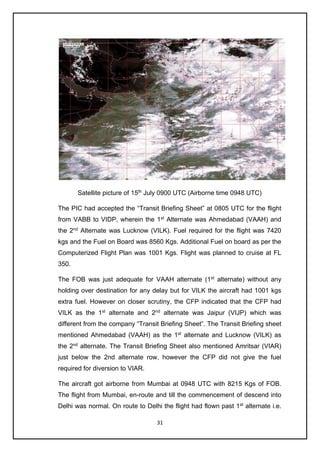
  • 10.
    6 Validity : 30.04.2023 AD,SB, Modification : All complied 1.7 Meterological Information The relevant METARs of Delhi, Ahmedabad, Amritsar,Jaipur, Lucknow & Udaipur are given below:- DELHI VIDP 151000Z 27020G30KT 0500 R28/1300 R29/1000 SHRA= VIDP 151030Z 09005KT 1000 R28/P2000 R29/P2000 –TSRA= VIDP 151100Z 32008G18KT 2500 -RA SCT030 FEW040CB OVC080= AHMEDABAD VAAH 150900Z 25011KT 4000 FEW020 SCT025 38/22 Q1001 BCMG 5000= VAAH 151030Z 25005G15KT 5000 FEW020 SCT025 39/21 Q1000 NOSIG= VAAH 151130Z 23015KT 5000 FU FEW020 SCT025 39/21 Q0999 NOSIG= VAAH 151200Z 23007G17KT 5000 FU FEW020 SCT025 39/21 Q0999 NOSIG= VAAH151300Z 23005G15KT 5000 FU FEW020 SCT025 37/21 Q0999 BECMG 4000= VAAH 151330Z 23015KT 4000 FU FEW020 SCT025 37/20 Q0999 NOSIG= VAAH 151400Z 23011KT 4000 FU FEW020 SCT025 36/20 Q0999 NOSIG= AMRITSAR VIAR 151000Z 14006KT 3000 HZ SCT035 SCT100 30/24 Q0996 NOSIG= VIAR 151030Z 14006KT 2500 HZ SCT025 BKN090 30/25 Q0996 NOSIG= VIAR 151100Z 14006KT 2000 BR SCT025 SCT090 30/25 Q0996 NOSIG= VIAR 151130Z 15005KT 2000 BR SCT025 BKN090 29/25 Q0996 NOSIG= VIAR 151200Z 15004KT 2000 BR SCT025 BKN090 29/25 Q0996 NOSIG= JAIPUR VIJP 150930Z 25009KT 3000 HZ SCT030 SCT100 34/20 Q0999 NOSIG= VIJP 151000Z 23009KT 3000 HZ SCT030 SCT100 35/20 Q0999 NOSIG=
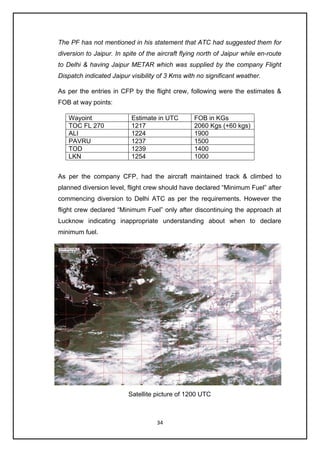
  • 11.
    7 VIJP 151030Z 23010KT3000 HZ SCT030 SCT100 34/21 Q0999 NOSIG= VIJP 151100Z 24010KT 3000 HZ SCT030 SCT100 35/21 Q0998 NOSIG= VIJP 151130Z 25010KT 3000 HZ SCT030 SCT100 34/20 Q0998 NOSIG= VIJP 151200Z 25008KT 3000 HZ SCT030 SCT100 34/20 Q0998 NOSIG= VIJP 151230Z 24009KT 3000 HZ SCT030 SCT100 34/20 Q0998 NOSIG= VIJP 151300Z 23010KT 3000 HZ SCT030 SCT100 34/20 Q0998 NOSIG= VIJP 151330Z 23007KT 3000 HZ SCT030 SCT100 34/20 Q0998 NOSIG= LUCKNOW VILK 151030Z 32003KT 5000 HZ SCT020 SCT025 BKN100 35/26 Q0997 NOSIG= VILK 151100Z 06005KT 4000 HZ SCT020 FEW030CB BKN100 34/25 Q0996 NOSIG= VILK 151130Z 05004KT 4000 HZ SCT020 FEW030CB BKN100 34/26 Q0996 NOSIG= VILK 151230Z 05004KT 3500 HZ SCT020 FEW030CB BKN100 33/26 Q0997 TEMPO 1500 RA TSRA= VILK 151251Z 31011KT 0800 R27/1000 TSRA BKN015 FEW030CB OVC090 27/26 Q1000 NOSIG= VILK 151330Z 35010KT 2000 -TSRA BKN015 FEW030CB OVC090 24/21 Q0998 NOSIG= VILK 151400Z 13005KT 2000 -TSRA BKN015 FEW030CB OVC090 24/22 Q0998 NOSIG= UDAIPUR VAUD 151000Z 26011KT 5000 HZ SCT025 SCT030 31/22 Q1002 NOSIG= VAUD 151030Z 23009KT 5000 HZ SCT025 SCT030 31/22 Q1002 NOSIG= VAUD 151100Z 24009KT 5000 HZ SCT025 SCT030 31/22 Q1002 NOSIG= VAUD 151130Z 26008KT 5000 HZ SCT025 SCT030 32/21 Q1001 NOSIG= VAUD 151200Z 25008KT 5000 HZ SCT025 SCT030 32/21 Q1001 NOSIG= VAUD 151230Z 20006KT 5000 HZ SCT025 SCT030 31/22 Q1001 NOSIG= VAUD 151300Z 23006KT 5000 HZ SCT025 SCT030 31/21 Q1001 NOSIG= VAUD 151330Z 24006KT 5000 HZ FEW025 SCT030 31/21 Q1001 NOSIG= VAUD 151400Z 24006KT 5000 HZ FEW025 SCT030 30/22 Q1002 NOSIG=
  • 12.
    8 Below is theMETAR/TAF sheet given to the flight crew before departure:
  • 13.
    9 TAF before departure: VAAH150200Z 1503/1512 2301 Kt 2500 Hz SCt 020 Sct 025 BECMG 1504/1506 23013 Kt 5000 FU. VILK 150500Z 1506/1515 28008 kts 5000 Hz Few 020 Sct 025 Bkn 100 BECMG 1513/1515 VRB 02 4000 Hz Tempo 1509/1513 Few030 CB035 VIJP 150500Z 1506/1515 25010 Kt 3000 Hz BLDU Sct 035 Sct100 TEMPO 1509/1515 230/10 1500 –TSRA FewCb035 Cb BECMG 1513/1515 Vrb03 Kt 2000 Hz. 1.8 Aids to Navigation All the installed navigational Aids viz. Localiser, Glide Path, DME, DVOR were functional at Delhi, Mumbai & Lucknow. All Automation Systems, VHF channel and ATS surveillance system were reported to be working normal. 1.9 Communication Two way communication was always established between the aircraft and various ATC units at all the stations. The communication was clear and loud. 1.10 Aerodrome Information MUMBAI The aircraft departed from Mumbai airport. The co-ordinates of ARP are 190530N, 0725158E. The Elevation of airport is 37 feet. The runways are 09/27 (3190 x 46 meters) and 14/32 (2871 x 45 meters). Weather information at Mumbai is provided by IMD round the clock. Online briefing of weather is also available. DELHI The aircraft destination was Delhi. The air traffic services at IGI airport are provided by AAI which includes Aerodrome Control service (ADC/SMC), Approach Control service (APP), Area Control Service (ACC), Terminal Approach Radar (TAR) and Route Surveillance Radar Service (RSR). Aerodrome has ARP at 283407N 0770644E. The airport is cleared for ILS CAT-III B landing.The 03 runways are 09/27, 10/28 & 11/29. Weather information is provided by IMD round the clock. The weather radar provides all the updates such as cloud, rain, trend etc. The Metars are updated in ATIS for broadcasting every 30 mins. If there is a trend of weather or sudden change (less than 30 min) weather warning or a SPECI is issued.
  • 14.
    10 Any sudden changein weather is also broadcasted by ATC, after which the flight crew (PIC) reassesses its minima and decides whether to hold, land or divert to alternate airport. LUCKNOW Lucknow airport (IATA: LKO, ICAO: VILK) is an International Airport (ILS CAT-III-B compliant). ARP coordinates are 264543N 0805300E. It has Cat 7 firefighting facilities. Weather information is provided by IMD round the clock (ATS complex from 2330 to 1630 UTC). Weather information is broadcasted on ATIS all the time. There is only one runway 09/27 (2742 x 45 meters) 1.11 Flight Recorders CVR Tape Transcript (TAKING GO AROUND TIME AT DELHI AS 00:00) Time (Relative) From Transmission -00:21:44 P1 I think we have to divert. ----- I do not think we will be landing in next at least 25 minutes. -00:13:32 Radar 40 miles touchdown. Confirm acceptable. -00:12:59 P1 40 miles is about 15 minutes to touch down. -00:12:50 P1 Will be very close. One Go Around and we will have very less fuel to divert. -00:12:37 P1 Any way, we will just continue what he is making us do right now and let us see how it goes but I am not landing at less than 3.5 tons over here. -00:11:29 Radar Vistara 944, radar descendto FL 60 -00:11:24 P1 Alright fuel is coming to 3.5 tons -00:10:49 P2 Approach phase activated -00:03:31 Tower Vistara 944, continue approach runway 29, wind 050/09 knots. -00:03:23 P1 We can expect strong tail winds at touchdown also. -00:03:20 P1 At anytime strong tailwinds then we will go around -00:03:17 P1 Runway looks really wet and probably contaminated as well because of the weather -00:01:13 Tower Vistara 944, tower runway 29, clear to land, winds 060/10 knots 00:00:00 P2 Delhi tower Vistara 944, going around runway 29. 00:01:04 P2 Delhi Vistara 944, we are diverting to Lucknow now 00:03:04 Radar Requesting reason for Go Around 00:03:06 P2 Strong Tail winds at 200 feet Vistara 944 00:03:38 Radar Roger climb to FL 110 00:03:40 P2 Climb FL 110 Vistara 944 00:03:44 Tower Able direct A L I
  • 15.
    11 00:03:46 P1 Unabledue weather, We can take heading 150 00:08:00 P2 Delhi Vistara 944, taking heading 180 due weather 00:08:33 P2 Delhi Vistara 944, taking heading 190 due weather 00:10:35 Radar Vistara 944, any interest for Jaipur, Sir Jaipur is vacant 00:10:38 P2 Negative Sir, Lucknow is our alternate, Vistara 944 00:24:54 P2 Lucknow Vistara 944 00:24:56 Radar Vistara 944, Lucknow Control 00:24:58 P2 FL 270 squak 1000, diverted flight from Lucknow 00:25:03 Radar Confirm release by Delhi 00:25:05 P2 Negative Vistara 944, requesting runway news on arrival 00:31:38 Radar Vistara 944, radar is terminated, frequency changed to Lucknow approved 00:33:20 P2 Any delay expected, Vistara 944 00:33:23 Radar No delay as of now 00:36:06 P1 Any change in weather 00:36:08 P2 No change in weather 00:45:17 Radar Vistara 944, descend to FL 70 00:45:20 P2 Descend FL 70, Vistara 944 00:45:24 P1 V/S 500, altitude level 70 set. Once we are out of this weather, then we will go for increasing the V/S after that 00:45:29 P2 OK Captain. Checked 00:45:33 P1 I want to stay as high as possible 00:45:34 P2 OK Check 00:45:54 P1 Seriously!!! 00:45:55 P2 Very heavy rain here 00:46:10 P1 Vistara 944, sir we are experiencing severe turbulence, maintaining level as of now, Vistara 944 00:46:17 P2 You wish to maintain level? 00:46:19 P1 Sir, we are maintaining present level of 106 due severe turbulence. We will be clear in about 5 miles, Will descend after that Vistara 944 00:46:24 Radar Copied Sir, copied 00:49:48 Radar Vistara 944, radar, descendto 2500 ft., QNH 997 HPa. Confirm able to take right heading 070 00:50:00 P2 Affirm, Vistara 944, Right heading 070, descend 2500 ft. on QNH 997, Vistara 944 00:51:00 P2 QNH 997, passing 6100 now 00:51:12 Go Air Approach radar, Go Air 397, climbing 3500, Go Around and maintaining runway heading 00:51:20 P1 Go Around? Engage autopilot 1 00:51:30 Radar Vistara 944, as of right now wind is 300/32 knots. Report your preference 00:51:37 P2 We will continue with the approach, Vistara 944 00:51:57 P1 32 knots? 00:52:08 P1 I think we should have taken a chance in Delhi 00:54:00 Radar Vistara 944, as per tower RVR is 675 m. Confirm on
  • 16.
    12 localizer? 00:54:08 P2 Affirmon localizer, Vistara 944. Standby for mimima 00:54:53 Tower Vistara 944, visibility as per MET office is 800 m and RVR touchdown 475 m. 00:55:00 P1 Don’t respond, don’t respond. Cabin crew landing stations 00:55:06 Tower Vistara 944, latest RVR touchdown 450 m 00:55:14 P2 Roger, Discontinuing approach Sir, Vistara 944 00:56:07 P1 Vistara 944, we are --- minimum fuel now. We need priority for landing. Otherwise we will be touhing our minimum reserve fuel and heading turning as of now 020 due weather, Vistara 944. Please advise as soon as the RVR is above 600 m. 00:59:19 P1 Vistara 944, any weather improvement sir? 00:59:20 Radar As per tower, current RVR is 275 m and 650 - 650 sir. 01:01:05 P2 Can we know the runway length at Kanpur airport and also do we have option of diverting to Kanpur in case the weather is bad at Lucknow 01:01:15 Radar Sir, we will check with Kanpur. At present Lucknow touchdown RVR is 250 m, mid RVR is 1200 m, end RVR is 1800 m. 01:03:15 P1 Sir, latest RVR available? 01:03:17 Radar Latest RVR 225 m, 2000 m and 2000 m 01:03:21 P1 Sir, Vistara 944. May Day May Day May Day Fuel. We need an airport to land sir immediately, Vistara 944 01:03:33 Radar Vistara 944, radar, confirm May Day? 01:03:37 P1 Sir, we need to land somewhere immediately. Lucknow is well below minima. Please give us an airport 01:03:44 Radar As per them, Kanpur is available. Proceed direct to correction, turn left heading 240 and proceed direct to Kanpur 01:04:29 P2 May Day, Vistara, we are diverting to Allahabad sir, Kanpur is unable due weather sir. It will take us right through weather 01:04:39 Radar Confirm, wish to proceed direct to Prayagraj, Allahabad? 01:04:42 P2 Affirm, Affirm, Vistara 944 01:05:07 P2 May Day, Vistara 944, requesting further climb. 01:05:17 Radar Vistara 944, radar, but Chakeri is 53 miles from present position. Confirm still wish to proceed towards Prayagraj 01:05:24 P1 Sir, there is lot of weather enroute to Kanpur. We will have to circumnavigate a lot. That will increase the track miles much more than the Prayagraj. 01:05:34 Radar Climb to FL 60 initially 01:10:57 Radar Vistara 944, radar, now visibility has improved at Luknow, visibility is 600 m
  • 17.
    13 1.12 Wreckage andImpact Information Not Applicable 1.13 Medical & Pathological Information The crew had undergone pre-flight medical prior to the flight and was satisfactory. Breath analysis test was negative for both the cockpit crew. 1.14 Fire There was no fire. 1.15 Survival Aspects Incident was survivable 1.16 Test & Research Nil 1.17 Organisation & Management Information The aircraft was operated by a Scheduled Airlines. 1.17.1 Airlines Fuel Policy& Operational Requirement Fuel Policy As per the Fuel Policy of the operator contained in Operations Manual Part ‘A’, Reserve Fuel is the sum of Alternate fuel, Final Reserve Fuel / alternate holding Fuel and the Contingency Fuel (If not consumed). These three are defined as follows: Alternate Fuel is the fuel required to fly from Destination to an Alternate Airport and is based on forecast winds, temperatures and the appropriate gross weight, for the following phases of flight: i. A missed approach from the applicable minima at the destination aerodrome to missed approach altitude, taking into account the complete missed approach procedure. 01:11:35 Radar Vistara 944, radar visibility has improved, visibility is 800 – 1000 m now. And if you wish, you may turn back for Lucknow 01:11:39 P2 Lucknow, May day Vistara 944, we are turning back to Lucknow. As per the previous controller we are changed over to you. 01:27:29 P2 Any rain over the airfield sir (UTC time 13:15:13) 01:29:25 P1 FOB at landing 260 kg
  • 18.
    14 ii. Climb frommissed approach point to planned cruise level / altitude. Fuel figure of 100 kg is catered for Go-Around. In addition, departure track is based on the expected runway in use and the appropriate SID. iii. Cruise at LRC. iv. Descent from final cruise altitude to the point where the approach is initiated, taking into account the expected arrival procedure. v. Approach from end of descent to touchdown. A fuel figure of 120 kg and 240 kg is included for approach and landing for A320 variants and B737-800 versions respectively. There is a Note as follows: “For flights that require a second destination alternate, the destination alternate fuel required in accordance with TSAL fuel policy shall be the amount of fuel, as calculated, that enables the aircraft to proceed to the destination alternate airport requiring the greater amount of fuel.” Final reserve fuel (alternate holding fuel) The fuel required (flight planning stage) to hold at 1500 ft above airport elevation in standard conditions with flaps up for 30 minutes at Holding speed for the appropriate gross weight, at the destination alternate airport. The operator has determined a fixed final reserve fuel value of 1150 kgs. Contingency Fuel is to cater for deviations from planned operations and shall not be less than 200 kgs. The contingency fuel displayed on the OFP is the fuel that shall remain till the end of the flight barring any deviations from planned operations. Additional Fuel A supplementary amount of fuel required if the minimum fuel calculated in is not sufficient to: ➢ Allow the aeroplane to descend as necessary and proceed to an alternate aerodrome in the event of engine failure or loss of pressurization, whichever requires the greater amount of fuel based on the assumption that such a failure occurs at the most critical point along the route; ▪ Fly for 15 minutes at holding speed at 450 m (1500 ft) above aerodrome elevation in standard conditions; and
  • 19.
    15 ▪ Make anapproach and landing; ➢ Meet additional requirements not covered above; Discretionary fuel is extra amount of fuel to be carried at the discretion of the Pilot in Command. Operational Requirement In the same chapter of Operations Manual, there is a heading Operational Requirement which mentions that a flight shall not be commenced unless, taking into account both the meteorological conditions and any delays that are expected in flight, the airplane carries sufficient fuel and oil to ensure that it can safely complete the flight and shall take into account: ❖ Anticipated meteorological conditions ❖ An IAP at the destination followed by a MAP ❖ Weights ❖ Routings ❖ Delays ❖ ATS procedures ❖ The procedures prescribed in the operations manual for loss of pressurization, where applicable, or failure of one engine while en-route; and ❖ Any other conditions that may delay the landing of the airplane or increase fuel and/ or oil consumption. It is mentioned that the final authority and responsibility for fuel loads and the fuel management in flight is with the Pilot in command and he shall ensure that the amount of usable fuel remaining in flight is not less than the fuel required to proceed to an aerodrome where a safe landing can be made, with final reserve fuel remaining. The fuel for a flight is calculated on the Operational flight Plan (OFP), and it assumes the following: A. ATC flight plan routing and flight levels can be expected to be achieved. B. Delays due to traffic or special activity are not expected, unless published. The final decision regarding the total amount of fuel to be carried rests with the pilot in command. It is also mentioned that the alternate aerodrome considered is usually the nearest, and may not always be the most appropriate.
  • 20.
    16 The standard flightfuel planning consists of: a) Taxi fuel; b) Trip fuel; c) Contingency fuel 5% d) Alternate fuel (Higher of the two alternates); e) Final reserve fuel; and Additional fuel is a supplementary amount of fuel which may be required when the minimum fuel calculated may not be sufficient to cater for circumstances for a given flight. Chapter 16 of the Operations Manual contains the following comment regarding RPL (R15): “Reflects the ICAO ATC flight plan as generated on completion of the OFP between the City pair. The same may also be filed with the concerned ATS unit”. 1.17.2 Flight Dispatch Desk (Flight Operations) The relevant job functions of the Flight Dispatch Desk (Flight Operations) covered in The Integrated Operations Control Centre (IOCC) Manual of the Operator are: 1. The Flight Dispatch Desk has the specialist on flight planning/dispatching matters and provides flight planning input to decisions made in VISTARA OCC. He reports to the MOC (Manager Operations Control) and is responsible for: • Assisting the Ops Controller(s) in flight planning efforts during flight diversions. • Shall support, brief and assist the PIC regarding risk tolerability with respect to safe conduct of each flight in the TSAL network. • Assist the PIC in flight preparation and providing required information. • Shall be responsible for preparation of the Operational and ATS flight plan and any amendment as required by PIC • Providing the PIC, while in flight, with appropriate information that may be necessary for the safe conduct of the flight
  • 21.
    17 • Shall analysethe Weather, NOTAM’s and Performance restrictions for the flights assigned to him • Shall maintain a weather watch on the flights assigned to him till the completion of the flight • Shall monitor the conditions on the route and keep the PIC informed of any adverse developments which may necessitate the aircraft to return to origin or land safely at the closest airfield • In the event of an emergency shall: i. Initiate such procedures as outlined in the TSAL operations manual while avoiding taking any action that would conflict with ATC procedures; ii. Notify IOCC and TSAL Flight Operations Management at the earliest, of the nature of the situation. iii. Request assistance if required. iv. Convey safety-related information to the pilot-in-command that may be necessary for the safe conduct of the flight, including information related to any amendments to the fight plan that become necessary in the course of the flight; v. Initiate action as per TSAL Operations Manual / Flight Safety Manual and Emergency Response Procedures Manual. This will include information about dangerous good from NOTOC which may be required during Aircraft accident and incident to facilitate emergency response • Shall keep the Shift in charge abreast of all developments in the shift • Shall alert all internal stakeholders of any local aerodrome weather warnings • Furnish the pilot-in-command with all latest available information on the route to be flown
  • 22.
    18 1.17.3 Fuel Planning– Flight Dispatch Circular of 8th July 2019 In view of recent occurrences (Out of these, occurrence of 4th July was also declared as serious incident and investigated by AAIB), wherein the flight crew has declared MAY DAY FUEL and landed with the remaining fuel less than the required quantity, the operator had issued Flight Dispatch Circular on 8th July 2019. The occurrence of 4th July 2019, prompted the issuance of this circular. There was however no mention of duties and responsibilities of operations department particularly regarding providing timely information to the flight crew in-flight. The said circular was only a reiteration of the existing policy in the company. 1.17.4 Alternate Airport For handling of diversions, alternate airports are defined by the operator as follows:
  • 23.
    19 Suitable Alternate –An online station for Vistara or a station where specific ground handling arrangements are made to handle a diverted flight. (e.g VILK for VIDP) Acceptable Alternate - A planned acceptable Airfield close to the destination meeting the requirements of the type operated. The purpose of the acceptable alternate is to reduce the sector fuel required on days of fair weather at destination. It is not recommended to divert to these airfields unless safety is a consideration. (e.g VIJP for VIDP). Enroute Alternate - An airfield meeting type specific performance requirement applicable at the expected landing weight and at the expected time of use. The airport will be available, equipped with the necessary ancillary services, such as ATS, lighting, communications, weather reporting, nav-aids and emergency services; and has at least one approach aid available for an instrument approach. Flight Dispatch and IOCC can provide time sensitive information and other data for consideration, but the decision rests solely with the Pilot in Command from the moment doors are closed for the purpose of flight until they are re- opened after parking. Suitable Alternate shall be planned by dispatch when weather is a factor at Destination and Acceptable Alternate can be planned when weather is not a factor at Destination. For en-route alternate planning, the flight crew shall consider the situation requiring a diversion and requiring a landing as soon as possible, any available alternate can be considered. For unforeseen delays in landing at destination, the flight crew can consider changing a Suitable Alternate to Acceptable Alternate. 1.18 Additional Information 1.18.1 DGCA CAR SECTION 8, SERIES O PART II DGCA has issued CAR section 8 Series O Part II on “Operation of Commercial Air Transport – Aeroplanes”, which also covers “Fuel
  • 24.
    20 Requirements”. The relevantextract of the above said CAR is reproduced below (paragraph numbers are of CAR): - 4.3.6 Fuel requirements 4.3.6.1 An aeroplane shall carry a sufficient amount of usable fuel, to complete the planned flight safely and to allow for deviations from the planned operation. 4.3.6.2 The amount of usable fuel to be carried shall, as a minimum, be based on the following data: a) ------ - - ------------------------------------- b) The operating conditions for the planned flight including: 1) Anticipated aeroplane mass; 2) Notices to Airmen; 3) Current meteorological reports or a combination of current reports and forecasts; 4) Air traffic services procedures, restrictions and anticipated delays; and 5) The effects of deferred maintenance items and/or configuration deviations. 4.3.6.3 The pre-flight calculation of usable fuel required shall include the following: - a. Taxi fuel, which shall be the amount of fuel expected to be consumed before take- off; taking into account local conditions at the departure aerodrome and auxiliary power unit (APU) fuel consumption; b. Trip fuel, which shall be the amount of fuel required to enable the aeroplane to fly from take-off or the point of in-flight re-planning until landing at the destination aerodrome taking into account the operating conditions of 4.3.6.2 b); c. Contingency fuel, which shall be the amount of fuel required to compensate for unforeseen factors. It shall be 5 per cent of the planned trip fuel or of the fuel required from the point of inflight re-planning based on the consumption rate used to plan the trip fuel but in any case shall not be lower than the amount required to fly for five minutes at holding speed at 450 m (1 500 ft) above the destination aerodrome in standard conditions; Note - Unforeseen factors are those which could have an influence on the fuel consumption to the destination aerodrome, such as deviations of an individual aeroplane from the expected fuel consumption data, deviations from forecast meteorological conditions, extended delays and deviations from planned routings and/or cruising levels.
  • 25.
    21 d. Destination alternatefuel, which shall be: 1) Where a destination alternate aerodrome is required, the amount of fuel required to enable the aeroplane to a. Perform a missed approach at the destination aerodrome; b. Climb to the expected cruising altitude; c. Fly the expected routing; d. Descend to the point where the expected approach is initiated; and e. Conduct the approach and landing at the destination alternate aerodrome; or 2) where two destination alternate aerodromes are required, the amount of fuel, as calculated in 4.3.6.3 d) 1), required to enable the aeroplane to proceed to the destination alternate aerodrome which requires the greater amount of alternate fuel; or e. Final reserve fuel, which shall be the amount of fuel calculated using the estimated mass on arrival at the destination alternate aerodrome or the destination aerodrome, when no destination alternate aerodrome is required: 1) - - - - - - - - - - - - - ------------------------------------- 2) for a turbine engine aeroplane, the amount of fuel required to fly for 30 minutes at holding speed at 450 m (1 500 ft) above aerodrome elevation in standard conditions; f. Additional fuel, which shall be the supplementary amount of fuel required if the minimum fuel calculated in accordance with 4.3.6.3 b), c), d) and e) is not sufficient to: 1) allow the aeroplane to descend as necessary and proceed to an alternate aerodrome in the event of engine failure or loss of pressurization, whichever requires the greater amount of fuel based on the assumption that such a failure occurs at the most critical point along the route; i) Fly for 15 minutes at holding speed at 450 m (1 500 ft) above aerodrome elevation in standard conditions; and ii) Make an approach and landing; 2) allow an aeroplane engaged in EDTO to comply with the EDTO critical fuel scenario as established by DGCA; 3) Meet additional requirements not covered above;
  • 26.
    22 g. Discretionary fuel,which shall be the extra amount of fuel to be carried at the discretion of the pilot-in-command. 4.3.6.4 --------------------------------------------------- 4.3.6.5 A flight shall not commence unless the usable fuel on board meets the requirements in 4.3.6.3 a), b), c), d), e) and f) if required and shall not continue from the point of in-flight re planning unless the usable fuel on board meets the requirements in 4.3.6.3 b), c), d) e) and f) if required. 4.3.6.6 Notwithstanding the provisions in 4.3.6.3 a), b), c), d), and f); DGCA may, based on the results of a specific safety risk assessment conducted by the operator which demonstrates how an equivalent level of safety will be maintained, approve variations to the pre-flight fuel calculation of taxi fuel, trip fuel, contingency fuel, destination alternate fuel, and additional fuel. The specific safety risk assessment shall include at least the: a) Flight fuel calculations; b) Capabilities of the operator to include: i) A data-driven method that includes a fuel consumption monitoring programme; and/or ii) The advanced use of alternate aerodromes; and c) Specific mitigation measures. 4.3.7 In-flight fuel management 4.3.7.1 ------------------------------------------------------- 4.3.7.2 The pilot-in-command shall continually ensure that the amount of usable fuel remaining on board is not less than the fuel required to proceed to an aerodrome where a safe landing can be made with the planned final reserve fuel remaining upon landing. 4.3.7.2.1 The pilot-in-command shall request delay information from ATC when unanticipated circumstances may result in landing at the destination aerodrome with less than the final reserve fuel plus any fuel required to proceed to an alternate aerodrome or the fuel required to operate to an isolated aerodrome. 4.3.7.2.2 The pilot-in-command shall advise ATC of a minimum fuel state by declaring MINIMUM FUEL when, having committed to land at a specific aerodrome, the
  • 27.
    23 pilot calculates thatany change to the existing clearance to that aerodrome may result in landing with less than planned final reserve fuel. 4.3.7.2.3 The pilot-in-command shall declare a situation of fuel emergency by broadcasting MAYDAY MAYDAY MAYDAY FUEL, when the calculated usable fuel predicted to be available upon landing at the nearest aerodrome where a safe landing can be made is less than the planned final reserve fuel. 1.18.2 Fuel Planning for the flights – DGCA Air Safety Circular (ASC) 03 of 2019 DGCA, has issued an Air Safety Circular considering increasing number of incidents wherein the operating crew have declared MAYDAY FUEL for seeking priority in landing due to adverse weather conditions or due to aerodrome limitations. The deficiencies in fuel planning, crew decision making and support provided by the ATC mentioned in the ASC are Fuel carried on-board did not cater for second alternate During flight, crew while deciding the alternate for diversion have not considered the nearest safe landing airport. Crew did not declare MINIMUM FUEL to ATC. After a crew has declared a MINIMUM FUEL, ATC has given additional clearances resulting in further depletion of fuel. The ASC refers to the CAR Section 8 Series O Part II which prescribes minimum fuel requirements for the operation of aircraft and mentions the following: During adverse weather conditions or aerodrome limitations conditions, second destination alternate should also be factored during the flight planning stage. Para 4.3.6 (d) (2) regarding selection of second destination alternate inter alia requires as follows: “where two destination alternate aerodromes are required, the amount of fuel, as calculated in 4.3.6.3 d) 1), required to enable the aeroplane to proceed to the destination alternate aerodrome which requires the greater amount of alternate fuel;” It further reiterates that Flight dispatch should update the crew during transit halts regarding weather conditions at destination and alternates. Use of electronic briefing folder may also be considered for providing data to the crew. For Air Traffic Control Units, the action suggested is “whenever a crew declares MINIMUM FUEL to the ATC, it means that all planned aerodrome options have been reduced to a specific aerodrome of intended landing and any change to the existing clearance may result in landing with less than planned final reserve fuel. This is not
  • 28.
    24 an emergency situationbut an indication that an emergency situation is possible, should any additional delay occur. The ATC should facilitate the early landing for the aircraft. The above instructions are for strict compliance by all the aircraft operators and ATC.” 1.18.3 Transit Briefing Sheet
  • 29.
    25 1.18.4 Computerised FlightPlan Relevant pages of the Computerised Flight Plan (CFP) with NB of the flight crew are given below:
  • 30.
  • 31.
    27 1.19 Useful orEffective Investigation Techniques Nil
  • 32.
    28 1 ANALYSIS 2.1 General ➢Both operating crew were appropriately licensed and qualified to operate the flight. ➢ The aircraft had a valid Certificate of Airworthiness at the time of incident. ➢ The Aircraft held valid Certificate of Release to Service which was issued at the airport of departure. ➢ Airworthiness Directives, Service Bulletins, DGCA Mandatory Modifications had been complied with. Transit inspections were carried out as per the approved transit inspection schedules and all higher inspection schedules including checks/inspection as per the manufacturer’s guidelines as specified in Maintenance Programme and approved by the Quality Manager. For purpose of discussion in the following paragraphs, an alternate is required when it becomes either impossible or inadvisable to proceed to or land at the aerodrome of intended landing as per the definition(s) given by the operator of these aerodromes. This was the case of subject flight. While the investigation reviewed the scenario in which the said occurrence took place, the investigation also analysed the current regulations and instructions given to implement these regulations. Further it has also been analysed that how tacit following of these instructions/ procedures might have precipitated into an unsafe situation of fuel emergency or be a contributory factor to the occurrence. 2.2 Fuel Policy & Procedures In today’s aviation scenario, maximum cost in operations is of fuel. Flight operations procedures of the operators are therefore based on reducing the overall fuel consumption and thereby the fuel cost. Across the Airlines, these fuel saving measures are covered in the training and through the issuance of SOPs. It is expected that flight crew would follow procedures which reduce fuel uplifted and fuel used. The scenario does not rule out action against flight
  • 33.
    29 crew if itis observed that he has carried extra fuel without justification. More or less the flight crew feels the pressure when it comes to carrying extra fuel. Careful perusal of the company Fuel Policy, CFP, OFP and the Transit Briefing Sheet was carried out. Although, fuel policy mentioned in the Operations Manual is in line with the DGCA CAR, however, practically the procedure followed during day to day operations of the operator becomes different. Vistara policy: For handling of diversions, alternate airports are defined by the operator. (1) Suitable Alternate is where specific ground handling arrangements are made to handle a diverted flight. (2) Acceptable Alternate is a planned & acceptable airport close to the destination and is proposed to reduce the sector fuel required on days of fair weather at destination. It is not recommended to divert to these airports unless safety is a consideration. Such a sentence in an important document creates subjectivity in the mind of the flight crew and increases the probability of erring on an unsafe side. Further the policy mentions that in case of emergency, the “Flight Dispatch and IOCC can provide” but it is not mandatory on the part of Flight Dispatch/ IOCC to provide time sensitive information and other data for consideration by the flight crew. Though there is no doubt and it is well established that the final decision rests solely with the Pilot in Command Further the policy intends that Suitable Alternate shall be planned by dispatch when weather is a factor at Destination and Acceptable Alternate can be planned when weather is not a factor at Destination. The definitions of alternates, therefore create confusion in the mind of flight crew, while taking a decision on where to divert, particularly when the clause of saving fuel is deeply imbibed in the mind of the flight crew these days. The decision making during a high stress situation (weather, destination/ alternate airport not available) may result in unsafe situations. Further with no mandate for providing time sensitive information by the IOCC, the flight crew is
  • 34.
    30 overloaded in caseof real emergency or a high stress situation as was the present case. 2.3 Circumstances leading to the incident Flight crew was briefed at Mumbai before departure for VIDP with VAAH as the 1st Alternate and VILK (Suitable Company Alternate) as the Second Alternate. However on OFP provided to flight crew 1st Alternate was VILK (Suitable Alternate) and Second Alternate was VIJP (Acceptable Alternate). Same was accepted by the PIC. As the Company OFP carried an “Additional Fuel” of 1001 kgs, Flight crew was aware that this additional fuel will cater for VAAH as the alternate for legal purpose. However if VAAH was to be the alternate, then there was no “Holding Fuel” over VIDP. The flight crew and company knew that in case of an actual diversion, the flight crew will choose to divert to the company preferred alternate (Suitable alternate as VILK) as this would suit commercial purpose ( where specific ground handling arrangements are made to handle a diverted flight). Therefore the “Transit Briefing Sheet” showed 1st alternate as Lucknow (VILK) and second alternate as Jaipur (VIJP). It is pertinent to note that on the date/ time of the occurrence, Vistara had no operations to VIJP and hence the company knew that in case of diversion to VIJP there will be delay wrt to ground handling and passenger inconvenience as they had no ground handling agreement in place. This information is also in the mind of flight crew while taking a decision to divert. VIJP is considered as an “Acceptable Alternate” wherein purpose is to reduce the sector fuel required on the day of fair weather at destination. It is not recommended to divert to these airfields unless safety is a consideration (e.g. VIJP for VIDP).
  • 35.
    31 Satellite picture of15th July 0900 UTC (Airborne time 0948 UTC) The PIC had accepted the “Transit Briefing Sheet” at 0805 UTC for the flight from VABB to VIDP, wherein the 1st Alternate was Ahmedabad (VAAH) and the 2nd Alternate was Lucknow (VILK). Fuel required for the flight was 7420 kgs and the Fuel on Board was 8560 Kgs. Additional Fuel on board as per the Computerized Flight Plan was 1001 Kgs. Flight was planned to cruise at FL 350. The FOB was just adequate for VAAH alternate (1st alternate) without any holding over destination for any delay but for VILK the aircraft had 1001 kgs extra fuel. However on closer scrutiny, the CFP indicated that the CFP had VILK as the 1st alternate and 2nd alternate was Jaipur (VIJP) which was different from the company “Transit Briefing Sheet”. The Transit Briefing sheet mentioned Ahmedabad (VAAH) as the 1st alternate and Lucknow (VILK) as the 2nd alternate. The Transit Briefing Sheet also mentioned Amritsar (VIAR) just below the 2nd alternate row, however the CFP did not give the fuel required for diversion to VIAR. The aircraft got airborne from Mumbai at 0948 UTC with 8215 Kgs of FOB. The flight from Mumbai, en-route and till the commencement of descend into Delhi was normal. On route to Delhi the flight had flown past 1st alternate i.e.
  • 36.
    32 Ahmedabad, Udaipur andnorth of Jaipur. Flight crew did not update themselves with the weather of en-route alternate or of Jaipur (VIJP), which was the 2nd alternate (Acceptable alternate). Both flight crew knew that at the time of arrival in to VIDP, they can expect “TSRA”. At 1015 UTC, IOCC had updated the flight crew with latest VIDP weather of 1000 UTC. The weather was winds 270/ 20 kts. gusting to 30 Kts; Visibility, R28/ 1300, R29/1000; SHRA SCT 030, Few 040 CB, OVC 080; Temp/ DP of 27/25; Q1000, TEMPO 280 20 gusting to 30 TSRA). This was around 01:12 mins before reaching overhead VIDP as per the OFP calculations. When the aircraft commenced descent into VIDP, the flight crew observed weather overhead VIDP. Delhi ATC had advised the crew regarding delay and was advised to join hold. The flight crew continued holding and with 1001 kgs of additional fuel, they were aware that they can hold only for 30 mins approx. to mitigate the delay due weather activity overhead VIDP. While remaining in the hold, the flight crew burnt the extra fuel which was sufficient for diversion to VAAH. By doing so the flight crew took a risk and closed one of the safer options for themselves. The holding continued till they had adequate fuel (2914 kgs) for VILK as diversion. While in the hold the PF briefed the PM that we will not consider Jaipur as an alternate. At this stage there was no discussion about the existing weather at Lucknow & Jaipur. When flight crew advised ATC of “10 minutes for our diversion and our diversion is Lucknow”, flight crew noted they had 3800 kgs. Thereafter Delhi ATC at 11:27 UTC advised that flight was 40 nms to touchdown and started radar vectors for ILS 29. PF in spite of knowing that the weather at VIDP was bad, elected to get vectored for the ILS approach knowing well that in all probability the approach was going to be unsuccessful, as he briefed that in case of a missed approach, will be left with 3200 kgs of “Fuel on Board”. After carrying out a “Missed Approach” due to changing winds, flight crew elected to divert to VILK and thereafter updated themselves with VILK & VIJP weather via ACARS:
  • 37.
    33 VILK 1130 UTC050/04 kts, 4000 meters visibility, Haze, Sct 020, Few 030 CB, BKN 100, 34/26, 996 NSG VIJP weather at 1130Z 25010KT 3000 HZ SCT030 SCT100 34/20 Q0998 NOSIG= PIC was fixated to divert to VILK as the “preferred company alternate” was VILK and not VIJP. The PIC also in his statement mentioned that due to expected en-route weather to VILK, he had decided to divert at 3200 kgs instead of 3000 kgs (2914 Kgs). However after Go Around FOB was 3400 Kgs (3396 as per DFDR) at the time of diversion 3100 Kgs (3077Kgs as per DFDR). No suggestion was given by Company IOCC regarding diversion to Jaipur. At this point it is pertinent to note that, had the flight crew updated themselves with Udaipur & Jaipur while en-route to Delhi, they would have known that Jaipur (2nd alternate as per CFP) weather was good. The flight crew also would have been aware of the en-route weather to Jaipur as their track to Delhi from Mumbai would made them fly north of the routing to Jaipur (Delhi- Jaipur), close enough to get a global picture of the en-route weather. After commencement of diversion at 1155 UTC, the aircraft could not maintain its track toward ALI VOR due weather en-route and initially maintained heading of 170 degrees, then 180 degrees. The aircraft climbed to FL130 due to traffic. Delhi ATC advised the flight crew, “Any interest for Jaipur, Sir Jaipur is vacant”. The flight crew did not take this hint given by ATC but continued diverting to VILK, en-route the aircraft had to deviate up to 40 nms South of track and post clearance from the Prohibited Area near Agra, it set course to VILK. At that point, after sequencing the FMS flight plan with the ILS approach at VILK, FOB on FMS prediction showed as 1600 Kgs. Had the flight crew been aware of the situation and judged the en-route weather to Lucknow, they would have decided to divert to Jaipur which was still closer in terms of distance. In that case, they would have landed at Jaipur without an emergency situation related to fuel.
  • 38.
    34 The PF hasnot mentioned in his statement that ATC had suggested them for diversion to Jaipur. In spite of the aircraft flying north of Jaipur while en-route to Delhi & having Jaipur METAR which was supplied by the company Flight Dispatch indicated Jaipur visibility of 3 Kms with no significant weather. As per the entries in CFP by the flight crew, following were the estimates & FOB at way points: Wayoint Estimate in UTC FOB in KGs TOC FL 270 1217 2060 Kgs (+60 kgs) ALI 1224 1900 PAVRU 1237 1500 TOD 1239 1400 LKN 1254 1000 As per the company CFP, had the aircraft maintained track & climbed to planned diversion level, flight crew should have declared “Minimum Fuel” after commencing diversion to Delhi ATC as per the requirements. However the flight crew declared “Minimum Fuel” only after discontinuing the approach at Lucknow indicating inappropriate understanding about when to declare minimum fuel. Satellite picture of 1200 UTC
  • 39.
    35 PIC decided todivert to VILK which was the “preferred company alternate” and not VIJP. The PIC also stated in his statement that due to expected en- route weather to VILK, he had decided to divert at 3200 kgs instead of 3000 kgs. due to expected weather. Also, no suggestion was given by company regarding diversion to VIJP. Thereafter flight till Lucknow was uneventful except during descent they experienced heavy rain and severe turbulence. As the flight got established on the Localizer for runway 27 at VILK, (at 17 nms), the flight crew were advised by VILK Approach that the RVR was 475 meters. The RVR further reduced to 275 meters in heavy thunderstorm & rain as reported by VILK Tower. PF decided to discontinue approach and thereafter decided to commence diversion initially to Kanpur. Rather the flight crew had put themselves in such an unsafe situation that they were desperate to land anywhere. Kanpur was then changed to Prayagraj (VEAB) due to severe weather en-route to Kanpur. During climb towards Kanpur and then subsequently toward Prayagraj PF had clearly informed PM that they might not have adequate fuel to go to Prayagraj. The aircraft neither had Kanpur (VICX) nor Prayagraj (VEAB) in the aircraft FMS navigation database for navigation purposes with automation (flight crew had to resort to basic raw data navigation using VOR & ADF). Nor did they have instrument let down charts for these airports available with them onboard as the operator had no operations to these airfields. Once the aircraft set course towards VEAB, VILK weather was updated by ATC as 600 Meters, though it was within “Landing Minima” for the flight but PIC was reluctant to divert back suspecting more rain. The ATC controller again relayed to the flight that the visibility had improved to 800-1000 meters and prompted the flight crew to return back to Lucknow. This prompting helped PIC change his mind in returning back to VILK. PIC decided to return back to VILK and carried out an ILS approach for runway 27 followed by a manual landing in the very high & demanding situation. Aircraft landed at 1318 UTC. FOB at touch down was 348 kgs.
  • 40.
    36 Satellite picture of1400 UTC 2.4 Role of Flight Dispatch/ Operations Control Centre: As per the DGCA CAR, the operator is required to provide operations control and monitor the flights progress. Especially once the aircraft is airborne, the Flight Dispatcher is required to monitor the En-route, Destination and Alternate weather along with the satellite pictures. Based on above satellite pictures the Flight Dispatcher would have realized that en-route weather to Lucknow would have been severe and Jaipur would have been clear of any significant weather instead only relying on METAR’s & TAF’s. However no advice was given to the flight crew apart from updating them with latest Lucknow & Jaipur METARs inspite of having access to the latest Doppler Radar and Satellite pictures. The Operators Flight Dispatch Manual Para 1.3.3 requires that the Flight Dispatcher should analyze weather & maintain a weather watch. He should support the PIC regarding Risk Tolerability with respect to safe conduct of each flight. The investigation also reviewed in detail the FAA Part 121 & 135 - Operations Control Requirements vis-à-vis DGCA CAR on Operations Control Centre.
  • 41.
    37 The requirements aslaid down in CAR do not suffice the purpose particularly in view of Total Flight Deck experience reducing day by day. 3 CONCLUSION 3.1 Findings • The policy of giving in “Transit Briefing Sheet” 1st Alternate as Ahmedabad and Second as Lucknow and then expecting the flight to “Hold” over destination with the additional fuel which was meant for diversion to 1st Alternate (VAAH in this case) and thereby restricting the aircraft to fly to 2nd Alternate (VILK in this case) was unsafe and circumvented the laid down requirements. • The Policy of leaving the choice of Alternate between Suitable & Acceptable Alternate puts subtle pressure on the PF to choose the company preferred alternate (Suitable in this case; VILK) in spite of having an Acceptable alternate (VIJP) close to VIDP which the flight crew should have had a better picture of, rather than choosing an alternate farther away in spite of knowing the en-route weather. The Operator in general & PF in particular has tilted the balance towards “Commercial Requirements” rather than keeping “Safety” of its aircraft and occupants in mind. • There was no practical “Safe” Operations Control of monitoring flight progress and to suggest to flight crew in timely manner to divert to an airport where better en-route & airport weather conditions prevailed. The PF could have thereby discontinued to proceed to “Company Preferred/ Suitable Alternate” and avoid situation of actual fuel emergency. • The investigation is of a strong opinion that had the aircraft continued to Kanpur or Prayagraj, there would have been a possibility of the aircraft running out of fuel en-route which would have led to a forced landing in the night time. • The recommendations made in the investigation report into the causes of accident to Air India A320 aircraft (VT-ESH) released on 12th Aug 2016 are still not fully implemented by the DGCA. • Fuel Below Minimums should have been taken as one of the Safety Performance Indicators (SPIs) by DGCA which could have avoided serious incidents of landing with fuel below minimums as the present.
  • 42.
    38 While reviewing theinformation which was made available to the investigation, extensive use of ICAO Human Factor Checklist was made. The factors observed were Faulty Planning, Error in Judgment, Stress, Company Policies & Procedures, Company Operating Pressure, Situational Awareness, CRM, Weather and documentation. Further the investigation used the James Reasons Swiss Cheese model to categorise the findings and is discussed below. (A) Organisational Factors (i) DGCA As per the Aircraft Act 1934, the Director General of Civil Aviation or any other officer specially empowered by the Central Government shall perform the safety oversight functions in respect of matters specified in the Act. It is responsible for regulation of air transport services to/from/within India and for enforcement of civil air regulations, air safety and airworthiness standards. In order to carry out the above duties and functions, DGCA issues Civil Aviation Requirements (CAR) under various sections and Section 8 deals with “Aircraft Operations”. Under Series ‘O’ of Section 8 is issued a CAR on “Operation of Commercial Air Transport – Aeroplanes”. Under Para 4.3.6.1 of this CAR are given fuel requirements which mention that an aeroplane shall carry a sufficient amount of usable fuel, to complete the planned flight safely and to allow for deviations from the planned operation. The said CAR available on DGCA website was issued on 8th July, 2011 and the last revision was on 30th October 2018. The requirements laid down in the CAR have been discussed in the analysis of earlier investigations and as brought out, the operator has in their Manuals mentioned that the above said CAR will be followed. However, in the subsequent paragraphs of these Manuals on fuel planning, the gaps/ ambiguity in the CAR was utilized for taking lesser fuel on board than intended by the CAR. DGCA had issued an ASC 3 of 2019, on fuel planning for the flights. The circular though does not have any legal binding on the operators. The circular identifies that an incident occurred because, fuel carried on-board did not
  • 43.
    39 cater for secondalternate. During flight, crew while deciding the alternate for diversion have not considered the nearest safe landing airport; crew did not declare MINIMUM FUEL to ATC; and after crew has declared a MINIMUM FUEL, ATC has given additional clearances resulting in further depletion of fuel. However, there is no mention of what should be done and how that action will obviate the occurrences in future. Otherwise also, it is agreed that there have been number of such occurrences. Investigation could not find if any concrete actions were suggested by DGCA under SSP (It qualifies for one of the top most Safety Performance Indicators) or mitigation actions taken by the operator under SMS. Be that as it may, the CAR on the subject should have been revisited by now and root cause of the non-following of the provisos of CAR be fixed by clarifying the ambiguous portion. In addition, the existing reasons which have been brought out as a result of reactive (investigation) process, should have been detected during the surveillance inspections carried out by the Flight Operations Inspectors or during scrutiny of the Manuals and SOPs of the operator. (ii) Operator • Putting subtle pressure on flight crew to divert only to “Suitable Alternates” which was company preferred due to availability of ground handling. • The “Transit Briefing” sheet showed 1st Alternate as Ahmedabad & 2nd Alternate as Lucknow. However the CFP had Lucknow as the 1st Alternate & Jaipur as the 2nd Alternate. Hence the company & PIC both knew that in case of actual diversion, aircraft would divert to Lucknow which was the company preferred alternate and not Jaipur or Ahmedabad. • Not providing any guidance to flight crew, while they were negotiating weather which was not in line with the company Flight Dispatch manual. • Lesser fuel was uplifted than that required as per CAR, by planning Ahmedabad as the 1st Alternate & Lucknow as the 2nd Alternate.
  • 44.
    40 (B) Unsafe Supervision •Ambiguous instructions issued to the flight crew on fuel uplift and aerodrome alternates were not captured by the DGCA (FSD office) during audits/ oversight. • Inadequate Flight Following by IOCC of the operator. (C) Pre-Conditions to the Unsafe Act • Pre-conceived notion in the mind of flight crew to divert to Suitable Alternate (because of conscious ambiguity in definition that in case the “situation demands PF is authorized to divert” to an “Acceptable Airport”). There is a tacit indication that efforts to be made by flight crew to divert to Suitable Airport • Not mitigating the risks associated with non-compliance of requirement of latest weather (basic norm) (D) Unsafe Act • Organisation (IOCC) not suggesting the flight crew on the safer option of diverting to Jaipur. • Flight crew not updating themselves with en route weather including observing the en-route weather to Jaipur. • PF having a fixed mind set to divert to Lucknow in line with company instructions and not seeing the big picture. 3.2 Probable Cause The aircraft went into an unsafe situation of fuel emergency as PIC has not given due consideration to the depleting fuel on board and getting fixated on diversion to Lucknow in severe enroute weather requiring additional diversion from track. This loss of situational awareness and fixation on diversion to Lucknow (company preferred alternate) was result of failure on part of: • Operators Flight Ops management to provide clear cut guidance to flight crew regarding diversion. • IOCC to update and provide guidance to flight crew regarding en-route weather and possible diversion to Jaipur. • PF to ensure that the alternate as per Transit Briefing Sheet & CFP are the same.
  • 45.
    41 • Flight crewto update themselves with latest Jaipur weather while en-route to Delhi. • Flight crew to divert to Jaipur in spite of facing severe weather en-route to Lucknow. • PF (during discussions with PM) to be assertive enough to divert to Jaipur. Further Non-assertive behavior on part of the PM and letting the PF continue with diversion to VILK. 4 RECOMMENDATIONS All Scheduled Operators 1. The Integrated Operations Control must be headed by a “Current type rated pilot” who has the experience in the area of operations covered by the operator for providing relevant inputs while making a decision, keeping the safety of aircraft & its occupants in mind. For operators, who operate multiple type of aircraft, the aircraft which covers the maximum area of operations must be the Head of Operations Control Centre/ IOCC. 2 IOCC/ Operations Controller/ Flight Dispatchers must make pro-active decision well in advance to assist the flight crew in diverting flights which are en-route to destination airports with moderate/ severe weather activity instead of aircraft holding over destination till Minimum Diversion Fuel (MDF) and then diverting to alternate. This results in flight crew declaring “Minimum Fuel” (as per ICAO) and putting undue pressure on themselves & ATCO’s. 3 PF(s) must divert to the airport which has been accepted on the Transit Briefing sheet as this alternate has been suggested by the Flight Dispatch keeping the latest weather conditions, NOTAMS etc. in mind at planning stage. If required the “Repetitive Flight Plan” (RFP) alternate must be revised by the company Flight Dispatch in such a case. (PIC has the final authority for keeping the safety of aircraft and passengers in mind) 4 “Current & Rated Pilot” should be available in IOCC/ Flight Dispatch for “Operations Control” duty to assist the operating flight crew & flight dispatchers make a decision keeping the safety of aircraft & passengers in mind. “Hold over destination till MDF” advice by IOCC/ Operations Controller/
  • 46.
    42 Flight Dispatcher mustbe suggested only when the weather at the alternate airport meets VFR requirements as defined in DGCA CAR. However PF has the final authority to hold or divert. 5 Must ensure that during the period of inclement weather IOCC/ Flight Dispatch contacts the aircraft by the best available means (VHF/HF/ACARS/SATCOM) and relay (positive) latest weather for Destination & Alternate. Operations Controller must give advice regarding weather trends and where the airplane should divert to, after reviewing the en-route weather as per the latest satellite picture & airfield METAR etc. in consultation with the Pilot on duty in IOCC/ OCC. Every airline must have a qualified Met Officer on duty (24 x 7) to assist the flight crew and dispatcher. However the final decision remains with the PIC of the flight. 6 Flight Dispatch & operating flight must ensure that the alternates filed in briefing sheets & OFP are the same. Fuel must be planned for the longest alternate and additional holding fuel over the destination must be carried if there is inclement weather. 7 Flight crew must be vigilant about weather conditions at Destination, En- Route & Alternate by seeking weather updates in flight from IOCC, ATIS or ATC to aid their decision. They must use the Flight Dispatch for this purpose actively. Airlines must not discourage flight crew for seeking weather update via ACARS. 8 Company must ensure that “Fuel Policy” is in line with the DGCA requirements and based on the statistical data for the last 15 days for the said flight number. This must include fuel for ATC delays, congestion at destination & alternate airports, change of routing etc. in the Company Flight Plan (OFP). Further in case the TAF indicates that at the time of arrival, moderate to severe weather is expected (Example: Moderate or Severe Thunderstorm, Fog with visibility less than 800 meters, Winds greater than 20 kts associated with Thunderstorm, Rain showers with visibility predicted to be less than 1500 meters), then fuel must be given on the OFP to hold over destination. This fuel will be over and above the normal fuel requirement. 9 Operators must educate the Operating flight crew & Flight Dispatchers that “Suitable Alternate” (Company preferred Alternates) are for the purpose of fuel planning, filing alternates for the ATC Flight Plan/ convenience of
  • 47.
    43 company but incase the situation demands, flight crew may be diverted to “Acceptable Airports” without the fear of being reprimanded. 10 Flight crew should be educated on when to exercise the “Emergency Authority of PIC”. Periodic training on various scenarios may be planned. 11 Airline must educate flight crew when to declare “Minimum Fuel & Fuel Emergency”. Periodic training on such scenarios should be planned. 12 Flight crew may be trained to carry out “Auto-Land” at airports equipped with reliable ILS (after proper risk mitigation) during high stress situation and monitor the aircraft till landing thereby reducing their workload & stress. 13 All Airlines must have all airports within India included in their Navigational database where their category of aircraft can land in case of an emergency. In addition Airlines must also provide Instrument Approach Charts for all Indian airports, which can be used in an emergency for their category of aircraft. 14 The Operators flight dispatch must provide a list of airports mentioning the watch hours of all the airports in India and enroute. DGCA 15 DGCA must investigate all cases of “Fuel Emergency” & “Landing below Fuel minima” in a pro-active manner and share learning with all operators. 16 DGCA must define and elaborate the safety purposes / requirement for “Operations Control”. 17 DGCA in their “Regulatory or Main Base Audit” must ensure practical compliance of above recommendations in operations. 18 The person carrying out Flight Dispatchers duties must be holding a “Licence” to carry out his duties and their licence must clearly indicate the type of aircraft which they are qualified for, validity etc. 19 DGCA must revise the “All Weather Operations Requirements” (CAR Series C, Part 1) to mention that the “Designated Alternate Weather” must be equal to or better than the values given in the said CAR for “Take-off, En-route and Destination Alternate”, for a period of 01 hour before the expected time of arrival & 01 hour after the expected time of arrival to ensure safe operations. However at the time of actual approach & landing, the normal landing minima would apply.
  • 48.
    44 (The above restrictionmust continue till such time IMD is able to provide accurate “TAFORS” for at least 3 years continuously, there after DGCA may carry out a “data driven Risk Assessment” to revise the weather requirements at alternate, however aircraft must be assured a safe landing in case it is unable to land at its destination airport. AAI: 20 The ATC Controller who suggested and coaxed the subject flight to return to Lucknow thereby avoiding an aircraft going out of fuel while in flight should be duly appreciated. IMD: 21 All the remaining recommendations regarding IMD given in the investigation report of accident to VT-ESH at Jaipur on 5.1.2014 should be implemented. 22 Further the accuracy of TAFOR needs to be improved which is directly effecting the safety of operations of aircraft on daily basis as the airlines are using this information for planning their alternates and in actual conditions. (R. S. Passi) Investigator - In - Charge (Shilpy Satiya) Investigator (Capt. Dhruv Rebbapragada) Investigator Place : New Delhi Date : 29.10.2020