Hallidays Introduction To Functional Grammar 4th Mak Halliday
1.
Hallidays Introduction ToFunctional Grammar 4th
Mak Halliday download
https://ebookbell.com/product/hallidays-introduction-to-
functional-grammar-4th-mak-halliday-6977636
Explore and download more ebooks at ebookbell.com
2.
Here are somerecommended products that we believe you will be
interested in. You can click the link to download.
An Introduction To Functional Grammar Third Revised Edition 3rd
Edition Michael Alexander Kirkwood Halliday
https://ebookbell.com/product/an-introduction-to-functional-grammar-
third-revised-edition-3rd-edition-michael-alexander-kirkwood-
halliday-2544008
Introduction To Vascular Biology From Basic Science To Clinical
Practice 2nd Edition Beverley J Hunt
https://ebookbell.com/product/introduction-to-vascular-biology-from-
basic-science-to-clinical-practice-2nd-edition-beverley-j-hunt-2004678
The Ethics Of Capitalism An Introduction 1st Edition Daniel Halliday
https://ebookbell.com/product/the-ethics-of-capitalism-an-
introduction-1st-edition-daniel-halliday-12081608
Lexicology A Short Introduction Mak Halliday Colin Yallop
https://ebookbell.com/product/lexicology-a-short-introduction-mak-
halliday-colin-yallop-4965926
3.
Lexicology And CorpusLinguistics An Introduction 1st Edition Mak
Halliday
https://ebookbell.com/product/lexicology-and-corpus-linguistics-an-
introduction-1st-edition-mak-halliday-1813112
English Tense And Aspect In Hallidays Systemic Functional Grammar A
Critical Appraisal And An Alternative Bache
https://ebookbell.com/product/english-tense-and-aspect-in-hallidays-
systemic-functional-grammar-a-critical-appraisal-and-an-alternative-
bache-4918056
Towards A New Pedagogy For Teaching Foreign Language Politeness
Hallidays Model And Approaches To Politeness 1 Mugford
https://ebookbell.com/product/towards-a-new-pedagogy-for-teaching-
foreign-language-politeness-hallidays-model-and-approaches-to-
politeness-1-mugford-55681272
Was Mao Really A Monster The Academic Response To Chang And Hallidays
Mao The Unknown Story Gregor Benton Chun Lin Editors
https://ebookbell.com/product/was-mao-really-a-monster-the-academic-
response-to-chang-and-hallidays-mao-the-unknown-story-gregor-benton-
chun-lin-editors-23394338
Was Mao Really A Monster The Academic Response To Chang And Hallidays
Mao The Unknown Story 1st Edition Gregor Benton
https://ebookbell.com/product/was-mao-really-a-monster-the-academic-
response-to-chang-and-hallidays-mao-the-unknown-story-1st-edition-
gregor-benton-2484052
5.
FOURTH EDITION
INTRODUCTION TO
M.A.K.Halliday
Revised by Christian M.I.M. Matthiessen
"Essential reading ... teeming with insights'.'
Michael Toolan, University of Birmingham, UK
6.
HALLIDAY'S
INTRODUCTION
TO FUNCTIONAL
GRAMMAR
Fully updatedand revised, this fourth edition of Halliday's Introduction to Functional
Grammar explains the principles of systemic functional grammar, enabling the reader to
understand and apply them in any context. Halliday's innovative approach of engaging with
grammar through discourse has become a worldwide phenomenon in linguistics.
Updates to the new edition include:
• Recent uses of systemic functional linguistics to provide further guidance for
students, scholars and researchers
• More on the ecology of grammar, illustrating how each major system serves to realise
a semantic system
• A systematic indexing and classification of examples
• More from corpora, thus allowing for easy access to data
• Extended textual and audio examples and an image bank available online at www.
routledge.corn/cw/halliday
Halliday's Introduction to Functional Grammar, fourth edition is the standard reference
text for systemic functional linguistics and an ideal introduction for students and scholars
interested in the relation between grammar, meaning and discourse.
M.A.K. Halliday is Emeritus Professor of Linguistics at the University of Sydney, Australia.
Christian M.I.M. Matthiessen is Chair Professor of the Department of English in the Faculty
of Humanities at Hong Kong Polytechnic University.
7.
Related titles include:
TheFunctional Analysis of English, third edition
Thomas Bloor and Meriel Bloor
ISBN 978 0 415 825 931 (hbk)
ISBN 978 1 444 156 652 (pbk)
Introducing Functional Grammar, third edition
Geoff Thompson
ISBN 978 0 415 826 303 (hbk)
ISBN 978 1 444 152 678 (pbk)
CONTENTS
Conventions ix
Introduction xiii
PartI The Clause l
I The architecture of language 3
1.1 Text and grammar 3
1.2 Phonology and grammar 11
1.3 Basic concepts for the study oflanguage 20
1.4 Context, language and other semiotic systems 31
1.5 The location of grammar in language; the role of the corpus 48
1.6 Theory, description and analysis 54
2 Towards a functional grammar 58
2.1 Towards a grammatical analysis 58
2.2 The lexicogrammar dine 64
2.3 Grammaticalization 67
2.4 Grammar and the corpus 69
2.5 Classes and functions 74
2.6 Subject, Actor, Theme 76
2.7 Three lines of meaning in the clause 82
3 Clause as message 88
3.1 Theme and Rheme 88
3.2 Group/phrase complexes as Theme; thematic equatives 92
3.3 Theme and mood 97
3.4 Textual, interpersonal and topical Themes 105
3.5 The information unit: Given+ New 114
3.6 Given+ New and Theme+ Rheme 119
3.7 Predicated Themes 122
3.8 Theme in bound, minor and elliptical clauses 125
3.9 Thematic interpretation of a text 128
11.
CONTENTS
4 Clause asexchange 134
4.1 The nature of dialogue 134
4.2 The Mood element 139
4.3 Other elements of Mood structure 151
4.4 Mood as system; further options 160
4.5 POLARITY and MODAL ASSESSMENT (including modality) 172
4.6 Absence of elements of the modal structure 193
4.7 Clause as Subject 197
4.8 Texts 200
5 Clause as representation 211
5.1 Modelling experience of change 211
5.2 Material clauses: processes of doing-&-happening 224
5.3 Mental clauses: processes of sensing 245
5.4 Relational clauses: processes of being & having 259
5.5 Other process types; summary of process types 300
5.6 Circumstantial elements 310
5.7 Transitivity and voice: another interpretation 332
5.8 Text illustrations 356
Part II Above, Below and Beyond the Clause 359
6 Below the clause: groups and phrases 361
6.1 Groups and phrases 361
6.2 Nominal group 364
6.3 Verbal group 396
6.4 Adverbial group, conjunction group, preposition group 419
6.5 Prepositional phrase 424
6.6 Word classes and group functions 426
7 Above the clause: the clause complex 428
7.1 The notion of 'clause complex' 428
7.2 Types of relationship between clauses 438
7.3 Taxis: parataxis and hypotaxis 451
7.4 Elaborating, extending, enhancing: three kinds of expansion 460
7.5 Reports, ideas and facts: three kinds of projection 508
7.6 The clause complex as textual domain 549
7.7 Clause complex and tone 553
7.8 Texts 555
8 Group and phrase complexes 557
vi
8.1 Overview of complexing at group/phrase rank 557
8.2 Parataxis: groups and phrases 560
8.3 Hypotaxis: nominal group 564
8.4 Hypotaxis: adverbial group/prepositional phrase 565
12.
DDDContents
8.5 Hypotaxis: verbalgroup, expansion (1) : general 567
8.6 Hypotaxis: verbal group, expansion (2) : passives 575
8.7 Hypotaxis: verbal group, expansion (3) : causative 578
8.8 Hypotaxis: verbal group, projection 584
8.9 Logical organization: complexes at clause and group/phrase structure, and
groups 588
9 Around the clause: cohesion and discourse 593
9.1 The concept of text; logogenetic patterns 593
9.2 The lexicogrammatical resources of COHESION 603
9.3 CONJUNCTION 609
9.4 REFERENCE 623
9.5 ELLIPSIS and SUBSTITUTION 635
9.6 LEXICAL COHESION 642
9.7 The creation of texture 650
10 Beyond the clause: metaphorical modes of expression 659
10.1 Lexicogrammar and semantics 659
10.2 Semantic domains 666
10.3 MODALITY 686
10.4 Interpersonal metaphor: metaphors of mood 698
10.5 Ideational metaphors 707
References 732
Index 753
vii
CONVENTIONS
Systemic description
Capitalization labelsused in systems and realization statements
Capitalization Convention Example
lower case, or lower case with name of term in system 'indicative'/'imperative'
single quotes (feature, option)
small capitals name of name of system M
OOD, MOOD TYPE, SUBJECT PERSON
initial capital name of structural function Mood, Subject; Theme, Rheme
(element)
Operators in system specifications
Operator Symbol Example
entry condition leading to terms indicative : declarative/
in system interrogative
systemic contrast (disjunction) I declarative/interrogative;
declarative/imperative: tagged/
untagged
systemic combination & intensive &identifying: assigned/
(conjunction) non-assigned
Operators in realization statements
Operator Symbol Example
insert + indicative . + Finite
order I
declarative . Subject" Finite
expand () indicative . Mood (Finite, Subject)
preselect mental . Senser: conscious
15.
CONVENTIONS
Graphic conventions insystem networks
a- [; there is a system x/y with entry condition a [if a, then either x or y]
[
m
x-
a-[ n
y
a ] m
-[
C n
there are two simultaneous systems x/y and mln, both having entry
condition a [if a, then both either x or y and, independently, either m
or n]
there are two systems x/y and m/n, ordered in dependence such that m/n
has entry condition x and x/y has entry condition a [if a then either x or
y, and if x, then either m or n]
there is a system x/y with compound entry condition, conjunction of a
and b [if both a and b, then either x or y]
there is a system m/n with two possible entry conditions, disjunction of a
and c [if either a or c, or both, then either morn]
Annotation of text
Boundary markers
Stratum Symbol Unit (complex) Example
lexicogrammar 111 clause complex
11 clause
I phrase, group
[[[ ]]] rankshifted (embedded)
clause complex
[[ II rankshifted (embedded)
clause
[l rankshifted (embedded)
phrase, group
phonology Ill tone group complex
II tone group
I foot
I
silent beat
X
16.
DDDConventions
Other forms ofannotation
Symbol Gloss Example
t Constructed example t John'sfather wanted him to give up the violin. His teacher persuaded him
to continue.
* Overlapping turns, starting at Jane: We were all exactly *the same.
the location of the asterisk Kate: * But I don't know that we were friends.
[0: 'x] element of structure ellipsed, You've lost credibility and also you've probably spent more than you wanted
reinstatable as 'x' to, so [0: 'you'] do be willing to back away from it, because there'salways
something else next week or the month after.
Example sources
Sources of examples are given in square brackets after examples. The main types are listed
in the table below.
Type of reference Comment Example
[number] Example taken from our archive of examples held in adatabase; these will [Text 370]
be listed on the IFG companion website
[corpus name] [ICE] Example take from one of the corpora in the collection known as [ICE-India]
International Corpus of English (ICE)
[ACE] Example take from the Australian Corpus of English (ACE)
[LOB] Example take from the Lancaster-Oslo-Bergen Corpus of British English
[BROWN] Example take from the BROWN Corpus of American English
[COCA] Example take from the Corpus of Contemporary American English (COCA)
[BE] Bank of English corpus
Other conventions
Bold font is used to indicate (first mention of) technical terms, as in:
Each foot, in tum, is made up of a number of syllables
Italic font is used to indicate grammatical and lexical items and examples cited in the body
of the text, as in:
Here, the Theme this responsibility is strongly foregrounded
xi
INTRODUCTION
The first editionof Halliday's introduction to functional grammar (IFG)
appeared in 1985. It was, among other things, an introduction to the systemic
functional theory of grammar that M.A.K. Halliday initiated through the
publication of his 1961 article 'Categories of the theory of grammar' (although
his publications on the grammar of Chinese go back to 1956). It was at the
same time an introduction to the description of the grammar of English
that he had started in the early 1960s (see e.g. Halliday, 1964). Thus, the
first edition of IFG was an introduction both to a functional theory of the
grammar of human language in general and to a description of the grammar of
a particular language, English, based on this theory. The relationship between
theory and description was a dialogic one: the theory was illustrated through
the description of English, and the description of English was empowered
by the theory. Halliday could have used any other language for this purpose
rather than English - for example, Chinese, since he had worked on Chinese
since the late 1940s. The theory had been developed as a theory of grammar
in general, and by the mid-l 980s it had already been deployed and tested in
the description of a number of languages.
Around half a century has passed since Halliday's first work on the general
theory of grammar and his first work on the description of English, and around
a quarter of a century has passed since IFG1 appeared: that edition represents
the mid-point between the early work and today's continued theoretical and
descriptive research activities, activities that were enabled by IFG1 and are
reflected in IFG4. When IFG1 appeared, it was the only introduction of its
kind, a summary of the work by Halliday and others undertaken since the
early 1960s. It was a 'thumbnail sketch'. He had already published accounts
of various areas, accounts that were in many respects more detailed than the
sketches in IFG- e.g. his account of transitivity and theme (Halliday, 1967/8),
his interpretation of modality (Halliday, 1970) and his description of grammar
and intonation (Halliday, 1967a). He had also worked on a manuscript
19.
INTRODUCTION
presenting a comprehensiveaccount of the grammar of English, The meaning of modem
English; many aspects of this account such as his interpretation of tense in English were only
sketched in IFG1. In addition, researchers had contributed significant text-based studies
of grammar and of intonation based on his framework. These informed the description
of English, but have not been published since text-based accounts were not welcomed by
publishers in the period dominated by formal generative linguistics.
Since IFG1 appeared a quarter of a century ago, and IFG2 followed nine years later in
1994, systemic functional linguists have published other complementary volumes drawing
on IFG in different ways, designed to serve different communities of users; these include
Geoff Thompson's Introducing functional grammar (first edition in 1996; second in 2004,
with the third about to appear), Meriel and Thomas Bloor's Functional analysis of English:
a Hallidayan approach (first edition in 1995; second in 2004), my own Lexicogrammatical
cartography: English systems (1995), Graham Lock's Functional English grammar: An
introduction for second language teachers (1996), and the IFG workbook by Clare Painter,
J.R. Martin and myself (first edition: Working with functional grammar, 1998; second
edition: Deploying functional grammar, 2010). In addition, researchers have contributed
many journal articles and book chapters to thematic volumes dealing with particular aspects
of IFG or reporting on research based on the IFG framework. For a summary of the rich
work in the IFG framework, see Matthiessen (2007b). However, researchers have also
complemented IFG stratally, moving from the account of lexicogrammar presented in IFG
to the stratum of semantics; book-length accounts include Martin's English text (1992) and
Halliday's and my Construing experience (1999, republished in 2006).
By the time Halliday generously invited me to take part in the project of producing IFG3,
the ecological niche in which IFG operates had thus changed considerably - certainly for the
better. It had, in a sense, become more crowded; but this meant that IFG3 could develop in
new ways. Thanks to Geoff Thompson's more introductory Introducing functional grammar
and to other contributions of this kind, we were able to extend IFG in significant ways,
perhaps making the third edition more of a reference work and less of a beginner's book
than the previous two editions had been. We certainly included features of the grammar of
English that had not been covered before, and we provided a more comprehensive sketch
of the overall theoretical framework in Chapters 1 and 2. In preparing the third edition,
we worked extensively with corpora of different kinds - resources that had become more
accessible since IFG1, supported by computational tools that had been developed since that
edition; and we included many examples drawn from corpora, and from our own archives
of text. In addition, we included system networks for all the major areas of the grammar.
In my own Lexicogrammatical cartography: English system (1995), LexCart, I had used
system networks as a cartographic tool, organizing the presentation of the description of
the grammar in terms of the system networks - ranging across metafunctions and down
ranks and taking a number of steps in delicacy. These system networks were derived
from a system network of the clause that Halliday had put together for a computational
project initiated by Nick Colby at UC Irvine and then taken over as the seed of the Nigel
grammar as part of the Penman project directed by Bill Mann at the Information Sciences
Institute, USC, in 1980 (this system network has now been published as part of Halliday's
collected works). As a research linguist working on Mann's project since the beginning, I
expanded this clause network, and added networks for other parts of the grammar - with
xiv
20.
DDDIntroduction
the help ofHalliday and other systemic functional linguists (see Matthiessen, 199Sa, and cf.
Matthiessen, 20076). When we added system networks to IFG3, we did not try to organize
the overall presentation in terms of them as I had done in LexCart, since IFG already had
its own logic of presentation, which included more reasoning about the development of the
account than I had included in LexCart.
In preparing IFG4, I have followed the trajectory from IFGl to IFG3, while at the same
time keeping in mind changes in the environment in which this fourth edition will appear.
I have continued working with corpora, benefiting from new resources generously made
available to the research community such as COCA (see Chapter 2). A great deal of this
work is, quite naturally, 'under the hood': as with IFG3, many fishing expeditions are
reflected by only one or two examples, or by just a brief note in passing, and many other
expeditions are only reflected indirectly. Along the way, there have been various interesting
findings that there is no space to report on in IFG4, like changes in the use of 'gush' as
a verb in Time Magazine since the 1920s, or more generally in the use of verbs of saying
over that period. In working with corpora, I was at various points tempted to replace all
examples from older corpora dating back to the 1960s with examples from more recent
ones; but I decided against it for various reasons - an important one being that, like any
other language, English is an assemblage of varieties of different kinds (cf. Chapter 2,
Section 2.4), including temporal dialects: the collective system of a language typically spans
a few generations - never in a state of being, always in a process of becoming. And even
more than a few generations: while Chaucer is almost out of range, Shakespeare is not.
One new feature in IFG4 is the introduction of a scheme for classifying texts according
to contextual variables, presented in Chapter l. In Chapter 2 through to Chapter 10, I
have classified all the short texts and text extracts according to this scheme. This is a step
in the direction of illuminating the grammar at work in different text types - of supporting
the understanding of a language as an assemblage of registers. We hope that the website
companion to IFG4 (see below) will make it possible to provide many more text examples.
Another feature of IFG4 is the continued expansion of references to theoretical
frameworks and to descriptive work on English in systemic functional linguistics but also in
other frameworks. Here it is, of course, impossible to be comprehensive, or even to achieve
a balanced representation of references to relevant contributions. In his preface to Volume
l of his Basic linguistic theory, Dixon refers to 'quotationitis', introducing it as 'a fashion
in linguistics', and characterizing it as 'attempting to cite every single thing published on
or around a topic, irrespective of its quality or direct relevance', and then pointing to
problems with this 'fashion'. At the same time, it is very important that readers of IFG
should be able to follow up on particular points mentioned in the book and go beyond the
material presented here; and these days scholars are increasingly subjected by governments
to ill-conceived and destructive frameworks designed to measure their output and impact
in terms of publications, so citations make a difference. At one point, I thought that the
solution in the area of description might be to cite central passages in the major reference
grammars of English. However, on the one hand, this would actually be a significant project
in its own right, and on the other hand, these reference grammars are not, on the whole,
designed as gateways to the literature. I hope that the website companion to IFG4 will be
able to provide more bibliographic information. And various online search facilities are
helping students and researchers find relevant references.
xv
21.
INTRODUCTION
IFG4 can beused as a reference work supporting more introductory accounts, or as a
textbook in its own right. In either case, there are a number of books that are an important
part of the environment in which IFG operates - theoretical and descriptive accounts of
grammar (e.g. Halliday, 20026, 2005; Butt et al., 2000; Thompson, 2004; Bloor & Bloor,
2004; Eggins, 2004; Matthiessen, 1995a; Martin, Matthiessen & Painter, 2010; Matthiessen &
Halliday, 2009; Caffarel, Martin & Matthiessen, 2004), of (prosodic) phonology (e.g. Halliday
& Greaves, 2008) and of semantics (e.g. Martin, 1992; Eggins & Slade, 2005; Martin & Rose,
2007; Halliday & Matthiessen, 2006). Accounts of language development both in the home
and the neighbourhood before school (e.g. Halliday, 1975, 2004; Painter, 1984, 1999) and in
school (see Christie &Derewianka, 2008, for a recent summary of research and report on their
own research from early primary school to late secondary school in Australia) give a unique
insight into the ontogenetic beginnings and continual expansion of lexicogrammar, and also a
very rich understanding of the grammar at work in everyday and educational contexts. Recent
overviews of systemic functional linguistics include Hasan, Matthiessen & Webster (2005,
2007), Halliday & Webster (2009); and, through the window of terminology, Matthiessen,
Teruya & Lam (2010). Here it is very important to note that Systemic Functional Grammar
(SFG) is only one part of Systemic Functional Linguistics (SFL). If one is working on English,
it is, of course, always helpful to have the standard reference grammars of English within easy
reach- Quirk et al. (1985), Biber et al. (1999) and Huddleston & Pullum (2002), as well as
overviews of descriptions of English such as Aarts & McMahon (2006).
In addition, IFG4 will be supported by a dedicated website. At the time of writing, I am
still working on material for the website, but it is clear that the site will offer additional
examples, extended text illustrations, sources of examples cited, additional pointers to the
literature, colour versions of a number of figures in IFG4 and probably additional displays,
the appendices from the first two editions of IFG and the foreword, and, I hope, in-depth
discussions of certain topics. I also hope that it will, at least to some extent, be possible
to take account of alternative descriptions, both systemic functional ones based on the
framework of the 'Cardiffgrammar', developed by Robin Fawcett, Gordon Tucker and their
team of colleagues, researchers and students, and functional ones from other traditions, as
well as formal ones where there are interesting convergences or illuminating differences. I
hope the website will make it possible to treat IFG4 as a 'live document'.
Let me round off this introduction on a personal note. When I saw the first drafts of parts
of IFG1 around 1980 or 1981, I was working as a research linguist on a computational
linguistic text-generation project directed by Bill Mann (cf. Matthiessen & Bateman, 1991;
Matthiessen, 2005). Halliday was a consultant on the project and had (as mentioned above)
already contributed an 'algebraic' representation of the core systems of the clause as a
foundation of the computational grammar part of the text generation system, the 'Nigel
grammar', and with the help of the first drafts and earlier published system networks, I
expanded the description for the computational grammar. Halliday and I had both started
on the project in mid-1980. In the course of this project and its successors, I was very
fortunate to learn from him how to develop grammatical descriptions - holistically, as global
outlines rather than as local grammar fragments; and I learned how to model grammar and
how to produce descriptions that are explicit enough for computational modelling.
However, my interest in Halliday'swork and in systemic functional linguistics more generally
had started during my undergraduate days in general linguistics and English linguistics at Lund
xvi
22.
DDDIntroduction
University in the1970s. As an undergraduate student in linguistics, I was taught to develop
descriptions of fragments of grammar using the version of Chomsky's generative grammar
that was current at the time (a version of the 'Extended Standard Theory'); I remember
working on mood tags - without any of the insights that Halliday's account brings to this
area of the grammar of English. But we were also encouraged to explore different theoretical
frameworks, by the two professors of Linguistics during my time there as a student, Bertil
Malmberg and then Bengt Sigurd. And in the Department of English, where I was also a
student, there was a great deal of interest in Halliday & Hasan's (1976) account of cohesion
- a contribution that stimulated a number of PhD theses in that department, as part of
the reorientation to corpus-based research brought about by the new Professor of English
linguistics, Jan Svartvik. (In those days, it was still possible for students to construct their own
study paths; I had added Arabic and Philosophy to my particular mix.)
When I first came across Systemic Functional Linguistics back at Lund University,
something clicked - or rather a number of things clicked. I realized that Halliday had solved
a problem that had puzzled and bothered me for quite a long time - since secondary school,
where I had come across Alvar Ellegard's highly original introduction to generative semantics
and also Bertil Malmberg's introduction to European structuralism. Both approaches
seemed full of insight and promising - one providing a deeper understanding of structure
and the other showing the power of the paradigmatic axis. However, they appeared to
be completely incompatible. It was only when I read Halliday's work that I understood
how systemic (paradigmatic) organization could be related to structural (syntagmatic)
organization through realization statements. His theory of paradigmatic organization and
the relationship between the paradigmatic axis and the syntagmatic one is one of the major
breakthroughs in twentieth-century theoretical linguistics. Later I became aware of other
breakthroughs he had quietly made, including his theory of metafunctions, his theory of
instantiation and his theory of grammatical metaphor.
In working on the description of English in a computational linguistics context, and on
the description of Akan in a typological linguistic context, I also came to appreciate the
descriptive power of systemic functional theory, including the heuristic value of developing
a description with the help of a function-rank matrix (see Chapter 2). I still remember very
clearly the quite extraordinary sensation I had when I began auditing the first seminars I
had ever attended by Halliday - a course he gave at UC Irvine starting around March 1980:
this was the first time anyone had ever given me a clear sense of the overall organization of
language as a complex semiotic system. I thought to myself that he was the first linguist to
teach me about language; previously other linguists had taught me about linguistics. There
is a very significant fundamental difference between the two; and language is much harder
to understand (and so to teach about) than linguistics]
I was very fortunate to start working on the systemic functional description of English in
1980 under Halliday's guidance. His descriptions were often quite 'unorthodox' in the sense
that they differed significantly from 'mainstream' accounts - for example, his account ofthe
clause as a metafunctional grammatical construct, his account of grammar and lexis as zones
within a lexicogrammatical continuum (rather than as separate 'modules'), his account of
transitivity in English based on the complementarity of the transitive and ergative models,
his account of theme and information as complementary textual systems, his account of
modality as a dine for propositions and proposal between positive and negative polarity
xvii
23.
INTRODUCTION
extended through interpersonalgrammatical metaphor, his account of tense as a logical
system for construing serial time (as opposed to a combination of tense and aspect), his
account of hypotactic verbal group complexes and of clause complexes (contrasting with
accounts based on the notion of complementation).
Naturally, in working on the computational grammar in the 1980s, I tried out more
fashionable accounts that were part of the received tradition; but every time I experimented
I came to realize how much more insightful Halliday's accounts were - being part of
(and thus revealing patterns within) the overall system of the grammar. He never tried
to convince me - never tried to pull rank (although in his position, I would've been very
tempted to tell me: 'just take my word for it'), but, instead, he taught me how to work
things out for myself.
One of the early areas I worked on was tense; when I finally understood his account, and
was able to appreciate the advance it represented over both tense-aspect accounts that were
popular at the time and Hans Reichenbach's sketch of a temporal logic from the 1940s
that had been adopted in a number of more recent linguistic and computational linguistic
accounts, I experienced the sense of an Aha-Erlebnis for the first time in my life - the term
had been introduced to us in high school (I probably learned the term 'epiphany' much
later), but I think I had only understood it theoretically before: I suddenly understood the
deep insight embodied in Halliday's description of the English grammar of serial time.
On another occasion I was trying to come to grips with 'serial verb constructions' in
Akan in the mid-l 980s and I suddenly realized that Halliday's account of hypotactic verbal
group complexes was a much better model than the assumption (still common at the
time) that some form of complementation was involved. But I've already gone on too long
... I just wanted to convey both my sense of the extraordinary intellectual excitement of
being involved in the long-term research programme of which IFG has turned out to be an
important part and my enormous sense of gratitude to Halliday for his mentorship, and also
for his fortitude - for daring to be so dramatically different from the mainstream even at
the cost of being ignored and effaced by its practitioners and for daring to develop appliable
linguistics at a time when application was a sign of theoretical impurity.
As I tinker with Michael Halliday's Introduction to functional grammar, I am yet again
reminded of my enormous debt to him - a debt that I am very happy to see increase over
the decades; it will continue to accumulate interest for as long as I live. At the same time,
I'm also happily aware of all the colleagues and students who have engaged with IFG, asking
questions and giving comments that have informed my work on the fourth edition. I am
deeply grateful to all of them. It's impossible to mention everyone; but I have benefited in
particular from the researchers who have done PhDs with me developing comprehensive
descriptions of the clause grammars of a rich range of languages: Alice Caffarel on French,
Kazuhiro Teruya on Japanese, Minh Due Thai on Vietnamese, Eden Li on Chinese, Pattama
Patpong on Thai, Ernest Akerejola on Ok6, Abhishek Kumar on Bajjika and Mohamed Ali
Bardi on Arabic.
xviii
Christian M .I.M. Matthiessen
The Hong Kong Polytechnic University
Hong Kong
CHAPTER
ONE
THE ARCHITECTURE OFLANGUAGE
1.1 Text and grammar
When people speak or write, they produce text; and text is what listeners
and readers engage with and interpret. The term 'text' refers to any instance
of language, in any medium, that makes sense to someone who knows the
language; we can characterize text as language functioning in context (cf.
Halliday & Hasan, 1976: Ch. l; Halliday, 2010). Language is, in the first
instance, a resource for making meaning; so text is a process of making meaning
in context.
To a grammarian, text is a rich, many-faceted phenomenon that 'means' in
many different ways. It can be explored from many different points of view.
But we can distinguish two main angles of vision: one, focus on the text as
an object in its own right; two, focus on the text as an instrument for finding
out about something else. Focusing on text as an object, a grammarian will
be asking questions such as: Why does the text mean what it does (to me,
or to anyone else)? Why is it valued as it is? Focusing on text as instrument,
the grammarian will be asking what the text reveals about the system of the
language in which it is spoken or written. These two perspectives are clearly
complementary: we cannot explain why a text means what it does, with all
the various readings and values that may be given to it, except by relating it
to the linguistic system as a whole; and, equally, we cannot use it as a window
on the system unless we understand what it means and why. But the text
has a different status in each case: either viewed as artefact, or else viewed as
specimen.
The text itselfmay be lasting or ephemeral, momentous or trivial, memorable
or soon forgotten. Here are three examples of text in English:
Text 1-1: Exploring text (spoken, monologic)
Today all of us do, by our presence here, and by our celebrations in other parts of our country
and the world, confer glory and hope to newborn liberty.
27.
THE ARCHITECTURE OFLANGUAGE
Out of the experience of an extraordinary human disaster that lasted too long, must be born a society of
which all humanity will be proud. Our daily deeds as ordinary South Africans must produce an actual South
African reality that will reinforce humanity's belief in justice, strengthen its confidence in the nobility of the
human soul and sustain all our hopes for a glorious life for all.
All this we owe both to ourselves and to the peoples of the world who are so well represented here today.
Text 1-2: Recommending text (written, monologic)
Cold power is the ideal brand for any family.
We understand that there is more than one thing you want to achieve out of every wash load.
As such, we have developed a formula capable of achieving a wide range of benefits for all types of wash
loads.
Text 1-3: Sharing text (spoken, dialogic)
'And we've been trying different places around the island that - em, a couple of years ago we got on to this
place called the Surai in East Bali and we just go back there now every time. It is-'
'Oh I've heard about this.'
'Have you heard about it7 Oh.'
'Friends have been there.'
'It is the most wonderful wonderful place. Fabulous.'
Text (1-3) was a spontaneous spoken text that we are able to transpose into writing because
it was recorded on audiotape. Text (1-2) is a written text, which we could (if we wanted to)
read aloud. Text (1-1) is more complex: it was probably composed in writing, perhaps with
some spoken rehearsal; but it was written in order to be spoken, and to be spoken on an all-
important public occasion (Nelson Mandela's inaugural speech as President, 10 May 1994).
When grammarians say that from their point ofview all texts are equal, they are thinking of
them as specimens. If we are interested in explaining the grammar of English, all these three
texts illustrate numerous grammatical features of the language, in meaningful functional
contexts, all equally needing to be taken into account. Seen as artefacts, on the other hand,
these texts are far from equal. Text (1-1) constituted an important moment in modern
human history, and may have left its imprint on the language in a way that only a very few
highly valued texts are destined to do. But here too there is a complementarity. Text (1-1)
has value because we also understand texts like (1-2) and (1-3); not that we compare them,
of course, but that each text gets its meaning by selecting from the same meaning-making
resources. What distinguishes any one text is the way these resources are deployed.
Our aim in this book has been to describe and explain the meaning-making resources
of modern English, going as far in detail as is possible within one medium-size volume. In
deciding what parts of the grammar to cover, and how far to go in discussion of theory,
we have had in mind those who want to use their understanding of grammar in analysing
and interpreting texts. This in turn means recognizing that the contexts for analysis of
discourse are numerous and varied - educational, social, literary, political, legal, clinical and
so on; and in all these the text may be being analysed as specimen or as artefact, or both
(specimen here might mean specimen of a particular functional variety, or register, such as
'legal English'). What is common to all these pursuits is that they should be grounded in an
4
28.
DDDText and grammar
accountof the grammar that is coherent, comprehensive, and richly dimensioned. To say
this is no more than to suggest that the grammatics - the model of grammar - should be as
rich as the grammar itself (Halliday, 1984b, 1996; for educational considerations, cf. also
Williams, 2005). If the account seems complex, this is because the grammar is complex - it
has to be, to do all the things we make it do for us. It does no service to anyone in the long
run if we pretend that semiosis - the making and understanding of meaning - is a simpler
matter than it really is.1
1.1.1 Constituency: (1) phonological
Perhaps the most noticeable dimension of language is its compositional structure, known
as 'constituency' : larger units of language consist of smaller ones. The patterns of any sub-
system of language such as the sub-system of sounding, or phonology, are distributed across
units of varying size, ranging from the largest units of that sub-system to the smallest. Units
of different sizes carry different kinds of pattern; for example, in phonology, the largest
units carry melodic patterns, and the smallest units carry articulatory patterns.
If we listen to any of these texts - to any text, in fact - in its spoken form we will hear
continuous melody with rising and falling pitch, and with certain moments of prominence
marked by either relatively rapid pitch changes or extended pitch intervals (cf. Halliday &
Greaves, 2008). These moments of prominence define a snatch of melody - a melodic unit,
or line; and within this melodic progression we will be able to pick up a more or less regular
beat, defining some rhythmic unit, or foot. We can perhaps recognize that the 'line' and
the 'foot' of our traditional verse metres are simply regularized versions of these properties
of ordinary speech.
Each foot, in turn, is made up of a number of units of articulatory movement, or syllables;
and each syllable is composed of two parts, one of which enables it to rhyme. We refer to
this rhyming segment, simply, as the rhyme; the preceding segment to which it is attached
is called the onset. Both onset and rhyme can be further analysed as articulatory sequences
of consonants and vowels: consonant and vowel phonemes, in technical parlance.
The stretch of speech is continuous; we stop and pause for breath from time to time, or
hesitate before an uncertain choice of word, but such pauses play no part in the overall
construction. None of these units - melodic line (or 'tone group'), foot (or 'rhythm group'),
syllable or phoneme - has clearly identifiable boundaries, some definite point in time where
it begins and ends. Nevertheless, we can hear the patterns that are being created by the
spoken voice. There is a form of order here that we can call constituency, whereby larger
units are made up out of smaller ones: a line out of feet, a foot out of syllables, a syllable
out of sequences of phonemes (perhaps with 'sub-syllable' intermediate between the two).
We refer to such a hierarchy of units, related by constituency, as a rank scale, and to each
step in the hierarchy as one rank (cf. Halliday, 1961, 1966c; Huddleston, 1965).
1 Throughout this book we will show the first mention of technical terms such as 'register' , 'grammatics'
and "semiosis" in bold. Most scientific disciplines use technical terms quite extensively as part of the
linguistic resources for construing their field of study. Technical terms are not unnecessary 'jargon'; they
are an essential part of construction of scientific knowledge. Many of the terms used here can be found in
Matthiessen, Teruya & Lam (2010). If this introduction to functional grammar seems to have many technical
terms, we recommend a comparison with a university textbook introducing, e.g. , anatomy or geology!
5
29.
THE ARCHITECTURE OFLANGUAGE
What we have been setting up here is the rank scale for the sound system of English:
the phonological rank scale (see Halliday, 1967a: 12ff.; Halliday & Greaves, 2008). Every
language has some rank scale of phonological constituents, but with considerable variation
in how the constituency is organized (cf. Halliday, 1992c, on Mandarin): in patterns of
articulation (syllables, phonemes), of rhythm (feet), and of melody (tone groups), and
in the way the different variables are integrated into a functioning whole. We get a good
sense of the way the sounds of English are organized when we analyse children's verses, or
'nursery rhymes'; these have evolved in such a way as to display the patterns in their most
regularized form. Little Miss Muffet can serve as an example (Figure 1-1).2
foot foot foot foot
syll. syll. syll. syll. syll. syll. syll. syll. syll. syll. syll. syll.
line Lit tie Miss Muf fet sat on a tut fet
line Eat ing her curds and whey There
line came a big spi der which sat down be side her And
line frigh tened Miss Muf fet a way
Fig. 1-1 Example of phonological constituency
We will say more about phonology in Section 1.2 below. Meanwhile we turn to the
notion of constituency in writing.
1.1.2 Constituency: (2) graphological
As writing systems evolved, they gradually came to model the constituent hierarchy of
spoken language, by developing a rank scale of their own. Thus, in modern English writing,
we have a graphological rank scale of four ranks: the sentence (beginning with a capital
letter and ending with a major punctuation mark: a full stop, question mark or exclamation
mark), sub-sentence (bounded by some intermediate punctuation mark: colon, semicolon
or comma; or a dash), word (bounded by spaces) and letter. Here is the same text written
in orthographic conventional form (see Figure 1-2).
word word word word word word word
sentence sub-sentence Little Miss Muffet sat on a tuffet,
sub-sentence eating her curds and whey.
sub-sentence There came a big spider,
sentence sub-sentence which sat down beside her,
sub-sentence and frightened Miss Muffet away.
Fig. 1-2 Examples of graphological constituency: sentence, sub-sentence and word
2
Versions of nursery rhymes are those given in Iona & Peter Opie, The Oxford dictionary of nursery rhymes.
6
30.
DDDText and grammar
Theconstituent structure is represented by a combination of spelling (combining letters
to form words) and punctuation (using special signs, and also the case of the letter, to signal
boundaries; cf. Halliday, 1985a). The system is more complex than we have illustrated
here, in three respects: (1) word boundaries are somewhat fuzzy, and there is a special
punctuation mark, the hyphen, brought in to allow for the uncertainty, e.g. frying pan,
fryingpan, frying-pan; (2) there is a further rank in the hierarchy of sub-sentences, with
colon and semicolon representing a unit higher than that marked off by a comma; (3) there
is at least one rank above the sentence, namely the paragraph. These do not affect the
principle of graphological constituency; but they raise the question of why these further
orders of complexity evolved.
The simple answer is: because writing is not the representation of speech sound. While
every writing system is related to the sound system of its language in systematic and non-
random ways (exactly how the two are related varies from one language to another), the
relationship is not a direct one. There is another level of organization in language to which
both the sound system and the writing system are related, namely the level of wording, or
'lexicogrammar'. 0Ne shall usually refer to this simply as 'grammar', as in the title of the
book; but it is important to clarify from the start that grammar and vocabulary are not two
separate components of a language - they are just the two ends of a single continuum (see
Halliday, 1961; Hasan, 1987; Matthiessen, 19916; Tucker, 1998, 2007).) The sound system
and the writing system are the two modes of expression by which the lexicogrammar of a
language is represented, or realized (to use the technical term).
Since language evolved as speech, in the life of the human species, all writing systems
are in origin parasitic on spoken language (cf. Halliday, 1985a; Matthiessen, 20066); and
since language develops as speech, in the life of every hearing individual, this dependency
is constantly being re-enacted. Even with the deaf, whose first language uses the visual
channel, this is not writing; Sign is more closely analogous to spoken than to written
language, signs being in a sense visible forms of articulation and facial expressions visible
prosodies. But as writing systems evolve, and as they are mastered and put into practice by
the growing child, they take on a life of their own, reaching directly into the wording of
the language rather than accessing the wording via the sound; and this effect is reinforced
by the functional complementarity between speech and writing. Writing evolved in its
own distinct functional contexts of book keeping and administration as 'civilizations' first
evolved - it never was just 'speech written down'; and (at least until very recent advances
in technology) the two have continued to occupy complementary domains.
So, still keeping for the moment to the notion of constituency, as a way in to exploring
how language is organized, let us look at the phenomenon of constituency in lexicogrammar.
This will help to explain the principles that lie behind this kind of hierarchic construction,
and to understand what is common to different manifestations (such as melodic unit of
speech, the line of metric verse, and the sub-sentence of the written text).
1.1.3 Constituency: (3) lexicogrammatical
We will visit Little Miss Muffet just one more time. The punctuation of the text, in the
previous section, clearly indicated its graphological composition, in terms of sentences,
sub-sentences and words. When we now break down the same text into its grammatical
constituents, we find a high degree of correspondence across the higher units: each written
7
31.
THE ARCHITECTURE OFLANGUAGE
sentence in the graphology is one clause complex in the grammar, and each sub-sentence
is one clause. This is obviously not a coincidence: the two sets of units are related (see
Figure 1-3).
word group word group word group word group
clause clause little miss muffet sat on a tuffet
complex clause eating her curds and whey
clause clause there came abig spider
complex clause which sat down beside her
clause and frightened miss muffet away
Fig. 1-3 Example of grammatical constituency
But they are not identical; the correspondence will not always hold. Little Miss Muffet
evolved as a spoken text, so when someone decided to write it down they chose to punctuate
it according to the grammar. In Nelson Mandela's text, on the other hand, the first (written)
sentence is grammatically a single clause - but it is written as five sub-sentences. Here
the punctuation is telling us more about the phonological structure (the division into
tone groups) than about the grammar. There is nothing unusual about this: many writers
punctuate phonologically rather than grammatically, or in some mixture of the two. And
there are many kinds of written text that are carefully punctuated into sentences and sub-
sentences (i.e. with full stops, colons and commas) but containing no clauses or clause
complexes at all, like the following:
Text 1-4: Recommending - 'Classified rates'
CLASSIFIED RATES
£5.10 per line (average six words per line); display £12 per single column centimetre; box numbers £5.
Discounts: 20 per cent for four insertions, 30 per cent for eight insertions, 50 per cent for twelve insertions.
Prices do not include VAT.
London Review of Books, 28 Little Russell Street, London WCIA 2HN.
It is often uncertain whether someone writing about grammar is talking about graphological
units or grammatical units. To avoid this confusion we shall call them by different names
(as has become the usual practice in systemic functional grammar). We will use sentence
and sub-sentence to refer only to units of orthography. In referring to grammar we will use
the term clause. When a number of clauses are linked together grammatically we talk of
a clause complex (each single linkage within a clause complex can be referred to as one
clause nexus).
Below the clause, the situation is rather different. Graphologically, sub-sentences consist
of words - there is no written unit in between. The word is also a grammatical unit; and
8
32.
DDDText and grammar
herewe shall continue to use the same term for both, because the correspondence is close
enough (both categories, orthographic word and grammatical word, are equally fuzzi) .
Grammatically, however, the constituent of a clause is not, in fact, a word; it is either a
phrase or a word group (which we shall call simply group from now on). (Yve have not
shown phrases in Little Miss Muffet; there are two examples, on a tuffet and beside her.
For the important difference between a group and a phrase, see Section 6.1 'Groups and
phrases' in, Chapter 6.) Grammatically, a word functions as constituent of a group.
Words have constituents oftheir own, morphemes. These are not marked off in the writing
system; sometimes they can be identified as the parts of a written word, e.g. eat+ ing, curd
+ s, frighten + ed, or else recognized as traces of its history (beside, away were both originally
dimorphemic). We shall not be dealing systematically with word morphology in this book
(see Matthiessen & Halliday, in prep.); but it illustrates the limits of compositional structure
in language (and hence the problems of trying to explain all of grammar in constituency
terms) . Grammarians used to worry a lot about whether to analyse sat, came as consisting of
two morphemes (sit/come plus an abstract morpheme 'past' realized as a vowel change); but
this is a problem created by the theory. Composition is an important semogenic (meaning-
creating) resource; but it should not be allowed to dominate our thinking about grammar.
Let us summarize here the five principles of constituency in lexicogrammar.
(1) There is a scale of rank in the grammar of every language. That of English (which
is typical of many3) can be represented as:
clause
phrase/group
word
morpheme.
(2) Each consists of one or more units of the rank next below. For example, Come!
is a clause consisting of one group consisting of one word consisting of one
morpheme.4
(3) Units of every rank may form complexes: not only clause complexes but also
phrase complexes, group complexes, word complexes and even morpheme
complexes may be generated by the same grammatical resources.
(4) There is the potential for rank shift, whereby a unit of one rank may be down-
ranked (downgraded) to function in the structure of a unit of its own rank or of a
3
Languages vary, however, with respect to the 'division of grammatical labour' among the ranks. In
particular, certain languages do relatively more grammatical work at group (and clause) rank, while other
languages do relatively more work at word rank. Thus, for example, Japanese, Turkish, and Inuit do
relatively more work at word rank, whereas, for example, Thai, Chinese, and Vietnamese do relatively more
work at group rank. For instance, verbal affixes operating at word rank in one language may correspond to
verbal auxiliaries operating at group rank in another, or even to modal particles operating at clause rank in
yet another. This distribution of grammatical work across the rank scale is likely to change over time as a
language evolves: there is a strong tendency for higher-ranking items to drift down the rank scale, as when
pronouns and auxiliaries lose their status as free words and gradually become bound verbal affixes.
4
This is not an arbitrary 'rule'. It is what explains the fact that such an instance is selecting simultaneously
in systems of every rank: Come/ is an 'imperative' (as opposed to 'indicative') clause, a 'positive' (as
opposed to 'negative') verbal group, a base (as opposed to derived) form of the verb (word).
9
33.
THE ARCHITECTURE OFLANGUAGE
rank below. Most commonly, though not uniquely, a clause may be down-ranked
to function in the structure of a group.
(5) Under certain circumstances it is possible for one unit to be enclosed within
another; not as a constituent of it, but simply in such a way as to split the other
one into two discrete parts.
To represent the lexicogrammatical constituents in a passage of written text we adopt
the notational conventions set out in Table 1-1 Notational conventions for representing
lexicogrammatical constituency (see Table 1-1).
Table 1-1 Notational conventions for representing lexicogrammatical constituency
Ill clause complex fil ID downranked clause complex «< >» enclosed clause complex
II clause llil downranked clause «» enclosed clause
I phrase or group II downranked phrase/group <> enclosed phrase/group
# [space] word
Examples:
II out of [ the experience [ of [ an extraordinary human disaster [ that I lasted I too long]]]] I must be born I a
society [ of which I all humanity I will be I proud ]II
II did <you> read Ithat article [the other day] [ about [ this woman IIIwho I was driving I along Isomewhere I
on [this country road] II when I hail Ijust suddenly Istarted pouring down ]Ill] II
Ill we I understand II that I there I is I more [ than [ one thing]] [ you I want to achieve I out of [ every wash
load] ]Ill
II today I all of us I do < by [ our presence here ] and I by [ our celebrations [in [other parts [ of [ our country
and the world []]]] > confer I glory and hope I to [ newborn liberty ] II
The clause is the central processing unit in the lexicogrammar - in the specific sense
that it is in the clause that meanings of different kinds are mapped into an integrated
grammatical structure. For this reason the first half of this book is organized around the
principal systems of the clause: theme, mood and transitivity. In Part II we move outward
from the clause, to take account of what happens above and below it - systems of the clause
complex, of groups and phrases, and of group and phrase complexes; and also beyond the
clause, along other dimensions so to speak.
The perspective moves away from structure to consideration of grammar as system,
enabling us to show the grammar as a meaning-making resource and to describe grammatical
categories by reference to what they mean. This perspective is essential if the analysis of
grammar is to be an insightful mode of entry to the study of discourse. But first, in the
remainder of the present chapter, we will say a little more about compositional structure,
including a more detailed sketch of phonology, so that we can take the relevant aspects of
it for granted throughout the rest of the book.
10
34.
DDDPhonology and grammar
1.2Phonology and grammar
If we want to take a comprehensive view of English grammar, we must first make an
excursion into phonology. This is because there are some grammatical systems that are
realized by prosodic means: for example, by the contrast between falling and rising tone.
As we have seen in Section 1.1.1, the units of phonology are organized from largest to
smallest according to the phonological rank scale - tone group (melodic line), foot (rhythm
group), syllable and phoneme. Each unit is the domain of certain phonological systems,
and it can be characterized in terms of a characteristic structure (the exception being the
smallest unit, the phoneme): see the summary in Table 1-2. These units can be divided into
two regions of articulation and prosody. Articulatory features are associated with smaller
units, typically phonemes (vowels and consonants) . Prosodic features are associated with
larger units; they are features of intonation and rhythm (for an overview of the phonetics
of prosody, see Nooteboom, 1997). The gateway between the two regions is the syllable; it
realizes prosodic features of intonation and rhythm (and may carry its own, e.g. syllabic tone
in 'tone languages' such as Chinese) and it 'choreographs' articulatory gestures (sequences
of phonemes).
Table 1-2 The phonological rank scale
Rank Nature of unit Major systems Structure
tone group prosody: melody (intonation) TONE, TONICITY, TONALITY (Pretonic ") Tonic
foot prosody: rhythm FOOT COMPOSITION, ICTUS STATE Ictus (" Remiss)
syllable prosody: salience SYLLABIC COMPOSITION (Onset ") Rhyme
articulation: articulatory gesture
phoneme articulation: articulatory sub-gesture [ARTICULATORY SYSTEMS:] MANNER, PLACE, NASALITY -
ETC.
As a general principle, articulation is arbitrary (conventional), in the sense that there
is no systematic relation between sound and meaning (as emphasized by Saussure and
further developed by other European structuralist linguists, in particular Hjelmslev and
Martinet; see e.g. Halliday, 1985b/2003: 196). Prosody, on the other hand, is natural
(just as grammar is in relation to semantics; see Halliday & Matthiessen, 1999: 18-22):
it is related systematically to meaning, as one of the resources for carrying contrasts
in grammar. In this section we give a sketch of the prosodic region of the phonology
from the standpoint of its importance to the grammatical description. For a more
comprehensive account, see Matthiessen & Halliday (in prep.), Halliday (1967a) and
Halliday & Greaves (2008).
1.2.1 Rhythm: the foot
Consider another well-known piece of traditional children's literature:
11
35.
THE ARCHITECTURE OFLANGUAGE
Text 1-5: Expounding - nursery rhyme
If all the world was apple pie,
And all the sea was ink,
And all the trees were bread and cheese,
What should we have to drink?
Say it aloud; or, better still, get a pre-literate child to say it aloud for you, so as to avoid
imposing any artificial conventions in the reading of written verse. You will hear the lines
of melody, and you will hear the rhythm.
The rhythm is carried by a succession of beats, occurring at more or less regular intervals
(Abercrombie, 1967: 96-98; Catford, 1977: 85-91, 1985).5
In this verse, the beats occur in
alternate syllables, which happen to be the even-numbered syllables in the line: all, world,
ap-, pie, sea, ink; all, trees, bread, cheese; should, have, drink. For contrast, here is a verse with
the beat on the odd-numbered syllables in the line:
Text 1-6: Recreating - nursery rhyme
Better Batter bought some butter.
But, she said, the butter's bitter;
If I put it in my batter,
It will make the batter bitter ...
Accompanying the beat syllable are other, off-beat syllables that are rhythmically
dependent on it. In these examples there was only one off-beat syllable attached to each
one that carried a beat. There may be two, as in Little Miss Muffet (cf. Figure 1-1 above).
We will refer to the syllable that carries the beat as a strong syllable (but noting at the
same time that there is also a technical term, salient, for it) and to the off-beat syllables as
weak. The structural unit formed by one strong, or salient, syllable together with any weak
syllable(s) following on from it is called a foot. The foot is one of the constituents of the
English sound system; it is the unit of rhythm.
The foot is easily recognized in children's nursery rhymes, (1) because the strong syllables
are very regular in tempo and (2) because a pattern is set up with a fixed number of
syllables in the foot. This second point does not mean that every foot contains exactly that
number; there may be a moment of silence, like a rest in music, or one syllable may be
lengthened to stretch over the time allowed for two, like curds in eating her curds and whey.
But each verse establishes is own basic pattern, either of two or of three syllables in the
foot, or sometimes of four; and every foot adapts to that pattern.
5
Note that the account of rhythm presented here is based on the study of natural, connected speech. This
contrasts sharply with accounts of rhythm that are based on isolated words and expressions (as in metrical
phonology) or constructed examples that are read aloud. There is, however, a trace of the connection
between the word (as a unit of grammar) and the foot (as unit of phonology) in the form of accent: a
grammatical word is realized phonologically by a sequence of syllables, and one of them will be the default
location of the beat. But this may be overridden in connected speech; and there are words where the beat
may fall on either syllable (as with Chinese) to accommodate the rhythmic pattern of connected speech.
12
36.
DDDPhonology and grammar
Thequestion then is: how does this relate to the natural rhythm of English speech?
All poetry ultimately derives from natural spoken language; over time it evolves a rich
array of patterns of its own, at all levels of language, but all of them have their origin in
speech. Every language has its own natural rhythm, some patterned way of modulating
the pulse of the air-stream that comes from the diaphragm (cf. Catford, 1977: 85-91). In
English, the rhythm of speech derives from the marked contrast between strong and weak
syllables (cf. Grabe & Low, 2002). When you speak, naturally and spontaneously, without
paying attention to the process of speaking, the strong syllables tend to occur at roughly
even intervals: nothing like so exact, of course, as in children's verses, or in recitations like
counting or listing the days of the week, but enough to provide a clear measure, a rhythmic
progression with which the listener keeps in phase.
This rhythmic progression represents a form of constituency: the foot is a constituent of the
sound system of English. The foot in poetry has its origin in the foot of the spoken language.
But there are three factors that need to be taken into account when we compare the two.
(1) In natural speech, the number of syllables in the foot continually varies; there may
be just one (the salient syllable), or there may be two, three, four, or even five or six in
speech with rapid tempo. This was, in fact, the pattern followed in Old English and Early
Middle English verse; the line had a definite number of feet (typically four), but the number
of syllables in the foot could vary freely. The metric foot - that is, a foot with a fixed
number of syllables - became established in Chaucer's time, largely through the influence
of Chaucer himself, and it remained the norm of mainstream English verse for the next
five centuries. In the twentieth century it ceased to dominate, and there has been a new
wave of input into poetry from spoken language - including, in the past few decades, from
speakers of new varieties of English whose rhythms are very different from those of the
original native speakers of the language.
(2) Part of the tradition of metric verse was the analysis of verse forms in terms of metrics:
this was an analysis based on the number of feet per line, and the number and distribution
of syllables in the foot. A line might have two, three, four, five or six (occasionally seven or
eight) feet; the favourite line, that of Chaucer, Shakespeare, Milton, Pope and Keats, was
the pentameter (five feet) . A foot might have two, three or four syllables, but, in addition,
it might be either 'descending' or 'ascending' - that is, the salient syllable might occur either
at the beginning or at the end. For example, a two-syllable foot might be trochaic (strong +
weak) or iambic (weak + strong) . Of the verses cited above, Betty Batter is trochaic, while
the world of apple pie and ink is iambic.
This last distinction, between descending and ascending rhythm, is a property of metric
verse form, accounting for how the line is organized into metric feet; it has no significance
for the sound system of English. In spoken English the salient syllable always occurs at the
beginning of the foot; a foot is thus like a bar in music, defined as beginning with a beat.
The phonological foot, therefore, as distinct from the metric foot, consists of one strong
syllable optionally followed by one or more weak syllables. The functional interpretation
of this structure is
Ictus ( A Remiss)
where A means 'followed by' and the parentheses indicate that the Remiss element is
optional. The Ictus and the Remiss are elements of the functional structure of the foot, and
13
37.
THE ARCHITECTURE OFLANGUAGE
they are realized by units of the rank below that of the foot, i.e. by syllables. The Ictus is
realized by a strong syllable (or a silent beat; see immediately below), and the Remiss (if
present) by one or more weak syllables.
(3) The tradition of metric analysis was faulty in certain respects, particularly in confusing
the opposition of 'strong/weak' with the quite different phenomenon of 'long/short'. But its
main defect in relation to our present discussion is that it failed to recognize silence. Silence
is a systematic feature of the rhythm of spoken English; there are many instances of what is
usually called a silent beat, where the Ictus is clearly present in the sound pattern (i.e. there
is a beat), but it is realized in the form of silence - just as a bar might begin with a silent
beat in music. So we may have an entirely silent foot, and many of the standard metres of
English verse depend on this; there is in fact a silent foot at the end of the second and fourth
lines of If all the world was apple pie, as you can tell by beating out the time while saying it.
In spontaneous dialogue, speakers and listeners can maintain the tempo across at least two
feet of total silence; and the silent beat also plays a part in grammar, in making a contrast
in meanings (see Chapter 7, Section 7.4.1.2).
Below the foot on the phonological rank scale (see Section 1.1. l) is the syllable; a foot
consists of one or more syllables (unless the foot consists of only an Ictus realized by a silent
beat). The syllable is the fundamental unit of an articulatory gesture (see, e.g., Catford, 1977:
88-91; Fujimura & Erickson, 1997: 98-99; and in auditory terms it can be characterized as
being organized around a peak of high sonority). Like the foot, the syllable is also a structured
unit; it consists of Onset + Rhyme. These are, in turn, realized by consonant and vowel
phonemes. The Onset is realized as initial consonant or consonant cluster, or zero. The Rhyme
is, naturally, the part of the syllable that is involved in rhyme: vowel plus following consonant
or consonant cluster if any. We shall say a little more about the organization of syllables later,
in Section 1.2.3; but here it is important to note that the realization of the phonemes serving
as Onset + Rhyme will depend on the rhythmic nature of connected speech. The syllable is
'elastic' so that it can accommodate itself to the rhythmic requirements of the foot. This is the
property of the syllable that enables the foot to function as a rhythmic unit: given a constant
tempo, the more syllables there are in a foot, the shorter those syllables have to be.
1.2.2 Intonation: the tone group
The foot, then, is a 'rhythm group': it is the unit that manages the rhythm ofspoken English.
It is a constituent in the phonological structure. But it is not the highest constituent; there
is a more extended sound pattern constructed out of a succession of feet. If you listen
again to the apple pie quatrain you will hear a clear melodic pattern emerging, probably
corresponding fairly closely to the line: one line of verse, one 'snatch' or line of melody. The
name for this systematic melodic variation in language is intonation, the melodic line is an
intonation contour, or more shortly a tone contour; and the snatch is called a tone group
(Halliday, 1967a; Halliday & Greaves, 2008; Elmenoufy, 1988; Tench, 1990, 1996; Wells,
2006; other names used are 'tone unit' and 'intonation unit').
If we are given a text in writing, there will always be various possible ways of intoning it,
each with a somewhat different meaning (cf. Davies, 1986); but generally one or a small
number of these possible intonation patterns will stand out as more natural and more likely.
If we say the apple-pie verse, we probably start the first three lines with a fairly high-
pitched note on all, descend step by step, and then end with a slight but noticeable rising
14
38.
DDDPhonology and grammar
pitchon the last syllable in the line: pie, ink, cheese. (Note that the melody is constructed
by the strong syllables; the weak ones fit in with them in the place of least effort - here the
if and the and at the beginning of the line would be on a neutral, medium pitch.) The third
line might also have a little rise on trees to go with the internal rhyme. The last line, on the
other hand, would probably have a highish level pitch on should, a similar but marginally
lower one on have, and a clearly marked falling pitch on the final word drink, with a total
effect of an overall movement from high to low.
The tone group is the phonological constituent that ranks above the foot: each tone group
consists of a whole number of feet - one or more. This relationship whereby syllables are
grouped into rhythm groups, or feet, and feet into tone groups, is the way the sounds of
English are organized into larger patterns. But unlike writing, which is captured (even if
very briefly) in time, so that written units can be clearly marked off one from another,
speech is fluid and kinetic: there are no clear boundaries between its constituents. So in a
given passage of speech we can tell how many syllables there are, how many feet, and how
many tone groups; and we can tell within limits where each one is located; but we cannot
pinpoint exactly where each one begins and ends. So we determine the boundaries on
theoretical grounds, making generalizations that have the greatest explanatory force. One
example of such a generalization is the principle just stated, whereby each unit consists of a
whole number of units of the rank next below; this means that a tone group boundary will
always also be a foot boundary, and a foot boundary always also a syllable boundary, and
this in turn makes it easier - makes it possible, in fact - to explain how these phonological
patterns function in the making of meaning (cf. Figure 1-1 above).
While the rhythm group, or foot, is largely a timing unit (it has one or two specific
functions in the grammar, but its domain of operation is principally phonological), the
tone group does a great deal of work in the construal of meaning: it organizes continuous
speech as a sequence of units of information (see further Chapter 3, Section 3.5). In other
words, it manages the flow of the discourse. It is thanks to the tone group, as defined
here, that listeners get the message: not only how it is framed into items of news but also
what value the speaker attaches to each. Hence it is on the basis of the tone group that, as
grammarians, we are able to analyse spoken language and 'chunk it up' into grammatical
units of a particular and important kind.
The tone group is the point of entry into the system of TONE: the systematic use of
melody as a grammatical resource. While the potential (and actual) variation in the pitch
movement in speech is immense, each snatch in the melody represents one of a small
number of systemically distinct tones. At the phonological level there are just five of these:
falling, rising, 'level', falling-rising, and rising-falling. These are realized in the form of a
characteristic pitch movement located on one particular foot within the tone group, the
tonic foot. (The 'level' tone is actually realized as a low with a slight rise.) Whereas the
organization of speech into a sequence of tone groups carries textual meaning, the choice
among the different tone carries interpersonal meaning, via the grammatical systems of KEY
(see further Section 4.4.4). For the metafunctional categories of interpersonal and textual,
see below Section 1.3.5.
The tone group itself has an internal structure of the form (P ") T : an obligatory Tonic
segment, optionally preceded by a Pretonic segment. Each of these consists of at least one
complete foot; the tonic foot is the first foot within the Tonic segment.
15
39.
THE ARCHITECTURE OFLANGUAGE
Let us return briefly to the relationship among spoken language, written prose, and
written verse. The 'line', in verse, evolved as the metric analogue of the tone group: one line
of verse corresponded to one tone group of natural speech. In children's nursery rhymes this
correspondence is often preserved intact (this is why they are valuable in helping children
learn the patterns of the language); but in adult verse of course it is not - on the contrary,
it becomes an idealized motif on which endless meaningful variations can be played. And
this illustrates a principal strategy whereby the meaning potential of a language comes to
be extended.
We can postulate an 'initial' state where the two variables are fully associated: at this
point, the 'line' is just the poetic incarnation of the tone group. Then the two become
dissociated: the poetic line takes on a life of its own, and new meanings are construed by
mapping a line into more than one tone group, or having the intonation patterns cut right
across those set up by the poetic form. This 'dissociation of associated variables' is one
of the main semogenic resources of a language; for a theoretical discussion, see Halliday
(1991).
As it happens, the verse form helps us recognize that there is a still higher unit of
organization above the tone group. Listening to the four lines of the apple-pie rhyme we
can hear that they make up a sequence of interrelated tone groups: beginning with a series
that are alike, all ending on a rise, and ending with one that is distinct, with its final falling
movement on drink. The rising tones suggest non-finality, whereas the fall sounds (and in
fact is) culminative: it brings the sequence to an end. Together these tone groups make up
a tone group complex (see further Chapter 7, Section 7.6); and this, in turn, is the origin
of the metric stanza, as a higher pattern of organization in poetry.
[gram. unit:]
I '
I ',
/ ~
1 [unit of verse:]
/ /
/ [phon. unit:]
~/
[graph. unit:]
clause--------- clause complex
I ' I
I ' I
I ', I
I ... I
/ line / stanza
/ / / /
t tone group tone group complex
~✓ V
subsentence - - - - - - - - sentence
Fig. 1-4 Analogic patterning of units across content (lexicogrammar) and expression
(phonology, graphology)
The explanation for all this analogic patterning lies in the grammar. When children start
to speak English as their mother tongue, they soon learn to construct a unit that is a
conflation of clause and tone group (later, again, they will learn to dissociate these two) .
This is also manifested as a unit in the rhymes they hear. When they start learning to read
and write they find this unit reappearing as a (simple) sentence, with a capital letter at the
beginning and a full stop or other major punctuation mark at the end; and this also turns
16
40.
DDDPhonology and grammar
upas a line in written verse. Behind all these diverse entities - tone group, spoken line,
sentence in writing and written line - lies the one fundamental grammatical unit, the clause.
By the same token, an analogous relationship is set up among a series of higher units:
tone group complex, spoken stanza, 'compound/complex' sentence, and stanza of written
verse, all of which originate as different incarnations of the grammatical clause complex
(see Chapter 7, passim). And when the rhymes have been set to music, and are sung, the
same patterns are reinforced over again, with the line of melody representing the clause,
and the melody as a whole representing the clause complex. We could diagram these two
sets of analogies as in Figure 1-4.
Then, in the very act of developing these fundamental unities, the child is also learning
to pull them apart: to deconstrue the pattern, so that each of its modes of being becomes
a carrier of meaning in its own right. Once a clause, for example, may be mapped either
into one tone group or into two, this enhances its meaning potential in the flow of
discourse; moreover, there are likely to be various places where the transition can take
place. The phonological patterns (and, for a literate person, the graphological ones also)
are the semogenic resources of a language; any systemic variation that they embody has the
potential for making systematic distinctions in meaning - and most of these are likely to
be taken up.
Here are the notational conventions for the higher units of phonology - the tone group
complex, the tone group and the foot (rhythm group): see Table 1-3. Examples:
(a) /// A if/ all the / world was / apple / pie and // all the / sea was / ink and // all the / trees were / bread
and / cheese what// would we / have to / drink///
(b) Ill A and we've been I trying I different/ places a/round the/ island that/ A em// A a/ couple of/ years
a/go we II got on to this/ place/ called the/ Surai in// east/ Bali and we// just go/ back there/ now/ every
I time// A it/ is ... ///
// oh I've / heard about/ this //
/// have you/ heard about it II oh///
// friends have / been there //
/// A it/ is the most / wonderful / wonderful / place // fabulous ///
Table 1-3 Notational conventions for higher phonological units
Ill tone group complex
II tone group
I foot I silent ictus
Figure 1-5 shows the system network for prosodic systems in English phonology. Note that
the network represents the phonological resources; it does not show how these resources
are exploited in the lexicogrammar. Some illustrations of this will be found in Chapters 3,
4 and 7.
17
41.
....
00
PRETONIC
r
I
tone group -
'-.+Tonic;
Tonic:foot1_, ,
TONIC
COMPOSITION
FOOT
COMPOSIT
ION
foot 1
'-,.+Ictus
ICTUS
STATE
• [ without pretonic
with pretonic
'-,. +Pretonic;
Pretonic: foot1_,
Pretonic / Tonic
SIMPIF
tone 1 fall
tone 2 high-rise/ -
high fall - high rise
simple - · ··-- tone 3 low rise
PRIMARY
TONE
I
compound COMPOUND
'-,.+Tonic 2· PRIMARY
Tonic 2:foot' TONE
Tonic/ Tonit2"
I simple
I
compound
'-,.+Remiss;
Remiss: syllable1-n
Ictus/ Remiss
filled
'-,. Ictus: syllable1-n
empty
'-,. Ictus: silent
tone 4 (rise-) fall-rise -+--__,
tone 5 (fall-) rise-fall
tone 13 fall plus
low rise
tone 53 (fall-) rise-
fall plus low rise
Fig. 1-5 System network for prosodic systems in English phonology
.1 even
}
_[ _1 bouncing
[tone 1] ~ - [ ... 1listing
1+wide
1. medium
1- narrow
2. straight I [tone 2] _ }----[ .2 high
2- broken - 2low
4. high [tone 3] }----C.3 mid
4-low -31ow
5. high
5-low
--t
=
l"'T"1
~
=
('"")
=
--t
l"'T"1
('"")
--t
=
=
l"'T"1
c:>
"'"T"1
,--
~
=
C"")
=
~
C"")
l"'T"1
42.
DDDPhonology and grammar
1.2.3Syllables and phonemes
Next below the foot is the syllable; as already remarked, a foot consists of a whole number
of syllables, one or more. From an articulatory point of view, the syllable is an articulatory
gesture; Catford (1977: 89) characterizes is as a '"ripple" on the surface of the initiator-
power curve' - that is, the articulatory correlate of a foot. From an auditory point of view,
this gesture is typically organized around a peak of sonority. All languages have something
that can be called a syllable; but these somethings are far from being the same - if we
compare just Russian, Japanese, Arabic and English we find great variation in how syllables
are structured and how they function (for a systemic account of syllables in Mandarin, see
Halliday, 1992c). In some languages, it is clear where a syllable begins and ends; but in
others it may not be quite so clear - in English it is not at all obvious how to divide up a
word such as colour or basket into syllables, and people dispute whether words like chasm,
rhythm, fathom consist of one syllable or two (I once watched a game of charades dissolve
into chaos as the players argued whether comfortable had three syllables in it or four). But
the fact that English verse came to depend on counting syllables means that syllables must
have been perceived as things that were able to be counted, even if there is indeterminacy
in certain places. Musical settings of verse also impose a syllable pattern - which is not
always the same as that required by the metre.
What is there below the syllable? English verse makes extensive use of rhyme; from that
point of view, a syllable consists of two parts, the non-rhyming part, or Onset (which may
be empty), and the Rhyme. This analysis is helpful in explaining the relative duration of
different syllables in English, since this depends entirely on the structure of the rhyme.
On the other hand, the English writing system is made up of letters, and the letters stand
for smaller units of sound called phonemes - the individual consonants and vowels out of
which both parts of the syllable are built.
The English script is not 'phonemic' if by that we understand a strict one-to-one
correspondence between phonemes and letters. It never could be phonemic in this sense,
because the criteria for identifying phonemes in English are internally contradictory: what
are one and the same phoneme from one point of view may be two separate phonemes
from another. But it clearly is phonemic in its general principle: the symbols represent
consonants and vowels that contrast systemically with one each other and combine to form
regular structures. Many of its symbols have more than one phonemic value; some pairs of
letters ('digraphs') have to be treated as single symbols, like thin thin, shin shin; and there
are various other departures from an imaginary phonemic ideal - some of them systematic,
some random. Nevertheless, speakers of English readily become aware of the phoneme as a
minimal phonological unit; the fact that there is no one right answer to the question 'How
many phonemes are there in English?', and there is indeterminacy where some of them
begin and end (is the sound eh in chin one phoneme or twon merely brings them into line
with all the other constituents in the phonological system - syllables, feet and tone groups
- and, it might be added, with most other phenomena pertaining to natural languages.
In this book we shall not need to be concerned with the detailed analysis of syllables and
phonemes. For discussion of the grammar, the important part of phonology is prosody -
features of intonation and rhythm. The transcription that will be needed is one that shows
the intonational and rhythmic features of speech but which uses ordinary orthography for
the spelling - an elaboration of the conventions introduced in the previous section.
19
43.
THE ARCHITECTURE OFLANGUAGE
1.3 Basic concepts for the study of language
The discussion so far has raised a number of theoretical issues, as can be seen from the
variety of technical terms that have had to be used. We have referred to language (i) as text
and as system, (ii) as sound, as writing and as wording, (iii) as structure - configurations
of parts, and (iv) as resource - choices among alternatives. These are some of the different
guises in which a language presents itself when we start to explore its grammar in functional
terms: that is, from the standpoint of how it creates and expresses meaning.
At this point, we begin to need a map: some overview of language that will enable us to
locate exactly where we are at any point along the route. A characteristic of the approach
we are adopting here, that of systemic theory, is that it is comprehensive: it is concerned
with language in its entirety, so that whatever is said about one aspect is to be understood
always with reference to the total picture. At the same time, of course, what is being said
about any one aspect also contributes to the total picture; but in that respect as well it is
important to recognize where everything fits in. There are many reasons for adopting this
systemic perspective; one is that languages evolve - they are not designed, and evolved
systems cannot be explained simply as the sum of their parts. Our traditional compositional
thinking about language needs to be, if not replaced by, at least complemented by a 'systems'
thinking whereby we seek to understand the nature and the dynamic of a semiotic system as
a whole (cf. Matthiessen & Halliday, in prep., Chapter 1, and references therein to Capra,
1996, and other proponents of systems thinking; Matthiessen, 2007a).
In the remainder of this chapter we shall present in a very summary way the critical
dimensions of the kind of semiotic that language is. By 'language' we mean natural, human,
adult, verbal language - natural as opposed to designed semiotics like mathematics and
computer languages (cf. Halliday & Matthiessen, 1999: 29-46; O'Halloran, 2005); adult
(i.e. post-infancy) as opposed to infant protolanguages (see Halliday, 1975, 2003); verbal
as opposed to music, dance and other languages of art (cf. Kress & van Leeuwen, 1996;
O'Toole, 1994; van Leeuwen, 1999). Ofcourse, all these other systems share certain features
with language in this specified sense; but none of them incorporates all. The dimensions,
or forms of order, in a language, and the ordering principles, are set out in Table 1-4 and
represented diagrammatically in Figure 1-6.
Table 1-4 The dimensions (forms of order) in language and their ordering principles
Dimension Principle Orders
1. structure (syntagmatic order) rank clause- group/phrase-word - morpheme [lexicogrammar];
tone group - foot - syllable - phoneme [phonology]
2. system (paradigmatic order) delicacy grammar - lexis [lexicogrammar]
3. stratification realization semantics - lexicogrammar - phonology - phonetics
4. instantiation instantiation potential - subpotential/ instance type - instance
5. metafunction metafunction ideational [logical - experiential] - interpersonal - textual
20
44.
DDDBasic concepts forthe study of language
Context
Field
Mode
Tenor
Semantics
(E . d. Figure
piso ic - (quantum of-
pattern) flow of events)
. Message
(Progression _(quantum of
pattern) information)
Move
(Exchange -(quantum of
pattern) interaction)
Lexicogrammar
System: TRANSITIVITY
Non-impacting/
Clause middle
~
Material
Mental
Relational
System: THEME Absolute
-{Marked-{
Clause Trans. role
Unmarked
SyStem: MOOD Declarative
- {
Indicative -{
Clause Interrogative
Imperative
Structure: Modal Structure
Fig. 1-6 The dimensions in language
1.3.1 Structure (syntagmatic order)
Clause
Group(/phrase)
Word
(Morpheme)
This is the compositional aspect of language, referred to in linguistic terminology as
'constituency' . The ordering principle, as defined in systemic theory, is that of rank:
compositional layers, rather few in number, organized by the relationship of 'is a part of' .
We have identified four such compositional hierarchies in English, as shown in Table 1-5.
Table 1-5 Compositional hierarchies in English
Domain Compositional hierarchy
(a) in sound: tone group - foot (rhythm group) - syllable (- hemisyllable) - phoneme
(b) in writing: sentence - sub-sentence - word (written) - letter
(c) in verse (spoken): stanza - line - foot (metric) - syllable
(d) in grammar: clause - phrase/ group - word - morpheme
The guiding principle is that of exhaustiveness: thus, in the writing system, a word consists
of a whole number of letters, a sub-sentence of a whole number of words, a sentence of
21
45.
THE ARCHITECTURE OFLANGUAGE
a whole number of sub-sentences; the number may be more than one, or just one. At the
same time, as always in language, there is much indeterminacy, or room for manoeuvre:
should we recognize just one layer of sub-sentences, marked off by any punctuation mark,
or two - a higher layer marked off by (semi)colons, a lower one marked off by commas?
This may well depend on the practice of the particular writer.
As we have seen, all these compositional hierarchies are ultimately variants of a single
motif: the organization of meaning in the grammar. As the language has evolved, they
have drifted apart (as will tend to happen in the history of every language); but traces of
their equivalence remain (e.g. tone group : sub-sentence : line : clause). When we come
to analyse the grammar, we find that the structure of each unit is an organic configuration
such that each part has a distinctive function with respect to the whole; and that some
units may form complexes, iterative sequences working together as a single part. Grammar
is the central processing unit of language, the powerhouse where meanings are created; it is
natural that the systems ofsound and ofwriting through which these meanings are expressed
should reflect the structural arrangement of the grammar. They cannot, obviously, copy
the functional configurations; but they do maintain the grammatical principle that units
of different rank construe patterns of different kinds. In English phonology, for example,
the foot is the unit of rhythm; it is the constituent that regulates the pulse of continuous
speech. In this it is distinct from other units both above it and below it: from the syllable,
which organizes the articulatory sequences of vowels and consonants, and from the tone
group, which organizes the pitch movement into patterns of intonation. This functional
specialization among units of different rank is a feature of the structure of language as a
whole.
1.3.2 System (paradigmatic order)
Structure is the syntagmatic ordering in language: patterns, or regularities, in what goes
together with what. System, by contrast, is ordering on the other axis: patterns in what
could go instead ofwhat. This is the paradigmatic ordering in language (cf. Halliday, 1966a;
Fawcett, 1988; Butt & Matthiessen, forthcoming) .
Any set of alternatives, together with its condition of entry, constitutes a system in this
technical sense. An example would be 'all clauses are either positive or negative', or more
fully 'all clauses select in the system of POLARITY whose terms are positive and negative';
diagrammatically as in Figure 1-7. To get a more rounded picture, we attach probabilities
to the two terms: 'positive, 0.9; negative, 0.1' (cf. Halliday & James, 1993).
positive 0.9
clause
TY
negative 0.1
Fig. 1-7 The system of POLARITY
It will be clear that this is a more abstract representation than that of structure, since it
does not depend on how the categories are expressed. Positive and negative are contrasting
features ofthe clause, which could be made manifest in many different ways. They represent
22
46.
DDDBasic concepts forthe study of language
an aspect of the meaning potential of the language, and they are mutually defining: 'not
positive' means the same thing as 'negative', and 'not negative' means the same thing as
'positive' .
The relationship on which the system is based is 'is a kind of': a clause having the feature
'positive' is a kind of clause. Suppose we now take a further step, and say that negative
clauses may be either generalized negative, like they didn't know, or some specific kind of
negative like they never knew or nobody knew. Here we have recognized two paradigmatic
contrasts, one being more refined than the other: see Figure 1-8. The relationship between
these two systems is one of delicacy: the second one is 'more delicate than' the first. Delicacy
in the system ('is a kind of a kind of ...') is the analogue of rank in the structure ('is a part
of a part of ...').
lY positive 0.9
clause lgeneralized
NEGATIVE
negative 0.1 --lY
- PE
- ----
specialized -
am: none no + N neither (+ N)
an: at no time under no circumstances for no reason in no way
bm: no-one nobody nothing
bn: never nowhere nowise seldom
Fig. 1-8 The system of POLARITY, next step in delicacy
NOMINAL
GROUP
FUNCTION
CLAUSE
FUNCTION
as Deictic (a)
as Thing (b)
in participation (m)
in circumstance (n)
A text is the product of ongoing selection in a very large network of systems - a system
network. Systemic theory gets its name from the fact that the grammar of a language is
represented in the form of system networks, not as an inventory of structures. Of course,
structure is an essential part of the description; but it is interpreted as the outward form
taken by systemic choices, not as the defining characteristic of language. A language is a
resource for making meaning, and meaning resides in systemic patterns of choice.
The way system and structure go together can be illustrated by showing a simplified
version of the system network for MOOD (this will be explained in detail in Chapter 4):
see Figure 1-9. This can be read as follows. A clause is either major or minor in STATUS; if
major, it has a Predicator in its structure. A major clause is either indicative or imperative
in MOOD; if indicative, it has a Finite (operator) and a Subject. An indicative clause is either
declarative or interrogative (still in MOOD); if declarative, the Subject comes before the
Finite. An interrogative clause is either yes/no type or WH-type; if yes/no type, the Finite
comes before the Subject; if WH-type, it has a Wh element.
23
47.
THE ARCHITECTURE OFLANGUAGE
. MOOD
maior lYPE
"" .
+Predicator
clause
minor
indicative
""
INDICATIVE
lYPE
+Mood (+ Finite0
+Subject)
imperative
Fig. 1-9 The Mooo system network
declarative
">.Subject" Finite
interrogative INTERROGATIVE
lYPE
l
~~~te" Subject
WH-
'-',. +Wh;
Wh" Finite
What this means is that each system - each moment of choice - contributes to the
formation of the structure. Of course, there is no suggestion here of conscious choice; the
'moments' are analytic steps in the grammar's construal of meaning (for the relationship
between semantic choice and what goes on in the brain see Lamb, 1999). Structural
operations - inserting elements, ordering elements and so on - are explained as realizing
systemic choices. So, when we analyse a text, we show the functional organization of its
structure; and we show what meaningful choices have been made, each one seen in the
context of what might have been meant but was not.
When we speak of structural features as 'realizing' systemic choices, this is one
manifestation of a general relationship that pervades every quarter of language. Realization
derives from the fact that a language is a stratified system.
1.3.3 Stratification
We are accustomed to talking about language under different headings. School grammar
books used to have chapters on pronunciation, orthography, morphology (earlier 'accidence')
and syntax, with a vocabulary added at the end. This acknowledged the fact that a language
is a complex semiotic system, having various levels, or strata. We have made the same
assumption here, referring to the sound system, the writing system and the wording system,
i.e. phonology, orthography (or graphology) and grammar. (We also noted, on the other
hand, that grammar and vocabulary are not different strata; they are the two poles of
a single continuum, properly called lexicogrammar (cf. Hasan, 1987). Likewise, syntax
and morphology are not different strata; they are both part of grammar - the distinction
evolved because in Inda-European languages the structure of words (morphology) tends
to be strikingly different from the structure of clauses (syntax); but this is not a feature of
languages in general.)
What does it mean to say that these are different 'strata'? In infants' protolanguage, which
has as yet no grammar in it, the elements are simple signs; for example, a meaning 'give
me that:' is expressed directly by a sound, like nananana, or maybe by a gesture of some
kind. Here we have just two strata, a stratum of content and a stratum of expression (cf.
Halliday, 1975, 2004).
Adult languages are more complex. For one thing, they may have two alternative modes
of expression, one of sounding (i.e. speech) and one of writing. More significantly, however,
they have more strata in them.
24
48.
DDDBasic concepts forthe study of language
The 'content' expands into two, a lexicogrammar and a semantics (cf. Halliday, 1984a;
Halliday & Matthiessen, 1999). This is what allows the meaning potential of a language to
expand, more or less indefinitely. The reason for this can best be explained in terms of the
functions that language serves in human lives.
We use language to make sense of our experience, and to carry out our interactions with
other people. This means that the grammar has to interface with what goes on outside
language: with the happenings and conditions of the world, and with the social processes
we engage in. But at the same time it has to organize the construal of experience, and the
enactment of social processes, so that they can be transformed into wording. The way it
does this is by splitting the task into two. In step one, the interfacing part, experience and
interpersonal relationships are transformed into meaning; this is the stratum of semantics.
In step two, the meaning is further transformed into wording; this is the stratum of
lexicogrammar. This is, of course, expressing it from the point of view of a speaker, or
writer; for a listener, or reader, the steps are the other way round.
This stratification of the content plane had immense significance in the evolution of the
human species - it is not an exaggeration to say that it turned homo ... into homo sapiens (cf.
Halliday, 19956; Matthiessen, 2004a). It opened up the power oflanguage and in so doing
created the modern human brain. Some sense of its consequences for the construction of
knowledge will be given in Chapter 10, where we raise the question of whether learned
forms of discourse, in education, science, technology and the humanities, could ever have
evolved without the 'decoupling' of these two aspects of the semogenic process.
It might be asked whether an analogous stratification took place within the expression
plane; and the answer would appear to be 'yes, it did', and for analogous reasons, namely
separating the organizing function from the function of interfacing with the environment.
Here, however, the environment is the human body, the biological resource with which
sounding (or signing) is carried out. Taking sound (spoken language) as the base, the
stratification is into phonetics, the interfacing with the body's resources for speech and
for hearing, and phonology, the organization of speech sound into formal structures and
systems (see Figure 1-10).
When we say that language is stratified in this way, we mean that this is how we have to
model language if we want to explain it. A language is a series of redundancies by which
we link our eco-social environment to non-random disturbances in the air (soundwaves).
Each step is, of course, masterminded by the brain. The relationship among the strata -
the process of linking one level of organization with another - is called realization.6
Table
1-6 presents this model from the point of view of the speaker - it is hard to present it in
a way that is neutral between speaking and listening. Figure 1-10 represents the stratal
organization of language, and shows how the stratified linguistic system is 'embedded' in
context (cf. Halliday, 1978; Halliday & Hasan, 1985; Hasan, 1999, and other contributions
to Ghadessy, 1999; Martin, 1992).
6
With a primary semiotic system, like the infant protolanguage (see immediately below), consisting only
of content and expression, we could still use the word 'express'. But with a higher order (multi-stratal)
semiotic this is no longer appropriate; we could not really say that wording 'expresses' meaning. Hence the
use of a distinct technical term.
25
49.
THE ARCHITECTURE OFLANGUAGE
context
content: semantics
content: lexicogrammar
Fig. 1-10 Stratification
Table 1-6 From eco-social environment to soundwaves: speaker perspective
[from environment to] meaning: interfacing, via receptors semantics
[from meaning to] wording: internal organization lexicogrammar
[from wording to] composing: internal organization phonology
[from composing to] sounding: interfacing, via motors phonetics
Language is thus organized into four strata - semantics, lexicogrammar, phonology, and
phonetics. But these four strata are grouped into two stratal planes, the content plane and
the expression plane. When children learn how to mean, they start with a very simple
semiotic system, a protolanguage, usually sometime in the second half of their first year
of life (see Halliday, 1973, 2003); and we hypothesize that language evolved in the same
way (see Matthiessen, 2004a). This system is organized into two stratal planes, content and
expression; but neither is internally stratified: content is mapped directly onto expression
(vocal or gestural). This protolanguage is a child tongue rather than a mother tongue; it
is not yet like the adult language spoken around young children. Children develop their
protolanguages in interaction with their immediate caregivers, gradually expanding their
protolinguistic meaning potentials. In doing so, they learn the principles of meaning. At
some point, typically in the second year of life, they are ready to build on this experience
and to begin to make the transition into the mother tongue spoken around them. This
transition involves a number of fundamental changes in the linguistic system. A key
26
50.
DDDBasic concepts forthe study of language
change - one that makes possible other changes - is the splitting up of each of the two
stratal planes into two content strata and two expression strata. Content gradually splits
into semantics and lexicogrammar, and expression gradually splits into phonology and
phonetics. The realizational relationship between content and expression, more specifically
between lexicogrammar and phonology is largely conventional, or 'arbitrary' (with certain
interesting exceptions relating to prosody and to two areas of articulation, phonaesthesia
and onomatopoeia). However, the realizational relationship between the two sets of content
strata (semantics and lexicogrammar) and the two sets of expression strata (phonology
and phonetics) is natural rather than conventional. Patterns of wording reflect patterns
of meaning. Part of the task of a functional theory of grammar is to bring out this natural
relationship between wording and meaning. The natural relationship between semantics
and lexicogrammar becomes more complex and less transparent with the development
of lexicogrammatical metaphor, as we shall see in Chapter l O; but the relationship is still
fundamentally natural rather than arbitrary.
1.3.4 Instantiation
When we want to explain how language is organized, and how its organization relates to
the function it fulfils in human life, we often find it difficult to make things clear; and this
is because we are trying to maintain two perspectives at once. One perspective is that of
language as system; the other perspective is that of language as text.
The concept we need here is that of instantiation. The system of a language is 'instantiated'
in the form of text. A text may be a trivial service encounter, like ordering coffee, or it may
be a momentous event in human history, like Nelson Mandela's inaugural speech; in either
case, and whatever its intrinsic value, it is an instance of an underlying system, and has no
meaningful existence except as such. A text in English has no semiotic standing other than
by reference to the system of English (which is why it has no meaning for you if you do
not know the language).
The system is the underlying potential of a language: its potential as a meaning-making
resource.7
This does not mean that it exists as an independent phenomenon: there are not
two separate objects, language as system and language as a set of texts. The relationship
between the two is analogous to that between the weather and the climate (cf. Halliday,
1992a). Climate and weather are not two different phenomena; rather, they are the same
phenomenon seen from different standpoints of the observer. What we call 'climate' is
weather seen from a greater depth of time - it is what is instantiated in the form of weather.
The weather is the text: it is what goes on around us all the time, impacting on, and
sometimes disturbing, our daily lives. The climate is the system, the potential that underlies
these variable effects.
Why then do we refer to them as different things? We can see why, if we consider some
recent arguments about global warming, the question is asked: 'Is this a long-term weather
pattern, or is it a blip in the climate?' What this means is, can we explain global warming
7
This use of 'system' is thus different from - although related to - its meaning as a technical term in the
grammar (see Section 1.3.2 above). The system in this general sense is equivalent to the totality of all the
specific systems that would figure in a comprehensive network covering every stratum.
27
51.
THE ARCHITECTURE OFLANGUAGE
in terms of some general theory (in this case, of climatic change), or is it just a set of similar
events? An analogous question about language would be if we took a corpus of, say, writings
by political scientists and asked, are these just a set of similar texts, or do they represent a
sub-system of the language? The climate is the theory of the weather. As such, it does have
its own separate existence - but (like all theoretical entities) it exists on the semiotic plane.
It is a virtual thing. Likewise with the system of language: this is language as a virtual thing;
it is not the sum of all possible texts but a theoretical entity to which we can assign certain
properties and which we can invest with considerable explanatory power.
System and text are thus related through instantiation. Like the relationship between
climate and weather, the relationship between system and text is a dine - the dine of
instantiation (Figure 1-11). System and text define the two poles of the dine - that of
the overall potential and that of a particular instance. Between these two poles there
are intermediate patterns. These patterns can be viewed either from the system pole as
institution -
situation type
context of
situation
instance
____ repertoire of _ __
context of
culture
subpotential -
instance type
texts
repertoire of
_______registers- - - - - - - -
potential text types
system
(of language)
Fig. 1-11 The cline of instantiation
28
52.
DDDBasic concepts forthe study of language
sub-systems or from the instance pole as instance types. If we start at the instance pole, we
can study a single text, and then look for other texts that are like it according to certain
criteria. When we study this sample of texts, we can identify patterns that they all share,
and describe these in terms of a text type. By identifying a text type, we are moving along
the dine of instantiation away from the text pole towards the system pole. The criteria
we use when we compare the texts in our sample could, in principle, come from any of
the strata of language - as long as they are systematic and explicit. However, research has
shown that texts vary systematically according to contextual values: texts vary according
the nature of the contexts they are used in. Thus recipes, weather forecasts, stockmarket
reports, rental agreements, e-mail messages, inaugural speeches, service encounters in the
local deli, news bulletins, media interviews, tutorial sessions, walking tours in a guide book,
gossip during a tea-break, advertisements, bedtime stories, and all the other innumerable
text types we meet in life are all ways of using language in different contexts. Looked at
from the system pole of the dine of instantiation, they can be interpreted as registers. A
register is a functional variety oflanguage (Halliday, McIntosh & Strevens, 1964; Halliday,
1978) - the patterns of instantiation of the overall system associated with a given type
of context (a situation type).8
These patterns of instantiation show up quantitatively as
adjustments in the systemic probabilities of language; a register can be represented as a
particular setting of systemic probabilities. For example, the future tense is very much more
likely to occur in weather forecasts than it is in stories (for examples of quantitative profiles
of registers, see Matthiessen, 2002a, 2006a).
If we now come back to the question of stratification, we can perhaps see more clearly
what it means to say that the semantic stratum is language interfacing with the non-
linguistic (prototypically material) world. Most texts in adult life do not relate directly to
the objects and events in their environment. Mandela's text was highly abstract, and even
when he talked about the soil of this beautiful country and the jacaranda trees of Pretoria it
is very unlikely that he could actually see them at the time. They were not a part of the
setting in that instance. Nevertheless the meanings that are realized by these wordings, and
the meanings realized by an extraordinary human disaster and humanity's beliefin justice are,
ultimately, construals of human experience; and when we now read or listen to that text we
are understanding it as just that. Interfacing with the eco-social environment is a property
of language as system; it is also, crucially, a feature of those instances through which small
children come to master the system; but it is not something that is re-enacted in every text.
Experience is remembered, imagined, abstracted, metaphorized and mythologized - the
text has the power to create its own environment; but it has this power because of the way
the system has evolved, by making meaning out of the environment as it was given.
As grammarians we have to be able to shift our perspective, observing now from the
system standpoint and now from that of the text; and we have to be aware at which point
we are standing at any time. This issue has been strongly foregrounded by the appearance of
the computerized corpus. A corpus is a large collection of instances - of spoken and written
8
Here the term 'register' thus refers to a functional variety of language (see e.g. Halliday, 1978; Hasan,
1973; Matthiessen, 1993b; Ghadessy, 1993; Lukin et al., 2008). It has also been used in a related, but
different way, to refer to the contextual values associated with such a functional variety (see Martin, 1992,
and other contributions to the 'genre model' within systemic functional linguistics; cf. Matthiessen, 1993b).
29
53.
THE ARCHITECTURE OFLANGUAGE
texts; the corpuses now available contain enough data to give significantly new insights
into the grammar of English, provided the data can be processed and interpreted. But the
corpus does not write the grammar for you, any more than the data from experiments in
the behaviour of light wrote Newton's Opticks for him; it has to be theorized. Writing a
description of a grammar entails constant shunting between the perspective of the system
and the perspective of the instance. We have tried in this edition to take account of the new
balance that has arisen as a result of data becoming accessible to grammarians in sufficient
quantity for the first time in the two and a half millennia history of the subject.
1.3.5 Metafunction
This brings us back to the question asked in Section 1.3.3: what are the basic functions of
language, in relation to our ecological and social environment? We suggested two: making
sense of our experience, and acting out our social relationships.
It is clear that language does - as we put it - construe human experience. It names things,
thus construing them into categories; and then, typically, goes further and construes the
categories into taxonomies, often using more names for doing so. So we have houses and
cottages and garages and sheds, which are all kinds of building; strolling and stepping and
marching and pacing, which are all kinds of walking; in, on, under, around as relative locations,
and so on - and the fact that these differ from one language to another is a reminder that the
categories are in fact construed in language (cf. Halliday & Matthiessen, 1999: Chapter 7;
Caffarel, Martin & Matthiessen, 2004). More powerfully still, these elements are configured
into complex grammatical patterns like marched out of the house; the figures can be built up
into sequences related by time, cause and the like - there is no facet of human experience
that cannot be transformed into meaning. In other words, language provides a theory of
human experience, and certain of the resources of the lexicogrammar of every language are
dedicated to that function. We call it the ideational metafunction, and distinguish it into
two components, the experiential and the logical (see Chapter 5 and Chapter 7).
At the same time, whenever we use language there is always something else going
on. While construing, language is always also enacting: enacting our personal and social
relationships with the other people around us. The clause of the grammar is not only a
figure, representing some process - some doing or happening, saying or sensing, being or
having - together with its various participants and circumstances; it is also a proposition, or
a proposal, whereby we inform or question, give an order or make an offer, and express our
appraisal of and attitude towards whoever we are addressing and what we are talking about.
This kind of meaning is more active: if the ideational function of the grammar is 'language
as reflection', this is 'language as action'. We call it the interpersonal metafunction, to
suggest that it is both interactive and personal (see Chapter 4).
This distinction between two modes of meaning is not just made from outside; when
the grammar is represented systemically, it shows up as two distinct networks of systems
(Halliday, 1969; cf. Martin, 1991, on intrinsic functionality). What it signifies is that (1)
every message is both about something and addressing someone, and (2) these two motifs
can be freely combined - by and large, they do not constrain each other. But the grammar
also shows up a third component, another mode of meaning that relates to the construction
of text. In a sense this can be regarded as an enabling or facilitating function, since both the
others - construing experience and enacting interpersonal relations - depend on being able
30
54.
DDDContext, language andother semiotic systems
to build up sequences of discourse, organizing the discursive flow, and creating cohesion
and continuity as it moves along. This, too, appears as a clearly delineated motif within the
grammar. We call it the textual metafunction (see Chapters 3 and 9).
Why this rather unwieldy term 'metafunction?' We could have called them simply
'functions'; however, there is a long tradition of talking about the functions of language
in contexts where 'function' simply means purpose or way of using language, and has no
significance for the analysis of language itself (cf. Halliday & Hasan, 1985: Ch. l; Martin,
1991). But the systemic analysis shows that functionality is intrinsic to language: that is
to say, the entire architecture of language is arranged along functional lines. Language is
as it is because of the functions in which it has evolved in the human species. The term
'metafunction' was adopted to suggest that function was an integral component within the
overall theory (Figure 1-12).
Fig. 1-12 Metafunction
1.4 Context, language and other semiotic systems
We have now introduced the major semiotic dimensions that define the 'architecture'
of language in context (cf. Halliday, 2003: 1- 29; Matthiessen, 2007a) . Some of these
dimensions enable us to locate lexicogrammar in relation to the other sub-systems that
make up the total system of language; these are known as global dimensions because they
31
This ebook isfor the use of anyone anywhere in the United States
and most other parts of the world at no cost and with almost no
restrictions whatsoever. You may copy it, give it away or re-use it
under the terms of the Project Gutenberg License included with this
ebook or online at www.gutenberg.org. If you are not located in the
United States, you will have to check the laws of the country where
you are located before using this eBook.
Title: Apró regények (1. kötet)
Author: Sándor Bródy
Release date: September 16, 2013 [eBook #43746]
Most recently updated: October 23, 2024
Language: Hungarian
Credits: Produced by Albert László from page images generously
made
available by the Google Books Library Project
*** START OF THE PROJECT GUTENBERG EBOOK APRÓ REGÉNYEK
(1. KÖTET) ***
61.
Megjegyzések:
A tartalomjegyzék a149. oldalon található.
Az eredeti képek elérhetők innen: http://books.google.com/books?
id=oENJAAAAYAAJ.
Facebook oldalunk: http://www.facebook.com/PGHungarianTeam.
APRÓ REGÉNYEK
IRTA
BRÓDY SÁNDOR.
BUDAPEST,
A MAGYAR NYOMDA KIADÁSA
1893.
MAGYAR NYOMDA, BUDAPEST, JÓZSEF-KÖRUT 47.
62.
A BÖLÉNY.
Szeptemberben, éjjel,vadászatról jőve, Wejér Ábrám pihenőt
sem engedett a kéjtől fáradságtól kiállott vendégeknek,
megcsendítette a várkastély harangját, megfúvatta a kürtöket:
«tornára!» kiabálták a huszárok, sipogta a komornyik.
A lovardában készen volt a tornára minden. A luszterok
ragyogtak, a dámák páholyai fölé boróka-fenyő baldachint emelének
a darabontok, a tölgy asztalokon már édesen-kéken füstölt a
mazsolás puncs…
Az öreg Taroczkay Gergely gróf vezette befelé Perei Krisztinát, az
ősz dáma helyet foglalt, mosolyogva bólintott mindenfelé, aztán
stecherjét folyton reszkető kézzel, de folytonfolyvást szeménél
tartotta. A dámák, a leányok, az urak betolulván, mélyen
meghajoltak előtte, Wejér Ábrám megcsókolta nénje homlokát és
intett a zöldruhás versenymesternek, hogy kezdődhetik.
Apróságokkal kezdték. Szentkereki Pali ezüst tallérokat tartott két
ujja között és Wejér Ábrám hosszucsövű pisztolylyal lövöldözött arra.
Kilenczszer kilőtte, tizedszerre szinte elhibázta és egy kicsit szakitott
a Szentkereki körméből. Perei Krisztina deakulum flastromot tett
rája, aztán Pali lőtt tizszer, s talált mind a tizszer.
Az asszonyok beszélgettek ezalatt. Ezt már megszokták. Más
következék, valóságos torna. Két mezőségi mágnás fényes
pánczélinget öltött, lóra ült s ugy ment egymásnak. Közöttük Wejér
Ábrám lovagló korbácscsal ingerelte egymásra a két paripát, még
jobban a két embert. Rövid nyaka egészen vörös lett azalatt, kicsiny
homlokán megdagadtak az erek, verességet árasztva rövidre nyirt,
ősz haja alá.
63.
– Ne hagydmagad, üssed, öld meg…! – kiáltá hol egyik, hol
másiknak.
Azok egészen neki tüzesedtek. A mélységes csendben
fogcsikorgást és egy galambszivű mellecske hangos, gyors pihegését
lehetett hallani. Perei Krisztina még reszketőbb kézzel szoritotta
szeméhez okuláréja fogantyúját…
Egyszerre mindenki elnevette magát.
Gógé, a czigány peczér állt az ajtóban, kitátott szájjal, felhúzott
szemöldökkel, fehéren, mint a kréta. Valamit akart mondani, de nem
tudott, mutatta véresre mart karját, kimarjult kezét, melyen
hiányzott egy ujj.
– Megette… megette… nyögte ki végre nagy kinosan.
*
Egy hajtó – havasi oláh, Harhula nevű – holttestét hozták be az
udvarra. Medvére lesett a radinoti rengetegben, ura parancsából,
hogy majd jelentse neki. Nagyon hamar találkozott a medvével,
tüzelnie kellett rája, elhibázta előszörre, aztán meg a
megereszkedett puskapor nem fogott tüzet. Nagyon megcsúfolta a
féreg, nem hagyott rajta emberi ábrázatot…
Ábrám gróf ott hagyta a tornát, kiment megnézni a testet. Két
oláh, szintén Harhulák, ott állottak a halott fölött, kezükben
fáklyával. Hidegek voltak, mint a szeptemberi éjjel és az urnak
minden kérdésére csak egy-egy szóval feleltek. Azzal sem törődének,
hogy Wejér Ábrám lehajol a halott társukhoz és szeliden, gondosan
megigazitja a fejét, szólongatja, mint egy gyermeket.
– Tor lesz? – kérdezte az egyik.
– Hozzátok be, erre! – mondta a gróf.
A testet letakarták egy fekete atlasz szoknyával, melyet Luigi, a
komornyik teremtett elő, aztán bevitték a lovardába. Ott letették a
64.
középre, az urviaszgyertyákat állittatott melléje, és őrizetére
alabárdost hivott. Azután pópákért küldött a szomszéd falukba,
elhozatta mind.
– Huzzátok ki az ágyából, a melyik nem akar.
Csendben várták a papokat. A leányok czitromvizet ittak, a
dámák meg az urak csendesen szörpölgették a forró puncsot. Ábrám
gróf leült a nénje mellé és hallgatott.
Jöttek a pópák, hat elvadult arczú, nagy fekete szakállu, szál
legény. Misének öltözve, teljes ornátusban. Megálltak a holttest fölött
és énekelték khórusban a halotti éneket.
– Krisztina néném, a keszkenőjét! – szólt Wejér Ábrám és apró,
keselyüszemeiben nagy könnycseppeket morzsolt szét.
*
Hajnal felé elásta Harhula Pétert a másik két Harhula. Még csak
három óra volt, hatkor kelni kell, az urak nem tartották érdemesnek
lefeküdni. Ábrám grófnak jó kedve kerekedett megint. Felöltözködött
tetőtől-talpig pánczélba és mérkőzésre hivta a két mezőségi
gavallért. Mindjárt-mindjárt sarokba szoritotta őket és a hogy cselei
sikerültek: aczélkaczagása nagy visszhangot vert az elcsendesedett
szálában. Ingerkedett velük, gúnyolta őket, de egyszerre csak
szeméhez kapott: megint arra vette magát a vér a két paripa helyett
két tüzes vermet látott.
Elfelejtkezett arról is, hogy asszonyok vannak még itt, hogy Perei
Krisztina nénje hallja és elbődült mint egy bölény. Leszállt a lóról,
szégyenkezve, támolyogva, és szó nélkül háló kamrájába ment.
*
Hat órakor, reggel, Luigi sorra járta a vendégek szobáit,
meggyujtotta a gyertyákat, teletömte elemózsiával a vadásztáskákat.
Egy pár percz mulva indult az egész társaság, hajtóstul, cselédestöl
a rengetek felé.
Á
65.
A tüz irányábamentek, hol Wejér Ábrámnak kellett várakozni
reájuk, rendes szokása szerint, mert a gazda mindig serényeb volt
vendégeinél.
Ott is találták, a kicsiny vadászával, egy tömzsi parasztgyerekkel
együtt. Övig pőrére vetkőzve ott állt a tűz mellett, a gyermek meg
vadászkürtből, forrásvizzel öntözte. Az óriás mell párolgott, tüzelt,
mig környöskörűl dér feküdt az avaron, a tölgyek lombjai vörösre
csipve, fázósan zizegtek.
Tél volt már itten és a fára mászott hajtók látták, hogy a hegyek
alja is fehér már. «Hó van!»
Mindannyiuknak különös jó kedvük támadt. Nagyokat húztak a
rózsolisos palaczkból, Ábrám gróf tréfásan magához szorította
egycsövű Lazaro Lazariniját és jelt adott a kürtösöknek.
Megindultak lefelé a ritkás erdő avarján. Szólott a kürt, csaholtak
a kutyák, a lovak nyerítettek alant.
A ház ura maradt hátul, a gyerekkel. Minduntalan meg-megállt s
oda szólt a gyereknek:
– Kölyök, a vállad! Belé-beléfogódzott, mert tartott attól, hogy
elesik. Szemei mindegyre kápráztak, minduntalan tüzes kerekeket,
halmokat, veres fákat látott. Majd egyszerre teljes sötétség borította
el, nem látott semmit.
Belefogódzott egy fiatal cserbe és megrázta azt:
– Nem látok, nem látok semmit! – ordítá és vak dühében szinte
kitépte a fát.
Alant a völgyben gazdáikra lelt paripák vidáman nyerítettek. Az
erdőmester egy sziklahasadékból jelölte a helyeket… az első igazi
kürtszó remegtette meg a szeptemberi reggel szűz csendességét.
És neki le kellett ülni a fa alá, tehetetlenül, mint egy
böngészésben kifáradt pulyának.
66.
I.
Még egyszer, –egy napig – látott, azután megvakult egészen.
Nem lehetett segíteni rajta, húga a ki udvari dáma volt Bécsben,
hiába küldte le a leghiresebb bécsi szemorvost. A látó idegei
sorvadtak el tökéletesen és egy véghetetlen barna tömeg volt
körülötte az egész világ, a piros arczú szelid leányok, a hollófekete
szelidíthetlen paripák, mosolygós mezőségek, elvadult erdők komor
belseje… Mindent, a mit csak szeretett a világon, s mindaz, a mi az
övé volt, azokkal nem birt, azoknak nem parancsolt többé.
Ébren volt éjszakákon át és nyögött. Perei Krisztina, néhai
anyjának özvegyen maradt húga, néha lejött hozzá a felső traktusból
és fölvervén Luigit, bejelentette magát. Együtt töltöttek el sok
álmatlan éjszakát. Az idős dáma leült öcscse ágyának szélére és
családjáról való történeteket beszélt el neki. Emlékezett egy
asszonyról és kárhoztatta azt, mert rossz vért hozott be a familiába.
Beszélt neki apjáról, annak gyermekkoráról, mely szakasztott olyan
volt, mint az Ábrámé. Elbeszélte neki azt a történetet, melyre Wejér
gróf már csak homályosan emlékezett. A mikor apját, a főispánt a
vármegye gyülésén szonika föl akarták konczolni. Egyedül ő, a hét
éves gyerek védte, kicsiny, gála kardját fogván az alispánékra…
Elregélte azt is, a mikor apja először ültette lóra… Négy éves volt, de
olyan nagy és erős, mintegy tiz éves gyerek… leesett, kétszer,
háromszor, de nem sirt. Akkor sem sirt, mikor apja megverte olyan
kegyetlenül, hogy szinte összetört belé minden csontja…
A vak ember arcza kiveresedett, a mint az apjától ötven
esztendők előtt kapott ütlegekre gondolt.
– Vad voltál, tüzes voltál, egyszer majd lelőtted a tulajdon édes
apádat!
– Igazságtalanul vert meg, most is mondom, igazságtalan volt
akkor… mormogta Ábrám, nénjének kicsiny fehér kezét odanyomva
forró homlokához.
Á
67.
Igy virradt rájukakárhányszor. A mikor álmatlan volt Ábrám,
Perei Krisztina mindjárt megérezte, mindjárt ott volt. Jött egészen
fehérben. Abban a hálóköntösben, melyben urát fogadta, de haja,
de arcza egészen olyan volt már mint a milyen rajta a hollandus
vászon. És az egész várban nem emlékezett rája másmilyennek
senki… Csak Luigi, a komornyik emlegette, hogy ezelőtt húsz évvel
még nagyon szeretett kártyázni…
Most is egy nap, hogy öcscsét mulattassa, előhozakodott a
pohárszékből valami régi kártyákkal. De csak némely figurákat ismert
már. Abbanhagyták és beszélgettek. Néha mindennap, néha meg
egy hétig sem látták egymást. Ábrám egyre aludt. Sosem ivott bort,
de most sokat és különösen nehéz fajtákat ivott, hogy elkábítsa
magát. Egyszer oszt azt is abban kellett hagynia, az ital nem birt
többé vele, ihatta kupástól, nem érezte meg.
Tél jött. A völgybe vezető utakat egészen elállotta a hó. Sem a
faluba, sem a várba nem szállt még egy idegen madár sem.
Ragyogó, világos, csendes éjszaka volt az, a mi leszállt reájuk. A
verebek potyogtak lefelé az ereszről, a komondorok behúzódtak a
szinekbe. Nem járt sehol senki.
Ábrám kiült az erkélyre és belémeredt a fehérségbe, hátha
megérzi vagy egyszer ha csak egyetlen csillanását. Hallgatta, nem
nyikorog-e valamely szekér, nem ugat-e tulnan a falu felől valami
idetévedt ordas… Egyszer mintha hallotta volna a jól ismert vonitást,
kiabált a puskája után. Virág, az egyik czigánypeczér kihozta neki a
hires Lazaro Lazarinit.
– Tessék!
Ábrám gróf leejtette kezéből a fegyvert és ráordított a czigányra:
– Mit vihogsz, gazember!
Meg akarta csapatni. Voltak napjai, a mikor mindenkit meg akart
veretni. Ide legközelebb eső faluját, a verbéniaiakat, kiket tiz,
esztendővel hamarabb szabaditott föl az általános fölszabaditás ideje
68.
előtt, de kiketmég most is jobbágyainak nézett. Kik még mind az ő
földjét szántották, erdejét tüzelték, zsarnokságát nyögték. Ezt a fél
székely, fél oláh keveréket, kik között – csudálatraméltó – nem egy
legény hasonlitott reá. Olyan nagy fejüek, olyan sürü hajuak
szögletes, Hephaistos mellüek voltak mint ő. Reményteljes
állapotban levő szép fekete asszonyok álmodtak tán róla, a
mindenható urról, kinek nem sok szavába került volna, hogy
fölelevenitse egy elévült jogát, a jus primaeről… A mi néha tán
eszébe is jutott Ábrámnak…
Verni, ütni, ölni. Ádáz vérének vér után való vágyakozása talán
sohasem volt olyan erős, mint most, a mikor a csinyt tevő béres is
elfutott előle. Dühvel és utálattal töltötte el tehetetlensége és
szerette volna szemeit kivájni, mert nem tudott az meglátni még
csak egy pusztát sem abból a temérdek hóból, mely vadászlovak
patái alatt nyikorog, vad vértől piros most mindenfelé…
II.
A tél mind erősebb lett. A hó megfagyott, még az árkokban is
úgy összeállott, hogy megbirta a szekeret. Jöttek a kis-páli várhoz az
urak, régi czimborák. De a kapuk be voltak zárva mindenfelől, hiába
zörgetének. Ábrám nem bocsátott be senkit, még Perei Krisztinát is
elküldte Kolozsvárra, szinházba, mint ilyenkor rendesen. A
magányosság még egy kissé hűtötte vérét, nem volt kivel mérkőznie,
kivel zsarnokoskodnia, kivel – nagylelküsködnie. A számtartót, a
belső tiszteket is bekergette a falubéli kastélyba, nem maradt itt
némi cselédségen, néhány lovászon, Luigin és a kis vadászgyereken
kivűl senki.
A felső traktusban egyedül lakott a Perei Krisztina kisasszonya,
egy húsz éves, csendes, satnya leány, a kit Penészvirágnak hívott itt
mindenki. Most ezzel együtt költötték el az estebédet, szótlanul,
komoran. A lány ugyszólván még lélekzeni se mert és egyszer, a
mikor véletlenül megfogta a vak ember kezét, a félelemtől elfakadt
sirva. Ábrám gróf a sirástól forró kis arczot magához vonta és
69.
hosszan, hevesen odaszorítottaarczához, mormogván mellé egy pár
szives szót…
Aztán nem ettek többet együtt.
Ábrám egészen bebujt odujába. Most már csak Pétert a
vadászgyereket türte meg maga mellett. Ezt költötte föl éjjel,
baraczkot mérve a csontos, nagy fejére, mely szakasztott olyan
formájú volt, mint az övé. De a gyerek, a mikor csak szerét ejthette,
elszökdösött mellőle, kiment madarászni, vagy veréb-göbecscsel lőni
össze-vissza mindenre. Baja volt vele, pedig a kis paraszt úgy
rettegett hangjától, mint menydörgéstől városi gyerekek.
Néha úgy bánt vele, mintha tulajdon gyermeke lett volna.
Tanította parancsolni, pipázni, uszitotta a cselédleányokra.
Éjjel – többször is – lovat nyergeltetett neki a lovardában.
Meggyujtatta a lámpákat, befüttette a nagy bólyai kemenczéket.
Aztán a terem közepére állva, biztatta a gyerek paripáját, csattantott
a nyelvével, pattintott ostorával…
Egyszer-egyszer, a mikor Péter lebukott és nagyokat nyögött,
nevetett is. És ráült a megvadult ménre maga, de hiába köttette
magát a lóhoz, mint egy gyermek, leesett és a ló elragadt vele,
vonszolván maga után ki az udvarba.
Összetörte egészen. Le kellett fektetni. Penészvirágot lehivatták,
az etette. Egészen ellágyult és hagyta magát pólyáztatni,
beczéztetni, mint lázbeteg kis lány. Egész estén át fogta a kisasszony
kezét. Egyszer-egyszer beszédbe is ereszkedett vele. Megkérdezte:
– Úgy-e maga kicsi Penészvirág most mosolyog?
– Igen, hogy tetszik tudni?
– Úgy érezem. – Nem fél már tőlem, mi?
– Nem.
– Nem is szomoru?
70.
– Nem, miértlennék az?
– Mert itt nincsenek férfiak?
– Hát a gróf ur?
– Én?
Ábrám elhallgatott, majd kevés vártatva elbeszélte a leánynak,
hogy is ragadt ő itten. Olyan bőbeszédű lett, mint egy poéta. Apró
részleteket, humoros, szines, apróságokat mondott el arról a napról,
a mikor szinészeit kiverte a házból. Nem akartak tanulni, mindig csak
ettek volna, olyan kövérekké lettek, mint egy-egy hörcsög…
– Csak maga maradt itt kicsi Penészvirág. Magát is ki akartam
dobni, de tél volt, a primadonna könyörgött, hadd maradjon itt… hát
itt maradt… Az apja egyszer másszor még eljött, egy tiszt, jólövő,
morva.
A leány csendesen, édesdeden sirt. Ábrám megszorította a kezét,
szinte vért facsart belőle. De aztán nem szólt többet hozzá, aludni
küldte.
Egész éjjel jó kedve volt. Többször megijesztette a kis Pétert,
olyant kaczagott. Reggelre fölkelt, nem volt semmi baja. Beküldött
sebten Torda-Ditróra papért s másnap ennek némi ellenállása után
összeeskettette magát Penészvirággal.
III.
Februárius negyedikén ujra nagy hó esett. Reggel kezdte és hullt
az egész éjszakán át. Ábrám gróf éjjelre mindig nyitott ablakán
keresztül jól hallotta a pelyhek melancholikus zenéjét és szive olyan
hangosan, különösen dobogott, hogy nem tudott többé hanyatt
feküdni, fölkelt és kezét kidugta az ablakon.
Nem is pelyhek, teljes, nagy, puha tollak estek a tenyerére. Olyan
hó volt ez, mint a milyen nem esik a világon sehol, csak erre az
71.
erdélyi havasok fölött.Nem is havazás ez többé, mert az egész
levegő-ég egy hó, a föld felett s az ég között egy fehér, puha, sürű,
de könnyü elementum foglalja a levegő helyét. Mintha a világ
ujonnan formálódnék, mintha a föld egyszerre más plánéta lenne…
És mintha ez a különös állapot, ez a szomoru, félelmes, édes
muzsika meg nem szünnék soha.
– Nagy hó, finom nagy hó! – mormogta magában a vak ur és
odaült az ablakhoz, hogy jobban hallja, mint muzsikál az éjben neki
egész operákat, regéseket, hősit, fényeset…
Milyen gyönyör hallgatni is ezt az ezüst éjszakát, hát még
belemerülni testestől, lelkestől, nekiindulni a fehér végtelenségnek, a
puha hullámokon, fekete vadat űzve. Menni, csak menni, loholni
előre, sziklán föl, sziklán le, kis hegyi lóval szügyig merülni a havas
szakadékba… Nem aludni, nem enni, csak be, be a rengetegbe!
A várkastély körül ötvenezer hold erdő terült el. Minden szál fa
benne – Ábrám grófé. Tavaly ilyenkor harmincz napig vadászott
benne és nem lelte végét. Pedig erőnek-erejével végére akart járni…
Kidőlt mellőle mindenki, az urak a hidegtől feketére égett ábrázattal
átszöktek tőle, előle Moldovába. Maga is, a fagytól olyan ábrázattal,
mint az ében, visszatért a harminczegyedik napon.
Most ez jutott eszébe és haragudott magára. Ez egyszer ki kellett
volna magát tombolnia, nem megfutnia gyáván, inkább meghalni, ott
fagyni a hóban, pakulár lelt volna a holttestére és nem tudta volna,
hogy kicsoda. Elásta volna, esett gödölyék mellé…
Megborzongott, a hó befujt az ablakon. Meghalni, nem.
Tehetetlenül feküdni, nem parancsolni önmagával, tűrni a mint vele,
fölötte csinálják a hókusz-pókuszt. Meghalni, elesni, olyan
tehetetlenül, mint egy vén ló, a ki teleette magát friss luczernával.
Ilyen rettentő düh soha sem fogta el még állapota ellen. Fogait
csikorgatta az éjben és szerette volna megrázni a kastély oszlopait,
hogy fölötte összerogyjék az, és vele eltemessen mindent.
72.
De a harmadikszobából, a nyitott ajtón át a kis Penészvirágnak,
az asszonynak egészséges, édesded lélekzése hallatszott be. Úgy
aludt, mint egy gyermek, mig a pitvarból izgatott és hangos, férfias
lélekzetvétellel szunnyadt a kis Péter. Néha álmában szólt is egyet-
egyet, kutyát, lovat szólingatott, kergette a vizslát a vadtól «csiba
te!»
«Az éjjelt érzi!» – susogta Ábrám és hirtelen gondolva valamit,
rányitotta az ajtót. A gyerek nyomban fölébredt és fölült vaczkán.
– Öltözz! – szólt Ábrám.
A gyerek magára kapta a bekecsét.
– Megyek valahová?
– Együtt megyünk. Húzz csizmát is. Menj ki, nyergeld fel Muczit
meg Barabolyt. De ne verj föl senkit. A fegyver-szálából hozzad ki a
Lazarinomat, vadászkést is hozz, magadnak is fegyvert, de nem
göbecscsel hordót. Férfifegyvert, birod?
– Birom, hová megyünk?
– Ki. Nem szünik a hó, nézzed?
– Szűnik, mindjárt eláll. Hajnalra nem lesz.
– Ne beszélgess. Igyekezzél. Egy, kettő.
… Megindultak a Korabgyia felé. A hátsó ajtón mentek ki, hogy a
kapus meg ne tudja. Valósággal szöktek, s az úgy tetszett a
gyereknek, hogy szeretett volna nevetni. De nem mert, nem
merészelt urára se nézni, a ki mereven, de bizonytalanul ült a kis
hegyi lovon. Erősen fogta a kantárt és szorosan a gyermekhez
tartotta magát:
– Vigyázz rám, ha Baraboly észre nem vesz valami bajt, te figyelj,
szólj. Világos van?
– Akár nappal. Merre menjünk.
73.
– Neki egyenesena Korabgyiának. A bánya felé, a forráson tul,
be a fenyvesbe. Jártál már ott?
– Nem, de megtudom. Messzebb van, mint a nyárfák?
– Messzebb. Három óra, de sietnünk kell, hogy ott legyünk
pirkadás előtt.
Serényen poroszkált alattuk a két kis ló Nem esett velük semmi
baj, Ábrám és még inkább lova tudta erre az utat. Ritkás erdőkön
mentek keresztül. Halott vidéken, a hol még csak egy sármány se
mutatkozott. Csak a hol a fenyvesek kezdődtek, ott látott a gyerek
valami mozgó vörösséget.
– Róka! róka! kiáltá.
Nem szabadott reája lőnie.
– Majd benn a Korabgyiában! – szólt Wejér Ábrám egészen
szeliden.
Ott akart űzni még egyszer vadat. Oda vágyott, annyi tűzzel,
olyan éhséggel, hogy ettől az érzéstől alig tudott lélekzeni is.
– Oda, oda, siessünk.
Beértek a fenyvesekbe. A lovakat itt kellett hagyniok, bekötötték
egy összeboruló fenyőpadmaly alá. A rövidebb, de a nehezebb út
most következék. Kúszniok, mászniok, kapaszkodniok kellett. A vak
ember egészen összevérezte magát, lélekzete is elfogyott,
minduntalan kérdezte a gyereket, nincs-e itt mély?
– Nincs, nincs, csak ne tessék félni.
Nem félt, de a félelemnél egy sokkalta kegyetlenebb érzés kapta
karmai közé. Fölfelé igyekezvén, úgy érezte, mintha egy rettentő
mélységbe zuhanna lefelé, de nem egyenest, hanem hol erre, hol
arra dobódva. És ez alatt egyre vérzett, minden pillanatban
megütötte fejét, hogy szinte elszédült bele. A gyerek, mint egy
74.
mókus, úgy mászottelőtte. Néha lenyujtotta feléje kezét s neki belé
kellett fogódzkodnia.
Fölértek. Benn voltak a rengetekben. Megállhattak egyenesen.
Pihenni, mindketten odatámaszkodtak egy fához. Perczekig nem
tettek egyebet, csak lélekzettek. Előbb jól kellett lakniok ezzel az
élettel itt, csak azután ocsudtak föl.
Már reggel volt. A sötét luczfenyők alatt világított a hó. Az erdő
mélyében végig-végig rezgett a napnak egy erővel betolakodott
szilánkja. Elhullajtott aranyszögek ebben az óriási kriptában, holott
örökös szomoru zsolozsmákat, fájdalmas halotti énekeket zizegtek a
fehéren mumifikált tű-lombok. Egy végtelen halotti mise, melyben a
nagy, kinőtt fenyvek celebráltak, a törpe, koldus, kopott kis fák
ministráltak. – Folytonos orgonazúgás, mely, ha elállt egy pillanatra,
ujra kitört nagyobb erővel, olyan forte, hogy szinte beleszakadt az
ég.
– Megfuladok, vágd szét a bekecsem gallérját! – nyögte Wejér
Ábrám, szédülve a kéjtől, a fájdalomtól.
A gyerek megcselekedte a parancsot. A vak ember bele
fogódzkodott a kezébe:
– Vigy beljebb, valami tisztásra.
Elvezette.
– Állíts egy nagy, széles törzsű fához. Add kezembe a fegyvert.
Vadászni akarok.
A gyerek odaállította, maga pedig odahuzódott egy száraz törzs
mellé és vizsgálgatta a fák koronáit.
Ábrám kezébe fogta fegyverét és kereste rajta a kakast. Keze
most fázott, nem találta. Ingerülten akasztotta vállára:
– Nem látsz valami nyomot?
75.
A gyerek elszaladtkörülnézni, majdnem egy negyedóráig volt
oda.
– De; róka- meg medvenyomot.
– Bizonyos vagy benne?
– Bizonyos.
– Nem félsz?
– Nem.
– Mit fogsz tenni, ha jönnek?
– Lelövöm.
– Majd csak én.
A vak ember ujra kezébe fogta a fegyvert, figyelt, hallgatódzott
olyan szenvedélylyel, hogy arcza szinte eltorzult bele! Visszafojtotta
lélekzetét is, hogy jobban halljon.
Hallott. A rengeteg megmozdult, a halotti kórus fölött
diadalmaskodott az élet. Mindenfelé megmozdultak a vadak, ordasok
jönnek csapatostúl, medve topog magányosan, maga alá törve a
tűlevelű cserjéket… Még olyan vadak is, melyek nem tanyázhatnak
itt, most el ide tévedének. A makkosból erre bujkál a rőt-vad és éles
röffentésének karéneke hangzik… Rüggyent a szarvas-ünő… Fölötte
fajdkakas szól, császármadár hullatja fölülről a havat…
És most mind e zaj egyszerre elfül. Hatalmas bőgés remegteti
meg a végtelen, a visszhangos kriptát. A vak ember arczán kiüt a
verejték, fejét odaszoritja a fához, világtalan szemeit tágra nyitja,
kezével reszketve keresi fegyverének kakasát és suttogja magának:
– A bölény, ez a bölény!
Az utolsó bölény, melyet negyven évvel ezelőtt itt ejtett el apja,
nem pusztult el, itt van, él, csörtet feléje rettentő robogással.
76.
Nekivadulva jön, mindjártitt lesz a királyi vad, az első, a
legnemesebb, a legerősebb, melyet ősei dárdával, buzogánynyal
űztek, mert golyó nem fogta… A kihalt vadkirály, melynek fajtája ez
országban elpusztult egészen, nincs már talán csak egy, az utolsó…
–
– Hallod, a bölény! – suttogá Ábrám.
A gyerek nem értette, nem hallott semmit.
Wejér Ábrám hallgatta tovább, mint közeledik feléje, már látnia is
kellene, már biztosan feketéllik… Jön, eltiporja rettenet.
Fölkapta fegyverét és lőtt a levegőbe.
A durranástól kijózanodott. Kietlen csend, egy feketeség volt
körülötte. Sóhajtottak a fák, miserere deit zizegtek a lombok. Kripta
volt ez, semmi élet sehol.
Egészen magához tért:
– Nincs itten semmi, gyerünk!
– Várnunk kellene, méltsás uram, valamit hallok, mintha ordas
söprené farkával a havat…
Vártak egy kissé. A vak ember szótlanul meredt maga elé, a
gyerek izgatottan mászkált a hóban. Egy félóra is eltelt igyen. Zaj
hallatszott, megint elhallszott. A szellő is megállt szinte egy perczre.
Ebben a halotti csendben egyszerre megszólalt Wejér Ábrám.
Rekedten beszélt, majd hirtelen olyan érczczel, hogy Péter
megrémült belé.
– Kölyök, haza tudsz-e innen menni magadban?
– Haza.
– Jól van, derék gyerek vagy, állj velem szembe. Vagy tiz
lépésnyire, ne nagyon távol.
Á
77.
A gyerek odaállott, Ábrám folytatá:
– Ne félj semmitől, nem lesz semmi bajod. Erősen meg van töltve
a puskád?
– Meg! – motyogta a gyerek reszkető szájjal.
– Derék gyerek vagy, nem félsz. Nem szabad sohasem félned.
Magyar vagy: tudsz-e egy zsoltárt? Mondd.
Péter mondta.
Ábrám gróf lehajtott fejjel hallgatta, majd rándított egyet vállain,
egészen kiegyenesedett, kigombolta mellén a bekecset, hogy
meztelen melle látszott és szólt:
– Vigyázz reám. Számolni fogok: egy, kettő, három. A mikor a
hármat mondom, már czéloztál és lősz ide, de nem máshová,
vigyázz!
A gyerek alig tudott már lábán állani. Kitörte a hideg, lázban volt
egészen, szeretett volna elfutni, de nem tudott. Büvölet tartotta itt e
tehetetlenül is óriás hatalmu emberrel, ezzel a királyi vadak
legutolsójával, kinek világtalan szeme is jobban tudott parancsolni,
mint mások ép tekintete…
Ott álltak egymással szemben. A gróf meztelen mellén szive
helyére mutatva, a gyerek dideregve tartván kezében puskáját.
– Vigyázz! – kiáltá Ábrám. Emeld föl a puskát, czélozz.
A gyerek eszméletét vesztve, fölemelte fegyverét, nagy, csontos
fejéhez, ahhoz a fejhez, mely kicsiben tökéletes mása volt annak a
hatalmas főnek, mely ijesztően, parancsolólag büvölettel meresztette
rá szemeit…
– Egy… hangzott érczesen.
– Kettő…
78.
Mintha e pillanatbana gyerek láza egyszerre elmult volna. Egy
másik láz kerekedett föléje. Az a vad tűz, melyet egy házasságot törő
nagy ur lopott be az ő paraszti vérébe. A pusztitás, az öldöklés, a
hősiesség, az akarat, a vér után való vágyakozás forró vágya… Keze
nem reszketett többé, izmai megfeszültek, szeme megvilágosodott,
czélzott és mikor a «három» felhangzott, annak második szótagja
beleveszett egy durranásba – és abba a zajba, melyet egy hatalmas
test zuhanása okozott a szűzi csendességben.
79.
TANULMÁNYFEJEK.
Legnyomorultabbnak azon anapon éreztem magam – egész
életemben – a mikor egy novellát kellett volna irnom és nem tudtam.
Ez a «kell» nem volt a közönséges kényszerek közül való,
majdnem életkérdés volt, hogy öt-hat lapot tele irjak valamely
fabulával és egész napi kinlódás után sem tudtam többre vinni
eldobott első lapoknál, a melyek legtöbbén csak ez az irás állott: «…
elbeszélés, irta:…»
Tárgyaim is voltak pedig; sőt nyolcz-tiz téma közül válogathattam
volna. Boldogtalan herczegkisasszonyok és boldog
napszámoslányokról történetek jártak az eszembe. Nagy szerelmek,
izzó szenvedélyek, a mint mozgatják, lázítják az embereket:
világosan láttam. Előszedegettem régi és uj keletű feldolgozatlan
meséimet, a melyek elgondolása kész volt, papirra vetése most: –
egyszerüen lehetetlen.
Mit bánom én herczegkisasszonyok boldogtalanságát, groteszk
öröme buta málterhordó lánynak mit érdekel engem! Emberek
szenvedélye, forró nagy szerelme: milyen kicsinyes, üres, hazudott,
vagy legjobb esetben vad és állati most nekem. A mi belőlük
megérint: kiáradó füstjök nehéz és kellemetlen; szabadulni vágyom
szürke felhőik közül.
De hová? Ezen a napon az élet és annak tükrözése: a művészet,
szinte ilyen nyomasztó, kellemetlen és érdektelen füstfelleg az én
elkínzott agyamnak. Élet, halál, szerelem, gyűlölség és bosszúvágy,
mindenféle ambiczió és minden szeretet, mindaz a mi fentartja és
tovább mozgatja a világot: szürke felhő, a mely rámborúl, elfogja az
én látóhatáromat, alakul, mozog körülöttem, alakot vált, oszlik,
szakadoz, eltűnik.
80.
Semmi az egész.Valami ismeretlen nagy, de gyerekes hatalom,
gyerekes játék: kaleidoszkop; unalmas, mert mindig más és mindig
ugyanaz.
Aludjunk inkább.
Lefeküdtem a diványra, este lett; behunytam a szemeimet s
azokra a dolgokra gondoltam, a melyekről tudom, hogy nekem
kellemesek, az én édes lányomra, anyámra, egy regényre, a melyhez
nem rég fogtam tűzzel és reménykedéssel, de e gondolatoknak édes
lépje mintha elfogyott volna, érdeklődésem megfogni nem tudta
egyik sem.
Nem éreztem semmiféle fájdalmat s mégis végtelenül
nyomorultnak éreztem magam. Halványan élt bennem bár a tudat,
hogy van valami szerencsém az életben, mely épp a válságos
pillanatokban mindig segítségemre jön.
A véletlen most is megjött, de csak későn, a tiz órai vonattal. Egy
barátom, az aszódi javítóintézet első családfője, a legtökéletesebb
tanító, a kit életemben ismertem. Juhász Istvánnak hivták, s az első
pillanatban sehogysem akartam ő benne üdvözölni azt a – véletlent.
Fel sem keltem a diványról, azt mondtam, hogy beteg vagyok.
– Na csak maradj, egy óra mulva ugy is tovább megyek, ki a
vasúthoz, áttettek a kolozsvári javítóhoz, aligazgatónak.
Abban a lélekállapotban is észrevettem, hogy kedvetlenül fogadja
előrehaladását. Szegény ember, vagy boldog ember! Ezt még
érdeklik a bűnök és az emberi szenvedések, még izgatják a
problémák, melyek épp ezer milliószor ismétlődnek és ő épp az
ezredik millió, a ki elég ostoba foglalkozni a megfejthetetlennel s
azzal, a mi a megfejtésre sem érdemes. Sajnálja a bűnös
gyermekeit, kik nagy és érdekes pszihologiai kérdések az ő
szemében, voltaképen pedig virgácsolni való gazficzkók.
István «családfő» belevágott e gondolatmenetbe:
81.
– Vigye azördög az ilyen avangeállást, jobb szerettem volna
maradni.
– Kevesebb fizetésért?
– Ingyért is… Volt egy, azaz két tanulmányfejem! Milyen fejek,
semmi alkati eltérés, de milyen koponyák!
– Alakra; alma vagy körte?
– Katlan, melyben izzó parázs serczeg.
– Jer, égess meg vele: de tűz legyen; csak tudnál valami
rettenetest, olyant, a mi megborzongat. Valami iszonyút, csak semmi
analizis, utálom, tettem én is, de látom, hogy hazugság. Kidoblak, ha
te is beállsz az újkori haruspexek közé. A bélből jósolni…
– Ne gorombáskodjál, tedd arrább a lábad, adj egy kis helyet.
I.
– Nem olyan nagy dolog az egész, egy fiúról van szó, a ki
mindössze tizennégy éves és mégis elviselhetetlen számára az élet,
mert tudja, hogy anyja megcsalja az apját.
– Hát ez az egész? Egy közönséges házasságtörés, egy tacskó
Hamlet?
– A körülményekben van némi érdek. A fiú egy pesti tanár fia,
kitünően nevelték, értelmi ereje elsőrangú, azért került a
javítóintézetbe, mert atyja nem tűrhette tovább brutalitását.
Anyjával úgy bánt, mint egy cseléddel. Nem akart neki kezet
csókolni, nem lehetett rábírni, hogy vele az utczára menjen. Ha
anyja tálalta ki ebédjét, otthagyta, nem evett. Néha egész hónapon
át nem váltott vele szót; egy alkalommal, este, minden szóváltás
nélkül hozzá akarta vágni a petroleumos lámpát. Néha nagy
82.
szorgalommal, kitünő sikerreltanult, olykor meg hetekig
elcsavarogta az iskolát.
Egyszer minden szó nélkül beállt valami erzsébetvárosi
dobozkészítőhez inasnak, két hétig nem leltek rá, végre is az utczán
fogták el. Ütötték, verték, kínozták, – hiába. Ilyenkor mindig
kiszökött a teherpályaudvar környékére az árúraktárak közé,
leginkább a tarjáni bányák rakodójában bujt meg és napszámosok,
szeneskocsisok, zsemlyéskofák kegyelméből élt.
Mint javíthatatlan rossz, romlott fiút beadták a javító-
intézetünkbe, a hol annyi elvetemült szegény fiú van, de még több
romlott nagyúri gyerek.
Az első héten, a mikor megjön a javítandó, – tudod –
magánzárkában tartja a házi-rend. Itt megkapja az egyptomi
szembetegséget és a lelkét megvizsgálja az igazgató, ha a
konyhakertészet után ideje marad. A rossz fiú mind a két bajon
könnyen túlesik és belekerül a családba, a hol dologra és tanulásra
fogják, annyi dologra és annyi tanulásra, hogy lélegzeni se marad
ideje, nemhogy a rosszaságra.
A fiút az igazgató helyett én vettem vizsgálat, helyesebben
vallatás alá. Nem tudtam tőle meg mit is. Rossz, mert rossz, nem fog
rossz lenni, igéri. Itt jobb, mint otthon.
Végre is – elismerem, szabályellenesen – bevettem az első
családba, a hol én voltam a fő, s a hol csak a «javult» fiúknak volna
helye. De nagyon megtetszett nekem ez a szép, kreolszinű,
választékos modorú úri gyerek. Fognak tőle tanulni.
Mindjárt a második héten folyton velem volt, egy szobában hált
velem, az ágya közel volt az én függönyös ágyamhoz, a honnan
láthattam őt és az egész családot folyton.
Egy fiú mellé fektettem, a kivel bizonyosan nem fog barátságot
kötni. Valami különösen durva, de tiszta tipusu kun parasztfiú mellé.
A fajtáját azt lehetett látni rajta, de hogyan hivják, kik a szülei, mi a
83.
neve, kik ahozzátartozói, azt nem tudta senki. Sem a Kunság, sem
az egész ország nem vállalta. Sem a születési helye, sem az
illetőségi helye nem volt kitöltve az intézet főkönyvében. Nevet itt
adtunk neki, a lehető legszegényesebbet s egyszersmind tisztára
királyit. Csak keresztnevet, ezt, hogy: János.
Jánosban a rabló kunok félezredéve élt vad romantikája nyult ki.
Kilenczéves korában fogták el először Jászberény körül. Ott
gyerekekből rablóbandát alakított és a hóstyai iskolából elcsalta az
egyik első eminenst – a bandába alkapitánynak. A város gyermekei
között olyan riadalmat okozott, mint II. Endre keresztesháboruba
induló gyerekhada.
A pandurok kezéből elszökött és télviz idején, gyalog, tizedik
évében neki indult a fővárosnak. A lábai lefagytak, a füle
megfagyott, alig tudott járni s a második napon beállott egy
tolvajbandába. De a banda üzérszelleme bántotta; feladta társait,
valamelyik járásbiróság börtönébe került, majd kegyelem révén
valami szeretetházba. Onnan elcsalt négy árvagyereket és Kis-
Kunság valamelyik községében ütötte fel tanyáját. A dohányos
községben annak törvényei szerint élt: meglopta és megverte a
finánczokat…
Ezzel az én uri gyerekem bizonynyal nem fog megbarátkozni.
Örömmel láttam, hogy csakugyan nem.
Öt vagy hat napig nem igen felelt a kérdéseire. Egyszer azonban
– éppen álmatlan éjszakám volt – hallottam, a mint mindakettő
mozgolódik ágyán.
– Kinek a fia vagy te? szólalt meg susogva az úri fiu.
A kunok ivadéka egyszerüen, durván azt mondta:
– Tudja az Isten.
– Hát nincs anyád?
– Nincsen.
84.
– Akkor jóneked.
Elhallgattak. Majd megszólalt a paraszt fiu.
– Borsodban a Bükk alján barlangok vannak, gyönyörű lakás esik
ott. Az erdőben ennivaló mogyoró van és som. Jaj de éhes vagyok!
– Miért van maga itt? – szólott némi szünet után a másik.
– Nem akartam juhturós galuskát enni! – válaszolt a parasztfiu és
egy kissé nevetett. – Hát maga?
– Beadott az anyám.
– Miért?
Hosszú szünet következett, majdnem egy negyedórás. Azt
hittem, már nem is válaszol. De egyszerre csak megszólalt tompán,
csendesen:
– Mert megcsalja az apámat.
Hajnal felé volt, a gyerekek most aludtak a legmélyebben, bár a
nagy ablakon által föntről kezdve lefelé egyre terjedt be a
világosság. Egy egész sor bünös fiunak megaranyozta fejét a hajnali
napsugár. Némely ágyak még egészen sötétek voltak. Olyan
fantasztikus ez a hálóterem! Csupa ellentét: aranyragyogású
világosság és koromsötét hálófülkék. Gyermek és bűn.
– Oh te, te, – szóltam közbe kelletlenül, – mindez csak látszik, de
hogy van tovább?
II.
– Az úri fiú szorgalmas volt, jól viselte magát, pompásan tanult –
többet tud, mint a többi – az asztalosmesterségre fogtam, abban is
ügyeskedett, mégis egyre fogyott.
85.
Az első negyedévvégén olyan sovány volt, mint egy finom agár.
Mi lelte?
Rájöttem, alig evett. A János nagyétű volt s annak adta –
titokban – minden ételét. Ugyszólván c s a k kenyérrel élt.
Megbüntettem mindakettőt s elfektettem őket egymás mellől.
Megesett azért egyszer, hogy a mint éjjel felébredve, hirtelen
megvizsgáltam a hálótermet: egymás közelében találtam őket.
Ideje volt már, hogy a kun gyerek kikerüljön innen. A büntetése
letelt, helyben is szükség volt, a megjavulásában se lehetett
reménykedni: az igazgató kiadta Budapestre egy fegyverkovácshoz
inasnak. Mikor elment az intézetből, nem is engedtem, hogy
búcsúzkodjék az önfeláldozó pajtástól.
Egyszerre csak nem látták egymást. Az úri fiú bizonynyal azt
hitte: el van zárva, de később megtudhatta, hogy elment, mert
éjjelenkint hallottam elfolytott sírását.
Két-három hónapig folyton bánkódott utána. Egyszerre azonban,
mintha csak elvágták volna szomoruságát: vidám lett és kezes, mint
a bárány. Olyan jól és intelligensen viselte magát, hogy gyakran
kérdeztem magamtól, mért van ez itt. Őt is megkérdtem nehányszor.
– Beadott az anyám – mindig ezt felelte: az anyám adott be,
mert rossz és engedetlen voltam vele. Nem leszek többé az, soha
többé, megcsókolom a kezét, szinházba is elmegyek vele, csak haza
ereszszenek.
Már egy éve volt itt a gyermekek börtönében; megszántam,
biztam is, hogy megokosodott, beletörődik a helyzetbe s belátja:
ilyen a világ…
Az igazgató irt a fiú apjának, az eljött érte, hazavitte.
… Mért ment haza a kis morálhős? egy kissé érdekelni kezdett a
dolog.
86.
Welcome to ourwebsite – the perfect destination for book lovers and
knowledge seekers. We believe that every book holds a new world,
offering opportunities for learning, discovery, and personal growth.
That’s why we are dedicated to bringing you a diverse collection of
books, ranging from classic literature and specialized publications to
self-development guides and children's books.
More than just a book-buying platform, we strive to be a bridge
connecting you with timeless cultural and intellectual values. With an
elegant, user-friendly interface and a smart search system, you can
quickly find the books that best suit your interests. Additionally,
our special promotions and home delivery services help you save time
and fully enjoy the joy of reading.
Join us on a journey of knowledge exploration, passion nurturing, and
personal growth every day!
ebookbell.com



![Third edition published 2004 by Hodder Education, an Hachette UK company
This fourth edition published in 2014
by Routledge
2 Park Square, Milton Park, Abingdon, Oxon OX14 4RN
Simultaneously published in the USA and Canada
by Routledge
711 Third Avenue, New York, NY 10017
Routledge is an imprint of the Taylor & Francis Group, an informa business
© 1985, 1994, 2004, 2014 M.A.K. Halliday and Christian M.I.M. Matthiessen
The right of M.A.K. Halliday and Christian M.I.M. Matthiessen to be identified as authors of this work
has been asserted by them in accordance with sections 77 and 78 of the Copyright, Designs and
Patents Act 1988.
All rights reserved. No part of this book may be reprinted or reproduced or utilised in any form
or by any electronic, mechanical, or other means, now known or hereafter invented, including
photocopying and recording, or in any information storage or retrieval system, without permission in
writing from the publishers.
Trademark notice: Product or corporate names may be trademarks or registered trademarks, and are
used only for identification and explanation without intent to infringe.
British Library Cataloguing in Publication Data
A catalogue record for this book is available from the British Library
Library of Congress Cataloging-in-Publication Data
Halliday, M. A. K. (Michael Alexander Kirkwood), 1925-
[lntroduction to functional grammar]
Halliday's introduction to functional grammar/ M.A.K. Halliday and Christian Matthiessen. - Fourth
Edition
pages cm
Previous ed. published as: Introduction to functional grammar, 2004.
Includes bibliographical references and index.
1. Functionalism (Linguistics) 2. Grammar, Comparative and general. I. Matthiessen, Christian M. I.
M., author. II. Title.
P147.H35 2013
410.1'8-dc23
2013006799
ISBN: 9780415826280 (hb~
ISBN: 9781444146608 (pbk)
~BN: 9780203431269 (eb~
Typeset in 10 on 12.5pt Berling
by Phoenix Photosetting, Chatham, Kent](https://image.slidesharecdn.com/3488818-250621233359-47239993/75/Hallidays-Introduction-To-Functional-Grammar-4th-Mak-Halliday-9-2048.jpg)
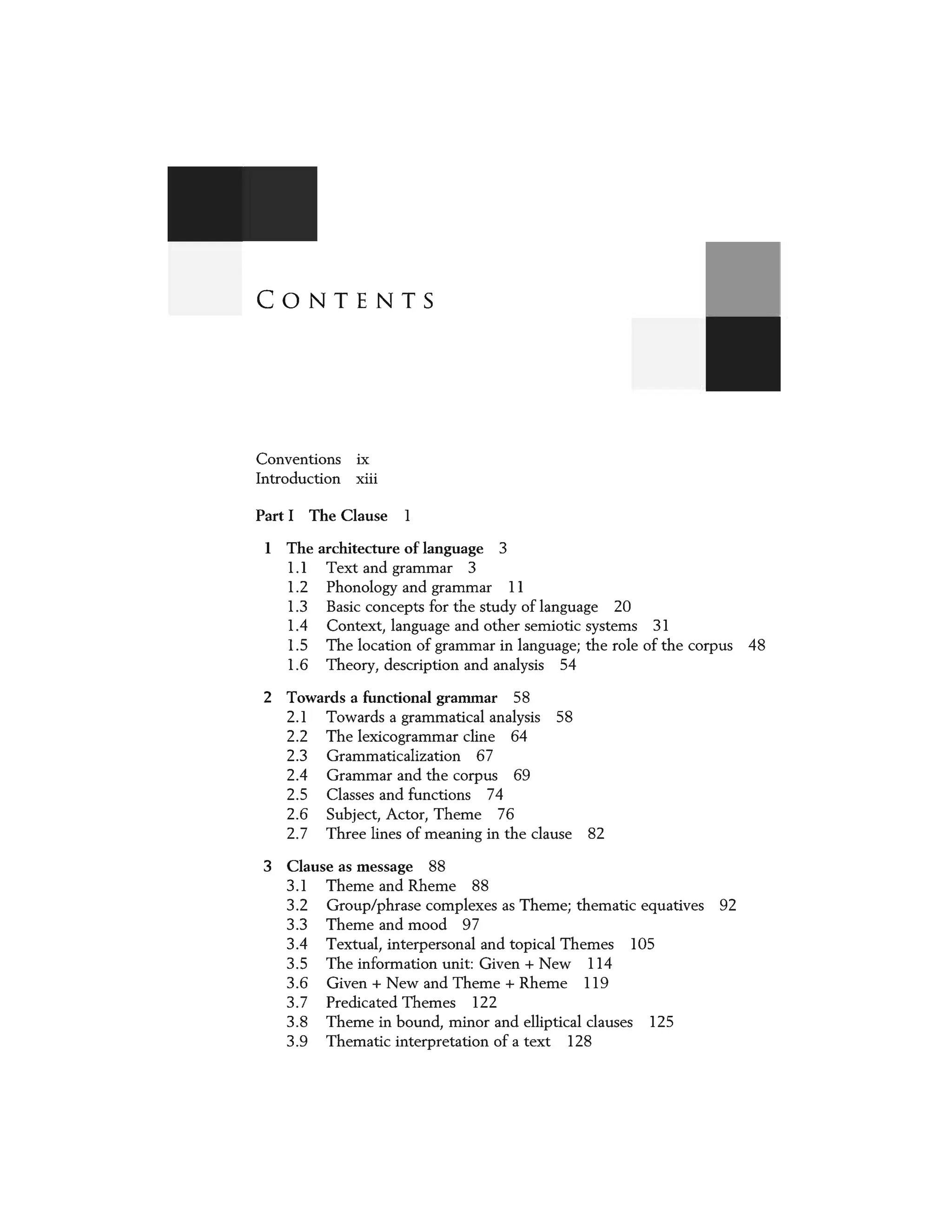
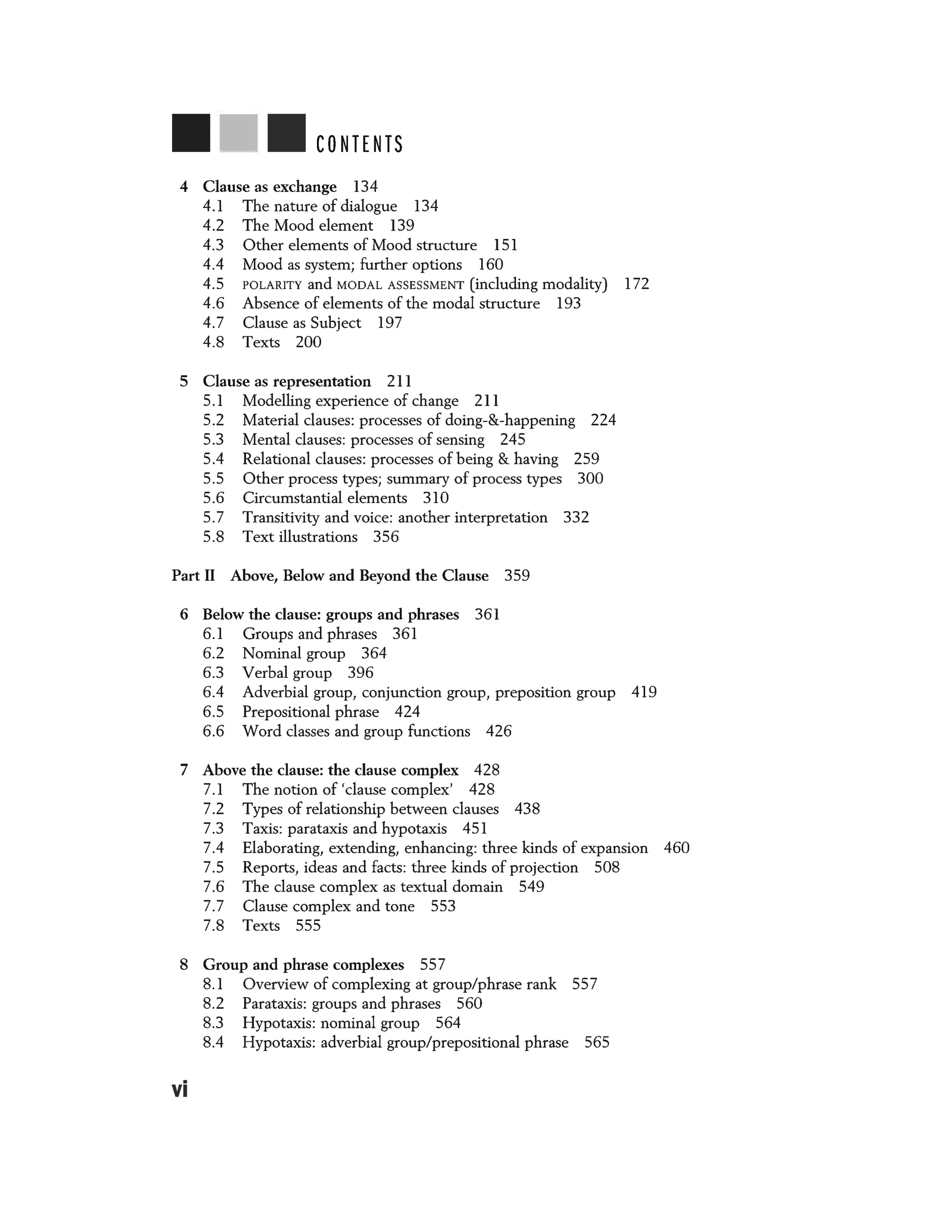
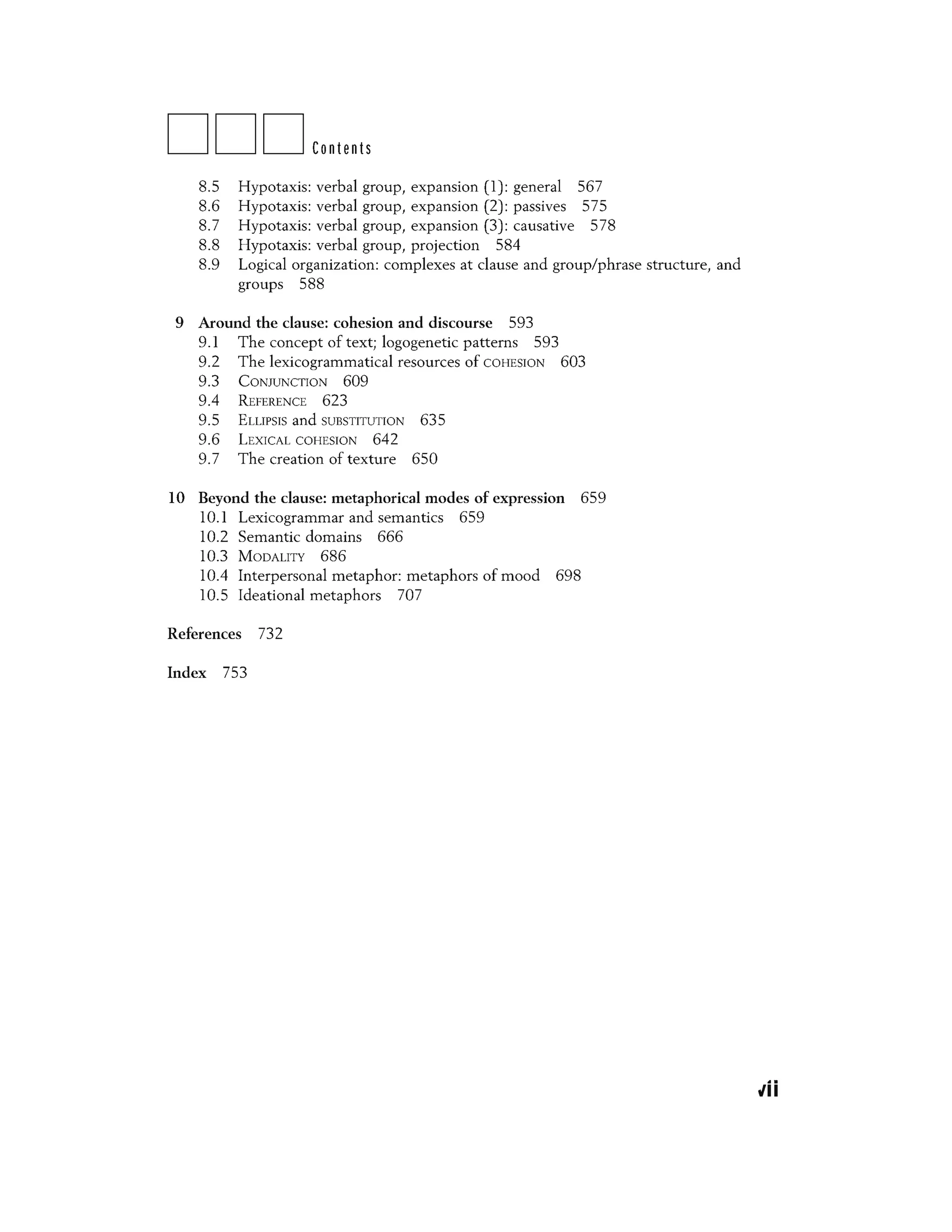

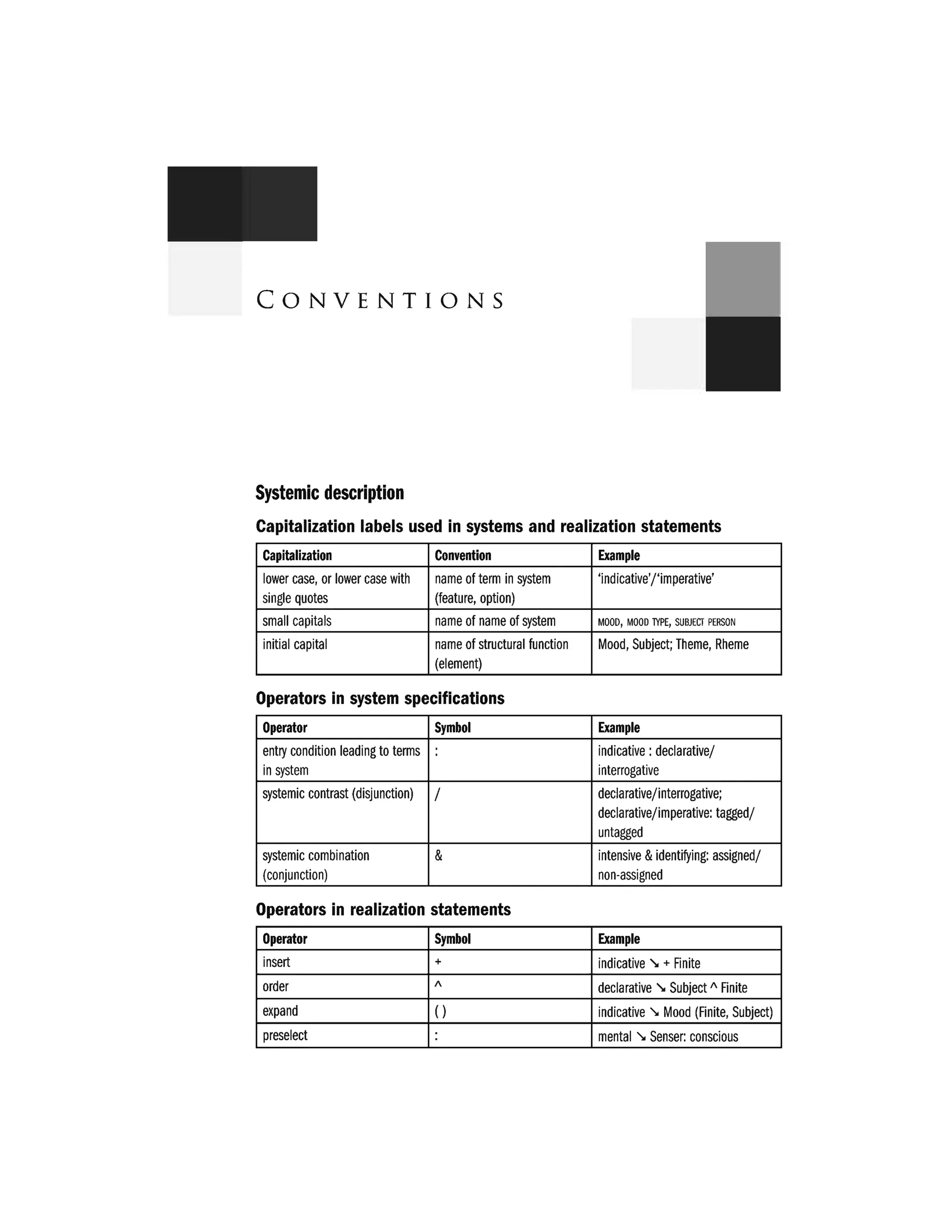
![CONVENTIONS
Graphic conventions in system networks
a- [; there is a system x/y with entry condition a [if a, then either x or y]
[
m
x-
a-[ n
y
a ] m
-[
C n
there are two simultaneous systems x/y and mln, both having entry
condition a [if a, then both either x or y and, independently, either m
or n]
there are two systems x/y and m/n, ordered in dependence such that m/n
has entry condition x and x/y has entry condition a [if a then either x or
y, and if x, then either m or n]
there is a system x/y with compound entry condition, conjunction of a
and b [if both a and b, then either x or y]
there is a system m/n with two possible entry conditions, disjunction of a
and c [if either a or c, or both, then either morn]
Annotation of text
Boundary markers
Stratum Symbol Unit (complex) Example
lexicogrammar 111 clause complex
11 clause
I phrase, group
[[[ ]]] rankshifted (embedded)
clause complex
[[ II rankshifted (embedded)
clause
[l rankshifted (embedded)
phrase, group
phonology Ill tone group complex
II tone group
I foot
I
silent beat
X](https://image.slidesharecdn.com/3488818-250621233359-47239993/75/Hallidays-Introduction-To-Functional-Grammar-4th-Mak-Halliday-15-2048.jpg)
![DDDConventions
Other forms of annotation
Symbol Gloss Example
t Constructed example t John'sfather wanted him to give up the violin. His teacher persuaded him
to continue.
* Overlapping turns, starting at Jane: We were all exactly *the same.
the location of the asterisk Kate: * But I don't know that we were friends.
[0: 'x] element of structure ellipsed, You've lost credibility and also you've probably spent more than you wanted
reinstatable as 'x' to, so [0: 'you'] do be willing to back away from it, because there'salways
something else next week or the month after.
Example sources
Sources of examples are given in square brackets after examples. The main types are listed
in the table below.
Type of reference Comment Example
[number] Example taken from our archive of examples held in adatabase; these will [Text 370]
be listed on the IFG companion website
[corpus name] [ICE] Example take from one of the corpora in the collection known as [ICE-India]
International Corpus of English (ICE)
[ACE] Example take from the Australian Corpus of English (ACE)
[LOB] Example take from the Lancaster-Oslo-Bergen Corpus of British English
[BROWN] Example take from the BROWN Corpus of American English
[COCA] Example take from the Corpus of Contemporary American English (COCA)
[BE] Bank of English corpus
Other conventions
Bold font is used to indicate (first mention of) technical terms, as in:
Each foot, in tum, is made up of a number of syllables
Italic font is used to indicate grammatical and lexical items and examples cited in the body
of the text, as in:
Here, the Theme this responsibility is strongly foregrounded
xi](https://image.slidesharecdn.com/3488818-250621233359-47239993/75/Hallidays-Introduction-To-Functional-Grammar-4th-Mak-Halliday-16-2048.jpg)

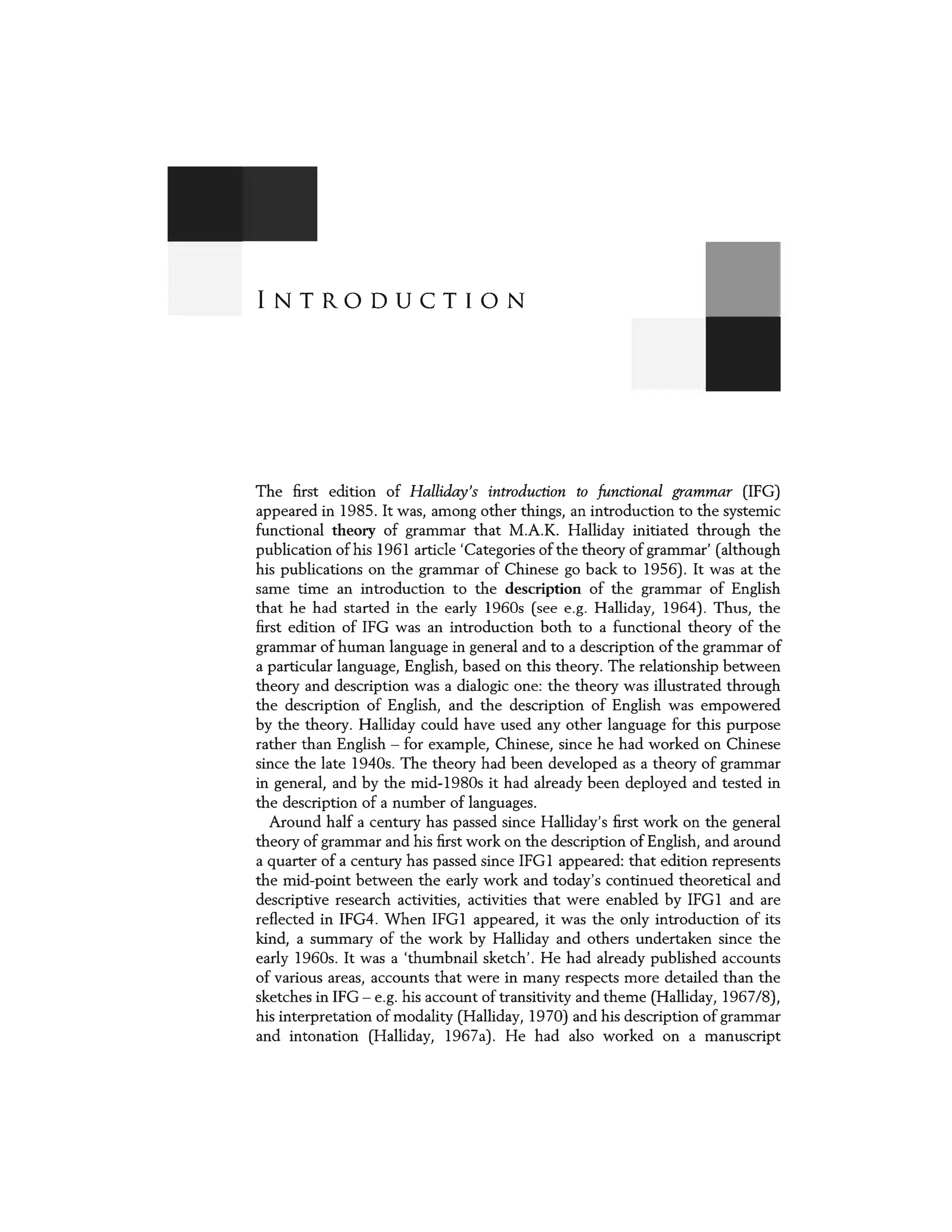
![DDDIntroduction
University in the 1970s. As an undergraduate student in linguistics, I was taught to develop
descriptions of fragments of grammar using the version of Chomsky's generative grammar
that was current at the time (a version of the 'Extended Standard Theory'); I remember
working on mood tags - without any of the insights that Halliday's account brings to this
area of the grammar of English. But we were also encouraged to explore different theoretical
frameworks, by the two professors of Linguistics during my time there as a student, Bertil
Malmberg and then Bengt Sigurd. And in the Department of English, where I was also a
student, there was a great deal of interest in Halliday & Hasan's (1976) account of cohesion
- a contribution that stimulated a number of PhD theses in that department, as part of
the reorientation to corpus-based research brought about by the new Professor of English
linguistics, Jan Svartvik. (In those days, it was still possible for students to construct their own
study paths; I had added Arabic and Philosophy to my particular mix.)
When I first came across Systemic Functional Linguistics back at Lund University,
something clicked - or rather a number of things clicked. I realized that Halliday had solved
a problem that had puzzled and bothered me for quite a long time - since secondary school,
where I had come across Alvar Ellegard's highly original introduction to generative semantics
and also Bertil Malmberg's introduction to European structuralism. Both approaches
seemed full of insight and promising - one providing a deeper understanding of structure
and the other showing the power of the paradigmatic axis. However, they appeared to
be completely incompatible. It was only when I read Halliday's work that I understood
how systemic (paradigmatic) organization could be related to structural (syntagmatic)
organization through realization statements. His theory of paradigmatic organization and
the relationship between the paradigmatic axis and the syntagmatic one is one of the major
breakthroughs in twentieth-century theoretical linguistics. Later I became aware of other
breakthroughs he had quietly made, including his theory of metafunctions, his theory of
instantiation and his theory of grammatical metaphor.
In working on the description of English in a computational linguistics context, and on
the description of Akan in a typological linguistic context, I also came to appreciate the
descriptive power of systemic functional theory, including the heuristic value of developing
a description with the help of a function-rank matrix (see Chapter 2). I still remember very
clearly the quite extraordinary sensation I had when I began auditing the first seminars I
had ever attended by Halliday - a course he gave at UC Irvine starting around March 1980:
this was the first time anyone had ever given me a clear sense of the overall organization of
language as a complex semiotic system. I thought to myself that he was the first linguist to
teach me about language; previously other linguists had taught me about linguistics. There
is a very significant fundamental difference between the two; and language is much harder
to understand (and so to teach about) than linguistics]
I was very fortunate to start working on the systemic functional description of English in
1980 under Halliday's guidance. His descriptions were often quite 'unorthodox' in the sense
that they differed significantly from 'mainstream' accounts - for example, his account ofthe
clause as a metafunctional grammatical construct, his account of grammar and lexis as zones
within a lexicogrammatical continuum (rather than as separate 'modules'), his account of
transitivity in English based on the complementarity of the transitive and ergative models,
his account of theme and information as complementary textual systems, his account of
modality as a dine for propositions and proposal between positive and negative polarity
xvii](https://image.slidesharecdn.com/3488818-250621233359-47239993/75/Hallidays-Introduction-To-Functional-Grammar-4th-Mak-Halliday-22-2048.jpg)

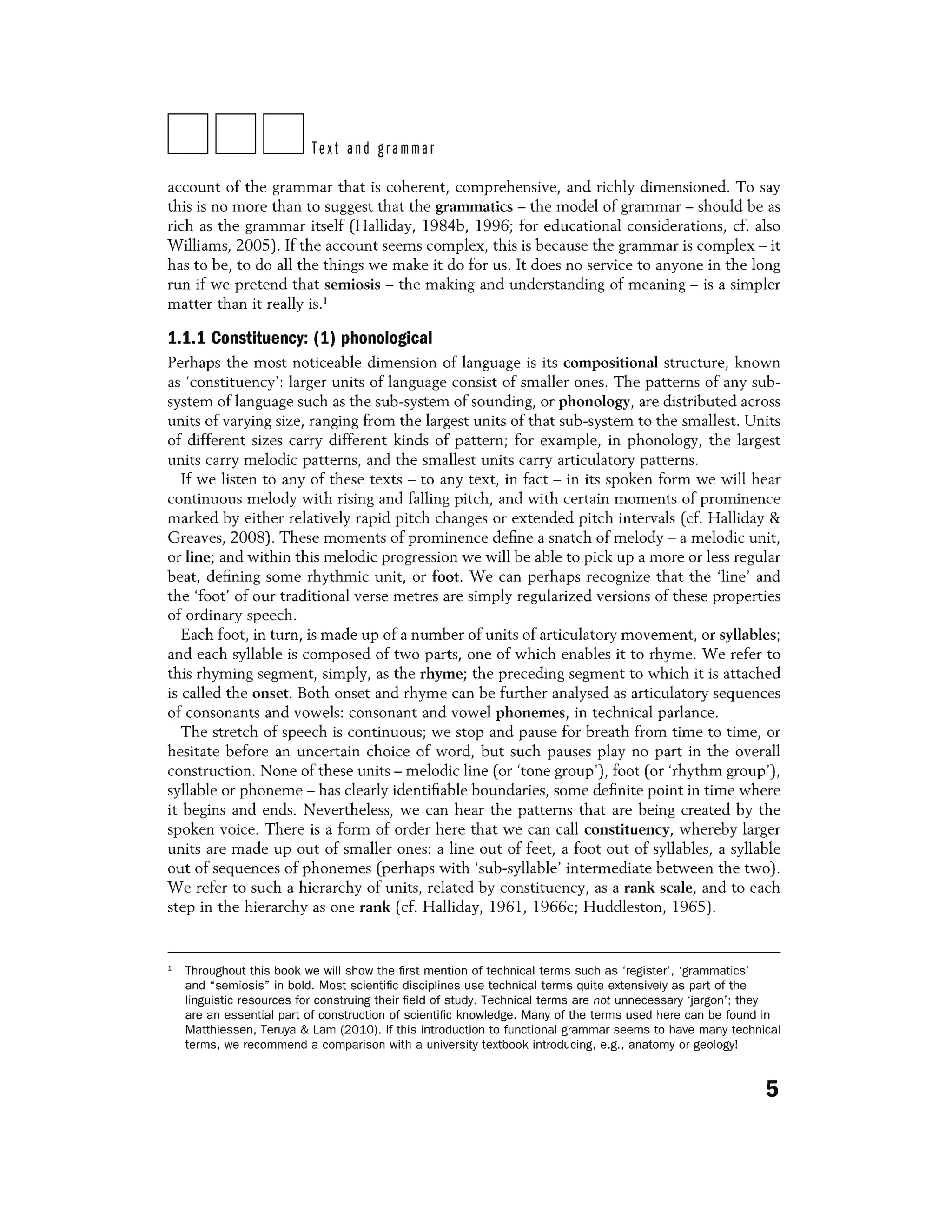
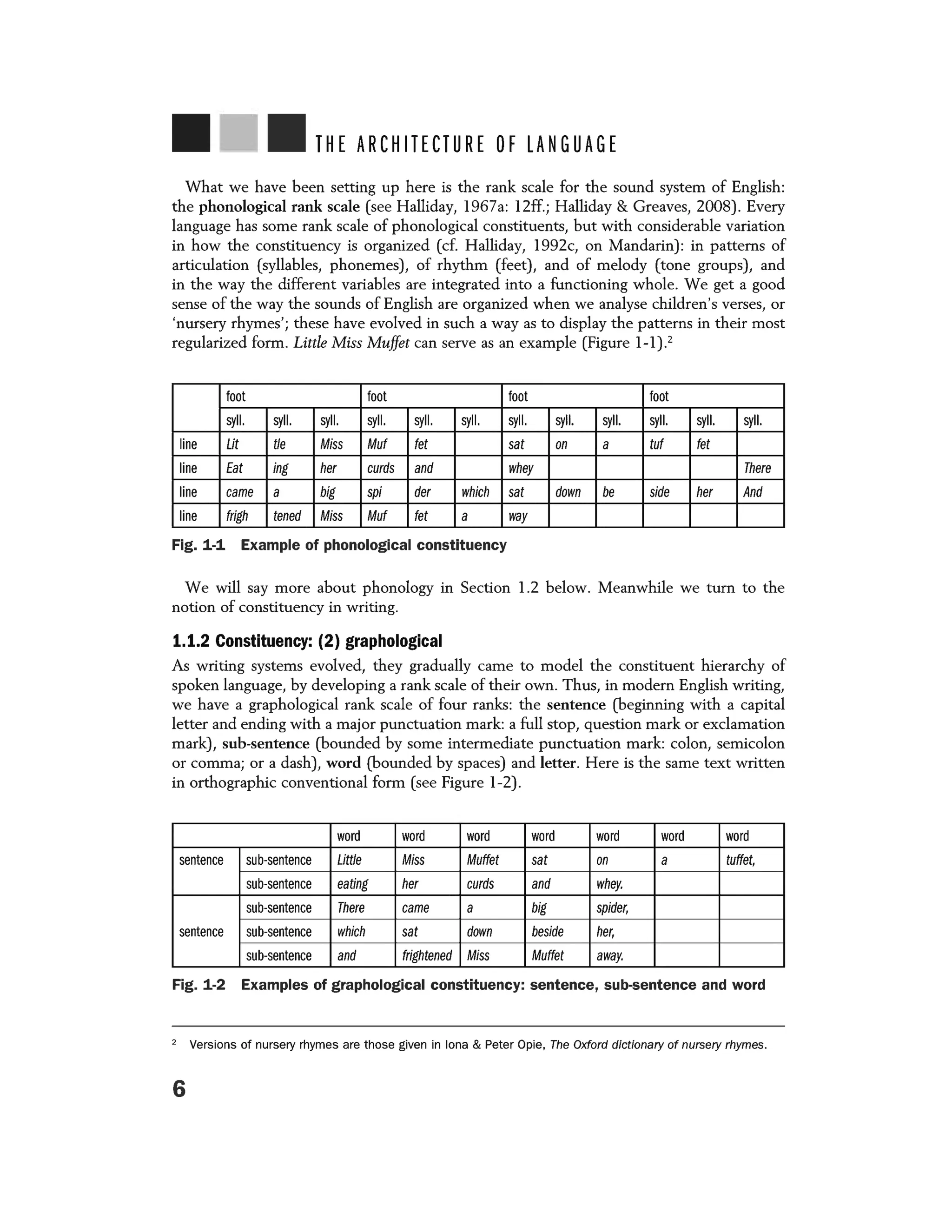
![THE ARCHITECTURE OF LANGUAGE
rank below. Most commonly, though not uniquely, a clause may be down-ranked
to function in the structure of a group.
(5) Under certain circumstances it is possible for one unit to be enclosed within
another; not as a constituent of it, but simply in such a way as to split the other
one into two discrete parts.
To represent the lexicogrammatical constituents in a passage of written text we adopt
the notational conventions set out in Table 1-1 Notational conventions for representing
lexicogrammatical constituency (see Table 1-1).
Table 1-1 Notational conventions for representing lexicogrammatical constituency
Ill clause complex fil ID downranked clause complex «< >» enclosed clause complex
II clause llil downranked clause «» enclosed clause
I phrase or group II downranked phrase/group <> enclosed phrase/group
# [space] word
Examples:
II out of [ the experience [ of [ an extraordinary human disaster [ that I lasted I too long]]]] I must be born I a
society [ of which I all humanity I will be I proud ]II
II did <you> read Ithat article [the other day] [ about [ this woman IIIwho I was driving I along Isomewhere I
on [this country road] II when I hail Ijust suddenly Istarted pouring down ]Ill] II
Ill we I understand II that I there I is I more [ than [ one thing]] [ you I want to achieve I out of [ every wash
load] ]Ill
II today I all of us I do < by [ our presence here ] and I by [ our celebrations [in [other parts [ of [ our country
and the world []]]] > confer I glory and hope I to [ newborn liberty ] II
The clause is the central processing unit in the lexicogrammar - in the specific sense
that it is in the clause that meanings of different kinds are mapped into an integrated
grammatical structure. For this reason the first half of this book is organized around the
principal systems of the clause: theme, mood and transitivity. In Part II we move outward
from the clause, to take account of what happens above and below it - systems of the clause
complex, of groups and phrases, and of group and phrase complexes; and also beyond the
clause, along other dimensions so to speak.
The perspective moves away from structure to consideration of grammar as system,
enabling us to show the grammar as a meaning-making resource and to describe grammatical
categories by reference to what they mean. This perspective is essential if the analysis of
grammar is to be an insightful mode of entry to the study of discourse. But first, in the
remainder of the present chapter, we will say a little more about compositional structure,
including a more detailed sketch of phonology, so that we can take the relevant aspects of
it for granted throughout the rest of the book.
10](https://image.slidesharecdn.com/3488818-250621233359-47239993/75/Hallidays-Introduction-To-Functional-Grammar-4th-Mak-Halliday-33-2048.jpg)
![DDDPhonology and grammar
1.2 Phonology and grammar
If we want to take a comprehensive view of English grammar, we must first make an
excursion into phonology. This is because there are some grammatical systems that are
realized by prosodic means: for example, by the contrast between falling and rising tone.
As we have seen in Section 1.1.1, the units of phonology are organized from largest to
smallest according to the phonological rank scale - tone group (melodic line), foot (rhythm
group), syllable and phoneme. Each unit is the domain of certain phonological systems,
and it can be characterized in terms of a characteristic structure (the exception being the
smallest unit, the phoneme): see the summary in Table 1-2. These units can be divided into
two regions of articulation and prosody. Articulatory features are associated with smaller
units, typically phonemes (vowels and consonants) . Prosodic features are associated with
larger units; they are features of intonation and rhythm (for an overview of the phonetics
of prosody, see Nooteboom, 1997). The gateway between the two regions is the syllable; it
realizes prosodic features of intonation and rhythm (and may carry its own, e.g. syllabic tone
in 'tone languages' such as Chinese) and it 'choreographs' articulatory gestures (sequences
of phonemes).
Table 1-2 The phonological rank scale
Rank Nature of unit Major systems Structure
tone group prosody: melody (intonation) TONE, TONICITY, TONALITY (Pretonic ") Tonic
foot prosody: rhythm FOOT COMPOSITION, ICTUS STATE Ictus (" Remiss)
syllable prosody: salience SYLLABIC COMPOSITION (Onset ") Rhyme
articulation: articulatory gesture
phoneme articulation: articulatory sub-gesture [ARTICULATORY SYSTEMS:] MANNER, PLACE, NASALITY -
ETC.
As a general principle, articulation is arbitrary (conventional), in the sense that there
is no systematic relation between sound and meaning (as emphasized by Saussure and
further developed by other European structuralist linguists, in particular Hjelmslev and
Martinet; see e.g. Halliday, 1985b/2003: 196). Prosody, on the other hand, is natural
(just as grammar is in relation to semantics; see Halliday & Matthiessen, 1999: 18-22):
it is related systematically to meaning, as one of the resources for carrying contrasts
in grammar. In this section we give a sketch of the prosodic region of the phonology
from the standpoint of its importance to the grammatical description. For a more
comprehensive account, see Matthiessen & Halliday (in prep.), Halliday (1967a) and
Halliday & Greaves (2008).
1.2.1 Rhythm: the foot
Consider another well-known piece of traditional children's literature:
11](https://image.slidesharecdn.com/3488818-250621233359-47239993/75/Hallidays-Introduction-To-Functional-Grammar-4th-Mak-Halliday-34-2048.jpg)
![THE ARCHITECTURE OF LANGUAGE
Let us return briefly to the relationship among spoken language, written prose, and
written verse. The 'line', in verse, evolved as the metric analogue of the tone group: one line
of verse corresponded to one tone group of natural speech. In children's nursery rhymes this
correspondence is often preserved intact (this is why they are valuable in helping children
learn the patterns of the language); but in adult verse of course it is not - on the contrary,
it becomes an idealized motif on which endless meaningful variations can be played. And
this illustrates a principal strategy whereby the meaning potential of a language comes to
be extended.
We can postulate an 'initial' state where the two variables are fully associated: at this
point, the 'line' is just the poetic incarnation of the tone group. Then the two become
dissociated: the poetic line takes on a life of its own, and new meanings are construed by
mapping a line into more than one tone group, or having the intonation patterns cut right
across those set up by the poetic form. This 'dissociation of associated variables' is one
of the main semogenic resources of a language; for a theoretical discussion, see Halliday
(1991).
As it happens, the verse form helps us recognize that there is a still higher unit of
organization above the tone group. Listening to the four lines of the apple-pie rhyme we
can hear that they make up a sequence of interrelated tone groups: beginning with a series
that are alike, all ending on a rise, and ending with one that is distinct, with its final falling
movement on drink. The rising tones suggest non-finality, whereas the fall sounds (and in
fact is) culminative: it brings the sequence to an end. Together these tone groups make up
a tone group complex (see further Chapter 7, Section 7.6); and this, in turn, is the origin
of the metric stanza, as a higher pattern of organization in poetry.
[gram. unit:]
I '
I ',
/ ~
1 [unit of verse:]
/ /
/ [phon. unit:]
~/
[graph. unit:]
clause--------- clause complex
I ' I
I ' I
I ', I
I ... I
/ line / stanza
/ / / /
t tone group tone group complex
~✓ V
subsentence - - - - - - - - sentence
Fig. 1-4 Analogic patterning of units across content (lexicogrammar) and expression
(phonology, graphology)
The explanation for all this analogic patterning lies in the grammar. When children start
to speak English as their mother tongue, they soon learn to construct a unit that is a
conflation of clause and tone group (later, again, they will learn to dissociate these two) .
This is also manifested as a unit in the rhymes they hear. When they start learning to read
and write they find this unit reappearing as a (simple) sentence, with a capital letter at the
beginning and a full stop or other major punctuation mark at the end; and this also turns
16](https://image.slidesharecdn.com/3488818-250621233359-47239993/75/Hallidays-Introduction-To-Functional-Grammar-4th-Mak-Halliday-39-2048.jpg)
![....
00
PRETONIC
r
I
tone group -
'-.+Tonic;
Tonic: foot1_, ,
TONIC
COMPOSITION
FOOT
COMPOSIT
ION
foot 1
'-,.+Ictus
ICTUS
STATE
• [ without pretonic
with pretonic
'-,. +Pretonic;
Pretonic: foot1_,
Pretonic / Tonic
SIMPIF
tone 1 fall
tone 2 high-rise/ -
high fall - high rise
simple - · ··-- tone 3 low rise
PRIMARY
TONE
I
compound COMPOUND
'-,.+Tonic 2· PRIMARY
Tonic 2:foot' TONE
Tonic/ Tonit2"
I simple
I
compound
'-,.+Remiss;
Remiss: syllable1-n
Ictus/ Remiss
filled
'-,. Ictus: syllable1-n
empty
'-,. Ictus: silent
tone 4 (rise-) fall-rise -+--__,
tone 5 (fall-) rise-fall
tone 13 fall plus
low rise
tone 53 (fall-) rise-
fall plus low rise
Fig. 1-5 System network for prosodic systems in English phonology
.1 even
}
_[ _1 bouncing
[tone 1] ~ - [ ... 1listing
1+wide
1. medium
1- narrow
2. straight I [tone 2] _ }----[ .2 high
2- broken - 2low
4. high [tone 3] }----C.3 mid
4-low -31ow
5. high
5-low
--t
=
l"'T"1
~
=
('"")
=
--t
l"'T"1
('"")
--t
=
=
l"'T"1
c:>
"'"T"1
,--
~
=
C"")
=
~
C"")
l"'T"1](https://image.slidesharecdn.com/3488818-250621233359-47239993/75/Hallidays-Introduction-To-Functional-Grammar-4th-Mak-Halliday-41-2048.jpg)
![THE ARCHITECTURE OF LANGUAGE
1.3 Basic concepts for the study of language
The discussion so far has raised a number of theoretical issues, as can be seen from the
variety of technical terms that have had to be used. We have referred to language (i) as text
and as system, (ii) as sound, as writing and as wording, (iii) as structure - configurations
of parts, and (iv) as resource - choices among alternatives. These are some of the different
guises in which a language presents itself when we start to explore its grammar in functional
terms: that is, from the standpoint of how it creates and expresses meaning.
At this point, we begin to need a map: some overview of language that will enable us to
locate exactly where we are at any point along the route. A characteristic of the approach
we are adopting here, that of systemic theory, is that it is comprehensive: it is concerned
with language in its entirety, so that whatever is said about one aspect is to be understood
always with reference to the total picture. At the same time, of course, what is being said
about any one aspect also contributes to the total picture; but in that respect as well it is
important to recognize where everything fits in. There are many reasons for adopting this
systemic perspective; one is that languages evolve - they are not designed, and evolved
systems cannot be explained simply as the sum of their parts. Our traditional compositional
thinking about language needs to be, if not replaced by, at least complemented by a 'systems'
thinking whereby we seek to understand the nature and the dynamic of a semiotic system as
a whole (cf. Matthiessen & Halliday, in prep., Chapter 1, and references therein to Capra,
1996, and other proponents of systems thinking; Matthiessen, 2007a).
In the remainder of this chapter we shall present in a very summary way the critical
dimensions of the kind of semiotic that language is. By 'language' we mean natural, human,
adult, verbal language - natural as opposed to designed semiotics like mathematics and
computer languages (cf. Halliday & Matthiessen, 1999: 29-46; O'Halloran, 2005); adult
(i.e. post-infancy) as opposed to infant protolanguages (see Halliday, 1975, 2003); verbal
as opposed to music, dance and other languages of art (cf. Kress & van Leeuwen, 1996;
O'Toole, 1994; van Leeuwen, 1999). Ofcourse, all these other systems share certain features
with language in this specified sense; but none of them incorporates all. The dimensions,
or forms of order, in a language, and the ordering principles, are set out in Table 1-4 and
represented diagrammatically in Figure 1-6.
Table 1-4 The dimensions (forms of order) in language and their ordering principles
Dimension Principle Orders
1. structure (syntagmatic order) rank clause- group/phrase-word - morpheme [lexicogrammar];
tone group - foot - syllable - phoneme [phonology]
2. system (paradigmatic order) delicacy grammar - lexis [lexicogrammar]
3. stratification realization semantics - lexicogrammar - phonology - phonetics
4. instantiation instantiation potential - subpotential/ instance type - instance
5. metafunction metafunction ideational [logical - experiential] - interpersonal - textual
20](https://image.slidesharecdn.com/3488818-250621233359-47239993/75/Hallidays-Introduction-To-Functional-Grammar-4th-Mak-Halliday-43-2048.jpg)
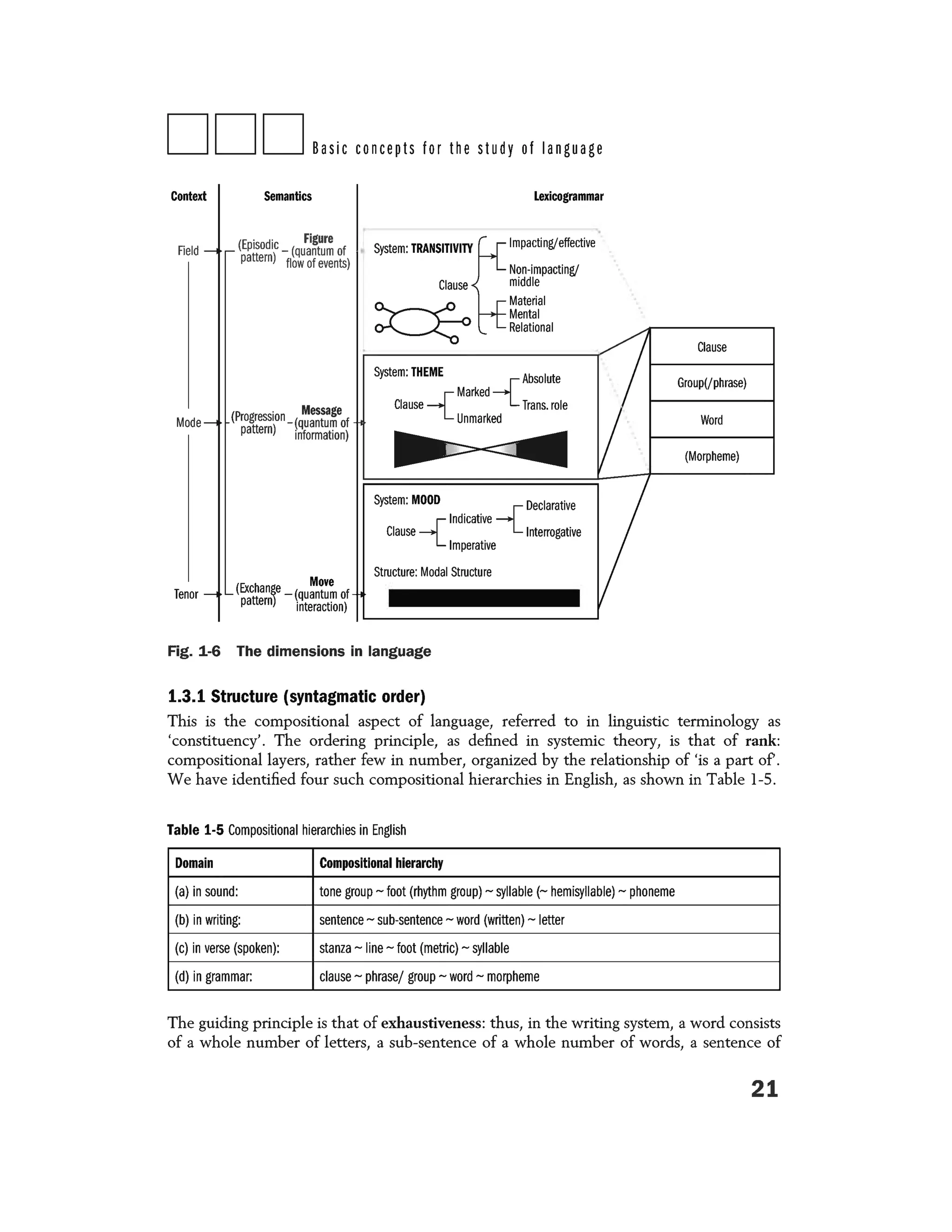
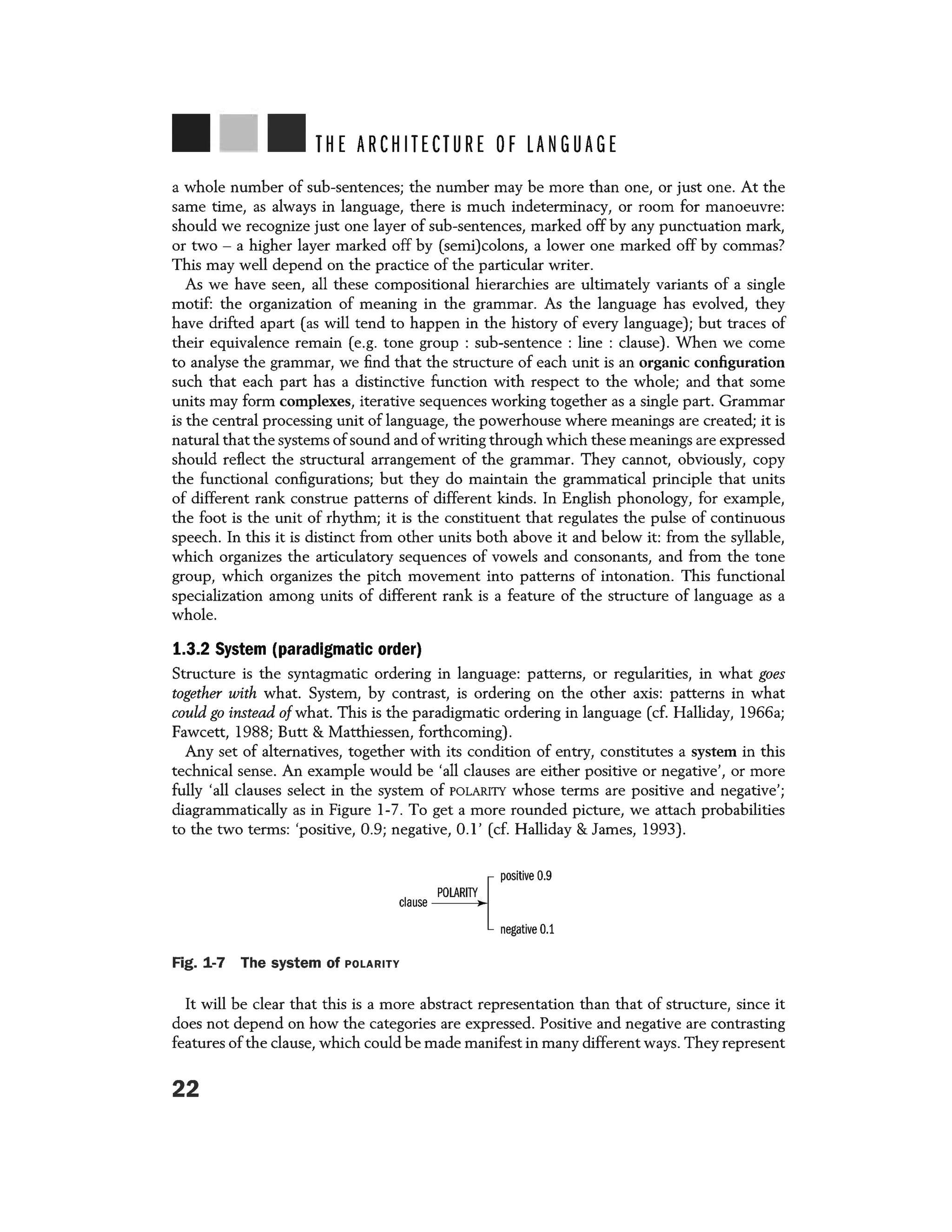
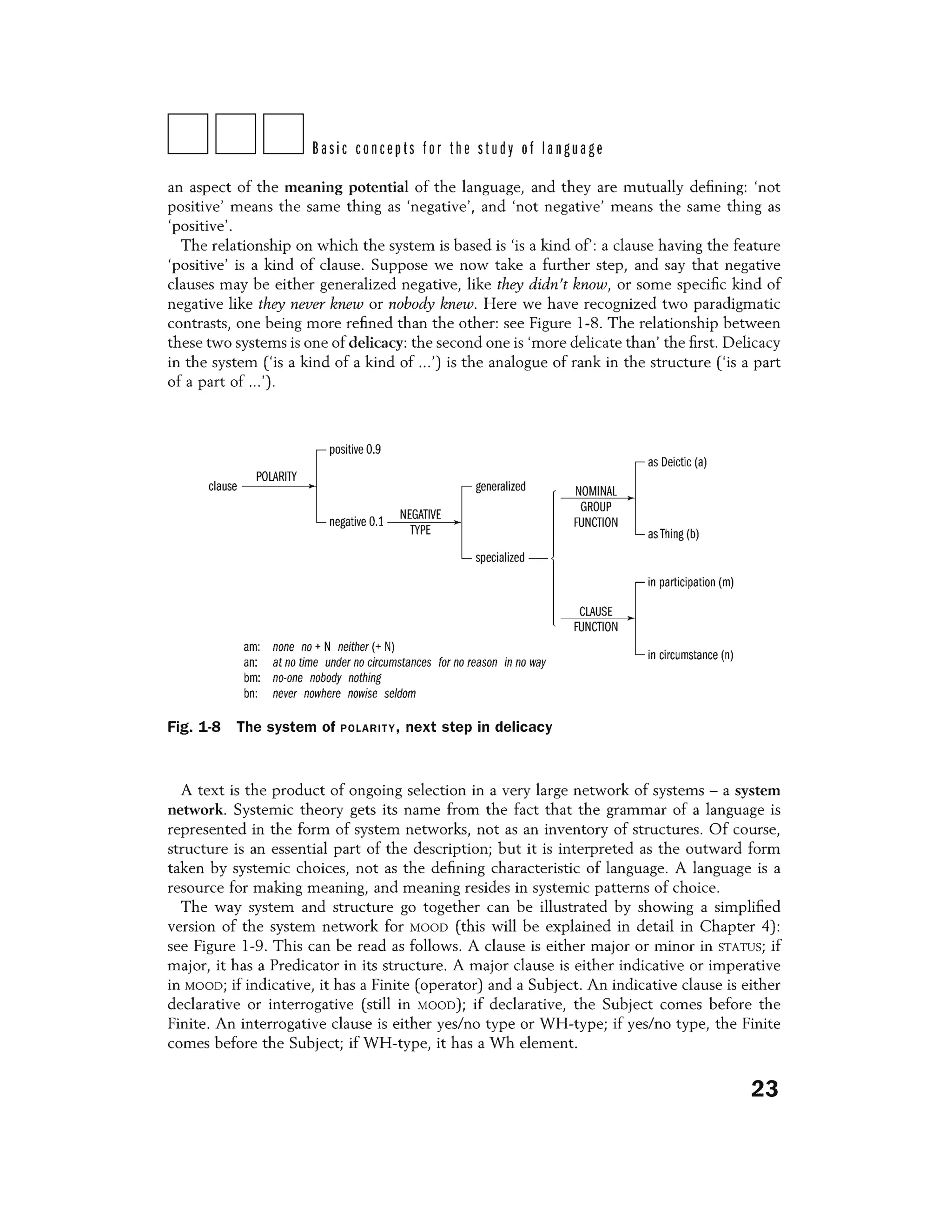
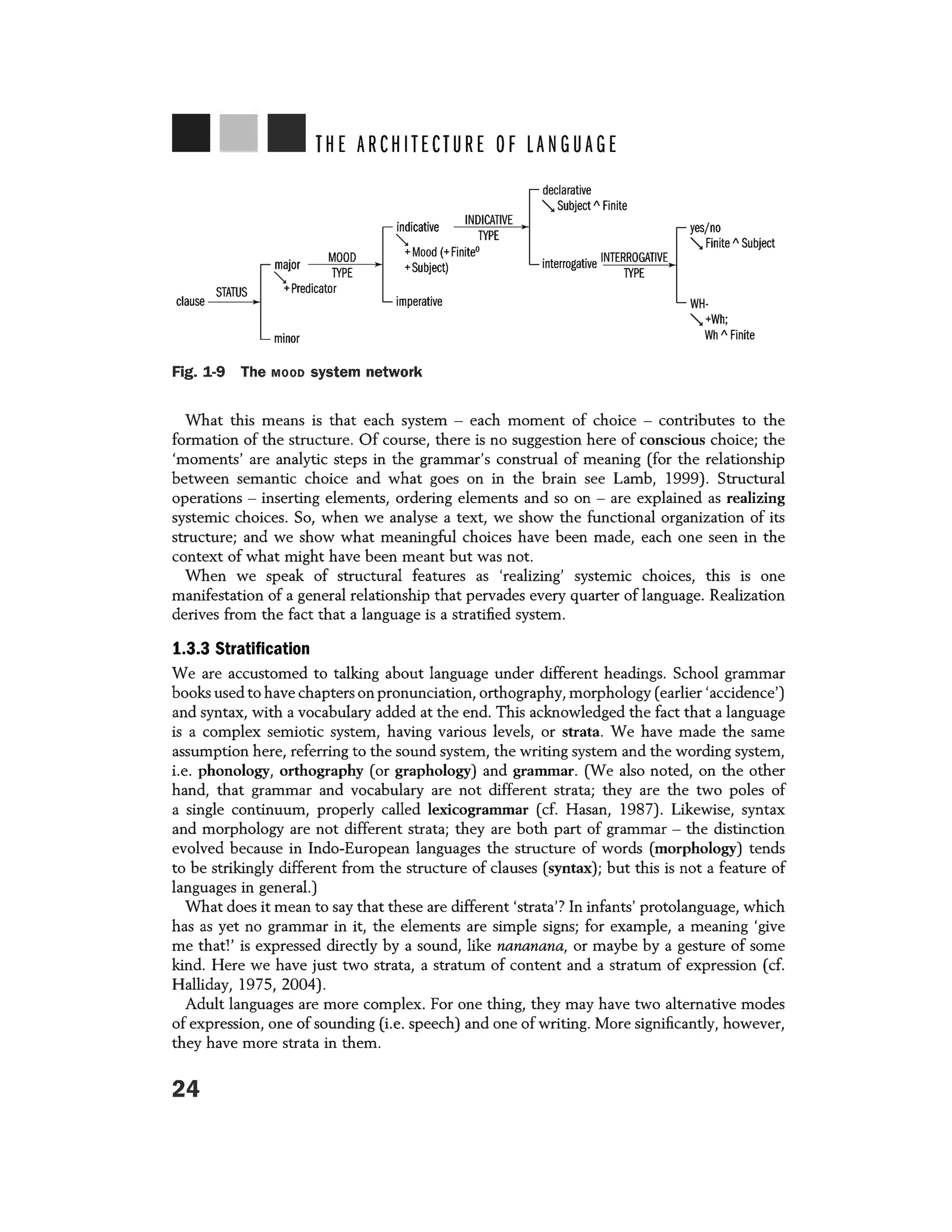
![THE ARCHITECTURE OF LANGUAGE
context
content: semantics
content: lexicogrammar
Fig. 1-10 Stratification
Table 1-6 From eco-social environment to soundwaves: speaker perspective
[from environment to] meaning: interfacing, via receptors semantics
[from meaning to] wording: internal organization lexicogrammar
[from wording to] composing: internal organization phonology
[from composing to] sounding: interfacing, via motors phonetics
Language is thus organized into four strata - semantics, lexicogrammar, phonology, and
phonetics. But these four strata are grouped into two stratal planes, the content plane and
the expression plane. When children learn how to mean, they start with a very simple
semiotic system, a protolanguage, usually sometime in the second half of their first year
of life (see Halliday, 1973, 2003); and we hypothesize that language evolved in the same
way (see Matthiessen, 2004a). This system is organized into two stratal planes, content and
expression; but neither is internally stratified: content is mapped directly onto expression
(vocal or gestural). This protolanguage is a child tongue rather than a mother tongue; it
is not yet like the adult language spoken around young children. Children develop their
protolanguages in interaction with their immediate caregivers, gradually expanding their
protolinguistic meaning potentials. In doing so, they learn the principles of meaning. At
some point, typically in the second year of life, they are ready to build on this experience
and to begin to make the transition into the mother tongue spoken around them. This
transition involves a number of fundamental changes in the linguistic system. A key
26](https://image.slidesharecdn.com/3488818-250621233359-47239993/75/Hallidays-Introduction-To-Functional-Grammar-4th-Mak-Halliday-49-2048.jpg)
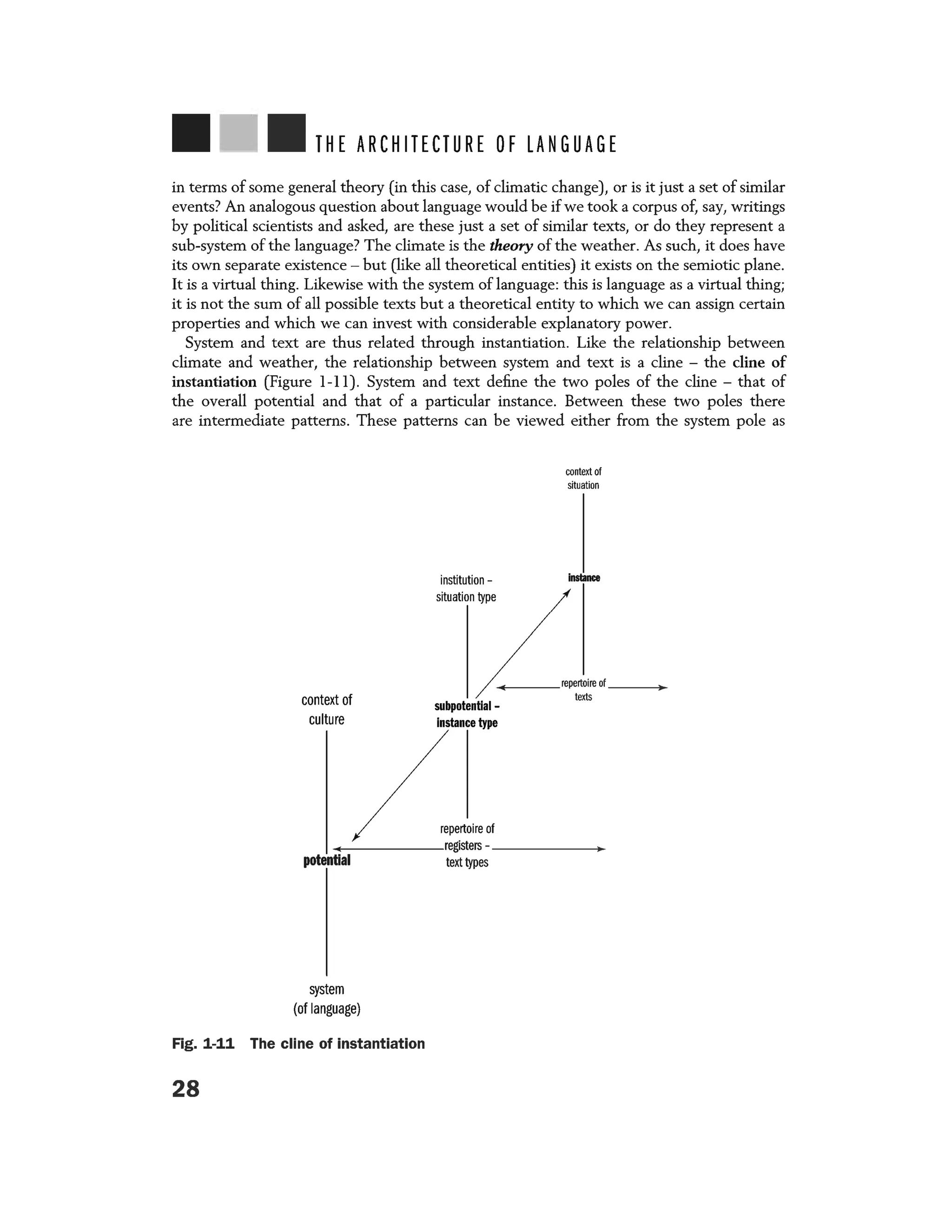
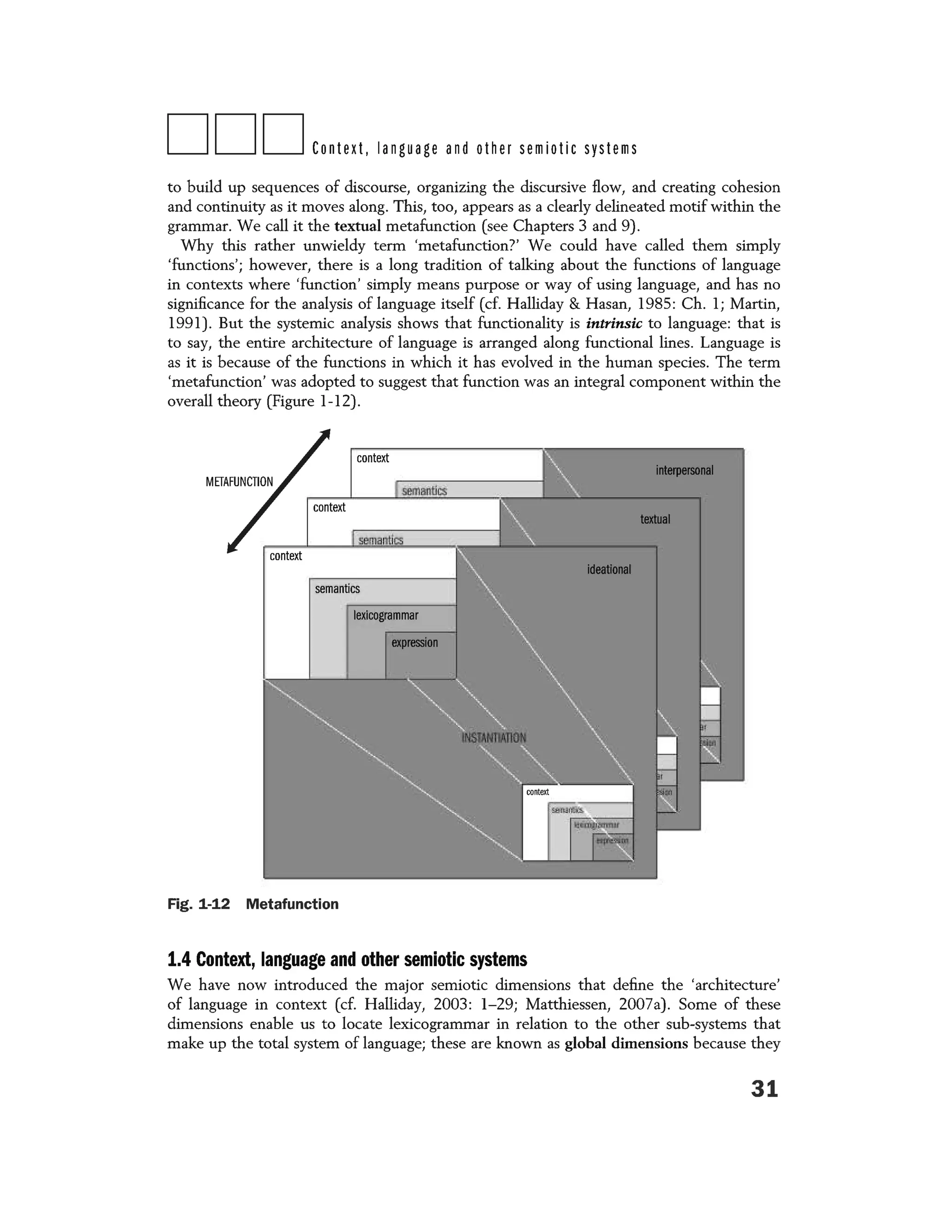

![This ebook is for the use of anyone anywhere in the United States
and most other parts of the world at no cost and with almost no
restrictions whatsoever. You may copy it, give it away or re-use it
under the terms of the Project Gutenberg License included with this
ebook or online at www.gutenberg.org. If you are not located in the
United States, you will have to check the laws of the country where
you are located before using this eBook.
Title: Apró regények (1. kötet)
Author: Sándor Bródy
Release date: September 16, 2013 [eBook #43746]
Most recently updated: October 23, 2024
Language: Hungarian
Credits: Produced by Albert László from page images generously
made
available by the Google Books Library Project
*** START OF THE PROJECT GUTENBERG EBOOK APRÓ REGÉNYEK
(1. KÖTET) ***](https://image.slidesharecdn.com/3488818-250621233359-47239993/75/Hallidays-Introduction-To-Functional-Grammar-4th-Mak-Halliday-60-2048.jpg)