“VORREI UNA PIZZA CON
CAVALLETTE E INSETTI
MISTI, GRAZIE”.
Io invece una
pizza con
cavallette e
insetti misti.
A me una
pasta in
bianco.
Io un panino
al tonno!
Scusi,
vorrei un
panino con il
salame
…Tutti gli occhi addosso
Prego? Non ho
capito bene,
può ripetere?
NO, HA CAPITO BENISSIMO,
VORREI UNA PIZZA CON
CAVALLETTE E INSETTI MISTI!
Scusami, ma davvero
vuoi mangiare le
cavallette. Sono buone
come la cotoletta alla
milanese?
Posso vedere quando le
mangi?
Sì piccolo, dovremo
andare da qualche
altra parte, visto
che qui sono tutti
impressionati dalla
mia richiesta
Così con il mio notebook, ci siamo seduti sulla panchina nel parco davanti al
bar e abbiamo cominciato il nostro viaggio tra insetti, mosche, larve,
cavallette e altri strani esseri commestibili.
“L’aumento della popolazione
mondiale corre a una velocità
superiore a quella
dell’incremento della
disponibilità alimentare.
Secondo un nuovo studio della
FAO (Organizzazione delle
Nazioni Unite per
l’Alimentazione e l’Agricoltura),
gli insetti potrebbero avere un
ruolo importante sia
nell’alimentazione umana che in
quella animale.
Secondo gli esperti ci sono circa
un milione di specie e, inoltre, in
alcune parti del globo gli insetti
fanno già parte della dieta.
I più presenti nei menu
(principalmente orientali e
africani) sono i coleotteri (31%),
davanti
a bruchi (18%), api, vespe e formic
he (14%), cavallette,
locuste e grilli (13%)”.
“Ma perché dovremmo imparare
a mangiare gli insetti”, mi chiede il
mio giovane amico?
“Perché gli insetti sono ricchi di
proteine e grassi buoni, di calcio,
ferro e zinco, ti basta pensare che
la carne bovina contiene 6 mg di
ferro su 100 grammi di peso secco,
mentre nelle locuste si va dagli 8 ai
20 per etto.
E poi costano poco! Terreni
sfruttati troppo per coltivazioni
e allevamenti, mari sempre
meno pescosi e costruzioni di
cemento sempre più invadenti
riducono le possibilità di
sfamare il pianeta, per cui gli
insetti potrebbero rivelarsi una
fonte alimentare sostenibile per
nutrire il mondo senza
impoverirlo ancora di più.”
“Tu li catturi da solo e li mangi
crudi?”
“Adesso non è possibile, o
meglio noi occidentali ancora
non siamo preparati a questo
tipo di alimento;
certo che se dovessero diventare
un alimento diffuso dovremmo
regolamentarne la produzione,
per non minacciare la biodiversità
e fornire un prodotto sempre
sicuro e standardizzato.
L'argomento va affrontato e
studiato seriamente, perché le
implicazioni sono molte: al di là
dell'aspetto "clamoroso" del
cucinare una falena o una
cavalletta, gli insetti potrebbero
essere impiegati per produrre
farine e anche mangimi per gli
animali.
Bisognerà farci un po’ l’occhio;
d’altronde cosa ne pensi se ti
dicessi di mangiare una
lumaca, una conchiglia, una
rana? Non ti fa un po’
effetto?” e quando mangi i
funghi, non lo sai che stai
mangiando la muffa? E non ti è
mai capitato di mangiare lo
yogurt? Sono fermenti lattici
vivi!! E il formaggio con i
vermi?”
La faccia e le smorfie del mio
compagno di viaggio mi hanno
portato a spiegargli che già
alcune popolazioni fanno uso
di insetti.
“Per esempio a Kinshasha, nella
Repubblica Democratica del Congo,
quando sono andato a fare un
viaggio, al mercato molte donne
vendevano bruchi mopane essiccati e
devi pensare che gli animali selvatici e
gli insetti sono spesso la principale
fonte di proteine ​​per le persone che
vivono in aree forestali. In Thailandia,
ad esempio, Vermi del bamboo con
cipolle verdi li ho trovati al mercato di
Chiang Mai.
Le comunità rurali del Sudamerica,
alcune popolazioni dell'Indonesia e
della Cina, l'Angola o la Nuova
Guinea, per esempio mangiano gli
insetti non come conseguenza della
povertà, ma perché fa parte della loro
cultura”.
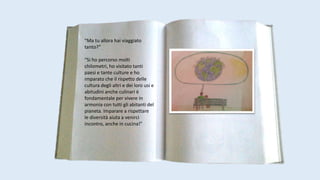
“Ma tu allora hai viaggiato
tanto?”
“Si ho percorso molti
chilometri, ho visitato tanti
paesi e tante culture e ho
imparato che il rispetto delle
cultura degli altri e dei loro usi e
abitudini anche culinari è
fondamentale per vivere in
armonia con tutti gli abitanti del
pianeta. Imparare a rispettare
le diversità aiuta a venirci
incontro, anche in cucina!”
“EXCUSE ME, I'D LIKE A
GRASSHOPPER SANDWICH”
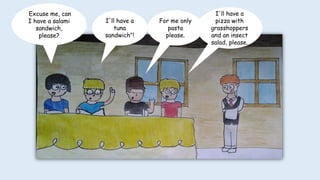
I'll have a
pizza with
grasshoppers
and an insect
salad, please.
For me only
pasta
please.
I'll have a
tuna
sandwich"!
Excuse me, can
I have a salami
sandwich,
please?
…All eyes on me!
I beg your
pardon? I
didn't
understand,
could you say
that again?
NO, YOU UNDERSTOOD
PERFECTLY WELL. I'LL HAVE A
PIZZA WITH GRASSHOPPERS
AND AN INSECT SALAD, PLEASE
Are you really going to
eat grasshoppers? Are
they as good as breaded
cutlets? Can I watch
you while you eat them?
Sure little boy... but
it’s better if we go
somewhere else
because the people
here look upset.
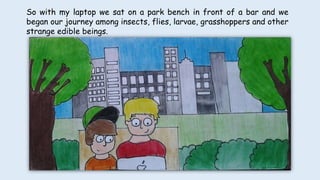
So with my laptop we sat on a park bench in front of a bar and we
began our journey among insects, flies, larvae, grasshoppers and other
strange edible beings.
"The increase of the world
population is higher than
that of the increase in food
availability. According to a
new study of FAO (Food and
Agriculture Organization),
insects could play an
important role in both
human and animal diet.
The most popular in the
menus ( mainly Eastern Asia
and Africa) are beetles
(31%), caterpillars (18%),
bees, wasps and ants (14%),
grasshoppers, locusts and
crickets (13%)"
"But why should we learn to eat
insects?" my young friend ask
me.
"Since insects are rich in
protein, fats, calcium, iron and
zinc, you only need to know
that beef contains 6 mg of iron
per 100 gr of dry weight, while
the locusts range from 8 to 20
per pound. And then they are
cheaper! Land and water
resources have been exploited
so much that it is impossible to
farm enough beef and chicken
to feed everyone on our planet.
So eating bugs could be the
answer. Moreover they can be
farmed in a relatively small
space, even in crowded cities"
"Do you catch them on your
own and eat them raw?"
Now it is impossible, or rather
those who live in western
countries aren't prepared for
this type of food; but if it were
to become a popular food we
should regulate its production
in order not to threaten
biodiversity and provide a
product that is always safe
and standardised.
This matter needs studying
seriously, because its implications
are many: apart from the shocking
aspect of cooking a moth or a
grasshopper, insects could be
used to produce flour and also
animal feed. We need time to get
used to it, but what would you
think if I told you to eat a snail, a
shell, a frog? Don't you feel
disgusted? and when you eat
mushrooms, do you know you are
eating mold? Have you ever eaten
yoghurt? It contains live enzymes!
And what about cheese with
worms?"
The smirk on the face of my young
travelling companion made me
explain to him that some people
use insects as part of their diet.
"When I travelled to Kinshasa in
the Democratic Republic of Congo,
some women were selling dried
mopane and caterpillars at the
local market. Do you know that
wild animals and insects are the
main source of protein for people
living in forests areas? When I was
in Angola and New Guinea, I
noticed that some rural
communities eat insects regularly
as part of their diet. It's a cultural
habit, not a result of poverty".
"Well, you have travelled all
around the world, haven't you?
the boys says".
"Yes, I've covered many
kilometres, I've visited different
countries and cultures and
learned that it's important to
respect each other's culture
and customs to live in harmony
on this planet. Encouraging
respect and diversity helps
people to understand one
another, even in the kitchen!"

Vorrei una pizza con cavallette e insetti

  • 1.
    “VORREI UNA PIZZACON CAVALLETTE E INSETTI MISTI, GRAZIE”.
  • 2.
    Io invece una pizzacon cavallette e insetti misti. A me una pasta in bianco. Io un panino al tonno! Scusi, vorrei un panino con il salame
  • 3.
  • 4.
    Prego? Non ho capitobene, può ripetere?
  • 5.
    NO, HA CAPITOBENISSIMO, VORREI UNA PIZZA CON CAVALLETTE E INSETTI MISTI!
  • 6.
    Scusami, ma davvero vuoimangiare le cavallette. Sono buone come la cotoletta alla milanese? Posso vedere quando le mangi? Sì piccolo, dovremo andare da qualche altra parte, visto che qui sono tutti impressionati dalla mia richiesta
  • 7.
    Così con ilmio notebook, ci siamo seduti sulla panchina nel parco davanti al bar e abbiamo cominciato il nostro viaggio tra insetti, mosche, larve, cavallette e altri strani esseri commestibili.
  • 8.
    “L’aumento della popolazione mondialecorre a una velocità superiore a quella dell’incremento della disponibilità alimentare. Secondo un nuovo studio della FAO (Organizzazione delle Nazioni Unite per l’Alimentazione e l’Agricoltura), gli insetti potrebbero avere un ruolo importante sia nell’alimentazione umana che in quella animale. Secondo gli esperti ci sono circa un milione di specie e, inoltre, in alcune parti del globo gli insetti fanno già parte della dieta. I più presenti nei menu (principalmente orientali e africani) sono i coleotteri (31%), davanti a bruchi (18%), api, vespe e formic he (14%), cavallette, locuste e grilli (13%)”. “Ma perché dovremmo imparare a mangiare gli insetti”, mi chiede il mio giovane amico? “Perché gli insetti sono ricchi di proteine e grassi buoni, di calcio, ferro e zinco, ti basta pensare che la carne bovina contiene 6 mg di ferro su 100 grammi di peso secco, mentre nelle locuste si va dagli 8 ai 20 per etto.
  • 9.
    E poi costanopoco! Terreni sfruttati troppo per coltivazioni e allevamenti, mari sempre meno pescosi e costruzioni di cemento sempre più invadenti riducono le possibilità di sfamare il pianeta, per cui gli insetti potrebbero rivelarsi una fonte alimentare sostenibile per nutrire il mondo senza impoverirlo ancora di più.” “Tu li catturi da solo e li mangi crudi?” “Adesso non è possibile, o meglio noi occidentali ancora non siamo preparati a questo tipo di alimento; certo che se dovessero diventare un alimento diffuso dovremmo regolamentarne la produzione, per non minacciare la biodiversità e fornire un prodotto sempre sicuro e standardizzato. L'argomento va affrontato e studiato seriamente, perché le implicazioni sono molte: al di là dell'aspetto "clamoroso" del cucinare una falena o una cavalletta, gli insetti potrebbero essere impiegati per produrre farine e anche mangimi per gli animali.
  • 10.
    Bisognerà farci unpo’ l’occhio; d’altronde cosa ne pensi se ti dicessi di mangiare una lumaca, una conchiglia, una rana? Non ti fa un po’ effetto?” e quando mangi i funghi, non lo sai che stai mangiando la muffa? E non ti è mai capitato di mangiare lo yogurt? Sono fermenti lattici vivi!! E il formaggio con i vermi?” La faccia e le smorfie del mio compagno di viaggio mi hanno portato a spiegargli che già alcune popolazioni fanno uso di insetti. “Per esempio a Kinshasha, nella Repubblica Democratica del Congo, quando sono andato a fare un viaggio, al mercato molte donne vendevano bruchi mopane essiccati e devi pensare che gli animali selvatici e gli insetti sono spesso la principale fonte di proteine ​​per le persone che vivono in aree forestali. In Thailandia, ad esempio, Vermi del bamboo con cipolle verdi li ho trovati al mercato di Chiang Mai. Le comunità rurali del Sudamerica, alcune popolazioni dell'Indonesia e della Cina, l'Angola o la Nuova Guinea, per esempio mangiano gli insetti non come conseguenza della povertà, ma perché fa parte della loro cultura”.
  • 11.
    “Ma tu allorahai viaggiato tanto?” “Si ho percorso molti chilometri, ho visitato tanti paesi e tante culture e ho imparato che il rispetto delle cultura degli altri e dei loro usi e abitudini anche culinari è fondamentale per vivere in armonia con tutti gli abitanti del pianeta. Imparare a rispettare le diversità aiuta a venirci incontro, anche in cucina!”
  • 12.
    “EXCUSE ME, I'DLIKE A GRASSHOPPER SANDWICH”
  • 13.
    I'll have a pizzawith grasshoppers and an insect salad, please. For me only pasta please. I'll have a tuna sandwich"! Excuse me, can I have a salami sandwich, please?
  • 14.
  • 15.
    I beg your pardon?I didn't understand, could you say that again?
  • 16.
    NO, YOU UNDERSTOOD PERFECTLYWELL. I'LL HAVE A PIZZA WITH GRASSHOPPERS AND AN INSECT SALAD, PLEASE
  • 17.
    Are you reallygoing to eat grasshoppers? Are they as good as breaded cutlets? Can I watch you while you eat them? Sure little boy... but it’s better if we go somewhere else because the people here look upset.
  • 18.
    So with mylaptop we sat on a park bench in front of a bar and we began our journey among insects, flies, larvae, grasshoppers and other strange edible beings.
  • 19.
    "The increase ofthe world population is higher than that of the increase in food availability. According to a new study of FAO (Food and Agriculture Organization), insects could play an important role in both human and animal diet. The most popular in the menus ( mainly Eastern Asia and Africa) are beetles (31%), caterpillars (18%), bees, wasps and ants (14%), grasshoppers, locusts and crickets (13%)" "But why should we learn to eat insects?" my young friend ask me. "Since insects are rich in protein, fats, calcium, iron and zinc, you only need to know that beef contains 6 mg of iron per 100 gr of dry weight, while the locusts range from 8 to 20 per pound. And then they are cheaper! Land and water resources have been exploited so much that it is impossible to farm enough beef and chicken to feed everyone on our planet.
  • 20.
    So eating bugscould be the answer. Moreover they can be farmed in a relatively small space, even in crowded cities" "Do you catch them on your own and eat them raw?" Now it is impossible, or rather those who live in western countries aren't prepared for this type of food; but if it were to become a popular food we should regulate its production in order not to threaten biodiversity and provide a product that is always safe and standardised. This matter needs studying seriously, because its implications are many: apart from the shocking aspect of cooking a moth or a grasshopper, insects could be used to produce flour and also animal feed. We need time to get used to it, but what would you think if I told you to eat a snail, a shell, a frog? Don't you feel disgusted? and when you eat mushrooms, do you know you are eating mold? Have you ever eaten yoghurt? It contains live enzymes! And what about cheese with worms?"
  • 21.
    The smirk onthe face of my young travelling companion made me explain to him that some people use insects as part of their diet. "When I travelled to Kinshasa in the Democratic Republic of Congo, some women were selling dried mopane and caterpillars at the local market. Do you know that wild animals and insects are the main source of protein for people living in forests areas? When I was in Angola and New Guinea, I noticed that some rural communities eat insects regularly as part of their diet. It's a cultural habit, not a result of poverty". "Well, you have travelled all around the world, haven't you? the boys says". "Yes, I've covered many kilometres, I've visited different countries and cultures and learned that it's important to respect each other's culture and customs to live in harmony on this planet. Encouraging respect and diversity helps people to understand one another, even in the kitchen!"