Volume curvature attributes to identify subtle faults and fractures in carbonate reservoirs:
Cimarrona Formation, Middle Magdalena Valley Basin, Colombia.
Luis Bravo* and Milagrosa Aldana, Simón Bolivar University, Caracas, Venezuela.
Summary
In this work we analyze a natural fractured carbonate
reservoir in the Middle Magdalena Valley Basin
(Colombia) using different volume curvature attributes.
The main objective was to illuminate small or sub-seismic
faults, and to delineate fractured zones in the area. Most
positive, most negative, dip, strike, curvedness, Gaussian,
maximum, minimum and mean curvature attributes were
calculated for a 3D post-stack time migrated seismic
volume. To reduce the noise level, a Butterworth filter was
applied previous to the curvature attributes extraction and a
combination of median and mean filters later. The most
positive and most negative attributes gave the best results.
They allowed identifying discontinuities at the target
horizon, illuminating short wavelength flexures and
lineaments. These features were associated to fracture
zones that could result in hydrocarbon accumulation areas.
Also, local geomorphological features and lineaments
related to the structure axes were also identified using these
attributes.
Introduction
The analysis of post-stack seismic attributes, as seismic
coherence (Bahorich, et al., 1995) and semblance (Marfurt,
et al., 1998), have been widely used to delineate faults and
stratigraphic characters. They measure lateral variations in
the waveform and amplitude. Attributes obtained from the
first surface derivative, as dip and dip azimuth, can
illuminate small faults with a displacement lower than the
seismic wavelength (Brown, 2004). Nevertheless, these
methods can delineate lineaments but they cannot
distinguish between symmetric and asymmetric features
(e.g. faults from ridges or valleys) (Roberts, 2001). Second
derivative or curvature attributes gave more insight
regarding the delineation of faults with throw under seismic
resolution, as well as they can help in the prediction of
fractures and their orientation (Roberts, 2001; Chopra et al.,
2007). These attributes have been correlated with open
fractures in outcrops (Lisle, 1994), and production tests
(Nissen et al., 2007). Bergbauer, et al. (2003) calculated
curvature using different wavelengths filtering the input
horizon; they concluded that images at different
wavelengths provide diverse perspectives of the same
geology. Al-Dossary et al. (2006) extended the concept of
surface curvature to volumetric curvature. This allows
calculating curvature in seismic volumes avoiding the need
of picking a horizon (Chopra et al., 2007).
In the present work, several volume curvature attributes are
applied to a natural fractured carbonate reservoir trying to
identify subtle faults and fractures, difficult to observe in
the seismic data or using other attributes. These attributes
could be an important tool in the characterization and
delineation of fractured structures at the Late Cretaceous of
Middle Magdalena Basin, where the production is mainly
associated to carbonate fractured reservoirs.
Theory
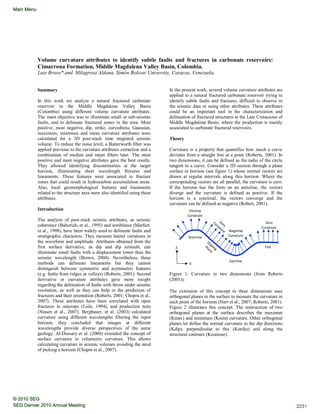
Curvature is a property that quantifies how much a curve
deviates from a straight line at a point (Roberts, 2001). In
two dimensions, it can be defined as the radio of the circle
tangent to a curve. Consider a 2D section through a plane
surface or horizon (see figure 1) whose normal vectors are
drawn at regular intervals along this horizon. Where the
corresponding vectors are all parallel, the curvature is cero.
If the horizon has the form on an anticline, the vectors
diverge and the curvature is defined as positive. If the
horizon is a synclinal, the vectors converge and the
curvature can be defined as negative (Robert, 2001).
Figure 1: Curvature in two dimensions (from Roberts
(2001)).
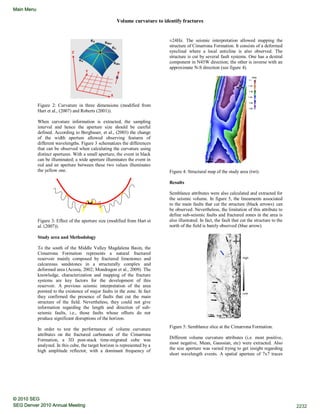
The extension of this concept to three dimensions uses
orthogonal planes to the surface to measure the curvature in
each point of the horizon (Hart et al., 2007; Roberts, 2001).
Figure 2 illustrates this concept. The intersection of two
orthogonal planes at the surface describes the maximun
(Kmax) and minimum (Kmin) curvature. Other orthogonal
planes let define the normal curvature in the dip directions
(Kdip), perpendicular to this (Kstrike) and along the
structural contours (Kcontour).
Positive
Curvature
Negative
Curvature
Zero
Curvature
Anticline
Syncline
FlatZ
X
2231SEG Denver 2010 Annual Meeting
© 2010 SEG
Main Menu
Volume curvature to identify fractures
seg.
1.1
1.24
1.38
1.52
1.66
1.80
Figure 2: Curvature in three dimensions (modified from
Hart et al., (2007) and Roberts (2001)).
When curvature information is extracted, the sampling
interval and hence the aperture size should be careful
defined. According to Bergbauer, et al., (2003) the change
of the width aperture allowed observing features of
different wavelengths. Figure 3 schematizes the differences
that can be observed when calculating the curvature using
distinct apertures. With a small aperture, the event in black
can be illuminated; a wide aperture illuminates the event in
red and an aperture between these two values illuminates
the yellow one.
Figure 3: Effect of the aperture size (modified from Hart et
al. (2007)).
Study area and Methodology
To the south of the Middle Valley Magdalena Basin, the
Cimarrona Formation represents a natural fractured
reservoir mainly composed by fractured limestones and
calcareous sandstones in a structurally complex and
deformed area (Acosta, 2002; Mondragon et al., 2009). The
knowledge, characterization and mapping of the fracture
systems are key factors for the development of this
reservoir. A previous seismic interpretation of the area
pointed to the existence of major faults in the zone. In fact
they confirmed the presence of faults that cut the main
structure of the field. Nevertheless, they could not give
information regarding the length and direction of sub-
seismic faults, i.e., those faults whose offsets do not
produce significant disruptions of the horizon.
In order to test the performance of volume curvature
attributes on the fractured carbonates of the Cimarrona
Formation, a 3D post-stack time-migrated cube was
analyzed. In this cube, the target horizon is represented by a
high amplitude reflector, with a dominant frequency of
±24Hz. The seismic interpretation allowed mapping the
structure of Cimarrona Formation. It consists of a deformed
synclinal where a local anticline is also observed. The
structure is cut by several fault systems. One has a dextral
component in N45W direction; the other is inverse with an
approximate N-S direction (see figure 4).
Figure 4: Structural map of the study area (twt).
Results
Semblance attributes were also calculated and extracted for
the seismic volume. In figure 5, the lineaments associated
to the main faults that cut the structure (black arrows) can
be observed. Nevertheless, the limitation of this attribute to
define sub-seismic faults and fractured zones in the area is
also illustrated. In fact, the fault that cut the structure to the
north of the field is barely observed (blue arrow).
-
+
N
1 Km
Figure 5: Semblance slice at the Cimarrona Formation.
Different volume curvature attributes (i.e. most positive,
most negative, Mean, Gaussian, etc) were extracted. Also
the size aperture was varied trying to get insight regarding
short wavelength events. A spatial aperture of 7x7 traces
High
Low
1 Km
N
2232SEG Denver 2010 Annual Meeting
© 2010 SEG
Main Menu
Volume curvature to identify fractures
and a temporal operator proportional to half the target
wavelength, proved to be enough to effectively sampling
the short wavelength events. To attenuate noise and high
frequencies, a Butterworth 4-8Hz, 65-70Hz filter was
applied to the data. With this filter and the application of
another after extracting curvature attributes, we tried to
minimize to an acceptable level, those short wavelength
events associated to seismic acquisition and processing.
The curvature attributes that gave the best illumination of
discontinuities and flexures at the Cimarrona Formation
seemed to be the most positive, most negative and strike
curvature. To correlate this lineaments or flexures with
small offset faults or fractured zones, available
petrophysical data (i.e. image wells, petrophysical
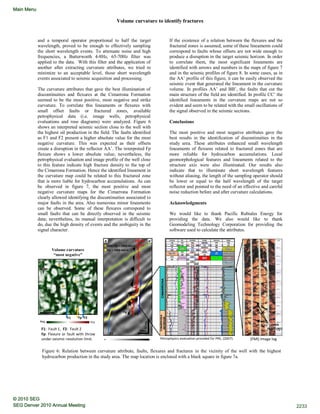
evaluations and rose diagrams) were analyzed. Figure 6
shows an interpreted seismic section close to the well with
the highest oil production in the field. The faults identified
as F1 and F2 present a higher absolute value for the most
negative curvature. This was expected as their offsets
create a disruption in the reflector AA’. The interpreted Fp
flexure shows a lower absolute value; nevertheless, the
petrophysical evaluation and image profile of the well close
to this feature indicate high fracture density to the top of
the Cimarrona Formation. Hence the identified lineament in
the curvature map could be related to this fractured zone
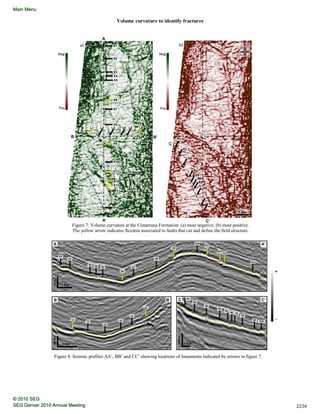
that is more liable for hydrocarbon accumulations. As can
be observed in figure 7, the most positive and most
negative curvature maps for the Cimarrona Formation
clearly allowed identifying the discontinuities associated to
major faults in the area. Also numerous minor lineaments
can be observed. Some of these flexures correspond to
small faults that can be directly observed in the seismic
data; nevertheless, its manual interpretation is difficult to
do, due the high density of events and the ambiguity in the
signal character.
If the existence of a relation between the flexures and the
fractured zones is assumed, some of these lineaments could
correspond to faults whose offsets are not wide enough to
produce a disruption in the target seismic horizon. In order
to correlate them, the most significant lineaments are
identified with arrows and numbers in the maps of figure 7
and in the seismic profiles of figure 8. In some cases, as in
the AA’ profile of this figure, it can be easily observed the
seismic event that generated the lineament in the curvature
volume. In profiles AA’ and BB’, the faults that cut the
main structure of the field are identified. In profile CC’ the
identified lineaments in the curvature maps are not so
evident and seem to be related with the small oscillations of
the signal observed in the seismic sections.
Conclusions
The most positive and most negative attributes gave the
best results in the identification of discontinuities in the
study area. These attributes enhanced small wavelength
lineaments of flexures related to fractured zones that are
more reliable for hydrocarbon accumulations. Local
geomorphological features and lineaments related to the
structure axis were also illuminated. Our results also
indicate that to illuminate short wavelength features
without aliasing, the length of the sampling operator should
be lower or equal to the half wavelength of the target
reflector and pointed to the need of an effective and careful
noise reduction before and after curvature calculations.
Acknowledgments
We would like to thank Pacific Rubiales Energy for
providing the data. We also would like to thank
Geomodeling Technology Corporation for providing the
software used to calculate the attributes.
Figure 6: Relation between curvature attribute, faults, flexures and fractures in the vicinity of the well with the highest
hydrocarbon production in the study area. The map location is enclosed with a black square in figure 7a.
PosNeg
A A’
F1
F2
Fp
GR
0 150
200m
50ms
F1: Fault 1, F2: Fault 2
Fp: Flexure or fault with throw
under seismic resolution limit. Petrophysics evaluation provided for PRE, (2007).
6382
6371
OPEN
FRACTURES
Volume curvature
“most negative”
-+
CIMARRONACIMARRONA
INFERIOR
(FMI) Image log
A A’
F1 F2Fp
N
500m
Qo > 1000 bbl/d
500< Qo < 1000 bbl/d
2233SEG Denver 2010 Annual Meeting
© 2010 SEG
Main Menu
Volume curvature to identify fractures
Figure 8: Seismic profiles AA’, BB’ and CC’ showing locations of lineaments indicated by arrows in figure 7.
Figure 7: Volume curvature at the Cimarrona Formation: (a) most negative; (b) most positive.
The yellow arrow indicates flexures associated to faults that cut and define the field structure.
-
+
X1
X2
X6
X9
X11
X12
X13
X14
A A’
X3 X4
1 Km
100ms
X5
X8
X7
X10
L1
L2
L3
L5
L6
L4
B B’
100ms
R10
R1
R2
R3
R4
R5
R6
R9
R7
R8
C C’
100ms
1 Km 1 Km
Inverse fault
Pos
Neg
a) X1
X2
X6
X9
X11
X12
X13
X14
L1 L2 L3 L5 L6L4
A
A’
B B’
X3
X4
X5
X7
X8
X10
b) N
1 Km
R10
R1
R2
R3
R4
R5
R6
R9
R7
R8
C
C’
Pos
Neg
2234SEG Denver 2010 Annual Meeting
© 2010 SEG
Main Menu
EDITED REFERENCES
Note: This reference list is a copy-edited version of the reference list submitted by the author. Reference lists for the 2010
SEG Technical Program Expanded Abstracts have been copy edited so that references provided with the online metadata for
each paper will achieve a high degree of linking to cited sources that appear on the Web.
REFERENCES
Acosta, J., 2002, Estructura, Tectonica y Modelos en 3D del Piedemonte Occidental de la Cordillera
Oriental y del Valle Medio del Magdalena, Colombia: PhD Dissertation, London University.
Al-Dossary, S., and K. Marfurt, 2006, 3D Volumetric multispectral estimates of reflector curvature and
rotation: Geophysics, 71, no. 5, P41–P51, doi:10.1190/1.2242449.
Bahorich, M., and S. Farmer, 1995, 3D Seismic Discontinuity for faults and Stratigraphics Features: The
Coherence Cube: The Leading Edge, 14, no. 10, 1053–1058, doi:10.1190/1.1437077.
Bergbauer, S., T. Mukerji, and P. Hennings, 2003, Improving Curvature Analyses Of Deformed Horizons
Using Scaledependent Filtering Techniques: AAPG Bulletin, 87, no. 8, 1255–1272,
doi:10.1306/0319032001101.
Brown, A., 2004. Interpretation of Three-Dimensional Seismic Data:AAPG Memoir 42.
Chopra, S. & Marfurt, K., 2007, Seismic Attribute for Prospect Identification and Reservoir
Characterization: SEG Geophysical Developments No 11.
Hart, B., and J. Sagan, 2007, Curvature for Visualization of Seismic Geomorphology, in R. Davies, H.
Posamentier, L. Wood, and J. Cartwright, eds., Seismic Geomorphology: Applications To
Hydrocarbon Exploration And Production:Geological Society, Special Publication, 139-149.
Lisle, R., 1994, Detection Of Zones Of Abnormal Strains In Structures Using Gaussian Curvature
Analysis: AAPG Bulletin, 78, 1811–1819.
Marfurt, K., L. Kirlin, S. Farmer, and M. Bahorich, 1998, 3-D Seismic Attributes Using a Semblance-
based Coherency Algorithm: Geophysics, 63, 1150–1165, doi:10.1190/1.1444415.
Mondragon, J., M. Mayorga, G. Rodriguez, J. Navarro, and I. Moretti, 2009, Nuevas Perspectivas
Exploratorias en el Sector Sur de la Cuenca del Valle Medio del Magdalena Colombia : X Simposio
Bolivariano de Exploración Petrolera en Cuencas Subandinas, Expanded abstract.
Nissen, S., T. Carr, and K. Marfurt, 2007, Using New 3-D Seismic Attributes to Identify Subtle Fracture
Trends in Mid-Continent Mississippian Carbonate Reservoirs: Geophysical Society of Kansas, 3, no.
3, 9–12.
Pacific Rubiales Energy, PRE, 2007, Internal Report.
Roberts, A., 2001, Curvature Attributes And Their Application to 3D Interpreted Horizons: First Break,
19, no. 2, 85–100, doi:10.1046/j.0263-5046.2001.00142.x.
2235SEG Denver 2010 Annual Meeting
© 2010 SEG
Main Menu

Volume curvature attribute_MMVB_Bravo_2010

  • 1.
    Volume curvature attributesto identify subtle faults and fractures in carbonate reservoirs: Cimarrona Formation, Middle Magdalena Valley Basin, Colombia. Luis Bravo* and Milagrosa Aldana, Simón Bolivar University, Caracas, Venezuela. Summary In this work we analyze a natural fractured carbonate reservoir in the Middle Magdalena Valley Basin (Colombia) using different volume curvature attributes. The main objective was to illuminate small or sub-seismic faults, and to delineate fractured zones in the area. Most positive, most negative, dip, strike, curvedness, Gaussian, maximum, minimum and mean curvature attributes were calculated for a 3D post-stack time migrated seismic volume. To reduce the noise level, a Butterworth filter was applied previous to the curvature attributes extraction and a combination of median and mean filters later. The most positive and most negative attributes gave the best results. They allowed identifying discontinuities at the target horizon, illuminating short wavelength flexures and lineaments. These features were associated to fracture zones that could result in hydrocarbon accumulation areas. Also, local geomorphological features and lineaments related to the structure axes were also identified using these attributes. Introduction The analysis of post-stack seismic attributes, as seismic coherence (Bahorich, et al., 1995) and semblance (Marfurt, et al., 1998), have been widely used to delineate faults and stratigraphic characters. They measure lateral variations in the waveform and amplitude. Attributes obtained from the first surface derivative, as dip and dip azimuth, can illuminate small faults with a displacement lower than the seismic wavelength (Brown, 2004). Nevertheless, these methods can delineate lineaments but they cannot distinguish between symmetric and asymmetric features (e.g. faults from ridges or valleys) (Roberts, 2001). Second derivative or curvature attributes gave more insight regarding the delineation of faults with throw under seismic resolution, as well as they can help in the prediction of fractures and their orientation (Roberts, 2001; Chopra et al., 2007). These attributes have been correlated with open fractures in outcrops (Lisle, 1994), and production tests (Nissen et al., 2007). Bergbauer, et al. (2003) calculated curvature using different wavelengths filtering the input horizon; they concluded that images at different wavelengths provide diverse perspectives of the same geology. Al-Dossary et al. (2006) extended the concept of surface curvature to volumetric curvature. This allows calculating curvature in seismic volumes avoiding the need of picking a horizon (Chopra et al., 2007). In the present work, several volume curvature attributes are applied to a natural fractured carbonate reservoir trying to identify subtle faults and fractures, difficult to observe in the seismic data or using other attributes. These attributes could be an important tool in the characterization and delineation of fractured structures at the Late Cretaceous of Middle Magdalena Basin, where the production is mainly associated to carbonate fractured reservoirs. Theory Curvature is a property that quantifies how much a curve deviates from a straight line at a point (Roberts, 2001). In two dimensions, it can be defined as the radio of the circle tangent to a curve. Consider a 2D section through a plane surface or horizon (see figure 1) whose normal vectors are drawn at regular intervals along this horizon. Where the corresponding vectors are all parallel, the curvature is cero. If the horizon has the form on an anticline, the vectors diverge and the curvature is defined as positive. If the horizon is a synclinal, the vectors converge and the curvature can be defined as negative (Robert, 2001). Figure 1: Curvature in two dimensions (from Roberts (2001)). The extension of this concept to three dimensions uses orthogonal planes to the surface to measure the curvature in each point of the horizon (Hart et al., 2007; Roberts, 2001). Figure 2 illustrates this concept. The intersection of two orthogonal planes at the surface describes the maximun (Kmax) and minimum (Kmin) curvature. Other orthogonal planes let define the normal curvature in the dip directions (Kdip), perpendicular to this (Kstrike) and along the structural contours (Kcontour). Positive Curvature Negative Curvature Zero Curvature Anticline Syncline FlatZ X 2231SEG Denver 2010 Annual Meeting © 2010 SEG Main Menu
  • 2.
    Volume curvature toidentify fractures seg. 1.1 1.24 1.38 1.52 1.66 1.80 Figure 2: Curvature in three dimensions (modified from Hart et al., (2007) and Roberts (2001)). When curvature information is extracted, the sampling interval and hence the aperture size should be careful defined. According to Bergbauer, et al., (2003) the change of the width aperture allowed observing features of different wavelengths. Figure 3 schematizes the differences that can be observed when calculating the curvature using distinct apertures. With a small aperture, the event in black can be illuminated; a wide aperture illuminates the event in red and an aperture between these two values illuminates the yellow one. Figure 3: Effect of the aperture size (modified from Hart et al. (2007)). Study area and Methodology To the south of the Middle Valley Magdalena Basin, the Cimarrona Formation represents a natural fractured reservoir mainly composed by fractured limestones and calcareous sandstones in a structurally complex and deformed area (Acosta, 2002; Mondragon et al., 2009). The knowledge, characterization and mapping of the fracture systems are key factors for the development of this reservoir. A previous seismic interpretation of the area pointed to the existence of major faults in the zone. In fact they confirmed the presence of faults that cut the main structure of the field. Nevertheless, they could not give information regarding the length and direction of sub- seismic faults, i.e., those faults whose offsets do not produce significant disruptions of the horizon. In order to test the performance of volume curvature attributes on the fractured carbonates of the Cimarrona Formation, a 3D post-stack time-migrated cube was analyzed. In this cube, the target horizon is represented by a high amplitude reflector, with a dominant frequency of ±24Hz. The seismic interpretation allowed mapping the structure of Cimarrona Formation. It consists of a deformed synclinal where a local anticline is also observed. The structure is cut by several fault systems. One has a dextral component in N45W direction; the other is inverse with an approximate N-S direction (see figure 4). Figure 4: Structural map of the study area (twt). Results Semblance attributes were also calculated and extracted for the seismic volume. In figure 5, the lineaments associated to the main faults that cut the structure (black arrows) can be observed. Nevertheless, the limitation of this attribute to define sub-seismic faults and fractured zones in the area is also illustrated. In fact, the fault that cut the structure to the north of the field is barely observed (blue arrow). - + N 1 Km Figure 5: Semblance slice at the Cimarrona Formation. Different volume curvature attributes (i.e. most positive, most negative, Mean, Gaussian, etc) were extracted. Also the size aperture was varied trying to get insight regarding short wavelength events. A spatial aperture of 7x7 traces High Low 1 Km N 2232SEG Denver 2010 Annual Meeting © 2010 SEG Main Menu
  • 3.
    Volume curvature toidentify fractures and a temporal operator proportional to half the target wavelength, proved to be enough to effectively sampling the short wavelength events. To attenuate noise and high frequencies, a Butterworth 4-8Hz, 65-70Hz filter was applied to the data. With this filter and the application of another after extracting curvature attributes, we tried to minimize to an acceptable level, those short wavelength events associated to seismic acquisition and processing. The curvature attributes that gave the best illumination of discontinuities and flexures at the Cimarrona Formation seemed to be the most positive, most negative and strike curvature. To correlate this lineaments or flexures with small offset faults or fractured zones, available petrophysical data (i.e. image wells, petrophysical evaluations and rose diagrams) were analyzed. Figure 6 shows an interpreted seismic section close to the well with the highest oil production in the field. The faults identified as F1 and F2 present a higher absolute value for the most negative curvature. This was expected as their offsets create a disruption in the reflector AA’. The interpreted Fp flexure shows a lower absolute value; nevertheless, the petrophysical evaluation and image profile of the well close to this feature indicate high fracture density to the top of the Cimarrona Formation. Hence the identified lineament in the curvature map could be related to this fractured zone that is more liable for hydrocarbon accumulations. As can be observed in figure 7, the most positive and most negative curvature maps for the Cimarrona Formation clearly allowed identifying the discontinuities associated to major faults in the area. Also numerous minor lineaments can be observed. Some of these flexures correspond to small faults that can be directly observed in the seismic data; nevertheless, its manual interpretation is difficult to do, due the high density of events and the ambiguity in the signal character. If the existence of a relation between the flexures and the fractured zones is assumed, some of these lineaments could correspond to faults whose offsets are not wide enough to produce a disruption in the target seismic horizon. In order to correlate them, the most significant lineaments are identified with arrows and numbers in the maps of figure 7 and in the seismic profiles of figure 8. In some cases, as in the AA’ profile of this figure, it can be easily observed the seismic event that generated the lineament in the curvature volume. In profiles AA’ and BB’, the faults that cut the main structure of the field are identified. In profile CC’ the identified lineaments in the curvature maps are not so evident and seem to be related with the small oscillations of the signal observed in the seismic sections. Conclusions The most positive and most negative attributes gave the best results in the identification of discontinuities in the study area. These attributes enhanced small wavelength lineaments of flexures related to fractured zones that are more reliable for hydrocarbon accumulations. Local geomorphological features and lineaments related to the structure axis were also illuminated. Our results also indicate that to illuminate short wavelength features without aliasing, the length of the sampling operator should be lower or equal to the half wavelength of the target reflector and pointed to the need of an effective and careful noise reduction before and after curvature calculations. Acknowledgments We would like to thank Pacific Rubiales Energy for providing the data. We also would like to thank Geomodeling Technology Corporation for providing the software used to calculate the attributes. Figure 6: Relation between curvature attribute, faults, flexures and fractures in the vicinity of the well with the highest hydrocarbon production in the study area. The map location is enclosed with a black square in figure 7a. PosNeg A A’ F1 F2 Fp GR 0 150 200m 50ms F1: Fault 1, F2: Fault 2 Fp: Flexure or fault with throw under seismic resolution limit. Petrophysics evaluation provided for PRE, (2007). 6382 6371 OPEN FRACTURES Volume curvature “most negative” -+ CIMARRONACIMARRONA INFERIOR (FMI) Image log A A’ F1 F2Fp N 500m Qo > 1000 bbl/d 500< Qo < 1000 bbl/d 2233SEG Denver 2010 Annual Meeting © 2010 SEG Main Menu
  • 4.
    Volume curvature toidentify fractures Figure 8: Seismic profiles AA’, BB’ and CC’ showing locations of lineaments indicated by arrows in figure 7. Figure 7: Volume curvature at the Cimarrona Formation: (a) most negative; (b) most positive. The yellow arrow indicates flexures associated to faults that cut and define the field structure. - + X1 X2 X6 X9 X11 X12 X13 X14 A A’ X3 X4 1 Km 100ms X5 X8 X7 X10 L1 L2 L3 L5 L6 L4 B B’ 100ms R10 R1 R2 R3 R4 R5 R6 R9 R7 R8 C C’ 100ms 1 Km 1 Km Inverse fault Pos Neg a) X1 X2 X6 X9 X11 X12 X13 X14 L1 L2 L3 L5 L6L4 A A’ B B’ X3 X4 X5 X7 X8 X10 b) N 1 Km R10 R1 R2 R3 R4 R5 R6 R9 R7 R8 C C’ Pos Neg 2234SEG Denver 2010 Annual Meeting © 2010 SEG Main Menu
  • 5.
    EDITED REFERENCES Note: Thisreference list is a copy-edited version of the reference list submitted by the author. Reference lists for the 2010 SEG Technical Program Expanded Abstracts have been copy edited so that references provided with the online metadata for each paper will achieve a high degree of linking to cited sources that appear on the Web. REFERENCES Acosta, J., 2002, Estructura, Tectonica y Modelos en 3D del Piedemonte Occidental de la Cordillera Oriental y del Valle Medio del Magdalena, Colombia: PhD Dissertation, London University. Al-Dossary, S., and K. Marfurt, 2006, 3D Volumetric multispectral estimates of reflector curvature and rotation: Geophysics, 71, no. 5, P41–P51, doi:10.1190/1.2242449. Bahorich, M., and S. Farmer, 1995, 3D Seismic Discontinuity for faults and Stratigraphics Features: The Coherence Cube: The Leading Edge, 14, no. 10, 1053–1058, doi:10.1190/1.1437077. Bergbauer, S., T. Mukerji, and P. Hennings, 2003, Improving Curvature Analyses Of Deformed Horizons Using Scaledependent Filtering Techniques: AAPG Bulletin, 87, no. 8, 1255–1272, doi:10.1306/0319032001101. Brown, A., 2004. Interpretation of Three-Dimensional Seismic Data:AAPG Memoir 42. Chopra, S. & Marfurt, K., 2007, Seismic Attribute for Prospect Identification and Reservoir Characterization: SEG Geophysical Developments No 11. Hart, B., and J. Sagan, 2007, Curvature for Visualization of Seismic Geomorphology, in R. Davies, H. Posamentier, L. Wood, and J. Cartwright, eds., Seismic Geomorphology: Applications To Hydrocarbon Exploration And Production:Geological Society, Special Publication, 139-149. Lisle, R., 1994, Detection Of Zones Of Abnormal Strains In Structures Using Gaussian Curvature Analysis: AAPG Bulletin, 78, 1811–1819. Marfurt, K., L. Kirlin, S. Farmer, and M. Bahorich, 1998, 3-D Seismic Attributes Using a Semblance- based Coherency Algorithm: Geophysics, 63, 1150–1165, doi:10.1190/1.1444415. Mondragon, J., M. Mayorga, G. Rodriguez, J. Navarro, and I. Moretti, 2009, Nuevas Perspectivas Exploratorias en el Sector Sur de la Cuenca del Valle Medio del Magdalena Colombia : X Simposio Bolivariano de Exploración Petrolera en Cuencas Subandinas, Expanded abstract. Nissen, S., T. Carr, and K. Marfurt, 2007, Using New 3-D Seismic Attributes to Identify Subtle Fracture Trends in Mid-Continent Mississippian Carbonate Reservoirs: Geophysical Society of Kansas, 3, no. 3, 9–12. Pacific Rubiales Energy, PRE, 2007, Internal Report. Roberts, A., 2001, Curvature Attributes And Their Application to 3D Interpreted Horizons: First Break, 19, no. 2, 85–100, doi:10.1046/j.0263-5046.2001.00142.x. 2235SEG Denver 2010 Annual Meeting © 2010 SEG Main Menu