SECOND
QUARTER
PROGRESS IN FITNESS
■ How do we progress in our fitness level?
■ One needs to have a fitness goal that is wisely
set.
■ It should be a real perceptible goal which you can
really achieve within a period of time.
REASONS WHY PEOPLE DO
NOT HAVE PROGRESS IN
FITNESS?■ A person does not have goals.
■ No schedule set for training.
■ Improper diet associated with exercise.
■ No monitoring of progress.
HOW CAN WE PROGRESS IN
FITNESS AND IN HEALTH?
■ Make exercise be a part of your habit.
■ Set reachable goals.
■ Support exercise routine with healthy lifestyle.
■ Get a workout partner.
■ Make sure that you have time to work out even on
your rest day.
OTHER COMPONENTS OF
PHYSICAL FITNESS
■ Agility – ability to move and change direction and
position of the body quickly and effectively with
controlled movement.
■ Coordination – linking of senses through the
brain to the different parts of the body to produce
a smooth, quick, and efficiently-controlled
movement an exact execution of the skill.
■ Power – ability to exert maximum force very
quickly.
TEAM SPORTS
TEAM SPORTS
■ They includes any sport which involves players playing
towards a shared objective.
■ An activity in which a group of individuals, on the same
team, work together to accomplish an ultimate goal: to
win.
■ Can be done in number of ways, i.e. outscoring the
opposing team.
■ Seen in sports, i.e. Volleyball, Basketball, Baseball,
Football
TEAM MEMBERS, IN ORDER TO
ACCOMPLISH THEIR
OBJECTIVES,■ Set goals
■ Make decisions
■ Communicate
■ Manage conflict
■ Solve problems in a supportive, trusting
atmosphere
VOLLEYBALL
HISTORY
■ William C. Morgan of Young Men Christian
Association
■ Holyoke, Massachusetts in 1893
■ Mintonette
■ A. Halsted
■ Philippines in 1924
VOLLEYBALL
■ Team sports that can be played either indoors or
outdoors.
■ Played by two opposing teams of six players each
with the dimension of 18m x 9m
■ Objective: landing the volleyball into opponent’s court
to gain a point or a score.
■ Set of rules should be followed for you to progress in
the game and to win it.
VOLLEYBALL
■ In order to win the game, a team should teach 25
points with a minimum lead of 2 points in 3 to 5
sets if in case extra sets are needed until 5 sets.
■ Both teams reach 24 points? The play is
continued until two-point lead is achieved.
HEALTH AND FITNESS
BENEFITS
■ Volleyball is an aerobic team activity. Players can real
both health benefits and team building benefits from
playing.
■ Playing volleyball brings good eye and hand
coordination.
■ It also helps you build muscle and burn fat.
■ It is also a great way of getting exercise.
■ Social benefits: self-confidence, leadership,
FACILITIES & EQUIPMENT
■ Playing Court
■ Net and Post
■ Ball
PLAYING COURT
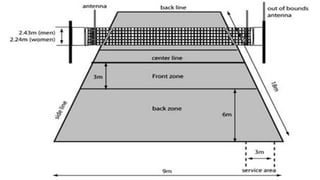
■ Rectangular and symmetrical
■ Rectangular shape of 18 m x 9 m surrounded by
free zone of at least 3 m wide
PARTS
■ Center line – divides the playing court into 2 equal
courts of 9 x 9 m each
■ Attack line – front partition of each court, 3 m from
the center line; front zone
■ Back zone – second partition of the playing court; 6 m
between front zone end line and the service line
■ Service zone – 9-meter wide behind each end line
NET AND POST
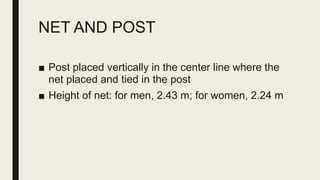
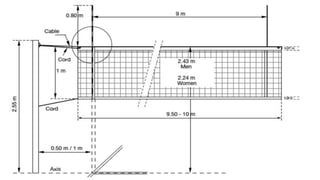
■ Post placed vertically in the center line where the
net placed and tied in the post
■ Height of net: for men, 2.43 m; for women, 2.24 m
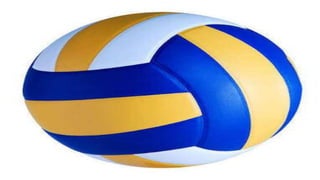
BALL
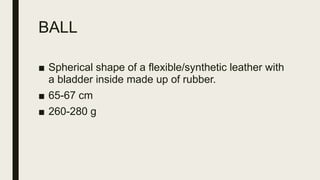
■ Spherical shape of a flexible/synthetic leather with
a bladder inside made up of rubber.
■ 65-67 cm
■ 260-280 g
FUNDAMENTAL SKILLS
■ Serve
■ Pass
■ Dig
■ Block
■ Set
■ Attack
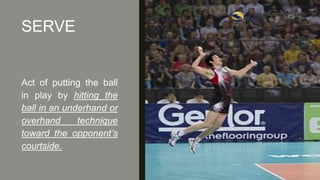
SERVE
Act of putting the ball
in play by hitting the
ball in an underhand or
overhand technique
toward the opponent’s
courtside.
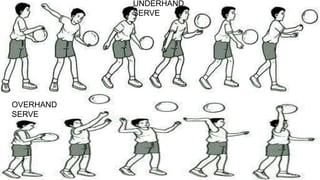
TYPES OF SERVICE
■ Underhand Serve
■ Act of serving the ball by
hitting it below the waist
level instead of tossing it
up and striking over the
head level.
■ Overhead Serve
■ Act of serving the ball by
tossing it overhead and
striking it above the
head level.
UNDERHAND
SERVE
OVERHAND
SERVE
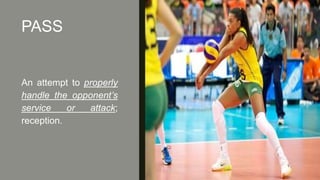
PASS
An attempt to properly
handle the opponent’s
service or attack;
reception.
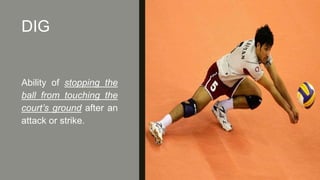
DIG
Ability of stopping the
ball from touching the
court’s ground after an
attack or strike.
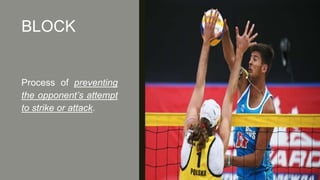
BLOCK
Process of preventing
the opponent’s attempt
to strike or attack.
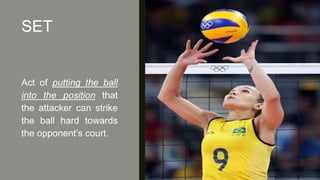
SET
Act of putting the ball
into the position that
the attacker can strike
the ball hard towards
the opponent’s court.
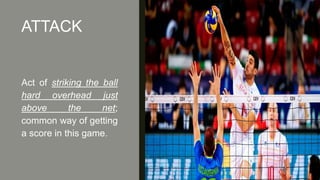
ATTACK
Act of striking the ball
hard overhead just
above the net;
common way of getting
a score in this game.
BASIC RULES
■ Six players on the court, who each must rotate one
position clockwise every time their team wins back
service from the opposition.
■ Only three players at the net positions can jump and
spike or block near the net.
■ Backcourt players can only hit the ball over the net if
they jump behind the attack line (three-meter line),
which separates the front and back part of the court.
BASIC RULES
■ Very specialized sport. Most teams will include in their
starting line-up: setter, 2 center blockers, 2 receiver-
hitters, & spiker. Certain players will be involved with
service reception, and have specialist positions for
attack and defense. Substitutions are allowed during
the game.
■ New scoring system: Teams scored a point on every
rally (RPS), regardless of which team served.
BASIC RULES
■ Matches are played best of 5 sets. First four sets: 25
points to play. Final set: 15 points to play. A team must
win a set by two or three points. No ceiling, so a set
continues until one of the teams gain a 2-point
advantage.
■ Libero, a new specialist role introduced by FIVB. The
player wears different uniform from the rest of the
team; can be substituted in backcourt for any player on
the team. Plays a vital role for the team in serve

Volleyball

  • 1.
  • 2.
    PROGRESS IN FITNESS ■How do we progress in our fitness level? ■ One needs to have a fitness goal that is wisely set. ■ It should be a real perceptible goal which you can really achieve within a period of time.
  • 3.
    REASONS WHY PEOPLEDO NOT HAVE PROGRESS IN FITNESS?■ A person does not have goals. ■ No schedule set for training. ■ Improper diet associated with exercise. ■ No monitoring of progress.
  • 4.
    HOW CAN WEPROGRESS IN FITNESS AND IN HEALTH? ■ Make exercise be a part of your habit. ■ Set reachable goals. ■ Support exercise routine with healthy lifestyle. ■ Get a workout partner. ■ Make sure that you have time to work out even on your rest day.
  • 5.
    OTHER COMPONENTS OF PHYSICALFITNESS ■ Agility – ability to move and change direction and position of the body quickly and effectively with controlled movement. ■ Coordination – linking of senses through the brain to the different parts of the body to produce a smooth, quick, and efficiently-controlled movement an exact execution of the skill. ■ Power – ability to exert maximum force very quickly.
  • 6.
  • 7.
    TEAM SPORTS ■ Theyincludes any sport which involves players playing towards a shared objective. ■ An activity in which a group of individuals, on the same team, work together to accomplish an ultimate goal: to win. ■ Can be done in number of ways, i.e. outscoring the opposing team. ■ Seen in sports, i.e. Volleyball, Basketball, Baseball, Football
  • 9.
    TEAM MEMBERS, INORDER TO ACCOMPLISH THEIR OBJECTIVES,■ Set goals ■ Make decisions ■ Communicate ■ Manage conflict ■ Solve problems in a supportive, trusting atmosphere
  • 10.
  • 11.
    HISTORY ■ William C.Morgan of Young Men Christian Association ■ Holyoke, Massachusetts in 1893 ■ Mintonette ■ A. Halsted ■ Philippines in 1924
  • 12.
    VOLLEYBALL ■ Team sportsthat can be played either indoors or outdoors. ■ Played by two opposing teams of six players each with the dimension of 18m x 9m ■ Objective: landing the volleyball into opponent’s court to gain a point or a score. ■ Set of rules should be followed for you to progress in the game and to win it.
  • 13.
    VOLLEYBALL ■ In orderto win the game, a team should teach 25 points with a minimum lead of 2 points in 3 to 5 sets if in case extra sets are needed until 5 sets. ■ Both teams reach 24 points? The play is continued until two-point lead is achieved.
  • 14.
    HEALTH AND FITNESS BENEFITS ■Volleyball is an aerobic team activity. Players can real both health benefits and team building benefits from playing. ■ Playing volleyball brings good eye and hand coordination. ■ It also helps you build muscle and burn fat. ■ It is also a great way of getting exercise. ■ Social benefits: self-confidence, leadership,
  • 15.
    FACILITIES & EQUIPMENT ■Playing Court ■ Net and Post ■ Ball
  • 16.
    PLAYING COURT ■ Rectangularand symmetrical ■ Rectangular shape of 18 m x 9 m surrounded by free zone of at least 3 m wide
  • 17.
    PARTS ■ Center line– divides the playing court into 2 equal courts of 9 x 9 m each ■ Attack line – front partition of each court, 3 m from the center line; front zone ■ Back zone – second partition of the playing court; 6 m between front zone end line and the service line ■ Service zone – 9-meter wide behind each end line
  • 19.
    NET AND POST ■Post placed vertically in the center line where the net placed and tied in the post ■ Height of net: for men, 2.43 m; for women, 2.24 m
  • 21.
    BALL ■ Spherical shapeof a flexible/synthetic leather with a bladder inside made up of rubber. ■ 65-67 cm ■ 260-280 g
  • 23.
    FUNDAMENTAL SKILLS ■ Serve ■Pass ■ Dig ■ Block ■ Set ■ Attack
  • 24.
    SERVE Act of puttingthe ball in play by hitting the ball in an underhand or overhand technique toward the opponent’s courtside.
  • 25.
    TYPES OF SERVICE ■Underhand Serve ■ Act of serving the ball by hitting it below the waist level instead of tossing it up and striking over the head level. ■ Overhead Serve ■ Act of serving the ball by tossing it overhead and striking it above the head level.
  • 26.
  • 27.
    PASS An attempt toproperly handle the opponent’s service or attack; reception.
  • 28.
    DIG Ability of stoppingthe ball from touching the court’s ground after an attack or strike.
  • 29.
    BLOCK Process of preventing theopponent’s attempt to strike or attack.
  • 30.
    SET Act of puttingthe ball into the position that the attacker can strike the ball hard towards the opponent’s court.
  • 31.
    ATTACK Act of strikingthe ball hard overhead just above the net; common way of getting a score in this game.
  • 32.
    BASIC RULES ■ Sixplayers on the court, who each must rotate one position clockwise every time their team wins back service from the opposition. ■ Only three players at the net positions can jump and spike or block near the net. ■ Backcourt players can only hit the ball over the net if they jump behind the attack line (three-meter line), which separates the front and back part of the court.
  • 33.
    BASIC RULES ■ Veryspecialized sport. Most teams will include in their starting line-up: setter, 2 center blockers, 2 receiver- hitters, & spiker. Certain players will be involved with service reception, and have specialist positions for attack and defense. Substitutions are allowed during the game. ■ New scoring system: Teams scored a point on every rally (RPS), regardless of which team served.
  • 34.
    BASIC RULES ■ Matchesare played best of 5 sets. First four sets: 25 points to play. Final set: 15 points to play. A team must win a set by two or three points. No ceiling, so a set continues until one of the teams gain a 2-point advantage. ■ Libero, a new specialist role introduced by FIVB. The player wears different uniform from the rest of the team; can be substituted in backcourt for any player on the team. Plays a vital role for the team in serve