I Ref. Ares(2013)190052 - 13/02/2013
JANEZ POTOČNIK
Member of the European Commission
Brussels, U 02. ШЗ
Ref.Ares (2013)
Mr Antonio Tajani
Vice-President - Industry and Entrepreneurship
BERL 12/366
Иууг / O -1w O
/
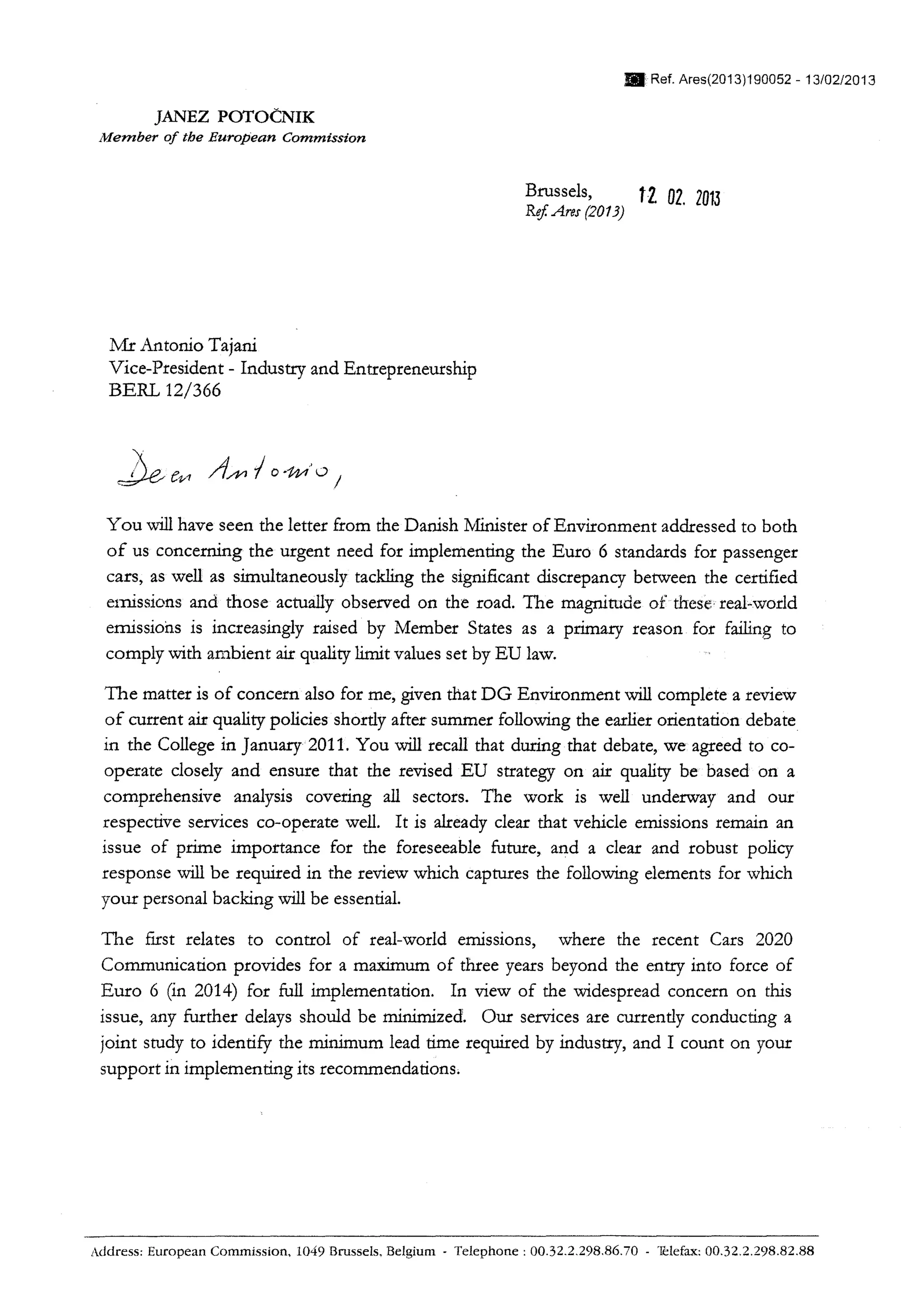
You will have seen the letter from the Danish Minister of Environment addressed to both
of us concerning the urgent need for implementing the Euro 6 standards for passenger
cars, as well as simultaneously tackling the significant discrepancy between the certified
emissions and those actually observed on the road. The magnitude of these real-world
emissions is increasingly raised by Member States as a primary reason for failing to
comply with ambient air qualitylimit values set by EU law.
The matter is of concern also for me, given that DG Environment will complete a review
of current air quality policies shortly after summer following the earlier orientation debate
in the College in January 2011. You win recall that during that debate, we agreed to co­
operate closely and ensure that the revised EU strategy on air quality be based on a
comprehensive analysis covering all sectors. The work is well underway and our
respective services co-operate well. It is already clear that vehicle emissions remain an
issue of prime importance for the foreseeable future, and a clear and robust policy
response will be required in the review which captures the following elements for which
your personal backing will be essential.
The first relates to control of real-world emissions, where the recent Cars 2020
Communication provides for a maximum of three years beyond the entry into force of
Euro 6 (in 2014) for full implementation. In view of the widespread concern on this
issue, any further delays should be minimized. Our services are currently conducting a
joint study to identify the minimum lead time required by industry, and I count on your
support in implementing its recommendations.
Address: European Commission, 1049 Brussels, Belgium - Telephone : 00.32.2.298.86,70 - Telefax: 00.32.2,298.82.88
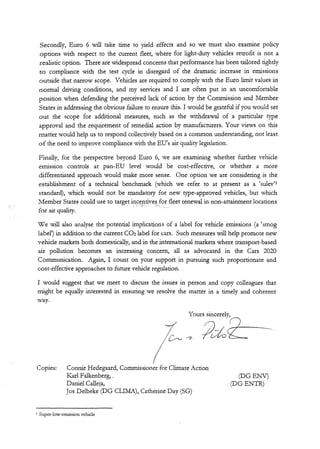
Secondly, Euro 6 will take time to yield effects and so we must also examine policy
options with respect to the current fleet, where for light-duty vehicles retrofit is not a
realistic option. There are widespread concerns that performance has been tailored tightly
to compliance with the test cycle in disregard of the dramatic increase in emissions
outside that narrow scope. Vehicles are required to comply with the Euro limit values in
normal driving conditions, and my services and I are often put in an uncomfortable
position when defending the perceived lack of action by the Commission and Member
States in addressing the obvious failure to ensure this. I would be grateful if you would set
out the scope for additional measures, such as the withdrawal of a particular type
approval and the requirement of remedial action by manufacturers. Your views on this
matter would help us to respond collectively based on a common understanding, not least
of the need to improve compliance with the EU's air quality legislation.
Finally, for the perspective beyond Euro 6, we are examining whether further vehicle
emission controls at pan-EU level would be cost-effective, or whether a more
differentiated approach would make more sense. One option we are considering is the
establishment of a technical benchmark (which we refer to at present as a 'sulev'1
standard), which would not be mandatory for new type-approved vehicles, but which
Member States could use to target incentives for fleet renewal in non-attainment locations
for air quality.
We will also analyse the potential implications of a label for vehicle emissions (a 'smog
label1) in addition to the current CO2 label for cars. Such measures will help promote new
vehicle markets both domestically, and in the international markets where transport-based
air pollution becomes an increasing concern, all as advocated in the Cars 2020
Communication. Again, I count on your support in pursuing such proportionate and
cost-effective approaches to future vehicle regulation.
I would suggest that we meet to discuss the issues in person and copy colleagues that
might be equally interested in ensuring we resolve the matter in a timely and coherent
way.
Copies: Connie Hedegaard, Commissioner for ClimateAction
Karl Falkenberg,. (DG ENV)
Daniel Calleja, .(DG ENTR)
Jos Delbeke (DG CLIMA), Catherine Day (SG)
1 Super-low-emission vehicle

Volkswagen

  • 1.
    I Ref. Ares(2013)190052- 13/02/2013 JANEZ POTOČNIK Member of the European Commission Brussels, U 02. ШЗ Ref.Ares (2013) Mr Antonio Tajani Vice-President - Industry and Entrepreneurship BERL 12/366 Иууг / O -1w O / You will have seen the letter from the Danish Minister of Environment addressed to both of us concerning the urgent need for implementing the Euro 6 standards for passenger cars, as well as simultaneously tackling the significant discrepancy between the certified emissions and those actually observed on the road. The magnitude of these real-world emissions is increasingly raised by Member States as a primary reason for failing to comply with ambient air qualitylimit values set by EU law. The matter is of concern also for me, given that DG Environment will complete a review of current air quality policies shortly after summer following the earlier orientation debate in the College in January 2011. You win recall that during that debate, we agreed to co­ operate closely and ensure that the revised EU strategy on air quality be based on a comprehensive analysis covering all sectors. The work is well underway and our respective services co-operate well. It is already clear that vehicle emissions remain an issue of prime importance for the foreseeable future, and a clear and robust policy response will be required in the review which captures the following elements for which your personal backing will be essential. The first relates to control of real-world emissions, where the recent Cars 2020 Communication provides for a maximum of three years beyond the entry into force of Euro 6 (in 2014) for full implementation. In view of the widespread concern on this issue, any further delays should be minimized. Our services are currently conducting a joint study to identify the minimum lead time required by industry, and I count on your support in implementing its recommendations. Address: European Commission, 1049 Brussels, Belgium - Telephone : 00.32.2.298.86,70 - Telefax: 00.32.2,298.82.88
  • 2.
    Secondly, Euro 6will take time to yield effects and so we must also examine policy options with respect to the current fleet, where for light-duty vehicles retrofit is not a realistic option. There are widespread concerns that performance has been tailored tightly to compliance with the test cycle in disregard of the dramatic increase in emissions outside that narrow scope. Vehicles are required to comply with the Euro limit values in normal driving conditions, and my services and I are often put in an uncomfortable position when defending the perceived lack of action by the Commission and Member States in addressing the obvious failure to ensure this. I would be grateful if you would set out the scope for additional measures, such as the withdrawal of a particular type approval and the requirement of remedial action by manufacturers. Your views on this matter would help us to respond collectively based on a common understanding, not least of the need to improve compliance with the EU's air quality legislation. Finally, for the perspective beyond Euro 6, we are examining whether further vehicle emission controls at pan-EU level would be cost-effective, or whether a more differentiated approach would make more sense. One option we are considering is the establishment of a technical benchmark (which we refer to at present as a 'sulev'1 standard), which would not be mandatory for new type-approved vehicles, but which Member States could use to target incentives for fleet renewal in non-attainment locations for air quality. We will also analyse the potential implications of a label for vehicle emissions (a 'smog label1) in addition to the current CO2 label for cars. Such measures will help promote new vehicle markets both domestically, and in the international markets where transport-based air pollution becomes an increasing concern, all as advocated in the Cars 2020 Communication. Again, I count on your support in pursuing such proportionate and cost-effective approaches to future vehicle regulation. I would suggest that we meet to discuss the issues in person and copy colleagues that might be equally interested in ensuring we resolve the matter in a timely and coherent way. Copies: Connie Hedegaard, Commissioner for ClimateAction Karl Falkenberg,. (DG ENV) Daniel Calleja, .(DG ENTR) Jos Delbeke (DG CLIMA), Catherine Day (SG) 1 Super-low-emission vehicle