Nursing Skills (Vital Signs)
Unit V
Objectives
At the completion of this unit learners will be able to:
 Define Vital Signs.
 Define terms related to Vital sign.
 Describe the physiological concept of temperature, respiration and blood
pressure.
 Describe the principles and mechanisms for normal thermoregulation in the body
 Identify ways that affect heat production and heat loss in the body.
 Define types of body temperature according to its characteristics.
 Identify the sign and symptoms of fever.
 Discuss the normal ranges for temperature, pulse, respiration and blood pressure.
 List the factors affecting temperature, pulse, respiration.
 Describe the characteristics of pulse and respiration.
 List factors responsible for maintaining normal blood pressure.
 Describe various methods and sites used to measure T.P & B.P.
 Recognize the signs of alert while taking TPR and B.P.
Vital Sign
• Vital signs are the “signs of life,” providing a way of connecting
the external inspection with the internal functioning of the
client’s organs.
• This is also known as cardinal signs
Vital Signs or Cardinal Signs are:
• Body temperature
• Pulse
• Respiration
• Blood pressure
• Pain
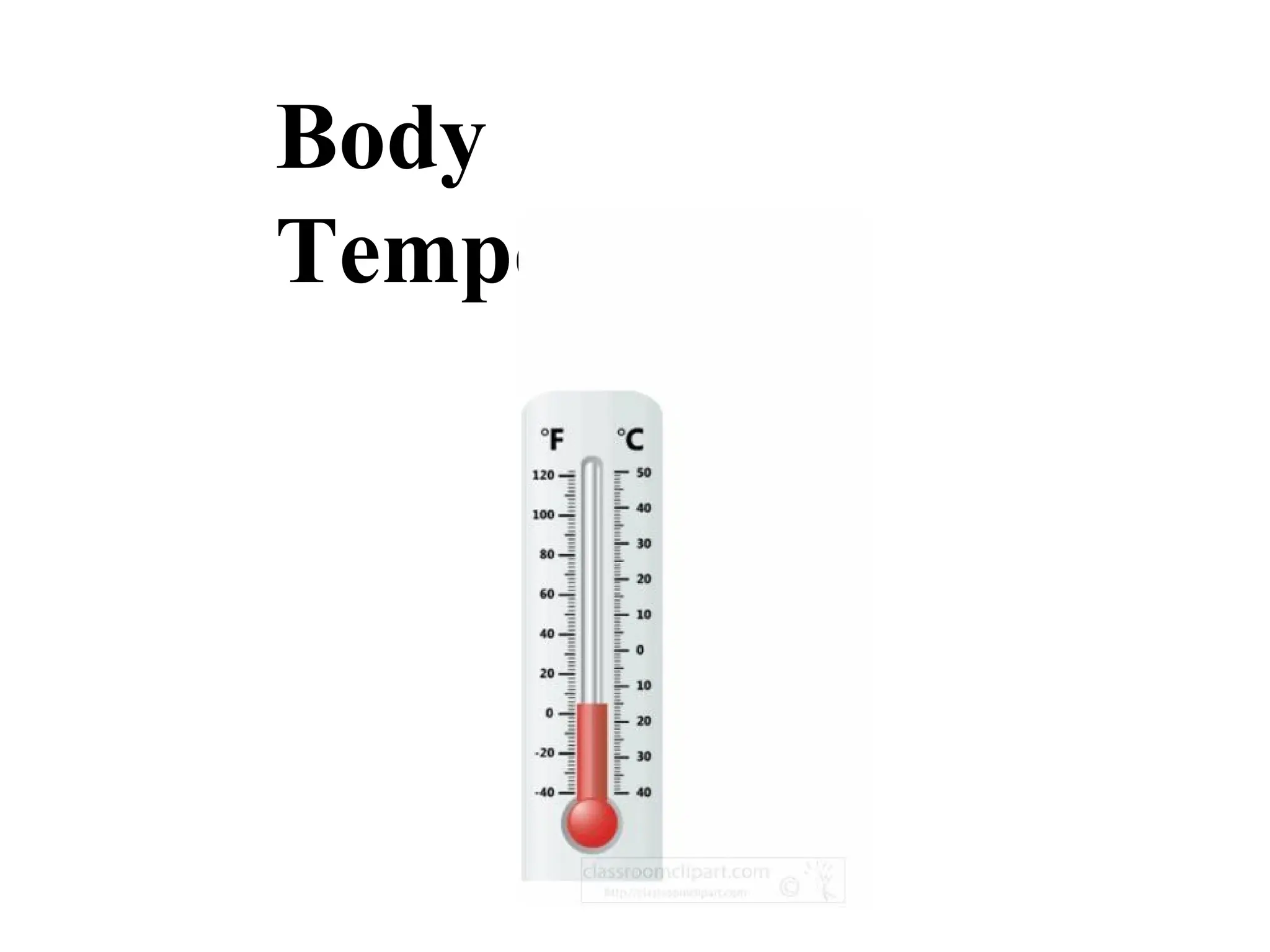
Body
Temperature
Body Temperature
• Body temperature is the balance between heat produced in
the
body and heat loss from the body.
• Body temperature is measured in heat units called degrees.
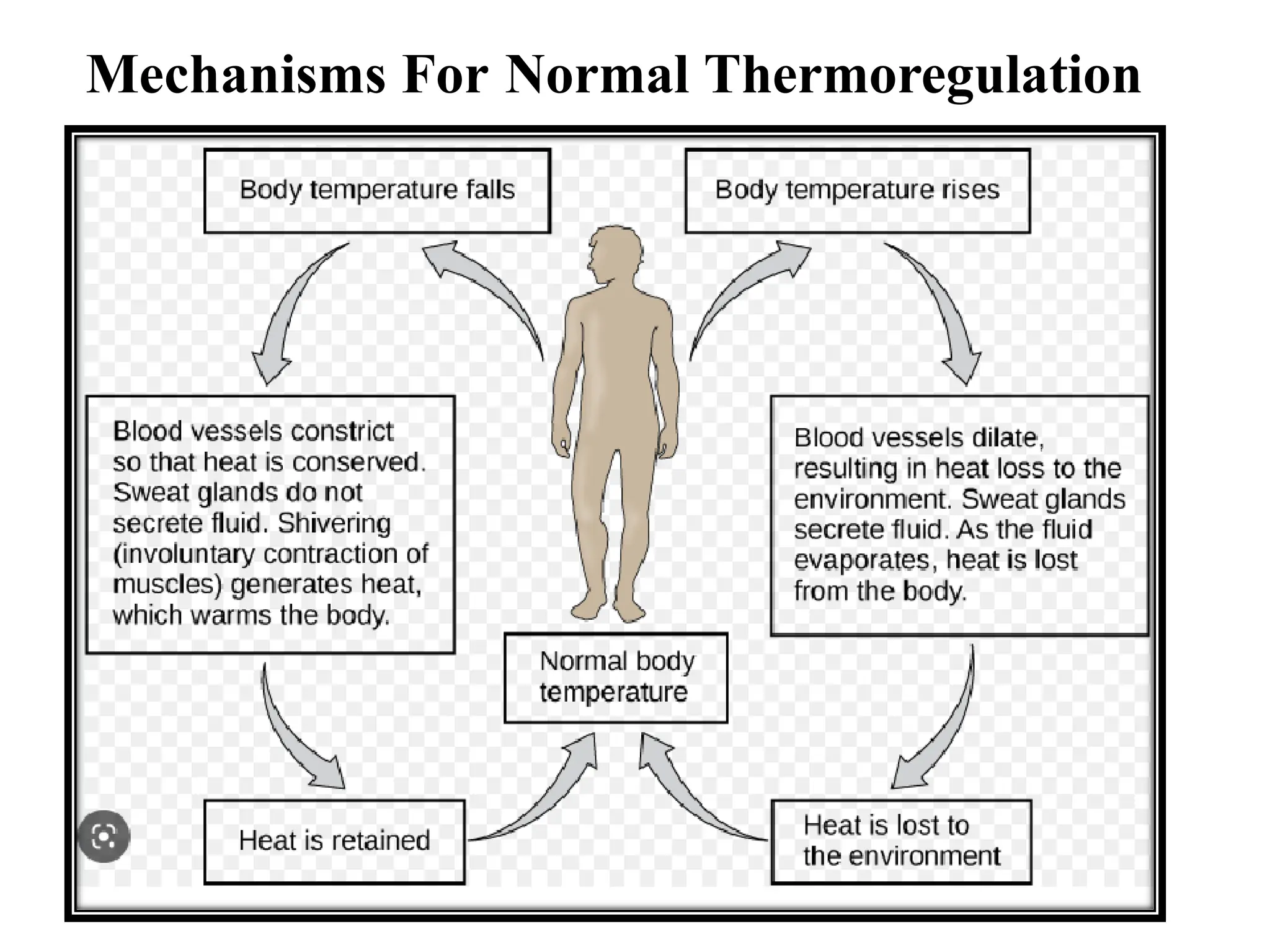
Mechanisms For Normal Thermoregulation
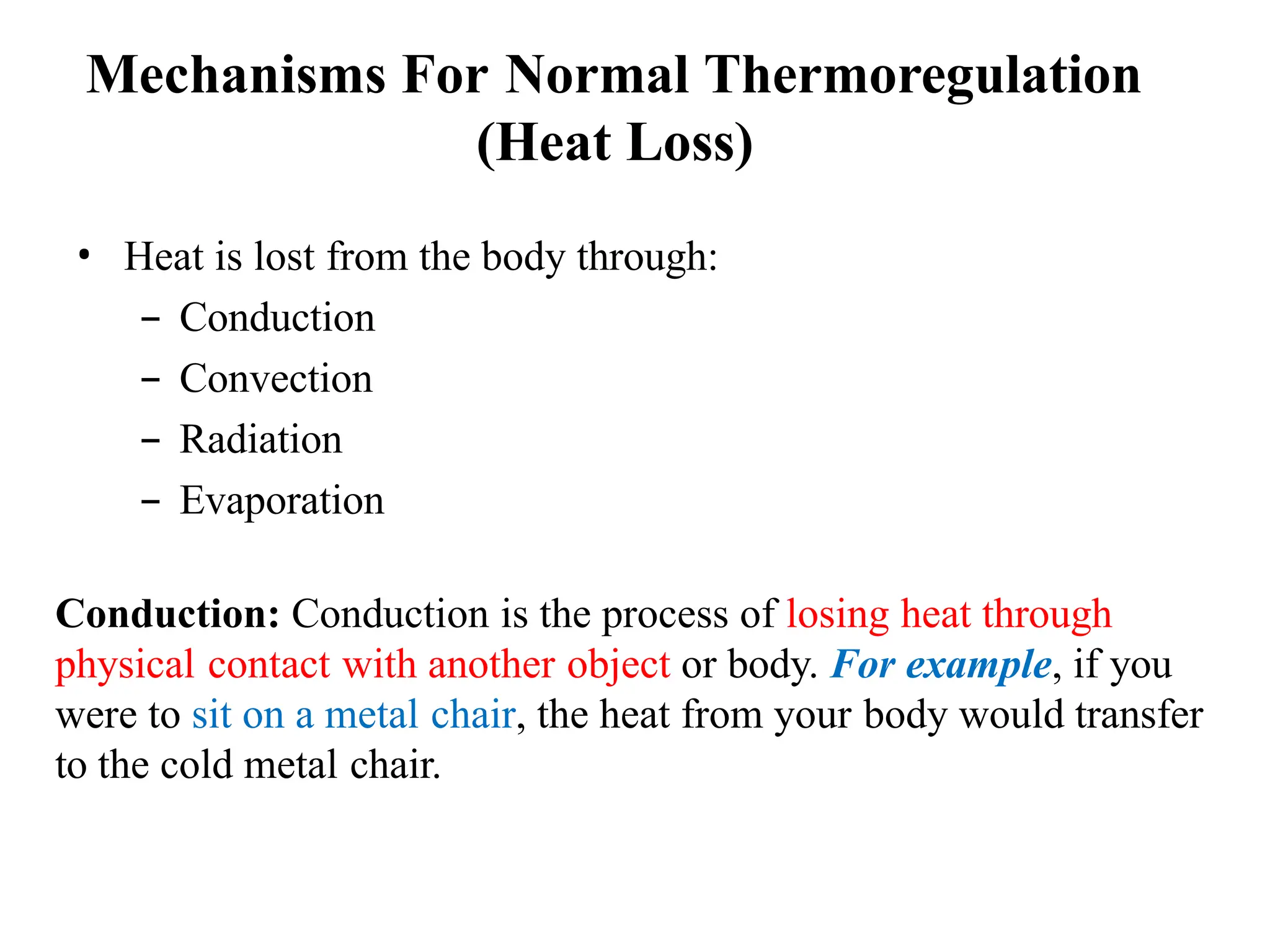
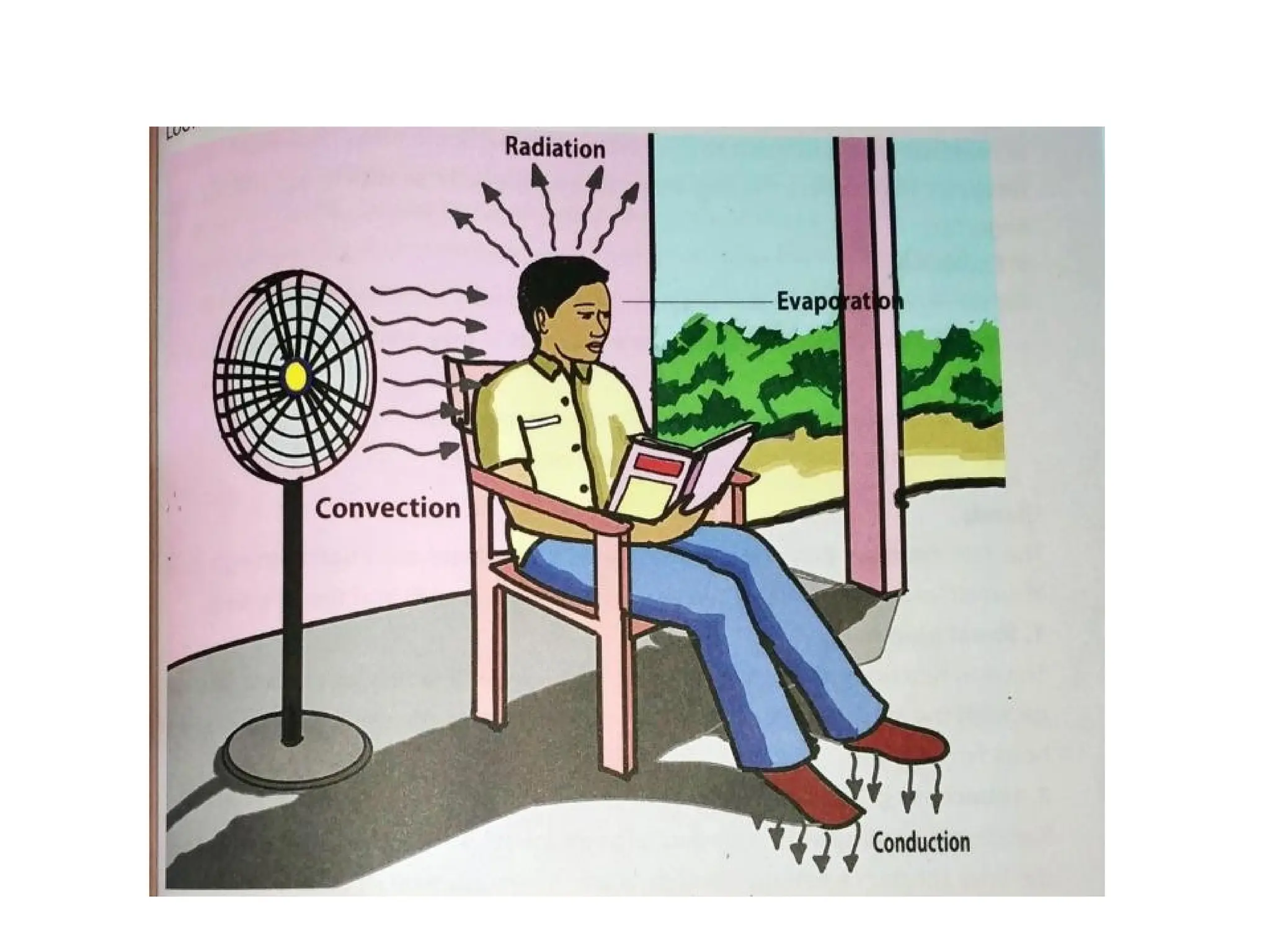
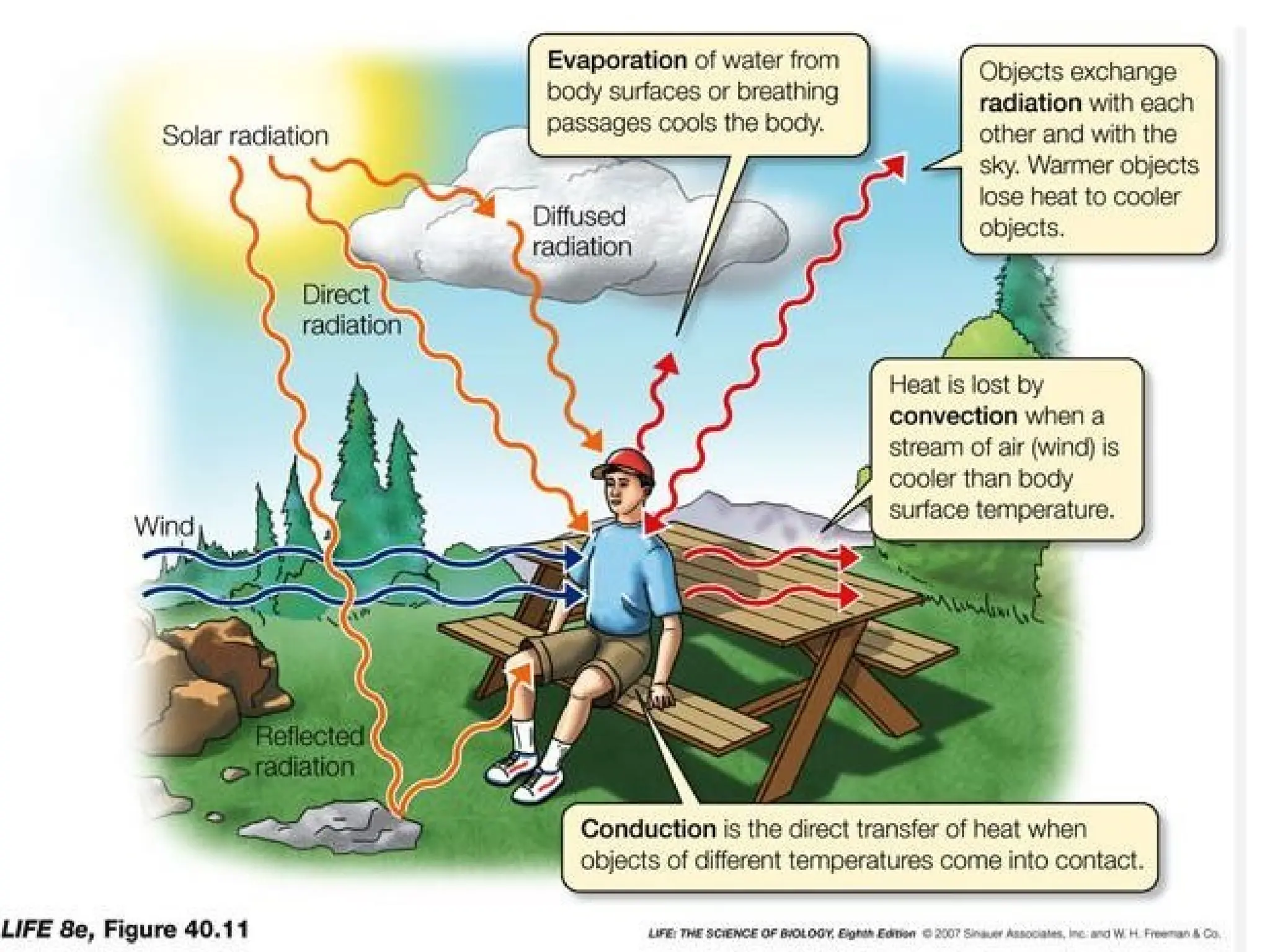
• Heat is lost from the body through:
– Conduction
– Convection
– Radiation
– Evaporation
Conduction: Conduction is the process of losing heat through
physical contact with another object or body. For example, if you
were to sit on a metal chair, the heat from your body would transfer
to the cold metal chair.
Mechanisms For Normal Thermoregulation
(Heat Loss)
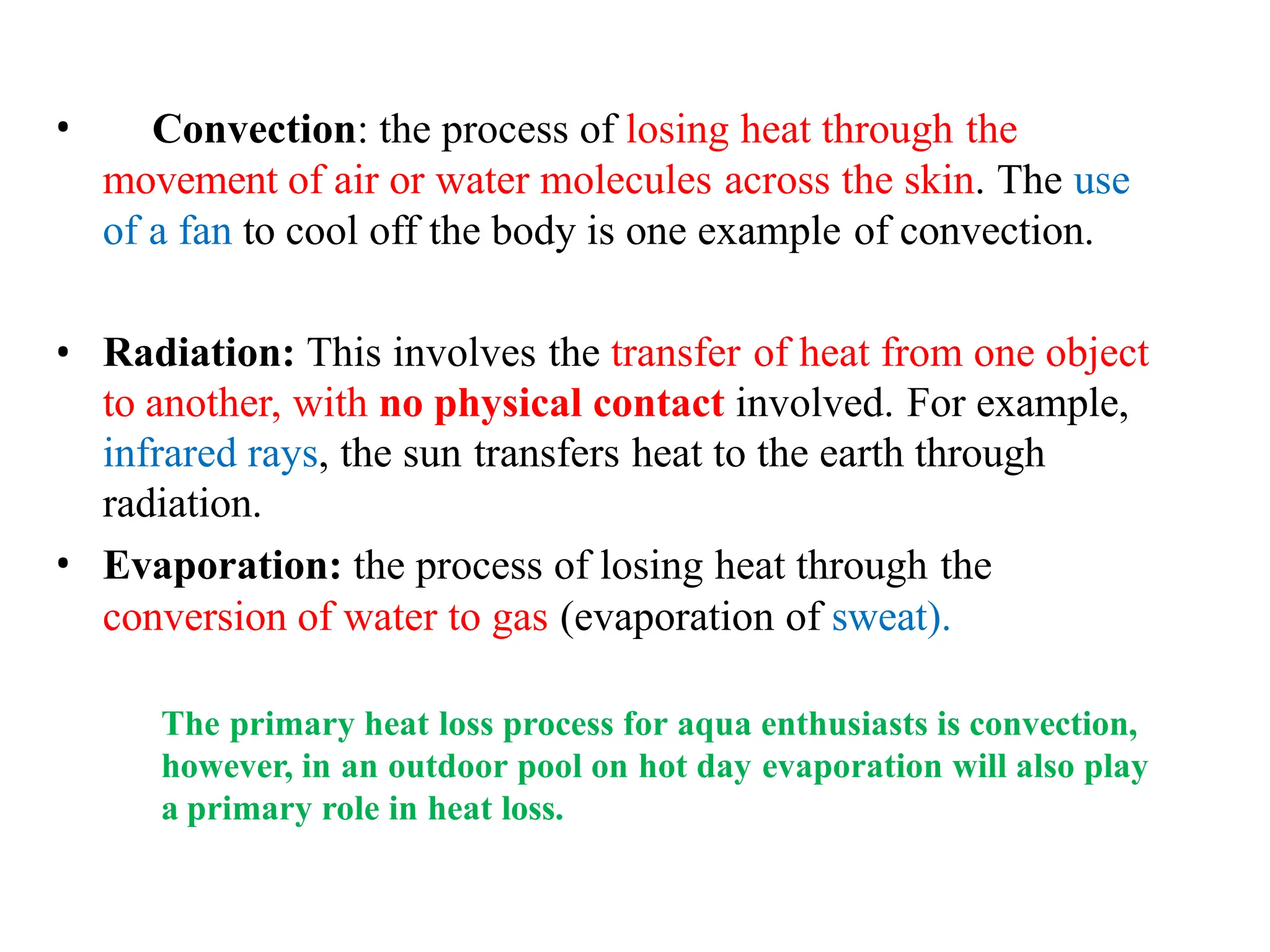
• Convection: the process of losing heat through the
movement of air or water molecules across the skin. The use
of a fan to cool off the body is one example of convection.
• Radiation: This involves the transfer of heat from one object
to another, with no physical contact involved. For example,
infrared rays, the sun transfers heat to the earth through
radiation.
• Evaporation: the process of losing heat through the
conversion of water to gas (evaporation of sweat).
The primary heat loss process for aqua enthusiasts is convection,
however, in an outdoor pool on hot day evaporation will also play
a primary role in heat loss.
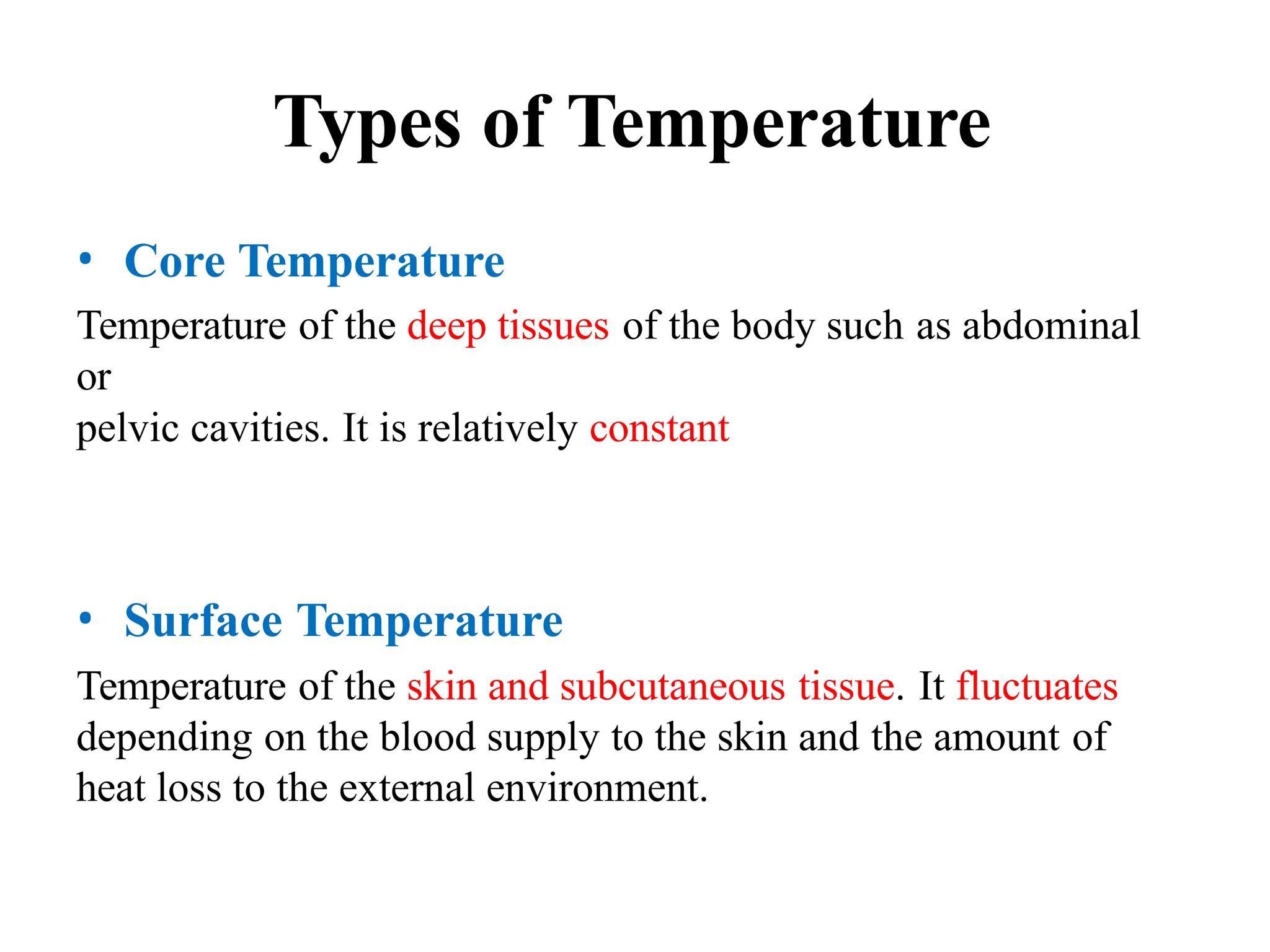
Types of Temperature
• Core Temperature
Temperature of the deep tissues of the body such as abdominal
or
pelvic cavities. It is relatively constant
• Surface Temperature
Temperature of the skin and subcutaneous tissue. It fluctuates
depending on the blood supply to the skin and the amount of
heat loss to the external environment.
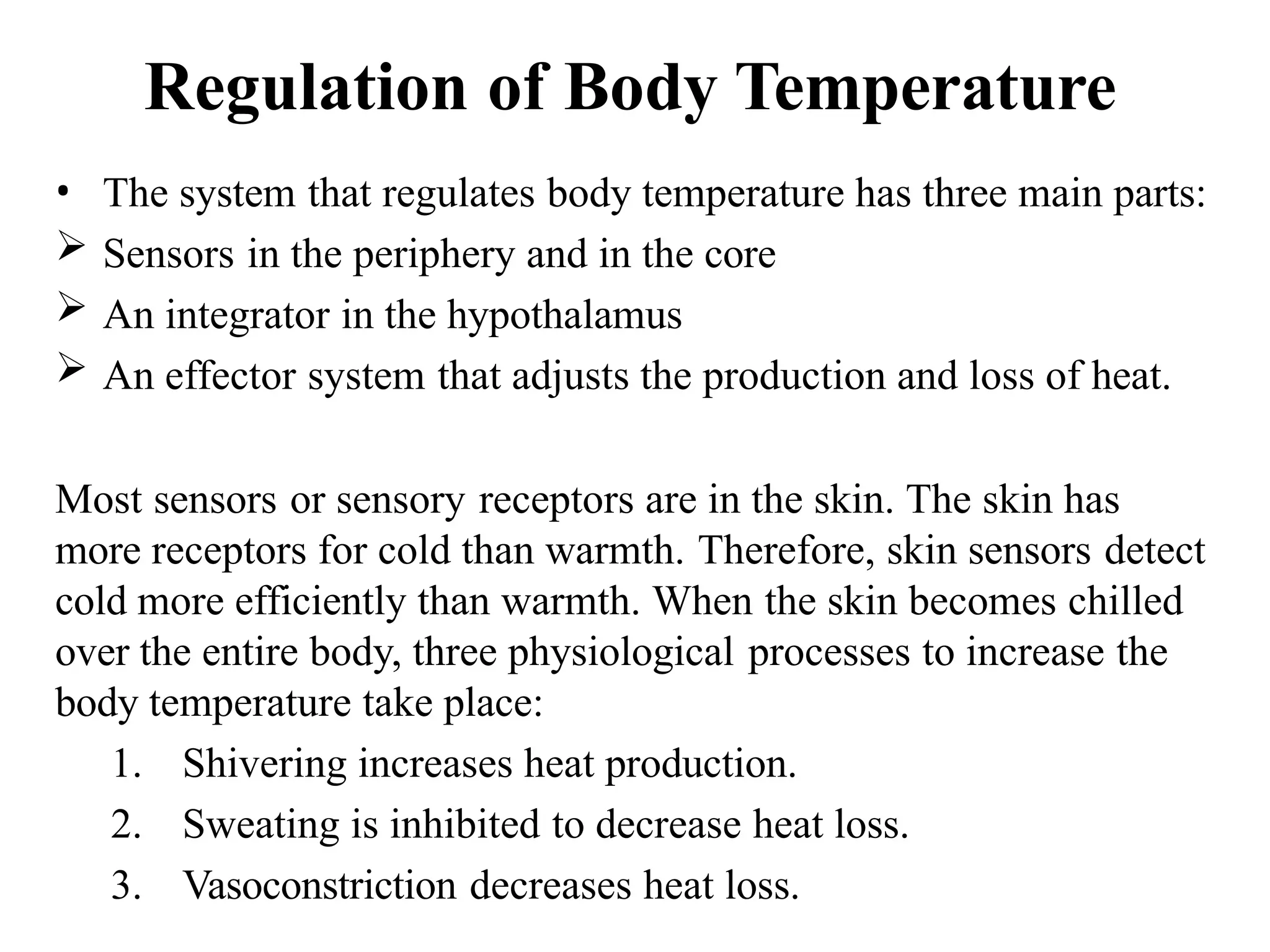
Regulation of Body Temperature
• The system that regulates body temperature has three main parts:
 Sensors in the periphery and in the core
 An integrator in the hypothalamus
 An effector system that adjusts the production and loss of heat.
Most sensors or sensory receptors are in the skin. The skin has
more receptors for cold than warmth. Therefore, skin sensors detect
cold more efficiently than warmth. When the skin becomes chilled
over the entire body, three physiological processes to increase the
body temperature take place:
1. Shivering increases heat production.
2. Sweating is inhibited to decrease heat loss.
3. Vasoconstriction decreases heat loss.
Behavioral
• When an individual perceives he is hot or cold, he
changes his behavior such as:
– Moves to the shade or sun
– regulates the thermostat
– removes extra clothes or puts on sweater.
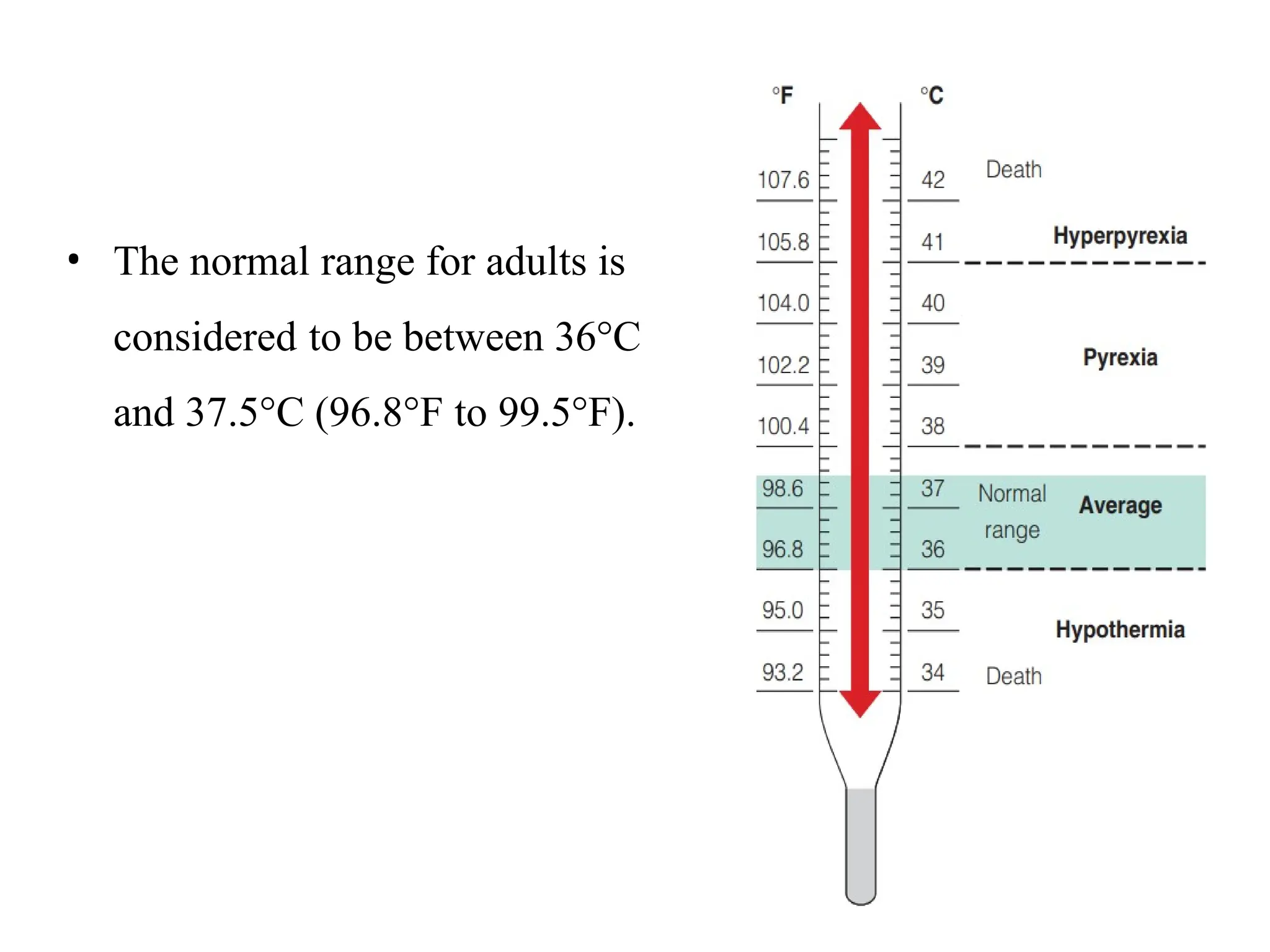
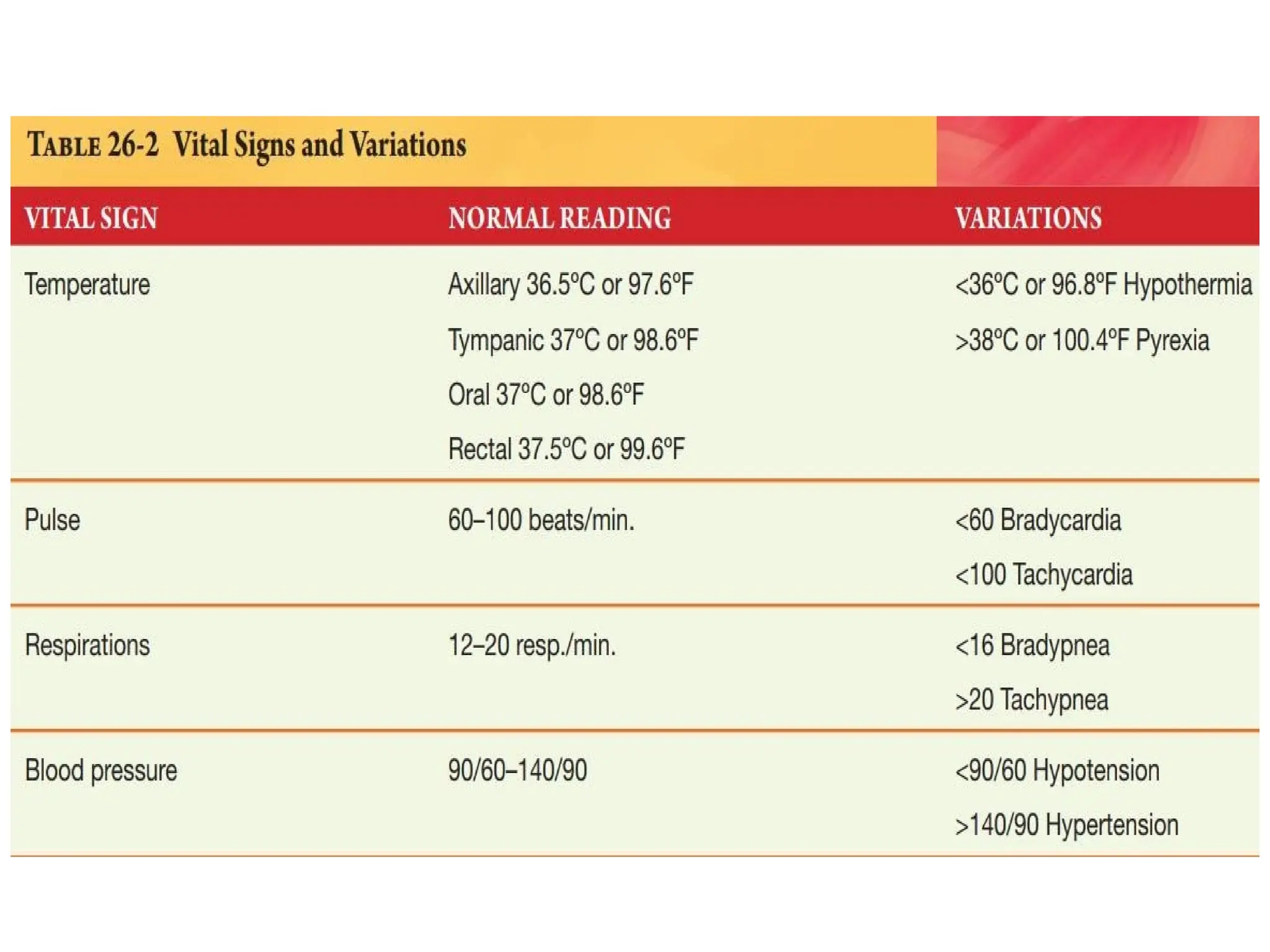
• The normal range for adults is
considered to be between 36°C
and 37.5°C (96.8°F to 99.5°F).
• A body temperature above the usual range is called
pyrexia, hyperthermia, or fever.
• A very high fever, such as 41°C (105.8°F), is called
hyperpyrexia
• The client who has a fever is referred to as febrile
• the one who does not have fever is referred as afebrile
• Hypothermia is a core body temperature below the lower
limit of normal
Types of Fever Pattern
• Intermittent Fever: Temperature returns to acceptable value at
least once in 24 hours. The temperature curve returns to
normal during the day and reaches its peak in the
evening. E.g.- malaria.
• Remittent Fever: fever spikes & falls without a return to the
normal temperature levels. The temperature fluctuates but does
not return to normal. E.g.- TB, viral diseases, bacterial infections
• Constant Fever: the temperature remains continuously
elevated above 38 degree Celsius & demonstrates little
fluctuation.
• Relapsing Fever: short febrile periods of a few days are
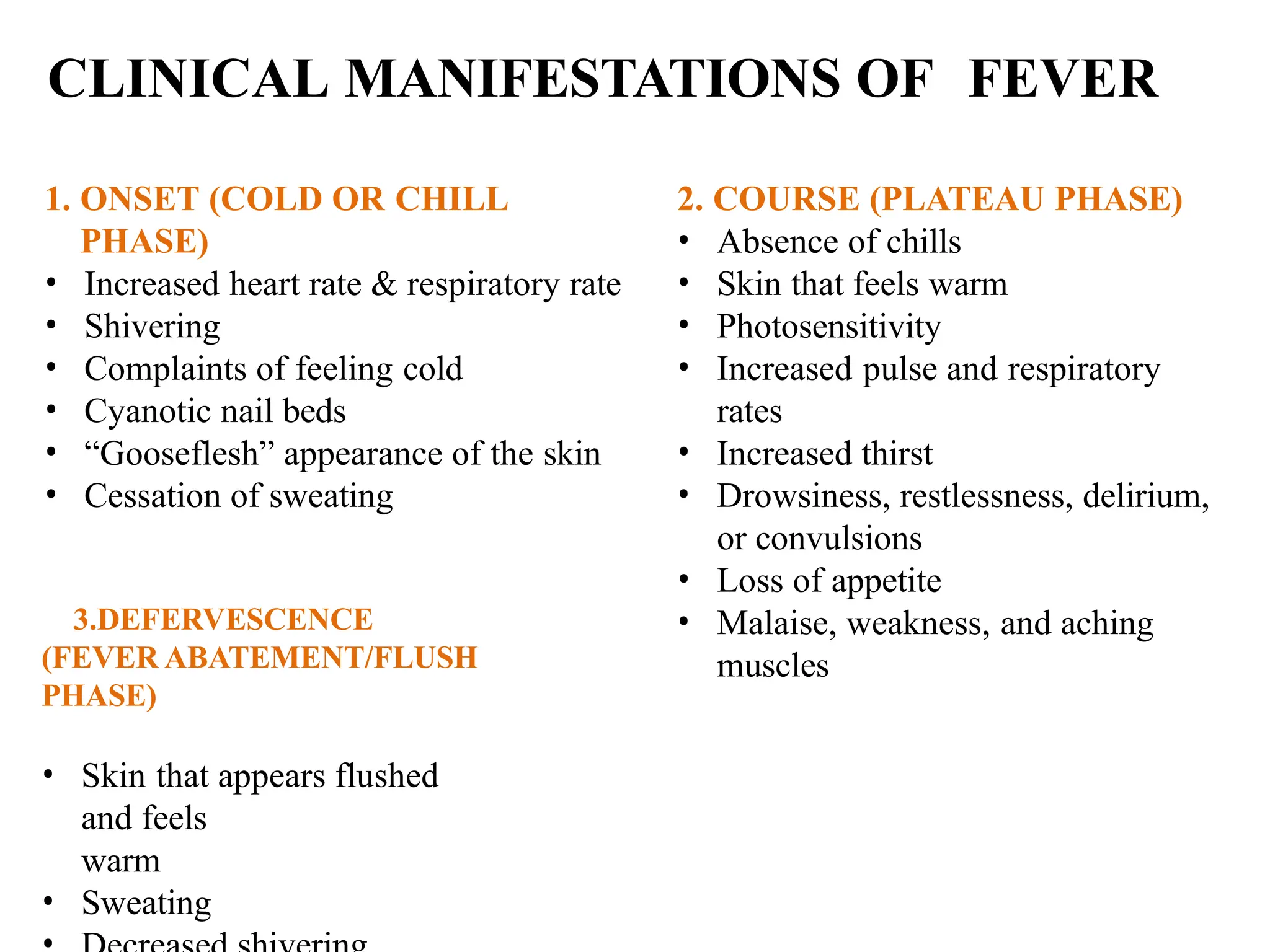
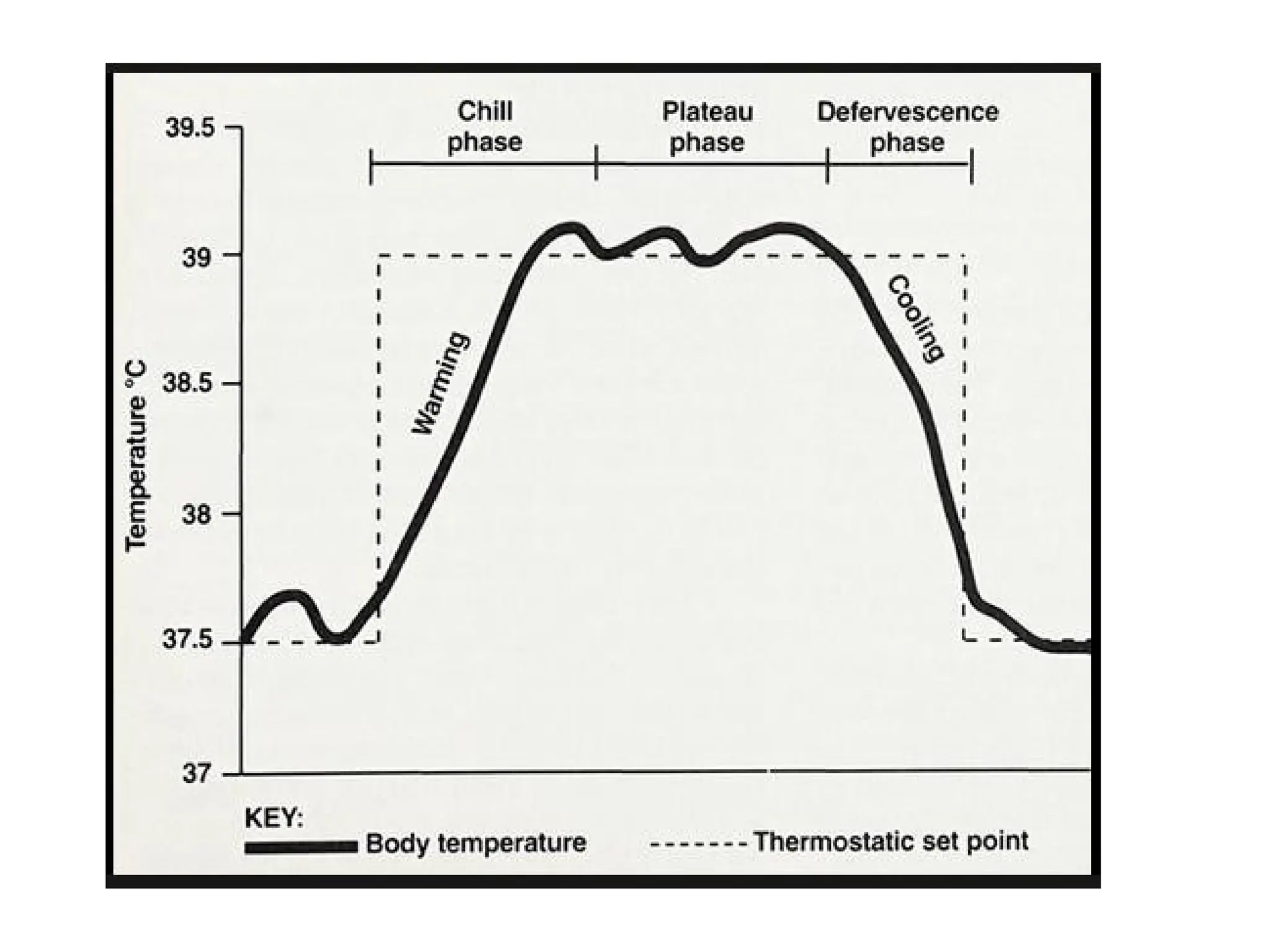
CLINICAL MANIFESTATIONS OF FEVER
1. ONSET (COLD OR CHILL
PHASE)
• Increased heart rate & respiratory rate
• Shivering
• Complaints of feeling cold
• Cyanotic nail beds
• “Gooseflesh” appearance of the skin
• Cessation of sweating
2. COURSE (PLATEAU PHASE)
• Absence of chills
• Skin that feels warm
• Photosensitivity
• Increased pulse and respiratory
rates
• Increased thirst
• Drowsiness, restlessness, delirium,
or convulsions
• Loss of appetite
• Malaise, weakness, and aching
muscles
3.DEFERVESCENCE
(FEVER ABATEMENT/FLUSH
PHASE)
• Skin that appears flushed
and feels
warm
• Sweating
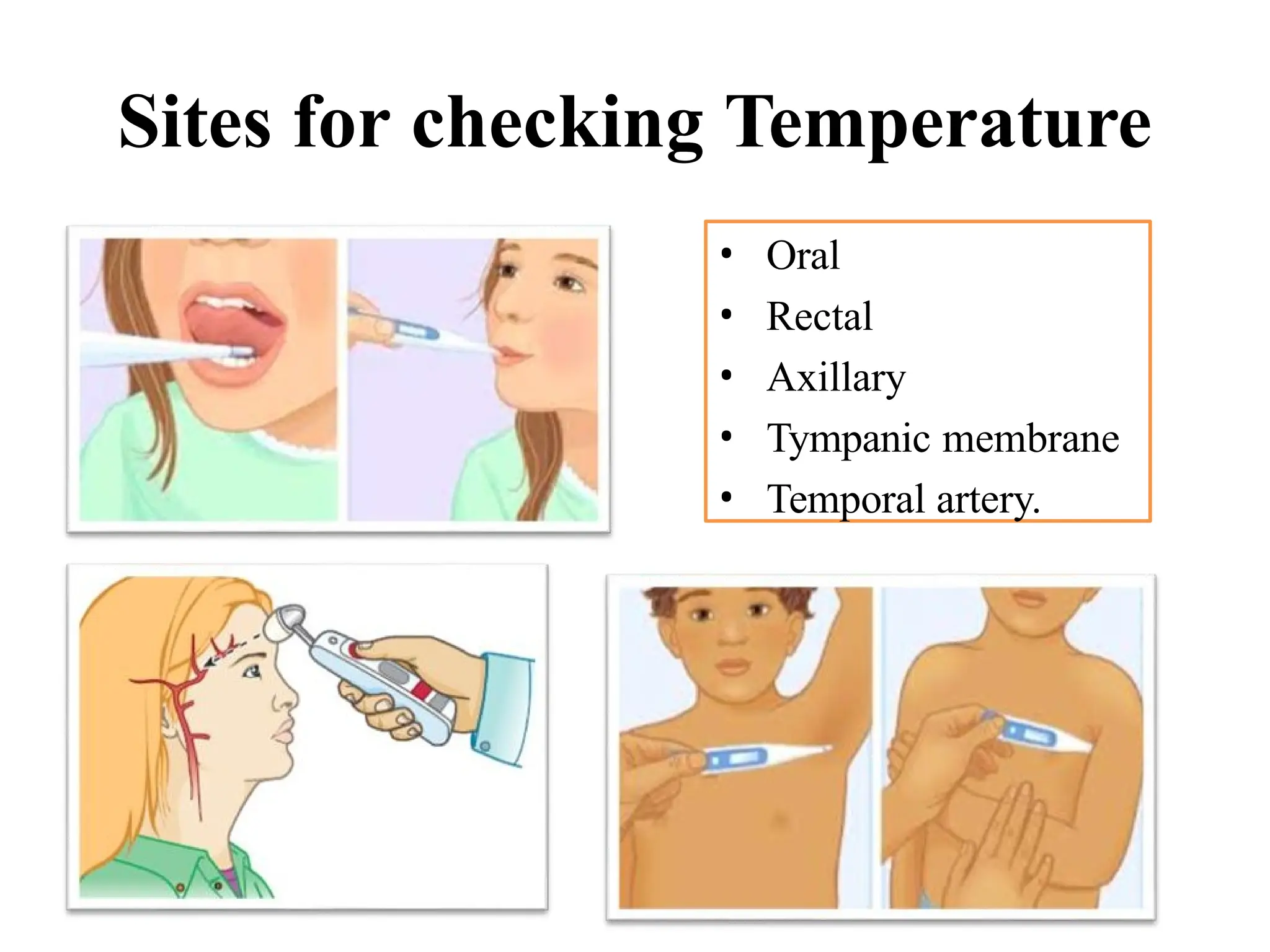
Sites for checking Temperature
• Oral
• Rectal
• Axillary
• Tympanic membrane
• Temporal artery.
Pulse
Pulse
• The pulse is a wave of blood created by contraction of the
left ventricle of the heart.
• The pulse wave represents the stroke volume output or the
amount of blood that enters the arteries with each
ventricular contraction.
• Compliance of the arteries is their ability to contract and
expand. When a person’s arteries lose their dispensability, as
can happen with age, greater pressure is required to pump
the blood into the arteries
Pulse
• The pulse is a wave of blood created by contraction of the
left
ventricle of the heart
• The rate of the pulse is expressed in beats per
minute
(beats/min)
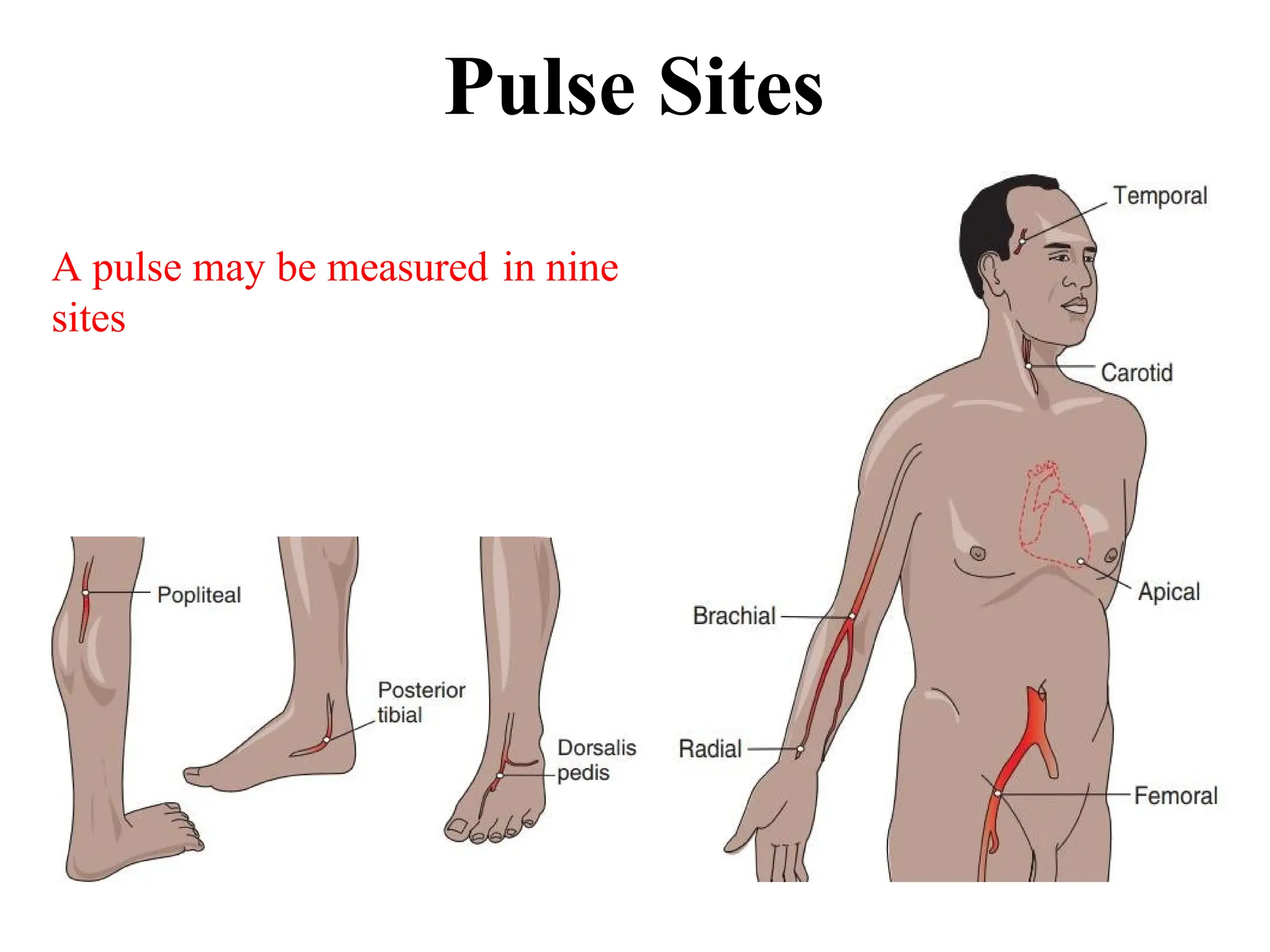
Pulse Sites
A pulse may be measured in nine
sites
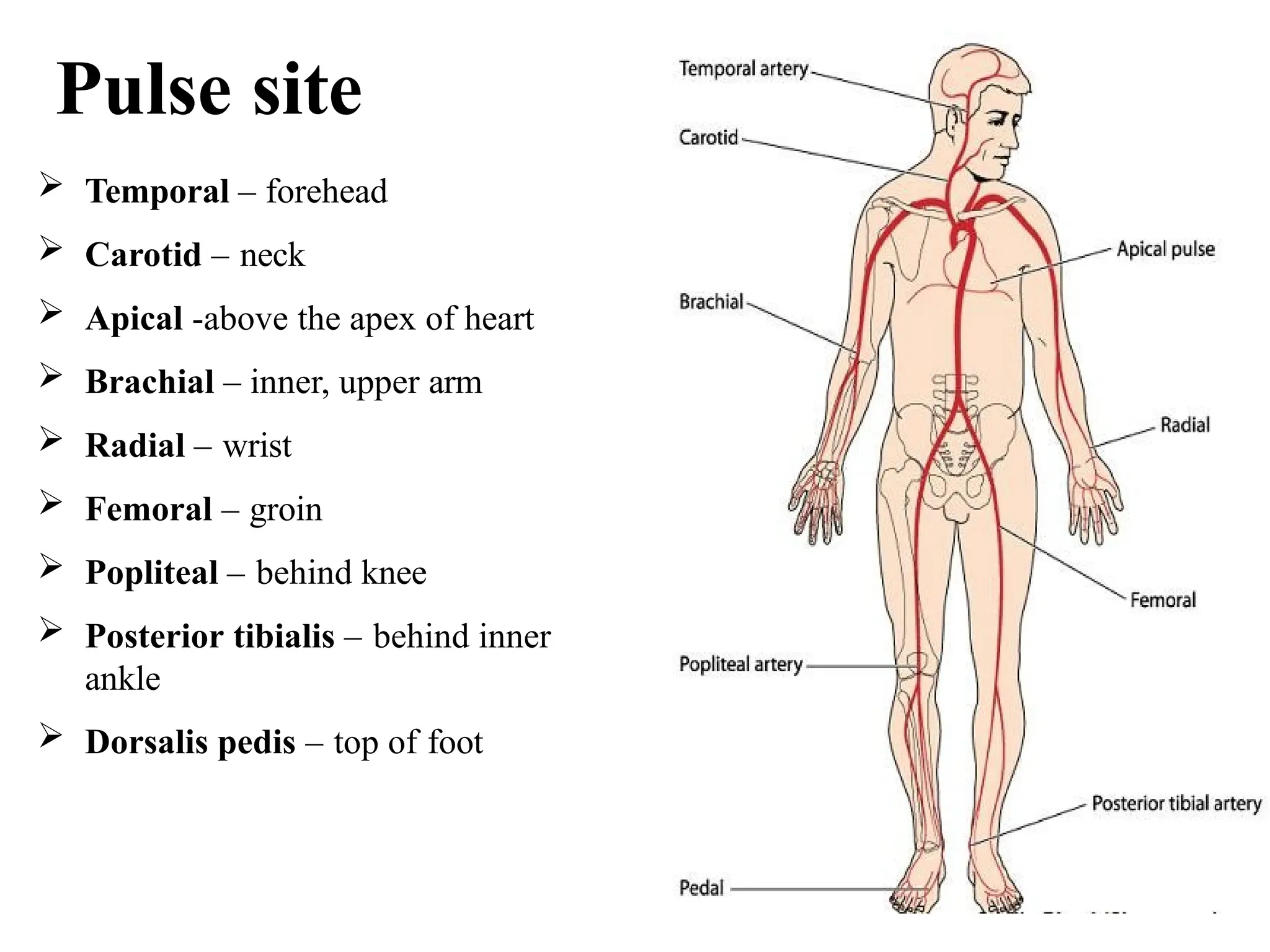
Pulse site
 Temporal – forehead
 Carotid – neck
 Apical -above the apex of heart
 Brachial – inner, upper arm
 Radial – wrist
 Femoral – groin
 Popliteal – behind knee
 Posterior tibialis – behind inner
ankle
 Dorsalis pedis – top of foot
Characteristics of pulse
• Rate
• Rhythm
• Volume
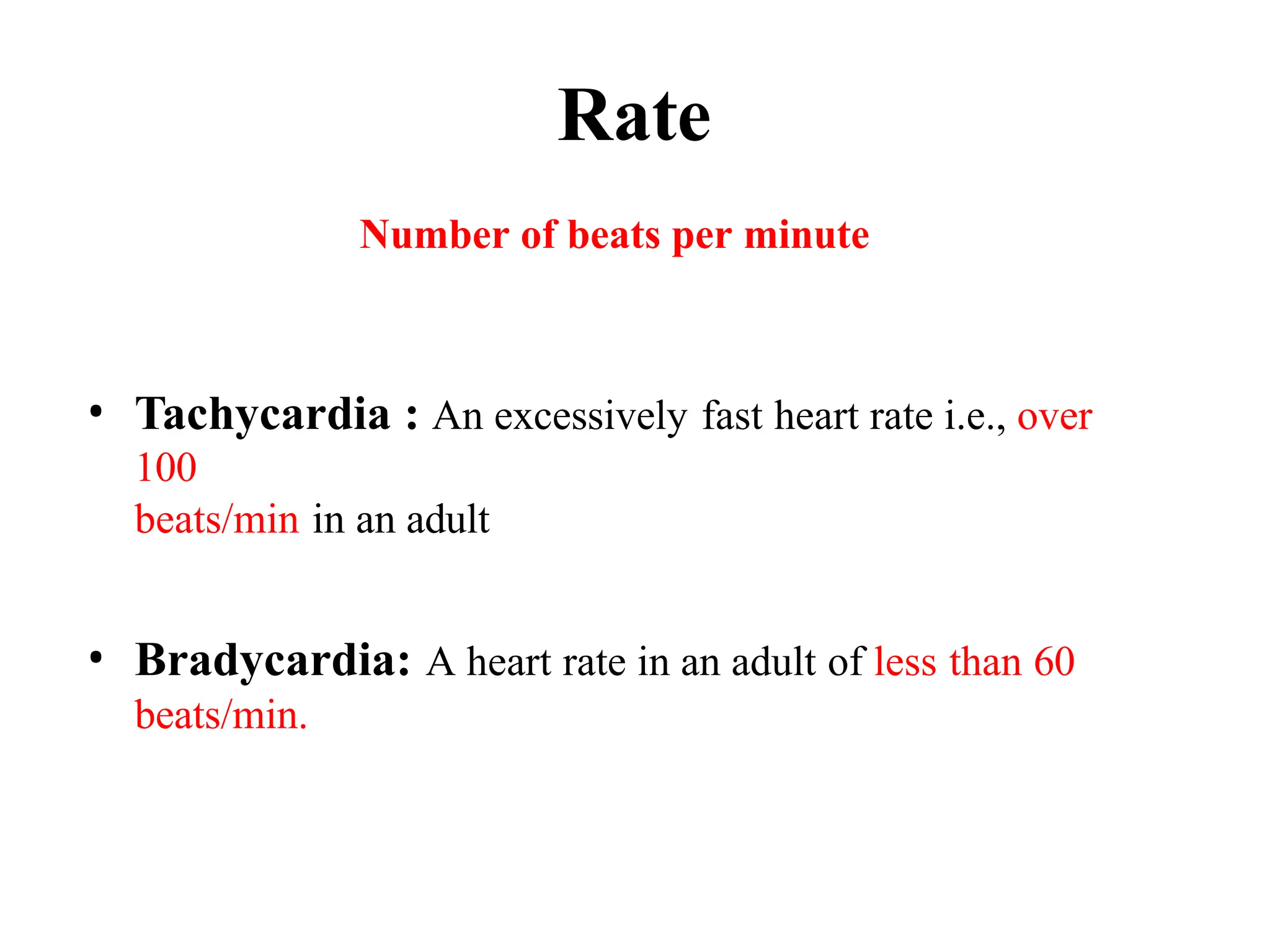
Rate
Number of beats per minute
• Tachycardia : An excessively fast heart rate i.e., over
100
beats/min in an adult
• Bradycardia: A heart rate in an adult of less than 60
beats/min.
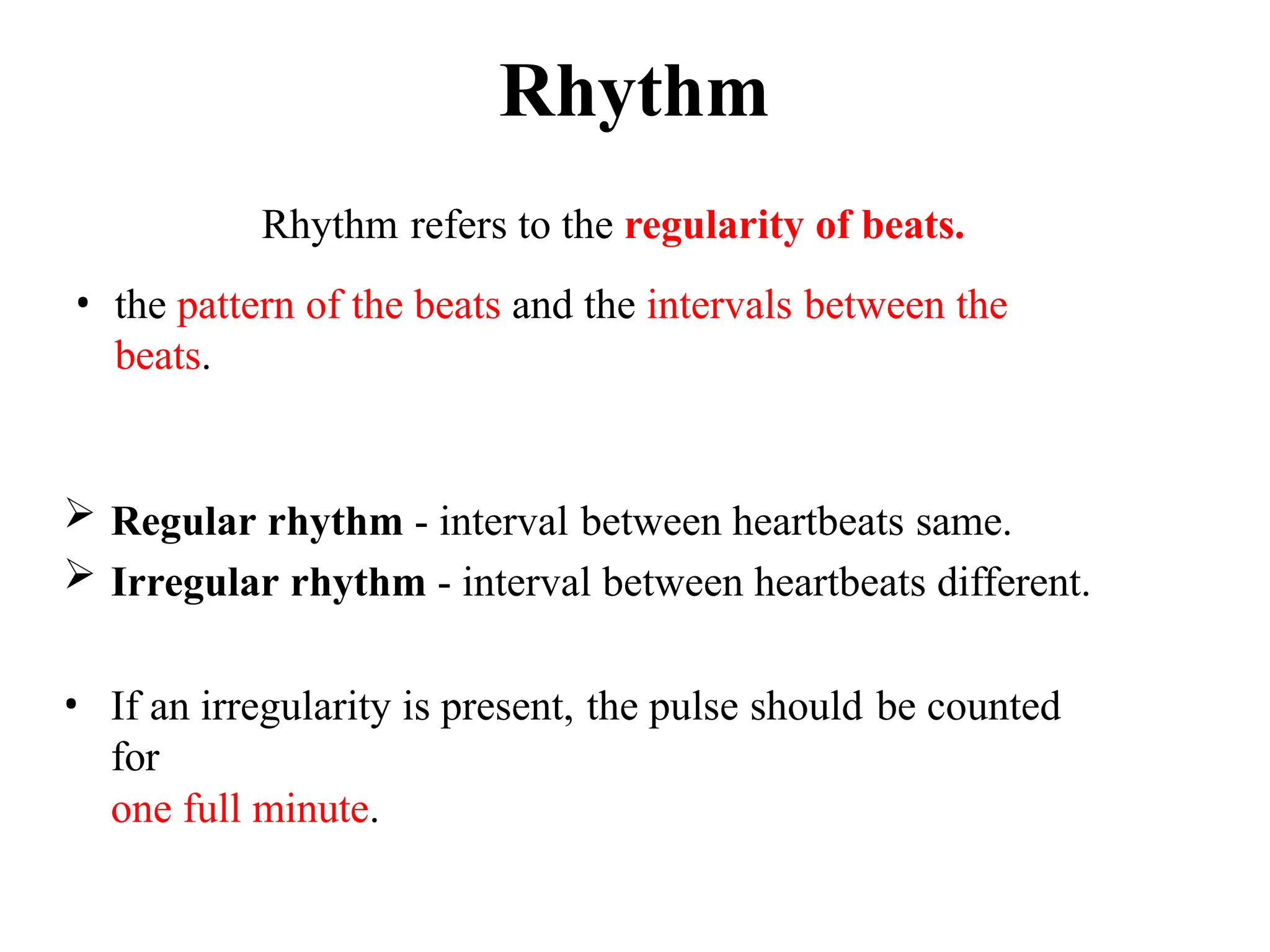
Rhythm
 Regular rhythm - interval between heartbeats same.
 Irregular rhythm - interval between heartbeats different.
• If an irregularity is present, the pulse should be counted
for
one full minute.
Rhythm refers to the regularity of beats.
• the pattern of the beats and the intervals between the
beats.
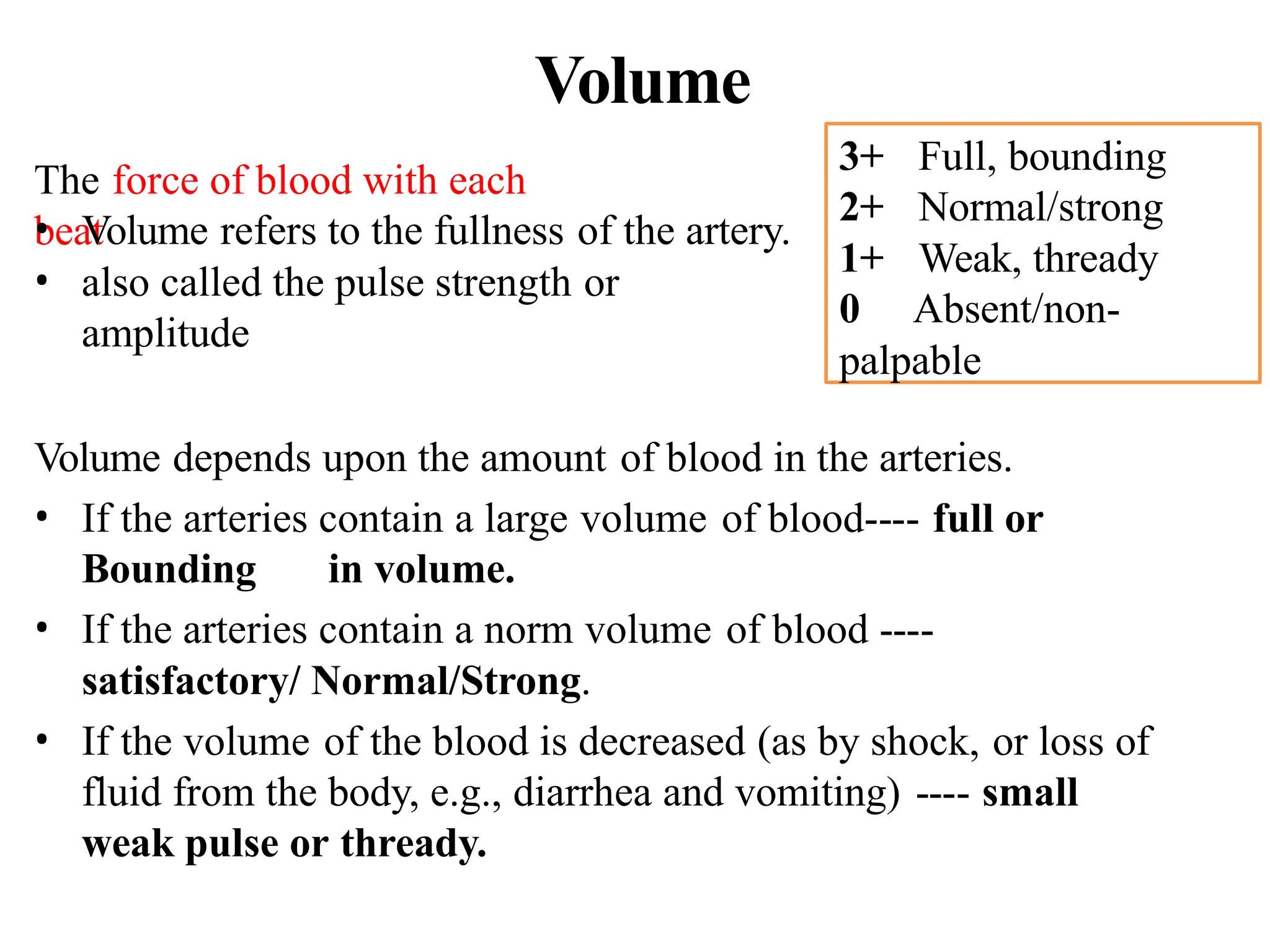
Volume
Volume depends upon the amount of blood in the arteries.
• If the arteries contain a large volume of blood---- full or
Bounding in volume.
• If the arteries contain a norm volume of blood ----
satisfactory/ Normal/Strong.
• If the volume of the blood is decreased (as by shock, or loss of
fluid from the body, e.g., diarrhea and vomiting) ---- small
weak pulse or thready.
The force of blood with each
beat
• Volume refers to the fullness of the artery.
• also called the pulse strength or
amplitude
3+ Full, bounding
2+ Normal/strong
1+ Weak, thready
0 Absent/non-
palpable
Factors that Influence Pulse Rate
• Age.
• Exercise.
• Fever.
• Medications.
• Hypovolemia /dehydration..
• Stress
• Position
• Pathology.
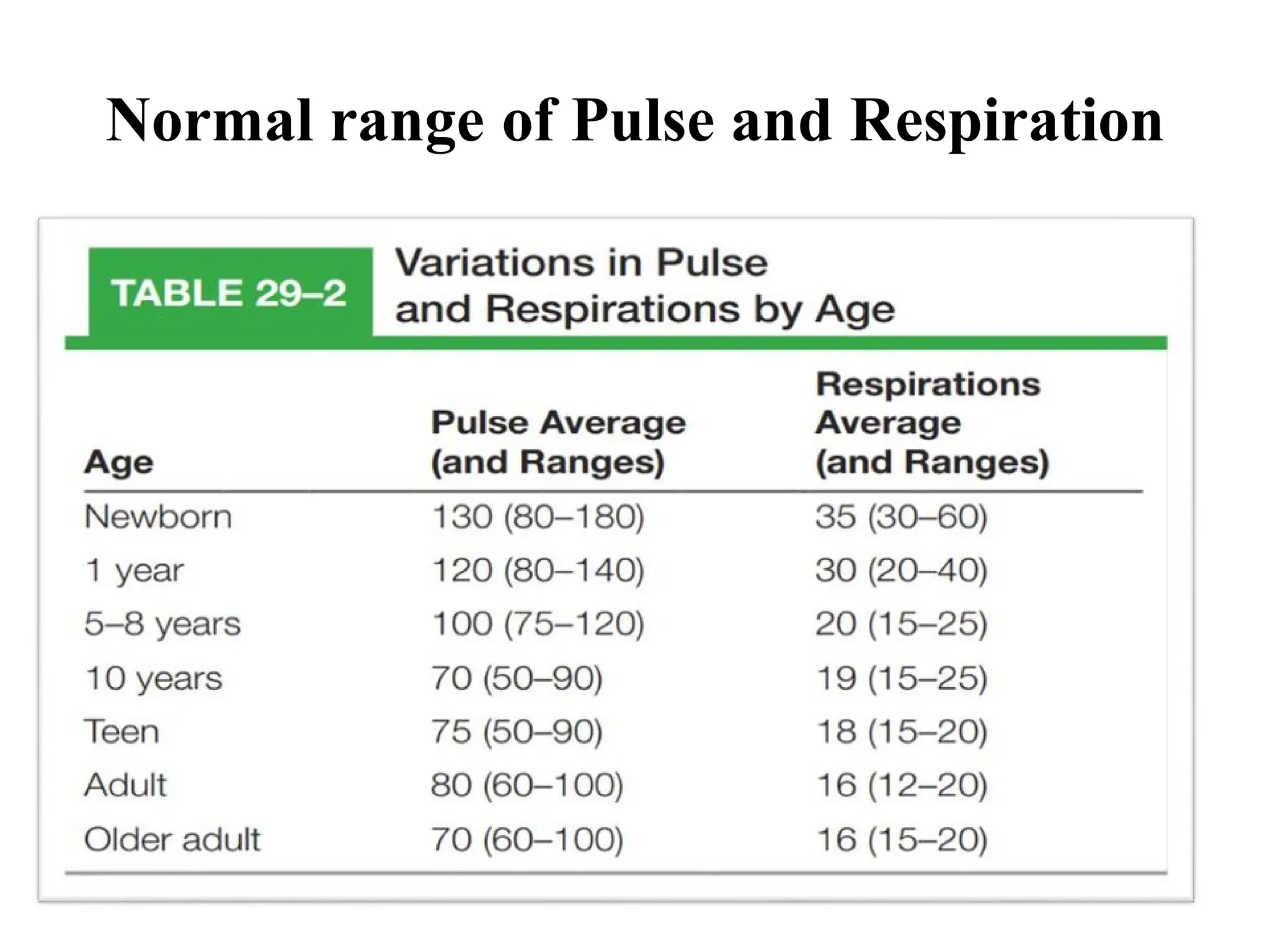
Normal range of Pulse and Respiration
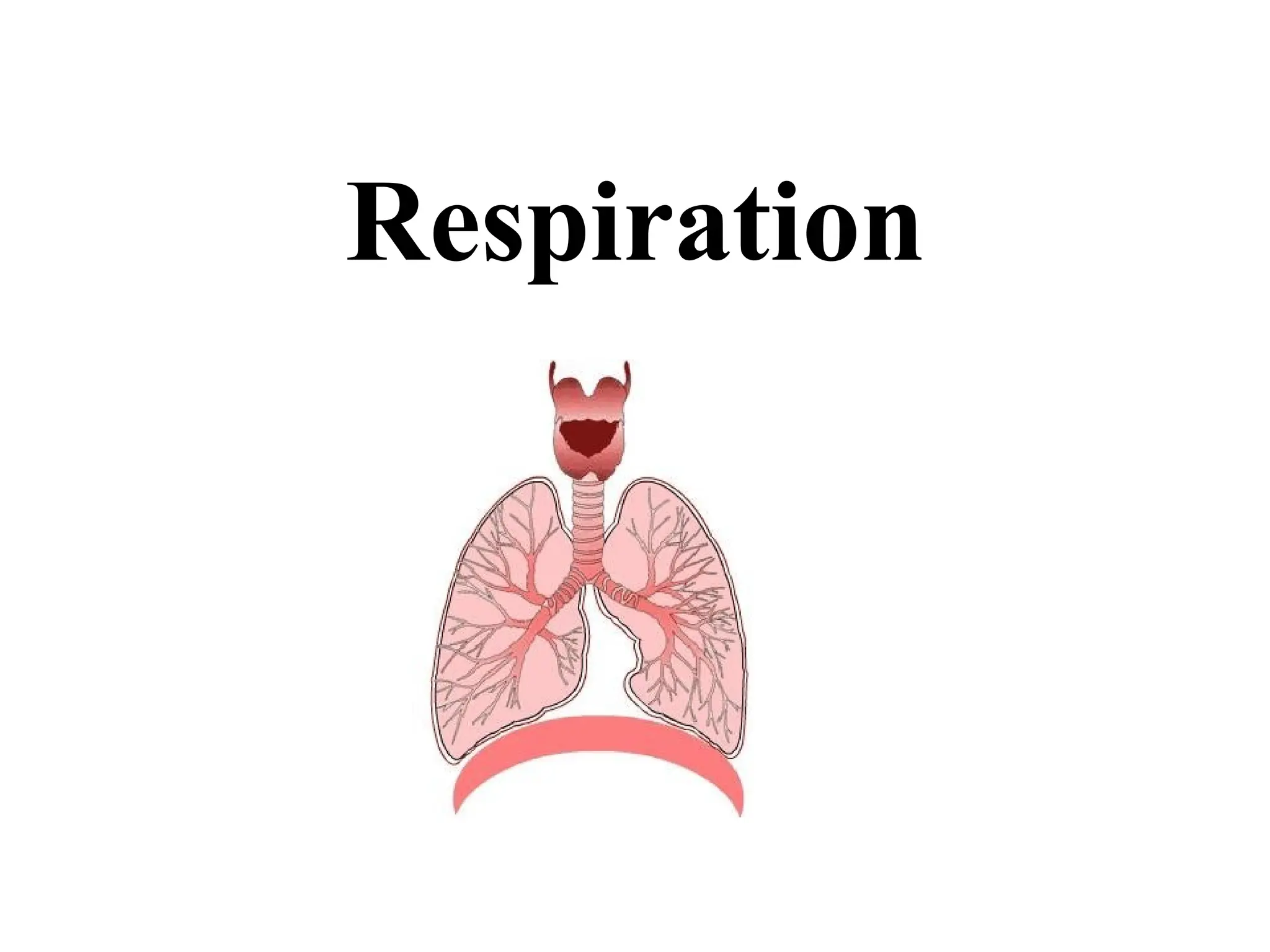
Respiration
Respiration
• Respiration is the act of breathing.
• The mechanical act of breathing in air (inspiration)
and expelling air (expiration) from the body
• Ventilation is also used to refer to the movement of air in
and out of the lungs.
Inhalation or inspiration---- intake of air into the lungs.
Exhalation or expiration ---- breathing out or the movement
of gases from the lungs to the atmosphere.
Types of Breathing
• There are basically two types of breathing:
1. Costal (thoracic) breathing: involves the external
intercostal muscles and other accessory muscles. It can be
observed by the movement of the chest upward and
outward.
2. Diaphragmatic (abdominal) breathing: involves
the contraction and relaxation of the diaphragm, and
it is observed by the movement of the abdomen.
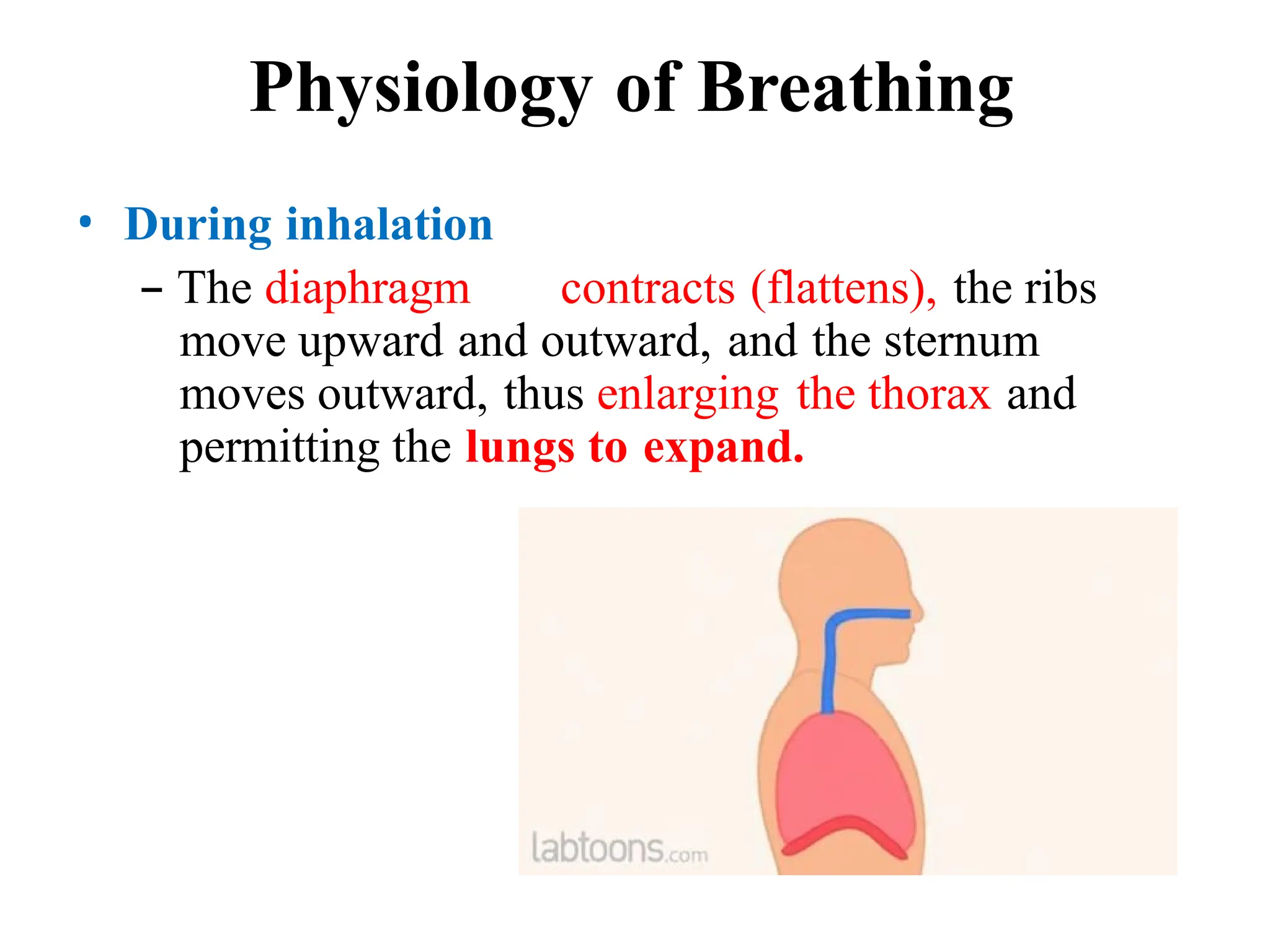
Physiology of Breathing
• During inhalation
– The diaphragm contracts (flattens), the ribs
move upward and outward, and the sternum
moves outward, thus enlarging the thorax and
permitting the lungs to expand.
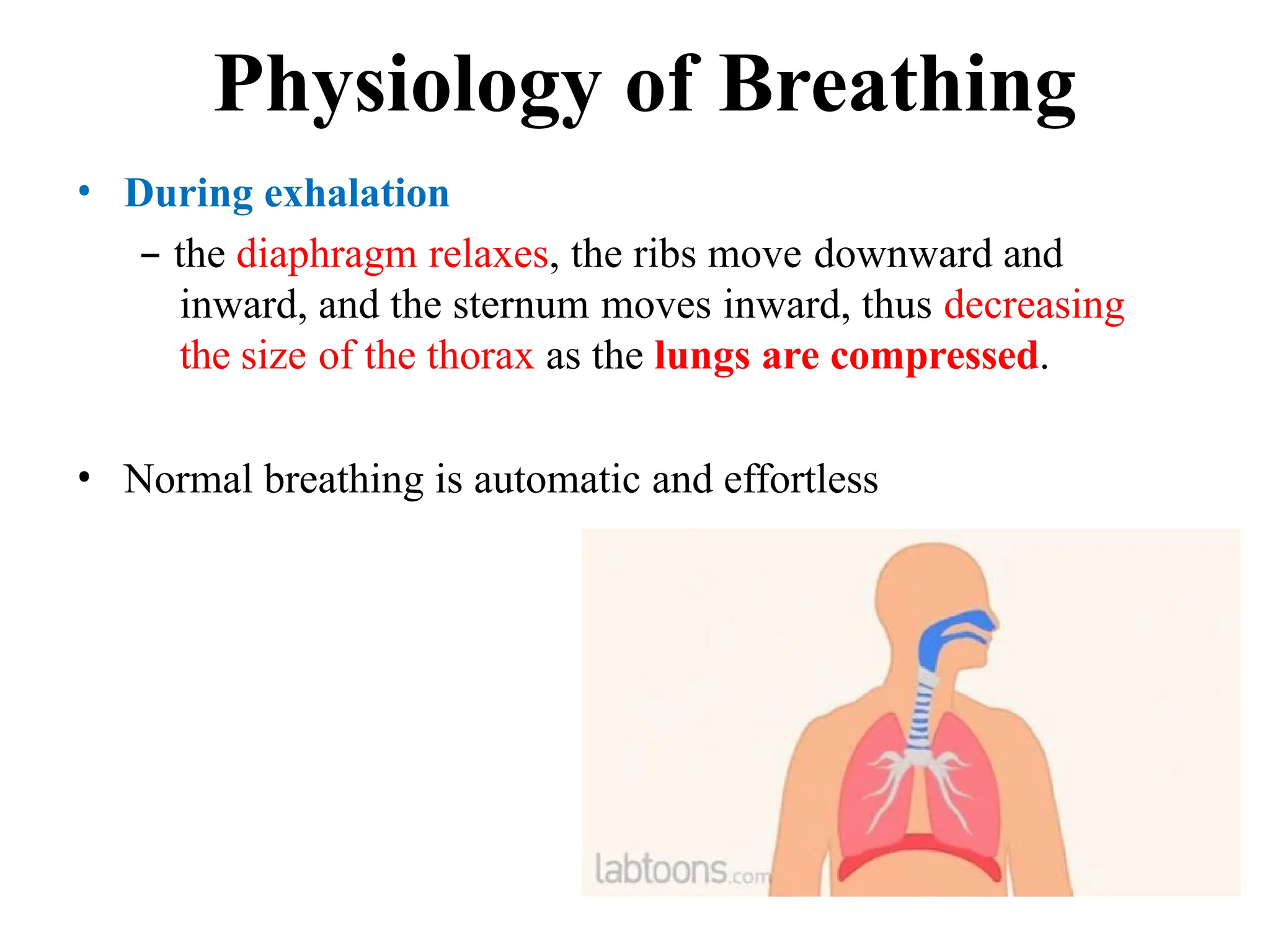
• During exhalation
– the diaphragm relaxes, the ribs move downward and
inward, and the sternum moves inward, thus decreasing
the size of the thorax as the lungs are compressed.
• Normal breathing is automatic and effortless
Physiology of Breathing
Terms related to Respiration
• Tachypnea—quick, shallow breaths
• Bradypnea—abnormally slow breathing
• Apnea—cessation of breathing
• Hyperventilation— overexpansion of the lungs characterized
by
rapid and deep breaths
• Hypoventilation— underexpansion of the lungs, shallow
respirations
• Cheyne-Stokes breathing —rhythmic waxing and waning of
respirations, from very deep to very shallow breathing and
temporary apnea
• Dyspnea—difficult and labored breathing
• Orthopnea—ability to breathe only in upright sitting or
standing
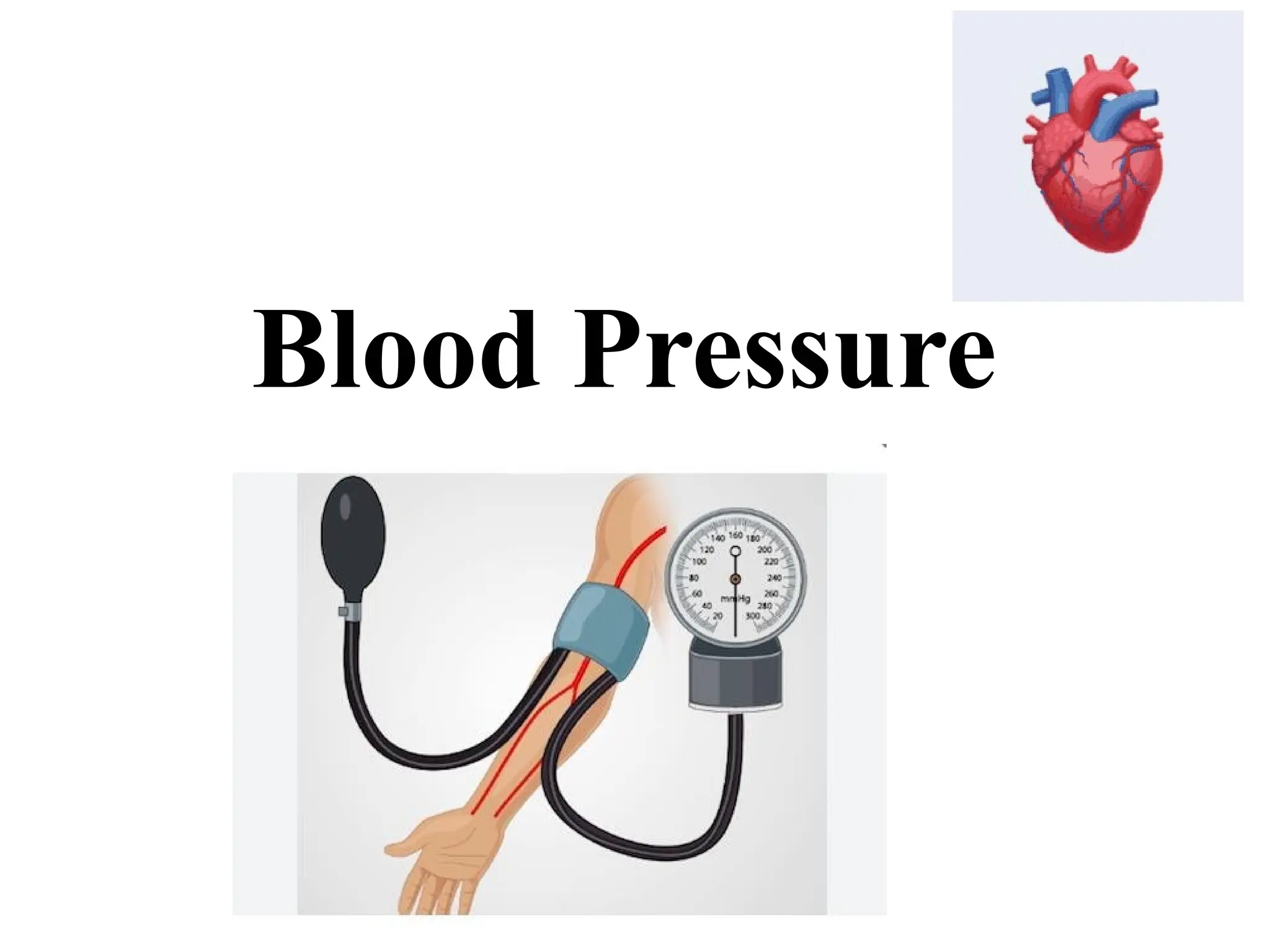
Blood Pressure
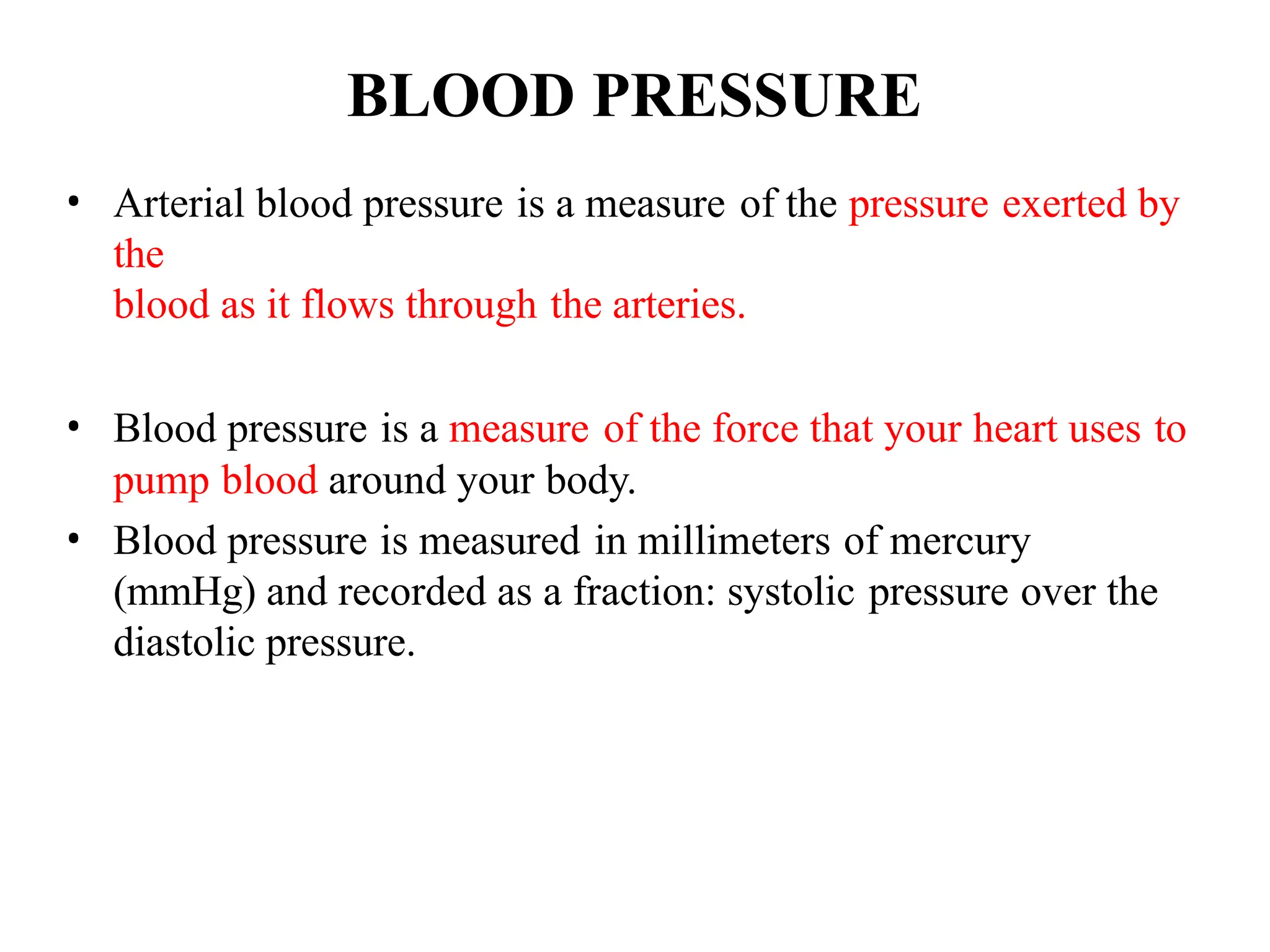
BLOOD PRESSURE
• Arterial blood pressure is a measure of the pressure exerted by
the
blood as it flows through the arteries.
• Blood pressure is a measure of the force that your heart uses to
pump blood around your body.
• Blood pressure is measured in millimeters of mercury
(mmHg) and recorded as a fraction: systolic pressure over the
diastolic pressure.
Blood Pressure Measurement
• The blood moves in waves, there are two blood pressure
measurements.
Systolic Pressure: is the pressure of the blood as a result of
contraction of the ventricles, that is, the pressure of
the height of the blood wave.
Diastolic Pressure: is the pressure when the ventricles
are at rest between beats .
For example, if your blood pressure is "140 over 90" or
140/90mmHg, it means you have a systolic pressure of
140mmHg and a diastolic pressure of 90mmHg.
Pulse Pressure :
• The difference between the diastolic and the systolic
pressures
is called the pulse pressure.
• A normal pulse pressure is about 40 mmHg but can be as
high as 100 mmHg during exercise.
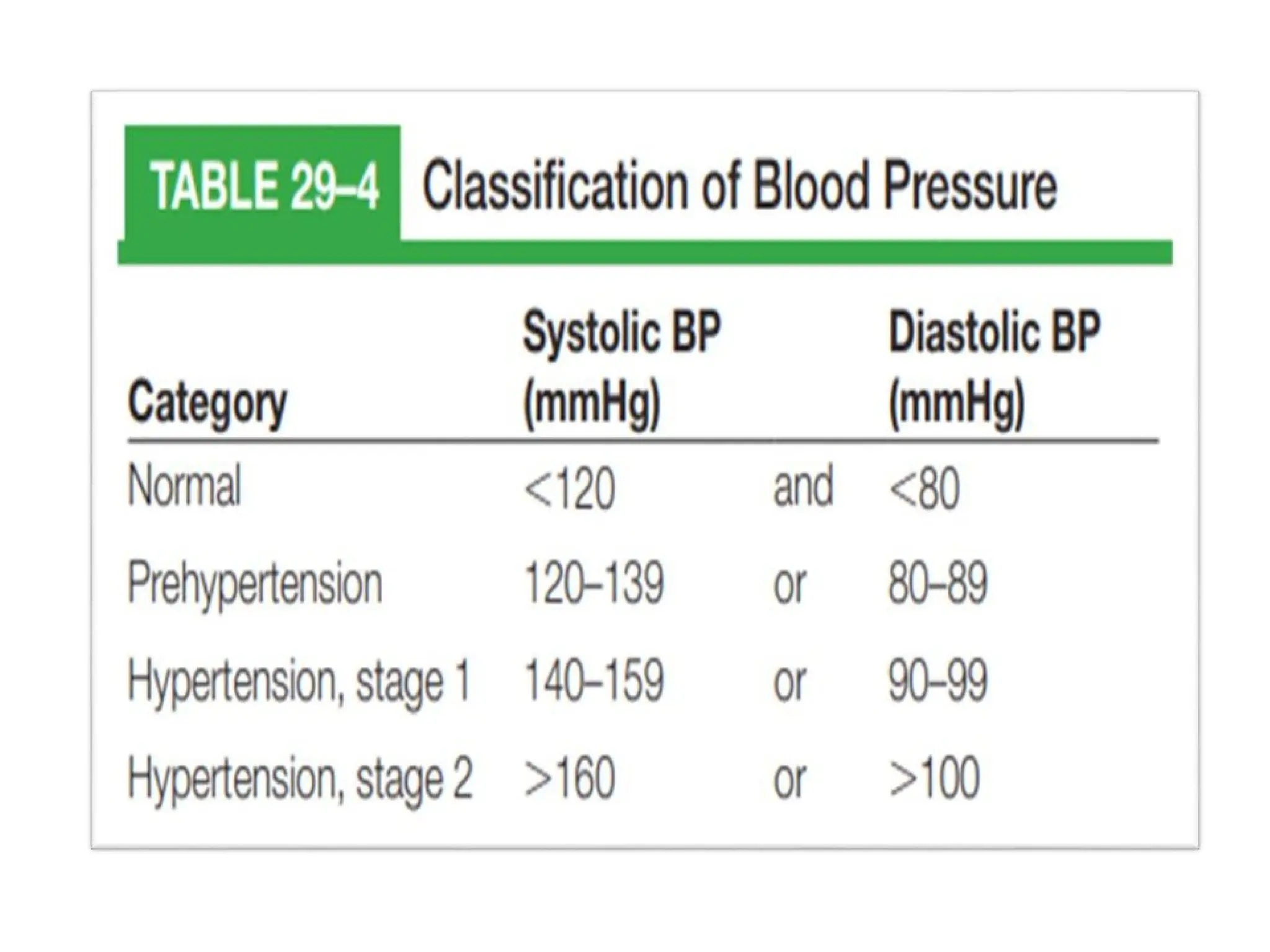
• A typical blood pressure for a healthy adult is 120/80 mmHg
(pulse pressure of 40).
• Because blood pressure can vary considerably among
individuals, it is important for the nurse to know a
specific client’s baseline blood pressure.
Terms Related to Blood Pressure
• Hypertension
A blood pressure that is persistently above normal is called
hypertension
• Hypotension
Hypotension is a blood pressure that is below normal
• Orthostatic
Hypotension is a blood pressure that decreases when the
client
sits or stands.
Factors Affecting Blood Pressure
• Age
• Exercise
• Stress
• Race
• Gender
• Medications
• Obesity
• diurnal variations
• medical
conditions
• temperature.
Blood Pressure Assessment Sites
• The blood pressure is usually assessed in the client’s
upper
arm using the brachial artery and a standard stethoscope.
• Assessing the blood pressure on a client’s thigh is
indicated in
these situations:
– The blood pressure cannot be measured on either arm
(e.g.,
because of burns or other trauma).
– The blood pressure in one thigh is to be compared with
the
blood pressure in the other thigh.
• Blood pressure is not measured on a particular client’s limb in
the following situations:
– The shoulder, arm, or hand (or the hip, knee, or ankle)
is injured or diseased.
– A cast or bulky bandage is on any part of the limb.
– The client has had surgical removal of breast or axillary
(or
inguinal) lymph nodes on that side.
– The client has an intravenous infusion or blood
transfusion
in that limb.
– The client has an arteriovenous fistula (e.g., for renal
dialysis) in that limb.
Contraindication for Blood
Pressure Assessment Sites
References
• Berman, A., Snyder, S., Kozier, B., & Erb, G. L. (2020).
Kozier and Erb's fundamentals of nursing, volumes 1-3 (10th
ed.).
• White, L., Duncan, G., & Baumle, W. (2010). Foundations
of
adult health nursing (3rd ed.). Cengage Learning

Vital Signs to improve our nursing skills and practices, as it is beneficial for our practices

  • 1.
    Nursing Skills (VitalSigns) Unit V
  • 2.
    Objectives At the completionof this unit learners will be able to:  Define Vital Signs.  Define terms related to Vital sign.  Describe the physiological concept of temperature, respiration and blood pressure.  Describe the principles and mechanisms for normal thermoregulation in the body  Identify ways that affect heat production and heat loss in the body.  Define types of body temperature according to its characteristics.  Identify the sign and symptoms of fever.  Discuss the normal ranges for temperature, pulse, respiration and blood pressure.  List the factors affecting temperature, pulse, respiration.  Describe the characteristics of pulse and respiration.  List factors responsible for maintaining normal blood pressure.  Describe various methods and sites used to measure T.P & B.P.  Recognize the signs of alert while taking TPR and B.P.
  • 3.
    Vital Sign • Vitalsigns are the “signs of life,” providing a way of connecting the external inspection with the internal functioning of the client’s organs. • This is also known as cardinal signs
  • 4.
    Vital Signs orCardinal Signs are: • Body temperature • Pulse • Respiration • Blood pressure • Pain
  • 5.
  • 6.
    Body Temperature • Bodytemperature is the balance between heat produced in the body and heat loss from the body. • Body temperature is measured in heat units called degrees.
  • 7.
    Mechanisms For NormalThermoregulation
  • 8.
    • Heat islost from the body through: – Conduction – Convection – Radiation – Evaporation Conduction: Conduction is the process of losing heat through physical contact with another object or body. For example, if you were to sit on a metal chair, the heat from your body would transfer to the cold metal chair. Mechanisms For Normal Thermoregulation (Heat Loss)
  • 9.
    • Convection: theprocess of losing heat through the movement of air or water molecules across the skin. The use of a fan to cool off the body is one example of convection. • Radiation: This involves the transfer of heat from one object to another, with no physical contact involved. For example, infrared rays, the sun transfers heat to the earth through radiation. • Evaporation: the process of losing heat through the conversion of water to gas (evaporation of sweat). The primary heat loss process for aqua enthusiasts is convection, however, in an outdoor pool on hot day evaporation will also play a primary role in heat loss.
  • 12.
    Types of Temperature •Core Temperature Temperature of the deep tissues of the body such as abdominal or pelvic cavities. It is relatively constant • Surface Temperature Temperature of the skin and subcutaneous tissue. It fluctuates depending on the blood supply to the skin and the amount of heat loss to the external environment.
  • 13.
    Regulation of BodyTemperature • The system that regulates body temperature has three main parts:  Sensors in the periphery and in the core  An integrator in the hypothalamus  An effector system that adjusts the production and loss of heat. Most sensors or sensory receptors are in the skin. The skin has more receptors for cold than warmth. Therefore, skin sensors detect cold more efficiently than warmth. When the skin becomes chilled over the entire body, three physiological processes to increase the body temperature take place: 1. Shivering increases heat production. 2. Sweating is inhibited to decrease heat loss. 3. Vasoconstriction decreases heat loss.
  • 14.
    Behavioral • When anindividual perceives he is hot or cold, he changes his behavior such as: – Moves to the shade or sun – regulates the thermostat – removes extra clothes or puts on sweater.
  • 15.
    • The normalrange for adults is considered to be between 36°C and 37.5°C (96.8°F to 99.5°F).
  • 16.
    • A bodytemperature above the usual range is called pyrexia, hyperthermia, or fever. • A very high fever, such as 41°C (105.8°F), is called hyperpyrexia • The client who has a fever is referred to as febrile • the one who does not have fever is referred as afebrile • Hypothermia is a core body temperature below the lower limit of normal
  • 17.
    Types of FeverPattern • Intermittent Fever: Temperature returns to acceptable value at least once in 24 hours. The temperature curve returns to normal during the day and reaches its peak in the evening. E.g.- malaria. • Remittent Fever: fever spikes & falls without a return to the normal temperature levels. The temperature fluctuates but does not return to normal. E.g.- TB, viral diseases, bacterial infections • Constant Fever: the temperature remains continuously elevated above 38 degree Celsius & demonstrates little fluctuation. • Relapsing Fever: short febrile periods of a few days are
  • 18.
    CLINICAL MANIFESTATIONS OFFEVER 1. ONSET (COLD OR CHILL PHASE) • Increased heart rate & respiratory rate • Shivering • Complaints of feeling cold • Cyanotic nail beds • “Gooseflesh” appearance of the skin • Cessation of sweating 2. COURSE (PLATEAU PHASE) • Absence of chills • Skin that feels warm • Photosensitivity • Increased pulse and respiratory rates • Increased thirst • Drowsiness, restlessness, delirium, or convulsions • Loss of appetite • Malaise, weakness, and aching muscles 3.DEFERVESCENCE (FEVER ABATEMENT/FLUSH PHASE) • Skin that appears flushed and feels warm • Sweating
  • 20.
    Sites for checkingTemperature • Oral • Rectal • Axillary • Tympanic membrane • Temporal artery.
  • 21.
  • 22.
    Pulse • The pulseis a wave of blood created by contraction of the left ventricle of the heart. • The pulse wave represents the stroke volume output or the amount of blood that enters the arteries with each ventricular contraction. • Compliance of the arteries is their ability to contract and expand. When a person’s arteries lose their dispensability, as can happen with age, greater pressure is required to pump the blood into the arteries
  • 23.
    Pulse • The pulseis a wave of blood created by contraction of the left ventricle of the heart • The rate of the pulse is expressed in beats per minute (beats/min)
  • 24.
    Pulse Sites A pulsemay be measured in nine sites
  • 25.
    Pulse site  Temporal– forehead  Carotid – neck  Apical -above the apex of heart  Brachial – inner, upper arm  Radial – wrist  Femoral – groin  Popliteal – behind knee  Posterior tibialis – behind inner ankle  Dorsalis pedis – top of foot
  • 26.
    Characteristics of pulse •Rate • Rhythm • Volume
  • 27.
    Rate Number of beatsper minute • Tachycardia : An excessively fast heart rate i.e., over 100 beats/min in an adult • Bradycardia: A heart rate in an adult of less than 60 beats/min.
  • 28.
    Rhythm  Regular rhythm- interval between heartbeats same.  Irregular rhythm - interval between heartbeats different. • If an irregularity is present, the pulse should be counted for one full minute. Rhythm refers to the regularity of beats. • the pattern of the beats and the intervals between the beats.
  • 29.
    Volume Volume depends uponthe amount of blood in the arteries. • If the arteries contain a large volume of blood---- full or Bounding in volume. • If the arteries contain a norm volume of blood ---- satisfactory/ Normal/Strong. • If the volume of the blood is decreased (as by shock, or loss of fluid from the body, e.g., diarrhea and vomiting) ---- small weak pulse or thready. The force of blood with each beat • Volume refers to the fullness of the artery. • also called the pulse strength or amplitude 3+ Full, bounding 2+ Normal/strong 1+ Weak, thready 0 Absent/non- palpable
  • 30.
    Factors that InfluencePulse Rate • Age. • Exercise. • Fever. • Medications. • Hypovolemia /dehydration.. • Stress • Position • Pathology.
  • 31.
    Normal range ofPulse and Respiration
  • 32.
  • 33.
    Respiration • Respiration isthe act of breathing. • The mechanical act of breathing in air (inspiration) and expelling air (expiration) from the body • Ventilation is also used to refer to the movement of air in and out of the lungs. Inhalation or inspiration---- intake of air into the lungs. Exhalation or expiration ---- breathing out or the movement of gases from the lungs to the atmosphere.
  • 34.
    Types of Breathing •There are basically two types of breathing: 1. Costal (thoracic) breathing: involves the external intercostal muscles and other accessory muscles. It can be observed by the movement of the chest upward and outward. 2. Diaphragmatic (abdominal) breathing: involves the contraction and relaxation of the diaphragm, and it is observed by the movement of the abdomen.
  • 35.
    Physiology of Breathing •During inhalation – The diaphragm contracts (flattens), the ribs move upward and outward, and the sternum moves outward, thus enlarging the thorax and permitting the lungs to expand.
  • 36.
    • During exhalation –the diaphragm relaxes, the ribs move downward and inward, and the sternum moves inward, thus decreasing the size of the thorax as the lungs are compressed. • Normal breathing is automatic and effortless Physiology of Breathing
  • 37.
    Terms related toRespiration • Tachypnea—quick, shallow breaths • Bradypnea—abnormally slow breathing • Apnea—cessation of breathing • Hyperventilation— overexpansion of the lungs characterized by rapid and deep breaths • Hypoventilation— underexpansion of the lungs, shallow respirations • Cheyne-Stokes breathing —rhythmic waxing and waning of respirations, from very deep to very shallow breathing and temporary apnea • Dyspnea—difficult and labored breathing • Orthopnea—ability to breathe only in upright sitting or standing
  • 38.
  • 39.
    BLOOD PRESSURE • Arterialblood pressure is a measure of the pressure exerted by the blood as it flows through the arteries. • Blood pressure is a measure of the force that your heart uses to pump blood around your body. • Blood pressure is measured in millimeters of mercury (mmHg) and recorded as a fraction: systolic pressure over the diastolic pressure.
  • 40.
    Blood Pressure Measurement •The blood moves in waves, there are two blood pressure measurements. Systolic Pressure: is the pressure of the blood as a result of contraction of the ventricles, that is, the pressure of the height of the blood wave. Diastolic Pressure: is the pressure when the ventricles are at rest between beats . For example, if your blood pressure is "140 over 90" or 140/90mmHg, it means you have a systolic pressure of 140mmHg and a diastolic pressure of 90mmHg.
  • 41.
    Pulse Pressure : •The difference between the diastolic and the systolic pressures is called the pulse pressure. • A normal pulse pressure is about 40 mmHg but can be as high as 100 mmHg during exercise. • A typical blood pressure for a healthy adult is 120/80 mmHg (pulse pressure of 40). • Because blood pressure can vary considerably among individuals, it is important for the nurse to know a specific client’s baseline blood pressure.
  • 42.
    Terms Related toBlood Pressure • Hypertension A blood pressure that is persistently above normal is called hypertension • Hypotension Hypotension is a blood pressure that is below normal • Orthostatic Hypotension is a blood pressure that decreases when the client sits or stands.
  • 43.
    Factors Affecting BloodPressure • Age • Exercise • Stress • Race • Gender • Medications • Obesity • diurnal variations • medical conditions • temperature.
  • 44.
    Blood Pressure AssessmentSites • The blood pressure is usually assessed in the client’s upper arm using the brachial artery and a standard stethoscope. • Assessing the blood pressure on a client’s thigh is indicated in these situations: – The blood pressure cannot be measured on either arm (e.g., because of burns or other trauma). – The blood pressure in one thigh is to be compared with the blood pressure in the other thigh.
  • 45.
    • Blood pressureis not measured on a particular client’s limb in the following situations: – The shoulder, arm, or hand (or the hip, knee, or ankle) is injured or diseased. – A cast or bulky bandage is on any part of the limb. – The client has had surgical removal of breast or axillary (or inguinal) lymph nodes on that side. – The client has an intravenous infusion or blood transfusion in that limb. – The client has an arteriovenous fistula (e.g., for renal dialysis) in that limb. Contraindication for Blood Pressure Assessment Sites
  • 48.
    References • Berman, A.,Snyder, S., Kozier, B., & Erb, G. L. (2020). Kozier and Erb's fundamentals of nursing, volumes 1-3 (10th ed.). • White, L., Duncan, G., & Baumle, W. (2010). Foundations of adult health nursing (3rd ed.). Cengage Learning