Chapter Seven
Understanding the
Management
Process
7 - 2
What Is Management?
• The process of coordinating people and other
resources to achieve the goals of an
organization
– Material resources
• The tangible physical resources an organization uses
– Human resources
• The people who staff the organization and use the other
resources to achieve the goals of the organization
– Financial resources
• The funds the organization uses to meet its obligations to
investors and creditors
– Information resources
• The information about internal and external business
environmental conditions that the firm uses to its
competitive advantage
7 - 3
Basic Management Functions
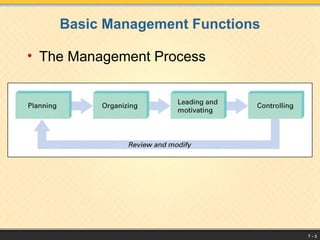
• The Management Process
7 - 4
Planning
• Planning
– Establishing organizational goals and deciding
how to accomplish them
• Mission
– A statement of the basic purpose that makes an
organization different from others
• Strategic planning
– The process of establishing an organization’s
major goals and objectives and allocating the
resources to achieve them
7 - 5
Planning (cont’d)
• Establishing goals and objectives
– Goal
• An end result that the organization is expected to
achieve over a one-to-ten year period
– Objective
• A specific statement detailing what the organization
intends to accomplish over a shorter period of time
– Properly set goals are
• Set at every level in the organization
• Consistent (supportive) with each other
• Optimized (balanced) to reduce conflicts between goals
7 - 6
Planning (cont’d)
• Establishing plans to accomplish goals and
objectives
– An outline of the actions by which the organization
intends to accomplish its goals and objectives
• Strategy
• An organization’s broadest set of plans, a guide for major
policy setting and decision making
• Tactical plan
• A smaller-scale plan to implement a strategy
• Operational plan
• A plan to implement a tactical plan
• Contingency plan
• A plan of alternative courses of action if the organization’s
other plans are disrupted or become ineffective
7 - 7
Organizing the Enterprise
• Organizing
– The grouping of resources and activities to
accomplish some end result in an efficient and
effective manner
• Leading and Motivating
– Leading
• Influencing people to work toward a common goal
– Motivating
• Providing reasons for people to work in the best interests
of the organization
– Directing
• The combined processes of leading and motivating
7 - 8
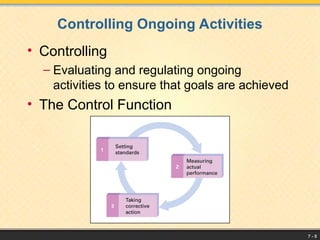
Controlling Ongoing Activities
• Controlling
– Evaluating and regulating ongoing
activities to ensure that goals are achieved
• The Control Function
7 - 9
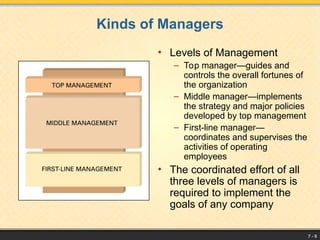
Kinds of Managers
• Levels of Management
– Top manager—guides and
controls the overall fortunes of
the organization
– Middle manager—implements
the strategy and major policies
developed by top management
– First-line manager—
coordinates and supervises the
activities of operating
employees
• The coordinated effort of all
three levels of managers is
required to implement the
goals of any company
7 - 10
Areas of Management
• Financial Managers
– Responsible for the organization’s financial resources
• Operations Managers
– Manage the systems that convert resources into goods and
services
• Marketing Managers
– Responsible for facilitating the exchange of products
between the organization and its customers or clients
• Human Resources Managers
– Manage the organization’s human resources programs
• Administrative Managers (General Managers)
– Not associated with any specific functional area; provide
overall administrative guidance and leadership
7 - 11
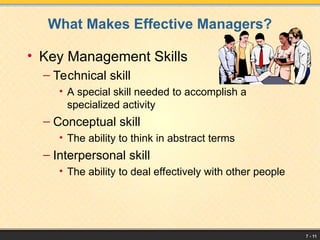
What Makes Effective Managers?
• Key Management Skills
– Technical skill
• A special skill needed to accomplish a
specialized activity
– Conceptual skill
• The ability to think in abstract terms
– Interpersonal skill
• The ability to deal effectively with other people
7 - 12
What Makes Effective Managers? (cont’d)
• Managerial Roles
– Decisional roles
• Involve various aspects of management
decision making
– Entrepreneur, disturbance handler, resource
allocator, negotiator
– Interpersonal roles
• The manager deals with people
– Figurehead, liaison, leader
– Informational roles
• A manager either gathers or provides
information
– Monitor, disseminator, spokesperson
7 - 13
Leadership
• The ability to influence others
• Leadership vs. management
• Formal leadership
– Legitimate power of position is the basis for
authority
• Informal leadership
– Not recognized formally by the
organization
7 - 14
Styles of Leadership
• Authoritarian
– Holds all authority and responsibility, with
communication usually moving from top to bottom
• Laissez-faire
– Gives authority to employees and allows
subordinates to work as they choose with a
minimum of of interference; communication flows
horizontally among group members
• Democratic
– Holds final responsibility but also delegates
authority to others, who help determine work
assignments; communication is active upward and
downward
7 - 15
Which Leadership Style Is Best?
• Matching style to the situation
• Effective leadership depends on
– Interaction among the employees
– Characteristics of the work situation
– The manager’s personality
7 - 16
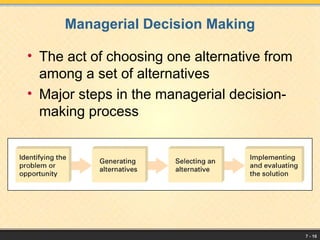
Managerial Decision Making
• The act of choosing one alternative from
among a set of alternatives
• Major steps in the managerial decision-
making process
7 - 17
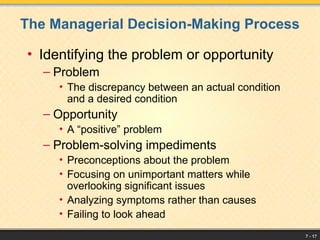
The Managerial Decision-Making Process
• Identifying the problem or opportunity
– Problem
• The discrepancy between an actual condition
and a desired condition
– Opportunity
• A “positive” problem
– Problem-solving impediments
• Preconceptions about the problem
• Focusing on unimportant matters while
overlooking significant issues
• Analyzing symptoms rather than causes
• Failing to look ahead
7 - 18
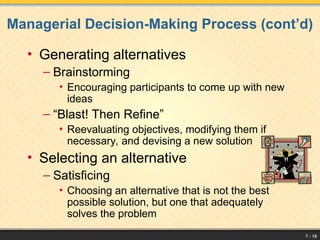
Managerial Decision-Making Process (cont’d)
• Generating alternatives
– Brainstorming
• Encouraging participants to come up with new
ideas
– “Blast! Then Refine”
• Reevaluating objectives, modifying them if
necessary, and devising a new solution
• Selecting an alternative
– Satisficing
• Choosing an alternative that is not the best
possible solution, but one that adequately
solves the problem
7 - 19
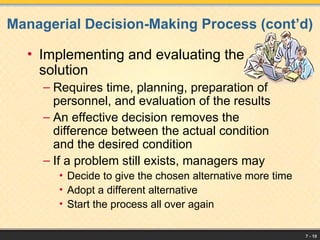
Managerial Decision-Making Process (cont’d)
• Implementing and evaluating the
solution
– Requires time, planning, preparation of
personnel, and evaluation of the results
– An effective decision removes the
difference between the actual condition
and the desired condition
– If a problem still exists, managers may
• Decide to give the chosen alternative more time
• Adopt a different alternative
• Start the process all over again
7 - 20
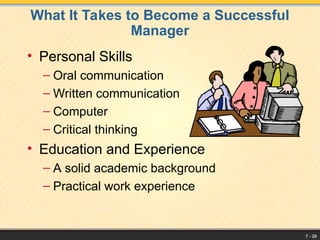
What It Takes to Become a Successful
Manager
• Personal Skills
– Oral communication
– Written communication
– Computer
– Critical thinking
• Education and Experience
– A solid academic background
– Practical work experience

Management process, explained in detail with step by step.

  • 1.
  • 2.
    7 - 2 WhatIs Management? • The process of coordinating people and other resources to achieve the goals of an organization – Material resources • The tangible physical resources an organization uses – Human resources • The people who staff the organization and use the other resources to achieve the goals of the organization – Financial resources • The funds the organization uses to meet its obligations to investors and creditors – Information resources • The information about internal and external business environmental conditions that the firm uses to its competitive advantage
  • 3.
    7 - 3 BasicManagement Functions • The Management Process
  • 4.
    7 - 4 Planning •Planning – Establishing organizational goals and deciding how to accomplish them • Mission – A statement of the basic purpose that makes an organization different from others • Strategic planning – The process of establishing an organization’s major goals and objectives and allocating the resources to achieve them
  • 5.
    7 - 5 Planning(cont’d) • Establishing goals and objectives – Goal • An end result that the organization is expected to achieve over a one-to-ten year period – Objective • A specific statement detailing what the organization intends to accomplish over a shorter period of time – Properly set goals are • Set at every level in the organization • Consistent (supportive) with each other • Optimized (balanced) to reduce conflicts between goals
  • 6.
    7 - 6 Planning(cont’d) • Establishing plans to accomplish goals and objectives – An outline of the actions by which the organization intends to accomplish its goals and objectives • Strategy • An organization’s broadest set of plans, a guide for major policy setting and decision making • Tactical plan • A smaller-scale plan to implement a strategy • Operational plan • A plan to implement a tactical plan • Contingency plan • A plan of alternative courses of action if the organization’s other plans are disrupted or become ineffective
  • 7.
    7 - 7 Organizingthe Enterprise • Organizing – The grouping of resources and activities to accomplish some end result in an efficient and effective manner • Leading and Motivating – Leading • Influencing people to work toward a common goal – Motivating • Providing reasons for people to work in the best interests of the organization – Directing • The combined processes of leading and motivating
  • 8.
    7 - 8 ControllingOngoing Activities • Controlling – Evaluating and regulating ongoing activities to ensure that goals are achieved • The Control Function
  • 9.
    7 - 9 Kindsof Managers • Levels of Management – Top manager—guides and controls the overall fortunes of the organization – Middle manager—implements the strategy and major policies developed by top management – First-line manager— coordinates and supervises the activities of operating employees • The coordinated effort of all three levels of managers is required to implement the goals of any company
  • 10.
    7 - 10 Areasof Management • Financial Managers – Responsible for the organization’s financial resources • Operations Managers – Manage the systems that convert resources into goods and services • Marketing Managers – Responsible for facilitating the exchange of products between the organization and its customers or clients • Human Resources Managers – Manage the organization’s human resources programs • Administrative Managers (General Managers) – Not associated with any specific functional area; provide overall administrative guidance and leadership
  • 11.
    7 - 11 WhatMakes Effective Managers? • Key Management Skills – Technical skill • A special skill needed to accomplish a specialized activity – Conceptual skill • The ability to think in abstract terms – Interpersonal skill • The ability to deal effectively with other people
  • 12.
    7 - 12 WhatMakes Effective Managers? (cont’d) • Managerial Roles – Decisional roles • Involve various aspects of management decision making – Entrepreneur, disturbance handler, resource allocator, negotiator – Interpersonal roles • The manager deals with people – Figurehead, liaison, leader – Informational roles • A manager either gathers or provides information – Monitor, disseminator, spokesperson
  • 13.
    7 - 13 Leadership •The ability to influence others • Leadership vs. management • Formal leadership – Legitimate power of position is the basis for authority • Informal leadership – Not recognized formally by the organization
  • 14.
    7 - 14 Stylesof Leadership • Authoritarian – Holds all authority and responsibility, with communication usually moving from top to bottom • Laissez-faire – Gives authority to employees and allows subordinates to work as they choose with a minimum of of interference; communication flows horizontally among group members • Democratic – Holds final responsibility but also delegates authority to others, who help determine work assignments; communication is active upward and downward
  • 15.
    7 - 15 WhichLeadership Style Is Best? • Matching style to the situation • Effective leadership depends on – Interaction among the employees – Characteristics of the work situation – The manager’s personality
  • 16.
    7 - 16 ManagerialDecision Making • The act of choosing one alternative from among a set of alternatives • Major steps in the managerial decision- making process
  • 17.
    7 - 17 TheManagerial Decision-Making Process • Identifying the problem or opportunity – Problem • The discrepancy between an actual condition and a desired condition – Opportunity • A “positive” problem – Problem-solving impediments • Preconceptions about the problem • Focusing on unimportant matters while overlooking significant issues • Analyzing symptoms rather than causes • Failing to look ahead
  • 18.
    7 - 18 ManagerialDecision-Making Process (cont’d) • Generating alternatives – Brainstorming • Encouraging participants to come up with new ideas – “Blast! Then Refine” • Reevaluating objectives, modifying them if necessary, and devising a new solution • Selecting an alternative – Satisficing • Choosing an alternative that is not the best possible solution, but one that adequately solves the problem
  • 19.
    7 - 19 ManagerialDecision-Making Process (cont’d) • Implementing and evaluating the solution – Requires time, planning, preparation of personnel, and evaluation of the results – An effective decision removes the difference between the actual condition and the desired condition – If a problem still exists, managers may • Decide to give the chosen alternative more time • Adopt a different alternative • Start the process all over again
  • 20.
    7 - 20 WhatIt Takes to Become a Successful Manager • Personal Skills – Oral communication – Written communication – Computer – Critical thinking • Education and Experience – A solid academic background – Practical work experience