-Have been teaching Math since first
assumed the teaching position.
-Have been teaching Math for more
than 10 years
-Have been teaching Math for less
than 10 years but more than 3 years.
- Math major/specialist
-Non-Central Teacher
#ABOUTME
-Have attended Math Training for the
past 5 years
-Awarded as Outstanding Math Teacher
-Is teaching Math in Early Grades for
the first time.
-MT III, MT II, MT I, T-III, T-II, T-I
-Single, beautiful /handsome
- Ready to take the challenge
#ABOUTME
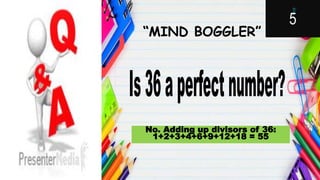
“MIND BOGGLER”
No. Adding up divisors of 36:
1+2+3+4+6+9+12+18 = 55
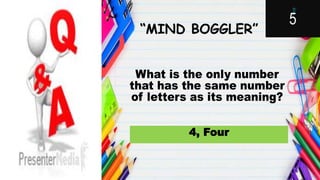
“MIND BOGGLER”
4, Four
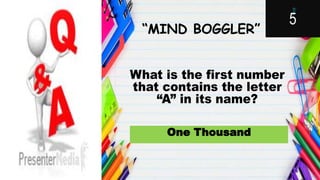
“MIND BOGGLER”
One Thousand
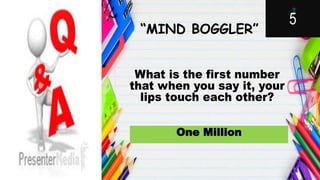
“MIND BOGGLER”
One Million
“MIND BOGGLER”
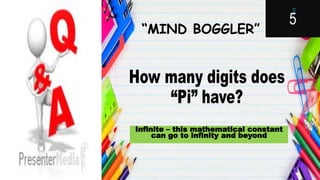
Infinite – this mathematical constant
can go to infinity and beyond
SESSION
OBJECTIVES
1. Understand the concept of
visualization and its importance.
2.Demonstrate competence in
teaching visualizing numbers and
fractions
3.Appreciate effective strategies
/techniques /practices in
teaching visualization of large
numbers and fractions
Is any technique for
creating image, diagram or
animation to communicate
message
-helps us to understand the
mathematical statements
-helps us to think the problem
through to clarity,
- helps us to see the situation as a
whole.
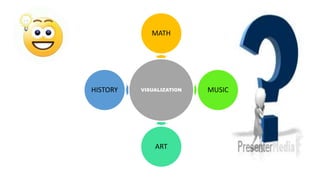
VISUALIZATION
MATH
MUSIC
ART
HISTORY
..
What strategy / technique/practices you have been
using in teaching visualizing numbers that you believe
effective?
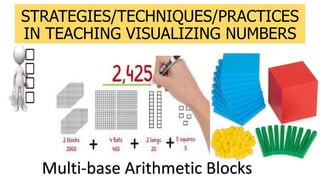
STRATEGIES/TECHNIQUES/PRACTICES
IN TEACHING VISUALIZING NUMBERS
Multi-base Arithmetic Blocks
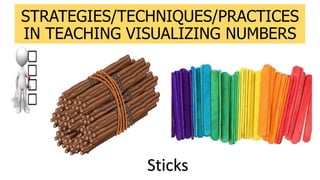
STRATEGIES/TECHNIQUES/PRACTICES
IN TEACHING VISUALIZING NUMBERS
Sticks
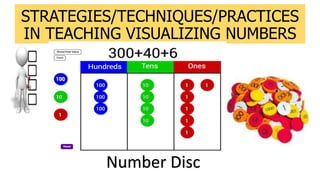
STRATEGIES/TECHNIQUES/PRACTICES
IN TEACHING VISUALIZING NUMBERS
Number Disc
STRATEGIES/TECHNIQUES/PRACTICES
IN TEACHING VISUALIZING NUMBERS
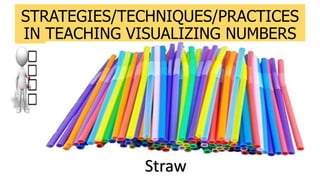
Straw
STRATEGIES/TECHNIQUES/PRACTICES
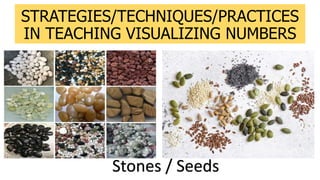
IN TEACHING VISUALIZING NUMBERS
Stones / Seeds
STRATEGIES/TECHNIQUES/PRACTICES/
IN TEACHING VISUALIZING NUMBERS
Beads / Softdrinks’ Caps
STRATEGIES/TECHNIQUES/PRACTICES
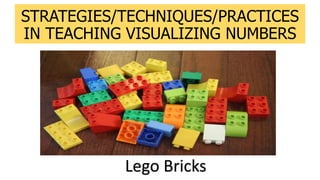
IN TEACHING VISUALIZING NUMBERS
Lego Bricks
STRATEGIES/TECHNIQUES/PRACTICES
IN TEACHING VISUALIZING FRACTIONS
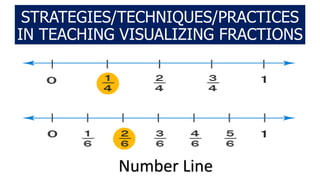
Number Line
STRATEGIES/TECHNIQUES/PRACTICES
IN TEACHING VISUALIZING FRACTIONS
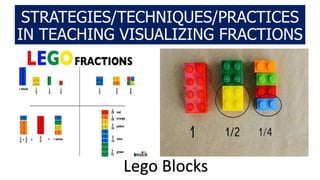
Lego Blocks
STRATEGIES/TECHNIQUES/PRACTICES
IN TEACHING VISUALIZING FRACTIONS
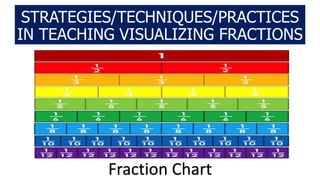
Fraction Chart
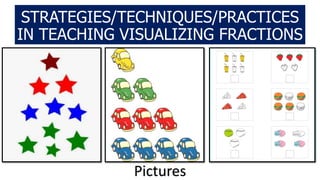
STRATEGIES/TECHNIQUES/PRACTICES
IN TEACHING VISUALIZING FRACTIONS
Pictures
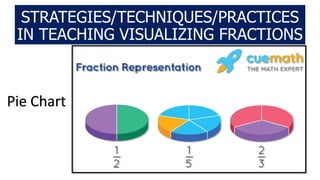
STRATEGIES/TECHNIQUES/PRACTICES
IN TEACHING VISUALIZING FRACTIONS
Pie Chart
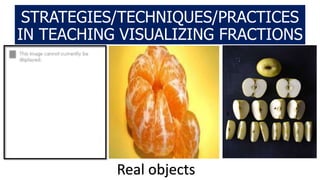
STRATEGIES/TECHNIQUES/PRACTICES
IN TEACHING VISUALIZING FRACTIONS
Real objects
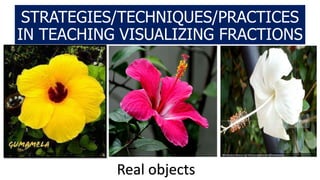
STRATEGIES/TECHNIQUES/PRACTICES
IN TEACHING VISUALIZING FRACTIONS
Real objects
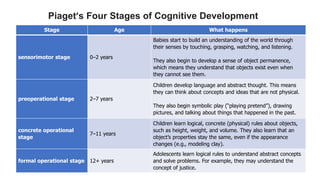
Stage Age What happens
sensorimotor stage 0–2 years
Babies start to build an understanding of the world through
their senses by touching, grasping, watching, and listening.
They also begin to develop a sense of object permanence,
which means they understand that objects exist even when
they cannot see them.
preoperational stage 2–7 years
Children develop language and abstract thought. This means
they can think about concepts and ideas that are not physical.
They also begin symbolic play (“playing pretend”), drawing
pictures, and talking about things that happened in the past.
concrete operational
stage
7–11 years
Children learn logical, concrete (physical) rules about objects,
such as height, weight, and volume. They also learn that an
object’s properties stay the same, even if the appearance
changes (e.g., modeling clay).
formal operational stage 12+ years
Adolescents learn logical rules to understand abstract concepts
and solve problems. For example, they may understand the
concept of justice.
Piaget’s Four Stages of Cognitive Development
The Preoperational Stage (2–7 years)
During this stage, children build on object permanence and
continue to develop abstract mental processes. This means
they can think about things beyond the physical world, such
as things that happened in the past.
They also imagine and think symbolically, and they begin to
display this ability through their language and behavior.
Piaget’s Four Stages of Cognitive Development
The five key behaviors children display during this period are:
 Imitation: Children can now mimic another person’s actions, even if the
individual they are modeling is no longer in front of them.
 Symbolic play: Children begin assigning characteristics or symbols to objects.
They can project the properties of one object onto another. For example, they
may pretend a stick is a sword.
 Drawing: Imitation and symbolic play are both essential elements of drawing. It
begins as meaningless scribbles and progresses to more accurate
representations of objects and people.
 Mental imagery: Children start to visualize a wide range of things in their mind.
They may ask the names of objects frequently to establish associations
between words and objects.
 Verbal evocation of events: This means children can use words to describe
and represent past events, people, or items.
Piaget’s Four Stages of Cognitive Development
Some examples a child is at the preoperational stage include:
 imitating the way someone talks or moves even when they
are not in the room
 drawing people and objects from their own life but
understanding they are only representations
 pretending a stick is a sword or that a broom is a horse during
play
 imagining that they are a superhero or someone they admire
 inventing an imaginary friend
Piaget’s Four Stages of Cognitive Development
The Concrete Operational Stage (7–11 years)
Piaget theorized that at this stage, children further develop and
master abstract thought and become less egocentric. They can
now understand that events do not always relate to them and
that others have different points of view.
Children also become able to apply logical, concrete rules to
physical objects. However, they cannot yet do the same thing
for abstract concepts.
Piaget’s Four Stages of Cognitive Development
Some signs a child has learned the skills from this stage
include:
 knowing that water has the same properties (e.g., wetness)
even when it is in different vessels or has a different color
 understanding that water can freeze and then melt again but
that other changes are permanent
 being able to organize crayons into groups based on their
color
 being able to sort their toys into order, based on their size or
importance
STRATEGIES/TECHNIQUES/PRACTICES
IN TEACHING VISUALIZING FRACTIONS
Real objects
“The key to Math success for students involve helping
them create images that go with the numbers and
Mathematics principles that they need to understand”
VISUALIZING LARGE NUMBERS.pptx

VISUALIZING LARGE NUMBERS.pptx

  • 3.
    -Have been teachingMath since first assumed the teaching position. -Have been teaching Math for more than 10 years -Have been teaching Math for less than 10 years but more than 3 years. - Math major/specialist -Non-Central Teacher #ABOUTME
  • 4.
    -Have attended MathTraining for the past 5 years -Awarded as Outstanding Math Teacher -Is teaching Math in Early Grades for the first time. -MT III, MT II, MT I, T-III, T-II, T-I -Single, beautiful /handsome - Ready to take the challenge #ABOUTME
  • 5.
    “MIND BOGGLER” No. Addingup divisors of 36: 1+2+3+4+6+9+12+18 = 55
  • 6.
  • 7.
  • 8.
  • 9.
    “MIND BOGGLER” Infinite –this mathematical constant can go to infinity and beyond
  • 11.
    SESSION OBJECTIVES 1. Understand theconcept of visualization and its importance. 2.Demonstrate competence in teaching visualizing numbers and fractions 3.Appreciate effective strategies /techniques /practices in teaching visualization of large numbers and fractions
  • 13.
    Is any techniquefor creating image, diagram or animation to communicate message
  • 14.
    -helps us tounderstand the mathematical statements -helps us to think the problem through to clarity, - helps us to see the situation as a whole.
  • 15.
  • 29.
  • 30.
    What strategy /technique/practices you have been using in teaching visualizing numbers that you believe effective?
  • 32.
    STRATEGIES/TECHNIQUES/PRACTICES IN TEACHING VISUALIZINGNUMBERS Multi-base Arithmetic Blocks
  • 33.
  • 34.
  • 35.
  • 36.
  • 37.
  • 38.
  • 39.
  • 40.
  • 41.
  • 42.
  • 43.
  • 44.
  • 45.
  • 46.
    Stage Age Whathappens sensorimotor stage 0–2 years Babies start to build an understanding of the world through their senses by touching, grasping, watching, and listening. They also begin to develop a sense of object permanence, which means they understand that objects exist even when they cannot see them. preoperational stage 2–7 years Children develop language and abstract thought. This means they can think about concepts and ideas that are not physical. They also begin symbolic play (“playing pretend”), drawing pictures, and talking about things that happened in the past. concrete operational stage 7–11 years Children learn logical, concrete (physical) rules about objects, such as height, weight, and volume. They also learn that an object’s properties stay the same, even if the appearance changes (e.g., modeling clay). formal operational stage 12+ years Adolescents learn logical rules to understand abstract concepts and solve problems. For example, they may understand the concept of justice. Piaget’s Four Stages of Cognitive Development
  • 47.
    Piaget’s Four Stagesof Cognitive Development The Preoperational Stage (2–7 years) During this stage, children build on object permanence and continue to develop abstract mental processes. This means they can think about things beyond the physical world, such as things that happened in the past. They also imagine and think symbolically, and they begin to display this ability through their language and behavior.

  • 48.
    Piaget’s Four Stagesof Cognitive Development The five key behaviors children display during this period are:  Imitation: Children can now mimic another person’s actions, even if the individual they are modeling is no longer in front of them.  Symbolic play: Children begin assigning characteristics or symbols to objects. They can project the properties of one object onto another. For example, they may pretend a stick is a sword.  Drawing: Imitation and symbolic play are both essential elements of drawing. It begins as meaningless scribbles and progresses to more accurate representations of objects and people.  Mental imagery: Children start to visualize a wide range of things in their mind. They may ask the names of objects frequently to establish associations between words and objects.  Verbal evocation of events: This means children can use words to describe and represent past events, people, or items.
  • 49.
    Piaget’s Four Stagesof Cognitive Development Some examples a child is at the preoperational stage include:  imitating the way someone talks or moves even when they are not in the room  drawing people and objects from their own life but understanding they are only representations  pretending a stick is a sword or that a broom is a horse during play  imagining that they are a superhero or someone they admire  inventing an imaginary friend
  • 50.
    Piaget’s Four Stagesof Cognitive Development The Concrete Operational Stage (7–11 years) Piaget theorized that at this stage, children further develop and master abstract thought and become less egocentric. They can now understand that events do not always relate to them and that others have different points of view. Children also become able to apply logical, concrete rules to physical objects. However, they cannot yet do the same thing for abstract concepts.
  • 51.
    Piaget’s Four Stagesof Cognitive Development Some signs a child has learned the skills from this stage include:  knowing that water has the same properties (e.g., wetness) even when it is in different vessels or has a different color  understanding that water can freeze and then melt again but that other changes are permanent  being able to organize crayons into groups based on their color  being able to sort their toys into order, based on their size or importance
  • 52.
  • 54.
    “The key toMath success for students involve helping them create images that go with the numbers and Mathematics principles that they need to understand”

Editor's Notes

  • #3 Say: HELLO GOOD MORNING! HOW ARE YOU TODAY, THIS BLESSED TUESDAY MORNING? WE MUST BE GRATEFUL AND THANKFUL BECAUSE GOD HAS GIVEN US ANOTHER DAY OF OPPORTUNITY TO ENHANCE OUR CRAFT. SO, AGAIN, GOOD MORNING AND WELCOME TO MY SESSION. I HOPE, I WILL BE ABLE TO MEET YOUR EXPECTATIONS.
  • #11 Say: ONCE AGAIN LET ME WELCOME TO THIS SESSION, “ VISUALIZING LARGE NUMBERS & FRACTIONS” I KNOW YOU ARE ALL FAMILIAR TO THIS TOPIC AND THE OTHER TOPICS TO BE DISCUSSED WITHIN 2 DAYS. THIS CAPABILITY BUILDING IS MORE OF RE-LEARNING, RETOOLING, RECALIBRATING OUR KNOWLEDGE AND SKILLS IN TEACHING MATH LESSONS.
  • #13 VISUALIZATION: (creating image, diagram or animation,,, to imagine, to paint something in your mind,,,,to make something visible, formation of mental image of something, representation of an object, situation or set of information) Ask: “What’s the purpose of creating image?” (to communicate a message, to represent something) Say: “So, therefore visualization…
  • #14 Say: “So, therefore visualization can be define as a any technique for creating image, diagram or animation to communicate message or represent something”
  • #15 Note: Let the participants read each reason. Say: “Taking into consideration the importance of visualization or visualizing skills, this is the very reason why this specific competency is given focus in this training because this is one of the least learned skills in Early Grade Mathematics.”
  • #16 Content Area Examples Math- Visualizing can be adapted in a math lesson by the teacher doing a read aloud to the students and having them visualize what the teacher is reading.  For example, if the teacher is doing a read aloud on different shapes, the students might want to visualize what the shapes might look like.  The students can create images in their mind of what they think the shape might look like, and draw it on paper.  When the teacher finishes the read aloud, he/she should show the students what the shape looks like.  There is no right or wrong answer when the students are creating their images.   [ Music-  This strategy can be adapted in a music lesson by having the students listen to music, visualize how the music makes them feel and what they "see," and then drawing or writing on paper their images.  For example, I had my students listen to music, and then draw lines on paper expressing how they felt as the music was playing.  If it was a graceful song, the students would draw smooth wavy lines on their paper.  If it was a scary song, the students would visualize and draw jagged lines that went all over the page in every which way.   History- Visualizing could be adapted in a history lesson by having the students read a chapter in their history book and visualizing what they see and how the story made them feel.  For example, the students may be reading a chapter on Native Americans and their living style.  Some Indians lived in Ti Pi's.  The students may visualize what Ti Pis look like and draw what they see in their mind.    Art- Visualizing is used in art very often.  For example, a teacher might read a book about fall, and have the stunts visualize the story and paint what they see in their mind.  The students may use warm colors (red, orange, yellow) when painting a picture about fall.  They may paint a picture of themselves jumping in a pile of leaves.  There is no correct way to draw what they see.  Once the students are done painting their vision from the story, the teacher may have the students share their painting and justify why they drew their image using specific words from the story. 
  • #17 Say: WHAT MESSAGE CAN YOU DEDUCE FROM THE PICTURE/ ILLUSTRATION? WHAT MESSAGE IS BEING CONVEYED?
  • #18 Note: Let the participants read each reason. Say: “Taking into consideration the importance of visualization or visualizing skills, this is the very reason why this specific competency is given focus in this training because this is one of the least learned skills in Early Grade Mathematics.”
  • #19 Note: Let the participants read each reason. Say: “Taking into consideration the importance of visualization or visualizing skills, this is the very reason why this specific competency is given focus in this training because this is one of the least learned skills in Early Grade Mathematics.”
  • #20 Note: Let the participants read each reason. Say: “Taking into consideration the importance of visualization or visualizing skills, this is the very reason why this specific competency is given focus in this training because this is one of the least learned skills in Early Grade Mathematics.”
  • #21 Note: Let the participants read each reason. Say: “Taking into consideration the importance of visualization or visualizing skills, this is the very reason why this specific competency is given focus in this training because this is one of the least learned skills in Early Grade Mathematics.”
  • #22 Note: Let the participants read each reason. Say: “Taking into consideration the importance of visualization or visualizing skills, this is the very reason why this specific competency is given focus in this training because this is one of the least learned skills in Early Grade Mathematics.”
  • #24 Note: Let the participants read each reason. Say: “Taking into consideration the importance of visualization or visualizing skills, this is the very reason why this specific competency is given focus in this training because this is one of the least learned skills in Early Grade Mathematics.”
  • #30 Ask; “What have you observed with the looped learning competencies? What common skill is being emphasized? What do you noticed with the sequence or arrangement of these competencies? Where are they located? What does this mean?
  • #31 Say:
  • #32 Say:
  • #33 Say:
  • #34 Say:
  • #35 Say:
  • #36 Say:
  • #37 Say:
  • #38 Say:
  • #39 Say:
  • #40 Say:
  • #41 Say:
  • #42 Say:
  • #43 Say:
  • #44 Say:
  • #45 Say:
  • #46 Say:
  • #47 Say:
  • #48 Say:
  • #49 Say: The primary function of speech at this age is to externalize thinking, rather than for communication. Children may talk in a stream of consciousness and develop more sophisticated language skills as they move through this stage. Piaget believed that children remain egocentric throughout the preoperational stage. This means they cannot understand that other people think in different ways to them or that events that take place are not always related to them.
  • #50 Say:
  • #51 Say:
  • #52 Say:
  • #53 Say:
  • #54 Say:
  • #55 Say:
  • #56 Say: