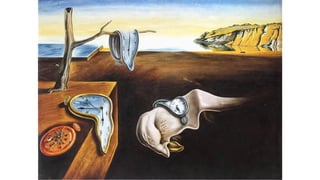
The Presistence ofMemory 19
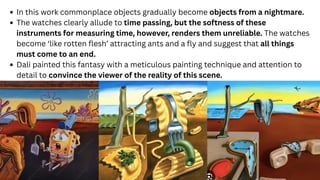
A barren space where time stands still.
A strange never-setting sun illuminates the landscape.
The cliffs in the distance are actually from a place in
Catalonia, where he grew up.
An amorphous* creature sleeps in the foreground.
This could be the face of Dali himself with long eyelashes that seem to be insect-like.
Dali has draped this creature with a limp pocket watch.
Ants swarm mysteriously over the small watch, while a fly walks on the face of the
neighbouring watch.
Another watch hangs like a pancake from the branch of a dead tree that springs
unexpectedly from a block-like architectural form.
A third watch hangs half over the edge of this rectangular form, beside a small watch
resting dial-down on the block.
It is as if these watches were organic and decaying, soft and sticky.
AMORPHOUS: without a clearly defined shape or form.
13.
In this workcommonplace objects gradually become objects from a nightmare.
The watches clearly allude to time passing, but the softness of these
instruments for measuring time, however, renders them unreliable. The watches
become ‘like rotten flesh’ attracting ants and a fly and suggest that all things
must come to an end.
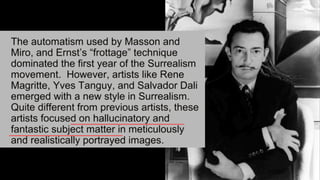
Dali painted this fantasy with a meticulous painting technique and attention to
detail to convince the viewer of the reality of this scene.
14.
Rene Magritte
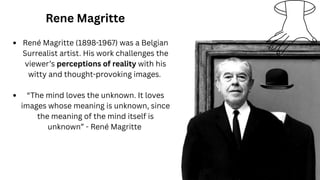
René Magritte(1898-1967) was a Belgian
Surrealist artist. His work challenges the
viewer’s perceptions of reality with his
witty and thought-provoking images.
“The mind loves the unknown. It loves
images whose meaning is unknown, since
the meaning of the mind itself is
unknown” - René Magritte
16.
Time Transfixed -1938
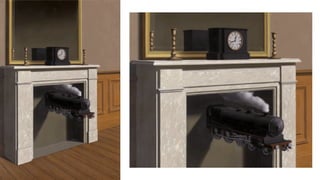
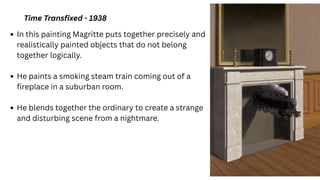
In this painting Magritte puts together precisely and
realistically painted objects that do not belong
together logically.
He paints a smoking steam train coming out of a
fireplace in a suburban room.
He blends together the ordinary to create a strange
and disturbing scene from a nightmare.
18.
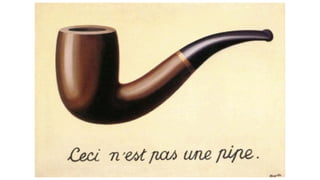
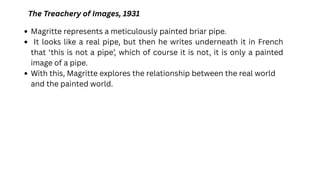
The Treachery ofImages, 1931
Magritte represents a meticulously painted briar pipe.
It looks like a real pipe, but then he writes underneath it in French
that ‘this is not a pipe’, which of course it is not, it is only a painted
image of a pipe.
With this, Magritte explores the relationship between the real world
and the painted world.