







State Led Virtual School Leaders:
An Exploratory Study
Mark J. Sivy
University of North Carolina at Charlotte
Department of Educational Leadership
February 27, 2014
Introduction
 A virtual school is an educational organization that offers
its courses and services via the Internet for students who
are at-a-distance.
 The first virtual school was launched in 1996, with the first
state led virtual school (SLVS) established in Florida in 1997.
 SLVS course enrollments in 2012-2013 (740,000) were a
131% increase over 2008-2009 (Watson, Murin, Vashaw, Gemin, &
Rapp, 2013).
 One projection is that by 2020 it is possible 50% of all high
school classes to be delivered online (Minceberg, 2010).
Problem Statement
 There are insufficient research-based findings to
adequately portray the role of the virtual school leader.
 For the topic of SLVS senior leaders, study findings are
extremely limited in quantity and scope.
 Additional research is needed to better understand the
parameters that define and impact the SLVS senior
leadership role and how SLVS senior leaders can best
address their responsibilities.
Support for Problem Statement
 The vast majority if not all current SLVS senior leaders
never planned an intentional path to virtual school
leadership (Brown, 2008).
 There is a growing number of virtual leaders who require
preparation, training, and development and research is
needed to develop these opportunities (Beck & France, 2012).
Purpose of Study
 The purpose of this study was the discovery and
presentation of findings related to role characteristics,
influential factors, and requirements that can impact
SLVS senior leadership qualities, attributes, beliefs, and
approaches.
Significance of Study
 The findings provide a much needed scaffolding and
direction for future research.
 This research informs the creation of professional
development offerings, certification agendas and
university preparatory programs that are seeking to
produce knowledgeable and effective SLVS leaders.
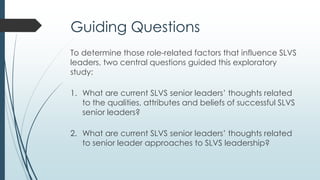
Guiding Questions
To determine those role-related factors that influence SLVS
leaders, two central questions guided this exploratory
study:
1. What are current SLVS senior leaders’ thoughts related
to the qualities, attributes and beliefs of successful SLVS
senior leaders?
2. What are current SLVS senior leaders’ thoughts related
to senior leader approaches to SLVS leadership?
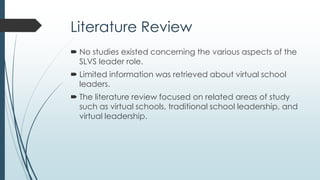
Literature Review
 No studies existed concerning the various aspects of the
SLVS leader role.
 Limited information was retrieved about virtual school
leaders.
 The literature review focused on related areas of study
such as virtual schools, traditional school leadership, and
virtual leadership.
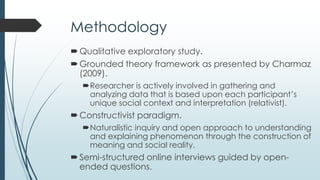
Methodology
Qualitative exploratory study.
Grounded theory framework as presented by Charmaz
(2009).
Researcher is actively involved in gathering and
analyzing data that is based upon each participant’s
unique social context and interpretation (relativist).
Constructivist paradigm.
Naturalistic inquiry and open approach to understanding
and explaining phenomenon through the construction of
meaning and social reality.
Semi-structured online interviews guided by open-
ended questions.
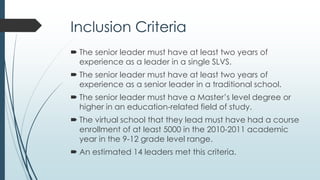
Inclusion Criteria
 The senior leader must have at least two years of
experience as a leader in a single SLVS.
 The senior leader must have at least two years of
experience as a senior leader in a traditional school.
 The senior leader must have a Master’s level degree or
higher in an education-related field of study.
 The virtual school that they lead must have had a course
enrollment of at least 5000 in the 2010-2011 academic
year in the 9-12 grade level range.
 An estimated 14 leaders met this criteria.
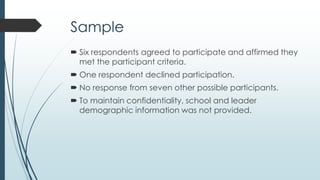
Sample
 Six respondents agreed to participate and affirmed they
met the participant criteria.
 One respondent declined participation.
 No response from seven other possible participants.
 To maintain confidentiality, school and leader
demographic information was not provided.
Data Collection
 Conducted 55-60 minute online interviews.
 Nine open-ended interview questions were asked of all
participants.
 Additional probing questions as needed.
 Discussions were digitally recorded and transcribed.
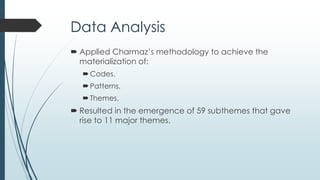
Data Analysis
 Applied Charmaz’s methodology to achieve the
materialization of:
Codes.
Patterns.
Themes.
 Resulted in the emergence of 59 subthemes that gave
rise to 11 major themes.
Credibility
Upheld by two qualitative approaches presented by Cho
and Trent (2006):
 Self-reflection and self-checking.
Aligns with Charmaz’s grounded theory data analysis
approach.
 Transactional validity.
Open-ended, non-leading questions.
Assuring the analysis is supported by the data.
Peer debriefing.
Inter-rater reliability (Cronbach’s alphas of .70, .85, and .89).
Emergent Themes
 Leader education, experience, and professional growth.
 Leader profile.
 Curriculum & instruction.
 The learner.
 Human capital.
 Work environment.
Emergent Themes (continued)
 Internal communication.
 External communication.
 Capital resources.
 Governing entity and legislators.
 Other influences.
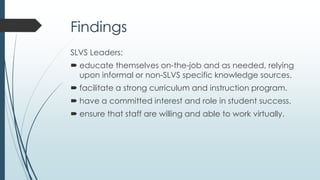
Findings
SLVS Leaders:
 educate themselves on-the-job and as needed, relying
upon informal or non-SLVS specific knowledge sources.
 facilitate a strong curriculum and instruction program.
 have a committed interest and role in student success.
 ensure that staff are willing and able to work virtually.
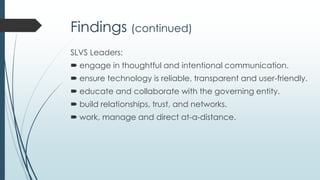
Findings (continued)
SLVS Leaders:
 engage in thoughtful and intentional communication.
 ensure technology is reliable, transparent and user-friendly.
 educate and collaborate with the governing entity.
 build relationships, trust, and networks.
 work, manage and direct at-a-distance.
Findings – Guiding Question 1
SLVS leaders:
 rely upon pre-existing traditional school experience and
knowledge.
 believe that the virtual school is for and about the
students.
 were self-described as being
visionary, empowering, supportive, collaborative, comm
unicative, trusting, and committed.
 were observed as being self-motivated, caring, broad-
minded, encouraging, confident, creative, passionate,
determined, and inspiring.
Findings – Guiding Question 2
 SLVS leaders’ approach was closely aligned with that of
transformational leadership, which offers followers:
inspiration to focus on the team and organization.
encouragement to think critically and creatively.
support, coaching, and recognition.
a trusted and respected role model.
 Transformational leadership correlates with studies on
virtual leadership in non-educational organizations.
Conclusions
 For the immediate future, new SLVS leaders will initially
depend heavily on prior experiences.
 Leaders will seek advice and professional development
through mixed channels, primarily via peer interactions,
SLVS staff, and non-SLVS development opportunities.
 There are many commonalities between the SLVSs for
which leaders can be prepared as a group.
 Each SLVS has unique characteristics that require
specialized leader tactics and skills.
 Each leader is unique and will rely upon their own
strengths, knowledge, and skills.
Limitations
 Study was restricted to larger state led virtual schools.
 Possibility of personal influence and bias.
 Online interviews possibly limited data.
 Findings are not directly transferable.
Implications
 Offers information that supports and guides current and
future leaders.
 Provides a foundation for future research.
 Serves as scaffolding for the development of virtual
school leadership standards and preparation offerings.
Recommendations - Research
 Further research is needed to continue the work started
by this study, resulting in:
generalizable findings for the field of virtual school and
online education program leadership.
specific findings for the leadership of SLVSs, charter virtual
schools, online school consortia, and other online
education programs.
a vetted and recognized set of virtual school leadership
standards.
Recommendations - Programs
 Development of comprehensive leadership certification
agendas through national organizations.
 Creation of higher education programs and courses for
online education and virtual school leadership.
 Design of standards-based professional development
sessions and workshops that target specific needs for
virtual school leaders.
 Provide in-depth learning through meaningful dialogue,
critical analysis, role-play, and case study.
Recommendations - Practice
 Individuals who are interested in becoming a virtual school
leader should seek
membership in professional organizations.
existing literature.
networking opportunities with current leaders.
 Interested individuals who are in another position within a
virtual school should inquire about succession planning.
 For purposes of support and ongoing development, existing
leaders should create a formal consortium or collaborative
organization that includes leaders from various online and
virtual school efforts.
Questions

Virtual School Leader Dissertation Defense

  • 1.
    State Led VirtualSchool Leaders: An Exploratory Study Mark J. Sivy University of North Carolina at Charlotte Department of Educational Leadership February 27, 2014
  • 2.
    Introduction  A virtualschool is an educational organization that offers its courses and services via the Internet for students who are at-a-distance.  The first virtual school was launched in 1996, with the first state led virtual school (SLVS) established in Florida in 1997.  SLVS course enrollments in 2012-2013 (740,000) were a 131% increase over 2008-2009 (Watson, Murin, Vashaw, Gemin, & Rapp, 2013).  One projection is that by 2020 it is possible 50% of all high school classes to be delivered online (Minceberg, 2010).
  • 3.
    Problem Statement  Thereare insufficient research-based findings to adequately portray the role of the virtual school leader.  For the topic of SLVS senior leaders, study findings are extremely limited in quantity and scope.  Additional research is needed to better understand the parameters that define and impact the SLVS senior leadership role and how SLVS senior leaders can best address their responsibilities.
  • 4.
    Support for ProblemStatement  The vast majority if not all current SLVS senior leaders never planned an intentional path to virtual school leadership (Brown, 2008).  There is a growing number of virtual leaders who require preparation, training, and development and research is needed to develop these opportunities (Beck & France, 2012).
  • 5.
    Purpose of Study The purpose of this study was the discovery and presentation of findings related to role characteristics, influential factors, and requirements that can impact SLVS senior leadership qualities, attributes, beliefs, and approaches.
  • 6.
    Significance of Study The findings provide a much needed scaffolding and direction for future research.  This research informs the creation of professional development offerings, certification agendas and university preparatory programs that are seeking to produce knowledgeable and effective SLVS leaders.
  • 7.
    Guiding Questions To determinethose role-related factors that influence SLVS leaders, two central questions guided this exploratory study: 1. What are current SLVS senior leaders’ thoughts related to the qualities, attributes and beliefs of successful SLVS senior leaders? 2. What are current SLVS senior leaders’ thoughts related to senior leader approaches to SLVS leadership?
  • 8.
    Literature Review  Nostudies existed concerning the various aspects of the SLVS leader role.  Limited information was retrieved about virtual school leaders.  The literature review focused on related areas of study such as virtual schools, traditional school leadership, and virtual leadership.
  • 9.
    Methodology Qualitative exploratory study. Groundedtheory framework as presented by Charmaz (2009). Researcher is actively involved in gathering and analyzing data that is based upon each participant’s unique social context and interpretation (relativist). Constructivist paradigm. Naturalistic inquiry and open approach to understanding and explaining phenomenon through the construction of meaning and social reality. Semi-structured online interviews guided by open- ended questions.
  • 10.
    Inclusion Criteria  Thesenior leader must have at least two years of experience as a leader in a single SLVS.  The senior leader must have at least two years of experience as a senior leader in a traditional school.  The senior leader must have a Master’s level degree or higher in an education-related field of study.  The virtual school that they lead must have had a course enrollment of at least 5000 in the 2010-2011 academic year in the 9-12 grade level range.  An estimated 14 leaders met this criteria.
  • 11.
    Sample  Six respondentsagreed to participate and affirmed they met the participant criteria.  One respondent declined participation.  No response from seven other possible participants.  To maintain confidentiality, school and leader demographic information was not provided.
  • 12.
    Data Collection  Conducted55-60 minute online interviews.  Nine open-ended interview questions were asked of all participants.  Additional probing questions as needed.  Discussions were digitally recorded and transcribed.
  • 13.
    Data Analysis  AppliedCharmaz’s methodology to achieve the materialization of: Codes. Patterns. Themes.  Resulted in the emergence of 59 subthemes that gave rise to 11 major themes.
  • 14.
    Credibility Upheld by twoqualitative approaches presented by Cho and Trent (2006):  Self-reflection and self-checking. Aligns with Charmaz’s grounded theory data analysis approach.  Transactional validity. Open-ended, non-leading questions. Assuring the analysis is supported by the data. Peer debriefing. Inter-rater reliability (Cronbach’s alphas of .70, .85, and .89).
  • 15.
    Emergent Themes  Leadereducation, experience, and professional growth.  Leader profile.  Curriculum & instruction.  The learner.  Human capital.  Work environment.
  • 16.
    Emergent Themes (continued) Internal communication.  External communication.  Capital resources.  Governing entity and legislators.  Other influences.
  • 17.
    Findings SLVS Leaders:  educatethemselves on-the-job and as needed, relying upon informal or non-SLVS specific knowledge sources.  facilitate a strong curriculum and instruction program.  have a committed interest and role in student success.  ensure that staff are willing and able to work virtually.
  • 18.
    Findings (continued) SLVS Leaders: engage in thoughtful and intentional communication.  ensure technology is reliable, transparent and user-friendly.  educate and collaborate with the governing entity.  build relationships, trust, and networks.  work, manage and direct at-a-distance.
  • 19.
    Findings – GuidingQuestion 1 SLVS leaders:  rely upon pre-existing traditional school experience and knowledge.  believe that the virtual school is for and about the students.  were self-described as being visionary, empowering, supportive, collaborative, comm unicative, trusting, and committed.  were observed as being self-motivated, caring, broad- minded, encouraging, confident, creative, passionate, determined, and inspiring.
  • 20.
    Findings – GuidingQuestion 2  SLVS leaders’ approach was closely aligned with that of transformational leadership, which offers followers: inspiration to focus on the team and organization. encouragement to think critically and creatively. support, coaching, and recognition. a trusted and respected role model.  Transformational leadership correlates with studies on virtual leadership in non-educational organizations.
  • 21.
    Conclusions  For theimmediate future, new SLVS leaders will initially depend heavily on prior experiences.  Leaders will seek advice and professional development through mixed channels, primarily via peer interactions, SLVS staff, and non-SLVS development opportunities.  There are many commonalities between the SLVSs for which leaders can be prepared as a group.  Each SLVS has unique characteristics that require specialized leader tactics and skills.  Each leader is unique and will rely upon their own strengths, knowledge, and skills.
  • 22.
    Limitations  Study wasrestricted to larger state led virtual schools.  Possibility of personal influence and bias.  Online interviews possibly limited data.  Findings are not directly transferable.
  • 23.
    Implications  Offers informationthat supports and guides current and future leaders.  Provides a foundation for future research.  Serves as scaffolding for the development of virtual school leadership standards and preparation offerings.
  • 24.
    Recommendations - Research Further research is needed to continue the work started by this study, resulting in: generalizable findings for the field of virtual school and online education program leadership. specific findings for the leadership of SLVSs, charter virtual schools, online school consortia, and other online education programs. a vetted and recognized set of virtual school leadership standards.
  • 25.
    Recommendations - Programs Development of comprehensive leadership certification agendas through national organizations.  Creation of higher education programs and courses for online education and virtual school leadership.  Design of standards-based professional development sessions and workshops that target specific needs for virtual school leaders.  Provide in-depth learning through meaningful dialogue, critical analysis, role-play, and case study.
  • 26.
    Recommendations - Practice Individuals who are interested in becoming a virtual school leader should seek membership in professional organizations. existing literature. networking opportunities with current leaders.  Interested individuals who are in another position within a virtual school should inquire about succession planning.  For purposes of support and ongoing development, existing leaders should create a formal consortium or collaborative organization that includes leaders from various online and virtual school efforts.
  • 27.