Virtual Reality
Hamzathul
Karrar
Mohammed
suhaib
Mohammed
twaha
Introduction to Virtual Reality
How Virtual Reality Works
Applications of Virtual Reality
Challenges and Limitations of Virtual Reality
The Future of Virtual Reality
Hardware and Software for Virtual Reality
Conclusion
Sample Footer Text 2
Introduction to Virtual Reality
• Virtual reality (VR) is a computer-generated
simulation of a three-dimensional environment that
can be interacted with in a seemingly real or
physical way by a person using special electronic
equipment.
• The concept of virtual reality has been around for
decades, but it was not until recently that technology
has advanced enough to make it more accessible
and affordable for consumers.
Sample Footer Text 3
How Virtual Reality Works
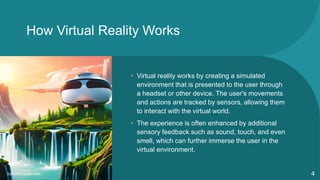
• Virtual reality works by creating a simulated
environment that is presented to the user through
a headset or other device. The user's movements
and actions are tracked by sensors, allowing them
to interact with the virtual world.
• The experience is often enhanced by additional
sensory feedback such as sound, touch, and even
smell, which can further immerse the user in the
virtual environment.
Sample Footer Text 4
Applications of Virtual Reality
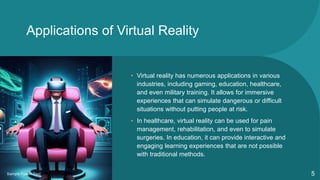
• Virtual reality has numerous applications in various
industries, including gaming, education, healthcare,
and even military training. It allows for immersive
experiences that can simulate dangerous or difficult
situations without putting people at risk.
• In healthcare, virtual reality can be used for pain
management, rehabilitation, and even to simulate
surgeries. In education, it can provide interactive and
engaging learning experiences that are not possible
with traditional methods.
Sample Footer Text 5
Challenges and Limitations of Virtual Reality
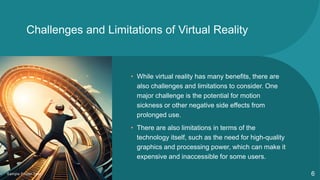
• While virtual reality has many benefits, there are
also challenges and limitations to consider. One
major challenge is the potential for motion
sickness or other negative side effects from
prolonged use.
• There are also limitations in terms of the
technology itself, such as the need for high-quality
graphics and processing power, which can make it
expensive and inaccessible for some users.
Sample Footer Text 6
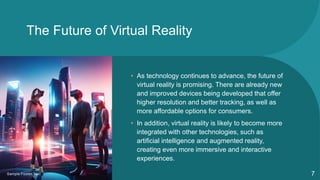
The Future of Virtual Reality
• As technology continues to advance, the future of
virtual reality is promising. There are already new
and improved devices being developed that offer
higher resolution and better tracking, as well as
more affordable options for consumers.
• In addition, virtual reality is likely to become more
integrated with other technologies, such as
artificial intelligence and augmented reality,
creating even more immersive and interactive
experiences.
Sample Footer Text 7
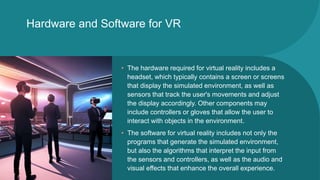
Hardware and Software for VR
• The hardware required for virtual reality includes a
headset, which typically contains a screen or screens
that display the simulated environment, as well as
sensors that track the user's movements and adjust
the display accordingly. Other components may
include controllers or gloves that allow the user to
interact with objects in the environment.
• The software for virtual reality includes not only the
programs that generate the simulated environment,
but also the algorithms that interpret the input from
the sensors and controllers, as well as the audio and
visual effects that enhance the overall experience.
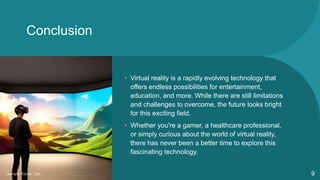
Conclusion
• Virtual reality is a rapidly evolving technology that
offers endless possibilities for entertainment,
education, and more. While there are still limitations
and challenges to overcome, the future looks bright
for this exciting field.
• Whether you're a gamer, a healthcare professional,
or simply curious about the world of virtual reality,
there has never been a better time to explore this
fascinating technology.
Sample Footer Text 9
Thank You
Sample Footer Text 10

virtual reality.pptx

  • 1.
  • 2.
    Introduction to VirtualReality How Virtual Reality Works Applications of Virtual Reality Challenges and Limitations of Virtual Reality The Future of Virtual Reality Hardware and Software for Virtual Reality Conclusion Sample Footer Text 2
  • 3.
    Introduction to VirtualReality • Virtual reality (VR) is a computer-generated simulation of a three-dimensional environment that can be interacted with in a seemingly real or physical way by a person using special electronic equipment. • The concept of virtual reality has been around for decades, but it was not until recently that technology has advanced enough to make it more accessible and affordable for consumers. Sample Footer Text 3
  • 4.
    How Virtual RealityWorks • Virtual reality works by creating a simulated environment that is presented to the user through a headset or other device. The user's movements and actions are tracked by sensors, allowing them to interact with the virtual world. • The experience is often enhanced by additional sensory feedback such as sound, touch, and even smell, which can further immerse the user in the virtual environment. Sample Footer Text 4
  • 5.
    Applications of VirtualReality • Virtual reality has numerous applications in various industries, including gaming, education, healthcare, and even military training. It allows for immersive experiences that can simulate dangerous or difficult situations without putting people at risk. • In healthcare, virtual reality can be used for pain management, rehabilitation, and even to simulate surgeries. In education, it can provide interactive and engaging learning experiences that are not possible with traditional methods. Sample Footer Text 5
  • 6.
    Challenges and Limitationsof Virtual Reality • While virtual reality has many benefits, there are also challenges and limitations to consider. One major challenge is the potential for motion sickness or other negative side effects from prolonged use. • There are also limitations in terms of the technology itself, such as the need for high-quality graphics and processing power, which can make it expensive and inaccessible for some users. Sample Footer Text 6
  • 7.
    The Future ofVirtual Reality • As technology continues to advance, the future of virtual reality is promising. There are already new and improved devices being developed that offer higher resolution and better tracking, as well as more affordable options for consumers. • In addition, virtual reality is likely to become more integrated with other technologies, such as artificial intelligence and augmented reality, creating even more immersive and interactive experiences. Sample Footer Text 7
  • 8.
    Hardware and Softwarefor VR • The hardware required for virtual reality includes a headset, which typically contains a screen or screens that display the simulated environment, as well as sensors that track the user's movements and adjust the display accordingly. Other components may include controllers or gloves that allow the user to interact with objects in the environment. • The software for virtual reality includes not only the programs that generate the simulated environment, but also the algorithms that interpret the input from the sensors and controllers, as well as the audio and visual effects that enhance the overall experience.
  • 9.
    Conclusion • Virtual realityis a rapidly evolving technology that offers endless possibilities for entertainment, education, and more. While there are still limitations and challenges to overcome, the future looks bright for this exciting field. • Whether you're a gamer, a healthcare professional, or simply curious about the world of virtual reality, there has never been a better time to explore this fascinating technology. Sample Footer Text 9
  • 10.