
VIRTUAL METROLOGY IN
SEMICONDUCTOR MANUFACTURING
Guided by Prof. ANAND RAJAGOPAL
ROSHAN SUNIL KURIAN
MUT15ME051
CONTENTS
■ INTRODUCTION
■ LIMITATION OF CURRENT METROLOGY
■ VIRTUAL METROLOGY
■ METHODOLOGY
■ ADVANTAGES
■ DISADVANTAGES
■ REFERNCES
INTRODUCTION
■ A process is controlled based on the information obtained.
■ Metrology values are available only for a small fraction of samples.
■ To overcome this, Virtual Metrology is used.
LIMITATIONS OF CURRENT METROLOGY
■ Metrology value depends on few sampled wafers.
■ Usage of metrology results is restricted.
■ Increased cycle time.
VIRTUAL METROLOGY
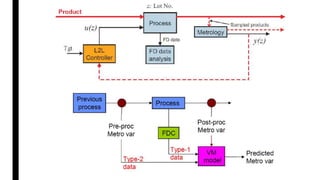
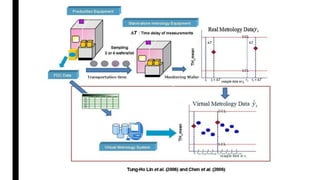
■ Prediction of metrology variables using information about the state of process or
product.
■ Class of methods aiming to estimate the metrology values, given the process data and
previous metrology information.
■ In practise it is difficult to measure each wafer.
■ So Virtual Metrology is used.
METHODOLOGY
■ Methodology is composed of three successive stages:
– Data Pre-processing
– VM Module Development
– VM Module Implementation
1. DATA PRE-PROCESSING
■ Assuring the input quality of the data.
■ Three steps are involved:
– 1. Data Sources
■ To define family of products.
■ Selecting recipes and steps for VM module development.
■ Preliminary study of processes and metrology equipment's is necessary.
1. DATA PRE-PROCESSING
– 2. Data Acquisition
■ To define raw data set including FDC data from production equipment and
measurement data from metrology equipment.
– 3. Data Consolidation
■ Includes data cleaning and statistical data analysis.
■ Identifying and removing outliers, missing values etc.. .
■ Statistical analysis include data normalization , data correlation studies.
2. VM MODULE DEVELOPMENT
■ Aims to build different prediction models , compare them and validate the best model.
■ Three steps are involved:
– 4. VM Modelling
■ To choose nonlinear prediction methods.
■ Build prediction model in two levels.
2. VM MODULE DEVELOPMENT
– 5. Model Comparison
■ Models compared based on robustness and prediction accuracy criteria.
■ To select the best model based to the performance.
– 6. VM Module
■ To perform the VM module with adjustments of the best model chosen in the previous
step.
3. VM MODULE IMPLEMENTATION
■ To define the steps to integrate the VM module into the industrial environment.
■ This stage includes three steps :
– 7. VM Module Test
■ To perform off line test with the offline data from production.
■ To identify the problems of the model and to evaluate the results.
■ To define a prototype for offline VM Module Implementation.
3. VM MODULE IMPLEMENTATION
– 8. VM Module in Production
■ Provide guidelines for full integration of VM module into manufacturing system.
– 9. VM Module Consolidation
■ To define the maintenance policies for the update of real time VM module.
ADVANTAGES
■ Increased production time.
■ Low scrap rate.
■ Predictive maintenance.
■ Real time tool performance.
■ Continuous information.
DISADVANTAGES
■ Large number of input variables.
■ Process is not stationary.
REFERENCES
■ Virtual metrology for run-to-run control in semiconductor manufacturing, Pilsung Kang
a, Dongil Kim a, Hyoung-joo Lee b, Seungyong Doh c, Sungzoon Cho a, Expert
Systems with Applications 38 (2011) 2508–2522
■ University of Padua, Department of Information Engineering, Virtual Metrology for
Semiconductor Manufacturing Applications, Prof. Beghi Alessandro, Gian Antonio
Susto, Padua, 28 June 2010
THANK YOU

Virtual metrology in semiconductor manufacturing

  • 1.
    VIRTUAL METROLOGY IN SEMICONDUCTORMANUFACTURING Guided by Prof. ANAND RAJAGOPAL ROSHAN SUNIL KURIAN MUT15ME051
  • 2.
    CONTENTS ■ INTRODUCTION ■ LIMITATIONOF CURRENT METROLOGY ■ VIRTUAL METROLOGY ■ METHODOLOGY ■ ADVANTAGES ■ DISADVANTAGES ■ REFERNCES
  • 3.
    INTRODUCTION ■ A processis controlled based on the information obtained. ■ Metrology values are available only for a small fraction of samples. ■ To overcome this, Virtual Metrology is used.
  • 4.
    LIMITATIONS OF CURRENTMETROLOGY ■ Metrology value depends on few sampled wafers. ■ Usage of metrology results is restricted. ■ Increased cycle time.
  • 5.
    VIRTUAL METROLOGY ■ Predictionof metrology variables using information about the state of process or product. ■ Class of methods aiming to estimate the metrology values, given the process data and previous metrology information. ■ In practise it is difficult to measure each wafer. ■ So Virtual Metrology is used.
  • 8.
    METHODOLOGY ■ Methodology iscomposed of three successive stages: – Data Pre-processing – VM Module Development – VM Module Implementation
  • 9.
    1. DATA PRE-PROCESSING ■Assuring the input quality of the data. ■ Three steps are involved: – 1. Data Sources ■ To define family of products. ■ Selecting recipes and steps for VM module development. ■ Preliminary study of processes and metrology equipment's is necessary.
  • 10.
    1. DATA PRE-PROCESSING –2. Data Acquisition ■ To define raw data set including FDC data from production equipment and measurement data from metrology equipment. – 3. Data Consolidation ■ Includes data cleaning and statistical data analysis. ■ Identifying and removing outliers, missing values etc.. . ■ Statistical analysis include data normalization , data correlation studies.
  • 11.
    2. VM MODULEDEVELOPMENT ■ Aims to build different prediction models , compare them and validate the best model. ■ Three steps are involved: – 4. VM Modelling ■ To choose nonlinear prediction methods. ■ Build prediction model in two levels.
  • 12.
    2. VM MODULEDEVELOPMENT – 5. Model Comparison ■ Models compared based on robustness and prediction accuracy criteria. ■ To select the best model based to the performance. – 6. VM Module ■ To perform the VM module with adjustments of the best model chosen in the previous step.
  • 13.
    3. VM MODULEIMPLEMENTATION ■ To define the steps to integrate the VM module into the industrial environment. ■ This stage includes three steps : – 7. VM Module Test ■ To perform off line test with the offline data from production. ■ To identify the problems of the model and to evaluate the results. ■ To define a prototype for offline VM Module Implementation.
  • 14.
    3. VM MODULEIMPLEMENTATION – 8. VM Module in Production ■ Provide guidelines for full integration of VM module into manufacturing system. – 9. VM Module Consolidation ■ To define the maintenance policies for the update of real time VM module.
  • 15.
    ADVANTAGES ■ Increased productiontime. ■ Low scrap rate. ■ Predictive maintenance. ■ Real time tool performance. ■ Continuous information.
  • 16.
    DISADVANTAGES ■ Large numberof input variables. ■ Process is not stationary.
  • 17.
    REFERENCES ■ Virtual metrologyfor run-to-run control in semiconductor manufacturing, Pilsung Kang a, Dongil Kim a, Hyoung-joo Lee b, Seungyong Doh c, Sungzoon Cho a, Expert Systems with Applications 38 (2011) 2508–2522 ■ University of Padua, Department of Information Engineering, Virtual Metrology for Semiconductor Manufacturing Applications, Prof. Beghi Alessandro, Gian Antonio Susto, Padua, 28 June 2010
  • 18.