Vimuttidhamma From Chakra To Dhammachakra Piyadhassi Bhikkhu
Vimuttidhamma From Chakra To Dhammachakra Piyadhassi Bhikkhu
Vimuttidhamma From Chakra To Dhammachakra Piyadhassi Bhikkhu
Vimuttidhamma From Chakra To Dhammachakra Piyadhassi Bhikkhu
Vimuttidhamma From Chakra To Dhammachakra Piyadhassi Bhikkhu
1.
Vimuttidhamma From ChakraTo Dhammachakra
Piyadhassi Bhikkhu download
https://ebookbell.com/product/vimuttidhamma-from-chakra-to-
dhammachakra-piyadhassi-bhikkhu-55240018
Explore and download more ebooks at ebookbell.com
2.
Here are somerecommended products that we believe you will be
interested in. You can click the link to download.
Vimuttidhamma From Chakra To Dhammachakra Piyadhassi Bhikkhu
https://ebookbell.com/product/vimuttidhamma-from-chakra-to-
dhammachakra-piyadhassi-bhikkhu-55240018
Vimuttidhamma:FromChakratoDhammachakra
Piyadhassi Bhikkhu
Published byDhamma Publication Fund
Wat Tam Doi Tone, Chiang Mai, Thailand
First Publishing, May 2011
1,300 copies
(Free Distribution)
All rights reserved.
Cover picture: Dhamek Stupa and Image of the
Buddha giving the First Sermon at Sarnath, India.
Cover design by Thaiis Co., www.thaiis.org
ISBN : 978-616-03-0372-4
Donation for Dhamma publication: please contact
Wat Tam Doi Tone, Mae Win Sub-District, Mae
Wang District, Chiang Mai 50360 Thailand
Tel. 66-53-268511
E-mail: doitcmm@yahoo.com
website: www.vimuttidhamma.org
Printed at Dhamma Sapha Publishing House, 1/4-5,
Baromarajachonni 119, Sala Dhammasop Sub-District,
Thaweewatana District, Bangkok 10170,
Tel. 66-2-888-7940, 66-2-441-1535,
Fax: 66-2-441-1983.
7.
Sahasrāra in thecortical layer of the brain
Third jhāna
Fourth jhāna
Visuddha behind the throat
Second jhāna
Anāhata near the heart
First jhāna Manīpura in the spinal chord
Access concentration Svādhistāna nerve center
Mūladhāra base of the spinal cord
Momentary concentration
Realm of neither perception nor
non-perception - Nevasaññanāsaññayatana
Realm of nothingness -
Ākiñcaññāyatana
Realm of boundless consciousness -
Viññāṇañcāyatana
Realm of boundless space - Ākāsānañcāyatana
Ajna
Heart
Kuṇḍalinī
Iḍā nādī
Suṣumṇa nādī
Piṇgalā nādī
Nibbānadhatu
Dimensions of Mind
Remark : - Mind in the four arūpajhānas has the same components as mind in the fourth rūpajhāna.
The only difference is that the objects of arūpa concentration are formless elements.
- iḍā nāḍī : Mind perceives past objects.
Inner energy moves within the left channel.
- piṇgalā nāḍī : Mind perceives future objects.
Inner energy moves within the right channel.
- suṣumṇa nāḍī : Mind perceives present objects.
Inner energy moves within the middle channel.
8.
Contents
Contents I
list offigures IX
abbreviations XI
preface XIII
translator notes XVI
Chapter I 1
The Buddha’s First Utterance 1
The Round of Rebirth 2
Rare States 4
Existence of a Happy State 5
Nature of the Buddha 6
Four Kinds of Miracles 8
CHAPTER II 11
Standard Practice for Liberation 11
The Path to Liberation 11
Standard Ways of Practice to Liberation 14
Mind in the Path:
The Balance of Tranquility and Insight 15
Path Leading to the Balance of
Tranquility and Insight 17
The Right Approach to Enlightenment 18
Happiness To Be Feared / Not To Be Feared 19
Vimuttidhamma
I
9.
Encounter with Māra20
The Yogi in States of Jhāna 23
Four Modes of Progress to Liberation 26
Celestial State 29
Power over the Mind 30
Wisdom Generated from Concentration 30
Mind Devoid of Hindrances 31
The Fortress 32
Experiencing Sensual Pleasure without Attachment 36
Right Concentration 40
Four Kinds of Concentration 40
Mind Inclined to Nibbāna 42
Sāriputta, Son of the Lord Buddha 44
Dhamma in the First Jhāna 44
Dhamma in the Second Jhāna 45
Dhamma in the Third Jhāna 45
Dhamma in the Fourth Jhāna 45
Dhamma in the Realm of Boundless Space 46
Dhamma in the Realm of Boundless Consciousness 46
Dhamma in the Realm of Nothingness 46
Dhamma in the Realm of
Neither Perception nor Non-Perception 47
Dhamma in the Realm of
Cessation of Perception and Feeling 47
Sāriputta, the Expert 48
Sāriputta, the Lord Buddha’s Son 48
CHAPTER III 51
The One Way 51
Mahā Satipaṭṭhāna Sutta 51
Vimuttidhamma II
10.
Benefits of SatipaṭṭhānaPractice 70
Development Process of Satipaṭṭhāna 71
Mental Bondage 72
Essence of Satipaṭṭhāna 73
A Summary of Satipaṭṭhāna Practice 78
Mindfulness is Necessary in All Cases 95
CHAPTER IV 99
Cycle And Exit 99
Dependent Origination 100
Cause Linked to Effect 103
Effect Linked to Cause 103
Cause Linked to Effect 104
CHAPTER V 111
The Attainment of the Noble Truth 111
Characteristics of Maggacitta: Some Metaphors 114
Omens Occurring Before
the Attainment of Enlightenment 115
Omens of the Buddha’s Enlightenment 116
Insight in Concentration 117
Successive Steps of Insight Knowledge 120
Attainment of the Four Levels of Enlightenment 126
Wisdom of the Path of the Stream-Enterer 127
Flash of Lightning 130
Concentration Bases at
the Attaining Moment of Enlightenment 131
Three Aspects of Liberation 132
Vimuttidhamma
III
11.
Wisdom Leading to
theState of the Once-Returner 135
Wisdom leading to the State of the Non-Returner 136
Wisdom Leading to
the State of the Fully Enlightened 138
The Wheel and Wisdom of Liberation 139
Sea of Saṃsāra 140
Those Who Transcend the States of Misery 143
CHAPTER VI 149
The State of Nibbāna 149
The State of Nibbāna 149
The End of Suffering 149
Two Conditions of Nibbāna 150
The Released through Discernment
(Paññāvimutti) 154
The Released Both Ways
(Ubhatobhāgavimutti) 155
Two Kinds of Genius 155
The Present Dwelling of the Enlightened One 157
CHAPTER VII 161
Major Dhamma 161
The One Thing 161
Mindfulness of Breathing
Highly Acclaimed by the Buddha 162
Dwelling Prior to Enlightenment 163
After the Enlightenment 163
Benefits of Mindfulness of Breathing 165
Vimuttidhamma IV
12.
Dhamma Supporting Mindfulnessof Breathing 165
Discourse on Mindfulness of Breathing
(Ānāpānasati Sutta) 166
Mindfulness of Breathing 169
Fulfillment of the Four Foundations of Mindfulness 171
Fulfillment of the Seven Enlightenment Factors 174
Fulfillment of True Knowledge and Deliverance 175
Chapter VIII 179
Breathing Meditation: The Practice 179
Dimensions of Mind 179
Chakras in the Science of Yoga 180
States of Body and Mind in Absorption Concentration 182
Introduction to the Practice 182
The Noble Right Concentration 184
Cycle of the Mind in the Wheel of Rebirth 184
Beginning of the World of Phenomena and Time 188
Mindfulness of Breathing: Practice Section 191
Three Breath-Touching Points 192
Section One: Contemplation of the Body 192
Concentrative Proficiency 212
Section Two: Contemplation of Feelings 214
Section Three: Contemplation of the Mind 226
Section Four: Contemplation of the Mental-Qualities 228
Techniques of Entering into Absorption Concentration 229
A Memoir on the Meditation Experiences of an
Anonymous Bhikkhu :Wisdom of a Stream Enterer 235
The Eye of Dhamma 237
Wisdom leading to the Path of Once-Returning 238
Vimuttidhamma
V
13.
Mind Training ofthe Higher Level 239
The Completion of Right Concentration 239
Wisdom leading to the Path of Non-Returning 242
The Cessation of Perception and Feelings 244
Saññavedayitanirodha 246
Wisdom of the Path of the Fully Enlightened 248
The Wheel of Dhamma 251
Wisdom of Liberation 252
Two Levels of Transcendental Jhāna 253
The Vibration of the Refined Physical 255
Three levels of Dhammadhātu vibration 255
Dhammachakra and its Cycling 256
CHAPTER IX 259
Threefold Attainments 259
Meditative Attainment 259
Fruition Enjoyment 259
Extinction Attainment 261
Progressive Abiding 263
Pairs of Adverse Conditions 265
Mental Rust, Golden Rust 266
Noble Disciples and the Coral Tree Flowers 267
Reference 272
Index 275
Vimuttidhamma VI
14.
List of Figures
Figure1: Forty Techniques of Concentration Exercises 39
Figure 2: The Interrelated States in Satipaṭṭhāna 82-83
Figure 3: Dependent Origination 99
Figure 4: Mental Process While Attaining Nibbāna 124
Figure 5: Functions of the Three Knowledges
Concerning the Four Noble Truths 133
Figure 6: Classification of Noble Ones 151
Figure 7: Dimensions of Mind 178
Figure 8: Cycle of the Mind in the Wheel of Rebirth 185
Figure 9: Concentration in Buddhism and Rājayoga 186
Figure 10: Dimensions of Mind 187
Figure 11: Visualized image-Conceptualized image 198
Figure 12: Cetasika 202
Figure 13: Mūladhāra - Momentary Concentration 204
Figure 14: Svādhistāna - Access Concentration 206
Figure 15: Manīpura - First Jhāna 208
Figure 16: Anāhata - Second Jhāna 213
Figure 17: Visuddha - Third Jhāna 216
Figure 18: Sahasrāra - Fourth Jhāna 219
Figure 19: Fire Contemplation 230
Figure 20: Mental Process While Attaining Absorption
Concentration 234
Figure 21: Progressive Abidings;
Mental States of Gradual Attainment-
Cessation of Perception and Feeling 241
Vimuttidhamma
VII
15.
Figure 22: ProgressiveAbidings; Mental States of
Gradual Attainment-The Backward Order 243
Figure 23: Progressive Abidings:
Mental States of Gradual Attainment -
The Forward Order 245
Figure 24: Dhammachakra - The Wheel of Dhamma 250
Figure 25: Vibration of the Refined Physical Elements 254
Figure 26: Dimensions of Mind 270
Vimuttidhamma VIII
Like a lakeunruffled by any breeze,
the concentrated mind is a faithful reflector
that mirrors what ever is placed before it
exactly as it is.
Vimuttidhamma X
18.
Preface
Vimuttidhamma is thetrue freedom, which does not change
according to any causes or factors, transcending all kinds of
conditioned phenomena. On the path to liberation (the noble
eightfold path), vimuttidhamma is the final goal for all beings.
Regarding the noble eightfold path, there are three levels
of learning and practice. Firstly, the sila level or the level of
adjusting one’s own physical and verbal conducts to support and
be conducive to the training of one’s mind. Second is the level of
concentration or mind training according to the principle of the four
foundation of mindfulness (satipaṭṭhāna practice). Practitioners
will be able to experience the rising and falling states within the
framework of their own body and mind. In Pali, body (rūpa) and
mind (nāma) are mere aggregates of compounded things. Such
rising and falling continuum appears from gross to subtler levels,
namely from the worldly to the form and formless realms.
Chakra is a knowledge at the level of absorption concentration
(appanāsamādhi) which covers both the form and formless realms.
Knowledge of chakra existed prior to the emergence of Buddhism.
Before enlightenment, the Buddha achieved all the eight levels
of absorption concentration from two masters, the yogies Alāra
Kalama and Uddaka Ramaputta. However, the knowledge of high
level of concentration or chakra was not sufficient for reaching
vimuttidhamma. The Buddha, therefore had to leave the two
masters in order to seek, by himself, the higher and subtler kind
of knowledge.
With tremendous effort and long-accumulated spiritual
intuitive faculty which heightened to its peak, the Buddha was
Vimuttidhamma
XI
19.
able to discoverthe higher kind of knowledge, or the third level
of practice, namely insight or vipassanā. Only when absorption
concentration is accompanied by insight, the ordinary kind of
concentration will escalate and change itself into the noble right
concentration. When both kinds of power, insight (vipassanābala)
and concentration (samādhibala), develop up to the level of
completion of factors of enlightenment (bojjhaṅga), the mind will
be free from the cycle of rebirth. Before being able to reach the
highest form of knowledge (vimuttiñāṇadassana), practitioners will
experience an excellent kind of chakra, namely dhammachakra.
Dhammachakra is a special state when ones experience only
the rising and falling of aggregates without accompaniment of
ignorance, craving and clinging force (which are the causes of
suffering). The perception at this level is called kiriyacitta* which
functions independently of both wholesome and unwholesome
factors. When dhammachakra cycles and escalates its speed, up
to one point, the cycling stops, and there emerges the last and
the highest kind of knowledge, vimuttiñāṇadassana which will
become clear only to those who can attain it.
Vimuttidhamma was translated from Thai to English by a
group of practitioners, namely, Krisda Dhiradityakul, Apinya
Feungfusakul with the help of Matt Meyers, Steve Rhodes,
Rudy Stoert, Arthur McKeown and Zarina Parpia. Those who
financially supported the publication are Thai meditator group
in Boston,Yaowalak Phenglee, Phorn Phivilay, Dalom Phivilay,
Pawaranan Wisitweradilok, Nattakini Jiramanthip, Pipaspon
* Kiriyacitta is karmically neutral, having no karma results, both negative or positive.
It is the mental state of the arahat or the fully enlightened, accompanied by two or three
noble roots (greedlessness, hatelessnes and undeludedness). See detailed description
on p. 256-257.
Vimuttidhamma XII
20.
Udompolpunit,ThomasMathsanghane,JenjiraJennyMathsanghane,
Nupan Chalanukroa, UbonwanSingphanomchai.The layout design
was done by Thaiis Co. I would like to express my thanks and
convey the blessing to all these people.
Vimuttidhamma will be a guiding friend for those who seek
and practice Dhamma and will lead them to the knowledge about
chakra and the higher knowledge of the excellent dhammachakra.
On the noble path, may the cycling of dhammachakra reveal itself
transparently to everybody who devotedly and persistently keeps
on training the mind.
Piyadhassi Bhikkhu
Visaka Puja, 2011
Wat Tam Doi Tone, Chiang Mai
Vimuttidhamma
XIII
21.
Translator Notes
In 2001,during the three month period of the rainy season known as
the Vassa, Kris Dhiradityakul, who ordained and studied Dhamma
at Wat Tam Doi Tone cave monastery in Thailand, got to know
and befriend George, a French-born American monk. Kris was
tremendously inspired by “Vimuttidhamma,” the book written by
his master, mentor and the Abbot of the monastery, Venerable
Phra Ajahn Nawee Piyadhassi. The book was first published in
October 1997 and since then has been reprinted four times. Kris
felt strongly committed to making it possible for George and other
westerners to read the book and taste the knowledge of his master.
Kris approached PhraAjahn (the respectful title means “Monk
Teacher” inThai) to ask permission to translate, and then embarked
upon a very difficult task. On the one hand, the book follows
Theravāda tradition in its tone and style as well as its systematic
analysis of the whole corpus of Dhamma.The rich quotations from
the Pāli Canon help the reader to understand the interrelatedness of
Buddhist core concepts. On the other hand, the book debates and
challenges mainstream Theravada beliefs regarding meditation.
However, the greatest challenge for the translators lay in the section
of the book that deals with meditative experiences. The two last
chapters of the book offer practical guidelines for beginners while
allowing the reader a glimpse into the transcendental realm of
higher level meditation. The book captures Phra Ajahn’s more
than 20 years of experience as a meditation teacher and also his
own unutterable moments in the world beyond.
After years of endeavour, Kris handed his first draft to
Apinya Feungfusakul, one of Phra Ajahn’s close disciples, who
Vimuttidhamma XIV
22.
revised the entiremanuscript and spent months searching through
different versions of English translations of Buddhist Scriptures
and Commentaries which were quoted as references. In addition,
she added more than 60 footnotes to clearly explain Pāli terms
and did multiple quality and accuracy reviews of the final draft.
Many English speaking friends who practice meditation with
Phra Ajahn offered invaluable help. Steve Rhodes and Arthur
McKeown edited the entire book, Rudy Stoert edited chapters one
to five, Matt Meyers edited chapters eight and nine, and Samaneri
Pema (Karen Schaefer) edited chapter eight. Wanda Weinberger
proof read a large part of the book, and Zarina Parpia edited the
final version, checking the Pāli spelling, doing meticulous proof
reading four times and preparing the index. Last but not least,
Wanachai Wongtala, Prapasri Poung-Ngernmak and the Thaiis
Co. team were in charge of the lay-out and book cover design.
Throughout the course of our journey, Phra Ajahn played a
vital role in guiding us along the frequently rocky road and kept
us walking on the right spiritual path. It has been an incredible
experience to go through the manuscript with the author at his
beautiful and peaceful monastery,WatTam DoiTone.To complete
the translation is a way of paying homage to our teacher and to
the Triple Gem, the Buddha, the Dhamma, and the Sangha.
Though this book contains many complicated Buddhist
philosophies and teachings, practitioners are always welcome
to seek further discussion with the author at Wat Tam Doi Tone,
where formal courses in meditation are organized to serve the
needs of practitioners of all levels, from beginning meditators to
those with years of experience.
Vimuttidhamma
XV
23.
The book hasnow been completed. We have done our job in
making it available to the world. Still, the task of constant practice
in order to achieve the ultimate goal continues. That is the goal
our great master wants all of us to reach.
Enjoy the book, and enjoy Dhamma.
Vimuttidhamma XVI
24.
The widespread miseryof the world
reveals itself to his mind
so nakedly, so powerful
that the cry for the end of it
drowns every other voice:
forth, forth, forth
to the other shore.
Vimuttidhamma
XVII
25.
Vimuttidhamma 1
Chapter I
TheBuddha’s First Utterance
Namo Tassa Bhagavato Arahato Sammāsambuddhassa.
Homage to Him, the Blessed One, the Holy One, the
Perfectly Self-Enlightened One.
“Monks, it is because of not understanding and not penetrating
the Four Noble Truths that you and I have roamed and wandered
through this long course of saṃsāra (the round of rebirth). What
four?
“It is, monks, because of not understanding and not penetrating
the noble truth of suffering… of the origin of suffering… of the
cessation of suffering… of the path leading to the cessation of
suffering that you and I have roamed and wandered through this
long course of saṃsāra.
“That noble truth of suffering, monks, that noble truth of the
origin of suffering… of the cessation of suffering… of the way
leading to the cessation of suffering has been understood and
penetrated. Craving for existence has been cut off; the conduit
to existence has been destroyed; now there is no more renewed
existence.”1
1 S.N. (vol.2), Mahā-vagga, Sacca-saṁyutta, Koṭigāma (21), p.1852, Bhikkhu Bodhi.
26.
The Buddha’s FirstUtterance
2
The Round of Rebirth
At Savatthi, there the Blessed One said: “From an inconstruable
beginning comes transmigration. A beginning point is not
evident, though beings hindered by ignorance and fettered by
craving are transmigrating and wandering on. Just as a stick
thrown up in the air lands sometimes on its base, sometimes on
its side, sometimes on its tip; in the same way, beings hindered by
ignorance and fettered by craving, transmigrating and wandering
on, sometimes go from this world to another world, sometimes
come from another world to this.
“Why is that? From an inconstruable beginning comes
transmigration ....”2
“An aeon is long, monks. It’s not easy to count it and say it is so
many years, or so many hundreds of years, or so many thousands
of years, or so many hundreds of thousands of years…. Suppose,
monks, there was a great stone mountain a yojana3
long, a yojana
wide and a yojana high, without holes or crevices, one solid mass
of rock. At the end of every hundred years, a man would stroke it
once with a piece of Kāsian4
cloth. By this effort that great stone
mountain might be worn away and eliminated but the aeon would
still not have come to an end. So long is an aeon, monks. And of
aeons of such length, we have wandered through so many aeons,
so many hundreds of aeons, so many thousands of aeons, so many
hundreds of thousands of aeons. For what reason? Because, monks,
this saṁsāra is without discoverable beginning…. It is enough
to experience revulsion towards all formations, enough to
2 S.N., Nidāna-vagga, Anatamagga-saṁyutta, 15.9, Bhikkhu Thanissaro, ATI.
3 An ancient Indian unit of measurement.
4 Kāsi, an ancient Indian city state, was well known for its cloth products.
27.
Vimuttidhamma 3
become dispassionatetowards them, enough to be liberated
from them.”5
“Excellent, monks. Excellent. It is excellent that you thus understand
the Dhamma taught by me.
“This is the greater: the tears you have shed while transmigrating
and wandering this long, long time, crying and weeping from
being joined with what is displeasing, being separated from what
is pleasing — not the water in the four great oceans.
“Long have you experienced the death of a mother. The tears
you have shed over the death of a mother... are greater than the
water in the four great oceans.
“Long have you experienced the death of a father... the death
of a brother... the death of a sister... the death of a son... the death
of a daughter... loss with regard to relatives... loss with regard to
wealth... loss with regard to disease. The tears you have shed over
loss with regard to disease while transmigrating and wandering
this long, long time, crying and weeping from being joined with
what is displeasing, being separated from what is pleasing — are
greater than the water in the four great oceans.
“Why is that? From an inconstruable beginning comes
transmigration. A beginning point is not evident, though beings
hindered by ignorance and fettered by craving are transmigrating
and wandering on. Long have you thus experienced stress,
experienced pain, experienced loss, swelling the cemeteries
— enough to become disenchanted with all fabricated things,
enough to become dispassionate, enough to be released.”6
5 S.N. (vol.1), Nidāna-vagga, Anamatagga-saṁyutta (5), p. 654, Bhikkhu Bodhi.
6 S.N. Nidāna-vagga, Anatamagga-saṁyutta, 15.3, Bhikkhu Thanissaro, ATI.
28.
The Buddha’s FirstUtterance
4
Rare States
“Monks, suppose that this great earth were totally covered with
water, and a man were to toss a yoke with a single hole there.
A wind from the east would push it west, a wind from the west
would push it east. A wind from the north would push it south,
a wind from the south would push it north. And suppose a blind
sea-turtle were there. It would come to the surface once every
one hundred years. Now what do you think: would that blind
sea-turtle, coming to the surface once every one hundred years,
stick his neck into the yoke with a single hole?
“It would be a sheer coincidence, Lord, that the blind sea-turtle,
coming to the surface once every one hundred years, would stick
his neck into the yoke with a single hole.
“It’s likewise a sheer coincidence that one obtains the human
state. It’s likewise a sheer coincidence that a Tathāgata,7
, worthy
and rightly self-awakened, arises in the world. It’s likewise a
sheer coincidence that a doctrine and discipline expounded by a
Tathāgata appears in the world. Now, this human state has been
obtained. A Tathāgata, worthy and rightly self-awakened, has
arisen in the world. A doctrine and discipline expounded by a
Tathāgata appears in the world.
“Therefore your duty is the contemplation, ‘This is [suffering]...
This is the origination of [suffering]... This is the cessation of
[suffering].’ Your duty is the contemplation, ‘This is the path of
practice leading to the cessation of [suffering].’”8
7 “The Perfect One,” an epithet of the Lord Buddha.
8 S.N., Mahā-vagga, Sacca-saṃyutta, 56.48, Bhikkhu Thanissaro, ATI.
29.
Vimuttidhamma 5
Existence ofa Happy State
This was said by the Blessed One, said by the arahant (a fully
enlightened person), so I have heard:
“When a deva (a celestial being) is about to pass away from
the company of devas, five omens appear: his garlands wither,
his clothes get soiled, sweat comes out of his armpits, a dullness
descends on his body, he no longer delights in his own deva-seat.
The devas, knowing from this that ‘This deva-son is about to pass
away,’encourage him with three sayings: ‘Go from here, honorable
sir, to a good destination. Having gone to a good destination, gain
the gain that is good to gain. Having gained the gain that is good
to gain, become well-established.
“When this was said, a certain monk said to the Blessed One,
‘What, Lord, is the devas’reckoning of going to a good destination?
What is their reckoning of the gain that is good to gain? What is
their reckoning of becoming well-established?
“The human state, monks, is the devas’ reckoning of going
to a good destination. Having become a human being, acquiring
conviction in the Dhamma-and-Vinaya9
taught by the Tathāgata:
this is the devas’reckoning of the gain that is good to gain. When
that conviction is settled within one — rooted, established, and
strong, not to be destroyed by any priest or contemplative deva,
Māra10
, or brahma11
; or anyone else in the world: this is the devas’
reckoning of becoming well-established.
9 Doctrine and discipline of the Lord Buddha. The word “dhamma” has several meanings.
“Dhamma” is the teaching or doctrine of the Buddha, while “dhamma” can mean the
“bearer”, consitution (or nature of a thing), norm, law, doctrine, justice, righteousness,
quality, object of mind, or phenomenon.
10Māra is the “tempter-figure.” He appears in the texts both as a real person (i.e. as a
deity, or the Lord of Evil) and as the personification of evil and passions, of the totality
of worldy existence, and of death.
11 Being residing in the higher heavenly planes of the form and formless realms.
30.
The Buddha’s FirstUtterance
6
“When a deva passes away from the company of devas
through his life-span’s ending, three sounds sound forth the
devas’ encouragement. ‘Go from here, honorable sir, to a good
destination, to companionship with human beings. On becoming a
human being, acquire a conviction unsurpassed in True Dhamma.
That conviction of yours in True Dhamma, well-taught, should
be settled, rooted, established — undestroyed as long as you
live. Having abandoned bodily misconduct, verbal misconduct,
mental misconduct, and whatever else is flawed; having done with
the body what is skillful, and much that is skillful with speech,
having done what is skillful with a heart without limit, with no
acquisitions, then having made much of that basis of merit through
giving, establish other mortals in True Dhamma and the holy life.’
With this sympathy, the devas, when they know a deva is passing
away, encourage him: ‘Come back, deva, again and again.’”12
Nature of the Buddha
“On one occasion, the Blessed One was walking on the highway
between Ukkatthā and Setavyā.And it happened that the Brahmin
Dona was also walking along that road. Dona, the Brahmin, saw
on the footprints of the Blessed One the wheel marks with their
thousand spokes, with felly and hub, perfect in every respect.
Seeing these marks, he thought to himself: ‘It is truly wonderful,
it is astonishing! These certainly cannot be the footprints of a
human being!’
“Meanwhile the Blessed One had left the highway and had
sat down under a tree not far off, with legs crossed, keeping his
body erect, having set mindfulness before him. Then Dona the
12 K.N., Itivuttaka, 3.34, Bhikkhu Thanissaro, ATI.
31.
Vimuttidhamma 7
Brahmin, followingthe Blessed One’s footprints, saw him seated
under a tree, of pleasing appearance, inspiring confidence, with
calm features and calm mind, in perfect composure and equipoise,
controlled and restrained [like] a well-trained bull elephant. Seeing
the Blessed One, Dona approached him and said:
‘Will Your Reverence become a deva?’
‘No, Brahmin, I shall not become a deva.’
‘Then Your Reverence might become a gandhabba (a kind of
celestial being skilled in music)... a yakkha(an ogre)… a human
being?’
‘No, Brahmin, I shall not become a gandhabba… a yakkha…
a human being.’
‘What, then, will Your Reverence become?’
‘Brahmin, those taints whereby, if they were not abandoned, I
might become a deva, a gandhabba, a yakkha, or a human being -
these taints are abandoned by me, cut off at the root, made barren
like palm-tree stumps, obliterated so that they are no more subject
to arise in the future.
‘Just as, Brahmin, a blue, red or white lotus, though born
and grown in the water, rises up and stands unsoiled by the
water, so, Brahmin, though born and grown in the world, I have
overcome the world and dwell unsoiled by the world. Consider me,
O Brahmin, a Buddha.’”13
13 A.N.,The Chapter of the Fours (58), p. 87-8, Bhikkhu Nyanaponika and Bhikkhu
Bodhi.
32.
The Buddha’s FirstUtterance
8
Four Kinds of Miracles
“Monks, on the manifestation of a Tathāgata, an arahant, a fully
enlightened one, four wonderful and marvellous things are
manifested. What four?
“People generally find pleasure in attachments, take delight
in attachments and enjoy attachments. But when the Dhamma of
non-attachment is taught by the Tathāgata, people wish to listen
to it, give ear and try to understand it.
“People generally find pleasure in conceit, take delight in
conceit and enjoy conceit. But when the Dhamma is taught by
the Tathāgata for the abolition of conceit, people wish to listen
to it, give ear and try to understand it.
“People generally find pleasure in a life of excitement, take
delight in excitement and enjoy excitement. But when the peaceful
Dhamma is taught by the Tathāgata, people wish to listen to it,
give ear and try to understand it.
“People generally live in ignorance, are blinded by ignorance
and fettered by ignorance. But when the Dhamma is taught by the
Tathāgata for the abolition of ignorance, people wish to listen
to it, give ear and try to understand it.
“On the manifestation of a Tathāgata, anArahant, a Fully
Enlightened One, these four wonderful and marvellous things
become manifest.”14
14 Ibid. (78), p. 109-10.
33.
Vimuttidhamma 9
By whattrack can you trace
that trackless Buddha of limitless range,
whose victory nothing can undo,
whom none of the vanquished defilements
can ever pursue?
Hard is it to be born a human being
hard is the life of mortals.
Hard is it to gain the opportunity
(to hear) the Sublime Truth,
and hard to encounter
is the arising of the Buddhas.
34.
The Buddha’s FirstUtterance
10
The good shine even from afar,
like the Himalayan mountain.
But the wicked are unseen,
like arrows shot in the night.
Just as a solid rock
is not shaken by a storm,
even so the wise are not affected
by praise or blame.
35.
Vimuttidhamma 11
CHAPTER II
StandardPractice for Liberation
The Path to Liberation
“There are, O monks, these five bases of liberation, and when
a monk dwells diligent, ardent and resolute in any of these, his
unliberated mind comes to be liberated, his undestroyed taints
undergo destruction, and he attains the as-yet-unattained unsurpassed
security from bondage. What five?
“1. Here, monks, the Teacher or a certain fellow monk in the
position of a teacher teaches the Dhamma to a monk. Even as the
Teacher teaches the Dhamma to him, that monk experiences
the meaning and the Dhamma. When he gains such experience,
gladnessarises.Whenheisgladdened,rapturearises;foroneuplifted
by rapture, the body becomes calm; one calm in body feels happy;
for one who is happy the mind becomes concentrated. This is the
first base of liberation, and when a monk dwells diligent, ardent
and resolute here, his unliberated mind comes to be liberated, his
undestroyed taints undergo destruction, and he attains the as-yet-
unattained unsurpassed security from bondage.
“2. Further, monks, neither the Teacher nor a fellow monk
in the position of a teacher teaches the Dhamma to a monk. But
the monk himself teaches the Dhamma in detail to others as he
has learned it and mastered it. Even as he teaches the Dhamma,
that monk experiences the meaning and the Dhamma. When
he gains such experience, gladness arises… the mind becomes
concentrated. This is the second base of liberation.
36.
Standard Practice forLiberation
12
“3. Further, monks, neither the Teacher nor a fellow monk in
the position of a teacher teaches the Dhamma to a monk, nor does
he himself teach the Dhamma in detail to others as he has learned
it and mastered it. But he recites the Dhamma in detail as he
has learned it and mastered it. Even as he recites the Dhamma,
the monk experiences the meaning and the Dhamma. When
he gains such experience, gladness arises… the mind becomes
concentrated. This is the third base of liberation….
“4. Further, monks, neither the Teacher nor a fellow monk in
the position of a teacher teaches the Dhamma to a monk, nor does
he himself teach the Dhamma in detail to others, nor does he recite
the Dhamma in detail. But he ponders, examines and mentally
investigates the Dhamma as he has learned it and mastered it.
Even as he ponders the Dhamma, that monk experiences the
meaning and the Dhamma. When he gains such experience,
gladness arises… the mind becomes concentrated. This is the
fourth base of liberation….
“5. Further, monks, neither the Teacher nor a fellow monk in
the position of a teacher teaches the Dhamma to a monk… nor
does he ponder the Dhamma. But he has learned well a certain
object of concentration, attends to it well, sustains it well, and
penetrates it thoroughly with wisdom. Even as he learns well
an object of concentration, that monk experiences the meaning
and the Dhamma. When he gains such experience, gladness
arises. When he is gladdened, rapture arises; for one uplifted by
rapture, the body becomes calm; one calm in body feels happy;
for one who is happy the mind becomes concentrated. This is the
fifth base of liberation, and when a monk dwells diligent, ardent
and resolute here, his unliberated mind comes to be liberated, his
undestroyed taints undergo destruction, and he attains the as-yet-
unattained unsurpassed security from bondage.
37.
Vimuttidhamma 13
“These, monks,are the five bases of liberation, and when
a monk dwells diligent, ardent and resolute in any of these, his
unliberated mind comes to be liberated, his undestroyed taints
undergo destruction, and he attains the as-yet-unattained unsurpassed
security from bondage.”15
Wisdom cannot be perfectly developed
In those with unstable minds,
Who know not the noble truth,
and who live with false faith.
15 A.N., The Chapter of the Fives (98), p.130-31, Bhikku Nyanaponika and Bhikku
Bodhi.
38.
Standard Practice forLiberation
14
A Summary of the Five Pathways to Liberation
1. Listening to Dhamma
2. Teaching Dhamma
3. Reciting Dhamma
4. Contemplating Dhamma
5. Samādhinimitta: a method of concentration using
certain mental images as concentrative objects
Standard Ways of Practice to Liberation
“Friends, whatever monks or nuns declare before me that they
have attained the final knowledge of arahantship, all these do so
in one of four ways. What four?
“1. Here, friends, a monk develops insight preceded by
tranquility.While he thus develops insight preceded by tranquility,
the path arises in him. He now pursues, develops, and cultivates
that path, and while he is doing so, the fetters are abandoned and
the underlying tendencies eliminated.
“2. Or again, friends, a monk develops tranquility preceded
by insight.While he thus develops tranquility preceded by insight,
the path arises in him. He now pursues, develops, and cultivates
that path, and while he is doing so, the fetters are abandoned and
the underlying tendencies eliminated.
“3. Or again, friends, a monk develops tranquility and insight
joined in pairs. While he thus develops tranquility and insight
joined in pairs, the path arises in him. He now pursues, develops,
and cultivates that path, and while he is doing so, the fetters are
abandoned and the underlying tendencies eliminated.
39.
Vimuttidhamma 15
“4. Oragain, friends, a monk’s mind is seized by agitation
caused by higher states of mind. But there comes a time when
his mind becomes internally steadied, composed, unified and
concentrated; then the path arises in him. He now pursues, develops,
and cultivates that path, and while he is doing so, the fetters are
abandoned and the underlying tendencies eliminated.”16
Mind in the Path:
The Balance of Tranquility and Insight
The eightfold path17
, when fully developed to the level where
their culminating power functions simultaneously, will create an
overwhelming light of wisdom to realize the truth and eradicate the
hindrance of defilements. The mannerin which all components of
the path generate their power simultaneously is called magga,
or path, which signifies the very moment when all components
realize themselves in full. When this process happens, the result
which follows is called phala, or fruit, which is the penetrative
understanding of the truth.
And if this enlightenment process proceeds gradually in
order, magga will function more and more strongly until all four
successive stages of enlightenment are completed. Therefore,
these four stages of enlightenment are called four maggas and the
following four states of fruition are called four phalas. These four
maggas and four phalas are also called the noble maggas and the
noble phalas, which can be identified as follows: sotāpattimagga
16 Ibid., The Chapter of the Fours (83), p.114.
17 The eightfold path consists of right view, right thought, right speech, right action,
right livelihood, right effort, right mindfulness and right concentration.
40.
Standard Practice forLiberation
16
(the path of the stream-enterer18
), sotāpattiphala (the fruition of
the stream-enterer), sakadāgāmimagga (the path of the once-
returner), sakadāgāmiphala (the fruition of the once-returner),
anāgāmimagga (the path of the non-returner), anāgāmiphala
(the fruition of the non-returner), arahattamagga (the path of the
fully enlightened), and arahattaphala (the fruition of the fully
enlightened).
In terms of its components, magga can be divided into eight
aspects (the eightfold path), therefore it is called aṭṭhaṇgikamagga
(aṭṭhaṇgika means eight, magga means path). In terms of its
function, there are four stages called catumagga or four maggas
as just described.
The manner in which all factors function simultaneously
within a single instant, followed by a tangible result, is also
referred to as Dhammasāmaggī (the accordance of Dhamma) which
has the same meaning as bodhi (enlightenment). In this very instant,
not only do all components of the eightfold path culminate, but so
do the components of the thirty-seven bodhipakkhiyadhamma19
.
However, all components of bodhipakkhiyadhamma can also be
summarized and manifested in the eightfold path. Thus, when we
talk about the eightfold path, it is understood to cover all other
related components of Dhamma.”20
18 The noble persons are those who have realized the successive stages of liberation.
There are four categories of these nobles persons: the stream-enterer, the once-returner,
the non-returner and the fully enlightened. See more detail in Chapter Five.
19 The requisites of enlightenment are: four foundations of mindfulness, four great
strivings, four means of accomplishment, five spiritual faculties, five bases of power,
seven factors of enlightenment and the eightfold path. All together, they make thirty
seven factors.
20 Translated from Phra Ratchaworamuni, Buddhadhamma, p. 886-887.
41.
Vimuttidhamma 17
Path Leadingto the Balance of
Tranquility and Insight
“These four kinds of persons, O monks, are found existing in the
world. What four?
“1.Therein, monks, the person who gains internal tranquility
of mind but not the higher wisdom of insight into things should
approach one who has gains the higher wisdom and inquire of him:
‘How, friend, should formation be seen? How should formations
be explored? How should constructions be discerned with insight?’
The other then answers him as he has seen and understood the
matter thus: ‘Formations should be seen in such a way; they
should be explored in such a way; they should be discerned with
insight in such a way.’At a later time, this one gains both internal
tranquility of mind and the higher wisdom of insight into things.
“2.Therein, monks, the person who gains the higherwisdom
of insight into things but not internal tranquility of mind should
approach one who has gained internal tranquility and inquire of
him: ‘How, friend, should the mind be steadied? How should
the mind be composed? How should the mind be unified? How
should the mind be concentrated?’ The other then answers him
as he has seen and understood the matter thus: ‘The mind should
be steadied in such a way, composed in such a way, unified in
such a way, concentrated in such a way.’At a later time, this one
gains both internal tranquility of mind and the higher wisdom of
insight into things.
3. Therein, monks, the person who gains neither internal
tranquility of mind nor the higher wisdom of insight into
things should approach one who has gained both and inquire of
him; ‘How, friend, should the mind be steadied?... How, friend,
42.
Standard Practice forLiberation
18
should formations be seen?…’The other then answers him as he
has seen and understood the matter thus: ‘The mind should be
steadied in such a way… Formations should be seen in such a
way…’At a later time, this one gains both internal tranquility of
mind and the higher wisdom of insight into things.
“4. Therein, monks, the person who gains both internal
tranquility of mind and the higher wisdom of insight into
things should establish himself in just these wholesome states
and make a further effort for the destruction of the taints.
“These are the four types of individuals to be found existing
in world.”21
The Right Approach to Enlightenment
“I thought: ‘Whatever recluses or brahmins in the past… in
the future... (or) at present have experienced painful, racking,
piercing feelings due to exertion, this is the utmost, there is none
beyond this. But by this racking practice of austerities, I have not
attained any superhuman states, any distinction in knowledge and
vision worthy of the noble ones. Could there be another path to
enlightenment?’
“I considered: ‘I recall that when my father the Sakyan was
occupied, I was sitting in the cool shade of a rose-apple tree, quite
secluded from sensual pleasures, secluded from unwholesome
states, I entered upon and abided in the first jhāna22
, which is
21 A.N., The Chapter of the Fours (72), p. 103-4, Bhikkhu Nyanaponika and Bhikkhu
Bodhi.
22 Jhāna, also referred to as absorption concentration, refers to the four meditative
absorptions of the form realm (sometimes called fine material realms and, in Pāli,
called rūpajhāna) and another four higher levels of the formless realm (sometimes
called immaterial realms and, in Pāli, called arūpajhāna). See more detail about jhāna
practice in Chapter Eight.
43.
Vimuttidhamma 19
accompanied byapplied and sustained thought23
, with rapture and
pleasure born of seclusion. Could that be the path to enlightenment?’
Then, following on that memory, came the realization: ‘That is
the path to enlightenment.’
“I thought: ‘Why am I afraid of that pleasure that has nothing
to do with sensual pleasures and unwholesome states?’I thought:
‘I am not afraid of that pleasure since it has nothing to do with
sensual pleasures and unwholesome states.’
“I considered: ‘It is not easy to attain that pleasure with a body
so excessively emaciated. Suppose I ate some solid food — some
boiled rice and porridge.’ And I ate some solid food — some
boiled rice and porridge.”24
Happiness To Be Feared / Not To Be Feared
“And, Udāyin, there are these five strings of sensuality.Which five?
Forms cognizable via the eye — agreeable, pleasing, charming,
endearing, fostering desire, enticing. Sounds cognizable via the
ear... aromas cognizable via the nose... flavors cognizable via the
tongue... tactile sensations cognizable via the body — agreeable,
pleasing, charming, endearing, fostering desire, enticing. These
are the five strings of sensuality. Now, any pleasure and happiness
that arises dependent on these five strings of sensuality is called
sensual pleasure, a filthy pleasure, a run-of-the-mill pleasure, an
ignoble pleasure. And of this pleasure I say that it is not to be
cultivated, not to be developed, not to be pursued, that it is to be
feared.
23 Applied and sustained thought (vitakka-vicāra) are constituents of the first absorption
or jhāna, but are absent in the higher levels of jhāna. Vitakka is the laying hold of a
thought or the fixing of consciousness to an object and vicāra is the continued activity
of the mind.
24 M.N., Mahāyamakavagga, Mahā-saccaka Sutta (36),p. 340, Bhikkhu Ñāṇamoli
and Bhikkhu Bodhi.
44.
Standard Practice forLiberation
20
“Now, there is the case where a monk, quite withdrawn from
sensuality, withdrawn from unskillful mental qualities, enters
and remains in the first jhāna: rapture and pleasure born from
withdrawal, accompanied by directed thought and evaluation.
With the stilling of directed thought and evaluation, he enters
and remains in the second jhāna: rapture and pleasure born of
concentration, unification of awareness free from directed thought
and evaluation — internal assurance.With the fading of rapture, he
remains equanimous, mindful and alert, and senses pleasure with
the body. He enters and remains in the third jhāna, of which the
Noble Ones declare, ‘Equanimous and mindful, he has a pleasant
abiding.’ With the abandoning of pleasure and pain — as with
the earlier disappearance of elation and distress — he enters and
remains in the fourth jhāna: purity of equanimity and mindfulness,
neither pleasure nor pain.
“This is called renunciation-pleasure, seclusion-pleasure,
calm-pleasure, self-awakening-pleasure.And of this pleasure
I say that it is to be cultivated, to be developed, to be pursued,
that it is not to be feared.”25
Encounter with Māra
“Monks, long ago a battle raged between the devas and the asuras
(demons), and in that battle the asuras won and the devas were
defeated. And the defeated devas simply fled, with the asuras
facing north hot after them. Then thought the devas: ‘The asuras
give chase; let us battle with them a second time!’And a second
time they fought and a second time were defeated and pursued....
25 M.N., 66, Laṭukikopama Sutta, Bhikkhu Thanissaro, ATI.
45.
Vimuttidhamma 21
“And athird time they fought and the asuras won and the
devas were defeated. Defeated and fearful, they just entered the
deva city. Monks, thus gone to their city, the devas thought: ‘Now
that we have come to the refuge for the fearful, we will henceforth
dwell by ourselves and have no dealings with the asuras.’And the
asuras thought also: ‘Gone, indeed, are the devas to the refuge for
the fearful, henceforth they will dwell by themselves and have
no dealing with us!’
“Monks, long ago another battle raged between the devas and
asuras; but in that fight the devas won and the asuras were defeated.
And the defeated asuras fled, pursued by the devas, facing south.
Then thought the asuras: ‘The devas pursue us; what if we fight a
second time!’And they did so… and were a second time defeated.
“And a third time they fought and the devas won and the
asuras were defeated; and defeated and fearful, they just entered
the asura city; and thus gone to their city, the asuras thought: ‘Now
that we’ve come to the refuge for the fearful, we will dwell by
ourselves and have nothing to do with the devas.’And the devas
thought likewise….
“In just the same way, monks, what time a monk, aloof from
sense desires,… enters and abides in the first [jhāna], he thinks:
‘Now that I have come to the refuge for the fearful, I will henceforth
dwell by myself and have no dealings with Māra.’And Māra, the
Evil One, thinks: ‘Now that the monk has gone to the refuge for
the fearful, he will dwell by himself and have no dealing with me.’
Monks, what time a monk… enters and abides in the second…
third… and fourth [jhāna], he thinks likewise… and Māra too….
46.
Standard Practice forLiberation
22
“Monks, when a monk... enters and abides in the realm of
boundless space26
, he is said to have put a darkness about Māra,
and Māra’s vision, being blotted out, is without range, and he has
become invisible to the Evil One.
“Monks, when a monk... enters and abides in the realm of
boundless consciousness… of nothingness… of neither perception
nor non-perception and by wisdom sees that the cankers are
completely destroyed, he is said to have put a darkness about
Māra, and Māra’s vision, being blotted out, is without range; and
he has become invisible to the Evil One and has passed through
the world’s entanglement.”27
Māra can destroy those
who are attached to sensual beauty,
not controlling their behavior,
lacking moderation in eating,
idle and weak,
like the strong wind
uprooting an old tree.
26 The four higher levels of jhāna in the formless realm (arūpajhāna) are as follows:
the realm of boundless space, the realm of boundless consciousness, the realm of
nothingness and the realm of neither perception nor non-perception.
27 A.N. vol. 4, The Book of the Nines (9,4,39), p. 290-91, Hare.
47.
Vimuttidhamma 23
The Yogiin States of Jhāna
Following are various arguments against the practice of jhāna from
those who see no benefits or advantages of a mind in absorption
concentration or jhānacitta.
Firstly, jhāna causes practitioners to attach themselves to its
pleasure and become more likely to be misled. Most of those who
hold this attitude have never had the experience of jhānacitta.
Or even if experienced, they fail to develop proficiency in it.
Therefore, they do not see its invaluable benefits.
Secondly, attaining the path or fruition does not necessarily
requireappanāsamādhi(absorptionconcentration).28
Khanikasamādhi
(momentaryconcentration)orupacārasamādhi(accessconcentration)
should suffice. Truly speaking, attaining the path and fruition
requires the masterful and skilled balancing of the culminating
powers of tranquility and insight. The concentrative power must
at least reach the level of absorption concentration in the first
jhāna, which is considered the factor of right concentration in
the eightfold path.
It is possible for sekkha29
persons to attain jhāna in the very
moment they attain the first path and fruition. After that, they
might not be able to raise their mind to jhāna again. However, for
once-returners wishing to attain the higher level of non-returning,
they must experience and gain proficiency in jhāna before they
can attain the third path.
28 Sometimes called attainment concentration or full concentration. It is the concentration
existing during absorption in jhāna. Access concentration (sometimes called sustained
attention, in Pāli upacārasamādhi) only approaches the first jhāna without attaining it, and
momentary concentration (sometimes called attention stillness, in Pāli khanikasamādhi)
is a state prior to access concentration.
29 Sekkha literally means ‘a learner.’ It signifies a person who has reached one of
the earlier stages of magga, but not the last, so has still to undergo a higher learning.
48.
Standard Practice forLiberation
24
The third argument against jhāna practice is that there are
known cases of those who attained absorption concentration and
had proficiency in supernormal powers, but still were not able
to attain the noble truth. The most frequently mentioned persons
are Asitta yogi (Kāladevin yogi), who enjoyed visiting heavens,
Ālāra yogi, who attained the seventh jhāna, and Udaka yogi, who
attained the eighth jhāna.
These commentators may have forgotten that the only types
of beings who are able to develop vipassanā (insight)30
without
relying on other people’s wisdom are the Buddha or solitary
buddhas.31
These three yogis did not possess the qualities that
would enable them to be Buddha nor had the Buddha been born
to the world during their time. How could they, then, attain magga
by themselves?
After attaining enlightenment, the Buddha at first hesitated
to teach the Dhamma as the knowledge attained by him was so
profound, complicated and difficult to understand. Then, after
emerging from contemplation at the end of a seven day retreat, the
Lord approached the Banyan tree of the goatherds. While staying
there and meditating in seclusion, a thought arose in his mind:
“This Dhamma, [known] by me, is deep, difficult to see,
difficult to understand, peaceful, excellent, beyond dialectic,
subtle, intelligible to the learned. But this is a creation delighting
in sensual pleasure, delighted by sensual pleasure, rejoicing in
sensual pleasure. So for a creation delighting in sensual pleasure,
delighted by sensual pleasure, rejoicing in sensual pleasure,
30 Insight, or wisdom, attained through direct meditative observation, is the decisive
liberating factor of the Lord Buddha’s teaching.
31 A solitary buddha attains enlightenment by himself, but does not teach others.
49.
Vimuttidhamma 25
this wouldbe a matter difficult to see, that is to say causal uprising
by way of cause. This too is a matter very difficult to see, that is
to say the calming of all the habitual tendencies, the renunciation
of all attachment, the destruction of craving, dispassion, stopping,
nibbāna. And so if I were to teach Dhamma and others were not
to understand me, this would be a weariness to me, this would
be a vexation to me.
“And further, these verses not heard before occurred
spontaneously to the Lord:
‘This that through many toils I’ve won —
Enough! Why should I make it known?
By folk with lust and hate consumed
This Dhamma is not understood.
Leading on against the stream,
Subtle, deep, difficult to see, delicate,
Unseen’twill be by passion’s slaves
Cloaked in the murk of ignorance.”32
“However, he later changed his mind. And he pondered:
‘Now, to whom should I first teach Dhamma?Who will understand
this Dhamma quickly?’ Then he thought: ‘Indeed, this Ālāra the
Kālāma… and Udaka are learned, experienced, wise, and for a
long time they have had only little dust in their eyes. Suppose
I were to teach Dhamma first to them? They will understand this
Dhamma quickly.’33
32 The Book of Discipline vol. 4 , Mahā-vagga I, p. 6, Horner.
33 Ibid., p.10.
50.
Standard Practice forLiberation
26
“There is no concentration for one who lacks wisdom.
Nor is there wisdom for one who lacks concentration.
In whom there are found both concentration and wisdom,
Are indeed in the presence of nibbāna.”34
Four Modes of Progress to Liberation
1. Dukkha patipadā dandhābhiññā – painful
progress with sluggish direct knowledge.
2. Dukkha patipadā khippābhiññā – painful
progress with swift direct knowledge.
3. Sukha patipadā dandhābhiññā – pleasant
progress with sluggish direct knowledge.
4. Sukha patipadā khippābhiññā – pleasant
progress with swift direct knowledge.
Painful Progress with Sluggish Direct Knowledge
“And of what sort, monks, is the painful mode of progress with
sluggish [direct knowledge]?
“In this case, a monk lives contemplating the loathsomeness
in the body, aware of the repulsiveness of food, aware of his
distaste for all the world, aware of impermanence in all activities.
Thus awareness of death is implanted in the very self. He lives
dependent on these five powers of a pupil: the power of faith,
the power of modesty, the power of self-restraint, the power
34 K.N. Dhammapada, Verses on Bhikkhu, p. 402, trans. by Sathienpong Wannapok,
The Buddha’s Verses in Dhammapada, published in commemoration of the crematory
rite of Mrs. Premsri Khemasingkhi, 4April 1999, Phra Sri Mahadhathu Royal Temple,
Bangkok.
51.
Vimuttidhamma 27
of energy,and the power of wisdom. But in him these five controlling
faculties are dully manifested, to wit: the controlling faculty of
faith, that of energy, that of mindfulness, that of concentration, and
the controlling faculty of wisdom. Thus, owing to the dullness of
these five controlling faculties, sluggish is his attainment of the
concentration that follows on for the destruction of the āsavas
(cankers or defilements). This, monks, is called ‘the mode of
progress that is painful with sluggish [direct knowledge].’
Painful Progress with Swift Direct Knowledge
“And of what sort, monks, is the mode of progress that is painful,
but with swift [direct knowledge]?
“In this case a monk lives contemplating the unloveliness
in the body same (as above). But in him these five controlling
faculties are manifested in abundance, to wit: the controlling
faculty of faith.... Thus, owing to the preponderance of these five
controlling faculties, swift is his attainment of the concentration
that follows on for the destruction of the āsavas. This, monks, is
called ‘the mode of progress that is painful but with swift [direct
knowledge].’
Pleasant Progress with Sluggish Direct Knowledge
“And of what sort, monks, is the mode of progress that is pleasant
but with sluggish [direct knowledge]?
“In this case a monk, aloof from sense-desires, aloof from evil
conditions… enters upon the first [jhāna]… the second [jhāna]…
the third [jhāna]…the fourth [jhāna], a state of neither ease nor
discomfort, an equanimity of utter purity, and having attained it,
52.
Standard Practice forLiberation
28
abides therein. He lives dependent on these five powers of a pupil:
the power of faith.... But in him these five controlling faculties
are dully manifested, to wit... Thus, owing to the dullness of
these five controlling faculties, sluggish is his attainment of the
concentration that follows on for the destruction of the āsavas.
This, monks, is called ‘the mode of progress that is pleasant, but
with sluggish [direct knowledge].’
Pleasant Progress with Swift Direct Knowledge
“And of what sort, monks, is the mode of progress that is both
pleasant and accompanied by swift [direct knowledge]?
“In this case a monk, aloof from sense-desire (same as
above)… But in him these five controlling faculties are manifested
in abundance... Thus, owing to the preponderance of these five
controlling faculties, swift is his attainment of the concentration that
follows on for the destruction of the āsavas.This, monks, is called
‘the mode of progress that is both pleasant and is accompanied by
swift [direct knowledge].’
“So these are the four modes of progress.”35
35 A.N. vol. 2, The Book of the Fours (9, 17, 163) p. 156, Woodward.
12
discovered. But troopships and munition ships and food ships must
be dispatched without interruption across the tricky waters of the
English Channel to France, and for this purpose convoy escorts were
devised, with camouflaged warships zigzagging alongside, while high
aloft in lookout stations men with binoculars strained their eyes,
searching the waters, ahead, astern, alongside, their search lingering
long over every bit of floating wreckage—and there was a lot of it—to
make sure it was not a periscope.
These lookouts aboard ship quickly had a new ally in the air. As the
submarine menace grew, binoculars began to flash too from the
fuselages of bobbing blimps overhead. At a few hundred or perhaps a
thousand feet elevation they could see deep below the surface, and
quickly learned to recognize at considerable distance the tell-tale trail
of bubbles or feathered waters or smear of oil which denoted the
enemy’s presence, might even pick out the shadowy form of the
submerged craft itself.
The value of the airship in convoy was that it could fly slowly, could
throttle down its motors and march in step with its charges, cruise
ahead, alongside, behind. The very speed of its sister craft, the
airplane, handicapped its use in this field.
This characteristic of the blimp was even more useful in hunting U-
boat nests. The blimp could head into the wind, with its motors
barely turning over, hover for hours at zero speed over suspect
areas. It could fly at low altitudes, follow even slender clues. Seagulls
following a periscope sometimes gave highly useful information. An
orange crate moving against the tide attracted the attention of one
alert pilot, for the crate concealed a periscope, and the blimp
dropped bombs—successfully.
When a blimp discovered a submarine, it would give chase. With its
50 knots of reserve speed it was faster than any warship, much faster
than the poky wartime submarine, which could do only 10 or 12
knots on the surface, much less than half that when submerged. If it
55.
13
was lucky theairship might drop a bomb alongside before the sub
got away.
And run for cover the submarine always did. It wanted no argument
with a ship which could see it under water, could out-run it, and
might plunk a bomb alongside before its presence was even
suspected.
Airships did get their subs during the war. The records, always
incomplete in the case of submarines, whose casualties were
invisible, show that British blimps sighted 49 U-boats, led to the
destruction of 27. But their greater usefulness lay in the fact that
their mere presence sent the underseas craft scuttling for submerged
safety.
Between June, 1917, and the end of the war British blimps flew
1,500,000 miles, nearly as many as the Zeppelins. A French
Commission made an exhaustive study of dirigible operations after
the war, and the late Rear Admiral W. A. Moffett quoted from its
reports in summarizing lighter-than-air lessons taken from the war,
when he told the Naval Affairs Committee of the House of
Representatives that “as far as they could learn, no steamer was ever
molested by submarines when escorted by a non-rigid airship.”
France and Italy had long coast lines, used the blimps extensively
along the Bay of Biscay, the Mediterranean and the Adriatic, but
England found still greater use for them because it was an island. So
blimp scouts played a singularly useful role from Land’s End to the
Orkneys, stood watch at the mouth of the Firth of Forth, the Solway,
the Humber, and the Thames.
56.
CHAPTER III
American Airshipsin Two Wars
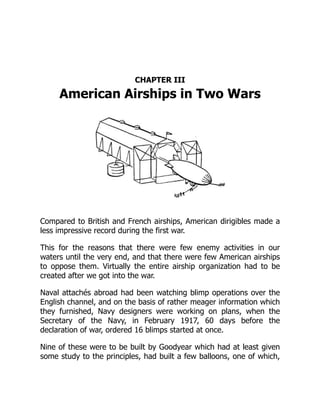
Compared to British and French airships, American dirigibles made a
less impressive record during the first war.
This for the reasons that there were few enemy activities in our
waters until the very end, and that there were few American airships
to oppose them. Virtually the entire airship organization had to be
created after we got into the war.
Naval attachés abroad had been watching blimp operations over the
English channel, and on the basis of rather meager information which
they furnished, Navy designers were working on plans, when the
Secretary of the Navy, in February 1917, 60 days before the
declaration of war, ordered 16 blimps started at once.
Nine of these were to be built by Goodyear which had at least given
some study to the principles, had built a few balloons, one of which,
57.
14
flown by itsengineers out of Paris, had won the James Gordon
Bennett Cup Race.
No one in this country, however, knew much about building airships,
and less about flying them after they were built. Operating bases
would have to be built and the very construction plants as well. The
first Goodyear airship under the Navy order was completed before
the airship dock (hangar) at Wingfoot Lake was ready, and the ship
had to be erected in Chicago and flown in.
The engineers who built it, Upson and Preston, made their first
airship flight in delivering the ship to Akron, using theoretical
principles applied in the international balloon race the year before, to
make up for their lack of practical experience.
Those first ships were small, slow, lacked range, uncovered
many shortcomings. Flight training was done under adverse
circumstances. Men had to teach themselves to fly airships, then
teach others to fly them.
The pilots were chiefly engineering students from the colleges, with a
sprinkling of Navy officers. They had to take their advanced training
abroad at British and French bases, because there were no facilities
here, and in fact did most of their flying abroad. By the end of the
war American pilots were manning three British airship bases and had
taken over practically all the French operations, including the large
base at Paimboeuf, across the Loire from St. Nazaire, on the French
coast.
So the war was well along before American bases were set up and
manned. These were at Chatham, Mass., at Montauk and Rockaway,
N. Y., at Cape May, Norfolk and Key West. Like the airplane patrols
the blimps saw little action, though they had an advantage in that
they could stay out all day, while the short range planes of 1917-18
had to come back every few hours to refuel.
58.
A patrol airshipat Chatham, Mass. missed its chance in that it was
adrift at sea with engine trouble when the German U-156 slipped into
the harbor at nearby Orleans and wiped out some fishing boats—
though it might have done no better than the first plane which
reached the scene, whose few bombs did not explode.
The blimp patrols, however, uncovered one other type of activity.
More than once they spotted suspicious looking craft emerging under
cover of fog, from remote coves and inlets along the Long Island
coast, fishing boats and barges with improvised power plant and
curious looking paraphernalia on deck. Keeping the stranger in sight
the blimp summoned armored craft from shore which sent boarding
crews on, found mines destined for the New York steamship lanes.
A more important result of the blimp operations was the
improvements in design which were found, particularly in the “C”
type ship, brought out in 1918, of which 20 were built. They had
much better performance in range, power, could make 60 miles
speed, were faster than any airships except the Zeppelins. Navy
officers and crews came to have high respect for them.
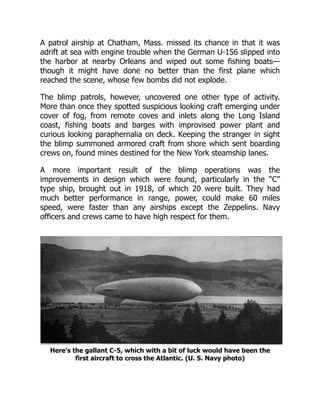
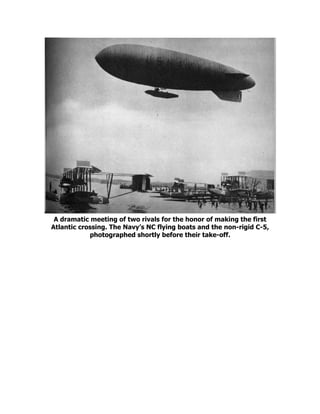
Here’s the gallant C-5, which with a bit of luck would have been the
first aircraft to cross the Atlantic. (U. S. Navy photo)
59.
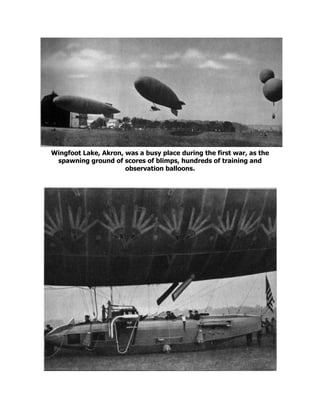
Wingfoot Lake, Akron,was a busy place during the first war, as the
spawning ground of scores of blimps, hundreds of training and
observation balloons.
60.
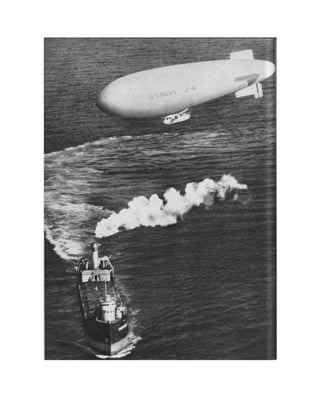
“Finger patches” ofrope ends raveled out and cemented to the
outside of the bag were used in 1918 to support the weight of the
gondola—an improvised airplane fuselage.
62.
15
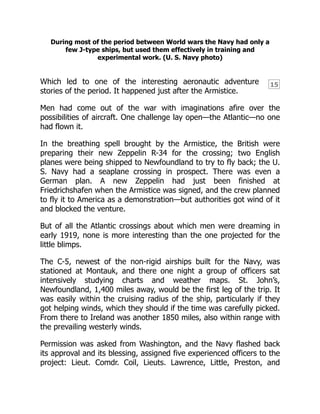
During most ofthe period between World wars the Navy had only a
few J-type ships, but used them effectively in training and
experimental work. (U. S. Navy photo)
Which led to one of the interesting aeronautic adventure
stories of the period. It happened just after the Armistice.
Men had come out of the war with imaginations afire over the
possibilities of aircraft. One challenge lay open—the Atlantic—no one
had flown it.
In the breathing spell brought by the Armistice, the British were
preparing their new Zeppelin R-34 for the crossing; two English
planes were being shipped to Newfoundland to try to fly back; the U.
S. Navy had a seaplane crossing in prospect. There was even a
German plan. A new Zeppelin had just been finished at
Friedrichshafen when the Armistice was signed, and the crew planned
to fly it to America as a demonstration—but authorities got wind of it
and blocked the venture.
But of all the Atlantic crossings about which men were dreaming in
early 1919, none is more interesting than the one projected for the
little blimps.
The C-5, newest of the non-rigid airships built for the Navy, was
stationed at Montauk, and there one night a group of officers sat
intensively studying charts and weather maps. St. John’s,
Newfoundland, 1,400 miles away, would be the first leg of the trip. It
was easily within the cruising radius of the ship, particularly if they
got helping winds, which they should if the time was carefully picked.
From there to Ireland was another 1850 miles, also within range with
the prevailing westerly winds.
Permission was asked from Washington, and the Navy flashed back
its approval and its blessing, assigned five experienced officers to the
project: Lieut. Comdr. Coil, Lieuts. Lawrence, Little, Preston, and
63.
16
Peck. The USSChicago was sent ahead to St. John’s to stand by and
give any help needed.
Shortly after sunrise on May 15, 1919, motors were warmed up and
the ship shoved off from the tip of Long Island with six men aboard
headed for Newfoundland. At 7 o’clock the next morning they circled
over the deck of the Chicago, dropped their handling lines to the
waiting ground crew on a rocky point at St. John’s. The first leg had
been made in a little more than 24 hours, at an average speed of
nearly 60 miles per hour.
The morning was clear and comparatively calm. Coil and Lawrence
went aboard the Chicago to catch a little sleep before the final
hop over the ocean. The others saw to re-fueling the C-5,
stowing provisions aboard, topping off a bit of hydrogen from the
cylinders alongside. Mechanics swarmed over the motors. All was
well.
But about 10 o’clock gusts began to sweep down from Hudson’s Bay,
dragging the ground crew over the rocks. There were no mooring
masts in those days. A modern mast would have saved the ship.
More sailors were put on the lines and word sent to Coil and
Lawrence. If the ground crew could hold the ship till the pilots could
get aboard and cut loose, the storm would give them a flying start
over the Atlantic.
But the wind blew steadily stronger as the commander was hurrying
ashore. It reached gale force, hurricane force, 40 knots, 60 knots in
gusts, varying in direction crazily around a 60-degree arc. It picked
the ship up and slammed it down, damaging the fuselage, breaking a
propeller. Little and Peck climbed aboard to pull the rip panel and let
the gas out. After the storm passed, they could cement the panel
back in, reinflate the bag and go on.
But the fates were against them. The cord leading to the rip panel
broke. Desperately, the two men started climbing up the suspension
cables to the gas bag with knives, planning to rip the panel out by
64.
17
hand. But atremendous gust caught the ship, lifted it up. Seeing the
danger to the crew, Peck shouted to them to let go, and he and Little
dropped over the side. Little broke an ankle.
The ship surged upward, crewless, set off like another “Flying
Dutchman” across the Atlantic, was never seen again.
Just three days later Hawker and Grieve set out from St. John’s,
landed in the ocean. Alcock and Brown cut loose their landing gear a
month later and landed in Ireland. One of the three Navy seaplanes,
the NC-4, reached Europe on May 31 and the British dirigible R-34 set
out on July 2 for its successful round trip to Mitchel Field.
But for a trick of fate and the lack of equipment available today, a
blimp would have been first to get across.
Many things happened in the airship field between the two wars, but
most of them affected non-rigid airships only indirectly, as the Navy
was primarily concerned with the larger rigids.
The loss of the Hindenburg by hydrogen fire (which American
helium would have prevented), coming on the heels of tragic
setbacks in this country was enough to dismay anyone except
Commander C. E. Rosendahl and his stouthearted associates at
Lakehurst Naval Air Station.
They didn’t give up. Setbacks were inevitable to progress. Count
Zeppelin had built and lost five rigid airships prior to 1909, but he
went on to build ships which were flown successfully in war and
peace. If the Germans, using hydrogen, could do this, Americans,
with helium, should not find it impossible, Lakehurst reasoned. And if
they had no rigid airships to fly and no immediate likelihood of
getting any they would use blimps.
The Navy was more familiar than the public with what the British and
French airships had accomplished in the first war. Studying, as all
Navy officers were doing in that period, the various possibilities of
65.
18
attack and defense,in case the war then threatening Europe should
sweep across the Atlantic, they came to the conclusion that the coast
line of America was no more remote from German submarines in
1938 than the coast of England was in 1914.
The airplane had improved vastly in speed, range, and striking power,
and their very multiplicity had ruled out the blimps over the English
channel, even if helium was available, but those conclusions did not
hold along the American coast.
The heroic part played by Allied blimps was a part of the legend of
the airship service. Nothing new developed in war had subtracted
anything from the ability of American airships to do in this war what
British non-rigids had done in the last. Commander J. L. Kenworthy
and after him Commander G. H. Mills as commanding officer at
Lakehurst turned to non-rigids.
Under Mills was instituted, quietly, unostentatiously, with what ships
he had, a series of practice patrols to determine the usefulness of
airships in this field, to discover and perfect technique, and to train
officers and men.
Lakehurst had a curious conglomeration of airships to start with.
There were two J ships of immediate post-war type, with open
cockpits, 210,000 cubic feet capacity; two TC ships, inherited from
the Army, of more modern design, and larger size; the ZMC2,
an experimental job built to study the use of a metal cover, and
about to be scrapped after nine years of existence; the L-1, the same
size as the Goodyear ships, 123,000 cubic feet, the first modern
training ship, which would be joined later by the L-2 and L-3; the G-1,
a larger trainer of Goodyear Defender size, useful for group
instruction, and the 320,000 cubic foot K-1, which had been built for
experiments in the use of fuel gas. Only the K-2, prototype of the
416,000 cubic foot patrol ships later ordered could be called a
modern airship, though the Army dirigibles also had good cruising
radius.
66.
19
Yet with thiscurious assortment of airships of various sizes, types
and ages, the Navy carried on practice patrols covering the areas
between Montauk and the Virginia Capes, flying day after day, built
an impressive accumulation of flight data, missed very few days on
account of weather, made it a point not to miss a rendezvous with
the surface fleet. More than any one thing it was this demonstration,
over an 18-month period, which led to the revival of an airship
program in this country, the ordering of ships and land bases.
Let us see what a blimp patrol is like. The airship can fly up to 65
knots or better, but this is no speed flight. The motors are throttled
down to 40 knots, so that the crew may see clearly, take its time,
study the moving surface underneath, scrutinize every trace of oil
smear on the surface, alert for the tell-tale “feather” of the
submarine’s wake, air bubbles, a phosphorescent glow at night, for
even a bit of debris which might conceal a periscope.
A school of whales, a lone hammerhead shark on the surface or
submerged stirs the interest of the patrol, offers a tempting live
target for the bombs,—light charges with little more powder than a
shot gun shell uses. Now a ship records a direct hit on a shark’s back
500 feet below. He shakes his head, dives to escape this unseen
enemy aloft. The airship gives chase, follows the moving shadow
below, so strikingly resembling a submarine, finds the practice useful.
Of the crew of eight, everyone on the airship is on watch, with an
observation tower open on all sides, without interference of wings, as
in the airplane. Compared with surface craft, the airship can
patrol more area in a dawn to dusk patrol because of its speed
and its wide range of unbroken observation.
The submarine is more efficient in relatively shallow depths, but
airships have spotted the silhouetted shadow of U-boats in clear
water as deep as 70 feet below the surface. The submarine will
attempt to maneuver within a mile of its target to launch its
torpedoes effectively. But even at a mile away the ten inches of
periscope which projects above the surface is difficult for other craft
67.
20
to detect,—either fora cruiser at sea level, or an airplane, flying at
relatively high speed, a threat either may miss.
Airship crews are at action stations even during peace time, on the
alert against the appearance of strange craft. They identify each
passing ship through binoculars, by voice or radio, taking no chances
that attack without warning by a seeming peaceful ship might not be
a declaration of war. As many as 40 or 50 ships may be encountered
and identified in a day’s patrol. The airships are off at sun-up, back at
sundown, unless on more extended reconnaissance, move quietly
into the big dock.
Patrol is tedious work. Occasionally there is a break in the routine. Lt.
Boyd has been assigned command of the big TC-14 for the next day’s
patrol. He is up late studying the curious tracks he is to follow in
coordination with the other airships. At midnight however the radio
brings startling word. An airplane leaving Norfolk with a crew of ten
for Newport, is reported missing. Nearby destroyers, airplanes,
airships, are ordered out as a searching party. The TC-14, having the
longest cruising radius, 52 hours without refueling, is sent off at
once, with a senior officer, Lt. Trotter, in charge. Men’s lives may be
at stake.
By daylight, the TC-14 has flown over the entire northern half of the
plane’s track and back, watching intently for distress signals or flares
or any sign of the distressed plane. Three miles north of Hog Island
light outside Norfolk, the ship encounters fog extending clear to the
water. Search of this area is hopeless and the ship scouts the edges,
waits for the fog to burn off. At noon as it lifts, pieces of wreckage
are spotted at the very area which it had hidden, and which the TC-
14 had flown over five hours earlier.
The airship cruised around, hoping that some bit of wreckage
might support a survivor, finally returned to its station after 20
hours, during which time it had covered 1,000 miles, intensively in
parallel courses 20 miles wide. Had the luckless plane or any of its
crew been able to send up flares anywhere within an area of 20,000
68.
square miles ofwater, the airship could have come up alongside and
effected a rescue in a matter of minutes.
In the meantime, Lt. Boyd, originally assigned to TC-14, was up at
dawn only to learn of the change in plans. He was assigned to pilot
the smaller G-1 trainer to New London, keep a sharp look-out enroute
for the missing plane, then work with the destroyers on torpedo
exercises. The G-1 had no galley aboard and in the rush the matter
of food for an 18-hour cruise was somehow overlooked, and Boyd
and his crew set off with only a couple of sardine sandwiches apiece
and a pot of coffee, which quickly grew cold.
Late in the afternoon, seeing his crew growing hungrier and hungrier,
—for airshipping is excellent for the appetite,—Boyd had an idea. He
radioed the Destroyer Division Commander: “After last torpedo
recovered, would you be able to furnish us with some hot coffee and
a loaf of bread, if we lower a container on a 200-foot line across your
after deck?”
Never in naval history had an airship borrowed chow from a surface
craft. But the answer came promptly. “Affirmative. Do you wish cream
and sugar?”
There was nothing in the books giving the procedure for borrowing a
meal from the air, but the crew rigged up a line from a target sleeve
reel, fastened a hook with a quick release at the end, attached a
monkey wrench to weight it down, stood by for the word to come
alongside.
Then while the crews of three destroyers watched, the G-1 swung
slowly over the destroyer’s deck. One sailor caught the line held it
while a second filled the coffee pot, and a third attached a load of
sandwiches. Then the airship sailors hauled away, radioed their
thanks, set off for the 200 mile trip back to Lakehurst, while
hundreds of sailors below waved their white caps and cheered, a little
inter-ship courtesy between sky and sea which all hands will long
remember.
CHAPTER IV
The Beginningsof Flight
In the spring of 1783, as the American Revolution was nearing a
successful conclusion, two brothers named Montgolfier sitting before
a fire at a little town in France found themselves wondering why
smoke went up into the air.
That was just as foolish as Newton wondering why an apple,
detached from the tree, fell down. Smoke had always gone up and
apples had always come down. That was all there was to it.
But when men wonder momentous events may be in the making. In
these instances epochal discoveries resulted: the law of gravitation
and the possibility of human flight.
The legends of Icarus and the narrative of Darius Green are symbols
of the long ambition of earth-bound men, even before the days of
recorded history, to leave the earth and soar into the air. The
Montgolfiers had found the key.
71.
22
But a hundredyears would pass before the discovery would be put to
use. It was in 1903 that another pair of brothers, the Wrights, made
their first flight from Kill Devil Hill in North Carolina. The first Zeppelin
took off from the shores of Lake Constance in 1900.
The Montgolfiers wasted no time testing out their conclusion that
smoke rose because it was lighter than the air. They built a great
paper bag 35 feet high, hung a brazier of burning charcoal under it,
and off it went. Annonnay is a small town but the story of that
miracle spread far and wide. The Academy of Science invited them to
the capital to repeat the experiment.
But while they were building a new bag a French physicist,
Prof. J. A. C. Charles, stole a march on them. He knew that
hydrogen was also lighter than air, so constructed a bag of silk,
inflated it with hydrogen, sent it aloft before the Montgolfiers were
ready.
Still the countrymen were not to lose their hour of glory. Merely to
repeat what had already been done was not enough. Their balloon
was to be flown from the grounds of the Palace of Versailles, before
the king and court and all the great folk of Paris, with half the people
of the city craning their necks to watch it pass over. So they loaded
aboard a basket containing a sheep, a duck and a rooster, and these
three became aircraft’s first passengers.
When the U. S. Army Air Corps years later sought an appropriate
insignia for its lighter-than-air division, it could think of nothing more
fitting than a design which included a rooster, a duck and a sheep.
Everyone was ready for the next step. A French judge had the
solution. He offered the choice to several prisoners awaiting
execution—a balloon flight or the guillotine. Two volunteered, felt
they had at least a chance with the balloon, whereas the guillotine
was distressingly final. They had nothing to lose. That word rang
through Paris. A young gallant named De Rozier objected.
72.
“The chance mightsucceed,” he said. “The honor of being the first
man to fly should not go to a convict, but to a gentleman of France. I
offer my life.”
Even the king protested at this needless risk, but De Rozier took off
the following month, flew half way over Paris, landed safely. This
happened on Nov. 21, 1783.
Among the witnesses to these experiments was Benjamin Franklin,
the American ambassador, himself a scientist of no small renown. He
predicted great things for aeronautics.
“But of what use is a balloon?” asked a practical-minded friend.
“Of what use,” replied the American, “is a baby?”
A little later, on January 7, 1785, Jean Pierre Francois Blanchard, a
Frenchman, and Dr. John Jeffries, an American, practicing medicine in
England, inflated a balloon, took off from the cliffs of Dover at one
o’clock in the afternoon, arrived safely in Calais three hours later.
73.
Santos Dumont startledParis in 1910, when he let an American girl
fly one of his airships over the city. To descend she threw her weight
forward, to climb she moved back a step.
74.
A dramatic meetingof two rivals for the honor of making the first
Atlantic crossing. The Navy’s NC flying boats and the non-rigid C-5,
photographed shortly before their take-off.
75.
Blimps too mayuse masts aboard surface ships as anchorage point
on long cruises, as the U.S.S. Los Angeles successfully demonstrated
when moored to the U.S.S. Patoka. (U. S. Navy photo)
76.
23
The Army’s TC-7demonstrates the first airplane pick-up at Dayton.
Army pilots found that at flying speed the plane weighed nothing,
was sustained by dynamic forces. (U. S. Army photo)
Flight was here, though it would be a long time becoming
practical. Dr. Charles and many others contributed, even at that
early day. Knowing that hydrogen expanded as the air pressure grew
less, at higher altitudes, Charles devised a valve at the top of the
balloon, so that the surplus gas could be released, not burst the
balloon. He devised a net from which the basket could be suspended,
distributing its load over the entire bag.
The drag rope was evolved, an ingenious device to stabilize the
balloon’s flight in unstable air. If the balloon tended to rise it would
have to carry the entire weight of the rope. If it grew sluggish and
drifted low, it had less weight to carry, as much of the rope now lay
on the ground. These ballooning principles, early found, are still in
77.
24
use. But the“dirigible” balloon, or airship must wait for light weight,
dependable motors, despite the hundreds of ingenious experiments
made by men over a full century.
Since this is an airship story, we should first make clear the difference
between the airship and the airplane.
The French hit on an apt phrase to distinguish them, dividing aircraft
into those which are lighter than the air, such as airships, and those
which are heavier than the air, like airplanes.
Airships are literally lighter than air. So are all free balloons, used for
training and racing, and all anchored balloons, such as the
observation balloon widely used in the last war and the barrage
balloons of the present war.
The airship goes up and stays up because the buoyancy given by its
lifting gas makes it actually lighter than the air it displaces, and even
with the load of motors, fuel, equipment and passengers, must still
use ballast to hold it in equilibrium.
The airplane, on the other hand, is heavier than the air. Even the
lightest plane can stay up only if it is moving fast enough to get a
lifting effect from the movement of air along the wings, similar to
that which makes a kite stay up. A kite may be flown in calm weather
only if the one who holds the cord keeps running. On a windy day,
the kite may be anchored on the ground, and the movement of the
wind alone will have sufficient lifting effect. So powerful are these air
forces that a plane weighing 20 tons may climb to an altitude of
10,000 feet if its speed is great enough, and its area of wing
surface broad enough to produce this kiting effect.
But an airplane can remain aloft only as long as it is moving faster
than a certain minimum speed. Cut the motors, or even throttle down
below this stalling speed, and the plane will start earthward.
78.
The airship needsits motors only to propel it forward. It can cut its
speed, even stop its engines, and nothing happens. It retains its
buoyancy, continues to float. The airplane’s lift is dynamic, that of the
airship is static.
The airship has some dynamic lift, also, because its horizontal fins or
rudders, and the body of the airship have some kiting effect in flight.
The blimp pilot, starting on a long trip, will fill up his tanks with all
the fuel the ship can lift statically, then take on another 2,000
pounds, taxi across the airport till he gets flying speed and so get
under way with many more miles added to his cruising speed.
This dynamic lift however, while useful in certain operations is still
incidental. Primarily the airship gets its lift from the fact that the gas
in the envelope is much lighter than the air.
Hydrogen is only one-fifteenth the weight of air, helium, the non-
inflammable American gas, is a little heavier, about one-seventh. The
practical lift is 68 pounds to the thousand cubic feet of hydrogen, 63
pounds in the case of helium.
Lighter-than-air ships are of three classes, rigid, semi-rigid and non-
rigid. The rigid airship has a complete metal skeleton, which gives the
ship strength and shape. Into the metal frame of the rigid airship are
built quarters, shops, communication ways, even engine rooms in the
case of the Akron and Macon, with only the control car, fins, and
propellers projecting outside the symmetrical hull. The lifting gas is
carried in a dozen or more separate gas cells, nested within the bays
of the ship.
The non-rigid airship has no such internal support. The bag keeps its
taut shape only from the gas and air pressure maintained within.
Release the gas and the bag becomes merely a flabby mass of fabric
on the hangar floor. Ship crews do not live in the balloon section, but
in the control car below.
79.
25
The British, aptat nicknames, differentiated between the two
types of airships by calling them “rigid” and “limp” types, and
since an early “Type B” was widely used in the first World War,
quickly contracted “B, limp” into the handier word “Blimp.”
The third type, semi-rigid, has a metal keel extending the length of
the ship, to which control surfaces and the car are attached, and with
a metal cone to stiffen the bow section.
The rigid ship is of German origin. Developed by Count Zeppelin,
retired army officer, and largely used by that nation during the war of
1914-18, it was taken up after the war started, by the British and
Americans, and to a small extent later by France and Italy.
Non-rigid ships were widely used by the British and French, to a less
extent by Italy and United States.
The intermediate semi-rigid was largely Italian and French in war
use, though United States bought one ship after the war from the
Italians, built one itself. The Germans also built smaller Parseval
semi-rigids.
The rigid airships are the largest, the non-rigids smallest. The rigid
has to be large to hold enough gas to lift its metal frame along with
the load of fuel, oil, crew, supplies, passengers and cargo. The blimps
can be much smaller.
The Army’s first airship, built by Major Tom Baldwin, old time
balloonist, had 19,500 cubic feet capacity. Goodyear’s pioneer helium
ship “Pilgrim” had 51,000 cubic feet. These contrast with the seven
million feet capacity of the Hindenburg, and the ten million cubic feet
of ships projected for the future.
The following table will show the range of sizes:
Rigid Airships: Hindenburg (German) 7,070,000 cubic feet
Akron-Macon (U. S.) 6,500,000 cubic feet
80.
26
R-100, 101 (British)5,000,000 cubic feet
Graf Zeppelin (German) 3,700,000 cubic feet
Los Angeles (U. S.) 2,500,000 cubic feet
R-34 (British) 2,000,000 cubic feet
Semi-Rigids: Norge (Italian) 670,000 cubic feet
RS-1 (U. S.) 719,000 cubic feet
Non-Rigids: Navy K type (Patrol) 416,000 cubic feet
Navy G type (Advanced Training) 180,000 cubic feet
Navy L type (Trainer) 123,000 cubic feet
Goodyear (Passenger) 123,000 cubic feet
Pilgrim (Goodyear) 51,000 cubic feet
The Akron and Macon were 785 feet in length, the K type non-
rigid, 250 feet long, the Navy “L’s” 150 feet long.
Let’s cut back now to the Montgolfiers. Progress was disappointingly
slow. The simple balloon would only go up and down, and in the
direction of the wind. Before it could be practical, men must be able
to drive it wherever they liked, make it dirigible, or directable.
Ingenious men, Meusnier, Giffard, Tissandier, Renard, Krebs, many
others worked over that problem through the entire nineteenth
century. They devised ballonets or air compartments to keep the
pressure up. They built airships of cylinder shape, spindle shape,
torpedo shape, airships shaped like a cigar, like a string bean, like a
whale. But the stumbling block remained, the need of an efficient
power plant.
The steam engine was dependable, but once you had installed
firebox, boiler and cord wood aboard, there was little if any lift
remaining for crew or cargo. Giffard in 1852 built an ingenious small
engine using steam but it still weighed 100 pounds per horsepower,
drove the ship at a speed of only three miles an hour. Automobile
engines today weigh as little as six pounds per horsepower, modern
airplane engines one pound per horsepower.
81.
27
Man experimented withfeather-bladed oars, with a screw propeller,
turned by hand, using a crew of eight men. Haenlein, German, built a
motor that would use the lifting gas from the ship—coal gas or
hydrogen. Rennard in 1884 built an electric motor, taking power from
a storage battery.
But real progress would have to wait for the discovery of petroleum
in Pennsylvania and the invention of the internal combustion engine.
When the gasoline engine came in, in the 90’s, the dirigible builders
saw the long sought key to their problem.
While Count Zeppelin was experimenting with his big ships in
Germany, Lebaudy, Juliot, Clement Bayard in France and most
conspicuously the young Brazilian, Santos Dumont, were working
with the smaller dirigibles. Santos Dumont built 14 airships in the first
decade of the century, brought the attention of the world to this
project. He won a 100,000 franc prize in 1901 for flying across Paris
to circle Eiffel Tower and return to his starting point—and gave the
money to the Paris poor.
The Wright Brothers made their historic flight at Kitty Hawk, in 1903,
opening a different field of experiment. France pushed both lines of
research. After Santos Dumont’s dirigible flight, Bleriot started from
the little town of Toury in an airplane, flew to the next town and
back, a distance of 17 miles, making only two en route stops,—and
the town erected a monument to him.
In 1909, Bleriot flew a plane across the English Channel and in the
following year the airship Clement Bayard II duplicated the feat,
carrying a crew of seven, made the 242 miles to London in six hours.
The year 1910 was a momentous one for all aircraft, with France as
the world center. Bleriot and Farman, Frenchmen, Latham, British,
the Wrights and Curtiss, Americans, broke records almost daily at a
big meet in August that year, while at longer range the French and
English dirigibles and the Parsevals of Germany, and still more
82.
28
important the greatZeppelins at Lake Constance droned the news of
a new epoch.
A young American engineer, P. W. Litchfield, attended the Paris meet,
saw these wonders, made notes. He stopped in Scotland on his way
back, bought a machine for spreading rubber on fabric, hired the two
men tending it (those men, Ferguson and Aikman, were still at their
posts in Akron thirty odd years later), hired two young technical
graduates on his return, tied in the fortunes of his struggling
company with what he believed was a coming industry.
The next five years would see the nations of the world bending their
efforts toward perfecting these vehicles of flight,—little realizing they
were building a combat weapon which would revolutionize warfare.
83.
CHAPTER V
Effect onAeronautics of Post-War
Reaction
Development of non-rigid airships slowed down after the impetus of
the war had spent itself, as was the case in aeronautics generally and
in all defense efforts.
With the Armistice of November, 1918, the world was through with
war. Men relaxed and reaction set in. There would not be another
major war in a hundred years. Well-meaning people everywhere
grasped at the straw of universal peace, of negotiated settlement of
difficulties between nations, of disarmament of military forces to the
point of being little more than an international police force. Germany,
the trouble-maker, had been disarmed and handcuffed, would make
no more trouble. The world, breathing freely after four years, wanted
only to be left alone.
Today with major countries striving feverishly to build guns and
navies, it is hard to believe that naïve nations were scrapping ships
84.
29
only a fewyears ago and pledging themselves to limit future building.
No one in the immediate post-war era could believe that men must
prepare for another war, an all-out war more terrible and ruthless
than men had known,—one which would send flame-spitting
machines down from the air and through woods and fields, against
which conventional foot soldiers would be as helpless as if they
carried bows and arrows. Wishing only to live at peace with other
nations, we could conceive no need to make defense preparation
against frightfulness.
Congress was divided between “big navy men” and “little navy
men,” and generals and admirals who brought in programs for
expansion or even reasonable maintenance were shouted down. The
public was in no mood to listen.
If the usefulness of the Army and Navy was discounted during this
period, more so was the rising new Air Force. Few were interested in
airplanes, and these chiefly wartime pilots, who sought to keep
aviation alive, made a precarious living flying wartime “Jennies” and
“Standards” out of cow pastures, carrying passengers at a dollar a
head, or how much have you. The word “haywire” came into the
language, as they made open-air repairs to wings and fuselage with
baling wire.
Lighter-than-air had no Rickenbackers or Richthofens to point to, but
got some advantage during this period from the activities of the
Shenandoah, completed in 1923, and the Los Angeles, delivered in
1924. These ships could not be regarded as military craft, carried no
arms. The Shenandoah was experimental, based on a 1916 design.
The Los Angeles was technically a commercial ship, with passenger
accommodations built in, could be used only for training.
This grew out of the fact that the Allies planned to order the Zeppelin
works at Friedrichshafen torn down but had held up the order long
enough for it to turn out one more ship. This last ship would be given
to United States in lieu of the Zeppelin this country would have
received from Germany, if the airship crews, like those of the surface
85.
30
fleet, had notscuttled their craft after the Armistice, to keep them
from falling into enemy hands. The Allies stipulated that the Los
Angeles should carry no armament. It took a specific waiver from
them for the ship to take part several years later in fleet maneuvers.
Other airship activities in this country were at a minimum. The
blimps, little heard of in this country during War I, remained in the
background. A joint board of the two services gave the Navy
responsibility for developing rigid airships, the Army to take non-
rigids and semi-rigids. The Navy maintained a few post-war blimps
for training, had little funds except for maintenance.
The Army, having Wright Field to do its engineering and experimental
work, fared somewhat better, carried on a training and
something of a development program. It built bases at Scott
Field, Ill., and Langley Field, Va., ordered one or two non-rigid ships a
year, purchased a semi-rigid ship from Italy, ordered another, the RS-
1, from Goodyear, operated it successfully.
The Army’s non-rigids, however, were overshadowed by the Navy’s
rigids and even more by its own airplanes, with the result finally that
the Chief of the Air Corps, Major General O. O. Westover, a believer in
lighter-than-air, an airship as well as airplane pilot, and a former
winner of the James Gordon Bennett cup in international balloon
racing, told Congress bluntly that there was no point in dragging
along, that unless funds were appropriated for a real airship program
the Army might as well close up shop. And this step Congress, in the
end, took, and the Army blimps and equipment were transferred to
the Navy, and the experimental program started by the one service
was carried on by the other.
The rigid ships were in more favorable position because they seemed
to have commercial possibilities, and it was the long-range policy of
the government to aid transportation. Government support to
commercial airships could be justified under the policy by which the
government gave land grants to the railways, built highways for the
automobile, deepened harbors and built lighthouses for the
86.
steamships, laid outairports for planes, gave airmail contracts to
keep the U. S. merchant flag floating on the high seas and air routes
open over land.
On this theory Navy airships, even though semi-military, got some
support during the reaction period, because they might blaze a trail
later for commercial lines—which, with ships and crews and
terminals, would be available in emergency as a secondary line of
defense, like the merchant marine.
The little non-rigid blimps remained the neglected Cinderellas of post-
war days.
The Goodyear Company at Akron, which had built 1000 balloons of all
types and 100 airships during and after the war, stepped into the
picture during this period with a modest program of its own. The first
of the Goodyear fleet, the pioneer, helium-inflated Pilgrim, now in the
Smithsonian Institute, was built in 1925.
87.
The Atlantic crossingof the Graf Zeppelin in 1928 and its round-the-
world flight in the following year gave new stimulus to all
aeronautics. With a relatively tiny Goodyear blimp as escort, the Graf
lands at Los Angeles after crossing the Pacific.
88.
At Lakehurst theGraf tries out the “Iron Horse,” the U.S. Navy’s
mobile mooring mast, finds it highly useful, utilized masting
equipment thereafter to compile an unusual record for regularity of
departures, even under highly unfavorable weather conditions. (U. S.
Navy photo)
89.
Welcome to ourwebsite – the perfect destination for book lovers and
knowledge seekers. We believe that every book holds a new world,
offering opportunities for learning, discovery, and personal growth.
That’s why we are dedicated to bringing you a diverse collection of
books, ranging from classic literature and specialized publications to
self-development guides and children's books.
More than just a book-buying platform, we strive to be a bridge
connecting you with timeless cultural and intellectual values. With an
elegant, user-friendly interface and a smart search system, you can
quickly find the books that best suit your interests. Additionally,
our special promotions and home delivery services help you save time
and fully enjoy the joy of reading.
Join us on a journey of knowledge exploration, passion nurturing, and
personal growth every day!
ebookbell.com







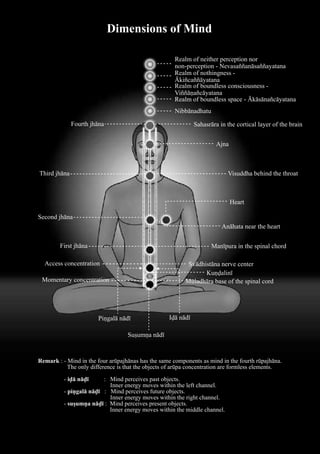
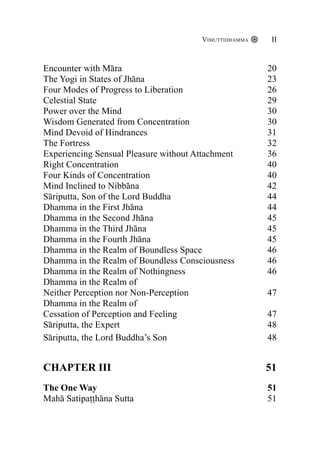
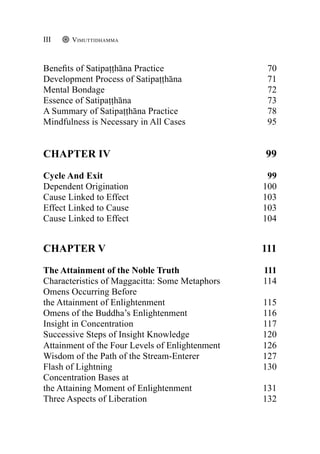
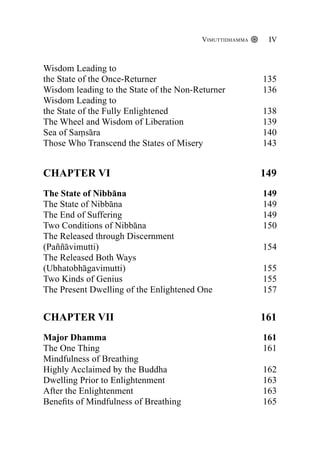
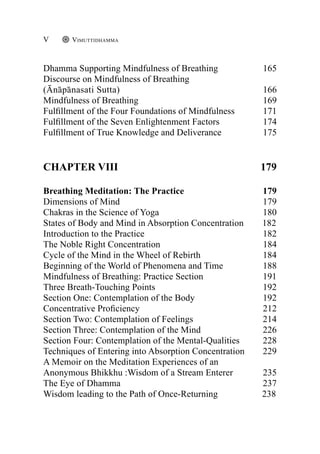
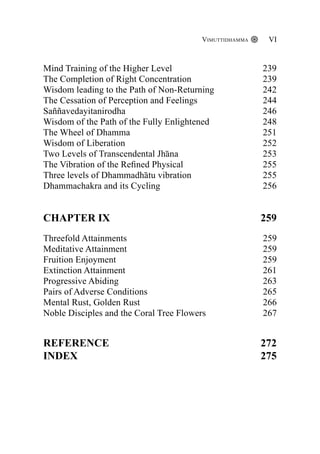
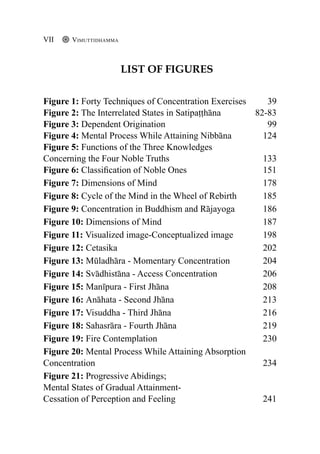







![The Buddha’s First Utterance
4
Rare States
“Monks, suppose that this great earth were totally covered with
water, and a man were to toss a yoke with a single hole there.
A wind from the east would push it west, a wind from the west
would push it east. A wind from the north would push it south,
a wind from the south would push it north. And suppose a blind
sea-turtle were there. It would come to the surface once every
one hundred years. Now what do you think: would that blind
sea-turtle, coming to the surface once every one hundred years,
stick his neck into the yoke with a single hole?
“It would be a sheer coincidence, Lord, that the blind sea-turtle,
coming to the surface once every one hundred years, would stick
his neck into the yoke with a single hole.
“It’s likewise a sheer coincidence that one obtains the human
state. It’s likewise a sheer coincidence that a Tathāgata,7
, worthy
and rightly self-awakened, arises in the world. It’s likewise a
sheer coincidence that a doctrine and discipline expounded by a
Tathāgata appears in the world. Now, this human state has been
obtained. A Tathāgata, worthy and rightly self-awakened, has
arisen in the world. A doctrine and discipline expounded by a
Tathāgata appears in the world.
“Therefore your duty is the contemplation, ‘This is [suffering]...
This is the origination of [suffering]... This is the cessation of
[suffering].’ Your duty is the contemplation, ‘This is the path of
practice leading to the cessation of [suffering].’”8
7 “The Perfect One,” an epithet of the Lord Buddha.
8 S.N., Mahā-vagga, Sacca-saṃyutta, 56.48, Bhikkhu Thanissaro, ATI.](https://image.slidesharecdn.com/27620009-250516174407-d72f23a7/85/Vimuttidhamma-From-Chakra-To-Dhammachakra-Piyadhassi-Bhikkhu-28-320.jpg)
![Vimuttidhamma 7
Brahmin, following the Blessed One’s footprints, saw him seated
under a tree, of pleasing appearance, inspiring confidence, with
calm features and calm mind, in perfect composure and equipoise,
controlled and restrained [like] a well-trained bull elephant. Seeing
the Blessed One, Dona approached him and said:
‘Will Your Reverence become a deva?’
‘No, Brahmin, I shall not become a deva.’
‘Then Your Reverence might become a gandhabba (a kind of
celestial being skilled in music)... a yakkha(an ogre)… a human
being?’
‘No, Brahmin, I shall not become a gandhabba… a yakkha…
a human being.’
‘What, then, will Your Reverence become?’
‘Brahmin, those taints whereby, if they were not abandoned, I
might become a deva, a gandhabba, a yakkha, or a human being -
these taints are abandoned by me, cut off at the root, made barren
like palm-tree stumps, obliterated so that they are no more subject
to arise in the future.
‘Just as, Brahmin, a blue, red or white lotus, though born
and grown in the water, rises up and stands unsoiled by the
water, so, Brahmin, though born and grown in the world, I have
overcome the world and dwell unsoiled by the world. Consider me,
O Brahmin, a Buddha.’”13
13 A.N.,The Chapter of the Fours (58), p. 87-8, Bhikkhu Nyanaponika and Bhikkhu
Bodhi.](https://image.slidesharecdn.com/27620009-250516174407-d72f23a7/85/Vimuttidhamma-From-Chakra-To-Dhammachakra-Piyadhassi-Bhikkhu-31-320.jpg)


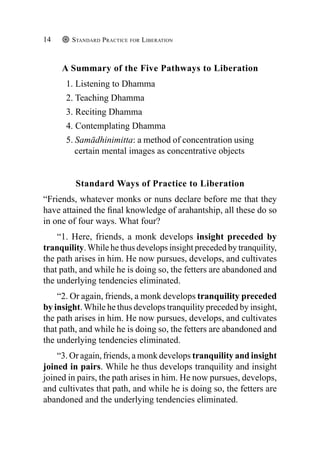

![Vimuttidhamma 21
“And a third time they fought and the asuras won and the
devas were defeated. Defeated and fearful, they just entered the
deva city. Monks, thus gone to their city, the devas thought: ‘Now
that we have come to the refuge for the fearful, we will henceforth
dwell by ourselves and have no dealings with the asuras.’And the
asuras thought also: ‘Gone, indeed, are the devas to the refuge for
the fearful, henceforth they will dwell by themselves and have
no dealing with us!’
“Monks, long ago another battle raged between the devas and
asuras; but in that fight the devas won and the asuras were defeated.
And the defeated asuras fled, pursued by the devas, facing south.
Then thought the asuras: ‘The devas pursue us; what if we fight a
second time!’And they did so… and were a second time defeated.
“And a third time they fought and the devas won and the
asuras were defeated; and defeated and fearful, they just entered
the asura city; and thus gone to their city, the asuras thought: ‘Now
that we’ve come to the refuge for the fearful, we will dwell by
ourselves and have nothing to do with the devas.’And the devas
thought likewise….
“In just the same way, monks, what time a monk, aloof from
sense desires,… enters and abides in the first [jhāna], he thinks:
‘Now that I have come to the refuge for the fearful, I will henceforth
dwell by myself and have no dealings with Māra.’And Māra, the
Evil One, thinks: ‘Now that the monk has gone to the refuge for
the fearful, he will dwell by himself and have no dealing with me.’
Monks, what time a monk… enters and abides in the second…
third… and fourth [jhāna], he thinks likewise… and Māra too….](https://image.slidesharecdn.com/27620009-250516174407-d72f23a7/85/Vimuttidhamma-From-Chakra-To-Dhammachakra-Piyadhassi-Bhikkhu-45-320.jpg)
![Standard Practice for Liberation
24
The third argument against jhāna practice is that there are
known cases of those who attained absorption concentration and
had proficiency in supernormal powers, but still were not able
to attain the noble truth. The most frequently mentioned persons
are Asitta yogi (Kāladevin yogi), who enjoyed visiting heavens,
Ālāra yogi, who attained the seventh jhāna, and Udaka yogi, who
attained the eighth jhāna.
These commentators may have forgotten that the only types
of beings who are able to develop vipassanā (insight)30
without
relying on other people’s wisdom are the Buddha or solitary
buddhas.31
These three yogis did not possess the qualities that
would enable them to be Buddha nor had the Buddha been born
to the world during their time. How could they, then, attain magga
by themselves?
After attaining enlightenment, the Buddha at first hesitated
to teach the Dhamma as the knowledge attained by him was so
profound, complicated and difficult to understand. Then, after
emerging from contemplation at the end of a seven day retreat, the
Lord approached the Banyan tree of the goatherds. While staying
there and meditating in seclusion, a thought arose in his mind:
“This Dhamma, [known] by me, is deep, difficult to see,
difficult to understand, peaceful, excellent, beyond dialectic,
subtle, intelligible to the learned. But this is a creation delighting
in sensual pleasure, delighted by sensual pleasure, rejoicing in
sensual pleasure. So for a creation delighting in sensual pleasure,
delighted by sensual pleasure, rejoicing in sensual pleasure,
30 Insight, or wisdom, attained through direct meditative observation, is the decisive
liberating factor of the Lord Buddha’s teaching.
31 A solitary buddha attains enlightenment by himself, but does not teach others.](https://image.slidesharecdn.com/27620009-250516174407-d72f23a7/85/Vimuttidhamma-From-Chakra-To-Dhammachakra-Piyadhassi-Bhikkhu-48-320.jpg)
![Standard Practice for Liberation
26
“There is no concentration for one who lacks wisdom.
Nor is there wisdom for one who lacks concentration.
In whom there are found both concentration and wisdom,
Are indeed in the presence of nibbāna.”34
Four Modes of Progress to Liberation
1. Dukkha patipadā dandhābhiññā – painful
progress with sluggish direct knowledge.
2. Dukkha patipadā khippābhiññā – painful
progress with swift direct knowledge.
3. Sukha patipadā dandhābhiññā – pleasant
progress with sluggish direct knowledge.
4. Sukha patipadā khippābhiññā – pleasant
progress with swift direct knowledge.
Painful Progress with Sluggish Direct Knowledge
“And of what sort, monks, is the painful mode of progress with
sluggish [direct knowledge]?
“In this case, a monk lives contemplating the loathsomeness
in the body, aware of the repulsiveness of food, aware of his
distaste for all the world, aware of impermanence in all activities.
Thus awareness of death is implanted in the very self. He lives
dependent on these five powers of a pupil: the power of faith,
the power of modesty, the power of self-restraint, the power
34 K.N. Dhammapada, Verses on Bhikkhu, p. 402, trans. by Sathienpong Wannapok,
The Buddha’s Verses in Dhammapada, published in commemoration of the crematory
rite of Mrs. Premsri Khemasingkhi, 4April 1999, Phra Sri Mahadhathu Royal Temple,
Bangkok.](https://image.slidesharecdn.com/27620009-250516174407-d72f23a7/85/Vimuttidhamma-From-Chakra-To-Dhammachakra-Piyadhassi-Bhikkhu-50-320.jpg)
![Vimuttidhamma 27
of energy, and the power of wisdom. But in him these five controlling
faculties are dully manifested, to wit: the controlling faculty of
faith, that of energy, that of mindfulness, that of concentration, and
the controlling faculty of wisdom. Thus, owing to the dullness of
these five controlling faculties, sluggish is his attainment of the
concentration that follows on for the destruction of the āsavas
(cankers or defilements). This, monks, is called ‘the mode of
progress that is painful with sluggish [direct knowledge].’
Painful Progress with Swift Direct Knowledge
“And of what sort, monks, is the mode of progress that is painful,
but with swift [direct knowledge]?
“In this case a monk lives contemplating the unloveliness
in the body same (as above). But in him these five controlling
faculties are manifested in abundance, to wit: the controlling
faculty of faith.... Thus, owing to the preponderance of these five
controlling faculties, swift is his attainment of the concentration
that follows on for the destruction of the āsavas. This, monks, is
called ‘the mode of progress that is painful but with swift [direct
knowledge].’
Pleasant Progress with Sluggish Direct Knowledge
“And of what sort, monks, is the mode of progress that is pleasant
but with sluggish [direct knowledge]?
“In this case a monk, aloof from sense-desires, aloof from evil
conditions… enters upon the first [jhāna]… the second [jhāna]…
the third [jhāna]…the fourth [jhāna], a state of neither ease nor
discomfort, an equanimity of utter purity, and having attained it,](https://image.slidesharecdn.com/27620009-250516174407-d72f23a7/85/Vimuttidhamma-From-Chakra-To-Dhammachakra-Piyadhassi-Bhikkhu-51-320.jpg)
![Standard Practice for Liberation
28
abides therein. He lives dependent on these five powers of a pupil:
the power of faith.... But in him these five controlling faculties
are dully manifested, to wit... Thus, owing to the dullness of
these five controlling faculties, sluggish is his attainment of the
concentration that follows on for the destruction of the āsavas.
This, monks, is called ‘the mode of progress that is pleasant, but
with sluggish [direct knowledge].’
Pleasant Progress with Swift Direct Knowledge
“And of what sort, monks, is the mode of progress that is both
pleasant and accompanied by swift [direct knowledge]?
“In this case a monk, aloof from sense-desire (same as
above)… But in him these five controlling faculties are manifested
in abundance... Thus, owing to the preponderance of these five
controlling faculties, swift is his attainment of the concentration that
follows on for the destruction of the āsavas.This, monks, is called
‘the mode of progress that is both pleasant and is accompanied by
swift [direct knowledge].’
“So these are the four modes of progress.”35
35 A.N. vol. 2, The Book of the Fours (9, 17, 163) p. 156, Woodward.](https://image.slidesharecdn.com/27620009-250516174407-d72f23a7/85/Vimuttidhamma-From-Chakra-To-Dhammachakra-Piyadhassi-Bhikkhu-52-320.jpg)