CAP in
children
is
classified
as pneumonia,
(agerelated
tachyypnca)severe
pneurmonia
(tachypnea and recessions)
and very severe pneumonia (severe pneumonia with
hypoxemia, dullness orinability
to drink). Severe or very severe pneumonia are
ideally
treated
asinpatients.
There issome data that
severe
CAP can alsobe treated
on
an outpatient
basisincertain
situations.
No investigations
including
CXR are needed
for
outpatients.
Bloodcultures
and CXR should
be performedfor
inpatients.
CBC and
CRP may not
alwayshelp
differentiate
bacterial
from
viral
CAP. Other investigations
todetermineetiology
arenotroutinely
indicated.
Empiricantimicrobial
therapyis
discussed inTable 2. Salient
difference
from adult CAP is
the sclectiveuse of
macrolidesonly if
clinical
features
suggest mycoplasma. Complications
such as
empyema shouldbe watchedout.
Duration
oftherapy
foroutpatientsis 5 days and for
uncomplicated
pneumonia ininpatients
is
7 days.
Choice
of
empiric antimicrobial
therapyinadult
CAP
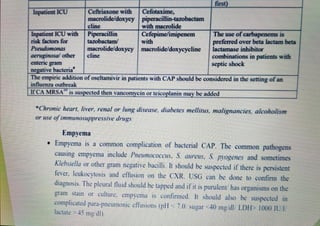
Type of CAP Preferred
drug Alternative Comments
Outpatients
without Co amoxiclav Macrolides** Beta lactam
preferred
over
co-morbidities Cefuroxime macrolidesdue tohigh
Cefpodoxime prevalenceof macrolide
resistance
inS.pneumoniae in
India.
Doxycyclinemonotherapy not
recommended
Outpatients
with Co-amoxiclav Cefuroxime
co-morbidities*
or and cefpodoximeand
use ofantimicrobialmacrolide doXyey macrolidedoxyeycline
in 3 months cline
If
there is hypersensitivity
to
Inpatient.,
nonICU Ceftriaxone
with CefotaXImeamox clav
macrolide doxyeywith beta lactams:
respiratory
Ime macrolide
doxyeycline fluoroquinolones
(exeludeTB
first)
Inpatient
ICU Ceftriaxone
with Cefotaxime,
macrolide/doxycypiperacillin-tazobactam
cline withmacrolide
Inpatient
IC with Piperacillin Cefepime/imipenem The useofcarbapenems is
risk
factors
for tazobactam/ with preferred
overbetalactam
beta
Pseudomonas macrolide/doxycymacrolide/doxycycline
combinations
inpatients
with
lactamase
inhibitor
aeruginosal
other cline
enteric
gram septic
shock
negative
bacteria"
The empiric
addition
ofoseltamivir
inpatients
withCAP shouldbe considered
inthesetting
of an
influenza
outbreak
|IfCA
MRSA issuspectedthenvancomycinorteicoplanin
may be added
*Chronic
heart,
liver,
renal
orlung
disease,
diabetesmellitus,
malignancies,
alcoholism
oruse ofimmunosuppressive
drugs
Empyema
•Empyema is a common complication
of bacterial
CAP. The common pathogens
causing empyema include
PneumococCUs, S.aureSs. S. pogenes and sometimes
Klebsiella
orothergram negative
bacilli.
It
shouldbe suspectedif
thereis persistent
fever,
leukocytosis
and effusion
on the CXR. USG can be done to confirm
the
diagnosis.
The pleural
fluid
should
be tapped andifit
is
purulenthas organisms onthe
gram stain or culture,
empvema is confirmed.
Itshould also be suspectedin
complicated
para-pncumonic
effusions
(pll
< 7.0
sugar<40 mg dl LDH> 1000 IUA
lactate>
45 mg dil).
•Drainage
oftheinfected
fluid
is
paramount and can be done by chesttube withor
without
fibrinolytics.
VATS or thoracotomy may benceded in
certain
cases with
organized
empyema.
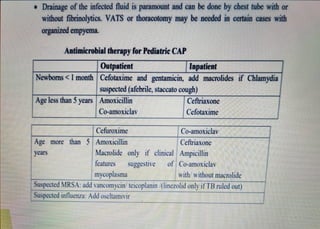
Antimicrobial
therapyfor
Pediatric
CAP
Outpatient |Inpatient
Newboms <l
month Cefotaximeand gentamicin,
add macrolides
if
Chlamydia
Suspected(afebrile,
staccato
cough)
Age less
than
5
years Amoxicillin Ceftriaxone
Co-amoxiclav Cefotaxime
Cefuroxime Co-amoxiclav
Age more than 5 Amoxicillin Ceftriaxone
years Macrolide only ifclinical|
Ampicillin
features Suggestive of Co-amoxiclav
mycoplasma with without
macrolide
Suspected
MRSA:add vancomycin'
teicoplanin
/(linezolid
only
ifTB
ruledout)
Suspectedinfluenza:
Addoseltamivir
Drugdoses,duration
and route
Drug Adult
dose Pediatric
dose
Penicillin
V 500 mg twice
daily 250 mg twicedaily
Benzathine 27kg6,00,000
units
IMsingle
dose
penicillin >27 kg1.2
million
units
IMsingle
dose
|Amoxicillin 500– 1000 mg thrice
daily
(POor|
15-20 mgkgtwice
daily
oral
IV) 30-35mgkg thrice
daily
IV
Co-amoxicavI
gm twice daily 625 mg thrice 15-20 mgkg of amoxicillin
daily
oral twice
daily
P0
12 gm IVq8h 25-30 mgkg of amoxicillin
component thrice
daily
IV
Azithromycin 500 mg daily
(POor1V) 10 mg kg oncedaily
Clarithromycin
500 mg twicedaily |7.5
mgke twicedaily
Oseltamivir 75 mg tWice daily
PO SISkg 30 mg twicedaily
16-34 kg45 mg twicedaily
35-44 kg 60 mg twicedaily
45 kgand more 75 mg twice
daily
Doxveveline 100mg twice
daily 1.5-2 mykg twice
daily
Clindamycin 300 mg four
timesa dayPO
600 mg thrice
daily
IV
Cepnhalexin 750 mg twicedaily
PO
Cefadroxil I
gm oncedaily
Levofloxacin 750 mg once daily
PO orIV
Moxifloxacin 400 mg once daily
PO orIV
Cefpodoxime 200 mg twicedaily
roxime
Cefuroxime 500 mg twicedaily
oral
1.5gm twicedaily
IV
Ceftriaxone 2 gm once daily
IV
Cefotaxime 2 gm thrice
daily
IV
Cefepime 2gm twicedaily
IV
Piperacllin 45gm thrice
daily
tazobactam
Cctoperazone3
gm twCe daily
sulbactam
|7mgkgthrice
daily
|20
mgkgtwicedaily
PO
30 mg kgonce daily
10-15 mpkg in one or two
divided
doses PO orIV
|
10 mg kgoncedaily
PO orIV
5 mg kgtwicedaily
1O mg kgtwice
daily
oral
35 mg kgtwice daily
IV
S0 mg kgtwicedaily
30-35 mg kgthrice
daily
IV
50 mg kgtwicedaily
100 mg kgpieracillin
thrice
daily
S0 mg kg of cetoperazone
tWIcedaily
Imipenem
Meropenem
Vancomycin
Teicoplanin
Linezolid
gm thrice
dailyor 500 mg four 15-25 mg/kg fourtimnes daily
times
daily IV IV
1gm thrice
daily
IV 20-40 mg/kgthrice
daily
1gm twice
daily 10 mg/kg four
timesdaily
400 mg twicedaily
for 3 doses and 12 mg/kg twice dailyfor
3
then400 mg oncedaily doses and then 12 mg/kg once
daily
600 mg twice
daily
PO orIV 10
mg/kg thrice
daily
PO orIV
References
1.Gupta D,Agarwal R,Aggarwal AN,Singh N.MishraN,Khilnani
GC etal (2012).Pneumonia
Guidelines
Working Group. Guidelines
for diagnosisand management of community- and
hospital-acquired
pncumonia in adults:Joint ICSNCCPT) recommendations.Lung India
29(Suppl2):S27-62.
2. Mandell
LA, Wunderink RG,Anzucto A, Bartlett
JG, Campbell GD, Dean NC etal (2007).
Infectious
Diseases
Society of America/ AmericanThoracicSocietyconsensusguidelines
on the
management of community-acquired
pneumonia inadults.
Clin
InfectDis 44(Suppl 2):S27 72.
3. JayaramanR,VargheseR.Kumar JL, Neeravi
A,Shanmugasundaram D, Ralph R, Et al (2018).
Invasive
pneumococeal diseaseinIndian
adults:
11years' experience.JMicrobiol
Immmunot nfeet
pi:
Si684-1182(18)30113-0.
4. Singh J,SundaresanS,Manoharan A,Shet A (2017). Serotype distribution
and antimierobial
susceptibility
patterrnin childrenESyears
with invasivepneumococcal disease in India A
systematicreview.
laCcine
35(35 Pt B):4501-4509.
5. VergheseVP,Veeraraghavan
B,JayaramanR.VargheseR,NeeraviA, Jayaraman Y et al(2017).
Increasing incidence of penicillin-
andcefotaxime-resistant
StrptococcUs pneumoniae causing
meningitis n India: Time for revision
ef treatment guidelines ndiazn Aled Microbio
35(2):228-236.
Names ofthecontributors:
1. Dr. Tanu
Singhal
Consultant Pediatrics
andInfectious
Disease
KokilabenDhirubhai
Ambani IHospital
and Medical Researeh Institute.
Mumbai
2. Dr.
Pallab
Ray
Professor,
Department of Medical
Microbiology,
PGIMER, Chandigarh

vignesh copd.pdf chronic obstructive disease

  • 1.
    CAP in children is classified as pneumonia, (agerelated tachyypnca)severe pneurmonia (tachypneaand recessions) and very severe pneumonia (severe pneumonia with hypoxemia, dullness orinability to drink). Severe or very severe pneumonia are ideally treated asinpatients. There issome data that severe CAP can alsobe treated on an outpatient basisincertain situations. No investigations including CXR are needed for outpatients. Bloodcultures and CXR should be performedfor inpatients. CBC and CRP may not alwayshelp differentiate bacterial from viral CAP. Other investigations todetermineetiology arenotroutinely indicated. Empiricantimicrobial therapyis discussed inTable 2. Salient difference from adult CAP is the sclectiveuse of macrolidesonly if clinical features suggest mycoplasma. Complications such as empyema shouldbe watchedout. Duration oftherapy foroutpatientsis 5 days and for uncomplicated pneumonia ininpatients is 7 days. Choice of empiric antimicrobial therapyinadult CAP Type of CAP Preferred drug Alternative Comments Outpatients without Co amoxiclav Macrolides** Beta lactam preferred over co-morbidities Cefuroxime macrolidesdue tohigh Cefpodoxime prevalenceof macrolide resistance inS.pneumoniae in India. Doxycyclinemonotherapy not recommended Outpatients with Co-amoxiclav Cefuroxime co-morbidities* or and cefpodoximeand use ofantimicrobialmacrolide doXyey macrolidedoxyeycline in 3 months cline If there is hypersensitivity to Inpatient., nonICU Ceftriaxone with CefotaXImeamox clav macrolide doxyeywith beta lactams: respiratory Ime macrolide doxyeycline fluoroquinolones (exeludeTB
  • 2.
    first) Inpatient ICU Ceftriaxone with Cefotaxime, macrolide/doxycypiperacillin-tazobactam clinewithmacrolide Inpatient IC with Piperacillin Cefepime/imipenem The useofcarbapenems is risk factors for tazobactam/ with preferred overbetalactam beta Pseudomonas macrolide/doxycymacrolide/doxycycline combinations inpatients with lactamase inhibitor aeruginosal other cline enteric gram septic shock negative bacteria" The empiric addition ofoseltamivir inpatients withCAP shouldbe considered inthesetting of an influenza outbreak |IfCA MRSA issuspectedthenvancomycinorteicoplanin may be added *Chronic heart, liver, renal orlung disease, diabetesmellitus, malignancies, alcoholism oruse ofimmunosuppressive drugs Empyema •Empyema is a common complication of bacterial CAP. The common pathogens causing empyema include PneumococCUs, S.aureSs. S. pogenes and sometimes Klebsiella orothergram negative bacilli. It shouldbe suspectedif thereis persistent fever, leukocytosis and effusion on the CXR. USG can be done to confirm the diagnosis. The pleural fluid should be tapped andifit is purulenthas organisms onthe gram stain or culture, empvema is confirmed. Itshould also be suspectedin complicated para-pncumonic effusions (pll < 7.0 sugar<40 mg dl LDH> 1000 IUA lactate> 45 mg dil).
  • 3.
    •Drainage oftheinfected fluid is paramount and canbe done by chesttube withor without fibrinolytics. VATS or thoracotomy may benceded in certain cases with organized empyema. Antimicrobial therapyfor Pediatric CAP Outpatient |Inpatient Newboms <l month Cefotaximeand gentamicin, add macrolides if Chlamydia Suspected(afebrile, staccato cough) Age less than 5 years Amoxicillin Ceftriaxone Co-amoxiclav Cefotaxime Cefuroxime Co-amoxiclav Age more than 5 Amoxicillin Ceftriaxone years Macrolide only ifclinical| Ampicillin features Suggestive of Co-amoxiclav mycoplasma with without macrolide Suspected MRSA:add vancomycin' teicoplanin /(linezolid only ifTB ruledout) Suspectedinfluenza: Addoseltamivir
  • 4.
    Drugdoses,duration and route Drug Adult dosePediatric dose Penicillin V 500 mg twice daily 250 mg twicedaily Benzathine 27kg6,00,000 units IMsingle dose penicillin >27 kg1.2 million units IMsingle dose |Amoxicillin 500– 1000 mg thrice daily (POor| 15-20 mgkgtwice daily oral IV) 30-35mgkg thrice daily IV Co-amoxicavI gm twice daily 625 mg thrice 15-20 mgkg of amoxicillin daily oral twice daily P0 12 gm IVq8h 25-30 mgkg of amoxicillin component thrice daily IV Azithromycin 500 mg daily (POor1V) 10 mg kg oncedaily Clarithromycin 500 mg twicedaily |7.5 mgke twicedaily Oseltamivir 75 mg tWice daily PO SISkg 30 mg twicedaily 16-34 kg45 mg twicedaily 35-44 kg 60 mg twicedaily 45 kgand more 75 mg twice daily Doxveveline 100mg twice daily 1.5-2 mykg twice daily
  • 5.
    Clindamycin 300 mgfour timesa dayPO 600 mg thrice daily IV Cepnhalexin 750 mg twicedaily PO Cefadroxil I gm oncedaily Levofloxacin 750 mg once daily PO orIV Moxifloxacin 400 mg once daily PO orIV Cefpodoxime 200 mg twicedaily roxime Cefuroxime 500 mg twicedaily oral 1.5gm twicedaily IV Ceftriaxone 2 gm once daily IV Cefotaxime 2 gm thrice daily IV Cefepime 2gm twicedaily IV Piperacllin 45gm thrice daily tazobactam Cctoperazone3 gm twCe daily sulbactam |7mgkgthrice daily |20 mgkgtwicedaily PO 30 mg kgonce daily 10-15 mpkg in one or two divided doses PO orIV | 10 mg kgoncedaily PO orIV 5 mg kgtwicedaily 1O mg kgtwice daily oral 35 mg kgtwice daily IV S0 mg kgtwicedaily 30-35 mg kgthrice daily IV 50 mg kgtwicedaily 100 mg kgpieracillin thrice daily S0 mg kg of cetoperazone tWIcedaily
  • 6.
    Imipenem Meropenem Vancomycin Teicoplanin Linezolid gm thrice dailyor 500mg four 15-25 mg/kg fourtimnes daily times daily IV IV 1gm thrice daily IV 20-40 mg/kgthrice daily 1gm twice daily 10 mg/kg four timesdaily 400 mg twicedaily for 3 doses and 12 mg/kg twice dailyfor 3 then400 mg oncedaily doses and then 12 mg/kg once daily 600 mg twice daily PO orIV 10 mg/kg thrice daily PO orIV References 1.Gupta D,Agarwal R,Aggarwal AN,Singh N.MishraN,Khilnani GC etal (2012).Pneumonia Guidelines Working Group. Guidelines for diagnosisand management of community- and hospital-acquired pncumonia in adults:Joint ICSNCCPT) recommendations.Lung India 29(Suppl2):S27-62. 2. Mandell LA, Wunderink RG,Anzucto A, Bartlett JG, Campbell GD, Dean NC etal (2007). Infectious Diseases Society of America/ AmericanThoracicSocietyconsensusguidelines on the management of community-acquired pneumonia inadults. Clin InfectDis 44(Suppl 2):S27 72. 3. JayaramanR,VargheseR.Kumar JL, Neeravi A,Shanmugasundaram D, Ralph R, Et al (2018). Invasive pneumococeal diseaseinIndian adults: 11years' experience.JMicrobiol Immmunot nfeet pi: Si684-1182(18)30113-0. 4. Singh J,SundaresanS,Manoharan A,Shet A (2017). Serotype distribution and antimierobial susceptibility patterrnin childrenESyears with invasivepneumococcal disease in India A systematicreview. laCcine 35(35 Pt B):4501-4509. 5. VergheseVP,Veeraraghavan B,JayaramanR.VargheseR,NeeraviA, Jayaraman Y et al(2017). Increasing incidence of penicillin- andcefotaxime-resistant StrptococcUs pneumoniae causing meningitis n India: Time for revision ef treatment guidelines ndiazn Aled Microbio 35(2):228-236. Names ofthecontributors: 1. Dr. Tanu Singhal Consultant Pediatrics andInfectious Disease KokilabenDhirubhai Ambani IHospital and Medical Researeh Institute. Mumbai 2. Dr. Pallab Ray Professor, Department of Medical Microbiology, PGIMER, Chandigarh