1
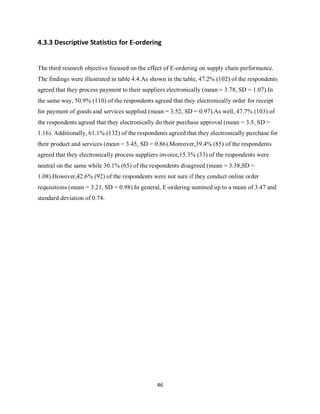
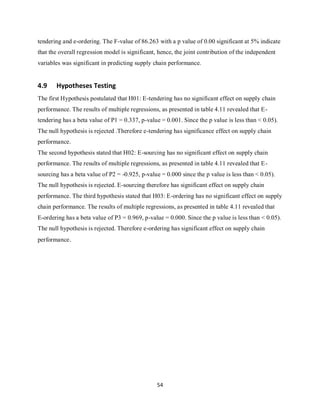
IMPACT OF E-PROCUREMENT ON SUPPLY CHAIN PERFORMANCE IN STATE
CORPORATIONS IN KENYA.
VICTOR KIBET KIPKULEI
L126/12155/2014
A RESEARCH PROJECT PRESENTED IN PARTIAL FULFILLMENT OF THE REQUIREMENT FOR THE
AWARD OF THE DIPLOMA IN PURCHASING AND SUPPLIES MANAGEMENT, SCHOOL OF
CONTINUING AND DISTANCE EDUCATION,
UNIVERSITY OF NAIROBI
November, 2016
kipkulei
2
DECLARATION
This project is my original work and has not been submitted for a diploma award in any other
University.
Signed.................................... Date..................................
Victor Kibet Kipkulei
L126/12155/2014
This project has been submitted for examination with my approval as university supervisor.
Signed.................................... Date.................................
Lecturer: Mr. Samuel Chege
School of continuing and distance education
University of Nairobi
kipkulei
3
ACKNOWLEDGEMENTS
I thank everyone who assisted me in realizing my dream of doing my diploma in purchasing and
supplies management. Special thanks go to my very able supervisor Mr. Samuel Chege for his
constant, incisive guidance. To my dearest family for being understanding and always
supportive during the period of my study.
Many thanks also go to my fellow students for constantly reminding me about the expectations
of the university in all my academic undertakings.
kipkulei
4
DEDICATION
I dedicate this work to my Parents, Mr. and Mrs. Johanna Cherutoi, my fiancée Joan Limo my
Siblings Dorothy, Janet Charles and my son Kayden and all those who supported me in the
completion of this project. Thank you and May God bless you abundantly
kipkulei
5
ABSTRACT
Supply Chain Management (SCM) has become a critical factor for the organization’s success. The use of
e-procurement enables fast responses, creating high responsiveness and cuts costs right through the
supply chain. The procurement function in Kenya has been undergoing through reforms and its
implementation has been very slow. This has been attributed to poor handling of procurement
activities, hence an effect on the supply chain performance. The main purpose of the study was to
determine the effect of e-procurement on supply chain performance. The main purpose of the study
was to determine the effect of e- procurement on supply chain performance. Specific objectives were to
determine the effect of E-tendering on supply chain performance, assess the effect of E-sourcing on
supply chain performance, determine the effect of E-ordering on supply chain performance and
determine the effect of E-informing on supply chain performance. The study was informed by theories
of transaction cost theory and Innovation Diffusion Theory. Explanatory research design was used in the
undertaking of this research. The study targeted procurement officers from the Kenyan State
Corporations in Kenya. Data was collected from a sample of 216 procurement officers using self-
administered questionnaires. The research instrument was tested for reliability by computing the
Cronbach alpha statistical tests. The data was cleaned and analyzed using descriptive and inferential
statistics. Descriptive statistics like means, frequencies and percentages were used. In addition, Pearson
correlation was used to show the correlation between the variables. Multiple regression was used to
test the study hypothesis. The results indicated that e-tendering, e-ordering, e-informing has a positive
and significant effect on supply chain performance. However, e-sourcing has a negative and significant
effect on supply chain performance. The study concludes that e-procurement dimensions with and
exception of e-sourcing increases supply chain performance. There is therefore need for firms to adopt
the use of e-procurement such as e-tendering, e-ordering, and e-informing. The study contributes to
theory and literature in supply chain management using the Kenyan experience.
kipkulei
6
TABLE OF CONTENTS
DECLARATION....................................................................................................i
ACKNOWLEDGEMENT........................................................................................ii
DEDICATION.......................................................................................................iii
ABSTRACT .........................................................................................................iv
TABLE OF CONTENTS..........................................................................................v
FIGURE ..............................................................................................................vii
LIST OF TABLES ..................................................................................................viii
OPERATIONAL DEFINITION OF TERMS ...............................................................ix
CHAPTER ONE ..........................................................................................1
INTRODUCTION.................................................................................................1
1.1 Background of the Study ....................................................................................1
1.2 Statement of the Problem ..................................................................................4
1.3 General Objective of the Study ..........................................................................5
1.3.1 Specific Objectives...........................................................................................5
1.3.2 Research Hypotheses.......................................................................................5
1.4 Significance of the Study ....................................................................................5
1.5 Scope of the Study..............................................................................................5
1.6 limitations of the Study.......................................................................................6
1.7 summary .............................................................................................................6
CHAPTER TWO....................................................................................................7
LITERATURE REVIEW .........................................................................................7
Introduction ............................................................................................................7
2.1 Concept of Supply Chain Performance ..............................................................7
2.2 Concept of E-Procurement. ...............................................................................9
2.3 Theoretical Framework. ....................................................................................11
2.3.1 Innovation Diffusion Theory ...........................................................................11
2.3.1 Transactional cost Theory ..............................................................................12
2.4 Effect of E-Tendering on Supply Chain Performance. .......................................12
2.5 Effect of E-Sourcing on Supply Chain Performance............................................14
2.6 Effect of E-Ordering on Supply Chain Performance...........................................15
2.7 Effect of E-Informing on Supply Chain Performance .........................................16
2.8 Conceptual Framework......................................................................................18
2.9 Performance ......................................................................................................19
kipkulei
7
CHAPTER THREE.................................................................................................20
RESEARCH METHODOLOGY ...............................................................................20
Introduction: ..........................................................................................................20
3.1 Research Design ................................................................................................20
3.2 Target Population...............................................................................................20
3.3 Census Study ......................................................................................................21
3.4 Data Collection Instruments and Procedures. ...................................................21
3.4.1 Types and Sources of Data ..............................................................................21
3.4.2 Data Collection Instruments ............................................................................22
3.4.3 Data Collection Procedures. ............................................................................22
3.5 Reliability and Validity.........................................................................................22
3.5.1 Reliability..........................................................................................................22
3.5.2 Validity ............................................................................................................23
3.6 Data Analysis and Presentation.......................................................................... 23
3.6.1 Assumptions of the Model ...............................................................................24
3.7 Measurement Instruments .................................................................................25
3.7.1 Supply Chain Performance................................................................................25
3.7.2 Independent Variable........................................................................................25
3.8 Ethical Considerations..........................................................................................27
3.9 Limitations of the Study ......................................................................................27
CHAPTER FOUR ...................................................................................................28
DATA ANALYSIS, PRESENTATION AND INTERPRETATION
.............................................................................................................................28
4.0 Overview ...............................................................................................................28
4.1 response rate………………………………….....................................................................28
4.2 demographic information. ....................................................................................28
4.3 descriptive statistics of variables...........................................................................30
4.3.1 Descriptive statistics for E-tendering..................................................................30
4.3.2 Descriptive statistics for E-sourcing....................................................................31
4.3.3 Descriptive statistics for E- ordering. .................................................................34
4.3.4 Descriptive statistics for E-informing..................................................................35
4.3.5 Descriptive statistics for supply chain performance...........................................36
4.4 Normality test .......................................................................................................37
4.5 reliability analysis...................................................................................................38
4.6 factor analysis ........................................................................................................39
4.7 correlation results...................................................................................................41
4.8 regression analysis results......................................................................................41
4.9 hypothesis testing..................................................................................................42
kipkulei
8
CHAPTER FIVE ............................................................................................................44
SUMMARY OF THE FINDINGS, CONCLUSIONS AND RECOMMENDATIONS
......................................................................................................................................44
5.0 Introduction............................................................................................................44
5.1 Summary of Findings..............................................................................................44
5.1.1 E-tendering on Supply Chain Performance..........................................................44
5.1.2 E-Sourcing on Supply Chain Performance............................................................45
5.1.3 E-ordering on Supply Chain Performance ...........................................................45
5.1.4 E- informing on Supply Chain Performance ........................................................45
5.2 Conclusion of the Study .........................................................................................46
5.3 Recommendations of the study..............................................................................47
5.4 Suggestions for Further Studies..............................................................................47
REFERENCES............................................................................................................48
APPENDIX I: QUESTIONNAIRE ................................................................................56
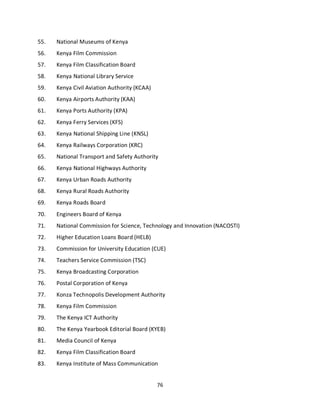
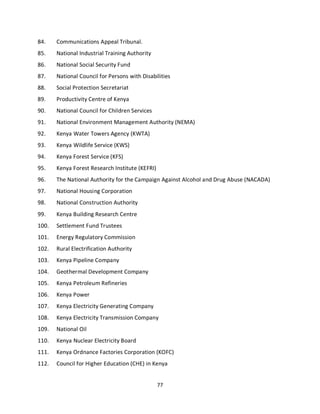
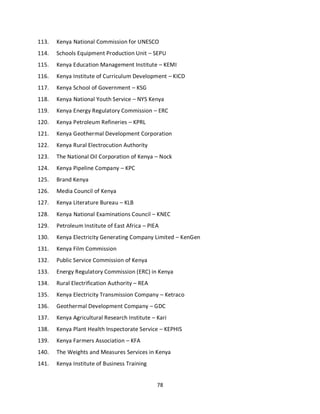
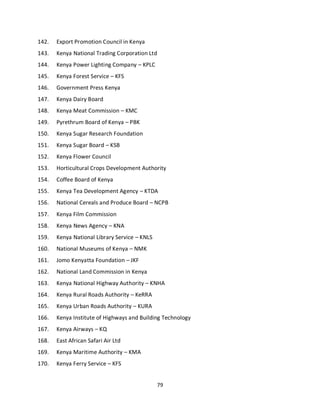
APPENDIX II: LIST OF THE KENYAN STATE CORPORATIONS......................................62
kipkulei
9
FIGURES
Figure 2.1 Conceptual frameworks on the effect of E-Procurement on Supply Chain
performance........................................................................................................................... 18
kipkulei
10
LIST OF TABLES
Table 3.1 Summary of Measurement Instruments ....................................................26
Table 4.1 Demographic Information ..........................................................................30
Table 4.2 E-Tendering ................................................................................................32
Table 4.3 E- Sourcing..................................................................................................33
Table 4.4 E-Ordering ..................................................................................................35
Table 4.6 Supply Chain Performance..........................................................................37
Table 4.7 Normality Tests...........................................................................................38
Table 4.8 Reliability Analysis.......................................................................................38
Table 4.9 Factor Analysis for Independent Variables..................................................40
Table 4.10 Correlation Results....................................................................................41
Table 4.11 Coefficient of Estimate..............................................................................43
kipkulei
11
OPERATIONAL DEFINITION OF TERMS
E-informing is the process of gathering and distributing purchasing information both from and
to internal and external parties, using Internet technology. For example, publishing purchasing
management information on an extranet that can be accessed by internal clients and suppliers
is a way of e-informing. This form is also called purchasing intelligence or spend control.
E-ordering is the process of creating and approving purchasing requisitions, placing purchase
orders as well as receiving goods and services ordered, by using a software system based on
internet technology.
E-sourcing is the process of identifying new suppliers for a specific spend category, using
Internet technology (usually the Internet itself). By identifying new suppliers a purchaser can
increase the competitiveness in the tactical purchasing process for this spend category.
E-tendering is the process of sending Response for Information (RFI’s) and Response for Prices
(RFP’s) to suppliers and receiving the responses of suppliers back, using Internet technology.
Usually e-tendering is supported by an e tendering system.
kipkulei
12
kipkulei
13
CHAPTER ONE
INTRODUCTION
This chapter dealt with the Background of the study, the statement of the problem, and the
objectives of the study, hypotheses, significance of the study and finally the scope of the study.
1.1 Background of the Study
Supply Chain Management (SCM) has become a critical factor for the organization’s success. In
this regard, many firms and researchers have attempted to find out variables that affect either
positively or negatively on SCM. Supply chains achieve performance improvements or resource
development through either building-specific capability over time or by looking to the supply
relationships to gain access to new resources (Eisenhardt & Schoonhoven, 1996). This may
occur through coercive pressure passed responsibility upstream or introduced contractual clauses
for suppliers (Pagell et al., 2007; Zhu & Sarkis, 2007) or collaboration, utilize social capital
within existing relationships to develop new competencies (Liker & Choi, 2004; Paulraj, Lado,
& Chen, 2008). The performance of supply chains is very often considered by comparison to
firm’s performance (Hammervoll, 2009). Lee (2004) specifies that to make a supply chain core
effective, it has to react to short term changes in demand or supply quickly and to handle external
descriptions smoothly. The use of e-procurement enables faster responses, creating high
responsiveness and cuts costs right through the supply chain (Lee, 2004).
The focus of a company’s e-procurement will be making its supply chain more efficient through
paperless processing of order, receipt and invoices. Increasing costs, competition and customer
pressure will drive companies to review their supply chain processes and tap into the enormous
savings potential from indirect spending (Staven and Leonard, 2001). According to Dalmalch et
kipkulei
14
al., (2000), e-procurement deals with the management of supply chains in the procurement of
indirect goods that is based on internet Information systems and also e-markets.
A procurement system is a vital component of a company's Supply Chain system. Typically, a
company’s procurement function is subdivided into strategic and operational processes since
activities and priorities in these two areas are entirely different (Kaufmann, 2009). Further, e-
Procurement can be used in conjunction with the varied technologies of electronic commerce
such as document imaging, workflow management, bulletin boards and e-mail to enable business
process reengineering. With these combinations, e-Procurement can give rise to a number of
benefits to an organization and to the strategic position of a firm. It will help to consolidate
purchasing practices that will lead to greater discounts and better service from suppliers. It also
accelerates the flow of important information between the buyer and supplier, reduce
administrative hours, thus freeing the workers to do other work and respond quickly to highly
competitive new market entrants (Dong et al, 2009)
A number of public sector agencies worldwide have identified Electronic Procurement (e-
procurement) as a priority of e-Government agenda and have implemented or are in the process
of implementing buy side e-Procurement systems (Vaidya et al., 2006) However, the scholarly
evaluation of e-procurement initiatives, especially in relation to the use of e-Procurement in
supply chain management is very limited (Birks, Bond & Radford, 2001; DOF, 2001; CGEC,
2002; ECOM, 2002). A review of e-Procurement literature, primarily from the last five years,
shows a lack of core constructs around CSFs. The reason for this might be that implementation
of e-Procurement initiatives in the public sector is still in the early stages.
Tonkin (2003) argues that there was little history of extensive use of e-Procurement in the public
sector and therefore, the academic literature covering public sector adoption of e
Procurement and its effect on supply chain management is limited. Before the introduction of
Public Procurement and Disposal Act (2005), the government of Kenya through the Financial
Regulations of 1970, gave the Ministry of finance the overall responsibility of regulating the
procurement of goods, works and services (Mose, 2012).
kipkulei
15
She further argues that the Ministry of finance communicated all procurement issues to
government departments through circulars. Later the government realized that this procurement
system had several deficiencies that contributed to huge losses in public funds. The procurement
system was noted to lack transparency, accountability and fair competition.
It was realized that the Procurement personnel were not adequately trained and there was also
lack of professionalism amongst them, and there was no professional body to oversee and install
discipline among procurement officers (Mose, 2012). It was in view of all these shortcomings
that the Kenya government in conjunction with other stakeholders likes the International Trade
Centre, World Bank and the Africa Development Bank thought of looking for a way to eliminate
the deficiencies by initiating the procurement reform process. As Mose (2012) notes, the reform
process was meant to create a system that allowed proper delegation of authority, procurement
threshold, planning and development of supplies manual. The primary focus was to address the
issue of procurement laws, establish appropriate procurement Institutions and entities, and create
adequate and timely monitoring and evaluation mechanism. This marked the birth of Public
Procurement Regulation (2001) and later the Public Procurement and Disposal Act (2005).
Manual procurement system has been in use not only in the private sector but also in the
government state corporations. Public procurement is an important function of government
(Thai, 2001). Instead of satisfying requirements for goods, works, systems, and services in a
timely manner (Vaidya et al., 2006), the Kenya procurement system had proved to be long,
cumbersome and time consuming. This procurement system had several deficiencies that
contributed to huge losses in public funds (Mose, 2012). It has also proved to be costly for both
buyer and supplier or organizations, besides being regarded as a perpetrator of corruption.
However, (Wittig, 2003; Callender & Schapper, 2003) noted that a good procurement system has
to meet the basic principles of good governance: transparency, accountability, and integrity.
With these in mind, the government in conjunction with other stakeholders decided to introduce
e-procurement in state corporations
kipkulei
16
1.2 Statement of the Problem
Supply Chain Management (SCM) has become a critical factor for the organization’s success. In
this regard most organizations have embraced ICT to enhance the supply performance.
Embracement of electronic procurement has greatly simplified/ made the business purchasing
operation easy and real. By accommodating e-procurement in an organization the entire process
especially purchasing leads to reduced cost of doing business.
Kenya has been undergoing reforms starting with the Public Procurement and Disposal Act 2005
that saw the creation of Public Procurement Oversight Authority. The next step was the
implementation of e-procurement for the public sector. According to the government strategy
paper 2004, e-procurement was one of the medium term objectives which were to be
implemented by June 2007, but the process has been very slow. The manual processes are
costly, slow, inefficient and data storage and retrieval is poor (Akinyi, 2010). There is need to
have a robust automated procurement system which is interlinked and this will lead to enhanced
competitiveness and lowered costs (Ogot et al., 2009).
Studies have attempted to establish the factors influencing the adoption effect of e-procurement
(Hui et al., 2011). Lysons and Farrington (2006) and (Weele, 2005). Leung (2007) has evaluated
information sharing on e-procurement. Nevertheless, the aforementioned studies did not provide
any evidence on how procurement affect supply chain performance. In addition, limited studies
have been done to establish the effect of e procurement on supply chain performance. Therefore
this study was undertaken to establish the effect of e-procurement on supply chain performance
in the Kenyan State Corporations. There was need to contribute to literature gap on the link
between e-procurement and supply chain performance.
kipkulei
17
1.3 General Objective of the Study
The general objective of the study was to determine effect of e-procurement on supply chain
performance in Kenyan State Corporations.
1.3.1 Specific Objectives
The study specifically assessed the following;
1. To determine the effect of E-tendering on supply chain performance
2. To assess the effect of E-sourcing on supply chain performance
3. To determine the effect of E-ordering on supply chain performance
4. To determine the effect of E-informing on supply chain performance
1.3.2 Research Hypotheses
The study tested the following hypotheses;
Ho1: E-tendering has no significant effect on supply chain performance
Ho2: E-sourcing has no significant effect on supply chain performance
Ho3: E-ordering has no significant effect on supply chain performance
Ho4: E-informing has no significant effect on supply chain performance
1.4 Significance of the Study
The study findings are significant to managers of public sectors. The study helps managers by
identifying various e-procurement strategies which improve supply chain performance. They
can also know weak and strong e-procurement strategies and how they can be practiced to
increase supply performance. The study also benefits employees in government institutions,
since they will be able to use effective e-procurement strategies mentioned in this study in their
day to day procurement activities. Policy makers can also use the study findings to diversify their
knowledge on E-Procurement, hence making effective policies on E-procurement in public
sectors. The study is also significance to researchers; they can gain skills of conducting research.
The study finding helps to add on the body of existing literature about the study variables and
this will be of help to future students and researchers.
1.5 Scope of the Study
The study explored the effect of e-procurement on supply chain performance in state
corporations. The study adopted explanatory research design to account for the effect of E-
procurement on supply Chain Performance. The study unit of analysis were all purchasing
officers who were directly involved in E-procurement procedures in the Kenyan state
corporations. The survey was undertaken in the months of January and November 2016.
kipkulei
18
1.6 limitation of the study
The limitation of such studies is that they treat procurement operations as a dependent variable,
which in diverse ways is influenced by the independent variable of e-procurement applications.
This approach pays scant attention to the development of theory from within purchasing and
supply chain management. Propositions from the e-procurement literature need to be evaluated
against the purchasing and supply chain literature domains, where the buyer-supplier relationship
is a core thematic principle. This is an important omission and this gap is addressed in this
exposition. Hence this work builds on existing propositions by establishing examples from
practice, and moving on to develop a model for managing these resources more effectively
1.7 Summary of the study
From the foregoing review, it can be postulated that what has been missing from the literature is
a clear articulation of the nature of the relationship between information technology and
purchasing management. There are explanatory theories such as markets versus hierarchies
(Malone et al, 1989) and the move to the middle (Clemons et al, 1993), which suggest how firms
will use information technology in relation to the way they procure from suppliers. Similarly
there are hypotheses on how such technologies as e-procurement can contribute to integration in
supply chain management. There is emerging evidence in particular from cases on e-
marketplaces and reverse auctions, but there are conflicting results from these studies in relation
to how purchasing management will be affected. In effect, how the range of mechanisms under
the heading of e-procurement influence purchasing activity in practice remained an area to be
explored. One particular theme which remains largely unevaluated is the relationship between
these applications and purchasing strategy, which ultimately defines relationship types with
suppliers. Indeed, many of the papers on e-procurement are written from an IT or systems
perspective where the authors do not overtly discuss elements of procurement policy and
management.
kipkulei
19
CHAPTER TWO
LITERATURE REVIEW
Introduction
This chapter is intended to acquaint the reader with existing studies carried out to determine
effect of e-procurement on supply chain performance. The chapter will also entail theories of the
study and the conceptual framework.
2.1 Concept of Supply Chain Performance
Supply chain performance is a combination of processes, functions, activities, relationships and
pathways along which products, services, information and financial transactions move in from
supplier to customer (Simchi-Levi et al., 2008).There are a lot of arguments about supply chain
performance measurement, and it has no consistent opinion until now. The most notable
perceived benefit from participating in the e-market place is lower unit cost of procurement but
there are more contributions when firms delivered e-procurement in supply chain (Eng, 2004).
From the SCM practices of Tan et al., (2002) time-based issues such as on-time deliveries and
reducing response time received the highest mean score. They also found that price/cost may not
be a primary factor in selecting supplies for firms and quality, and service levels, on-time
delivery, quick response and volume flexibility are critical factors in selecting suppliers and its
influence on supply chain performance. However, more scholars have other more comprehensive
thoughts regarding supply chain performance. Eng (2004) considered the perceived contributions
of e-marketplace to SCM are examined in three dimensions which include: unit cost reduction,
increased efficiency and streamlined operations. Croom & Johnson (2003) identified three areas
of internal service performance. They are cost efficiency, process conformance and internal
satisfaction. In cost conformance we use the Economic Value Added also called EVA.
The metrics and measures are discussed in the context of the following supply chain activities or
processes and they include: planning, sourcing, making/assembling and delivering goods or
services to customers (Gunasekaran et al., 2001). In the order entry method which is part of
planning, it determines the way and extent to which customer specifications are converted into
kipkulei
20
information exchanged along the supply chain. Order lead-time is the order cycle sourcing time
also called order to delivery cycle time which refers to the time elapsed in between the receipt of
customer order until the delivery of finished goods to the customer is made. The reduction in
order cycle time leads to reduction in supply chain response time and as such is an important
performance measure and source of competitive advantage and on the opinion of the researcher,
this can only be enhanced by an integrated supply chain function which has electronic
procurement as an element and it directly interacts with customer service in determining
competitiveness.
Traditionally supplier performance measures were based on price variation which is outdated and
rejects on receipt and on time delivery. For many years, the selection of suppliers and product
choice were mainly based on price competition with less attention accorded to other criteria like
quality and reliability (Gunasekaran et al., 2001). The evaluation of suppliers in the context of
the supply chain efficiency, flow, integration, responsiveness and customer satisfaction involves
measures that are important at the strategic, operational and tactical level. Strategic level
measures include lead time against whole industry operations, quality level, cost saving
initiatives and supplier pricing against market. Tactical level measures include the efficiency of
purchase order cycle time at departmental levels, booking in procedures, cash flow, quality
assurance methodology and capacity flexibility. Operational level measures include ability in day
to day technical representation, adherence to developed schedule, ability to avoid complaints and
achievement of defect free deliveries (Croom, 2003).
Purchasing and supply management must analyze on a periodic basis their supplier abilities to
meet the firm’s long-term needs. The areas that need particular attention include the supplier’s
general growth plans, future design capability in relevant areas, role of purchasing and supply
management in the supplier’s strategic planning, potential for future production capacity and
financial ability to support such growth. Supply chain partnership is a collaborative relationship
between a buyer and seller which recognizes some degree of interdependence and cooperation on
a specific project or for a specific purchase agreement (Van Hoek, 2001). Such a partnership
emphasizes direct, long-term association, encouraging mutual planning and problem solving
efforts. Supplier partnerships have attracted the attention of practitioners and researchers. All
have contended that partnership formation is an important supply chain concept in operations
and as such for efficient and effective sourcing. Partnership maintenance is no less important.
Wisner, (2003) in his study argues that performance evaluation of buyers or suppliers is simply
not enough relationships must be evaluated. The parameters that need to be considered in the
evaluation of partnerships are the ones that promote and strengthen them. For example, the level
of assistance in mutual problem solving is indicative of the strength of supplier partnerships.
Partnership evaluation based on such criteria will result in win- win partnerships leading to
more efficient and more thoroughly integrated supply chains especially through electronic
kipkulei
21
means. After the order is planned and goods sourced, the next step in to make/assemble products.
This is the activity carried out by organizations that own production sites, and their performance
has a major impact on product cost, quality, speed of delivery and delivery reliability. As it is
quite an important part of the supply chain, procurement needs to be measured and continuously
improved.
Suitable metrics for the procurement level improvement are as follows: Reduction in paper work,
less legal cases, space utilization especially through effectiveness of scheduling techniques,
supply chain and logistics cost reduction and less information processing cost through an
integrated electronic means of communication.
2.2 Concept of E-Procurement
Min and Galles (2003) define electronic procurement as business-to-business purchasing practice
that utilizes electronic commerce to identify potential sources of supply, to purchase goods and
services, to transfer payment, and to interact with suppliers was adopted for this research because
it is comprehensive. Many agree that the intensely competitive nature of today’s business
environment makes the effective use of e-procurement an operational necessity for firms; it is an
important issue that must be confronted by purchasing/supply management decision-makers now
and into the future (Dooley and Purchase 2006; Davilia, Gupta & Palmer2003; Carter et al.,
2000).
Some of the noted benefits of e-procurement include increased collaboration between buyers and
suppliers, reduced personnel requirements, improved coordination, reduced transaction costs,
shorter procurement cycles, lower inventory levels, and greater transparency (Dooley and
Purchase 2006; Davila et al., 2003; Min and Galle 2003; Turban et al., 2002; Osmonbekov, Bello
& Gilliland 2002; Rajkumar 2001; Carter et al., 2000).
Giunipero and Sawchuck (2002) noted that the Internet can be used as a research tool, allowing
the purchasing professional to shop around and compare suppliers capabilities and to peruse
online catalogs. Second, the Internet can be used to generate savings. Purchasing via the Internet
is an effective way to reduce otherwise high transaction costs for low-value items such as
maintenance, repair, and operating items. Third, Internet based procurement tools can be used
not only to reduce transaction costs, but as a means of reducing prices paid for purchased
goods/services. The buying firm can use the Internet to solicit bids from a wider range of
potential bidders than is possible using traditional methods. This could increase the firm’s
chances of getting a better price. Fourth, the buying firm can use an e-marketplace and
participate in online auctions, both reverse where a buying firm makes its purchase needs known
kipkulei
22
online and forward where a selling firm puts goods/services up for sale on-line. Finally, e-
procurement can be used as part of an effort undertaken by the entire supply chain, from the final
customer back to firms’ suppliers.
Albrecht et al., (2005) asserts that a number of organizations have recently adopted e-
procurement systems to purchase indirect materials for processes like operations, sales,
maintenance and administration. Only those vendors connected to a buyer’s e-procurement
system are visible to the buyer. Kim and Shunk (2004) mentioned that in a narrow sense, e
procurement systems can be defined as the web-based systems building at the buying
organizations, i.e. buyer-centric buy-side, buyer-managed, buyer-focused, buyer-specific, or
buyer-oriented e-procurement systems such as intranet internal, desktop, or end-user’s e-
procurement systems and buy-centric private e-marketplaces managed by a single buyer.
Sain et al., (2004), in their study argued that E-procurement can be considered as the electronic
integration and management of all procurement activities, including purchase request,
authorization, ordering, delivery and payment between a purchaser and a supplier. Croom (2000)
also mentioned that e-procurement systems in essence mirror the procurement process through
the provision of two distinct, but connected, infrastructures internal processing and external
communication with the supply base. It is commonly defined as an organization’s indirect
procurement using the internet, as procurement is the concept closely inter-related with the
supplier’s selling activities.
Tatsis et al., (2006) argued that e-procurement is the integration, management, automation,
optimization and enablement of an organization’s procurement process, using electronic tools
and technologies and web-based applications. Based on these, e-procurement in this study was
defined as an organization’s procurement using the internet technologies (Kim & Shunk, 2004)
with support to sourcing, procurement, tendering and ordering fulfillment processes De Boer et
al., (2002), Such system allows employees to order goods and services directly form their own
computers through the web. Requests and orders are channeled through various forms of hub or
database, which acts as an online catalogue of specifications, prices and, often, authorization
rules. It also allows employees to search for items, check availability, place and track orders and
initiate payment on delivery (Croom & Johnson, 2003).
The adopted forms of e-procurement are mainly in Electric Data Interchange (EDI) and e-
marketplace. Albrecht et al., (2005) stated that the mainline E-business architectures are: EDI,
company websites, B2B hubs, e-procurement system, and web services. All of them were
encompassed in the definition.
kipkulei
23
Kim & Shunk (2004) have defined the taxonomy in more detail and clear manners for e-
procurement systems: Buyer-centric e-procurement systems, included intranet e-procurement.
Establishing buying requirements through the specification development process, has emerged to
help facilitate early supplier involvement. Buyers and suppliers communicate and develop
products and specifications on line with collaboration. The application of internet technology to
the steps of supplier selection in purchasing process is known as e-sourcing. A proposal is
requested on the internet for pre-qualified supplier.
The suppliers receive the request and submit bids electrically. Then, they evaluate the bids,
negotiate on line and select the most proper suppliers. In the contract agreement stage of
purchasing process, the purchasing department needs more involvement with it. The role of e-
procurement in this stage is on-line negotiation. It can be called e-negotiation in this study. The
final stage of e-procurement that will be extended in this study is e-evaluation. In this stage,
information is critical; company requires more proper solutions to collect detail, extensive and
accurate information for evaluating and rating suppliers. E-Procurement solutions provide the
firm with data warehousing capabilities and other knowledge management tool to support this.
According to the literatures on purchasing, e-procurement and e-marketplace discussed above,
the definition of e-procurement was developed: E-procurement is organization’s procurement
using the internet technologies, including E-tendering, E-sourcing, E-ordering and E-informing.
(Albrecht et al., 2005).
2.3 Theoretical Framework.
2.3.1 Innovation Diffusion Theory
The Innovation diffusion theory (Rodgers, 1995) is a model grounded in business study. Since
1940’s the social scientists coined the terms diffusion and diffusion theory (Dean, 2004). This
theory provides a framework with which it can make predictions for the time period that is
necessary for a technology to be accepted. Constructs are the characteristics of the new
technology, the communication networks and the characteristics of the adopters. Innovation
diffusion can be seen as a set of four basic elements: the innovation, the time, the communication
process and the social system. As the adoption of e-Procurement as an innovation generates
uncertainty, the procurement organization must be aware of the relative advantage and risk of
implementing such innovation. Although the attributes suggested by IDT include relative
advantage, compatibility, complexity, trainability, and observability (Rogers, 1995), only two
variables – relative advantage (i.e. degree to which an innovation is perceived as being better
than the idea it supersedes) and compatibility (of an innovation with existing practices and
values) have been consistently found to be positively related and only variable – complexity (i.e.
kipkulei
24
degree to which an innovation is perceived as relatively difficult to understand and use) has been
consistently found to be negatively related to adoption of innovation (Callender, 2004).
As the different public sector agencies with different adoption intensity can perceive the
characteristics of an innovation differently, Downs and Mohr (Fichman and Kemerer, 2001)
suggest taking perception-based characteristics of innovation into account rather than the
inherent characteristics of the technology that do not vary across settings and organizations
2.3.2 Transaction Cost Theory
Transaction cost theory could serve as a good starting point for the analysis, which explains why
certain tasks are performed by firms and others by markets (Coase, 1937). Transaction costs can
be divided into coordination costs and transaction risk (Clemons & Row, 1992). Coordination
costs are the direct costs of integrating decisions between economic activities (such as search and
bargaining costs). Transaction risk is associated with the exposure to being exploited in the
relationship (Clemons &Row, 1992). Uncertainty and asset specificity are two factors, which
increase coordination costs and transaction risk, respectively (Williamson, 1985). The use of
information technology has facilitated the reduction of coordination costs, which has been
extensively documented in the literature (Bakos, 1991). For example, electronic market places,
facilitated through IT, reduce the cost of searching for obtaining information about product
offerings and prices (Bakos, 1991).
2.4 Effect of E-Tendering on Supply Chain Performance.
Smith, (2000) in his study asserts that E-tendering- is the process of sending Request For
Invoices (RFIs) and Request For Purchases (RFPs) to suppliers and receiving the responses of
suppliers back, using internet technology hence improving supply chain performance. Usually e-
tendering is supported by an e-tendering system often the e-tendering system also supports the
analysis and assessment of responses. E-tendering does not include closing the deal with a
supplier. E-tendering smoothens a large part of the tactical purchasing process without focusing
on the content that is spending category of that process.
A based process wherein the complete tendering process; from advertising to receiving and
submitting tender-related information are done online. This enables firms to be more efficient in
their supply chains as paper-based transactions are reduced or eliminated, facilitating for a more
speedy exchange of information thus high supply chain performance (Swan, 2000).
kipkulei
25
Traditionally E-tendering has been most commonly used by government agencies and the public
sector rather than by the private sector. However, with increasing numbers of both business
customers and consumers turning to the internet to research goods and services before making a
purchase, e-Tendering is becoming a successful and efficient sales channel for a variety of
organizations hence more efficient supply chain performance (Dexter, 2001).
Frankwick, (2004) in his study argues that the electronic nature of an e-Tender marketplace
means that a business never needs to miss an opportunity as they receive an email or SMS alert
every time a relevant, new tender is published. Suppliers get the benefit of customers, who have
usually already made a decision to purchase, coming directly to them. They don’t have to spend
time and money tracking down potential customers. They have a brand new sales channel with
very little effort or cost. Customers can let the suppliers do their research for them. Businesses
that respond to the e-Tender will provide information about their products and services, their
pricing, and any other information the customer might need to help them make the purchase.
They will normally provide a link to their website and any customer testimonials that might be
relevant. Rather than having to search the internet for this type of information, the customer
completes one simple web-form and the suppliers do the rest (Palmer, 2003).
Electronic tendering is an online process that manages the tendering cycle from the
advertisement of the notice straight through to the issuing of an award. It provides a centralized
process to help organizations improve efficiencies and accountability while reducing traditional
tendering costs and increasing supply chain performance (Chen, 2004).
Frankwick, (2004) in his study argues that electronic tendering has grown in popularity in recent
years. Some of the recent developments include support for specific commodity procurement,
virtual plans rooms to facilitate construction procurement, increased integration with current
procurement processes, electronic bid submission and support for by invitation tendering and
increasing acceptance by the supplier community of electronic tendering practices which all
serve to increase supply chain performance. Electronic Bid Submission also known as Electronic
Bid Response is the electronic transfer of proposal bid data between a potential supplier and the
contracting authority and it tends to improve supply chain performance. The electronic bid
submission system includes safeguards to ensure the security and authenticity of the material
being transferred. Legislation in Canada and the United States supports that electronic
submissions have the same binding effect as traditional paper bids (Dexter, 2001).
Electronic bid submission is a very secure process. A tender is prepared and then posted; an
authorized buyer is given secure access for document retrieval. The deadline and procedures for
Electronic Bid Submission (EBS) are clearly identified for both buyers and suppliers.
Prospective bidders register, are authenticated and are then given a secure access key with which
kipkulei
26
to submit their bids. Proposals and associated response documents are submitted through an
electronic bid submission system which logs a receipt and sends the supplier confirmation.
Updates to the submissions can be made up to the time of closing. All submitted documents are
stored in a secure fashion with a high level of security and bids may only be opened by the
authorized buyer after the closing date and time have passed. A full electronic audit trail on all
activity is maintained. Electronic bid submission improves supply chain performance because of
easy accessibility (Palmer, 2003).
2.5 Effect of E-Sourcing on Supply Chain Performance
Harink, (2002) in his study argues that E-sourcing is the process of identifying next supplies for
a specific spend category, using internet technology usually the internet itself. By identifying
new suppliers a purchaser can increase the competitiveness in the tactical purchasing process for
this spend category hence improve supply chain performance. E-sourcing is a way of decreasing
the supply risk associated with this spend category.
As e-business transforms the market for goods and services globally, it is redefining the way
companies manage their supply chains. E-sourcing whether through an electronic catalogue,
online auction or virtual buying community is emerging as one of the quickest and least painful
ways for companies to boost their bottom line in an increasingly competitive economy thus
improved supply chain performance (Dooley, 2006).
E-sourcing does more than establish an electronic venue for buyers and sellers to meet. It also
streamlines workflows, enhances flexibility and drives transparency in the buyer seller
relationship. That knowledge makes for more informed negotiations and richer arbitrage
opportunities hence improving the supply chain performance. Finally, e-sourcing frees up
purchasing personnel to focus on more strategic concerns such as supply base development and
relationship management, linking suppliers into up-front innovation processes and value chain
restructuring (Folinas, 2004).
Johnson, (2000) in his study argues that E-sourcing solutions create value by lowering spend
costs, streamlining processes and enabling new business development. While most of the
electronic purchasing principles apply to all companies assessing e-sourcing, the market maker
concept pertains primarily to buyers with significant market clout and/or first-mover advantage.
These potential aggregators can use Web-based technology to move beyond their extended
enterprise and create new virtual marketplaces within their industries thus improving their supply
chain performance.
kipkulei
27
The market sites they are developing not only increase competition among suppliers, but they
extract value from others in the industry who may wish to participate. The potential of this
electronic procurement is enormous. Companies that are the most successful at implementing e-
sourcing are able to adopt a holistic approach, build on sound strategic sourcing capabilities,
realize that arbitrage is not the name of the game, understand that this isn’t alchemy but change
supported by market logic, use e-sourcing as a total business proposition and are comfortable
with controlling the market versus letting the market control them thus improving supply chain
performance (Kutner, 2004).
Neter, (2004) asserts that E-sourcing streamlines workflows, enhances flexibility and drives
transparency in the buyer-seller relationship. By automating and speeding up the transaction end
of the purchasing process, e-sourcing frees up purchasing personnel to spend more time on a
strategic level tackling the total value chain for the business and delivering the right supply
relationships hence improved supply chain performance. By enabling the process, e-sourcing
improves the accuracy and availability of information on the supply and demand side, facilitating
collaboration as well as control and compliance. That knowledge makes for more informed
negotiations and richer arbitrage opportunities. Additionally, e-sourcing provides a unique
opportunity for companies to leverage their purchasing scale or industry knowledge to launch a
new business venture (Cooper, 2000).
Galle, (2003) in his study found out that e-sourcing solutions create value by lowering spend
costs, streamlining processes and enabling new business development. Many of the benefits
accrue to the bottom line through significant spend cost reductions. Indeed, much of the rush to
migrate sourcing programs online is the widely held belief that there is a great deal of easy
money left on the table i.e.-sourcing can reduce costs by consolidating buying across an
enterprise and help large companies capitalize on volume discounts through virtual scale.
2.6 Effect of E-Ordering on Supply Chain Performance
Kim, (2002) argues that E-ordering is the process of creating and approving purchasing
requisition, placing purchase orders as well as receiving goods and services ordered, by using a
software system based on internet technology which greatly improves the supply chain
performance. In the case of e-ordering, the goods and services ordered are indirect goods and
services i.e., non-product related goods and services. The supporting software system an ordering
catalogue system is usually used by all employees of an organization. In case of Enterprise
kipkulei
28
Resources Planning (ERP) the goods and services ordered are product related. It may be noted
that ordering of direct goods and services usually is plan based. EDI electronic ordering is ideal
for customers wishing to develop an automated purchasing system for orders. By eradicating
repetitive manual processes and removing the need for paperwork, EDI electronic ordering
solution enables the business to reduce costs, increase productivity and improve customer service
thus improved supply chain performance (Bello, 2002)
Petersen, (2005) asserts that online ordering system is an e-commerce function where a company
allows customers to order products or services via their website. Since the Internet is booming,
having an online ordering system can boost sales to some extent as it eases customers to place an
order for the company's services. People can place orders from their home as long as they have a
computer/laptop with Internet connection thus improved supply chain performance.
Electronic controlled substance orders are placed using a software program that has been
approved for Controlled Substance Order System (CSOS). Typically, this software is available
through a wholesaler and may be implemented into their ordering Web site. This software
includes functionality to digitally sign the purchase order using the purchaser's CSOS digital
certificate issued by DEA. A CSOS Certificate may be installed into multiple software programs
and may also be transferred to multiple ordering computers (Sanders, 2004).
Sales and Purchase ordering appears to be a straightforward process but is in fact a major
challenge for buyers and suppliers. Relying on paper, fax, email and phone based ordering means
that there is a dependency on manual intervention which in itself can be slow but is proven to be
liable to rekeying errors hence could increase the performance of the supply chain (Foster, 2002).
2.7 Effect of E-Informing on Supply Chain Performance
Stonebraker (2006) in his study argues that E-informing is a form of Enterprise Resource
Planning (ERP) that is not directly associated with a phase in the purchasing process like
contracting or ordering. E-informing is the process of gathering and distributing purchasing
information both from and to internal and external parties, using the internet technology. For
example publishing purchasing management information on an extranet that can be accessed by
internal clients and suppliers is a way of e-informing. This form is also called purchasing
intelligence or spend control and if used properly increases the performance of the supply chain.
Li et al., (2005) mentioned that information sharing refers to the extent to which critical and
kipkulei
29
proprietary information is communicated to one’s supply chain partner thus more efficiency and
high performance of the supply chain. Information sharing does not only share information with
partners, but also provides adequate, timely and accurate information. In other words,
information sharing should include the concept of information quality. Information quality
includes such aspects as the accuracy, timeliness, adequacy, and credibility of information
exchanged.
Information sharing includes both formal and informal information sharing with partners. And
the information must ensure the quality with accuracy, timeliness, adequacy, credibility, and
criticality thus more noticeable supply chain performance (Croom, 2003). Ensuring the quality of
shared information has become a critical issue of effective Supply Chain Management (Cagliano
et al., 2003), supported that internet or internet tool can facilitate information sharing and more
collaboratively with their partners. E-procurement is a kind of internet tool in their article. Eng
(2004) also said that e-marketplace provides a shared internet-based infrastructure that enables
participant organizations to communicate with one another effortlessly.
Presutti (2003) proposed that in the e-design stage, buyer and seller share information in real
time to build specifications that add value to the resulting product. That communication helps to
minimize design complexities and avoids building in unnecessary costs into the specification. E-
procurement has played more and more central role in supply chain management. E-procurement
will enhance the flow of information along the supply chain, improved the information sharing
(Johnson & Klassen, 2005). As a result, if firms delivered e-procurement system in their supply
chain, they will enhance their information sharing.
In the study of Presutti (2003), the real-time exchange of information in the e-design stage is
crucial because of shrinking product life cycles and the competitive advantage that comes from
reduced time-to-market thus improved supply chain performance. E-design facilitates real-time
collaboration among all internal members of the firm’s cross functional buying team, as well as
with suppliers. As mentioned before, the efficiency of information transfer, the timeliness of
information availability, the openness and transparency of relevant information influence supply
chain performance.
Information sharing is about the information flow, the timeliness of information availability, and
the openness and transparency. It will affect performance apparently. For instance, the e-
marketplace provides a mechanism for companies to control, coordinate, and economize on
transaction costs, as it improves information flows and helps reduce uncertainty (Eng, 2004). The
use of IT enables far greater information to be more widely distributed, and in terms of the
ability to offer access to large catalogues of suppliers, the range of products and services
kipkulei
30
available to employees is reported to have provided far greater range flexibility (Evans &
Wruster, 2001).
2.8 Conceptual Framework
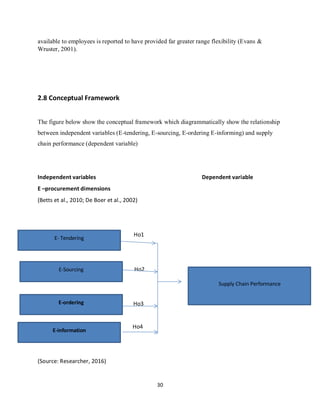
The figure below show the conceptual framework which diagrammatically show the relationship
between independent variables (E-tendering, E-sourcing, E-ordering E-informing) and supply
chain performance (dependent variable)
Independent variables Dependent variable
E –procurement dimensions
(Betts et al., 2010; De Boer et al., 2002)
Ho1
Ho2
Ho3
Ho Ho4
(Source: Researcher, 2016)
E-information
E- Tendering
E-Sourcing
E-ordering
Supply Chain Performance
kipkulei
31
Figure 2.1 Conceptual frameworks on the effect of E-Procurement on Supply Chain
2.9 Performance
E-tendering, E-sourcing-ordering and E-informing which were obtained from Boer et al., (2002).
He argued that the above factors are major drivers of Supply Chain Performance which the
researcher investigated in the Kenyan State Corporations. The dependent variable was Supply
Chain Performance. The study assumed that E-tendering, E-sourcing, E-ordering and E-
informing influenced the supply chain performance in relation to Handle difficult non-standard
order , meet special customer specification , have enough flexibility to respond to unexpected
demand changes, present high quality levels among others.
kipkulei
32
CHAPTER THREE
RESEARCH METHODOLOGY
3.0 Introduction:
This chapter discussed the methodological aspects of the research including the research design,
population of study, sampling procedures and sample size, data collection procedures, data
analysis, limitations of the study and ethical considerations.
3.1 Research Design
Research Design constitutes a blueprint for the collection, measurement, and analysis of data
(Cooper & Schindler, 2008). According to Young (1960) this is a comprehensive study of social
unit, e.g. an individual, a group, social institution, district or a community. According to Cooper
and Schindler, (2000) explanatory research will focus on why questions. In answering the `why'
questions, the study is involved in developing causal explanations. Efforts were made to study
each and every aspect of the subject in minute details and then case data generalization and
inferences are drawn (Leedy, 2004).
Explanatory studies examined relationship to identify possible cause/effect on Independent and
Dependent variables.
3.2 Target Population
The study targeted a population of 244 top management in procurement (managers and assistant
managers) drawn from 22 public sectors (The study chose top management since they were the
one directly involved in the procurement practices and procedures from the universities (GoK,
2013).
kipkulei
33
3.3 Census Study
A census survey was utilized to select the target respondents for the study. This included 244
employees who were directly involved in the procurement practices in the Kenyan State
Corporations.
3.4 Data Collection Instruments and Procedures.
3.4.1 Types and Sources of Data
The research was based on the collection of primary and secondary data. Primary data was
gathered from respondents using the questionnaires as data collection instruments. Primary data
are information collected by a researcher specifically for a research assignment. In other words,
primary data are information that a study must gather because no one has compiled and
published the information in a forum accessible to the public. Researcher generally take the time
and allocate the resources required to gather primary data only when a question, issue or problem
presents itself that is sufficiently important or unique that it warrants the expenditure necessary
to gather the primary data.
Primary data are original in nature and directly related to the issue or problem and current data.
However, secondary data was used to depict pertinent issues which existed before the study was
conducted; it was used as a basis to confirm/contrast further findings of the study. Secondary
sources of data were journals, conference reviews, books and magazine articles. Secondary data
are the data collected by a party not related to the research study but collected these data for
some other purpose and at different time in the past. If the researcher uses these data then these
become secondary data for the current users. These may be available in written, typed or in
electronic forms. A variety of secondary information sources is available to the researcher
gathering data on an industry, potential product applications and the market place.
kipkulei
34
3.4.2 Data Collection Instruments
The study administered structured questionnaires to obtain data from respondents.
Questionnaires were calibrated using a five point Likert Scale, ranging from ‘strongly agree’
(SA) to ‘strongly disagree’ (SD).
3.4.3 Data Collection Procedures.
Prior to administering study instruments, a brief introduction was made to the respondents
explaining the nature and importance of the study to the respondents during pilot and main study.
Respondents were assured of their confidentiality and the data collected was only be used for the
purpose of the study.
3.5 Reliability and Validity
3.5.1 Reliability
According Tan et al, (2000), the reliability of an instrument is the measure of the degree to which
a research instrument yields consistent results or data after repeated trials. In order to test the
reliability of the instrument, the Cronbach alpha test which is a measure of internal consistency
was used in which closely relates a set of items are taken as a group. A "high" value of alpha
often was used as evidence that the items measure an underlying (or latent) construct, was used.
Reliability assessment of internal consistency of the items was determined using Cronbach alpha
coefficient. According to (Sekeran, 2003; Ventura et al.,2013; Waithaka et al.,2014; Cooper &
Schindler, 2001), the general reliability coefficients around 0.9, was considered excellent, values
around 0.8 as very good and values around 0.7 as adequate ((Sekeran, 2003;).
kipkulei
35
3.5.2 Validity
According to McMillan and Schumacher (1993) validity is quality attributed to proposition or
measures of the degree to which they conform to establish knowledge or truth. An attitude scale
is considered valid, for example, to the degree to which its results conform to other measures of
possession of the attitude.
Validity is concerned with whether the findings are really about what they appear to be about
(Cooper & Schindler 2008) this was achieved by providing adequate coverage of the
investigative questions and was done by reviewing literature related to this study and discussion
with the lecturers. Criterion-related validity was achieved through correlation analysis.
Convergent Content validity was achieved through factor loadings of the items by conducting
factor analysis in SPSS (Waithaka et al., 2014; Cooper & Schindler 2008).
3.6 Data Analysis and Presentation
The study used quantitative method to analyze data. The information was codified and entered
into a spread sheet and analyzed using SPSS (statistical package for social sciences).
Quantitative data was analyzed using descriptive statistical method; the statistical tools such as
mean, mode and standard deviation were used. Inferential statistic such as Pearson correlation
coefficients and multiple regression models were used. Multiple regression analysis was
employed to test the hypotheses. Multiple regression analysis was applied to analyze the
relationship between a single dependent variable and several independent variables (Hair et al.,
2005). The study utilized variable inflation factor (VIF) to handle the issue of Multi-
Collinearity.
The study adopted Correlation and Regression analysis to estimate the causal relationships
between e-procurement and supply chain performance, and other chosen variables. SPSS version
20 software was used for Correlation and Regression analysis the significant of each independent
kipkulei
36
variable was tested at a confidence level of 95%. The regression equation of the study applied as
shown below.
Regression equation was a function of variables x and β
𝑦 = 𝛼 + 𝛽1𝑥1 + 𝛽2𝑥2 + 𝛽3𝑥3 + 𝛽4𝑥4 + 𝜀
Where 𝛼 was the intercept
β1…., β4 are regressions coefficients
X1 = E-tendering
X2 = E-sourcing
X3 = E-ordering
X4 = E-informing
Y = Supply Chain Performance.
ε = Error Term
3.6.1 Assumptions of the Model
The assumption of the model was assumed to have; Normality of the error distributions,
Linearity of the relationship between dependent and independent variables,
Homoscedasticity (constant variance) of the errors and Independence of the errors that is (No
serial correlation).
kipkulei
37
3.7 Measurement Instruments
3.7.1 Supply Chain Performance
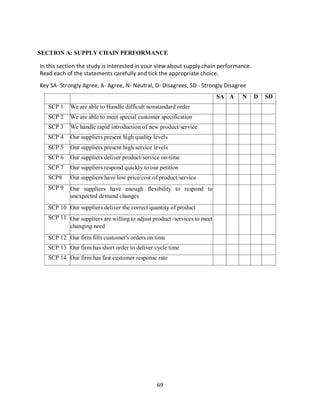
The study adopted the 14 items (measures) of Supply chain performance from (Quesada et al.,
2010). The indicator of supply chain performance included; Handle difficult nonstandard order,
meet special customer specification, introduction of new product/service, present high quality
levels, present high service levels, correct quantity of product, respond quickly to our petition,
have low price/cost of product/service, flexibility, orders on time, deliver cycle time, customer
response rate, adjust product /services to meet changing need and deliver product/service on-
time. The responses to the items were made using a 5-point Likert scales, ranging from ‘strongly
agree’ (SA) to ‘strongly disagree’ (SD).
3.7.2 Independent Variable
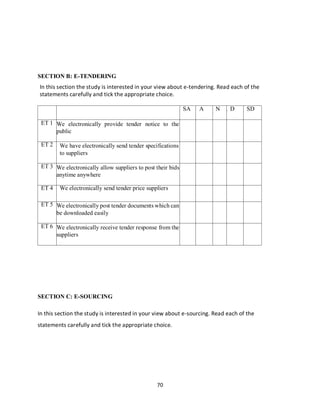
The study adopted 6 items from (Betts et al., 2010; De Boer et al., 2002) to measure E-tendering,
6 items from ((De Boer et al., 2000 Fuks, Kawa & Wieczerzyck 2009; Knudsen, 2003) were to
measure E- sourcing, 6 items from Harink, 2003; Reunis, Santema & Harink, 2006) to measure
E-ordering, and 5 items from (Boer, Harink & Heijboer, 2001; De Boer, Harink &
Heijboer,2002; Essig & Arnold, 2001 to measure E-informing. The responses to the items were
made using a 5-point Likert scales, ranging from ‘strongly agree’ (SA) to ‘strongly disagree’
(SD).
kipkulei
38
Table 3.1 Summary of Measurement Instruments
Variables Indicators Adopted from:
Supply chain
performance
 Handle difficult nonstandard order
 Meet special customer specification
 Introduction of new product/service
 Present high quality levels
 Present high service levels
 Correct quantity of product
 Respond quickly to our petition
 Have low price/cost of product/service
 Flexibility
 Orders on time
 Deliver cycle time
 Customer response rate
 Adjust product /services to meet changing need
 Deliver product/service on-time
(Quesada et al., 2010)
E-Tendering  Electronically provide tender notice
 Electronically send tender specifications
 Electronically allow suppliers to post their bids
 Electronically send tender price
 Electronically post tender document
 Electronically receive tender response
(Betts et al., 2010; De
Boer et al., 2002)
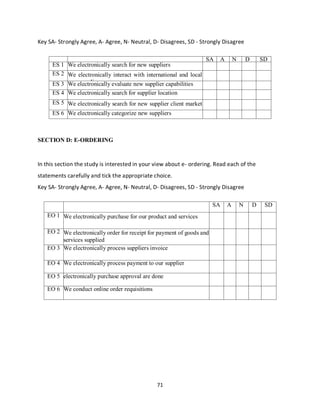
E-Sourcing  Electronically search for new suppliers
 Electronically interact with international and local new supplier
 Electronically evaluate new supplier capabilities
 Electronically search for supplier location
 Electronically search for new supplier client market area
 Electronically categorize new suppliers
((De Boer et al., 2000
Fuks, Kawa &
Wieczerzyck 2009;
Knudsen, 2003)
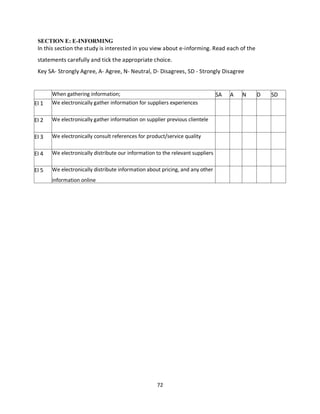
E-Ordering  Electronically purchase for our product and services
 Conduct online order requisitions
 Electronically process suppliers invoice
 Electronically process payment to our supplier
 Electronically purchase approval are done
 Electronically order for receipt for payment
Harink, 2003; Reunis,
Santema & Harink,
2006)
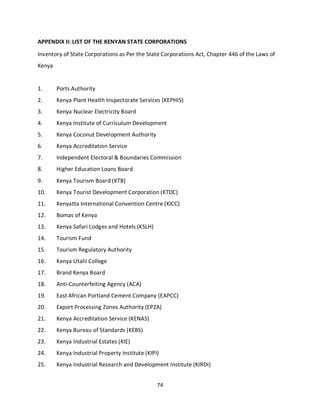
E-informing  Electronically gather information for suppliers experiences
 Electronically gather information on supplier previous clientele
 Electronically consult references for product/service quality
 Electronically distribute our information to the relevant
suppliers
 Electronically distribute information about pricing, and any
other information online
Boer, Harink &
Heijboer, 2001; De
Boer, Harink &
Heijboer, 2002; Essig &
Arnold, 2001
kipkulei
39
3.8 Ethical Considerations.
The researcher obtained permission to conduct the research from the Kenya Film Classification
Board before the commencement of data collection. In addition, all respondents of the study
were identified and recruited using the prescribed procedures after they were requested to give
informed consent in writing. Respondents who were unwilling to participate received the same
treatment. Moreover, information and data collected from the respondents were confidential only
used for the study. It was only accessed with full authority from the respondent.
3.9 Limitations of the Study
The first limitation was to deal with the busy procurement managers, some of whom did not have
time to fill the questionnaires. It was difficult to obtain sufficient information from such people.
However, most of the firms where managers were or could not fill the questionnaire; the
researcher requested their representatives to fill the questionnaires on their behalf. The second
was that of non-response from some respondents who reserved their opinions and refused to fill
questionnaires. The researcher convinced them in a polite way with a promise to keep all
information confidential. At the same time the researcher's contacts was affixed on each
questionnaire in case the respondent needed to call back to confirm their response.
kipkulei
40
CHAPTER FOUR
DATA ANALYSIS, PRESENTATION AND INTERPRETATION
4.0 Overview
This chapter covers data analysis, presentation and interpretation of the findings. The study
aimed to determine effect of e-procurement on supply chain performance in Kenyan State
Corporations. It therefore sought to determine the effect of E-tendering, E- sourcing, E-ordering
and E-informing on supply chain performance.
The chapter summarized the response rate, demographic information, descriptive statistics,
reliability analysis, factor analysis, and normality test correlation and regression analysis results.
4.1 Response Rate
Out of the two hundred and forty four (244) employees who were sampled and the
questionnaires were administered, two hundred and sixteen (216) responded. This gave a
response rate of 88.5% percent. This response rate is considered adequate considering that,
according to Sekaran, (2006) the response rate of 30% is acceptable for surveys.
4.2 Demographic Information
The study put into account the demographic information of the respondents since the background
information of the respondents is crucial for the authenticity of the results. The demographic
information of the respondents includes their gender, age bracket, education level, job experience
and training on e- procurement.
The study sought to establish the respondents' gender. From table 4.1 below, majority 77.8%
(168) are male and 22.2% (48) are female. This is a clear indication that male individuals are in
the stewardship of majority of the Kenyan State Corporations.
kipkulei
41
Further, the study aimed at establishing the age bracket in which respondents age fell. From table
4.1, majority 63% (136) are between 18-30 years, 22.7% (49) are over 46 years, 6.5% (14) are
between 31-35 years, 4.6% (10) are between 41-45 years and 3.2% (7) of the respondents are
between 36-40 years. This tentatively implies that majority of the respondents comprised of the
youth as evidenced by the 18 to 30 years age bracket. This implies that most of the employees in
the procurement department in government corporations are youth.
The study also required that the respondents to give their education level. The education
distribution of the respondents was analyzed in order to establish the prevailing levels of
education among the respondents, and more importantly, to control for the influence of level of
education in the study model as evidenced in table 4.1, majority 70.4% (152) had a Bachelor's
degree, 14.4% (31) Diploma, 9.7% (21) Certificate and 5.6% (12) Masters Level of education.
From the findings, it is evident that majority of the respondents have a Bachelor's degree while
the least being those with a Masters level of education. Hence, from the study most of the
respondents were aware of E-procurement since it is taught in degree and master level of
education.
The study also sought to establish the job experience of the respondents. As shown in table 4.1,
41.2% (89) of the respondents have a job experience of less than 3 years, 31.5% (68) of the
respondents have worked for over 10 years, and 26.4% (57) for 4 to 6 years and 0.9% (2) of the
respondents have a job experience of between 7 to 9 years. It is clear from the results that
Kenyan State Corporations have attracted and retained skilled employees as evident by their
experience.
Finally, the study established that majority 68.1% (147) of the respondents have no training on e-
procurement while only 31.9% (69) of the respondents have received training on e-procurement.
Since majority of the respondents lack training on e- procurement, they are unable to understand
its use hence unable to embrace e- procurement.
kipkulei
42
Source: Survey data (2016)
4.3 Descriptive Statistics of Variables
4.3.1 Descriptive Statistics for E-tendering
The first research objective aimed at determining the effect of E-tendering on supply chain
performance. Table 4.2 captures the response of the respondents. As evidenced in the table,
68.1% (147) of the respondents strongly agreed that they electronically provide tender notice to
the public (mean = 4.64, SD = 0.58).Similarly, 67.6% (146) of the respondents strongly agreed
that they electronically post tender documents which can be downloaded easily (mean = 4.49, SD
= 0.81).Also, 68.1% (147) of the respondents strongly agreed that they can electronically send
tender specifications to suppliers (mean = 4.39, SD = 0.91).Additionally,38.4% (83) of the
Table 4.1 Demographic Information
Frequency Percent
Gender Male 168 77.8
Female 48 22.2
Total 216 100
Age bracket 18-30yrs 136 63
31-35yrs 14 6.5
36-40yrs 7 3.2
41-45yrs 10 4.6
over 46yrs 49 22.7
Education level Masters 12 5.6
Bachelors 152 70.4
Diploma 31 14.4
Certificate 21 9.7
Job experience Less than 3yrs 89 41.2
Between 4-6yrs 57 26.4
Between 7-9yrs 2 0.9
10yrs and above 68 31.5
Total 216 100
Training on e- procurement Yes 69 31.9
No 147 68.1
Total 216 100
kipkulei
43
respondents agreed that they electronically receive tender response from the suppliers (mean=
4.13, S.D =0.83).Moreover,50% (108) of the respondents agreed that they electronically allow
suppliers to post their bids anytime anywhere (mean = 3.62, SD = 0.91).Finally, 40.3%(87)
agreed that they electronically send tender price to suppliers (mean = 3.49, S.D = 0.95 ). In a
nutshell, e-tendering summed up to a mean of 4.13 and standard deviation of 0.65.
4.3.2 Descriptive Statistics for E- sourcing
The second research objective was set to assess the effect of E-sourcing on supply chain
performance. Table 4.3 presents findings on E-sourcing, it shows that 49.5% (107) of the
respondents strongly agreed that they electronically search for supplier location (mean = 4.14,
SD = 1.08). As well, 38% (82) of the respondents strongly agreed that they electronically interact
with international and local new supplier, 19.9% (43) of the respondents agreed on the same
while 13.4% (29) were neutral and 28.2% (61) disagreed
kipkulei
44
Table 4.2 E-Tendering
Std.
SD D N A SA Mean Deviation
We electronically provide
tender notice to the public Freq. 3 2 64 147 4.64 0.58
% 1.4 0.9 29.6 68.1
We have electronically send
tender specifications to
Suppliers Freq. 2 58 9 147 4.39 0.91
% 0.9 26.9 4.2 68.1
We electronically allow
suppliers to post their bids
anytime anywhere Freq. 1 31 47 108 29 3.62 0.91
% 0.5 14.4 21.8 50 13.4
we electronically send tender
price suppliers Freq. 4 30 67 87 28
% 1.9 13.9 31 40.3 13 3.49 0.95
we electronically post tender
documents which can be
downloaded easily Freq. 3 35 32 146
% 1.4 16.2 14.8 67.6 4.49 0.81
We electronically receive tender
response from the suppliers Freq. 1 4 45 83 83
% 0.5 1.9 20.8 38.4 38.4 4.13 0.83
E tendering 4.13 0.65
Source: Survey data (2016).
kipkulei
45
Table 4.3 E- Sourcing
SD D N A SA Mean Std.
Deviation
We electronically search for new
Suppliers Freq. 1 61 29 43 82 3.36 1.28
% 0.5 28.2 13.4 19.9 38
we electronically interact with
international and local new
Supplier Freq. 1 61 29 43 82 3.67 1.26
% 0.5 28.2 13.4 19.9 38
We electronically evaluate new
supplier capabilities Freq. 0 66 16 78 56 3.57 1.18
% 0 30.6 7.4 36.1 25.9
We electronically search for
supplier location Freq. 35 6 68 107 4.14 1.08
% 16.2 2.8 31.5 49.5
We electronically search for new
supplier client market area Freq. 24 39 23 49 81 3.57 1.43
% 11.1 18.1 10.6 22.7 37.5
We electronically categorize new
Suppliers Freq. 25 36 27 69 59 3.47 1.35
% 11.6 16.7 12.5 31.9 27.3
E sourcing 3. 63 1.12
(mean = 3.67, SD = 1.26).In addition,36.1% (78) of the respondents agreed that they
electronically evaluate new supplier capabilities (mean = 3.57, SD = 1.18).As well,37.5% (81) of
the respondents affirmed that they electronically search for new supplier client market area
(mean = 3.57, SD = 1.43).Further,31.9% (69) of the respondents agreed that they electronically
categorize new suppliers (mean = 3.47, SD = 1.35).Finally,38% (82) of the respondents agreed
that they electronically search for new suppliers,19.9% (43) of the respondents agreed on the
same,13.4% (29) were neutral and 28.2% 961) of the respondents disagreed (mean = 3.36, SD =
1.28). To sum up, E-sourcing had a mean of 3.63 and standard deviation of 1.12
kipkulei
46
4.3.3 Descriptive Statistics for E-ordering
The third research objective focused on the effect of E-ordering on supply chain performance.
The findings were illustrated in table 4.4.As shown in the table, 47.2% (102) of the respondents
agreed that they process payment to their suppliers electronically (mean = 3.78, SD = 1.07).In
the same way, 50.9% (110) of the respondents agreed that they electronically order for receipt
for payment of goods and services supplied (mean = 3.52, SD = 0.97).As well, 47.7% (103) of
the respondents agreed that they electronically do their purchase approval (mean = 3.5, SD =
1.16). Additionally, 61.1% (132) of the respondents agreed that they electronically purchase for
their product and services (mean = 3.45, SD = 0.86).Moreover,39.4% (85) of the respondents
agreed that they electronically process suppliers invoice,15.3% (33) of the respondents were
neutral on the same while 30.1% (65) of the respondents disagreed (mean = 3.38,SD =
1.08).However,42.6% (92) of the respondents were not sure if they conduct online order
requisitions (mean = 3.21, SD = 0.98).In general, E-ordering summed up to a mean of 3.47 and
standard deviation of 0.74.
kipkulei
47
Source: Survey data (2016).
4.3.4 Descriptive statistics for E- informing
The fourth research objective was set to determine the effect of E-informing on supply chain
performance. Table 4.5 illustrates the responses of the respondents. From the table, 56.5% (122)
of the respondents agreed that they electronically consult references for product/service quality
(mean = 3.84, SD = 0.67).Further, 50.9% (110) of the respondents agreed that they electronically
distribute their information to the relevant suppliers (mean = 3.79, SD = 0.71).Also, 55.6% (120)
of the respondents agreed that that they electronically gather information for suppliers
experiences (mean = 3.79, SD = 0.73).As well,55.6% (120) of the respondents agreed that they
electronically gather information on supplier previous clientele (mean = 3.78, SD = 0.73).
Finally, 53.7% (116) of the respondents agreed that they electronically distribute information
about pricing, and any other information online, 28.2% (61) of the respondents were neutral on
Table 4.4 E-Ordering
SD D N A SA Mean Std.
Deviation
We electronically purchase for
our product and services Freq. 2 41 36 132 5 3.45 0.86
% 0.9 19 16.7 61.1 2.3
We electronically order for
receipt for payment of goods
and services supplied Freq. 3 41 37 110 25 3.52 0.97
% 1.4 19 17.1 50.9 11.6
We electronically process
suppliers invoice Freq. 1 65 33 85 32 3.38 1.08
% 0.5 30.1 15.3 39.4 14.8
We electronically process
payment to our supplier Freq. 2 42 14 102 56 3.78 1.07
% 0.9 19.4 6.5 47.2 25.9
electronically purchase approval
are done Freq. 27 5 49 103 32 3.5 1.16
% 12.5 2.3 22.7 47.7 14.8
We conduct online order
Requisitions Freq. 25 5 92 88 6 3.21 0.98
% 11.6 2.3 42.6 40.7 2.8
E ordering 3.47 0.74
kipkulei
48
the same while 11.6% (25) of the respondents strongly disagreed (mean = 3.32, SD = 1.02).In a
nutshell, the use of e-informing enables for greater information to be more widely distributed to
the concerned parties. E-informing had a mean of 3.7 and a standard deviation of 0.55.
4.3.5 Descriptive Statistics for Supply Chain Performance
This section of the analysis focused on the supply chain performance of Kenyan State
corporations. As evidenced in table 4.6, 64.4% (139) of the respondents agreed that they are able
to handle difficult nonstandard order as supported by a mean of 4.07 and standard deviation of
0.64.Also, 60.6% (131) of the respondents agreed that they are able to meet special customer
specification (mean = 4.33,SD = 0.56).Also,45.4% (98) of the respondents agreed that they can
handle rapid introduction of new product/service (mean = 3.73, SD = 0.77).Moreover,69.9%
(151) of the respondents agreed that their suppliers present high quality levels (mean = 4.22,SD
= 0.52).0n the same note,69% (149) of the respondents agreed that suppliers present high service
levels (mean = 4.21, SD = 0.54).
Furthermore, 58.3% (126) of the respondents agreed that suppliers deliver product/service on-
time (mean = 4.3, SD = 0.64).As well, 58.3% (126) of the respondents agreed that suppliers
respond quickly to their petition (mean = 4.12, SD = 0.65).Similarly,47.7% (107) of the
respondents affirmed that suppliers have low price/cost of product/service (mean = 4.02, SD =
0.98).In the same way,48.6% (105) of the respondents strongly agreed that their suppliers have
enough flexibility to respond to unexpected demand changes (mean = 4.07, SD =
0.97).Additionally,60.2% (130) of the respondents strongly agreed that their suppliers deliver the
correct quantity of product (mean = 4.59, SD = 0.53).In a similar vein, 49.1% (106) of the
respondents strongly agreed that their suppliers are willing to adjust product /services to meet
changing need (mean = 4.4, SD = 0.65).Likewise, 63% (136) of the respondents affirmed that
their firm fills customer's orders on time (mean = 4.61, SD = 0.54).In addition, 43.5% (94) of the
respondents agreed that their firm has short order to deliver cycle time (mean = 3.94, SD =
0.77).As well, 59.3% (128) of the respondents agreed that their firm has fast customer response
rate (mean = 4.39, SD = 0.52). Generally, supply chain performance summed up to a mean of
4.21 and standard deviation of 0.46.
kipkulei
49
Table 4.6 Supply Chain Performance
SD D N A SA Mean Deviation
We are able to Handle difficult
nonstandard order
Freq
%
%
0 4 25 139 48 4.07 0.64
0 1.9 11.6 64.4 22.2
We are able to meet special
customer specification
Freq
%
0 2 4 131 79 4.33 0.56
0 0.9 1.9 60.6 36.6
We handle rapid introduction of
new product/service
Freq
%
0 8 76 98 34 3.73 0.77
0 3.7 35.2 45.4 15.7
Our suppliers present high
quality levels
Freq
%
%
0 1 7 151 57 4.22 0.52
0 0.5 3.2 69.9 26.4
Our suppliers present high
service levels
Freq
%
0 2 8 149 57 4.21 0.54
0 0.9 3.7 69 26.4
Our suppliers deliver
product/service on-time
Freq
%
0 6 4 126 80 4. 3 0.64
0 2.8 1.9 58.3 37
Our suppliers respond quickly
to our petition
Freq
%
0 1 31 126 58 4.12 0.65
0 0.5 14.4 58.3 26.9
Our suppliers have low
price/cost of product/service
Freq
%
0 3 92 18 103 4.02 0.98
0 1.4 42.6 8.3 47.7
Our suppliers have enough
flexibility to respond to
unexpected demand changes
Freq
%
0 4 82 25 105 4.07 0.97
0 1.9 38 11.6 48.6
Our suppliers deliver the correct
quantity of product
Freq
%
0 1 1 84 130 4.59 0.53
0 0.5 0.5 38.9 60.2
Our suppliers are willing to
adjust product /services to meet
changing need
Freq
%
0 1 17 92 106 4. 4 0.65
0 0.5 7.9 42.6 49.1
Our firm fills customer's orders
on time
Freq
%
0 5 75 136 4.61 0.54
0 2.3 34.7 63
Our firm has short order to
deliver cycle time
Freq
%
0 2 64 94 56 3.94 0.77
0 0.9 29.6 43.5 25.9
Our firm has fast customer
response rate
Freq
%
%
0 1 128 87 4.39 0.52
0 0.5 59.3 40.3
Supply chain performance 4.21 0.46
4.4 Normality Test
The study tested the normality of the regression model to determine whether the assumption of
normality of distribution was attained. The normality assumption was evaluated both using the
Kolmogorov-Smirnov criterion (p>0.05 for all variables) and normal probability plots. The data
is considered normally distributed if the Sig. value is greater than 0.05. The results, in the Table
4.7, show that variables fit a normal distribution (the Sig value for each parameter is greater to
0.00). The Kolmogorov- Smirnov statistic was not significant (p>0.05) and therefore the
distribution is normal.
kipkulei
50
Source: Survey data (2016).
4.5 Reliability Analysis
A pilot study was carried out to determine reliability of the questionnaires. Reliability analysis
subsequently done using Cronbach's Alpha which measures the internal consistency by
establishing if certain items within a scale measure the same construct. Table 4.8 below shows
that E-sourcing had the highest reliability (a=0.945), followed by supply chain performance (a=
0.911), E-tendering was third (a =0.861) then E-ordering (a=0.821) and finally E informing (a
=0.747). This illustrates that all the five scales were reliable as their reliability values exceeded
the prescribed threshold of 0.7. This therefore depicts that the research instrument was reliable
and therefore required no amendments.
Table 4.8 Reliability Analysis
Cronbach's Alpha Cronbach's Based
on _________________________________Alpha_______Standardized Items No. of Items
Supply chain performance 0.911 0.915 14
E tendering 0.861 0.872 6
E sourcing 0.945 0.942 6
E ordering 0.821 0.823 6
E informing 0.747 0.816 5
Source: Survey data (2016).
Table 4.7 Normality Tests
Kolmogorov-
Smirnov
Std.
Mean Deviation Skewness Kurtosis Statistic Sig.
Supply chain
performance 4.212 0.46671 0.143 -1.386 1.18 0.179
E tendering 4.0731 0.63092 -0.427 -0.77 1.266 0.172
E sourcing 3.5849 1.05097 -0.421 -1.238 2.174 0.167
E ordering 3.4882 0.75347 -0.369 -0.921 1.177 0.125
E informing 3.7117 0.55449 -0.59 -0.56 2.305 0.14
kipkulei
51
4.6 Factor Analysis
The results on factor analysis are presented in table 4.9.The factor loading for each of the items
is sorted by size. Any item that was found to have a loading not greater than 0.5 and loads on one
and only one factor was dropped from the study (Liao et al., 2007; Wei et al, 2008). All loading
were suppressed to 0.5 in the output. Thus from the findings all values for all the factors were
more than 0.5 reflecting the accepted value of factor loading. The Kaiser-Meyer-Olkin value of
0.656 and the significant Bartlett's test of sphericity (x2 (21) = 10753.94, p<0.001) indicated that
data were adequate for principal component analysis (Hair et.al, 2005).
kipkulei
52
ET - E-Tendering ES - E-Sourcing EO - E-Ordering EI - E-Informing
F1 - Factor loadings of E-Tendering F2 - Factor loadings of E- Sourcing
F3 - Factor loadings of E-Ordering F4 - Factor loadings of E-Informing
Source: Survey data (2016).
Table 4.9 Factor Analysis for Independent Variables
F1 F2 F3 F4
ET1 -We electronically provide tender notice to the public 0.754
ET2 -We electronically send tender specifications to suppliers 0.95
ET3 -We electronically allow suppliers to post their bids anytime
anywhere
0.853
ET4- We electronically send tender price to suppliers 0.873
ET5 -We electronically post tender documents which can be
downloaded easily
0.898
ET6 -We electronically receive tender response from the suppliers 0.837
ES1 -We electronically search for new suppliers 0.9 29
ES2 -We electronically interact with international and local new
supplier
0.962
ES3 -We electronically evaluate new supplier capabilities 0.956
ES4 -We electronically search for supplier location 0.95
ES5 -We electronically search for new supplier client market area 0.973
ES6 -We electronically categorize new suppliers 0.939
EO1 -We electronically purchase for our products and services 0.8 42
EO2 -We electronically order for receipt for payment of goods and
services supplied
0.914
EO3 -We electronically process suppliers invoice 0.895
EO4 -We electronically process payment to our supplier 0.875
EO5 -Electronically purchase approval are done 0.92
EO6 -We conduct online order requisitions 0.901
EI1 -We electronically gather information for suppliers
experiences
0.8 93
EI2 -We electronically gather information on supplier previous
clientele
0.945
EI3 -We electronically consult references for product/service
quality
0.909
EI4 -We electronically distribute our information to the relevant
suppliers
0.833
EI5 -We electronically distribute information about pricing, and
any other information online
0.929
KMO and Bartlett's Test
Kaiser-Meyer-Olkin Measure of Sampling Adequacy. 0.656
Bartlett's Test of Sphericity (chi square ) 10753.94
Sig. 0.00
Key:
kipkulei
53
4.7 Correlation Results
Pearson's product moment correlation analysis was used to assess the correlation between the
variables. The results in table 4.10 indicate that, there is positive and significant correlation
between E-informing and supply chain performance (r = 0.697, p < 0.01) and E-ordering and
supply chain performance (r = 0.610, p < 0.01). This implies that e-ordering was linearly
correlated with supply chain performance. Thus indicating when e-ordering increase there is
likelihood of supply chain performance increasing.
The results also indicate that there is a positive and significant correlation between E- tendering
and supply chain performance (r = 0.591, p < 0 .01). Finally, the findings indicate that there is a
positive and significant correlation between E-sourcing and supply chain performance (r = 0.301,
p < 0 .01).The finding on table 4.9 indicates that the highest relationship is found between E-
informing and supply chain performance
Source: Survey data (2016).
4.8 Regression Analysis Results
Multiple regression analysis was conducted so as to determine the relationship between supply
chain performance and the four variables (E-tendering, E-sourcing, E- ordering and E-
informing). The results from table 4.11 shows that the study multiple regression model had a
coefficient of determination (R2) of about 0.621. This means that 62.1% variation of supply
chain performance is explained/predicted by joint contribution of e- informing, e-sourcing, e-
Table 4.10 Correlation Results
Supply chain
performance
E
tendering
E
sourcing
E
ordering
E informing
Supply chain
performance
1
E tendering .591** 1
E sourcing .301** 741** 1
E ordering .610** .823** .787** 1
E informing .697** .676** .450** .672** 1
** Correlation is significant at the 0.01 level (2-tailed).
kipkulei
54
tendering and e-ordering. The F-value of 86.263 with a p value of 0.00 significant at 5% indicate
that the overall regression model is significant, hence, the joint contribution of the independent
variables was significant in predicting supply chain performance.
4.9 Hypotheses Testing
The first Hypothesis postulated that H01: E-tendering has no significant effect on supply chain
performance. The results of multiple regressions, as presented in table 4.11 revealed that E-
tendering has a beta value of P1 = 0.337, p-value = 0.001. Since the p value is less than < 0.05).
The null hypothesis is rejected .Therefore e-tendering has significance effect on supply chain
performance.
The second hypothesis stated that H02: E-sourcing has no significant effect on supply chain
performance. The results of multiple regressions, as presented in table 4.11 revealed that E-
sourcing has a beta value of P2 = -0.925, p-value = 0.000 since the p value is less than < 0.05).
The null hypothesis is rejected. E-sourcing therefore has significant effect on supply chain
performance. The third hypothesis stated that H03: E-ordering has no significant effect on supply
chain performance. The results of multiple regressions, as presented in table 4.11 revealed that
E-ordering has a beta value of P3 = 0.969, p-value = 0.000. Since the p value is less than < 0.05).
The null hypothesis is rejected. Therefore e-ordering has significant effect on supply chain
performance.
kipkulei
55
Dependent Variable: supply chain performance
Source: Survey data (2016).
Table 4.11 Coefficient of Estimate
Unstandardized Collinearity
Coefficients Standardized Coefficients Statistics
B Std. Error Beta T Sig. Tolerance VIF
(Constant) 1.725 0.156 11.029 0.000
E tendering 0.241 0.074 0.3 37 3.238 0.001 0.1 66 6.0 18
E sourcing -0.382 0.051 -0.925 -7.547 0.000 0.12 8.359
E ordering 0.603 0.071 0.969 8.486 0.000 0.138 7.258
E informing 0.213 0.061 0.255 3.502 0.001 0.34 2.940
R2
0.621
Adjusted R2
0.613
ANOVA (F test) 86.263
ANOVA (Prob) 0.000
kipkulei
56
CHAPTER FIVE
SUMMARY OF THE FINDINGS, CONCLUSIONS AND RECOMMENDATIONS
5.0 Introduction
This chapter provides the summary of the findings from chapter four, and it also gives the
conclusions and recommendations of the study based on the objectives of the study.
5.1 Summary of Findings
The general purpose of this study was to determine effect of e-procurement on supply chain
performance in Kenyan State Corporations. The study also made inference on the research
hypotheses that; E-tendering, E-sourcing, E-ordering and E-informing have no significant effect
on supply chain performance. The study had R2 of 0.621. This means that 62.1% variation of
supply chain performance is explained/ predicted by joint contribution of e-informing, e-
sourcing, e-tendering and e-ordering
5.1.1 E-tendering on Supply Chain Performance
Research findings revealed that E-tendering has a positive and significant effect on supply chain
performance (β1 = 0.337, p<0.05). In conformity with the findings, Smith, (2000) asserts that E-
tendering which involves sending Request For Invoices (RFIs) and Request For Purchases
(RFPs) to suppliers and receiving the responses of suppliers back with the use of the internet
results to improved supply chain performance. On the same note, Swan, (2000) states that the
fact that the tendering process is online, it is more efficient than paper-based transactions hence
facilitating speedy exchange of information which contributes to high supply chain performance.
Similarly, Dexter, (2001) echoes that e-tendering has become a successful and efficient sales
channel over the years for a wide range of organizations hence more efficient supply chain
performance. Furthermore,
kipkulei
57
Chen, (2004) echoes that e-tendering provides a centralized process that helps organizations to
reduce traditional tendering costs, improve efficiencies and accountability as well as increase
supply chain performance.
5.1.2 E-Sourcing on Supply Chain Performance
The study results also revealed that E-sourcing has a negative and significant effect on supply
chain performance (β2 = -0.925, p-value = 0.000). Contrary to the study, Dooley, (2006) states
that E-sourcing is one of the quickest ways for firms to boost their bottom line in a competitive
economy thus improved supply chain performance. Contrary to the results, Harink, (2002) in his
study argues that E-sourcing aids in identifying new supplies for a specific spend category with
the use of the internet hence improving the supply chain performance. Furthermore, companies
that are successful at implementing e-sourcing are able to build on sound strategic sourcing
capabilities and adopt a holistic approach leading to improved supply chain performance
(Kutner, 2004).In a similar vein
Neter, (2004) asserts that E-sourcing frees up purchasing personnel to spend more time on a
strategic level tackling the total value chain for the business hence improved supply chain
performance.
5.1.3 E-ordering on Supply Chain Performance
Further, E-ordering showed a positive and significant effect on supply chain performance (β3 =
0.969, p-value = 0.000). Cognate to the results, Kim, (2002) argues that E-ordering greatly
improves the supply chain performance since the placing of purchasing orders as well as
receiving goods and services ordered is made possible by the use of internet technology.
Concurrently, Bello, (2002) argues that, EDI electronic ordering eradicates repetitive manual
processes and removes the need for paperwork leading to increased productivity and improved
customer service thus improving supply chain performance. Further support to the study is by
Petersen, (2005) who asserts that online ordering allows customers to order products or services
via their website thus improving supply chain performance.
5.1.4 E- informing on Supply Chain Performance
Finally, E-informing was found to have a positive and significant effect on supply chain
performance (β4 = 0.255, p-value = 0.001). Therefore, the use of internet technology to gather
kipkulei
58
and distribute purchasing information results to improved supply chain performance. In
conformity with the findings of the study, Li et al., (2005) echoed that information sharing
facilitates relay of critical and proprietary information to one’s supply chain partner hence
contributing to high performance of the supply chain. Similarly, Croom, (2003) opines that E-
informing ensures quality with accuracy, timeliness, adequacy, credibility, and criticality thus
more noticeable supply chain performance. In line with the findings of the study, a study by
Presutti (2003) found out that real-time exchange of information in the e-design stage reduces
time-to-market thus improving supply chain performance.
5.2 Conclusion of the Study
The study has established that E-tendering smoothens the supply chain process. The study
concludes through E-tendering, firms can electronically post tender documents which can be
downloaded by the public. In so doing, there is speedy exchange of information which results to
high supply chain performance. E- tendering electronically provide tender notice to the public,
send tender specifications to suppliers, allow suppliers to post their bids anytime anywhere, send
tender price suppliers, post tender documents which can be downloaded easily and receive
tender response from the suppliers which improves firms supply performance.
The study has also established that the supplier location is determined electronically. The study
concludes through e-sourcing hence providing an avenue for more informed negotiations and
transparency in the buyer seller relationship. In light of the foregoing, E-sourcing assist firms to
electronically search for new suppliers, interact with international and local new supplier,
evaluate new supplier capabilities, search for supplier location, and search for new supplier client
market area and categorize new suppliers, hence able to meet special customer specification,
handle rapid introduction of new product/service and present high service quality levels hence
improves firms supply chain performance. Also, E-ordering was shown to contribute immensely
to supply chain performance. Hence, the study conclude shat e-ordering electronically purchase
for products and services, order for receipt for payment of goods and services supplied, process
suppliers invoice, process payment to the supplier , purchase approval are done and conduct
online order requisitions. It also increases productivity and improves customer service since
products and services can be purchased electronically. As a result, there is reduced dependency
on manual intervention since the online ordering system caters for the supply chain functions.
Finally, E-informing contributed positively to supply chain performance. This is because e-
informing electronically gather information for suppliers experiences, gather information on
supplier previous clientele, consult references for product/service quality, distribution of
information to the relevant suppliers and distribute information about pricing, and any other
information online. Also, information is gathered for suppliers’ experiences and their previous
kipkulei
59
clientele. Additionally, information about pricing is available online. In so doing, supply chain
performance is enhanced.
5.3 Recommendations of the study
In light of the aforementioned findings, the following recommendations are made:
E-tendering has been shown to contribute positively to supply chain performance. There is
therefore need for firms to adopt the use of e-tendering so that tender documents can be posted
electronically and thereby enhance reliable exchange of information. Also, there is need for e-
tendering because of its convenience. In order to reap the benefits of e-sourcing, it is important
for firms to understand that e-sourcing is not able to replace a solid groundwork that lays
foundation for supply chain performance. As such, the firm must take the initiative to establish
interaction with both local and international suppliers and categorizing and evaluating suppliers
so as to enjoy the benefits of e-sourcing.
Moreover, there is need for firms to implement the use of e- ordering in supply chain so as to
reduce on paper work and also save on cost. E-ordering also provides an avenue for improved
customer service and increased productivity hence the need for its implementation by firms.
E-informing has a positive influence on supply chain performance, it is imperative for firms to
gather information for suppliers experiences, previous clientele as well as distributing
information to the relevant suppliers. There is also need to electronically consult references for
product/service quality so as to improve supply chain performance. In theoretical contribution
this study was drawn from diffusions innovation theory.
Although the theory suggests how innovation can be adopted based on the firm resources, those
models are not specific on the implementation of a new innovation such as e-procurement
system. This study provides a framework where e-procurement can impact supply chain
performance adding more knowledge and variables in the theory of Innovation diffusions.
5.4 Suggestions for Further Studies
Although the implications of the findings in the study indicate that e-procurement has a positive
influence on supply chain performance in Kenyan State Corporations, more elaborate research is
necessary to accurately quantify the effects of e-sourcing on supply chain performance. In
addition, including moderator factors and looking forward to direct or indirect relationship
towards supply chain performance can also be made in the research models of the new research
by other scholars in future. A similar study also has to be conducted in another County so as to
come up with a conclusive picture. Given these considerations, there will be conclusive results
on the effect of e-procurement on supply chain performance.
kipkulei
60
REFERENCES
Akinyi M G., (2010). E-Procurement Model for the Public Sector of Kenya School of Computing
and Informatics (http://sci.uonbi.ac.ke).
Albrecht, C.C., Dean, D.L. & Hansen, J.V. (2005). Marketplace and technology standards for B2B
E-commerce: Progress, challenges, and the state of the art, Information & Management.
Marriott School of Management and Rollins Center for E-business Brigham Young
University, USA.
Bakos, J.Y. (1991). A strategic analysis of electronic marketplaces, MIS Quarterly, 15(3).
Bello D., Osmonbekov, T., and D. Gilliland. 2002. Adoption of electronic commerce tools in
business procurement: Enhanced buying center structure and processes. Journal of
Business and Industrial Marketing 17: 151-166.
Betts, M, Black, P, Christensen, SA, Dawson, E, Du, R, Duncan, W, Foo, E & Nieto, G (2010),
‘Towards secure and legal e-tendering', Journal of Information Technology in
Construction, 11(0): 89-102.
Birks, C., Bond, S. & Radford, M. (2001). Guide to e-Procurement in the Public Sector: Cutting
through the Hype. London, UK: Office of Government Commerce, HMSO.
Cagliano, R., Caniato, F. & Spina, G. (2003). E-business strategy: How companies are shaping their
supply chain through the Internet, International Journal of Operations &Production
Management, 23(10).
Callender, G. & Schapper, P. (2003). “Public Procurement Reform in Australia: A Federal-State
Evaluation. International Research Study of Public Procurement.” In Proceedings of
International Research Study of Public Procurement (pp. 4861), 10-12 April, Budapest,
Hungary.
Carter, P., J. Carter, R. Monczka, T. Slaight, and A. Swan. 2000. The future of purchasing and
supply: A ten-year forecast. The Journal of Supply Chain Management 36: 4-13.
Chen I. J., & Paulraj, A. (2004b). Understanding supply chain management: critical research and
a theoretical framework. International Journal of Production Research, 42(1), 131-163.
http://dx.doi.org/10.1080/00207540310001602865.
Chen, I. J., Paulraj, A., & Lado, A. A. (2004). Strategic purchasing, supply management and firm
performance. Journal of Operations Management, 22(5), 505-523.
http://dx.doi.org/10.1016/j.jom.2004.06.002.
kipkulei
61
Chen, I., & Paulraj, A. (2004a). Towards a theory of supply chain management: the constructs and
measurements. Journal of Operations Management, 22(2), 119150.
http://dx.doi.org/10.1016/j.jom.2003.12.007.
Clemons, E.K., Row, M.C. (1992), Information Technology and Industrial Cooperation: The
Changing Economics of Coordination and Ownership, Journal of Management
Information Systems, 9:2, 9-28.
Coase, R., 1937 "The Nature of the Firm" in Economica, Vol. 4, No. 16, November pp. 386-405.
Consortium for Global Electronic Commerce (CGEC) (2002, October). Measuring and Improving
Value of E-procurement Initiatives. Madison, WI: University of Wisconsin-Madison,
Consortium for Global Electronic Commerce.
Cooper, C. R., & Schindler, P. S. (2008). Business research methods (10 Ed.). Boston: McGraw-Hill.
Cooper, D. R. & Schindler, P. S. (2001). Business research methods. New York: McGrew-Hill
Companies.
Cooper, D.R. and Schindler, P S (2000), Business research methods, seventh edition New York:
Irwin/ McGraw- Hill.
Cooper, D.R. and Schindler, P.S. (2008). Business Research Methods. (10th, Ed.) Boston, MA and
Burr Ridge: McGraw-Hill.
Croom, S. (2000). “The Impact of Web-Based Procurement on the Management of Operating
Resources Supply.” The Journal of Supply Chain Management, 36 (1): 4-13.
Croom, S. and Johnston, R. (2003), “E-service: enhancing internal customer service through e
procurement”, International Journal of Service Industry Management, Vol. 14 No. 5, pp.
539-55.
Croom, S., & Johnston, R. (2003). “E-Service: Enhancing internal customer service through e-
procurement.” International Journal of Service Industries Management, 14 (5): 539-555.
Davila, A. Gupta, M., & Palmer, R. (2003). Moving Procurement Systems to the Internet: the
Adoption and Use of E-Procurement Technology Models. European Management Journal,
21(1), 11–23.
Davila, A., M. Gupta, and R. Palmer. 2003. Moving procurement systems to the internet: The
adoption and use of e-procurement technology models. European Management Journal
21: 11-23.
De Boer, L., Harink, J. & Heijboer G. (2002). A conceptual model for assessing the impact of
electronic procurement, European Journal of Purchasing & Supply Management, 8(1).
kipkulei
62
De Boer, L., Harink, J., & Heijboer, G. (2002). “A Conceptual Model for Assessing the Impact of
Electronic Procurement.” European Journal of Purchasing and Supply Management, 8 (1):
25-33.
De Boer, L., Harink, J., & Heijboer, G. (2002). “A Conceptual Model for Assessing the Impact of
Electronic Procurement.” European Journal of Purchasing and Supply Management, 8 (1):
25-33.
Dean, T. J., Brown, R. L., & Bamford, C. E. (2004). Differences in large and small firm responses to
environmental context: strategic implications from a comparative analysis of business
formations. Strategic Management Journal, 19, 709–728.
Department of Finance (DOF) (2001). Strategy for the Implementation of e-Procurement in the
Irish Public Sector. Dublin, Ireland: Author.
Dexter A... Chwelos, P., and Benbasat I., 2001. Research report: Empirical test of an EDI adoption
model. Information Systems Research. 12(3): 304-321.
Dong, S., Xu, S.X. and Zhu, K.X. (2009), “Information technology in supply chains: the value of IT-
enabled resources under competition”, Information Systems Research, Vol. 20 No. 1, pp.
18-32.
Dooley, K. and S. Purchase. 2006. Factors influencing e-procurement usage. Journal of Public
Procurement 6: 28-45.
Downs, G.W. and Mohr, L.B. "Conceptual Issues in the Study of Innovation," Administrative
Science Quarterly (21: December), 1976, pp. 700714.
ECOM Group (2002, February). E-Procurement in the UK Public Sector: A Guide to Developments
and Best Practices (A CIPFA e-Government Forum Report). London, UK: Author.
Eisenhardt, K. M., & Schoonhoven, C. B. (1996). Resource-based view of strategic alliance
formation: strategic and social effects in entrepreneurial firms. Organization Science, 7
(2), 136–150.
Eng, T.Y. (2004). The role of e-marketplaces in supply chain management, Industrial Marketing
Management, 33(2).
Essig, M., & Arnold, U. (2001). “Electronic Procurement in Supply Chain Management: An
Information Economics-Based Analysis of Electronic Markets.” Journal of Supply Chain
Management, 37 (4): 43-49.
Evans, P., & Wurster, T. S. (2000). Blown to Bits. How the New Economics of Information
Transforms Strategy. Boston, MA: Harvard Business School Press.
Fichman, R.G. and Kemerer, C.F. (2001). "The Illusory Diffusion of Innovation: An Examination of
Assimilation Gaps," Information Systems Research (10:3), pp. 255-275.
kipkulei
63
Folinas, D., V. Manthou, M. Sigala, and M. Vlachopoulou.2004. Evolution of a supply chain: Cases
and best practices. Internet Research 14: 274-283.
Frankwick, G. L. Iyer, K. N. S., and Germain, R. (2004) ‘Supply Chain B2B eCommerce and Time-
based Delivery Performance’, International Journal of Physical Distribution & Logistics
Management 34(7/8): 645–61.
Fuks, K, Kawa, A & Wieczerzycki, W (2009), 'Improved E-sourcing Strategy with Multiagent
Swarms', paper presented to Computational Intelligence for Modelling Control &
Automation, International Conference on 10-12 December 2009, Viena
Galle, P & Min, H (2003) “E-purchasing profiles of adopters and non-adopters”. International
Marketing Management, Vol 32, No 3, pp 227-233.
Giunipero, L. and C. Sawchuck. 2002. E-purchasing plus: Changing the way corporations buy, JGS
Enterprise.
Government of Kenya (2001) Public Procurement and Disposal Regulation (2001). Legal Notice
No. 51. Nairobi: Government Press.
Government of Kenya (2013) Public Procurement and Disposal Regulation (2013). Legal Notice
No. 51. Nairobi: Government Press.
Gunasekaran, A., Patel, C., Tirtiroglu, E. (2001). Performance measure and metrics in a supply
chain environment. International Journal of Operations & Production Management 21
(1/2).
Hammervoll, T. (2009). Value creation in supply chain relationships: A critique of governance
value analysis. European Journal of Marketing, 43(5/6), 630-639.
Harink, J and Rooijen, V G., (2002): “Framewok for the application of E-procurement. Thoretical
framework properly models situation at Dutch Railways”. Proceedings of the 11th IPSERA
Conference, University of Twente, 253-262.
Harink, J., de Boer, L., & Heijboer, G. (2002). “A Conceptual Model for Assessing the Impact of
Electronic Procurement.” European Journal of Purchasing and Supply Management, 8 (1):
25-33.
Harink, JHA. (2003), 'Internet technology to purchase, PhD thesis', University of Twente,
Netherland.
Hui, Othman, Normah, Rahman, & Haron (2011). Procurement issues in Malaysia. International
Journal of Public Sector Management, 24(6), 567-593.
Johnson, P.F., Klassen, R.D., Leenders, M.R., and Awaysheh, A., (2005) “Utilizing ebusiness
technologies in supply chains: the impact of firm characteristics and teams”, Journal of
Operations Management, Vol. 25, No. 6, pp. 1255-1274.
kipkulei
64
Johnson, R. and D.W. Wichern. 2000. Applied Multivariate Statistical Analysis, 5th edition. New
Jersey: Prentice-Hall.
Kaufmann, P. J., & Stern, L. W. (1988). Relational exchange norms, perceptions of unfairness, and
retained hostility in commercial litigation. Journal of Conflict Resolution, 32, 534-552.
Kim J. and Shunk D. (2004). Matching indirect procurement process with different B2B e
procurement systems, Computers in Industry Vol. 53. 153-164.
Kim, J.I., & Shunk, D.L. (2004). Matching indirect procurement process with different B2B e-
procurement systems. Computers in Industry, 53, 153-164.
Knudsen, D (2003), 'Aligning corporate strategy, procurement strategy and E-procurement tools',
International Journal of Physical Distribution & Logistics Management, 33(8):720-34.
Kutner, N., (2004).”Applied Linear Regression Models”, 4th edition, McGraw-Hill Irwin.
Lee, S.C., Pak, B.Y., and Lee, H.G., 2004 “Business value of B2B electronic commerce: the critical
role of inter-firm collaboration”, Electronic Commerce Research and Applications, Vol. 2,
No. 4, pp. 350-361.
Leedy, P. D., & Ormrod, J. E. (2004). Practical research: Planning and design (8th Ed.). Upper
Saddle River, NJ: Prentice-Hall.
Leung W. (2007). Review on the Electronic Tendering System (ETS) of the Government of Hong
Kong, Unpublished Masters Dissertation, University of Hong Kong.
Li, S., Rao, S. S., Ragunathan, T. S., & Ragunathan, B. (2005). Development and validation of a
measurement instrument for studying supply chain management practices, Journal of
Operations Management 23(6).
Liao, C.H., Tsou, C.W. and Huang, M.F. (2007), “Factors influencing the usage of 3G mobile
services in Taiwan”, Online Information Review, Vol. 31 No. 6, pp. 759774.
Liao, S.-H., Cheng, C.-H., Liao, W.-B., & Chen, I.-L. (2003). “A Web-Based Architecture for
Implementing Electronic Procurement in Military Organisations.” Technovation, 23 (6):
521-532.
Liker, J.K. & Choi, T.Y. (2004). Building deep supplier relationships, Harvard Business Review, 82
(12).
Lysons, K, Farrington, B, 2006: Purchasing and Supply Chain Management, pp. Aa.pdf. Purchasing
Supply Chain. Dec 12, 2014. The International Journal of Business Management. In large
corporations, a proper purchasing and supply chain structure may not be a strange.
McMillan, J. H. & Schumacher, S. (1993). Research in education: A conceptual understanding.
New York: Haprer Collins.
kipkulei
65
Min, H. & Galle, W. (2003). “E-Purchasing: Profiles of Adopters and Nonadopters.” Industrial
Marketing Management, 32: 227-233.
Min, H. and W.P Galle. 2003. E-purchasing: Profiles of adopters and non-adopters. Industrial
Marketing Management 32:227-233.
Mose, P.N (2012). An Assessment of the Extent of Compliance with Public Procurement and
Disposal Act 2005 in Level 5 Hospitals in Kenya: A Study of Kisii Level 5 Hospital.
Unpublished MBA Report, Egerton University.
Mose, P.N (2012). An Assessment of the Extent of Compliance with Public Procurement and
Disposal Act 2005 in Level 5 Hospitals in Kenya: A Study of Kisii Level 5 Hospital.
Unpublished MBA Report, Egerton University, Kenya.
Ogot, M., Nyandemo, S., Kenduiwo, J. Mokaya, J., & Iraki, W., (2009). The long term Policy
Framework for public procurement in Kenya, Draft Zero in Public Procurement Oversight
Authority, University of Nairobi, Kenya.
Osmonbekov, T., Bello, D. & Gilliland, D. (2002). “Adoption of Electronic Commerce Tools in
Business Procurement: Enhanced Buying Center Structure and Processes.” Journal of
Business and Industrial Marketing, 17 (2/3): 151-166.
Pagell, M., Wu, Z., & Murthy, N. (2007). The supply chain implications of recycling. Business
Horizon, 50, 133-143.
Paulraj A., Lado, A., & Chen, I. (2008). Inter-organizational communication as a relational
competency: Antecedents and performance outcomes in collaborative buyer–supplier
relationships. Journal of Operations Management, 26, 45–64.
Petersen, K., G. Ragatz, and R. Monczka. 2005. An examination of collaborative planning
effectiveness and supply chain performance. Journal of Supply Chain Management 41(2):
14-25.
Presutti Jr., W. D. (2003). Supply management and e-procurement: Creating value added in the
supply chain, Industrial Marketing Management 32(3).
Quesada, G., González, M. E., Mueller, J., & Mueller, R. (2010). Impact of e-procurement on
procurement practices and performance. Benchmarking: An International Journal, 17(4),
516-538.
Rajkumar, T. (2001). “E-Procurement: Business and Technical Issues.” Information Systems
Management, fall.
Reunis, M.R.B., Santema, S.C., and Harink, J.H.A., 2006 “Increasing e-ordering adoption: a
casestudy”, Journal of Purchasing and Supply Management, Vol. 12, No. 6, pp. 322-331.
kipkulei
66
Reunis, MRB, Santema, SC & Harink, JHA (2006), 'Increasing e-ordering adoption: A case study',
Journal of Purchasing and Supply Management, 12 (6):322-31.
Reunis, MRB, Santema, SC & Harink, JHA (2006), 'Increasing e-ordering adoption: A case study',
Journal of Purchasing and Supply Management, 12 (6):322-31.
Rogers E M. (1995). Diffusion of innovation model. http://nnlm.gov/pnr/eval/rogers.html.
Sain, B. and Owens, J.D. and Hill, J. D. (2004). Advances in e-procurement: A focus on the
product/buying situation, Management Services, 48(6).
Sanders, N. 2004. IT alignment in supply chain relationships: A study of supplier benefits. Journal
of Supply Chain Management 41: 4-13.
Sekaran U (2006). Research Method for Business: A Skill Building Approach. United Kingdom:
John Wiley & sons, Inc.
Sekaran, U. (2006). Research methods for business. New York: John Wiley & Sons Inc.
Simchi-Levi, D., Kaminsky, P. & Simchi-Levi, E. 2008. Designing and managing the supply chain:
concepts, strategies, and case studies. 3rd ed. Mc Graw Hill, New York. 498 p.
Smith, A.D., & Correa, J. (2000). Value added benefits of technology: E-procurement and e-
commerce related to the health care industry. International Journal of HealthCare Quality
Assurance, 18, 6, 458-473. DOI 10.1108/09526860510619444.
Steven Leonard R. (2001) Electronic Procurement, European Commission’s IST Programme
eBusiness and eWork, (www.lsi.upc.edu/~jmpujol/gsel/eprogurement.pdf).
Stonebraker, P. and J. Lia. 2006. Supply chain integration: Exploring product and environmental
contingencies. Supply Chain Management: An International Journal 11: 34-43.
Swan A.. Carter, P., Carter J., Monczka R., and Slaight T., 2000. The future of purchasing and
supply: A ten-year forecast. The Journal of Supply Chain Management 36: 4-13.
Tan, K. C., Lyman, S. B., & Wisner, J. D. (2000). Supply chain management: A strategic perspective,
International Journal of Operations & Production Management, 22(6).
Tatsis, V., Mena, C., Wassenhove, L.N.V., & Whicher, L. (2006). E-procurement in the Greek food
and drink industry: Drivers and impediments. Journal of Purchasing & Supply
Management, 12, 63-74. doi:10.1016/j.pursup.2006.04.003.
Thai, K.V. (2001). “Public Procurement Re-examined”. Journal of Public Procurement, 1(1), 9 50.
Tonkin, C. (2003). “E-Procurement in the Public Sector: Story, Myth and Legend”. Paper
presented to the Policy Institute, Trinity College Dublin on 18 November 2003.
kipkulei
67
Turban, E., King, D., Lee, J., Warkentin, M. & Chung, H. (2002). Electronic Commerce 2002: A
Managerial Perspective. NY: Pearson.
Vaidya, K., Sajeev, A.S.M. & Callender, G. (2006). “Critical Factors that Influence e Procurement
Implementation Success in the Public Sector”. Journal of Public Procurement, 6(1&SS3),
70-99.
Van Hoek, R.I. (2001). The contribution of performance measurement to the expansion of third
party logistics alliances in the supply chain. International Journal of Operations &
Production Management 21 (1/2).
Ventura, J., Reise, S. P., Keefe, R. S., Hurford, I. M., Wood, R. C., & Bilder, R. M. (2013). The
Cognitive Assessment Interview (CAI): reliability and validity of a brief interview-based
measure of cognition. Schizophrenia bulletin, 39 (3), 583591.
Waithaka, H. K., & Ngugi, K. (2014). Factors influencing Acquisition of Stressed Assets and Asset
Securitization into the Financial Market in Kenya. International Journal of Social Sciences
and Entrepreneurship, 1(2), 529-539.
Weele Van, A.J. (2005). Purchasing and Supply Chain Management, (4th Ed). Thomson Learning,
London.
Wei, T.W., Marthandan, G., Chong, A.Y.L., Ooi, K.B. and Arumugam, S. (2008), “What drives
Malaysian m- commerce adoption? An empirical analysis. Industrial Management & Data
Systems, Vol. 109 No. 3, pp. 370-388.
Williamson, O., E., (1975), Markets and Hierarchies: Analysis and Antitrust Implications. Free
Press New York, NY.
Williamson, Oliver. 1985. The economic institutions of capitalism. New York, NY: Free Press.
Wisner, J. 2003. A structural equation model of supply chain management strategies and firm
performance. Journal of Business Logistics 24(1): 1-26.
Wittig, W. A. (2003). Public Procurement and the Development Agenda. Geneva, Switzerland:
International Trade Centre.
Zhu, Q., & Sarkis, J. (2007). The moderating effects of institutional pressures on emergent green
supply chain practices and performance. International Journal of Production Research,
45(18-19), 4333–4355.
kipkulei
68
APPENDIX I: QUESTIONNAIRE
Dear Respondent,
RE: REQUEST TO FILL THE ATTACHED QUESTIONNAIRE.
I am student of the University of Nairobi pursuing a diploma in purchasing and supplies
management course in the School of continuing and distance education. I am currently on
research work and would like to request your assistance to fill the attached questionnaire. The
questionnaire has been designed to gather information on the “IMPACT OF E-PROCUREMENT
ON SUPPLY CHAIN PERFORMANCE IN STATE CORPORATIONS IN KENYA“. The information you
will present will be entirely for academic and learning purposes and will be treated with utmost
confidentiality.
Thank you.
Victor kibet kipkulei
0710620868
Email: kipkuleikvictor@gmail.com
kipkulei
69
SECTION A: SUPPLY CHAIN PERFORMANCE
In this section the study is interested in your view about supply chain performance.
Read each of the statements carefully and tick the appropriate choice.
Key SA- Strongly Agree, A- Agree, N- Neutral, D- Disagrees, SD - Strongly Disagree
SA A N D SD
SCP 1 We are able to Handle difficult nonstandard order
SCP 2 We are able to meet special customer specification
SCP 3 We handle rapid introduction of new product/service
SCP 4 Our suppliers present high quality levels
SCP 5 Our suppliers present high service levels
SCP 6 Our suppliers deliver product/service on-time
SCP 7 Our suppliers respond quickly to our petition
SCP8 Our suppliers have low price/cost of product/service
SCP 9 Our suppliers have enough flexibility to respond to
unexpected demand changes
SCP 10 Our suppliers deliver the correct quantity of product
SCP 11 Our suppliers are willing to adjust product /services to meet
changing need
SCP 12 Our firm fills customer's orders on time
SCP 13 Our firm has short order to deliver cycle time
SCP 14 Our firm has fast customer response rate
kipkulei
70
SECTION B: E-TENDERING
In this section the study is interested in your view about e-tendering. Read each of the
statements carefully and tick the appropriate choice.
SECTION C: E-SOURCING
In this section the study is interested in your view about e-sourcing. Read each of the
statements carefully and tick the appropriate choice.
Key SA- Strongly Agree, A- Agree, N- Neutral, D- Disagrees, SD - Strongly DisagreeSA A N D SD
ET 1 We electronically provide tender notice to the
public
ET 2 We have electronically send tender specifications
to suppliers
ET 3 We electronically allow suppliers to post their bids
anytime anywhere
ET 4 We electronically send tender price suppliers
ET 5 We electronically post tender documents which can
be downloaded easily
ET 6 We electronically receive tender response from the
suppliers
kipkulei
71
Key SA- Strongly Agree, A- Agree, N- Neutral, D- Disagrees, SD - Strongly Disagree
SA A N D SD
ES 1 We electronically search for new suppliers
ES 2 We electronically interact with international and local
new supplierES 3 We electronically evaluate new supplier capabilities
ES 4 We electronically search for supplier location
ES 5 We electronically search for new supplier client market
areaES 6 We electronically categorize new suppliers
SECTION D: E-ORDERING
In this section the study is interested in your view about e- ordering. Read each of the
statements carefully and tick the appropriate choice.
Key SA- Strongly Agree, A- Agree, N- Neutral, D- Disagrees, SD - Strongly Disagree
SA A N D SD
EO 1 We electronically purchase for our product and services
EO 2 We electronically order for receipt for payment of goods and
services supplied
EO 3 We electronically process suppliers invoice
EO 4 We electronically process payment to our supplier
EO 5 electronically purchase approval are done
EO 6 We conduct online order requisitions
kipkulei
72
SECTION E: E-INFORMING
In this section the study is interested in you view about e-informing. Read each of the
statements carefully and tick the appropriate choice.
Key SA- Strongly Agree, A- Agree, N- Neutral, D- Disagrees, SD - Strongly Disagree
When gathering information; SA A N D SD
EI 1 We electronically gather information for suppliers experiences
EI 2 We electronically gather information on supplier previous clientele
EI 3 We electronically consult references for product/service quality
EI 4 We electronically distribute our information to the relevant suppliers
EI 5 We electronically distribute information about pricing, and any other
information online
kipkulei
73
SECTION F: DEMOGRAPHIC INFORMATION
In this section the study would like you to provide some background information about
yourself.
Kindly tick (V) appropriately.]
1. What is your gender?
Male [ ]
Female [ ]
2. What is your age bracket?
18-30 years [ ]
31-35 years [ ]
36-40 years [ ]
41-45 years over 46 years [ ]
3. What is your education level?
PHD [ ]
Masters [ ]
Bachelors [ ]
Diploma [ ]
Certificate [ ]
4. How long have you been working in this organization?
Less than 3 years [ ]
Between 4-6 years [ ]
Between 7-9 [ ]
10years and above [ ]
5. Have you ever attended ' any training on information technology related to e-procurement?
Yes [ ]
No [ ]
If yes, how relevant is it in the supply chain performance?
kipkulei
74
APPENDIX II: LIST OF THE KENYAN STATE CORPORATIONS
Inventory of State Corporations as Per the State Corporations Act, Chapter 446 of the Laws of
Kenya
1. Ports Authority
2. Kenya Plant Health Inspectorate Services (KEPHIS)
3. Kenya Nuclear Electricity Board
4. Kenya Institute of Curriculum Development
5. Kenya Coconut Development Authority
6. Kenya Accreditation Service
7. Independent Electoral & Boundaries Commission
8. Higher Education Loans Board
9. Kenya Tourism Board (KTB)
10. Kenya Tourist Development Corporation (KTDC)
11. Kenyatta International Convention Centre (KICC)
12. Bomas of Kenya
13. Kenya Safari Lodges and Hotels (KSLH)
14. Tourism Fund
15. Tourism Regulatory Authority
16. Kenya Utalii College
17. Brand Kenya Board
18. Anti-Counterfeiting Agency (ACA)
19. East African Portland Cement Company (EAPCC)
20. Export Processing Zones Authority (EPZA)
21. Kenya Accreditation Service (KENAS)
22. Kenya Bureau of Standards (KEBS)
23. Kenya Industrial Estates (KIE)
24. Kenya Industrial Property Institute (KIPI)
25. Kenya Industrial Research and Development Institute (KIRDI)
kipkulei
75
26. Kenya Investment Authority (KIA)
27. Kenya Wine Agencies (KWAL)
28. Micro and Small Enterprises Authority (MSEA)
29. New Kenya Co-operative Creameries (New KCC)
30. Numerical Machining Complex (NMC)
31. Sacco Societies Regulatory Authority (SASRA)
32. Kenya Medical Research Institute (KEMRI)
33. Kenya Medical Supplies Agency (KEMSA)
34. National Hospital Insurance Fund (NHIF)
35. Kenya Accountants and Secretaries National Examinations Board (KASNEB)
36. Kenya Investment Authority
37. Insurance Regulatory Authority
38. Public Procurement Oversight Authority
39. State Corporations Appeals Tribunal
40. Kenya National Assurance Co. (2001)
41. Capital Market Authority
42. Deposit Protection Fund Board
43. National Bank of Kenya
44. Kenya Post Office Savings Bank
45. Consolidated Bank of Kenya
46. Retirements Benefit Authority
47. Kenya Reinsurance Corporation
48. Kenya Revenue Authority
49. Kenya Trade Network Agency
50. Competition Authority of Kenya
51. Sports Kenya
52. National Sports Academy
53. National Sports Fund
54. Kenya Cultural Centre
kipkulei
76
55. National Museums of Kenya
56. Kenya Film Commission
57. Kenya Film Classification Board
58. Kenya National Library Service
59. Kenya Civil Aviation Authority (KCAA)
60. Kenya Airports Authority (KAA)
61. Kenya Ports Authority (KPA)
62. Kenya Ferry Services (KFS)
63. Kenya National Shipping Line (KNSL)
64. Kenya Railways Corporation (KRC)
65. National Transport and Safety Authority
66. Kenya National Highways Authority
67. Kenya Urban Roads Authority
68. Kenya Rural Roads Authority
69. Kenya Roads Board
70. Engineers Board of Kenya
71. National Commission for Science, Technology and Innovation (NACOSTI)
72. Higher Education Loans Board (HELB)
73. Commission for University Education (CUE)
74. Teachers Service Commission (TSC)
75. Kenya Broadcasting Corporation
76. Postal Corporation of Kenya
77. Konza Technopolis Development Authority
78. Kenya Film Commission
79. The Kenya ICT Authority
80. The Kenya Yearbook Editorial Board (KYEB)
81. Media Council of Kenya
82. Kenya Film Classification Board
83. Kenya Institute of Mass Communication
kipkulei
77
84. Communications Appeal Tribunal.
85. National Industrial Training Authority
86. National Social Security Fund
87. National Council for Persons with Disabilities
88. Social Protection Secretariat
89. Productivity Centre of Kenya
90. National Council for Children Services
91. National Environment Management Authority (NEMA)
92. Kenya Water Towers Agency (KWTA)
93. Kenya Wildlife Service (KWS)
94. Kenya Forest Service (KFS)
95. Kenya Forest Research Institute (KEFRI)
96. The National Authority for the Campaign Against Alcohol and Drug Abuse (NACADA)
97. National Housing Corporation
98. National Construction Authority
99. Kenya Building Research Centre
100. Settlement Fund Trustees
101. Energy Regulatory Commission
102. Rural Electrification Authority
103. Kenya Pipeline Company
104. Geothermal Development Company
105. Kenya Petroleum Refineries
106. Kenya Power
107. Kenya Electricity Generating Company
108. Kenya Electricity Transmission Company
109. National Oil
110. Kenya Nuclear Electricity Board
111. Kenya Ordnance Factories Corporation (KOFC)
112. Council for Higher Education (CHE) in Kenya
kipkulei
78
113. Kenya National Commission for UNESCO
114. Schools Equipment Production Unit – SEPU
115. Kenya Education Management Institute – KEMI
116. Kenya Institute of Curriculum Development – KICD
117. Kenya School of Government – KSG
118. Kenya National Youth Service – NYS Kenya
119. Kenya Energy Regulatory Commission – ERC
120. Kenya Petroleum Refineries – KPRL
121. Kenya Geothermal Development Corporation
122. Kenya Rural Electrocution Authority
123. The National Oil Corporation of Kenya – Nock
124. Kenya Pipeline Company – KPC
125. Brand Kenya
126. Media Council of Kenya
127. Kenya Literature Bureau – KLB
128. Kenya National Examinations Council – KNEC
129. Petroleum Institute of East Africa – PIEA
130. Kenya Electricity Generating Company Limited – KenGen
131. Kenya Film Commission
132. Public Service Commission of Kenya
133. Energy Regulatory Commission (ERC) in Kenya
134. Rural Electrification Authority – REA
135. Kenya Electricity Transmission Company – Ketraco
136. Geothermal Development Company – GDC
137. Kenya Agricultural Research Institute – Kari
138. Kenya Plant Health Inspectorate Service – KEPHIS
139. Kenya Farmers Association – KFA
140. The Weights and Measures Services in Kenya
141. Kenya Institute of Business Training
kipkulei
79
142. Export Promotion Council in Kenya
143. Kenya National Trading Corporation Ltd
144. Kenya Power Lighting Company – KPLC
145. Kenya Forest Service – KFS
146. Government Press Kenya
147. Kenya Dairy Board
148. Kenya Meat Commission – KMC
149. Pyrethrum Board of Kenya – PBK
150. Kenya Sugar Research Foundation
151. Kenya Sugar Board – KSB
152. Kenya Flower Council
153. Horticultural Crops Development Authority
154. Coffee Board of Kenya
155. Kenya Tea Development Agency – KTDA
156. National Cereals and Produce Board – NCPB
157. Kenya Film Commission
158. Kenya News Agency – KNA
159. Kenya National Library Service – KNLS
160. National Museums of Kenya – NMK
161. Jomo Kenyatta Foundation – JKF
162. National Land Commission in Kenya
163. Kenya National Highway Authority – KNHA
164. Kenya Rural Roads Authority – KeRRA
165. Kenya Urban Roads Authority – KURA
166. Kenya Institute of Highways and Building Technology
167. Kenya Airways – KQ
168. East African Safari Air Ltd
169. Kenya Maritime Authority – KMA
170. Kenya Ferry Service – KFS
kipkulei
80
171. Centre for Mathematics Science and Technology in Africa
172. Kenya Institute of Special Education – KISE
173. Kenya Education Staff Institute – KESI
174. Kenya Literature Bureau
175. Higher Education Loan Board – Kenya
176. Kenya institute of Education (KIE)
177. The Kenya Medical Training College – KMTC
kipkulei

Victor Kipkulei

  • 1.
    1 IMPACT OF E-PROCUREMENTON SUPPLY CHAIN PERFORMANCE IN STATE CORPORATIONS IN KENYA. VICTOR KIBET KIPKULEI L126/12155/2014 A RESEARCH PROJECT PRESENTED IN PARTIAL FULFILLMENT OF THE REQUIREMENT FOR THE AWARD OF THE DIPLOMA IN PURCHASING AND SUPPLIES MANAGEMENT, SCHOOL OF CONTINUING AND DISTANCE EDUCATION, UNIVERSITY OF NAIROBI November, 2016 kipkulei
  • 2.
    2 DECLARATION This project ismy original work and has not been submitted for a diploma award in any other University. Signed.................................... Date.................................. Victor Kibet Kipkulei L126/12155/2014 This project has been submitted for examination with my approval as university supervisor. Signed.................................... Date................................. Lecturer: Mr. Samuel Chege School of continuing and distance education University of Nairobi kipkulei
  • 3.
    3 ACKNOWLEDGEMENTS I thank everyonewho assisted me in realizing my dream of doing my diploma in purchasing and supplies management. Special thanks go to my very able supervisor Mr. Samuel Chege for his constant, incisive guidance. To my dearest family for being understanding and always supportive during the period of my study. Many thanks also go to my fellow students for constantly reminding me about the expectations of the university in all my academic undertakings. kipkulei
  • 4.
    4 DEDICATION I dedicate thiswork to my Parents, Mr. and Mrs. Johanna Cherutoi, my fiancée Joan Limo my Siblings Dorothy, Janet Charles and my son Kayden and all those who supported me in the completion of this project. Thank you and May God bless you abundantly kipkulei
  • 5.
    5 ABSTRACT Supply Chain Management(SCM) has become a critical factor for the organization’s success. The use of e-procurement enables fast responses, creating high responsiveness and cuts costs right through the supply chain. The procurement function in Kenya has been undergoing through reforms and its implementation has been very slow. This has been attributed to poor handling of procurement activities, hence an effect on the supply chain performance. The main purpose of the study was to determine the effect of e-procurement on supply chain performance. The main purpose of the study was to determine the effect of e- procurement on supply chain performance. Specific objectives were to determine the effect of E-tendering on supply chain performance, assess the effect of E-sourcing on supply chain performance, determine the effect of E-ordering on supply chain performance and determine the effect of E-informing on supply chain performance. The study was informed by theories of transaction cost theory and Innovation Diffusion Theory. Explanatory research design was used in the undertaking of this research. The study targeted procurement officers from the Kenyan State Corporations in Kenya. Data was collected from a sample of 216 procurement officers using self- administered questionnaires. The research instrument was tested for reliability by computing the Cronbach alpha statistical tests. The data was cleaned and analyzed using descriptive and inferential statistics. Descriptive statistics like means, frequencies and percentages were used. In addition, Pearson correlation was used to show the correlation between the variables. Multiple regression was used to test the study hypothesis. The results indicated that e-tendering, e-ordering, e-informing has a positive and significant effect on supply chain performance. However, e-sourcing has a negative and significant effect on supply chain performance. The study concludes that e-procurement dimensions with and exception of e-sourcing increases supply chain performance. There is therefore need for firms to adopt the use of e-procurement such as e-tendering, e-ordering, and e-informing. The study contributes to theory and literature in supply chain management using the Kenyan experience. kipkulei
  • 6.
    6 TABLE OF CONTENTS DECLARATION....................................................................................................i ACKNOWLEDGEMENT........................................................................................ii DEDICATION.......................................................................................................iii ABSTRACT.........................................................................................................iv TABLE OF CONTENTS..........................................................................................v FIGURE ..............................................................................................................vii LIST OF TABLES ..................................................................................................viii OPERATIONAL DEFINITION OF TERMS ...............................................................ix CHAPTER ONE ..........................................................................................1 INTRODUCTION.................................................................................................1 1.1 Background of the Study ....................................................................................1 1.2 Statement of the Problem ..................................................................................4 1.3 General Objective of the Study ..........................................................................5 1.3.1 Specific Objectives...........................................................................................5 1.3.2 Research Hypotheses.......................................................................................5 1.4 Significance of the Study ....................................................................................5 1.5 Scope of the Study..............................................................................................5 1.6 limitations of the Study.......................................................................................6 1.7 summary .............................................................................................................6 CHAPTER TWO....................................................................................................7 LITERATURE REVIEW .........................................................................................7 Introduction ............................................................................................................7 2.1 Concept of Supply Chain Performance ..............................................................7 2.2 Concept of E-Procurement. ...............................................................................9 2.3 Theoretical Framework. ....................................................................................11 2.3.1 Innovation Diffusion Theory ...........................................................................11 2.3.1 Transactional cost Theory ..............................................................................12 2.4 Effect of E-Tendering on Supply Chain Performance. .......................................12 2.5 Effect of E-Sourcing on Supply Chain Performance............................................14 2.6 Effect of E-Ordering on Supply Chain Performance...........................................15 2.7 Effect of E-Informing on Supply Chain Performance .........................................16 2.8 Conceptual Framework......................................................................................18 2.9 Performance ......................................................................................................19 kipkulei
  • 7.
    7 CHAPTER THREE.................................................................................................20 RESEARCH METHODOLOGY...............................................................................20 Introduction: ..........................................................................................................20 3.1 Research Design ................................................................................................20 3.2 Target Population...............................................................................................20 3.3 Census Study ......................................................................................................21 3.4 Data Collection Instruments and Procedures. ...................................................21 3.4.1 Types and Sources of Data ..............................................................................21 3.4.2 Data Collection Instruments ............................................................................22 3.4.3 Data Collection Procedures. ............................................................................22 3.5 Reliability and Validity.........................................................................................22 3.5.1 Reliability..........................................................................................................22 3.5.2 Validity ............................................................................................................23 3.6 Data Analysis and Presentation.......................................................................... 23 3.6.1 Assumptions of the Model ...............................................................................24 3.7 Measurement Instruments .................................................................................25 3.7.1 Supply Chain Performance................................................................................25 3.7.2 Independent Variable........................................................................................25 3.8 Ethical Considerations..........................................................................................27 3.9 Limitations of the Study ......................................................................................27 CHAPTER FOUR ...................................................................................................28 DATA ANALYSIS, PRESENTATION AND INTERPRETATION .............................................................................................................................28 4.0 Overview ...............................................................................................................28 4.1 response rate………………………………….....................................................................28 4.2 demographic information. ....................................................................................28 4.3 descriptive statistics of variables...........................................................................30 4.3.1 Descriptive statistics for E-tendering..................................................................30 4.3.2 Descriptive statistics for E-sourcing....................................................................31 4.3.3 Descriptive statistics for E- ordering. .................................................................34 4.3.4 Descriptive statistics for E-informing..................................................................35 4.3.5 Descriptive statistics for supply chain performance...........................................36 4.4 Normality test .......................................................................................................37 4.5 reliability analysis...................................................................................................38 4.6 factor analysis ........................................................................................................39 4.7 correlation results...................................................................................................41 4.8 regression analysis results......................................................................................41 4.9 hypothesis testing..................................................................................................42 kipkulei
  • 8.
    8 CHAPTER FIVE ............................................................................................................44 SUMMARYOF THE FINDINGS, CONCLUSIONS AND RECOMMENDATIONS ......................................................................................................................................44 5.0 Introduction............................................................................................................44 5.1 Summary of Findings..............................................................................................44 5.1.1 E-tendering on Supply Chain Performance..........................................................44 5.1.2 E-Sourcing on Supply Chain Performance............................................................45 5.1.3 E-ordering on Supply Chain Performance ...........................................................45 5.1.4 E- informing on Supply Chain Performance ........................................................45 5.2 Conclusion of the Study .........................................................................................46 5.3 Recommendations of the study..............................................................................47 5.4 Suggestions for Further Studies..............................................................................47 REFERENCES............................................................................................................48 APPENDIX I: QUESTIONNAIRE ................................................................................56 APPENDIX II: LIST OF THE KENYAN STATE CORPORATIONS......................................62 kipkulei
  • 9.
    9 FIGURES Figure 2.1 Conceptualframeworks on the effect of E-Procurement on Supply Chain performance........................................................................................................................... 18 kipkulei
  • 10.
    10 LIST OF TABLES Table3.1 Summary of Measurement Instruments ....................................................26 Table 4.1 Demographic Information ..........................................................................30 Table 4.2 E-Tendering ................................................................................................32 Table 4.3 E- Sourcing..................................................................................................33 Table 4.4 E-Ordering ..................................................................................................35 Table 4.6 Supply Chain Performance..........................................................................37 Table 4.7 Normality Tests...........................................................................................38 Table 4.8 Reliability Analysis.......................................................................................38 Table 4.9 Factor Analysis for Independent Variables..................................................40 Table 4.10 Correlation Results....................................................................................41 Table 4.11 Coefficient of Estimate..............................................................................43 kipkulei
  • 11.
    11 OPERATIONAL DEFINITION OFTERMS E-informing is the process of gathering and distributing purchasing information both from and to internal and external parties, using Internet technology. For example, publishing purchasing management information on an extranet that can be accessed by internal clients and suppliers is a way of e-informing. This form is also called purchasing intelligence or spend control. E-ordering is the process of creating and approving purchasing requisitions, placing purchase orders as well as receiving goods and services ordered, by using a software system based on internet technology. E-sourcing is the process of identifying new suppliers for a specific spend category, using Internet technology (usually the Internet itself). By identifying new suppliers a purchaser can increase the competitiveness in the tactical purchasing process for this spend category. E-tendering is the process of sending Response for Information (RFI’s) and Response for Prices (RFP’s) to suppliers and receiving the responses of suppliers back, using Internet technology. Usually e-tendering is supported by an e tendering system. kipkulei
  • 12.
  • 13.
    13 CHAPTER ONE INTRODUCTION This chapterdealt with the Background of the study, the statement of the problem, and the objectives of the study, hypotheses, significance of the study and finally the scope of the study. 1.1 Background of the Study Supply Chain Management (SCM) has become a critical factor for the organization’s success. In this regard, many firms and researchers have attempted to find out variables that affect either positively or negatively on SCM. Supply chains achieve performance improvements or resource development through either building-specific capability over time or by looking to the supply relationships to gain access to new resources (Eisenhardt & Schoonhoven, 1996). This may occur through coercive pressure passed responsibility upstream or introduced contractual clauses for suppliers (Pagell et al., 2007; Zhu & Sarkis, 2007) or collaboration, utilize social capital within existing relationships to develop new competencies (Liker & Choi, 2004; Paulraj, Lado, & Chen, 2008). The performance of supply chains is very often considered by comparison to firm’s performance (Hammervoll, 2009). Lee (2004) specifies that to make a supply chain core effective, it has to react to short term changes in demand or supply quickly and to handle external descriptions smoothly. The use of e-procurement enables faster responses, creating high responsiveness and cuts costs right through the supply chain (Lee, 2004). The focus of a company’s e-procurement will be making its supply chain more efficient through paperless processing of order, receipt and invoices. Increasing costs, competition and customer pressure will drive companies to review their supply chain processes and tap into the enormous savings potential from indirect spending (Staven and Leonard, 2001). According to Dalmalch et kipkulei
  • 14.
    14 al., (2000), e-procurementdeals with the management of supply chains in the procurement of indirect goods that is based on internet Information systems and also e-markets. A procurement system is a vital component of a company's Supply Chain system. Typically, a company’s procurement function is subdivided into strategic and operational processes since activities and priorities in these two areas are entirely different (Kaufmann, 2009). Further, e- Procurement can be used in conjunction with the varied technologies of electronic commerce such as document imaging, workflow management, bulletin boards and e-mail to enable business process reengineering. With these combinations, e-Procurement can give rise to a number of benefits to an organization and to the strategic position of a firm. It will help to consolidate purchasing practices that will lead to greater discounts and better service from suppliers. It also accelerates the flow of important information between the buyer and supplier, reduce administrative hours, thus freeing the workers to do other work and respond quickly to highly competitive new market entrants (Dong et al, 2009) A number of public sector agencies worldwide have identified Electronic Procurement (e- procurement) as a priority of e-Government agenda and have implemented or are in the process of implementing buy side e-Procurement systems (Vaidya et al., 2006) However, the scholarly evaluation of e-procurement initiatives, especially in relation to the use of e-Procurement in supply chain management is very limited (Birks, Bond & Radford, 2001; DOF, 2001; CGEC, 2002; ECOM, 2002). A review of e-Procurement literature, primarily from the last five years, shows a lack of core constructs around CSFs. The reason for this might be that implementation of e-Procurement initiatives in the public sector is still in the early stages. Tonkin (2003) argues that there was little history of extensive use of e-Procurement in the public sector and therefore, the academic literature covering public sector adoption of e Procurement and its effect on supply chain management is limited. Before the introduction of Public Procurement and Disposal Act (2005), the government of Kenya through the Financial Regulations of 1970, gave the Ministry of finance the overall responsibility of regulating the procurement of goods, works and services (Mose, 2012). kipkulei
  • 15.
    15 She further arguesthat the Ministry of finance communicated all procurement issues to government departments through circulars. Later the government realized that this procurement system had several deficiencies that contributed to huge losses in public funds. The procurement system was noted to lack transparency, accountability and fair competition. It was realized that the Procurement personnel were not adequately trained and there was also lack of professionalism amongst them, and there was no professional body to oversee and install discipline among procurement officers (Mose, 2012). It was in view of all these shortcomings that the Kenya government in conjunction with other stakeholders likes the International Trade Centre, World Bank and the Africa Development Bank thought of looking for a way to eliminate the deficiencies by initiating the procurement reform process. As Mose (2012) notes, the reform process was meant to create a system that allowed proper delegation of authority, procurement threshold, planning and development of supplies manual. The primary focus was to address the issue of procurement laws, establish appropriate procurement Institutions and entities, and create adequate and timely monitoring and evaluation mechanism. This marked the birth of Public Procurement Regulation (2001) and later the Public Procurement and Disposal Act (2005). Manual procurement system has been in use not only in the private sector but also in the government state corporations. Public procurement is an important function of government (Thai, 2001). Instead of satisfying requirements for goods, works, systems, and services in a timely manner (Vaidya et al., 2006), the Kenya procurement system had proved to be long, cumbersome and time consuming. This procurement system had several deficiencies that contributed to huge losses in public funds (Mose, 2012). It has also proved to be costly for both buyer and supplier or organizations, besides being regarded as a perpetrator of corruption. However, (Wittig, 2003; Callender & Schapper, 2003) noted that a good procurement system has to meet the basic principles of good governance: transparency, accountability, and integrity. With these in mind, the government in conjunction with other stakeholders decided to introduce e-procurement in state corporations kipkulei
  • 16.
    16 1.2 Statement ofthe Problem Supply Chain Management (SCM) has become a critical factor for the organization’s success. In this regard most organizations have embraced ICT to enhance the supply performance. Embracement of electronic procurement has greatly simplified/ made the business purchasing operation easy and real. By accommodating e-procurement in an organization the entire process especially purchasing leads to reduced cost of doing business. Kenya has been undergoing reforms starting with the Public Procurement and Disposal Act 2005 that saw the creation of Public Procurement Oversight Authority. The next step was the implementation of e-procurement for the public sector. According to the government strategy paper 2004, e-procurement was one of the medium term objectives which were to be implemented by June 2007, but the process has been very slow. The manual processes are costly, slow, inefficient and data storage and retrieval is poor (Akinyi, 2010). There is need to have a robust automated procurement system which is interlinked and this will lead to enhanced competitiveness and lowered costs (Ogot et al., 2009). Studies have attempted to establish the factors influencing the adoption effect of e-procurement (Hui et al., 2011). Lysons and Farrington (2006) and (Weele, 2005). Leung (2007) has evaluated information sharing on e-procurement. Nevertheless, the aforementioned studies did not provide any evidence on how procurement affect supply chain performance. In addition, limited studies have been done to establish the effect of e procurement on supply chain performance. Therefore this study was undertaken to establish the effect of e-procurement on supply chain performance in the Kenyan State Corporations. There was need to contribute to literature gap on the link between e-procurement and supply chain performance. kipkulei
  • 17.
    17 1.3 General Objectiveof the Study The general objective of the study was to determine effect of e-procurement on supply chain performance in Kenyan State Corporations. 1.3.1 Specific Objectives The study specifically assessed the following; 1. To determine the effect of E-tendering on supply chain performance 2. To assess the effect of E-sourcing on supply chain performance 3. To determine the effect of E-ordering on supply chain performance 4. To determine the effect of E-informing on supply chain performance 1.3.2 Research Hypotheses The study tested the following hypotheses; Ho1: E-tendering has no significant effect on supply chain performance Ho2: E-sourcing has no significant effect on supply chain performance Ho3: E-ordering has no significant effect on supply chain performance Ho4: E-informing has no significant effect on supply chain performance 1.4 Significance of the Study The study findings are significant to managers of public sectors. The study helps managers by identifying various e-procurement strategies which improve supply chain performance. They can also know weak and strong e-procurement strategies and how they can be practiced to increase supply performance. The study also benefits employees in government institutions, since they will be able to use effective e-procurement strategies mentioned in this study in their day to day procurement activities. Policy makers can also use the study findings to diversify their knowledge on E-Procurement, hence making effective policies on E-procurement in public sectors. The study is also significance to researchers; they can gain skills of conducting research. The study finding helps to add on the body of existing literature about the study variables and this will be of help to future students and researchers. 1.5 Scope of the Study The study explored the effect of e-procurement on supply chain performance in state corporations. The study adopted explanatory research design to account for the effect of E- procurement on supply Chain Performance. The study unit of analysis were all purchasing officers who were directly involved in E-procurement procedures in the Kenyan state corporations. The survey was undertaken in the months of January and November 2016. kipkulei
  • 18.
    18 1.6 limitation ofthe study The limitation of such studies is that they treat procurement operations as a dependent variable, which in diverse ways is influenced by the independent variable of e-procurement applications. This approach pays scant attention to the development of theory from within purchasing and supply chain management. Propositions from the e-procurement literature need to be evaluated against the purchasing and supply chain literature domains, where the buyer-supplier relationship is a core thematic principle. This is an important omission and this gap is addressed in this exposition. Hence this work builds on existing propositions by establishing examples from practice, and moving on to develop a model for managing these resources more effectively 1.7 Summary of the study From the foregoing review, it can be postulated that what has been missing from the literature is a clear articulation of the nature of the relationship between information technology and purchasing management. There are explanatory theories such as markets versus hierarchies (Malone et al, 1989) and the move to the middle (Clemons et al, 1993), which suggest how firms will use information technology in relation to the way they procure from suppliers. Similarly there are hypotheses on how such technologies as e-procurement can contribute to integration in supply chain management. There is emerging evidence in particular from cases on e- marketplaces and reverse auctions, but there are conflicting results from these studies in relation to how purchasing management will be affected. In effect, how the range of mechanisms under the heading of e-procurement influence purchasing activity in practice remained an area to be explored. One particular theme which remains largely unevaluated is the relationship between these applications and purchasing strategy, which ultimately defines relationship types with suppliers. Indeed, many of the papers on e-procurement are written from an IT or systems perspective where the authors do not overtly discuss elements of procurement policy and management. kipkulei
  • 19.
    19 CHAPTER TWO LITERATURE REVIEW Introduction Thischapter is intended to acquaint the reader with existing studies carried out to determine effect of e-procurement on supply chain performance. The chapter will also entail theories of the study and the conceptual framework. 2.1 Concept of Supply Chain Performance Supply chain performance is a combination of processes, functions, activities, relationships and pathways along which products, services, information and financial transactions move in from supplier to customer (Simchi-Levi et al., 2008).There are a lot of arguments about supply chain performance measurement, and it has no consistent opinion until now. The most notable perceived benefit from participating in the e-market place is lower unit cost of procurement but there are more contributions when firms delivered e-procurement in supply chain (Eng, 2004). From the SCM practices of Tan et al., (2002) time-based issues such as on-time deliveries and reducing response time received the highest mean score. They also found that price/cost may not be a primary factor in selecting supplies for firms and quality, and service levels, on-time delivery, quick response and volume flexibility are critical factors in selecting suppliers and its influence on supply chain performance. However, more scholars have other more comprehensive thoughts regarding supply chain performance. Eng (2004) considered the perceived contributions of e-marketplace to SCM are examined in three dimensions which include: unit cost reduction, increased efficiency and streamlined operations. Croom & Johnson (2003) identified three areas of internal service performance. They are cost efficiency, process conformance and internal satisfaction. In cost conformance we use the Economic Value Added also called EVA. The metrics and measures are discussed in the context of the following supply chain activities or processes and they include: planning, sourcing, making/assembling and delivering goods or services to customers (Gunasekaran et al., 2001). In the order entry method which is part of planning, it determines the way and extent to which customer specifications are converted into kipkulei
  • 20.
    20 information exchanged alongthe supply chain. Order lead-time is the order cycle sourcing time also called order to delivery cycle time which refers to the time elapsed in between the receipt of customer order until the delivery of finished goods to the customer is made. The reduction in order cycle time leads to reduction in supply chain response time and as such is an important performance measure and source of competitive advantage and on the opinion of the researcher, this can only be enhanced by an integrated supply chain function which has electronic procurement as an element and it directly interacts with customer service in determining competitiveness. Traditionally supplier performance measures were based on price variation which is outdated and rejects on receipt and on time delivery. For many years, the selection of suppliers and product choice were mainly based on price competition with less attention accorded to other criteria like quality and reliability (Gunasekaran et al., 2001). The evaluation of suppliers in the context of the supply chain efficiency, flow, integration, responsiveness and customer satisfaction involves measures that are important at the strategic, operational and tactical level. Strategic level measures include lead time against whole industry operations, quality level, cost saving initiatives and supplier pricing against market. Tactical level measures include the efficiency of purchase order cycle time at departmental levels, booking in procedures, cash flow, quality assurance methodology and capacity flexibility. Operational level measures include ability in day to day technical representation, adherence to developed schedule, ability to avoid complaints and achievement of defect free deliveries (Croom, 2003). Purchasing and supply management must analyze on a periodic basis their supplier abilities to meet the firm’s long-term needs. The areas that need particular attention include the supplier’s general growth plans, future design capability in relevant areas, role of purchasing and supply management in the supplier’s strategic planning, potential for future production capacity and financial ability to support such growth. Supply chain partnership is a collaborative relationship between a buyer and seller which recognizes some degree of interdependence and cooperation on a specific project or for a specific purchase agreement (Van Hoek, 2001). Such a partnership emphasizes direct, long-term association, encouraging mutual planning and problem solving efforts. Supplier partnerships have attracted the attention of practitioners and researchers. All have contended that partnership formation is an important supply chain concept in operations and as such for efficient and effective sourcing. Partnership maintenance is no less important. Wisner, (2003) in his study argues that performance evaluation of buyers or suppliers is simply not enough relationships must be evaluated. The parameters that need to be considered in the evaluation of partnerships are the ones that promote and strengthen them. For example, the level of assistance in mutual problem solving is indicative of the strength of supplier partnerships. Partnership evaluation based on such criteria will result in win- win partnerships leading to more efficient and more thoroughly integrated supply chains especially through electronic kipkulei
  • 21.
    21 means. After theorder is planned and goods sourced, the next step in to make/assemble products. This is the activity carried out by organizations that own production sites, and their performance has a major impact on product cost, quality, speed of delivery and delivery reliability. As it is quite an important part of the supply chain, procurement needs to be measured and continuously improved. Suitable metrics for the procurement level improvement are as follows: Reduction in paper work, less legal cases, space utilization especially through effectiveness of scheduling techniques, supply chain and logistics cost reduction and less information processing cost through an integrated electronic means of communication. 2.2 Concept of E-Procurement Min and Galles (2003) define electronic procurement as business-to-business purchasing practice that utilizes electronic commerce to identify potential sources of supply, to purchase goods and services, to transfer payment, and to interact with suppliers was adopted for this research because it is comprehensive. Many agree that the intensely competitive nature of today’s business environment makes the effective use of e-procurement an operational necessity for firms; it is an important issue that must be confronted by purchasing/supply management decision-makers now and into the future (Dooley and Purchase 2006; Davilia, Gupta & Palmer2003; Carter et al., 2000). Some of the noted benefits of e-procurement include increased collaboration between buyers and suppliers, reduced personnel requirements, improved coordination, reduced transaction costs, shorter procurement cycles, lower inventory levels, and greater transparency (Dooley and Purchase 2006; Davila et al., 2003; Min and Galle 2003; Turban et al., 2002; Osmonbekov, Bello & Gilliland 2002; Rajkumar 2001; Carter et al., 2000). Giunipero and Sawchuck (2002) noted that the Internet can be used as a research tool, allowing the purchasing professional to shop around and compare suppliers capabilities and to peruse online catalogs. Second, the Internet can be used to generate savings. Purchasing via the Internet is an effective way to reduce otherwise high transaction costs for low-value items such as maintenance, repair, and operating items. Third, Internet based procurement tools can be used not only to reduce transaction costs, but as a means of reducing prices paid for purchased goods/services. The buying firm can use the Internet to solicit bids from a wider range of potential bidders than is possible using traditional methods. This could increase the firm’s chances of getting a better price. Fourth, the buying firm can use an e-marketplace and participate in online auctions, both reverse where a buying firm makes its purchase needs known kipkulei
  • 22.
    22 online and forwardwhere a selling firm puts goods/services up for sale on-line. Finally, e- procurement can be used as part of an effort undertaken by the entire supply chain, from the final customer back to firms’ suppliers. Albrecht et al., (2005) asserts that a number of organizations have recently adopted e- procurement systems to purchase indirect materials for processes like operations, sales, maintenance and administration. Only those vendors connected to a buyer’s e-procurement system are visible to the buyer. Kim and Shunk (2004) mentioned that in a narrow sense, e procurement systems can be defined as the web-based systems building at the buying organizations, i.e. buyer-centric buy-side, buyer-managed, buyer-focused, buyer-specific, or buyer-oriented e-procurement systems such as intranet internal, desktop, or end-user’s e- procurement systems and buy-centric private e-marketplaces managed by a single buyer. Sain et al., (2004), in their study argued that E-procurement can be considered as the electronic integration and management of all procurement activities, including purchase request, authorization, ordering, delivery and payment between a purchaser and a supplier. Croom (2000) also mentioned that e-procurement systems in essence mirror the procurement process through the provision of two distinct, but connected, infrastructures internal processing and external communication with the supply base. It is commonly defined as an organization’s indirect procurement using the internet, as procurement is the concept closely inter-related with the supplier’s selling activities. Tatsis et al., (2006) argued that e-procurement is the integration, management, automation, optimization and enablement of an organization’s procurement process, using electronic tools and technologies and web-based applications. Based on these, e-procurement in this study was defined as an organization’s procurement using the internet technologies (Kim & Shunk, 2004) with support to sourcing, procurement, tendering and ordering fulfillment processes De Boer et al., (2002), Such system allows employees to order goods and services directly form their own computers through the web. Requests and orders are channeled through various forms of hub or database, which acts as an online catalogue of specifications, prices and, often, authorization rules. It also allows employees to search for items, check availability, place and track orders and initiate payment on delivery (Croom & Johnson, 2003). The adopted forms of e-procurement are mainly in Electric Data Interchange (EDI) and e- marketplace. Albrecht et al., (2005) stated that the mainline E-business architectures are: EDI, company websites, B2B hubs, e-procurement system, and web services. All of them were encompassed in the definition. kipkulei
  • 23.
    23 Kim & Shunk(2004) have defined the taxonomy in more detail and clear manners for e- procurement systems: Buyer-centric e-procurement systems, included intranet e-procurement. Establishing buying requirements through the specification development process, has emerged to help facilitate early supplier involvement. Buyers and suppliers communicate and develop products and specifications on line with collaboration. The application of internet technology to the steps of supplier selection in purchasing process is known as e-sourcing. A proposal is requested on the internet for pre-qualified supplier. The suppliers receive the request and submit bids electrically. Then, they evaluate the bids, negotiate on line and select the most proper suppliers. In the contract agreement stage of purchasing process, the purchasing department needs more involvement with it. The role of e- procurement in this stage is on-line negotiation. It can be called e-negotiation in this study. The final stage of e-procurement that will be extended in this study is e-evaluation. In this stage, information is critical; company requires more proper solutions to collect detail, extensive and accurate information for evaluating and rating suppliers. E-Procurement solutions provide the firm with data warehousing capabilities and other knowledge management tool to support this. According to the literatures on purchasing, e-procurement and e-marketplace discussed above, the definition of e-procurement was developed: E-procurement is organization’s procurement using the internet technologies, including E-tendering, E-sourcing, E-ordering and E-informing. (Albrecht et al., 2005). 2.3 Theoretical Framework. 2.3.1 Innovation Diffusion Theory The Innovation diffusion theory (Rodgers, 1995) is a model grounded in business study. Since 1940’s the social scientists coined the terms diffusion and diffusion theory (Dean, 2004). This theory provides a framework with which it can make predictions for the time period that is necessary for a technology to be accepted. Constructs are the characteristics of the new technology, the communication networks and the characteristics of the adopters. Innovation diffusion can be seen as a set of four basic elements: the innovation, the time, the communication process and the social system. As the adoption of e-Procurement as an innovation generates uncertainty, the procurement organization must be aware of the relative advantage and risk of implementing such innovation. Although the attributes suggested by IDT include relative advantage, compatibility, complexity, trainability, and observability (Rogers, 1995), only two variables – relative advantage (i.e. degree to which an innovation is perceived as being better than the idea it supersedes) and compatibility (of an innovation with existing practices and values) have been consistently found to be positively related and only variable – complexity (i.e. kipkulei
  • 24.
    24 degree to whichan innovation is perceived as relatively difficult to understand and use) has been consistently found to be negatively related to adoption of innovation (Callender, 2004). As the different public sector agencies with different adoption intensity can perceive the characteristics of an innovation differently, Downs and Mohr (Fichman and Kemerer, 2001) suggest taking perception-based characteristics of innovation into account rather than the inherent characteristics of the technology that do not vary across settings and organizations 2.3.2 Transaction Cost Theory Transaction cost theory could serve as a good starting point for the analysis, which explains why certain tasks are performed by firms and others by markets (Coase, 1937). Transaction costs can be divided into coordination costs and transaction risk (Clemons & Row, 1992). Coordination costs are the direct costs of integrating decisions between economic activities (such as search and bargaining costs). Transaction risk is associated with the exposure to being exploited in the relationship (Clemons &Row, 1992). Uncertainty and asset specificity are two factors, which increase coordination costs and transaction risk, respectively (Williamson, 1985). The use of information technology has facilitated the reduction of coordination costs, which has been extensively documented in the literature (Bakos, 1991). For example, electronic market places, facilitated through IT, reduce the cost of searching for obtaining information about product offerings and prices (Bakos, 1991). 2.4 Effect of E-Tendering on Supply Chain Performance. Smith, (2000) in his study asserts that E-tendering- is the process of sending Request For Invoices (RFIs) and Request For Purchases (RFPs) to suppliers and receiving the responses of suppliers back, using internet technology hence improving supply chain performance. Usually e- tendering is supported by an e-tendering system often the e-tendering system also supports the analysis and assessment of responses. E-tendering does not include closing the deal with a supplier. E-tendering smoothens a large part of the tactical purchasing process without focusing on the content that is spending category of that process. A based process wherein the complete tendering process; from advertising to receiving and submitting tender-related information are done online. This enables firms to be more efficient in their supply chains as paper-based transactions are reduced or eliminated, facilitating for a more speedy exchange of information thus high supply chain performance (Swan, 2000). kipkulei
  • 25.
    25 Traditionally E-tendering hasbeen most commonly used by government agencies and the public sector rather than by the private sector. However, with increasing numbers of both business customers and consumers turning to the internet to research goods and services before making a purchase, e-Tendering is becoming a successful and efficient sales channel for a variety of organizations hence more efficient supply chain performance (Dexter, 2001). Frankwick, (2004) in his study argues that the electronic nature of an e-Tender marketplace means that a business never needs to miss an opportunity as they receive an email or SMS alert every time a relevant, new tender is published. Suppliers get the benefit of customers, who have usually already made a decision to purchase, coming directly to them. They don’t have to spend time and money tracking down potential customers. They have a brand new sales channel with very little effort or cost. Customers can let the suppliers do their research for them. Businesses that respond to the e-Tender will provide information about their products and services, their pricing, and any other information the customer might need to help them make the purchase. They will normally provide a link to their website and any customer testimonials that might be relevant. Rather than having to search the internet for this type of information, the customer completes one simple web-form and the suppliers do the rest (Palmer, 2003). Electronic tendering is an online process that manages the tendering cycle from the advertisement of the notice straight through to the issuing of an award. It provides a centralized process to help organizations improve efficiencies and accountability while reducing traditional tendering costs and increasing supply chain performance (Chen, 2004). Frankwick, (2004) in his study argues that electronic tendering has grown in popularity in recent years. Some of the recent developments include support for specific commodity procurement, virtual plans rooms to facilitate construction procurement, increased integration with current procurement processes, electronic bid submission and support for by invitation tendering and increasing acceptance by the supplier community of electronic tendering practices which all serve to increase supply chain performance. Electronic Bid Submission also known as Electronic Bid Response is the electronic transfer of proposal bid data between a potential supplier and the contracting authority and it tends to improve supply chain performance. The electronic bid submission system includes safeguards to ensure the security and authenticity of the material being transferred. Legislation in Canada and the United States supports that electronic submissions have the same binding effect as traditional paper bids (Dexter, 2001). Electronic bid submission is a very secure process. A tender is prepared and then posted; an authorized buyer is given secure access for document retrieval. The deadline and procedures for Electronic Bid Submission (EBS) are clearly identified for both buyers and suppliers. Prospective bidders register, are authenticated and are then given a secure access key with which kipkulei
  • 26.
    26 to submit theirbids. Proposals and associated response documents are submitted through an electronic bid submission system which logs a receipt and sends the supplier confirmation. Updates to the submissions can be made up to the time of closing. All submitted documents are stored in a secure fashion with a high level of security and bids may only be opened by the authorized buyer after the closing date and time have passed. A full electronic audit trail on all activity is maintained. Electronic bid submission improves supply chain performance because of easy accessibility (Palmer, 2003). 2.5 Effect of E-Sourcing on Supply Chain Performance Harink, (2002) in his study argues that E-sourcing is the process of identifying next supplies for a specific spend category, using internet technology usually the internet itself. By identifying new suppliers a purchaser can increase the competitiveness in the tactical purchasing process for this spend category hence improve supply chain performance. E-sourcing is a way of decreasing the supply risk associated with this spend category. As e-business transforms the market for goods and services globally, it is redefining the way companies manage their supply chains. E-sourcing whether through an electronic catalogue, online auction or virtual buying community is emerging as one of the quickest and least painful ways for companies to boost their bottom line in an increasingly competitive economy thus improved supply chain performance (Dooley, 2006). E-sourcing does more than establish an electronic venue for buyers and sellers to meet. It also streamlines workflows, enhances flexibility and drives transparency in the buyer seller relationship. That knowledge makes for more informed negotiations and richer arbitrage opportunities hence improving the supply chain performance. Finally, e-sourcing frees up purchasing personnel to focus on more strategic concerns such as supply base development and relationship management, linking suppliers into up-front innovation processes and value chain restructuring (Folinas, 2004). Johnson, (2000) in his study argues that E-sourcing solutions create value by lowering spend costs, streamlining processes and enabling new business development. While most of the electronic purchasing principles apply to all companies assessing e-sourcing, the market maker concept pertains primarily to buyers with significant market clout and/or first-mover advantage. These potential aggregators can use Web-based technology to move beyond their extended enterprise and create new virtual marketplaces within their industries thus improving their supply chain performance. kipkulei
  • 27.
    27 The market sitesthey are developing not only increase competition among suppliers, but they extract value from others in the industry who may wish to participate. The potential of this electronic procurement is enormous. Companies that are the most successful at implementing e- sourcing are able to adopt a holistic approach, build on sound strategic sourcing capabilities, realize that arbitrage is not the name of the game, understand that this isn’t alchemy but change supported by market logic, use e-sourcing as a total business proposition and are comfortable with controlling the market versus letting the market control them thus improving supply chain performance (Kutner, 2004). Neter, (2004) asserts that E-sourcing streamlines workflows, enhances flexibility and drives transparency in the buyer-seller relationship. By automating and speeding up the transaction end of the purchasing process, e-sourcing frees up purchasing personnel to spend more time on a strategic level tackling the total value chain for the business and delivering the right supply relationships hence improved supply chain performance. By enabling the process, e-sourcing improves the accuracy and availability of information on the supply and demand side, facilitating collaboration as well as control and compliance. That knowledge makes for more informed negotiations and richer arbitrage opportunities. Additionally, e-sourcing provides a unique opportunity for companies to leverage their purchasing scale or industry knowledge to launch a new business venture (Cooper, 2000). Galle, (2003) in his study found out that e-sourcing solutions create value by lowering spend costs, streamlining processes and enabling new business development. Many of the benefits accrue to the bottom line through significant spend cost reductions. Indeed, much of the rush to migrate sourcing programs online is the widely held belief that there is a great deal of easy money left on the table i.e.-sourcing can reduce costs by consolidating buying across an enterprise and help large companies capitalize on volume discounts through virtual scale. 2.6 Effect of E-Ordering on Supply Chain Performance Kim, (2002) argues that E-ordering is the process of creating and approving purchasing requisition, placing purchase orders as well as receiving goods and services ordered, by using a software system based on internet technology which greatly improves the supply chain performance. In the case of e-ordering, the goods and services ordered are indirect goods and services i.e., non-product related goods and services. The supporting software system an ordering catalogue system is usually used by all employees of an organization. In case of Enterprise kipkulei
  • 28.
    28 Resources Planning (ERP)the goods and services ordered are product related. It may be noted that ordering of direct goods and services usually is plan based. EDI electronic ordering is ideal for customers wishing to develop an automated purchasing system for orders. By eradicating repetitive manual processes and removing the need for paperwork, EDI electronic ordering solution enables the business to reduce costs, increase productivity and improve customer service thus improved supply chain performance (Bello, 2002) Petersen, (2005) asserts that online ordering system is an e-commerce function where a company allows customers to order products or services via their website. Since the Internet is booming, having an online ordering system can boost sales to some extent as it eases customers to place an order for the company's services. People can place orders from their home as long as they have a computer/laptop with Internet connection thus improved supply chain performance. Electronic controlled substance orders are placed using a software program that has been approved for Controlled Substance Order System (CSOS). Typically, this software is available through a wholesaler and may be implemented into their ordering Web site. This software includes functionality to digitally sign the purchase order using the purchaser's CSOS digital certificate issued by DEA. A CSOS Certificate may be installed into multiple software programs and may also be transferred to multiple ordering computers (Sanders, 2004). Sales and Purchase ordering appears to be a straightforward process but is in fact a major challenge for buyers and suppliers. Relying on paper, fax, email and phone based ordering means that there is a dependency on manual intervention which in itself can be slow but is proven to be liable to rekeying errors hence could increase the performance of the supply chain (Foster, 2002). 2.7 Effect of E-Informing on Supply Chain Performance Stonebraker (2006) in his study argues that E-informing is a form of Enterprise Resource Planning (ERP) that is not directly associated with a phase in the purchasing process like contracting or ordering. E-informing is the process of gathering and distributing purchasing information both from and to internal and external parties, using the internet technology. For example publishing purchasing management information on an extranet that can be accessed by internal clients and suppliers is a way of e-informing. This form is also called purchasing intelligence or spend control and if used properly increases the performance of the supply chain. Li et al., (2005) mentioned that information sharing refers to the extent to which critical and kipkulei
  • 29.
    29 proprietary information iscommunicated to one’s supply chain partner thus more efficiency and high performance of the supply chain. Information sharing does not only share information with partners, but also provides adequate, timely and accurate information. In other words, information sharing should include the concept of information quality. Information quality includes such aspects as the accuracy, timeliness, adequacy, and credibility of information exchanged. Information sharing includes both formal and informal information sharing with partners. And the information must ensure the quality with accuracy, timeliness, adequacy, credibility, and criticality thus more noticeable supply chain performance (Croom, 2003). Ensuring the quality of shared information has become a critical issue of effective Supply Chain Management (Cagliano et al., 2003), supported that internet or internet tool can facilitate information sharing and more collaboratively with their partners. E-procurement is a kind of internet tool in their article. Eng (2004) also said that e-marketplace provides a shared internet-based infrastructure that enables participant organizations to communicate with one another effortlessly. Presutti (2003) proposed that in the e-design stage, buyer and seller share information in real time to build specifications that add value to the resulting product. That communication helps to minimize design complexities and avoids building in unnecessary costs into the specification. E- procurement has played more and more central role in supply chain management. E-procurement will enhance the flow of information along the supply chain, improved the information sharing (Johnson & Klassen, 2005). As a result, if firms delivered e-procurement system in their supply chain, they will enhance their information sharing. In the study of Presutti (2003), the real-time exchange of information in the e-design stage is crucial because of shrinking product life cycles and the competitive advantage that comes from reduced time-to-market thus improved supply chain performance. E-design facilitates real-time collaboration among all internal members of the firm’s cross functional buying team, as well as with suppliers. As mentioned before, the efficiency of information transfer, the timeliness of information availability, the openness and transparency of relevant information influence supply chain performance. Information sharing is about the information flow, the timeliness of information availability, and the openness and transparency. It will affect performance apparently. For instance, the e- marketplace provides a mechanism for companies to control, coordinate, and economize on transaction costs, as it improves information flows and helps reduce uncertainty (Eng, 2004). The use of IT enables far greater information to be more widely distributed, and in terms of the ability to offer access to large catalogues of suppliers, the range of products and services kipkulei
  • 30.
    30 available to employeesis reported to have provided far greater range flexibility (Evans & Wruster, 2001). 2.8 Conceptual Framework The figure below show the conceptual framework which diagrammatically show the relationship between independent variables (E-tendering, E-sourcing, E-ordering E-informing) and supply chain performance (dependent variable) Independent variables Dependent variable E –procurement dimensions (Betts et al., 2010; De Boer et al., 2002) Ho1 Ho2 Ho3 Ho Ho4 (Source: Researcher, 2016) E-information E- Tendering E-Sourcing E-ordering Supply Chain Performance kipkulei
  • 31.
    31 Figure 2.1 Conceptualframeworks on the effect of E-Procurement on Supply Chain 2.9 Performance E-tendering, E-sourcing-ordering and E-informing which were obtained from Boer et al., (2002). He argued that the above factors are major drivers of Supply Chain Performance which the researcher investigated in the Kenyan State Corporations. The dependent variable was Supply Chain Performance. The study assumed that E-tendering, E-sourcing, E-ordering and E- informing influenced the supply chain performance in relation to Handle difficult non-standard order , meet special customer specification , have enough flexibility to respond to unexpected demand changes, present high quality levels among others. kipkulei
  • 32.
    32 CHAPTER THREE RESEARCH METHODOLOGY 3.0Introduction: This chapter discussed the methodological aspects of the research including the research design, population of study, sampling procedures and sample size, data collection procedures, data analysis, limitations of the study and ethical considerations. 3.1 Research Design Research Design constitutes a blueprint for the collection, measurement, and analysis of data (Cooper & Schindler, 2008). According to Young (1960) this is a comprehensive study of social unit, e.g. an individual, a group, social institution, district or a community. According to Cooper and Schindler, (2000) explanatory research will focus on why questions. In answering the `why' questions, the study is involved in developing causal explanations. Efforts were made to study each and every aspect of the subject in minute details and then case data generalization and inferences are drawn (Leedy, 2004). Explanatory studies examined relationship to identify possible cause/effect on Independent and Dependent variables. 3.2 Target Population The study targeted a population of 244 top management in procurement (managers and assistant managers) drawn from 22 public sectors (The study chose top management since they were the one directly involved in the procurement practices and procedures from the universities (GoK, 2013). kipkulei
  • 33.
    33 3.3 Census Study Acensus survey was utilized to select the target respondents for the study. This included 244 employees who were directly involved in the procurement practices in the Kenyan State Corporations. 3.4 Data Collection Instruments and Procedures. 3.4.1 Types and Sources of Data The research was based on the collection of primary and secondary data. Primary data was gathered from respondents using the questionnaires as data collection instruments. Primary data are information collected by a researcher specifically for a research assignment. In other words, primary data are information that a study must gather because no one has compiled and published the information in a forum accessible to the public. Researcher generally take the time and allocate the resources required to gather primary data only when a question, issue or problem presents itself that is sufficiently important or unique that it warrants the expenditure necessary to gather the primary data. Primary data are original in nature and directly related to the issue or problem and current data. However, secondary data was used to depict pertinent issues which existed before the study was conducted; it was used as a basis to confirm/contrast further findings of the study. Secondary sources of data were journals, conference reviews, books and magazine articles. Secondary data are the data collected by a party not related to the research study but collected these data for some other purpose and at different time in the past. If the researcher uses these data then these become secondary data for the current users. These may be available in written, typed or in electronic forms. A variety of secondary information sources is available to the researcher gathering data on an industry, potential product applications and the market place. kipkulei
  • 34.
    34 3.4.2 Data CollectionInstruments The study administered structured questionnaires to obtain data from respondents. Questionnaires were calibrated using a five point Likert Scale, ranging from ‘strongly agree’ (SA) to ‘strongly disagree’ (SD). 3.4.3 Data Collection Procedures. Prior to administering study instruments, a brief introduction was made to the respondents explaining the nature and importance of the study to the respondents during pilot and main study. Respondents were assured of their confidentiality and the data collected was only be used for the purpose of the study. 3.5 Reliability and Validity 3.5.1 Reliability According Tan et al, (2000), the reliability of an instrument is the measure of the degree to which a research instrument yields consistent results or data after repeated trials. In order to test the reliability of the instrument, the Cronbach alpha test which is a measure of internal consistency was used in which closely relates a set of items are taken as a group. A "high" value of alpha often was used as evidence that the items measure an underlying (or latent) construct, was used. Reliability assessment of internal consistency of the items was determined using Cronbach alpha coefficient. According to (Sekeran, 2003; Ventura et al.,2013; Waithaka et al.,2014; Cooper & Schindler, 2001), the general reliability coefficients around 0.9, was considered excellent, values around 0.8 as very good and values around 0.7 as adequate ((Sekeran, 2003;). kipkulei
  • 35.
    35 3.5.2 Validity According toMcMillan and Schumacher (1993) validity is quality attributed to proposition or measures of the degree to which they conform to establish knowledge or truth. An attitude scale is considered valid, for example, to the degree to which its results conform to other measures of possession of the attitude. Validity is concerned with whether the findings are really about what they appear to be about (Cooper & Schindler 2008) this was achieved by providing adequate coverage of the investigative questions and was done by reviewing literature related to this study and discussion with the lecturers. Criterion-related validity was achieved through correlation analysis. Convergent Content validity was achieved through factor loadings of the items by conducting factor analysis in SPSS (Waithaka et al., 2014; Cooper & Schindler 2008). 3.6 Data Analysis and Presentation The study used quantitative method to analyze data. The information was codified and entered into a spread sheet and analyzed using SPSS (statistical package for social sciences). Quantitative data was analyzed using descriptive statistical method; the statistical tools such as mean, mode and standard deviation were used. Inferential statistic such as Pearson correlation coefficients and multiple regression models were used. Multiple regression analysis was employed to test the hypotheses. Multiple regression analysis was applied to analyze the relationship between a single dependent variable and several independent variables (Hair et al., 2005). The study utilized variable inflation factor (VIF) to handle the issue of Multi- Collinearity. The study adopted Correlation and Regression analysis to estimate the causal relationships between e-procurement and supply chain performance, and other chosen variables. SPSS version 20 software was used for Correlation and Regression analysis the significant of each independent kipkulei
  • 36.
    36 variable was testedat a confidence level of 95%. The regression equation of the study applied as shown below. Regression equation was a function of variables x and β 𝑦 = 𝛼 + 𝛽1𝑥1 + 𝛽2𝑥2 + 𝛽3𝑥3 + 𝛽4𝑥4 + 𝜀 Where 𝛼 was the intercept β1…., β4 are regressions coefficients X1 = E-tendering X2 = E-sourcing X3 = E-ordering X4 = E-informing Y = Supply Chain Performance. ε = Error Term 3.6.1 Assumptions of the Model The assumption of the model was assumed to have; Normality of the error distributions, Linearity of the relationship between dependent and independent variables, Homoscedasticity (constant variance) of the errors and Independence of the errors that is (No serial correlation). kipkulei
  • 37.
    37 3.7 Measurement Instruments 3.7.1Supply Chain Performance The study adopted the 14 items (measures) of Supply chain performance from (Quesada et al., 2010). The indicator of supply chain performance included; Handle difficult nonstandard order, meet special customer specification, introduction of new product/service, present high quality levels, present high service levels, correct quantity of product, respond quickly to our petition, have low price/cost of product/service, flexibility, orders on time, deliver cycle time, customer response rate, adjust product /services to meet changing need and deliver product/service on- time. The responses to the items were made using a 5-point Likert scales, ranging from ‘strongly agree’ (SA) to ‘strongly disagree’ (SD). 3.7.2 Independent Variable The study adopted 6 items from (Betts et al., 2010; De Boer et al., 2002) to measure E-tendering, 6 items from ((De Boer et al., 2000 Fuks, Kawa & Wieczerzyck 2009; Knudsen, 2003) were to measure E- sourcing, 6 items from Harink, 2003; Reunis, Santema & Harink, 2006) to measure E-ordering, and 5 items from (Boer, Harink & Heijboer, 2001; De Boer, Harink & Heijboer,2002; Essig & Arnold, 2001 to measure E-informing. The responses to the items were made using a 5-point Likert scales, ranging from ‘strongly agree’ (SA) to ‘strongly disagree’ (SD). kipkulei
  • 38.
    38 Table 3.1 Summaryof Measurement Instruments Variables Indicators Adopted from: Supply chain performance  Handle difficult nonstandard order  Meet special customer specification  Introduction of new product/service  Present high quality levels  Present high service levels  Correct quantity of product  Respond quickly to our petition  Have low price/cost of product/service  Flexibility  Orders on time  Deliver cycle time  Customer response rate  Adjust product /services to meet changing need  Deliver product/service on-time (Quesada et al., 2010) E-Tendering  Electronically provide tender notice  Electronically send tender specifications  Electronically allow suppliers to post their bids  Electronically send tender price  Electronically post tender document  Electronically receive tender response (Betts et al., 2010; De Boer et al., 2002) E-Sourcing  Electronically search for new suppliers  Electronically interact with international and local new supplier  Electronically evaluate new supplier capabilities  Electronically search for supplier location  Electronically search for new supplier client market area  Electronically categorize new suppliers ((De Boer et al., 2000 Fuks, Kawa & Wieczerzyck 2009; Knudsen, 2003) E-Ordering  Electronically purchase for our product and services  Conduct online order requisitions  Electronically process suppliers invoice  Electronically process payment to our supplier  Electronically purchase approval are done  Electronically order for receipt for payment Harink, 2003; Reunis, Santema & Harink, 2006) E-informing  Electronically gather information for suppliers experiences  Electronically gather information on supplier previous clientele  Electronically consult references for product/service quality  Electronically distribute our information to the relevant suppliers  Electronically distribute information about pricing, and any other information online Boer, Harink & Heijboer, 2001; De Boer, Harink & Heijboer, 2002; Essig & Arnold, 2001 kipkulei
  • 39.
    39 3.8 Ethical Considerations. Theresearcher obtained permission to conduct the research from the Kenya Film Classification Board before the commencement of data collection. In addition, all respondents of the study were identified and recruited using the prescribed procedures after they were requested to give informed consent in writing. Respondents who were unwilling to participate received the same treatment. Moreover, information and data collected from the respondents were confidential only used for the study. It was only accessed with full authority from the respondent. 3.9 Limitations of the Study The first limitation was to deal with the busy procurement managers, some of whom did not have time to fill the questionnaires. It was difficult to obtain sufficient information from such people. However, most of the firms where managers were or could not fill the questionnaire; the researcher requested their representatives to fill the questionnaires on their behalf. The second was that of non-response from some respondents who reserved their opinions and refused to fill questionnaires. The researcher convinced them in a polite way with a promise to keep all information confidential. At the same time the researcher's contacts was affixed on each questionnaire in case the respondent needed to call back to confirm their response. kipkulei
  • 40.
    40 CHAPTER FOUR DATA ANALYSIS,PRESENTATION AND INTERPRETATION 4.0 Overview This chapter covers data analysis, presentation and interpretation of the findings. The study aimed to determine effect of e-procurement on supply chain performance in Kenyan State Corporations. It therefore sought to determine the effect of E-tendering, E- sourcing, E-ordering and E-informing on supply chain performance. The chapter summarized the response rate, demographic information, descriptive statistics, reliability analysis, factor analysis, and normality test correlation and regression analysis results. 4.1 Response Rate Out of the two hundred and forty four (244) employees who were sampled and the questionnaires were administered, two hundred and sixteen (216) responded. This gave a response rate of 88.5% percent. This response rate is considered adequate considering that, according to Sekaran, (2006) the response rate of 30% is acceptable for surveys. 4.2 Demographic Information The study put into account the demographic information of the respondents since the background information of the respondents is crucial for the authenticity of the results. The demographic information of the respondents includes their gender, age bracket, education level, job experience and training on e- procurement. The study sought to establish the respondents' gender. From table 4.1 below, majority 77.8% (168) are male and 22.2% (48) are female. This is a clear indication that male individuals are in the stewardship of majority of the Kenyan State Corporations. kipkulei
  • 41.
    41 Further, the studyaimed at establishing the age bracket in which respondents age fell. From table 4.1, majority 63% (136) are between 18-30 years, 22.7% (49) are over 46 years, 6.5% (14) are between 31-35 years, 4.6% (10) are between 41-45 years and 3.2% (7) of the respondents are between 36-40 years. This tentatively implies that majority of the respondents comprised of the youth as evidenced by the 18 to 30 years age bracket. This implies that most of the employees in the procurement department in government corporations are youth. The study also required that the respondents to give their education level. The education distribution of the respondents was analyzed in order to establish the prevailing levels of education among the respondents, and more importantly, to control for the influence of level of education in the study model as evidenced in table 4.1, majority 70.4% (152) had a Bachelor's degree, 14.4% (31) Diploma, 9.7% (21) Certificate and 5.6% (12) Masters Level of education. From the findings, it is evident that majority of the respondents have a Bachelor's degree while the least being those with a Masters level of education. Hence, from the study most of the respondents were aware of E-procurement since it is taught in degree and master level of education. The study also sought to establish the job experience of the respondents. As shown in table 4.1, 41.2% (89) of the respondents have a job experience of less than 3 years, 31.5% (68) of the respondents have worked for over 10 years, and 26.4% (57) for 4 to 6 years and 0.9% (2) of the respondents have a job experience of between 7 to 9 years. It is clear from the results that Kenyan State Corporations have attracted and retained skilled employees as evident by their experience. Finally, the study established that majority 68.1% (147) of the respondents have no training on e- procurement while only 31.9% (69) of the respondents have received training on e-procurement. Since majority of the respondents lack training on e- procurement, they are unable to understand its use hence unable to embrace e- procurement. kipkulei
  • 42.
    42 Source: Survey data(2016) 4.3 Descriptive Statistics of Variables 4.3.1 Descriptive Statistics for E-tendering The first research objective aimed at determining the effect of E-tendering on supply chain performance. Table 4.2 captures the response of the respondents. As evidenced in the table, 68.1% (147) of the respondents strongly agreed that they electronically provide tender notice to the public (mean = 4.64, SD = 0.58).Similarly, 67.6% (146) of the respondents strongly agreed that they electronically post tender documents which can be downloaded easily (mean = 4.49, SD = 0.81).Also, 68.1% (147) of the respondents strongly agreed that they can electronically send tender specifications to suppliers (mean = 4.39, SD = 0.91).Additionally,38.4% (83) of the Table 4.1 Demographic Information Frequency Percent Gender Male 168 77.8 Female 48 22.2 Total 216 100 Age bracket 18-30yrs 136 63 31-35yrs 14 6.5 36-40yrs 7 3.2 41-45yrs 10 4.6 over 46yrs 49 22.7 Education level Masters 12 5.6 Bachelors 152 70.4 Diploma 31 14.4 Certificate 21 9.7 Job experience Less than 3yrs 89 41.2 Between 4-6yrs 57 26.4 Between 7-9yrs 2 0.9 10yrs and above 68 31.5 Total 216 100 Training on e- procurement Yes 69 31.9 No 147 68.1 Total 216 100 kipkulei
  • 43.
    43 respondents agreed thatthey electronically receive tender response from the suppliers (mean= 4.13, S.D =0.83).Moreover,50% (108) of the respondents agreed that they electronically allow suppliers to post their bids anytime anywhere (mean = 3.62, SD = 0.91).Finally, 40.3%(87) agreed that they electronically send tender price to suppliers (mean = 3.49, S.D = 0.95 ). In a nutshell, e-tendering summed up to a mean of 4.13 and standard deviation of 0.65. 4.3.2 Descriptive Statistics for E- sourcing The second research objective was set to assess the effect of E-sourcing on supply chain performance. Table 4.3 presents findings on E-sourcing, it shows that 49.5% (107) of the respondents strongly agreed that they electronically search for supplier location (mean = 4.14, SD = 1.08). As well, 38% (82) of the respondents strongly agreed that they electronically interact with international and local new supplier, 19.9% (43) of the respondents agreed on the same while 13.4% (29) were neutral and 28.2% (61) disagreed kipkulei
  • 44.
    44 Table 4.2 E-Tendering Std. SDD N A SA Mean Deviation We electronically provide tender notice to the public Freq. 3 2 64 147 4.64 0.58 % 1.4 0.9 29.6 68.1 We have electronically send tender specifications to Suppliers Freq. 2 58 9 147 4.39 0.91 % 0.9 26.9 4.2 68.1 We electronically allow suppliers to post their bids anytime anywhere Freq. 1 31 47 108 29 3.62 0.91 % 0.5 14.4 21.8 50 13.4 we electronically send tender price suppliers Freq. 4 30 67 87 28 % 1.9 13.9 31 40.3 13 3.49 0.95 we electronically post tender documents which can be downloaded easily Freq. 3 35 32 146 % 1.4 16.2 14.8 67.6 4.49 0.81 We electronically receive tender response from the suppliers Freq. 1 4 45 83 83 % 0.5 1.9 20.8 38.4 38.4 4.13 0.83 E tendering 4.13 0.65 Source: Survey data (2016). kipkulei
  • 45.
    45 Table 4.3 E-Sourcing SD D N A SA Mean Std. Deviation We electronically search for new Suppliers Freq. 1 61 29 43 82 3.36 1.28 % 0.5 28.2 13.4 19.9 38 we electronically interact with international and local new Supplier Freq. 1 61 29 43 82 3.67 1.26 % 0.5 28.2 13.4 19.9 38 We electronically evaluate new supplier capabilities Freq. 0 66 16 78 56 3.57 1.18 % 0 30.6 7.4 36.1 25.9 We electronically search for supplier location Freq. 35 6 68 107 4.14 1.08 % 16.2 2.8 31.5 49.5 We electronically search for new supplier client market area Freq. 24 39 23 49 81 3.57 1.43 % 11.1 18.1 10.6 22.7 37.5 We electronically categorize new Suppliers Freq. 25 36 27 69 59 3.47 1.35 % 11.6 16.7 12.5 31.9 27.3 E sourcing 3. 63 1.12 (mean = 3.67, SD = 1.26).In addition,36.1% (78) of the respondents agreed that they electronically evaluate new supplier capabilities (mean = 3.57, SD = 1.18).As well,37.5% (81) of the respondents affirmed that they electronically search for new supplier client market area (mean = 3.57, SD = 1.43).Further,31.9% (69) of the respondents agreed that they electronically categorize new suppliers (mean = 3.47, SD = 1.35).Finally,38% (82) of the respondents agreed that they electronically search for new suppliers,19.9% (43) of the respondents agreed on the same,13.4% (29) were neutral and 28.2% 961) of the respondents disagreed (mean = 3.36, SD = 1.28). To sum up, E-sourcing had a mean of 3.63 and standard deviation of 1.12 kipkulei
  • 46.
    46 4.3.3 Descriptive Statisticsfor E-ordering The third research objective focused on the effect of E-ordering on supply chain performance. The findings were illustrated in table 4.4.As shown in the table, 47.2% (102) of the respondents agreed that they process payment to their suppliers electronically (mean = 3.78, SD = 1.07).In the same way, 50.9% (110) of the respondents agreed that they electronically order for receipt for payment of goods and services supplied (mean = 3.52, SD = 0.97).As well, 47.7% (103) of the respondents agreed that they electronically do their purchase approval (mean = 3.5, SD = 1.16). Additionally, 61.1% (132) of the respondents agreed that they electronically purchase for their product and services (mean = 3.45, SD = 0.86).Moreover,39.4% (85) of the respondents agreed that they electronically process suppliers invoice,15.3% (33) of the respondents were neutral on the same while 30.1% (65) of the respondents disagreed (mean = 3.38,SD = 1.08).However,42.6% (92) of the respondents were not sure if they conduct online order requisitions (mean = 3.21, SD = 0.98).In general, E-ordering summed up to a mean of 3.47 and standard deviation of 0.74. kipkulei
  • 47.
    47 Source: Survey data(2016). 4.3.4 Descriptive statistics for E- informing The fourth research objective was set to determine the effect of E-informing on supply chain performance. Table 4.5 illustrates the responses of the respondents. From the table, 56.5% (122) of the respondents agreed that they electronically consult references for product/service quality (mean = 3.84, SD = 0.67).Further, 50.9% (110) of the respondents agreed that they electronically distribute their information to the relevant suppliers (mean = 3.79, SD = 0.71).Also, 55.6% (120) of the respondents agreed that that they electronically gather information for suppliers experiences (mean = 3.79, SD = 0.73).As well,55.6% (120) of the respondents agreed that they electronically gather information on supplier previous clientele (mean = 3.78, SD = 0.73). Finally, 53.7% (116) of the respondents agreed that they electronically distribute information about pricing, and any other information online, 28.2% (61) of the respondents were neutral on Table 4.4 E-Ordering SD D N A SA Mean Std. Deviation We electronically purchase for our product and services Freq. 2 41 36 132 5 3.45 0.86 % 0.9 19 16.7 61.1 2.3 We electronically order for receipt for payment of goods and services supplied Freq. 3 41 37 110 25 3.52 0.97 % 1.4 19 17.1 50.9 11.6 We electronically process suppliers invoice Freq. 1 65 33 85 32 3.38 1.08 % 0.5 30.1 15.3 39.4 14.8 We electronically process payment to our supplier Freq. 2 42 14 102 56 3.78 1.07 % 0.9 19.4 6.5 47.2 25.9 electronically purchase approval are done Freq. 27 5 49 103 32 3.5 1.16 % 12.5 2.3 22.7 47.7 14.8 We conduct online order Requisitions Freq. 25 5 92 88 6 3.21 0.98 % 11.6 2.3 42.6 40.7 2.8 E ordering 3.47 0.74 kipkulei
  • 48.
    48 the same while11.6% (25) of the respondents strongly disagreed (mean = 3.32, SD = 1.02).In a nutshell, the use of e-informing enables for greater information to be more widely distributed to the concerned parties. E-informing had a mean of 3.7 and a standard deviation of 0.55. 4.3.5 Descriptive Statistics for Supply Chain Performance This section of the analysis focused on the supply chain performance of Kenyan State corporations. As evidenced in table 4.6, 64.4% (139) of the respondents agreed that they are able to handle difficult nonstandard order as supported by a mean of 4.07 and standard deviation of 0.64.Also, 60.6% (131) of the respondents agreed that they are able to meet special customer specification (mean = 4.33,SD = 0.56).Also,45.4% (98) of the respondents agreed that they can handle rapid introduction of new product/service (mean = 3.73, SD = 0.77).Moreover,69.9% (151) of the respondents agreed that their suppliers present high quality levels (mean = 4.22,SD = 0.52).0n the same note,69% (149) of the respondents agreed that suppliers present high service levels (mean = 4.21, SD = 0.54). Furthermore, 58.3% (126) of the respondents agreed that suppliers deliver product/service on- time (mean = 4.3, SD = 0.64).As well, 58.3% (126) of the respondents agreed that suppliers respond quickly to their petition (mean = 4.12, SD = 0.65).Similarly,47.7% (107) of the respondents affirmed that suppliers have low price/cost of product/service (mean = 4.02, SD = 0.98).In the same way,48.6% (105) of the respondents strongly agreed that their suppliers have enough flexibility to respond to unexpected demand changes (mean = 4.07, SD = 0.97).Additionally,60.2% (130) of the respondents strongly agreed that their suppliers deliver the correct quantity of product (mean = 4.59, SD = 0.53).In a similar vein, 49.1% (106) of the respondents strongly agreed that their suppliers are willing to adjust product /services to meet changing need (mean = 4.4, SD = 0.65).Likewise, 63% (136) of the respondents affirmed that their firm fills customer's orders on time (mean = 4.61, SD = 0.54).In addition, 43.5% (94) of the respondents agreed that their firm has short order to deliver cycle time (mean = 3.94, SD = 0.77).As well, 59.3% (128) of the respondents agreed that their firm has fast customer response rate (mean = 4.39, SD = 0.52). Generally, supply chain performance summed up to a mean of 4.21 and standard deviation of 0.46. kipkulei
  • 49.
    49 Table 4.6 SupplyChain Performance SD D N A SA Mean Deviation We are able to Handle difficult nonstandard order Freq % % 0 4 25 139 48 4.07 0.64 0 1.9 11.6 64.4 22.2 We are able to meet special customer specification Freq % 0 2 4 131 79 4.33 0.56 0 0.9 1.9 60.6 36.6 We handle rapid introduction of new product/service Freq % 0 8 76 98 34 3.73 0.77 0 3.7 35.2 45.4 15.7 Our suppliers present high quality levels Freq % % 0 1 7 151 57 4.22 0.52 0 0.5 3.2 69.9 26.4 Our suppliers present high service levels Freq % 0 2 8 149 57 4.21 0.54 0 0.9 3.7 69 26.4 Our suppliers deliver product/service on-time Freq % 0 6 4 126 80 4. 3 0.64 0 2.8 1.9 58.3 37 Our suppliers respond quickly to our petition Freq % 0 1 31 126 58 4.12 0.65 0 0.5 14.4 58.3 26.9 Our suppliers have low price/cost of product/service Freq % 0 3 92 18 103 4.02 0.98 0 1.4 42.6 8.3 47.7 Our suppliers have enough flexibility to respond to unexpected demand changes Freq % 0 4 82 25 105 4.07 0.97 0 1.9 38 11.6 48.6 Our suppliers deliver the correct quantity of product Freq % 0 1 1 84 130 4.59 0.53 0 0.5 0.5 38.9 60.2 Our suppliers are willing to adjust product /services to meet changing need Freq % 0 1 17 92 106 4. 4 0.65 0 0.5 7.9 42.6 49.1 Our firm fills customer's orders on time Freq % 0 5 75 136 4.61 0.54 0 2.3 34.7 63 Our firm has short order to deliver cycle time Freq % 0 2 64 94 56 3.94 0.77 0 0.9 29.6 43.5 25.9 Our firm has fast customer response rate Freq % % 0 1 128 87 4.39 0.52 0 0.5 59.3 40.3 Supply chain performance 4.21 0.46 4.4 Normality Test The study tested the normality of the regression model to determine whether the assumption of normality of distribution was attained. The normality assumption was evaluated both using the Kolmogorov-Smirnov criterion (p>0.05 for all variables) and normal probability plots. The data is considered normally distributed if the Sig. value is greater than 0.05. The results, in the Table 4.7, show that variables fit a normal distribution (the Sig value for each parameter is greater to 0.00). The Kolmogorov- Smirnov statistic was not significant (p>0.05) and therefore the distribution is normal. kipkulei
  • 50.
    50 Source: Survey data(2016). 4.5 Reliability Analysis A pilot study was carried out to determine reliability of the questionnaires. Reliability analysis subsequently done using Cronbach's Alpha which measures the internal consistency by establishing if certain items within a scale measure the same construct. Table 4.8 below shows that E-sourcing had the highest reliability (a=0.945), followed by supply chain performance (a= 0.911), E-tendering was third (a =0.861) then E-ordering (a=0.821) and finally E informing (a =0.747). This illustrates that all the five scales were reliable as their reliability values exceeded the prescribed threshold of 0.7. This therefore depicts that the research instrument was reliable and therefore required no amendments. Table 4.8 Reliability Analysis Cronbach's Alpha Cronbach's Based on _________________________________Alpha_______Standardized Items No. of Items Supply chain performance 0.911 0.915 14 E tendering 0.861 0.872 6 E sourcing 0.945 0.942 6 E ordering 0.821 0.823 6 E informing 0.747 0.816 5 Source: Survey data (2016). Table 4.7 Normality Tests Kolmogorov- Smirnov Std. Mean Deviation Skewness Kurtosis Statistic Sig. Supply chain performance 4.212 0.46671 0.143 -1.386 1.18 0.179 E tendering 4.0731 0.63092 -0.427 -0.77 1.266 0.172 E sourcing 3.5849 1.05097 -0.421 -1.238 2.174 0.167 E ordering 3.4882 0.75347 -0.369 -0.921 1.177 0.125 E informing 3.7117 0.55449 -0.59 -0.56 2.305 0.14 kipkulei
  • 51.
    51 4.6 Factor Analysis Theresults on factor analysis are presented in table 4.9.The factor loading for each of the items is sorted by size. Any item that was found to have a loading not greater than 0.5 and loads on one and only one factor was dropped from the study (Liao et al., 2007; Wei et al, 2008). All loading were suppressed to 0.5 in the output. Thus from the findings all values for all the factors were more than 0.5 reflecting the accepted value of factor loading. The Kaiser-Meyer-Olkin value of 0.656 and the significant Bartlett's test of sphericity (x2 (21) = 10753.94, p<0.001) indicated that data were adequate for principal component analysis (Hair et.al, 2005). kipkulei
  • 52.
    52 ET - E-TenderingES - E-Sourcing EO - E-Ordering EI - E-Informing F1 - Factor loadings of E-Tendering F2 - Factor loadings of E- Sourcing F3 - Factor loadings of E-Ordering F4 - Factor loadings of E-Informing Source: Survey data (2016). Table 4.9 Factor Analysis for Independent Variables F1 F2 F3 F4 ET1 -We electronically provide tender notice to the public 0.754 ET2 -We electronically send tender specifications to suppliers 0.95 ET3 -We electronically allow suppliers to post their bids anytime anywhere 0.853 ET4- We electronically send tender price to suppliers 0.873 ET5 -We electronically post tender documents which can be downloaded easily 0.898 ET6 -We electronically receive tender response from the suppliers 0.837 ES1 -We electronically search for new suppliers 0.9 29 ES2 -We electronically interact with international and local new supplier 0.962 ES3 -We electronically evaluate new supplier capabilities 0.956 ES4 -We electronically search for supplier location 0.95 ES5 -We electronically search for new supplier client market area 0.973 ES6 -We electronically categorize new suppliers 0.939 EO1 -We electronically purchase for our products and services 0.8 42 EO2 -We electronically order for receipt for payment of goods and services supplied 0.914 EO3 -We electronically process suppliers invoice 0.895 EO4 -We electronically process payment to our supplier 0.875 EO5 -Electronically purchase approval are done 0.92 EO6 -We conduct online order requisitions 0.901 EI1 -We electronically gather information for suppliers experiences 0.8 93 EI2 -We electronically gather information on supplier previous clientele 0.945 EI3 -We electronically consult references for product/service quality 0.909 EI4 -We electronically distribute our information to the relevant suppliers 0.833 EI5 -We electronically distribute information about pricing, and any other information online 0.929 KMO and Bartlett's Test Kaiser-Meyer-Olkin Measure of Sampling Adequacy. 0.656 Bartlett's Test of Sphericity (chi square ) 10753.94 Sig. 0.00 Key: kipkulei
  • 53.
    53 4.7 Correlation Results Pearson'sproduct moment correlation analysis was used to assess the correlation between the variables. The results in table 4.10 indicate that, there is positive and significant correlation between E-informing and supply chain performance (r = 0.697, p < 0.01) and E-ordering and supply chain performance (r = 0.610, p < 0.01). This implies that e-ordering was linearly correlated with supply chain performance. Thus indicating when e-ordering increase there is likelihood of supply chain performance increasing. The results also indicate that there is a positive and significant correlation between E- tendering and supply chain performance (r = 0.591, p < 0 .01). Finally, the findings indicate that there is a positive and significant correlation between E-sourcing and supply chain performance (r = 0.301, p < 0 .01).The finding on table 4.9 indicates that the highest relationship is found between E- informing and supply chain performance Source: Survey data (2016). 4.8 Regression Analysis Results Multiple regression analysis was conducted so as to determine the relationship between supply chain performance and the four variables (E-tendering, E-sourcing, E- ordering and E- informing). The results from table 4.11 shows that the study multiple regression model had a coefficient of determination (R2) of about 0.621. This means that 62.1% variation of supply chain performance is explained/predicted by joint contribution of e- informing, e-sourcing, e- Table 4.10 Correlation Results Supply chain performance E tendering E sourcing E ordering E informing Supply chain performance 1 E tendering .591** 1 E sourcing .301** 741** 1 E ordering .610** .823** .787** 1 E informing .697** .676** .450** .672** 1 ** Correlation is significant at the 0.01 level (2-tailed). kipkulei
  • 54.
    54 tendering and e-ordering.The F-value of 86.263 with a p value of 0.00 significant at 5% indicate that the overall regression model is significant, hence, the joint contribution of the independent variables was significant in predicting supply chain performance. 4.9 Hypotheses Testing The first Hypothesis postulated that H01: E-tendering has no significant effect on supply chain performance. The results of multiple regressions, as presented in table 4.11 revealed that E- tendering has a beta value of P1 = 0.337, p-value = 0.001. Since the p value is less than < 0.05). The null hypothesis is rejected .Therefore e-tendering has significance effect on supply chain performance. The second hypothesis stated that H02: E-sourcing has no significant effect on supply chain performance. The results of multiple regressions, as presented in table 4.11 revealed that E- sourcing has a beta value of P2 = -0.925, p-value = 0.000 since the p value is less than < 0.05). The null hypothesis is rejected. E-sourcing therefore has significant effect on supply chain performance. The third hypothesis stated that H03: E-ordering has no significant effect on supply chain performance. The results of multiple regressions, as presented in table 4.11 revealed that E-ordering has a beta value of P3 = 0.969, p-value = 0.000. Since the p value is less than < 0.05). The null hypothesis is rejected. Therefore e-ordering has significant effect on supply chain performance. kipkulei
  • 55.
    55 Dependent Variable: supplychain performance Source: Survey data (2016). Table 4.11 Coefficient of Estimate Unstandardized Collinearity Coefficients Standardized Coefficients Statistics B Std. Error Beta T Sig. Tolerance VIF (Constant) 1.725 0.156 11.029 0.000 E tendering 0.241 0.074 0.3 37 3.238 0.001 0.1 66 6.0 18 E sourcing -0.382 0.051 -0.925 -7.547 0.000 0.12 8.359 E ordering 0.603 0.071 0.969 8.486 0.000 0.138 7.258 E informing 0.213 0.061 0.255 3.502 0.001 0.34 2.940 R2 0.621 Adjusted R2 0.613 ANOVA (F test) 86.263 ANOVA (Prob) 0.000 kipkulei
  • 56.
    56 CHAPTER FIVE SUMMARY OFTHE FINDINGS, CONCLUSIONS AND RECOMMENDATIONS 5.0 Introduction This chapter provides the summary of the findings from chapter four, and it also gives the conclusions and recommendations of the study based on the objectives of the study. 5.1 Summary of Findings The general purpose of this study was to determine effect of e-procurement on supply chain performance in Kenyan State Corporations. The study also made inference on the research hypotheses that; E-tendering, E-sourcing, E-ordering and E-informing have no significant effect on supply chain performance. The study had R2 of 0.621. This means that 62.1% variation of supply chain performance is explained/ predicted by joint contribution of e-informing, e- sourcing, e-tendering and e-ordering 5.1.1 E-tendering on Supply Chain Performance Research findings revealed that E-tendering has a positive and significant effect on supply chain performance (β1 = 0.337, p<0.05). In conformity with the findings, Smith, (2000) asserts that E- tendering which involves sending Request For Invoices (RFIs) and Request For Purchases (RFPs) to suppliers and receiving the responses of suppliers back with the use of the internet results to improved supply chain performance. On the same note, Swan, (2000) states that the fact that the tendering process is online, it is more efficient than paper-based transactions hence facilitating speedy exchange of information which contributes to high supply chain performance. Similarly, Dexter, (2001) echoes that e-tendering has become a successful and efficient sales channel over the years for a wide range of organizations hence more efficient supply chain performance. Furthermore, kipkulei
  • 57.
    57 Chen, (2004) echoesthat e-tendering provides a centralized process that helps organizations to reduce traditional tendering costs, improve efficiencies and accountability as well as increase supply chain performance. 5.1.2 E-Sourcing on Supply Chain Performance The study results also revealed that E-sourcing has a negative and significant effect on supply chain performance (β2 = -0.925, p-value = 0.000). Contrary to the study, Dooley, (2006) states that E-sourcing is one of the quickest ways for firms to boost their bottom line in a competitive economy thus improved supply chain performance. Contrary to the results, Harink, (2002) in his study argues that E-sourcing aids in identifying new supplies for a specific spend category with the use of the internet hence improving the supply chain performance. Furthermore, companies that are successful at implementing e-sourcing are able to build on sound strategic sourcing capabilities and adopt a holistic approach leading to improved supply chain performance (Kutner, 2004).In a similar vein Neter, (2004) asserts that E-sourcing frees up purchasing personnel to spend more time on a strategic level tackling the total value chain for the business hence improved supply chain performance. 5.1.3 E-ordering on Supply Chain Performance Further, E-ordering showed a positive and significant effect on supply chain performance (β3 = 0.969, p-value = 0.000). Cognate to the results, Kim, (2002) argues that E-ordering greatly improves the supply chain performance since the placing of purchasing orders as well as receiving goods and services ordered is made possible by the use of internet technology. Concurrently, Bello, (2002) argues that, EDI electronic ordering eradicates repetitive manual processes and removes the need for paperwork leading to increased productivity and improved customer service thus improving supply chain performance. Further support to the study is by Petersen, (2005) who asserts that online ordering allows customers to order products or services via their website thus improving supply chain performance. 5.1.4 E- informing on Supply Chain Performance Finally, E-informing was found to have a positive and significant effect on supply chain performance (β4 = 0.255, p-value = 0.001). Therefore, the use of internet technology to gather kipkulei
  • 58.
    58 and distribute purchasinginformation results to improved supply chain performance. In conformity with the findings of the study, Li et al., (2005) echoed that information sharing facilitates relay of critical and proprietary information to one’s supply chain partner hence contributing to high performance of the supply chain. Similarly, Croom, (2003) opines that E- informing ensures quality with accuracy, timeliness, adequacy, credibility, and criticality thus more noticeable supply chain performance. In line with the findings of the study, a study by Presutti (2003) found out that real-time exchange of information in the e-design stage reduces time-to-market thus improving supply chain performance. 5.2 Conclusion of the Study The study has established that E-tendering smoothens the supply chain process. The study concludes through E-tendering, firms can electronically post tender documents which can be downloaded by the public. In so doing, there is speedy exchange of information which results to high supply chain performance. E- tendering electronically provide tender notice to the public, send tender specifications to suppliers, allow suppliers to post their bids anytime anywhere, send tender price suppliers, post tender documents which can be downloaded easily and receive tender response from the suppliers which improves firms supply performance. The study has also established that the supplier location is determined electronically. The study concludes through e-sourcing hence providing an avenue for more informed negotiations and transparency in the buyer seller relationship. In light of the foregoing, E-sourcing assist firms to electronically search for new suppliers, interact with international and local new supplier, evaluate new supplier capabilities, search for supplier location, and search for new supplier client market area and categorize new suppliers, hence able to meet special customer specification, handle rapid introduction of new product/service and present high service quality levels hence improves firms supply chain performance. Also, E-ordering was shown to contribute immensely to supply chain performance. Hence, the study conclude shat e-ordering electronically purchase for products and services, order for receipt for payment of goods and services supplied, process suppliers invoice, process payment to the supplier , purchase approval are done and conduct online order requisitions. It also increases productivity and improves customer service since products and services can be purchased electronically. As a result, there is reduced dependency on manual intervention since the online ordering system caters for the supply chain functions. Finally, E-informing contributed positively to supply chain performance. This is because e- informing electronically gather information for suppliers experiences, gather information on supplier previous clientele, consult references for product/service quality, distribution of information to the relevant suppliers and distribute information about pricing, and any other information online. Also, information is gathered for suppliers’ experiences and their previous kipkulei
  • 59.
    59 clientele. Additionally, informationabout pricing is available online. In so doing, supply chain performance is enhanced. 5.3 Recommendations of the study In light of the aforementioned findings, the following recommendations are made: E-tendering has been shown to contribute positively to supply chain performance. There is therefore need for firms to adopt the use of e-tendering so that tender documents can be posted electronically and thereby enhance reliable exchange of information. Also, there is need for e- tendering because of its convenience. In order to reap the benefits of e-sourcing, it is important for firms to understand that e-sourcing is not able to replace a solid groundwork that lays foundation for supply chain performance. As such, the firm must take the initiative to establish interaction with both local and international suppliers and categorizing and evaluating suppliers so as to enjoy the benefits of e-sourcing. Moreover, there is need for firms to implement the use of e- ordering in supply chain so as to reduce on paper work and also save on cost. E-ordering also provides an avenue for improved customer service and increased productivity hence the need for its implementation by firms. E-informing has a positive influence on supply chain performance, it is imperative for firms to gather information for suppliers experiences, previous clientele as well as distributing information to the relevant suppliers. There is also need to electronically consult references for product/service quality so as to improve supply chain performance. In theoretical contribution this study was drawn from diffusions innovation theory. Although the theory suggests how innovation can be adopted based on the firm resources, those models are not specific on the implementation of a new innovation such as e-procurement system. This study provides a framework where e-procurement can impact supply chain performance adding more knowledge and variables in the theory of Innovation diffusions. 5.4 Suggestions for Further Studies Although the implications of the findings in the study indicate that e-procurement has a positive influence on supply chain performance in Kenyan State Corporations, more elaborate research is necessary to accurately quantify the effects of e-sourcing on supply chain performance. In addition, including moderator factors and looking forward to direct or indirect relationship towards supply chain performance can also be made in the research models of the new research by other scholars in future. A similar study also has to be conducted in another County so as to come up with a conclusive picture. Given these considerations, there will be conclusive results on the effect of e-procurement on supply chain performance. kipkulei
  • 60.
    60 REFERENCES Akinyi M G.,(2010). E-Procurement Model for the Public Sector of Kenya School of Computing and Informatics (http://sci.uonbi.ac.ke). Albrecht, C.C., Dean, D.L. & Hansen, J.V. (2005). Marketplace and technology standards for B2B E-commerce: Progress, challenges, and the state of the art, Information & Management. Marriott School of Management and Rollins Center for E-business Brigham Young University, USA. Bakos, J.Y. (1991). A strategic analysis of electronic marketplaces, MIS Quarterly, 15(3). Bello D., Osmonbekov, T., and D. Gilliland. 2002. Adoption of electronic commerce tools in business procurement: Enhanced buying center structure and processes. Journal of Business and Industrial Marketing 17: 151-166. Betts, M, Black, P, Christensen, SA, Dawson, E, Du, R, Duncan, W, Foo, E & Nieto, G (2010), ‘Towards secure and legal e-tendering', Journal of Information Technology in Construction, 11(0): 89-102. Birks, C., Bond, S. & Radford, M. (2001). Guide to e-Procurement in the Public Sector: Cutting through the Hype. London, UK: Office of Government Commerce, HMSO. Cagliano, R., Caniato, F. & Spina, G. (2003). E-business strategy: How companies are shaping their supply chain through the Internet, International Journal of Operations &Production Management, 23(10). Callender, G. & Schapper, P. (2003). “Public Procurement Reform in Australia: A Federal-State Evaluation. International Research Study of Public Procurement.” In Proceedings of International Research Study of Public Procurement (pp. 4861), 10-12 April, Budapest, Hungary. Carter, P., J. Carter, R. Monczka, T. Slaight, and A. Swan. 2000. The future of purchasing and supply: A ten-year forecast. The Journal of Supply Chain Management 36: 4-13. Chen I. J., & Paulraj, A. (2004b). Understanding supply chain management: critical research and a theoretical framework. International Journal of Production Research, 42(1), 131-163. http://dx.doi.org/10.1080/00207540310001602865. Chen, I. J., Paulraj, A., & Lado, A. A. (2004). Strategic purchasing, supply management and firm performance. Journal of Operations Management, 22(5), 505-523. http://dx.doi.org/10.1016/j.jom.2004.06.002. kipkulei
  • 61.
    61 Chen, I., &Paulraj, A. (2004a). Towards a theory of supply chain management: the constructs and measurements. Journal of Operations Management, 22(2), 119150. http://dx.doi.org/10.1016/j.jom.2003.12.007. Clemons, E.K., Row, M.C. (1992), Information Technology and Industrial Cooperation: The Changing Economics of Coordination and Ownership, Journal of Management Information Systems, 9:2, 9-28. Coase, R., 1937 "The Nature of the Firm" in Economica, Vol. 4, No. 16, November pp. 386-405. Consortium for Global Electronic Commerce (CGEC) (2002, October). Measuring and Improving Value of E-procurement Initiatives. Madison, WI: University of Wisconsin-Madison, Consortium for Global Electronic Commerce. Cooper, C. R., & Schindler, P. S. (2008). Business research methods (10 Ed.). Boston: McGraw-Hill. Cooper, D. R. & Schindler, P. S. (2001). Business research methods. New York: McGrew-Hill Companies. Cooper, D.R. and Schindler, P S (2000), Business research methods, seventh edition New York: Irwin/ McGraw- Hill. Cooper, D.R. and Schindler, P.S. (2008). Business Research Methods. (10th, Ed.) Boston, MA and Burr Ridge: McGraw-Hill. Croom, S. (2000). “The Impact of Web-Based Procurement on the Management of Operating Resources Supply.” The Journal of Supply Chain Management, 36 (1): 4-13. Croom, S. and Johnston, R. (2003), “E-service: enhancing internal customer service through e procurement”, International Journal of Service Industry Management, Vol. 14 No. 5, pp. 539-55. Croom, S., & Johnston, R. (2003). “E-Service: Enhancing internal customer service through e- procurement.” International Journal of Service Industries Management, 14 (5): 539-555. Davila, A. Gupta, M., & Palmer, R. (2003). Moving Procurement Systems to the Internet: the Adoption and Use of E-Procurement Technology Models. European Management Journal, 21(1), 11–23. Davila, A., M. Gupta, and R. Palmer. 2003. Moving procurement systems to the internet: The adoption and use of e-procurement technology models. European Management Journal 21: 11-23. De Boer, L., Harink, J. & Heijboer G. (2002). A conceptual model for assessing the impact of electronic procurement, European Journal of Purchasing & Supply Management, 8(1). kipkulei
  • 62.
    62 De Boer, L.,Harink, J., & Heijboer, G. (2002). “A Conceptual Model for Assessing the Impact of Electronic Procurement.” European Journal of Purchasing and Supply Management, 8 (1): 25-33. De Boer, L., Harink, J., & Heijboer, G. (2002). “A Conceptual Model for Assessing the Impact of Electronic Procurement.” European Journal of Purchasing and Supply Management, 8 (1): 25-33. Dean, T. J., Brown, R. L., & Bamford, C. E. (2004). Differences in large and small firm responses to environmental context: strategic implications from a comparative analysis of business formations. Strategic Management Journal, 19, 709–728. Department of Finance (DOF) (2001). Strategy for the Implementation of e-Procurement in the Irish Public Sector. Dublin, Ireland: Author. Dexter A... Chwelos, P., and Benbasat I., 2001. Research report: Empirical test of an EDI adoption model. Information Systems Research. 12(3): 304-321. Dong, S., Xu, S.X. and Zhu, K.X. (2009), “Information technology in supply chains: the value of IT- enabled resources under competition”, Information Systems Research, Vol. 20 No. 1, pp. 18-32. Dooley, K. and S. Purchase. 2006. Factors influencing e-procurement usage. Journal of Public Procurement 6: 28-45. Downs, G.W. and Mohr, L.B. "Conceptual Issues in the Study of Innovation," Administrative Science Quarterly (21: December), 1976, pp. 700714. ECOM Group (2002, February). E-Procurement in the UK Public Sector: A Guide to Developments and Best Practices (A CIPFA e-Government Forum Report). London, UK: Author. Eisenhardt, K. M., & Schoonhoven, C. B. (1996). Resource-based view of strategic alliance formation: strategic and social effects in entrepreneurial firms. Organization Science, 7 (2), 136–150. Eng, T.Y. (2004). The role of e-marketplaces in supply chain management, Industrial Marketing Management, 33(2). Essig, M., & Arnold, U. (2001). “Electronic Procurement in Supply Chain Management: An Information Economics-Based Analysis of Electronic Markets.” Journal of Supply Chain Management, 37 (4): 43-49. Evans, P., & Wurster, T. S. (2000). Blown to Bits. How the New Economics of Information Transforms Strategy. Boston, MA: Harvard Business School Press. Fichman, R.G. and Kemerer, C.F. (2001). "The Illusory Diffusion of Innovation: An Examination of Assimilation Gaps," Information Systems Research (10:3), pp. 255-275. kipkulei
  • 63.
    63 Folinas, D., V.Manthou, M. Sigala, and M. Vlachopoulou.2004. Evolution of a supply chain: Cases and best practices. Internet Research 14: 274-283. Frankwick, G. L. Iyer, K. N. S., and Germain, R. (2004) ‘Supply Chain B2B eCommerce and Time- based Delivery Performance’, International Journal of Physical Distribution & Logistics Management 34(7/8): 645–61. Fuks, K, Kawa, A & Wieczerzycki, W (2009), 'Improved E-sourcing Strategy with Multiagent Swarms', paper presented to Computational Intelligence for Modelling Control & Automation, International Conference on 10-12 December 2009, Viena Galle, P & Min, H (2003) “E-purchasing profiles of adopters and non-adopters”. International Marketing Management, Vol 32, No 3, pp 227-233. Giunipero, L. and C. Sawchuck. 2002. E-purchasing plus: Changing the way corporations buy, JGS Enterprise. Government of Kenya (2001) Public Procurement and Disposal Regulation (2001). Legal Notice No. 51. Nairobi: Government Press. Government of Kenya (2013) Public Procurement and Disposal Regulation (2013). Legal Notice No. 51. Nairobi: Government Press. Gunasekaran, A., Patel, C., Tirtiroglu, E. (2001). Performance measure and metrics in a supply chain environment. International Journal of Operations & Production Management 21 (1/2). Hammervoll, T. (2009). Value creation in supply chain relationships: A critique of governance value analysis. European Journal of Marketing, 43(5/6), 630-639. Harink, J and Rooijen, V G., (2002): “Framewok for the application of E-procurement. Thoretical framework properly models situation at Dutch Railways”. Proceedings of the 11th IPSERA Conference, University of Twente, 253-262. Harink, J., de Boer, L., & Heijboer, G. (2002). “A Conceptual Model for Assessing the Impact of Electronic Procurement.” European Journal of Purchasing and Supply Management, 8 (1): 25-33. Harink, JHA. (2003), 'Internet technology to purchase, PhD thesis', University of Twente, Netherland. Hui, Othman, Normah, Rahman, & Haron (2011). Procurement issues in Malaysia. International Journal of Public Sector Management, 24(6), 567-593. Johnson, P.F., Klassen, R.D., Leenders, M.R., and Awaysheh, A., (2005) “Utilizing ebusiness technologies in supply chains: the impact of firm characteristics and teams”, Journal of Operations Management, Vol. 25, No. 6, pp. 1255-1274. kipkulei
  • 64.
    64 Johnson, R. andD.W. Wichern. 2000. Applied Multivariate Statistical Analysis, 5th edition. New Jersey: Prentice-Hall. Kaufmann, P. J., & Stern, L. W. (1988). Relational exchange norms, perceptions of unfairness, and retained hostility in commercial litigation. Journal of Conflict Resolution, 32, 534-552. Kim J. and Shunk D. (2004). Matching indirect procurement process with different B2B e procurement systems, Computers in Industry Vol. 53. 153-164. Kim, J.I., & Shunk, D.L. (2004). Matching indirect procurement process with different B2B e- procurement systems. Computers in Industry, 53, 153-164. Knudsen, D (2003), 'Aligning corporate strategy, procurement strategy and E-procurement tools', International Journal of Physical Distribution & Logistics Management, 33(8):720-34. Kutner, N., (2004).”Applied Linear Regression Models”, 4th edition, McGraw-Hill Irwin. Lee, S.C., Pak, B.Y., and Lee, H.G., 2004 “Business value of B2B electronic commerce: the critical role of inter-firm collaboration”, Electronic Commerce Research and Applications, Vol. 2, No. 4, pp. 350-361. Leedy, P. D., & Ormrod, J. E. (2004). Practical research: Planning and design (8th Ed.). Upper Saddle River, NJ: Prentice-Hall. Leung W. (2007). Review on the Electronic Tendering System (ETS) of the Government of Hong Kong, Unpublished Masters Dissertation, University of Hong Kong. Li, S., Rao, S. S., Ragunathan, T. S., & Ragunathan, B. (2005). Development and validation of a measurement instrument for studying supply chain management practices, Journal of Operations Management 23(6). Liao, C.H., Tsou, C.W. and Huang, M.F. (2007), “Factors influencing the usage of 3G mobile services in Taiwan”, Online Information Review, Vol. 31 No. 6, pp. 759774. Liao, S.-H., Cheng, C.-H., Liao, W.-B., & Chen, I.-L. (2003). “A Web-Based Architecture for Implementing Electronic Procurement in Military Organisations.” Technovation, 23 (6): 521-532. Liker, J.K. & Choi, T.Y. (2004). Building deep supplier relationships, Harvard Business Review, 82 (12). Lysons, K, Farrington, B, 2006: Purchasing and Supply Chain Management, pp. Aa.pdf. Purchasing Supply Chain. Dec 12, 2014. The International Journal of Business Management. In large corporations, a proper purchasing and supply chain structure may not be a strange. McMillan, J. H. & Schumacher, S. (1993). Research in education: A conceptual understanding. New York: Haprer Collins. kipkulei
  • 65.
    65 Min, H. &Galle, W. (2003). “E-Purchasing: Profiles of Adopters and Nonadopters.” Industrial Marketing Management, 32: 227-233. Min, H. and W.P Galle. 2003. E-purchasing: Profiles of adopters and non-adopters. Industrial Marketing Management 32:227-233. Mose, P.N (2012). An Assessment of the Extent of Compliance with Public Procurement and Disposal Act 2005 in Level 5 Hospitals in Kenya: A Study of Kisii Level 5 Hospital. Unpublished MBA Report, Egerton University. Mose, P.N (2012). An Assessment of the Extent of Compliance with Public Procurement and Disposal Act 2005 in Level 5 Hospitals in Kenya: A Study of Kisii Level 5 Hospital. Unpublished MBA Report, Egerton University, Kenya. Ogot, M., Nyandemo, S., Kenduiwo, J. Mokaya, J., & Iraki, W., (2009). The long term Policy Framework for public procurement in Kenya, Draft Zero in Public Procurement Oversight Authority, University of Nairobi, Kenya. Osmonbekov, T., Bello, D. & Gilliland, D. (2002). “Adoption of Electronic Commerce Tools in Business Procurement: Enhanced Buying Center Structure and Processes.” Journal of Business and Industrial Marketing, 17 (2/3): 151-166. Pagell, M., Wu, Z., & Murthy, N. (2007). The supply chain implications of recycling. Business Horizon, 50, 133-143. Paulraj A., Lado, A., & Chen, I. (2008). Inter-organizational communication as a relational competency: Antecedents and performance outcomes in collaborative buyer–supplier relationships. Journal of Operations Management, 26, 45–64. Petersen, K., G. Ragatz, and R. Monczka. 2005. An examination of collaborative planning effectiveness and supply chain performance. Journal of Supply Chain Management 41(2): 14-25. Presutti Jr., W. D. (2003). Supply management and e-procurement: Creating value added in the supply chain, Industrial Marketing Management 32(3). Quesada, G., González, M. E., Mueller, J., & Mueller, R. (2010). Impact of e-procurement on procurement practices and performance. Benchmarking: An International Journal, 17(4), 516-538. Rajkumar, T. (2001). “E-Procurement: Business and Technical Issues.” Information Systems Management, fall. Reunis, M.R.B., Santema, S.C., and Harink, J.H.A., 2006 “Increasing e-ordering adoption: a casestudy”, Journal of Purchasing and Supply Management, Vol. 12, No. 6, pp. 322-331. kipkulei
  • 66.
    66 Reunis, MRB, Santema,SC & Harink, JHA (2006), 'Increasing e-ordering adoption: A case study', Journal of Purchasing and Supply Management, 12 (6):322-31. Reunis, MRB, Santema, SC & Harink, JHA (2006), 'Increasing e-ordering adoption: A case study', Journal of Purchasing and Supply Management, 12 (6):322-31. Rogers E M. (1995). Diffusion of innovation model. http://nnlm.gov/pnr/eval/rogers.html. Sain, B. and Owens, J.D. and Hill, J. D. (2004). Advances in e-procurement: A focus on the product/buying situation, Management Services, 48(6). Sanders, N. 2004. IT alignment in supply chain relationships: A study of supplier benefits. Journal of Supply Chain Management 41: 4-13. Sekaran U (2006). Research Method for Business: A Skill Building Approach. United Kingdom: John Wiley & sons, Inc. Sekaran, U. (2006). Research methods for business. New York: John Wiley & Sons Inc. Simchi-Levi, D., Kaminsky, P. & Simchi-Levi, E. 2008. Designing and managing the supply chain: concepts, strategies, and case studies. 3rd ed. Mc Graw Hill, New York. 498 p. Smith, A.D., & Correa, J. (2000). Value added benefits of technology: E-procurement and e- commerce related to the health care industry. International Journal of HealthCare Quality Assurance, 18, 6, 458-473. DOI 10.1108/09526860510619444. Steven Leonard R. (2001) Electronic Procurement, European Commission’s IST Programme eBusiness and eWork, (www.lsi.upc.edu/~jmpujol/gsel/eprogurement.pdf). Stonebraker, P. and J. Lia. 2006. Supply chain integration: Exploring product and environmental contingencies. Supply Chain Management: An International Journal 11: 34-43. Swan A.. Carter, P., Carter J., Monczka R., and Slaight T., 2000. The future of purchasing and supply: A ten-year forecast. The Journal of Supply Chain Management 36: 4-13. Tan, K. C., Lyman, S. B., & Wisner, J. D. (2000). Supply chain management: A strategic perspective, International Journal of Operations & Production Management, 22(6). Tatsis, V., Mena, C., Wassenhove, L.N.V., & Whicher, L. (2006). E-procurement in the Greek food and drink industry: Drivers and impediments. Journal of Purchasing & Supply Management, 12, 63-74. doi:10.1016/j.pursup.2006.04.003. Thai, K.V. (2001). “Public Procurement Re-examined”. Journal of Public Procurement, 1(1), 9 50. Tonkin, C. (2003). “E-Procurement in the Public Sector: Story, Myth and Legend”. Paper presented to the Policy Institute, Trinity College Dublin on 18 November 2003. kipkulei
  • 67.
    67 Turban, E., King,D., Lee, J., Warkentin, M. & Chung, H. (2002). Electronic Commerce 2002: A Managerial Perspective. NY: Pearson. Vaidya, K., Sajeev, A.S.M. & Callender, G. (2006). “Critical Factors that Influence e Procurement Implementation Success in the Public Sector”. Journal of Public Procurement, 6(1&SS3), 70-99. Van Hoek, R.I. (2001). The contribution of performance measurement to the expansion of third party logistics alliances in the supply chain. International Journal of Operations & Production Management 21 (1/2). Ventura, J., Reise, S. P., Keefe, R. S., Hurford, I. M., Wood, R. C., & Bilder, R. M. (2013). The Cognitive Assessment Interview (CAI): reliability and validity of a brief interview-based measure of cognition. Schizophrenia bulletin, 39 (3), 583591. Waithaka, H. K., & Ngugi, K. (2014). Factors influencing Acquisition of Stressed Assets and Asset Securitization into the Financial Market in Kenya. International Journal of Social Sciences and Entrepreneurship, 1(2), 529-539. Weele Van, A.J. (2005). Purchasing and Supply Chain Management, (4th Ed). Thomson Learning, London. Wei, T.W., Marthandan, G., Chong, A.Y.L., Ooi, K.B. and Arumugam, S. (2008), “What drives Malaysian m- commerce adoption? An empirical analysis. Industrial Management & Data Systems, Vol. 109 No. 3, pp. 370-388. Williamson, O., E., (1975), Markets and Hierarchies: Analysis and Antitrust Implications. Free Press New York, NY. Williamson, Oliver. 1985. The economic institutions of capitalism. New York, NY: Free Press. Wisner, J. 2003. A structural equation model of supply chain management strategies and firm performance. Journal of Business Logistics 24(1): 1-26. Wittig, W. A. (2003). Public Procurement and the Development Agenda. Geneva, Switzerland: International Trade Centre. Zhu, Q., & Sarkis, J. (2007). The moderating effects of institutional pressures on emergent green supply chain practices and performance. International Journal of Production Research, 45(18-19), 4333–4355. kipkulei
  • 68.
    68 APPENDIX I: QUESTIONNAIRE DearRespondent, RE: REQUEST TO FILL THE ATTACHED QUESTIONNAIRE. I am student of the University of Nairobi pursuing a diploma in purchasing and supplies management course in the School of continuing and distance education. I am currently on research work and would like to request your assistance to fill the attached questionnaire. The questionnaire has been designed to gather information on the “IMPACT OF E-PROCUREMENT ON SUPPLY CHAIN PERFORMANCE IN STATE CORPORATIONS IN KENYA“. The information you will present will be entirely for academic and learning purposes and will be treated with utmost confidentiality. Thank you. Victor kibet kipkulei 0710620868 Email: kipkuleikvictor@gmail.com kipkulei
  • 69.
    69 SECTION A: SUPPLYCHAIN PERFORMANCE In this section the study is interested in your view about supply chain performance. Read each of the statements carefully and tick the appropriate choice. Key SA- Strongly Agree, A- Agree, N- Neutral, D- Disagrees, SD - Strongly Disagree SA A N D SD SCP 1 We are able to Handle difficult nonstandard order SCP 2 We are able to meet special customer specification SCP 3 We handle rapid introduction of new product/service SCP 4 Our suppliers present high quality levels SCP 5 Our suppliers present high service levels SCP 6 Our suppliers deliver product/service on-time SCP 7 Our suppliers respond quickly to our petition SCP8 Our suppliers have low price/cost of product/service SCP 9 Our suppliers have enough flexibility to respond to unexpected demand changes SCP 10 Our suppliers deliver the correct quantity of product SCP 11 Our suppliers are willing to adjust product /services to meet changing need SCP 12 Our firm fills customer's orders on time SCP 13 Our firm has short order to deliver cycle time SCP 14 Our firm has fast customer response rate kipkulei
  • 70.
    70 SECTION B: E-TENDERING Inthis section the study is interested in your view about e-tendering. Read each of the statements carefully and tick the appropriate choice. SECTION C: E-SOURCING In this section the study is interested in your view about e-sourcing. Read each of the statements carefully and tick the appropriate choice. Key SA- Strongly Agree, A- Agree, N- Neutral, D- Disagrees, SD - Strongly DisagreeSA A N D SD ET 1 We electronically provide tender notice to the public ET 2 We have electronically send tender specifications to suppliers ET 3 We electronically allow suppliers to post their bids anytime anywhere ET 4 We electronically send tender price suppliers ET 5 We electronically post tender documents which can be downloaded easily ET 6 We electronically receive tender response from the suppliers kipkulei
  • 71.
    71 Key SA- StronglyAgree, A- Agree, N- Neutral, D- Disagrees, SD - Strongly Disagree SA A N D SD ES 1 We electronically search for new suppliers ES 2 We electronically interact with international and local new supplierES 3 We electronically evaluate new supplier capabilities ES 4 We electronically search for supplier location ES 5 We electronically search for new supplier client market areaES 6 We electronically categorize new suppliers SECTION D: E-ORDERING In this section the study is interested in your view about e- ordering. Read each of the statements carefully and tick the appropriate choice. Key SA- Strongly Agree, A- Agree, N- Neutral, D- Disagrees, SD - Strongly Disagree SA A N D SD EO 1 We electronically purchase for our product and services EO 2 We electronically order for receipt for payment of goods and services supplied EO 3 We electronically process suppliers invoice EO 4 We electronically process payment to our supplier EO 5 electronically purchase approval are done EO 6 We conduct online order requisitions kipkulei
  • 72.
    72 SECTION E: E-INFORMING Inthis section the study is interested in you view about e-informing. Read each of the statements carefully and tick the appropriate choice. Key SA- Strongly Agree, A- Agree, N- Neutral, D- Disagrees, SD - Strongly Disagree When gathering information; SA A N D SD EI 1 We electronically gather information for suppliers experiences EI 2 We electronically gather information on supplier previous clientele EI 3 We electronically consult references for product/service quality EI 4 We electronically distribute our information to the relevant suppliers EI 5 We electronically distribute information about pricing, and any other information online kipkulei
  • 73.
    73 SECTION F: DEMOGRAPHICINFORMATION In this section the study would like you to provide some background information about yourself. Kindly tick (V) appropriately.] 1. What is your gender? Male [ ] Female [ ] 2. What is your age bracket? 18-30 years [ ] 31-35 years [ ] 36-40 years [ ] 41-45 years over 46 years [ ] 3. What is your education level? PHD [ ] Masters [ ] Bachelors [ ] Diploma [ ] Certificate [ ] 4. How long have you been working in this organization? Less than 3 years [ ] Between 4-6 years [ ] Between 7-9 [ ] 10years and above [ ] 5. Have you ever attended ' any training on information technology related to e-procurement? Yes [ ] No [ ] If yes, how relevant is it in the supply chain performance? kipkulei
  • 74.
    74 APPENDIX II: LISTOF THE KENYAN STATE CORPORATIONS Inventory of State Corporations as Per the State Corporations Act, Chapter 446 of the Laws of Kenya 1. Ports Authority 2. Kenya Plant Health Inspectorate Services (KEPHIS) 3. Kenya Nuclear Electricity Board 4. Kenya Institute of Curriculum Development 5. Kenya Coconut Development Authority 6. Kenya Accreditation Service 7. Independent Electoral & Boundaries Commission 8. Higher Education Loans Board 9. Kenya Tourism Board (KTB) 10. Kenya Tourist Development Corporation (KTDC) 11. Kenyatta International Convention Centre (KICC) 12. Bomas of Kenya 13. Kenya Safari Lodges and Hotels (KSLH) 14. Tourism Fund 15. Tourism Regulatory Authority 16. Kenya Utalii College 17. Brand Kenya Board 18. Anti-Counterfeiting Agency (ACA) 19. East African Portland Cement Company (EAPCC) 20. Export Processing Zones Authority (EPZA) 21. Kenya Accreditation Service (KENAS) 22. Kenya Bureau of Standards (KEBS) 23. Kenya Industrial Estates (KIE) 24. Kenya Industrial Property Institute (KIPI) 25. Kenya Industrial Research and Development Institute (KIRDI) kipkulei
  • 75.
    75 26. Kenya InvestmentAuthority (KIA) 27. Kenya Wine Agencies (KWAL) 28. Micro and Small Enterprises Authority (MSEA) 29. New Kenya Co-operative Creameries (New KCC) 30. Numerical Machining Complex (NMC) 31. Sacco Societies Regulatory Authority (SASRA) 32. Kenya Medical Research Institute (KEMRI) 33. Kenya Medical Supplies Agency (KEMSA) 34. National Hospital Insurance Fund (NHIF) 35. Kenya Accountants and Secretaries National Examinations Board (KASNEB) 36. Kenya Investment Authority 37. Insurance Regulatory Authority 38. Public Procurement Oversight Authority 39. State Corporations Appeals Tribunal 40. Kenya National Assurance Co. (2001) 41. Capital Market Authority 42. Deposit Protection Fund Board 43. National Bank of Kenya 44. Kenya Post Office Savings Bank 45. Consolidated Bank of Kenya 46. Retirements Benefit Authority 47. Kenya Reinsurance Corporation 48. Kenya Revenue Authority 49. Kenya Trade Network Agency 50. Competition Authority of Kenya 51. Sports Kenya 52. National Sports Academy 53. National Sports Fund 54. Kenya Cultural Centre kipkulei
  • 76.
    76 55. National Museumsof Kenya 56. Kenya Film Commission 57. Kenya Film Classification Board 58. Kenya National Library Service 59. Kenya Civil Aviation Authority (KCAA) 60. Kenya Airports Authority (KAA) 61. Kenya Ports Authority (KPA) 62. Kenya Ferry Services (KFS) 63. Kenya National Shipping Line (KNSL) 64. Kenya Railways Corporation (KRC) 65. National Transport and Safety Authority 66. Kenya National Highways Authority 67. Kenya Urban Roads Authority 68. Kenya Rural Roads Authority 69. Kenya Roads Board 70. Engineers Board of Kenya 71. National Commission for Science, Technology and Innovation (NACOSTI) 72. Higher Education Loans Board (HELB) 73. Commission for University Education (CUE) 74. Teachers Service Commission (TSC) 75. Kenya Broadcasting Corporation 76. Postal Corporation of Kenya 77. Konza Technopolis Development Authority 78. Kenya Film Commission 79. The Kenya ICT Authority 80. The Kenya Yearbook Editorial Board (KYEB) 81. Media Council of Kenya 82. Kenya Film Classification Board 83. Kenya Institute of Mass Communication kipkulei
  • 77.
    77 84. Communications AppealTribunal. 85. National Industrial Training Authority 86. National Social Security Fund 87. National Council for Persons with Disabilities 88. Social Protection Secretariat 89. Productivity Centre of Kenya 90. National Council for Children Services 91. National Environment Management Authority (NEMA) 92. Kenya Water Towers Agency (KWTA) 93. Kenya Wildlife Service (KWS) 94. Kenya Forest Service (KFS) 95. Kenya Forest Research Institute (KEFRI) 96. The National Authority for the Campaign Against Alcohol and Drug Abuse (NACADA) 97. National Housing Corporation 98. National Construction Authority 99. Kenya Building Research Centre 100. Settlement Fund Trustees 101. Energy Regulatory Commission 102. Rural Electrification Authority 103. Kenya Pipeline Company 104. Geothermal Development Company 105. Kenya Petroleum Refineries 106. Kenya Power 107. Kenya Electricity Generating Company 108. Kenya Electricity Transmission Company 109. National Oil 110. Kenya Nuclear Electricity Board 111. Kenya Ordnance Factories Corporation (KOFC) 112. Council for Higher Education (CHE) in Kenya kipkulei
  • 78.
    78 113. Kenya NationalCommission for UNESCO 114. Schools Equipment Production Unit – SEPU 115. Kenya Education Management Institute – KEMI 116. Kenya Institute of Curriculum Development – KICD 117. Kenya School of Government – KSG 118. Kenya National Youth Service – NYS Kenya 119. Kenya Energy Regulatory Commission – ERC 120. Kenya Petroleum Refineries – KPRL 121. Kenya Geothermal Development Corporation 122. Kenya Rural Electrocution Authority 123. The National Oil Corporation of Kenya – Nock 124. Kenya Pipeline Company – KPC 125. Brand Kenya 126. Media Council of Kenya 127. Kenya Literature Bureau – KLB 128. Kenya National Examinations Council – KNEC 129. Petroleum Institute of East Africa – PIEA 130. Kenya Electricity Generating Company Limited – KenGen 131. Kenya Film Commission 132. Public Service Commission of Kenya 133. Energy Regulatory Commission (ERC) in Kenya 134. Rural Electrification Authority – REA 135. Kenya Electricity Transmission Company – Ketraco 136. Geothermal Development Company – GDC 137. Kenya Agricultural Research Institute – Kari 138. Kenya Plant Health Inspectorate Service – KEPHIS 139. Kenya Farmers Association – KFA 140. The Weights and Measures Services in Kenya 141. Kenya Institute of Business Training kipkulei
  • 79.
    79 142. Export PromotionCouncil in Kenya 143. Kenya National Trading Corporation Ltd 144. Kenya Power Lighting Company – KPLC 145. Kenya Forest Service – KFS 146. Government Press Kenya 147. Kenya Dairy Board 148. Kenya Meat Commission – KMC 149. Pyrethrum Board of Kenya – PBK 150. Kenya Sugar Research Foundation 151. Kenya Sugar Board – KSB 152. Kenya Flower Council 153. Horticultural Crops Development Authority 154. Coffee Board of Kenya 155. Kenya Tea Development Agency – KTDA 156. National Cereals and Produce Board – NCPB 157. Kenya Film Commission 158. Kenya News Agency – KNA 159. Kenya National Library Service – KNLS 160. National Museums of Kenya – NMK 161. Jomo Kenyatta Foundation – JKF 162. National Land Commission in Kenya 163. Kenya National Highway Authority – KNHA 164. Kenya Rural Roads Authority – KeRRA 165. Kenya Urban Roads Authority – KURA 166. Kenya Institute of Highways and Building Technology 167. Kenya Airways – KQ 168. East African Safari Air Ltd 169. Kenya Maritime Authority – KMA 170. Kenya Ferry Service – KFS kipkulei
  • 80.
    80 171. Centre forMathematics Science and Technology in Africa 172. Kenya Institute of Special Education – KISE 173. Kenya Education Staff Institute – KESI 174. Kenya Literature Bureau 175. Higher Education Loan Board – Kenya 176. Kenya institute of Education (KIE) 177. The Kenya Medical Training College – KMTC kipkulei