Experience with an online Virtual Interactive Cleanroom (VIC)
Campion, MG; Hertig, JB; Abel, SR; Davis, SN
Purdue University College of Pharmacy
Methods
Images and Results
Authors of this presentation have nothing to disclose concerning possible financial or personal relationships with
commercial entities that may have a direct or indirect interest in the subject matter of this presentation.
Background
Objectives
Limitations
Conclusions
Pharmacists serve a vital role by ensuring the right patient receives the right
medication through involvement in every step of the medication use process,
including the compounding and verification of sterile products. Pharmacy
compounding meets an important healthcare need, however, concern
associated with compounding errors in recent years has lead to closer scrutiny
of pharmacies and sterile compounding techniques. Properly interpreting and
implementing USP <797>, and the forthcoming USP <800>, is the professional
responsibility of a pharmacist. As such, it should be taught early and applied
longitudinally throughout a pharmacy curriculum.
Online virtual simulations are a cost effective manner for training, skill
development, as well as professional advancement. These simulations can
assist health care professionals to better understand the variability within a
modeled system. The concept of virtual simulations has been applied to create
an IV cleanroom. VIC was available for students to view the components of a
cleanroom and understand proper garbing order and technique, USP
standards, and detailed product preparation
Evaluate the difference in students’ levels of comfort, confidence, and
knowledge of parenteral compounding techniques and procedures before and
after the use of the online Virtual Interactive Cleanroom course program
Design: IRB exempt online survey
Setting: Purdue University College of Pharmacy; IPPH 471
An online virtual training course was developed to prepare current and future
pharmacists for their sterile compounding experiences with parenteral products in
an online virtual interactive cleanroom. It was designed to inform the users about
the role of pharmacists and pharmacy staff in the safe preparation of parenteral
products in a clean room setting. The course discussed the proper environment,
equipment, and attire expected in a clean room setting. This online virtual course
introduced aspects of compounding practice including USP <797>. The online
study was launched with a twenty-five question pre-survey of 168 third-year
pharmacy students in January 2014 and completed with the same post-survey in
March 2014. The responses to the questions were measured using a five-point
Likert scale.
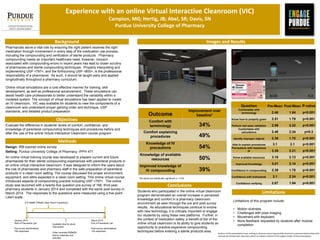
Students who participated in the online virtual cleanroom
program demonstrated an overall increase in perceived
knowledge and comfort in a pharmacy cleanroom
environment as seen through the pre and post survey
results. As educational techniques continue to evolve
with new technology, it is critically important to engage
our students by using these new platforms. Further, in
the context of medication safety, a benefit of the of the
online virtual cleanroom is its ability to give students an
opportunity to practice expensive compounding
techniques before entering a sterile products area.
Limitations of this program include:
• Motion sickness
• Challenges with pixel imaging
• Movement with keyboard
• More feedback requested by students after module
completion
Outcome
Improvement over
baseline*
Comfort with
terminology 34%
Comfort explaining
procedures 49%
Knowledge of IV
precautions 54%
Knowledge of available
resources 50%
Improved knowledge of
IV compounding 39%
Question Pre-Mean Post-Mean P-value
Comfortable with
terminology 2.46 1.84 p<0.001
Know how to properly gown 2.51 1.79 p<0.001
Perform and pass validation 2.99 2.22 p<0.001
Comfortable with
calculations 2.46 2.34 p=0.3
Identify improper objects 2.38 1.75 p<0.001
Able to explain procedures 3.1 2.1 p<0.001
Precautions with hazardous
IV 3.39 2.21 p<0.001
Know available resources 3.18 2.13 p<0.001
Improved Knowledge 3.01 2.14 p<0.001
Confidence in compounding 2.39 1.78 p<0.001
Confidence with biohazards 3.1 2.24 p<0.001
Confidence verifying 2.67 1.94 p<0.001
*All values are statistically significant p < 0.05
January 2014
Start of Parenteral Lab
Pre-survey administered
168 responses
2.5 week Virtual Clean Room Experience
March 2014
End of Parenteral Lab
Post-survey administered
129 responses
Available time for study
intervention
Other recorded didactic
lecture materials and
activities

VIC 2

  • 1.
    Experience with anonline Virtual Interactive Cleanroom (VIC) Campion, MG; Hertig, JB; Abel, SR; Davis, SN Purdue University College of Pharmacy Methods Images and Results Authors of this presentation have nothing to disclose concerning possible financial or personal relationships with commercial entities that may have a direct or indirect interest in the subject matter of this presentation. Background Objectives Limitations Conclusions Pharmacists serve a vital role by ensuring the right patient receives the right medication through involvement in every step of the medication use process, including the compounding and verification of sterile products. Pharmacy compounding meets an important healthcare need, however, concern associated with compounding errors in recent years has lead to closer scrutiny of pharmacies and sterile compounding techniques. Properly interpreting and implementing USP <797>, and the forthcoming USP <800>, is the professional responsibility of a pharmacist. As such, it should be taught early and applied longitudinally throughout a pharmacy curriculum. Online virtual simulations are a cost effective manner for training, skill development, as well as professional advancement. These simulations can assist health care professionals to better understand the variability within a modeled system. The concept of virtual simulations has been applied to create an IV cleanroom. VIC was available for students to view the components of a cleanroom and understand proper garbing order and technique, USP standards, and detailed product preparation Evaluate the difference in students’ levels of comfort, confidence, and knowledge of parenteral compounding techniques and procedures before and after the use of the online Virtual Interactive Cleanroom course program Design: IRB exempt online survey Setting: Purdue University College of Pharmacy; IPPH 471 An online virtual training course was developed to prepare current and future pharmacists for their sterile compounding experiences with parenteral products in an online virtual interactive cleanroom. It was designed to inform the users about the role of pharmacists and pharmacy staff in the safe preparation of parenteral products in a clean room setting. The course discussed the proper environment, equipment, and attire expected in a clean room setting. This online virtual course introduced aspects of compounding practice including USP <797>. The online study was launched with a twenty-five question pre-survey of 168 third-year pharmacy students in January 2014 and completed with the same post-survey in March 2014. The responses to the questions were measured using a five-point Likert scale. Students who participated in the online virtual cleanroom program demonstrated an overall increase in perceived knowledge and comfort in a pharmacy cleanroom environment as seen through the pre and post survey results. As educational techniques continue to evolve with new technology, it is critically important to engage our students by using these new platforms. Further, in the context of medication safety, a benefit of the of the online virtual cleanroom is its ability to give students an opportunity to practice expensive compounding techniques before entering a sterile products area. Limitations of this program include: • Motion sickness • Challenges with pixel imaging • Movement with keyboard • More feedback requested by students after module completion Outcome Improvement over baseline* Comfort with terminology 34% Comfort explaining procedures 49% Knowledge of IV precautions 54% Knowledge of available resources 50% Improved knowledge of IV compounding 39% Question Pre-Mean Post-Mean P-value Comfortable with terminology 2.46 1.84 p<0.001 Know how to properly gown 2.51 1.79 p<0.001 Perform and pass validation 2.99 2.22 p<0.001 Comfortable with calculations 2.46 2.34 p=0.3 Identify improper objects 2.38 1.75 p<0.001 Able to explain procedures 3.1 2.1 p<0.001 Precautions with hazardous IV 3.39 2.21 p<0.001 Know available resources 3.18 2.13 p<0.001 Improved Knowledge 3.01 2.14 p<0.001 Confidence in compounding 2.39 1.78 p<0.001 Confidence with biohazards 3.1 2.24 p<0.001 Confidence verifying 2.67 1.94 p<0.001 *All values are statistically significant p < 0.05 January 2014 Start of Parenteral Lab Pre-survey administered 168 responses 2.5 week Virtual Clean Room Experience March 2014 End of Parenteral Lab Post-survey administered 129 responses Available time for study intervention Other recorded didactic lecture materials and activities