Chapter:4
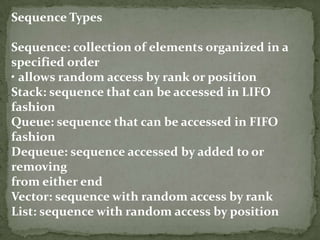
Sequence Types

Sequence: collection of elements organized in a
specified order
• allows random access by rank or position
Stack: sequence that can be accessed in LIFO
fashion
Queue: sequence that can be accessed in FIFO
fashion
Dequeue: sequence accessed by added to or
removing
from either end
Vector: sequence with random access by rank
List: sequence with random access by position
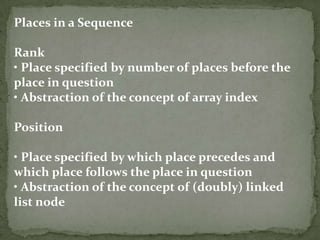
Places in a Sequence

Rank
• Place specified by number of places before the
place in question
• Abstraction of the concept of array index

Position

• Place specified by which place precedes and
which place follows the place in question
• Abstraction of the concept of (doubly) linked
list node
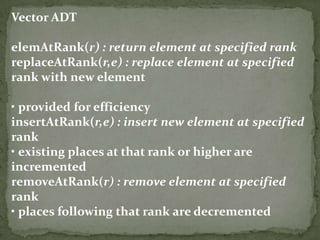
Vector ADT

elemAtRank(r) : return element at specified rank
replaceAtRank(r,e) : replace element at specified
rank with new element

• provided for efficiency
insertAtRank(r,e) : insert new element at specified
rank
• existing places at that rank or higher are
incremented
removeAtRank(r) : remove element at specified
rank
• places following that rank are decremented
Array-based Vector Implementation
insertAtRank(r, e) {
if (size == A.length)
for (int i=size-1; i>=r; i--)
A[i+1]= A[i];
A[r]= e;
size++;
}
removeAtRank(r) {
Object e = A[r];
for (int i=r; i<size-1; i++)
A[i] = A[i+1];
size--;
}
Analysis

elemAtRank: O(1)

replaceAtRank: O(1)

insertAtRank: O(n)

removeAtRank: O(n)
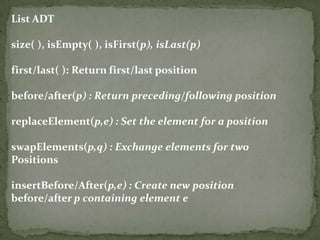
List ADT

size( ), isEmpty( ), isFirst(p), isLast(p)

first/last( ): Return first/last position

before/after(p) : Return preceding/following position

replaceElement(p,e) : Set the element for a position

swapElements(p,q) : Exchange elements for two
Positions

insertBefore/After(p,e) : Create new position
before/after p containing element e
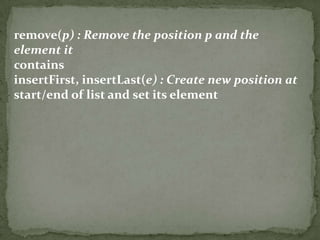
remove(p) : Remove the position p and the
element it
contains
insertFirst, insertLast(e) : Create new position at
start/end of list and set its element
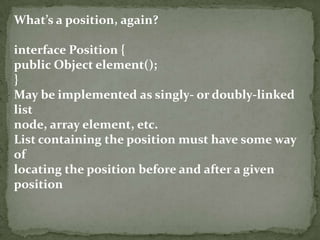
What’s a position, again?

interface Position {
public Object element();
}
May be implemented as singly- or doubly-linked
list
node, array element, etc.
List containing the position must have some way
of
locating the position before and after a given
position
Analysis


All methods of List using doubly linked list
are O(1)
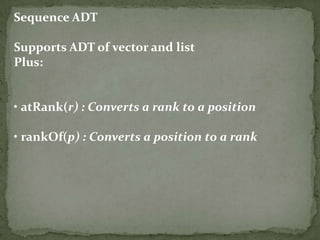
Sequence ADT

Supports ADT of vector and list
Plus:


• atRank(r) : Converts a rank to a position

• rankOf(p) : Converts a position to a rank
Sequence Interface
interface Sequence extends List, Vector
 {
public Position atRank(int rank);
//Returns the Position Containing the Element at
the Give Rank.

public int rankOf(Position position);
//Returns the Rank of Element Stored at the given
Position.
}
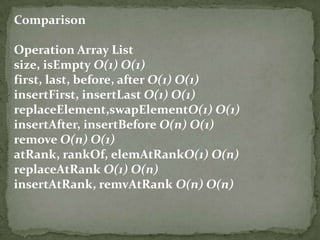
Comparison

Operation Array List
size, isEmpty O(1) O(1)
first, last, before, after O(1) O(1)
insertFirst, insertLast O(1) O(1)
replaceElement,swapElementO(1) O(1)
insertAfter, insertBefore O(n) O(1)
remove O(n) O(1)
atRank, rankOf, elemAtRankO(1) O(n)
replaceAtRank O(1) O(n)
insertAtRank, remvAtRank O(n) O(n)

Vector list nd sequence

  • 1.
  • 2.
    Sequence Types Sequence: collectionof elements organized in a specified order • allows random access by rank or position Stack: sequence that can be accessed in LIFO fashion Queue: sequence that can be accessed in FIFO fashion Dequeue: sequence accessed by added to or removing from either end Vector: sequence with random access by rank List: sequence with random access by position
  • 3.
    Places in aSequence Rank • Place specified by number of places before the place in question • Abstraction of the concept of array index Position • Place specified by which place precedes and which place follows the place in question • Abstraction of the concept of (doubly) linked list node
  • 4.
    Vector ADT elemAtRank(r) :return element at specified rank replaceAtRank(r,e) : replace element at specified rank with new element • provided for efficiency insertAtRank(r,e) : insert new element at specified rank • existing places at that rank or higher are incremented removeAtRank(r) : remove element at specified rank • places following that rank are decremented
  • 5.
    Array-based Vector Implementation insertAtRank(r,e) { if (size == A.length) for (int i=size-1; i>=r; i--) A[i+1]= A[i]; A[r]= e; size++; } removeAtRank(r) { Object e = A[r]; for (int i=r; i<size-1; i++) A[i] = A[i+1]; size--; }
  • 6.
  • 7.
    List ADT size( ),isEmpty( ), isFirst(p), isLast(p) first/last( ): Return first/last position before/after(p) : Return preceding/following position replaceElement(p,e) : Set the element for a position swapElements(p,q) : Exchange elements for two Positions insertBefore/After(p,e) : Create new position before/after p containing element e
  • 8.
    remove(p) : Removethe position p and the element it contains insertFirst, insertLast(e) : Create new position at start/end of list and set its element
  • 9.
    What’s a position,again? interface Position { public Object element(); } May be implemented as singly- or doubly-linked list node, array element, etc. List containing the position must have some way of locating the position before and after a given position
  • 10.
    Analysis All methods ofList using doubly linked list are O(1)
  • 11.
    Sequence ADT Supports ADTof vector and list Plus: • atRank(r) : Converts a rank to a position • rankOf(p) : Converts a position to a rank
  • 12.
    Sequence Interface interface Sequenceextends List, Vector { public Position atRank(int rank); //Returns the Position Containing the Element at the Give Rank. public int rankOf(Position position); //Returns the Rank of Element Stored at the given Position. }
  • 13.
    Comparison Operation Array List size,isEmpty O(1) O(1) first, last, before, after O(1) O(1) insertFirst, insertLast O(1) O(1) replaceElement,swapElementO(1) O(1) insertAfter, insertBefore O(n) O(1) remove O(n) O(1) atRank, rankOf, elemAtRankO(1) O(n) replaceAtRank O(1) O(n) insertAtRank, remvAtRank O(n) O(n)