Equity Research Reports: Structure and
Components
• - Equity Research Reports: Overview and Purpose
• - Report Components: Executive Summary, Investment Thesis,
Industry Outlook, Company Analysis,
Valuation, etc.
• - Report Formats: Written Reports, Presentations, Webcasts, etc.
Equity Research Reports
•Equity research reports are comprehensive documents
or presentations produced by financial analysts who
conduct in-depth analysis of companies and industries,
with the goal of providing insights and recommendations
to investors.
•The purpose of equity research reports is to assist
investors in making informed investment decisions by
providing valuable information, analysis, and opinions on
the financial performance, growth prospects, risks, and
valuation of companies.
Report Components
•Executive Summary: Provides a brief overview of the research report and its
key findings.
•Investment Thesis: States the analyst's opinion and rationale for
recommending or not recommending an investment in the company's stock.
•Industry Outlook: Provides an analysis of the industry dynamics, trends, and
competitive landscape.
•Company Analysis: Offers an in-depth assessment of the company's financial
statements, business model, operations, management, and risks.
•Valuation: Presents the valuation techniques used and the estimated intrinsic
value of the company's stock.
•Other Components: May include information on the company's historical and
projected financial performance, key performance indicators, SWOT analysis,
and other relevant information.
Report Formats
•Written Reports: Equity research reports are typically written documents
that provide detailed analysis and recommendations in a written format.
They are usually presented in a structured manner with headings,
subheadings, tables, and charts for easy readability.
•Presentations: Equity research reports can also be presented in the form
of presentations, either in-person or through webcasts. Presentations may
include slides summarizing the key findings, analysis, and
recommendations of the research report, and may be accompanied by
verbal explanations from the analyst.
•Other Formats: Equity research reports can also be disseminated through
other formats such as video presentations, podcasts, or interactive online
platforms.
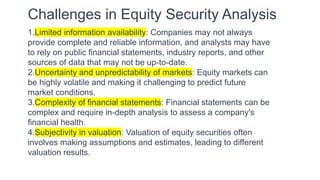
Challenges in Equity Security Analysis
1.Limited information availability: Companies may not always
provide complete and reliable information, and analysts may have
to rely on public financial statements, industry reports, and other
sources of data that may not be up-to-date.
2.Uncertainty and unpredictability of markets: Equity markets can
be highly volatile and making it challenging to predict future
market conditions.
3.Complexity of financial statements: Financial statements can be
complex and require in-depth analysis to assess a company's
financial health.
4.Subjectivity in valuation: Valuation of equity securities often
involves making assumptions and estimates, leading to different
valuation results.
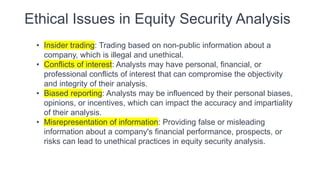
Ethical Issues in Equity Security Analysis
• Insider trading: Trading based on non-public information about a
company, which is illegal and unethical.
• Conflicts of interest: Analysts may have personal, financial, or
professional conflicts of interest that can compromise the objectivity
and integrity of their analysis.
• Biased reporting: Analysts may be influenced by their personal biases,
opinions, or incentives, which can impact the accuracy and impartiality
of their analysis.
• Misrepresentation of information: Providing false or misleading
information about a company's financial performance, prospects, or
risks can lead to unethical practices in equity security analysis.
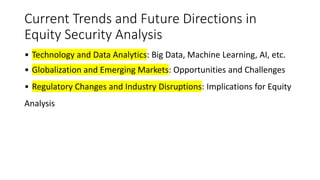
Current Trends and Future Directions in
Equity Security Analysis
• Technology and Data Analytics: Big Data, Machine Learning, AI, etc.
• Globalization and Emerging Markets: Opportunities and Challenges
• Regulatory Changes and Industry Disruptions: Implications for Equity
Analysis
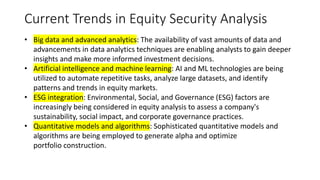
Current Trends in Equity Security Analysis
• Big data and advanced analytics: The availability of vast amounts of data and
advancements in data analytics techniques are enabling analysts to gain deeper
insights and make more informed investment decisions.
• Artificial intelligence and machine learning: AI and ML technologies are being
utilized to automate repetitive tasks, analyze large datasets, and identify
patterns and trends in equity markets.
• ESG integration: Environmental, Social, and Governance (ESG) factors are
increasingly being considered in equity analysis to assess a company's
sustainability, social impact, and corporate governance practices.
• Quantitative models and algorithms: Sophisticated quantitative models and
algorithms are being employed to generate alpha and optimize
portfolio construction.
Future Directions in Equity Security Analysis
• Increased focus on ESG analysis: ESG factors are likely to gain more prominence in
equity analysis as investors place greater emphasis on sustainable investing and
responsible corporate practices.
• Enhanced use of artificial intelligence and machine learning: AI and ML
technologies are expected to further advance and play a larger role in equity
analysis, automating tasks, uncovering insights, and improving decision-making.
• Integration of alternative data sources: Non-traditional data sources such as social
media sentiment, satellite imagery, and IoT data may be integrated into equity
analysis to gain unique insights into companies and industries.
• Continued regulatory changes: Ongoing changes in regulations and reporting
requirements may impact the way equity security analysis is conducted, including
increased scrutiny on transparency, disclosure, and compliance.

VASAL PPT.pptx

  • 1.
    Equity Research Reports:Structure and Components • - Equity Research Reports: Overview and Purpose • - Report Components: Executive Summary, Investment Thesis, Industry Outlook, Company Analysis, Valuation, etc. • - Report Formats: Written Reports, Presentations, Webcasts, etc.
  • 2.
    Equity Research Reports •Equityresearch reports are comprehensive documents or presentations produced by financial analysts who conduct in-depth analysis of companies and industries, with the goal of providing insights and recommendations to investors. •The purpose of equity research reports is to assist investors in making informed investment decisions by providing valuable information, analysis, and opinions on the financial performance, growth prospects, risks, and valuation of companies.
  • 3.
    Report Components •Executive Summary:Provides a brief overview of the research report and its key findings. •Investment Thesis: States the analyst's opinion and rationale for recommending or not recommending an investment in the company's stock. •Industry Outlook: Provides an analysis of the industry dynamics, trends, and competitive landscape. •Company Analysis: Offers an in-depth assessment of the company's financial statements, business model, operations, management, and risks. •Valuation: Presents the valuation techniques used and the estimated intrinsic value of the company's stock. •Other Components: May include information on the company's historical and projected financial performance, key performance indicators, SWOT analysis, and other relevant information.
  • 4.
    Report Formats •Written Reports:Equity research reports are typically written documents that provide detailed analysis and recommendations in a written format. They are usually presented in a structured manner with headings, subheadings, tables, and charts for easy readability. •Presentations: Equity research reports can also be presented in the form of presentations, either in-person or through webcasts. Presentations may include slides summarizing the key findings, analysis, and recommendations of the research report, and may be accompanied by verbal explanations from the analyst. •Other Formats: Equity research reports can also be disseminated through other formats such as video presentations, podcasts, or interactive online platforms.
  • 5.
    Challenges in EquitySecurity Analysis 1.Limited information availability: Companies may not always provide complete and reliable information, and analysts may have to rely on public financial statements, industry reports, and other sources of data that may not be up-to-date. 2.Uncertainty and unpredictability of markets: Equity markets can be highly volatile and making it challenging to predict future market conditions. 3.Complexity of financial statements: Financial statements can be complex and require in-depth analysis to assess a company's financial health. 4.Subjectivity in valuation: Valuation of equity securities often involves making assumptions and estimates, leading to different valuation results.
  • 6.
    Ethical Issues inEquity Security Analysis • Insider trading: Trading based on non-public information about a company, which is illegal and unethical. • Conflicts of interest: Analysts may have personal, financial, or professional conflicts of interest that can compromise the objectivity and integrity of their analysis. • Biased reporting: Analysts may be influenced by their personal biases, opinions, or incentives, which can impact the accuracy and impartiality of their analysis. • Misrepresentation of information: Providing false or misleading information about a company's financial performance, prospects, or risks can lead to unethical practices in equity security analysis.
  • 7.
    Current Trends andFuture Directions in Equity Security Analysis • Technology and Data Analytics: Big Data, Machine Learning, AI, etc. • Globalization and Emerging Markets: Opportunities and Challenges • Regulatory Changes and Industry Disruptions: Implications for Equity Analysis
  • 8.
    Current Trends inEquity Security Analysis • Big data and advanced analytics: The availability of vast amounts of data and advancements in data analytics techniques are enabling analysts to gain deeper insights and make more informed investment decisions. • Artificial intelligence and machine learning: AI and ML technologies are being utilized to automate repetitive tasks, analyze large datasets, and identify patterns and trends in equity markets. • ESG integration: Environmental, Social, and Governance (ESG) factors are increasingly being considered in equity analysis to assess a company's sustainability, social impact, and corporate governance practices. • Quantitative models and algorithms: Sophisticated quantitative models and algorithms are being employed to generate alpha and optimize portfolio construction.
  • 9.
    Future Directions inEquity Security Analysis • Increased focus on ESG analysis: ESG factors are likely to gain more prominence in equity analysis as investors place greater emphasis on sustainable investing and responsible corporate practices. • Enhanced use of artificial intelligence and machine learning: AI and ML technologies are expected to further advance and play a larger role in equity analysis, automating tasks, uncovering insights, and improving decision-making. • Integration of alternative data sources: Non-traditional data sources such as social media sentiment, satellite imagery, and IoT data may be integrated into equity analysis to gain unique insights into companies and industries. • Continued regulatory changes: Ongoing changes in regulations and reporting requirements may impact the way equity security analysis is conducted, including increased scrutiny on transparency, disclosure, and compliance.