The black polymorph of TTF-CA: TTF
polymorphism and solvent effects in
mechanochemical and vapor digestion
syntheses, FT-IR, crystal packing and
electronic structure
Dr. Silvina Pagola
Research Scientist, College of William and Mary
Adjunct Professor, Hampton University
VAS 92nd
Annual Meeting, VCU, Richmond
May 15, 2014
Overview
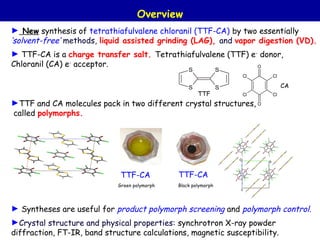
► New synthesis of tetrathiafulvalene chloranil (TTF-CA) by two essentially
‘solvent-free’ methods, liquid assisted grinding (LAG), and vapor digestion (VD).
► TTF-CA is a charge transfer salt. Tetrathiafulvalene (TTF) e-
donor,
Chloranil (CA) e-
acceptor.
►TTF and CA molecules pack in two different crystal structures,
called polymorphs.
► Syntheses are useful for product polymorph screening and polymorph control.
►Crystal structure and physical properties: synchrotron X-ray powder
diffraction, FT-IR, band structure calculations, magnetic susceptibility.
Green polymorph Black polymorph
TTF-CA TTF-CA
S
S
S
S
O
O
Cl
Cl
Cl
ClTTF
CA
TTF(s) + CA(s) TTF-CA(s)
O
O
Cl
Cl
Cl
Cl
S
S
S
S
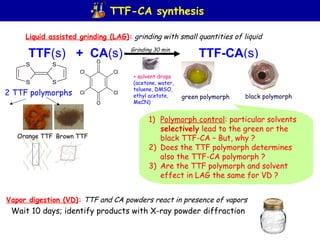
1) Polymorph control: particular solvents
selectively lead to the green or the
black TTF-CA – But, why ?
2) Does the TTF polymorph determines
also the TTF-CA polymorph ?
3) Are the TTF polymorph and solvent
effect in LAG the same for VD ?
TTF-CA synthesis
Grinding 30 min.
green polymorph black polymorph
2 TTF polymorphs
Orange TTF Brown TTF
Wait 10 days; identify products with X-ray powder diffraction
Vapor digestion (VD): TTF and CA powders react in presence of vapors
Liquid assisted grinding (LAG): grinding with small quantities of liquid
+ solvent drops
(acetone, water,
toluene, DMSO,
ethyl acetate,
MeCN)
1 0 1 5 2 0 2 5 3 0 3 5 4 0 4 5 5 0 5 5
2 t h e t a / d e g r e e s
0
2 0 0 0 0
4 0 0 0 0
6 0 0 0 0
X-raycounts
- 3 0 0 0
0
3 0 0 0
Difference
acetone
TTF(s) + CA(s) TTF-CA(s) [1]
[1]- S. Benjamin et al. Synthetic Metals 161 (2011) 996-1000; [2]- Mayerle et al, Acta Cryst. (1979) B35, 2988-2995.
Green TTF-CA: Rietveld fit of the laboratory XRPD data
► Crystal structure known (1979). [2]
► Neutral (ρ=0.3e-
) to ionic (0.7e-
)
transition at 81K and 1atm, together with a
crystallographic phase transition (P21/n to Pn)
Viewed along [010] (T=300K)
ρ=0.3e-
(pseudo-neutral)
Black TTF-CA: synchrotron X-ray powder diffraction data (298 K)
DMSO
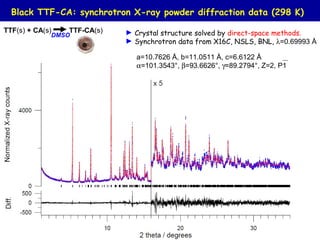
TTF(s) + CA(s) TTF-CA(s) ► Crystal structure solved by direct-space methods.
► Synchrotron data from X16C, NSLS, BNL, λ=0.69993 Å
a=10.7626 Å, b=11.0511 Å, c=6.6122 Å
α=101.3543°, β=93.6626°, γ=89.2794°, Z=2, P1
Black TTF-CA: crystal structure analysis
►Experimentally DIAMAGNETIC (magnetic susceptibility balance)
Viewed along [001]: eclipsed
(TTF+●
)2
radical cation dimers;
typical packing motif of ionic,
diamagnetic and insulating TTF compounds
Viewed along [110]: columns of TTF
and (CA-●
)2 radical anion dimers
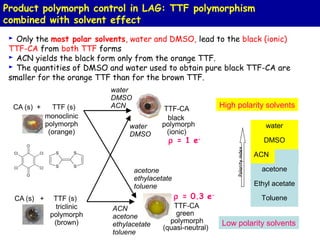
Product polymorph control in LAG: TTF polymorphism
combined with solvent effect
Low polarity solvents
High polarity solvents
► Only the most polar solvents, water and DMSO, lead to the black (ionic)
TTF-CA from both TTF forms
► ACN yields the black form only from the orange TTF.
► The quantities of DMSO and water used to obtain pure black TTF-CA are
smaller for the orange TTF than for the brown TTF.
ρ = 1 e-
ρ = 0.3 e-
water
DMSO
ACN
acetone
Ethyl acetate
Toluene
Polarityindex
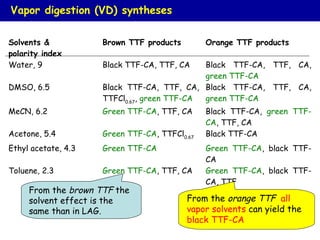
Solvents &
polarity index
Brown TTF products Orange TTF products
Water, 9 Black TTF-CA, TTF, CA Black TTF-CA, TTF, CA,
green TTF-CA
DMSO, 6.5 Black TTF-CA, TTF, CA,
TTFCl0.67
, green TTF-CA
Black TTF-CA, TTF, CA,
green TTF-CA
MeCN, 6.2 Green TTF-CA, TTF, CA Black TTF-CA, green TTF-
CA, TTF, CA
Acetone, 5.4 Green TTF-CA, TTFCl0.67
Black TTF-CA
Ethyl acetate, 4.3 Green TTF-CA Green TTF-CA, black TTF-
CA
Toluene, 2.3 Green TTF-CA, TTF, CA Green TTF-CA, black TTF-
CA, TTF
Vapor digestion (VD) syntheses
From the brown TTF the
solvent effect is the
same than in LAG.
From the orange TTF all
vapor solvents can yield the
black TTF-CA
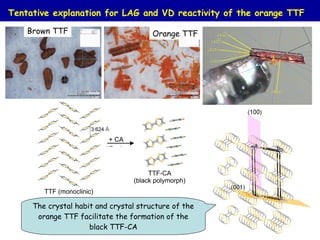
Tentative explanation for LAG and VD reactivity of the orange TTF
Brown TTF
The crystal habit and crystal structure of the
orange TTF facilitate the formation of the
black TTF-CA
Orange TTF
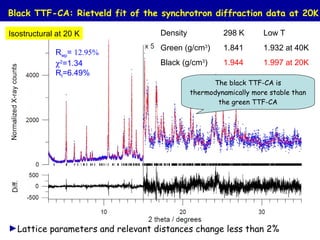
Black TTF-CA: Rietveld fit of the synchrotron diffraction data at 20K
►Lattice parameters and relevant distances change less than 2%
Isostructural at 20 K
Rwp= 12.95%
χ2
=1.34
RI=6.49%
Density 298 K Low T
Green (g/cm3
) 1.841 1.932 at 40K
Black (g/cm3
) 1.944 1.997 at 20K
The black TTF-CA is
thermodynamically more stable than
the green TTF-CA
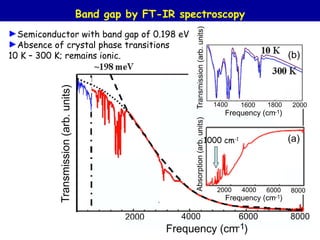
Band gap by FT-IR spectroscopy
►Semiconductor with band gap of 0.198 eV
►Absence of crystal phase transitions
10 K – 300 K; remains ionic.
1000 cm-1
I am grateful for synchrotron powder diffraction data collected at the
beamline X16C of the National Synchrotron Light Source, BNL.
Use of the National Synchrotron Light Source, Brookhaven National
Laboratory, is supported by the U.S. Department of Energy, Office of
Science, Office of Basic Energy Sciences, under Contract No. DE-
AC02-98CH10886.
I am grateful to the College of William and Mary for the use of the
single crystal diffractometer and to ODU for the use of the
laboratory X-ray powder diffractometer.
Acknowledgements
Thanks !

VAS - May 2014 Pagola current

  • 1.
    The black polymorphof TTF-CA: TTF polymorphism and solvent effects in mechanochemical and vapor digestion syntheses, FT-IR, crystal packing and electronic structure Dr. Silvina Pagola Research Scientist, College of William and Mary Adjunct Professor, Hampton University VAS 92nd Annual Meeting, VCU, Richmond May 15, 2014
  • 2.
    Overview ► New synthesisof tetrathiafulvalene chloranil (TTF-CA) by two essentially ‘solvent-free’ methods, liquid assisted grinding (LAG), and vapor digestion (VD). ► TTF-CA is a charge transfer salt. Tetrathiafulvalene (TTF) e- donor, Chloranil (CA) e- acceptor. ►TTF and CA molecules pack in two different crystal structures, called polymorphs. ► Syntheses are useful for product polymorph screening and polymorph control. ►Crystal structure and physical properties: synchrotron X-ray powder diffraction, FT-IR, band structure calculations, magnetic susceptibility. Green polymorph Black polymorph TTF-CA TTF-CA S S S S O O Cl Cl Cl ClTTF CA
  • 3.
    TTF(s) + CA(s)TTF-CA(s) O O Cl Cl Cl Cl S S S S 1) Polymorph control: particular solvents selectively lead to the green or the black TTF-CA – But, why ? 2) Does the TTF polymorph determines also the TTF-CA polymorph ? 3) Are the TTF polymorph and solvent effect in LAG the same for VD ? TTF-CA synthesis Grinding 30 min. green polymorph black polymorph 2 TTF polymorphs Orange TTF Brown TTF Wait 10 days; identify products with X-ray powder diffraction Vapor digestion (VD): TTF and CA powders react in presence of vapors Liquid assisted grinding (LAG): grinding with small quantities of liquid + solvent drops (acetone, water, toluene, DMSO, ethyl acetate, MeCN)
  • 4.
    1 0 15 2 0 2 5 3 0 3 5 4 0 4 5 5 0 5 5 2 t h e t a / d e g r e e s 0 2 0 0 0 0 4 0 0 0 0 6 0 0 0 0 X-raycounts - 3 0 0 0 0 3 0 0 0 Difference acetone TTF(s) + CA(s) TTF-CA(s) [1] [1]- S. Benjamin et al. Synthetic Metals 161 (2011) 996-1000; [2]- Mayerle et al, Acta Cryst. (1979) B35, 2988-2995. Green TTF-CA: Rietveld fit of the laboratory XRPD data ► Crystal structure known (1979). [2] ► Neutral (ρ=0.3e- ) to ionic (0.7e- ) transition at 81K and 1atm, together with a crystallographic phase transition (P21/n to Pn) Viewed along [010] (T=300K) ρ=0.3e- (pseudo-neutral)
  • 5.
    Black TTF-CA: synchrotronX-ray powder diffraction data (298 K) DMSO TTF(s) + CA(s) TTF-CA(s) ► Crystal structure solved by direct-space methods. ► Synchrotron data from X16C, NSLS, BNL, λ=0.69993 Å a=10.7626 Å, b=11.0511 Å, c=6.6122 Å α=101.3543°, β=93.6626°, γ=89.2794°, Z=2, P1
  • 6.
    Black TTF-CA: crystalstructure analysis ►Experimentally DIAMAGNETIC (magnetic susceptibility balance) Viewed along [001]: eclipsed (TTF+● )2 radical cation dimers; typical packing motif of ionic, diamagnetic and insulating TTF compounds Viewed along [110]: columns of TTF and (CA-● )2 radical anion dimers
  • 7.
    Product polymorph controlin LAG: TTF polymorphism combined with solvent effect Low polarity solvents High polarity solvents ► Only the most polar solvents, water and DMSO, lead to the black (ionic) TTF-CA from both TTF forms ► ACN yields the black form only from the orange TTF. ► The quantities of DMSO and water used to obtain pure black TTF-CA are smaller for the orange TTF than for the brown TTF. ρ = 1 e- ρ = 0.3 e- water DMSO ACN acetone Ethyl acetate Toluene Polarityindex
  • 8.
    Solvents & polarity index BrownTTF products Orange TTF products Water, 9 Black TTF-CA, TTF, CA Black TTF-CA, TTF, CA, green TTF-CA DMSO, 6.5 Black TTF-CA, TTF, CA, TTFCl0.67 , green TTF-CA Black TTF-CA, TTF, CA, green TTF-CA MeCN, 6.2 Green TTF-CA, TTF, CA Black TTF-CA, green TTF- CA, TTF, CA Acetone, 5.4 Green TTF-CA, TTFCl0.67 Black TTF-CA Ethyl acetate, 4.3 Green TTF-CA Green TTF-CA, black TTF- CA Toluene, 2.3 Green TTF-CA, TTF, CA Green TTF-CA, black TTF- CA, TTF Vapor digestion (VD) syntheses From the brown TTF the solvent effect is the same than in LAG. From the orange TTF all vapor solvents can yield the black TTF-CA
  • 9.
    Tentative explanation forLAG and VD reactivity of the orange TTF Brown TTF The crystal habit and crystal structure of the orange TTF facilitate the formation of the black TTF-CA Orange TTF
  • 10.
    Black TTF-CA: Rietveldfit of the synchrotron diffraction data at 20K ►Lattice parameters and relevant distances change less than 2% Isostructural at 20 K Rwp= 12.95% χ2 =1.34 RI=6.49% Density 298 K Low T Green (g/cm3 ) 1.841 1.932 at 40K Black (g/cm3 ) 1.944 1.997 at 20K The black TTF-CA is thermodynamically more stable than the green TTF-CA
  • 11.
    Band gap byFT-IR spectroscopy ►Semiconductor with band gap of 0.198 eV ►Absence of crystal phase transitions 10 K – 300 K; remains ionic. 1000 cm-1
  • 12.
    I am gratefulfor synchrotron powder diffraction data collected at the beamline X16C of the National Synchrotron Light Source, BNL. Use of the National Synchrotron Light Source, Brookhaven National Laboratory, is supported by the U.S. Department of Energy, Office of Science, Office of Basic Energy Sciences, under Contract No. DE- AC02-98CH10886. I am grateful to the College of William and Mary for the use of the single crystal diffractometer and to ODU for the use of the laboratory X-ray powder diffractometer. Acknowledgements Thanks !