Varied Encounters
With Data Science
How does data science relate to traditional scientific and
computational approaches? What can we learn about data science
pitfalls from these approaches? Is there a role for the social sciences
and humanities?
A partial exposition by example.
Gilbert Peffer
gilbert@kubify.co
25 August 2020
About
A quick overview of what we are
covering in our discussions today.
★ Method
★ A data science lens
★ Computational mathematics
★ Agent-based models
★ Quantified self
★ Learning analytics
★ Business intelligence
★ Philosophy of algorithms
Method
Quizzing projects through a data
science lens.
Poking the data science lens
through project work.
Source: https://jobs-to-be-done.com/what-is-jobs-to-be-done-fea59c8e39eb
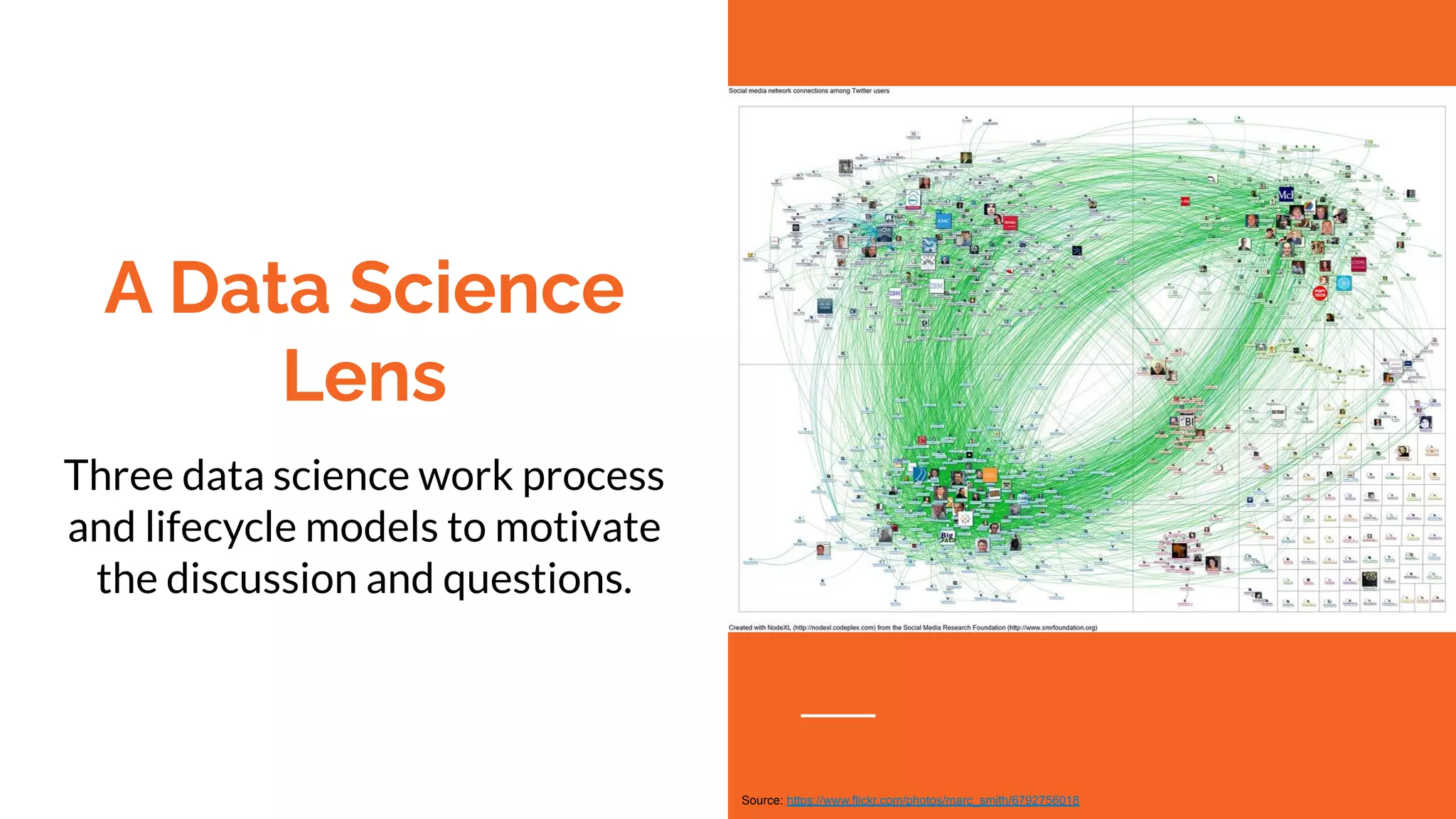
A Data Science
Lens
Three data science work process
and lifecycle models to motivate
the discussion and questions.
Source: https://www.flickr.com/photos/marc_smith/6792756018
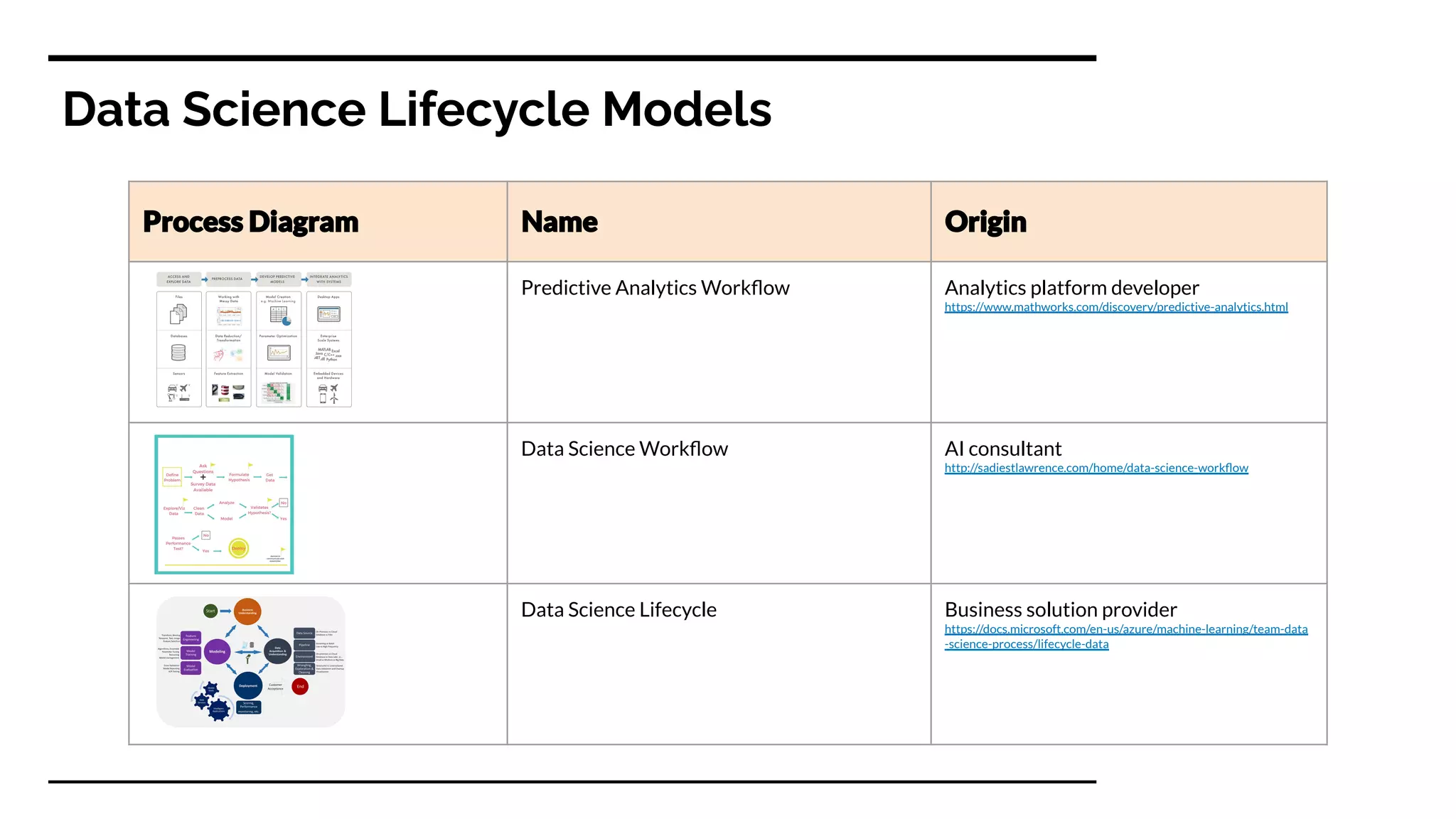
Predictive Analytics Workflow Analytics platform developer
https://www.mathworks.com/discovery/predictive-analytics.html
Data Science Workflow AI consultant
http://sadiestlawrence.com/home/data-science-workflow
Data Science Lifecycle Business solution provider
https://docs.microsoft.com/en-us/azure/machine-learning/team-data
-science-process/lifecycle-data
Data Science Lifecycle Models
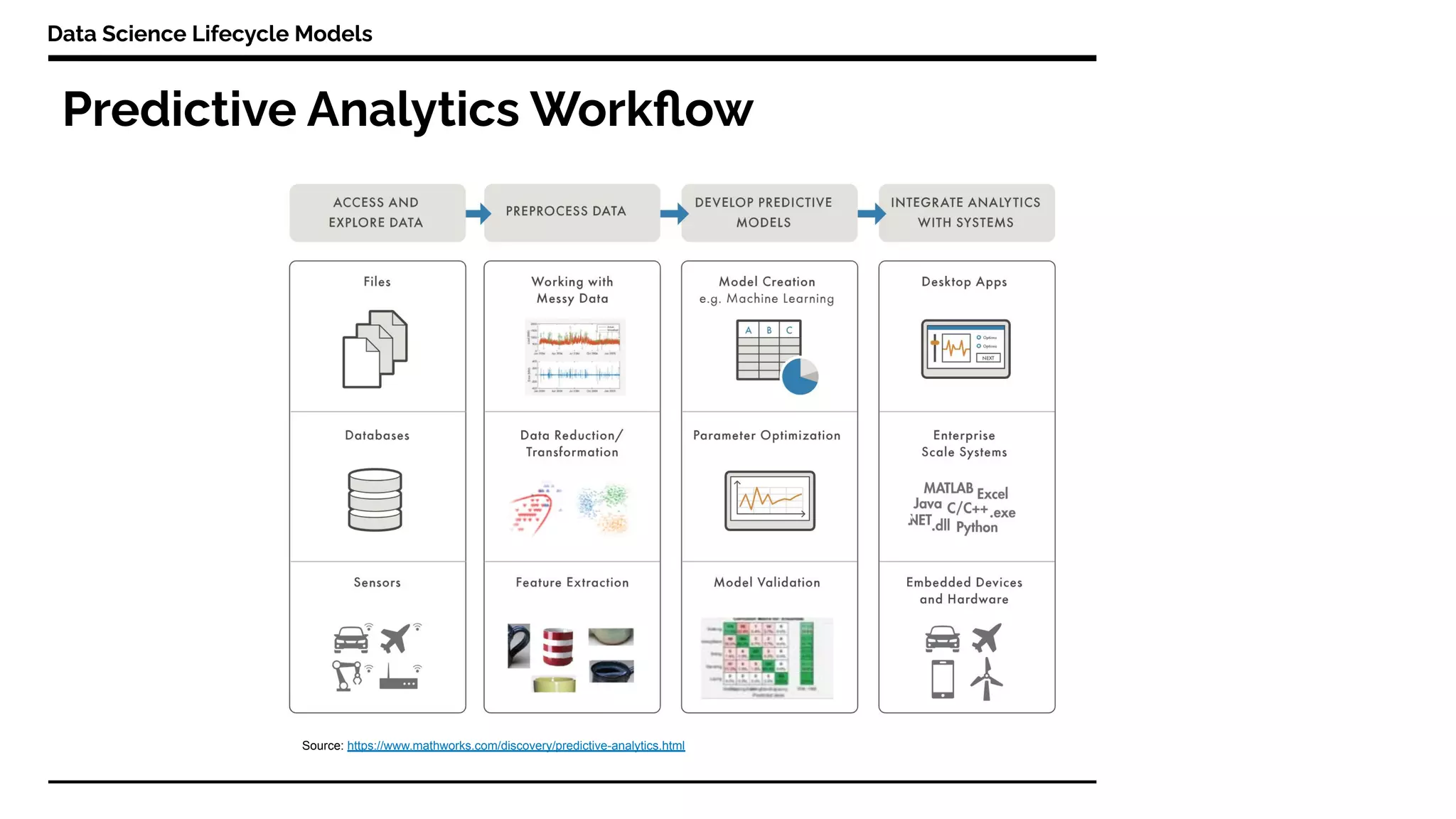
Predictive Analytics Workflow
Data Science Lifecycle Models
Source: https://www.mathworks.com/discovery/predictive-analytics.html
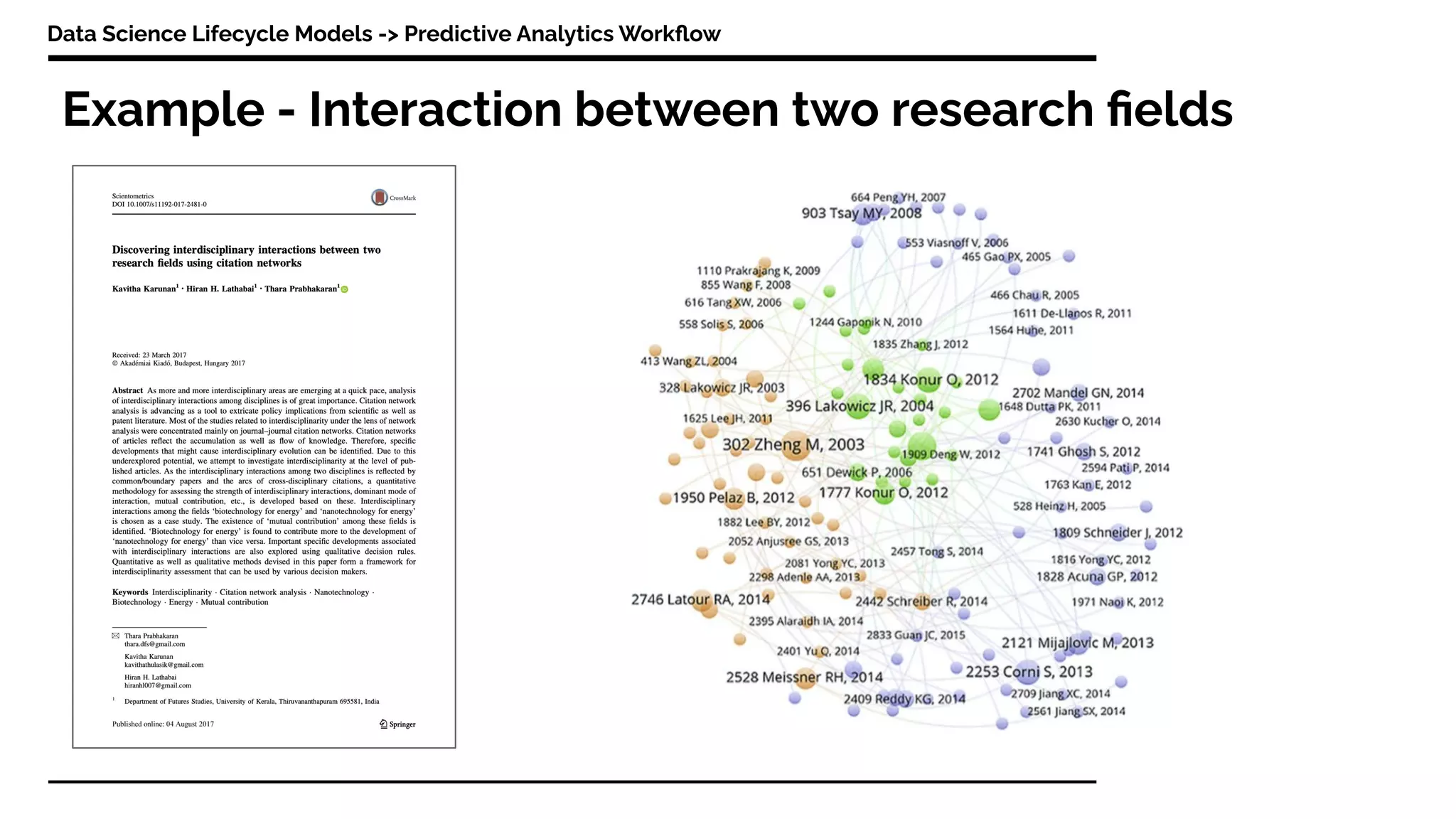
Example - Interaction between two research fields
Data Science Lifecycle Models -> Predictive Analytics Workflow
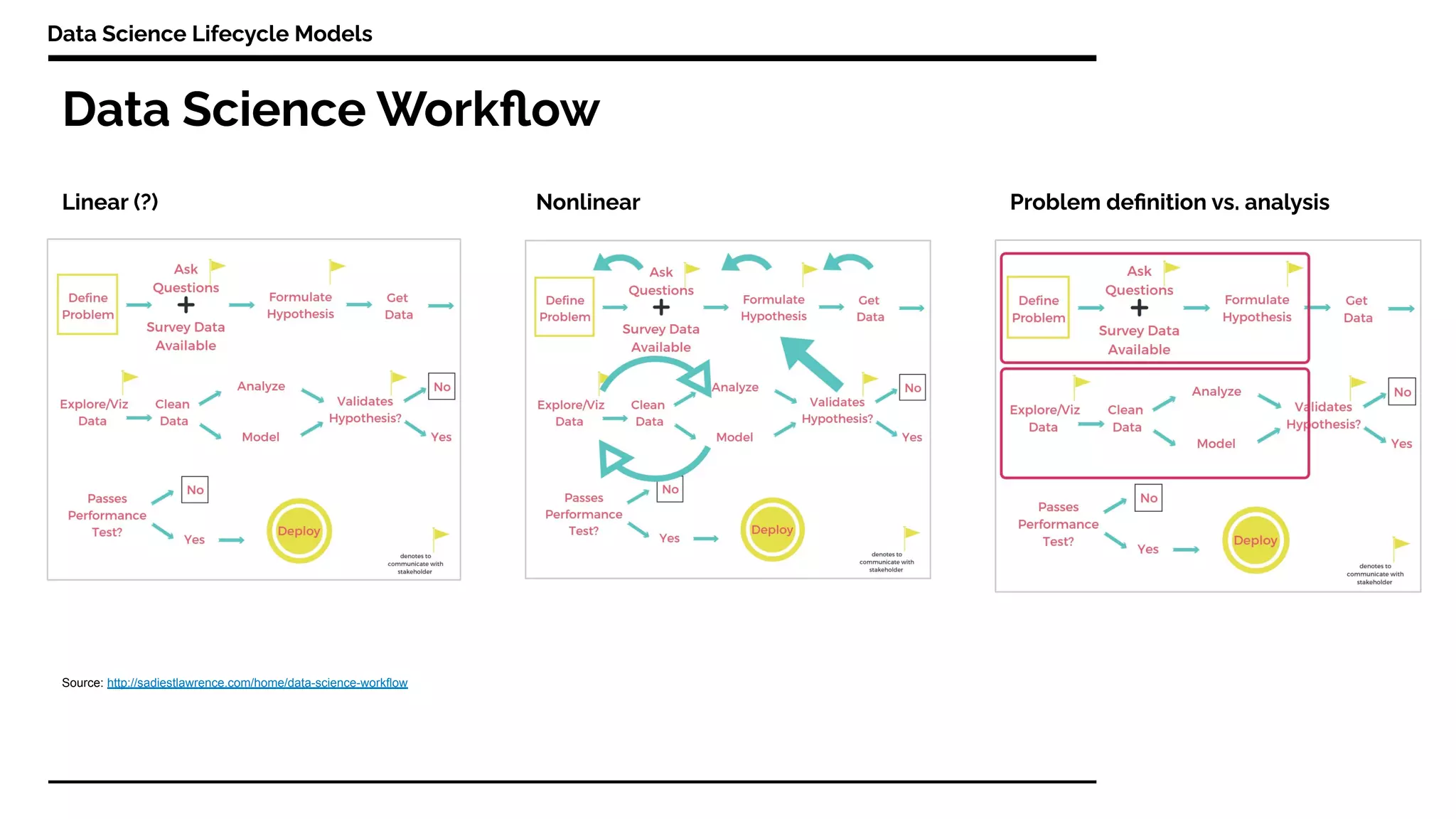
Data Science Workflow
Data Science Lifecycle Models
Linear (?) Nonlinear Problem definition vs. analysis
Source: http://sadiestlawrence.com/home/data-science-workflow
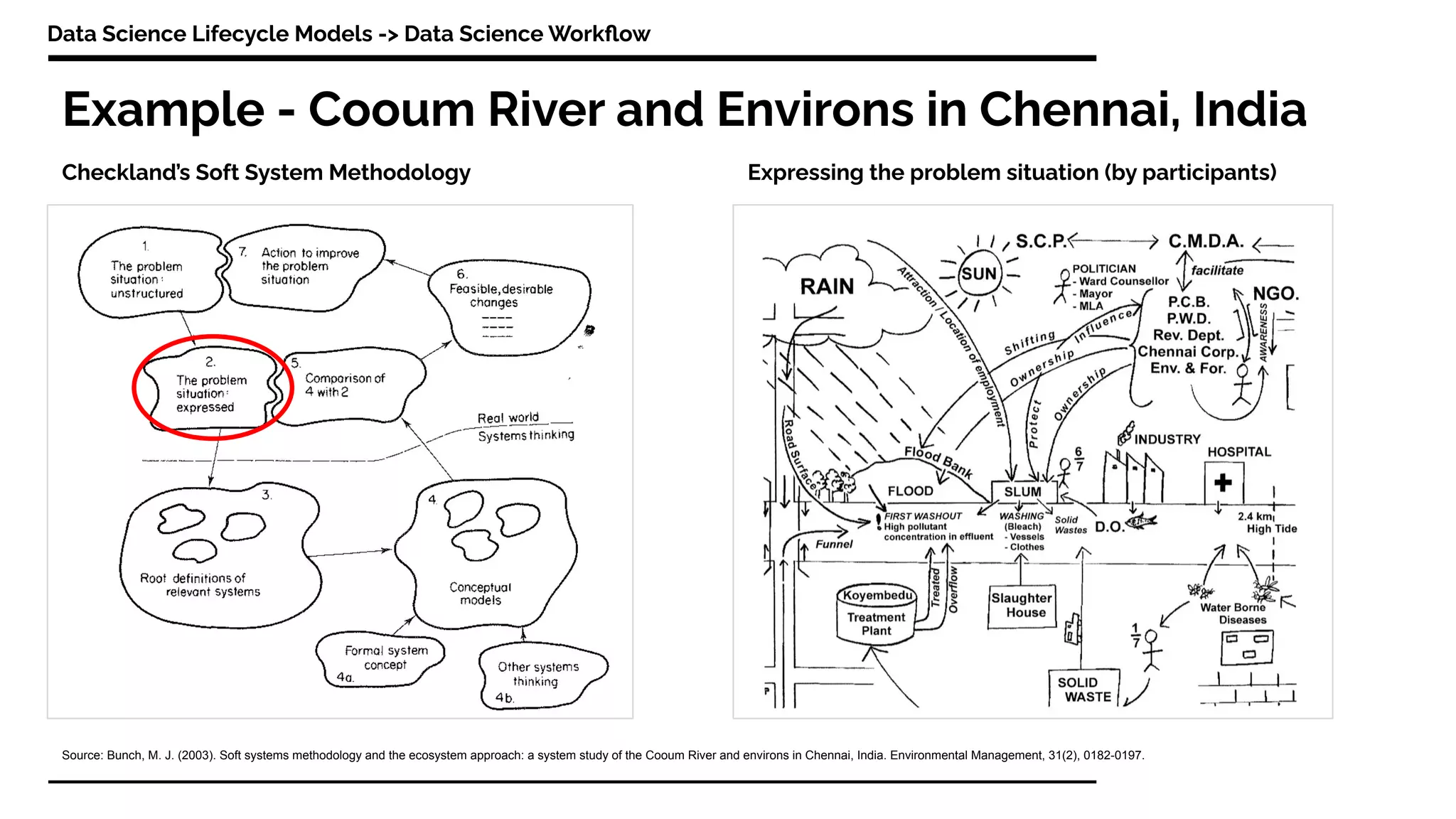
Example - Cooum River and Environs in Chennai, India
Data Science Lifecycle Models -> Data Science Workflow
Checkland’s Soft System Methodology Expressing the problem situation (by participants)
Source: Bunch, M. J. (2003). Soft systems methodology and the ecosystem approach: a system study of the Cooum River and environs in Chennai, India. Environmental Management, 31(2), 0182-0197.
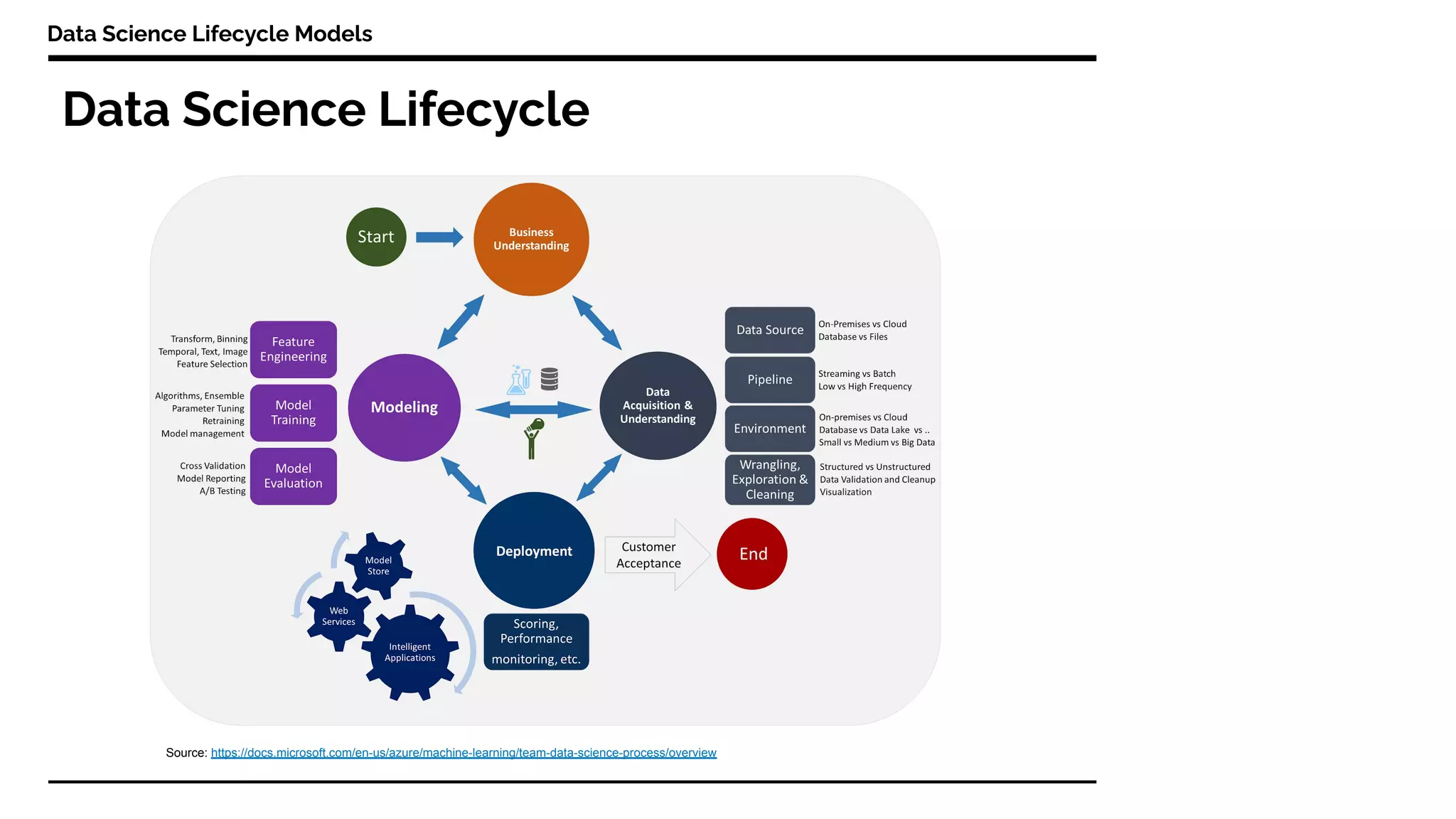
Data Science Lifecycle
Data Science Lifecycle Models
Source: https://docs.microsoft.com/en-us/azure/machine-learning/team-data-science-process/overview
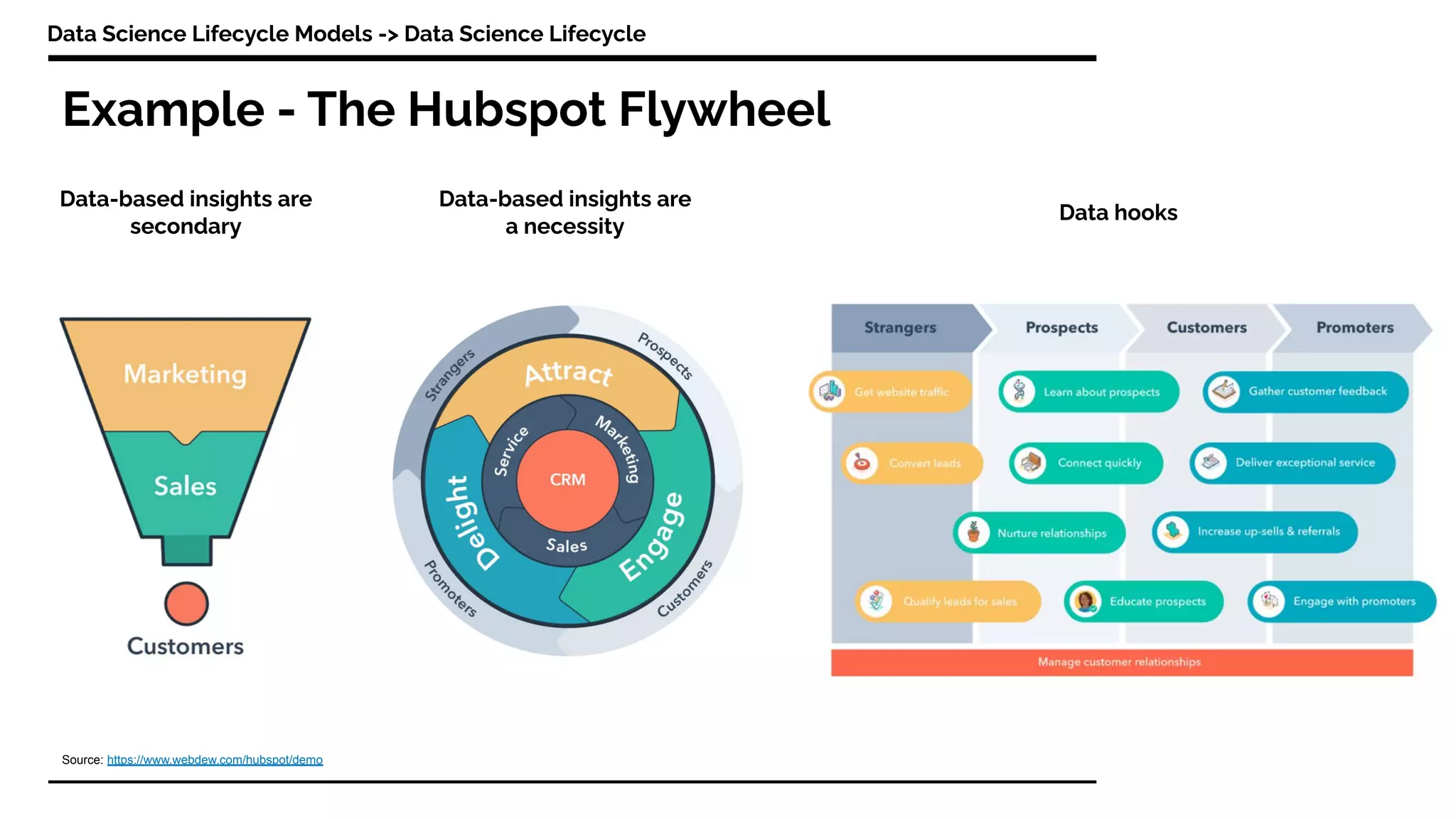
Example - The Hubspot Flywheel
Data Science Lifecycle Models -> Data Science Lifecycle
Data-based insights are
secondary
Data-based insights are
a necessity
Source: https://www.webdew.com/hubspot/demo
Data hooks
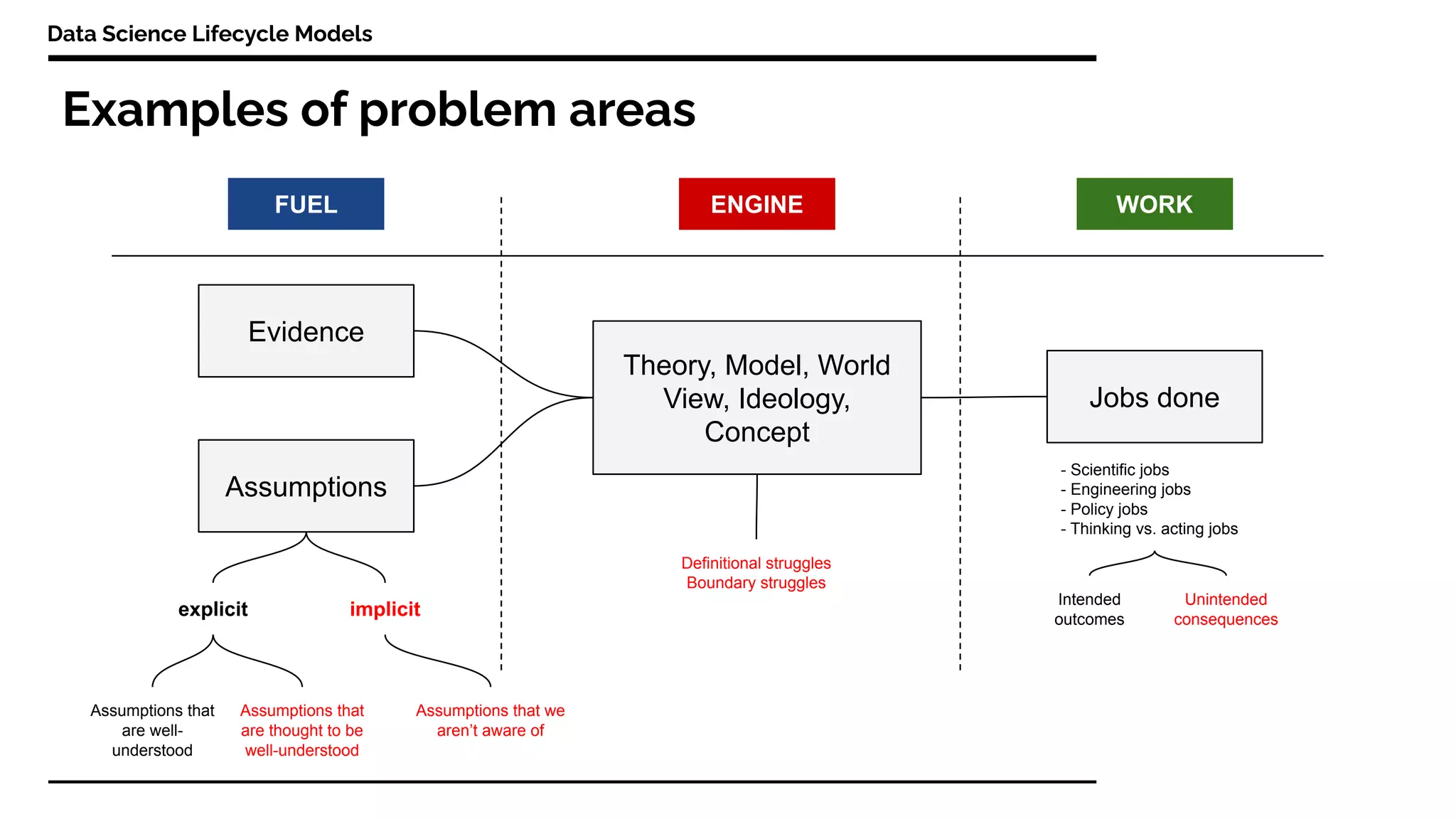
Examples of problem areas
Data Science Lifecycle Models
Theory, Model, World
View, Ideology,
Concept
Assumptions
Evidence
explicit
Assumptions that
are thought to be
well-understood
FUEL ENGINE WORK
- Scientific jobs
- Engineering jobs
- Policy jobs
- Thinking vs. acting jobs
Unintended
consequences
Intended
outcomes
implicit
Assumptions that
are well-
understood
Jobs done
Assumptions that we
aren’t aware of
Definitional struggles
Boundary struggles
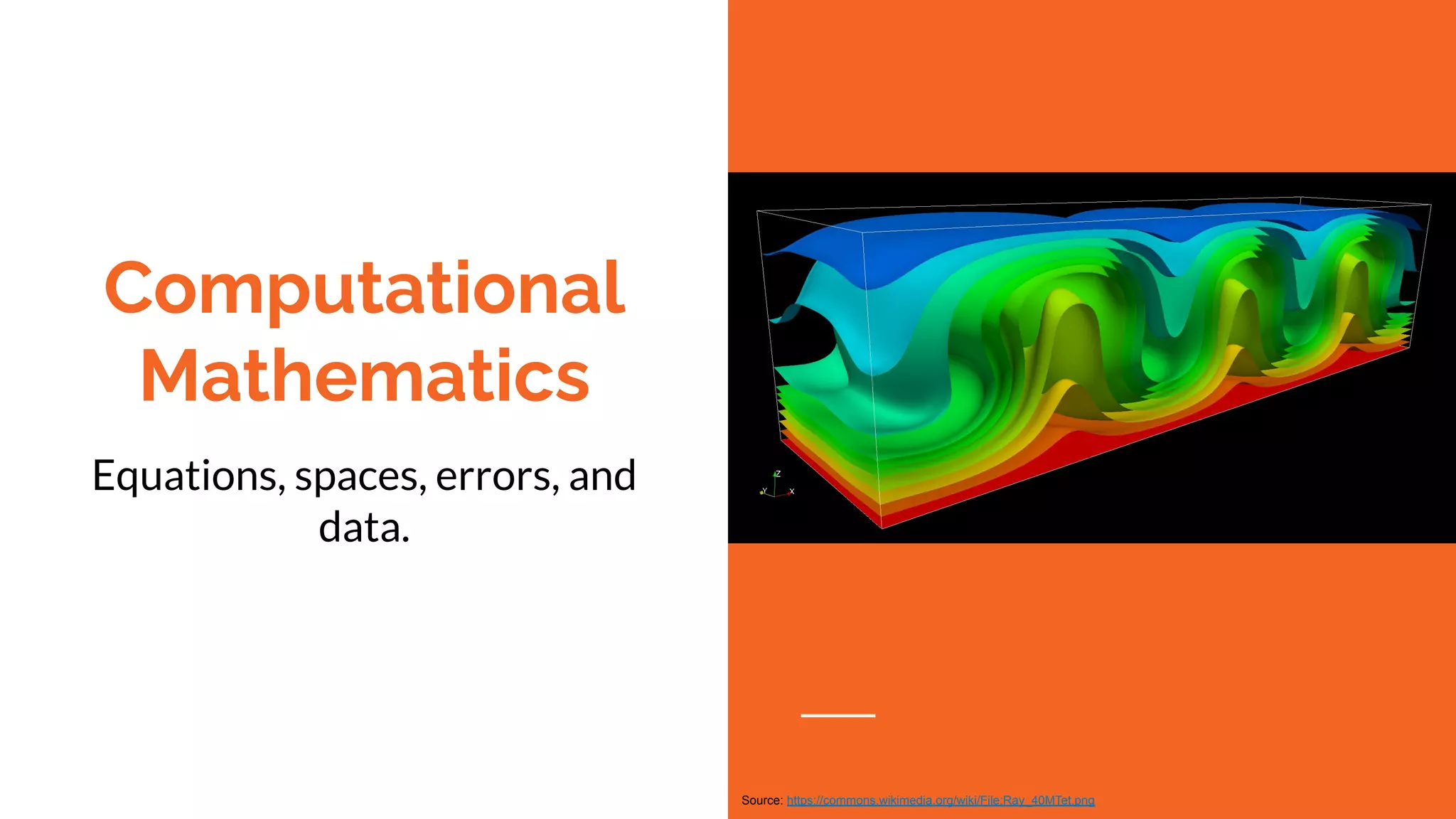
Computational
Mathematics
Equations, spaces, errors, and
data.
Source: https://commons.wikimedia.org/wiki/File:Ray_40MTet.png
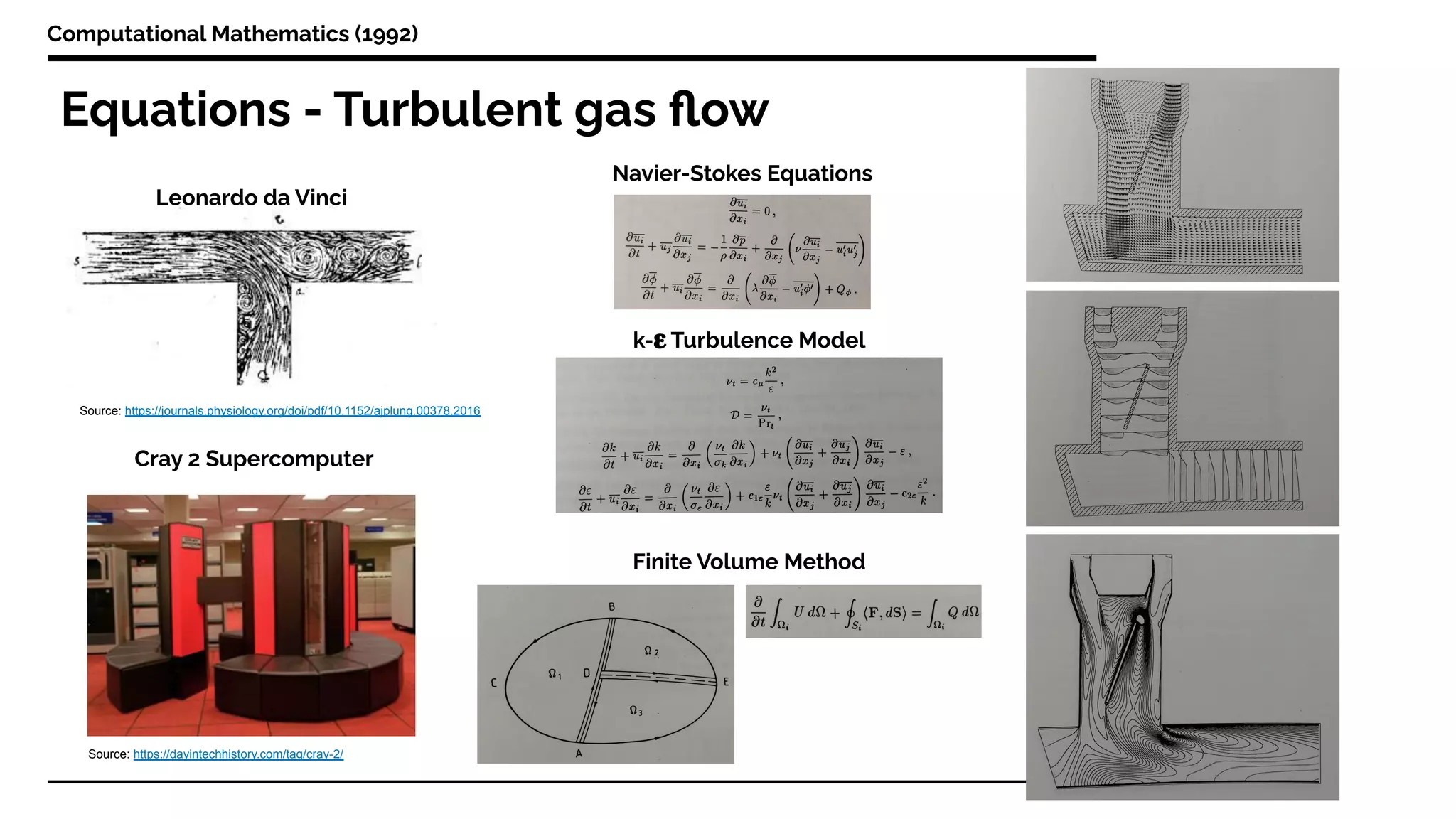
Equations - Turbulent gas flow
Computational Mathematics (1992)
Leonardo da Vinci
Cray 2 Supercomputer
Navier-Stokes Equations
k- 𝛆 Turbulence Model
Finite Volume Method
Source: https://dayintechhistory.com/tag/cray-2/
Source: https://journals.physiology.org/doi/pdf/10.1152/ajplung.00378.2016
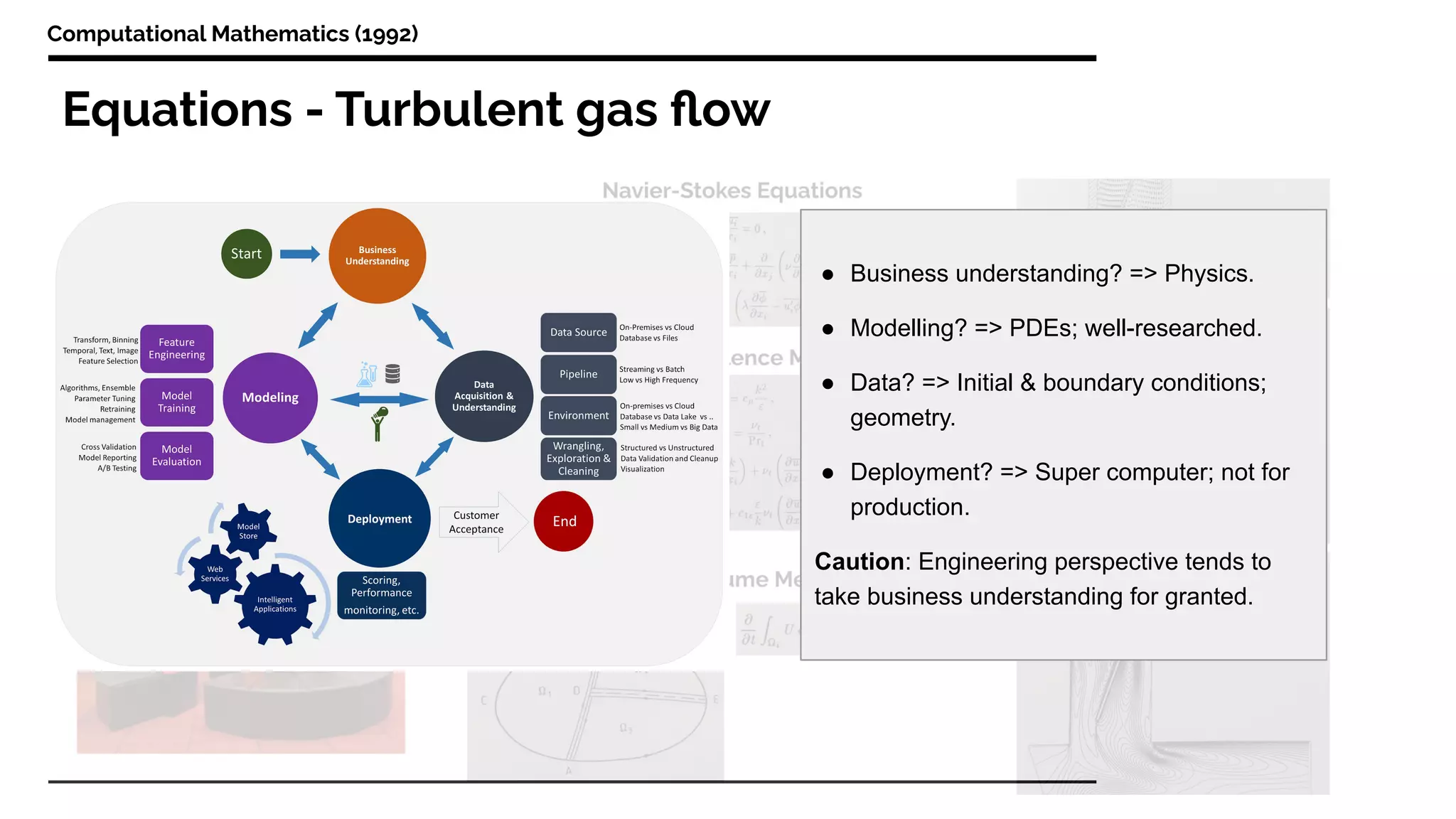
Equations - Turbulent gas flow
Computational Mathematics (1992)
● Business understanding? => Physics.
● Modelling? => PDEs; well-researched.
● Data? => Initial & boundary conditions;
geometry.
● Deployment? => Super computer; not for
production.
Caution: Engineering perspective tends to
take business understanding for granted.
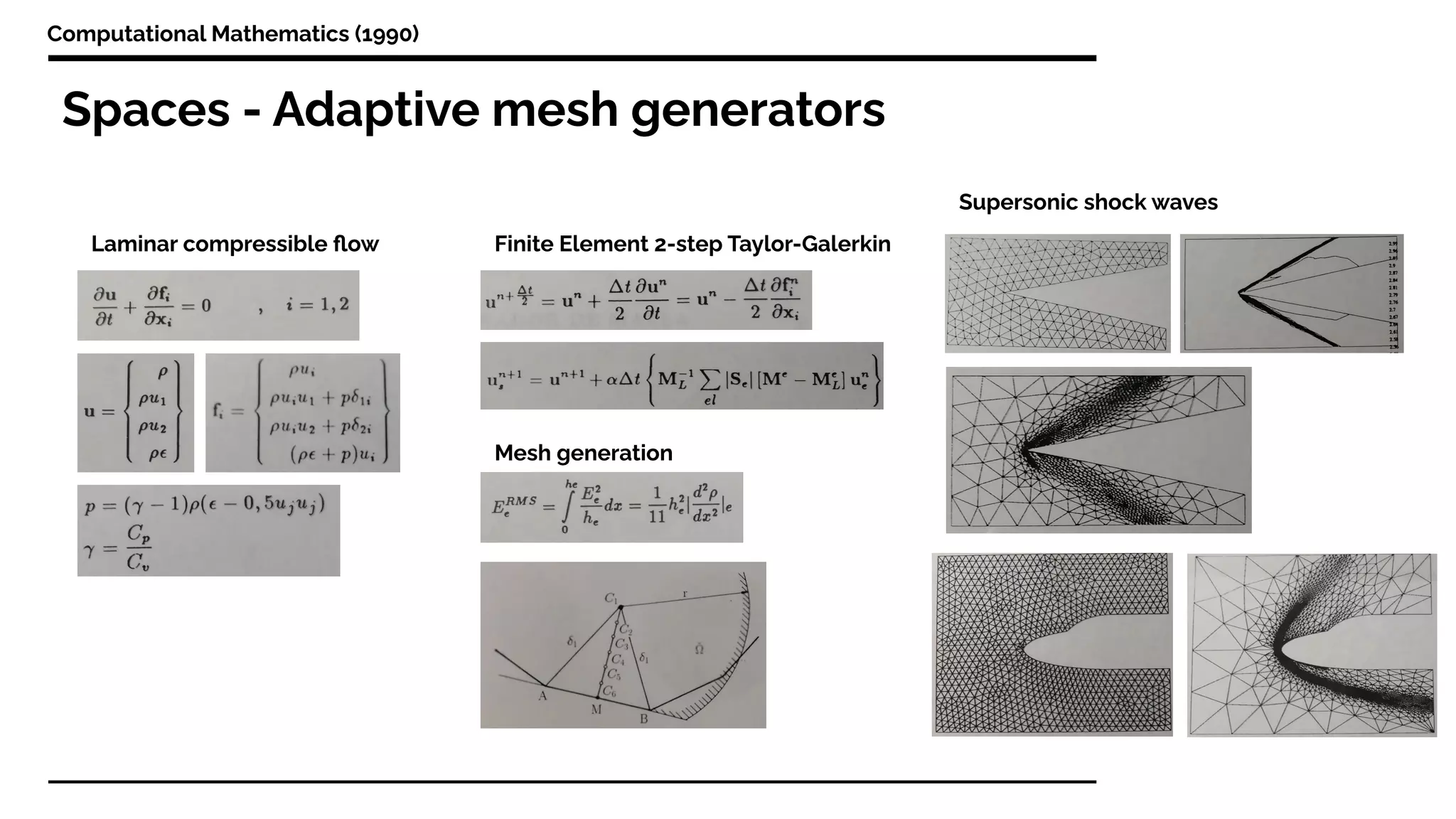
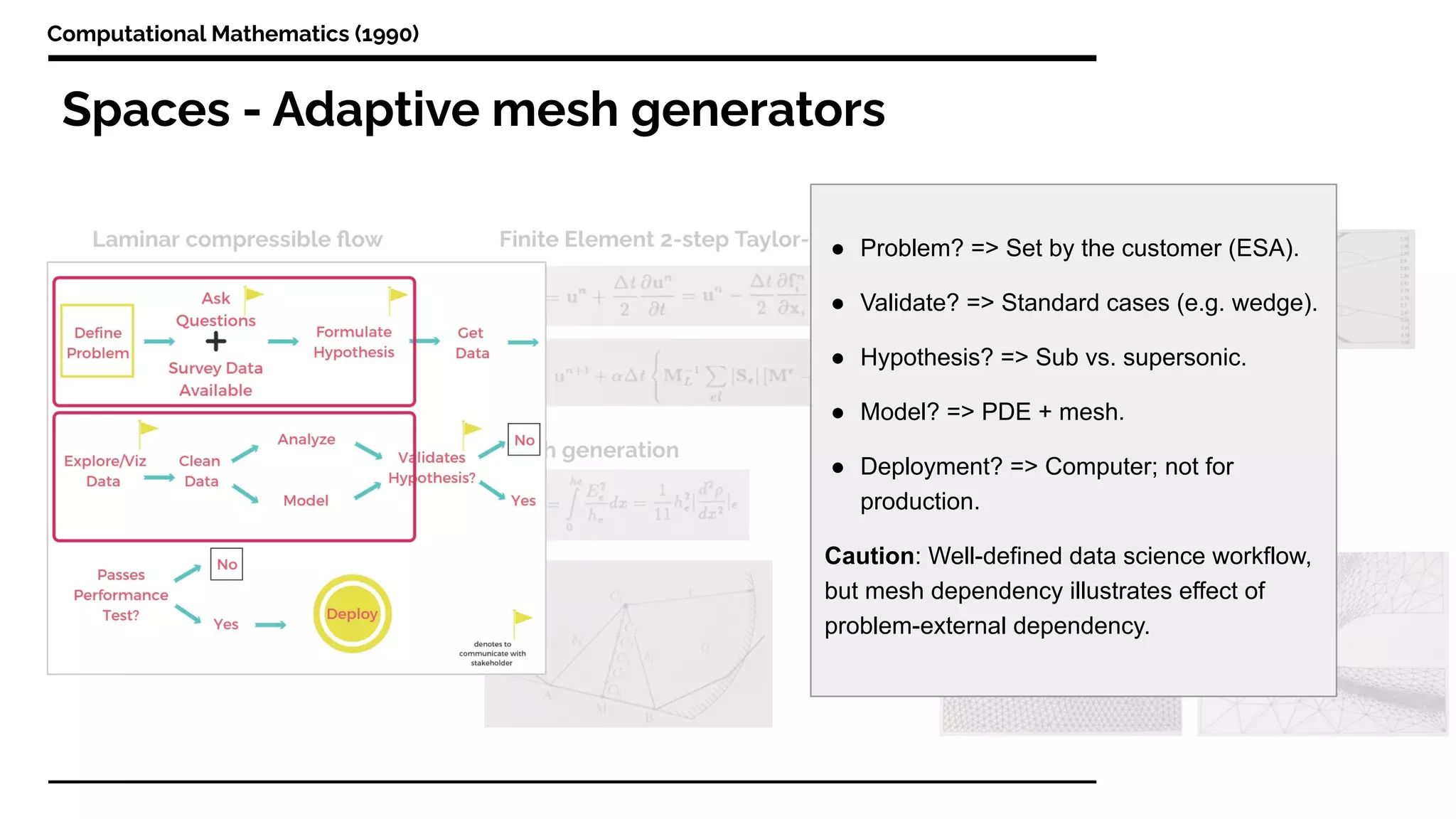
Spaces - Adaptive mesh generators
Computational Mathematics (1990)
Laminar compressible flow Finite Element 2-step Taylor-Galerkin
Mesh generation
Supersonic shock waves
Spaces - Adaptive mesh generators
Computational Mathematics (1990)
● Problem? => Set by the customer (ESA).
● Validate? => Standard cases (e.g. wedge).
● Hypothesis? => Sub vs. supersonic.
● Model? => PDE + mesh.
● Deployment? => Computer; not for
production.
Caution: Well-defined data science workflow,
but mesh dependency illustrates effect of
problem-external dependency.
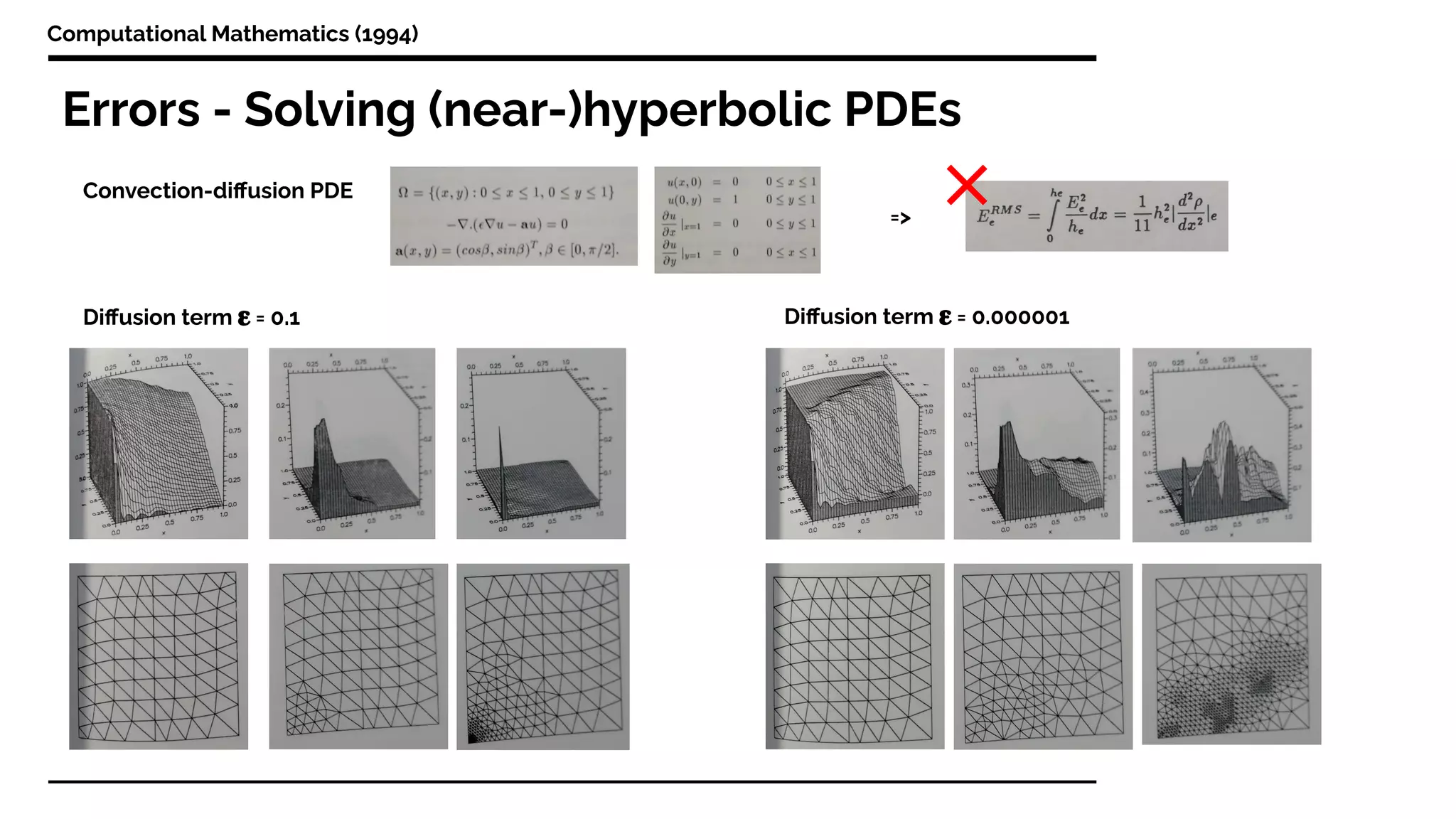
Errors - Solving (near-)hyperbolic PDEs
Computational Mathematics (1994)
Diffusion term 𝛆 = 0.1 Diffusion term 𝛆 = 0.000001
=>
Convection-diffusion PDE
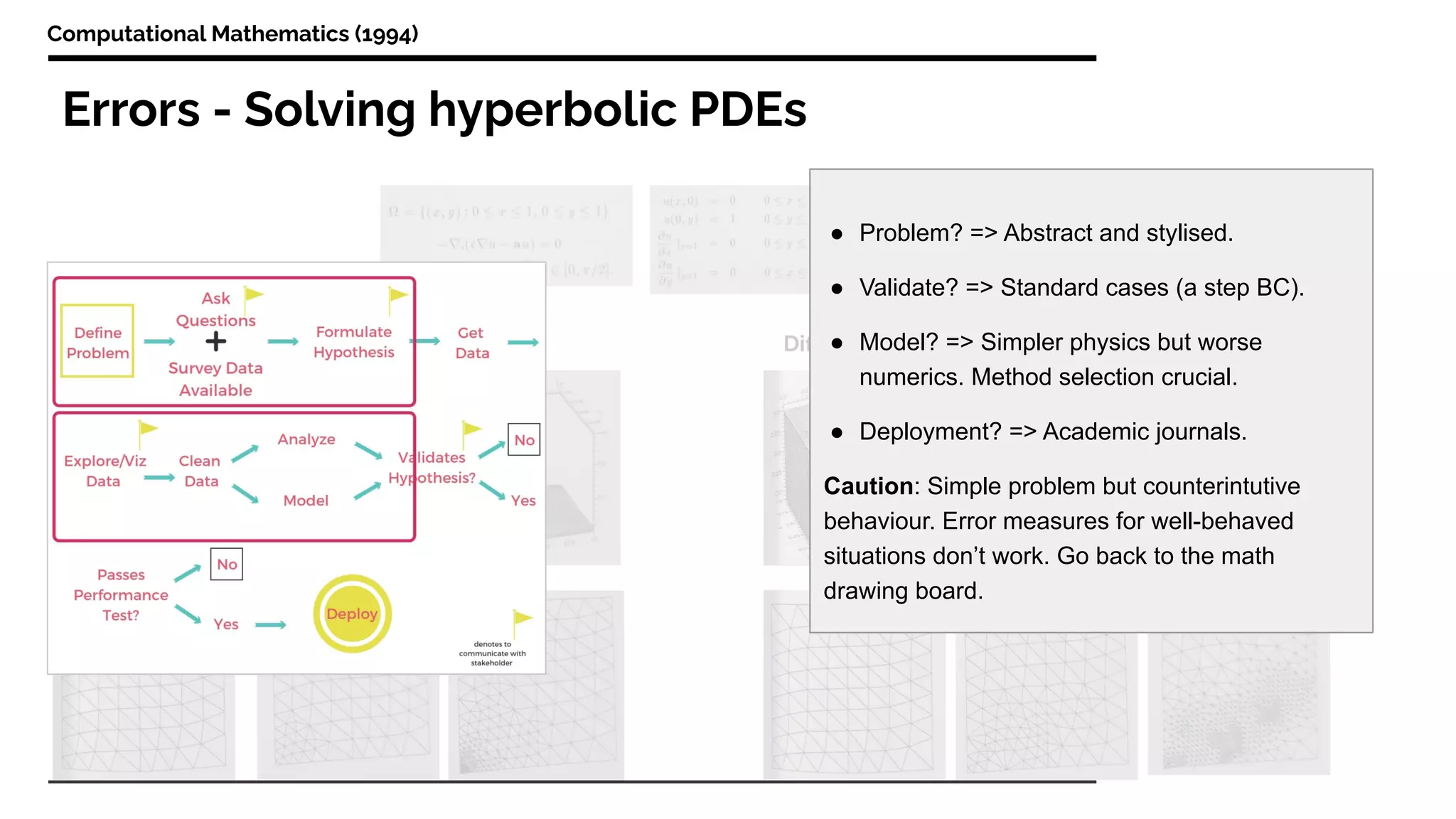
Errors - Solving hyperbolic PDEs
Computational Mathematics (1994)
● Problem? => Abstract and stylised.
● Validate? => Standard cases (a step BC).
● Model? => Simpler physics but worse
numerics. Method selection crucial.
● Deployment? => Academic journals.
Caution: Simple problem but counterintutive
behaviour. Error measures for well-behaved
situations don’t work. Go back to the math
drawing board.
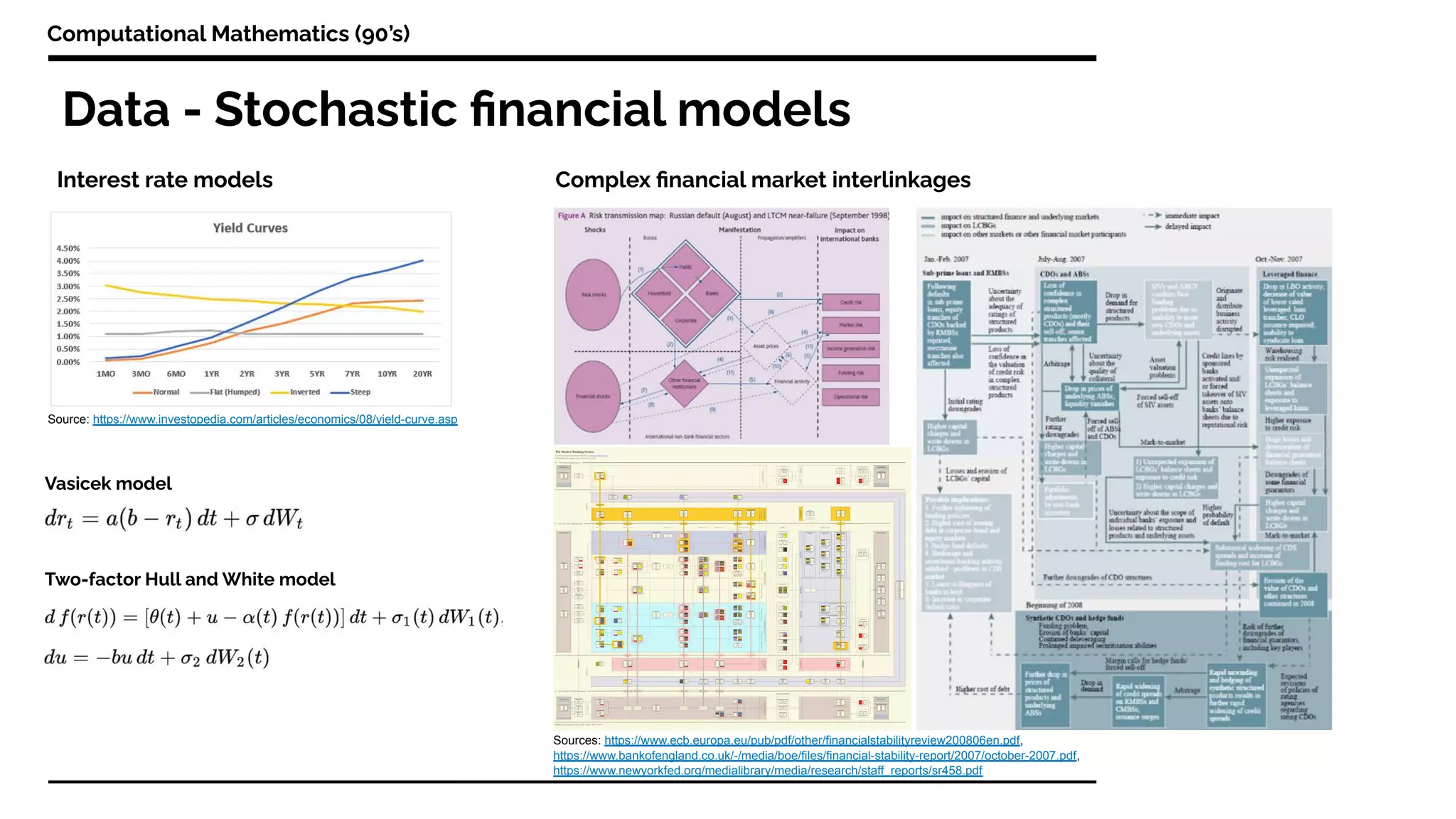
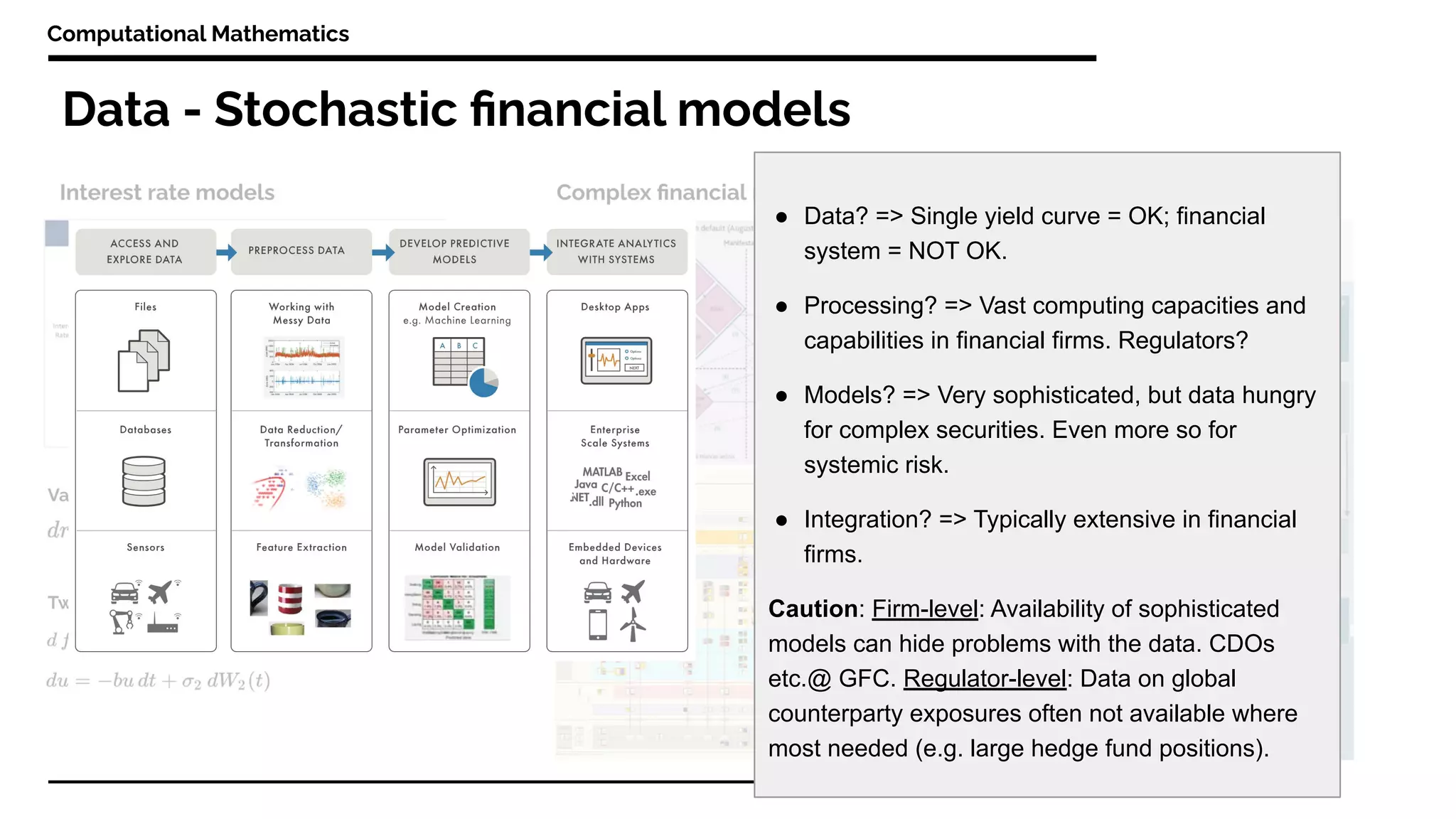
Data - Stochastic financial models
Computational Mathematics (90’s)
Interest rate models
Vasicek model
Two-factor Hull and White model
Complex financial market interlinkages
Sources: https://www.ecb.europa.eu/pub/pdf/other/financialstabilityreview200806en.pdf,
https://www.bankofengland.co.uk/-/media/boe/files/financial-stability-report/2007/october-2007.pdf,
https://www.newyorkfed.org/medialibrary/media/research/staff_reports/sr458.pdf
Source: https://www.investopedia.com/articles/economics/08/yield-curve.asp
Data - Stochastic financial models
Computational Mathematics
● Data? => Single yield curve = OK; financial
system = NOT OK.
● Processing? => Vast computing capacities and
capabilities in financial firms. Regulators?
● Models? => Very sophisticated, but data hungry
for complex securities. Even more so for
systemic risk.
● Integration? => Typically extensive in financial
firms.
Caution: Firm-level: Availability of sophisticated
models can hide problems with the data. CDOs
etc.@ GFC. Regulator-level: Data on global
counterparty exposures often not available where
most needed (e.g. large hedge fund positions).
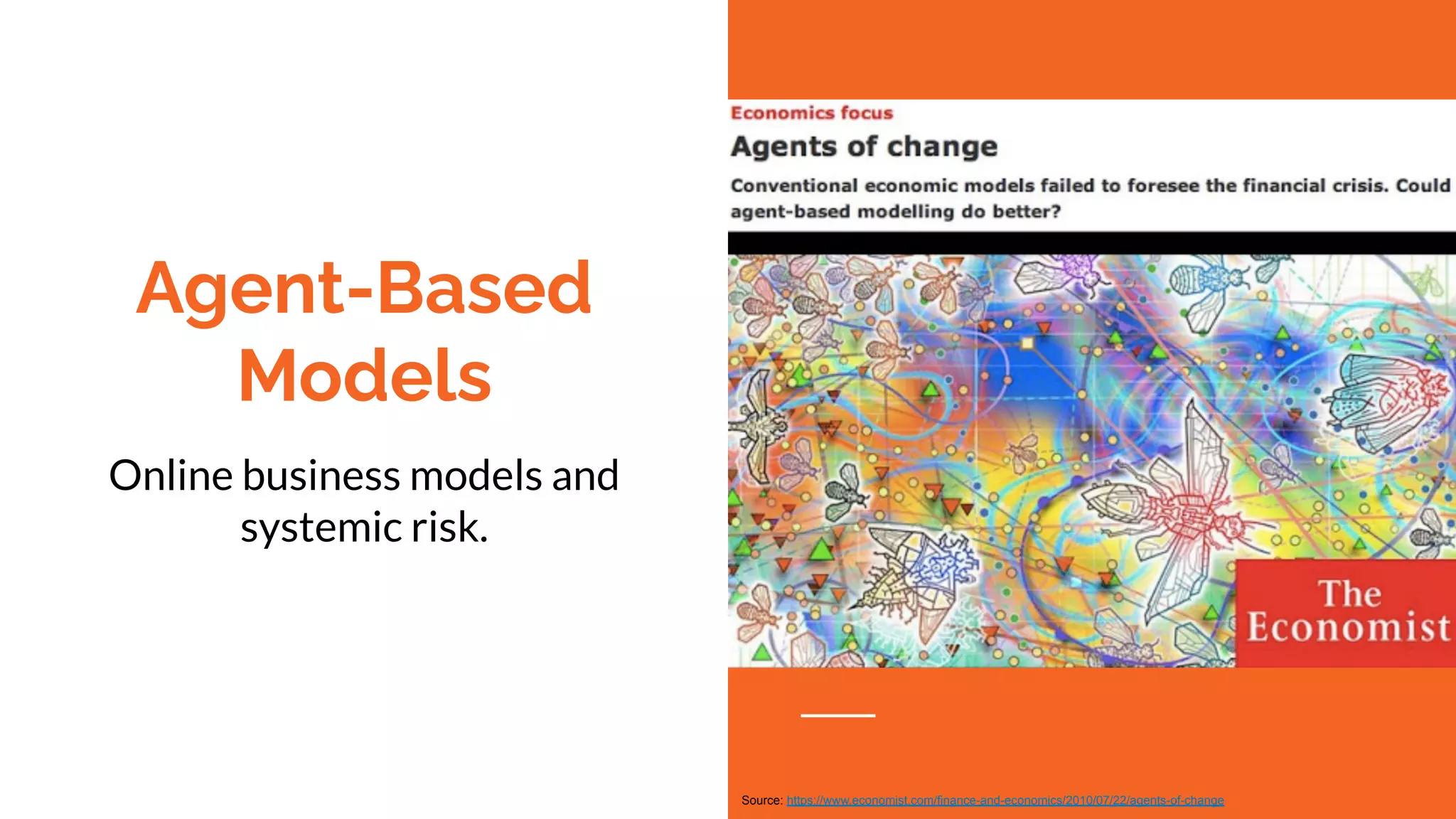
Agent-Based
Models
Online business models and
systemic risk.
Source: https://www.economist.com/finance-and-economics/2010/07/22/agents-of-change
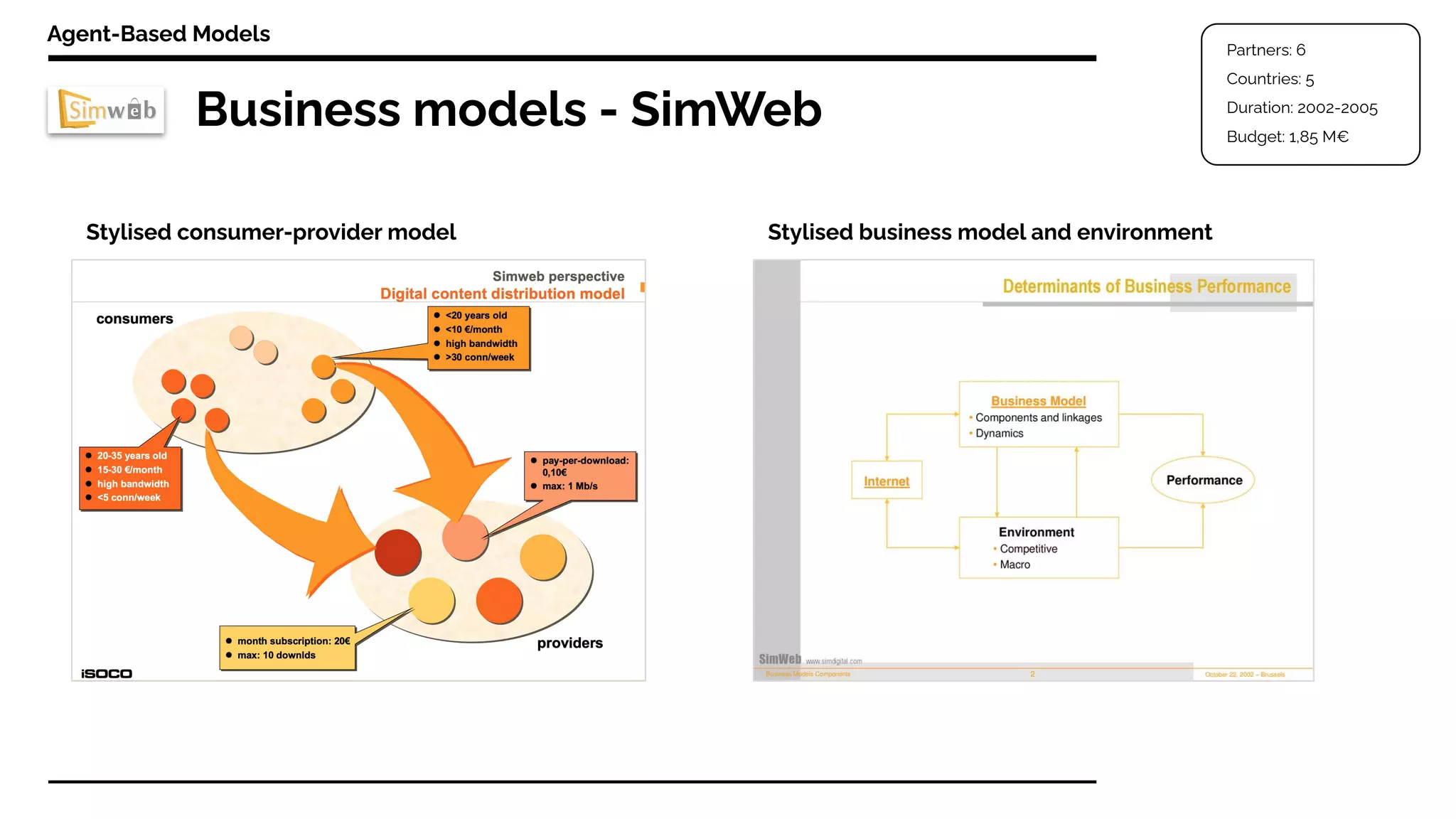
Business models - SimWeb
Agent-Based Models
Stylised consumer-provider model
Partners: 6
Countries: 5
Duration: 2002-2005
Budget: 1,85 M€
Stylised business model and environment
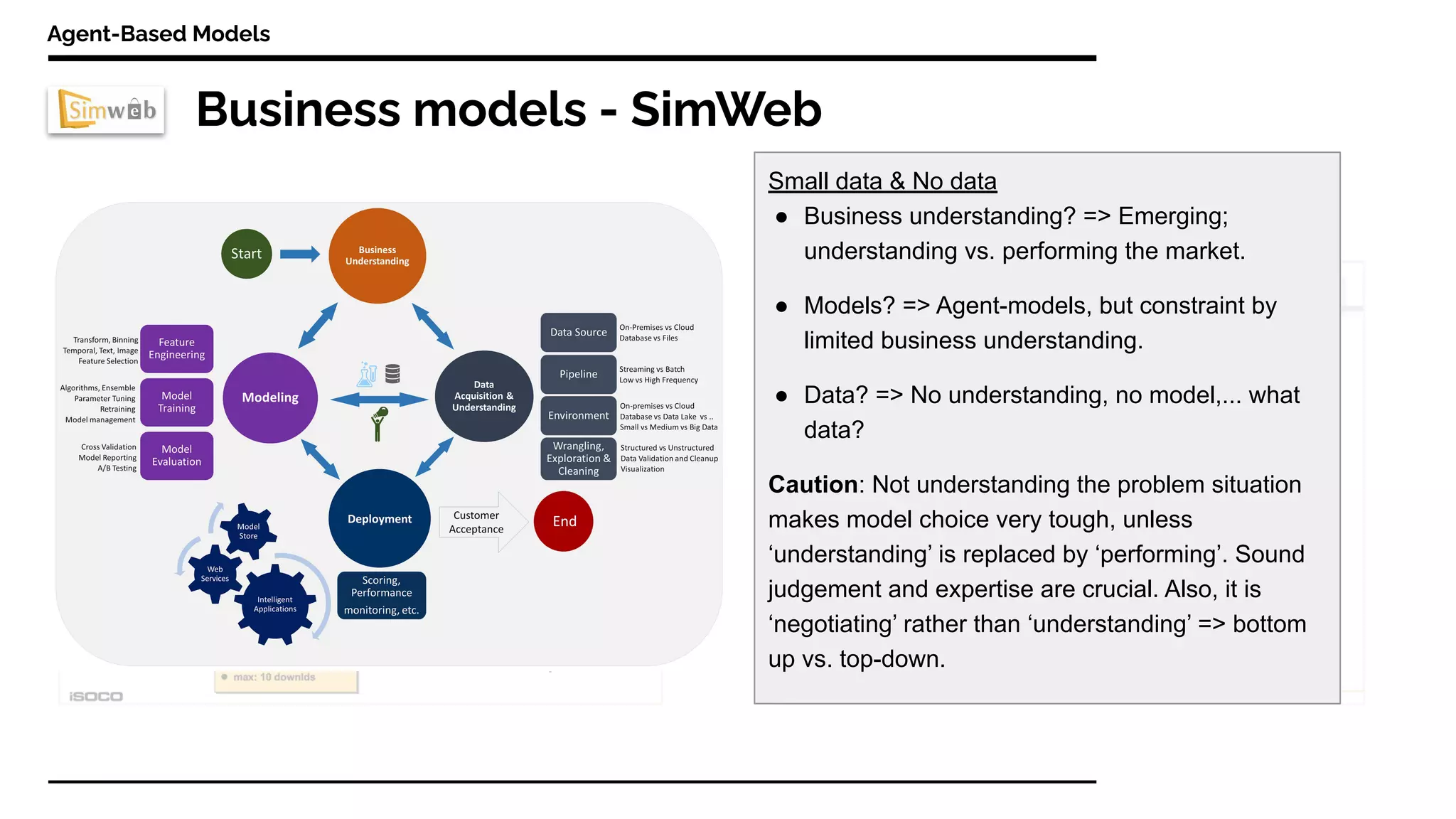
Business models - SimWeb
Agent-Based Models
Small data & No data
● Business understanding? => Emerging;
understanding vs. performing the market.
● Models? => Agent-models, but constraint by
limited business understanding.
● Data? => No understanding, no model,... what
data?
Caution: Not understanding the problem situation
makes model choice very tough, unless
‘understanding’ is replaced by ‘performing’. Sound
judgement and expertise are crucial. Also, it is
‘negotiating’ rather than ‘understanding’ => bottom
up vs. top-down.
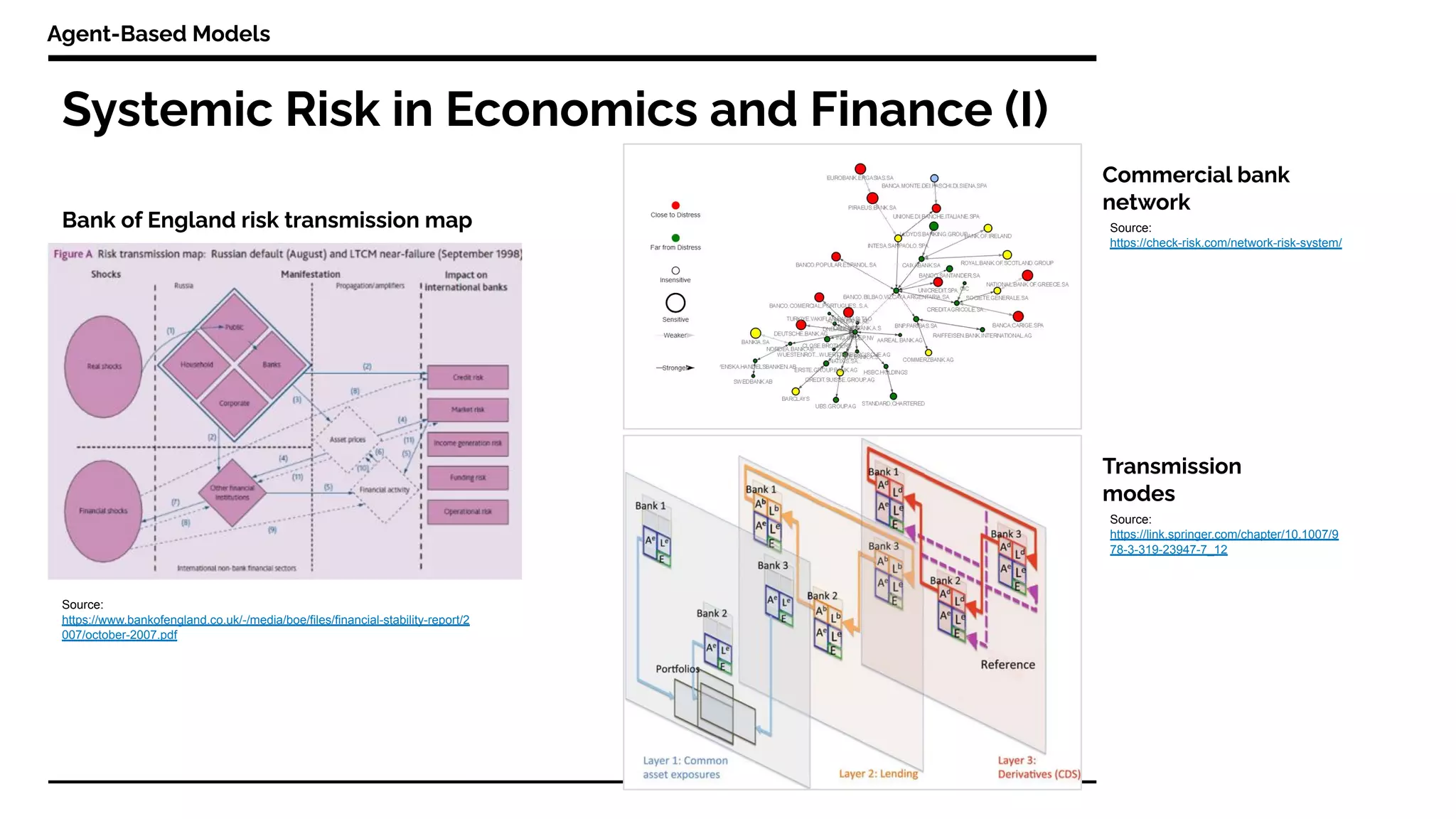
Systemic Risk in Economics and Finance (I)
Agent-Based Models
Bank of England risk transmission map
Source:
https://link.springer.com/chapter/10.1007/9
78-3-319-23947-7_12
Commercial bank
network
Transmission
modes
Source:
https://check-risk.com/network-risk-system/
Source:
https://www.bankofengland.co.uk/-/media/boe/files/financial-stability-report/2
007/october-2007.pdf
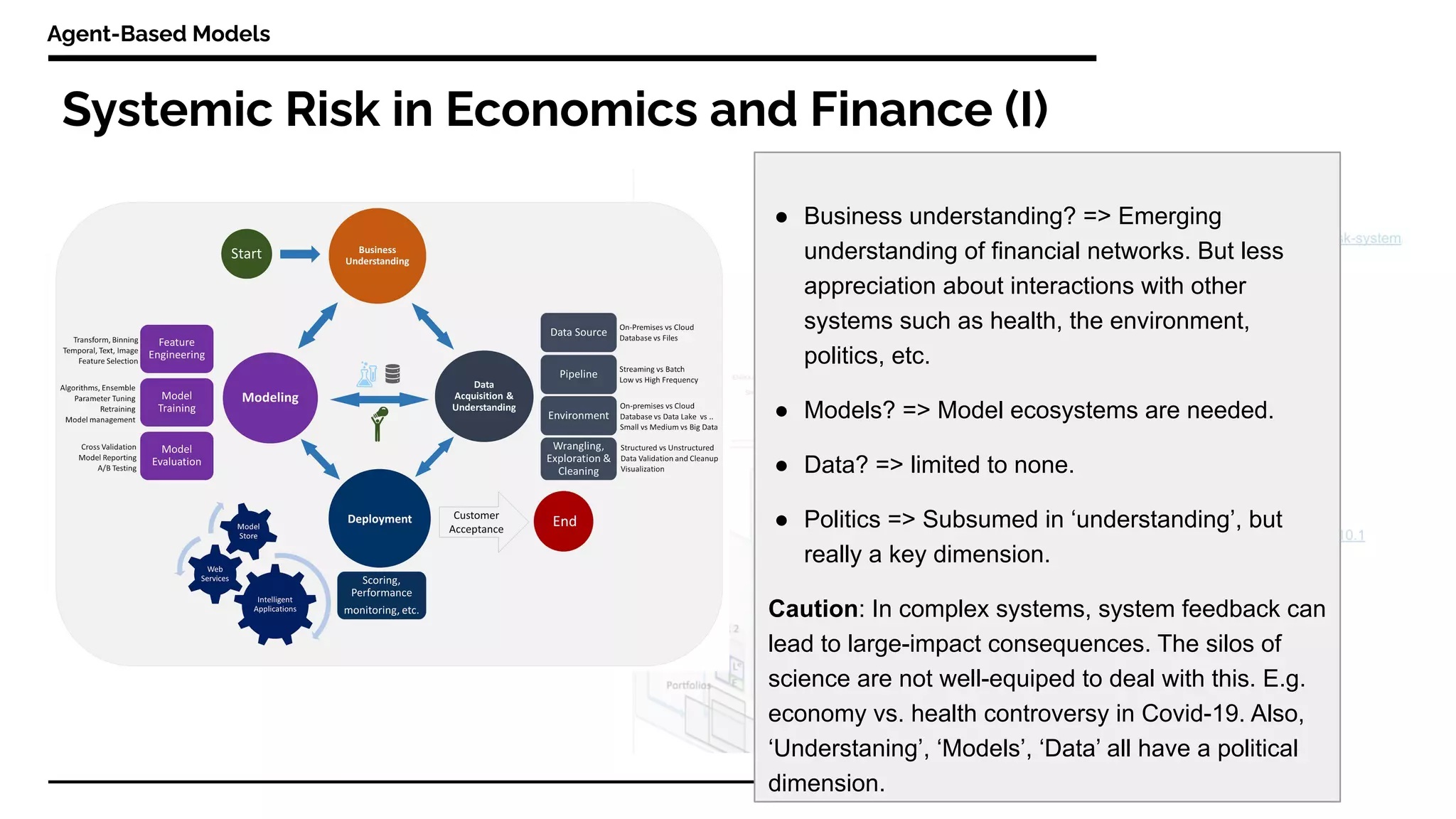
Systemic Risk in Economics and Finance (I)
Agent-Based Models
● Business understanding? => Emerging
understanding of financial networks. But less
appreciation about interactions with other
systems such as health, the environment,
politics, etc.
● Models? => Model ecosystems are needed.
● Data? => limited to none.
● Politics => Subsumed in ‘understanding’, but
really a key dimension.
Caution: In complex systems, system feedback can
lead to large-impact consequences. The silos of
science are not well-equiped to deal with this. E.g.
economy vs. health controversy in Covid-19. Also,
‘Understaning’, ‘Models’, ‘Data’ all have a political
dimension.
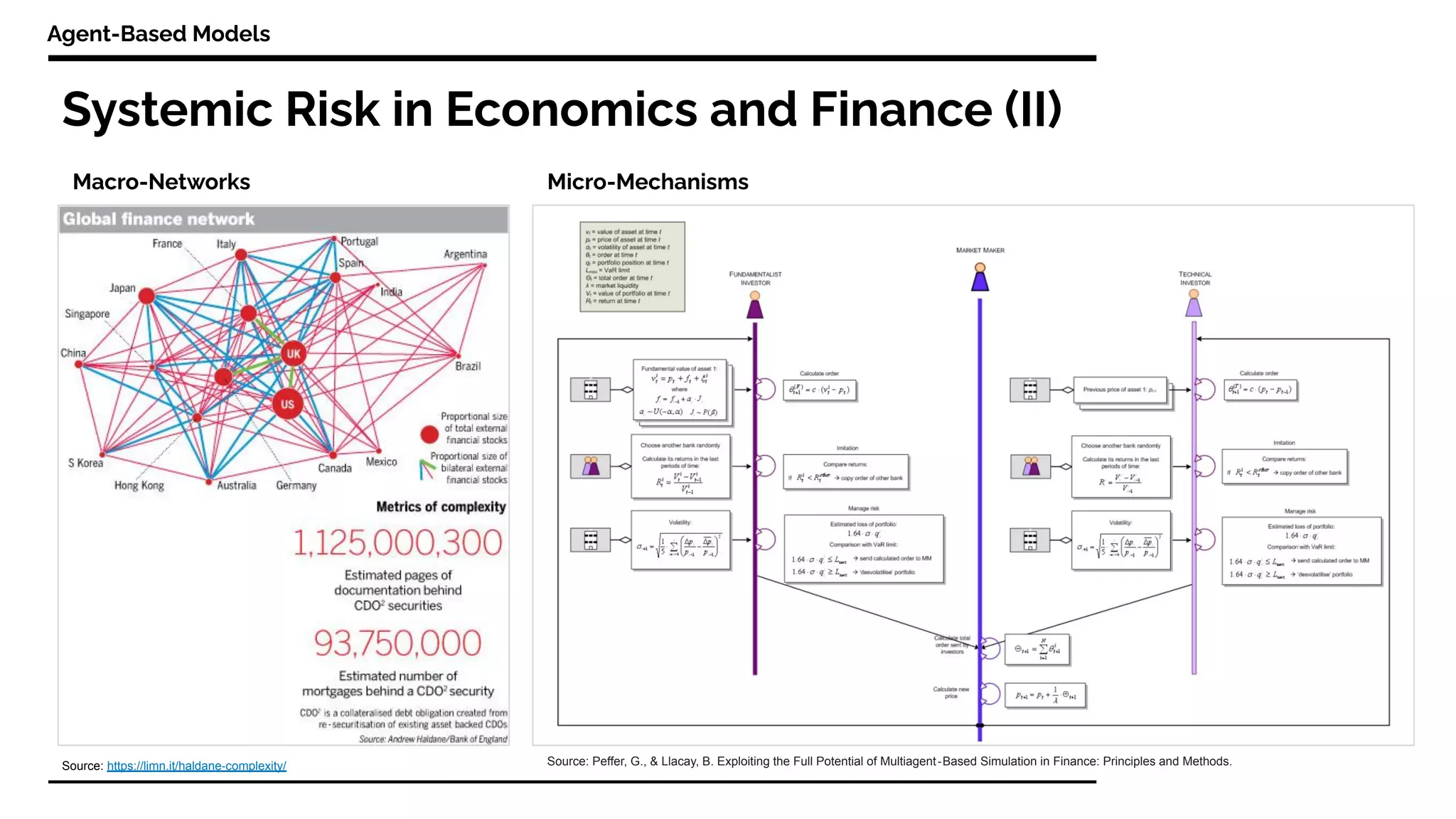
Systemic Risk in Economics and Finance (II)
Agent-Based Models
Source: https://limn.it/haldane-complexity/
Macro-Networks Micro-Mechanisms
Source: Peffer, G., & Llacay, B. Exploiting the Full Potential of Multiagent‐Based Simulation in Finance: Principles and Methods.
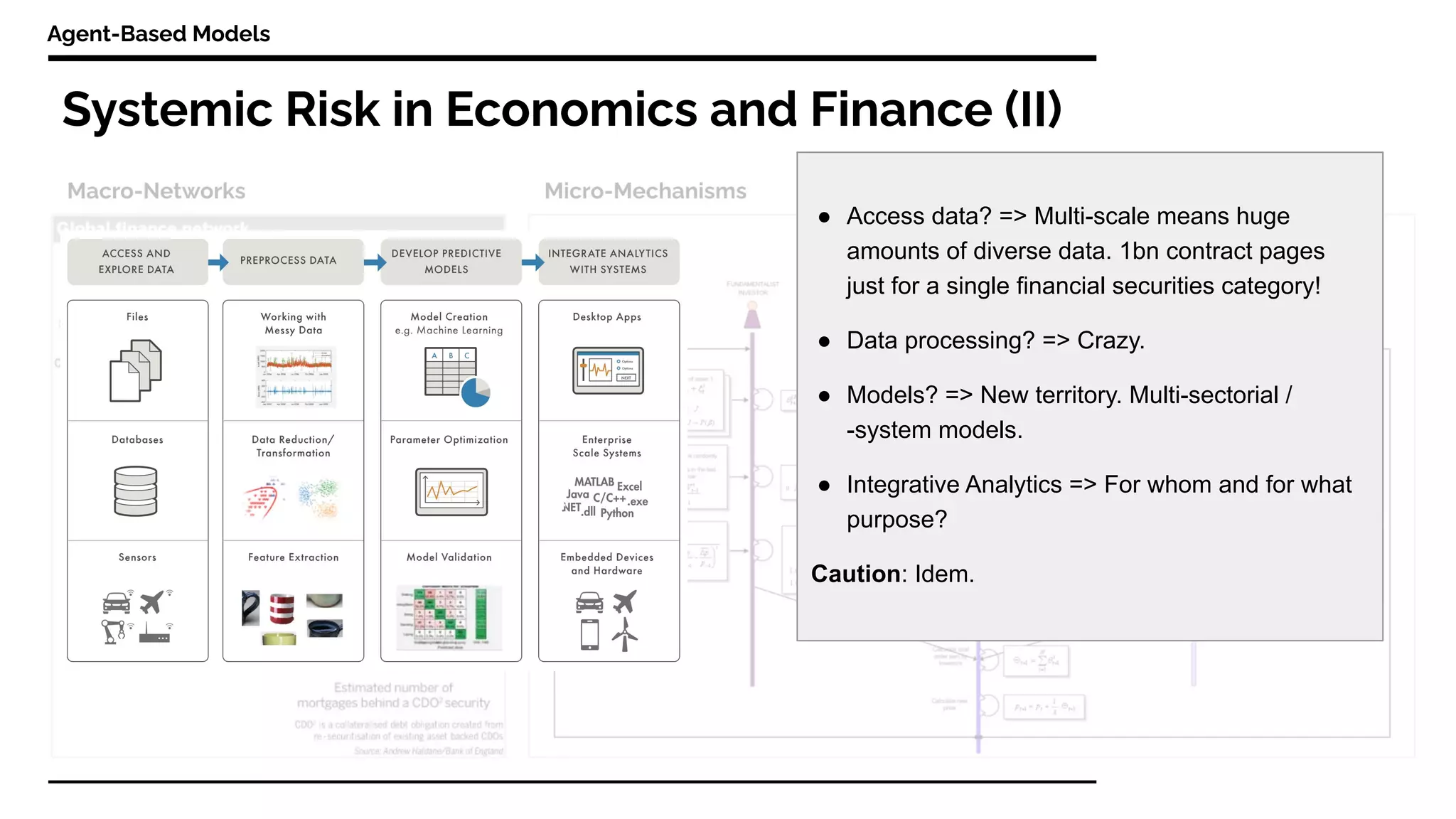
Systemic Risk in Economics and Finance (II)
Agent-Based Models
● Access data? => Multi-scale means huge
amounts of diverse data. 1bn contract pages
just for a single financial securities category!
● Data processing? => Crazy.
● Models? => New territory. Multi-sectorial /
-system models.
● Integrative Analytics => For whom and for what
purpose?
Caution: Idem.
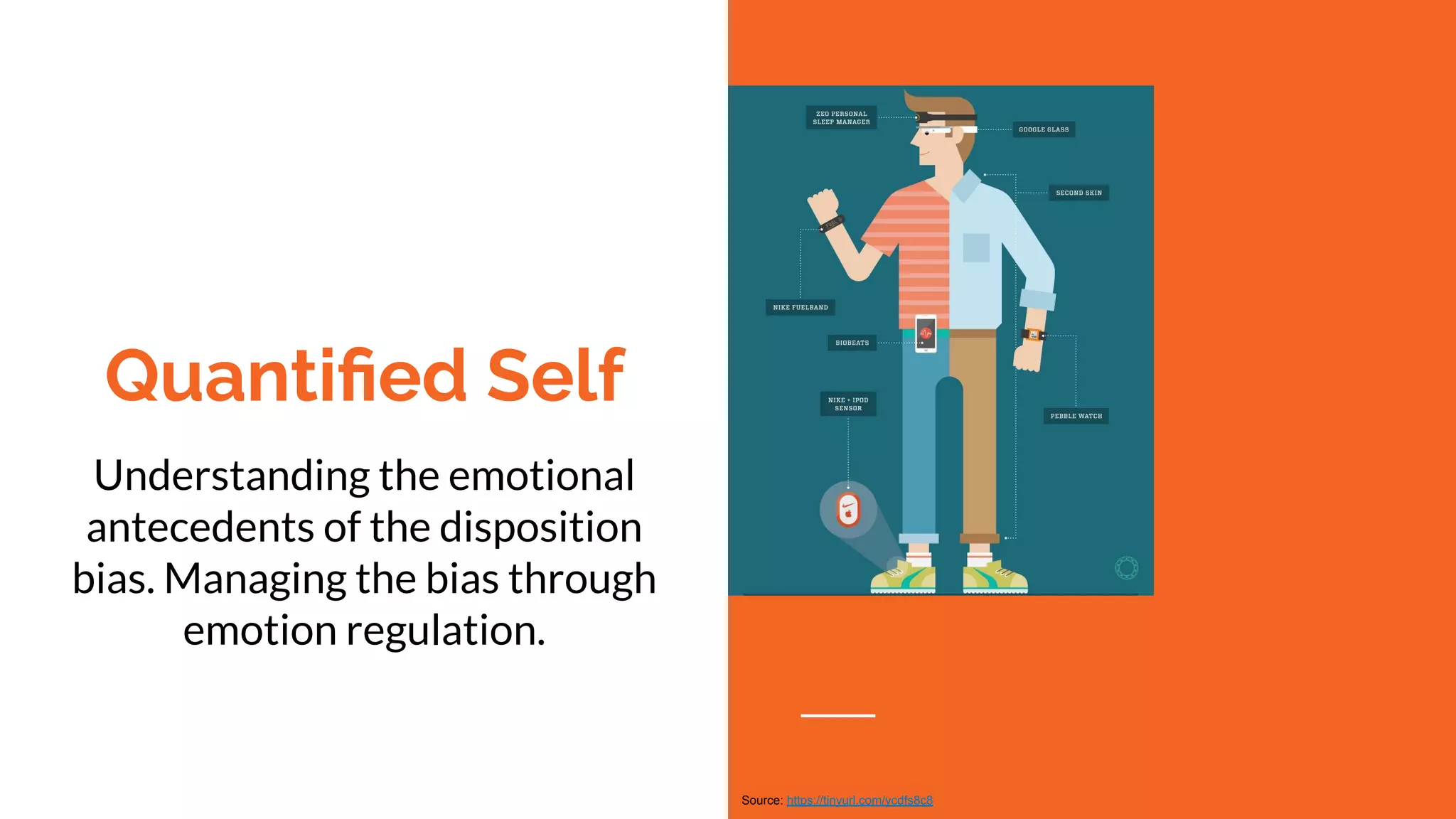
Quantified Self
Understanding the emotional
antecedents of the disposition
bias. Managing the bias through
emotion regulation.
Source: https://tinyurl.com/ycdfs8c8
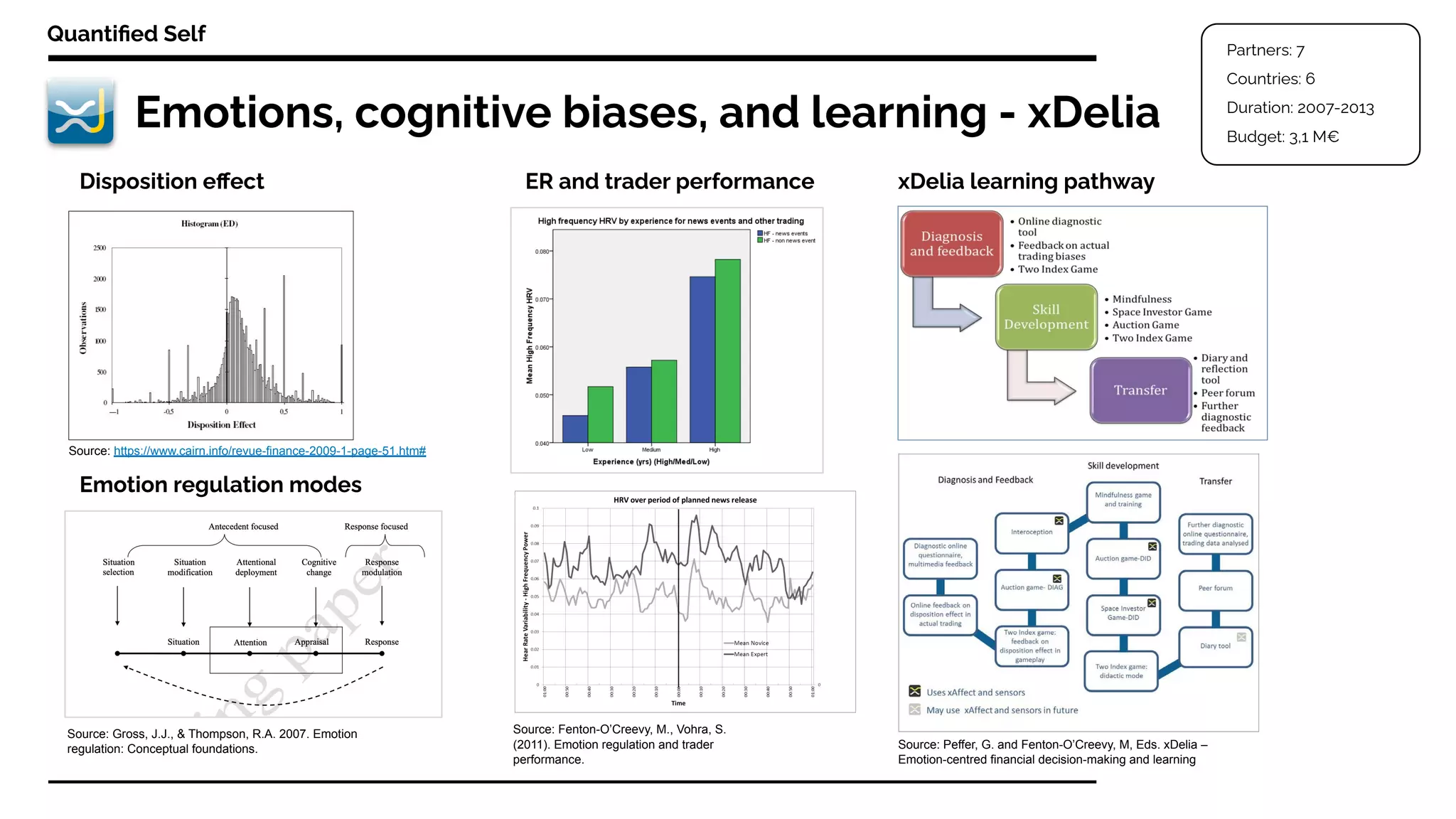
Emotions, cognitive biases, and learning - xDelia
Quantified Self
xDelia learning pathway
Emotion regulation modes
Partners: 7
Countries: 6
Duration: 2007-2013
Budget: 3,1 M€
ER and trader performanceDisposition effect
Source: https://www.cairn.info/revue-finance-2009-1-page-51.htm#
Source: Fenton-O’Creevy, M., Vohra, S.
(2011). Emotion regulation and trader
performance.
Source: Peffer, G. and Fenton-O’Creevy, M, Eds. xDelia –
Emotion-centred financial decision-making and learning
Source: Gross, J.J., & Thompson, R.A. 2007. Emotion
regulation: Conceptual foundations.
Emotions, cognitive biases, and learning - xDelia
Quantified Self
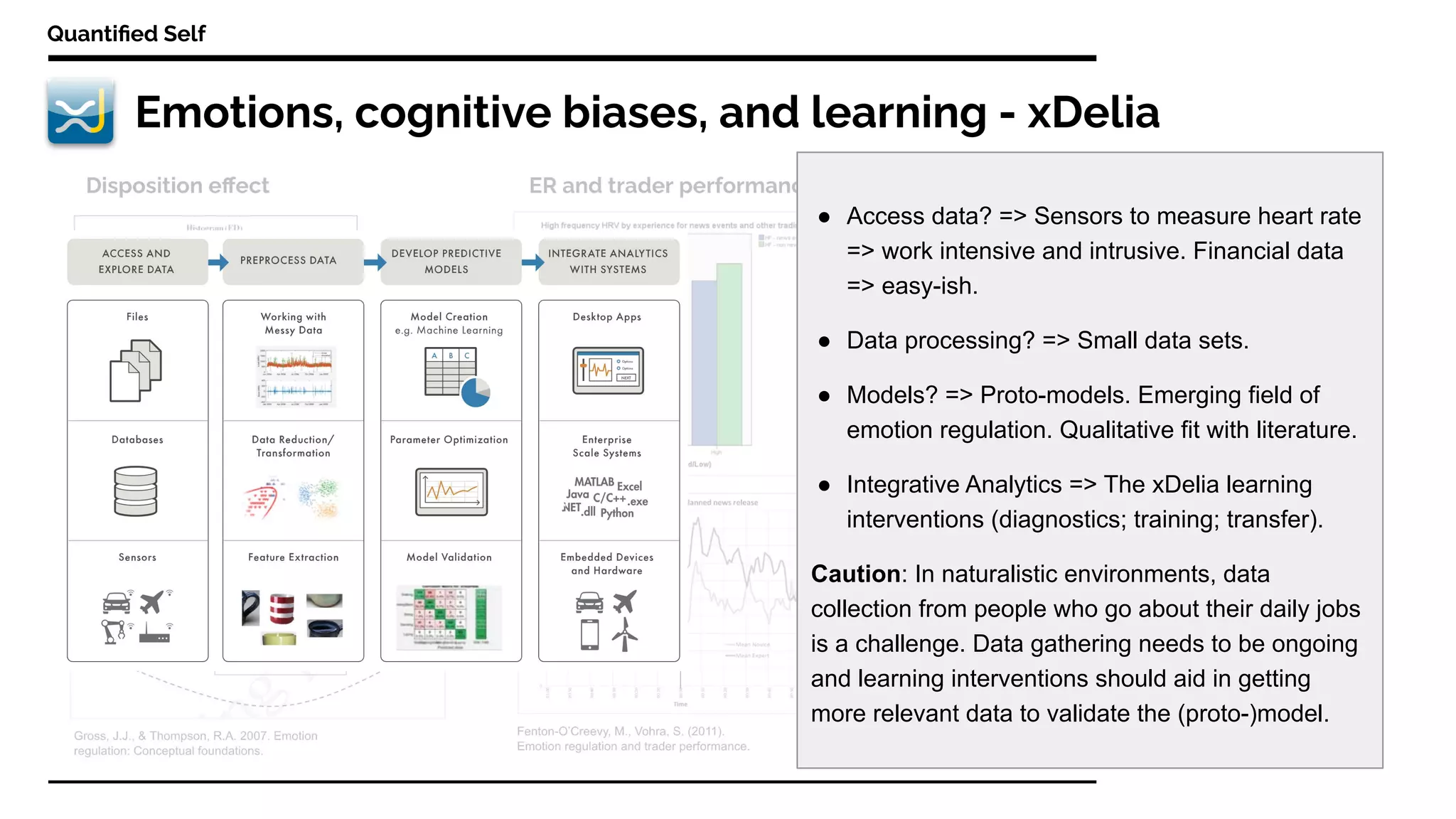
● Access data? => Sensors to measure heart rate
=> work intensive and intrusive. Financial data
=> easy-ish.
● Data processing? => Small data sets.
● Models? => Proto-models. Emerging field of
emotion regulation. Qualitative fit with literature.
● Integrative Analytics => The xDelia learning
interventions (diagnostics; training; transfer).
Caution: In naturalistic environments, data
collection from people who go about their daily jobs
is a challenge. Data gathering needs to be ongoing
and learning interventions should aid in getting
more relevant data to validate the (proto-)model.
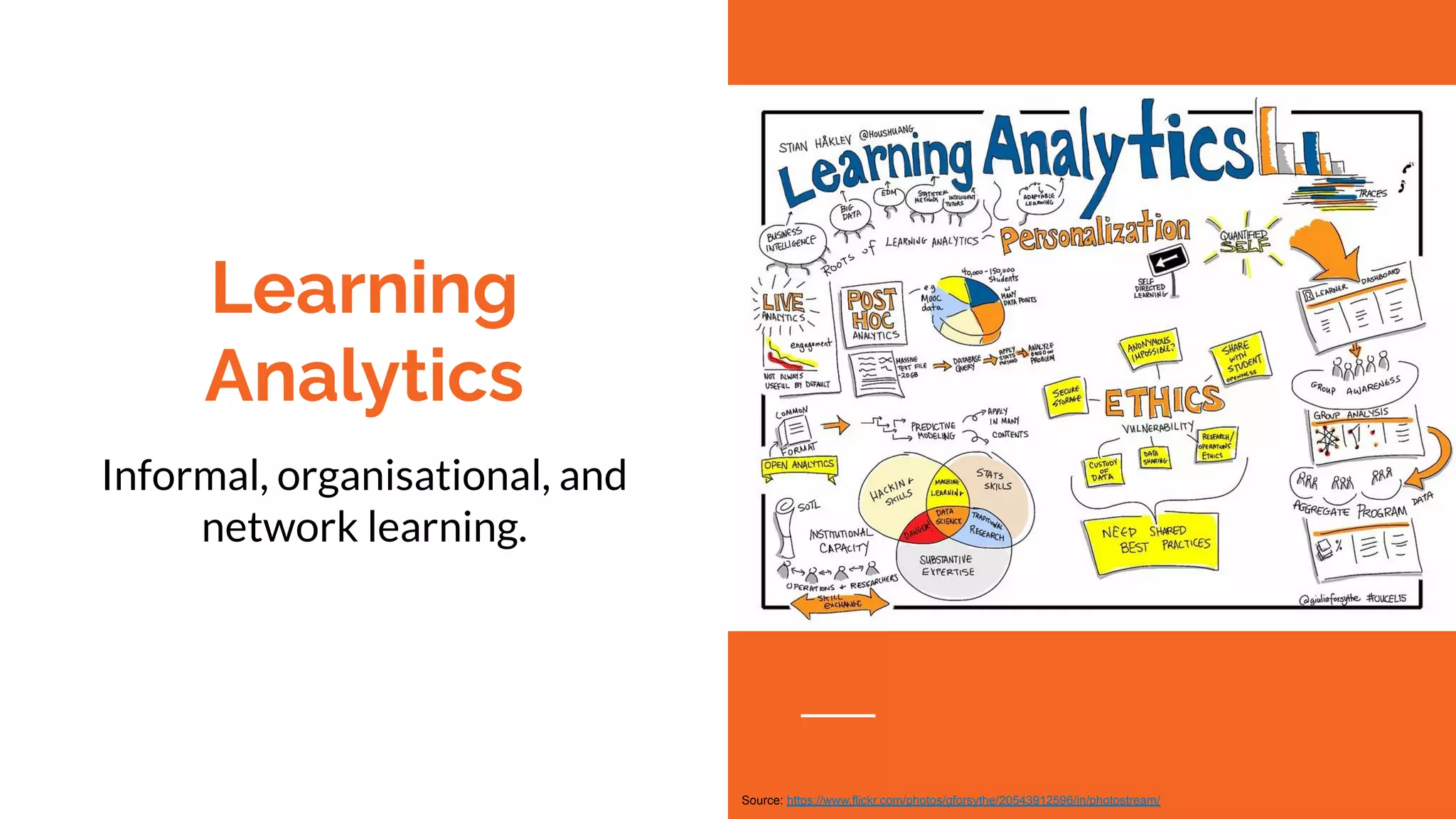
Learning
Analytics
Informal, organisational, and
network learning.
Source: https://www.flickr.com/photos/gforsythe/20543912596/in/photostream/
Informal learning - Layers
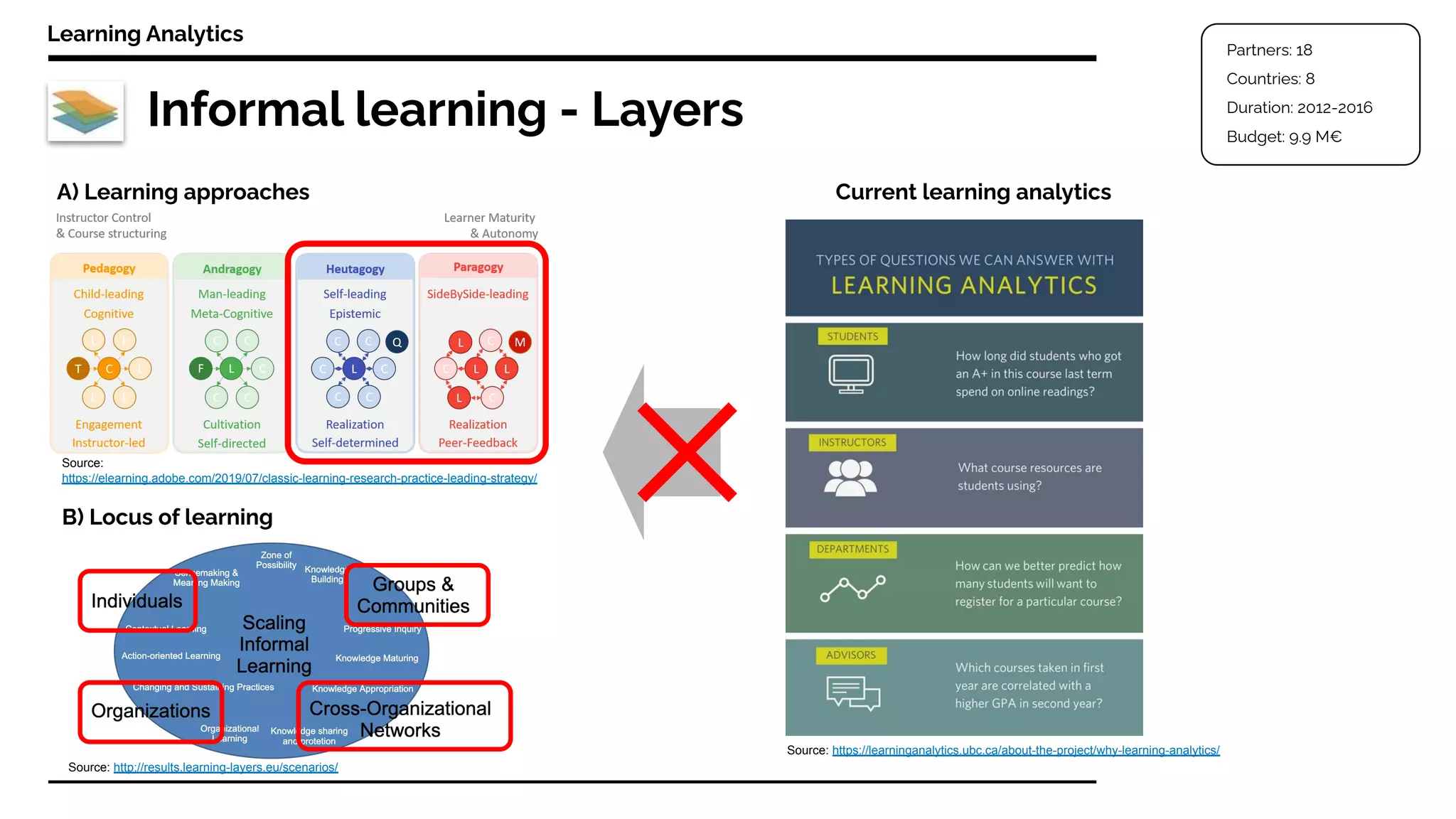
Learning Analytics
A) Learning approaches
B) Locus of learning
Partners: 18
Countries: 8
Duration: 2012-2016
Budget: 9.9 M€
Source:
https://elearning.adobe.com/2019/07/classic-learning-research-practice-leading-strategy/
Source: http://results.learning-layers.eu/scenarios/
Current learning analytics
Source: https://learninganalytics.ubc.ca/about-the-project/why-learning-analytics/
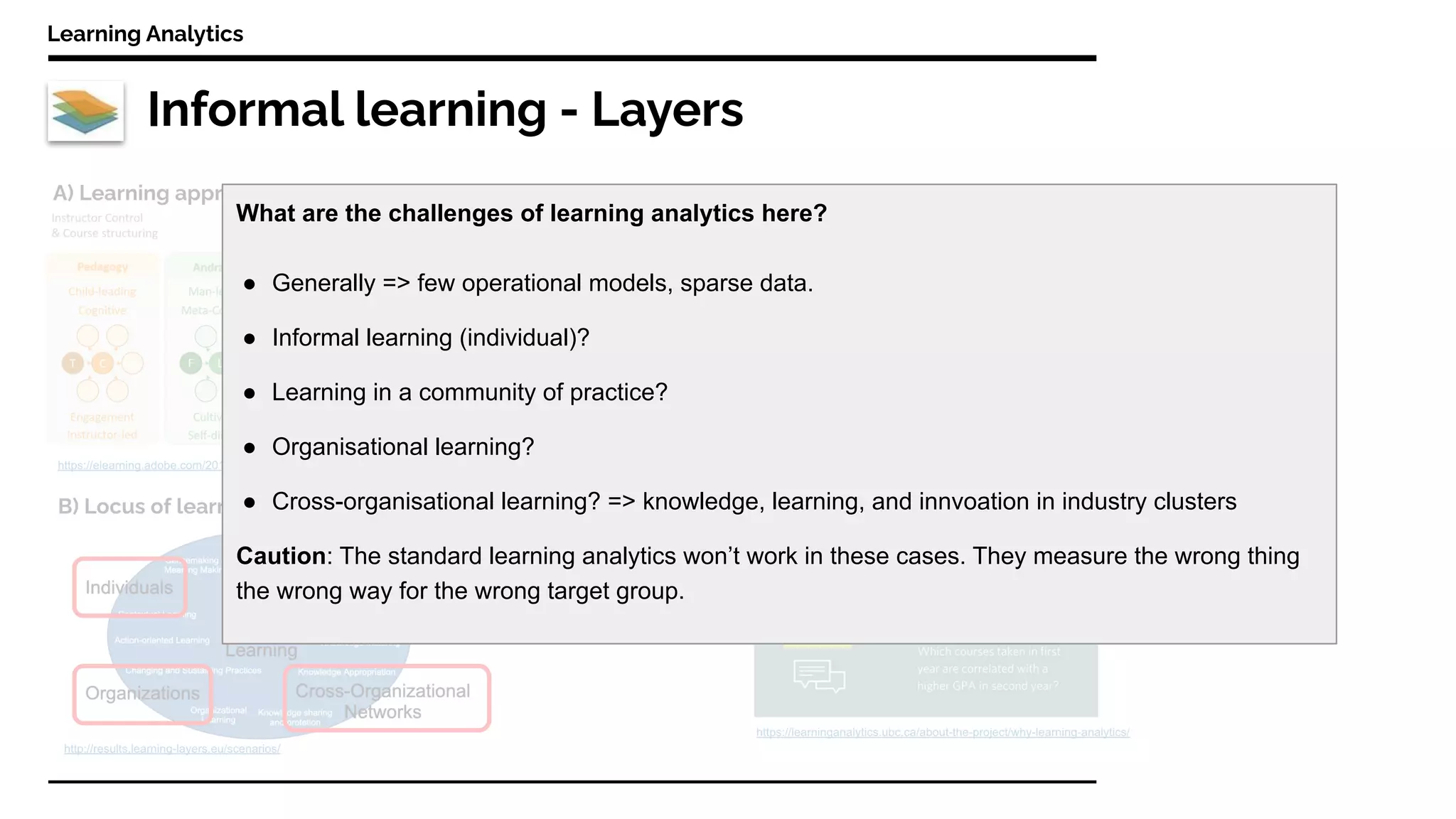
Informal learning - Layers
Learning Analytics
What are the challenges of learning analytics here?
● Generally => few operational models, sparse data.
● Informal learning (individual)?
● Learning in a community of practice?
● Organisational learning?
● Cross-organisational learning? => knowledge, learning, and innvoation in industry clusters
Caution: The standard learning analytics won’t work in these cases. They measure the wrong thing
the wrong way for the wrong target group.
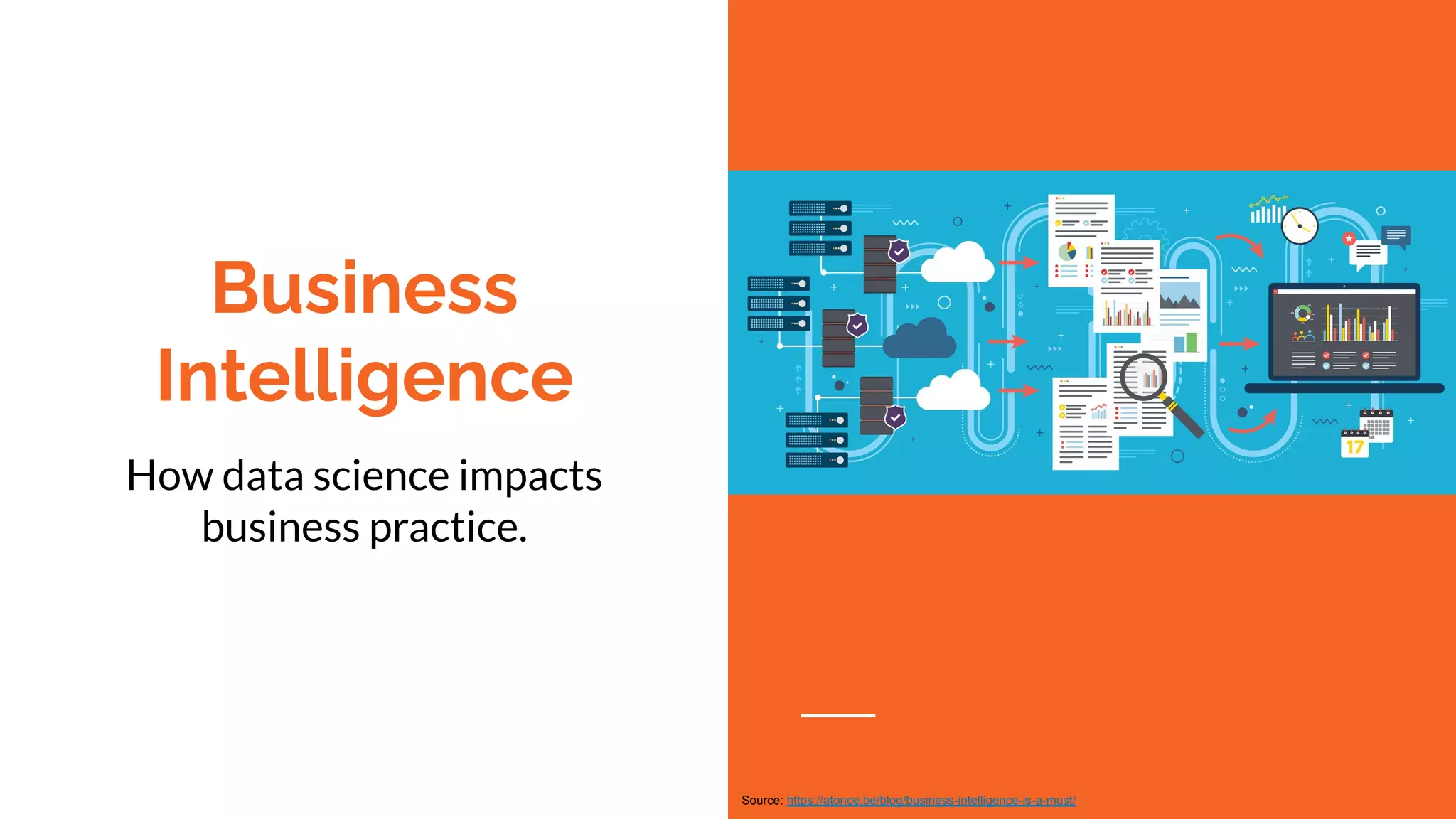
Business
Intelligence
How data science impacts
business practice.
Source: https://atonce.be/blog/business-intelligence-is-a-must/
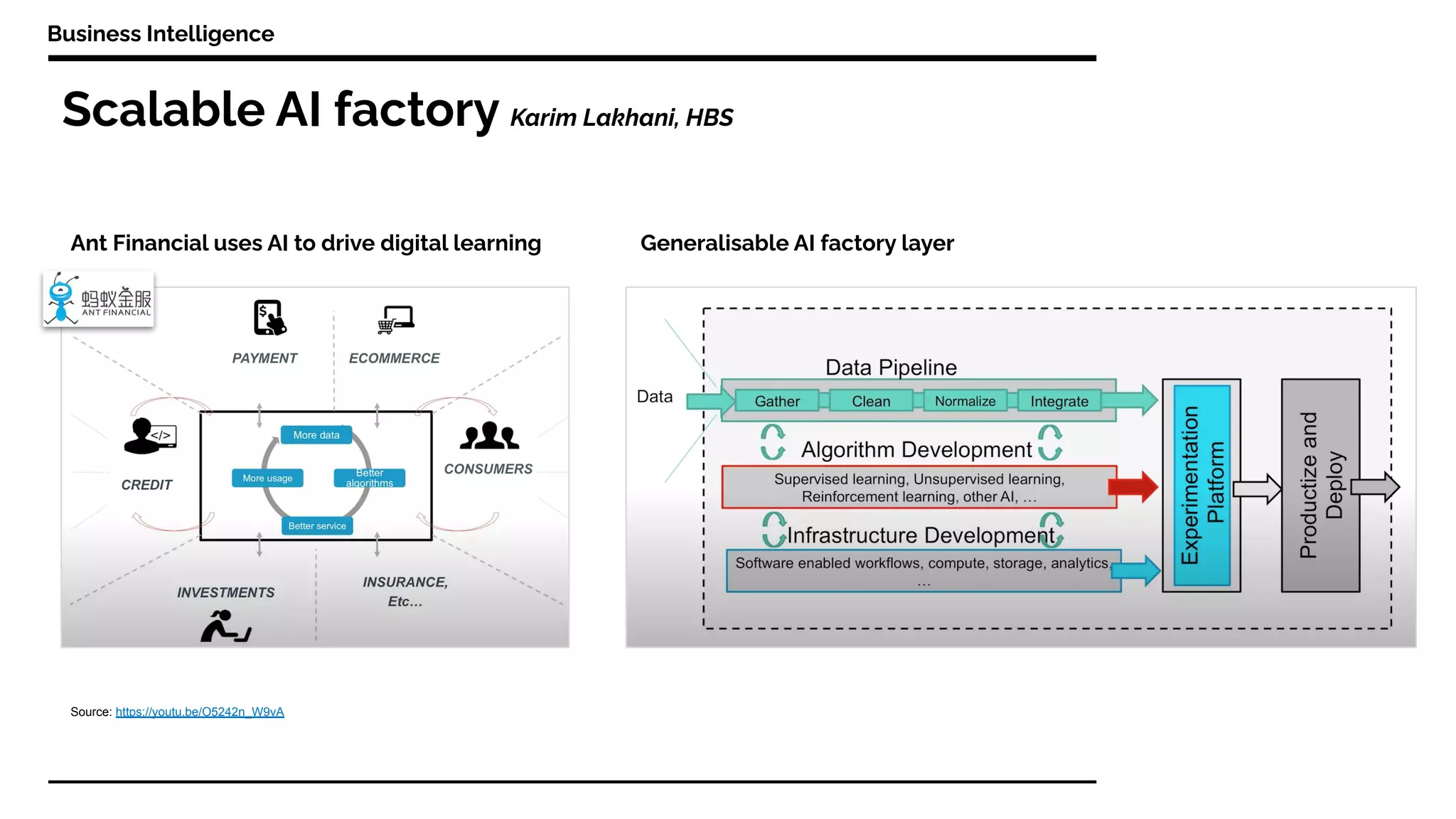
Scalable AI factory Karim Lakhani, HBS
Business Intelligence
Ant Financial uses AI to drive digital learning Generalisable AI factory layer
Source: https://youtu.be/O5242n_W9vA
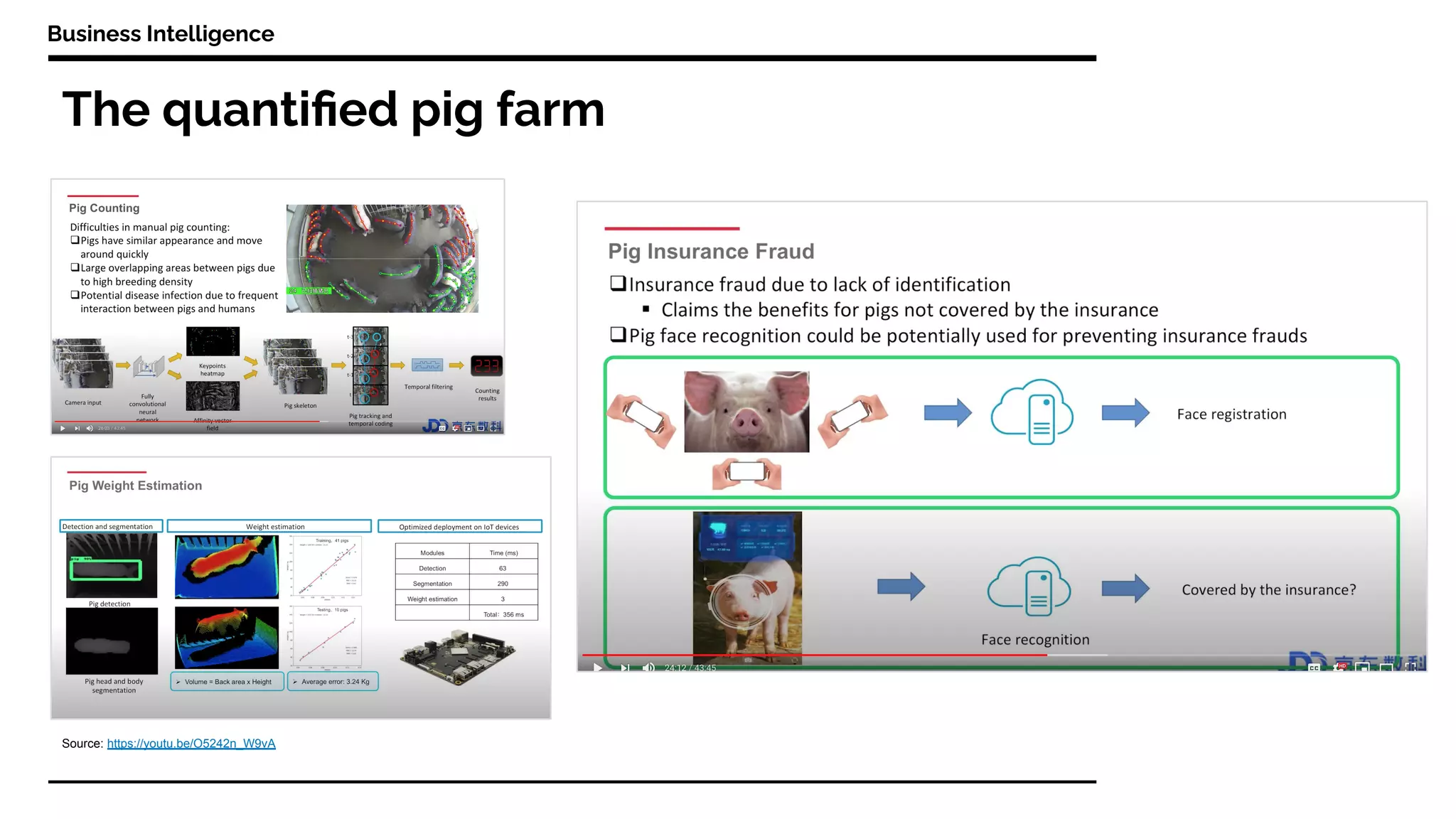
The quantified pig farm
Business Intelligence
Source: https://youtu.be/O5242n_W9vA
Scalable AI factory = Scalable ethics problems
Business Intelligence
“In an analogue world you can basically have
your bias limited. In a digital world, you can
bias at scale.
“We have to think about ethics at scale.”
Karim Lakhani, Harvard Business School
Philosophy of
Algorithms
The need for a social sciences
and humanities approach in the
data sciences.
Source: https://www.gapingvoid.com/blog/2007/08/20/complicated/
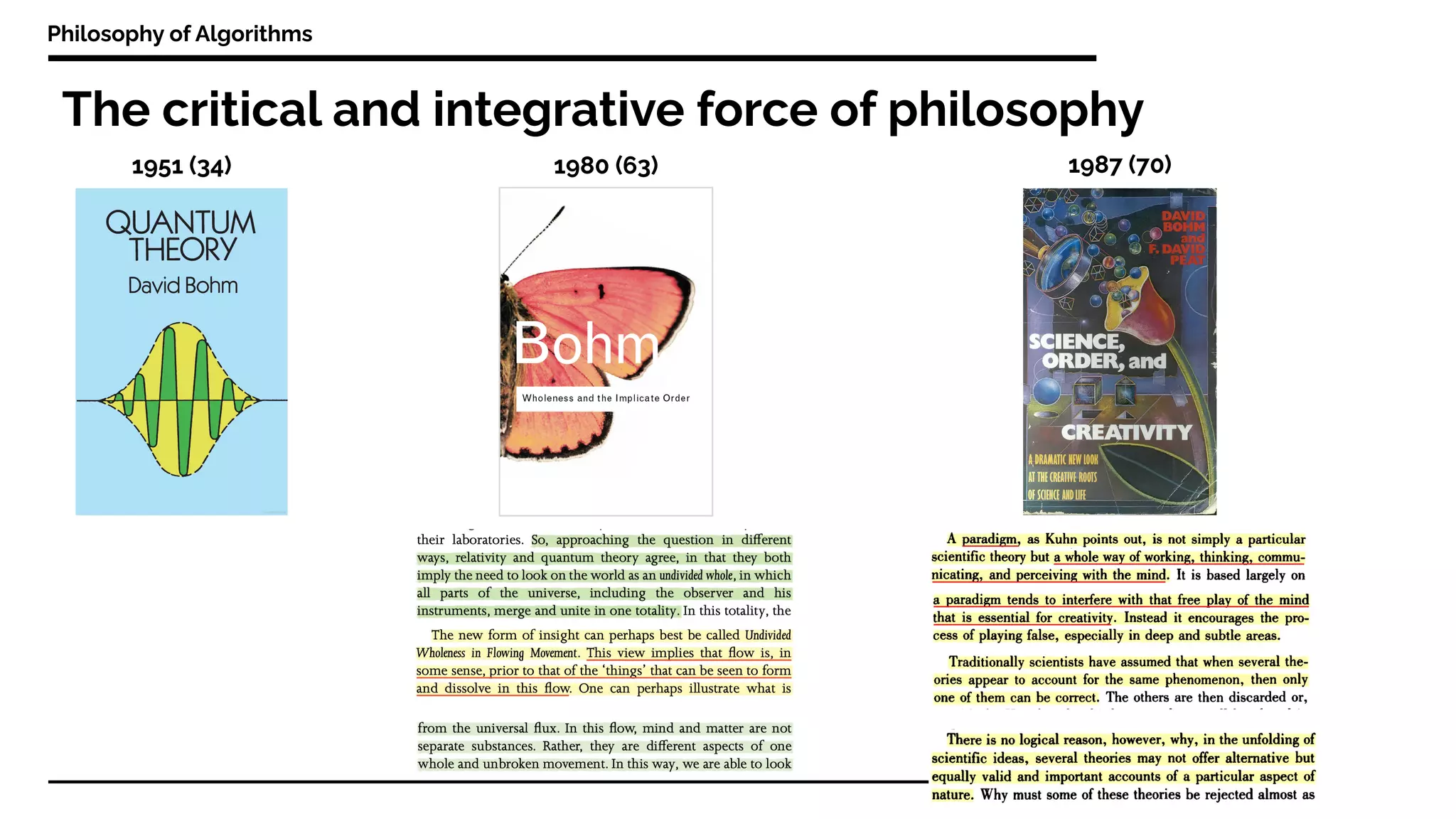
The critical and integrative force of philosophy
Philosophy of Algorithms
1951 (34) 1980 (63) 1987 (70)
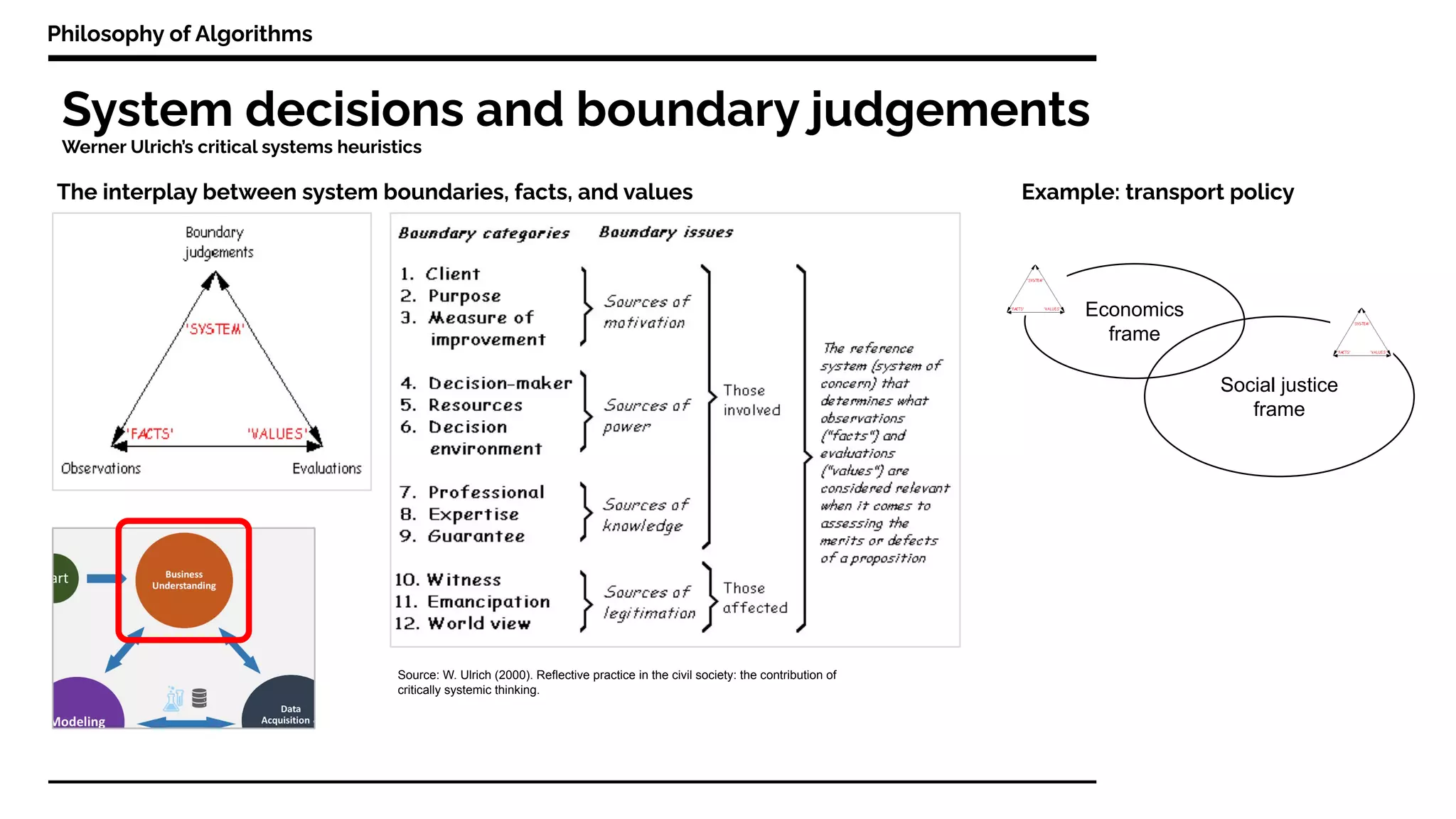
System decisions and boundary judgements
Philosophy of Algorithms
Werner Ulrich’s critical systems heuristics
Economics
frame
Social justice
frame
Source: W. Ulrich (2000). Reflective practice in the civil society: the contribution of
critically systemic thinking.
The interplay between system boundaries, facts, and values Example: transport policy
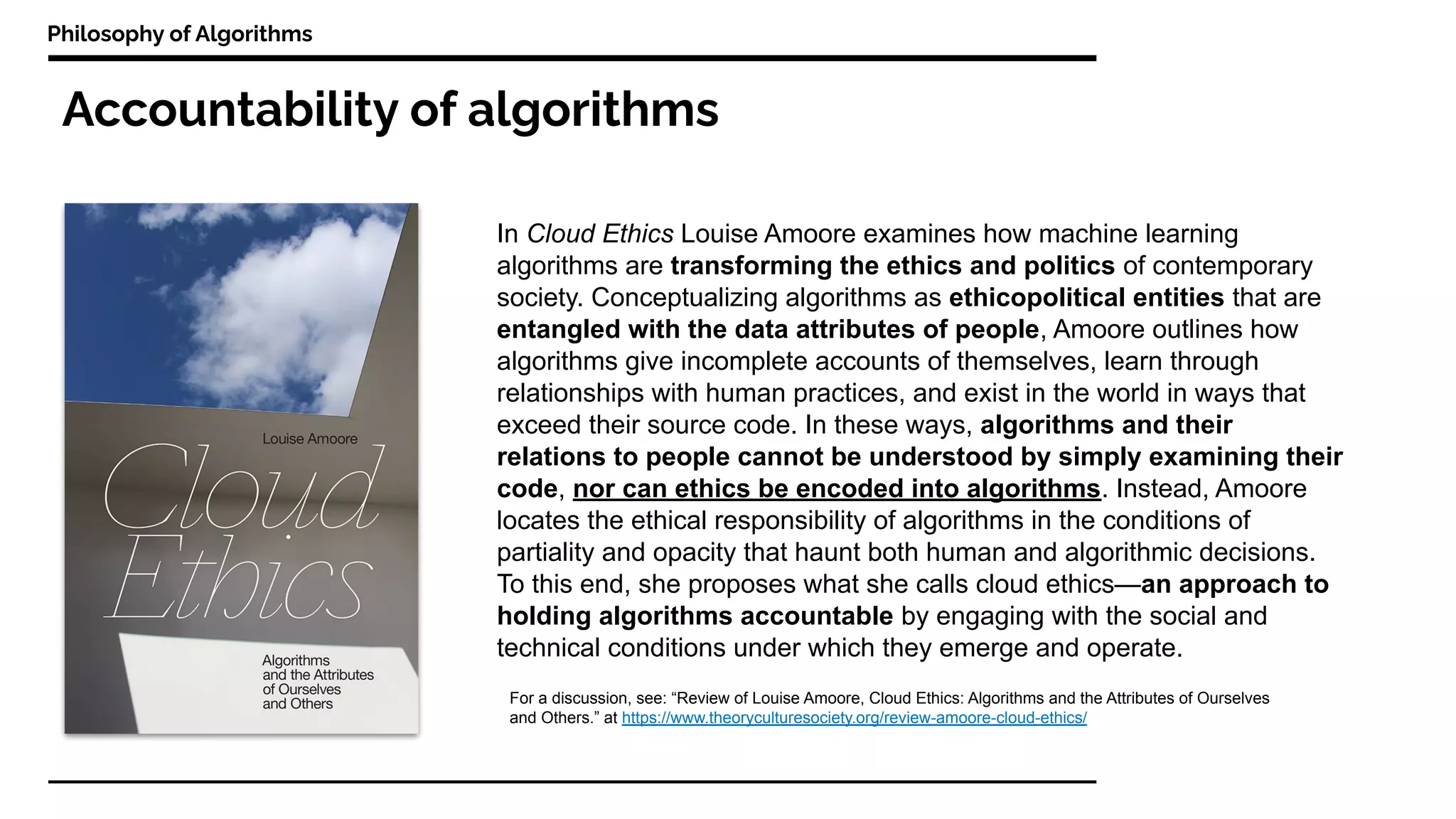
Accountability of algorithms
Philosophy of Algorithms
In Cloud Ethics Louise Amoore examines how machine learning
algorithms are transforming the ethics and politics of contemporary
society. Conceptualizing algorithms as ethicopolitical entities that are
entangled with the data attributes of people, Amoore outlines how
algorithms give incomplete accounts of themselves, learn through
relationships with human practices, and exist in the world in ways that
exceed their source code. In these ways, algorithms and their
relations to people cannot be understood by simply examining their
code, nor can ethics be encoded into algorithms. Instead, Amoore
locates the ethical responsibility of algorithms in the conditions of
partiality and opacity that haunt both human and algorithmic decisions.
To this end, she proposes what she calls cloud ethics—an approach to
holding algorithms accountable by engaging with the social and
technical conditions under which they emerge and operate.
For a discussion, see: “Review of Louise Amoore, Cloud Ethics: Algorithms and the Attributes of Ourselves
and Others.” at https://www.theoryculturesociety.org/review-amoore-cloud-ethics/
Thank you!
Gilbert Peffer
gilbert@kubify.co
25 August 2020

Varied encounters with data science (slide share)

  • 1.
    Varied Encounters With DataScience How does data science relate to traditional scientific and computational approaches? What can we learn about data science pitfalls from these approaches? Is there a role for the social sciences and humanities? A partial exposition by example. Gilbert Peffer gilbert@kubify.co 25 August 2020
  • 2.
    About A quick overviewof what we are covering in our discussions today. ★ Method ★ A data science lens ★ Computational mathematics ★ Agent-based models ★ Quantified self ★ Learning analytics ★ Business intelligence ★ Philosophy of algorithms
  • 3.
    Method Quizzing projects througha data science lens. Poking the data science lens through project work. Source: https://jobs-to-be-done.com/what-is-jobs-to-be-done-fea59c8e39eb
  • 4.
    A Data Science Lens Threedata science work process and lifecycle models to motivate the discussion and questions. Source: https://www.flickr.com/photos/marc_smith/6792756018
  • 5.
    Predictive Analytics WorkflowAnalytics platform developer https://www.mathworks.com/discovery/predictive-analytics.html Data Science Workflow AI consultant http://sadiestlawrence.com/home/data-science-workflow Data Science Lifecycle Business solution provider https://docs.microsoft.com/en-us/azure/machine-learning/team-data -science-process/lifecycle-data Data Science Lifecycle Models
  • 6.
    Predictive Analytics Workflow DataScience Lifecycle Models Source: https://www.mathworks.com/discovery/predictive-analytics.html
  • 7.
    Example - Interactionbetween two research fields Data Science Lifecycle Models -> Predictive Analytics Workflow
  • 8.
    Data Science Workflow DataScience Lifecycle Models Linear (?) Nonlinear Problem definition vs. analysis Source: http://sadiestlawrence.com/home/data-science-workflow
  • 9.
    Example - CooumRiver and Environs in Chennai, India Data Science Lifecycle Models -> Data Science Workflow Checkland’s Soft System Methodology Expressing the problem situation (by participants) Source: Bunch, M. J. (2003). Soft systems methodology and the ecosystem approach: a system study of the Cooum River and environs in Chennai, India. Environmental Management, 31(2), 0182-0197.
  • 10.
    Data Science Lifecycle DataScience Lifecycle Models Source: https://docs.microsoft.com/en-us/azure/machine-learning/team-data-science-process/overview
  • 11.
    Example - TheHubspot Flywheel Data Science Lifecycle Models -> Data Science Lifecycle Data-based insights are secondary Data-based insights are a necessity Source: https://www.webdew.com/hubspot/demo Data hooks
  • 12.
    Examples of problemareas Data Science Lifecycle Models Theory, Model, World View, Ideology, Concept Assumptions Evidence explicit Assumptions that are thought to be well-understood FUEL ENGINE WORK - Scientific jobs - Engineering jobs - Policy jobs - Thinking vs. acting jobs Unintended consequences Intended outcomes implicit Assumptions that are well- understood Jobs done Assumptions that we aren’t aware of Definitional struggles Boundary struggles
  • 13.
    Computational Mathematics Equations, spaces, errors,and data. Source: https://commons.wikimedia.org/wiki/File:Ray_40MTet.png
  • 14.
    Equations - Turbulentgas flow Computational Mathematics (1992) Leonardo da Vinci Cray 2 Supercomputer Navier-Stokes Equations k- 𝛆 Turbulence Model Finite Volume Method Source: https://dayintechhistory.com/tag/cray-2/ Source: https://journals.physiology.org/doi/pdf/10.1152/ajplung.00378.2016
  • 15.
    Equations - Turbulentgas flow Computational Mathematics (1992) ● Business understanding? => Physics. ● Modelling? => PDEs; well-researched. ● Data? => Initial & boundary conditions; geometry. ● Deployment? => Super computer; not for production. Caution: Engineering perspective tends to take business understanding for granted.
  • 16.
    Spaces - Adaptivemesh generators Computational Mathematics (1990) Laminar compressible flow Finite Element 2-step Taylor-Galerkin Mesh generation Supersonic shock waves
  • 17.
    Spaces - Adaptivemesh generators Computational Mathematics (1990) ● Problem? => Set by the customer (ESA). ● Validate? => Standard cases (e.g. wedge). ● Hypothesis? => Sub vs. supersonic. ● Model? => PDE + mesh. ● Deployment? => Computer; not for production. Caution: Well-defined data science workflow, but mesh dependency illustrates effect of problem-external dependency.
  • 18.
    Errors - Solving(near-)hyperbolic PDEs Computational Mathematics (1994) Diffusion term 𝛆 = 0.1 Diffusion term 𝛆 = 0.000001 => Convection-diffusion PDE
  • 19.
    Errors - Solvinghyperbolic PDEs Computational Mathematics (1994) ● Problem? => Abstract and stylised. ● Validate? => Standard cases (a step BC). ● Model? => Simpler physics but worse numerics. Method selection crucial. ● Deployment? => Academic journals. Caution: Simple problem but counterintutive behaviour. Error measures for well-behaved situations don’t work. Go back to the math drawing board.
  • 20.
    Data - Stochasticfinancial models Computational Mathematics (90’s) Interest rate models Vasicek model Two-factor Hull and White model Complex financial market interlinkages Sources: https://www.ecb.europa.eu/pub/pdf/other/financialstabilityreview200806en.pdf, https://www.bankofengland.co.uk/-/media/boe/files/financial-stability-report/2007/october-2007.pdf, https://www.newyorkfed.org/medialibrary/media/research/staff_reports/sr458.pdf Source: https://www.investopedia.com/articles/economics/08/yield-curve.asp
  • 21.
    Data - Stochasticfinancial models Computational Mathematics ● Data? => Single yield curve = OK; financial system = NOT OK. ● Processing? => Vast computing capacities and capabilities in financial firms. Regulators? ● Models? => Very sophisticated, but data hungry for complex securities. Even more so for systemic risk. ● Integration? => Typically extensive in financial firms. Caution: Firm-level: Availability of sophisticated models can hide problems with the data. CDOs etc.@ GFC. Regulator-level: Data on global counterparty exposures often not available where most needed (e.g. large hedge fund positions).
  • 22.
    Agent-Based Models Online business modelsand systemic risk. Source: https://www.economist.com/finance-and-economics/2010/07/22/agents-of-change
  • 23.
    Business models -SimWeb Agent-Based Models Stylised consumer-provider model Partners: 6 Countries: 5 Duration: 2002-2005 Budget: 1,85 M€ Stylised business model and environment
  • 24.
    Business models -SimWeb Agent-Based Models Small data & No data ● Business understanding? => Emerging; understanding vs. performing the market. ● Models? => Agent-models, but constraint by limited business understanding. ● Data? => No understanding, no model,... what data? Caution: Not understanding the problem situation makes model choice very tough, unless ‘understanding’ is replaced by ‘performing’. Sound judgement and expertise are crucial. Also, it is ‘negotiating’ rather than ‘understanding’ => bottom up vs. top-down.
  • 25.
    Systemic Risk inEconomics and Finance (I) Agent-Based Models Bank of England risk transmission map Source: https://link.springer.com/chapter/10.1007/9 78-3-319-23947-7_12 Commercial bank network Transmission modes Source: https://check-risk.com/network-risk-system/ Source: https://www.bankofengland.co.uk/-/media/boe/files/financial-stability-report/2 007/october-2007.pdf
  • 26.
    Systemic Risk inEconomics and Finance (I) Agent-Based Models ● Business understanding? => Emerging understanding of financial networks. But less appreciation about interactions with other systems such as health, the environment, politics, etc. ● Models? => Model ecosystems are needed. ● Data? => limited to none. ● Politics => Subsumed in ‘understanding’, but really a key dimension. Caution: In complex systems, system feedback can lead to large-impact consequences. The silos of science are not well-equiped to deal with this. E.g. economy vs. health controversy in Covid-19. Also, ‘Understaning’, ‘Models’, ‘Data’ all have a political dimension.
  • 27.
    Systemic Risk inEconomics and Finance (II) Agent-Based Models Source: https://limn.it/haldane-complexity/ Macro-Networks Micro-Mechanisms Source: Peffer, G., & Llacay, B. Exploiting the Full Potential of Multiagent‐Based Simulation in Finance: Principles and Methods.
  • 28.
    Systemic Risk inEconomics and Finance (II) Agent-Based Models ● Access data? => Multi-scale means huge amounts of diverse data. 1bn contract pages just for a single financial securities category! ● Data processing? => Crazy. ● Models? => New territory. Multi-sectorial / -system models. ● Integrative Analytics => For whom and for what purpose? Caution: Idem.
  • 29.
    Quantified Self Understanding theemotional antecedents of the disposition bias. Managing the bias through emotion regulation. Source: https://tinyurl.com/ycdfs8c8
  • 30.
    Emotions, cognitive biases,and learning - xDelia Quantified Self xDelia learning pathway Emotion regulation modes Partners: 7 Countries: 6 Duration: 2007-2013 Budget: 3,1 M€ ER and trader performanceDisposition effect Source: https://www.cairn.info/revue-finance-2009-1-page-51.htm# Source: Fenton-O’Creevy, M., Vohra, S. (2011). Emotion regulation and trader performance. Source: Peffer, G. and Fenton-O’Creevy, M, Eds. xDelia – Emotion-centred financial decision-making and learning Source: Gross, J.J., & Thompson, R.A. 2007. Emotion regulation: Conceptual foundations.
  • 31.
    Emotions, cognitive biases,and learning - xDelia Quantified Self ● Access data? => Sensors to measure heart rate => work intensive and intrusive. Financial data => easy-ish. ● Data processing? => Small data sets. ● Models? => Proto-models. Emerging field of emotion regulation. Qualitative fit with literature. ● Integrative Analytics => The xDelia learning interventions (diagnostics; training; transfer). Caution: In naturalistic environments, data collection from people who go about their daily jobs is a challenge. Data gathering needs to be ongoing and learning interventions should aid in getting more relevant data to validate the (proto-)model.
  • 32.
    Learning Analytics Informal, organisational, and networklearning. Source: https://www.flickr.com/photos/gforsythe/20543912596/in/photostream/
  • 33.
    Informal learning -Layers Learning Analytics A) Learning approaches B) Locus of learning Partners: 18 Countries: 8 Duration: 2012-2016 Budget: 9.9 M€ Source: https://elearning.adobe.com/2019/07/classic-learning-research-practice-leading-strategy/ Source: http://results.learning-layers.eu/scenarios/ Current learning analytics Source: https://learninganalytics.ubc.ca/about-the-project/why-learning-analytics/
  • 34.
    Informal learning -Layers Learning Analytics What are the challenges of learning analytics here? ● Generally => few operational models, sparse data. ● Informal learning (individual)? ● Learning in a community of practice? ● Organisational learning? ● Cross-organisational learning? => knowledge, learning, and innvoation in industry clusters Caution: The standard learning analytics won’t work in these cases. They measure the wrong thing the wrong way for the wrong target group.
  • 35.
    Business Intelligence How data scienceimpacts business practice. Source: https://atonce.be/blog/business-intelligence-is-a-must/
  • 36.
    Scalable AI factoryKarim Lakhani, HBS Business Intelligence Ant Financial uses AI to drive digital learning Generalisable AI factory layer Source: https://youtu.be/O5242n_W9vA
  • 37.
    The quantified pigfarm Business Intelligence Source: https://youtu.be/O5242n_W9vA
  • 38.
    Scalable AI factory= Scalable ethics problems Business Intelligence “In an analogue world you can basically have your bias limited. In a digital world, you can bias at scale. “We have to think about ethics at scale.” Karim Lakhani, Harvard Business School
  • 39.
    Philosophy of Algorithms The needfor a social sciences and humanities approach in the data sciences. Source: https://www.gapingvoid.com/blog/2007/08/20/complicated/
  • 40.
    The critical andintegrative force of philosophy Philosophy of Algorithms 1951 (34) 1980 (63) 1987 (70)
  • 41.
    System decisions andboundary judgements Philosophy of Algorithms Werner Ulrich’s critical systems heuristics Economics frame Social justice frame Source: W. Ulrich (2000). Reflective practice in the civil society: the contribution of critically systemic thinking. The interplay between system boundaries, facts, and values Example: transport policy
  • 42.
    Accountability of algorithms Philosophyof Algorithms In Cloud Ethics Louise Amoore examines how machine learning algorithms are transforming the ethics and politics of contemporary society. Conceptualizing algorithms as ethicopolitical entities that are entangled with the data attributes of people, Amoore outlines how algorithms give incomplete accounts of themselves, learn through relationships with human practices, and exist in the world in ways that exceed their source code. In these ways, algorithms and their relations to people cannot be understood by simply examining their code, nor can ethics be encoded into algorithms. Instead, Amoore locates the ethical responsibility of algorithms in the conditions of partiality and opacity that haunt both human and algorithmic decisions. To this end, she proposes what she calls cloud ethics—an approach to holding algorithms accountable by engaging with the social and technical conditions under which they emerge and operate. For a discussion, see: “Review of Louise Amoore, Cloud Ethics: Algorithms and the Attributes of Ourselves and Others.” at https://www.theoryculturesociety.org/review-amoore-cloud-ethics/
  • 43.