Around the world
Variations of Rummy Game
Also known as Indian Rummy and Classic
Rummy, it can be played by 2-6 players. Each
player gets 13 cards, and Jokers- printed as well
as wild card Jokers are of immense value. One
pure sequence i.e. without the use of Joker and
one impure sequence i.e. which uses Joker to
form a sequence, are mandatory. It has 3
variations namely Points Rummy, Pool Rummy
and Deals Rummy. Points Rummy is the one
which enjoys maximum popularity. It is the
quickest version of the 13 card rummy and as
such lapped up by all.
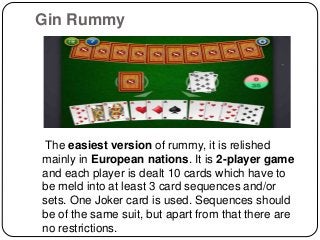
Gin Rummy
The easiest version of rummy, it is relished
mainly in European nations. It is 2-player game
and each player is dealt 10 cards which have to
be meld into at least 3 card sequences and/or
sets. One Joker card is used. Sequences should
be of the same suit, but apart from that there are
no restrictions.
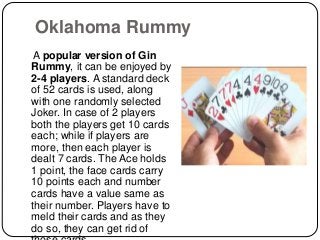
Oklahoma Rummy
A popular version of Gin
Rummy, it can be enjoyed by
2-4 players. A standard deck
of 52 cards is used, along
with one randomly selected
Joker. In case of 2 players
both the players get 10 cards
each; while if players are
more, then each player is
dealt 7 cards. The Ace holds
1 point, the face cards carry
10 points each and number
cards have a value same as
their number. Players have to
meld their cards and as they
do so, they can get rid of
Kalooki Rummy
A game of 2-6 players, it is played with 106 cards
i.e. 2 decks and 2 Jokers. It can be enjoyed by
players of all ages and finds favor with the
Britons who play it at homes, in clubs as also
casinos. Each player is dealt 13 cards but in a
different way- first 3-3, then 2-2, then again 3-3,
again 2-2 and finally 3-3 and involves several
rounds of play.
500 Rummy or Persian Rummy
It is a game of 2-8 players. Normally in all
versions, points carry negative value, but here
whosoever gains 500 points first is the
winner. 13 cards are dealt to each player.
Properly melded cards help you gain points and
others get your points deducted. Ace, face cards
and Joker have 1, 10 and 15 points respectively.
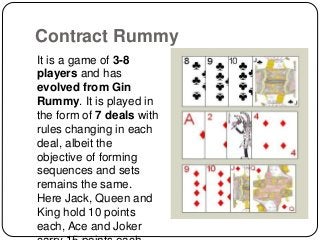
Contract Rummy
It is a game of 3-8
players and has
evolved from Gin
Rummy. It is played in
the form of 7 deals with
rules changing in each
deal, albeit the
objective of forming
sequences and sets
remains the same.
Here Jack, Queen and
King hold 10 points
each, Ace and Joker
Shanghai Rummy
It is a game that originated in China and is quite
similar to ‘Contract Rummy’, only that the number of
deals is 10. It is somewhat flexible too as players can
‘buy’ cards- they can discard a card to and pick a card
from the open deck. However, Joker can be used only
in case of 3 or 4 card sequences/sets and not for
Dummy Rummy
This game which originated in the US and is played in
some parts of Europe too is a game of 2-4 players. It
uses two decks of cards along with 4 Jokers so that
there is a total of 108 cards. Number ‘2’ cards are
used as wild card Jokers. 13 cards are dealt to each
player. And as they form sequences and/or sets, they
can get rid of those cards. The first player to dispose
of all the cards wins the game. Main difference is in
the variety of sequences and sets in the game, as
also the number of melds needed which is 12.
Variations of rummy game

  • 1.
  • 2.
    Also known asIndian Rummy and Classic Rummy, it can be played by 2-6 players. Each player gets 13 cards, and Jokers- printed as well as wild card Jokers are of immense value. One pure sequence i.e. without the use of Joker and one impure sequence i.e. which uses Joker to form a sequence, are mandatory. It has 3 variations namely Points Rummy, Pool Rummy and Deals Rummy. Points Rummy is the one which enjoys maximum popularity. It is the quickest version of the 13 card rummy and as such lapped up by all.
  • 3.
    Gin Rummy The easiestversion of rummy, it is relished mainly in European nations. It is 2-player game and each player is dealt 10 cards which have to be meld into at least 3 card sequences and/or sets. One Joker card is used. Sequences should be of the same suit, but apart from that there are no restrictions.
  • 4.
    Oklahoma Rummy A popularversion of Gin Rummy, it can be enjoyed by 2-4 players. A standard deck of 52 cards is used, along with one randomly selected Joker. In case of 2 players both the players get 10 cards each; while if players are more, then each player is dealt 7 cards. The Ace holds 1 point, the face cards carry 10 points each and number cards have a value same as their number. Players have to meld their cards and as they do so, they can get rid of
  • 5.
    Kalooki Rummy A gameof 2-6 players, it is played with 106 cards i.e. 2 decks and 2 Jokers. It can be enjoyed by players of all ages and finds favor with the Britons who play it at homes, in clubs as also casinos. Each player is dealt 13 cards but in a different way- first 3-3, then 2-2, then again 3-3, again 2-2 and finally 3-3 and involves several rounds of play.
  • 6.
    500 Rummy orPersian Rummy It is a game of 2-8 players. Normally in all versions, points carry negative value, but here whosoever gains 500 points first is the winner. 13 cards are dealt to each player. Properly melded cards help you gain points and others get your points deducted. Ace, face cards and Joker have 1, 10 and 15 points respectively.
  • 7.
    Contract Rummy It isa game of 3-8 players and has evolved from Gin Rummy. It is played in the form of 7 deals with rules changing in each deal, albeit the objective of forming sequences and sets remains the same. Here Jack, Queen and King hold 10 points each, Ace and Joker
  • 8.
    Shanghai Rummy It isa game that originated in China and is quite similar to ‘Contract Rummy’, only that the number of deals is 10. It is somewhat flexible too as players can ‘buy’ cards- they can discard a card to and pick a card from the open deck. However, Joker can be used only in case of 3 or 4 card sequences/sets and not for
  • 9.
    Dummy Rummy This gamewhich originated in the US and is played in some parts of Europe too is a game of 2-4 players. It uses two decks of cards along with 4 Jokers so that there is a total of 108 cards. Number ‘2’ cards are used as wild card Jokers. 13 cards are dealt to each player. And as they form sequences and/or sets, they can get rid of those cards. The first player to dispose of all the cards wins the game. Main difference is in the variety of sequences and sets in the game, as also the number of melds needed which is 12.