1
Value Propositions in B2B Markets
■ Consumer vs. Industrial Markets
■ Commodity vs. Specialty Industrial Markets
■ Picking markets / applications
■ Defining value and market needs
■ Competitive Benchmarking
■ Value Capture Checklist
■ Organizational & Process Issues
■ Summary
Agenda
Sudhir Hublikar
Vice President of Technology
AGY, Inc.
2
Industrial vs Consumer Markets
Technical
Understanding
Impulsive
Buying
Dependency
on Suppliers
Number of
Buyers
Number of
Product App’s
High
Low
Consumer
Industrial
Buyer
Industrial buyers are sophisticated and use a deliberate, technical process.
Source: Advanced Industrial Marketing, Inc.
3
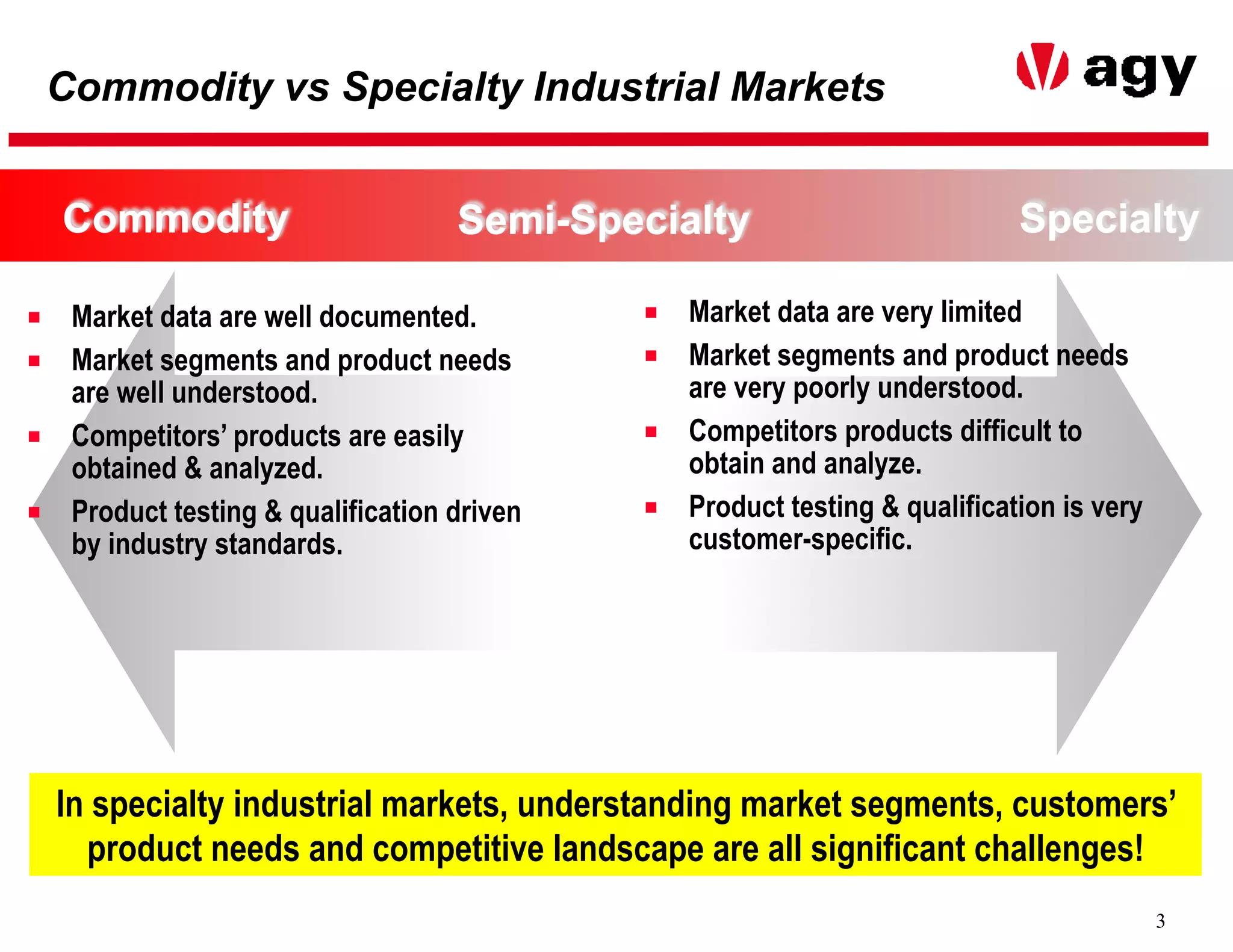
Commodity vs Specialty Industrial Markets
SpecialtySemi-SpecialtyCommodity
■ Market data are well documented.
■ Market segments and product needs
are well understood.
■ Competitors’ products are easily
obtained & analyzed.
■ Product testing & qualification driven
by industry standards.
■ Market data are very limited
■ Market segments and product needs
are very poorly understood.
■ Competitors products difficult to
obtain and analyze.
■ Product testing & qualification is very
customer-specific.
In specialty industrial markets, understanding market segments, customers’
product needs and competitive landscape are all significant challenges!
4
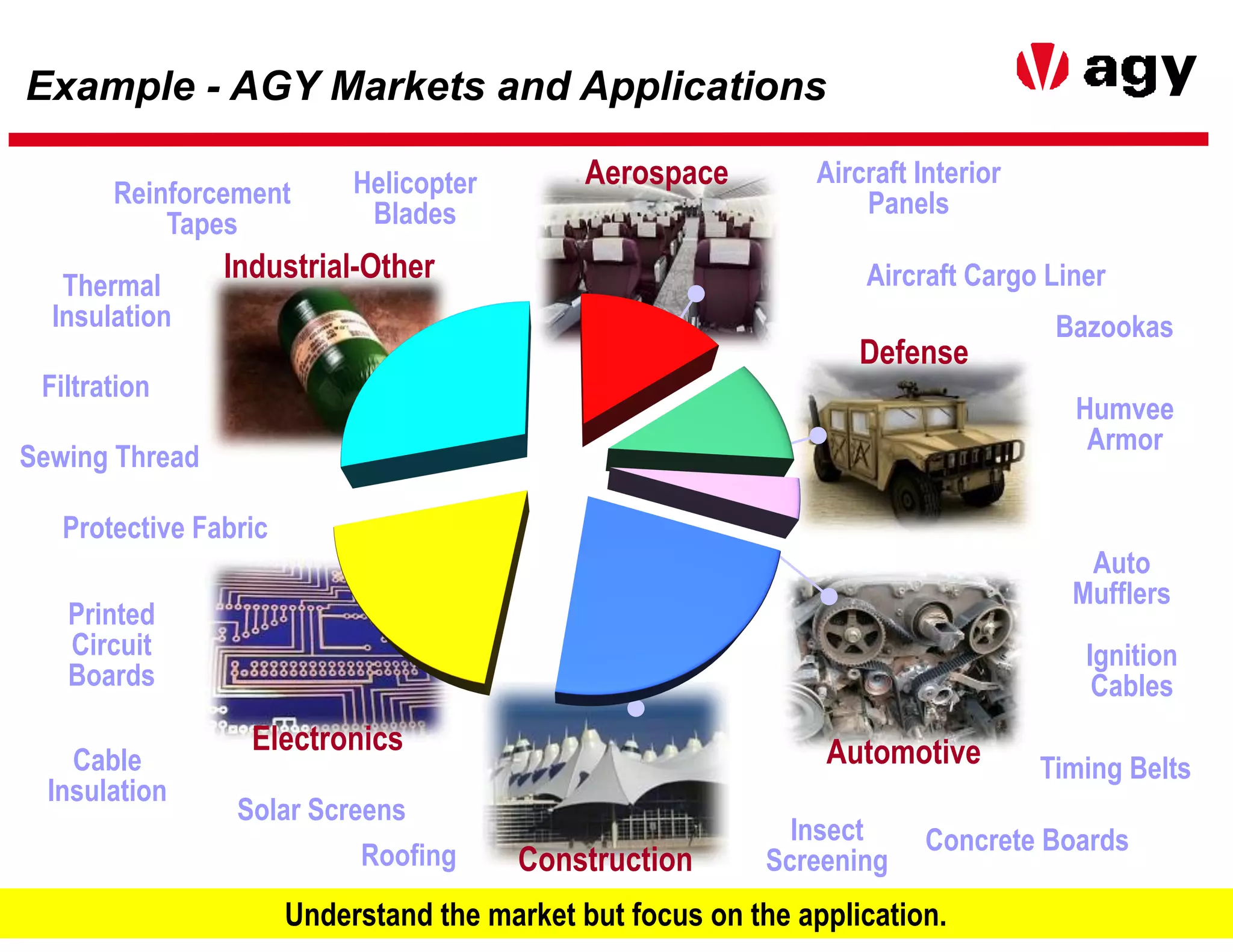
Example - AGY Markets and Applications
Aerospace
Defense
Automotive
Construction
Industrial-Other
Electronics
Filtration
Thermal
Insulation
Protective Fabric
Cable
Insulation
Printed
Circuit
Boards
Roofing
Insect
Screening
Timing Belts
Ignition
Cables
Solar Screens
Reinforcement
Tapes
Sewing Thread
Concrete Boards
Bazookas
Humvee
Armor
Auto
Mufflers
Helicopter
Blades
Aircraft Interior
Panels
Aircraft Cargo Liner
Understand the market but focus on the application.
5
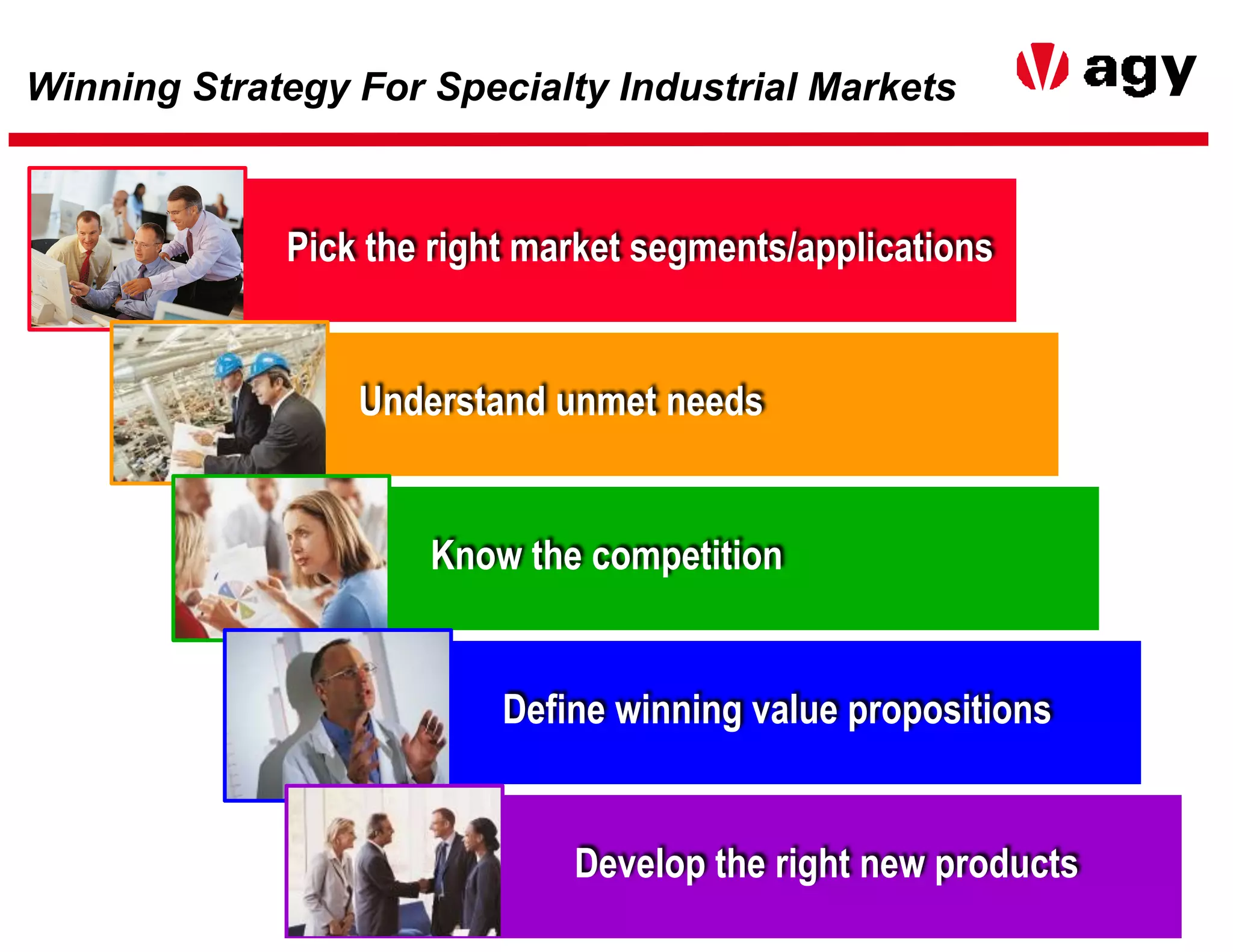
Winning Strategy For Specialty Industrial Markets
!
Pick the right market segments/applications
!
Understand unmet needs
!
Know the competition
!
Define winning value propositions
!
Develop the right new products
6
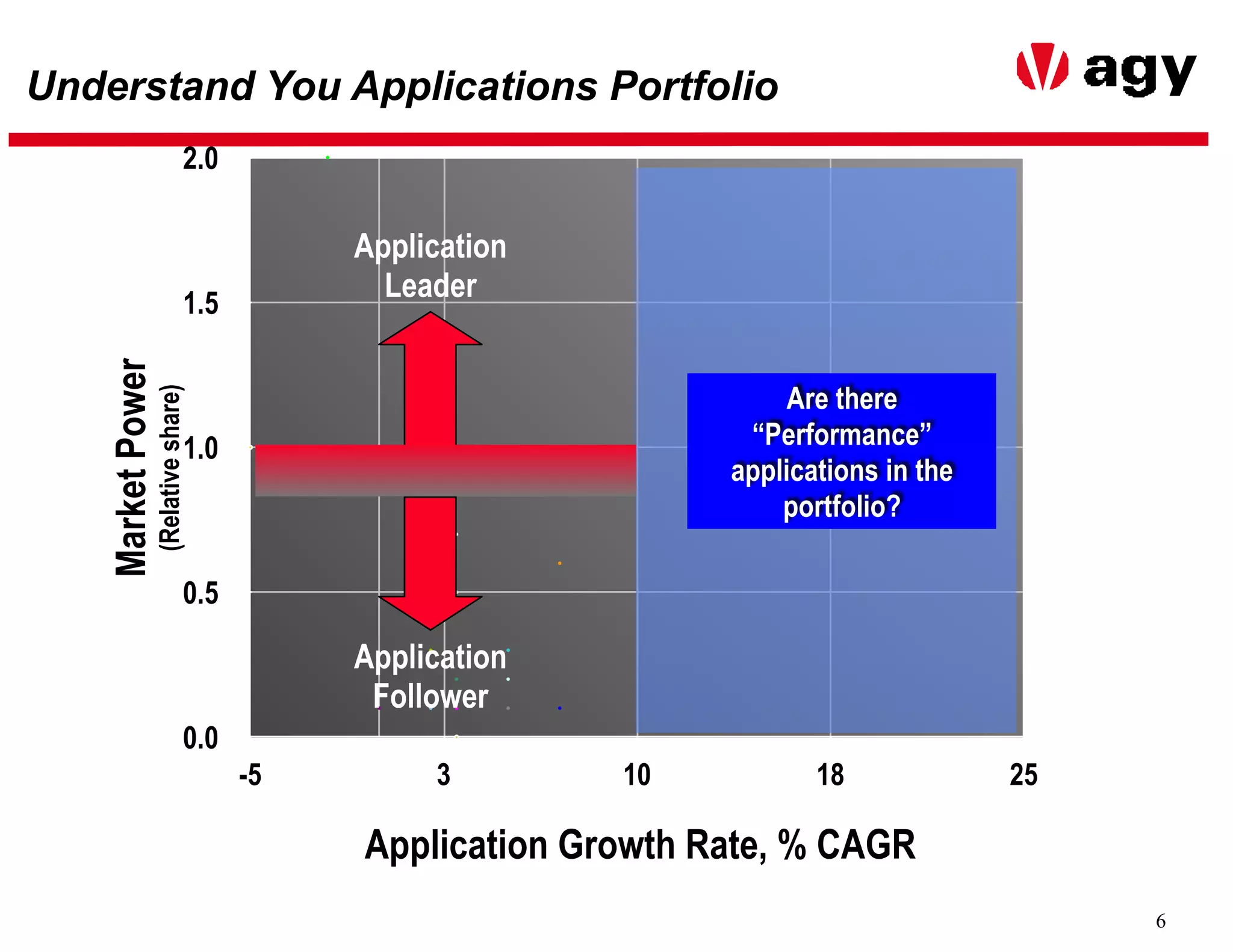
Understand You Applications Portfolio
0.0
0.5
1.0
1.5
2.0
-5 3 10 18 25
Application Growth Rate, % CAGR
MarketPower
(Relativeshare)
Application
Leader
Are there
“Performance”
applications in the
portfolio?
Application
Follower
7
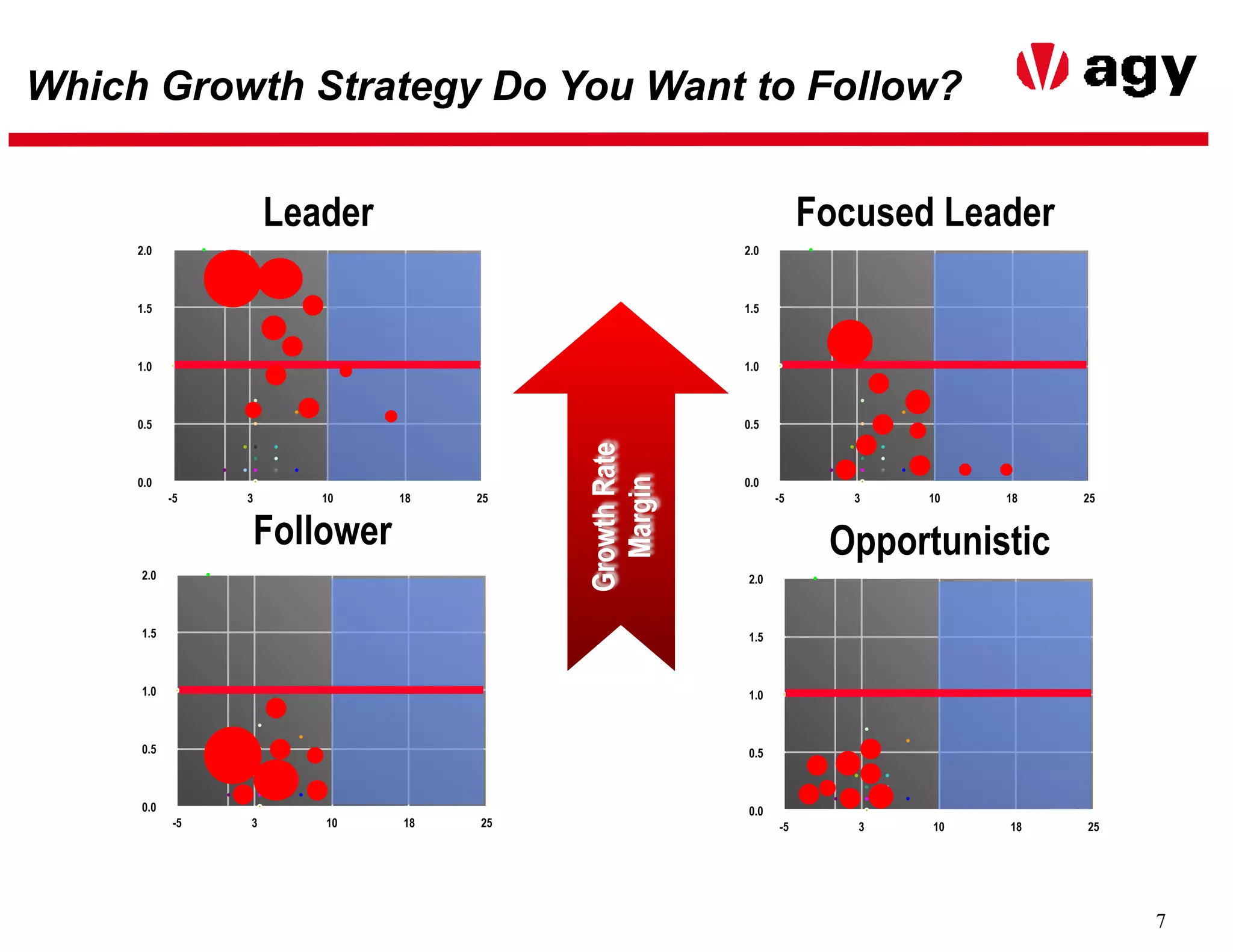
Which Growth Strategy Do You Want to Follow?
0.0
0.5
1.0
1.5
2.0
-5 3 10 18 25
Follower
0.0
0.5
1.0
1.5
2.0
-5 3 10 18 25
Focused Leader
Opportunistic
0.0
0.5
1.0
1.5
2.0
-5 3 10 18 25
Leader
0.0
0.5
1.0
1.5
2.0
-5 3 10 18 25
GrowthRate
Margin
8
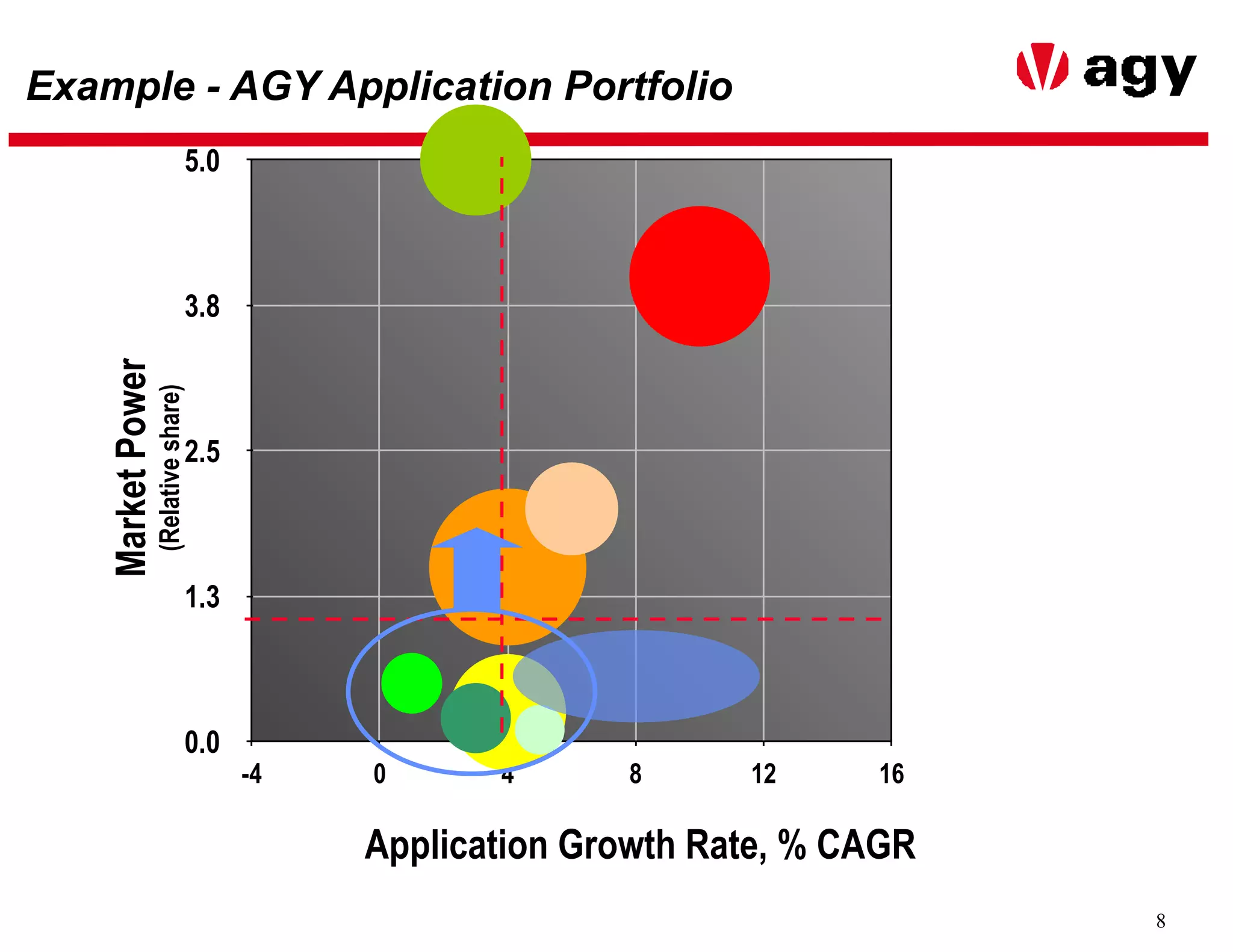
Example - AGY Application Portfolio
0.0
1.3
2.5
3.8
5.0
-4 0 4 8 12 16
Application Growth Rate, % CAGR
MarketPower
(Relativeshare)
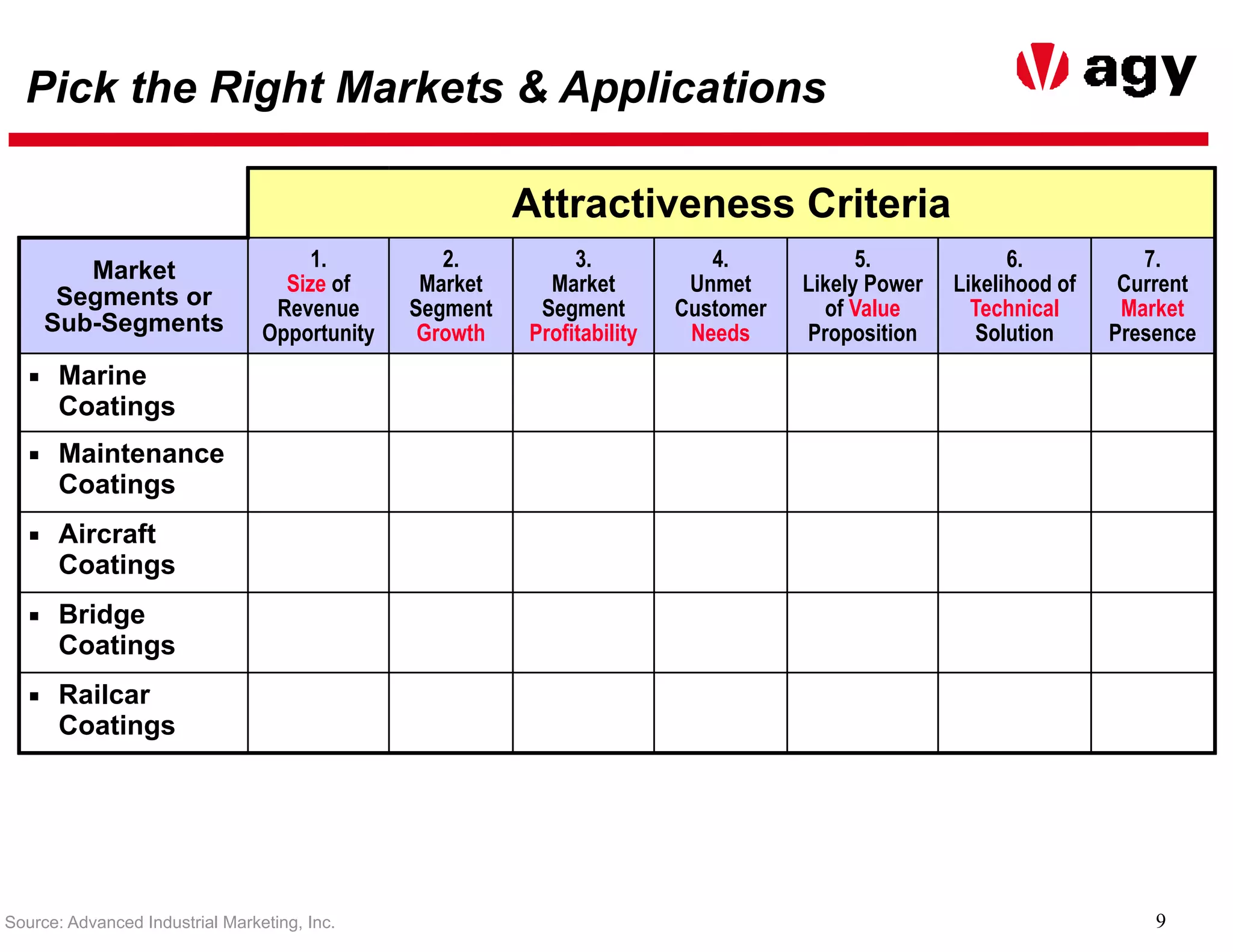
9
Attractiveness Criteria
Market
Segments or
Sub-Segments
1.
Size of
Revenue
Opportunity
2.
Market
Segment
Growth
3.
Market
Segment
Profitability
4.
Unmet
Customer
Needs
5.
Likely Power
of Value
Proposition
6.
Likelihood of
Technical
Solution
7.
Current
Market
Presence
▪ Marine
Coatings B C B A A C C
▪ Maintenance
Coatings A C B B B C C
▪ Aircraft
Coatings A A B A A B B
▪ Bridge
Coatings C B A A B C B
▪ Railcar
Coatings B C C C A B C
Pick the Right Markets & Applications
Source: Advanced Industrial Marketing, Inc.
10
Attractiveness Criteria
Market
Segments or
Sub-Segments
1.
Size of
Revenue
Opportunity
2.
Market
Segment
Growth
3.
Market
Segment
Profitability
4.
Unmet
Customer
Needs
5.
Likely Power
of Value
Proposition
6.
Likelihood of
Technical
Solution
7.
Current
Market
Presence
▪ Marine
Coatings B C B A A C C
▪ Maintenance
Coatings A C B B B C C
▪ Aircraft
Coatings A A B A A B B
▪ Bridge
Coatings C B A A B C B
▪ Railcar
Coatings B C C C A B C
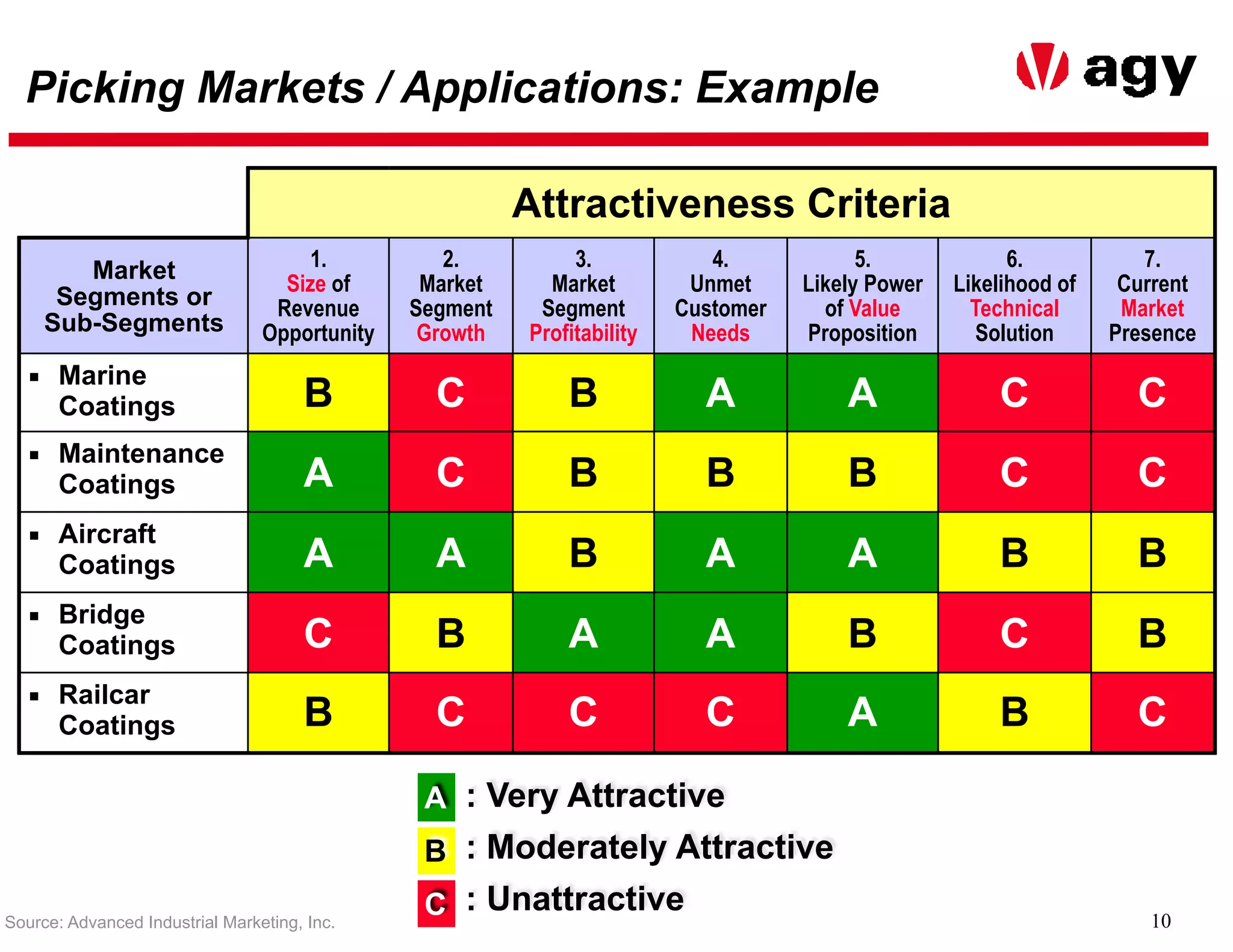
Picking Markets / Applications: Example
A
B
C
: Very Attractive
: Moderately Attractive
: Unattractive
Source: Advanced Industrial Marketing, Inc.
11
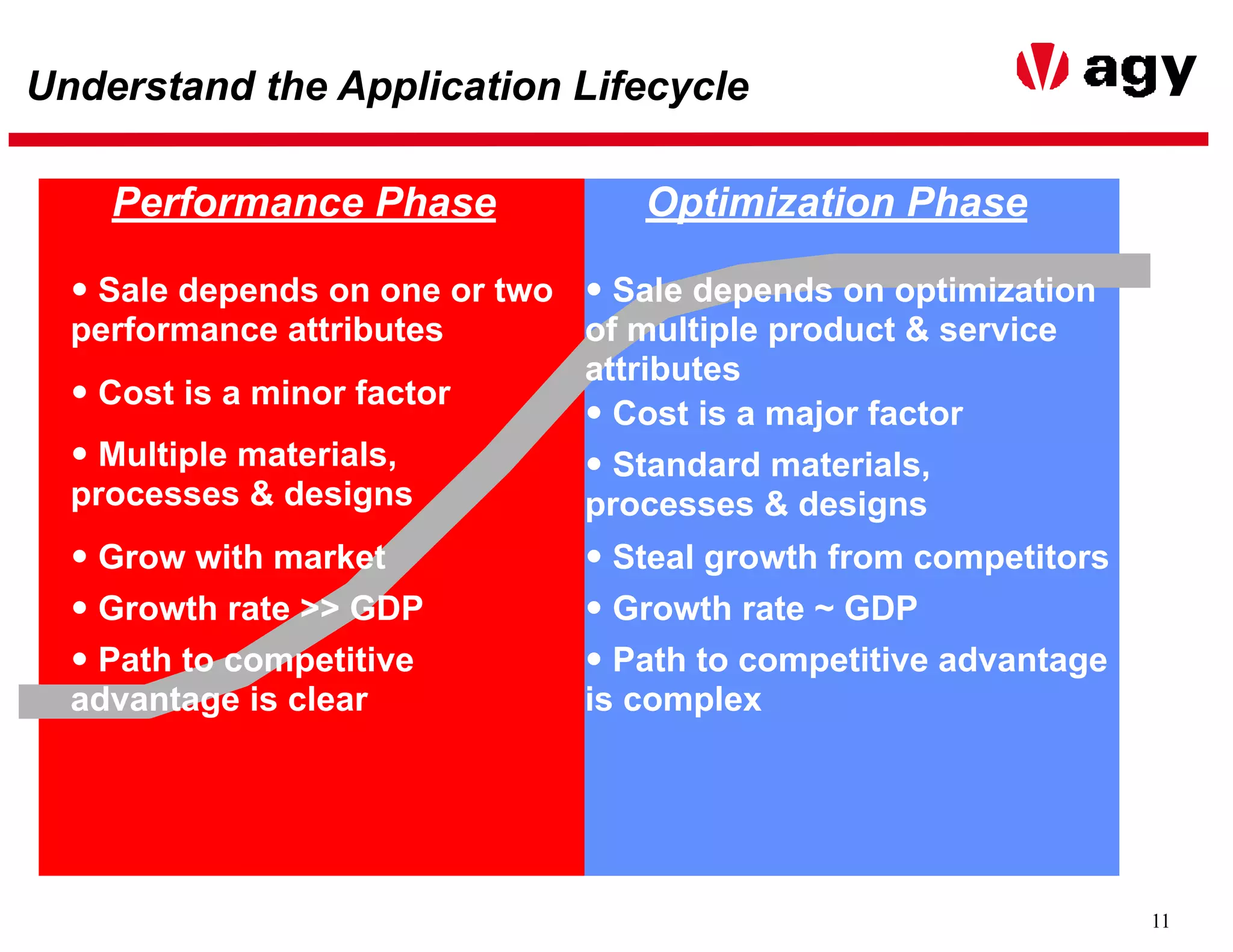
Understand the Application Lifecycle
Performance Phase Optimization Phase
• Sale depends on one or two
performance attributes
• Sale depends on optimization
of multiple product & service
attributes
• Cost is a minor factor
• Cost is a major factor
• Multiple materials,
processes & designs
• Standard materials,
processes & designs
• Grow with market • Steal growth from competitors
• Growth rate >> GDP • Growth rate ~ GDP
• Path to competitive
advantage is clear
• Path to competitive advantage
is complex
12
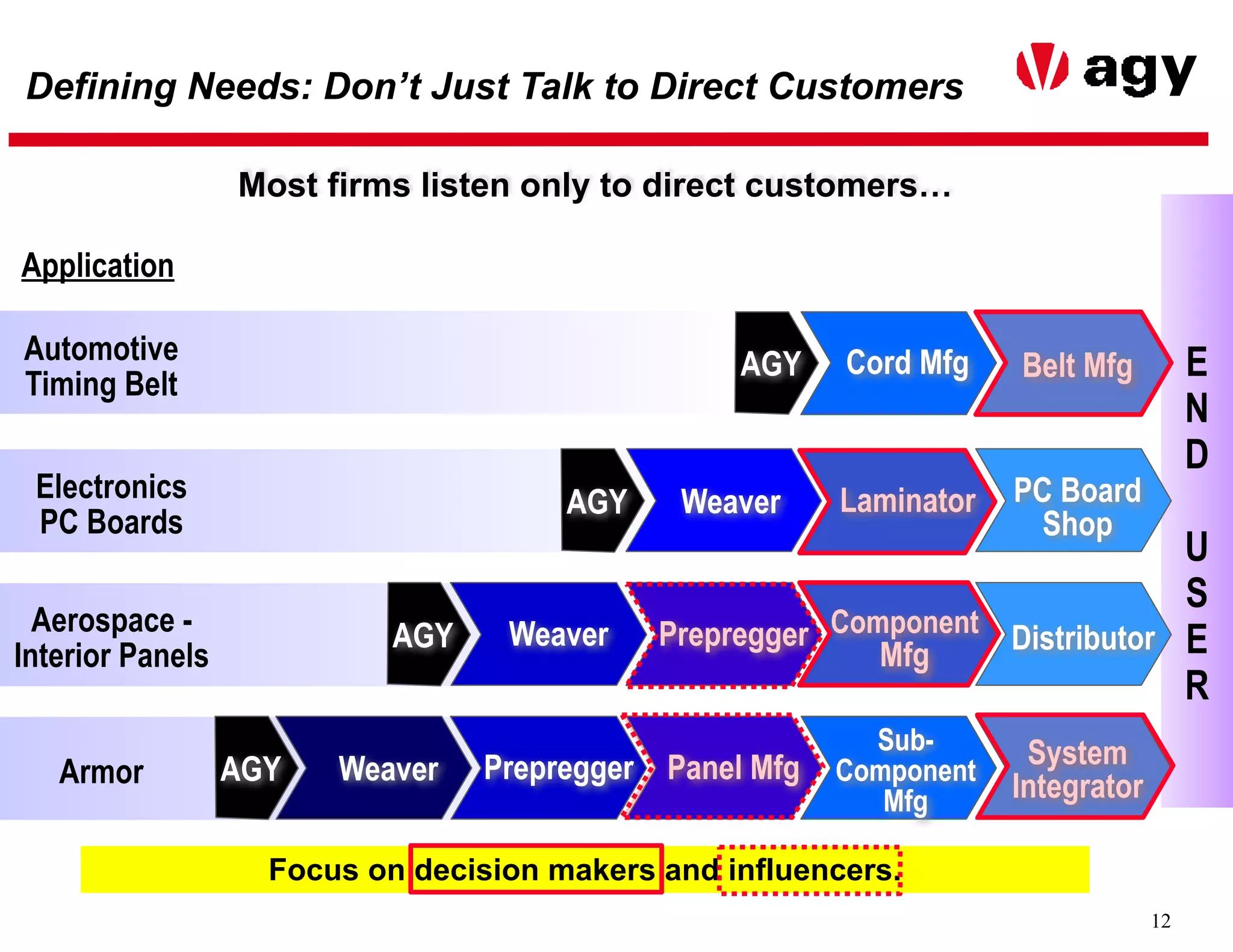
Defining Needs: Don’t Just Talk to Direct Customers
!
!
!
E
N
D
!
U
S
E
R
!
Automotive
Timing Belt
Application
AGY Cord Mfg
AGY Weaver Prepregger Panel Mfg
Sub-
Component
Mfg
System
Integrator
AGY Weaver PC Board
Shop
AGY Weaver DistributorComponent
Mfg
Electronics
PC Boards
Aerospace -
Interior Panels
Armor
Most firms listen only to direct customers…
Focus on decision makers and influencers.
Belt Mfg
Prepregger
Laminator
13
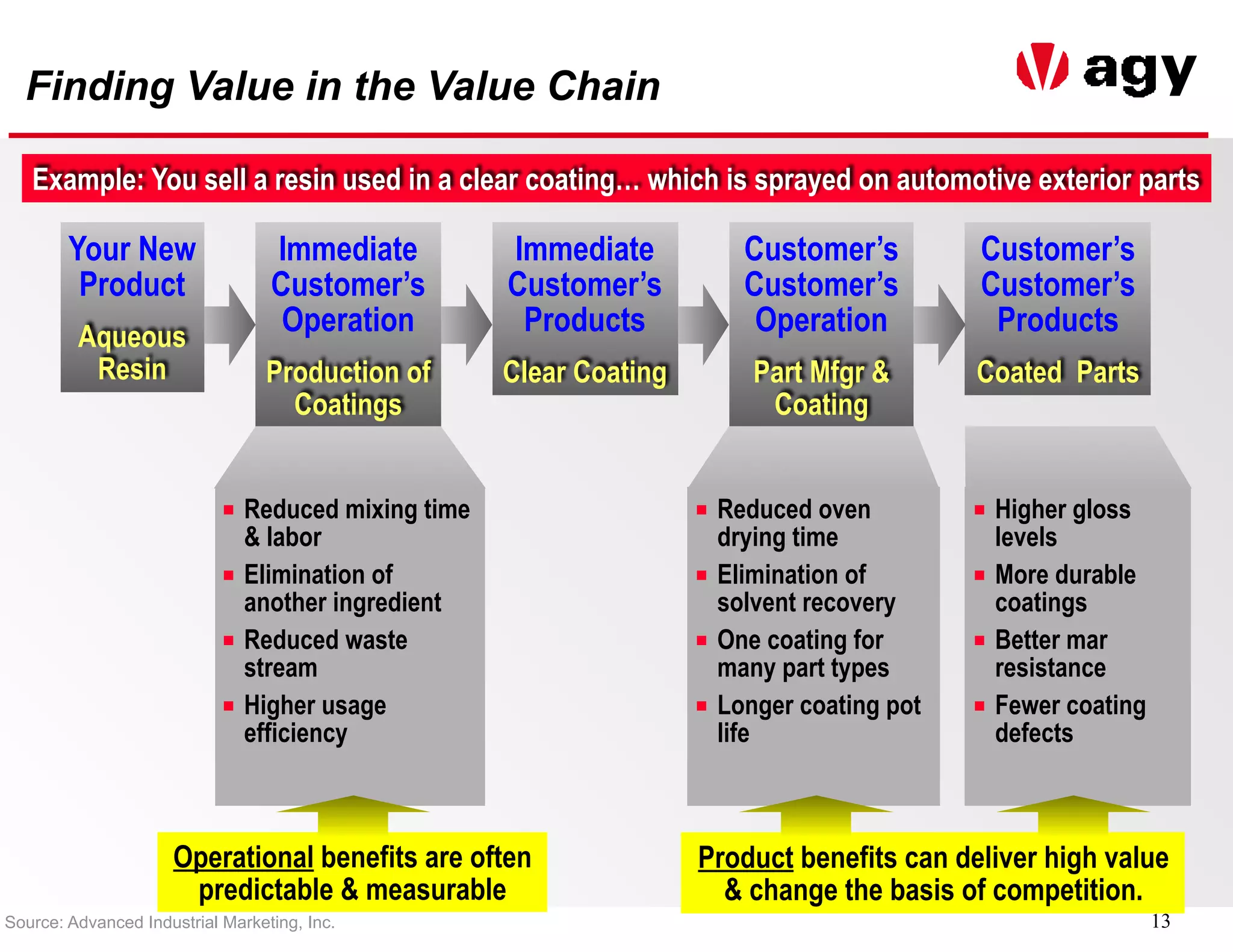
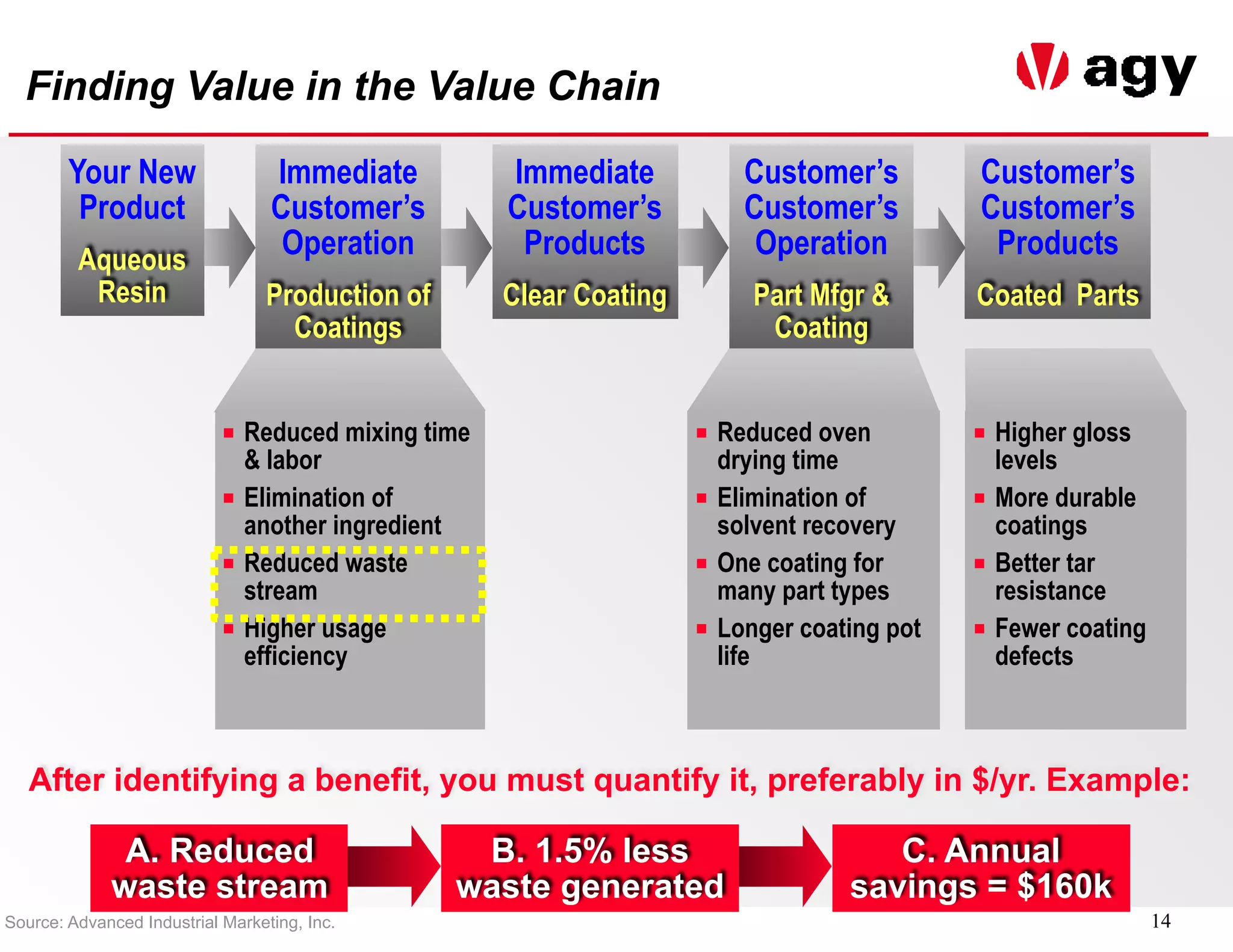
Finding Value in the Value Chain
Your New
Product
Aqueous
Resin
Immediate
Customer’s
Operation
Production of
Coatings
Immediate
Customer’s
Products
Clear Coating
Customer’s
Customer’s
Operation
Part Mfgr &
Coating
Customer’s
Customer’s
Products
Coated Parts
Example: You sell a resin used in a clear coating… which is sprayed on automotive exterior parts
■ Reduced oven
drying time
■ Elimination of
solvent recovery
■ One coating for
many part types
■ Longer coating pot
life
!
■ Higher gloss
levels
■ More durable
coatings
■ Better mar
resistance
■ Fewer coating
defects
■ Reduced mixing time
& labor
■ Elimination of
another ingredient
■ Reduced waste
stream
■ Higher usage
efficiency
!
Source: Advanced Industrial Marketing, Inc.
Operational benefits are often
predictable & measurable
Product benefits can deliver high value
& change the basis of competition.
14
Your New
Product
Aqueous
Resin
Immediate
Customer’s
Operation
Production of
Coatings
Immediate
Customer’s
Products
Clear Coating
Customer’s
Customer’s
Operation
Part Mfgr &
Coating
Customer’s
Customer’s
Products
Coated Parts
■ Reduced oven
drying time
■ Elimination of
solvent recovery
■ One coating for
many part types
■ Longer coating pot
life
!
■ Higher gloss
levels
■ More durable
coatings
■ Better tar
resistance
■ Fewer coating
defects
■ Reduced mixing time
& labor
■ Elimination of
another ingredient
■ Reduced waste
stream
■ Higher usage
efficiency
!
Finding Value in the Value Chain
Your New
Product
Aqueous
Resin
Immediate
Customer’s
Operation
Production of
Coatings
Immediate
Customer’s
Products
Clear Coating
Customer’s
Customer’s
Operation
Part Mfgr &
Coating
Customer’s
Customer’s
Products
Coated Parts
■ Reduced oven
drying time
■ Elimination of
solvent recovery
■ One coating for
many part types
■ Longer coating pot
life
!
■ Higher gloss
levels
■ More durable
coatings
■ Better tar
resistance
■ Fewer coating
defects
■ Reduced mixing time
& labor
■ Elimination of
another ingredient
■ Reduced waste
stream
■ Higher usage
efficiency
!
After identifying a benefit, you must quantify it, preferably in $/yr. Example:
A. Reduced
waste stream
B. 1.5% less
waste generated
C. Annual
savings = $160k
Source: Advanced Industrial Marketing, Inc.
15
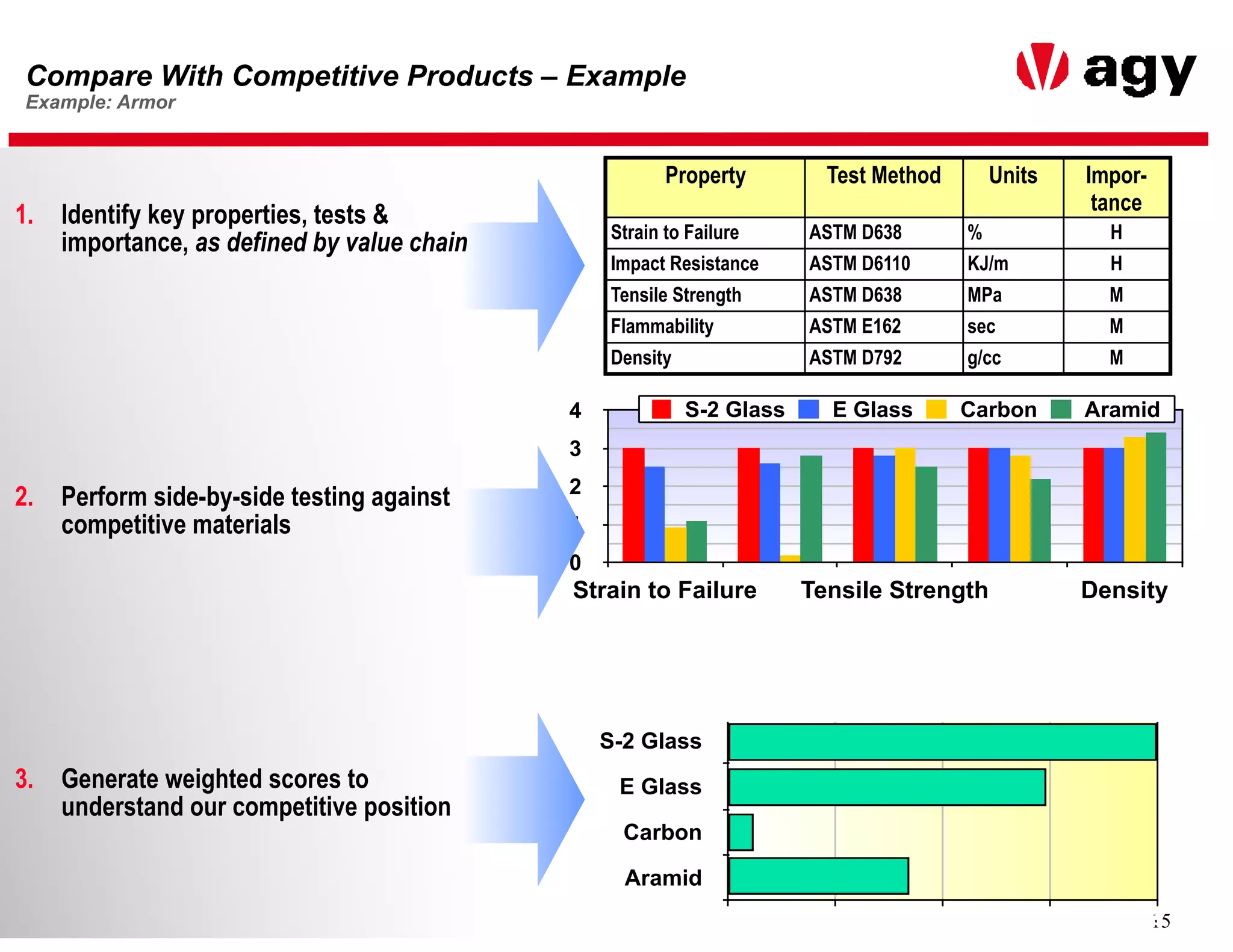
Compare With Competitive Products – Example

Example: Armor
0
1
2
3
4
Strain to Failure Tensile Strength Density
S-2 Glass E Glass Carbon Aramid
S-2 Glass
E Glass
Carbon
Aramid
0 1.3 2.5 3.8 5
Property Test Method Units Impor-
tance
Strain to Failure ASTM D638 % H
Impact Resistance ASTM D6110 KJ/m H
Tensile Strength ASTM D638 MPa M
Flammability ASTM E162 sec M
Density ASTM D792 g/cc M
1. Identify key properties, tests &
importance, as defined by value chain
!
2. Perform side-by-side testing against
competitive materials
!
3. Generate weighted scores to
understand our competitive position
16
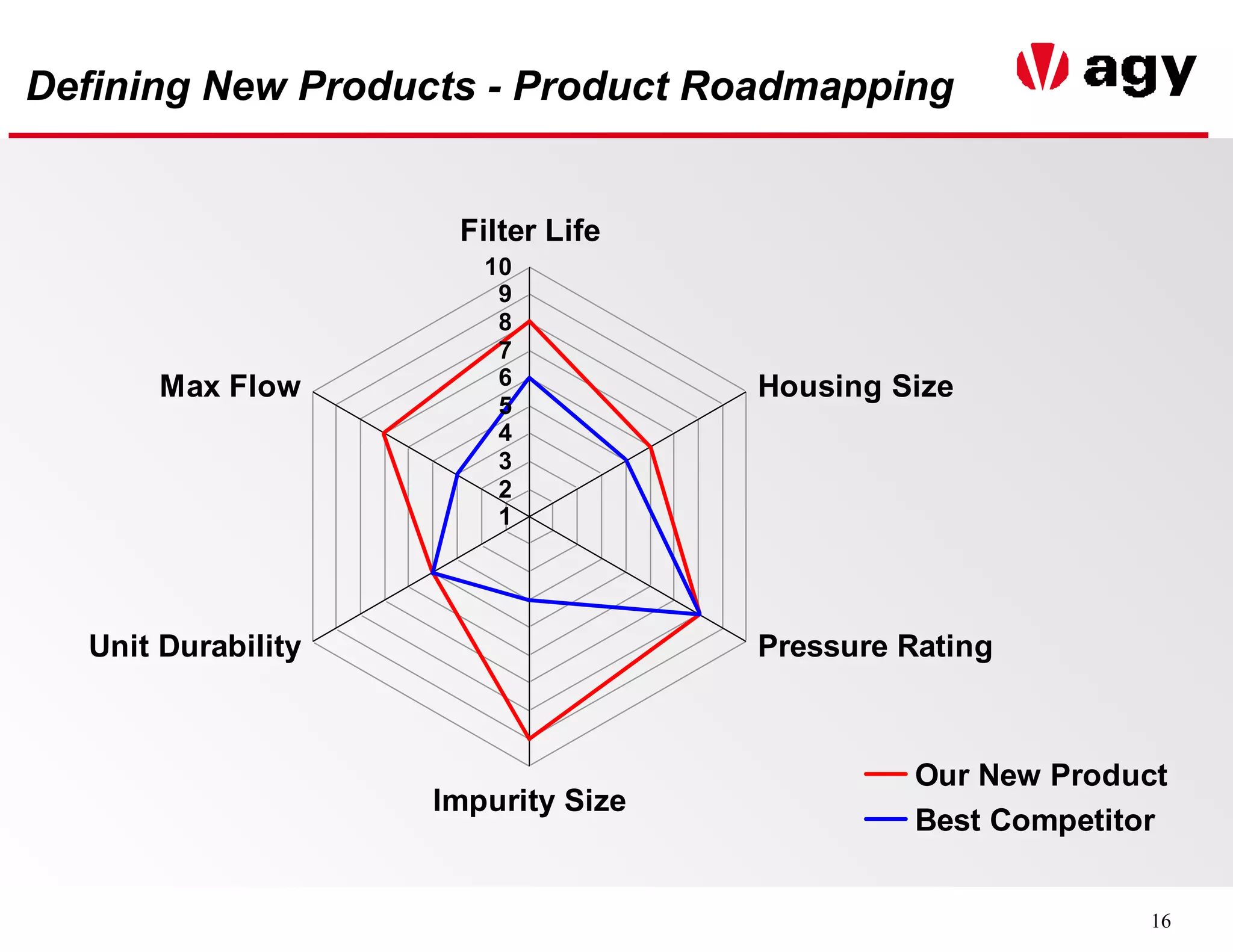
Defining New Products - Product Roadmapping
1
2
3
4
5
6
7
8
9
10
Filter Life
Housing Size
Pressure Rating
Impurity Size
Unit Durability
Max Flow
Our New Product
Best Competitor
17
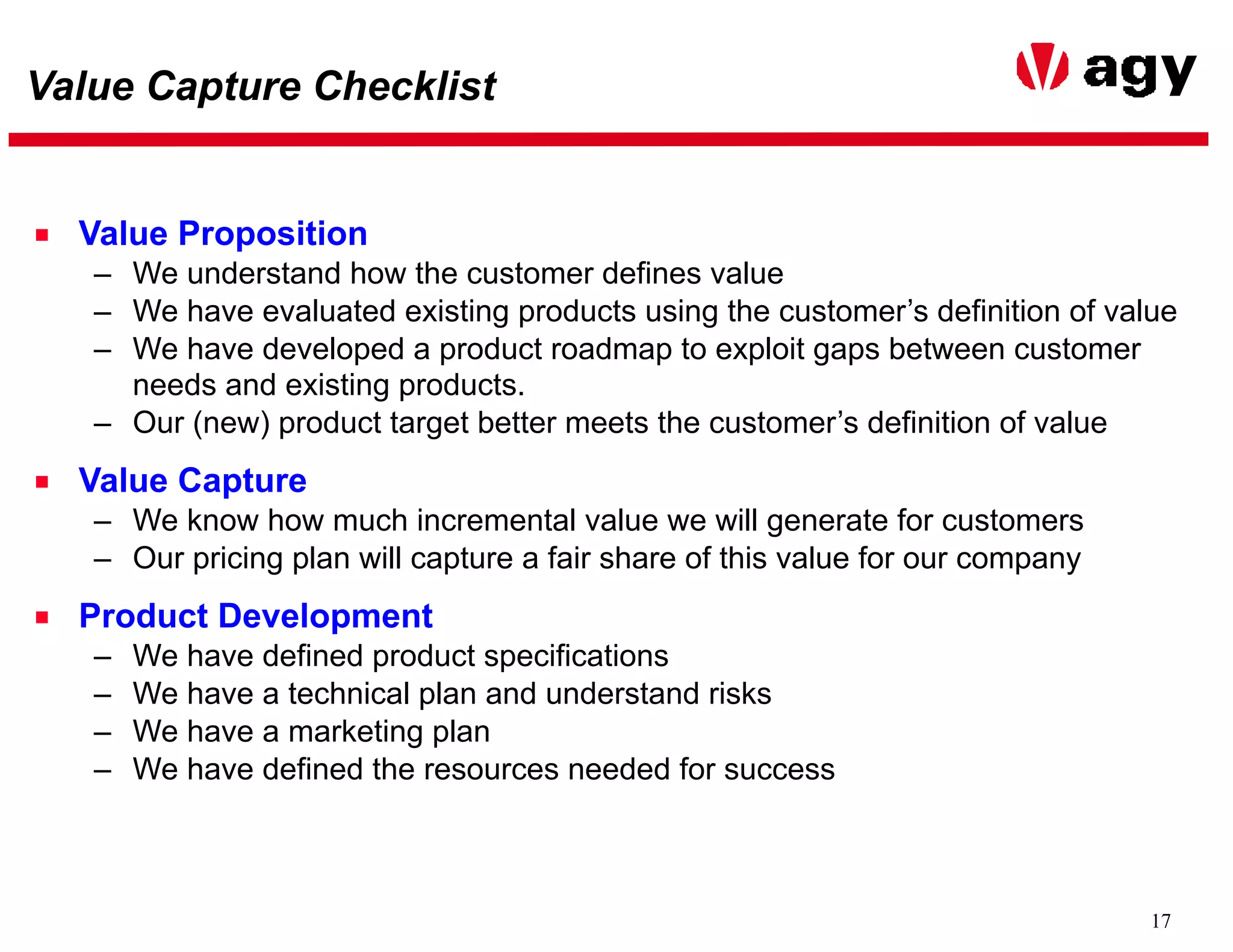
Value Capture Checklist
■ Value Proposition
– We understand how the customer defines value
– We have evaluated existing products using the customer’s definition of value
– We have developed a product roadmap to exploit gaps between customer
needs and existing products.
– Our (new) product target better meets the customer’s definition of value
■ Value Capture
– We know how much incremental value we will generate for customers
– Our pricing plan will capture a fair share of this value for our company
■ Product Development
– We have defined product specifications
– We have a technical plan and understand risks
– We have a marketing plan
– We have defined the resources needed for success
18
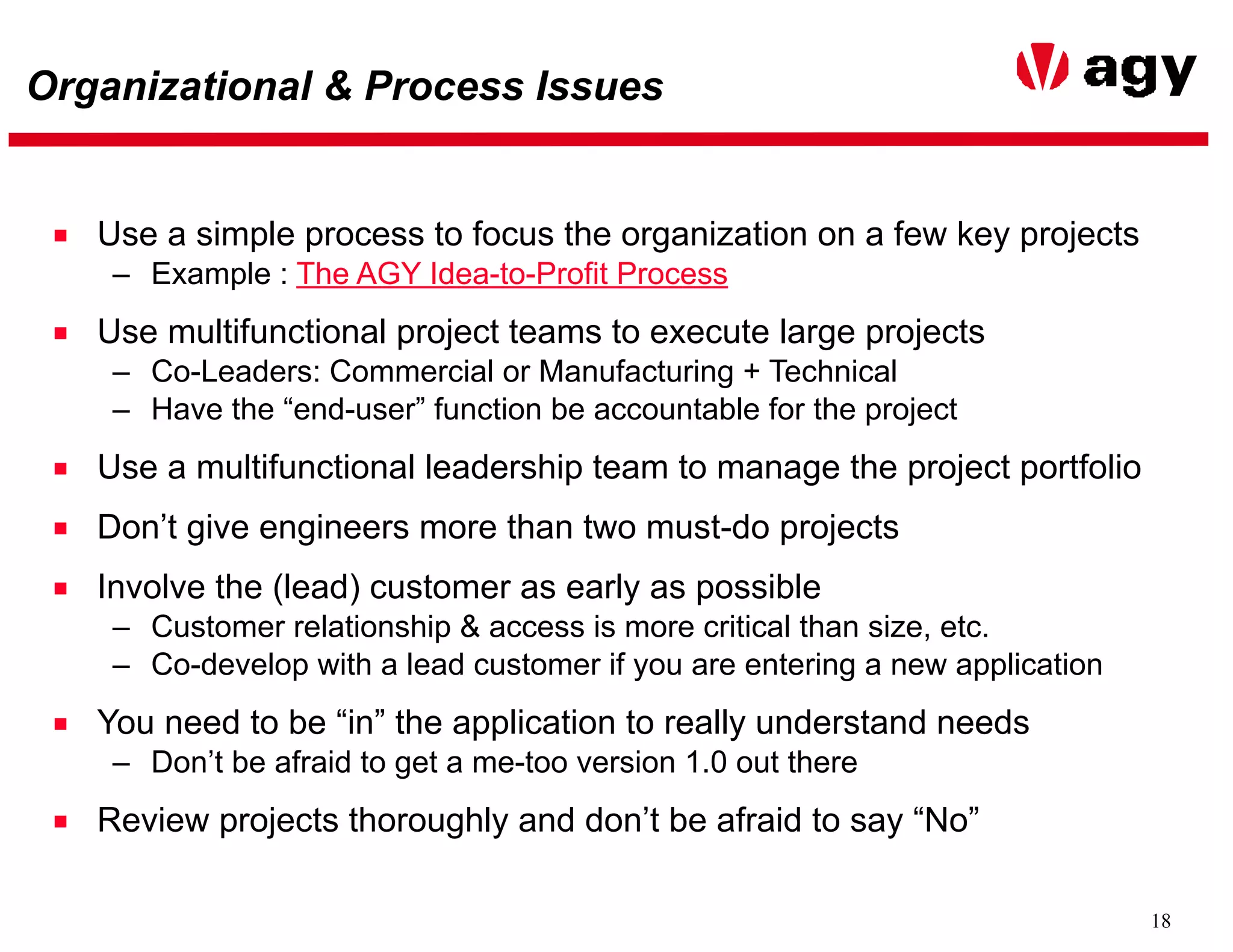
Organizational & Process Issues
■ Use a simple process to focus the organization on a few key projects
– Example : The AGY Idea-to-Profit Process
■ Use multifunctional project teams to execute large projects
– Co-Leaders: Commercial or Manufacturing + Technical
– Have the “end-user” function be accountable for the project
■ Use a multifunctional leadership team to manage the project portfolio
■ Don’t give engineers more than two must-do projects
■ Involve the (lead) customer as early as possible
– Customer relationship & access is more critical than size, etc.
– Co-develop with a lead customer if you are entering a new application
■ You need to be “in” the application to really understand needs
– Don’t be afraid to get a me-too version 1.0 out there
■ Review projects thoroughly and don’t be afraid to say “No”
19
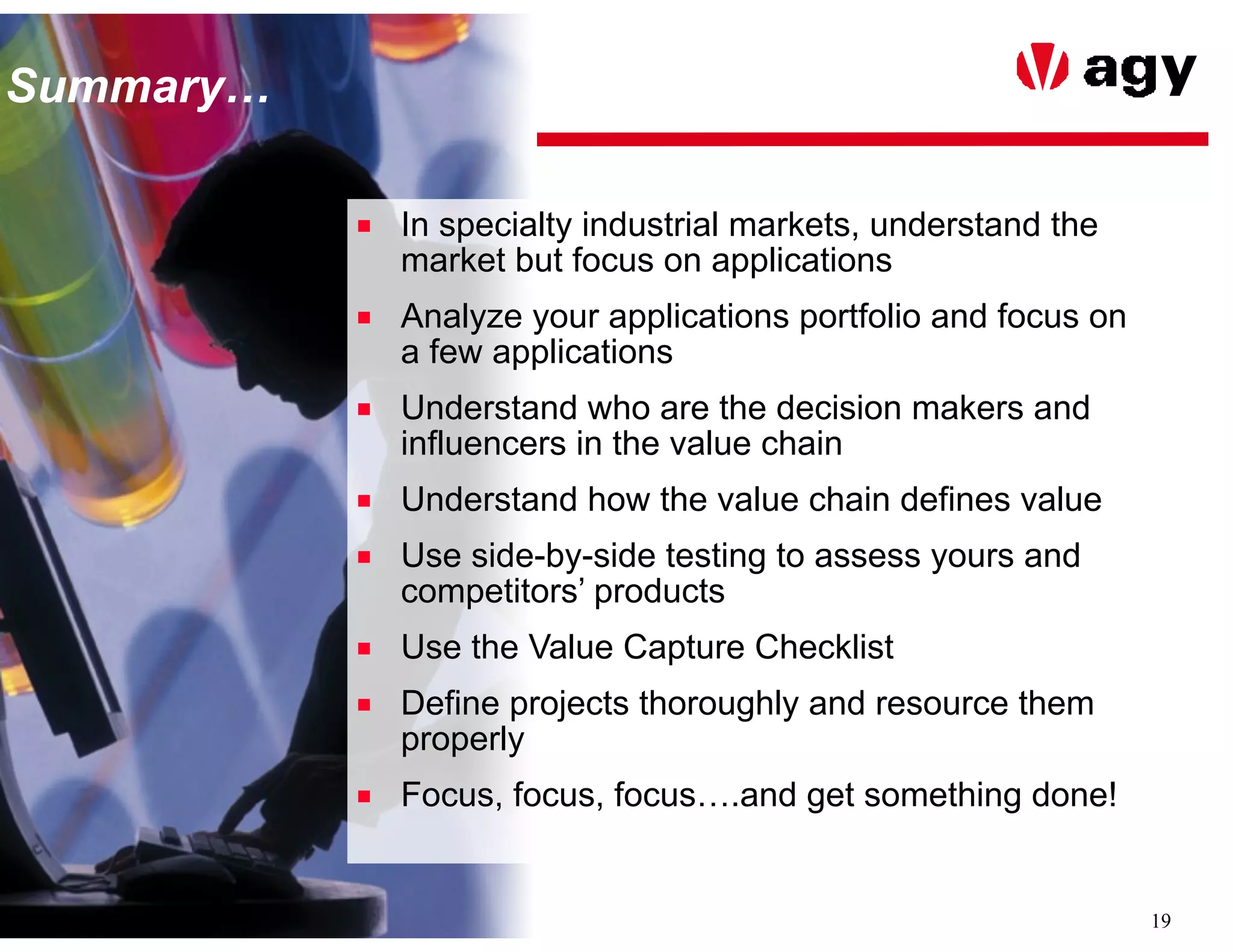
SummarySummary…
■ In specialty industrial markets, understand the
market but focus on applications
■ Analyze your applications portfolio and focus on
a few applications
■ Understand who are the decision makers and
influencers in the value chain
■ Understand how the value chain defines value
■ Use side-by-side testing to assess yours and
competitors’ products
■ Use the Value Capture Checklist
■ Define projects thoroughly and resource them
properly
■ Focus, focus, focus….and get something done!
20
Value Propositions in B2B Markets
Questions?
■ Consumer vs Industrial Markets
■ Commodity vs Specialty Industrial
Markets
■ Picking markets / applications
■ Defining value and market needs
■ Competitive Benchmarking
■ Value Capture Checklist
■ Organizational & Process Issues
■ Summary
21
22
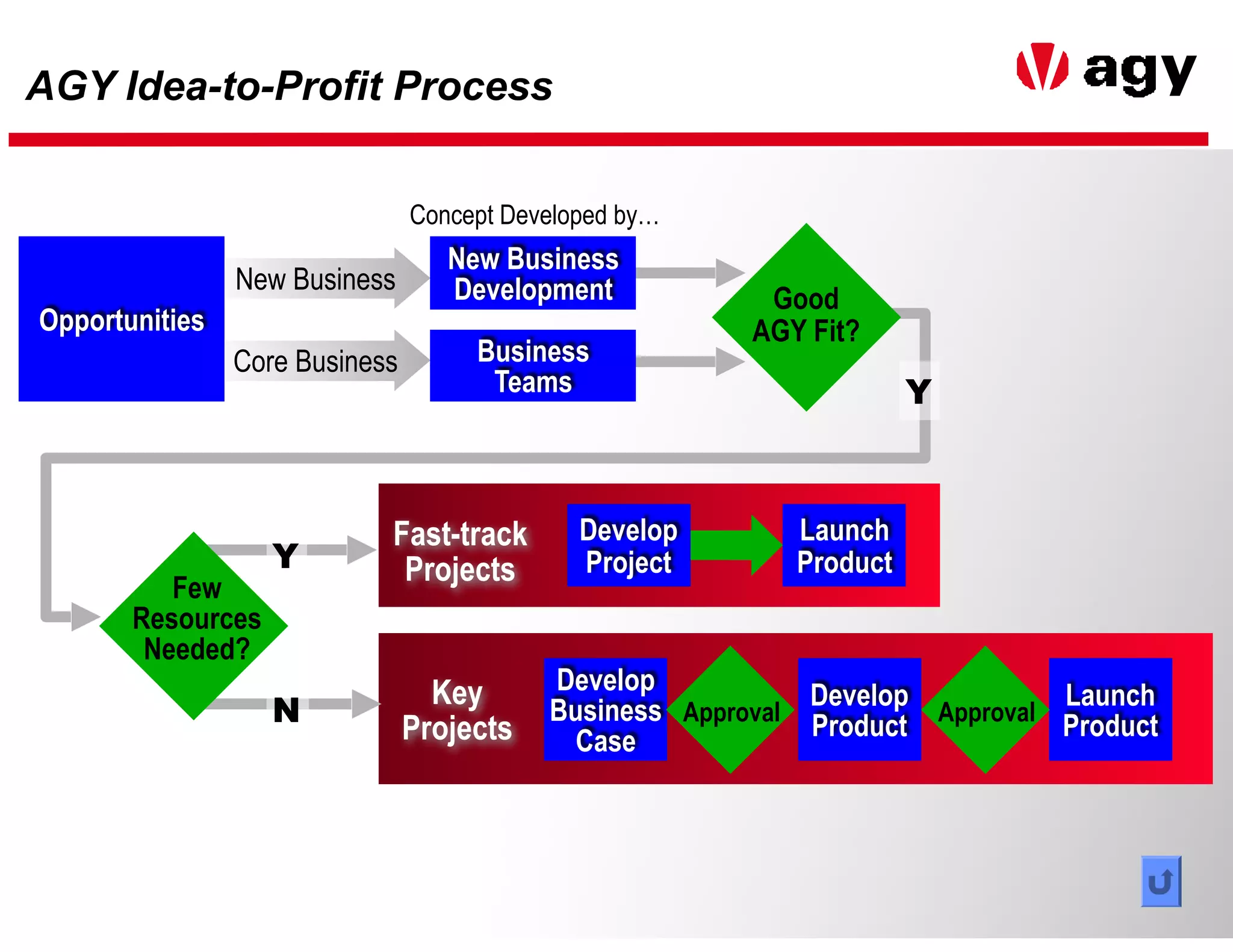
AGY Idea-to-Profit Process
Opportunities
Develop
Project
Launch
Product
Fast-track
ProjectsY
Develop
Business
Case
Develop
ProductApproval
Launch
ProductApproval
Key
Projects
N
Few
Resources
Needed?
Y
Good
AGY Fit?
New Business
Core Business
Concept Developed by…
New Business
Development
Business
Teams

Value Propositions - CDMA meeting 2006

  • 1.
    1 Value Propositions inB2B Markets ■ Consumer vs. Industrial Markets ■ Commodity vs. Specialty Industrial Markets ■ Picking markets / applications ■ Defining value and market needs ■ Competitive Benchmarking ■ Value Capture Checklist ■ Organizational & Process Issues ■ Summary Agenda Sudhir Hublikar Vice President of Technology AGY, Inc.
  • 2.
    2 Industrial vs ConsumerMarkets Technical Understanding Impulsive Buying Dependency on Suppliers Number of Buyers Number of Product App’s High Low Consumer Industrial Buyer Industrial buyers are sophisticated and use a deliberate, technical process. Source: Advanced Industrial Marketing, Inc.
  • 3.
    3 Commodity vs SpecialtyIndustrial Markets SpecialtySemi-SpecialtyCommodity ■ Market data are well documented. ■ Market segments and product needs are well understood. ■ Competitors’ products are easily obtained & analyzed. ■ Product testing & qualification driven by industry standards. ■ Market data are very limited ■ Market segments and product needs are very poorly understood. ■ Competitors products difficult to obtain and analyze. ■ Product testing & qualification is very customer-specific. In specialty industrial markets, understanding market segments, customers’ product needs and competitive landscape are all significant challenges!
  • 4.
    4 Example - AGYMarkets and Applications Aerospace Defense Automotive Construction Industrial-Other Electronics Filtration Thermal Insulation Protective Fabric Cable Insulation Printed Circuit Boards Roofing Insect Screening Timing Belts Ignition Cables Solar Screens Reinforcement Tapes Sewing Thread Concrete Boards Bazookas Humvee Armor Auto Mufflers Helicopter Blades Aircraft Interior Panels Aircraft Cargo Liner Understand the market but focus on the application.
  • 5.
    5 Winning Strategy ForSpecialty Industrial Markets ! Pick the right market segments/applications ! Understand unmet needs ! Know the competition ! Define winning value propositions ! Develop the right new products
  • 6.
    6 Understand You ApplicationsPortfolio 0.0 0.5 1.0 1.5 2.0 -5 3 10 18 25 Application Growth Rate, % CAGR MarketPower (Relativeshare) Application Leader Are there “Performance” applications in the portfolio? Application Follower
  • 7.
    7 Which Growth StrategyDo You Want to Follow? 0.0 0.5 1.0 1.5 2.0 -5 3 10 18 25 Follower 0.0 0.5 1.0 1.5 2.0 -5 3 10 18 25 Focused Leader Opportunistic 0.0 0.5 1.0 1.5 2.0 -5 3 10 18 25 Leader 0.0 0.5 1.0 1.5 2.0 -5 3 10 18 25 GrowthRate Margin
  • 8.
    8 Example - AGYApplication Portfolio 0.0 1.3 2.5 3.8 5.0 -4 0 4 8 12 16 Application Growth Rate, % CAGR MarketPower (Relativeshare)
  • 9.
    9 Attractiveness Criteria Market Segments or Sub-Segments 1. Sizeof Revenue Opportunity 2. Market Segment Growth 3. Market Segment Profitability 4. Unmet Customer Needs 5. Likely Power of Value Proposition 6. Likelihood of Technical Solution 7. Current Market Presence ▪ Marine Coatings B C B A A C C ▪ Maintenance Coatings A C B B B C C ▪ Aircraft Coatings A A B A A B B ▪ Bridge Coatings C B A A B C B ▪ Railcar Coatings B C C C A B C Pick the Right Markets & Applications Source: Advanced Industrial Marketing, Inc.
  • 10.
    10 Attractiveness Criteria Market Segments or Sub-Segments 1. Sizeof Revenue Opportunity 2. Market Segment Growth 3. Market Segment Profitability 4. Unmet Customer Needs 5. Likely Power of Value Proposition 6. Likelihood of Technical Solution 7. Current Market Presence ▪ Marine Coatings B C B A A C C ▪ Maintenance Coatings A C B B B C C ▪ Aircraft Coatings A A B A A B B ▪ Bridge Coatings C B A A B C B ▪ Railcar Coatings B C C C A B C Picking Markets / Applications: Example A B C : Very Attractive : Moderately Attractive : Unattractive Source: Advanced Industrial Marketing, Inc.
  • 11.
    11 Understand the ApplicationLifecycle Performance Phase Optimization Phase • Sale depends on one or two performance attributes • Sale depends on optimization of multiple product & service attributes • Cost is a minor factor • Cost is a major factor • Multiple materials, processes & designs • Standard materials, processes & designs • Grow with market • Steal growth from competitors • Growth rate >> GDP • Growth rate ~ GDP • Path to competitive advantage is clear • Path to competitive advantage is complex
  • 12.
    12 Defining Needs: Don’tJust Talk to Direct Customers ! ! ! E N D ! U S E R ! Automotive Timing Belt Application AGY Cord Mfg AGY Weaver Prepregger Panel Mfg Sub- Component Mfg System Integrator AGY Weaver PC Board Shop AGY Weaver DistributorComponent Mfg Electronics PC Boards Aerospace - Interior Panels Armor Most firms listen only to direct customers… Focus on decision makers and influencers. Belt Mfg Prepregger Laminator
  • 13.
    13 Finding Value inthe Value Chain Your New Product Aqueous Resin Immediate Customer’s Operation Production of Coatings Immediate Customer’s Products Clear Coating Customer’s Customer’s Operation Part Mfgr & Coating Customer’s Customer’s Products Coated Parts Example: You sell a resin used in a clear coating… which is sprayed on automotive exterior parts ■ Reduced oven drying time ■ Elimination of solvent recovery ■ One coating for many part types ■ Longer coating pot life ! ■ Higher gloss levels ■ More durable coatings ■ Better mar resistance ■ Fewer coating defects ■ Reduced mixing time & labor ■ Elimination of another ingredient ■ Reduced waste stream ■ Higher usage efficiency ! Source: Advanced Industrial Marketing, Inc. Operational benefits are often predictable & measurable Product benefits can deliver high value & change the basis of competition.
  • 14.
    14 Your New Product Aqueous Resin Immediate Customer’s Operation Production of Coatings Immediate Customer’s Products ClearCoating Customer’s Customer’s Operation Part Mfgr & Coating Customer’s Customer’s Products Coated Parts ■ Reduced oven drying time ■ Elimination of solvent recovery ■ One coating for many part types ■ Longer coating pot life ! ■ Higher gloss levels ■ More durable coatings ■ Better tar resistance ■ Fewer coating defects ■ Reduced mixing time & labor ■ Elimination of another ingredient ■ Reduced waste stream ■ Higher usage efficiency ! Finding Value in the Value Chain Your New Product Aqueous Resin Immediate Customer’s Operation Production of Coatings Immediate Customer’s Products Clear Coating Customer’s Customer’s Operation Part Mfgr & Coating Customer’s Customer’s Products Coated Parts ■ Reduced oven drying time ■ Elimination of solvent recovery ■ One coating for many part types ■ Longer coating pot life ! ■ Higher gloss levels ■ More durable coatings ■ Better tar resistance ■ Fewer coating defects ■ Reduced mixing time & labor ■ Elimination of another ingredient ■ Reduced waste stream ■ Higher usage efficiency ! After identifying a benefit, you must quantify it, preferably in $/yr. Example: A. Reduced waste stream B. 1.5% less waste generated C. Annual savings = $160k Source: Advanced Industrial Marketing, Inc.
  • 15.
    15 Compare With CompetitiveProducts – Example
 Example: Armor 0 1 2 3 4 Strain to Failure Tensile Strength Density S-2 Glass E Glass Carbon Aramid S-2 Glass E Glass Carbon Aramid 0 1.3 2.5 3.8 5 Property Test Method Units Impor- tance Strain to Failure ASTM D638 % H Impact Resistance ASTM D6110 KJ/m H Tensile Strength ASTM D638 MPa M Flammability ASTM E162 sec M Density ASTM D792 g/cc M 1. Identify key properties, tests & importance, as defined by value chain ! 2. Perform side-by-side testing against competitive materials ! 3. Generate weighted scores to understand our competitive position
  • 16.
    16 Defining New Products- Product Roadmapping 1 2 3 4 5 6 7 8 9 10 Filter Life Housing Size Pressure Rating Impurity Size Unit Durability Max Flow Our New Product Best Competitor
  • 17.
    17 Value Capture Checklist ■Value Proposition – We understand how the customer defines value – We have evaluated existing products using the customer’s definition of value – We have developed a product roadmap to exploit gaps between customer needs and existing products. – Our (new) product target better meets the customer’s definition of value ■ Value Capture – We know how much incremental value we will generate for customers – Our pricing plan will capture a fair share of this value for our company ■ Product Development – We have defined product specifications – We have a technical plan and understand risks – We have a marketing plan – We have defined the resources needed for success
  • 18.
    18 Organizational & ProcessIssues ■ Use a simple process to focus the organization on a few key projects – Example : The AGY Idea-to-Profit Process ■ Use multifunctional project teams to execute large projects – Co-Leaders: Commercial or Manufacturing + Technical – Have the “end-user” function be accountable for the project ■ Use a multifunctional leadership team to manage the project portfolio ■ Don’t give engineers more than two must-do projects ■ Involve the (lead) customer as early as possible – Customer relationship & access is more critical than size, etc. – Co-develop with a lead customer if you are entering a new application ■ You need to be “in” the application to really understand needs – Don’t be afraid to get a me-too version 1.0 out there ■ Review projects thoroughly and don’t be afraid to say “No”
  • 19.
    19 SummarySummary… ■ In specialtyindustrial markets, understand the market but focus on applications ■ Analyze your applications portfolio and focus on a few applications ■ Understand who are the decision makers and influencers in the value chain ■ Understand how the value chain defines value ■ Use side-by-side testing to assess yours and competitors’ products ■ Use the Value Capture Checklist ■ Define projects thoroughly and resource them properly ■ Focus, focus, focus….and get something done!
  • 20.
    20 Value Propositions inB2B Markets Questions? ■ Consumer vs Industrial Markets ■ Commodity vs Specialty Industrial Markets ■ Picking markets / applications ■ Defining value and market needs ■ Competitive Benchmarking ■ Value Capture Checklist ■ Organizational & Process Issues ■ Summary
  • 21.
  • 22.