Valuation Methods Used In
          Mergers & Acquisition


                          Roshankumar S Pimpalkar


roshankumar.2007@rediffmail.com
Need for valuing shares (or business)

As far as unlisted companies are concerned the price of shares of such company is not
readily available, so we need to determine the value of shares of such companies, but this is
not the case with the listed companies. The price of share of a listed company is already
available on the stock market. Then why do we need to calculate the value of shares or
business separately?

The reasons are:

         The market price may not represent fair value.
         There is no guarantee that the market price is not rigged or manipulated.

Methods of Valuation

         Asset based valuation
         Earnings or dividend based valuation
         CAPM based valuation
         Valuation based on Present Value of free cash flows

Assets Based Valuation

The book value of a firm is based on the balance sheet value of owner's equity or in other
words Assets minus liabilities. For assets value to be useful, the target company should
have followed a regular depreciation, replacement and revaluation policy. The reasons for
using this method are

         It can be used as a starting point to be compared and complemented by other
         analysis
         Where large investment in fixed assets is required to generate earnings, the book
         value could be a critical factor especially where plant and equipment are relatively
         new.
         The study of firm's working capital is also necessary.

However this method suffers from certain disadvantages:

         It is based on historical cost of the asset which do not bear a relationship either to
         value of the firm or its ability to generate earnings.
         Some entities may wish to sell only part of their business. In such case book value
         may fall flat.

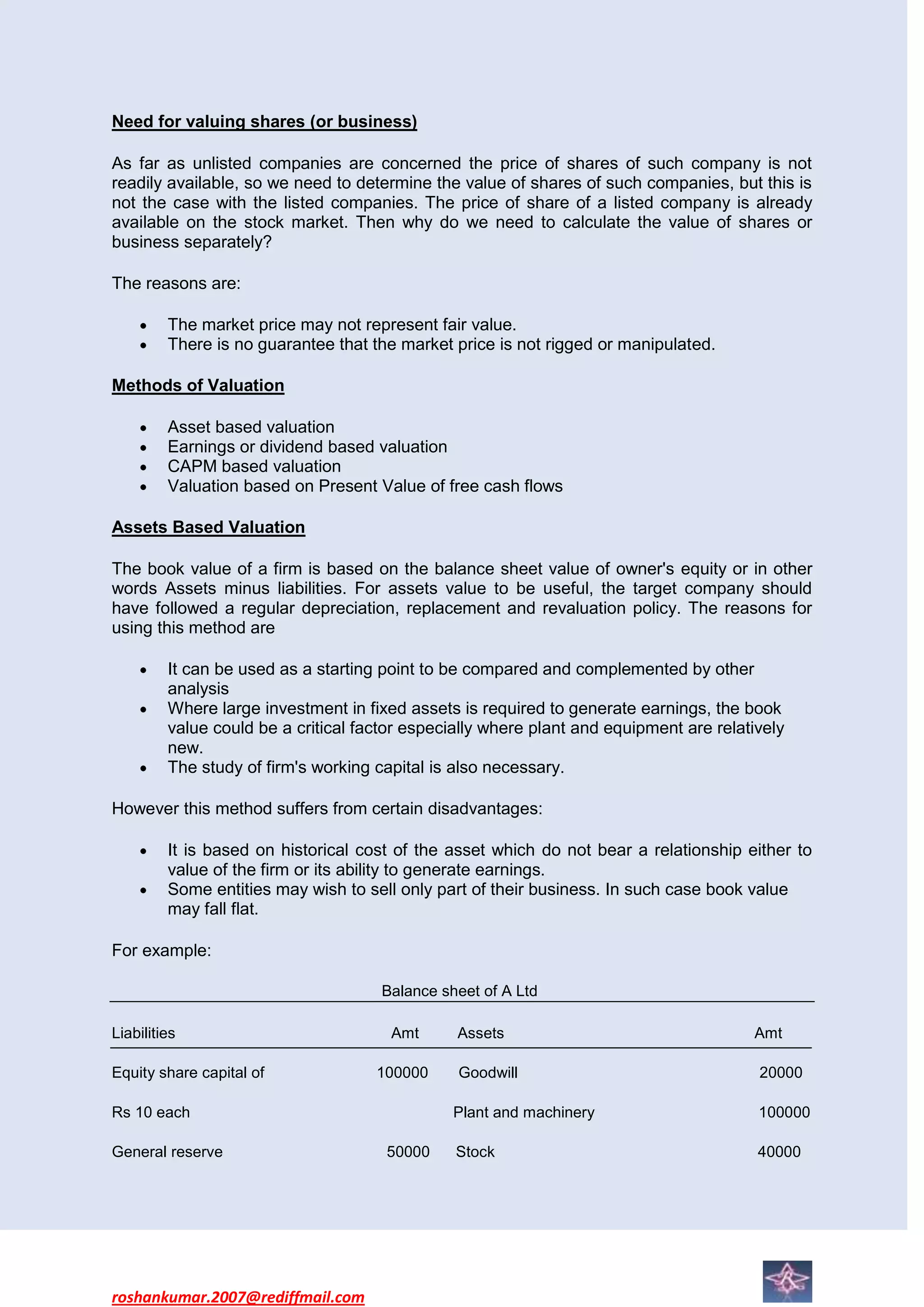
For example:

                                      Balance sheet of A Ltd

Liabilities                            Amt      Assets                                  Amt

Equity share capital of              100000     Goodwill                                 20000

Rs 10 each                                      Plant and machinery                      100000

General reserve                       50000     Stock                                    40000


roshankumar.2007@rediffmail.com
Creditors                            60000      Debtors                       50000

Tax payable                          30000      Cash at bank                  30000

Total                              240000       Total                        240000

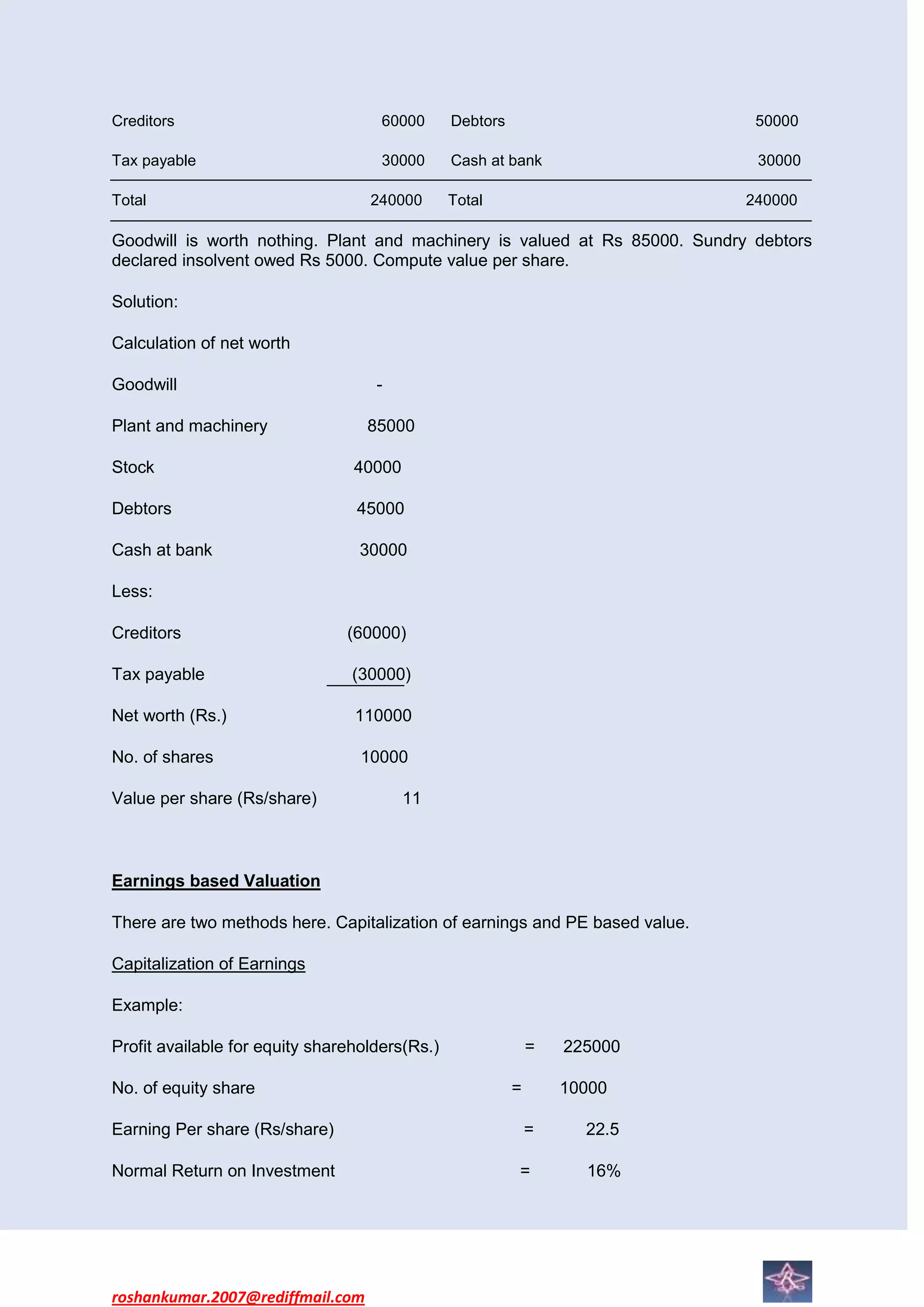
Goodwill is worth nothing. Plant and machinery is valued at Rs 85000. Sundry debtors
declared insolvent owed Rs 5000. Compute value per share.

Solution:

Calculation of net worth

Goodwill                            -

Plant and machinery                85000

Stock                            40000

Debtors                          45000

Cash at bank                      30000

Less:

Creditors                       (60000)

Tax payable                      (30000)

Net worth (Rs.)                  110000

No. of shares                     10000

Value per share (Rs/share)               11


Earnings based Valuation

There are two methods here. Capitalization of earnings and PE based value.

Capitalization of Earnings

Example:

Profit available for equity shareholders(Rs.)                 =   225000

No. of equity share                                       =       10000

Earning Per share (Rs/share)                                  =     22.5

Normal Return on Investment                               =         16%


roshankumar.2007@rediffmail.com
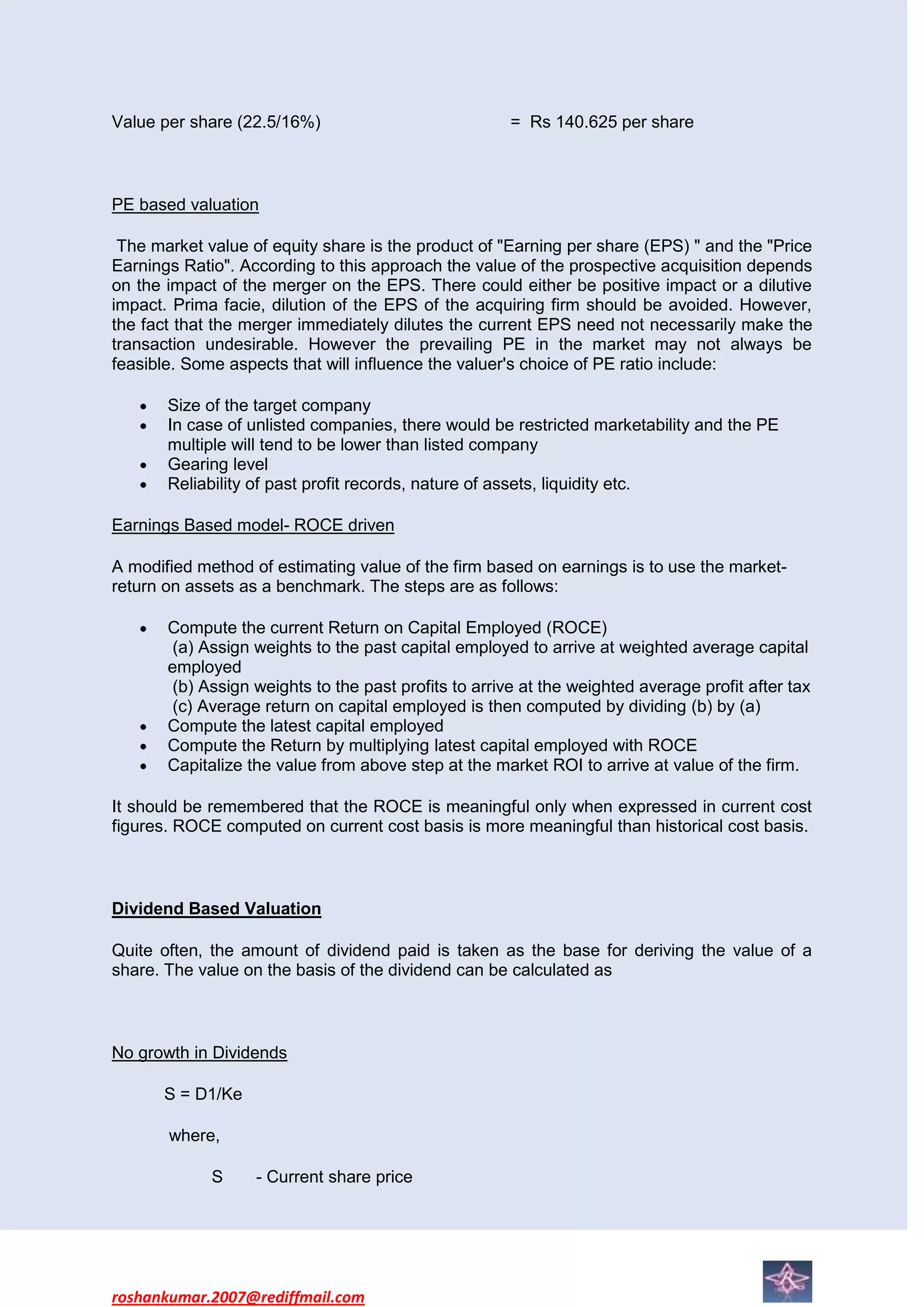
Value per share (22.5/16%)                            = Rs 140.625 per share


PE based valuation

 The market value of equity share is the product of "Earning per share (EPS) " and the "Price
Earnings Ratio". According to this approach the value of the prospective acquisition depends
on the impact of the merger on the EPS. There could either be positive impact or a dilutive
impact. Prima facie, dilution of the EPS of the acquiring firm should be avoided. However,
the fact that the merger immediately dilutes the current EPS need not necessarily make the
transaction undesirable. However the prevailing PE in the market may not always be
feasible. Some aspects that will influence the valuer's choice of PE ratio include:

       Size of the target company
       In case of unlisted companies, there would be restricted marketability and the PE
       multiple will tend to be lower than listed company
       Gearing level
       Reliability of past profit records, nature of assets, liquidity etc.

Earnings Based model- ROCE driven

A modified method of estimating value of the firm based on earnings is to use the market-
return on assets as a benchmark. The steps are as follows:

       Compute the current Return on Capital Employed (ROCE)
        (a) Assign weights to the past capital employed to arrive at weighted average capital
       employed
        (b) Assign weights to the past profits to arrive at the weighted average profit after tax
        (c) Average return on capital employed is then computed by dividing (b) by (a)
       Compute the latest capital employed
       Compute the Return by multiplying latest capital employed with ROCE
       Capitalize the value from above step at the market ROI to arrive at value of the firm.

It should be remembered that the ROCE is meaningful only when expressed in current cost
figures. ROCE computed on current cost basis is more meaningful than historical cost basis.


Dividend Based Valuation

Quite often, the amount of dividend paid is taken as the base for deriving the value of a
share. The value on the basis of the dividend can be calculated as


No growth in Dividends

      S = D1/Ke

       where,

             S     - Current share price


roshankumar.2007@rediffmail.com
D1     - Dividend

             Ke     - cost of equity


Constant Growth in Dividends

      S = [Do(1+g)] / (Ke-g)

       where,

             Do - Dividend of last year

             g    - Expected growth rate


CAPM based valuation

The Capital Asset pricing model can be used to value the shares. This method is useful
when we need to estimate the price for initial listing in the stock exchange. The crux of this
model is to arrive at the cost of the equity and then use it as the capitalization of dividend or
earning to arrive at the value of share.

The formula is:

ke = Rf + beta of the firm (Rm-Rf)

                             where,

                                       Ke - cost of equity
                                       Rf  - Risk free rate of return
                                       Rm - market rate of return.


Free Cash flow model

Free cash flow model facilitates estimating the maximum worthwhile price that one may pay
for a business. Free cash flow analysis utilizes the financial statements of the target-
business, to determine the distributable cash surpluses, and takes into account not merely
the additional investments required to maintain growth, but also the tie-up of funds needed to
meet incremental working capital requirements. Under this model value of the firm is
estimated by a three step procedure:

       Determine the free future cash flows:
          Net operating income + Depreciation - incremental investment in capital or current
       asset for each year separately.
       Determine terminal cash flows, on the assumption that there would be constant
       growth, or no growth.
       Present values these cash flows can then be compared with the price that we would
       pay for the acquisition..


roshankumar.2007@rediffmail.com
However while estimating future cash flows, the sensitivity of cash flows to various factors
should also be considered.


Fair Value

Instead of placing reliance on a single method, it preferable to base our valuation on the
average of results of two or three types discussed above. Normally fair value is ascertained
as the average of net asset value (NAV) per share and the capitalized value of earnings per
share (EPS). This particular method is also known as Berliner Method.


roshankumar.2007@rediffmail.com

Valuation methods used in mergers & acquisitions

  • 1.
    Valuation Methods UsedIn Mergers & Acquisition Roshankumar S Pimpalkar roshankumar.2007@rediffmail.com
  • 2.
    Need for valuingshares (or business) As far as unlisted companies are concerned the price of shares of such company is not readily available, so we need to determine the value of shares of such companies, but this is not the case with the listed companies. The price of share of a listed company is already available on the stock market. Then why do we need to calculate the value of shares or business separately? The reasons are: The market price may not represent fair value. There is no guarantee that the market price is not rigged or manipulated. Methods of Valuation Asset based valuation Earnings or dividend based valuation CAPM based valuation Valuation based on Present Value of free cash flows Assets Based Valuation The book value of a firm is based on the balance sheet value of owner's equity or in other words Assets minus liabilities. For assets value to be useful, the target company should have followed a regular depreciation, replacement and revaluation policy. The reasons for using this method are It can be used as a starting point to be compared and complemented by other analysis Where large investment in fixed assets is required to generate earnings, the book value could be a critical factor especially where plant and equipment are relatively new. The study of firm's working capital is also necessary. However this method suffers from certain disadvantages: It is based on historical cost of the asset which do not bear a relationship either to value of the firm or its ability to generate earnings. Some entities may wish to sell only part of their business. In such case book value may fall flat. For example: Balance sheet of A Ltd Liabilities Amt Assets Amt Equity share capital of 100000 Goodwill 20000 Rs 10 each Plant and machinery 100000 General reserve 50000 Stock 40000 roshankumar.2007@rediffmail.com
  • 3.
    Creditors 60000 Debtors 50000 Tax payable 30000 Cash at bank 30000 Total 240000 Total 240000 Goodwill is worth nothing. Plant and machinery is valued at Rs 85000. Sundry debtors declared insolvent owed Rs 5000. Compute value per share. Solution: Calculation of net worth Goodwill - Plant and machinery 85000 Stock 40000 Debtors 45000 Cash at bank 30000 Less: Creditors (60000) Tax payable (30000) Net worth (Rs.) 110000 No. of shares 10000 Value per share (Rs/share) 11 Earnings based Valuation There are two methods here. Capitalization of earnings and PE based value. Capitalization of Earnings Example: Profit available for equity shareholders(Rs.) = 225000 No. of equity share = 10000 Earning Per share (Rs/share) = 22.5 Normal Return on Investment = 16% roshankumar.2007@rediffmail.com
  • 4.
    Value per share(22.5/16%) = Rs 140.625 per share PE based valuation The market value of equity share is the product of "Earning per share (EPS) " and the "Price Earnings Ratio". According to this approach the value of the prospective acquisition depends on the impact of the merger on the EPS. There could either be positive impact or a dilutive impact. Prima facie, dilution of the EPS of the acquiring firm should be avoided. However, the fact that the merger immediately dilutes the current EPS need not necessarily make the transaction undesirable. However the prevailing PE in the market may not always be feasible. Some aspects that will influence the valuer's choice of PE ratio include: Size of the target company In case of unlisted companies, there would be restricted marketability and the PE multiple will tend to be lower than listed company Gearing level Reliability of past profit records, nature of assets, liquidity etc. Earnings Based model- ROCE driven A modified method of estimating value of the firm based on earnings is to use the market- return on assets as a benchmark. The steps are as follows: Compute the current Return on Capital Employed (ROCE) (a) Assign weights to the past capital employed to arrive at weighted average capital employed (b) Assign weights to the past profits to arrive at the weighted average profit after tax (c) Average return on capital employed is then computed by dividing (b) by (a) Compute the latest capital employed Compute the Return by multiplying latest capital employed with ROCE Capitalize the value from above step at the market ROI to arrive at value of the firm. It should be remembered that the ROCE is meaningful only when expressed in current cost figures. ROCE computed on current cost basis is more meaningful than historical cost basis. Dividend Based Valuation Quite often, the amount of dividend paid is taken as the base for deriving the value of a share. The value on the basis of the dividend can be calculated as No growth in Dividends S = D1/Ke where, S - Current share price roshankumar.2007@rediffmail.com
  • 5.
    D1 - Dividend Ke - cost of equity Constant Growth in Dividends S = [Do(1+g)] / (Ke-g) where, Do - Dividend of last year g - Expected growth rate CAPM based valuation The Capital Asset pricing model can be used to value the shares. This method is useful when we need to estimate the price for initial listing in the stock exchange. The crux of this model is to arrive at the cost of the equity and then use it as the capitalization of dividend or earning to arrive at the value of share. The formula is: ke = Rf + beta of the firm (Rm-Rf) where, Ke - cost of equity Rf - Risk free rate of return Rm - market rate of return. Free Cash flow model Free cash flow model facilitates estimating the maximum worthwhile price that one may pay for a business. Free cash flow analysis utilizes the financial statements of the target- business, to determine the distributable cash surpluses, and takes into account not merely the additional investments required to maintain growth, but also the tie-up of funds needed to meet incremental working capital requirements. Under this model value of the firm is estimated by a three step procedure: Determine the free future cash flows: Net operating income + Depreciation - incremental investment in capital or current asset for each year separately. Determine terminal cash flows, on the assumption that there would be constant growth, or no growth. Present values these cash flows can then be compared with the price that we would pay for the acquisition.. roshankumar.2007@rediffmail.com
  • 6.
    However while estimatingfuture cash flows, the sensitivity of cash flows to various factors should also be considered. Fair Value Instead of placing reliance on a single method, it preferable to base our valuation on the average of results of two or three types discussed above. Normally fair value is ascertained as the average of net asset value (NAV) per share and the capitalized value of earnings per share (EPS). This particular method is also known as Berliner Method. roshankumar.2007@rediffmail.com