About Me
?L74 D@
Director of Pre-Sale Strategy and AI Delivery
15+ DK6 6  ( as Project Manager, Product Owner), 6
DK6 6 Delivery Management, 74D47 Director Of Pre-
Sale  AI Delivery
N5?N Pre-sale F4 ?EFK=A 68EA4?NN ?DF5E8
@K6 @4A84@8
8LF EF4FFK A4 DOU F4 dev.ua, 658F D?D4F86AK
FD5AKA78
What experience do you have with pre-sale?
Delivery Manager in Pre-sale
You are responsible for giving commitments on behalf of your company/team and the contracts preparation
A significant part of your time is spent communicating with the customers - presentation and negotiation skills are critical
here
The quality of your work determines how many contracts are signed and whether the delivery team has issues with
unrealistic commitments
Your work is more diverse and hectic - tens of presales per year, usually lasting for a few weeks each
Your feedback loops are shorter, because of the smaller duration of presales compared to implementation projects
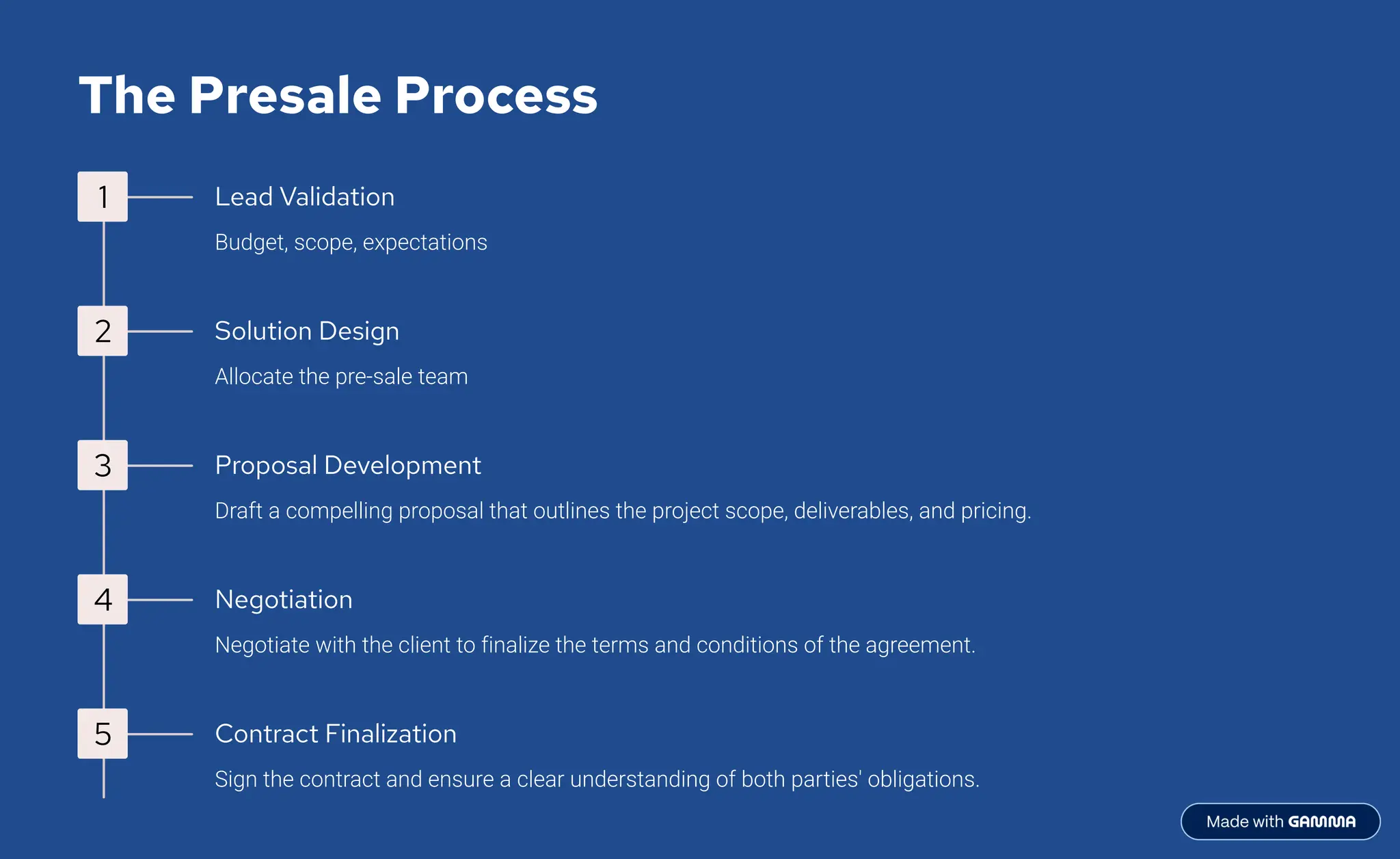
The Presale Process
1 Lead Validation
Budget, scope, expectations
2 Solution Design
Allocate the pre-sale team
3 Proposal Development
Draft a compelling proposal that outlines the project scope, deliverables, and pricing.
4 Negotiation
Negotiate with the client to finalize the terms and conditions of the agreement.
5 Contract Finalization
Sign the contract and ensure a clear understanding of both parties' obligations.
How do you usually prepare for pre-sale with a new
lead?
Business ( Revenue) Models of Client Businesses
A business model outlines how a company creates, delivers, and captures value. It is the blueprint for how a business operates,
generates revenue, and sustains profitability. Here are some common types of business models:
X Common Types of Business Revenue Models
Sales (Transactional) Model Revenue comes from selling goods or services directly. Examples: Retail stores, e-commerce,
car dealerships. Amazon (product sales) or Apple Store.
1.
Subscription Model Customers pay a recurring fee (monthly, yearly) for continued access to a product or service. Examples:
Netflix, Spotify, SaaS companies. D Provides predictable recurring revenue.
2.
Freemium Model Basic features are free; advanced features cost money. Examples: Zoom, Dropbox, Slack. D Converts free
users into paying customers over time.
3.
Advertising Model Revenue comes from selling ad space or attention of users to advertisers. Examples: YouTube,
Facebook, Google Search. D Users get free services, advertisers pay.
4.
Commission / Brokerage Model The business earns a percentage or fixed fee for facilitating transactions between two
parties. Examples: Uber, Airbnb, eBay. D Acts as a middleman= platform.
5.
Licensing Model Customers pay to use intellectual property, software, or content. Examples: Microsoft Office (software
license), stock photo sites. D Scales well for digital products.
6.
Affiliate Model The business earns a commission for promoting another company9s product. Examples: Bloggers or
influencers using Amazon Affiliate links. D Low cost, relies on performance.
7.
Usage-Based (Pay-as-You-Go) Model Customers pay based on how much they use a service. Examples: AWS cloud
services, mobile data plans. D Flexible and scalable pricing.
8.
Hybrid Model Combines multiple revenue streams for diversification. Example: Amazon (product sales + subscription +
advertising).
9.
Organizational Structures of Client Businesses
An organizational structure defines how activities such as task allocation, coordination, and
supervision are directed toward achieving organizational goals. It determines the flow of information
and delineates authority and responsibility.
Functional Structure Description: Groups employees based on specialized functions (e.g., marketing,
finance, production).
Advantages: Encourages specialization and efficiency within departments.
Disadvantages: Can create silos and hinder cross-departmental communication.
Divisional Structure Description: Segregates the company based on products, services, markets, or geographic locations.
Advantages: Focuses on specific market segments or products, enhancing responsiveness.
Disadvantages: Potential duplication of resources and efforts across divisions.
Matrix Structure Description: Combines functional and divisional structures, with dual reporting relationships. Disadvantages:
Can lead to confusion and conflicts due to dual authority.
Advantages: Facilitates efficient information flow and resource sharing.
Disadvantages: Can lead to confusion and conflicts due to dual authority.
Flat Structure Description: Minimizes hierarchical levels between staff and executives.
Advantages: Enhances communication and decision-making speed.
Disadvantages: May result in unclear roles and overburdened management.
Network Structure Description: Centralizes core functions while outsourcing others to external entities.
Advantages: Increases flexibility and focuses on core competencies.
Disadvantages: Reliance on external partners can pose risks.
Innovative Startups Business Model: Often adopt a freemium or subscription model.
Organizational Structure: May use a flat or team-based structure to foster innovation and
agility.
Large Multinationals Business Model: Might employ a diversified product-based
model. Organizational Structure: Likely to have a divisional or matrix structure to manage
complexity across products and regions.
Service-Oriented Firms Business Model: Service-based or consulting models.
Organizational Structure: Functional or network structures to leverage specialized
expertise.
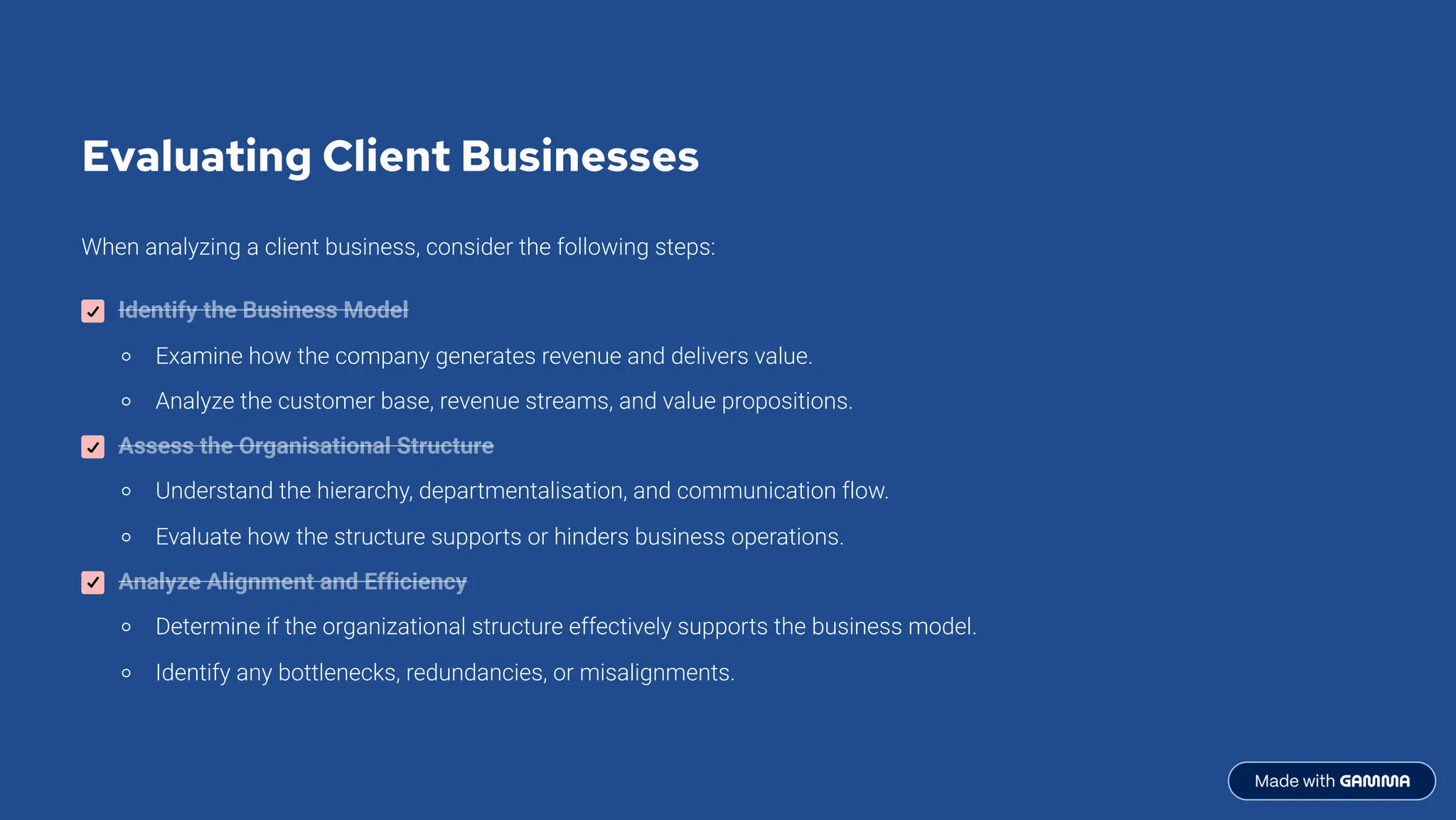
Evaluating Client Businesses
When analyzing a client business, consider the following steps:
Identify the Business Model
Examine how the company generates revenue and delivers value.
Analyze the customer base, revenue streams, and value propositions.
Assess the Organisational Structure
Understand the hierarchy, departmentalisation, and communication flow.
Evaluate how the structure supports or hinders business operations.
Analyze Alignment and Efficiency
Determine if the organizational structure effectively supports the business model.
Identify any bottlenecks, redundancies, or misalignments.
Customer Profile
Key Components of the Customer Profile Document
Below are the essential sections that should be included:
Company Overview Business Name: Official name of the company. Industry: Sector in which the company operates.
Location: Headquarters and key operational regions. Size: Number of employees, revenue figures.
Business Model and Organizational Structure Business Model: Detailed description of how the company generates
revenue. Products/Services Offered: List of main products or services. Organizational Structure: Insight into the company's
hierarchy and departmental setup.
Key Stakeholders and Decision-Makers Names and Titles: Who are the influencers and decision-makers? Roles and
Responsibilities: Their involvement in the potential project.
Current Challenges and Pain Points Operational Issues: Problems affecting efficiency. Market Challenges: Competitive
pressures, market entry issues. Technical Limitations: Existing technology constraints.
Project Scope and Requirements Objectives: What the client aims to achieve. Deliverables: Expected outputs or services.
Timeline: Project start date and expected completion.
Budget and Financial Considerations Estimated Budget: Available funding for the project. Financial Constraints: Any
limitations or special terms.
Competitive Landscape Competitors: Major competitors and their market position. Differentiators: What sets the client
apart in the market.
Existing Technologies and Infrastructure Current Systems: Technologies and platforms in use. Integration Needs:
Requirements for integrating new solutions.
Regulatory and Compliance Requirements Industry Regulations: Any compliance standards that must be met. Data
Security: Requirements for data handling and protection.
Additional Notes and Observations Cultural Fit: Alignment of company cultures. Risks and Concerns: Potential obstacles or
red flags. Opportunities for Growth: Areas where the client could expand or improve.
Business Engagement Models
Engagement Models
Dedicated Team Model
Description: A team of professionals is
allocated exclusively to the client for a
specified period.
Features: Team acts as an extension of the client's in-
house staff. Clients have control over team selection
and workload.
Specifics:
Control: High level of oversight and management of
the team.
Scalability: Easy to scale resources up or down
based on needs.
Considerations: Management
Responsibility: Client needs to manage the team's
daily activities.
Cost: cheaper than TM as paid on FTE rates
Managed Services Model
Description: The service provider manages the entire project or service area, delivering agreed-upon outcomes.
Features: Service Level Agreements (SLAs) define expectations. Provider takes responsibility for process and resource
management.
Advantages:
Expertise: Leverages the provider's specialized skills and experience.
Focus on Core Business: Clients can concentrate on their primary activities.
Dependency: Client relies heavily on the provider's capabilities.
Less Control: Limited oversight over how services are delivered.
Staff Augmentation
Model Description: Provider supplies additional personnel to supplement the client's existing team.
Features: Personnel work under the client's direction. Typically used for short-term needs or specific skills. Advantages:
Resource Gap Filling: Addresses immediate staffing needs.
Cost-Effective: Avoids long-term employment commitments.
Considerations: Training Requirements: May need to onboard temporary staff. Integration: Ensuring augmented staff fit into
existing team dynamics.
Co-Sourcing/Hybrid Model
Description: Combines in-house resources with external expertise from the provider.
Features: Joint responsibility for project execution. Shared resources and management.
Advantages:
Collaboration: Leverages strengths of both organizations.
Flexibility: Adjust resource levels as needed.
Considerations: Coordination Challenges: Requires effective communication and management. Role Clarity: Potential for
overlapping responsibilities.
Outcome-Based Model Description:
Payment and engagement are based on achieving specific results or outcomes.
Features: Clearly defined performance metrics. Provider is incentivized to meet or exceed targets.
Advantages:
Alignment of Interests: Both parties focus on end results.
Efficiency: Encourages provider to optimize processes.
Considerations: Defining Outcomes: Requires precise and measurable objectives. Risk Sharing: Provider assumes more risk if
outcomes are not met.
Time and Material Price Model
Description: is a pricing approach
where the client pays the service
provider based on the actual time
spent on the project and the materials
or resources used.
Features: The time and materials model involves
payment for the time and effort spent on development
4 that is, for the actual time spent implementing
planned project functionality.
Specifics:
Control: on the client
Scalability: adaptation needs/market requirements
gives flexibility to make changes to the project
Considerations: Budget and cost control
Responsibility: Practical involvement of the client in
the development process in order to monitor the
performance of a certain work schedule in
accordance with the expected results.
Cost: expensive
Fixed Price Model
Description: a project pricing approach
where the service provider agrees to
deliver a specific scope of work for a
predetermined, fixed cost.
Features: The fixed price model (or fixed budget model
or fixed-capacity model) is considered riskier for
developers since all risks are on them. The fixed bid
model is most favorable for the client, who has the
opportunity to defer payment.
Specifics:
Control: on the vendor
Scalability: A long preparation period is needed as
all requirements for implementation and deadlines
must be documented.
Considerations: Budget and cost control
Responsibility: on the vendor, but if the project goes
wrong two sides suffer
Cost: The cost of work is agreed before signing the
software development contract. Consider payment
terms carefully.
Exercise:
Work in groups for 15 minutes. Present the results.
Case 1. Case 2.
Project Scenario
Client Profile
Industry: Financial Services
Company Size: Mid-sized enterprise with 500
employees
Organizational Structure: Hierarchical with well-
defined departments
Business Model: Provides investment and wealth
management services
Project Description
Objective: Develop a secure client portal for investors
to view portfolios, statements, and performance
reports
Scope:
Web-based application accessible via desktop and
mobile browsers
Integration with existing backend systems and
databases
Implementation of data visualization tools for
performance tracking
Expected Outcomes:
Enhance client satisfaction by providing real-time
access to investment information
Reduce manual report generation by staff
Requirements
Functional Requirements:
Secure login and multi-factor authentication
Dashboard displaying account balances,
transaction history, and portfolio performance
Document center for statements and reports
Non-Functional Requirements:
High security standards to comply with financial
regulations
User-friendly interface adhering to company
branding
Technology Stack:
Preferred use of .NET framework and Microsoft
Azure services
Constraints
Budget: Fixed budget allocated for the project
Timeline: Must be completed within four months to
align with the new financial year
Resources: Client's IT team is occupied with other
compliance projects; limited availability for
collaboration
Risk Factors
Regulatory Compliance: Must meet stringent financial
industry regulations (e.g., GDPR, PCI DSS)
Scope Creep: Potential for additional feature requests
from stakeholders
Client's Priorities
Cost Predictability: Need to stay within the allocated
budget
Quality Assurance: High emphasis on security and
reliability
Defined Scope: Clear set of requirements with minimal
expected changes
Project Scenario
Client Profile
Industry: Global E-commerce Retailer
Company Size: Large enterprise with over 5,000
employees
Organizational Structure: Matrix structure with cross-
functional teams
Business Model: Online marketplace operating in
multiple countries
Project Description
Objective: Continuous development and maintenance
of a multi-language, multi-currency e-commerce
platform
Scope:
Ongoing feature enhancements and optimizations
Localization for new markets (languages,
currencies, regional regulations)
Performance tuning and scalability improvements
Expected Outcomes:
Accelerate time-to-market for new features
Improve user experience and platform stability
Expand into emerging markets efficiently
Requirements
Functional Requirements:
Integration of new payment gateways
Development of personalized recommendation
engines
Implementation of advanced search functionalities
Non-Functional Requirements:
High availability and uptime
Ability to handle peak traffic during sales events
Technology Stack:
Microservices architecture using Java and Node.js
Cloud infrastructure on AWS
Constraints
Budget: Significant budget allocated for ongoing
development
Timeline: Continuous development with no fixed end
date
Resources: In-house teams are at full capacity; need
for additional skilled developers
Risk Factors
Market Dynamics: Rapid changes in e-commerce
trends and customer expectations
Scalability Challenges: Need to handle increasing user
loads efficiently
Client's Priorities
Control and Flexibility: Desire to manage priorities and
workloads dynamically
Quality and Expertise: Need for high-caliber talent
familiar with their technology stack
Long-Term Collaboration: Looking for a partner to
grow with the business
Which model to choose?
Understanding Project Scope and Clarity
Well-defined vs. evolving requirements.
Assessing Project Complexity
Predictable outcome vs. innovative project or RD
Evaluating Risk Factors
Client risk tolerance and company willingness to assume risks associated with cost overruns or project changes
Budget Constraints and Financial Planning
Fixed budget vs. flexibility for cost variations
Resource Availability
In-house capabilities vs. need for external expertise.
Timeline and Deadline Sensitivity
In-house capabilities vs. need for external expertise.
Client's Long-Term Needs and Relationship
Previous Experience with the Client
Key Takeaways and Conclusion
Selecting the appropriate customer engagement model is a strategic
decision that can significantly impact the success of a project or service
delivery. By understanding the different models available and evaluating
them against your project's specific needs, resources, and constraints,
you can forge a partnership that enhances efficiency, fosters innovation,
and delivers value to both your business and your clients.
Homework: Define the customer profile and engagement model for your
project.
Q  A
LinkedIn - Olga Grom

Olga Grom: Presale та комерційні моделі (UA)

  • 2.
    About Me ?L74 D@ Directorof Pre-Sale Strategy and AI Delivery 15+ DK6 6 ( as Project Manager, Product Owner), 6 DK6 6 Delivery Management, 74D47 Director Of Pre- Sale AI Delivery N5?N Pre-sale F4 ?EFK=A 68EA4?NN ?DF5E8 @K6 @4A84@8 8LF EF4FFK A4 DOU F4 dev.ua, 658F D?D4F86AK FD5AKA78
  • 3.
    What experience doyou have with pre-sale?
  • 4.
    Delivery Manager inPre-sale You are responsible for giving commitments on behalf of your company/team and the contracts preparation A significant part of your time is spent communicating with the customers - presentation and negotiation skills are critical here The quality of your work determines how many contracts are signed and whether the delivery team has issues with unrealistic commitments Your work is more diverse and hectic - tens of presales per year, usually lasting for a few weeks each Your feedback loops are shorter, because of the smaller duration of presales compared to implementation projects
  • 5.
    The Presale Process 1Lead Validation Budget, scope, expectations 2 Solution Design Allocate the pre-sale team 3 Proposal Development Draft a compelling proposal that outlines the project scope, deliverables, and pricing. 4 Negotiation Negotiate with the client to finalize the terms and conditions of the agreement. 5 Contract Finalization Sign the contract and ensure a clear understanding of both parties' obligations.
  • 6.
    How do youusually prepare for pre-sale with a new lead?
  • 7.
    Business ( Revenue)Models of Client Businesses A business model outlines how a company creates, delivers, and captures value. It is the blueprint for how a business operates, generates revenue, and sustains profitability. Here are some common types of business models: X Common Types of Business Revenue Models Sales (Transactional) Model Revenue comes from selling goods or services directly. Examples: Retail stores, e-commerce, car dealerships. Amazon (product sales) or Apple Store. 1. Subscription Model Customers pay a recurring fee (monthly, yearly) for continued access to a product or service. Examples: Netflix, Spotify, SaaS companies. D Provides predictable recurring revenue. 2. Freemium Model Basic features are free; advanced features cost money. Examples: Zoom, Dropbox, Slack. D Converts free users into paying customers over time. 3. Advertising Model Revenue comes from selling ad space or attention of users to advertisers. Examples: YouTube, Facebook, Google Search. D Users get free services, advertisers pay. 4. Commission / Brokerage Model The business earns a percentage or fixed fee for facilitating transactions between two parties. Examples: Uber, Airbnb, eBay. D Acts as a middleman= platform. 5. Licensing Model Customers pay to use intellectual property, software, or content. Examples: Microsoft Office (software license), stock photo sites. D Scales well for digital products. 6. Affiliate Model The business earns a commission for promoting another company9s product. Examples: Bloggers or influencers using Amazon Affiliate links. D Low cost, relies on performance. 7. Usage-Based (Pay-as-You-Go) Model Customers pay based on how much they use a service. Examples: AWS cloud services, mobile data plans. D Flexible and scalable pricing. 8. Hybrid Model Combines multiple revenue streams for diversification. Example: Amazon (product sales + subscription + advertising). 9.
  • 8.
    Organizational Structures ofClient Businesses An organizational structure defines how activities such as task allocation, coordination, and supervision are directed toward achieving organizational goals. It determines the flow of information and delineates authority and responsibility. Functional Structure Description: Groups employees based on specialized functions (e.g., marketing, finance, production). Advantages: Encourages specialization and efficiency within departments. Disadvantages: Can create silos and hinder cross-departmental communication.
  • 9.
    Divisional Structure Description:Segregates the company based on products, services, markets, or geographic locations. Advantages: Focuses on specific market segments or products, enhancing responsiveness. Disadvantages: Potential duplication of resources and efforts across divisions.
  • 10.
    Matrix Structure Description:Combines functional and divisional structures, with dual reporting relationships. Disadvantages: Can lead to confusion and conflicts due to dual authority. Advantages: Facilitates efficient information flow and resource sharing. Disadvantages: Can lead to confusion and conflicts due to dual authority.
  • 11.
    Flat Structure Description:Minimizes hierarchical levels between staff and executives. Advantages: Enhances communication and decision-making speed. Disadvantages: May result in unclear roles and overburdened management.
  • 12.
    Network Structure Description:Centralizes core functions while outsourcing others to external entities. Advantages: Increases flexibility and focuses on core competencies. Disadvantages: Reliance on external partners can pose risks.
  • 13.
    Innovative Startups BusinessModel: Often adopt a freemium or subscription model. Organizational Structure: May use a flat or team-based structure to foster innovation and agility. Large Multinationals Business Model: Might employ a diversified product-based model. Organizational Structure: Likely to have a divisional or matrix structure to manage complexity across products and regions. Service-Oriented Firms Business Model: Service-based or consulting models. Organizational Structure: Functional or network structures to leverage specialized expertise.
  • 14.
    Evaluating Client Businesses Whenanalyzing a client business, consider the following steps: Identify the Business Model Examine how the company generates revenue and delivers value. Analyze the customer base, revenue streams, and value propositions. Assess the Organisational Structure Understand the hierarchy, departmentalisation, and communication flow. Evaluate how the structure supports or hinders business operations. Analyze Alignment and Efficiency Determine if the organizational structure effectively supports the business model. Identify any bottlenecks, redundancies, or misalignments.
  • 15.
    Customer Profile Key Componentsof the Customer Profile Document Below are the essential sections that should be included: Company Overview Business Name: Official name of the company. Industry: Sector in which the company operates. Location: Headquarters and key operational regions. Size: Number of employees, revenue figures. Business Model and Organizational Structure Business Model: Detailed description of how the company generates revenue. Products/Services Offered: List of main products or services. Organizational Structure: Insight into the company's hierarchy and departmental setup. Key Stakeholders and Decision-Makers Names and Titles: Who are the influencers and decision-makers? Roles and Responsibilities: Their involvement in the potential project. Current Challenges and Pain Points Operational Issues: Problems affecting efficiency. Market Challenges: Competitive pressures, market entry issues. Technical Limitations: Existing technology constraints. Project Scope and Requirements Objectives: What the client aims to achieve. Deliverables: Expected outputs or services. Timeline: Project start date and expected completion. Budget and Financial Considerations Estimated Budget: Available funding for the project. Financial Constraints: Any limitations or special terms. Competitive Landscape Competitors: Major competitors and their market position. Differentiators: What sets the client apart in the market. Existing Technologies and Infrastructure Current Systems: Technologies and platforms in use. Integration Needs: Requirements for integrating new solutions. Regulatory and Compliance Requirements Industry Regulations: Any compliance standards that must be met. Data Security: Requirements for data handling and protection. Additional Notes and Observations Cultural Fit: Alignment of company cultures. Risks and Concerns: Potential obstacles or red flags. Opportunities for Growth: Areas where the client could expand or improve.
  • 16.
  • 17.
    Engagement Models Dedicated TeamModel Description: A team of professionals is allocated exclusively to the client for a specified period. Features: Team acts as an extension of the client's in- house staff. Clients have control over team selection and workload. Specifics: Control: High level of oversight and management of the team. Scalability: Easy to scale resources up or down based on needs. Considerations: Management Responsibility: Client needs to manage the team's daily activities. Cost: cheaper than TM as paid on FTE rates
  • 18.
    Managed Services Model Description:The service provider manages the entire project or service area, delivering agreed-upon outcomes. Features: Service Level Agreements (SLAs) define expectations. Provider takes responsibility for process and resource management. Advantages: Expertise: Leverages the provider's specialized skills and experience. Focus on Core Business: Clients can concentrate on their primary activities. Dependency: Client relies heavily on the provider's capabilities. Less Control: Limited oversight over how services are delivered. Staff Augmentation Model Description: Provider supplies additional personnel to supplement the client's existing team. Features: Personnel work under the client's direction. Typically used for short-term needs or specific skills. Advantages: Resource Gap Filling: Addresses immediate staffing needs. Cost-Effective: Avoids long-term employment commitments. Considerations: Training Requirements: May need to onboard temporary staff. Integration: Ensuring augmented staff fit into existing team dynamics. Co-Sourcing/Hybrid Model Description: Combines in-house resources with external expertise from the provider. Features: Joint responsibility for project execution. Shared resources and management. Advantages: Collaboration: Leverages strengths of both organizations. Flexibility: Adjust resource levels as needed. Considerations: Coordination Challenges: Requires effective communication and management. Role Clarity: Potential for overlapping responsibilities. Outcome-Based Model Description: Payment and engagement are based on achieving specific results or outcomes. Features: Clearly defined performance metrics. Provider is incentivized to meet or exceed targets. Advantages: Alignment of Interests: Both parties focus on end results. Efficiency: Encourages provider to optimize processes. Considerations: Defining Outcomes: Requires precise and measurable objectives. Risk Sharing: Provider assumes more risk if outcomes are not met.
  • 19.
    Time and MaterialPrice Model Description: is a pricing approach where the client pays the service provider based on the actual time spent on the project and the materials or resources used. Features: The time and materials model involves payment for the time and effort spent on development 4 that is, for the actual time spent implementing planned project functionality. Specifics: Control: on the client Scalability: adaptation needs/market requirements gives flexibility to make changes to the project Considerations: Budget and cost control Responsibility: Practical involvement of the client in the development process in order to monitor the performance of a certain work schedule in accordance with the expected results. Cost: expensive
  • 20.
    Fixed Price Model Description:a project pricing approach where the service provider agrees to deliver a specific scope of work for a predetermined, fixed cost. Features: The fixed price model (or fixed budget model or fixed-capacity model) is considered riskier for developers since all risks are on them. The fixed bid model is most favorable for the client, who has the opportunity to defer payment. Specifics: Control: on the vendor Scalability: A long preparation period is needed as all requirements for implementation and deadlines must be documented. Considerations: Budget and cost control Responsibility: on the vendor, but if the project goes wrong two sides suffer Cost: The cost of work is agreed before signing the software development contract. Consider payment terms carefully.
  • 21.
    Exercise: Work in groupsfor 15 minutes. Present the results. Case 1. Case 2. Project Scenario Client Profile Industry: Financial Services Company Size: Mid-sized enterprise with 500 employees Organizational Structure: Hierarchical with well- defined departments Business Model: Provides investment and wealth management services Project Description Objective: Develop a secure client portal for investors to view portfolios, statements, and performance reports Scope: Web-based application accessible via desktop and mobile browsers Integration with existing backend systems and databases Implementation of data visualization tools for performance tracking Expected Outcomes: Enhance client satisfaction by providing real-time access to investment information Reduce manual report generation by staff Requirements Functional Requirements: Secure login and multi-factor authentication Dashboard displaying account balances, transaction history, and portfolio performance Document center for statements and reports Non-Functional Requirements: High security standards to comply with financial regulations User-friendly interface adhering to company branding Technology Stack: Preferred use of .NET framework and Microsoft Azure services Constraints Budget: Fixed budget allocated for the project Timeline: Must be completed within four months to align with the new financial year Resources: Client's IT team is occupied with other compliance projects; limited availability for collaboration Risk Factors Regulatory Compliance: Must meet stringent financial industry regulations (e.g., GDPR, PCI DSS) Scope Creep: Potential for additional feature requests from stakeholders Client's Priorities Cost Predictability: Need to stay within the allocated budget Quality Assurance: High emphasis on security and reliability Defined Scope: Clear set of requirements with minimal expected changes Project Scenario Client Profile Industry: Global E-commerce Retailer Company Size: Large enterprise with over 5,000 employees Organizational Structure: Matrix structure with cross- functional teams Business Model: Online marketplace operating in multiple countries Project Description Objective: Continuous development and maintenance of a multi-language, multi-currency e-commerce platform Scope: Ongoing feature enhancements and optimizations Localization for new markets (languages, currencies, regional regulations) Performance tuning and scalability improvements Expected Outcomes: Accelerate time-to-market for new features Improve user experience and platform stability Expand into emerging markets efficiently Requirements Functional Requirements: Integration of new payment gateways Development of personalized recommendation engines Implementation of advanced search functionalities Non-Functional Requirements: High availability and uptime Ability to handle peak traffic during sales events Technology Stack: Microservices architecture using Java and Node.js Cloud infrastructure on AWS Constraints Budget: Significant budget allocated for ongoing development Timeline: Continuous development with no fixed end date Resources: In-house teams are at full capacity; need for additional skilled developers Risk Factors Market Dynamics: Rapid changes in e-commerce trends and customer expectations Scalability Challenges: Need to handle increasing user loads efficiently Client's Priorities Control and Flexibility: Desire to manage priorities and workloads dynamically Quality and Expertise: Need for high-caliber talent familiar with their technology stack Long-Term Collaboration: Looking for a partner to grow with the business
  • 22.
    Which model tochoose? Understanding Project Scope and Clarity Well-defined vs. evolving requirements. Assessing Project Complexity Predictable outcome vs. innovative project or RD Evaluating Risk Factors Client risk tolerance and company willingness to assume risks associated with cost overruns or project changes Budget Constraints and Financial Planning Fixed budget vs. flexibility for cost variations Resource Availability In-house capabilities vs. need for external expertise. Timeline and Deadline Sensitivity In-house capabilities vs. need for external expertise. Client's Long-Term Needs and Relationship Previous Experience with the Client
  • 23.
    Key Takeaways andConclusion Selecting the appropriate customer engagement model is a strategic decision that can significantly impact the success of a project or service delivery. By understanding the different models available and evaluating them against your project's specific needs, resources, and constraints, you can forge a partnership that enhances efficiency, fosters innovation, and delivers value to both your business and your clients. Homework: Define the customer profile and engagement model for your project.
  • 24.
    Q A LinkedIn- Olga Grom