
TOWARDS A DEVELOPMENT
FRAMEWORK BASED ON BEHAVIOR
RECOMBINATION


 Houman Younessi, RH,     RPI, USA
 Renaud Pawlak, LISITE, ISEP, France
 Carlos E. Cuesta, VorTIC3, URJC, Spain

                     Hersonissos, Crete, Greece, 18/10/2011
CONTENTS

   Introduction

   Behavioral Recombination Framework (BRF)
       Behavior Predicates

       Abstracting Behavior

       Recombining Behaviors

       The Recombinator

   Related work

   Conclusions & Future work                  2
INTRODUCTION:
THE NEED FOR VARIABILITY
   Adaptation needs variability
     Variation points imply a strategic choice
     For instance, less consume over QoS

   Variation + modularity = simple choice
     Just activate/deactivate a certain module
     Loose coupling: CBSE, AOSE
     But modularity depends on architecture
         Tyranny of the dominant decomposition
         Related to architectural erosion


   Proposal: define variation on behavior
     To define trusted behavior adaptations
                                                  3
     The structure is not important anymore
BEHAVIORAL RECOMBINATION FRAMEWORK
(BRF)
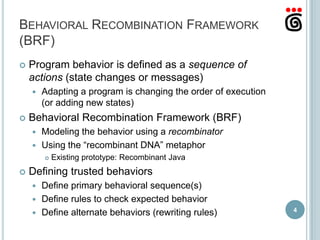
   Program behavior is defined as a sequence of
    actions (state changes or messages)
       Adapting a program is changing the order of execution
        (or adding new states)
   Behavioral Recombination Framework (BRF)
     Modeling the behavior using a recombinator
     Using the “recombinant DNA” metaphor
           Existing prototype: Recombinant Java
   Defining trusted behaviors
     Define primary behavioral sequence(s)
     Define rules to check expected behavior
                                                                4
     Define alternate behaviors (rewriting rules)
PRIMARY SEQUENCE:
THE EXPECTED BEHAVIOR
   Relation to Use Cases
     Primary Sequence = main scenario
     Rewriting Rules = alternate scenarios

   Relation to TDD and agile processes
     Particularly, Continuosus Integration
     Rewriting Rules = integration tests

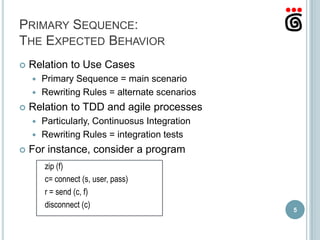
   For instance, consider a program
        zip (f)
        c= connect (s, user, pass)
        r = send (c, f)
        disconnect (c)
                                              5
BEHAVIOR PREDICATES
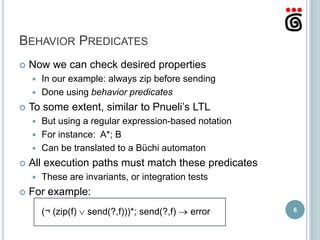
   Now we can check desired properties
     In our example: always zip before sending
     Done using behavior predicates

   To some extent, similar to Pnueli’s LTL
     But using a regular expression-based notation
     For instance: A*; B
     Can be translated to a Büchi automaton

   All execution paths must match these predicates
       These are invariants, or integration tests
   For example:
        (¬ (zip(f)   send(?,f)))*; send(?,f)   error   6
ABSTRACTING BEHAVIOR
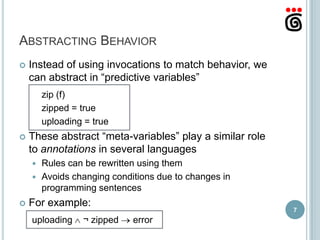
   Instead of using invocations to match behavior, we
    can abstract in “predictive variables”
        zip (f)
        zipped = true
        uploading = true
   These abstract “meta-variables” play a similar role
    to annotations in several languages
     Rules can be rewritten using them
     Avoids changing conditions due to changes in
      programming sentences
   For example:
                                                          7
    uploading    ¬ zipped   error
RECOMBINING BEHAVIORS
   The key point in the recombinant approach
       Alternate behaviors are defined as rewriting rules which
        may alter original ones
           Following again a Use-Case-Driven approach
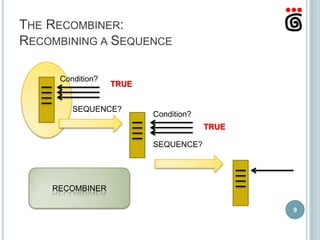
       The recombiner mixes this behavior and the primary
        sequence, re-calculating the entire program
           Use of the sequence(n) and join operators
       Process:
         In every sequence, go to first action
         WHILE a predicate matches current action

            Apply this rule

            Recalculate the new primary sequence

         Once all have been applied, go to the next one           8
         Loop
THE RECOMBINER:
RECOMBINING A SEQUENCE

     Condition?
                  TRUE


        SEQUENCE?
                         Condition?
                                      TRUE

                         SEQUENCE?


    RECOMBINER

                                             9
RELATED WORK
   An obvious similarity to model checking
     But the approach was not originally conceived as a
      formal approach, and has avoided this
     Behavior predicates (aka regular expressions) can be
      compared to LTL formulae
     Spin allows something similar using LTL
         It allows multithreading while checking
         It does not allow constructive rewriting


   Similar to EAOP in the AOSD world
     EAOP triggers events by using program traces
     Event-driven aspects are similar to rewriting rules
     This is essentially a language, ours a framework       10
CONCLUSIONS & FURTHER WORK
   Developing a framework for constructing
    applications
     By recombining sequences of actions
     Possible to develop trusted behaviors
           And therefore trusted adaptations
     Also for recombining “generic” sequences
     Prototype: Recombinant Java
           Generalizing into a methodolical framework
   Future work
     A requirements specification method (Manhattan)
     Use a high-level specification language
     Complements a “pure” CBSE approach                 11
THANKS FOR YOUR ATTENTION


                            12

VADER 2011 (Younessi)

  • 1.
    TOWARDS A DEVELOPMENT FRAMEWORKBASED ON BEHAVIOR RECOMBINATION Houman Younessi, RH, RPI, USA Renaud Pawlak, LISITE, ISEP, France Carlos E. Cuesta, VorTIC3, URJC, Spain Hersonissos, Crete, Greece, 18/10/2011
  • 2.
    CONTENTS  Introduction  Behavioral Recombination Framework (BRF)  Behavior Predicates  Abstracting Behavior  Recombining Behaviors  The Recombinator  Related work  Conclusions & Future work 2
  • 3.
    INTRODUCTION: THE NEED FORVARIABILITY  Adaptation needs variability  Variation points imply a strategic choice  For instance, less consume over QoS  Variation + modularity = simple choice  Just activate/deactivate a certain module  Loose coupling: CBSE, AOSE  But modularity depends on architecture  Tyranny of the dominant decomposition  Related to architectural erosion  Proposal: define variation on behavior  To define trusted behavior adaptations 3  The structure is not important anymore
  • 4.
    BEHAVIORAL RECOMBINATION FRAMEWORK (BRF)  Program behavior is defined as a sequence of actions (state changes or messages)  Adapting a program is changing the order of execution (or adding new states)  Behavioral Recombination Framework (BRF)  Modeling the behavior using a recombinator  Using the “recombinant DNA” metaphor  Existing prototype: Recombinant Java  Defining trusted behaviors  Define primary behavioral sequence(s)  Define rules to check expected behavior 4  Define alternate behaviors (rewriting rules)
  • 5.
    PRIMARY SEQUENCE: THE EXPECTEDBEHAVIOR  Relation to Use Cases  Primary Sequence = main scenario  Rewriting Rules = alternate scenarios  Relation to TDD and agile processes  Particularly, Continuosus Integration  Rewriting Rules = integration tests  For instance, consider a program zip (f) c= connect (s, user, pass) r = send (c, f) disconnect (c) 5
  • 6.
    BEHAVIOR PREDICATES  Now we can check desired properties  In our example: always zip before sending  Done using behavior predicates  To some extent, similar to Pnueli’s LTL  But using a regular expression-based notation  For instance: A*; B  Can be translated to a Büchi automaton  All execution paths must match these predicates  These are invariants, or integration tests  For example: (¬ (zip(f) send(?,f)))*; send(?,f) error 6
  • 7.
    ABSTRACTING BEHAVIOR  Instead of using invocations to match behavior, we can abstract in “predictive variables” zip (f) zipped = true uploading = true  These abstract “meta-variables” play a similar role to annotations in several languages  Rules can be rewritten using them  Avoids changing conditions due to changes in programming sentences  For example: 7 uploading ¬ zipped error
  • 8.
    RECOMBINING BEHAVIORS  The key point in the recombinant approach  Alternate behaviors are defined as rewriting rules which may alter original ones  Following again a Use-Case-Driven approach  The recombiner mixes this behavior and the primary sequence, re-calculating the entire program  Use of the sequence(n) and join operators  Process:  In every sequence, go to first action  WHILE a predicate matches current action  Apply this rule  Recalculate the new primary sequence  Once all have been applied, go to the next one 8  Loop
  • 9.
    THE RECOMBINER: RECOMBINING ASEQUENCE Condition? TRUE SEQUENCE? Condition? TRUE SEQUENCE? RECOMBINER 9
  • 10.
    RELATED WORK  An obvious similarity to model checking  But the approach was not originally conceived as a formal approach, and has avoided this  Behavior predicates (aka regular expressions) can be compared to LTL formulae  Spin allows something similar using LTL  It allows multithreading while checking  It does not allow constructive rewriting  Similar to EAOP in the AOSD world  EAOP triggers events by using program traces  Event-driven aspects are similar to rewriting rules  This is essentially a language, ours a framework 10
  • 11.
    CONCLUSIONS & FURTHERWORK  Developing a framework for constructing applications  By recombining sequences of actions  Possible to develop trusted behaviors  And therefore trusted adaptations  Also for recombining “generic” sequences  Prototype: Recombinant Java  Generalizing into a methodolical framework  Future work  A requirements specification method (Manhattan)  Use a high-level specification language  Complements a “pure” CBSE approach 11
  • 12.
    THANKS FOR YOURATTENTION 12