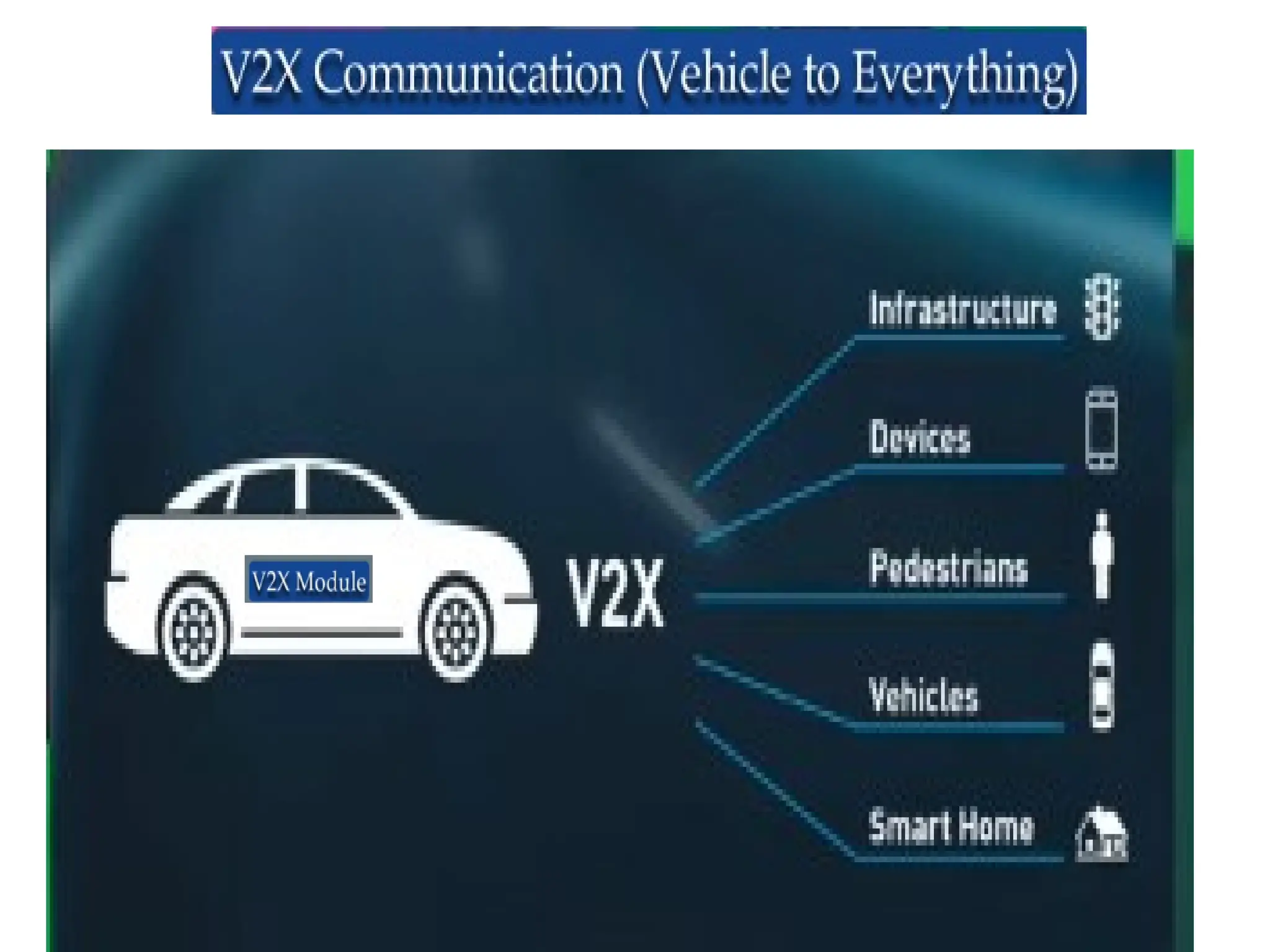
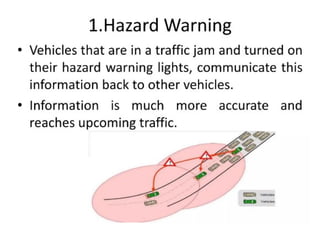
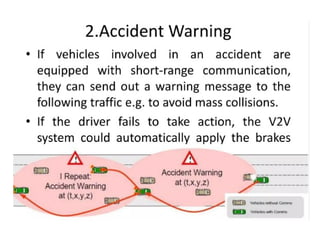
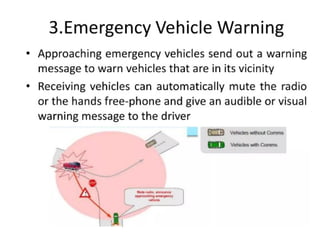
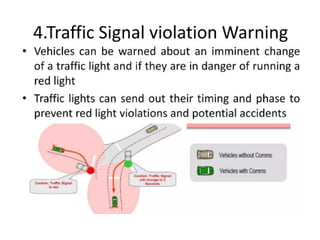
• Vehicle-to-everything (V2X)communication is a
wireless technology that allows vehicles to share
information from its sensors, cameras and internal
systems with other vehicles, nearby pedestrians, road
infrastructure, and Smart City systems using wireless
data connectivity.
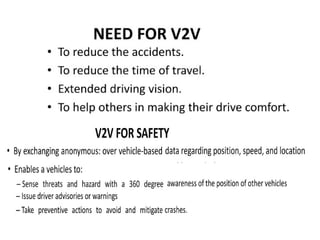
• V2X is intended to improve road safety and traffic
efficiency, while also reducing pollution and saving
energy.
Vehicle-to-everything (V2X) communication
5.
V2X communication includesthree types of
communication:
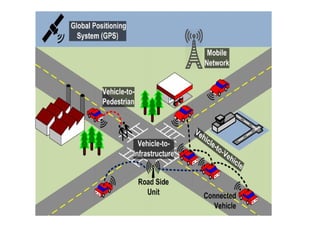
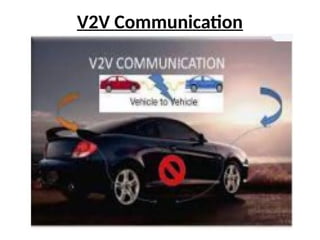
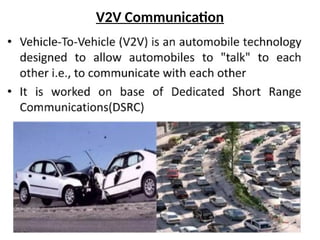
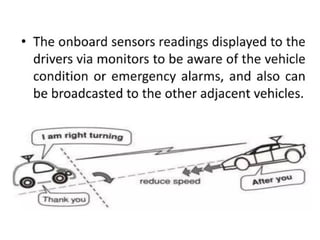
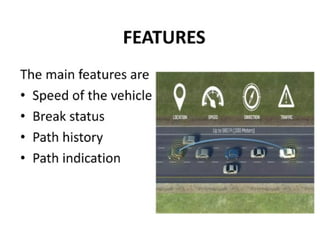
• Vehicle-to-vehicle (V2V): Cars can exchange data
such as speed, location, and direction of travel.
• Vehicle-to-infrastructure (V2I): Cars can
exchange information with connected roads, urban
infrastructure, such as traffic lights and road signs,
and Smart City technology.
• Vehicle-to-pedestrian (V2P): Cars can
communicate with pedestrians and cyclists.
Vehicle-to-everything (V2X) communication
6.
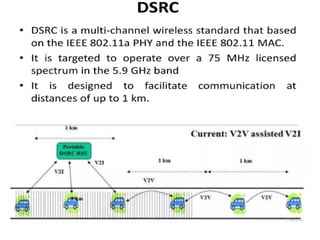
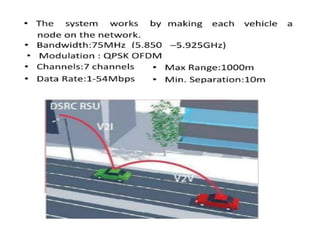
The IEEE 802.11pWAVE (DSRC) is the most
popular protocol for Vehicle-to-Infrastructure
(V2I) communication.
This protocol is capable of providing safe and
reliable communication for V2X applications.
Dedicated short-range communications (DSRC)/
Wireless Access for Vehicular Environments
(WAVE) is a standardized protocol stack suite
intended for use in vehicular environments
Vehicle-to-everything (V2X) communication
7.
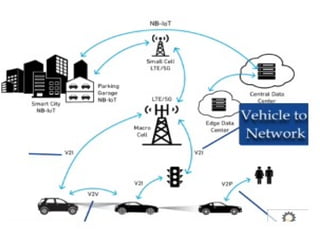
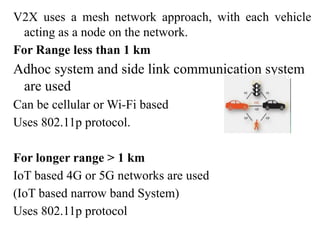
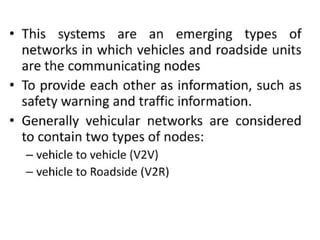
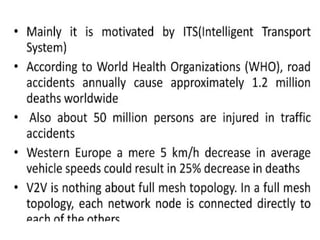
V2X uses amesh network approach, with each vehicle
acting as a node on the network.
For Range less than 1 km
Adhoc system and side link communication system
are used
Can be cellular or Wi-Fi based
Uses 802.11p protocol.
For longer range > 1 km
IoT based 4G or 5G networks are used
(IoT based narrow band System)
Uses 802.11p protocol
Some challenges facingV2X communication
• Cyber security issues,
• Standardization efforts,
• Problems or failure of sensor will affect the
system
• User privacy issues.
• Regulatory considerations and
• Public awareness and acceptance.
Vehicle-to-everything (V2X) communication
10.
• Vehicle-to-Infrastructure (V2I)
communication
•Vehicle-to-Infrastructure (V2I) communication
is a wireless technology that allows vehicles to
exchange data with road infrastructure.
• V2I is the next generation of Intelligent
Transportation Systems (ITS).
• The primary goal of V2I is to
• Improve road safety and
• Reduce collisions.
11.
• V2I communicationworks by using hardware,
software and firmware to enable two-way
communication between vehicles and
infrastructure.
For example, traffic lights, lane markings, and
road signs can wirelessly send information to
vehicles, and vehicles can also send
information back to the infrastructure.
12.
• V2I communicationcan provide a variety of benefits,
including:
• Safety: V2I can help avoid motor vehicle crashes by sharing
critical safety data
• Mobility: V2I can provide information about mobility
conditions
• Environmental benefits: V2I can share information about
environmental conditions
• Traffic management: V2I can support traffic management
and work zone operations .
13.
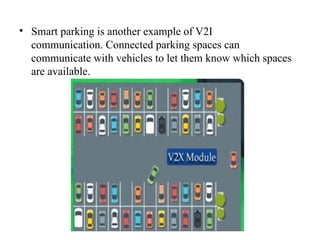
• Smart parkingis another example of V2I
communication. Connected parking spaces can
communicate with vehicles to let them know which spaces
are available.