Executive summary
Health care is an industry in need of innovation. Health plans, providers,
life sciences companies, and the government are facing rising costs and
inconsistent outcomes. They are working to achieve the triple aim—
improving care, improving health, and reducing spending. What innovations
are most likely to help stakeholders achieve these goals and transform
health care over the next 10 years?
We surveyed leaders across the health care system to identify the
innovations they think are most likely to transform health care. We then
narrowed the list to the top 10 by applying the following definition:
Innovation: Any combination of activities or technologies that
break existing performance tradeoffs in the attainment of an
outcome, in a manner that expands the realm of the possible.
Defined in health care as providing “more for less”—more
value, better outcomes, greater convenience, access and
simplicity; all for less cost, complexity, and time required by
the patient and the provider, in a way that expands what is
currently possible.
Our current health care system’s performance can be defined by its rules,
policies, regulations, enabling technologies, operating models, customs,
and patient and provider preferences; together, these elements comprise
the frontier of what is possible. They also serve as the constraints to what
can be achieved. For far too long the health care industry’s performance,
despite attempts to spur progress, has remained at the edge of this
frontier. The industry needs to break current constraints and expand the
frontier to achieve true breakthrough performance. While the constraints
are many, the traditional, dominant, fee-for-service (FFS) payment model,
in particular, does not align provider incentives with the goal of achieving
more for less.
EXECUTIVE SUMMARY INTRODUCTION TOP 10 INNOVATIONS EMBRACING INNOVATION: NEXT STEPS AUTHORS
REFERENCES
EXECUTIVE SUMMARY
Top 10 health care innovations:
Achieving more for less
The top 10 list consists of innovations that will most likely achieve more for
less in health care:
• Next-generation sequencing (NGS): Applications of genetic sequencing
to identify at-risk populations or target therapies to patients who are
likely to respond
• 3D-printed devices: Lower-cost and highly customized medical
technology products that can be tailored to suit the physiological needs
of individual patients
• Immunotherapy: Treatments with the potential to significantly extend
survival for cancer patients, without the negative side effects and related
health care costs of traditional chemotherapy
• Artificial intelligence (AI): The ability of computers to think like and
complete tasks currently performed by humans with greater speed,
accuracy, and lower resource utilization
• Point-of-care (POC) diagnostics: Allow for convenient, timely testing at
the point of care (e.g., physician office, ambulance, home, or hospital),
resulting in faster, more cohesive patient care
• Virtual reality (VR): Simulated environments that could accelerate
behavior change in patients in a way that is safer, more convenient, and
more accessible
• Leveraging social media to improve patient experience: Tapping
data from social media and online communities to give health care
organizations the ability to track consumer experience and population
health trends in real-time
• Biosensors and trackers: Technology-enabled activity trackers,
monitors, and sensors incorporated into clothing, accessories, and
devices that allow consumers and clinicians to easily monitor health
• Convenient care: Retail clinics and urgent care centers that provide
more convenient and lower-cost care to patients for a number of
health issues
• Telehealth: A more convenient way for consumers to access and
increase self-care while potentially reducing office visits and travel time;
may also prevent complications and emergency room (ER) visits
“Incorporating these top 10 innovations into
business models will require changing how
health care organizations currently prevent,
diagnose, monitor, and treat disease.”
EXECUTIVE SUMMARY INTRODUCTION TOP 10 INNOVATIONS EMBRACING INNOVATION: NEXT STEPS AUTHORS
REFERENCES
EXECUTIVE SUMMARY
Top 10 health care innovations: Achieving more for less 2
The 10 innovations we describe in this report have the potential to
break the constraints of the FFS-based health care system and expand
the frontier through new business models that can deliver care in ways
previously not thought possible. Early adopters of these innovations are
likely to be those already experimenting with business model changes as
a result of recent, transformational market shifts: value-based care (VBC),
consumerism, and the proliferation of new data sources.
VBC creates incentives for providers to experiment with care management
and patient engagement approaches that could improve health outcomes
and reduce spending. Some stakeholders are recognizing the importance
of activating patients in their own care and are investing in capabilities
to encourage this. Meanwhile, new data sources and tools are informing
clinical trial design, treatment decisions, and ongoing patient care.
Incorporating these top 10 innovations into business models will require
changing how health care organizations currently prevent, diagnose,
monitor, and treat disease. Leaders should determine which innovations
break performance trade-offs, or create “more for less,” in a way that
impacts their core business.
Healthcare leaders should consider building ecosystems that embrace
nontraditional players and sources of knowledge outside their own four
walls. Stakeholders should also consider building pilots before investing in
scale, learn to embrace change, and evaluate new revenue sources. And,
organizations should strive to be agile in anticipating and adjusting their
strategies as innovations continue to evolve.
“Incorporating these top 10 innovations into
business models will require changing how
health care organizations currently prevent,
diagnose, monitor, and treat disease.”
Top 10 health care innovations: Achieving more for less 3
EXECUTIVE SUMMARY INTRODUCTION TOP 10 INNOVATIONS EMBRACING INNOVATION: NEXT STEPS AUTHORS
REFERENCES
EXECUTIVE SUMMARY
Introduction
Public and private sector momentum towards achieving the triple aim
is strengthening the business case for innovation in health care. (See
sidebar: Balancing innovation and regulation: The public sector’s role.)
In this dynamic environment, what are the innovations most likely to
transform health care over the next 10 years?
Deloitte conducted an external survey of innovation leaders across
several segments of the health care system*
to gather their opinions
about which innovations are most likely to transform health care over
the next decade. Respondents suggested many ideas and we then
applied our definition of innovation to narrow the list to the top 10.
While there are many ways to define innovation, we chose the
definition used by Michael Raynor, author of Innovation: A Chimera
No More:1
Any combination of activities or technologies that break
existing performance tradeoffs in the attainment of an
outcome, in a manner that expands the realm of the possible.
More value, better outcomes, greater convenience, access
and simplicity; all for less cost, complexity, and time required
by the patient and the provider, in a way that expands what is
currently possible.
* Our survey included 85 external respondents, including leaders from the biopharmaceutical industry, medical technology companies,
diagnostics, health and nonhealth focused technology companies, venture capital investors, providers (Accountable Care Organizations,
Integrated Delivery Networks, Academic Medical Centers, physician groups), urgent care, retail clinics, health plans, and nurse practitioners,
clinical pharmacists, academics, and former policy makers.
EXECUTIVE SUMMARY INTRODUCTION TOP 10 INNOVATIONS EMBRACING INNOVATION: NEXT STEPS AUTHORS
REFERENCES
INTRODUCTION
Top 10 health care innovations: Achieving more for less 4
In the context of the health care system, this requires breaking the
constraints of FFS clinical models to provide better care, in the optimal
setting, at the right time, with the right provider, to create better outcomes
and access using enabling technologies that lower the overall cost of
managing a population’s acute and chronic care. It also means changing
care delivery models to progress beyond the current limits of performance
and cost of existing approaches and technologies.
The top 10 innovations include those with the potential to change
how health care organizations prevent, diagnose, monitor, and treat
disease. The potential impact of these innovations transcends traditional
stakeholder segmentation (e.g., health plans, health care providers, and life
sciences companies) and is anticipated to drive transformative change in
business and operating models.
Some organizations are already experiencing business model
transformation arising from payment model changes, new demands
from consumers, and increased availability of data sources. The top 10
innovations are likely to accelerate transformation of the health care
system across each of these three areas. Further, early adopters of the
top innovations are likely to be organizations which are already embracing
these market shifts:
• Aligning financial incentives: The FFS payment model does not create
financial incentives for providers to improve quality and does not typically
reimburse for the use of nontraditional services. Rather, FFS could
create incentives for physicians to provide more services, even if the
incremental benefit may not be commensurate to the cost. The shift to
VBC aims to change these incentives by tying payment to quality and total
cost of care, rather than rewarding volume. Public and private payers
have aggressive goals for the shift to VBC: The US Department of Health
and Human Services (HHS) aims to link 50 percent of Medicare payments
to quality or value through alternative payment models by 2018.2
The
Health Care Transformation Task Force, consisting of providers, health
plans, and employers, has committed to shift 75 percent of its members’
business into contracts with incentives for health outcomes, quality, and
cost management by January 2020.3
The Medicare Access and CHIP
Reauthorization Act of 2015 (MACRA) is poised to drive payment and
delivery reform across the payer mix for the foreseeable future. (See
sidebar: Balancing innovation and regulation: The public sector’s role.)
• Rise of consumerism: Consumers’ expectations for how they receive
services—including health care—are changing. Consumers impatient
with poor service are happy to transfer their loyalty to companies and
products that deliver on cost and convenience. Health care consumerism
is increasing, even as some health plans are shifting more cost-sharing
to consumers, many of whom are struggling to make informed decisions
due to a lack of available information on treatment options, quality, and
price. Another aspect of consumerism is patient behavior, one of the key
components of disease management amidst the increasing prevalence
of chronic conditions. Successful patient engagement could improve self-
care and help achieve better outcomes; many health care stakeholders
EXECUTIVE SUMMARY INTRODUCTION TOP 10 INNOVATIONS EMBRACING INNOVATION: NEXT STEPS AUTHORS
REFERENCES
INTRODUCTION
Top 10 health care innovations: Achieving more for less 5
are investing in solutions to address this issue. In addition, some
researchers are trying to understand what motivates individual
patients and are working on developing tailored solutions that
incorporate individualized goals.
• Data privacy, security, and interoperability: Several new data
sources are being discovered and created, generating a wealth
of information on practice patterns, health, outcomes, and costs.
Increasing data volume and variety are being partially fueled by
the adoption of electronic health records (EHRs); however, much
of the data is not yet interoperable, limiting the extent to which
organizations can use it for research or incorporate it into clinician
workflows. Further, health care stakeholders are concerned with
protecting the privacy and security of patient data.
Health care leaders should identify which of the top 10 innovations
are likely to impact their specific business models. For each
innovation, we describe how it might break constraints to create
“more for less,” and what changes could support greater adoption.
EXECUTIVE SUMMARY INTRODUCTION TOP 10 INNOVATIONS EMBRACING INNOVATION: NEXT STEPS AUTHORS
REFERENCES
INTRODUCTION
Top 10 health care innovations: Achieving more for less 6
Balancing innovation and regulation: The public sector’s role
The federal government can play a key role in health care innovation
both by launching pilots and programs as well as evolving regulations to
keep pace with emerging technologies and ideas. Regulators set metrics
and measure outcomes, establish objectives, and create processes for
stakeholders to follow. These rule sets can serve dual functions: While they
set guidelines or rules for organizations to follow, they can also serve as
catalysts for innovation. Several recent examples of federal health initiatives
or policy changes, for example, could help the top 10 innovations realize
their transformative potential:
• The Obama Administration is issuing regulations to implement new
payment tracks under the Medicare Access and CHIP Reauthorization
Act of 2015 (MACRA), which is poised to drive health care delivery
and payment reform across clinicians, health systems, Medicare, and
other government and commercial payers. Congress intended MACRA
to be a transformative law that fundamentally changes how physicians
and other clinicians are reimbursed under the Medicare Physician Fee
Schedule, and establishes new incentives that will drive payment and
delivery reform efforts across the health care payer mix. MACRA has the
potential to be a game-changer at all levels of the health care system.
Already, the law is igniting strategic discussions around new care,
payment, and delivery models and creating new sources of risk-sharing
for health care organizations. MACRA’s implementation could drive
health care providers to experiment with new approaches to care
delivery and patient engagement, including several of the innovations
we describe in this paper.
• In 2015, the Administration announced the Precision Medicine
Initiative (PMI) to improve health outcomes, fuel the development of
new disease treatments, and catalyze a new era of data-based and more
precise preventive care and medical treatment. The National Institutes
of Health (NIH) is working to create a research cohort that will engage
a million or more Americans who volunteer to contribute their health
data over many years to help meet this goal. This registry will help
researchers understand how genetic and nongenetic factors, such as
the gut microbiome, patient behaviors, and the environment, could also
influence patient outcomes.4
• In January 2016, President Obama announced the launch of the
National Cancer Moonshot Initiative (NCM). Led by Vice President
Joe Biden, the initiative aims to make more therapies available to more
patients, while also improving our ability to prevent cancer and detect
it at an early stage.5
Greater collaboration could result in additional
investment and acceleration in research for new treatment approaches
like immunotherapy. The NCM is also encouraging the research
community to make data available and mineable by all.
EXECUTIVE SUMMARY INTRODUCTION TOP 10 INNOVATIONS EMBRACING INNOVATION: NEXT STEPS AUTHORS
REFERENCES
INTRODUCTION
Top 10 health care innovations: Achieving more for less 7
• The Centers for Disease Control and Prevention (CDC) plays a leadership
role in our nation’s response to disease outbreaks like the recent
Ebola outbreak and Zika virus. These kinds of global health crises can
generate new ideas and bold solutions to problems that surface during
an outbreak response. CDC teams across the globe are coming up with
innovative ways to handle these unexpected challenges by creating
better approaches and tools to fight epidemics. Specifically, they are
leading vaccine trials, creating new uses for technologies, developing
rapid diagnostics, and facilitating innovative partnerships.6
For example,
CDC labs have developed a test that can confirm Zika in the first week of
illness or in a sample from an affected child.7
• The Energy and Commerce Committee’s 21st Century Cures initiative
and related legislation aim to modernize elements of the federal
government’s research and regulatory agencies to accelerate the
pace of cures in America.8
The initiative is focused on a broad range of
issues, including a comprehensive process of basic science discovery,
streamlining the drug and device development process, and using
digital medicine and social media at the treatment and delivery phase.
The legislation seeks to strengthen the federal agencies charged with
advancing these areas, including NIH, the Food and Drug Administration
(FDA), and CMS.9
As many of these initiatives gain momentum it is important to acknowledge
that innovation and regulation can sometimes clash. It can be a challenge
for regulatory agencies, policymakers, and governing bodies to keep
up with the rapid evolution of technology and new and evolving threats
to public health. Innovators should carefully consider how to operate
in the heavily regulated health care industry. The public wants new,
groundbreaking treatments and cures for our most perplexing diseases,
but also wants them to be safe and accessible. Consumers want health
care information at their fingertips, but also want assurance that their
privacy is protected and their personal data secure. Society wants access to
the best innovations, but there is a need to balance that with investments
in infrastructure, education, and providing a safety net for our vulnerable
citizens. The public sector strives to achieve this balance through increased
coordination among agencies, public input, and public-private partnerships.
“It can be a challenge for regulatory agencies,
policymakers, and governing bodies to keep up
with the rapid evolution of technology and new
and evolving threats to public health.”
EXECUTIVE SUMMARY INTRODUCTION TOP 10 INNOVATIONS EMBRACING INNOVATION: NEXT STEPS AUTHORS
REFERENCES
INTRODUCTION
Top 10 health care innovations: Achieving more for less 8
Top 10 innovations
Next-generation sequencing (NGS)
3D-printed devices
Immunotherapy
Artificial intelligence (AI)
Point-of-care (POC) diagnostics
Virtual reality (VR)
Leveraging social media to improve patient experience
Biosensors and trackers
Convenient care: Retail clinics and urgent care
Telehealth
Popular innovations that didn’t make the list
EXECUTIVE SUMMARY INTRODUCTION TOP 10 INNOVATIONS EMBRACING INNOVATION: NEXT STEPS AUTHORS
REFERENCES
TOP 10 INNOVATIONS
Top 10 health care innovations: Achieving more for less 9
Next-generation sequencing (NGS)
More for less: Advances in genetic sequencing could lead to the
development of diagnostic tests that may identify at-risk populations
where early interventions could save downstream health care costs.
Diagnostic tests also may help clinicians target specific medicines to
patients who are likely to respond well to them, reducing or eliminating
the use of ineffective treatments.
Rapid progress in genetic testing is expected to help accelerate scientists’
and clinicians’ understanding of genetic indicators for susceptibility to
various diseases, and patients’ likely response to treatment. Researchers
working on the Human Genome Project completed sequencing the first
human genome in 2001, and it took 15 years and cost $3 billion. Since
then, advances in sequencing techniques have led to exponential increases
in the data output for each sequencing run, from 84 kilobases of data to
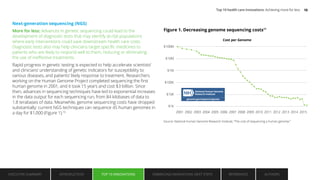
1.8 terabases of data. Meanwhile, genome sequencing costs have dropped
substantially: current NGS techniques can sequence 45 human genomes in
a day for $1,000 (Figure 1).10
Figure 1. Decreasing genome sequencing costs11
Cost per Genome
Source: National Human Genome Research Institute, “The cost of sequencing a human genome.”
National Human Genome
Research Institute
$1K
2001 2002 2003 2004 2005 2006 2007 2008 2009 2010 2011 2012 2013 2014 2015
$10K
$100K
$1M
$10M
$100M
genome.gov/sequencingcosts
EXECUTIVE SUMMARY INTRODUCTION TOP 10 INNOVATIONS EMBRACING INNOVATION: NEXT STEPS AUTHORS
REFERENCES
TOP 10 INNOVATIONS
Top 10 health care innovations: Achieving more for less 10
Genetic testing can have broad applications in population health
screening and identification of at-risk populations where early
intervention would be beneficial. Identifying sub-populations that
might be more responsive to treatment could help get the right
drug to the right patient at the right time. This, in turn, could reduce
inefficiencies and generate more consistent responses for patients
receiving treatment.
For NGS to realize its potential, innovators will likely need to:
• Demonstrate the accuracy, reliability, and clinical validity (the ability
of a test to accurately predict the condition or risk of disease) of
diagnostic tools;12
• Demonstrate improvement over the current standard of care and
cost-effectiveness to receive reimbursement;
• Understand and comply with requirements to protect patient
information that, by its nature, cannot be de-identified.
Use case: Specific tumor receptors can be indicative of genetic
causes of disease. For example, a positive BRCA1/2 test in a breast
cancer patient could indicate that the patient is at higher risk of
recurrence and malignancies. Awareness of the increased risk may
alter the patient’s treatment plan. Further, it could prompt physicians
to conduct genetic screening for at-risk relatives.13
EXECUTIVE SUMMARY INTRODUCTION TOP 10 INNOVATIONS EMBRACING INNOVATION: NEXT STEPS AUTHORS
REFERENCES
TOP 10 INNOVATIONS
Top 10 health care innovations: Achieving more for less 11
3D-printed devices
More for less: Manufacturers and providers could use 3D printing to
create highly customized, low-cost medical technology products that can
be tailored to suit the physiological needs of individual patients.
Examples of 3D-printed medical technologies include 3D-printed
prosthetics, skin for burn victims, organs, implants (dental and orthopedic),
and casts. In some applications, 3D printing offers solutions where none
existed; for example, airway splints for babies with tracheobronchomalacia
(a rare condition where the tracheal or windpipe cartilage is soft).14
Other
applications, such as 3D-printed prosthetics, offer more customized and
lower-cost alternatives than the current standard of care. 3D printing also
aids physicians with surgical planning—they can study exact replicas of
patients’ organs before going into surgery.
Additive manufacturing (AM) techniques are enabling 3D-printed medical
devices to enter the market at a reasonable price point. AM technology
provides the ability for mass customization and reduces waste. For
example, the airway splints for babies with tracheobronchomalacia
can be made in a matter of hours and cost about $10 per unit.15
AM works by adding materials layer by layer, rather than producing
something and cutting away the excess. This approach could potentially
disrupt traditional supply chains in two ways. First, AM requires less capital
to achieve scale economies, reducing the minimum efficient scale—the
point at which the average cost of each unit of production is minimized.
Second, AM decreases the amount of capital needed to achieve scope
economies, as its flexibility allows for the same equipment, materials, and
processes to be used to produce multiple different products.16
Greater adoption of 3D-printed medical devices will likely depend
on the:
• Ability of innovators to demonstrate biocompatible products’ safety;
• Development of a consistent reimbursement framework, likely requiring
prospective clinical trials to determine cost-effectiveness;
• Willingness for providers (beyond academic medical centers) to invest in
3D-printing equipment.
Use case: Close to 200,000 amputations are performed each year in
the US. Prosthetics can be priced from $5,000-$50,000, creating access
challenges for patients.17
One company, Open Bionics, is an open-source
initiative for the development of 3D-printed hands and arms. Open
Bionics prosthetics are offered to amputees at a much lower cost than
traditional prosthetics, ranging from $100-$200.18
EXECUTIVE SUMMARY INTRODUCTION TOP 10 INNOVATIONS EMBRACING INNOVATION: NEXT STEPS AUTHORS
REFERENCES
TOP 10 INNOVATIONS
Top 10 health care innovations: Achieving more for less 12
Immunotherapy
More for less: Immunotherapies have the potential to significantly
extend survival for cancer patients, without the negative side effects and
associated health care costs of traditional chemotherapy.
Immunotherapy refers to classes of drugs that strengthen the body’s ability
to generate an immune response. Immunotherapy could be useful in the
treatment of cancer, allergies, inflammatory conditions, infectious diseases,
and neurodegenerative diseases. Successful applications have been
seen in oncology, where therapies can counteract how tumors suppress
the immune system and instead help the immune system to effectively
attack tumor cells. Researchers are particularly interested in two classes of
therapies: checkpoint inhibitors including PD-1 and PDL-1 inhibitors, and
adoptive t-cell therapy, including CAR-T.19
• Checkpoint inhibitors: Checkpoints are molecules that help the immune
system distinguish normal cells from foreign cells. Cancer cells may express
some of these checkpoint molecules to prevent from being recognized
and attacked. Checkpoint inhibitors target these checkpoint molecules
and essentially turn them off, making the tumor cells more visible to the
immune system. The FDA has approved three of these drugs.20
• Adoptive T-cell therapies: Adoptive T-cell therapies involve removing
the patient’s T-cells, changing them to better attack cancer cells, and re-
injecting them into the patient. Chimeric antigen receptors (or CAR) are
added to the T-cells (CAR-T) and injected into the patient, where they
replicate and attack the cancer cells.
Immunotherapies have already shown early signs of success. Checkpoint
inhibitors are increasing progression-free survival. Using CAR-T to treat
blood malignancies has shown response rates as high as 70-90 percent.
Further research is required to see if the technology will have similar
success in treating solid tumors.
Further progress for immunotherapy may depend on innovators’ ability to:
• Invest in additional research to understand what biologic molecules
are responsible for triggering tumor susceptibility. Low participation in
clinical trials and the need to study individualized responses make further
research challenging.21
• Develop a scalable manufacturing process. The use of CAR-T is limited
to specialized labs where clinicians are trained to handle risks and
potentially life threatening adverse reactions.
• Demonstrate evidence of significant improvement over the standard
of care, and long-term efficacy to gain reimbursement. Some
immunotherapies have shown efficacy in combination with other
therapies, with high treatment costs reaching above $250,000.
Use case: Early studies show that CD-19-targeted chimeric antigen receptor
therapy treatments from Juno and Kite provide response rates hovering
around 90 percent for patients with multiple relapsed or refractory acute
lymphoblastic leukemia. Patients from some of these trials have experienced
greater than one-year remissions with persistence of CAR-T cells.22
EXECUTIVE SUMMARY INTRODUCTION TOP 10 INNOVATIONS EMBRACING INNOVATION: NEXT STEPS AUTHORS
REFERENCES
TOP 10 INNOVATIONS
Top 10 health care innovations: Achieving more for less 13
Artificial intelligence (AI)
More for less: AI, the ability of computers to think like humans, is
anticipated to transform health care by completing tasks currently
performed by humans with greater speed and accuracy, and using
fewer resources.
Within health care, AI includes clinical tasks such as diagnosing patients
and spotting disease outbreaks earlier; accelerating the development of
new drugs and devices; and streamlining administrative duties such as
approving claims and rooting out fraud. Frost and Sullivan projects that
90 percent of US hospitals and insurance companies will implement AI
systems by 2025.23
AI has the potential to improve the accuracy, precision, and timeliness
of patient diagnoses, which could increase therapeutic success rates and
decrease unnecessary medical interventions. Population health would
improve with better understanding of behavior patterns that impact
chronic disease outcomes. Streamlining administrative duties may
improve operational efficiencies.
Increased adoption of AI will likely depend on:
• Innovators’ ability to decrease cost and improve accuracy of technologies
such as natural language processing, big data, and cognitive technologies;
• Health care professionals’ and patients’ acceptance and trust of AI tools.
Use case: Watson Oncology is an AI solution that helps oncologists keep
up with the field’s rapidly expanding evidence base. A collaboration of IBM
and Memorial Sloan Kettering, Watson Oncology provides individualized
treatment options for patients based on their specific case details and
existing clinical evidence. The technology will assist oncologists with the
challenging task of synthesizing the latest research and best available
information to improve patient care.24
“AI has the potential to improve the accuracy,
precision, and timeliness of patient diagnoses.”
EXECUTIVE SUMMARY INTRODUCTION TOP 10 INNOVATIONS EMBRACING INNOVATION: NEXT STEPS AUTHORS
REFERENCES
TOP 10 INNOVATIONS
Top 10 health care innovations: Achieving more for less 14
Point-of-care (POC) diagnostics
More for less: POC diagnostics allow for convenient and timely testing at
the point of care, resulting in faster, more cohesive, and less-expensive
patient care.
Patients can use POC diagnostics in the physician office, ambulance, home,
or hospital. Current widely available home POC tests include blood glucose,
pregnancy, and HIV. Some medical device and diagnostic companies are
developing POC tests for cancer, tuberculosis, and stroke markers, among
others. POC diagnostics could aid in prevention, early diagnosis, and
management of chronic conditions.
Providing test results when patients are receiving care speeds diagnoses,
increases care efficiencies and, potentially, decreases costs associated with
delayed treatment. Analysts expect the market for POC diagnostics will total
nearly $3 billion in 2021, up from $2.13 billion in 2015.25
Further adoption of POC diagnostics will likely require:
• Innovators to improve POC diagnostic technology, through lower cost,
less invasive, easy to use, and more accurate tests;
• Health care providers to participate in the transition to VBC, which
creates opportunities for clinicians to indirectly receive reimbursement
for the time and costs of administering these tests.
Use case: Kardia is a device that enables consumers to track and
analyze their heart health. Frequently, by the time a patient with heart
arrhythmia arrives at the ER or physician office, their heartbeat returns
to normal, making it difficult to diagnose the problem. Kardia takes
a medical-grade electrocardiogram in 30 seconds and shares it with
physicians, capturing irregular heartbeats when they occur. The mobile
device connects to smartphones and tablets and is also available in a
band for the Apple Watch®
wrist band.26
Users have commented that it
“brings peace of mind.”27
“Providing test results when patients are
receiving care speeds diagnoses, increases
care efficiencies and, potentially, decreases
costs associated with delayed treatment.”
EXECUTIVE SUMMARY INTRODUCTION TOP 10 INNOVATIONS EMBRACING INNOVATION: NEXT STEPS AUTHORS
REFERENCES
TOP 10 INNOVATIONS
Top 10 health care innovations: Achieving more for less 15
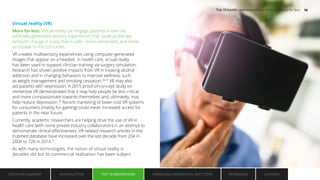
Virtual reality (VR)
More for less: Virtual reality can engage patients in low-risk,
artificially-generated sensory experiences that could accelerate
behavior change in a way that is safer, more convenient, and more
accessible to the consumer.
VR creates multisensory experiences using computer-generated
images that appear on a headset. In health care, virtual reality
has been used to support clinician training via surgery simulation.
Research has shown positive impacts from VR in treating alcohol
addiction and in changing behaviors to improve wellness, such
as weight management and smoking cessation.28,29
VR may also
aid patients with depression. A 2015 proof-of-concept study on
immersive VR demonstrated that it may help people be less critical
and more compassionate towards themselves and, ultimately, may
help reduce depression.30
Recent marketing of lower-cost VR systems
for consumers (mainly for gaming) could mean increased access for
patients in the near future.
Currently, academic researchers are helping drive the use of VR in
health care (with some private industry collaboration) in an attempt to
demonstrate clinical effectiveness. VR-related research articles in the
Pubmed database have increased over the last decade from 204 in
2004 to 720 in 2014.31
As with many technologies, the notion of virtual reality is
decades old but its commercial realization has been subject
EXECUTIVE SUMMARY INTRODUCTION TOP 10 INNOVATIONS EMBRACING INNOVATION: NEXT STEPS AUTHORS
REFERENCES
TOP 10 INNOVATIONS
Top 10 health care innovations: Achieving more for less 16
to the sometimes slow pace of technological progress. Screen
and processor technology have only recently improved in terms of
price and performance such that VR is commercially viable, though
the price may still be too high for widespread adoption.32
In the
future, VR could be integrated with technology advances such as AI,
sophisticated bio-sensors, and increased computing power. For the
innovation to reach its full potential, innovators should:
• Consider VR as an extension of digital strategy, applying new technologies
to transform customer engagement and employee empowerment; and
• Demonstrate clinical efficacy for specific conditions to encourage clinician
and health plan adoption.
Use case: VR is being used to help some soldiers with post-traumatic
stress disorder (PTSD). Clinics and hospitals are using VR warfare
simulations akin to conditions in Iraq and Afghanistan to help veterans
who are, in many ways, continually reliving the traumatic events they
experienced. In a safe and controlled environment, the soldiers can
learn how to deal with instances that might otherwise be triggers to
behavior that could be destructive to themselves and others.33
Facebook’s
Oculus Rift is experimenting with exposure therapy, where a patient
can experience driving a Humvee down a desert road or mountain pass
or recreating an improvised explosive device blast or attack.34
The VR
experience allows the patient to pace the exposure in a more controlled
fashion that engages the user and enables the clinician to guide therapy.
EXECUTIVE SUMMARY INTRODUCTION TOP 10 INNOVATIONS EMBRACING INNOVATION: NEXT STEPS AUTHORS
REFERENCES
TOP 10 INNOVATIONS
Top 10 health care innovations: Achieving more for less 17
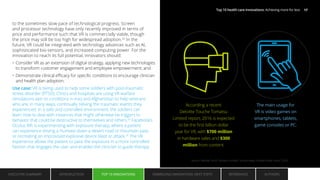
The main usage for
VR is video games on
smartphones, tablets,
game consoles or PC.
According a recent
Deloitte Touche Tomatsu
Limited report, 2016 is expected
to be the first billion dollar
year for VR, with $700 million
in hardware sales and $300
million from content.
Source: Deloitte Touch Tomatsu Limited, “Virtual reality: a billion dollar niche,” 2016.
Top 10 health care innovations: Achieving more for less 17
Leveraging social media to improve patient experience
More for less: Social media offers health care organizations a
potentially rich source of data to efficiently track consumer experiences
and population health trends in real time, much more efficiently than
current approaches.
Just as retailers are using customer data to promote specific products,
the health care industry is evolving its ability to apply data mining and
predictive analytics to help improve population health and the patient
experience. Social media can be a rich source of health care information
that could be valuable to patients, researchers, policymakers, and hospital
administrators. Social networks and online communities could play an
important role in consumer health management, serving as hubs where
patients and caregivers can meet to ask questions, share information,
and compare experiences with treatments and medications. The Deloitte
Center for Health Solutions 2015 Survey of US Health Care Consumers
found that 52 percent of consumers actively search online for health-
or care-related information. Patient-generated content on these digital
platforms illustrates the needs, wants, motivations, behaviors, and decision
considerations of patients and caregivers. This data can provide a valuable
source of insights for providers and pharmaceutical companies seeking to
understand how best to reach, engage, and support individuals across the
patient journey.
Social media also can be used to track consumers’ experiences with the
health care system. Research has focused on leveraging broad population
data such as looking for certain terms on Twitter or other platforms, or
using focused disease communities to learn about patient preferences,
symptoms, responses to treatment, and other quality-of-life measures.35
Several well-established surveys capture patient experience with the
health care system, but it takes several months to publish results, and
response rates are typically low. Greater use of social media generated
lifestyle and behavioral data may help to measure patient experience with
less of a lag-time than these traditional survey methods. In addition, a
recent Deloitte report, “Developing mission-critical social listening programs
for pharmaceutical companies,” showed that these companies could make
better use of their social media channels to understand how, when, and
why patients and caregivers are sharing experiences with specific drugs,
therapies, diseases, and condition.36
Health plans, providers, and life sciences companies would likely need
a better understanding of several factors to increase adoption of social
media listening strategies:
• Whether patients who are willing to share information on social
media are different—demographically or clinically—from non-sharers
(Figure 2);
• What insights may be available from a database that merges social
media and electronic medical record data;
• Which methods can control for data that may be inaccurate
or mischaracterized.
EXECUTIVE SUMMARY INTRODUCTION TOP 10 INNOVATIONS EMBRACING INNOVATION: NEXT STEPS AUTHORS
REFERENCES
TOP 10 INNOVATIONS
Top 10 health care innovations: Achieving more for less 18
Use case: In the past year, several studies have looked at smartphone
data and social media use to study various health issues, including
predicting symptoms of depression and learning about patient experience
and behavioral epidemiology of sleep disorders. Researchers at the
University of Arizona have combined Twitter posts with air quality and
hospital data into a model that predicts ER trends for asthma better
than existing disease surveillance models.37
The team combined Twitter
keywords, air quality data from the Environmental Protection Agency,
and emergency department data from a hospital in Dallas and found a
correlation between tweets about asthma, changes in air quality, and
asthma-related ER visits. Twenty-five million Americans have asthma
and there are two million asthma-related ER visits in the US each year.
An ongoing challenge for hospitals is predicting how many people with
chronic conditions will come to the ER on any given day. This model uses
data to help make those predictions and can anticipate ER visits with 70
percent precision.
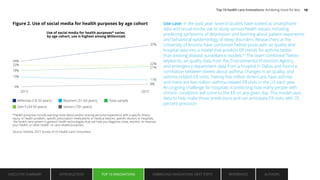
Figure 2. Use of social media for health purposes by age cohort
Use of social media for health purposes* varies
by age cohort; use is highest among Millennials
*Health purposes include learning more about and/or sharing personal experience with a specific illness,
injury, or health problem; specific prescription medications or medical devices; specific doctors or hospitals;
the health care system in general; health technologies that can help you diagnose, treat, monitor, or improve
your health; or other health- or care-related purposes.
Source: Deloitte 2015 Survey of US Health Care Consumers.
28%
37%
22%
21%
11%
8%
22%
18%
13%
6%
2013 2015
Millenials (18-33 years)
Gen X (34-50 years)
Boomers (51-69 years)
Seniors (70+ years)
Total sample
EXECUTIVE SUMMARY INTRODUCTION TOP 10 INNOVATIONS EMBRACING INNOVATION: NEXT STEPS AUTHORS
REFERENCES
TOP 10 INNOVATIONS
Top 10 health care innovations: Achieving more for less 19
Biosensors and trackers
More for less: Biosensors included in rapidly shrinking wearables and
medical devices allow consumers and clinicians to monitor and track
more aspects of patients’ health, enabling earlier intervention—and even
prevention—in a way that is much less intrusive to patients’ lives.
Technology-enabled activity trackers, monitors, and sensors incorporated
into clothing, accessories, and implantable medical devices are evolving
to be able to monitor and sense an increasing number of health
indicators. In addition to monitoring exercise, nutrition, and vital signs,
these trackers and sensors could track changes inside a patient’s
body—medication levels, blood/hormone/protein levels, and device
performance. Patients are more likely to accept these devices as they
become smaller and less intrusive. Some envision that wearables will
shrink to the point where they “disappear” from consumers’ awareness.
CCS Insights expects 411 million wearable devices ranging from eyewear
to watches to jewelry to be sold in 2020.38
Increased biosensing could improve patient engagement, medication
adherence, disease monitoring and, ultimately, health outcomes. The
collected data could be used by clinicians to intervene earlier and more
often, and by researchers to better understand treatment effectiveness.
Wider adoption of biosensors and trackers would likely require:
• Improvements in the technologies’ accuracy, although some clinicians
have noted that trend data is usually helpful, even if specific data points
are not completely accurate;
• Biosensor and tracker interoperability with EHRs;
• Patient and provider willingness to incorporate these devices and data
into daily routines; and
• Transition to VBC payment models, which would create opportunities for
clinicians to indirectly receive reimbursement for the time and costs of
accessing and evaluating this new data set.
Use case: Profusa is developing tissue-integrated sensors to help
individuals continuously monitor their body chemistry. The Lumee
biosensor consists of a biosensor that is made of material similar to
contact lens and is integrated into the body’s tissue. An external optical
reader tracks signals from the biosensor and sends the data to a
smartphone. Applications will focus on peripheral artery disease initially,
with plans to expand to diabetes; chronic obstructive pulmonary disease;
and prevention, wellness, and fitness uses.39
EXECUTIVE SUMMARY INTRODUCTION TOP 10 INNOVATIONS EMBRACING INNOVATION: NEXT STEPS AUTHORS
REFERENCES
TOP 10 INNOVATIONS
Top 10 health care innovations: Achieving more for less 20
Convenient care: Retail clinics and urgent care
More for less: Retail clinics and urgent care centers provide more
convenient and lower-cost health care to patients.
Retail clinics and urgent care centers are generally lower-cost sites of care
that focus on a limited number of health issues. Pharmacies or health
systems often own or partner to run a retail or urgent care clinic, and
they are typically located within shopping centers or other public spaces.
These alternative care sites offer extended hours, more locations, and
shorter wait times. The use of physician assistants, nurse practitioners,
and pharmacists, under the supervision of physicians, lowers costs. As
retail clinics expand their services to include areas such as chronic care
management, educational and behavioral counseling, care coordination,
and infusion centers, their impact may increase.
According to the Deloitte Center for Health Solutions 2015 Survey of US
Health Care Consumers, 77 percent of respondents choose retail clinics for
their convenience, 72 percent for speed of securing an appointment, and
60 percent for after-hours care.
Greater utilization of these lower-cost care centers would likely require:
• State regulators’ expansion of the scope of services for nonphysician
providers, including pharmacists and nurse practitioners;
• Health plan reimbursement for those services, either through traditional
FFS or through VBC models in partnership with provider organizations;
and
• Retail clinic and urgent care center care coordination and demonstration
of equivalent or superior care quality.
Use case: With over 400 locations across the US, Walgreens health
care clinics offer same-day appointments and walk-in visits for services
including vaccinations; health screenings; and treatment of illness, aches
and pains, minor injuries, and skin conditions. In 2013, Walgreens was
the first retail clinic to offer management of chronic conditions including
asthma, diabetes, high blood pressure, and high cholesterol.40
Walgreens
recently announced its collaboration with Mental Health America, a
national behavioral health advocacy organization.41
Walgreens will provide
mental health screenings online as well as train its clinicians to better
identify mental health conditions.
EXECUTIVE SUMMARY INTRODUCTION TOP 10 INNOVATIONS EMBRACING INNOVATION: NEXT STEPS AUTHORS
REFERENCES
TOP 10 INNOVATIONS
Top 10 health care innovations: Achieving more for less 21
Telehealth
More for less: Telehealth offers a more convenient way for consumers
to access care while potentially reducing office visits and travel time. This
convenient care model has the potential to increase self-care and prevent
complications and ER visits.
Telehealth is part of connected health (cHealth), technology-enabled
integrated care delivery that allows for remote communication, diagnosis,
treatment, and monitoring. Specifically, telehealth uses electronic
information and telecommunications technologies to support long-
distance clinical health care and patient and professional health-related
education. Telehealth lets health care providers connect with patients
and consulting practitioners across vast distances. It offers the ability for
patients to have more frequent, convenient, and low-cost touchpoints
with their physicians. In addition, telehealth may enable closer monitoring,
earlier diagnosis and intervention, and better adherence, ultimately
resulting in lower cost of care.42
For health care organizations looking to implement or expand telehealth,
it is important to note that simply giving consumers more access to care
doesn’t automatically translate to improved outcomes. But, organizations
have shown that through a targeted approach, especially to certain high-
risk populations who are covered under VBC models, telehealth programs
can be cost-effective.43
The US Department of Veterans Affairs (VA) has
been using telehealth to enhance veterans’ access to high-quality care
for over a decade. VA has published some results of its home telehealth
programs for noninstitutionalized care patients with chronic conditions,
and the studies show that the programs have resulted in sizable declines in
several health care cost drivers (e.g., ER visits and admissions).44
In addition,
individuals who would have long-term or frequent hospital admissions are
able to live independently in their homes.
Although telehealth technology is not new, provider use remains low.
Some current/pending marketplace changes that may encourage greater
provider adoption of telehealth include:
• Provider participation in value-based payment models;
• Increasing patient willingness to leverage technology to facilitate a
relationship with their clinician (see current level of interest in using
technology in Figure 4);
• Flexibility in government policies to allow practitioners to practice across
state lines.
EXECUTIVE SUMMARY INTRODUCTION TOP 10 INNOVATIONS EMBRACING INNOVATION: NEXT STEPS AUTHORS
REFERENCES
TOP 10 INNOVATIONS
Top 10 health care innovations: Achieving more for less 22
Use case: American Well is working to make online doctor visits accessible
for one-off care issues such as colds or infections, and chronic care
management including diabetes and depression. The care delivery model
involves working with health plans, employers, and health systems, as well
as their telehealth app, Amwell.
American Well is collaborating with several providers to implement its
services. American Well is rolling out a service that will provide urgent
care services to patients using online video. Patients experiencing
nonemergency medical conditions can connect to board-certified
physicians from American Well’s nationwide medical affiliate. The service
features high-definition video that is available 24 hours a day, seven days
a week through a mobile app, tablet, or computer with Internet access.
The company says that the service will cost $49 and includes physician
review of information, development of a treatment plan, medication
prescriptions, if necessary, and suggested follow-up care.45
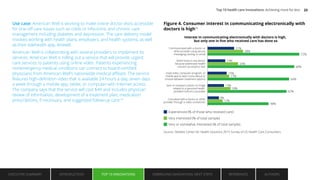
Figure 4. Consumer interest in communicating electronically with
doctors is high46
Interest in communicating electronically with doctors is high,
but only one in five who received care has done so
Source: Deloitte Center for Health Solutions 2015 Survey of US Health Care Consumers.
Experienced (% of those who received care)
Very interested (% of total sample)
Very or somewhat interested (% of total sample)
Communicated with a doctor or
other provider using secure
messaging, texting, or email
Consulted with a doctor or other
provider through a video connection
Sent or received a photo or image
related to a personal health
problem to/from a provider
Used video, computer program, or
mobile app to learn more about or
choose between treatment options
Didn’t have to visit doctor
because addressed health
concern via email or text
21%
28%
72%
14%
24%
68%
15%
17%
64%
13%
18%
62%
9%
12%
48%
EXECUTIVE SUMMARY INTRODUCTION TOP 10 INNOVATIONS EMBRACING INNOVATION: NEXT STEPS AUTHORS
REFERENCES
TOP 10 INNOVATIONS
Top 10 health care innovations: Achieving more for less 23
Popular innovations that didn’t make the list
Recent buzzworthy reports about innovation have tended to focus on
“shiny objects,” or technologies that have been the focus of a lot of recent
hype. Many technologies that fall into this category represent “more for
more”—advancements that typically come at a higher cost, either financially
or physically in the case of health care. It is possible that with further
research and advances some of the innovations described below could
become “more for less” but they did not make the top 10 list. Nominated
technologies that do not yet meet our definition of innovation include:
• Gene therapy—Gene transfer technology involves inserting genes into
living cells to enhance the body’s own response to complex diseases or
to provide specific proteins that are lacking in the patient. In most gene
therapy studies, researchers use a carrier molecule called a vector to
deliver the therapeutic gene to the target cells. Early candidates for gene
therapy are rare genetic diseases associated with significant disability
and early mortality with limited or no therapeutic options. However,
treatment costs can exceed $1 million and there is limited data on the
long-term safety and efficacy. Reimbursement for these treatments will
likely require demonstrable data that the benefits are sustainable and
there are minimal negative effects for the patient. Without such data,
gene therapy is not likely to be incorporated into clinical practice at a
scale that will transform health care.
• Regenerative medicine—Regenerative medicine describes the use
of human cells to rejuvenate, replace, or regenerate human tissues.
This technology has the potential to transform care by replacing
some biopharmaceuticals and medical prostheses. For example, if
regenerative medicine was successful in replacing B-islet cells in the
pancreas, it could negate the need for a patient to receive insulin
injections. Cartilage regeneration could replace the need for certain
prostheses. However, it is unclear how expensive these products
will be, or if they will be significantly better than the standard of care.
Further, ethical concerns around the use of stem-cell-based therapies
remain. Until these issues are resolved this technology is not likely to be
adopted into clinical practice.
• Robotics—Robotics has the potential to take over many of the mundane
or unsafe health care-related tasks that humans currently perform
and increase the efficiency of these tasks. For instance, robotics could
improve drug compounding preparation, decontaminate and sterilize
medical equipment, and reallocate personnel resources to more
high-value areas (e.g., allow nurses to spend more time directly with
patients). Driverless cars could take patients to their appointments,
improving continuity of care. Drones could pick up medication that an
elderly patient may have dropped on the floor. Robotic applications in
pharmacies and surgery are being used today, though the full potential of
the technology has not yet been reached. The cost of these technologies
remains a challenge in some applications (e.g., surgery), and it is unclear
if leveraging robotics will improve efficiencies and outcomes enough to
justify the additional cost.
EXECUTIVE SUMMARY INTRODUCTION TOP 10 INNOVATIONS EMBRACING INNOVATION: NEXT STEPS AUTHORS
REFERENCES
TOP 10 INNOVATIONS
Top 10 health care innovations: Achieving more for less 24
Embracing innovation: Next steps
These top 10 innovations have the potential to transform the health care
system at large but each organization will be impacted to different degrees
depending on its core strategies, offerings, and goals. Health care leaders
should focus on innovations that have the potential to positively impact
their specific business models. Regardless of where leaders choose to
focus first, there are several next steps that they should consider:
• Build ecosystems: Adopting many of these innovations requires
capabilities that fall beyond the traditional purview of health care
organizations. They should identify partners which can complement
their existing capabilities or fill gaps. Some of these complementary
capabilities could include technology development, data capture, or
patient engagement.
• Embrace nontraditional sources of knowledge: The democratization
of innovation and the rise of the makers movement, where individuals
or groups of individuals use existing materials to build solutions to
health care’s challenges, could create new sources of knowledge and
talent. Organizations might consider looking outside their walls and
crowdsourcing fresh ideas to challenging problems.
• Pilot, experiment, and scale: Given the rapid pace of change,
organizations would benefit from embarking on small-scale pilots
before entering into full-scale contracts with new technology providers.
Small-scale pilots would allow organizations to experiment with new
approaches or technologies. If they are successful, then expand to scale.
If not, then quietly pivot to adjust the strategy.
• Experiment with new business models: Traditional health care
business models are changing and, as a result, organizations could
benefit from expanding beyond traditional revenue sources. Many health
care organizations are growing venture capital investments or engaging
in joint ventures with nontraditional partners.
• Focus on change management: Many times an organization knows
it needs to change and wants to do so but simply doesn’t have the
ability. This is evident in the low success rate of many transformational
initiatives. Successful change requires dedicated focus and effort.
• Be agile: Leading organizations should learn to anticipate and swiftly
address emerging innovation. They should disrupt their own business
models before someone else does.
“Health care leaders should focus on
innovations that have the potential to positively
impact their specific business models.”
EXECUTIVE SUMMARY INTRODUCTION TOP 10 INNOVATIONS EMBRACING INNOVATION: NEXT STEPS AUTHORS
REFERENCES
EMBRACING INNOVATION: NEXT STEPS
Top 10 health care innovations: Achieving more for less 25
References
1. Michael E. Raynor, Heather A. Gray, “Innovation: A chimera no more,” DUPress, July 14, 2013, http://dupress.com/
articles/innovation-a-chimera-no-more/, accessed July 19, 2016.
2. Department of Health and Human Services, “Better, smarter, healthier: Health Care Payment Learning and
ActionNetwork kick off to advance value and quality in health care,” March 25, 2015, http://www.hhs.gov/about/
news/2015/03/25/better-smarter-healthier-health-care-payment-learning-and-action-network-kick-off-to-advance-
value-and-quality-in-health-care.html, accessed July 19, 2016.
3. Health Care Transformation Task Force, “Major health care players unite to accelerate transformation of U.S. health
care system,” January 28, 2015, http://www.hcttf.org/releases/2015/1/28/major-health-care-players-unite-to-accelerate-
transformation-of-us-health-care-system, accessed July 19, 2016.
4. National Institutes of Health, “Precision Medicine Initiative Cohort Program,” https://www.nih.gov/precision-medicine-
initiative-cohort-program, accessed July 19, 2016.
5. National Cancer Institute at the National Institutes of Health, “Cancer Moonshot,” http://www.cancer.gov/research/key-
initiatives/moonshot-cancer-initiative, accessed July 19, 2016.
6. Centers for Disease Control and Prevention, “The road to zero: CDC’s Response to the West African Ebola Epidemic,”
2014–2015, http://www.cdc.gov/about/ebola/index.html, accessed July 19, 2016.
7. Centers for Disease Control and Prevention, “CDC Director: What we’re doing about the Zika Virus,” http://blogs.cdc.gov/
cdcdirector/2016/02/01/cdc-director-what-were-doing-about-the-zika-virus/, accessed July 19, 2016.
8. US Congress, House of Representatives’ Energy and Commerce Committee, “21st Century Cures: Hearings,
Roundtables, and Forums,” 2016, https://energycommerce.house.gov/cures-events, accessed July 19, 2016.
9. US Congress, House of Representatives’ Energy and Commerce Committee, “H.R. 6, the 21st Century Cures Act:
Frequently Asked Questions,” June 25, 2016, https://energycommerce.house.gov/news-center/fact-sheets/hr-6-21st-
century-cures-act-frequently-asked-questions, accessed July 19, 2016.
10. National Human Genome Research Institute, “The cost of sequencing a human genome,” https://www.genome.gov/
images/content/costpergenome2015_4.jpg, accessed July 19, 2016.
11. Ibid.
12. Brenda J. Wilson, Stuart G. Nicholls, “The Human Genome Project, and recent advances in personalized genomics,”
Risk Management and Healthcare Policy, Volume 8, February 16, 2015, https://www.dovepress.com/the-human-genome-
project-and-recent-advances-in-personalized-genomics-peer-reviewed-article-RMHP, accessed July 19, 2016.
13. Ibid.
14. Drew Hendricks, “3D printing is already changing health care,” Harvard Business Review, March 4, 2016, https://hbr.
org/2016/03/3d-printing-is-already-changing-health-care, accessed July 19, 2016.
15. Ibid.
16. Mark Cotteleer, Jim Joyce, “3D opportunity: Additive manufacturing paths to performance, innovation, and growth,”
Deloitte Review, Issue 14, January 17, 2014, http://dupress.com/articles/dr14-3d-opportunity/, accessed July 19, 2016.
17. Jonathan Schwartz, “The future of 3D-printed prosthetics,” Crunch Network, June 26, 2016, https://techcrunch.
com/2016/06/26/the-future-of-3d-printed-prosthetics/, accessed July 19, 2016.
18. Open Bionics, “Overview,” http://www.openbionics.org/overview/, accessed July 19, 2016.
19. Colin White, Robert Jeng, Jolene Lau, “Immuno-Oncology Overview,” DataMonitor Healthcare, June 12, 2015, https://www.
futureofoncology.com/wp-content/uploads/2015/06/Datamonitor-Healthcare-Immuno-Oncology-Product-Brochure.
pdf, accessed July 19, 2016.
20. Ibid.
21. American Society of Clinical Oncology, “The State of Cancer Care in America, 2016: A Report by the American Society of
Clinical Oncology,” Journal of Oncology Practice, Volume 12(4), March 15, 2016, http://www.asco.org/research-progress/
reports-studies/cancer-care-america-2016#/message-ascos-president, accessed July 19, 2016.
22. Colin White, Robert Jeng, Jolene Lau, “Immuno-Oncology Overview,” DataMonitor Healthcare, June 12, 2015, https://www.
futureofoncology.com/wp-content/uploads/2015/06/Datamonitor-Healthcare-Immuno-Oncology-Product-Brochure.
pdf, accessed July 19, 2016.
23. Reenita Das, “Five Technologies That Will Disrupt Healthcare by 2020,” Forbes, March 30, 2016, http://www.forbes.com/
sites/reenitadas/2016/03/30/top-5-technologies-disrupting-healthcare-by-2020/#4d108f162528, accessed July 13,
2016.
24. Memorial Sloan Kettering Cancer Center, “Watson Oncology,” 2016, https://www.mskcc.org/about/innovative-
collaborations/watson-oncology, accessed July 13, 2016.
25. GlobalData, “Point of Care Diagnostics Market Will Rise to Almost $3 Billion by 2021,” Medical Design Technology
Magazine, March 21, 2016, http://www.mdtmag.com/news/2016/03/point-care-diagnostics-market-will-rise-almost-3-
billion-2021, accessed July 13, 2016.
26. Apple Watch is a trademarks of Apple Inc., registered in the US and other countries. “Top 10 health care innovations:
Achieving more for less” is an independent publication and has not been authorized, sponsored, or otherwise approved
by Apple Inc.
27. Jmomma, “Helped diagnose my palpitations and saved me $500,” Amazon Customer Reviews, July 8, 2016, http://www.
amazon.com/Kardia-Mobile-Black-0-6-oz/product-reviews/B01A4W8AUK/ref=cm_cr_arp_d_paging_btm_7?ie=UTF8&sho
wViewpoints=1&sortBy=recent&pageNumber=7, accessed July 13, 2016.
EXECUTIVE SUMMARY INTRODUCTION TOP 10 INNOVATIONS EMBRACING INNOVATION: NEXT STEPS AUTHORS
ENDNOTES
REFERENCES
Top 10 health care innovations: Achieving more for less 26
28. Sun Joo (Grace) Ahn, “Incorporating immersive virtual environments in health promotion campaigns: a construal level
theory approach,” Health Communication, Volume 30(6), July 3, 2015, http://www.ncbi.nlm.nih.gov/pubmed/24991725,
accessed July 19, 2016.
29. Ji Hyun Son, et al, “Virtual reality therapy for the treatment of alcohol dependence: A preliminary investigation with
positron emission tomography/computerized tomography,” Journal of Studies on Alcohol and Drugs, Volume 76(4), July
2015, http://www.ncbi.nlm.nih.gov/pubmed/26098039, accessed July 19, 2016.
30. Caroline J. Falconer et al, “Embodying self-compassion within virtual reality and its effects on patients with depression,”
British Journal of Psychiatry Volume 2(1), February 2016, http://bjpo.rcpsych.org/content/2/1/74, accessed July 19, 2016.
31. Alex Senson, “Virtual reality in health care: where is the innovation?” Techcrunch, September 16, 2015, https://
techcrunch.com/2015/09/16/virtual-reality-in-healthcare-wheres-the-innovation/, accessed July 19, 2016.
32. Paul Lee, Duncan Stewart, “Virtual reality (VR): a billion dollar niche: TMT Predictions 2016,” Deloitte Technology, Media &
Telecommunications, http://www2.deloitte.com/global/en/pages/technology-media-and-telecommunications/articles/
tmt-pred16-media-virtual-reality-billion-dollar-niche.html#full-report, accessed July 19, 2016.
33. Alex Senson, “Virtual reality in health care: where is the innovation?” Techcrunch, September 16, 2015, https://
techcrunch.com/2015/09/16/virtual-reality-in-healthcare-wheres-the-innovation/, accessed July 19, 2016.
34. Joel Lee, “Five amazing non-gaming ways people are using Oculus Rift,” MakeUseOf, October 23, 2014, http://www.
makeuseof.com/tag/5-amazing-non-gaming-ways-people-using-oculus-rift/, accessed July 19, 2016.
35. Sudha Ram, Wenli Zhang, Max Williams, and Yolande Pengetnze, “Predicting asthma-related emergency department
visits using big data,” IEEE Journal of Biomedical Health Informatics, Volume 19(4), July 2015, http://www.ncbi.nlm.nih.gov/
pubmed/25706935, accessed July 19, 2016.
36. Becca Ramble and Katy Balatero, “Developing mission critical social listening programs for pharmaceutical companies,”
Deloitte Center for Health Solutions blog, April 13, 2016, http://blogs.deloitte.com/centerforhealthsolutions/developing-
mission-critical-social-listening-programs-for-pharmaceutical-companies/, accessed July 19, 2016.
37. Sudha Ram, Wenli Zhang, Max Williams, and Yolande Pengetnze, “Predicting asthma-related emergency department
visits using big data,” IEEE Journal of Biomedical Health Informatics, Volume 19(4), July 2015, http://www.ncbi.nlm.nih.gov/
pubmed/25706935, accessed July 19, 2016.
38. Paul Lamkin, “Wearable Tech Market To Be Worth $34 Billion by 2020,” Forbes, February 17, 2016, http://www.forbes.
com/sites/paullamkin/2016/02/17/wearable-tech-market-to-be-worth-34-billion-by-2020/#3a290e4f3fe3, accessed July
13, 2016.
39. Jennifer Hicks, “Beyond Fitness Trackers at CES: Tiny Wearable Biosensor Continuously Monitors Your Body Chemistry,”
Forbes, January 17, 2016, http://www.forbes.com/sites/jenniferhicks/2016/01/07/beyond-fitness-trackers-at-ces-tiny-
wearable-biosensor-continuously-monitors-your-body-chemistry/#34f65c0b6019, accessed July 22, 2016.
40. Dr. Ishani Ganguli, “Chronic care at Walgreens? Why not.” Boston Globe, April 22, 2013, https://www.bostonglobe.
com/lifestyle/health-wellness/2013/04/21/chronic-care-walgreens-why-not/WVB3YqhyDIPqvI5APVuodM/story.html,
accessed July 13, 2016.
41. Steven Ross Johnson, “Walgreens aims to promote greater mental health awareness,” Modern Healthcare, May 10, 2016,
http://www.modernhealthcare.com/article/20160510/NEWS/160519997, accessed July 13, 2016.
42. Harrry Greenspun, Casey Korba, Sunandan Bandyopadhyay, “Accelerating the adoption of connected health,” Deloitte
Center for Health Solutions, https://www2.deloitte.com/content/dam/Deloitte/us/Documents/life-sciences-health-care/
us-dchs-connected-health.pdf, accessed July 19, 2016.
43. Ibid.
44. Adam Darkins, Patricia Ryan, Rita Kobb, Linda Foster, Ellen Edmonson, Bonnie Wakefield, and Anne Lancaster, “Care
Coordination/Home Telehealth: the systematic implementation of health informatics, home telehealth, and disease
management to support the care of veteran patients with chronic conditions,” Telemedicine and e-Health Volume 10(14),
December 2008, http://www.ncbi.nlm.nih.gov/pubmed/19119835, accessed July 19, 2016.
45. American Well, “TGH and American Well Set to Deliver Online Health Care,” https://www.americanwell.com/press-
release/tgh-and-american-well-set-to-deliver-online-health-care/, accessed July 19, 2016.
46. Harry Greenspun, Sarah Thomas, Gregory Scott, David Betts, “Health care consumer engagement: No ‘one-size-fits-
all’ approach,” Deloitte Center for Health Solutions, http://www2.deloitte.com/us/en/pages/life-sciences-and-health-care/
articles/health-care-consumer-engagement.html, accessed July 19, 2016.
EXECUTIVE SUMMARY INTRODUCTION TOP 10 INNOVATIONS EMBRACING INNOVATION: NEXT STEPS AUTHORS
ENDNOTES
REFERENCES
Top 10 health care innovations: Achieving more for less 27
Authors
Bill Copeland
Vice Chairman
US Life Sciences & Health Care Industry Leader
Deloitte LLP
bcopeland@deloitte.com
Michael Raynor
Managing Director
Monitor Deloitte
Deloitte Consulting LLP
mraynor@deloitte.com
Sonal Shah
Senior Manager
Deloitte Center for Health Solutions
Deloitte Services LP
sonshah@deloitte.com
Acknowledgements
The authors would like to especially thank
Christine Chang and Casey Korba for their
significant contributions to the survey design,
analysis, and writing of this report.
We also wish to thank Jonathan Fox, Mariya
Filipova, Bill Eggers, Satish Nelanuthula, Anish
Kumar, Andrew Ryscavage, Daniel Esquibel, Harry
Greenspun, Sarah Thomas, Lauren Wallace and
the many others who contributed their ideas and
insights to this project.
To download a copy of this report, please visit
www.deloitte.com/us/top-health-care-innovations.
Deloitte Center for Health Solutions
To learn more about the Deloitte Center for
Health Solutions, its projects, and events, please
visit www.deloitte.com/centerforhealthsolutions.
Harry Greenspun, MD
Managing Director
Deloitte Services LP
hgreenspun@deloitte.com
Sarah Thomas, MS
Managing Director, Research
Deloitte Services LP
sarthomas@deloitte.com
Web: www.deloitte.com/centerforhealthsolutions
Twitter: @DeloitteHealth
EXECUTIVE SUMMARY INTRODUCTION TOP 10 INNOVATIONS EMBRACING INNOVATION: NEXT STEPS AUTHORS
REFERENCES AUTHORS
Top 10 health care innovations: Achieving more for less 28
As used in this document, “Deloitte” means Deloitte LLP and its subsidiaries. Please see www.deloitte.com/us/about for a
detailed description of the legal structure of Deloitte LLP and its subsidiaries. Certain services may not be available to attest
clients under the rules and regulations of public accounting.
This publication contains general information only and Deloitte is not, by means of this publication, rendering accounting,
business, financial, investment, legal, tax, or other professional advice or services. This publication is not a substitute for such
professional advice or services, nor should it be used as a basis for any decision or action that may affect your business.
Before making any decision or taking any action that may affect your business, you should consult a qualified professional
advisor.
Deloitte shall not be responsible for any loss sustained by any person who relies on this publication.
Copyright © 2016 Deloitte Development LLC. All rights reserved.
Member of Deloitte Touche Tohmatsu Limited.
The Deloitte Center for Health Solutions is the health services research arm of Deloitte LLP. Our goal is to inform all
stakeholders in the health care system about emerging trends, challenges, and opportunities using rigorous research.
Through our research, roundtables, and other forms of engagement, we seek to be a trusted source for relevant, timely, and
reliable insights.
EXECUTIVE SUMMARY INTRODUCTION TOP 10 INNOVATIONS EMBRACING INNOVATION: NEXT STEPS AUTHORS
ENDNOTES

us-lshc-top-ten-innovation.pdf

  • 1.
    Executive summary Health careis an industry in need of innovation. Health plans, providers, life sciences companies, and the government are facing rising costs and inconsistent outcomes. They are working to achieve the triple aim— improving care, improving health, and reducing spending. What innovations are most likely to help stakeholders achieve these goals and transform health care over the next 10 years? We surveyed leaders across the health care system to identify the innovations they think are most likely to transform health care. We then narrowed the list to the top 10 by applying the following definition: Innovation: Any combination of activities or technologies that break existing performance tradeoffs in the attainment of an outcome, in a manner that expands the realm of the possible. Defined in health care as providing “more for less”—more value, better outcomes, greater convenience, access and simplicity; all for less cost, complexity, and time required by the patient and the provider, in a way that expands what is currently possible. Our current health care system’s performance can be defined by its rules, policies, regulations, enabling technologies, operating models, customs, and patient and provider preferences; together, these elements comprise the frontier of what is possible. They also serve as the constraints to what can be achieved. For far too long the health care industry’s performance, despite attempts to spur progress, has remained at the edge of this frontier. The industry needs to break current constraints and expand the frontier to achieve true breakthrough performance. While the constraints are many, the traditional, dominant, fee-for-service (FFS) payment model, in particular, does not align provider incentives with the goal of achieving more for less. EXECUTIVE SUMMARY INTRODUCTION TOP 10 INNOVATIONS EMBRACING INNOVATION: NEXT STEPS AUTHORS REFERENCES EXECUTIVE SUMMARY Top 10 health care innovations: Achieving more for less
  • 2.
    The top 10list consists of innovations that will most likely achieve more for less in health care: • Next-generation sequencing (NGS): Applications of genetic sequencing to identify at-risk populations or target therapies to patients who are likely to respond • 3D-printed devices: Lower-cost and highly customized medical technology products that can be tailored to suit the physiological needs of individual patients • Immunotherapy: Treatments with the potential to significantly extend survival for cancer patients, without the negative side effects and related health care costs of traditional chemotherapy • Artificial intelligence (AI): The ability of computers to think like and complete tasks currently performed by humans with greater speed, accuracy, and lower resource utilization • Point-of-care (POC) diagnostics: Allow for convenient, timely testing at the point of care (e.g., physician office, ambulance, home, or hospital), resulting in faster, more cohesive patient care • Virtual reality (VR): Simulated environments that could accelerate behavior change in patients in a way that is safer, more convenient, and more accessible • Leveraging social media to improve patient experience: Tapping data from social media and online communities to give health care organizations the ability to track consumer experience and population health trends in real-time • Biosensors and trackers: Technology-enabled activity trackers, monitors, and sensors incorporated into clothing, accessories, and devices that allow consumers and clinicians to easily monitor health • Convenient care: Retail clinics and urgent care centers that provide more convenient and lower-cost care to patients for a number of health issues • Telehealth: A more convenient way for consumers to access and increase self-care while potentially reducing office visits and travel time; may also prevent complications and emergency room (ER) visits “Incorporating these top 10 innovations into business models will require changing how health care organizations currently prevent, diagnose, monitor, and treat disease.” EXECUTIVE SUMMARY INTRODUCTION TOP 10 INNOVATIONS EMBRACING INNOVATION: NEXT STEPS AUTHORS REFERENCES EXECUTIVE SUMMARY Top 10 health care innovations: Achieving more for less 2
  • 3.
    The 10 innovationswe describe in this report have the potential to break the constraints of the FFS-based health care system and expand the frontier through new business models that can deliver care in ways previously not thought possible. Early adopters of these innovations are likely to be those already experimenting with business model changes as a result of recent, transformational market shifts: value-based care (VBC), consumerism, and the proliferation of new data sources. VBC creates incentives for providers to experiment with care management and patient engagement approaches that could improve health outcomes and reduce spending. Some stakeholders are recognizing the importance of activating patients in their own care and are investing in capabilities to encourage this. Meanwhile, new data sources and tools are informing clinical trial design, treatment decisions, and ongoing patient care. Incorporating these top 10 innovations into business models will require changing how health care organizations currently prevent, diagnose, monitor, and treat disease. Leaders should determine which innovations break performance trade-offs, or create “more for less,” in a way that impacts their core business. Healthcare leaders should consider building ecosystems that embrace nontraditional players and sources of knowledge outside their own four walls. Stakeholders should also consider building pilots before investing in scale, learn to embrace change, and evaluate new revenue sources. And, organizations should strive to be agile in anticipating and adjusting their strategies as innovations continue to evolve. “Incorporating these top 10 innovations into business models will require changing how health care organizations currently prevent, diagnose, monitor, and treat disease.” Top 10 health care innovations: Achieving more for less 3 EXECUTIVE SUMMARY INTRODUCTION TOP 10 INNOVATIONS EMBRACING INNOVATION: NEXT STEPS AUTHORS REFERENCES EXECUTIVE SUMMARY
  • 4.
    Introduction Public and privatesector momentum towards achieving the triple aim is strengthening the business case for innovation in health care. (See sidebar: Balancing innovation and regulation: The public sector’s role.) In this dynamic environment, what are the innovations most likely to transform health care over the next 10 years? Deloitte conducted an external survey of innovation leaders across several segments of the health care system* to gather their opinions about which innovations are most likely to transform health care over the next decade. Respondents suggested many ideas and we then applied our definition of innovation to narrow the list to the top 10. While there are many ways to define innovation, we chose the definition used by Michael Raynor, author of Innovation: A Chimera No More:1 Any combination of activities or technologies that break existing performance tradeoffs in the attainment of an outcome, in a manner that expands the realm of the possible. More value, better outcomes, greater convenience, access and simplicity; all for less cost, complexity, and time required by the patient and the provider, in a way that expands what is currently possible. * Our survey included 85 external respondents, including leaders from the biopharmaceutical industry, medical technology companies, diagnostics, health and nonhealth focused technology companies, venture capital investors, providers (Accountable Care Organizations, Integrated Delivery Networks, Academic Medical Centers, physician groups), urgent care, retail clinics, health plans, and nurse practitioners, clinical pharmacists, academics, and former policy makers. EXECUTIVE SUMMARY INTRODUCTION TOP 10 INNOVATIONS EMBRACING INNOVATION: NEXT STEPS AUTHORS REFERENCES INTRODUCTION Top 10 health care innovations: Achieving more for less 4
  • 5.
    In the contextof the health care system, this requires breaking the constraints of FFS clinical models to provide better care, in the optimal setting, at the right time, with the right provider, to create better outcomes and access using enabling technologies that lower the overall cost of managing a population’s acute and chronic care. It also means changing care delivery models to progress beyond the current limits of performance and cost of existing approaches and technologies. The top 10 innovations include those with the potential to change how health care organizations prevent, diagnose, monitor, and treat disease. The potential impact of these innovations transcends traditional stakeholder segmentation (e.g., health plans, health care providers, and life sciences companies) and is anticipated to drive transformative change in business and operating models. Some organizations are already experiencing business model transformation arising from payment model changes, new demands from consumers, and increased availability of data sources. The top 10 innovations are likely to accelerate transformation of the health care system across each of these three areas. Further, early adopters of the top innovations are likely to be organizations which are already embracing these market shifts: • Aligning financial incentives: The FFS payment model does not create financial incentives for providers to improve quality and does not typically reimburse for the use of nontraditional services. Rather, FFS could create incentives for physicians to provide more services, even if the incremental benefit may not be commensurate to the cost. The shift to VBC aims to change these incentives by tying payment to quality and total cost of care, rather than rewarding volume. Public and private payers have aggressive goals for the shift to VBC: The US Department of Health and Human Services (HHS) aims to link 50 percent of Medicare payments to quality or value through alternative payment models by 2018.2 The Health Care Transformation Task Force, consisting of providers, health plans, and employers, has committed to shift 75 percent of its members’ business into contracts with incentives for health outcomes, quality, and cost management by January 2020.3 The Medicare Access and CHIP Reauthorization Act of 2015 (MACRA) is poised to drive payment and delivery reform across the payer mix for the foreseeable future. (See sidebar: Balancing innovation and regulation: The public sector’s role.) • Rise of consumerism: Consumers’ expectations for how they receive services—including health care—are changing. Consumers impatient with poor service are happy to transfer their loyalty to companies and products that deliver on cost and convenience. Health care consumerism is increasing, even as some health plans are shifting more cost-sharing to consumers, many of whom are struggling to make informed decisions due to a lack of available information on treatment options, quality, and price. Another aspect of consumerism is patient behavior, one of the key components of disease management amidst the increasing prevalence of chronic conditions. Successful patient engagement could improve self- care and help achieve better outcomes; many health care stakeholders EXECUTIVE SUMMARY INTRODUCTION TOP 10 INNOVATIONS EMBRACING INNOVATION: NEXT STEPS AUTHORS REFERENCES INTRODUCTION Top 10 health care innovations: Achieving more for less 5
  • 6.
    are investing insolutions to address this issue. In addition, some researchers are trying to understand what motivates individual patients and are working on developing tailored solutions that incorporate individualized goals. • Data privacy, security, and interoperability: Several new data sources are being discovered and created, generating a wealth of information on practice patterns, health, outcomes, and costs. Increasing data volume and variety are being partially fueled by the adoption of electronic health records (EHRs); however, much of the data is not yet interoperable, limiting the extent to which organizations can use it for research or incorporate it into clinician workflows. Further, health care stakeholders are concerned with protecting the privacy and security of patient data. Health care leaders should identify which of the top 10 innovations are likely to impact their specific business models. For each innovation, we describe how it might break constraints to create “more for less,” and what changes could support greater adoption. EXECUTIVE SUMMARY INTRODUCTION TOP 10 INNOVATIONS EMBRACING INNOVATION: NEXT STEPS AUTHORS REFERENCES INTRODUCTION Top 10 health care innovations: Achieving more for less 6
  • 7.
    Balancing innovation andregulation: The public sector’s role The federal government can play a key role in health care innovation both by launching pilots and programs as well as evolving regulations to keep pace with emerging technologies and ideas. Regulators set metrics and measure outcomes, establish objectives, and create processes for stakeholders to follow. These rule sets can serve dual functions: While they set guidelines or rules for organizations to follow, they can also serve as catalysts for innovation. Several recent examples of federal health initiatives or policy changes, for example, could help the top 10 innovations realize their transformative potential: • The Obama Administration is issuing regulations to implement new payment tracks under the Medicare Access and CHIP Reauthorization Act of 2015 (MACRA), which is poised to drive health care delivery and payment reform across clinicians, health systems, Medicare, and other government and commercial payers. Congress intended MACRA to be a transformative law that fundamentally changes how physicians and other clinicians are reimbursed under the Medicare Physician Fee Schedule, and establishes new incentives that will drive payment and delivery reform efforts across the health care payer mix. MACRA has the potential to be a game-changer at all levels of the health care system. Already, the law is igniting strategic discussions around new care, payment, and delivery models and creating new sources of risk-sharing for health care organizations. MACRA’s implementation could drive health care providers to experiment with new approaches to care delivery and patient engagement, including several of the innovations we describe in this paper. • In 2015, the Administration announced the Precision Medicine Initiative (PMI) to improve health outcomes, fuel the development of new disease treatments, and catalyze a new era of data-based and more precise preventive care and medical treatment. The National Institutes of Health (NIH) is working to create a research cohort that will engage a million or more Americans who volunteer to contribute their health data over many years to help meet this goal. This registry will help researchers understand how genetic and nongenetic factors, such as the gut microbiome, patient behaviors, and the environment, could also influence patient outcomes.4 • In January 2016, President Obama announced the launch of the National Cancer Moonshot Initiative (NCM). Led by Vice President Joe Biden, the initiative aims to make more therapies available to more patients, while also improving our ability to prevent cancer and detect it at an early stage.5 Greater collaboration could result in additional investment and acceleration in research for new treatment approaches like immunotherapy. The NCM is also encouraging the research community to make data available and mineable by all. EXECUTIVE SUMMARY INTRODUCTION TOP 10 INNOVATIONS EMBRACING INNOVATION: NEXT STEPS AUTHORS REFERENCES INTRODUCTION Top 10 health care innovations: Achieving more for less 7
  • 8.
    • The Centersfor Disease Control and Prevention (CDC) plays a leadership role in our nation’s response to disease outbreaks like the recent Ebola outbreak and Zika virus. These kinds of global health crises can generate new ideas and bold solutions to problems that surface during an outbreak response. CDC teams across the globe are coming up with innovative ways to handle these unexpected challenges by creating better approaches and tools to fight epidemics. Specifically, they are leading vaccine trials, creating new uses for technologies, developing rapid diagnostics, and facilitating innovative partnerships.6 For example, CDC labs have developed a test that can confirm Zika in the first week of illness or in a sample from an affected child.7 • The Energy and Commerce Committee’s 21st Century Cures initiative and related legislation aim to modernize elements of the federal government’s research and regulatory agencies to accelerate the pace of cures in America.8 The initiative is focused on a broad range of issues, including a comprehensive process of basic science discovery, streamlining the drug and device development process, and using digital medicine and social media at the treatment and delivery phase. The legislation seeks to strengthen the federal agencies charged with advancing these areas, including NIH, the Food and Drug Administration (FDA), and CMS.9 As many of these initiatives gain momentum it is important to acknowledge that innovation and regulation can sometimes clash. It can be a challenge for regulatory agencies, policymakers, and governing bodies to keep up with the rapid evolution of technology and new and evolving threats to public health. Innovators should carefully consider how to operate in the heavily regulated health care industry. The public wants new, groundbreaking treatments and cures for our most perplexing diseases, but also wants them to be safe and accessible. Consumers want health care information at their fingertips, but also want assurance that their privacy is protected and their personal data secure. Society wants access to the best innovations, but there is a need to balance that with investments in infrastructure, education, and providing a safety net for our vulnerable citizens. The public sector strives to achieve this balance through increased coordination among agencies, public input, and public-private partnerships. “It can be a challenge for regulatory agencies, policymakers, and governing bodies to keep up with the rapid evolution of technology and new and evolving threats to public health.” EXECUTIVE SUMMARY INTRODUCTION TOP 10 INNOVATIONS EMBRACING INNOVATION: NEXT STEPS AUTHORS REFERENCES INTRODUCTION Top 10 health care innovations: Achieving more for less 8
  • 9.
    Top 10 innovations Next-generationsequencing (NGS) 3D-printed devices Immunotherapy Artificial intelligence (AI) Point-of-care (POC) diagnostics Virtual reality (VR) Leveraging social media to improve patient experience Biosensors and trackers Convenient care: Retail clinics and urgent care Telehealth Popular innovations that didn’t make the list EXECUTIVE SUMMARY INTRODUCTION TOP 10 INNOVATIONS EMBRACING INNOVATION: NEXT STEPS AUTHORS REFERENCES TOP 10 INNOVATIONS Top 10 health care innovations: Achieving more for less 9
  • 10.
    Next-generation sequencing (NGS) Morefor less: Advances in genetic sequencing could lead to the development of diagnostic tests that may identify at-risk populations where early interventions could save downstream health care costs. Diagnostic tests also may help clinicians target specific medicines to patients who are likely to respond well to them, reducing or eliminating the use of ineffective treatments. Rapid progress in genetic testing is expected to help accelerate scientists’ and clinicians’ understanding of genetic indicators for susceptibility to various diseases, and patients’ likely response to treatment. Researchers working on the Human Genome Project completed sequencing the first human genome in 2001, and it took 15 years and cost $3 billion. Since then, advances in sequencing techniques have led to exponential increases in the data output for each sequencing run, from 84 kilobases of data to 1.8 terabases of data. Meanwhile, genome sequencing costs have dropped substantially: current NGS techniques can sequence 45 human genomes in a day for $1,000 (Figure 1).10 Figure 1. Decreasing genome sequencing costs11 Cost per Genome Source: National Human Genome Research Institute, “The cost of sequencing a human genome.” National Human Genome Research Institute $1K 2001 2002 2003 2004 2005 2006 2007 2008 2009 2010 2011 2012 2013 2014 2015 $10K $100K $1M $10M $100M genome.gov/sequencingcosts EXECUTIVE SUMMARY INTRODUCTION TOP 10 INNOVATIONS EMBRACING INNOVATION: NEXT STEPS AUTHORS REFERENCES TOP 10 INNOVATIONS Top 10 health care innovations: Achieving more for less 10
  • 11.
    Genetic testing canhave broad applications in population health screening and identification of at-risk populations where early intervention would be beneficial. Identifying sub-populations that might be more responsive to treatment could help get the right drug to the right patient at the right time. This, in turn, could reduce inefficiencies and generate more consistent responses for patients receiving treatment. For NGS to realize its potential, innovators will likely need to: • Demonstrate the accuracy, reliability, and clinical validity (the ability of a test to accurately predict the condition or risk of disease) of diagnostic tools;12 • Demonstrate improvement over the current standard of care and cost-effectiveness to receive reimbursement; • Understand and comply with requirements to protect patient information that, by its nature, cannot be de-identified. Use case: Specific tumor receptors can be indicative of genetic causes of disease. For example, a positive BRCA1/2 test in a breast cancer patient could indicate that the patient is at higher risk of recurrence and malignancies. Awareness of the increased risk may alter the patient’s treatment plan. Further, it could prompt physicians to conduct genetic screening for at-risk relatives.13 EXECUTIVE SUMMARY INTRODUCTION TOP 10 INNOVATIONS EMBRACING INNOVATION: NEXT STEPS AUTHORS REFERENCES TOP 10 INNOVATIONS Top 10 health care innovations: Achieving more for less 11
  • 12.
    3D-printed devices More forless: Manufacturers and providers could use 3D printing to create highly customized, low-cost medical technology products that can be tailored to suit the physiological needs of individual patients. Examples of 3D-printed medical technologies include 3D-printed prosthetics, skin for burn victims, organs, implants (dental and orthopedic), and casts. In some applications, 3D printing offers solutions where none existed; for example, airway splints for babies with tracheobronchomalacia (a rare condition where the tracheal or windpipe cartilage is soft).14 Other applications, such as 3D-printed prosthetics, offer more customized and lower-cost alternatives than the current standard of care. 3D printing also aids physicians with surgical planning—they can study exact replicas of patients’ organs before going into surgery. Additive manufacturing (AM) techniques are enabling 3D-printed medical devices to enter the market at a reasonable price point. AM technology provides the ability for mass customization and reduces waste. For example, the airway splints for babies with tracheobronchomalacia can be made in a matter of hours and cost about $10 per unit.15 AM works by adding materials layer by layer, rather than producing something and cutting away the excess. This approach could potentially disrupt traditional supply chains in two ways. First, AM requires less capital to achieve scale economies, reducing the minimum efficient scale—the point at which the average cost of each unit of production is minimized. Second, AM decreases the amount of capital needed to achieve scope economies, as its flexibility allows for the same equipment, materials, and processes to be used to produce multiple different products.16 Greater adoption of 3D-printed medical devices will likely depend on the: • Ability of innovators to demonstrate biocompatible products’ safety; • Development of a consistent reimbursement framework, likely requiring prospective clinical trials to determine cost-effectiveness; • Willingness for providers (beyond academic medical centers) to invest in 3D-printing equipment. Use case: Close to 200,000 amputations are performed each year in the US. Prosthetics can be priced from $5,000-$50,000, creating access challenges for patients.17 One company, Open Bionics, is an open-source initiative for the development of 3D-printed hands and arms. Open Bionics prosthetics are offered to amputees at a much lower cost than traditional prosthetics, ranging from $100-$200.18 EXECUTIVE SUMMARY INTRODUCTION TOP 10 INNOVATIONS EMBRACING INNOVATION: NEXT STEPS AUTHORS REFERENCES TOP 10 INNOVATIONS Top 10 health care innovations: Achieving more for less 12
  • 13.
    Immunotherapy More for less:Immunotherapies have the potential to significantly extend survival for cancer patients, without the negative side effects and associated health care costs of traditional chemotherapy. Immunotherapy refers to classes of drugs that strengthen the body’s ability to generate an immune response. Immunotherapy could be useful in the treatment of cancer, allergies, inflammatory conditions, infectious diseases, and neurodegenerative diseases. Successful applications have been seen in oncology, where therapies can counteract how tumors suppress the immune system and instead help the immune system to effectively attack tumor cells. Researchers are particularly interested in two classes of therapies: checkpoint inhibitors including PD-1 and PDL-1 inhibitors, and adoptive t-cell therapy, including CAR-T.19 • Checkpoint inhibitors: Checkpoints are molecules that help the immune system distinguish normal cells from foreign cells. Cancer cells may express some of these checkpoint molecules to prevent from being recognized and attacked. Checkpoint inhibitors target these checkpoint molecules and essentially turn them off, making the tumor cells more visible to the immune system. The FDA has approved three of these drugs.20 • Adoptive T-cell therapies: Adoptive T-cell therapies involve removing the patient’s T-cells, changing them to better attack cancer cells, and re- injecting them into the patient. Chimeric antigen receptors (or CAR) are added to the T-cells (CAR-T) and injected into the patient, where they replicate and attack the cancer cells. Immunotherapies have already shown early signs of success. Checkpoint inhibitors are increasing progression-free survival. Using CAR-T to treat blood malignancies has shown response rates as high as 70-90 percent. Further research is required to see if the technology will have similar success in treating solid tumors. Further progress for immunotherapy may depend on innovators’ ability to: • Invest in additional research to understand what biologic molecules are responsible for triggering tumor susceptibility. Low participation in clinical trials and the need to study individualized responses make further research challenging.21 • Develop a scalable manufacturing process. The use of CAR-T is limited to specialized labs where clinicians are trained to handle risks and potentially life threatening adverse reactions. • Demonstrate evidence of significant improvement over the standard of care, and long-term efficacy to gain reimbursement. Some immunotherapies have shown efficacy in combination with other therapies, with high treatment costs reaching above $250,000. Use case: Early studies show that CD-19-targeted chimeric antigen receptor therapy treatments from Juno and Kite provide response rates hovering around 90 percent for patients with multiple relapsed or refractory acute lymphoblastic leukemia. Patients from some of these trials have experienced greater than one-year remissions with persistence of CAR-T cells.22 EXECUTIVE SUMMARY INTRODUCTION TOP 10 INNOVATIONS EMBRACING INNOVATION: NEXT STEPS AUTHORS REFERENCES TOP 10 INNOVATIONS Top 10 health care innovations: Achieving more for less 13
  • 14.
    Artificial intelligence (AI) Morefor less: AI, the ability of computers to think like humans, is anticipated to transform health care by completing tasks currently performed by humans with greater speed and accuracy, and using fewer resources. Within health care, AI includes clinical tasks such as diagnosing patients and spotting disease outbreaks earlier; accelerating the development of new drugs and devices; and streamlining administrative duties such as approving claims and rooting out fraud. Frost and Sullivan projects that 90 percent of US hospitals and insurance companies will implement AI systems by 2025.23 AI has the potential to improve the accuracy, precision, and timeliness of patient diagnoses, which could increase therapeutic success rates and decrease unnecessary medical interventions. Population health would improve with better understanding of behavior patterns that impact chronic disease outcomes. Streamlining administrative duties may improve operational efficiencies. Increased adoption of AI will likely depend on: • Innovators’ ability to decrease cost and improve accuracy of technologies such as natural language processing, big data, and cognitive technologies; • Health care professionals’ and patients’ acceptance and trust of AI tools. Use case: Watson Oncology is an AI solution that helps oncologists keep up with the field’s rapidly expanding evidence base. A collaboration of IBM and Memorial Sloan Kettering, Watson Oncology provides individualized treatment options for patients based on their specific case details and existing clinical evidence. The technology will assist oncologists with the challenging task of synthesizing the latest research and best available information to improve patient care.24 “AI has the potential to improve the accuracy, precision, and timeliness of patient diagnoses.” EXECUTIVE SUMMARY INTRODUCTION TOP 10 INNOVATIONS EMBRACING INNOVATION: NEXT STEPS AUTHORS REFERENCES TOP 10 INNOVATIONS Top 10 health care innovations: Achieving more for less 14
  • 15.
    Point-of-care (POC) diagnostics Morefor less: POC diagnostics allow for convenient and timely testing at the point of care, resulting in faster, more cohesive, and less-expensive patient care. Patients can use POC diagnostics in the physician office, ambulance, home, or hospital. Current widely available home POC tests include blood glucose, pregnancy, and HIV. Some medical device and diagnostic companies are developing POC tests for cancer, tuberculosis, and stroke markers, among others. POC diagnostics could aid in prevention, early diagnosis, and management of chronic conditions. Providing test results when patients are receiving care speeds diagnoses, increases care efficiencies and, potentially, decreases costs associated with delayed treatment. Analysts expect the market for POC diagnostics will total nearly $3 billion in 2021, up from $2.13 billion in 2015.25 Further adoption of POC diagnostics will likely require: • Innovators to improve POC diagnostic technology, through lower cost, less invasive, easy to use, and more accurate tests; • Health care providers to participate in the transition to VBC, which creates opportunities for clinicians to indirectly receive reimbursement for the time and costs of administering these tests. Use case: Kardia is a device that enables consumers to track and analyze their heart health. Frequently, by the time a patient with heart arrhythmia arrives at the ER or physician office, their heartbeat returns to normal, making it difficult to diagnose the problem. Kardia takes a medical-grade electrocardiogram in 30 seconds and shares it with physicians, capturing irregular heartbeats when they occur. The mobile device connects to smartphones and tablets and is also available in a band for the Apple Watch® wrist band.26 Users have commented that it “brings peace of mind.”27 “Providing test results when patients are receiving care speeds diagnoses, increases care efficiencies and, potentially, decreases costs associated with delayed treatment.” EXECUTIVE SUMMARY INTRODUCTION TOP 10 INNOVATIONS EMBRACING INNOVATION: NEXT STEPS AUTHORS REFERENCES TOP 10 INNOVATIONS Top 10 health care innovations: Achieving more for less 15
  • 16.
    Virtual reality (VR) Morefor less: Virtual reality can engage patients in low-risk, artificially-generated sensory experiences that could accelerate behavior change in a way that is safer, more convenient, and more accessible to the consumer. VR creates multisensory experiences using computer-generated images that appear on a headset. In health care, virtual reality has been used to support clinician training via surgery simulation. Research has shown positive impacts from VR in treating alcohol addiction and in changing behaviors to improve wellness, such as weight management and smoking cessation.28,29 VR may also aid patients with depression. A 2015 proof-of-concept study on immersive VR demonstrated that it may help people be less critical and more compassionate towards themselves and, ultimately, may help reduce depression.30 Recent marketing of lower-cost VR systems for consumers (mainly for gaming) could mean increased access for patients in the near future. Currently, academic researchers are helping drive the use of VR in health care (with some private industry collaboration) in an attempt to demonstrate clinical effectiveness. VR-related research articles in the Pubmed database have increased over the last decade from 204 in 2004 to 720 in 2014.31 As with many technologies, the notion of virtual reality is decades old but its commercial realization has been subject EXECUTIVE SUMMARY INTRODUCTION TOP 10 INNOVATIONS EMBRACING INNOVATION: NEXT STEPS AUTHORS REFERENCES TOP 10 INNOVATIONS Top 10 health care innovations: Achieving more for less 16
  • 17.
    to the sometimesslow pace of technological progress. Screen and processor technology have only recently improved in terms of price and performance such that VR is commercially viable, though the price may still be too high for widespread adoption.32 In the future, VR could be integrated with technology advances such as AI, sophisticated bio-sensors, and increased computing power. For the innovation to reach its full potential, innovators should: • Consider VR as an extension of digital strategy, applying new technologies to transform customer engagement and employee empowerment; and • Demonstrate clinical efficacy for specific conditions to encourage clinician and health plan adoption. Use case: VR is being used to help some soldiers with post-traumatic stress disorder (PTSD). Clinics and hospitals are using VR warfare simulations akin to conditions in Iraq and Afghanistan to help veterans who are, in many ways, continually reliving the traumatic events they experienced. In a safe and controlled environment, the soldiers can learn how to deal with instances that might otherwise be triggers to behavior that could be destructive to themselves and others.33 Facebook’s Oculus Rift is experimenting with exposure therapy, where a patient can experience driving a Humvee down a desert road or mountain pass or recreating an improvised explosive device blast or attack.34 The VR experience allows the patient to pace the exposure in a more controlled fashion that engages the user and enables the clinician to guide therapy. EXECUTIVE SUMMARY INTRODUCTION TOP 10 INNOVATIONS EMBRACING INNOVATION: NEXT STEPS AUTHORS REFERENCES TOP 10 INNOVATIONS Top 10 health care innovations: Achieving more for less 17 The main usage for VR is video games on smartphones, tablets, game consoles or PC. According a recent Deloitte Touche Tomatsu Limited report, 2016 is expected to be the first billion dollar year for VR, with $700 million in hardware sales and $300 million from content. Source: Deloitte Touch Tomatsu Limited, “Virtual reality: a billion dollar niche,” 2016. Top 10 health care innovations: Achieving more for less 17
  • 18.
    Leveraging social mediato improve patient experience More for less: Social media offers health care organizations a potentially rich source of data to efficiently track consumer experiences and population health trends in real time, much more efficiently than current approaches. Just as retailers are using customer data to promote specific products, the health care industry is evolving its ability to apply data mining and predictive analytics to help improve population health and the patient experience. Social media can be a rich source of health care information that could be valuable to patients, researchers, policymakers, and hospital administrators. Social networks and online communities could play an important role in consumer health management, serving as hubs where patients and caregivers can meet to ask questions, share information, and compare experiences with treatments and medications. The Deloitte Center for Health Solutions 2015 Survey of US Health Care Consumers found that 52 percent of consumers actively search online for health- or care-related information. Patient-generated content on these digital platforms illustrates the needs, wants, motivations, behaviors, and decision considerations of patients and caregivers. This data can provide a valuable source of insights for providers and pharmaceutical companies seeking to understand how best to reach, engage, and support individuals across the patient journey. Social media also can be used to track consumers’ experiences with the health care system. Research has focused on leveraging broad population data such as looking for certain terms on Twitter or other platforms, or using focused disease communities to learn about patient preferences, symptoms, responses to treatment, and other quality-of-life measures.35 Several well-established surveys capture patient experience with the health care system, but it takes several months to publish results, and response rates are typically low. Greater use of social media generated lifestyle and behavioral data may help to measure patient experience with less of a lag-time than these traditional survey methods. In addition, a recent Deloitte report, “Developing mission-critical social listening programs for pharmaceutical companies,” showed that these companies could make better use of their social media channels to understand how, when, and why patients and caregivers are sharing experiences with specific drugs, therapies, diseases, and condition.36 Health plans, providers, and life sciences companies would likely need a better understanding of several factors to increase adoption of social media listening strategies: • Whether patients who are willing to share information on social media are different—demographically or clinically—from non-sharers (Figure 2); • What insights may be available from a database that merges social media and electronic medical record data; • Which methods can control for data that may be inaccurate or mischaracterized. EXECUTIVE SUMMARY INTRODUCTION TOP 10 INNOVATIONS EMBRACING INNOVATION: NEXT STEPS AUTHORS REFERENCES TOP 10 INNOVATIONS Top 10 health care innovations: Achieving more for less 18
  • 19.
    Use case: Inthe past year, several studies have looked at smartphone data and social media use to study various health issues, including predicting symptoms of depression and learning about patient experience and behavioral epidemiology of sleep disorders. Researchers at the University of Arizona have combined Twitter posts with air quality and hospital data into a model that predicts ER trends for asthma better than existing disease surveillance models.37 The team combined Twitter keywords, air quality data from the Environmental Protection Agency, and emergency department data from a hospital in Dallas and found a correlation between tweets about asthma, changes in air quality, and asthma-related ER visits. Twenty-five million Americans have asthma and there are two million asthma-related ER visits in the US each year. An ongoing challenge for hospitals is predicting how many people with chronic conditions will come to the ER on any given day. This model uses data to help make those predictions and can anticipate ER visits with 70 percent precision. Figure 2. Use of social media for health purposes by age cohort Use of social media for health purposes* varies by age cohort; use is highest among Millennials *Health purposes include learning more about and/or sharing personal experience with a specific illness, injury, or health problem; specific prescription medications or medical devices; specific doctors or hospitals; the health care system in general; health technologies that can help you diagnose, treat, monitor, or improve your health; or other health- or care-related purposes. Source: Deloitte 2015 Survey of US Health Care Consumers. 28% 37% 22% 21% 11% 8% 22% 18% 13% 6% 2013 2015 Millenials (18-33 years) Gen X (34-50 years) Boomers (51-69 years) Seniors (70+ years) Total sample EXECUTIVE SUMMARY INTRODUCTION TOP 10 INNOVATIONS EMBRACING INNOVATION: NEXT STEPS AUTHORS REFERENCES TOP 10 INNOVATIONS Top 10 health care innovations: Achieving more for less 19
  • 20.
    Biosensors and trackers Morefor less: Biosensors included in rapidly shrinking wearables and medical devices allow consumers and clinicians to monitor and track more aspects of patients’ health, enabling earlier intervention—and even prevention—in a way that is much less intrusive to patients’ lives. Technology-enabled activity trackers, monitors, and sensors incorporated into clothing, accessories, and implantable medical devices are evolving to be able to monitor and sense an increasing number of health indicators. In addition to monitoring exercise, nutrition, and vital signs, these trackers and sensors could track changes inside a patient’s body—medication levels, blood/hormone/protein levels, and device performance. Patients are more likely to accept these devices as they become smaller and less intrusive. Some envision that wearables will shrink to the point where they “disappear” from consumers’ awareness. CCS Insights expects 411 million wearable devices ranging from eyewear to watches to jewelry to be sold in 2020.38 Increased biosensing could improve patient engagement, medication adherence, disease monitoring and, ultimately, health outcomes. The collected data could be used by clinicians to intervene earlier and more often, and by researchers to better understand treatment effectiveness. Wider adoption of biosensors and trackers would likely require: • Improvements in the technologies’ accuracy, although some clinicians have noted that trend data is usually helpful, even if specific data points are not completely accurate; • Biosensor and tracker interoperability with EHRs; • Patient and provider willingness to incorporate these devices and data into daily routines; and • Transition to VBC payment models, which would create opportunities for clinicians to indirectly receive reimbursement for the time and costs of accessing and evaluating this new data set. Use case: Profusa is developing tissue-integrated sensors to help individuals continuously monitor their body chemistry. The Lumee biosensor consists of a biosensor that is made of material similar to contact lens and is integrated into the body’s tissue. An external optical reader tracks signals from the biosensor and sends the data to a smartphone. Applications will focus on peripheral artery disease initially, with plans to expand to diabetes; chronic obstructive pulmonary disease; and prevention, wellness, and fitness uses.39 EXECUTIVE SUMMARY INTRODUCTION TOP 10 INNOVATIONS EMBRACING INNOVATION: NEXT STEPS AUTHORS REFERENCES TOP 10 INNOVATIONS Top 10 health care innovations: Achieving more for less 20
  • 21.
    Convenient care: Retailclinics and urgent care More for less: Retail clinics and urgent care centers provide more convenient and lower-cost health care to patients. Retail clinics and urgent care centers are generally lower-cost sites of care that focus on a limited number of health issues. Pharmacies or health systems often own or partner to run a retail or urgent care clinic, and they are typically located within shopping centers or other public spaces. These alternative care sites offer extended hours, more locations, and shorter wait times. The use of physician assistants, nurse practitioners, and pharmacists, under the supervision of physicians, lowers costs. As retail clinics expand their services to include areas such as chronic care management, educational and behavioral counseling, care coordination, and infusion centers, their impact may increase. According to the Deloitte Center for Health Solutions 2015 Survey of US Health Care Consumers, 77 percent of respondents choose retail clinics for their convenience, 72 percent for speed of securing an appointment, and 60 percent for after-hours care. Greater utilization of these lower-cost care centers would likely require: • State regulators’ expansion of the scope of services for nonphysician providers, including pharmacists and nurse practitioners; • Health plan reimbursement for those services, either through traditional FFS or through VBC models in partnership with provider organizations; and • Retail clinic and urgent care center care coordination and demonstration of equivalent or superior care quality. Use case: With over 400 locations across the US, Walgreens health care clinics offer same-day appointments and walk-in visits for services including vaccinations; health screenings; and treatment of illness, aches and pains, minor injuries, and skin conditions. In 2013, Walgreens was the first retail clinic to offer management of chronic conditions including asthma, diabetes, high blood pressure, and high cholesterol.40 Walgreens recently announced its collaboration with Mental Health America, a national behavioral health advocacy organization.41 Walgreens will provide mental health screenings online as well as train its clinicians to better identify mental health conditions. EXECUTIVE SUMMARY INTRODUCTION TOP 10 INNOVATIONS EMBRACING INNOVATION: NEXT STEPS AUTHORS REFERENCES TOP 10 INNOVATIONS Top 10 health care innovations: Achieving more for less 21
  • 22.
    Telehealth More for less:Telehealth offers a more convenient way for consumers to access care while potentially reducing office visits and travel time. This convenient care model has the potential to increase self-care and prevent complications and ER visits. Telehealth is part of connected health (cHealth), technology-enabled integrated care delivery that allows for remote communication, diagnosis, treatment, and monitoring. Specifically, telehealth uses electronic information and telecommunications technologies to support long- distance clinical health care and patient and professional health-related education. Telehealth lets health care providers connect with patients and consulting practitioners across vast distances. It offers the ability for patients to have more frequent, convenient, and low-cost touchpoints with their physicians. In addition, telehealth may enable closer monitoring, earlier diagnosis and intervention, and better adherence, ultimately resulting in lower cost of care.42 For health care organizations looking to implement or expand telehealth, it is important to note that simply giving consumers more access to care doesn’t automatically translate to improved outcomes. But, organizations have shown that through a targeted approach, especially to certain high- risk populations who are covered under VBC models, telehealth programs can be cost-effective.43 The US Department of Veterans Affairs (VA) has been using telehealth to enhance veterans’ access to high-quality care for over a decade. VA has published some results of its home telehealth programs for noninstitutionalized care patients with chronic conditions, and the studies show that the programs have resulted in sizable declines in several health care cost drivers (e.g., ER visits and admissions).44 In addition, individuals who would have long-term or frequent hospital admissions are able to live independently in their homes. Although telehealth technology is not new, provider use remains low. Some current/pending marketplace changes that may encourage greater provider adoption of telehealth include: • Provider participation in value-based payment models; • Increasing patient willingness to leverage technology to facilitate a relationship with their clinician (see current level of interest in using technology in Figure 4); • Flexibility in government policies to allow practitioners to practice across state lines. EXECUTIVE SUMMARY INTRODUCTION TOP 10 INNOVATIONS EMBRACING INNOVATION: NEXT STEPS AUTHORS REFERENCES TOP 10 INNOVATIONS Top 10 health care innovations: Achieving more for less 22
  • 23.
    Use case: AmericanWell is working to make online doctor visits accessible for one-off care issues such as colds or infections, and chronic care management including diabetes and depression. The care delivery model involves working with health plans, employers, and health systems, as well as their telehealth app, Amwell. American Well is collaborating with several providers to implement its services. American Well is rolling out a service that will provide urgent care services to patients using online video. Patients experiencing nonemergency medical conditions can connect to board-certified physicians from American Well’s nationwide medical affiliate. The service features high-definition video that is available 24 hours a day, seven days a week through a mobile app, tablet, or computer with Internet access. The company says that the service will cost $49 and includes physician review of information, development of a treatment plan, medication prescriptions, if necessary, and suggested follow-up care.45 Figure 4. Consumer interest in communicating electronically with doctors is high46 Interest in communicating electronically with doctors is high, but only one in five who received care has done so Source: Deloitte Center for Health Solutions 2015 Survey of US Health Care Consumers. Experienced (% of those who received care) Very interested (% of total sample) Very or somewhat interested (% of total sample) Communicated with a doctor or other provider using secure messaging, texting, or email Consulted with a doctor or other provider through a video connection Sent or received a photo or image related to a personal health problem to/from a provider Used video, computer program, or mobile app to learn more about or choose between treatment options Didn’t have to visit doctor because addressed health concern via email or text 21% 28% 72% 14% 24% 68% 15% 17% 64% 13% 18% 62% 9% 12% 48% EXECUTIVE SUMMARY INTRODUCTION TOP 10 INNOVATIONS EMBRACING INNOVATION: NEXT STEPS AUTHORS REFERENCES TOP 10 INNOVATIONS Top 10 health care innovations: Achieving more for less 23
  • 24.
    Popular innovations thatdidn’t make the list Recent buzzworthy reports about innovation have tended to focus on “shiny objects,” or technologies that have been the focus of a lot of recent hype. Many technologies that fall into this category represent “more for more”—advancements that typically come at a higher cost, either financially or physically in the case of health care. It is possible that with further research and advances some of the innovations described below could become “more for less” but they did not make the top 10 list. Nominated technologies that do not yet meet our definition of innovation include: • Gene therapy—Gene transfer technology involves inserting genes into living cells to enhance the body’s own response to complex diseases or to provide specific proteins that are lacking in the patient. In most gene therapy studies, researchers use a carrier molecule called a vector to deliver the therapeutic gene to the target cells. Early candidates for gene therapy are rare genetic diseases associated with significant disability and early mortality with limited or no therapeutic options. However, treatment costs can exceed $1 million and there is limited data on the long-term safety and efficacy. Reimbursement for these treatments will likely require demonstrable data that the benefits are sustainable and there are minimal negative effects for the patient. Without such data, gene therapy is not likely to be incorporated into clinical practice at a scale that will transform health care. • Regenerative medicine—Regenerative medicine describes the use of human cells to rejuvenate, replace, or regenerate human tissues. This technology has the potential to transform care by replacing some biopharmaceuticals and medical prostheses. For example, if regenerative medicine was successful in replacing B-islet cells in the pancreas, it could negate the need for a patient to receive insulin injections. Cartilage regeneration could replace the need for certain prostheses. However, it is unclear how expensive these products will be, or if they will be significantly better than the standard of care. Further, ethical concerns around the use of stem-cell-based therapies remain. Until these issues are resolved this technology is not likely to be adopted into clinical practice. • Robotics—Robotics has the potential to take over many of the mundane or unsafe health care-related tasks that humans currently perform and increase the efficiency of these tasks. For instance, robotics could improve drug compounding preparation, decontaminate and sterilize medical equipment, and reallocate personnel resources to more high-value areas (e.g., allow nurses to spend more time directly with patients). Driverless cars could take patients to their appointments, improving continuity of care. Drones could pick up medication that an elderly patient may have dropped on the floor. Robotic applications in pharmacies and surgery are being used today, though the full potential of the technology has not yet been reached. The cost of these technologies remains a challenge in some applications (e.g., surgery), and it is unclear if leveraging robotics will improve efficiencies and outcomes enough to justify the additional cost. EXECUTIVE SUMMARY INTRODUCTION TOP 10 INNOVATIONS EMBRACING INNOVATION: NEXT STEPS AUTHORS REFERENCES TOP 10 INNOVATIONS Top 10 health care innovations: Achieving more for less 24
  • 25.
    Embracing innovation: Nextsteps These top 10 innovations have the potential to transform the health care system at large but each organization will be impacted to different degrees depending on its core strategies, offerings, and goals. Health care leaders should focus on innovations that have the potential to positively impact their specific business models. Regardless of where leaders choose to focus first, there are several next steps that they should consider: • Build ecosystems: Adopting many of these innovations requires capabilities that fall beyond the traditional purview of health care organizations. They should identify partners which can complement their existing capabilities or fill gaps. Some of these complementary capabilities could include technology development, data capture, or patient engagement. • Embrace nontraditional sources of knowledge: The democratization of innovation and the rise of the makers movement, where individuals or groups of individuals use existing materials to build solutions to health care’s challenges, could create new sources of knowledge and talent. Organizations might consider looking outside their walls and crowdsourcing fresh ideas to challenging problems. • Pilot, experiment, and scale: Given the rapid pace of change, organizations would benefit from embarking on small-scale pilots before entering into full-scale contracts with new technology providers. Small-scale pilots would allow organizations to experiment with new approaches or technologies. If they are successful, then expand to scale. If not, then quietly pivot to adjust the strategy. • Experiment with new business models: Traditional health care business models are changing and, as a result, organizations could benefit from expanding beyond traditional revenue sources. Many health care organizations are growing venture capital investments or engaging in joint ventures with nontraditional partners. • Focus on change management: Many times an organization knows it needs to change and wants to do so but simply doesn’t have the ability. This is evident in the low success rate of many transformational initiatives. Successful change requires dedicated focus and effort. • Be agile: Leading organizations should learn to anticipate and swiftly address emerging innovation. They should disrupt their own business models before someone else does. “Health care leaders should focus on innovations that have the potential to positively impact their specific business models.” EXECUTIVE SUMMARY INTRODUCTION TOP 10 INNOVATIONS EMBRACING INNOVATION: NEXT STEPS AUTHORS REFERENCES EMBRACING INNOVATION: NEXT STEPS Top 10 health care innovations: Achieving more for less 25
  • 26.
    References 1. Michael E.Raynor, Heather A. Gray, “Innovation: A chimera no more,” DUPress, July 14, 2013, http://dupress.com/ articles/innovation-a-chimera-no-more/, accessed July 19, 2016. 2. Department of Health and Human Services, “Better, smarter, healthier: Health Care Payment Learning and ActionNetwork kick off to advance value and quality in health care,” March 25, 2015, http://www.hhs.gov/about/ news/2015/03/25/better-smarter-healthier-health-care-payment-learning-and-action-network-kick-off-to-advance- value-and-quality-in-health-care.html, accessed July 19, 2016. 3. Health Care Transformation Task Force, “Major health care players unite to accelerate transformation of U.S. health care system,” January 28, 2015, http://www.hcttf.org/releases/2015/1/28/major-health-care-players-unite-to-accelerate- transformation-of-us-health-care-system, accessed July 19, 2016. 4. National Institutes of Health, “Precision Medicine Initiative Cohort Program,” https://www.nih.gov/precision-medicine- initiative-cohort-program, accessed July 19, 2016. 5. National Cancer Institute at the National Institutes of Health, “Cancer Moonshot,” http://www.cancer.gov/research/key- initiatives/moonshot-cancer-initiative, accessed July 19, 2016. 6. Centers for Disease Control and Prevention, “The road to zero: CDC’s Response to the West African Ebola Epidemic,” 2014–2015, http://www.cdc.gov/about/ebola/index.html, accessed July 19, 2016. 7. Centers for Disease Control and Prevention, “CDC Director: What we’re doing about the Zika Virus,” http://blogs.cdc.gov/ cdcdirector/2016/02/01/cdc-director-what-were-doing-about-the-zika-virus/, accessed July 19, 2016. 8. US Congress, House of Representatives’ Energy and Commerce Committee, “21st Century Cures: Hearings, Roundtables, and Forums,” 2016, https://energycommerce.house.gov/cures-events, accessed July 19, 2016. 9. US Congress, House of Representatives’ Energy and Commerce Committee, “H.R. 6, the 21st Century Cures Act: Frequently Asked Questions,” June 25, 2016, https://energycommerce.house.gov/news-center/fact-sheets/hr-6-21st- century-cures-act-frequently-asked-questions, accessed July 19, 2016. 10. National Human Genome Research Institute, “The cost of sequencing a human genome,” https://www.genome.gov/ images/content/costpergenome2015_4.jpg, accessed July 19, 2016. 11. Ibid. 12. Brenda J. Wilson, Stuart G. Nicholls, “The Human Genome Project, and recent advances in personalized genomics,” Risk Management and Healthcare Policy, Volume 8, February 16, 2015, https://www.dovepress.com/the-human-genome- project-and-recent-advances-in-personalized-genomics-peer-reviewed-article-RMHP, accessed July 19, 2016. 13. Ibid. 14. Drew Hendricks, “3D printing is already changing health care,” Harvard Business Review, March 4, 2016, https://hbr. org/2016/03/3d-printing-is-already-changing-health-care, accessed July 19, 2016. 15. Ibid. 16. Mark Cotteleer, Jim Joyce, “3D opportunity: Additive manufacturing paths to performance, innovation, and growth,” Deloitte Review, Issue 14, January 17, 2014, http://dupress.com/articles/dr14-3d-opportunity/, accessed July 19, 2016. 17. Jonathan Schwartz, “The future of 3D-printed prosthetics,” Crunch Network, June 26, 2016, https://techcrunch. com/2016/06/26/the-future-of-3d-printed-prosthetics/, accessed July 19, 2016. 18. Open Bionics, “Overview,” http://www.openbionics.org/overview/, accessed July 19, 2016. 19. Colin White, Robert Jeng, Jolene Lau, “Immuno-Oncology Overview,” DataMonitor Healthcare, June 12, 2015, https://www. futureofoncology.com/wp-content/uploads/2015/06/Datamonitor-Healthcare-Immuno-Oncology-Product-Brochure. pdf, accessed July 19, 2016. 20. Ibid. 21. American Society of Clinical Oncology, “The State of Cancer Care in America, 2016: A Report by the American Society of Clinical Oncology,” Journal of Oncology Practice, Volume 12(4), March 15, 2016, http://www.asco.org/research-progress/ reports-studies/cancer-care-america-2016#/message-ascos-president, accessed July 19, 2016. 22. Colin White, Robert Jeng, Jolene Lau, “Immuno-Oncology Overview,” DataMonitor Healthcare, June 12, 2015, https://www. futureofoncology.com/wp-content/uploads/2015/06/Datamonitor-Healthcare-Immuno-Oncology-Product-Brochure. pdf, accessed July 19, 2016. 23. Reenita Das, “Five Technologies That Will Disrupt Healthcare by 2020,” Forbes, March 30, 2016, http://www.forbes.com/ sites/reenitadas/2016/03/30/top-5-technologies-disrupting-healthcare-by-2020/#4d108f162528, accessed July 13, 2016. 24. Memorial Sloan Kettering Cancer Center, “Watson Oncology,” 2016, https://www.mskcc.org/about/innovative- collaborations/watson-oncology, accessed July 13, 2016. 25. GlobalData, “Point of Care Diagnostics Market Will Rise to Almost $3 Billion by 2021,” Medical Design Technology Magazine, March 21, 2016, http://www.mdtmag.com/news/2016/03/point-care-diagnostics-market-will-rise-almost-3- billion-2021, accessed July 13, 2016. 26. Apple Watch is a trademarks of Apple Inc., registered in the US and other countries. “Top 10 health care innovations: Achieving more for less” is an independent publication and has not been authorized, sponsored, or otherwise approved by Apple Inc. 27. Jmomma, “Helped diagnose my palpitations and saved me $500,” Amazon Customer Reviews, July 8, 2016, http://www. amazon.com/Kardia-Mobile-Black-0-6-oz/product-reviews/B01A4W8AUK/ref=cm_cr_arp_d_paging_btm_7?ie=UTF8&sho wViewpoints=1&sortBy=recent&pageNumber=7, accessed July 13, 2016. EXECUTIVE SUMMARY INTRODUCTION TOP 10 INNOVATIONS EMBRACING INNOVATION: NEXT STEPS AUTHORS ENDNOTES REFERENCES Top 10 health care innovations: Achieving more for less 26
  • 27.
    28. Sun Joo(Grace) Ahn, “Incorporating immersive virtual environments in health promotion campaigns: a construal level theory approach,” Health Communication, Volume 30(6), July 3, 2015, http://www.ncbi.nlm.nih.gov/pubmed/24991725, accessed July 19, 2016. 29. Ji Hyun Son, et al, “Virtual reality therapy for the treatment of alcohol dependence: A preliminary investigation with positron emission tomography/computerized tomography,” Journal of Studies on Alcohol and Drugs, Volume 76(4), July 2015, http://www.ncbi.nlm.nih.gov/pubmed/26098039, accessed July 19, 2016. 30. Caroline J. Falconer et al, “Embodying self-compassion within virtual reality and its effects on patients with depression,” British Journal of Psychiatry Volume 2(1), February 2016, http://bjpo.rcpsych.org/content/2/1/74, accessed July 19, 2016. 31. Alex Senson, “Virtual reality in health care: where is the innovation?” Techcrunch, September 16, 2015, https:// techcrunch.com/2015/09/16/virtual-reality-in-healthcare-wheres-the-innovation/, accessed July 19, 2016. 32. Paul Lee, Duncan Stewart, “Virtual reality (VR): a billion dollar niche: TMT Predictions 2016,” Deloitte Technology, Media & Telecommunications, http://www2.deloitte.com/global/en/pages/technology-media-and-telecommunications/articles/ tmt-pred16-media-virtual-reality-billion-dollar-niche.html#full-report, accessed July 19, 2016. 33. Alex Senson, “Virtual reality in health care: where is the innovation?” Techcrunch, September 16, 2015, https:// techcrunch.com/2015/09/16/virtual-reality-in-healthcare-wheres-the-innovation/, accessed July 19, 2016. 34. Joel Lee, “Five amazing non-gaming ways people are using Oculus Rift,” MakeUseOf, October 23, 2014, http://www. makeuseof.com/tag/5-amazing-non-gaming-ways-people-using-oculus-rift/, accessed July 19, 2016. 35. Sudha Ram, Wenli Zhang, Max Williams, and Yolande Pengetnze, “Predicting asthma-related emergency department visits using big data,” IEEE Journal of Biomedical Health Informatics, Volume 19(4), July 2015, http://www.ncbi.nlm.nih.gov/ pubmed/25706935, accessed July 19, 2016. 36. Becca Ramble and Katy Balatero, “Developing mission critical social listening programs for pharmaceutical companies,” Deloitte Center for Health Solutions blog, April 13, 2016, http://blogs.deloitte.com/centerforhealthsolutions/developing- mission-critical-social-listening-programs-for-pharmaceutical-companies/, accessed July 19, 2016. 37. Sudha Ram, Wenli Zhang, Max Williams, and Yolande Pengetnze, “Predicting asthma-related emergency department visits using big data,” IEEE Journal of Biomedical Health Informatics, Volume 19(4), July 2015, http://www.ncbi.nlm.nih.gov/ pubmed/25706935, accessed July 19, 2016. 38. Paul Lamkin, “Wearable Tech Market To Be Worth $34 Billion by 2020,” Forbes, February 17, 2016, http://www.forbes. com/sites/paullamkin/2016/02/17/wearable-tech-market-to-be-worth-34-billion-by-2020/#3a290e4f3fe3, accessed July 13, 2016. 39. Jennifer Hicks, “Beyond Fitness Trackers at CES: Tiny Wearable Biosensor Continuously Monitors Your Body Chemistry,” Forbes, January 17, 2016, http://www.forbes.com/sites/jenniferhicks/2016/01/07/beyond-fitness-trackers-at-ces-tiny- wearable-biosensor-continuously-monitors-your-body-chemistry/#34f65c0b6019, accessed July 22, 2016. 40. Dr. Ishani Ganguli, “Chronic care at Walgreens? Why not.” Boston Globe, April 22, 2013, https://www.bostonglobe. com/lifestyle/health-wellness/2013/04/21/chronic-care-walgreens-why-not/WVB3YqhyDIPqvI5APVuodM/story.html, accessed July 13, 2016. 41. Steven Ross Johnson, “Walgreens aims to promote greater mental health awareness,” Modern Healthcare, May 10, 2016, http://www.modernhealthcare.com/article/20160510/NEWS/160519997, accessed July 13, 2016. 42. Harrry Greenspun, Casey Korba, Sunandan Bandyopadhyay, “Accelerating the adoption of connected health,” Deloitte Center for Health Solutions, https://www2.deloitte.com/content/dam/Deloitte/us/Documents/life-sciences-health-care/ us-dchs-connected-health.pdf, accessed July 19, 2016. 43. Ibid. 44. Adam Darkins, Patricia Ryan, Rita Kobb, Linda Foster, Ellen Edmonson, Bonnie Wakefield, and Anne Lancaster, “Care Coordination/Home Telehealth: the systematic implementation of health informatics, home telehealth, and disease management to support the care of veteran patients with chronic conditions,” Telemedicine and e-Health Volume 10(14), December 2008, http://www.ncbi.nlm.nih.gov/pubmed/19119835, accessed July 19, 2016. 45. American Well, “TGH and American Well Set to Deliver Online Health Care,” https://www.americanwell.com/press- release/tgh-and-american-well-set-to-deliver-online-health-care/, accessed July 19, 2016. 46. Harry Greenspun, Sarah Thomas, Gregory Scott, David Betts, “Health care consumer engagement: No ‘one-size-fits- all’ approach,” Deloitte Center for Health Solutions, http://www2.deloitte.com/us/en/pages/life-sciences-and-health-care/ articles/health-care-consumer-engagement.html, accessed July 19, 2016. EXECUTIVE SUMMARY INTRODUCTION TOP 10 INNOVATIONS EMBRACING INNOVATION: NEXT STEPS AUTHORS ENDNOTES REFERENCES Top 10 health care innovations: Achieving more for less 27
  • 28.
    Authors Bill Copeland Vice Chairman USLife Sciences & Health Care Industry Leader Deloitte LLP bcopeland@deloitte.com Michael Raynor Managing Director Monitor Deloitte Deloitte Consulting LLP mraynor@deloitte.com Sonal Shah Senior Manager Deloitte Center for Health Solutions Deloitte Services LP sonshah@deloitte.com Acknowledgements The authors would like to especially thank Christine Chang and Casey Korba for their significant contributions to the survey design, analysis, and writing of this report. We also wish to thank Jonathan Fox, Mariya Filipova, Bill Eggers, Satish Nelanuthula, Anish Kumar, Andrew Ryscavage, Daniel Esquibel, Harry Greenspun, Sarah Thomas, Lauren Wallace and the many others who contributed their ideas and insights to this project. To download a copy of this report, please visit www.deloitte.com/us/top-health-care-innovations. Deloitte Center for Health Solutions To learn more about the Deloitte Center for Health Solutions, its projects, and events, please visit www.deloitte.com/centerforhealthsolutions. Harry Greenspun, MD Managing Director Deloitte Services LP hgreenspun@deloitte.com Sarah Thomas, MS Managing Director, Research Deloitte Services LP sarthomas@deloitte.com Web: www.deloitte.com/centerforhealthsolutions Twitter: @DeloitteHealth EXECUTIVE SUMMARY INTRODUCTION TOP 10 INNOVATIONS EMBRACING INNOVATION: NEXT STEPS AUTHORS REFERENCES AUTHORS Top 10 health care innovations: Achieving more for less 28
  • 29.
    As used inthis document, “Deloitte” means Deloitte LLP and its subsidiaries. Please see www.deloitte.com/us/about for a detailed description of the legal structure of Deloitte LLP and its subsidiaries. Certain services may not be available to attest clients under the rules and regulations of public accounting. This publication contains general information only and Deloitte is not, by means of this publication, rendering accounting, business, financial, investment, legal, tax, or other professional advice or services. This publication is not a substitute for such professional advice or services, nor should it be used as a basis for any decision or action that may affect your business. Before making any decision or taking any action that may affect your business, you should consult a qualified professional advisor. Deloitte shall not be responsible for any loss sustained by any person who relies on this publication. Copyright © 2016 Deloitte Development LLC. All rights reserved. Member of Deloitte Touche Tohmatsu Limited. The Deloitte Center for Health Solutions is the health services research arm of Deloitte LLP. Our goal is to inform all stakeholders in the health care system about emerging trends, challenges, and opportunities using rigorous research. Through our research, roundtables, and other forms of engagement, we seek to be a trusted source for relevant, timely, and reliable insights. EXECUTIVE SUMMARY INTRODUCTION TOP 10 INNOVATIONS EMBRACING INNOVATION: NEXT STEPS AUTHORS ENDNOTES