CLAIM TERMS OF
APPROXIMATION
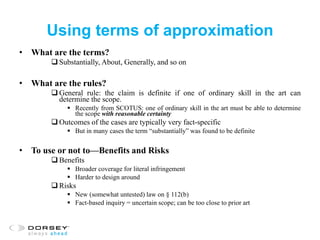
Using terms of approximation
• What are the terms?
 Substantially, About, Generally, and so on
• What are the rules?
 General rule: the claim is definite if one of ordinary skill in the art can
determine the scope.
 Recently from SCOTUS: one of ordinary skill in the art must be able to determine
the scope with reasonable certainty
 Outcomes of the cases are typically very fact-specific
 But in many cases the term “substantially” was found to be definite
• To use or not to—Benefits and Risks
 Benefits
 Broader coverage for literal infringement
 Harder to design around
 Risks
 New (somewhat untested) law on § 112(b)
 Fact-based inquiry = uncertain scope; can be too close to prior art
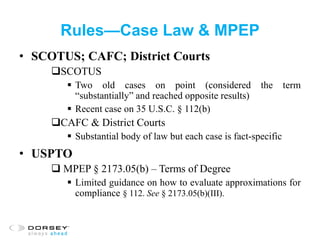
Rules—Case Law & MPEP
• SCOTUS; CAFC; District Courts
SCOTUS
 Two old cases on point (considered the term
“substantially” and reached opposite results)
 Recent case on 35 U.S.C. § 112(b)
CAFC & District Courts
 Substantial body of law but each case is fact-specific
• USPTO
 MPEP § 2173.05(b) – Terms of Degree
 Limited guidance on how to evaluate approximations for
compliance § 112. See § 2173.05(b)(III).
MPEP
• MPEP §2173.05(b)(III).
 Has guidance essentially for only four terms but notes
that “one must consider the term as it is used in the
specification and claims of the application.”
 About: two examples—one of where the term was found
to be definite and another indefinite
 Essentially: one example where the term was found
definite
 Similar: two example where the term was found to be
indefinite
 Substantially: two example where the term was found to
be definite
Case Law
• Fact-specific inquiry into whether one of ordinary
skill in the art can determine the scope of the
claim
 When analyzing the approximation terms, courts
follow general rules of claim construction
1. Intrinsic evidence:
a. Is the term defined in the specification? (the same is
noted in MPEP)
b. Does prosecution history help explain the meaning of
the term?
2. Extrinsic evidence:
a. Dictionaries, etc.
b. Expert testimony/affidavits on the meaning of the term
Case Law on Commonly Used Terms
• Commonly used terms:
 Substantially; About; Generally
• Even with fact-specific analysis, the term
“substantially” has proven pretty resilient to
indefiniteness challenges.
 As Judge Hand once noted, the term “substantially” “must
always be implied in every claim, even when not introduced, and
adds nothing when it is.” Musher Foundation v. Alba Trading
Co., Inc., (2d Cir. 1945) (L. Hand., J.).
 While, Judge Hand’s position has not be adopted as the rule, the
Federal Circuit has repeatedly stated that the terms “about” and
“substantially” are “commonly used in patent claims . . . .” See,
e.g., Ecolab, Inc. v. Envirochem, Inc., 264 F.3d 1358, 1367 (Fed.
Cir. 2001).
Case Law on “substantially”
• Courts construe the terms using standard tools of
claim construction
 For example, using qualified terms interchangeably
with unqualified may result in having the same
definition for both.
 E.g., Applicant used substantially vertical interchangeably with
“vertical” both in the specification and during prosecution; the
court ruled that the two terms are essentially the same. Amhil Ent.
v. Wawa, Inc., 81 F.3d 1554 (Fed. Cir. 1996).
 Interpretation will depend on context: “Substantially”
can be interpreted as an approximation of precision
for another term or as a magnitude.
Case Law on “substantially” (cont’d)
• Essentially all of recent cases that considered the
term “substantially” found it to be definite
• Lack of special definition in the specification is not
fatal
 CAFC has also noted that “’substantially equal’ is a
term of degree, and that its acceptability depends on
whether one of ordinary skill in the art would
understand what is claimed in light of the
specification, even if experimentation may be
needed.” Andrew Corp. v. Gabriel Elec., Inc., 847
F.2d 819, 821 (Fed. Cir. 1988).
Case Law on “substantially” (cont’d)
• No numerical limitation imported into claim
language
 E.g., courts will consider possible deviations from
absolute so that claimed device/method is still useful
and/or novel/nonobvious
• Courts often look at the function of the claimed
device to determine the scope of the term
“substantially” (so the function is as described in the
claim(s) and specification)
“Substantially” – Specific Decisions
• In each example, the specification did not provide
a special definition of the term “substantially”
 substantially uniform
 no functional limitation imported into the claim
 substantially constant wall thickness
 wall thickness such that the claimed device still works
 substantially uniform magnetic field
 Degree of non-uniformity such that device is still useful
 substantially equal to
 Degree of non-uniformity as would be understood by one of ordinary
skill in the art, even if experimentations may be needed. The court
also noted that prior art used the same terms.
Case Law on “about”
• Again, typical fact-specific claim construction
• Not as good a bet as “substantially”
 E.g., indefinite when claimed purified protein of “at least
about” a numerically specific activity. Amgen, Inc. v.
Chugai Pharm. Co., Ltd. (Fed. Cir. 2003).
 There was close prior art
• But not always fatal
 The Federal Circuit has noted that the term “’about’ does
not have a universal meaning depends upon the
technological facts of the particular case.” Ortho-McNeil
Pharm., Inc. v. Caraco Pharm. Labs., Ltd. (Fed. Cir. 2007).
 Consider effects of varying parameter (similar to analysis of
“substantially”)
 Extrinsic evidence of meaning and usage may be helpful
 The court construed the term to define a range based on expert
testimony
Case Law on “generally”
• And again, similar to “substantially” and “about”
the Courts engage in typical fact-specific claim
construction
• Can be interpreted as an approximation
 E.g., “generally parallel” ≠ parallel (unless
specification and/or prosecution history suggests
otherwise)
• Also can be interpreted as magnitude or amount
 E.g., “generally convex” = majority of points
New Rule: “reasonable certainty”
• SCOTUS says that a claim is invalid if, when “read in light
of the specification delineating the patent and the
prosecution history, [it] fail[s] to inform, with reasonable
certainty, those skilled in the art about the scope of the
invention.” Nautilus, Inc. v. Biosig Inst., Inc. (2014).
New Rule: “reasonable certainty”
• Two cases from Federal Circuit applying “reasonable
certainty standard” to terms of degree
– Interval Licensing v. AOL, Inc. and Biosig v. Nautilus (on remand)
• Language using terms of degree still definite (court cites cases on
“substantially”)
• When analyzing definiteness, the Court looked at function of the
claimed method (in Interval Licensing) and device (in Nautilus) to
determine if definite—what’s required to make the claimed
method/device work?
• Results
– Term “unobstructive manner” is purely subjective terms—can
mean different things to deferent user. Since no guidance in the
specification, it’s indefinite. Interval Licensing.
– Term “spaced relationship” is OK—based on the function of the
device one of ordinary skill can figure out the scope.
Upside of approximating
• Sometimes can get broader coverage
But if use qualified terms interchangeably with
unqualified—probably no broader coverage
• Can get range-like coverage without claiming
ranges
 No numerical limitation imported into claim language
 E.g., courts will consider possible deviations from
absolute so that claimed device/method is still useful
and/or novel/nonobvious
 Sometimes no practical way to get suitable coverage
without qualifying
Upside of approximating (cont’d)
• Maybe greater deterring affect
 Cautious competitors reviewing claims may take a
broader view of the claims to avoid potential
infringement
Weighing the risks
• Potentially more uncertainty during claim
construction
 Potentially invalid
 Maybe safer when claim “substantially”
 Recent case law from SCOTUS (Nautilus) may add to uncertainty
• Potentially more challenging prosecution
Options
• Backup claims (e.g., ranges, specific quantities)
• Examples in the specification to provide context
• Do not use the qualified and unqualified terms
interchangeably
• Provide examples of suitable variation from absolute values
• Describe function of the device/method while using the
terms of approximation
Questions?

Using terms of approximation

  • 1.
  • 2.
    Using terms ofapproximation • What are the terms?  Substantially, About, Generally, and so on • What are the rules?  General rule: the claim is definite if one of ordinary skill in the art can determine the scope.  Recently from SCOTUS: one of ordinary skill in the art must be able to determine the scope with reasonable certainty  Outcomes of the cases are typically very fact-specific  But in many cases the term “substantially” was found to be definite • To use or not to—Benefits and Risks  Benefits  Broader coverage for literal infringement  Harder to design around  Risks  New (somewhat untested) law on § 112(b)  Fact-based inquiry = uncertain scope; can be too close to prior art
  • 3.
    Rules—Case Law &MPEP • SCOTUS; CAFC; District Courts SCOTUS  Two old cases on point (considered the term “substantially” and reached opposite results)  Recent case on 35 U.S.C. § 112(b) CAFC & District Courts  Substantial body of law but each case is fact-specific • USPTO  MPEP § 2173.05(b) – Terms of Degree  Limited guidance on how to evaluate approximations for compliance § 112. See § 2173.05(b)(III).
  • 4.
    MPEP • MPEP §2173.05(b)(III). Has guidance essentially for only four terms but notes that “one must consider the term as it is used in the specification and claims of the application.”  About: two examples—one of where the term was found to be definite and another indefinite  Essentially: one example where the term was found definite  Similar: two example where the term was found to be indefinite  Substantially: two example where the term was found to be definite
  • 5.
    Case Law • Fact-specificinquiry into whether one of ordinary skill in the art can determine the scope of the claim  When analyzing the approximation terms, courts follow general rules of claim construction 1. Intrinsic evidence: a. Is the term defined in the specification? (the same is noted in MPEP) b. Does prosecution history help explain the meaning of the term? 2. Extrinsic evidence: a. Dictionaries, etc. b. Expert testimony/affidavits on the meaning of the term
  • 6.
    Case Law onCommonly Used Terms • Commonly used terms:  Substantially; About; Generally • Even with fact-specific analysis, the term “substantially” has proven pretty resilient to indefiniteness challenges.  As Judge Hand once noted, the term “substantially” “must always be implied in every claim, even when not introduced, and adds nothing when it is.” Musher Foundation v. Alba Trading Co., Inc., (2d Cir. 1945) (L. Hand., J.).  While, Judge Hand’s position has not be adopted as the rule, the Federal Circuit has repeatedly stated that the terms “about” and “substantially” are “commonly used in patent claims . . . .” See, e.g., Ecolab, Inc. v. Envirochem, Inc., 264 F.3d 1358, 1367 (Fed. Cir. 2001).
  • 7.
    Case Law on“substantially” • Courts construe the terms using standard tools of claim construction  For example, using qualified terms interchangeably with unqualified may result in having the same definition for both.  E.g., Applicant used substantially vertical interchangeably with “vertical” both in the specification and during prosecution; the court ruled that the two terms are essentially the same. Amhil Ent. v. Wawa, Inc., 81 F.3d 1554 (Fed. Cir. 1996).  Interpretation will depend on context: “Substantially” can be interpreted as an approximation of precision for another term or as a magnitude.
  • 8.
    Case Law on“substantially” (cont’d) • Essentially all of recent cases that considered the term “substantially” found it to be definite • Lack of special definition in the specification is not fatal  CAFC has also noted that “’substantially equal’ is a term of degree, and that its acceptability depends on whether one of ordinary skill in the art would understand what is claimed in light of the specification, even if experimentation may be needed.” Andrew Corp. v. Gabriel Elec., Inc., 847 F.2d 819, 821 (Fed. Cir. 1988).
  • 9.
    Case Law on“substantially” (cont’d) • No numerical limitation imported into claim language  E.g., courts will consider possible deviations from absolute so that claimed device/method is still useful and/or novel/nonobvious • Courts often look at the function of the claimed device to determine the scope of the term “substantially” (so the function is as described in the claim(s) and specification)
  • 10.
    “Substantially” – SpecificDecisions • In each example, the specification did not provide a special definition of the term “substantially”  substantially uniform  no functional limitation imported into the claim  substantially constant wall thickness  wall thickness such that the claimed device still works  substantially uniform magnetic field  Degree of non-uniformity such that device is still useful  substantially equal to  Degree of non-uniformity as would be understood by one of ordinary skill in the art, even if experimentations may be needed. The court also noted that prior art used the same terms.
  • 11.
    Case Law on“about” • Again, typical fact-specific claim construction • Not as good a bet as “substantially”  E.g., indefinite when claimed purified protein of “at least about” a numerically specific activity. Amgen, Inc. v. Chugai Pharm. Co., Ltd. (Fed. Cir. 2003).  There was close prior art • But not always fatal  The Federal Circuit has noted that the term “’about’ does not have a universal meaning depends upon the technological facts of the particular case.” Ortho-McNeil Pharm., Inc. v. Caraco Pharm. Labs., Ltd. (Fed. Cir. 2007).  Consider effects of varying parameter (similar to analysis of “substantially”)  Extrinsic evidence of meaning and usage may be helpful  The court construed the term to define a range based on expert testimony
  • 12.
    Case Law on“generally” • And again, similar to “substantially” and “about” the Courts engage in typical fact-specific claim construction • Can be interpreted as an approximation  E.g., “generally parallel” ≠ parallel (unless specification and/or prosecution history suggests otherwise) • Also can be interpreted as magnitude or amount  E.g., “generally convex” = majority of points
  • 13.
    New Rule: “reasonablecertainty” • SCOTUS says that a claim is invalid if, when “read in light of the specification delineating the patent and the prosecution history, [it] fail[s] to inform, with reasonable certainty, those skilled in the art about the scope of the invention.” Nautilus, Inc. v. Biosig Inst., Inc. (2014).
  • 14.
    New Rule: “reasonablecertainty” • Two cases from Federal Circuit applying “reasonable certainty standard” to terms of degree – Interval Licensing v. AOL, Inc. and Biosig v. Nautilus (on remand) • Language using terms of degree still definite (court cites cases on “substantially”) • When analyzing definiteness, the Court looked at function of the claimed method (in Interval Licensing) and device (in Nautilus) to determine if definite—what’s required to make the claimed method/device work? • Results – Term “unobstructive manner” is purely subjective terms—can mean different things to deferent user. Since no guidance in the specification, it’s indefinite. Interval Licensing. – Term “spaced relationship” is OK—based on the function of the device one of ordinary skill can figure out the scope.
  • 15.
    Upside of approximating •Sometimes can get broader coverage But if use qualified terms interchangeably with unqualified—probably no broader coverage • Can get range-like coverage without claiming ranges  No numerical limitation imported into claim language  E.g., courts will consider possible deviations from absolute so that claimed device/method is still useful and/or novel/nonobvious  Sometimes no practical way to get suitable coverage without qualifying
  • 16.
    Upside of approximating(cont’d) • Maybe greater deterring affect  Cautious competitors reviewing claims may take a broader view of the claims to avoid potential infringement
  • 17.
    Weighing the risks •Potentially more uncertainty during claim construction  Potentially invalid  Maybe safer when claim “substantially”  Recent case law from SCOTUS (Nautilus) may add to uncertainty • Potentially more challenging prosecution
  • 18.
    Options • Backup claims(e.g., ranges, specific quantities) • Examples in the specification to provide context • Do not use the qualified and unqualified terms interchangeably • Provide examples of suitable variation from absolute values • Describe function of the device/method while using the terms of approximation
  • 19.