Basic
Using Spark DataFrame
For SQL
charsyam@naver.com
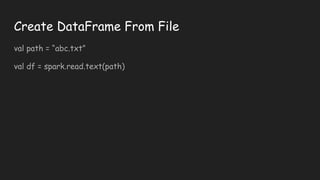
Create DataFrame From File
val path = “abc.txt”
val df = spark.read.text(path)
Create DataFrame From Kafka
val rdd = KafkaUtils.createRDD[String, String](...)
val logsDF = rdd.map { _.value }.toDF
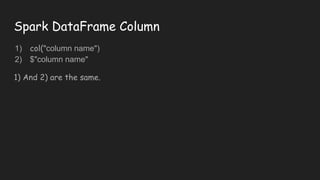
Spark DataFrame Column
1) col("column name")
2) $"column name"
1) And 2) are the same.
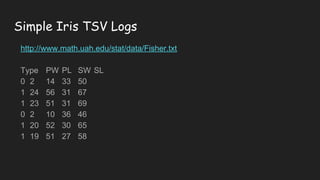
Simple Iris TSV Logs
http://www.math.uah.edu/stat/data/Fisher.txt
Type PW PL SW SL
0 2 14 33 50
1 24 56 31 67
1 23 51 31 69
0 2 10 36 46
1 20 52 30 65
1 19 51 27 58
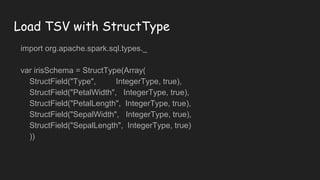
Load TSV with StructType
import org.apache.spark.sql.types._
var irisSchema = StructType(Array(
StructField("Type", IntegerType, true),
StructField("PetalWidth", IntegerType, true),
StructField("PetalLength", IntegerType, true),
StructField("SepalWidth", IntegerType, true),
StructField("SepalLength", IntegerType, true)
))
Load TSV with Encoder #1
import org.apache.spark.sql.Encoders
case class IrisSchema(Type: Int, PetalWidth: Int, PetalLength: Int,
SepalWidth: Int, SepalLength: Int)
var irisSchema = Encoders.product[IrisSchema].schema
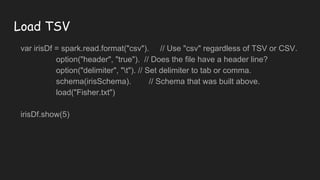
Load TSV
var irisDf = spark.read.format("csv"). // Use "csv" regardless of TSV or CSV.
option("header", "true"). // Does the file have a header line?
option("delimiter", "t"). // Set delimiter to tab or comma.
schema(irisSchema). // Schema that was built above.
load("Fisher.txt")
irisDf.show(5)
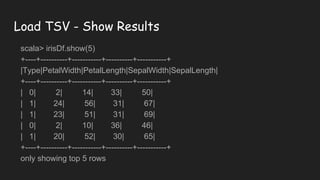
Load TSV - Show Results
scala> irisDf.show(5)
+----+----------+-----------+----------+-----------+
|Type|PetalWidth|PetalLength|SepalWidth|SepalLength|
+----+----------+-----------+----------+-----------+
| 0| 2| 14| 33| 50|
| 1| 24| 56| 31| 67|
| 1| 23| 51| 31| 69|
| 0| 2| 10| 36| 46|
| 1| 20| 52| 30| 65|
+----+----------+-----------+----------+-----------+
only showing top 5 rows
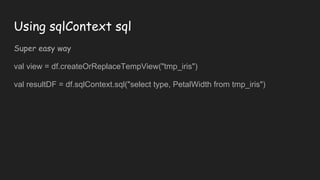
Using sqlContext sql
Super easy way
val view = df.createOrReplaceTempView("tmp_iris")
val resultDF = df.sqlContext.sql("select type, PetalWidth from tmp_iris")
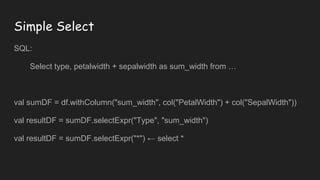
Simple Select
SQL:
Select type, petalwidth + sepalwidth as sum_width from …
val sumDF = df.withColumn("sum_width", col("PetalWidth") + col("SepalWidth"))
val resultDF = sumDF.selectExpr("Type", "sum_width")
val resultDF = sumDF.selectExpr("*") ← select *
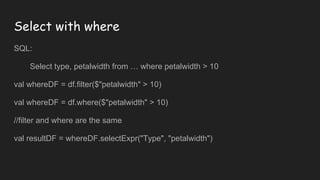
Select with where
SQL:
Select type, petalwidth from … where petalwidth > 10
val whereDF = df.filter($"petalwidth" > 10)
val whereDF = df.where($"petalwidth" > 10)
//filter and where are the same
val resultDF = whereDF.selectExpr("Type", "petalwidth")
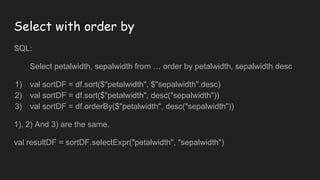
Select with order by
SQL:
Select petalwidth, sepalwidth from … order by petalwidth, sepalwidth desc
1) val sortDF = df.sort($"petalwidth", $"sepalwidth".desc)
2) val sortDF = df.sort($"petalwidth", desc("sepalwidth"))
3) val sortDF = df.orderBy($"petalwidth", desc("sepalwidth"))
1), 2) And 3) are the same.
val resultDF = sortDF.selectExpr("petalwidth", "sepalwidth")
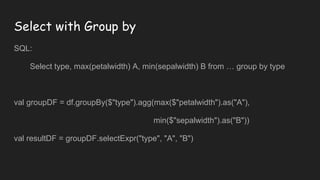
Select with Group by
SQL:
Select type, max(petalwidth) A, min(sepalwidth) B from … group by type
val groupDF = df.groupBy($"type").agg(max($"petalwidth").as("A"),
min($"sepalwidth").as("B"))
val resultDF = groupDF.selectExpr("type", "A", "B")
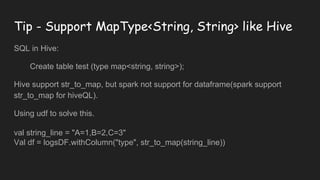
Tip - Support MapType<String, String> like Hive
SQL in Hive:
Create table test (type map<string, string>);
Hive support str_to_map, but spark not support for dataframe(spark support
str_to_map for hiveQL).
Using udf to solve this.
val string_line = "A=1,B=2,C=3"
Val df = logsDF.withColumn("type", str_to_map(string_line))
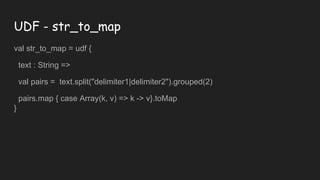
UDF - str_to_map
val str_to_map = udf {
text : String =>
val pairs = text.split("delimiter1|delimiter2").grouped(2)
pairs.map { case Array(k, v) => k -> v}.toMap
}
Thank you.

Using spark data frame for sql

  • 1.
    Basic Using Spark DataFrame ForSQL charsyam@naver.com
  • 2.
    Create DataFrame FromFile val path = “abc.txt” val df = spark.read.text(path)
  • 3.
    Create DataFrame FromKafka val rdd = KafkaUtils.createRDD[String, String](...) val logsDF = rdd.map { _.value }.toDF
  • 4.
    Spark DataFrame Column 1)col("column name") 2) $"column name" 1) And 2) are the same.
  • 5.
    Simple Iris TSVLogs http://www.math.uah.edu/stat/data/Fisher.txt Type PW PL SW SL 0 2 14 33 50 1 24 56 31 67 1 23 51 31 69 0 2 10 36 46 1 20 52 30 65 1 19 51 27 58
  • 6.
    Load TSV withStructType import org.apache.spark.sql.types._ var irisSchema = StructType(Array( StructField("Type", IntegerType, true), StructField("PetalWidth", IntegerType, true), StructField("PetalLength", IntegerType, true), StructField("SepalWidth", IntegerType, true), StructField("SepalLength", IntegerType, true) ))
  • 7.
    Load TSV withEncoder #1 import org.apache.spark.sql.Encoders case class IrisSchema(Type: Int, PetalWidth: Int, PetalLength: Int, SepalWidth: Int, SepalLength: Int) var irisSchema = Encoders.product[IrisSchema].schema
  • 8.
    Load TSV var irisDf= spark.read.format("csv"). // Use "csv" regardless of TSV or CSV. option("header", "true"). // Does the file have a header line? option("delimiter", "t"). // Set delimiter to tab or comma. schema(irisSchema). // Schema that was built above. load("Fisher.txt") irisDf.show(5)
  • 9.
    Load TSV -Show Results scala> irisDf.show(5) +----+----------+-----------+----------+-----------+ |Type|PetalWidth|PetalLength|SepalWidth|SepalLength| +----+----------+-----------+----------+-----------+ | 0| 2| 14| 33| 50| | 1| 24| 56| 31| 67| | 1| 23| 51| 31| 69| | 0| 2| 10| 36| 46| | 1| 20| 52| 30| 65| +----+----------+-----------+----------+-----------+ only showing top 5 rows
  • 10.
    Using sqlContext sql Supereasy way val view = df.createOrReplaceTempView("tmp_iris") val resultDF = df.sqlContext.sql("select type, PetalWidth from tmp_iris")
  • 11.
    Simple Select SQL: Select type,petalwidth + sepalwidth as sum_width from … val sumDF = df.withColumn("sum_width", col("PetalWidth") + col("SepalWidth")) val resultDF = sumDF.selectExpr("Type", "sum_width") val resultDF = sumDF.selectExpr("*") ← select *
  • 12.
    Select with where SQL: Selecttype, petalwidth from … where petalwidth > 10 val whereDF = df.filter($"petalwidth" > 10) val whereDF = df.where($"petalwidth" > 10) //filter and where are the same val resultDF = whereDF.selectExpr("Type", "petalwidth")
  • 13.
    Select with orderby SQL: Select petalwidth, sepalwidth from … order by petalwidth, sepalwidth desc 1) val sortDF = df.sort($"petalwidth", $"sepalwidth".desc) 2) val sortDF = df.sort($"petalwidth", desc("sepalwidth")) 3) val sortDF = df.orderBy($"petalwidth", desc("sepalwidth")) 1), 2) And 3) are the same. val resultDF = sortDF.selectExpr("petalwidth", "sepalwidth")
  • 14.
    Select with Groupby SQL: Select type, max(petalwidth) A, min(sepalwidth) B from … group by type val groupDF = df.groupBy($"type").agg(max($"petalwidth").as("A"), min($"sepalwidth").as("B")) val resultDF = groupDF.selectExpr("type", "A", "B")
  • 15.
    Tip - SupportMapType<String, String> like Hive SQL in Hive: Create table test (type map<string, string>); Hive support str_to_map, but spark not support for dataframe(spark support str_to_map for hiveQL). Using udf to solve this. val string_line = "A=1,B=2,C=3" Val df = logsDF.withColumn("type", str_to_map(string_line))
  • 16.
    UDF - str_to_map valstr_to_map = udf { text : String => val pairs = text.split("delimiter1|delimiter2").grouped(2) pairs.map { case Array(k, v) => k -> v}.toMap }
  • 17.